



Abstract
Background:
Since the Physician Payments Sunshine Act in 2010, a substantial body of work has explored the supplemental income received by physicians to understand trends in industry payments and investigate sources of bias. To date, no study has examined how various fellowship characteristics impact industry earning levels at foot and ankle orthopaedic surgery fellowships. The purpose of this study is to examine the various fellowship and faculty-specific variables in correlation with industry earnings in foot and ankle orthopaedic surgery fellowships.
Methods:
This study is a retrospective analysis of foot and ankle orthopaedic surgery fellowships and respective faculty along with various fellowship characteristics in correlation to industry lifetime earning levels as of March 2023. Industry total lifetime earnings represent income directly paid to physicians, is not part of the physician's salary, and does not include any research grants or funding. Lifetime earnings represent all years recorded on the Open Payments Database website (2015-2021).
Results:
There are 165 faculty physicians and 48 programs with complete data out of all foot and ankle orthopaedic surgery fellowship programs in the United States. The mean fellowship H-Index per fellowship was 48.94 ± 38.92, and the mean fellowship lifetime earning was $1 551 791.66 ± $4 136 091.64. There was no significant association between fellowship lifetime earnings and Newsweek ranking of fellowship-affiliated hospitals (P = .906), Doximity ranking of fellowship-affiliated residencies (P = .703), and region of the United States (P = .126). There was a statistically significant increase in total lifetime earnings in programs with 4 fellows as compared to 1 fellow (P = .035).
Conclusion:
There was no statistically significant correlation between a variety of foot and ankle fellowship-specific factors and lifetime industry earnings, aside from increased earnings in programs having 4 fellows. Prestige factors, such as Doximity and Ranked Hospital Newsweek List rank, as well as region of the United States is not associated with industry earnings.
Level of Evidence:
Level III, retrospective cohort study.
Introduction
With the passing of the Affordable Care Act (ACA) in the Unites States, the Physician Payments Sunshine Act (PPSA) was established in 2010 as part of the ACA. 16 The PPSA authorized and helped support the creation of a publicly accessible electronic record of physician financial payments from medically related firms termed the “Open Payments” (OP) public database. 16 Implant and pharmaceutical manufacturers are required to record all payments greater than $10 made to physicians, categorizing these monies as either “general payments,” “ownership interests,” or “research payments.” 20 The cumulative payments to orthopaedic surgeons are substantial. Royalties and license fees (69%, $74.4 million), consulting fees (13%, $13.9 million), and nonconsulting services (5%, $5.8 million) represent large shares of the yearly total payments made to orthopaedic surgeons in the United States. 22
The OP Database has been the subject of numerous investigations across various physician subspecialities in an effort to better understand demographic trends in industry payments, elucidate potential sources of bias, and document improper disclosing of financial relationships.1,3,4,10,11,13,15,19,21,24 -26 Foot and ankle surgery involves the use of many implantable devices and orthobiologic products. Thus, it follows that there would be substantial industry involvement in the field. The top 5% of earners with regard to industry payments within foot and ankle surgery received an average of $158 349 in 2018, and this number has been shown to grow substantially year to year. As a whole, 802 orthopaedic foot and ankle surgeons received nearly $39 million from industry through 29 442 transactions during a 3-year period. 21
Growing interest in pursuit of orthopaedic fellowship matriculation after completion of residency training has occurred throughout the United States. 12 Thus, a body of literature has sought to evaluate which factors make certain fellowship programs more sought after than others. 27 Applicants to orthopaedic foot and ankle fellowships report operative experience, current faculty, and program reputation as the major factors that influence their choice of fellowship program rank. 18 Fellowship training has the potential to heavily influence future foot and ankle surgeons, 23 and a better understanding of the relationship between industry involvement and program reputation, academic output, region of practice, and total number of faculty and fellows at a particular program is valuable. To this end, no study has sought to explore the relationship between various fellowship characteristics and industry involvement in the form of nonresearch payments to the faculty at that fellowship. We hypothesized that higher H-index, North East and West Coast region, higher number of total faculty members, and higher rank of the affiliated residency program on the Doximity rank list would correlate with higher total industry monies awarded to the faculty at that fellowship given a perceived higher prestige, which may impact desirability for involvement from industry partners.
Methodology
Study Search Information and Setup
The current study used the Centers for Medicare and Medicaid Services (CMS) website (https://openpaymentsdata.cms.gov/search) to extract industry payment information for physician lifetime earnings (dollars) and payments (number of payments), the Scopus website to determine each individual faculty physician’s H-index as a measure of academic productivity (https://openpaymentsdata.cms.gov/search), and the American Orthopaedic Foot & Ankle Society (AOFAS) website for specific fellowship data (https://www.aofas.org/education/fellowship-match-program/orthopaedic-foot-and-ankle-fellowship-programs). Each individual fellowship site was then searched for relevant faculty and fellowship information, including all fellowships on the AOFAS website. We also used the following resources for data extraction: Wikipedia webpage for associated Master of Business Administration (MBA) programs, Newsweek for hospital rankings (https://www.newsweek.com/rankings/worlds-best-hospitals-2023/united-states), and the Doximity website (https://www.doximity.com/residency/match-data-step-comlex-scores?specialtyKey=bd2342386960426094751fa18f58f092orthopaedicsurgery&sortByKey=reputation&trainingEnvironmentKey=&intendedFellowshipKey=) sorted by reputation for residency ranking.
Data Extraction
Data extraction and synthesis was conducted by a single author throughout the course of the study in March 2023. Data collected in this study included total lifetime earnings per fellowship (dollars), total H-index per fellowship, average total lifetime earnings per faculty physician per fellowship (dollars), combined total payments per fellowship (dollars), type of program (university, mixed, private), Doximity rank of associated orthopaedic residency programs, region (Northeast, Midwest, Southeast, Southwest, and West Coast), Newsweek rank of affiliated hospital, number of fellows, and presence of MBA program affiliated with fellowship (yes or no). Doximity ranking of orthopaedic residency programs were paired with the foot and ankle fellowship by direct affiliation by shared name (eg, Duke University Orthopedic Surgery Residency and Duke University Foot and Ankle Orthopedic Surgery Fellowship).
Statistical Analysis
Statistical analysis for this study was completed using SPSS, version 29.0 (IBM Corp, Armonk, NY) as the statistical software. Multiple measures of central tendency (mean, SD, and median) were used to describe the data for improved clarity. The Kolmogorov-Smirnov test or the Shapiro-Wilks test was used to test the normality of the data distribution to determine appropriate statistical analysis. Comparisons between 2 groups were done using the t test with 2-sided P values for parametric data, whereas comparisons between 2 groups were done using the Mann-Whitney U test for nonparametric data. Comparisons between 3 or more groups were done using analysis of variance for parametric data and Kruskal-Wallis test for nonparametric data. Post hoc testing was then completed using the Bonferroni correction. Significance values were set at .05 for the current study. Frequency counts, summative data, and descriptive data were used for demographics.
Results
Initial Search Results
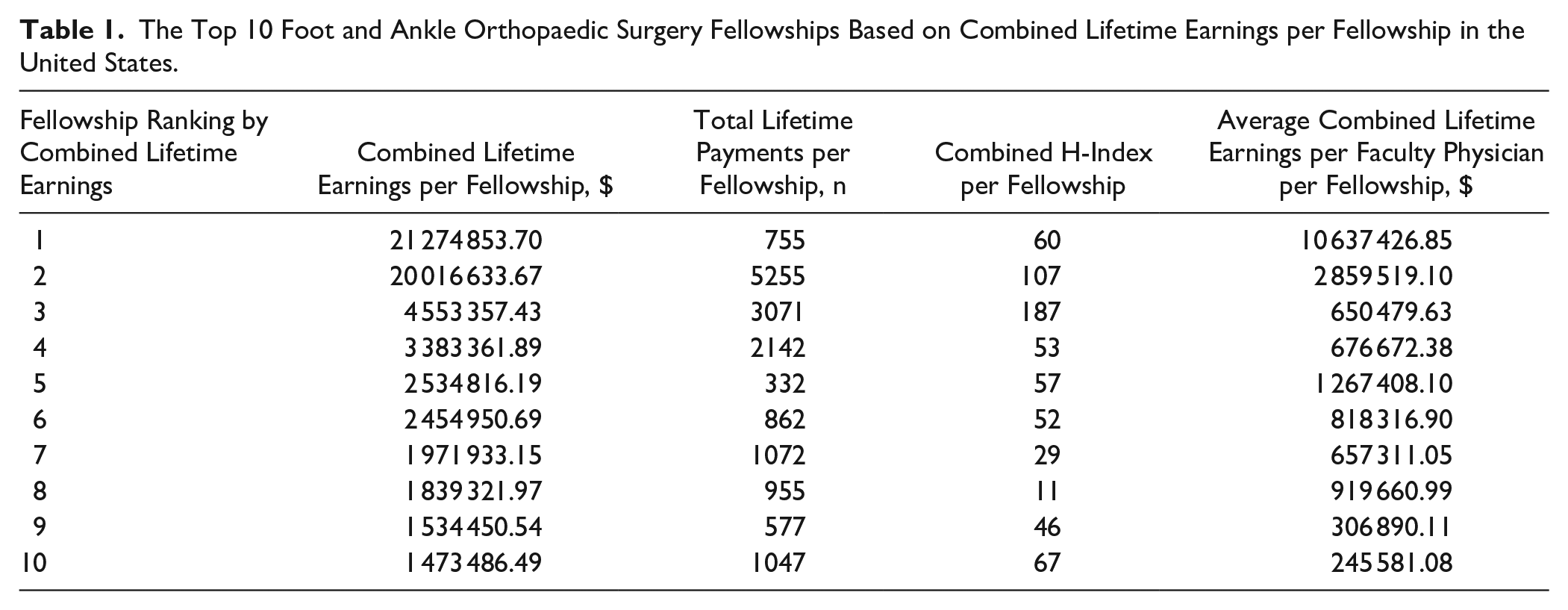
No a priori power analysis was performed for this study, given the choice of attempting to include all foot and ankle fellowship programs across the United States. A grand total of 48 foot and ankle orthopaedic surgery fellowships in the United States with a combined total of 172 physicians as fellowship faculty at those foot and ankle fellowships were assessed in the current study. In terms of missing data, 7 physicians were missing data on the CMS website (total lifetime earnings and payments) and 4 physicians were missing an H-index on the Scopus website. Only physicians with compete CMS money data and H-index on Scopus (n = 165 physicians, 95.9%) were included in data analysis for aggregate fellowship data for the current study. Mean combined physician H-index per fellowship (n = 48 foot and ankle fellowships) was 48.94 ± 38.92 (range: 9.00-187.00; median: 35.50). Mean combined physician lifetime earnings, defined as an aggregate of all years listed on the CMS website (2015-2021), was $1 551 791.66 ± $4 136 091.64 (range: $8668.93-$21 274 853.70; median: $359 425.24). Mean combined physician number of payments per fellowship was 664.27 ± 867.84 (range: 41.00-5255.00; median: 403.00). Average combined physician lifetime earnings per faculty member per fellowship was $502 585.76 ± $1 574 736.73 (range: $3349.90-$10 637 426.85; median: $95 146.67). See Table 1 for information on the top 10 foot and ankle orthopaedic surgery fellowships based on combined lifetime earnings per fellowship in the United States.
The Top 10 Foot and Ankle Orthopaedic Surgery Fellowships Based on Combined Lifetime Earnings per Fellowship in the United States.
Fellowship Characteristics by Region
Total lifetime earnings per fellowship has no significant association with region of the fellowship program in the United States (Kruskal-Wallis H = 7.196, P = .126). Northeast region (n = 16 fellowships) mean was $470 345.38 ± $473 267.73 (median: $387 357.97) total lifetime earnings per fellowship, Midwest region (n = 9 fellowships) mean was $586 493.72 ± $811 566.43 (median: $230 313.03) total lifetime earnings per fellowship, Southeast region (n = 10 fellowships) mean was $4 863 983.38 ± $8 429 684.35 (median: $485 512.48) total lifetime earnings per fellowship, Southwest region (n = 9 fellowships) mean was $523 812.45 ± 691 186.44 (median: $257 580.01) total lifetime earnings per fellowship, and West Coast region (n = 4 fellowships) mean was $2 081 971.10 ± $1 240 185.73 (median: $2 253 374.67) total lifetime earnings per fellowship. See Figure 1 for a graph representing average (mean) total lifetime earnings per fellowship by region of the United States. There was no significant association between total H-Index per fellowship and region of the fellowship program in the United States (Kruskal-Wallis H = 8.032, P = .090). See Figure 2 for a graph representing average (mean) H-index per fellowship by region of the United States in the current study. There was also no significant association between average total lifetime earnings per faculty physician per fellowship and region of the fellowship program in the United States (Kruskal-Wallis H = 6.238, P = .182).

Average (mean) total lifetime earnings per fellowship by region in the United States in the current study. Five regions are represented in this study (Northeast, Midwest, Southeast, Southwest, and West Coast).

Average (mean) H-index per fellowship by region of the United States. Regions represented in this study included Northeast, Midwest, Southeast, Southwest, and West Coast.
Fellowship Characteristics by Affiliated Orthopaedic Residency Program
For foot and ankle fellowships with an associated orthopaedic residency program, there was no significant association between total lifetime earnings per fellowship and Doximity ranking of the associated orthopaedic residency program (Top 10, 11-30, 31-70, 71+, and not ranked) (Kruskal-Wallis H = 2.176, P = .703). See Figure 3 for a graph depicting mean total lifetime earnings per fellowship by Doximity ranking of associated orthopaedic residency program. Furthermore, there was no significant association between the presence of orthopaedic fellowship ranking on Doximity (Yes or No) and total lifetime earnings per fellowship (P = .376). Fellowships associated with ranked orthopaedic residency programs (n = 34) had an average combined lifetime earning of $722 822.72 ± $1 034 138.55 (median: $301 815.33). Fellowships not associated with a ranked orthopaedic residency program (n = 14) had an average combined lifetime earnings of $3 565 001.94 ± $7 278 221.87 (median: $513 445.21).
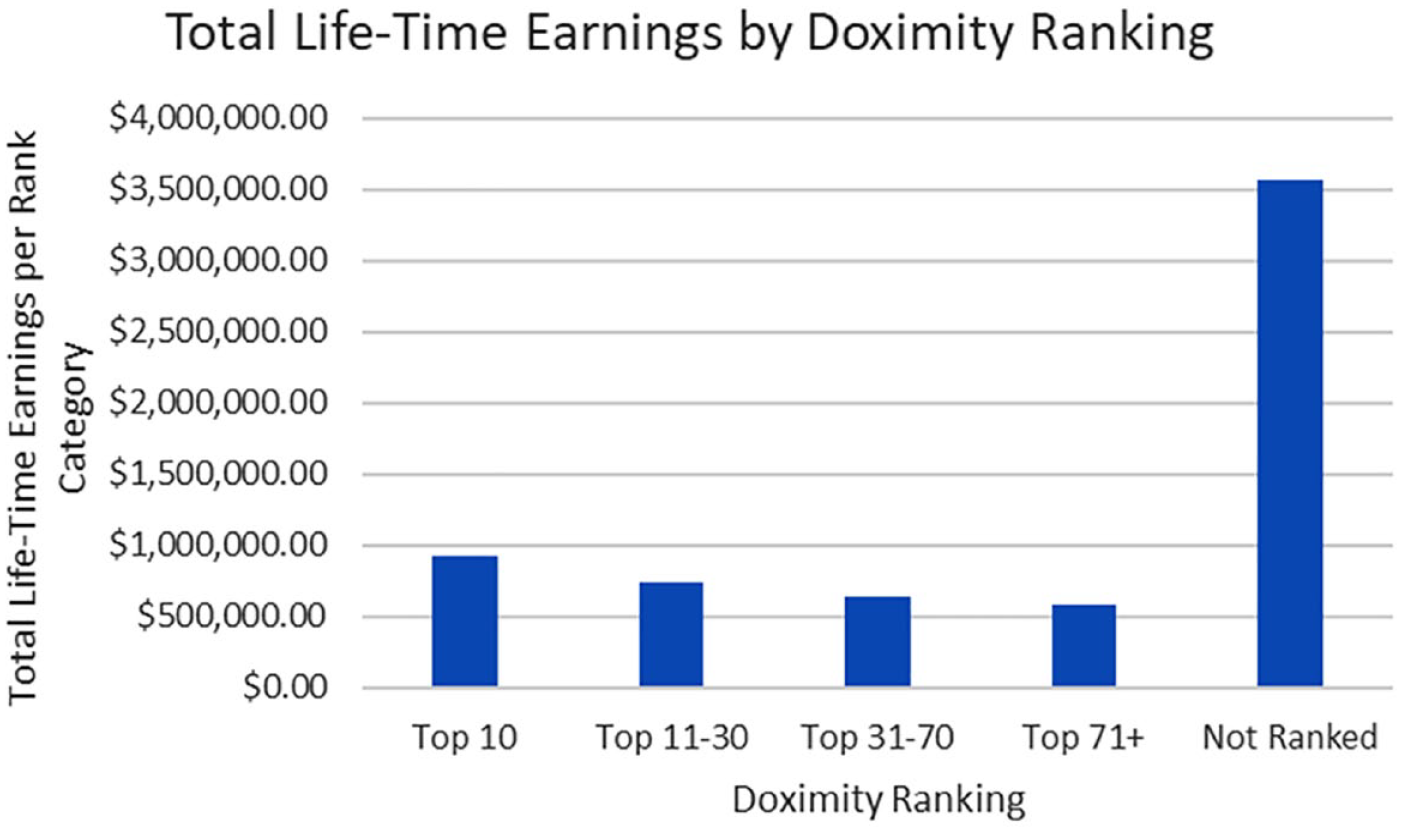
The mean total lifetime earnings (dollars) by Doximity ranking of associated orthopaedic residency program per fellowship. Categories included top 10, top 11-30, top 31-70, top 71+, and not ranked. Not ranked included fellowships not associated with a residency program at all as determined by shared name or not associated with a ranked program.
Fellowship Characteristics and Other Associations
There was no significant association between total lifetime earnings per fellowship and affiliation with hospitals on the Ranked Hospital Newsweek List (Top 10, 11-30, 31-70, 71+, and not ranked ) (Kruskal-Wallis H = 2.522, P = .641). Furthermore, there was no significant association between total lifetime earnings per fellowship and hospitals on the Ranked Hospital Newsweek versus hospitals that were not ranked (P = .681). However, there was a significant association between total lifetime earnings and the number of fellows per fellowship program (1, 2, 3, or 4 fellows) (Kruskal-Wallis H = 8.601, P = .035). After post hoc testing, the only significant relationship was between programs with 1 fellow and programs with 4 fellows (P = .045). Programs with 1 fellow (n = 30 programs) had mean total lifetime earnings of $1 167 199.48 ± $3 852 881.53 (median: $243 946.52) whereas programs with 4 fellows (n = 4 programs) had mean total lifetime earnings of $6 632 441.90 ± $9 084 195.14 (median: $2 927 050.87). There was no significant association between programs closely affiliated with MBA programs and total lifetime earnings per fellowship (P > .99). Finally, there was also no significant association between total lifetime earnings per fellowship and type of fellowship program (university, mixed, or private) (Kruskal-Wallis H = 2.431, P = .297).
Discussion
This study aimed to assess if the grouped total lifetime earnings from industry payments as reported on the OP Database at an orthopaedic foot and ankle fellowship correlates with a variety of factors related to that fellowship. We explored the link between industry payments and geographic location of a fellowship, the ranking of the affiliated institution on the Doximity reputation rankings, the Ranked Hospital Newsweek List rankings, and the average H-index of the partners at the particular fellowship. We also assessed whether industry payments correlated with program affiliation with MBA programs, type of fellowship program (university, mixed, or private), and number of fellows at each program. We found no statistically significant correlation after analysis of variance or Kruskal-Wallis testing with Bonferroni correction for any of the characteristics evaluated in the study, with the exception of higher monies awarded to programs having 4 fellows as compared to 1 fellow, perhaps because of larger program size and presence of a higher number of active faculty. However, we describe several obvious trends in the data that likely would have reached statistical significance with larger samples sizes (our sample is innately limited given the relatively small number of foot and ankle fellowships in the United States).
Perhaps most surprisingly, the average total lifetime earnings at programs not affiliated with orthopaedic residency programs ranked on the Doximity reputation rankings were far higher (>$3.5 million) than those at programs affiliated with programs ranked in the top 10 (<$1.0 million). We had hypothesized that implant manufacturers may be more inclined to work with surgeons at higher-ranking institutions, given a perceived sense of prestige associated with those institutions. Supporting our hypothesis, other work has explored industry involvement at teaching hospitals and found very high dollar values of nonresearch payments made by industry to teaching hospitals. In 2018, 91% of teaching hospitals received industry payments tallying a total of $832 million in that 1 year alone. 2 In this same study, major medical school affiliation and inclusion on the U.S. News & World Report Best Hospitals Honor Roll was associated with higher total number and value of industry payments. 2 Further work could seek to continue to characterize this relationship within foot and ankle and orthopaedics at large.
Despite these data, our findings reveal no association between Doximity reputation rankings and Ranked Hospital Newsweek List rankings on industry payments to the faculty at foot and ankle fellowship programs. This finding can in part be explained by our pairing of foot and ankle fellowship by direct affiliation by shared name (eg, Duke University Orthopedic Surgery Residency Program and Duke University Foot and Ankle Orthopedic Surgery Fellowship). Thus, many reputable foot and ankle fellowship programs with less overt ties to academic institutions were described as “not-ranked” given the lack of a shared name with an orthopaedic residency program. This finding may be of particular import: many of the fellowships that are most linked with industry are private groups without involvement of a larger academic institution. This finding may be unique to orthopaedic surgery or orthopaedic foot and ankle specifically, given other work demonstrating correlation between institutional ranking and industry monies. 2 Causative factors for this observed trend are likely multifactorial, but institutional policies that discourage involvement with industry may partially explain the high number of “nonranked” programs with greater cumulative industry payments. 17 Further work should seek to identify this observed paradox whereby the prestige of the affiliated residency program or teaching hospital fails to correlate with industry involvement across orthopaedic foot and ankle programs.
In addition, we report that total earnings per fellowship has no significant association with region of the fellowship program in the United States. However, we describe a preponderance of industry involvement in the Southeast and West Coast, with these 2 regions earning roughly 7 million combined, whereas the other regions (Northeast, Midwest, and Southwest) tallied together earn slightly over 1 million. This regional concentration of industry involvement within foot and ankle fellowship programs (and specifically within the Southeast, where total earnings are roughly double that of all other regions combined) has hitherto been undescribed to our knowledge. Further research should aim to describe this phenomenon whereby specific regions within the United States appear to be hotbeds of industry involvement within foot and ankle and the impact of this finding on choice of fellowship for matriculants and practice patterns for fellows graduating from programs within a specific region.
We also determined that the average summed H-index of the faculty at the fellowships in a particular region did not correlate with cumulative industry payments to that fellowship. For example, the average summed H-index of the fellowships in the Northeast was higher than the value recorded for the Southeast region, but the total amount of industry monies paid to surgeons in the Southeast region was 10-fold higher than the amount paid to surgeons in the Northeast. This finding directly contradicts other studies that have identified an association between H-index and mean annual industry compensation. 8 This information may be of interest for foot and ankle fellowship applicants. Other authors have noted a strong association between H-index and National Institute of Health (NIH) funding and industry research funding. 5 However, these authors report a poor correlation between nonresearch industry payments and H-index. Chen et al corroborate these finding within sports medicine 6 and total joint arthroplasty, 7 describing an association between H-index and industry research payments with a lack of correlation between H-index and nonresearch payments. These same findings apply to shoulder and elbow surgey. 9 Our data serve to bolster these findings, as we included only nonresearch payments in our analysis, demonstrating a lack of association within foot and ankle surgery between H-index and cumulative nonresearch payments.
Limitations of this study include the potential for variability in ideal stratification choice for the foot and ankle fellowship–specific characteristics we evaluated with respect to industry payments. For example, we stratified by only 5 regions throughout the United States in lieu of more granular geographic locations. Moreover, we only included affiliations between fellowship programs and teaching hospitals if the program shared a common name with the institution. Our choice to do so was purposeful. However, several private practice groups that do not share a common name with a teaching hospital still work very closely with that institution and the trainees at the residency program of interest. This factor may impact the perceived prestige of that fellowship program and may subsequently influence industry involvement. Notably, a major limitation of this study involves the sample size, as there are a limited number of foot and ankle orthopaedic surgery fellowships. Therefore, it is likely that some comparisons were underpowered without an opportunity to improve this sample size. Additionally, we did not break down payment types based on specific purpose of payment. For example, several high-earning surgeons may earn primarily from royalties on implants they have helped design as opposed to consulting fees. Further work should seek to characterize these relationships. As a final limitation, we correlated academic productivity with the summed H-index of the faculty at each foot and ankle fellowship program. H index is associated with age, 14 and older surgeons with very high H-indices may be phasing out of practice and less actively involved with industry, potentially confounding these results. We did not control for age of the surgeons at a particular fellowship in our analysis. Furthermore, as the identity and number of physicians employed at a specific fellowship can change by the year, this study used the current physician staff at each individual specific foot and ankle orthopaedic surgery as of March 2023 when this study was completed.
Conclusion
In conclusion, we failed to identify any statistically significant correlation between H-index and prestige metrics of foot and ankle fellowship programs and cumulative industry monies awarded to the faculty at the specific fellowship in question. However, we did identify a number of trends that likely would have reached statistical significance with a larger sample size, as the number of fellowship programs continues to grow. Industry involvement in orthopaedic foot and ankle fellowship programs is concentrated in the Southeast region, and nonresearch payments do not correlate with the H-index. Moreover, prestige factors such as Doximity reputation rank and the Ranked Hospital Newsweek List rank does not correlate positively with industry payments. Further research should aim to assess the impact of these findings on foot and ankle fellowship selection.
Supplemental Material
sj-pdf-1-fao-10.1177_24730114231212473 – Supplemental material for Evaluating the Correlation Between Various Orthopaedic Foot and Ankle Fellowship Characteristics and Total Industry Payments Through the Open Payments Database
Supplemental material, sj-pdf-1-fao-10.1177_24730114231212473 for Evaluating the Correlation Between Various Orthopaedic Foot and Ankle Fellowship Characteristics and Total Industry Payments Through the Open Payments Database by Albert T. Anastasio, Anthony N. Baumann, Kempland C. Walley and Samuel B. Adams in Foot & Ankle Orthopaedics
Footnotes
Ethical Approval
Institutional Review Board (IRB) approval was not required for the completion of this study.
Declaration of Conflicting Interests
The author(s) declared no potential conflicts of interest with respect to the research, authorship, and/or publication of this article. ICMJE forms for all authors are available online.
Funding
The author(s) received no financial support for the research, authorship, and/or publication of this article.

References
Supplementary Material
Please find the following supplemental material available below.
For Open Access articles published under a Creative Commons License, all supplemental material carries the same license as the article it is associated with.
For non-Open Access articles published, all supplemental material carries a non-exclusive license, and permission requests for re-use of supplemental material or any part of supplemental material shall be sent directly to the copyright owner as specified in the copyright notice associated with the article.
