



Abstract
Background:
The foot and ankle play a critical role in ultramarathon running. Because foot and ankle injuries are the most common location of injury in this group, proper care is essential for prevention. In this sport, small issues can become big problems over such long distances, and understanding the preventative measures taken by ultramarathon runners may provide insight for other athletes looking to avoid similar problems. The purpose of this study was to examine the routine and preventative care of the foot and ankle, as well as injury rates, in this group of high-risk athletes.
Methods:
The Ultrarunners Longitudinal TRAcking (ULTRA) Study is the largest known prospective longitudinal study of ultramarathon runners. In this portion of the study, participants reported general health status, running behavior and performance, as well as foot and ankle care, injuries, stretching frequency, and shoewear.
Results:
A total of 734 ultramarathon runners participated in the study. This group ran a median of 40.2 km per week. Overall, 71.2% of active ultramarathon runners reported a foot or ankle injury in the previous 12 months. The most common injuries reported were plantar fasciitis (36.3%), Achilles tendinitis (24.0%), nonspecific foot pain (14.0%), and stress fractures (13.4%). Sit and reach flexibility test showed that 63.7% of runners could not reach past their toes. There were no significant correlations for sit and reach flexibility or stretching frequency with injury rate.
Conclusion:
The high prevalence of foot and ankle injuries in ultramarathon runners does not appear to be influenced by arch type, foot strike pattern, orthotic usage, stretching behavior, or actual flexibility. A high percentage of the study runners used comfort as a shoe selection method, independent of alignment or foot strike pattern. These findings guide the clinician in shared decision making with runners about routine care, including injury prevention and shoe selection.
Level of Evidence:
Level II, prospective study.
Introduction
Running is the second most popular physical activity in the world. 20 It is estimated that roughly 1.3 million people completed a marathon in 2018. 1 The participation in ultramarathons has increased by 1676% in the last 23 years to roughly 611 098 yearly participants as of 2021. 30 The foot and ankle play a critical role in ultramarathon running, as they support the body's weight and participate in absorption of impact from each step. Although not described as a traditional contact sport, long distance running is associated with substantial cyclic loading that may lead to overuse injuries. In the context of this exposure, it has been shown that up to 79% of runners sustain an injury during any given year, the vast majority of which involve the lower limb (97%).23,25,31 -33 Sports clinicians will frequently encounter long distance runners who have foot and ankle pain and/or questions about shoes, orthotics, alignment, and injury prevention.
Studying outliers in sport, such as ultramarathon runners relative to distance running, can provide insight into a topic that can be applied to a broader population. So, understanding the preventative care practices used by ultramarathon runners can inform all runners on maintaining foot health, as small issues can manifest as larger problems during running such long distances as those associated with ultramarathons. To date, no studies have been published on the topic of foot and ankle care in this unique population. Thus, the purpose of the current study was to examine the injury rates in a large group of ultramarathon runners, and the characteristics that may prevent injuries including running behavior, foot alignment, shoe wear selection, orthotic usage, and stretching behavior.
Methods
Participants in the Ultrarunners Longitudinal TRAcking (ULTRA) Study were enlisted through a variety of methods. Starting in 2011, recruitment efforts involved sending direct electronic mails to ultramarathon runners, posting on multiple ultramarathon-related websites and blogs, placing advertisements in magazines focused on ultramarathon running, and distributing flyers at prominent ultramarathon events across the United States. To be eligible for participation, individuals needed to have previously completed at least 1 ultramarathon spanning 50 km or more. Consent and study participation was performed online, where participants provided self-reported information concerning a broad range of personal attributes and exercise background. Findings from the enrollment and the initial follow-up surveys have been published elsewhere.9,10,13 -15,19
The present data involve the third follow-up survey that was completed during 2022 by prior ULTRA Study enrollees. Within that survey was a series of questions on running habits, health habits, and focused questions on foot and ankle care. This aspect of the study was approval by the Institutional Review Board of Western Michigan Universty Homer Stryker M.D. School of Medicine.
Data are presented as percentages or median and 25th and 75th interquartile (IQR) range because the nominal data were generally skewed on the D’Agostino-Pearson normality test. Group comparisons of continuous data were made with the Mann-Whitney test. Multiple linear regression analysis was used to explore the relationship between variables. Statistical significance was set at P <.05.
Results
Demographics and Running Behavior
A total of 1153 ultramarathon runners were contacted via email for study participation. A total of 734 runners completed the survey, for a participation rate of 64%. The median (IQR) age was 53.9 (45.1-61.9) years. Median body mass index was 23.3. Study participants ran a median (IQR) of 40.2 (19.3-59.5) km/wk over the previous 12 months. A total of 48.8% of participants completed at least 1 ultramarathon within the last 12 months. The median number of hours per week exercising was 8 hours. This included a median (IQR) of 5 (3-6) days per week running, 3 (2-4) days per week cross training, 2 (1-3) days per week on strength work, and 2 (1-3) days per week on focused stretching. Of the 80.9% that was employed, they reported missing a median (IQR) of 0 (0-0) days of work due to exercise-related or any injury in the prior 12 months. They missed a median (IQR) of 3 (0-20) days of training because of an exercise-related injury in the prior 12 months.
Injury
The study participants reported a high foot and ankle injury rate, with 71.2% of those who had completed an ultramarathon in the preceding 12 months reporting a foot or ankle injury in the previous 12 months that resulted in lost training time. This included a total of 450 injuries, a median (IQR) of 1 (0-2) injury per runner (range 0-6). The prevalence of the most common injuries are shown in Figure 1. Note the percentages sum to greater than 100 because of some runners reporting more than 1 injury. Only 13.6% of active ultramarathoners, however, reported these injuries to be chronic in nature.

Prevalence of various self-reported foot and ankle injuries causing lost time among ULTRA Study participants. The sum of percentages is greater than 100 because some participants had multiple types of injuries.
Alignment, Orthotics, and Shoe Selection
Of the study participants, 45.5% reported a neutral longitudinal arch alignment on standing, 26.3% reported an elevated arch, 21.0% reported a low arch, and 7.3% reported they were unsure of their arch alignment, Table 1. In addition, 30.9% reported a heel strike gait while running, 51.2% reported a midfoot strike gait, 9.2% reported a forefoot strike gait, and 8.7% were unsure of their gait type. Multiple linear regression analysis was performed to explore the statistical relationship between the number of injuries sustained in the previous 12 months and foot strike pattern. There was no statistically significant relationship (P = .08). There was a statistically significant correlation between number of injuries in the previous 12 months and arch alignment (P = .01) although the relationship was weak and likely not clinically significant (r square = .02). This correlation was significant for high arches (coefficient = 0.47, P = .009) and for low arches (coefficient = 0.52, P = .004).
Alignment, Orthotics, Shoe Selection, and Stretching Behavior Results.
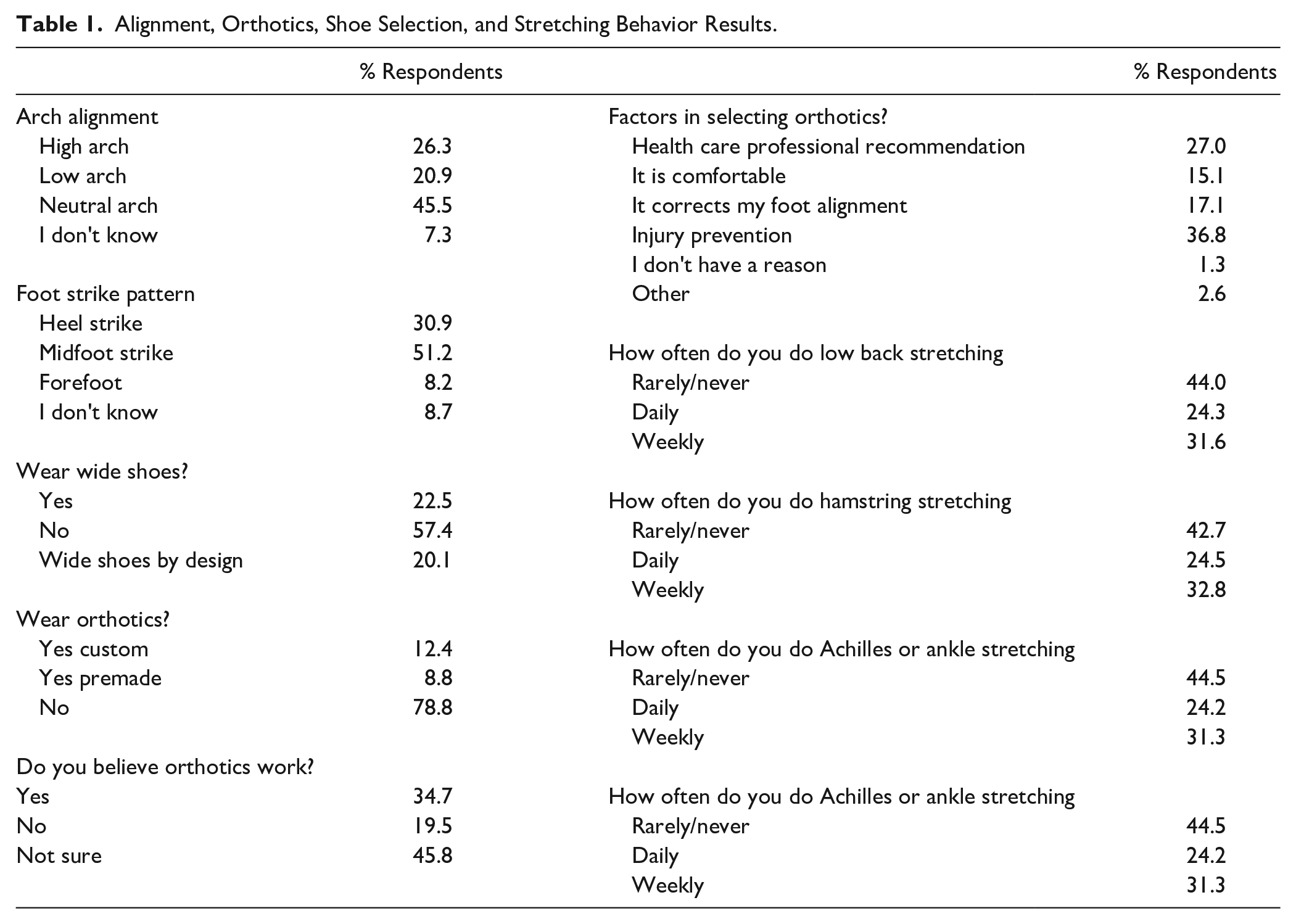
Several aspects of shoe selection were explored. First, runners replaced their shoes after a median (IQR) of 644 (483-805) km (range: 97-4828 km). Second, 22.5% of the subjects reported wearing wide shoes and another 20.1% wearing shoes that were wide by design. Third, 85.3% of runners agree or strongly agree that they “wear the most comfortable shoe I can find” as a shoe selection method. Several other factors in shoe selection are included in Table 2.
Shoe Selection Criteria.

Only 21.2% of participants reported wearing orthotics; in addition, 12.4% reported wearing custom orthotics whereas 8.8% report wearing “off the shelf” orthotics. More than one-third (34.7%) of participants believed that orthotics work, whereas 19.5% reported they do not believe orthotics work, and 45.8% reported they are not sure. Of those that reported wearing orthotics, the biggest factors in choosing orthotics were injury prevention (36.8%), recommendation by their health care professional (27.0%), correction of foot alignment (17.1%), and comfort (15.1%). Multiple linear regression analysis was performed to explore the statistical relationship between participants who wore orthotics, and foot shape. A statistically significant but likely not clinically significant relationship was found (r square = 0.02, P < .001). The strongest relationship existed between those self-reporting a low arch and wearing orthotics (coefficient = 0.17, P < .001).
Flexibility and Stretching Behavior
Participants were asked to perform a sit and reach exercise while seated with care to keep the knees straight and ankles at 90 degrees. Interestingly, a total of 63.7% of participants report they cannot reach past their toes, Figure 2. Participants were asked the frequency of low back stretching (44.0% report rarely/never, 31.6% report weekly, and 24.3% report daily), hamstring stretching (42.7% report rarely/never, 32.8% report weekly, and 24.5% report daily), and Achilles stretching (44.5% report rarely/never, 31.3% report weekly, and 24.2% report daily).
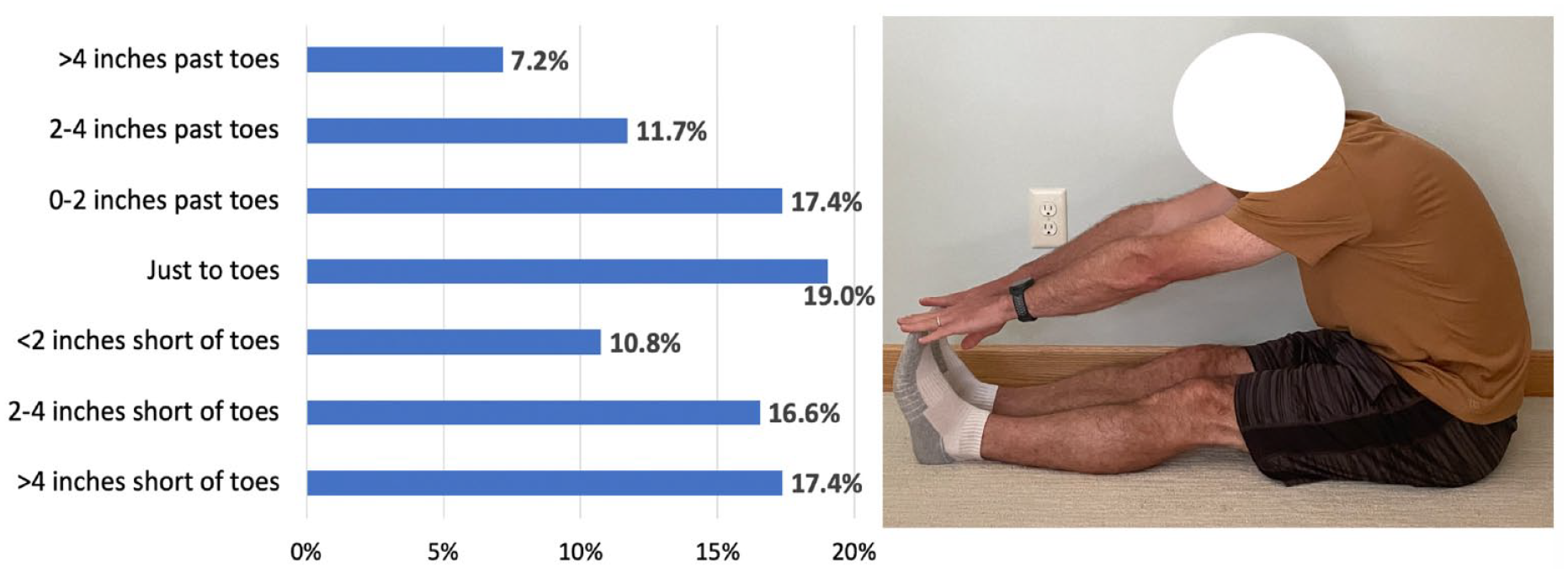
Sit and reach performance among study participants.
Multiple linear regression analysis was performed to explore the statistical relationship between the number of foot and ankle injuries and several other variables. There was no statistically significant relationship between injury and sit and reach flexibility (P = .986), low back stretching frequency (P = .148), hamstring stretching frequency (P = .267), Achilles stretching frequency (P = .137), average running distance per week (P = .771), or number of days per week cross training (P = .948). A weak but statistically significant positive relationship was found with age (r square = 0.0065, P = .023).
Discussion
The current study provides key information on foot and ankle injuries in a large group of ultramarathon runners including demographics, injury rates, shoe selection factors, orthotics usage, stretching and flexibility, gait pattern, and arch height.
Several findings in the current study are of particular interest and may be helpful for the clinician in advising runners about foot and ankle care informed by ultramarathon runners. First, running injuries are very common in ultramarathon runners. The injuries are similar in scope to other groups of athletes; however, they tend not to be from acute trauma but instead are a result of high cycles of relatively low stress during ultramarathons and requisite training. Second, the most important factor in shoe selection was found to be comfort. Ultramarathon runners seem to value comfort over the other shoe selection factors like advice from professionals, matching to gait pattern, cost, or color. This will be discussed further below. Third, this study reports on flexibility as well as stretching behavior of ultramarathon runners. The current results found no statistically significant link between injury risk and the frequency of lower extremity stretching or flexibility on the sit and reach test. Stretching and injury risk has been a topic of interest in the sports medicine community and the current findings support the notion that stretching does not correlate highly with injury prevention.26,34,35 Finally, most of the study participants did not wear orthotics (78.8%), and most were not convinced that orthotics work (65.3%, report “no” or “unsure”). This lack of conviction of the benefit of orthotics in this population is in contrast to runners of shorter distances where other studies have demonstrated up to 80% of runners have a positive opinion of orthotics.5,21
One important concept that applies to ultramarathon runners is optimizing comfort while running, especially since ultramarathons requires many hours (and sometimes days) on foot. The concept of comfort while running is poorly defined or understood, but seems to be important in selection of running shoewear. Feeling comfortable while running may be a sign of low tissue stress and subsequent decreased injury risk. Shoes that may be comfortable for some, may be uncomfortable for others. 27 The correlation between shoe selection and comfort may be something ultramarathon runners do to prevent injury, unknowingly. There is some support for this in the literature. Mundermann et al 28 performed a study of military personnel and had recruits wear a shoe insert, of several types, that they found most comfortable and were monitored for injury during military training exercise. The authors found the insert group sustained less overall stress fractures and foot pain than the control group (8.8% vs 22.2%). 28 Finally, shoes that are more comfortable have been associated with decreased oxygen consumption while running, which may be another reason runners would select a shoe optimizing for comfort. 24 Luo et al 24 asked a group of proficient runners to try 5 different shoes and select for the most comfortable. They then measured oxygen consumption and found a 0.7% improvement in running economy when runners used the most comfortable compared to the least comfortable shoes. 24
The lack of faith in orthotics in the study population is interesting. The published evidence regarding the benefit of orthotics in runners is limited. These studies generally have a small sample size, lack a control group, and have practitioner-dependent fitting.2,4 To the authors’ knowledge, there are no high-level controlled trials investigating orthotics in runners. In controlled studies on nonrunners, including patients with Achilles tendinitis, rheumatoid arthritis, and other causes of foot pain, results have not shown a compelling benefit of orthotics over sham or placebo conditions.3,22,29
The current study has several limitations. First, this study uses a self-selection recruitment method and thus self-selection bias likely exists since the population was volunteer. Furthering the selection bias, the current study population has been part of the longitudinal study for up to 11 years. It can be noted, however, that the current population sample demographic characteristics is comparable to prior reports of ultramarathon runners.6 -8,11,12,16 -18 Second, recall bias is likely present in the current study. Additionally, although queried on the incidence of injury, the incidence of undiagnosed pathology is unknown, or some subjects may not be comfortable sharing. Third, the injury diagnoses are self-reported so it is ultimately unknown how accurate these diagnoses are in the event that they were not physician diagnosed. Similarly, stretching performance was self-reported and thus the accuracy of the reported results is ultimately unknown.
Conclusion
Ultramarathon runners have an 71.2% prevalence of foot and ankle injuries that limit running in a 12-month period. In the current study population, injury was not correlated with flexibility, stretching behavior, foot strike pattern, or arch alignment. A high percentage of the study runners used comfort as a shoe selection method, independent of alignment or foot strike pattern. These findings guide the clinician in shared decision making with runners about routine care, including injury prevention and shoe selection.
Supplemental Material
sj-pdf-1-fao-10.1177_24730114231198832 – Supplemental material for The Foot and Ankle in Ultramarathon Runners: Results of the Ultrarunners Longitudinal TRAcking (ULTRA) Study
Supplemental material, sj-pdf-1-fao-10.1177_24730114231198832 for The Foot and Ankle in Ultramarathon Runners: Results of the Ultrarunners Longitudinal TRAcking (ULTRA) Study by James R. Jastifer and Martin D. Hoffman in Foot & Ankle Orthopaedics
Footnotes
Ethical Approval
Ethical approval for this study was obtained from Western Michigan University Homer Stryker MD School of Medicine IRB (WMed-2022-0935).
Declaration of Conflicting Interests
The author(s) declared no potential conflicts of interest with respect to the research, authorship, and/or publication of this article. ICMJE forms for all authors are available online.
Funding
The author(s) received no financial support for the research, authorship, and/or publication of this article.

References
Supplementary Material
Please find the following supplemental material available below.
For Open Access articles published under a Creative Commons License, all supplemental material carries the same license as the article it is associated with.
For non-Open Access articles published, all supplemental material carries a non-exclusive license, and permission requests for re-use of supplemental material or any part of supplemental material shall be sent directly to the copyright owner as specified in the copyright notice associated with the article.
