



Abstract

Ankle arthritis (AA) is a disabling condition affecting thousands of Americans. In the United States, a query of the National inpatient sample identified 5500 surgical procedures for the management of end-stage AA in 2012. 16 This number likely underestimates the overall surgical impact of AA, as it does not account for any procedure done on an outpatient basis. While these numbers are significantly lower than the number of procedures done for end-stage knee and hip arthritis (200 000 to 600 000), they are closer to the rates seen in shoulder arthritis where 24 000 complete arthroplasties were performed in 2010 in Medicare patients.6,18,21,43
Historically, treatment of end-stage AA was an ankle arthrodesis, commonly referred to as ankle fusion (AF) procedure. This longstanding surgery was the preferred procedure for decades as initial trials of total ankle arthroplasty (TAA) in the 1970s had significantly high failure rates in first- and second-generation models. 45 Management of AA has evolved over the past 5 to 10 years as modern TAAs are changing the paradigm. 37 Third-generation implants for TAA became available for use in the United States in the late 1990s/early 2000s. Currently in the United States, several TAA models approved for use have mid- to long-term follow-up data showing significant improvement from earlier generations. 27 As there have been improvements and changes in technology (fixed and mobile bearings, anterior and lateral approaches, extramedullary and intramedullary fixation), the use of TAA as a mainstay of treatment for AA is on the rise, with 2825 TAAs vs 2665 AFs performed on inpatients in 2012. 16 This finding is corroborated by other reports regarding the rising trend of the TAA in the United States.33,34 In addition, with the success of other joint replacements, patients are beginning to seek an option for replacement of the ankle.
Currently, there is a limited number of studies directly comparing AF to TAA, but a trend of improved results can be observed in the the newer generation prostheses. One of the largest prospective studies compared 281 TAAs and 107 AFs from 2001 to 2007, for a mean follow up of 5.5 years. 11 In this cohort, overall patient-reported outcome improvements were equivocal for the Ankle Osteoarthritis Scale (AOS) as well as SF-36 scores. There were more complications related to TAA (19% vs 7%), but many of the complications were implant issues that may not be currently relevant as improvements in polyethylene (12 cases) and advances in implant designs could yield a different outcome in a more modern study. Examples of this concept are Agility and Mobility (DePuy Synthes, Raynham, MA) prostheses that are no longer available in the United States due to high failure rates. The largest prospective study performed in the United States compared 158 Scandinavian Total Ankle Replacement (STAR; Stryker, Kalamazoo, MI) TAAs to 66 AFs between 2000 and 2006 for a 2-year period, and then an additional 448 patients with TAAs were followed as well. 38 Overall, the TAA group showed significantly greater improvement in Buechel-Pappas outcome scores compared to the AF group. Pain improvements were equivocal between groups at 2 years. In long-term follow-up of the TAA group, patients continued to maintain improvement in AOS scores as well as SF-36 at a 9-year follow-up, with a 12% revision rate for hardware failure and an 18% revision rate for polyethylene-related issues. 10 Overall, STAR survivorship has been reported at the following ranges: 5 years, 93% to 96%22,29; 10 years, 78% to 94%13,22,29; 15 years, 63% 22 ; and 19 years, 5% to 91%. 13 Variability in the definition of survival may be part of the wide range and difficulty in clearly identifying a more consistent value. In addition, overall reoperation rate after STAR TAA has been reported to be as high as 52% over a 19-year time course. 13
While the STAR TAA (Figure 1) has the longest term data available, other newer devices have also had successful outcomes at midterm. Unfortunately, only few studies are direct comparisons to ankle fusion. The Salto Talaris (Integra LifeSciences, Plainsboro NJ), a fixed-bearing prosthesis (in the United States), has 3 studies with midterm follow-up (Figure 2). One study retrospectively reviewed 96 patients, 85 with a minimum of 6.8 years of follow-up and a mean of 8.9 years. 4 In this study, 65% TAA survival was achieved with any type of reoperation considered or 85% survival when revision of a component was excluded. The American Orthopaedic Foot & Ankle Society (AOFAS) outcome scores were 79 ± 12. A second study reported on 75 implants with an average follow-up of 43 months (range, 24-73 months). 31 Foot and Ankle Outcome Score, SF-12, and visual analog scale (VAS) were used as outcome measures. There was significant improvement in the SF-12 and VAS scores. There was significant improvement in all subscales of the Foot and Ankle Outcome Score. TAA survivorship was 98%. A recent 2016 study reported on 81 TAAs with a minimum clinical follow-up of 2 years and an average of 5.2 years. 18 Implant survival was 97.5%. Outcome measures include the Foot and Ankle Disability Index, the Short Musculoskeletal Function Assessment (SMFA), the SF-36v2, and the VAS. Outcome scores showed improvement at follow-up.

(A) Lateral and (B) anteroposterior X-ray of ankle arthritis. (C) Lateral and (D) anteroposterior views after STAR® total ankle arthroplasty by Synthes.
Salto-Talaris total ankle system by Integra Life Sciences.
The Inbone I/II (Wright Medical, Memphis, TN) prosthesis has an intramedullary tibial stem design (Figure 5). One study evaluated 194 TAAs with a range of follow-up from 2 to 5 years and an average of 3.7 years. 1 The authors used the VAS, AOFAS, SMFA, and SF-36 scores for evaluation. Revision rate was 6%. A number of functional parameters were also assessed and were noted significantly improved at 2 years. Hsu and Haddad 19 looked at both the Inbone I and II implants. A total of 59 TAAs were evaluated. Mean follow-up was 35 months. Survival rate was 91% for the Inbone I and 100% for the Inbone II after at least 2 years. Overall improvement was found on AOFAS and the VAS pain scores. Subsequently, 4 additional TAA implant systems became available in the United States, including Cadence (Integra LifeSciences), Vantage (Exactech, Gainesville, FL), Infinity (Wright Medical, Memphis, TN), and Trabecular Metal TAA (Zimmer Biomet, Warsaw, IN) (Figures 3–6). There are limited clinical outcomes from the newer designs available in the literature.

Cadence total ankle system by Integra Life Sciences.

Vantage total ankle system by Exactech, Inc.

(A) Anteroposterior and (B) lateral images of Inbone 2 total ankle system by Wright Medical. (C) Anteroposterior, (D) oblique, and (E) lateral X-rays of Inbone 2 total ankle system.

(A) Image of Infinity total ankle system by Wright Medical. (B) Anteroposterior, (C) oblique, and (D) lateral X-rays of Infinity total ankle system.
While the above-mentioned studies look at the safety and efficacy of TAA in comparison to AF, other differences between the 2 procedures affect outcomes. For example, A comparison of 17 patients undergoing TAA to 17 patients undergoing AF and 10 matched control subjects with normal gait. 41 Patients who had undergone TAA had greater postoperative sagittal plane motion and range of tibial tilt compared to the AF group. While the TAA group had gait abnormalities, it more closely resembled normal gait than the AF group. Similarly, one study found that TAAs had better gait velocity, cadence, and step length compared to AFs. 12 Another recent study found that TAAs showed better dorsiflexion/plantarflexion going up and down stairs as well as clinical scores compared to AF, although they found similar gait speeds on flat surfaces. 20 One study found no difference in activity levels and sports participations at approximately 3 years postoperatively between patients who had TAA vs AF. 40 Last, a systematic review confirmed the suggestion of more symmetric gait and less impairment on uneven surfaces after TAA. 26 While the adjusted revision rate was higher in TAA (7.9%) compared to AA (5.4%), the adjusted overall complication rate was higher for the AA group (26.9% vs 19.7%).
Assessment of the cost variation between TAA and AF is somewhat difficult due to the multiple factors influencing pricing. AF has been estimated to cost approximately $5500 to $7900 for implants and hospitalization.9,49 The cost of TAA has been reported to range from $13 500 in Canada 49 to $18 656 14 to $28 000 9 to as high as $46 000 in the United States. 3 These variations can be related to length of hospitalization, complications, adjunctive procedures, negotiated implant pricing, and country of the procedure (Canada vs United States) as these all can contribute to very different cost profiles. 32 It is important to note a study conducted in Canada found that the overall hospital cost of TAA was on par with the cost of total hip and total knee replacements. 49 While implant costs were greater ($6420 vs $3200/$3060), length of stay was frequently shorter, helping to balance out overall hospital charges. It is important to note that there are significant differences in the postoperative care of the TAA (and AF) patient compared to total hip/knee patients. In most cases, TAA and AF patients require a period of nonweightbearing for several weeks postoperatively that can be a challenge for older patients who require additional therapy and nursing services, while total hip and knee patients are able to begin full weightbearing ambulation on the day of surgery. A recent analysis of Medicare claims data from 2011 to 2012 identified financial burden as a limiter for TAA as two-thirds of the hospitals failed to demonstrate profitability. 35
A cost modeling study by found TAA to be more cost-effective than AF in a 60-year-old with adjustments for quality of life, even with a $20 000 increased implant cost. 9 Another study looking at a specific subset of the population for whom outpatient procedures are appropriate—young, healthy, home support network, and so on—found that TAA can be performed on an outpatient basis at an average cost savings of 13.4%. 14 Last, one study was able to identify that those surgeons in the top 90% of TAA volume (21/year) had significantly less complications and decreased hospital charges by almost $20 000. 3
As mentioned above, complications can add significant cost to TAA. It is important to also note that AF is not without its own complications. Nonunion rates in AF have been reported to be around 10% with reoperation rates up to 19%.7,44 In the long term, arthritis of adjacent joints, such as the subtalar and talonavicular, commonly develops following ankle fusion. 8 One of the major limitations in TAA is the unclear data on complications and longevity of implants. Data continue to be mixed on the overall rates of complications and longevity of implants due to the various ways these events are classified and defined in studies. 30 Two studies reported a 10% revision rate at 5 years in data from several national and state registries but did not clearly define the reasons for revision or clarify implant survival.24,25 Another study reported a 12% metal hardware failure rate over 10 years, although there was an 18% rate of polyethylene exchange. 10
The role of revision TAA has not been well defined. Revision surgeries have been described to address aseptic loosening, subsidence, osteolysis, malpositioning, deep infection, and failure of implant components.* Virtually all of the studies were reports of results in the hand of highly experienced surgeons that may not be generalizable to average orthopaedic surgeons. While revision TAAs are technically demanding procedures, several implant systems have been designed to address revision procedures such as Invision (Wright Medical), Salto XT (Integra LifeSciences), and Cadence (Integra LifeSciences).
Overall, TAA has a role in the treatment of end-stage ankle arthritis. There are studies indicating that it may even be superior to AF in certain populations or scenarios. While total hip and total knee arthroplasty has been standard of care for several decades in the management of hip and knee end-stage arthritis, TAA is still in its infancy, with only 10 to 15 years of experience and a smaller patient population (all current Food and Drug Administration–approved TAAs are included in Figures 1–7). As technology continues to improve implant design and longevity, and surgeons continue to gain experience, we can expect that complications and implant survival will also improve.

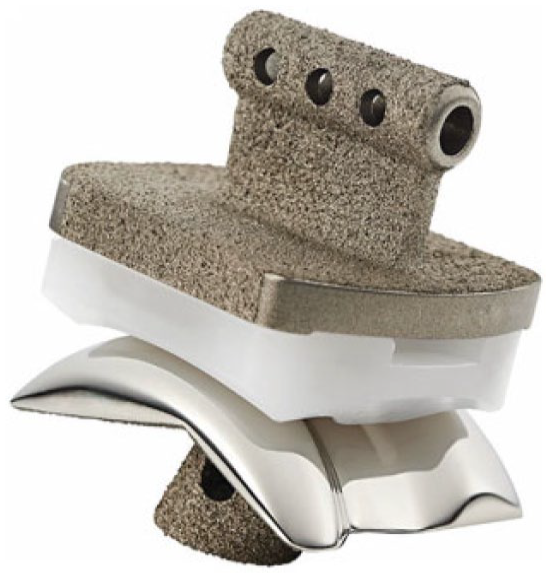
(A) Lateral and (B) oblique images of Zimmer Trabecular Metal total ankle system. (C) Anteroposterior and (D) lateral X-ray of Zimmer Trabecular Metal total ankle system.
Footnotes
This article was originally published as: O’Connor K, Klein S, Ebeling P, Flemister AS, Phisitkul P, American Orthopaedic Foot & Ankle Society Evidence-Based Medicine Committee. Total ankle arthroplasty: summary of current status. Foot Ankle Orthop. 2018 Sep 27;3(3):2473011418790003. doi:10.1177/2473011418790003.
Declaration of Conflicting Interests
The author(s) declared no potential conflicts of interest with respect to the research, authorship, and/or publication of this article.
Funding
The author(s) received no financial support for the research, authorship, and/or publication of this article.