



Abstract
Background:
No study in the orthopedic literature has analyzed the demographic characteristics or surgical training of foot and ankle fellowship directors (FDs). Our group sought to illustrate demographic trends among foot and ankle fellowship leaders.
Methods:
The American Orthopaedic Foot & Ankle Society (AOFAS) Fellowship Directory for the 2021 to 2022 program year was queried in order to identify all foot and ankle fellowship leaders at programs currently offering positions in the United States and Canada. Data points gathered included age, sex, race/ethnicity, location of surgical training, time since training completion until FD appointment, length in FD role, and individual research H-index.
Results:
We identified 68 fellowship leaders, which consisted of 48 FDs and 19 co-FDs. Sixty-five individuals (95.6%) were male, and 3 (4.4%) were female. As regards race/ethnicity, 88.2% of the leadership was Caucasian (n = 60), 7.4% was Asian American (n = 5), 1.5% was Hispanic/Latino (n = 1), and 1.5% was African American (n = 1). The average age was 51.5 years, and the calculated mean Scopus H-index was 15.28. The mean duration from fellowship training to fellowship leader position was 11.23 years.
Conclusion:
Leaders within foot and ankle orthopedic surgery are characterized by research prowess and experience, but demographic diversity is lacking.
Level of Evidence:
Level III.
Keywords
Introduction
A leadership position in medicine is a highly regarded title that many strive to achieve throughout the progression of their career. Physicians may choose to seek leadership roles in their practice, professional societies, and academic institutions. Factors for the selection of these qualified individuals can include a dedication to education, research productivity, interpersonal skills, and a commitment to patient outcomes. 8,9 Leadership in surgery entails technical competence, motivation, innovation, and emotional intelligence that may be developed through experience, mentorship, education, and networking. 1,10 Through academic training, some physicians may seek the prestigious role of fellowship leader (FL), whether that may be fellowship director (FD), fellowship co-director (co-FD), or a synonymous title. However, the attributes that permit a physician to be promoted to FL are not clearly defined.
Recent studies of other orthopedic fellowships have demonstrated that specific graduate and postgraduate training programs may play a role in the future acquisition of an FL role. 8,19 Moreover, certain demographic characteristics and attributes such as gender and race have been disproportionately weighed to favor certain groups. 17 These previous studies lay a strong foundation for presenting and comparing our findings. Also, given leadership abilities are vital for obtaining an FL role, it is concerning that available studies show residents feel they do not learn adequate leadership skills throughout residency. 10 Identifying leadership characteristics valued within the field could offer guidance in addressing this problem.
There are no current studies analyzing the demographic trends, characteristics, and research productivity of orthopedic foot and ankle FLs. Importantly, foot and ankle rotations and faculty are continuing to increase within orthopedic residencies across the country. 13 More than 80% of foot and ankle fellows report complete satisfaction with choosing their fellowship, ranking it among the highest of operative subspecialties. 18 Thus, the interest in attending a foot and ankle fellowship and possibly pursuing an FL role is likely increasing. This heightened competition may result in increased selection for specific attributes and accolades in FLs. We aim to determine these specific demographic characteristics and attributes, which may yield guidance to aspiring orthopedic leaders and/or uncover potential disparities within foot and ankle leadership.
We hypothesize that current foot and ankle FLs will comprise a large percentage of individuals from certain residency and fellowship training programs. We also anticipate strong institutional loyalty to exist whereby a large percentage of current FLs will have undergone residency or fellowship training at their current institution. The proposed study will have substantial implications for medical students, residents, fellows, and faculty within orthopedic surgery. We hope to direct prospective individuals interested in obtaining leadership roles in foot and ankle surgery.
Methods
Data Collection
We analyzed the American Orthopaedic Foot & Ankle Society (AOFAS) Fellowship Directory for the 2021-2022 program year in order to identify all current foot and ankle fellowships in the United States and Canada. All documented fellowship leaders (FLs), which includes fellowship directors (FDs) and co-fellowship directors (co-FDs), were identified. The demographic characteristics and educational background history were obtained from publicly available curriculum vitae (CV) information. If information was not available via CV, we explored institutional biographies, Scopus Web of Science, and electronically mailed questionnaires to fellowship administrators. The demographic information collected included age, sex, race/ethnicity, location of medical school, residency, and fellowship training, time since residency and fellowship completion until FL appointment, length in FL role, number and type of fellowships pursued, research productivity by the Scopus H-index, and a current or past president title in the AOFAS. Current major editorial board positions were also recorded for Foot & Ankle International (FAI), Journal of Orthopaedic Trauma (JOT), Journal of the American Academy of Orthopaedic Surgeons (JAAOS), and Foot and Ankle Clinics.
The American Academy of Orthopaedic Surgeons (AAOS) 2019 Orthopaedic Practice in the United States (OPUS) survey was analyzed to understand whether the demographic pool of potential candidates of foot and ankle FL positions was significantly different from the pool of current FLs. 2 Data on orthopedic surgeons from the AAOS was matched based on age ranges to ensure accurate comparisons could be made between current FLs and prospective candidates.
The Scopus database (Elsevier BV, Waltham, MA) was used to obtain each fellowship leaders’ H-index for research activity. The Scopus H-index is computed by adding the number of publications for which an author has been cited by other authors at least that same number of times. For example, an H-index of 25 means a researcher has 25 publications that have each been cited at least 25 times. This study also included president leadership roles that were obtained from the AOFAS website. All collected data were reviewed by the 2 lead authors and cross-referenced with the fellowship directory to ensure completeness and accuracy.
Statistical Analysis
Pearson correlation coefficients were determined via SPSS (Statistical Package for the Social Sciences Version 27.0; IBM, Armonk, NY). Correlation coefficients were analyzed according to the guide of Mukaka. 12 Values under 0.3,0.3 to 0.5, 0.5 to 0.7, 0.7 to 0.9, and greater than 0.90 are indicative of negligible, low, moderate, high, and very high positive correlation, respectively. Odds ratios were calculated for the chance of attaining an FL position given a certain demographic background. Alpha (statistical) significance was determined at the level of .05.
Results
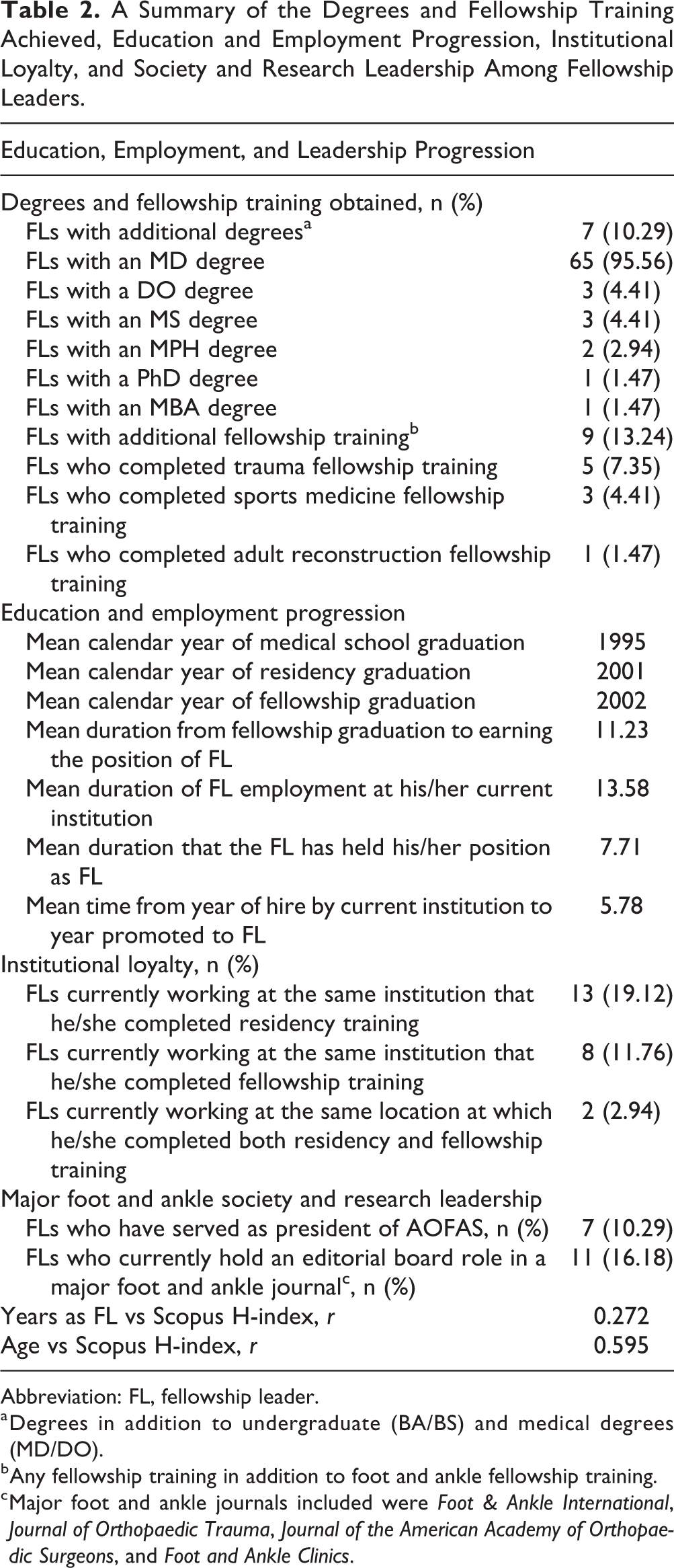
Complete information was obtained for 68 FLs from all 48 AOFAS-approved foot and ankle fellowship programs, which consisted of 48 FDs (72.1%) and 19 co-FDs (27.9%) (Table 1). Of the 68 FLs, 65 (95.6%) were male and 3 (4.4%) were female. As regards race/ethnicity, 88.2% of the leadership was Caucasian (n = 60), 7.4% was Asian American (n = 5), 1.5% was Hispanic/Latino (n = 1), and 1.5% was African American (n = 1). The average age was 51.5 years, and the calculated mean Scopus H-index was 15.28. Seven FLs had additional degrees, including 3 with a Master’s in Science (MS), 2 with a degree with Master’s in Public Health (MPH), 1 with a PhD, and one with a Master’s in Business Administration (MBA) (Table 2).
A Summary of the Overall Leadership Roles Held by Fellowship Leaders and the General Demographics of Fellowship Leaders.

Abbreviation: OR, odds ratio.
A Summary of the Degrees and Fellowship Training Achieved, Education and Employment Progression, Institutional Loyalty, and Society and Research Leadership Among Fellowship Leaders.
Abbreviation: FL, fellowship leader.
a Degrees in addition to undergraduate (BA/BS) and medical degrees (MD/DO).
b Any fellowship training in addition to foot and ankle fellowship training.
c Major foot and ankle journals included were Foot & Ankle International, Journal of Orthopaedic Trauma, Journal of the American Academy of Orthopaedic Surgeons, and Foot and Ankle Clinics.
The mean calendar year of residency and fellowship graduation for all FLs was 2001 and 2002, respectively. In addition to a foot and ankle fellowship, nine FLs (13.2%) have pursued an additional fellowship. Five FLs have additional training in trauma, 3 in sports medicine, and 1 in adult reconstruction. The mean duration from fellowship training graduation to acquisition of an FL position was 11.23 years, and the mean time from hiring at current institution to promotion to an FL role was 5.78 years. To better understand institutional loyalty in the hiring process, we found that 23 FLs (33.8%) have trained in the same location for residency and/or fellowship as their current institution. Specifically, 13 FLs were currently working at the same institution they completed residency, 8 were working at the same institution they completed fellowship training, and 2 were working at the same institution in which they had both residency and fellowship training (Table 2).
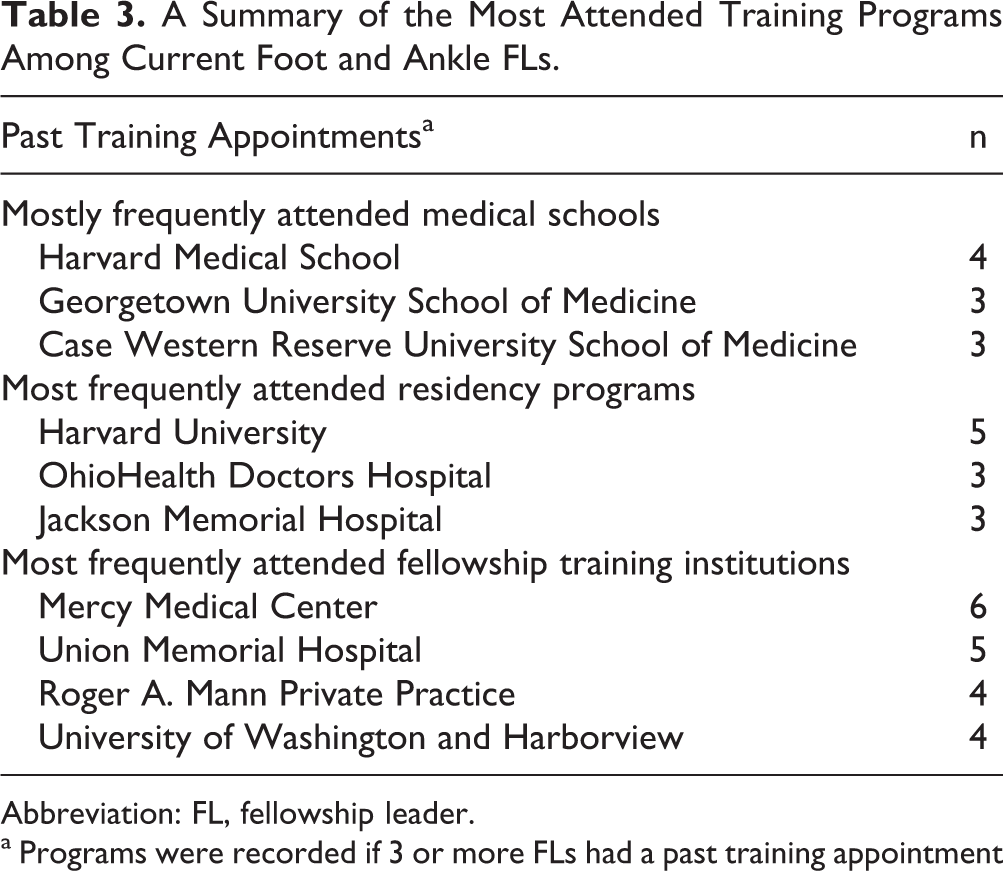
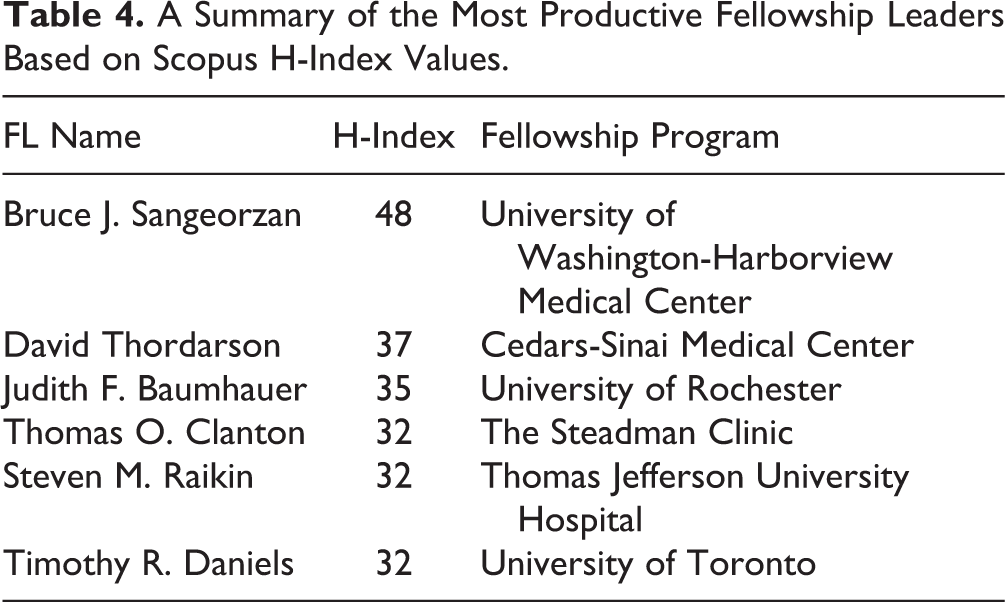
Interestingly, the medical schools most frequently attended by FLs included Harvard Medical School (n = 4), Georgetown University School of Medicine (n = 3), and Case Western Reserve University School of Medicine (n = 3) (Table 3). Furthermore, the residency programs that produced the largest number of FLs include Harvard University (n = 5), OhioHealth Doctors Hospital (n = 4), and Jackson Memorial Hospital (n = 4) (Table 3). The most frequently attended fellowship programs among FLs were Mercy Medical Center (n = 6), Union Memorial Hospital (n = 4), Roger A. Mann Private Practice (n = 4), and the University of Washington at Harborview (n = 4) (Table 3). We also report the 6 most impactful FLs in terms of research productivity by use of the Scopus H-index values (Table 4). The greatest H-index value was found to be 48. By way of comparison, the sixth most impactful FL in research had an H-index of 32.
A Summary of the Most Attended Training Programs Among Current Foot and Ankle FLs.
Abbreviation: FL, fellowship leader.
a Programs were recorded if 3 or more FLs had a past training appointment
A Summary of the Most Productive Fellowship Leaders Based on Scopus H-Index Values.
Seven FLs (10.3%) have served a past president role in the AOFAS, the largest national foot and ankle society. In addition, 16.2% of FLs currently hold an editorial board role in a major foot and ankle journal (FAI, JOT, JAAOS, Foot and Ankle Clinics). The Scopus H-indices for all FLs are displayed as ranges that include 1 to 10 (n = 25), 10 to 18 (n = 20), 18 to 27 (n = 14), 27 to 35 (n = 5), 35 to 43 (n = 2), and 43 to 51 (n = 1) (Figure 1).

A representation of the Scopus H-indices of all adult reconstruction FDs. Note: The Scopus H-index values are as of April 2, 2021. Interval notation is used. The opening bracket “[” indicates that the range includes the adjacent numerical value. The opening parenthesis “(” indicates that the range does not include the adjacent numerical value.
Discussion
The aim of this study was to describe the current demographic, educational, and research background of current leaders within academic orthopedic surgery. Although many of the intangible leadership traits, such as internal motivation, confidence, patient-centered, communication, empathy, and trustworthiness, are critical for future leaders to recognize, there remains a need to characterize objective training requirements and research productivity to attain such a position. Previous investigations have analyzed the role of skill development in other surgical specialties. 5,10,14 Within orthopedic surgery, Donnally et al 8 described leadership characteristics of spine surgery FLs. They found that leaders within spine surgery are more likely to come from certain residency and fellowship training institutions, and FLs are likely to have a relatively extensive research background. 8 The group speculated this may be the result of the training structure within certain institutions or that certain programs select applicants who are more likely to pursue roles in academic leadership. Similarly, recent studies analyzing trends in adult reconstruction and sports medicine fellowships supported the data that certain training programs are more likely to produce individuals in FL roles; however, the institutions were significantly different across all subspecialties. 3,19 All 3 studies found women were disproportionately less represented within orthopedic leadership. This has added to recent discussions highlighting the importance of gender and cultural diversity and inclusion within orthopedic academic medicine. 7,20 Evaluating insights and objective data in the selection of fellowship leaders may guide future applicants for the future. To date, there are no examinations concentrating on leadership trends specifically in the field of orthopedic foot and ankle surgery.
Our results indicate that foot and ankle FLs are certainly distinguished by their level of research productivity in academic medicine with a mean Scopus H-index of 15.28. This is significantly higher than the reported average orthopedic surgeon H-index of 5. 9 By way of comparison, the mean H-indices found for FLs in spine surgery, adult reconstruction, and sports medicine were 23.75, 16.54, and 24.1, respectively. 3,8,19 It remains unclear why spine surgery and sports medicine FLs have higher H-index values than other orthopedic subspecialties, but it is crucial to associate H-index values with age, given the metric does not factor age into consideration. Our results highlight a moderate correlation between H-index and age (r = 0.595), indicating age may play a significant role in the acquisition of more research publications and citations. Foot and ankle FLs have the lowest reported mean age of 51.45 years relative to FLs in the other 3 fellowships’ analyzed subspecialties. 3,8,19 Overall, strong research productivity is prevalent within orthopedic surgery, particularly among academic leaders. In addition to research experience, foot and ankle FLs have a strong national leadership presence, with 10% of these leaders having served a president role for the AOFAS, the largest foot and ankle association in the United States. Furthermore, 16% of FLs currently hold an editorial board position in one of the four major foot and ankle journals, FAI, JOT, JAAOS, and Foot and Ankle Clinics.
Additionally, our data suggest a potential connection between place of residency and/or fellowship training with the potential acquisition of an FL role. Harvard University (n = 5) was the most heavily attended residency program for all FLs. This was followed by OhioHealth Doctors Hospital (n = 3) and Jackson Memorial Hospital (n = 3). To note, 9 FLs decided to pursue an additional fellowship besides foot and ankle, with trauma and sports medicine comprising the majority. This is in accordance with previous orthopedic subspecialty studies, which have concluded that FLs are more likely to have had training at certain institutions. 8,19 For fellowship training, Mercy Medical Center (n = 6) was the most heavily attended program among FLs. This was followed by Union Memorial Hospital (n = 5), Roger A. Mann Private Practice (n = 4), and University of Washington and Harborview (n = 4). Although the exact reasons why these institutions produce more FLs remains unclear, it is possible these programs tailor their curriculum to provide ample mentorship and guidance for a successful future in academic and leadership pursuits. It also might be the case that these programs have a larger supply of research availability and connections that could help propel one’s career.
It is interesting to note how the length of time from fellowship training to acquisition of an FL role parallels other available studies regarding orthopedic fellowships. Our study indicates the average time from fellowship matriculation to appointment was 11.23 years. This length is slightly longer than the previously reported studies analyzing spine surgery and adult reconstruction, which had durations of fellowship graduation to appointment of 8.59 years and 10.42 years, respectively. 8,19 Potential applicants should be cognizant of the average time requirement needed to attain such a title.
Another important point of analysis is the lack of female and cultural representation within foot and ankle leadership, which is consistent with the literature across academic orthopedic surgery. 4,6,16,21 It is important to first consider whether the demographic pool of potential candidates for these leadership positions is significantly different from the pool of current foot and ankle FLs on the basis of gender and race. Data from the AAOS 2019 survey revealed that the average age of orthopedic surgeons is 56.5 years. To ensure matched fits with our FL cohort, AAOS 2019 OPU survey data responses from surgeons between the ages of 51 and 59 years was used to compare demographic variables. Among those surgeons, 93.3% are male and 6.7% are female. Also, 84.7% are Caucasian, 6.7% are Asian, 2.2% are Hispanic/Latino, and 1.9% are African American. 2 Our results indicate only 3 females (4.4%) currently hold FL positions within foot and ankle surgery. Additionally, 88.2% of the identified leaders are Caucasian. All calculated odds ratios for achieving an FL revealed no significant racial or gender differences between the pool of potential candidates for FLs and current foot and ankle FLs. Additional factors such as research and place of training may play a more crucial role in the acquisition of such a position.
Multiple studies have analyzed the gender disparity in academic leadership roles within orthopedic surgery. 11,15 Ence et al 9 concluded that women in orthopedic surgery have a lower H-index relative to their male counterparts. As research productivity plays a large component in the acquisition of a leadership position, we must ensure women are given equal opportunity for publishing and conference attendances. While there has been a rise in the number of female orthopedic residents, there still exists room for improvement. 6 These disparities within medicine are beginning to gain attention; however, much more needs to be done within the field. It is critical that academic leaders act on these discussions to enable a more diversified culture. A central question remains how to effectively increase diversity in orthopedic surgery. Recent literature has suggested mentorship, early exposure, and outreach programs are essential for improving female and underrepresented minority interest in pursuing an orthopedic surgery residency. Several programs have been developed to foster diversity in orthopedics, particularly The Perry Initiative, The Women Orthopedist Global Outreach, and the J. Robert Gladden Orthopedic Society among others. Given the results from this study highlight the disparity within orthopedic surgery as a whole, it is imperative that these programs continue to foster growth to ensure leadership within the specialty accounts for all diverse populations.
Our study has limitations. A central limitation is the nature of acquiring CVs for the usage in our data analysis. Information was obtained from online CVs, Web of Science, and institutional biographies; however, these data may be outdated and/or inaccurate. Furthermore, much of these online data are self-reported. Program directors were contacted directly to fill in any data that could not be gathered from online resources. Another limitation exists within gender and ethnicity and/or race as these are self-identified traits. Program administrators and/or directors were contacted to obtain information regarding age, gender, and ethnicity. For any information regarding gender or ethnicity that could be directly gathered, the authors used all available resources to make a strong educated conclusion. This included but was not limited to looking for the inclusion of pronouns and other identifiable characteristics on institutional biographies, conference gatherings, or professional associations. Lastly, our study represents the current state of foot and ankle FLs but given the dynamic nature of trends in academic leadership, these results may be slightly variant over time. Our results did not seek to analyze subjective factors for the hiring of FLs as this study focused on objective determinants of academic leadership.
In conclusion, leaders within foot and ankle orthopedic surgery are characterized by research productivity and experience. Additionally, foot and ankle FLs are likely to have graduated from certain residency and fellowship programs. This may be due to certain institutions selecting individuals who openly admit to pursuing a career in academic medicine. There also exist a strong sense of institutional loyalty whereby current leaders have trained at their current program for residency or fellowship. This may create a cyclic environment whereby institutions are selecting applicants from similar programs, which may result in a consistently homogenous group of individuals. This consideration can be an important point of improvement within foot and ankle orthopedic surgery to create a more gender and ethnically diverse community.
Supplemental Material
sj-pdf-1-fao-10.1177_24730114211033299 – Supplemental material for Trends in Leadership Within Orthopedic Foot and Ankle Fellowships
Supplemental material, sj-pdf-1-fao-10.1177_24730114211033299 for Trends in Leadership Within Orthopedic Foot and Ankle Fellowships by Joshua P. Weissman, Cody Goedderz, Muhammad Y. Mutawakkil, Peter R. Swiatek, Erik B. Gerlach, Milap S. Patel and Anish R. Kadakia in Foot & Ankle Orthopaedics
Footnotes
Ethical Approval
Ethical approval for this study was waived by Northwestern University Institutional Review Board because this study “collected publicly available information and did not involve human subjects.”
Declaration of Conflicting Interests
The author(s) declared no potential conflicts of interest with respect to the research, authorship, and/or publication of this article. ICMJE forms for all authors are available online.
Funding
The author(s) received no financial support for the research, authorship, and/or publication of this article.

References
Supplementary Material
Please find the following supplemental material available below.
For Open Access articles published under a Creative Commons License, all supplemental material carries the same license as the article it is associated with.
For non-Open Access articles published, all supplemental material carries a non-exclusive license, and permission requests for re-use of supplemental material or any part of supplemental material shall be sent directly to the copyright owner as specified in the copyright notice associated with the article.
