




Abstract
Background
Nonspherical prosthetic humeral head designs have become increasingly popular as they better approximate the native shoulder anatomy and biomechanical properties and is supported by the existing literature. It remains to be seen how this will impact postoperative outcomes for total shoulder arthroplasty providing a justification for this review.
Methods
A review and synthesis of the literature on the subject of joint replacement in the native and prosthetic humeral head was performed.
Results
Our review encompasses the anatomical, biomechanical, and finite element data present in the literature for native and prosthetic joint replacement. They describe the native humeral head as more elliptical (nonspherical) than circular (spherical) and that nonspherical prosthetics more closely approximate glenohumeral kinematic properties.
Conclusion
A nonspherical prosthetic may influence long-term clinical outcomes in hemiarthroplasty and anatomic total shoulder arthroplasty though further research in this area is necessary.
Introduction
In recent years, nonspherical humeral prosthetic designs have been commercialized for anatomic shoulder arthroplasty. This review summarizes the published literature that forms the basis for this concept as well as examines the extent to which a nonspherical humeral head (NSH) approximates native humeral anatomy compared to a spherical humeral head design. Our review of the literature examined anatomical, biomechanical, and finite element analysis studies. In addition, it is unclear whether an NSH impacts glenohumeral joint stability and joint kinematics. These results could have implications on surgical selection of spherical and nonspherical prosthetic heads and patient outcomes.
Anatomical Studies
There are several anatomical studies to support an NSH prosthesis as a better approximation of the native humeral head anatomy.1–4 The first published study by Iannotti et al. determined that the shape of the humeral head articular surface was elliptical by evaluating 100 cadaveric specimens. They defined the shape of the humeral head by its radius of curvature (ROCHH) in sagittal and coronal planes. 4 In this study, the authors measured the elliptical shape on the nonarticular surface being on average 2 mm smaller in the axial plane than in the coronal plane (Figure 1). They postulated from their data and the work of Soslowsky et al. that the center of the articular surface was spherical and tapered in the axial dimension by 2 mm. 5 They further suggested that the shape of the humeral head had an effect on the kinematics of the glenohumeral articulation.6,7 Anatomically, humeral head size was defined by ROC and head thickness, which forms the basis of prosthetic humeral head size configurations. There is a strong linear correlation between the thickness of the humeral head articular surface and the ROC with a ratio of approximately 0.71.
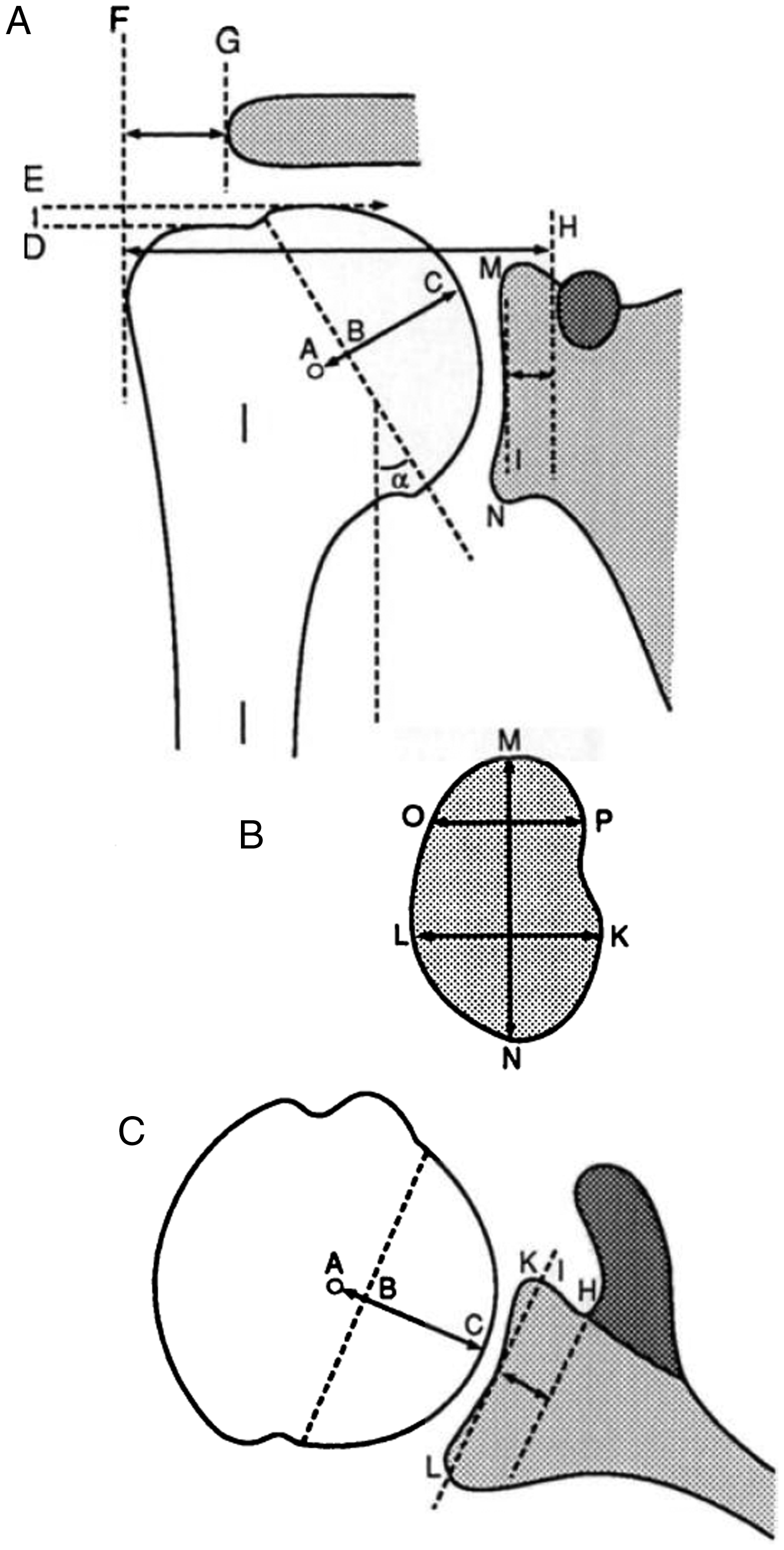
A–C, Depiction of anatomical measurements. (A) and (C) are coronal and axial views of the glenohumeral joint, respectively, while (B) is a sagittal view of the glenoid. Radius of curvature of the humeral head is observed in both coronal and axial planes as A-C. Thickness of the humeral head is observed in coronal and axial planes (B-C). Dimensions of the glenoid are shown in (B); superior-inferior is M-N; anteriorposterior (top) is O-P; anterior-posterior (bottom) is L-K. Neck-shaft angle is depicted in (A). Joint line of the glenoid is H-I. Lateral humeral offset is F-H. Distance from the greater tuberosity to the lateral acromial process is F-G. Distance from the humeral head to the greater tuberosity is D-E. Figure is taken from Iannotti et al. 4
Hertel et al. also investigated the proximal humerus shape (or geometry) in cadaveric specimens to determine particular parameters that would aid in prosthetic humeral design. Using computed tomography (CT) images, they evaluated ROCHH in coronal and sagittal planes and height (thickness) of the humeral head. They reported a 12% ROCHH difference between the coronal and sagittal planes and that the ratio of coronal radius versus humeral head height was fixed. 2
Humphrey et al. also reported that the average ROCHH was greater in the coronal plane than the sagittal. They determined that the ratio of the sagittal plane ROC was 0.91 and that the length of the humeral head at the anatomic neck becomes more equal in the coronal plane and sagittal plane as the humeral head size decreases (Figure 2). 3 This demonstrated that smaller head sizes may be more spherical. This may support difference in head shape between men and women. The clinical relevance of a gender difference has not been studied to date.

With increasing humeral head size, the difference between the length of the humeral head base in the coronal plane (DF) and the humeral head base in the sagittal plane (DS) increases. The ratio of DS/DF becomes less equal implying a more elliptical morphology. Figure is taken from Humphrey et al. 3
In another study conducted by Humphrey et al., a series of spherical and elliptical prosthetic humeral heads were evaluated using 3D CT. Using the software (SolidWorks 2014; Dassault Systèmes, Waltham, MA, USA), virtual sets of both spherical and elliptical prosthetics were virtually implanted into 3D CT scan models to anatomically approximate humeral head fit within 3 mm. The elliptical (nonspherical) head was more successful at reproducing native anatomy than was the spherical head. 8
In summary, these anatomic studies define that the native humeral head is not spherical, yet most modern humeral head prostheses are designed as a sphere. These studies bring into question the effect of spherical and nonspherical prosthetic head shape in hemiarthroplasty or total shoulder arthroplasty.
Biomechanical Studies: Kinematics and Finite Element Analysis
Jun et al. assessed the effect of prosthetic humeral head shape on glenohumeral joint kinematics after hemiarthroplasty in cadaveric specimens using either a spherical or nonspherical (NSH) prosthetic head and compared them to that of the native humeral head. The authors found a spherical prosthetic head shape that differed from the native humeral head in the superior-inferior and anterior-posterior dimensions by 2 mm on its nonarticular surface. On the articular surface, the central 30% of the native humeral head surface was spherical with the ROCHH remaining unchanged in the superior-inferior dimension, whereas the ROCHH gradually tapered such that the AP dimension was 2 mm smaller at its nonarticular surfaces. This shape was determined to have the best representation of the average native humeral head shape (Figure 3).

Depiction of 2 prosthetic humeral head models—one is a spherical and the other a nonspherical displaying differences in anterior-posterior dimensions (AP).
They compared glenohumeral joint kinematics of the experimental, anatomically shaped humeral head (NSH) to a commercially available spherical head of the same superior-inferior ROCHH and head thickness under anatomic muscle loading. In total, they examined kinematics at 7 positions: 0° abduction; 30° abduction in the coronal plane; 30° abduction in the scapular plane; 30° abduction in the forward flexion plane; 60° abduction in the coronal plane; 60° abduction in the scapular plane; and 60° abduction in the forward flexion plane. The humeral head apex (HHA) was defined as the farthest point of the humeral head from the geometric center of the humeral head (GCHH), which was the center of the sphere fit model used in the study. They found no statistically significant difference in rotational range of motion between the experimental NSH and native humeral head. The spherical prosthetic humeral head showed decreased internal rotation at 0° and 30° of abduction, while also showing decreased external rotation at 30° and 60° of abduction. More translation of the humeral head occurred with the spherical prosthetic head as the HHA increased while the translation of GCHH decreased at 5 of 7 positions. When the NSH was implanted, the GCHH decreased only at 1 position. 6 They postulated that the spherical head resulted in an increase in the size of the humeral head from the native anatomy, resulting in overstuffing of the joint and caused loss of motion and increase obligate translation of the humeral head at the end of range of motion resulting from tightening of the capsule (Figure 4).

Illustration showing effect of humeral head shape on glenohumeral joint kinematics under forces and capsular tension. The dotted outline represents the cross section of the humeral head at NR, while the solid outline represents the cross section of the humeral head at ER. This motion as shown is in the mid arc of motion where there is less translation of the GCHH. ANT, anterior; ER, external rotation; FM, compressive muscle forces; GCHH, geometric center of the humeral head; MED, medial; NR, neutral rotation; TC, capsular tension. Figure is taken from Jun et al. 6
In another study, Jun et al. examined the difference between a spherical and nonspherical head (NSH) in a simulation of total shoulder arthroplasty while varying the conformity between the prosthetic humeral head and glenoid components. They tested 4 prosthetic configurations using the same 7 positions as in the earlier study: (1) spherical head with conforming glenoid, (2) NSH with conforming glenoid, (3) spherical head with nonconforming glenoid, and (4) NSH with nonconforming glenoid. As expected, spherical head with conforming glenoid showed the smallest translation of GCHH during humeral axial rotation. The configurations of the NSH with conforming and nonconforming glenoid provided more net translation of the GCHH in anterior-posterior, superior-inferior, and medial-lateral axes at 0° and 30° of abduction (Figure 5).

Schema showing glenohumeral translations during humeral axial rotation ER, IR, and NR for a native joint (A), a spherical head with a glenoid component (B), and a nonspherical head with a glenoid component (C) when the arm is positioned at 30 of arm elevation in the scapular plane. The small circles indicate the COR at each humeral axial rotational position (gray circles, COR at IR; black circles, COR at NR; and white circles, COR at ER). Both the native joint (A) and the nonspherical head (C) result in the same patterns and directions of glenohumeral translation during humeral axial rotation because of the geometry similarity. However, the spherical head (B) results in a fixed COR or small amount of glenohumeral translation, namely, a spinning motion, during humeral axial rotation. COR, center of rotation; ER, external rotation; IR, internal rotation; NR, neutral rotation. Figure is taken from Jun et al. 7
They further found that glenoid component conformity did not alter glenohumeral translation to the same degree as humeral head shape; thus, humeral head shape plays a more significant role in glenohumeral kinematics than does conformity to articular surface. 7 The authors conveyed that a nonspherical prosthetic humeral head shape not only restores the native articulating surface geometry but also mimics native joint kinematics (Figure 6). The volume of humeral head replaced by the prosthetic humeral head is directly influenced by the choice of prosthetic humeral head shape. It also alters the location of the center of rotation, as defined by the GCHH.
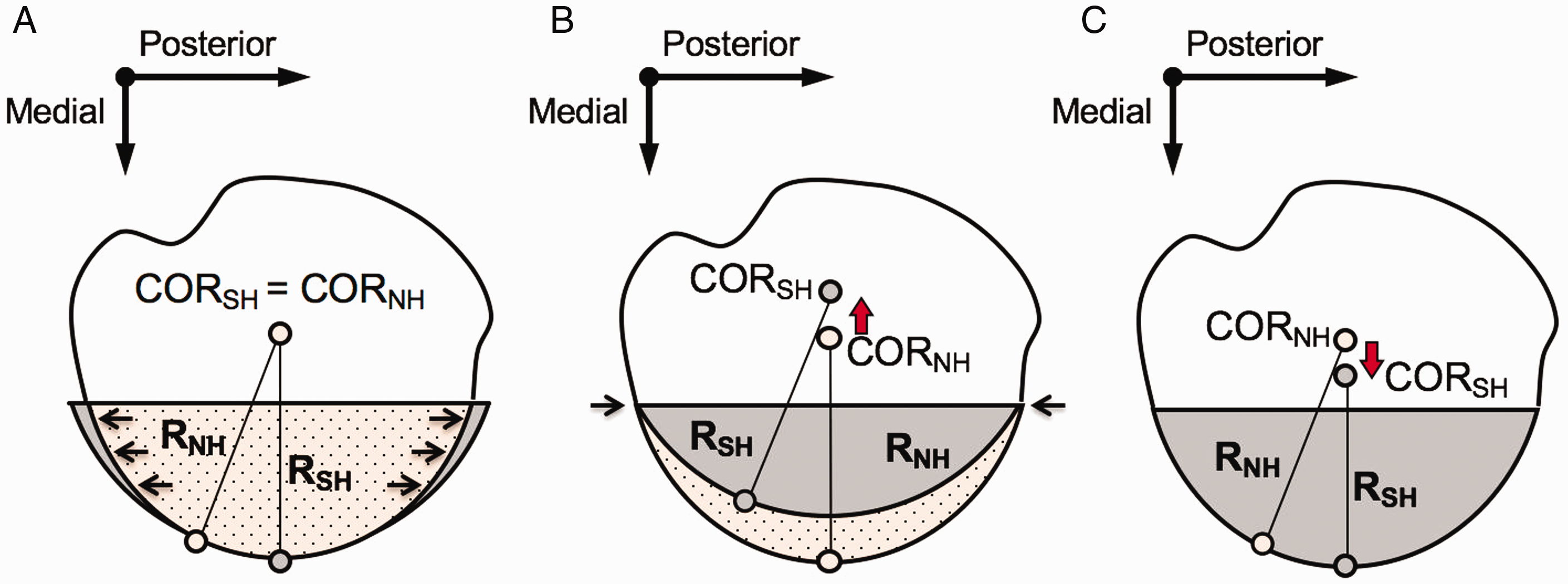
Schema showing geometric contribution of spherical prosthetic humeral head shape on placement of COR. A, Use of an SH with the same radius of curvature as the spherical portion of the NH will place the CORSH at the coincident position of the CORNH but will slightly overhang at the articular margin in the anterior-posterior dimension. B, Matching the anterior-posterior articular margin using an SH with the same radius of curvature as the NH will result in a lateral shift of the CORSH. C, Using an SH with a smaller radius of curvature than that of the NH will result in a medial shift of the CORSH. CORSH, center of rotation of the spherical head; CORNH, center of rotation of the native head; NH, native head; SH, spherical head. Figure is taken from Jun et al. 7
A study by Karduna et al. examined glenohumeral joint stability after total shoulder arthroplasty in a cadaver model. Joint stability was defined as the required force to dislocate the joint. Transverse displacement was defined as the maximum amount of translation anteriorly or posteriorly in the load frame design; 6 humeral head components of varying size (range, 20–25 mm) were assessed with 1 glenoid component, creating radius of curvature mismatches. They found that the minimum force needed for joint dislocation was independent of joint conformity but that it is impacted by glenoid radius of curvature. In addition, they found that the slope of the ratio of transverse displacement per force applied increased with increased joint conformity. 9
Matsuhashi et al. described the effect of humeral head rotation on glenohumeral joint stability. They used a sample of 7 cadaveric shoulders and translated the humeral head anteriorly and anteroinferiorly relative to the glenoid and analyzed contact forces and lateral humeral displacement. They hypothesized that the humeral head and glenoid were both nonspherical and had different radii of curvature and furthermore, that glenohumeral joint stability was dependent on axial humeral rotation. Their results showed that humeral head axial rotation impacts the stability of the glenohumeral joint. 10 The nonspherical shape of the humeral head may attribute to this effect, especially during initial displacement of the joint but perhaps is less relevant in glenohumeral stability in total joint dislocation.
In a finite element analysis, Buchler et al. examined the influence of prosthetic humeral head shape on shoulder kinematics. They used a 3-dimensional numerical model to reconstruct a healthy shoulder aimed at comparing the biomechanics of a shoulder before humeral hemiarthroplasty to one after—they used a spherical head implant and an elliptical head (NSH). The elliptical reconstructed NSH was most effective in limiting eccentric loading on the glenoid and muscle forces induced during rotation were closer to a native shoulder. 11
Conclusion
In conclusion, the existing literature supports that a nonspherical prosthetic head (NSH) more closely replicates anatomy and kinematics of the native shoulder joint when compared to a spherical humeral head. The humeral head shape may also influence glenohumeral joint stability and articular contact area and pressure, yet, it has not been investigated. A nonspherical prosthetic humeral head (NSH) may have different rates of glenoid component wear or loosening of a glenoid component in total shoulder arthroplasty or cartilage and glenoid bone wear in hemiarthroplasty. The use of NSH shape may influence long-term clinical outcomes, compared to spherical prosthetic humeral head in hemiarthroplasty and anatomic total shoulder arthroplasty, but further research and clinical outcomes data are needed to support this theory.
Footnotes
Declaration of Conflicting Interests
The author(s) declared the following potential conflicts of interest with respect to the research, authorship, and/or publication of this article: Joseph P Iannotti states he receives royalties from DePuy Synthes, DJO Surgical, Wright Tornier, and Arthrex, consulting income from DJO Surgical, and has Intellectual Property related to a prosthetic nonspherical humeral head. Eric Ricchetti receives royalties from DJO Surgical and has received consulting income from DJO Surgical and JBJS Inc. Bong Jae Jun and Jason Teplensky state they, their immediate families, and any research foundation with which they are affiliated have not received any financial payments or other benefits from any commercial entity related to the subject of this article.
Funding
The author(s) received no financial support for the research, authorship, and/or publication of this article.