



Abstract
The COVID-19 pandemic took a heavy toll on the mental and physical health of U.S. citizens, particularly among females. This study used a large sample of post-9/11 veterans to examine how their psychological stress levels and satisfaction with certain aspects of life changed prior to and then after the COVID-19 pandemic. Life domains included employment, social, relationships, and parenting. Data examined were collected from a large sample of post-9/11 veterans approximately four years after leaving the military (pre-COVID-19; n = 5258) and six years after separation (post-COVID-19; n = 3180). Data on the relationship and parenting domains were gathered from post-9/11 veterans living with a partner or married or cohabitating (n = 4714), while data on parenting was collected from those who had children aged 18 or younger (n = 3835). In general, female post-9/11 veterans reported significantly higher levels of stress both before and after COVID-19 and lower levels of life satisfaction relative to their male veteran peers. Female veterans also evidenced steeper increases in stress and declines in satisfaction from pre-to-post-COVID-19. Work, child-rearing, and household management demands of the COVID-19 pandemic disproportionately affected female veterans. As a result, the gender-specific vulnerabilities found in this study were not surprising. To bolster the well-being of female veterans who may face future life shocks, such as a pandemic, targeted support such as respite care and female veteran support groups should be available.
Introduction
The COVID-19 pandemic resulted in an international public health crisis as it was associated with morbidity, illness, mortality, severe economic downturns, and unemployment. Daily routines were upended, causing significant disruption to the lives of children, youth, and families. 1 Social distancing, lockdowns, and school closings increased feelings of isolation and loneliness. 2 The curtailment of social relationships and social isolation increased during the pandemic and was considered one of the most problematic outcomes since social isolation is associated with mental health problems, including depression, anxiety, hopelessness, and suicidality, 3 as well as relationship and family problems. 4 Moreover, social distancing reduced the availability of social support which is positively associated with better coping, health, and wellness among post 9-11 veterans. 5
Many studies found that individual 6 and family 7 stress increased during the COVID-19 pandemic. Stress arises when individuals perceive that the challenges and demands of life exceed their perceived capacity to cope with these demands. 8 Major life events, such as COVID-19, are a substantial challenge that anyone would find challenging and threatening. 9 Major life events are also a source of chronic daily stressors and hassles, which are small but persistent annoyances that build up over time. 10
During the COVID-19 pandemic, stress experiences were common in the areas of employment, social relationships, and parenting. Employment stress occurs when an individual perceives or feels that their personal dysfunction (or lack of capability) is the cause of work problems. 11 Employment stress is associated with negative physiological, emotional, and psychological symptoms. 12 During COVID-19, many people worked in fields where ongoing and close interactions took place which increased the odds of transmission - nurses, doctors, hospitality workers, and airline employees. Many of these workers experienced stress due to fear that they would infect or be infected by others. 13
COVID-19 also wreaked havoc on social relationships. 14 COVID-19 was associated with decreased relationship quality and satisfaction, reduced physical and emotional intimacy, and greater difficulty managing daily tasks. 15 A recent literature review found that in 11 of 19 studies that examined interpersonal violence (IPV) from hospital and police records, self-reports, or calls to helplines, IPV significantly increased during COVID-19. 16 Many experienced social isolation as distressing. 17 In addition, individuals reported low levels of social satisfaction. 18
Parenting stress occurs when a parent perceives that there is an imbalance such that the demands of parenting are beyond the parent's personal resources and capabilities. 19 During the pandemic, parents tried to adapt to having children at home throughout the school day, being torn between work and taking care of their at-home children, including trying to establish new daily routines, teaching, and worrying about family members becoming infected with the virus. 20 As a result, parenting became harder during the pandemic. 20 Chronic contextual stressors, such as the COVID-19 pandemic, reduced parents’ available instrumental and psychological resources, which increased parenting stress substantially. 21
Post-9/11 Veterans During the COVID-19 Pandemic
Some veterans are considered at-risk for poor well-being because their military service subjected to them to unique military-related stressors (eg, frequent relocations, long separations, being in harm's way). A number of veterans sustain serious and long-lasting injuries (eg, amputations, severe burns, musculoskeletal problems), chronic pain, and mental health problems, and a number of veterans receive compensation for life long disabilities resulting from their military service. Veterans are also more likely than civilians to have been exposed to a greater number of lifetime traumatic exposures. 22 Prior exposure to trauma is associated with poorer health and well-being outcomes for those exposed to an additional life event, 23 such as the COVID-19 pandemic.
Female veterans may be particularly vulnerable to stress-related problems. Females in the military are more likely to have experienced adverse childhood experiences (ACEs) and other lifetime traumas compared to their military (male) and civilian peers. 24 They are also more likely to experience military sexual trauma. 25 These prior adverse or traumatic exposures may add additional stress-related vulnerabilities to the well-being of female veterans. During COVID-19, female veterans were more likely than male veterans to report feelings of distress. 26 In response to the challenges female veterans experienced during the pandemic, several online/web-based stress management programs emerged. For example, the Online Parenting Pro-Tips (OPPT) provided educational modules addressing child development and positive parenting with live coaching to help allay parenting stress. 27 The use of peer support groups for women, such as the Women's Veterans Network (WoVeN), also increased during COVID-19. 28 Virtual Veterans Affairs (VA) wellness services, especially health coaching and mind-body wellness groups, were another key source of support and connection for veteran mothers. 29
The Current Study
The COVID-19 pandemic led to a global shock the like of which had not been seen in over 100 years since the Spanish Flu. 30 It is generally agreed that, given the ease of global transportation, there will undoubtedly be future pandemics. 31 Given that some veterans struggle as they transition to civilian life, it is important to understand how veteran transition well-being was impacted by the pandemic across various life domains. Lessons learned from COVID-19 may be critical in how VA and non-VA providers of veteran focused services and supports plan for future global pandemics and other serious global disruptions.
The current study used data from The Veterans Metrics Initiative (TVMI) and the Veterans Engaging in Transition Studies (VETS) to examine the degree to which the level of perceived stress in several life domains changed before and after COVID-19 among a large sample of post-9/11 veterans. The study hypothesized that from pre- to post-COVID-19, female post-9/11 veterans would report a significantly larger increase in perceived stress across various life domains, including parenting, employment, finances, and household responsibilities relative to their male peers. In addition, female veterans were predicted to report a significantly larger increase in psychological distress pre- to post-COVID-19.
Methods
Participants
Participants were from a cohort of post-9/11 veterans who completed six waves of surveys in TVMI and one wave of data in VETS examining their military-to-civilian transitions from shortly after they left the military and over the next 6.5 years. The data for this study were from the sixth wave of TVMI (pre-COVID-19, n = 5258) and the first wave of VETS (post-COVID-19, n = 3180). Data on the relationship domain was gathered from respondents who were living with a partner, married, or cohabitating (Wave 6 TVMI, n = 4116; Wave 1 VETS, n = 2063), while data on parenting was collected from those who had children (TVMI Wave 6, n = 3055; Wave 1, VETS n = 1537). On average, participants were approximately 38 years old (SD = 9.41). Most were White (70%), male (81%), and honorably discharged (85%). Unweighted frequencies and means for Wave 6 demographics are presented in Table 1.
Demographic Characteristics of the Unweighted Sample at Wave 6 (n = 5258).

Note: a Age range = is 18.8–64.0 years.
Measures
Work Stress. Work stress was examined using three questions from the Well-Being Inventory (WBI; Vogt et al. 32 ). The WBI was designed to assess the well-being of military veterans across multiple life domains. 33 Participants were asked about their job satisfaction in the prior six months. Answers were on a five-point scale from “very dissatisfied” to “very satisfied.” Respondents were asked to indicate how often they experienced work strain (i.e., being emotionally drained by work) on a seven-point scale from “never” to “every day.” Participants’ perceptions of underemployment were assessed by examining the extent to which they agreed that they should be in a better job given their skills, education, and leadership ability on a five-point scale from “strongly disagree” to “strongly agree.” The WBI is a widely used measure that has consistently demonstrated sound psychometric properties.32,33
Relationship Stress. A shortened version of the Relationship Assessment Scale was used to assess relationship stress.34,35 Specifically, respondents who were married or in a romantic relationship were asked to indicate how often they provided emotional support to their partner, shared intimate thoughts and feelings, and did their fair share of day-to-day tasks. Answers were on a five-point scale from “never” to “most or all of the time.” Respondents then indicated how satisfied they were, from “very dissatisfied” to “very satisfied,” with their relationship's emotional closeness, companionship, and division of day-to-day tasks. 34 The measure demonstrated a mean inter-item correlation of .49 and the alpha of .86. 34 Other studies have found that the measure has sound psychometric properties. 35
Social Stress. The social stress section of the Medical Outcomes Study-Short Form-36 was used to ask participants how often someone was available to support them in cases when physical healp was needed (i.e., they were sick, needed to get to a doctor, to prepare meals, help with daily chores, borrow money) and when social support was needed (i.e., someone to have fun with, understand their problems, help find solutions to their problems, to love and make them feel wanted). 36 Answers ranged from “none of the time” to “all of the time.” Finally, participants were asked how satisfied they were with their friends, the area where they lived, and feelings of belongingness to their community. Answers ranged from “very dissatisfied” to “very satisfied.” The reliability and validity of the measure has been demonstrated in prior studies. 37
Parenting Stress. To assess parenting stress, two questions were adopted from the National Vietnam Veterans Readjustment Study (NVVRS38,39), which were used in a prior study with veterans. 40 Specifically, participants indicated how often they were able to meet their child(ren)'s needs, from “never” to “most or all of the time.” Finally, respondents indicated how satisfied they were with the amount of closeness they had with their child(ren) on a scale from “very dissatisfied” to “very satisfied.” The measure has evidenced good reliability. 40
Procedures
TVMI 41 was a longitudinal survey studying of a large cohort of post-9/11 veterans who transitioned from military service to civilian life. The study captured six waves of data between 2016 and 2019 at six-month intervals. Wave 1 included a representative sample of post-9/11 veterans transitioning to civilian life in 2016 (n = 9566). The analyses reported here includes respondents to TVMI Wave 6 (n = 5258). Veterans who completed TVMI Waves 2-6 were asked if they would be willing to participate in future research studies (n = 3516). At the end of TVMI, new funding was obtained that allowed for the collection of an additional wave of data, called VETS. A total of 3205 veterans consented to participate in VETS, and 3180 completed the survey. The data collected in Wave 1 of VETS, post-COVID, was essentially the seventh wave of data from TVMI participants; the survey was administered online between November 2020 and January 2021.
Human Subjects Protections approval for the TVMI study was obtained from ICF International, Inc., and Human Subjects Protections approval for VETS was obtained from the Pennsylvania State University Institutional Review Board. Informed consent was implied for those responding to the survey. An incentive of a $50 gift card was provided to those who completed the survey.
Data Analytic Approach
Means and frequencies were generated for participant background variables for the total sample. General linear mixed models (GLMM) using weighted data were conducted to analyze the main effects of gender and time and the interaction effects of gender x time. Estimated marginal means were generated to compare mean scores between males and females and between wave 6 and wave 7. The dependent variables comprised four domains: social, work, parenting, and relationships. For the work outcomes, respondents working either full- or part-time were selected. For the parenting outcomes, selected respondents reported having at least one child under age 18. Respondents who were married or living together were selected for the outcomes in the relationship domain. Three covariates were added to the models, including household income, a mental health disorder, and the highest level of education obtained, as these factors are associated with individual and family stress.
Sample weights were employed to approximate missingness at random (MAR) to reduce bias and increase statistical power. GLMM uses maximum likelihood, which allows all available data to be included in the analyses instead of using listwise deletion for missing responses. All analyses were conducted in SPSS v. 29.0.1.1.
Results
Instrumental and Emotional Social Support and Social Support Satisfaction
Instrumental social support was measured by how often (from “none of the time” to “all the time”) someone was available to support the respondent in case they were sick or needed help with getting to a doctor, preparing meals, daily chores, finding solutions to problems, etc. Instrumental support was also measured by the extent to which others understood the veteran's problems and loved them and made them feel wanted, etc. Social support satisfaction was measured by asking how satisfied respondents were with their friends, the area where they lived, and feelings of belongingness to their community. GLMM analyses (Tables 2 and 3) revealed significant effects for gender and time for both instrumental social support and social support satisfaction scores. Also, a significant gender x time effect emerged for instrumental social support.
Estimated Marginal Means (Standard Errors) for the Gender x Time Interaction Effect for the Dependent Variables.
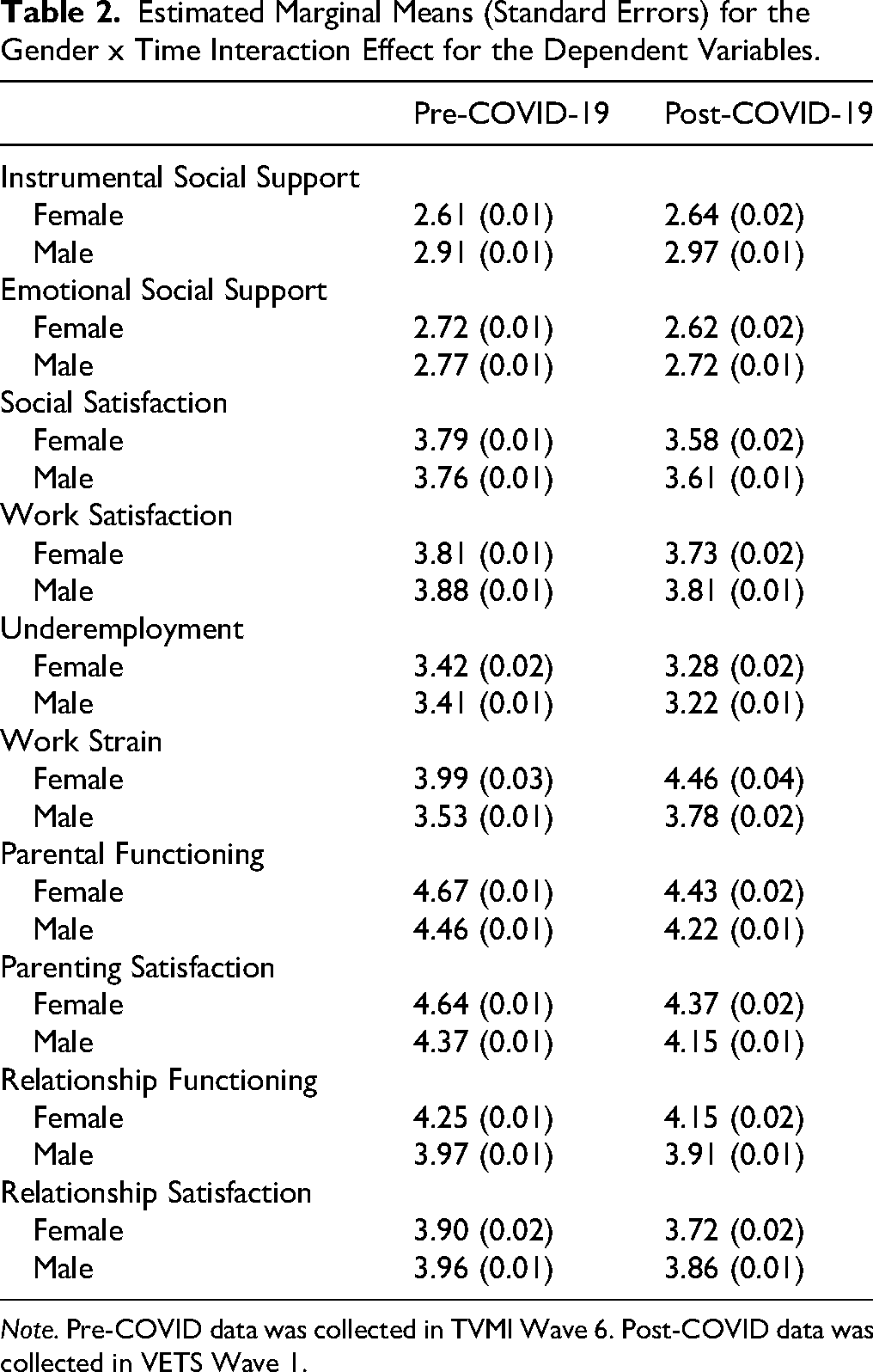
Note. Pre-COVID data was collected in TVMI Wave 6. Post-COVID data was collected in VETS Wave 1.
General Linear Mixed Model Analyses with the Dependent Variables.

Estimated marginal means [EMM] analyses found that there was a slight increase from pre-to-post COVID-19 in instrumental social support for females (EMM = 2.61 [SE = 0.01] and EMM = 2.64 [SE = 0.02]) and for males (EMM = 2.91 [SE = 0.01] and EMM = 2.97 [SE = 0.01]). Social support satisfaction scores decreased slightly from pre-to-post COVID-19 for females (EMM = 2.72 [SE = 0.01] and EMM = 2.62 [SE = 0.02]) and males (EMM = 2.77 [SE = 0.01] and EMM = 2.72 [SE = 0.01]). On average, males reported significantly higher instrumental social support and social support satisfaction than females. The significant effect for time indicates that males and females had significantly higher scores post-COVID-19 compared to pre-COVID-19 on instrumental social support and significantly lower scores post-COVID-19 compared to pre-COVID-19 for social support satisfaction. The significant effect of gender x time interaction indicated that male veterans increased slightly more than females in their reports of receiving instrumental social support post-COVID-19.
While there was no significant effect for gender (p = 0.98), there were significant effects for time and for the gender x time interaction (both p's < 0.001) for socialsupport satisfaction. Mean social satisfaction scores decreased from pre- to post-COVID-19 for both females (EMM = 3.79 [SE = 0.01]) and (EMM = 3.58 [SE = 0.02]) and males (EMM = 3.76 [SE = 0.01]) and (EMM = 3.61 [SE = 0.01]). The significant effect of the gender x time interaction indicated that females had a significantly steeper decrease in social satisfaction scores than males.
Changes in Employment Stress
Three aspects of employment stress were examined. Participants were asked how satisfied they were with their employment, from “very dissatisfied” to “very satisfied.” GLMM indicated significant main effects of gender and time for work satisfaction (p's < 0.001), but no significant interaction effect of gender x time (p = 0.62). Both before and after COVID-19, females had significantly lower work satisfaction scores (EMM = 3.81 [SE = 0.01] and EMM = 3.73 [SE = 0.02]) than males (EMM = 3.88 [SE = 0.01] and EMM = 3.81 [SE = 0.01]). A significant effect for time indicated that pre-COVID work satisfaction scores were significantly higher than post-COVID-19 scores for both female and male veterans.
Respondents were next asked to indicate how often they experienced work strain (i.e., being emotionally drained by work) from “never” to “every day.” GLMM analyses showed significant effects for gender, time, and gender x time (all p's < 0.001). In terms of main effects, females had significantly higher work strain scores both before and after COVID-19 (EMM = 3.99 [SE = 0.03] and EMM = 4.46 [SE = 0.04]) than males (EMM = 3.53 [SE = 0.01] and EMM = 3.78 [SE = 0.02]). EMM scores also indicated a significant main effect for time, with post-COVID-19 work strain scores higher than pre-COVID-19 scores. A significant gender x time effect revealed that females had a significantly steeper increase in average work strain scores over time than males.
Participants’ perceptions of underemployment were assessed by asking how strongly they agreed they should be in a better job based on their skills, education, and leadership ability. 42 GLMM analyses revealed significant main effects for gender (p = 0.01) and time (p < 0.001) for the underemployment outcome but no significant effect for the gender x time interaction. In terms of main effects, females had significantly higher underemployment scores on average both before and after COVID-19 (EMM = 3.42 [SE = 0.02] and EMM = 3.28 [SE = 0.02]) than males (EMM = 3.41 [SE = 0.01] and EMM = 3.22 [SE = 0.01]). The significant main effect for time indicated that pre-COVID-19 underemployment scores were significantly higher than post-COVID-19 scores for female and male veterans.
Changes in Parenting Stress
Participants reported on parenting functioning and parenting satisfaction to measure parenting stress. Parenting functioning was assessed by asking respondents how often they could meet their children's needs. Respondents were also asked how satisfied they were with the amount of closeness they had with their children.
The GLMM analyses for parent functioning and parenting satisfaction revealed significant main effects for gender and time (all p's < 0.001) but no significant interaction effect for either outcome. With respect to parent functioning, females had significantly higher scores before and after COVID-19 (EMM = 4.67 [SE = 0.01] and EMM = 4.43 [SE = 0.02]) compared to males (EMM = 4.46 [SE = 0.01] and EMM = 4.22 [SE = 0.01]). The significant time effect indicated that parental functioning scores decreased pre- to post-COVID-19 for females and males. For parenting satisfaction, females had significantly higher scores (EMM = 4.61 [SE = 0.01] and EMM = 4.37 [SE = 0.02]) both before and after COVID-19 compared to their male veteran peers (EMM = 4.37 [SE = 0.01] and EMM = 4.15 [SE = 0.01]). The significant main effect of time indicated that pre-COVID-19 scores were significantly higher than post-COVID-19 scores.
Changes in Relationship Stress
Two aspects of relationship stress were examined among respondents who were married or in a romantic relationship. First, these respondents indicated their level of relationship satisfaction. Second, they were asked about their relationship functioning in terms of emotional closeness, companionship, and division of daily labor within their relationship. Analyses revealed that there were significant effects for gender (both p's < 0.001) and time (both p's < 0.001). The gender x time interaction was significant for relationship satisfaction (p < 0.004) but not for relationship functioning (p = 0.10).
In terms of relationship satisfaction, there was a main effect for gender. On average, female veterans had significantly lower average satisfaction scores (EMM = 3.90 [SE = 0.02] and EMM = 3.72 [SE = 0.02]) before and after COVID-19 compared to their male peers (EMM = 3.96 [SE = 0.01] and EMM = 3.86 [SE = 0.01]). The significant effect of time indicated that post-COVID-19 relationship satisfaction scores were significantly lower on average than pre-COVID-19 satisfaction scores for females and males. The significant gender x time interaction effect indicated that females’ relationship satisfaction scores decreased significantly more steeply than males’ satisfaction scores.
Participants who were married or in a romantic relationship and living together were next asked about their relationship functioning (i.e., the extent to which the respondent provided emotional support to their partner, shared intimate thoughts and feelings, and did their fair share of day-to-day tasks). There was a significant gender effect. On average, females reported that they were significantly more likely to provide emotional support, share intimate thoughts and feelings, and do their fair share of household tasks before and after COVID-19 (EMM = 4.25 [SE = 0.01]), (EMM = 4.16 [SE = 0.02]), and (EMM = 3.91 [SE = 0.01]), respectively, compared to males (EMM = 3.97 [SE = 0.01]). Relationship functioning significantly decreased from pre-to-post-COVID-19 for females. The significant interaction between gender x time indicated that relationship functioning scores decreased significantly more steeply from pre-to-post-COVID-19 for females.
Discussion
This study examined the degree to which self-reported stress levels and satisfaction in various life domains changed from pre- to post-COVID-19 among a large sample of post-9/11 veterans who were followed for approximately 6.5 years after leaving the military. The study hypothesized that from pre- to post-COVID-19, female post-9/11 veterans would report significantly higher levels of stress both before and after COVID-19 relative to their male veteran peers. This hypothesis was partially supported.
Females reported greater employment stress before and after COVID-19 than males. Females also reported that their employment stress significantly increased from pre-to-post COVID-19. In addition, females reported greater underemployment and lower work satisfaction than males. However, work satisfaction declined for females and males from before to after COVID-19, although females saw a steeper decline. Females experienced more stress when balancing work and family life due to taking on more responsibilities at home than males. 43 Women with children are more likely to arrive late to work, leave early, miss work, experience frequent interruptions, and be reprimanded because of their caregiving responsibilities. 44 Much research demonstrates how caregiving work challenges and underemployment take a toll on women's mental and physical health. 45 There are a number of interventions to improve work-family balance, including respite care.
Both female and male veterans reported significant, although slight, increases in instrumental support pre- to post-COVID. On the other hand, both females and males evidenced a significant, although slight, decline in emotional support during that time. As predicted, both before and after COVID-19, male veterans reported significantly higher levels of instrumental and emotional support than their female veteran peers. The importance of social support in physical and emotional health is well established. Developing social networks, dividing household chores equitably, and finding time for enjoyable activities and exercise are all important steps that can be taken to enhance social support. 46
Concerning satisfaction with social support, both genders reported significant, although slight, declines from pre- and post-COVID-19. However, female veterans reported a significantly sharper decline in social satisfaction than males. However, mean satisfaction scores did not differ between males and females before or after COVID-19. The decline in satisfaction with social support is somewhat surprising given that social support increased over time. One possibility is that during much of COVID-19, the type of support received was often not in-person. Some research has found that on-line or remote social support is not valued as much as face-to-face social support. 47
That female veterans would report somewhat lower levels of instrumental and emotional social support than their male peers was not surprising. In general and across the globe, females tend to report lower levels of well-being, 48 greater sadness and anxiety,49,50 and higher stress 51 than males. An examination of the impact of COVID-19 on stress across 26 countries found that women reported significantly higher stress levels than men. 52 This finding may be because women take on approximately 75% of unpaid domestic work, spending more than four hours daily on domestic work compared to one hour for men (Power, 2020).51,53 During COVID-19, there was evidence that working women spent more time caring for the household and providing child care. 54 The lower levels of emotional support reported by women may have to do with them spending more time in isolation than men. During COVID-19, feelings of isolation were much more distressing for females than males. 53 Increasingly, the VA is recognizing the unique needs of female veterans, and many of these needs are explained by the Center for Women Veterans (CWV; https://www.va.gov/womenvet/).
In parenting, female veterans reported significantly higher parent functioning than their male peers before and after COVID-19. However, females and males reported that their parent functioning declined from pre- to post-COVID-19. Females also reported higher parenting satisfaction before and after COVID-19. Pre-COVID-19 satisfaction scores were higher than post-COVID-19 scores for both males and females. Understanding parent functioning is important because parents who report higher levels of parenting competence are more likely to have children who exhibit social skills, cultivate better relationships with peers, and earn higher grades for conduct than children of parents who are less satisfied with their parenting skills. 55 In contrast, parents with lower perceived competence are more likely to engage in problematic parenting. 56 There are several military-specific parenting programs that improve child and family functioning (e.g., After Deployment, Adaptive Parenting Tools [ADAPT]). Providing veterans with free or low-cost programs to enhance family functioning may be particularly helpful during times of significant chronic stress, such as that seen during the pandemic.
On average, female veterans reported lower levels of relationship satisfaction before and after COVID-19 than their male peers, and female veterans saw a steeper decline post-COVID-19. Work-family imbalances, particularly unfairness in household responsibilities for women, are associated with declines in relationship satisfaction.57,58 In this study, females reported being significantly more likely to provide emotional support, share intimate thoughts and feelings, and do their fair share of household tasks before and after COVID-19. Therefore, veterans may benefit from exposure to counseling and evidence-informed programs that promote improved communication and collaboration in parenting relationships. Previous studies have found higher parental functioning among veterans within satisfying relationships. 59 Therefore, supportive relationships with a shared division of labor can be more enjoyable and vital for psychological well-being and effective co-parenting.
A host of support services and programs were made available to veteran mothers during COVID-19. These included online educational and coaching programs, peer support groups for women, and virtual wellness and stress reduction interventions focused on health coaching and mind-body wellness. In addition, while not directly motivated by COVID-19, the VA developed a Whole Health System of Care approach to increase attention to prevention, mental health, and physical health, including a focus on stress reduction. 60
The COVID-19 pandemic also exposed significant weaknesses in the ability of the VA and other healthcare providers to offer telehealth and virtual services. 61 Healthcare providers scrambled to stand up virtual health services. The use of telehealth has increased 12-fold within the VA. 62 However, there are still gaps in coverage, particularly in remote and socially-isolated geographical areas where wireless service remains insufficient. 62 The VA should adopt policies to improve the quality and range of their virtual services. Similarly, it has been recommended that the VA adopt policies that will increase its use of artificial intelligence (AI) to improve veteran healthcare. 63
Limitations and Future Directions
This study's findings should be interpreted cautiously as there were several limitations. While the sample size was relatively large compared to other veteran studies, the degree to which the sample was representative of all veteran parents is limited. Compared to 2017 Department of Defense numbers, the parent veterans in this study were slightly older. Older parents tend to report lower levels of stress than younger parents. Hence, the stress levels reported in this study may be somewhat lower than the overall population of post-9/11 veterans. This study reported on two specific periods, before and after the COVID-19 pandemic, representing life experiences over approximately two years. During that time, numerous uncontrolled variables could have accounted for respondents’ stress and satisfaction levels. In addition, the study did not examine stress and transition outcomes during COVID-19.
Future studies should carefully specify and illuminate the time periods that should be considered as before, during, and after COVID-19. While there are “official” dates that were established for public health purposes, it is not possible to pinpoint with the exact dates of these periods. For example, there is no question that individuals and families continued to be impacted by COVID-19 after the “end” of the pandemic was officially declared. Future research should examine how best to develop stress-coping skills among veterans. The data in this study were gathered using self-report measures, which means the data are susceptible to multiple forms of bias (e.g., recall, social desirability, common method variance). An additional limitation is the use of brief measures of several constructs. Brief measures were required to avoid overburdening surveyed respondents. Future studies could expand the scope of data collection to include various reporters (e.g., spouses, children, friends) to capture a deeper understanding of the stress experiences of post-9/11 veterans.
Footnotes

Ethical Approval and Informed Consent Statements
This study was approved by ICF International, Inc. (approval no. 151636.0.000.00.000) on March 19, 2019 and by Pennsylvania State University Internal Review Board (approval no. 00015732) on September 8, 2020 and Penn State University Internal Review Board (approval no. 00021180) on November 8, 2022. Written informed consent was not required. Informed consent was implied for those responding to the survey.
Author Contributions
DFP, KJM, and KRA designed the study; KJM and KRA managed the literature searches; MMM undertook the statistical analyses; KJM and KRA wrote the first draft of the manuscript.
Funding
The authors disclose receipt of the following financial support for the research, authorship, and/or publication of this article: This work was supported by the Henry M. Jackson Foundation for the Advancement of Military Medicine Medical Research Council [grant number 2021-48709-35659]; The Pew Charitable Trusts [grant number 34406].
Declaration of Conflicting Interests
The authors declared no potential conflicts of interest with respect to the research, authorship, and/or publication of this article.