



Abstract
Introduction
The scientific literature argues the urgent need for adequate tools to assess burnout in human service professionals, however, little progress has been made on this in university teachers in hybrid environments, even though after the pandemic, these work scenarios are predominant.
Objective
To determine the psychometric properties of invariance between male and female teachers of hybrid education in the Spanish Burnout Inventory (SBI).
Method
The anonymous, self-administered SBI was administered to 1060 university teachers in Lima, Peru, from online random sampling. Of the total number of participants, 626 were women (59.1%) and 434 were men (40.9%), with an age range of 22 to 76 years, with a mean of 46.97 and a standard deviation of 10.256. It should be noted that 74.5% of the teachers worked full time. The analysis used the statistical programs AMOS v24, SPSS v26 and R-Project v4.1.2. First, a descriptive analysis of the data was performed, as well as a multivariate normality test of the data. Secondly, confirmatory factor analysis was performed; finally, a factorial invariance test was performed.
Results
Cronbach's alpha of the SBI was 0.827, and for each subscale: Enthusiasm toward the job (0.742), Psychological exhaustion (0.889), Indolence (0.819), Guilt (0.816). According to the fit indicators, the confirmatory factor model is adequate. The results supported configural invariance, metric invariance, scalar invariance, and strict invariance in the male and female groups, although further investigation of some items specific to the indolence factor is needed.
Conclusion
The SBI is a valid instrument to assess burnout in university teachers in hybrid environments. Studies associated with the SBI focus on its psychometric properties, burnout prevalence, related variables, and literature reviews. The validation of the SBI in various countries and service areas is discussed, as well as future implications for intervention in burnout prevention and mastery.
Introduction
The mental health of teachers is a process that deserves special attention; specifically related to the emergence of Burnout Syndrome, whose publications in Scopus date back to 1980. 1 It is a really worrying aspect, as indicated by the study of Davis and collaborators, chronic stress accounts for billions of dollars of annual economic losses and is recognized as a major source of disability and mortality worldwide, 2 while McEwen states that stress can cause imbalance of neural circuits, decision making, anxiety and mood. 3
Recently with the coronavirus disease 2019 (COVID-19) pandemic and the predominant need for virtual or hybrid education, which requires integrating Information and Communication Technologies (ICTs) to pedagogy and disciplinary content, 4 a study that has analyzed the new roles of university teachers in these scenarios found a high prevalence of role stress, with a negative impact on their digital competencies and performance. 5 Other binding studies express that burnout syndrome has been associated with negative work outcomes, but protective factors, such as engagement and resilience, are still not clearly known,5–7 which highlights the need to further deepen the positive factors of subjective well-being and mental health.6,7
The COVID-19 pandemic forced universities to quickly move towards e-learning. 8 Relatedly, one study notes that COVID-19 has had terrible consequences; however, the pandemic has brought some positive effects and opportunities for improvement in higher education and argues that the future of higher education should be hybrid. 9 Another study postulates that some of the education systems that were developed during the COVID-19 pandemic, such as tele-education and ways to stay connected, may offer advantages and will be important to continue and expand after COVID-19, 10 legitimizing the hybrid learning model as a model that supported the continuity of faculty and student education/learning and transcended the COVID-19 pandemic, 11 hence Lapitan and collaborators, 12 caution about the need to develop research to add valuable resources for further hybrid instruction in the post-COVID-19 era in higher education.
The concept of hybrid education is specified as it allows us to better delimit the specificity of this work and avoid confusion with totally virtual education, emphasizing that all participants are teachers who work in hybrid mode in the post-pandemic stage. Hybrid education refers to an educational approach that combines elements of face-to-face and online teaching. This involves students participating in both classroom and online activities. In a hybrid education model, students can attend physical classes on campus and, at the same time, access online educational resources or participate in online activities to complement their learning, simultaneously coexist with virtually connected students and students in a physical classroom and interact synchronously and asynchronously with each other. The three institutions studied developed this approach through Hyflex classrooms and learning management platforms such as Moodle, Canvas, and Blackboard.
Hyflex classrooms (also known as hybrid classrooms or flexible classrooms) are educational spaces designed to offer a flexible learning experience, 13 that combines face-to-face teaching with online teaching, 14 in response to COVID-19 there was an adoption of HyFlex classrooms in higher education as explained by Kohnke and Moorhouse in 2021 15 ; these classrooms are equipped with advanced technology that allows students and faculty to interact effectively regardless of whether they are on campus or online.
As the study by Pérez-Sanagustín and collaborators in 2017 16 points out, higher education entities have begun to explore and experiment with hybrid learning initiatives and in this context, the concept of hybrid is understood in a broad sense, including any initiative, strategy or learning model that integrates technologies into a traditional or face-to-face curriculum, “the concept of Hybrid Education may serve both as a guideline for the utilization of digital technologies in education and as a methodology for fostering new forms of participation, inclusion and engagement in society” 17 (p.225).
From the above the present study assumes as an essential precept that the hybrid classroom approach is concretized in the integration of the virtual and face-to-face field, 18 in this sense, the hybrid classroom is considered a design for the new normal after the COVID-19 pandemic to allow physical and online attendees to interact during operational sessions 19 thus expressing technology-based teaching, interactive online and offline technological teaching method and students’ learning experience, being a new teaching model that will undoubtedly become the new normal of the educational model in the future. 20
During COVID-19 the diagnosis of Burnout Syndrome derived from virtual work in teachers increased, it was found that many times these professionals had to submit to virtuality suddenly and did not have the technical preparation to deal with this modality, causing emotional and physical exhaustion. 21 The inadequate use of technological tools caused work overload and burnout in university teachers, 22 especially if it is considered that in these professional's work stress is positively correlated with emotional exhaustion..23,24 This is demonstrated by a recent study that highlights the urgent need for adequate tools to assess burnout. 25
A recent study has revealed challenges for Latin American university teachers in the face of digital teaching: “ICT strategies for formative assessment in virtual environments, promotion of learning communities and self-management of positive mental health” (p.88) 5 ; while recognizing the need to boost positive coping styles; psychological empowerment, creative self-efficacy, self-confidence, and motivation for learning in the workplace 26 to promote relevant learning. 27
Given the priority of the psychological well-being of university teachers in the framework of their digital competencies and educational innovation with ICT5,28 especially when a low level of positive mental health has been found in professional teaching communities in Latin America, 29 and taking into account the relationship between teachers’ mental health and burnout, 30 as well as between digital competencies and burnout, 31 it is necessary to rethink mechanisms to prevent or reduce burnout in teachers 30 and a starting point is to achieve a good assessment, so the present study bets on one of the diagnostic techniques that has proven its high effectiveness in the Latin American context: Spanish Burnout Inventory (SBI).32,33
The SBI32,33 is one of the most widely applied questionnaires to assess burnout in Latin America (with multiple scientific evidences showing good psychometric properties of the instrument in this context), it has recently been validated and applied in different countries such as: Argentina, Brazil, Chile, Colombia, Costa Rica, France, Italy, and Spain in general and a sample of Valencia, Poland, Puerto Rico, Mexico, Peru, Portugal, Uruguay, India, Ecuador, and in 7 languages. 34 However, it is required to deepen the psychometric characteristics of this questionnaire in university teachers working in hybrid education, considering that there are very few advances in this regard.
In this paper, we define the burnout syndrome from the epistemological position of Pedro Gil-Montes as a process based on four factors: Enthusiasm toward the job, psychological exhaustion, indolence, and guilt.32,33 This author states that enthusiasm for work is related to the person's desire to achieve work goals as a source of personal satisfaction, psychological burnout is related to the appearance of emotional and physical exhaustion as a result of daily dealings with people who present or cause difficulties, indolence is related to the appearance of negative attitudes of indifference and cynicism towards users of the workplace, and guilt to the presence of feelings of guilt for one's own behavior and negative attitudes towards coworkers.32,33
Gil-Monte et al 34 note that studies of burnout prevalence in educators have concluded that burnout in teachers is a serious problem that has increased during the COVID-19 pandemic35,36 due to concerns about unsafe school conditions and the pressure of virtual work, 37 as well as some working conditions in education 38 have made teaching a profession with a high risk of developing this syndrome. The findings of a systematic review showed that the overall burnout rate approached 37% in university teachers. 35
This section concludes by stating the objective and hypotheses of the study. This hypothesis is subsequently taken up in the scientific discussion section for its acceptance or rejection. Objective: To determine the psychometric properties of invariance between male and female teachers of hybrid education in the SBI. Hypothesis: There is invariance between male and female teachers of hybrid education in the SBI. From the original question, it is investigated whether there are significant differences in the SBI between the participating subjects, or if, on the contrary, the SBI is consistent or invariant between both groups, i.e., there are no significant differences. Invariance in this context suggests that SBI remains constant or similar between the male and female teacher groups in the context of hybrid education.
Methods
Study Design, Locations, and Participants
A cross-sectional study was carried out in the city of Lima, Peru; with university teachers from several universities who voluntarily decided to participate in the study, sponsored by the Education Studies Network. Data collection took place between August and October 2022, by means of an online, anonymous, self-administered questionnaire. The main inclusion criteria consisted of willingness to participate and being active for at least 1 year as a university professor in hybrid environments.
Sample Characteristics
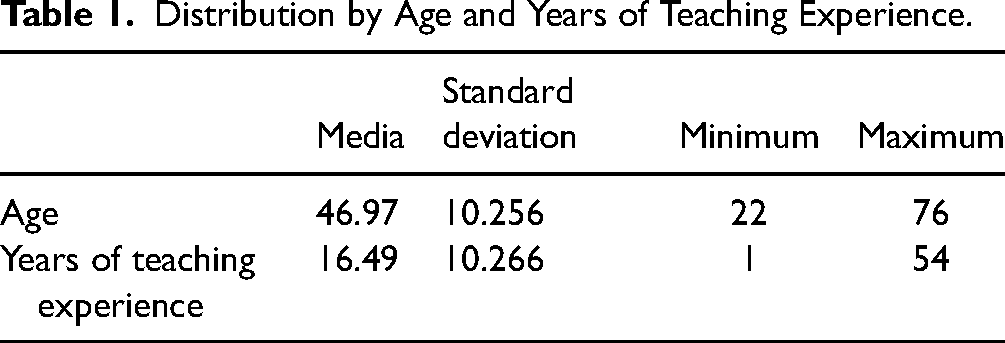
The study sample consisted of 1060 university teachers with an average age of 46.97 years and an average of 16.50 years of experience (see Table 1).
Distribution by Age and Years of Teaching Experience.
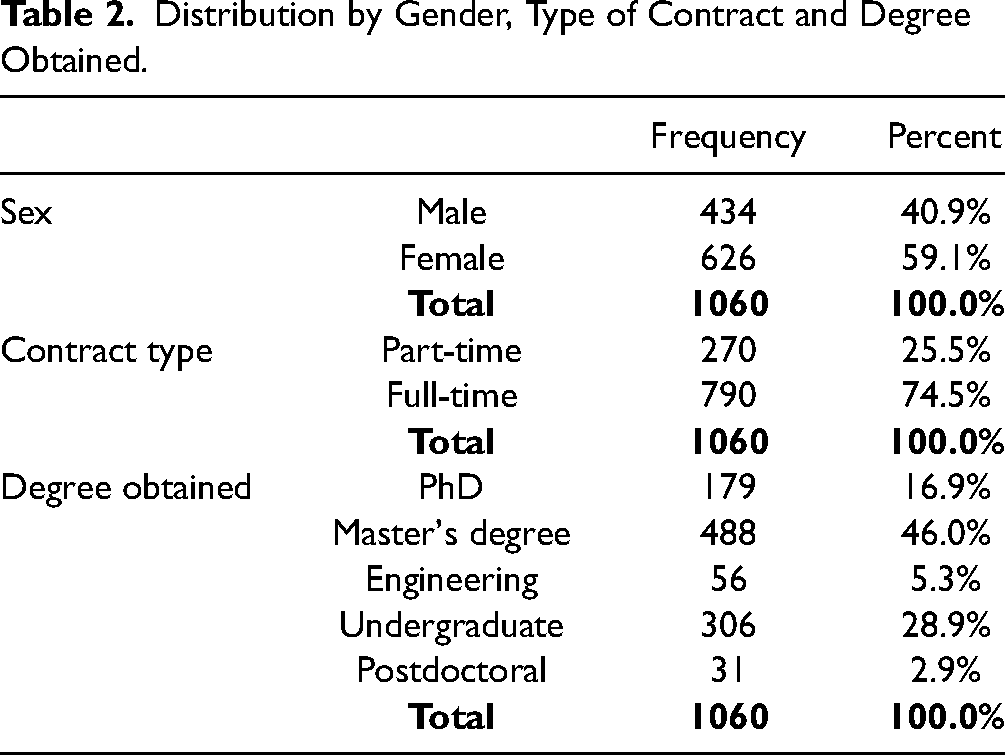
In relation to gender, 40.9% of the participants were men and 59.1% were women; in relation to the type of employment relationship at the university, the highest percentage declared themselves full-time professors (74.5%), and the highest degree obtained was a master's degree (46%), with a lower number of PhDs (see Table 2).
Distribution by Gender, Type of Contract and Degree Obtained.
Variable and Instrument
The variable studied was burnout based on the theoretical model developed by Gil-Monte where he explains that it is a response to chronic work stress that derives mainly from problematic interpersonal work relationships characterized by four symptoms: (1) cognitive impairment (i.e., low enthusiasm for work), (2) emotional impairment (i.e., psychological exhaustion), (3) attitudes and behaviors of indifference, indolence, withdrawal and, in some cases, (4) feelings of guilt. The SBI consists of 20 items divided into four subscales: (1) Enthusiasm toward the job: the individual's desire to achieve goals at work because it is a source of personal pleasure, (2) Psychological exhaustion: occurrence of emotional and physical exhaustion. (3) Indolence: Appearance of negative attitudes of indifference and cynicism towards students and staff of the institution (4) Guilt: Appearance of feelings of guilt for negative attitudes developed at work, especially towards people with whom he/she establishes working relationships. This is a new dimension added to the concept of burnout. The distribution of items for each dimension is as follows: Enthusiasm for work (5 items), psychological burnout (4 items), indolence (6 items), guilt (5 items).
The instrument has 20 statements related to work and the consequences derived from this relationship for each teacher as a professional and as a person. Teachers should think about how often these ideas arise or how often they feel them, considering the scale presented below, where they should mark the alternative (the number) that best fits their situation: 0 = Never, 1 = Rarely: A few times a year, 2 = Sometimes: A few times a month, 3 = Frequently: A few times a week, 4 = Very often: Every day.
The following are some examples of the items used for the scale, (1) enthusiasm toward the job: “My work is a stimulating challenge” or “I see my work as a source of personal fulfillment,” among others, for (2) Psychological exhaustion: “I think I am overworked,” for (3) Indolence: “I don't feel like attending to some students.” (4) Guilt: “I feel guilty about some of my attitudes at work.”
The interpretation of the results was performed following the guidelines validated in the Manual for the Evaluation of the Burnout Syndrome by the author: Pedro Gil-Monte, with scales available in: Spain, Argentina, Chile, Colombia, Costa Rica, Mexico, Peru, Puerto Rico. Indexed by “TEA Ediciones” and has also been indexed in “APA PsycTests”; this database is an authoritative source of structured information on tests of interest to a variety of fields, produced by the American Psychological Association. 33
The first two paragraphs of the discussion section of the manuscript have been devoted to examining the psychometric properties of the instrument in previous studies in various countries (more than 10 previous studies could be analyzed).
Statistical Analyses
The analysis was carried out using the statistical programs AMOS v24, SPSS v26, and R-Project v4.1.2. It is important to note that there are no missing values or outliers in the study. First, the descriptive analysis of the data was performed, as well as the multivariate normality test of the data which resulted that the data do not approximate a multivariate normal distribution. Second, confirmatory factor analysis (CFA) was performed using the asymptotic free distribution estimation method, due to the violation of the multivariate normality assumption in the data 24 However, future studies could compare different estimation methods for data with non-normal distributions and analyze the stability of the results. The fit indices used in the CFA estimation were: Normed Fit Index (NFI), Goodness of Fit Index (GFI), Comparative Fit Index (CFI), Tucker-Lewis Index (TLI), Incremental Fit Index, Adjusted GFI, Relative Fit Index, Root Mean Square Error of Approximation (RMSEA), and root mean square residual. 39
Finally, a factorial invariance test was performed using the procedure suggested by Dimitrov, 40 among the sex of the respondents, where: M1. Configuration invariance (Baseline), M2. Metric or weak invariance (restricted λ), M3. Scalar or strong invariance (restricted λ and θ), and M4. Strict invariance (λ, θ, τ restricted). Due to the sensitivity of the χ2 statistic to sample size, the literature recommends using the CFI increment (< .01) as a criterion for comparison between models. In this sense, to conclude on the level of invariance, the fit of the nested models was compared by the difference between the CFI values. If the value of the difference between two nested models is less than .01, i.e., M2 vs M1 for metric invariance, M3 vs M2 for scalar invariance, or M4 vs M3 for strict invariance, the results support invariance for the groups under analysis. 41 It is important to note that in the present study, the SBI has not been adapted, since the main objective was to analyze its invariance and for this purpose the original version was used, which already has a standardized scale in Peru.
Ethical Statement
The study design and consent form were reviewed and approved by the Ethics Committee of the Network for Education Studies (REED; Project 0042-171006-019/2017, number 221028221). Participants received detailed information about the research project and were enrolled free to voluntarily choose whether to participate in the study. To guarantee the anonymity and confidentiality of the participants, were eliminated data such as emails, names, university name, that could reveal the identity of the professors and institutions involved. The study was carried out with a sample of 1060 teachers working in a hybrid manner, and all treatment was performed online. The procedure is detailed as follows:
Results
The SBI had a high internal consistency in all its dimensions, which proves its validity for this type of sample (see Table 3). These results are like the findings found in other studies and legitimize the reliability of the SBI in different countries and service personnel; this will be discussed in the discussion section of the study.
Instrument Reliability Measures.

The CFA was performed using the asymptotic free distribution estimation method because the data did not present multivariate normality (Table 4).
Multivariate Normality Test of the Data.

The bivariate correlations between the SBI items are presented below, which can help to understand how they relate or influence each other, referring to measures of the relationship or association between items in the data set. The correlations between items range from −0.21 to 0.75 (see Figure 1).

Bivariate correlations between Spanish Burnout Inventory (SBI) items.
The SBI measurement model confirms its 4 dimensions with unidimensional factor loadings (see Figure 2).
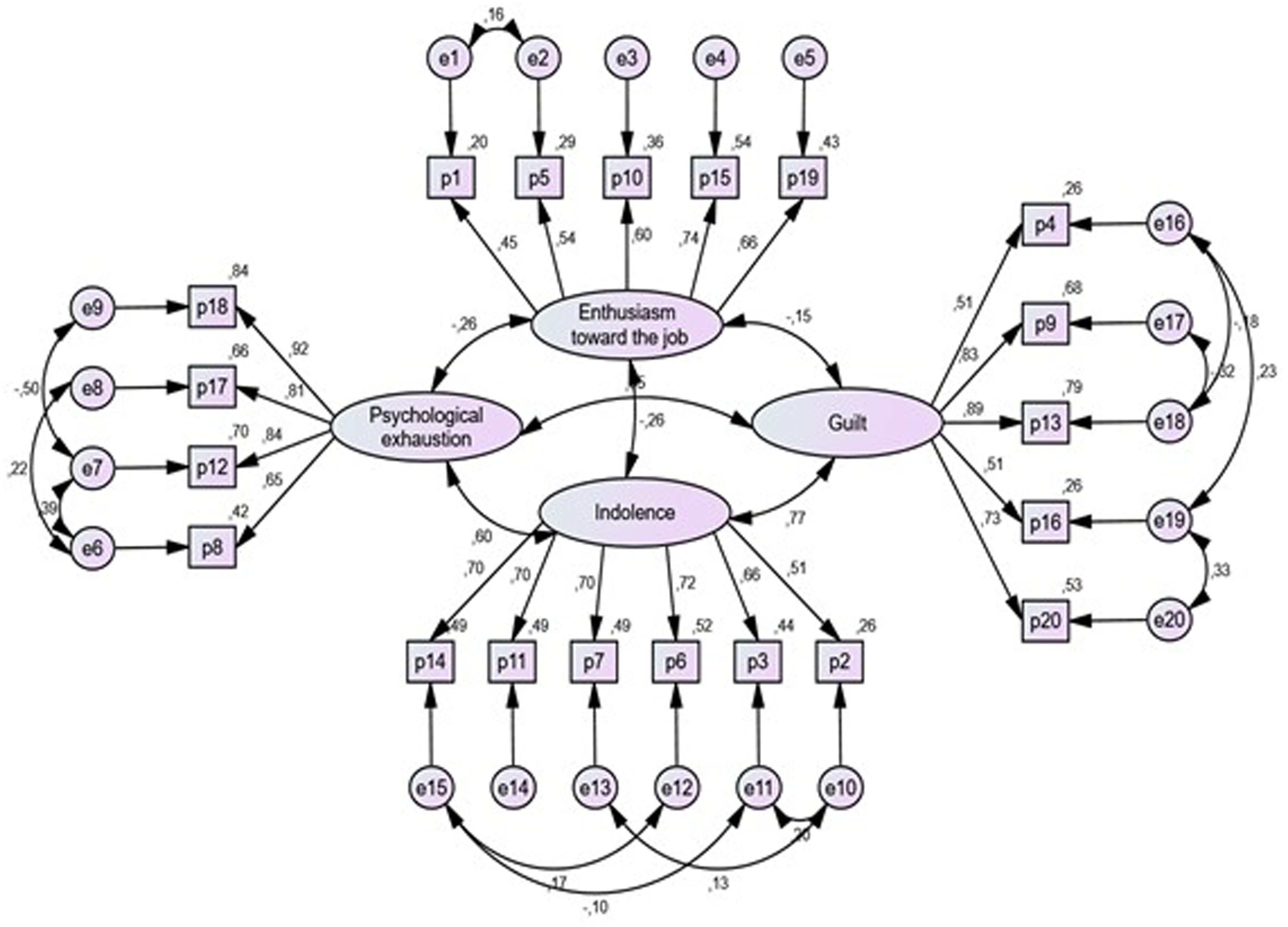
Spanish Burnout Inventory (SBI) measurement model.
An additional procedure consisted of dividing the total sample into two random subsamples. An exploratory factor analysis was performed with subsample 1 and a CFA was performed with subsample 2, and in both samples the factor structure fit adequately.
It is observed that all coefficients are significant and directly related since all coefficients have a positive sign (see Table 5).
Coefficients of the CFA of SBI.

Abbreviations: CFA, confirmatory factor analysis; SBI, Spanish Burnout Inventory.
All covariance relationships are significant, which means that indirectly there are variables that share something in common through their random errors (Table 6).
Covariance Relationships in the CFA of the SBI.

Abbreviations: CFA, confirmatory factor analysis; SBI, Spanish Burnout Inventory.
According to the fit indicators, it can be said that the confirmatory factor model is adequate since it meets all the goodness-of-fit indicators (see Table 7).
Goodness-of-fit Indicators of the Confirmatory Factor Analysis of the SBI.

* Byrme 41
** Browne and Cudeck 42
Invariance Test for Respondent's Sex
A multigroup CFA was performed to test the measurement invariance of the SBI. Initially, the configuration, baseline, or free invariance model (M1), which proposes that the SBI presents a 4-factor structure in both groups (male and female), was tested and the factor loadings, intercepts, and error variances were allowed to be estimated freely. The metric or weak invariance model (M2) consists of restricting the factor loadings to be equal between male and female sex which showed a good fit (CFI = 0.962 and RMSEA = 0.031), when compared to M1, the model is similar for the male and female sex since the ΔCFI (−0.003 ≤ 0.01) and ΔRMSEA (0.000 ≤ 0.015) meet the criteria proposed by Cheung & Rensvold (2002) that guarantee sex invariance when comparing M2 vs M1—The value of the difference between the CFI indices of the configural model and the metric model (ΔCFI = −0.003) resulted in less than 0.01. The test of the scalar or strong invariance model (M3), in which the factor loadings and intercepts were restricted to be equal in both groups (male and female) showed a good fit (CFI = 0.952 and RMSEA = 0.034), when compared to M2, the model is not different for both sexes, since the ΔCFI indicators (−0.010 ≤ 0.01) and ΔRMSEA (0.003 ≤ 0.015) meet the criteria proposed by Cheung & Rensvold (2002) that guarantee sex invariance when comparing M3 vs M2. The value of the difference between the CFI indices of the metric model and the scalar model (ΔCFI = −0.010) was less than 0.01. For its part, the strict invariance model (M4), in which factor loadings, intercepts and error variances were restricted, also showed a good fit (CFI = 0.920 and RMSEA = 0.042), and when compared to M3, the model is not different for both sexes, since the ΔCFI (−0.032 ≤ 0.01) and ΔRMSEA (0.008 ≤ 0.015) meet the criteria proposed by Cheung & Rensvold (2002) that guarantee sex invariance when comparing M4 vs M3 The value of the difference between the CFI indices of the scalar model and the strict or residual model (ΔCFI = −0.032) resulted less than 0.01. In summary, it is concluded that the SBI scores are comparable between the group (male and female) and the change in one unit would be equivalent between them Table 8.
Invariance Test Metrics.

* 43 Abbreviations: CFI, Comparative Fit Index; RMSEA, root mean square error of approximation.
Chi-square is strongly influenced by the sample size, so that large and even medium-sized samples it is always significant. For this reason, it is recommended in the literature to use the CFI increment (< 0.01) as a criterion for comparison between models, as verified by Brian & Holmes Finch. 44
Finally, the standardized factor loadings of the SBI were visualized to examine in more detail the behavior of each item of the questionnaire by comparing the groups of men and women (see Figure 3).
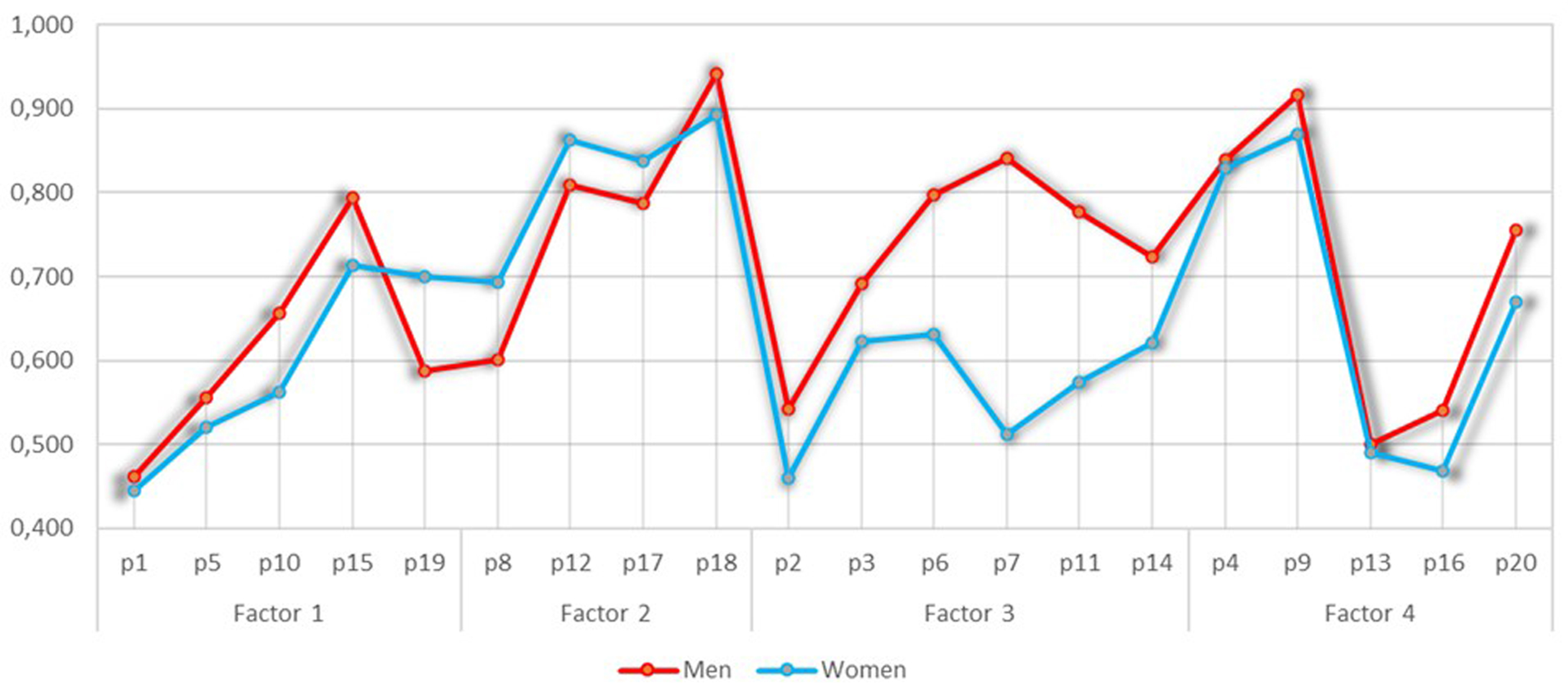
Standardized factorial loadings of the Spanish Burnout Inventory (SBI).
In general, there is invariance between the male and female sexes; however, the greatest differences in factor loadings are seen in items 6, item 7, and item 11. It is important to note that these three items belong to the indolence factor, so it would be interesting in future studies to continue examining this aspect so that it can be verified that at the level of scalar and strict invariance, the differences observed in the scores really reflect genuine differences in the level of indolence, and are not distorted by gender-related biases, nor are they influenced by any type of random variability or errors in the responses.
Discussion
In order to discuss the psychometric properties of the SBI and its invariance, as an answer to the main hypothesis of the study, works that have applied the SBI in countries such as: Colombia, Germany, Spain, Portugal, Brazil, Mexico, Chile, Italy have been carefully selected and a recent work entitled “Factor Structure and Measurement Invariance of the SBI Among Professionals Across 17 Countries and Regions” has been added, which includes participants from Peru. 34
For the discussion section, priority was given to studies directly associated with the topic indexed in Scopus, the scientific literature shows a sustained advance in research that has evaluated the psychometric properties of the SBI or “CESQT.” Among the studies that examine the psychometric properties of the SBI, some are detailed with their respective results to establish a comparison with the results found in this study. Borrero et al 45 developed a recent study with the aim of evaluating the validity and reliability of the SBI in 234 surgical medical specialists, and obtained a high reliability of 0.82, and the CFA showed an acceptable model fit. Prior to that several studies that examined the psychometric properties of the SBI explicitly state that Cronbach's alpha values for all subscales were higher than 0.70,46–49 a result coincident with the present study.
At the same time, there are also multiple investigations showing that the four-factor model obtained a good data fit and good internal consistency, in public administration employees 50 RMSEA = 0.062, GFI = 0.910, NFI = 0.915, CFI = 0.940, and AIC = 606.358, in Mexican physicians, GFI = 0.83, RMSEA = 0.061, NNFI = 0.90, CFI = 0.92, PNFI = 0.65., 51 in 211 secondary school teachers and 133 nurses in a general hospital in Lisbon, Portugal, 52 in 714 teachers working in schools in the metropolitan area of the city of Porto Alegre, South Brazil, 53 in 698 elementary school teachers in public schools in Mexico, 37 in 505 Mexican teachers of Secondary Education, 54 in 720 staff nurses of two Spanish general hospitals, 55 in 277 Chilean professionals working with people with physical disabilities, 56 in Italian health professionals −453 nursing professionals and 242 physicians-, 57 in service professionals, 58 in 391 nurses employed in three hospitals in the Northern Region of Italy. 59
Another group of studies, although not exactly dedicated to the validation of the SBI, do apply the instrument and show aspects of great relevance, especially for future lines of research and intervention in burnout; such is the case of Goebel and Carlotto, 60 one of the studies that is most directly related to this research by addressing burnout in distance teachers; 310 distance teachers (professors and tutors) working in higher education in public and private universities throughout Brazil participated in the study. This study aimed to identify the predictive power of sociodemographic, occupational, and psychosocial variables (occupational stressors, contextual stressors, and dimensions of technostress) on the dimensions of Burnout Syndrome in distance education teachers. The results obtained identified predictor models. In the “Illusion for Work” dimension, the variable with the greatest explanatory power was technostress/incredulity; in the “Psychic Burnout” dimension, it was work-family conflict; in “Indolence”, work organization; and for the “Guilt” dimension, the variable was role overload. The results suggest the need for interventions, mainly in the organization of teaching work in terms of occupational stressors and preventive actions around technical and relational training and the importance of work-family life balance.
Another study carried out by Carlotto and collaborators in 2012 61 aimed to identify the prevalence of Burnout Syndrome and its association with psychosocial risk factors in 63 teachers at special schools in Brazil. The results show a prevalence of 30.6% of teachers with Burnout Profile 1 of Burnout, considered as a moderate level of the syndrome, and 14.3% of Profile 2, defined as a more severe form of Burnout. Profile 1 was associated with greater role conflict and inequality and Profile 2 with role conflict, work overload, inequality, job dissatisfaction and health problems. Likewise, Braun and Carlotto 49 made a comparative study of Burnout syndrome, between special education and regular education teachers; the results point to the need for different interventions that consider the peculiarities of the groups investigated, while emphasizing public policies for the prevention of psych emotional problems. 62 Along the same lines Reyes-Oyola et al 63 conclude that it is necessary to design and implement training programs aimed at explaining what work-related Burnout Syndrome is, why and how it appears, its evolution and symptoms, as well as prevention and intervention strategies.
Likewise, Tejada and Gómez 64 explain that age, work as an employee and exclusive dedication were the main factors associated with the presence of the syndrome in their study population, while another study 65 concludes that personality style is related to burnout, with teachers with an Insecure Type personality scoring higher on the Indolence and Guilt scales; and the Enterprising Type have the highest Motivation for Work and the lowest on the Indolence scale; thus, research supports the development of intervention programs that favor social support and the reconciliation of family life, as well as the training of skills related to emotional intelligence, such as communication and conflict resolution. 66
Finally, a singular study is highlighted in a meta-analysis 67 which concluded that the fundamental structures presented in the theoretical sections were validated and, in general, the results indicate that the SBI has adequate psychometric properties for the study of Burnout. The main recommendation for future studies is to evaluate the levels of skewness in each item of the SBI to select the best estimation method for the CFA.
In relation to measurement invariance, a related study in Latin American university teachers found that role stress was similar in women and men, 5 another previous study of structural analysis and measurement invariance of the MBI-GS in Peruvian workers, found that “measurement properties remained satisfactorily invariant in the tested invariance criteria, i.e., configurational, metric and scalar between men and women” 68 (p.15), although burnout was not measured with the SBI, it gives important evidence of the interpretation of burnout in men and women; 2 years later in the same journal, a more direct study was published that was able to measure burnout with the SBI, this study argued that to test whether the factor structure was equivalent between the sample of men and women, the nested models procedure was followed.
In this sense, they proved that the configural model presented a good fit to the data, metric invariance was also tested, and finally the results supported strong invariance and strict invariance, respectively, so that the factorial model presents measurement invariance for the two samples, 69 These findings integrated to the results of the present study show the relevance of the SBI, especially in teachers who work in the educational cyberspace, since hybrid and virtual education is already a daily reality in many Latin American universities. 70
Conclusion
The statistical and scientific evidence allows affirming that the SBI is a valid instrument to assess burnout in university teachers working in hybrid environments, the current study reaffirms the 4-dimensional model: Enthusiasm toward the job (5 items), Psychological exhaustion (4 items), indolence (6 items), guilt (5 items), the results supported configural invariance, metric invariance, scalar invariance and strict invariance in the male and female groups.
In relation to the analysis of invariance in previous studies, the greatest emphasis has been placed on the configural invariance (configurational level), showing that the theoretical structure is the same in the different groups and on the other hand on the metric or weak invariance, showing in general that the factor loadings are the same in the different groups, however, there are fewer studies on scalar invariance and strict invariance, which show greater robustness, stability, and consistency of the instrument, which calls for future research that can examine these levels.
Four main types of studies around the SBI are revealed, a significant part of them have been devoted to examining its psychometric characteristics, a second group aimed to assess the prevalence of burnout, a third group examines predictors, protective factors, and other variables associated with burnout, and a fourth smaller group are review studies such as systematic reviews, meta-analyses, bibliometric studies, comprehensive reviews, etc.
The selected studies show the validation of the SBI in several countries and in three main areas: (1) health area (physicians, nurses, psychiatrists, specialists in intellectual disability, among others), (2) education area (primary, secondary, special education, physical education, university education, with less presence of studies in hybrid learning environments), (3) other human interaction services (public administration, human services, police, etc.).
Regarding the recommendations systematized in favor of intervention for the prevention and control of burnout, the need to train teachers in technostress, work-family balance, work organization and role management, occupational stressors, job satisfaction, and positive mental health is noted. The design of contextualized interventions that consider the peculiarities, needs, and potential of each human group is required, as well as public and institutional policies for the prevention of psych-emotional problems that consider factors such as age, type of work relationship and dedication to work, in order to develop intervention programs that favor social support, reconciliation of family life, and training in soft skills such as emotional intelligence, communication and conflict resolution.
Footnotes
Declaration of Conflicting Interests
The author(s) declared no potential conflicts of interest with respect to the research, authorship, and/or publication of this article.
Funding
The author(s) disclosed receipt of the following financial support for the research, authorship, and/or publication of this article.

Acknowledgments
The authors thank San Ignacio de Loyola University for all the support provided.