




Abstract

It is not the strongest of the species that survives, nor the most intelligent, but the one most responsive to change.
—Charles Darwin
The global health landscape is on the cusp of a significant transformation, driven by the rapid integration of digital technologies and artificial intelligence (AI). In healthcare, medtech and pharma, an inflection point has been reached: the choice now lies between transforming systems and continuing down the road of incremental improvement. As this transformation unfolds, it is crucial for addressing the urgency for real, impactful change rather than small, marginal advances.
—Andy Moose
Head of Health and Wellness
World Economic Forum
The future of healthcare lies at the intersection of technology, innovation, and patient-centric care. Artificial intelligence (AI) in health faces dual challenges. First, the naturally sensitive nature of health, where the protection of individuals is utmost, leads to a highly risk-averse environment. Second, societal distrust toward AI, as highlighted by consumer sentimentality surveys, presents an impediment.
It is vital to remain focused on the decisive goal: improving health outcomes for all, irrespective of geographical, socio-economic, or cultural barriers. The path forward requires innovation, partnership, and a resolute pledge to using technology for the larger good.
AI is restructuring critical segments across the globe. AI is the most quickly evolving science affecting the majority of human happenings in a rather advantageous way. Medicine is one of the sciences that has been beneficially affected by the improved accuracy of diagnosis, epidemiology, staging, severity, prognosis, and treatment of numerous diseases.
AI in Healthcare
AI is a group of know-how that enables machines to perform tasks that typically rely on human intelligence, such as learning, solving problems, and making decisions. Central to the power of AI in healthcare are algorithms that analyze and process text, images, audio, and video to detect patterns and connections.
Types of algorithms include
Deep learning algorithms: Specialize in image and speech recognition. Natural language processing (NLP) algorithms: Work to comprehend and generate language. Computer vision algorithms: Interpret data to analyze objects, recognize faces, and other visual tasks. Reinforcement learning algorithms: Used to train agents (or autonomous systems) in making chronological decisions.
AI algorithms can potentially transmute, redefine, and mechanize multiple aspects of the healthcare industry.
Applications of AI in Medicine
Benefits of AI in the Healthcare Sector
AI brings several advantages to the healthcare industry by improving accuracy by reducing human error, faster decisions in planning treatment with risk assessment, and lower costs by reducing operational costs.
Pros of AI in Healthcare
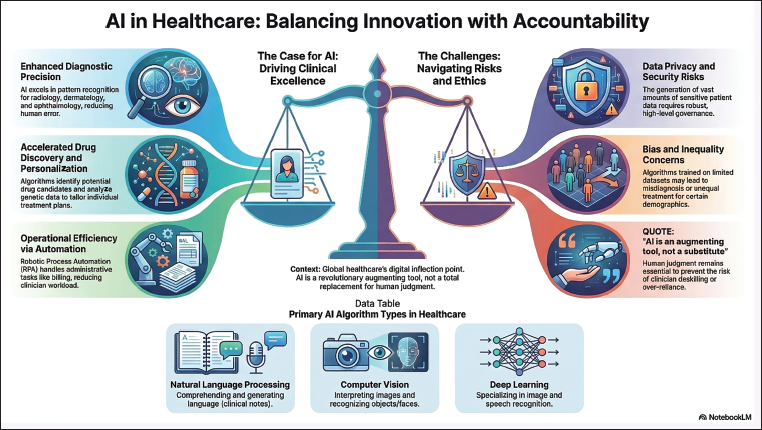
AI systems are powering the future of healthcare in multiple domains, from diagnosis to delivery. Early disease detection and prediction of conditions such as sepsis, cardiac events, and disease progression, enable preventive and precision medicine. It has a role in remote consultations, remote monitoring by the data provided by AI-powered wearable devices and sensors. AI excels in pattern recognition with high accuracy, especially in radiology (computed tomography (CT), magnetic resonance imaging (MRI), X-ray), dermatology (skin lesion analysis), and ophthalmology (diabetic retinopathy (DR), retinopathy of prematurity (ROP) screening). AI reduces human error and inter-observer variability.
AI identifies potential drug candidates and expedites drug discovery. AI can help in planning personalized treatment plans by using AI-powered apps that analyze clinical, lifestyle, and genetic data. AI can analyze patient data and environmental factors to predict disease outbreaks. AI uses robotic process automation (RPA) to streamline administrative tasks, including billing, appointment scheduling, and patient inquiries, which reduces clinician administrative burden. AI helps in decision support for clinicians with clinical decision support systems (CDSS), evidence-based recommendations at the point of care, especially valuable in resource-limited settings.
Cons of AI in Healthcare
Data privacy and security risk are prime concerns, as there is a generation of vast sensitive patient data. Data may lead to unequal treatment, misdiagnosis, or underdiagnosis of certain demographic groups because of bias and fairness concerns. AI requires navigating complex regulatory frameworks. Interoperability issues between existing healthcare systems and emerging data platforms. What or who is responsible in the event of an error leading to reliability and accountability concerns? Resistance to acceptance by healthcare workers and the general public. The high cost of development and implementation adds to the reluctance to implement AI in resource-poor settings. Ethical concerns, cybersecurity issues, and data quality issues add to the cons of AI use in healthcare settings. Lack of explainability or difficulty in explaining decisions to patients, along with ethical and medico-legal challenges, hampers the spirit of AI usage. Misuse of personal health data requires strong governance. It requires local validation, as there is limited generalizability, and algorithms trained in one setting may fail in another.
The most important issue would be an over-reliance on technology, leading to the risk of deskilling clinicians. AI errors may be blindly trusted, but human judgment is still essential.
From the Indian healthcare perspective, opportunities are there, as there are large population datasets and a shortage of specialists. AI has the potential to be a revolutionary force, reshaping the future of global healthcare, boosting the effectiveness of treatments, and supporting professionals to better care for patients.
Above is the best use of AI, like creating an infographic of the topic just discussed above by using NotebookLM.
In conclusion, “AI will NOT replace doctors, but doctors who use AI will replace those who don’t.” AI is an augmenting tool, not a substitute. AI should be treated like a junior doctor—fast, tireless, but always supervised.