




Abstract
This article, by using evidence from the old town of Mikindani in Tanzania, explores multivocality in the memorialization of the slavery heritage in Mikindani. It also looks at how multivocality perpetuates dissonance and shapes cultural negotiations and the people’s strategies for coping with violent memories. It employed the notion of heritage dissonance and integrated heritage discourse and a qualitative case-study design. Thirty-three respondents were interviewed and three focus group discussion sessions were held. The findings support the argument that multivocality is an inherent part of heritage that shapes the dissonance regarding what should be conserved and heritage meaning-making processes. Multivocality and the resultant dissonance are further shaped by a complex mix of demographic dynamics, socio-cultural contexts, including religious values, identity struggles, the community’s articulation of the theoretical apparatus, political contexts, including power relations, the local or state political standing, the cultural heritage management (CHM) approach in place, and economic contexts, including the forward-looking nature of the younger people based on the tourist potential of the heritage. Although the resultant dissonance may be passive, it is embedded with the inert social tensions that may not necessarily be harmful to the heritage, but which provide potential spaces for conducting cultural negotiations that strive to defuse the boundaries of identities and the moral superiority–inferiority dogma. This article notes that multivocality should neither be ignored nor evaded, as it could be embraced as a medium for unlocking the sedimentation of a single discourse, understanding and addressing different experiences and expressions and resolving conflicts. The article also provides practical suggestions to the CHM authorities in Mikindani and related sites, as well as suggestions for further research.
Introduction
Cultural heritage might seem to be tranquil but is intrinsically embedded with variant narratives and experiences, also known as multivocality. As a result of the widening of the democratic space, cultural heritage has become a complex political phenomenon and a site of social struggles that generate contests, resistance, opposition, complicity and compliance (Fouéré & Hughes, 2015; Kisic, 2013; Lwoga, 2018; Smith, 2006). Cultural heritage management (CHM) authorities could privilege certain vocals over others, thereby fuelling social conflicts and symbolic violence, including the destruction of heritage (Ashworth et al., 2007). Thus, the multivocality nature of heritage makes the question of how we govern heritage inseparable from the question of how we prevent, mediate and resolve conflicts (Timothy & Boyd, 2006).
The notion of multivocality is post-modernistic and critiques the conventional intellectual discourse, also known as the Authoritative Heritage Discourse (AHD), which ignores heritage dissonance and local communities. In fact, the AHD has for a long time been sustained by the Western materialistic conservation approach, in which the concept of innate and immutable cultural values of heritage are based on monument materiality, authenticity, aesthetics, conservation and expertise. Under the AHD, the cultural importance of heritage is identified by experts and transferred intact to future generations through CHM practices (Kisic, 2013). In contrast, critical heritage scholarship and subsequent policy developments see heritage as a dynamic resource rather than as a static entity, which is in need of preservation. For instance, the UNESCO Declaration on Protection of Cultural Diversity (2001) and the UNESCO Declaration on Safeguarding of Intangible Cultural Heritage (2003) have been key international policy texts, which challenge the AHD. The basis of the discursive shift has come from the aspiration to link heritage to concepts of pluralism and reconciliation (Kisic, 2013).
Past research considered multivocality to represent the dichotomous polarized discourses of agreement versus opposition, with regard to the AHD (Aikawa-Faure, 2009; Buzinde & Santos, 2008; Deutsch, 2011; Wynne-Jones, 2011). This domination-based dogma in explaining the workings of multivocality, however, understates the plurality of society and its heritage and provides a blurred conceptual, normative and pragmatic description of how multivocality could be managed to open space for negotiating the heritage meaning and for resolving conflicts (Barnabas, 2016; Buchholtz, 2005). Exploring multivocality beyond the dichotomous view has been emphasized by Kisic (2013) using the concepts of heritage dissonance and inclusive heritage discourse (IHD) in the European context. These concepts, however, have limitedly been empirically understood in sub-Sahara Africa, where the so-called lay perspectives have long been ignored. Slavery and colonialism are some of the phenomena in sub-Saharan Africa that have divided and brought together many African ethnicities and caused cultural clashes, identity crises and disinherited pasts in favour of the ethnicities in power and the neo-colonialist heritage agenda (Timothy & Nyaupane, 2009). How multivocality is shaped in such contexts and the way in which it could be used to structure egalitarian heritage representation remains unclear.
This article, therefore, deploys heritage dissonance and the IHD to explore multivocality in the context of the memorialization of heritage associated with the slave trade, and how it perpetuates a kind of heritage dissonance that shapes cultural negotiations and the people’s strategies for coping with violent memories. It uses the old town of Mikindani as a case study to ask theoretical questions related to difficult heritage. It also provides useful insights and a basis for rethinking the CHM authorities’ and actors’ approach to the past, and for dealing with diversities. It also offers important insights into the benefits and flaws of CHM practices in post-colonial states, thus making a strong case for multivocality and its tensions in overcoming symbolic violence and creating an understanding of ‘the other’.
Literature Review
Multivocality
Multivocality refers to the various narratives and experiences embedded within cultural heritage (Barnabas, 2016). In CHM, it is expressed using the notion of dissonance. Dissonant heritage was first used by Turnbridge and Ashworth (1996) to refer to particular classes of heritage that are attached to multivocality as a result of different actors assigning contested meanings to heritage and presuming that there are others that have no dissonance. In contrast, the heritage dissonance construct by Kisic (2013) acknowledges that any heritage has multivocality. This is a latent quality of any heritage, which generates active dissonance when new voices are articulated, unlocks the sedimentation of a single discourse and provides space for negotiating the meaning of heritage via diverse actions and agencies. The line between latent and active dissonance is fluid and historical because, in some contexts, dissonance was resolved and may not be active, as long as the CHM processes resulted in a consensus, objectivity or the sedimentation and naturalization of one discourse of multivocality (Kisic, 2013). However, at any time, dissonance may unlock the dominant sediment discourse of multivocality and cause political struggles, tensions, confusions and conflicts.
Inclusive Heritage Discourse
The notion of IHD stems from radical democracy and a pluralist paradigm, which provides space for accepting, understanding, discussing and negotiating multivocality as a form of resistance to hegemonic discourses (rather than destructive to identity) and a condition for the construction of pluralist, multicultural societies based on inclusiveness (Graham et al., 2000). It, thus, considers heritage as a resource from the past that is (re)constructed in the present for use in the present, having extrinsic value for a myriad of identity-based, political, economic, social and cultural goals (Kisic, 2013). In general, it embraces multivocality and dissonance as the quality embedded in heritage.
The IHD opposes the AHD, which relies on the materiality of heritage and contends that heritage values are given features that could be unlocked by experts’ univocality (Smith, 2006). In this way, the AHD has been dominating under the auspices of amnesia, a deliberate disregard for or complete erasure of a particular history or past. For instance, political authorities have used heritage to shape and express the virtues of political ideologies and propaganda (Timothy & Boyd, 2006; Chronis, 2005). Some communities have at some point in history been oppressed by the ethnic groups in power and have had their pasts excluded from the official history in their places (Goudie et al., 1996; Mordue, 2005; Timothy & Boyd, 2006). It is also evident that the multivocality of civil society is often undermined in states suffering from the waves of ethnic conflicts and centralizing powers and are on a nation-building move based on top-down unification (Fouéré & Hughes, 2015; Morales & Mysyk, 2004).
With regard to the slavery heritage, the slave trade has entrenched a binary division between Mainland Africans and the Swahili and the people of Arab Peninsula origin, who have been demonized as ex-slave masters (Fouéré & Hughes, 2015). From the amnesia perspective, the ex-slaves caused ruptures in the transmission of family memories of slavery, thus leading to the partial forgetting and the devising of early strategies for integration within the host society were devised by them to erase the stigma attached to slave descent (Fouéré & Hughes, 2015). Individuals would not like being associated with the generation of ex-slaves because of the stigma and rigid consciousness of the social class that gave slaves the lowest status or nothingness, as social beings. In Zanzibar, for instance, the slave market stories have been distorted to circulate about slave chambers, glorifying abolitionism and exacerbate the essentialization of a bounded racial identity of Arabs that would subsume all slave traders and owners (Fouéré & Hughes, 2015; Wynne-Jones & Walsh, 2010). Similarly, in Bagamoyo town, while some people deliberately decided to forget or interpret events differently in order to erase accounts of slavery that construct their identity within a servitude or cruelty self-definition, others constructed new narratives to suit their touristic commercial agenda. In such communities, memories of slavery would mainly persist as a public secret, hardly articulated, except for the fragments of recollections resurfacing in daily conversations or gossip, or which have survived in non-discursive practices, such as in rituals and religious cults (Larsen, 1998, as cited in Fouéré & Hughes, 2015). It is, thus, expected that, in historical towns such as Mikindani where the slave trade occurred, the imputation of slave origins may be offensive, as the era of slavery still divides people.
There are several types of empirical evidence showing the workings of multivocality and its inherent dissonance in forming egalitarian heritage-making and representation. Vivid examples are the plantation houses in the south-eastern United States, the prisons in South Africa and the Nazi concentration camps in Europe. Documenta’s Croatian Memories Archive (Kisic, 2013) shows that multivocality and dissonance were purposefully made visible in order to counteract the selective and static culture of memory. Another example from the slavery heritage site is from the Frere community in Kenya, where the local community, which had long refused to acknowledge any slave ancestry, today mobilizes around three sites of memory, including their church and attracts international tourism to the extent of claiming a specific status as the 43rd tribe in Kenya (Kiriama & Ballarin, 2013). This example shows that the memories of slavery rekindled by grassroots movements are associated with symbolic significance and the expected financial benefits, and that they may be successful.
Indeed, the literature shows that multivocality may serve as a starting point for addressing and understanding different experiences that could be capitalized on to solve social and cultural conflicts. However, there is an inconclusive discussion on how multivocality works, especially on how it influences historical contests and cultural negotiations, and shapes the way in which people cope with violent memories in sub-Saharan African communities. For instance, in regard to Mikindani, Becker (2021) asked whether the ex-slave descendants have silenced, rather than reclaimed, their painful heritage constitute a, however qualified, victory or whether their avoidance of the topic signals their continuing marginalization. The inconclusive dialogue and questions signal the infancy of knowledge in this topic, which this study intends to contribute to and expand our understanding.
Methodology
Case Study: Mikindani
Mikindani is a coastal town located on the gently sloping hills of the southern coast of the Mikindani natural harbour, which is off Mikindani Bay in the Mtwara Region (Figure 1). Specifically, the town is located along the Lindi–Mtwara main road, about 10 km from Mtwara town.
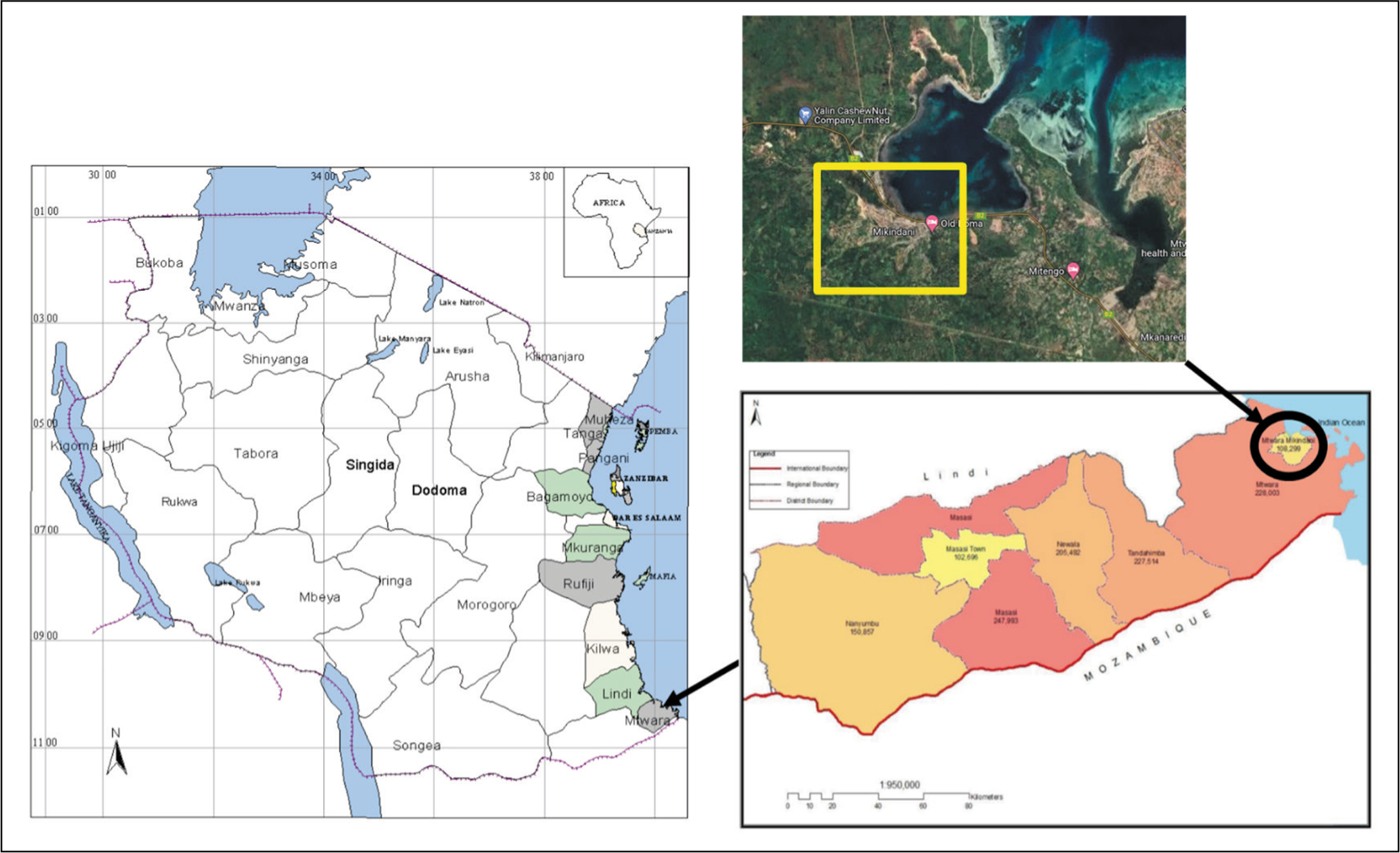
Historically, Mikindani Bay had had people living there since 2200
Today’s Mikindani society is made up of more than 108,299 people, who are mostly practicing small-scale agriculture, fishing and trade (URT, 2013). The society is composed of people from many different ethnic groups, including the Makonde, the Maraba, who emigrated from Mozambique 400 years ago, the Yao, who sold slaves to the Arabs, descendants of the Makua and Mwera slaves, and the Ngoni, who came to Mikindani as caravan porters, among others. It also consists of descendants of the early foreigners, including a few Arabs and Indian merchants. Most people speak Kiswahili and Kimaraba, which is a Kimakonde dialect incorporating Kiswahili words and words from other African languages. About 85% of the population is Moslem. The town’s spatial layout is characterized by a social division (see Figure 2; Becker, 2021). Economically, life is not easy for the younger generation due to the limited number of well-paid jobs in the town, though there are hopes as a result of the slightly growing tourism and heritage sectors (with about 4,000 visitors a year) spearheaded by Trade Aid, the Ministry of Natural Resources and Tourism through the National Museum of Tanzania, and the local government.
Different Scenes of Streetscape, from Stone Houses in Hindi Street, Mud and Thatched Grass Huts, to a Mix of Huts and Modern Concrete Blocks with Corrugated Iron Sheets.
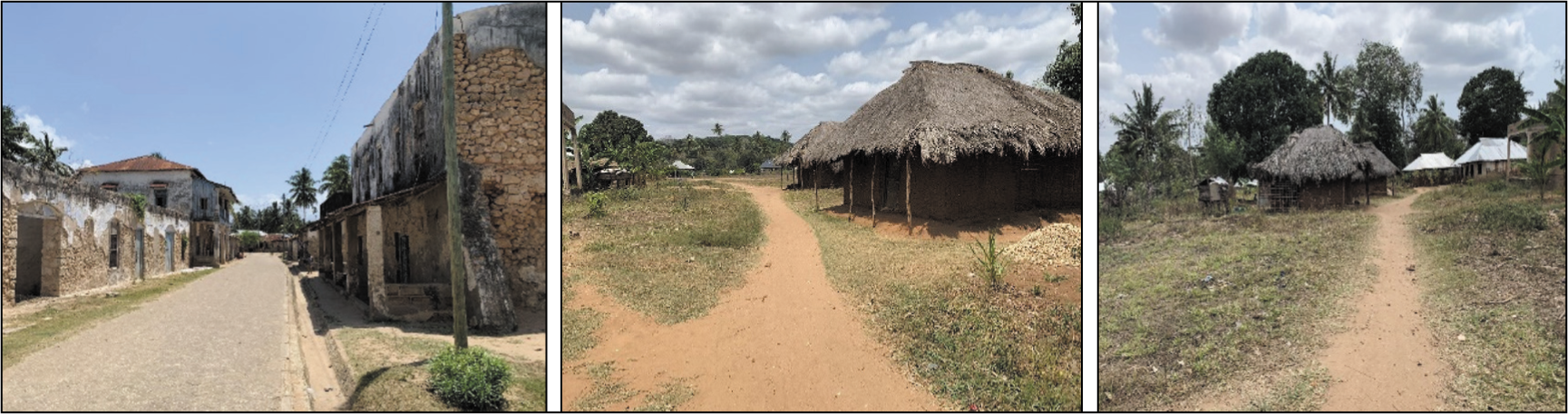
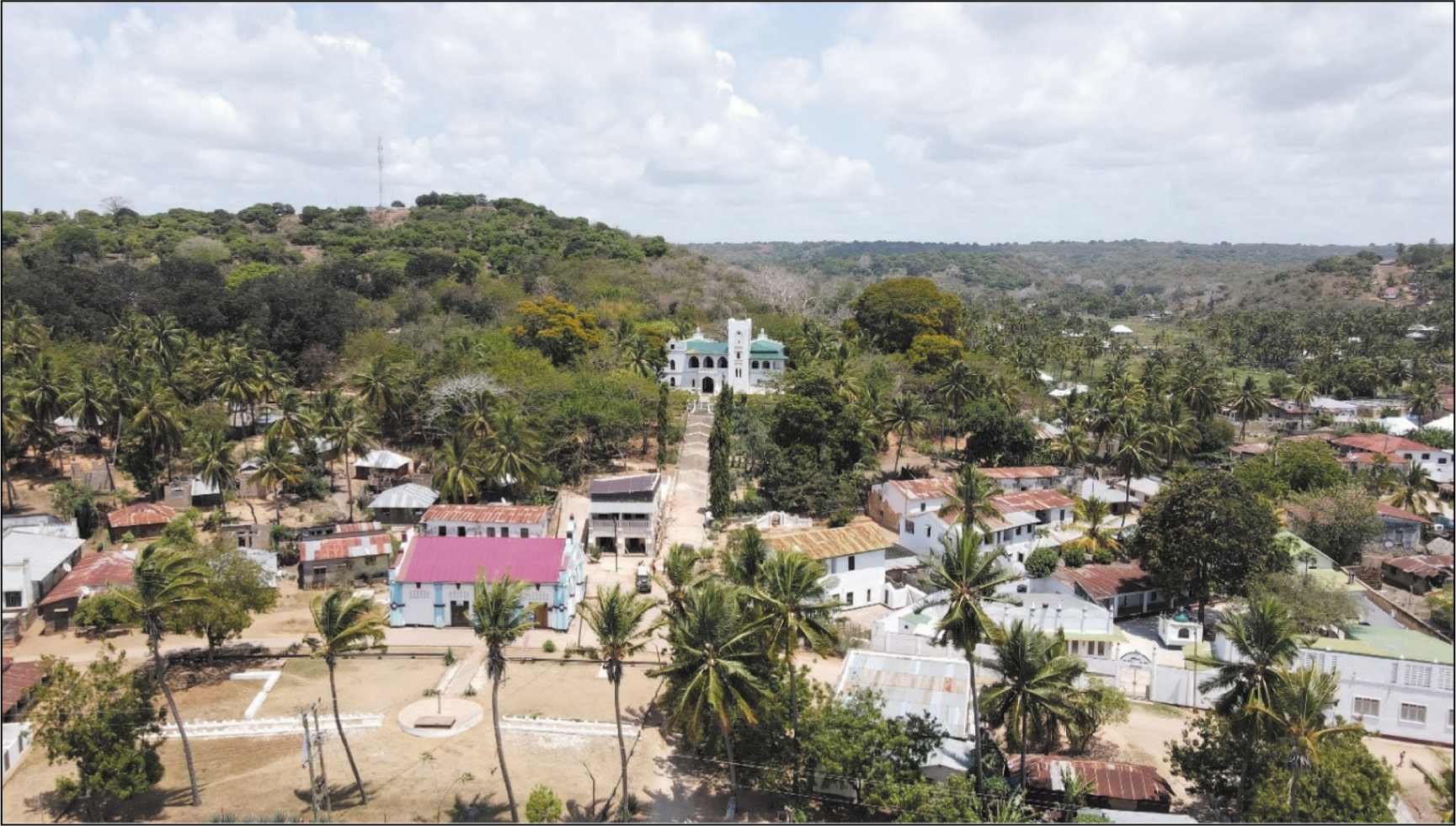
Due to its rich historical heritage and culture, including the built heritage, such as the Old Boma, the old market, the old prison, several Asiatic buildings and old wells, Mikindani town was declared a conservation area by the Ministry of Natural Resources and Tourism in 2017 (see Figure 3). Trade Aid, a European NGO, spearheaded the conservation programmes and CHM in Mikindani, and later the government, through the Ministry of Natural Resources and Tourism’s Division of Antiquities, let its two officers oversee CHM activities. Today, the town’s CHM activities are under the National Museum of Tanzania, Mtwara Municipality, Trade Aid and other actors. Although limited efforts have been made to reconcile and start dialogue among the local communities, the AHD dominates the latent competing discourses. It is, thus, an interesting platform for the multivocality study.
Old Boma, Old Market and Other Historic Structures in White.
Research Design
This study adopted a case-study approach, applying qualitative constructivist designs to explore diverse pieces of evidence from the people’s construction of the slavery heritage. Thus, it employed in-depth interviews and focus group discussions (FGD), as well as surveying the existing and non-existing non-human slavery remains. This approach helped to understand multivocality and cultural negotiations, and the way they shape the people’s strategies for coping with the slavery heritage.
Sample and Sample Size
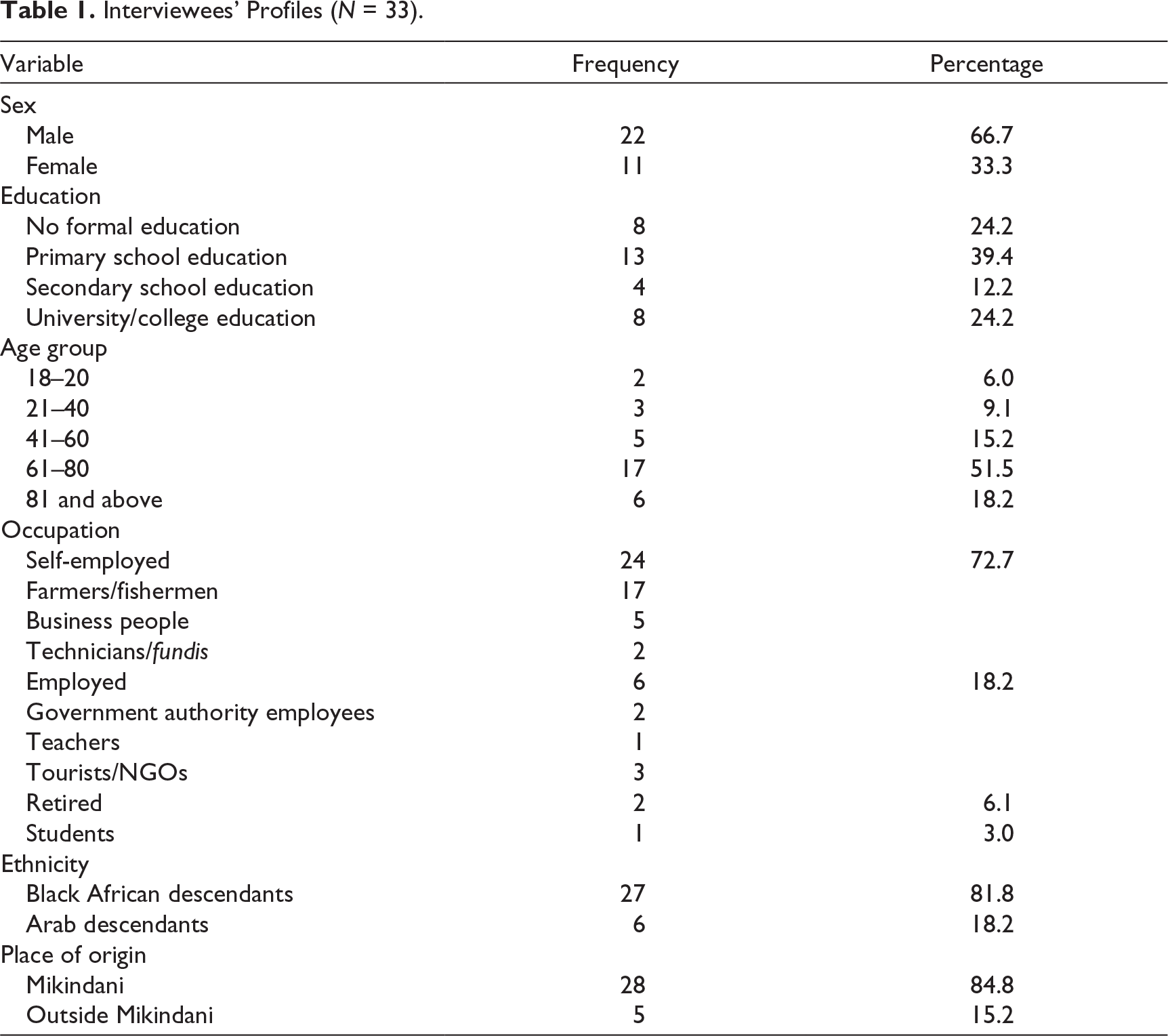
Key stakeholders, especially the local communities, were involved. These include local experts from organizations responsible for conserving the heritage sites in Mikindani, such as the National Museum of Tanzania and the District Council. It also involved local NGO members, such as Trade Aid members. It also involved many groups of people and individuals, including elders, youth, men and women from different backgrounds. As indicated in Table 1, 33 respondents were interviewed. The study involved elders who are above 61 years of age (69.7%) and who are indigenous to Mikindani (84.8%) as key informants and holders of the memory regarding the slavery heritage. It also involved 15% of youth aged between 18 and 40. In terms of sex, the study involved 66.7% male and 33.3% female respondents, because of the cultural dominance of males as key informants. In terms of education, the majority (about 40% of the respondents) had primary school education, as the formal levels of education in Mtwara are relatively low. Most respondents were self-employed (about 72.7%) because most people in Mikindani engage in farming, fishing, small-scale businesses and technical work. The study also held three FGD sessions involving women, men and youth. Each session had a minimum of five participants.
Interviewees’ Profiles (N = 33).
Data Collection Methods and Analysis
The study was conducted from October 2021 to January 2022. Particularly, the study involved doing several activities to achieve its specific objectives. The activities included: (i) analysing local stakeholders to identify the slavery heritage stakeholders, apart from those known beforehand, considering broader dimensions of the people’s interest, power, legitimacy and historical connections and attachment to the heritage; (ii) surveying the slavery archival materials to document and assess their cultural significance and (iii) involving the local communities in the data collection process, for example in in-depth interviews and FGDs to understand the way in which people under a multivocality perspective cope with the violent memories of slavery. Using multiple pieces of evidence from Mikindani, the study unravelled the multivocality of slave masters or slave descendants, and of other people, as well as its dynamics and the way in which it perpetuates the historical contests and cultural negotiations shaping the way in which people cope with the violent memories and the conservation of the slavery heritage.
In-depth interviews involved using topics to initiate WHAT? as an ‘ice-breaker’, thereby creating rapport between the interviewer and the interviewee. The main topic was about people’s diverse perspectives on the slavery heritage, the dissonance and cultural negotiations, and ways of coping with violent memories. During an interview, when researchers felt that the interviewee had either made an insightful comment but shorter than desired or had introduced a new relevant topic, follow-up questions were used to stimulate the interviewee to expand on the original comment. In general, the interviews were conversational in nature. Each interview lasted about 50 minutes. In order to maximize the time spent on the interviews, at the beginning of every interview, the following things were done: obtaining permission from the interviewees, booking the interview time, making the inquiry’s purpose clear, ensuring that interviewees’ information was kept confidential and obtaining permission to record the interview.
FGDs involve interviewing a group of individuals who have had some common experience with something. The FGDs were conducted to obtain data that complemented the data obtained from individual in-depth interviews. Specifically, the discussions were intended to give an opportunity to women and youngsters who would rather express themselves more openly when they were part of a group than when they were the target of a solo interview. During the FGDs, the researchers stimulated and moderated the discussion, ensuring that the discussion really took place and that everybody participated in it without influencing and biasing the group’s discussion.
During the interviews and FGDs, with the help of trained research assistants who took field notes, the researcher used an audio recorder to capture the actual words and a notebook to capture body language. The respondents’ feelings (gestures and expressions) and the context were also recorded in the notebook. Pictures were also taken (with the respondents’ permission) to graphically record the context. The researcher reviewed the field notes before each subsequent interview and FGD session. At the end of each day, the researcher and assistant researchers transcribed the words verbatim and entered all the qualitative data into a computer.
The trustworthiness of the data was ensured by selecting respondents (key informants) who had rich information about conservation issues, for instance, those who were known to be vocal and critical of the official interpretation of the heritage, including elders who knew much about the history of Mikindani. It was also ensured by asking the interviewees to validate the transcripts in the field.
Because the interviews and FGDs were conducted in Kiswahili, back translation, as suggested by Neuman (2011), was used to minimize inaccuracies in the translations. Two independent translators were engaged to translate the data. One translated the transcripts from Kiswahili into English and the other translated them back into Kiswahili. The back-translation version of the data was then compared with the original version, and thus several translation errors were corrected. Once a transcription had been completed, it was reviewed using an audio recorder. The five-stage data analysis method suggested by Yin (2010) was used to analyse the data, which involved compiling, disassembling, reassembling, interpreting and concluding.
Findings
Slavery Heritage in Mikindani
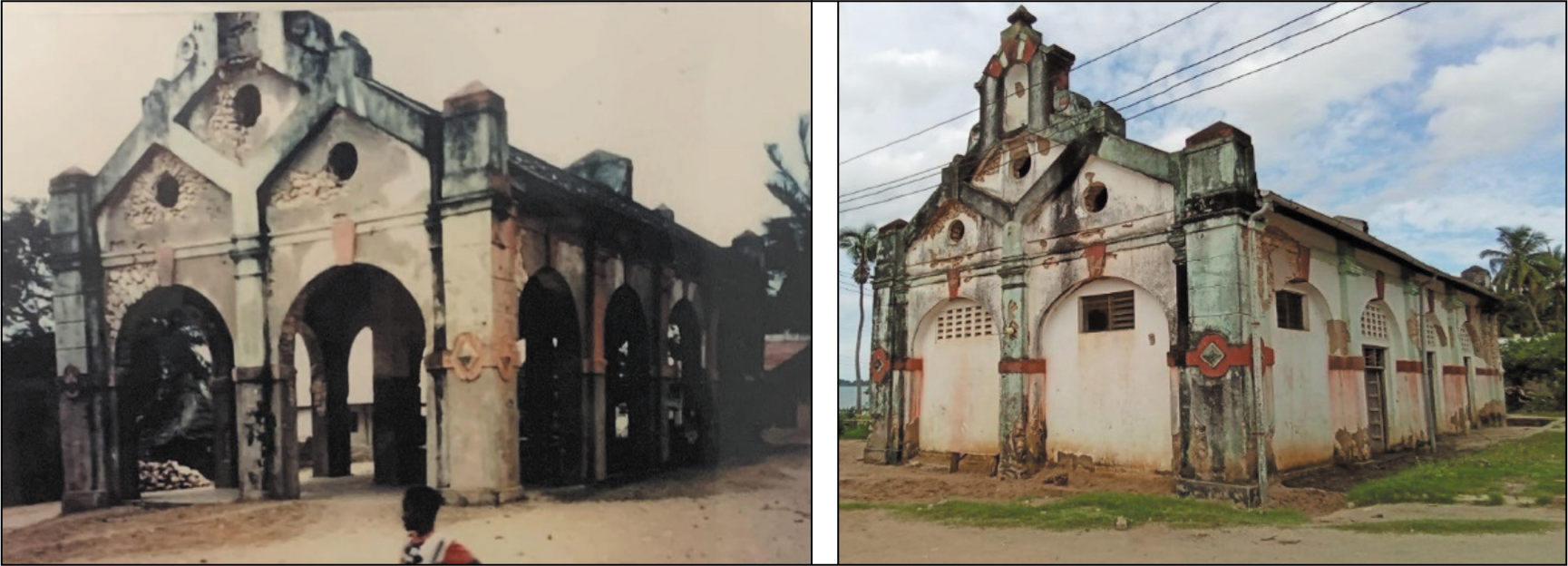
Respondents unanimously agreed that there were remains of the slave trade in the town. An elder (MikMale01) reported that the slave trade took place in Mikindani, which was connected to other centres, such as Kilwa Kivinje and Zanzibar. Several features associated with the slave trade were mentioned. These include buildings, such as the old market building (see Figure 4), the remains of the port, the ocean and the land. They also include spaces, such as the eastern side of the old market, on which a building in which slaves stayed before being taken overseas is believed to have been built (see Figure 2). The market is believed to have been established in the nineteenth century and repaired in the 1990s, when walls were added to it to transform it from an open public market to closed private shops:
‘Mikindani town was like a minor slave point.’ (MikMale01) ‘In front of this building (pointing to the eastern side of the old market) there was a big building that had a big veranda and a flag pole … an ambassador from Zanzibar used to live there and keep slaves before transporting them elsewhere … several Arab families had slaves and some of them used to treat them well.’ (MikMale02) ‘An elder (the late Kidume) who evidenced slave traders told us that the open space close to an old school … after the one-storey building used to be occupied by a house of an agent, who used to buy slaves and keep them before transporting them ….’ (MikMale03)
Old Market in the 1980s. Old Market in the 1990s.
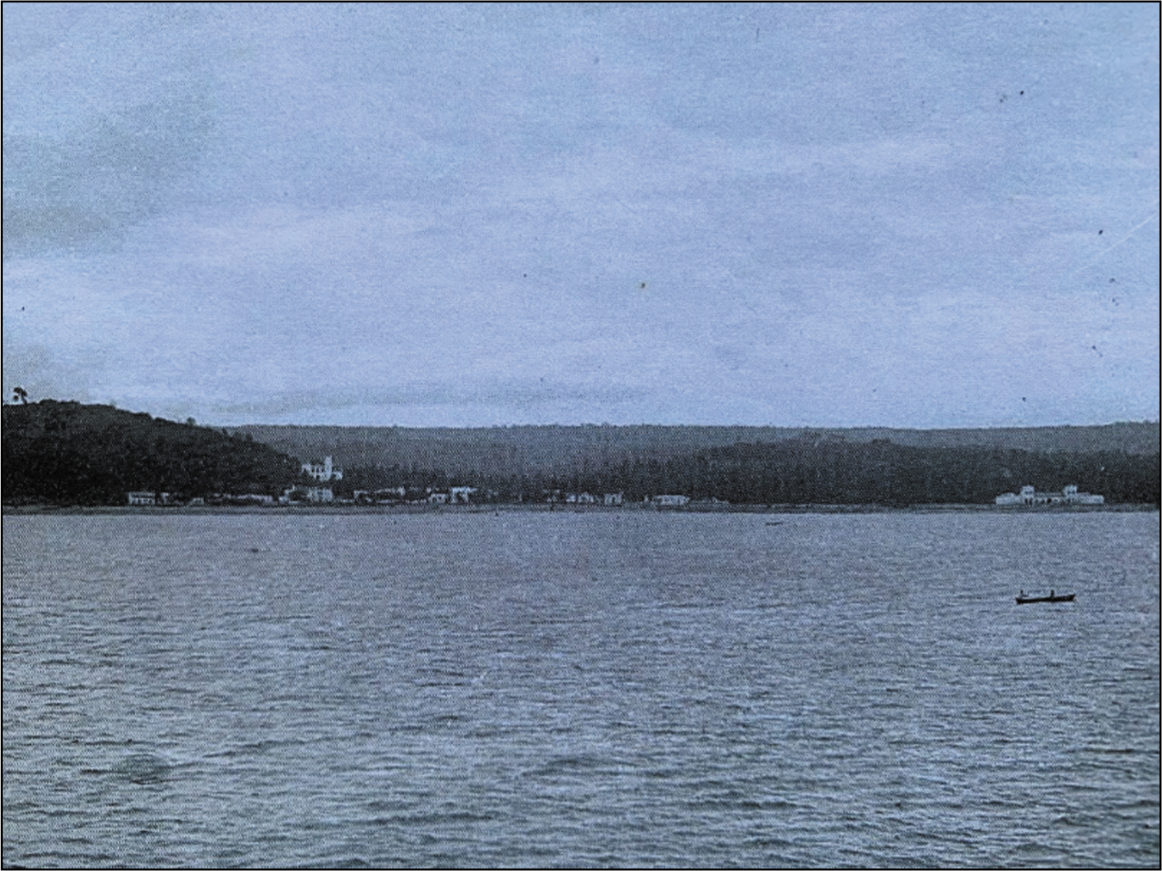
The other features mentioned by the respondents include the land, the local farm yards and the ocean. Land is mentioned as an important heritage because it is a source of water, a habitat for people and animals and a carrier of everything on earth, including the historical built heritage, including that associated with the slave trade. A respondent observed that, if the land were to be degraded, the built heritage would disappear. The respondent tales show that, on the local farms, especially the farms associated with the mango and jamun trees, ‘the thieves were caught stealing mangoes and jamun fruits were kept in the huts on the farms as captives, forced to work for the farm owners, and eventually sold to slave traders’ (MikMale01). The section of the ocean that surrounds the old port and the inland ocean water stream were said to be important in remembering the slave trade (Figure 5). The ocean served as the major means of transporting slaves from the mainland to Kilwa Kivinje and Zanzibar. The inland ocean water stream was built during the German colonial period so that it could hold some water during tides. Today it serves as a barrier that reduces flood waters and protects the settlements near the ocean.
Mikindani Old Town During Early 1900.
‘If land is not treated well, soil erosion and related problems occur, and this affects everything, including the historical buildings and ruins … it should thus be included in heritage conservation programs.’ (MikMale01)
The findings also indicate that the intangible heritage, including the rituals, myths, legends and fairy tales related to the ocean, slavery, seasonal traditional ceremonies, such as circumcision and harvesting ceremonies, and religious activities are important to the local communities and, thus, they should be considered in the conservation programmes. MikMale03 insisted that conserving the built slavery heritage, without conserving the associated legends and tales as well, is not appropriate. One of the local fairy tales related to the slave trade is about one of the means through which slaves were obtained. According to MikMale01, uncles—who have superior authority in the traditional Swahili families—could give their sisters’ children (nephews) to their debtors, especially if they failed to pay back the money they had borrowed. The children would eventually become slaves or would be sold to slave traders. Another tale relates to the earlier story of the use and sale of thieves (caught on local farms) by farm owners as slaves.
‘The indigenous people of Mikindani want their local values to be regenerated … they value the antiquities, including old mosques, rituals, seasonal traditional ceremonies, such as circumcision and harvesting ceremonies, and religious values… they want all these to be conserved and contribute to development.’ (MikMale03)
‘The locally generated slavery related to the misuse of customs and traditions; uncles are relatively superior in the families … an uncle could order a poor family to provide their child (nephew) to him in lieu of the money owed to him … he could either enslave the person or sell her/him to other people ….’ (MikMale01)
Multivocality and Associated Dissonance
After identifying the slavery-related heritage assets, we inquired into the meanings they attached to them. The findings show the existence of multiple narratives regarding some of the heritage assets, especially the old market building. The respondents who are directly associated with the CHM authorities and the tourism sector referred to it as the slave market. Similarly, a few respondents from the local community associated it with the slave trade. One respondent (MikMale03) recalled a narrative told by a dead prominent elder. The elder had said that chains had been found in the old market during its repairs in the 1990s.
‘… it is believed that, before the repairs, the old market chains had been attached to the columns. This signifies that they were used during the slave trade ….’ (MikMale03)
Similarly, tourism-promoting documents from Mikindani show that the old market used to be a slave market. Some of the documents were prepared by the Ministry of Natural Resources and Tourism (through the Antiquities Division) and Trade Aid (see Figure 6).
Tourism Promotional Document Representing of Old Market as Slave Market.
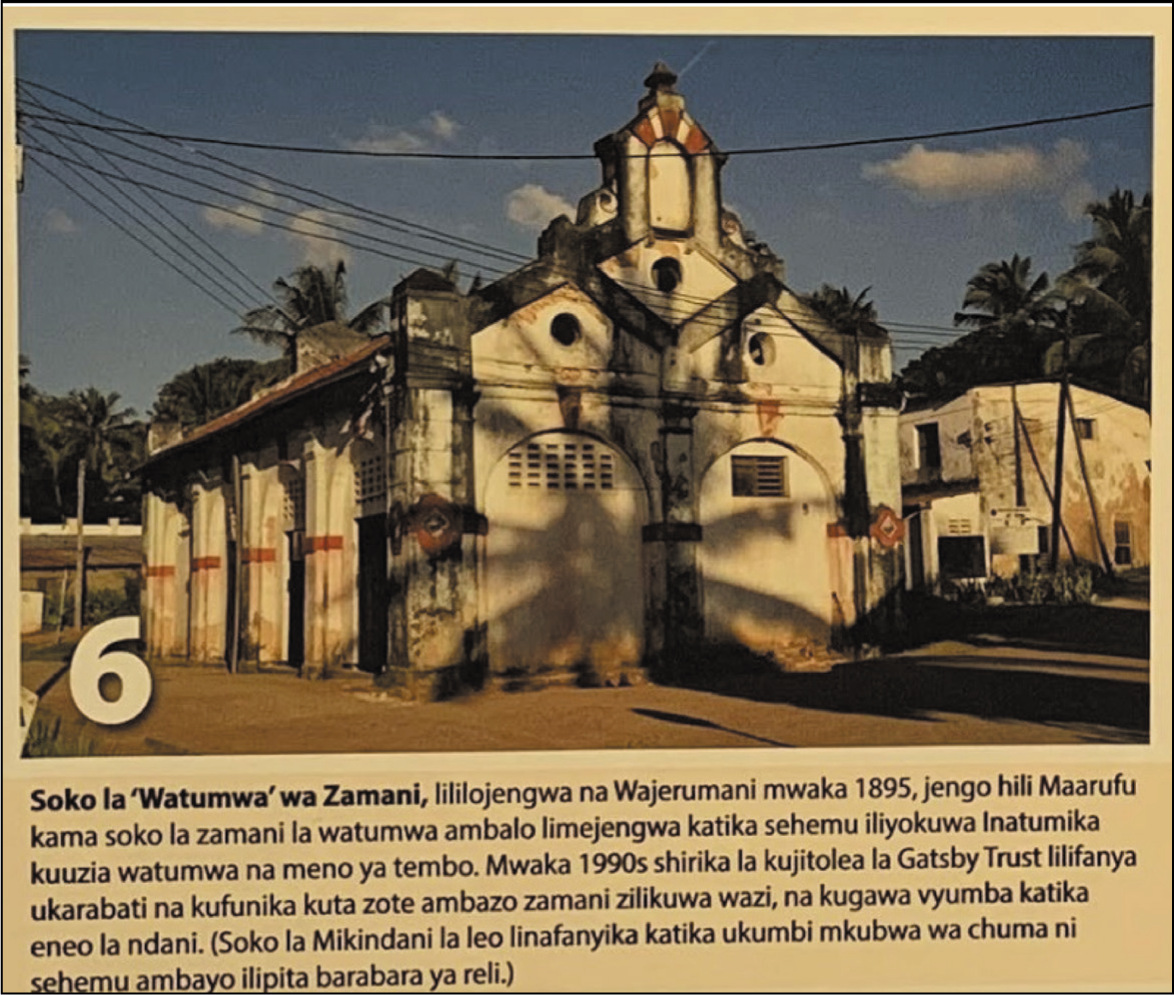
Translation of the Swahili words in English ‘
This tourist/conservator-based narrative seems to be supported by the younger generation. A young respondent (MikFemale07) referred to the old market as an old slave market, adding that she had got that understanding from her friends, some of whom are local tour guides trained at a local hospitality college.
‘Tour guides say that the building is the old slave market, as they think that that is interesting and exciting information to tourists.’ (MikMale01)
‘… I know that this building is the old slave market. My friends, including tour guides, told me that … in fact, most visitors talk about it as having been the slave market.’ (MikFemale07)
Some elders were not sure of the truth of that narrative. An elder (MikMale12) seemed to appreciate the remains of slavery, including the so-called slave market. He believed that the building was later used as a common food market.
‘I know that the market… I remember that it was just a market, although others say it used to be a slave market … I have never seen slaves… I must speak the truth. I left Mikindani when I was a little boy … but I believe that the market is one of the places used during the slave trade.’ (MikMale12)
On the other hand, several elders (MikMale01 African, MikMale02 Arab, MikMale30), who claim to be the indigenes of Mikindani, said that their parents had witnessed the slave trade, some of them had kept slaves and had participated in the construction of the Old Boma building. However, they were sceptical about calling the old market a slave market. They mentioned that the association of the old market with the slave trade was probably done by actors in the tourism industry for commercial purposes and by the majority of the young people who did not know the real history of the town. One elder said that the building was used as a market for selling food and other goods, and that it was the busiest place in the old Mikindani town.
‘That old market was not used as a slave market… It was a market for selling various food products, including cereals and vegetables. People think that the building used to be a slave market because Mikindani used to be a slave trade centre … there was a building belonging to Nammeta where slaves used to be kept before they were transported overseas. Before its demolition, I used to keep my luggage and products in it when I was working in the old market.’ (MikMale01)
‘The building was never used as a slave market … all the time that I have lived here, I have never seen any piece of evidence showing that the building was a slave market. Instead, food products, including fruits, used to be sold at the building. However, there was a banda nearby where slaves were sold….’ (MikMale30)
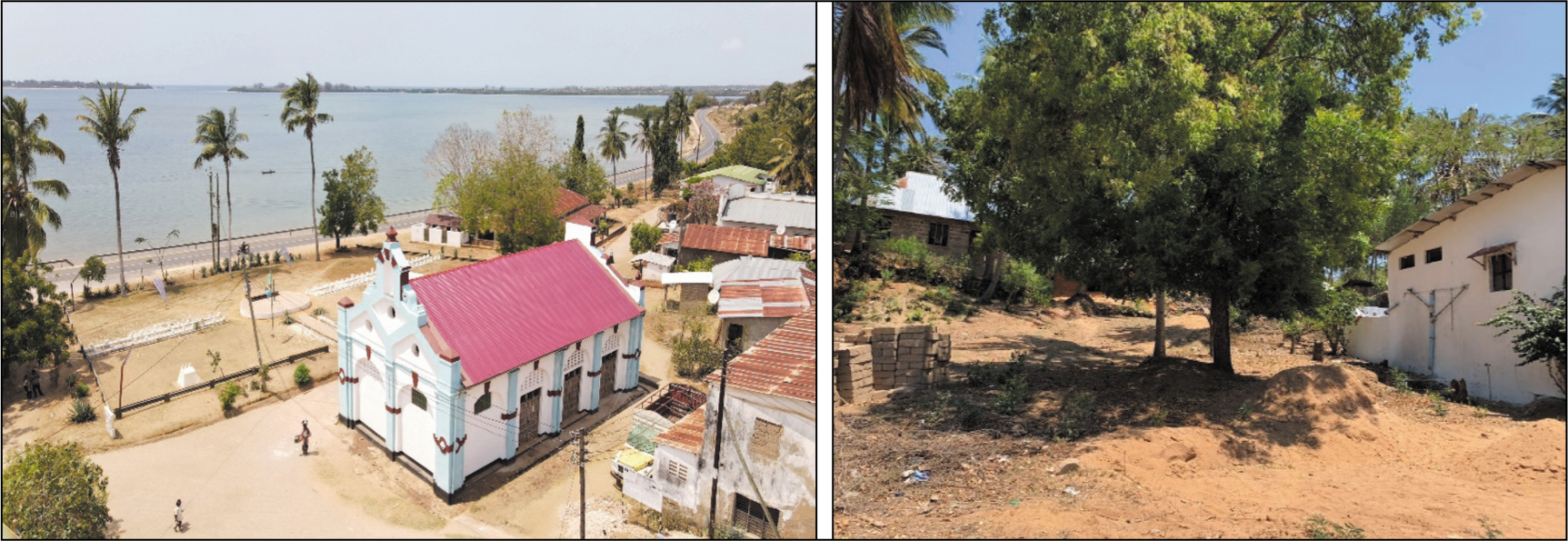
Some of the elders (MikMale01 and MikMale30) consider the space east to the old market building, rather than the building itself, as the place where slaves used to be kept. Another space south to the old market is believed to have been occupied by a banda, which housed slaves before they were taken to the slave trader’s house (see Figure 7).
Eastern Side of the Old Market. Space Occupied by Slave banda.
Another elder (MikMale02 Arab) reported that the old market used to be an open market so that people could interact. Several food products such as cashew nuts, cassava, cereals, tobacco, mangoes and pawpaws were sold. Local women food-selling entrepreneurs called kapile sold various food products, including cassava, cowpeas and pigeon peas. It was, thus, an economic centre and the pride of the people of Mikindani. However, during the 1990s, repair of the building covered the open spaces with concrete block walls. An Arab elder (MikMale02) wants the walls added to the building to be demolished in order to restore the original façade and space that portray the building as an open and public market.
‘The building was not a slave market. It was the centre of Mikindani … in the past it was not enclosed by walls. We campaigned so that the walls could be removed and retain the past façade of the building. All commercial products were sold at that centre, including cashew nuts, cassava, cereals, tobacco, mangoes, and pawpaws. Interestingly, that was a famous place for kapile, the local food-selling women entrepreneurs. It was our busy commercial center.’ (MikMale02)
Cultural Negotiations Attempt
The findings indicate that there have been a few local cultural negotiation attempts among the community members and between them and the CHM authorities. The community members want to ensure that their voices are incorporated into the representation of the heritage in Mikindani. This happens because some of the community members feel that they are being dispossessed of their valuable heritage and pride, such as their intangible culture, the representation of their past economic hub, that is, the old market, and the representation of their peace and harmony-building traditions through the Mkalimala 1 sculpture. Regarding the representation of their former public market, some of the community members attempted to negotiate the destruction of the walls in order to restore its public and open-market sense rather than the current closed and private sense.
Some community members, especially the Arab descendants, feel that they are unfairly and wrongly treated by the attachment of the slavery-related story to the old market. The story offends some of them, as it associates their race with the slave masters. Specifically, they perceive those who promote the history of slavery as having the intention of causing conflicts among the black Africans and them. The cultural negotiations regarding this occur in the private sphere and have never been a public matter.
‘… the hatred between the black Africans and the Arab descendants has diminished … but because I am an Arab descendant, when I hear these slave-trade histories around the Arabic historical structures, I feel like we are being considered as slave masters, and that we enslaved the black African people … I hate this, but I cannot do anything about it. However, the truth is that the old market was a common food market … there are people who implant the history of slavery over the old market in order to create hatred in the community.’ (MikMale18)
Behind the Passive Dissonant Situation and Coping Strategies
Overall, the findings indicate that the dissonance in Mikindani is passive. There are several explanations for this situation. First, the community members have less perceived control in terms of skills, knowledge, power, resources and, to some, pride, which they need in order to tell their narratives, especially when they face the CHM authorities, experts and actors in the tourism industry who are often well funded and who are believed to hold much information and details about the heritage.
In addition, the majority of people—who are relatively young—are not interested in past history. To most of them, the historical buildings are not very important; they focus much of their attention on their economic advancement. A young girl and student mentioned that most of the young people and their interests are economy-oriented, and would not, therefore, seek much information about the history of the old market, as it has little to do with their economic issues.
‘These days, the young people are not interested in history and the historical heritage. Most of them are not aware of the history of these historical structures; they focus much on hustling… they thus do not care whether you call the old market a slave market or not.’ (MikFemale07)
To an elder, the young people’s lack of interest in history indicates ignorance and lack of self-identity. He also noted that, if the young people were aware of their history and were interested in their history, there would be problems, as they would seriously want a true representation of their heritage and would have come up with a representation that better presents their society.
‘Because the people, including the younger ones, are ignorant of their history, there are no serious conflicts regarding the wrong representation of the old market … but if the people were aware of and serious about their history, there would have been conflicts.’ (MikMale01)
In addition, it is believed that God called for those who wanted repentance and forgiveness to free the slaves. Responding to God’s directives, the slave trade was stopped. This means that it was God who ended the slave trade and, thus, no man could condemn nor punish those who used to conduct the trade. This religious connotation to the slave trade, given that most people in Mikindani are religious (Muslims), has enabled the people to cope with the narratives about slavery, especially those related to the historical heritage.
‘Arabs conducted the slave trade. We believe that our God says that, in order for you to be forgiven, you need to forgive others, including freeing slaves. Thus, the slave trade was abolished … and we have forgiven each other and all those who conducted the trade.’ (MikMale01)
Discussion
The analysis of the data indicates that multivocality and its resultant dissonance are structured around what heritage to conserve as the slavery heritage and how to present it. Interestingly, the narratives regarding what to conserve as the slavery heritage are composed of the built environment, as is commonly argued (see Becker, 2021) and contended by the AHD, and of natural and intangible heritage features. This means that such natural features as the land, the ocean and the intangible heritage, such as the local beliefs, rituals, legends, fairy tales and myths, are an important part of the heritage. In fact, to the coastal communities, the land and the ocean are perhaps the most critical resources, which provide them with food, means of transportation and a socio-cultural space and carry the built heritage. During the period of slavery, the land and the ocean were also the major means of transporting slaves. Although the local legends, fairy tales and myths related to the slave trade are not common in tour guides’ narratives, they make the meaning of the slavery heritage from the local eyes. This implies that, whereas the heritage authorities and tourism actors focus much on the built heritage, what is also important in heritage-making and representation includes the broader natural landscape and the intangible heritage. The overlooking of these narratives and features is a result of the fact that heritage-making along the coast of the Indian Ocean, including Mikindani, was prompted by the local government authority, Trade Aid and the Antiquities Division, while at the same time, to a lesser extent (mostly at the placation level), involving the local community members. It also reflects the problems of the AHD and its monumentalistic dominance in CHM and tourism practices, where the focus is solely on tangible objects, while at the same time overlooking the wider landscape, intangible aspects and local perspectives on heritage representation. This calls for a review of the heritage-making process in Mikindani so that it includes the local narratives and broader meaning of the heritage.
Perhaps the most critical dissonance relates to the presentation of the old market building. The dominant narrative about the building is shaped by conservation and tourism agencies, and considers it as having been a slave market that was later turned into a common-item market. In contrast, there are various discourses among the community members which generally show that the building has never been used as a slave market. Instead, the narratives show that the space around it had buildings that used to house slaves. This dissonance implicitly attempts to unlock the dominant sedimented discourse and create passive political struggles, which are being renegotiated in the community. It is mostly the ethnic and Arab-descendant elders in the community who seem to consider the building to have been a market for common food items. The elders in Mikindani feel that calling the building an old slave market is dispossessing them of something valuable to them, something that represents the socio-economic history of the emergence and growth of what they believe was their market and the past commercial hub. They also believe that the old market was their social hub—a place where most Mikindanis would sell and buy food and other goods. The elders feel that it is the landscape and intangible aspects surrounding the market building that represent the history of the slave trade rather than the building itself.
There are several reasons behind the differences in narratives between the African and Arab-descendant elders and between the people in these groups. On the one hand, the Arab descendants feel that they are being unfairly and wrongly treated by the attachment of slavery-related stories to the Old Market. The story offends some of them, as it associates their race with the past slave masters. They particularly perceive those who promote slavery history as having the intention of causing conflicts between the Arab and the black Africans. On the other hand, the native black African elders feel uncomfortable about being associated with the slavery history. Although the ex-slave origin shaded with the economic and political changes of the colonial and post-colonial periods, being associated with ex-slaves or slave descendants would still refer to an inferior class in the society, the outsider watuwakuja, social debased, marginal and economically precarious (Becker, 2021). In fact, the organization of the urban space in Mikindani is suffused with hierarchy, displacement and the people’s struggle to belong there amid shifting hierarchies, to the extent that some wenyeji pride themselves on being descendants of immigrants—albeit high-status, not enslaved, ones (McIntosh, 2009, in Becker, 2021; Bissel 2011). This amnesia-based notion is common in most slavery heritage sites along the Swahili coast (see Becker, 2021; Fouéré & Hughes, 2015; Mapunda, 2007). In fact, a limited engagement of the local communities in the heritage-making process has left slavery among the community as the subject of silence and shame (Klein, 1989).
The younger generation is relatively non-sceptical about attaching slavery history to the old market building. They are proud of the prevailing growing heritage tourism, associated partly with the slavery history, which is attached to the old market. In fact, Mikindani’s tourism is going fairly well as a result of the efforts by the government and Trade Aid to conserve a few buildings and run a hospitality facility and a museum. The NGO’s programmes provide the youth with some tourism jobs. The young people’s involvement in tourism activities partly explains why they are non-sceptical about the slavery narratives around the old market. An alternative explanation is that there is a weak link between the younger generation and their past, partly due to the declining practice of traditional story-telling in the town and the demographic shifts that have led many members of the old patrician families to migrate to Mtwara and Lindi, following the stagnation in the twentieth century and the late colonial plans. The younger people in Mikindani have, therefore, limitedly inherited the stories about slavery and probably do not care about what is true or false about the historical heritage.
Overall, the findings show that the resultant heritage dissonance in Mikindani is relatively passive and that it has resulted in neither serious social conflicts nor explicit damage of the heritage fabric. The passive dissonance is explained by a complex mix of social, cultural and economic factors, including the community members’ perceived control of the dialogue, amnesia and the people’s ignorance of their past and the younger generation’s limited interest in and awareness of the history of slavery. Regarding perceived control, the community members seem to have little control and limited awareness of the theoretical apparatus that they need to articulate their narratives in the community to unlock the sedimentation of a dominant discourse. In fact, the elders who told the dissonant narratives quickly put them back in the discursive space of the AHD. Thus, they depend much on the AHD’s theoretical apparatus, which is probably becoming popular, to deliberate on the meaning of the heritage, although they do not align with it.
To stress the importance of a theoretical apparatus in shaping active dissonance, we may refer to the Mkalimala sculpture case (Figure 8) we encountered in the field. Although it does not directly relate to the slavery heritage, the Mkalimala sculpture issue refers to the past wrong interpretation of the traditional sculpture by Trade Aid (supported by a British founder and researchers) that the local community elders contested and managed to correct. In 2018, Trade Aid installed exhibitions in its small museum located on the north-eastern part of the old market, including Mkalimala, which was initially interpreted as a crazy person who often wears a tortoise shell on his head and asks illogical questions. However, according to the elders, Mkalimala danced a traditional dance called Mapiku. During the dance, Mkalimala, covered himself with the tortoise shell, would pretend to enjoy watching a fight between two tall stilt dancers. However, the local narratives suggest that one would be foolish to take pleasure in observing others who are in a serious conflict, and would, therefore, want to mediate them because they can also affect him. It, thus, encourages people to promote peace and harmony in the community.
Mkalimala Sculpture.
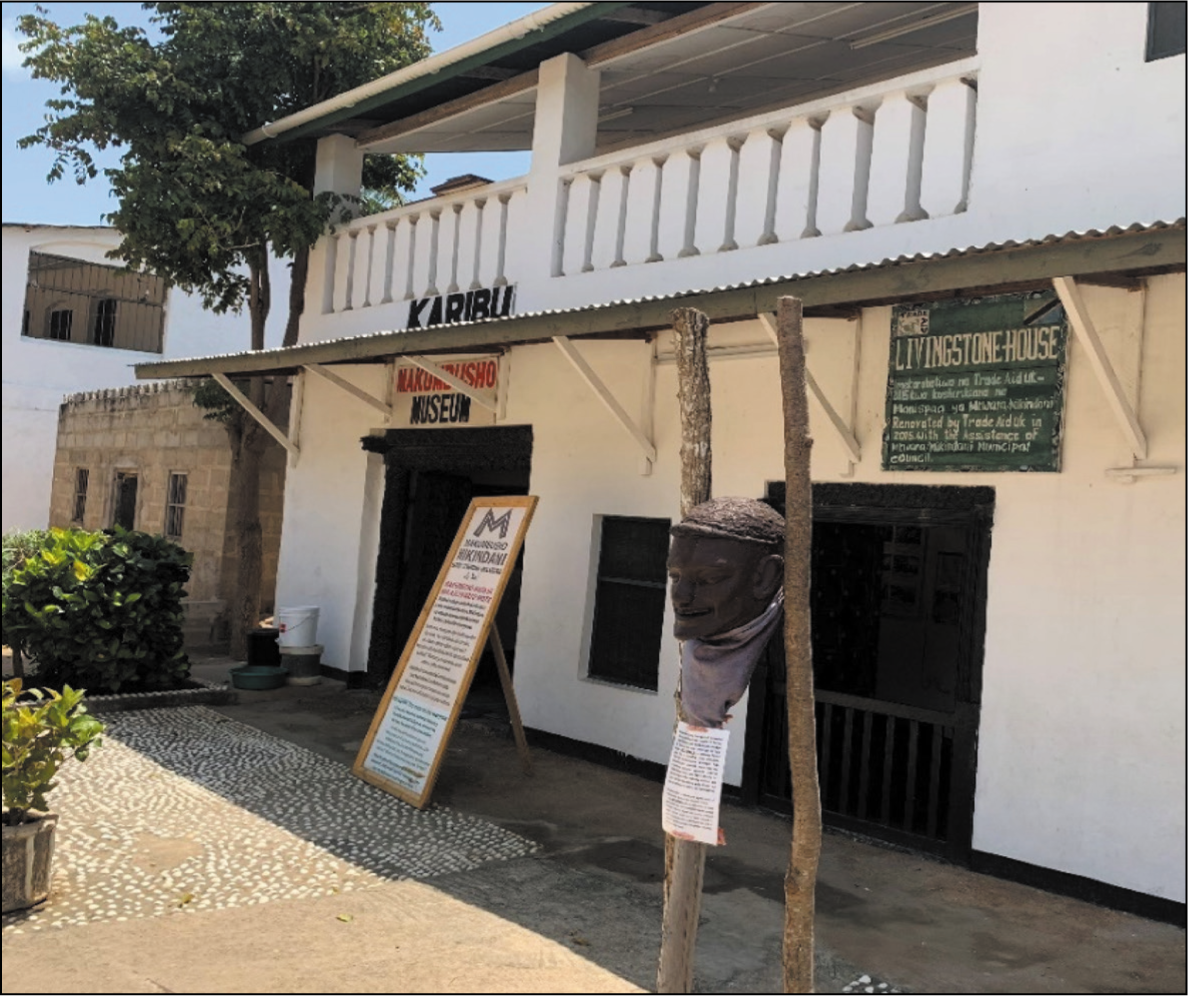
We learned from the Mkalimala case that, due to the fact that the local community members are closely attached to their traditional dances involving the traditional sculpture as a peace and harmony-promoting symbol, it was relatively easy for them to tell their narratives and question the appropriateness of museographic methods to the extent of succeeding in defending their position. Regarding the old market, whereas the authorities and the NGO do not have hard scientific evidence to prove their AHD, some community members may not have the confidence, information and evidence that would support their theory and discourse. Because the authorities and the NGO can speak about the building through tourism and the conservation platforms, the AHD’s memory is predominant and overwhelming in the community.
There is relatively limited space and know-how for negotiating the meaning of slavery-related archival materials among the community members. A few futile attempts were made when some community members raised their voice to force the authorities to remove wall coverings from the old market building and return the building to its original façade so that it could be used as a public food market.
The community members’ interesting coping strategy, which is probably contributing to the latent dissonant situation, is associated with their religious beliefs. Most community members believe that the slave trade was promoted by Arabs during the Arab times. However, God called for those who wanted repentance and forgiveness to free the slaves. Responding to God’s directives, the Arabs ended the slave trade. This means that it was God who ended the slave trade and, thus, no man could condemn nor punish those who used to conduct the trade. This Islamic religious connotation has made people cope with multivocality and its associated dissonance. It has also made people stop to seek the real meaning and the correct representation of the heritage. According to Becker (2021), it is actually these religious networks which had Arabs being part, and internally less hierarchical, that encouraged the ex-slaves to claim some status in the town and presumably influenced the residents’ passive attitude towards the memories related to slavery.
Although the dissonance is passive, it has certain implications for the community that should not be ignored. This implies that the CHM needs to promote the intergenerational dialogue around memory, which involves the community’s representation, symbolic metaphors and belongings to illustrate the stories about slavery and integrate the narratives in the core representation of the sites associated with the slave trade in Mikindani.
Conclusion
This study deployed the lens of heritage dissonance and the IHD to explore multivocality, and how it perpetuates heritage dissonance, thereby shaping cultural negotiations and people’s means of coping with violent memories by largely drawing on evidence for the slavery heritage in Mikindani, Tanzania. We have learned that multivocality shapes the heritage dissonance with regard to the composition of the slavery heritage and its representation. However, the conventional CHM based on a monumentalist approach excludes multivocality from the heritage-making process, thus emphasizing the built structures, while at the same time overlooking important dimensions of the heritage constructed by the community members, including the heritage’s broader, natural and cultural landscapes and intangible perspectives. The conventional CHM also misses out on broader insights from the minority elders and slavery-related descendants, as it is often offered—and becomes overwhelmed by—uninformed support by the non-sceptical youth who have certain economic expectations, while at the same time avoiding the critical insights.
The dissonance resulting from multivocality in Mikindani is passive due to a complex mix of socio-cultural and economic factors that shape its existence. These include the demographic dynamics, socio-cultural contexts related to religious values, the community’s interest in and awareness about its past and its articulation of theoretical apparatus, power relations and identity struggles, the local or state political standing, the CHM approach in place, and the economic context, including the forward-looking nature of the younger generation. Indeed, the study proves the fact that managing cultural heritage requires a comprehensive knowledge of the multivocality found within a particular society and around its heritage—a role that is often ignored by the conventional CHM practices in most sub-Saharan African heritage sites, which consider multivocality as agreeing with or opposing the AHD, thereby undermining the plurality of a society and its heritage.
Most heritage places may ignore multivocality, especially when its resultant dissonance remains latent. We have learned from this study that the latent dissonance should not be undermined and ignored because, in contexts similar to Mikindani, in as much as religious values partly provide a mechanism for coping with the dissonant situation, inert social and political tensions often continue striving to balance and defuse the boundaries of identities, power, respect and the moral superiority–inferiority dogma. A CHM that is blind to these scenarios would often induce people’s feelings of being dispossessed of their valuable heritage and pride, and promote conflicts. If taken positively by CHM, multivocality and its dissonance effect can serve as space for conducting cultural negotiations and as a mechanism for addressing and understanding different experiences, for unlocking and challenging the sedimentation of a single discourse, and indirectly for resolving potential conflicts.
Thus, with regard to the Mikindani case, the study urges CHM authorities to address multivocality and embrace the local elders’ fears and the youth’s stability by adopting a futuristic and forward-looking approach, and supporting them to recover in their inherent social and cultural struggles by facilitating and enhancing the local cultural negotiations. They should also strive to make the heritage meaningful to the locals by connecting it to their natural environment, local culture, as well as religious and spiritual beliefs and traditions. A CHM appropriate to a context similar to Mikindani should play a role in making and representing heritage as defined by multivocality and in educating the diverse groups, including the youth, about their past in a two-way, inclusive manner so as to build their relationship with their heritage because it carries their identity and forges their hopes for a better future and a better socio-economic and cultural well-being.
Although the study examined multivocality in relation to one site, it engaged with the findings of previous studies conducted in various contexts and confirms the importance of applying the concepts of heritage dissonance and the IHD in exploring multivocality in CHM beyond the dichotomous polarized discourses of agreement versus opposition with regard to the AHD. The study calls for further research on very good examples of egalitarian CHM practices that can shed more light on how multivocality and its dissonance effect could be embraced in CHM.
Footnotes
Declaration of Conflicting Interests
The authors declared no potential conflicts of interest with respect to the research, authorship and/or publication of this article.
Funding
This work was supported by the Imagining Futures Project of the University of Exeter (113806).