




Abstract
The concept of ‘overlooked cities’ calls for a research agenda to critically examine the actors and processes involved in power relations, analyse the production of knowledge on cities and increase collaboration with grassroots organisations in studying cities, with the intention to reshape urban policies and planning practices. This research agenda warrants further inquiry into how the concept can help when researchers face urban conditions in the field, especially when the continuing trend of managerial city leadership encourages the production of urban spaces that enable overlooking. What is the relationship between managerial city leadership and ‘overlookedness’? What are the methods of ‘counter-overlooking’ that researchers need to deploy in observing the field? In this article, I discuss the complexity of applying the overlooked cities research agenda in the field and propose methodological approaches to counter-overlooking. I rely on findings from my research on public spaces, notes from experiences in engaging with grassroots organisations and the Southeast Asia Neighbourhoods Network (SEANNET), as well as observations from Taman Film and its surroundings in Tamansari, a city district in Bandung, Indonesia. To overcome the under-representation of overlooked cities in urban studies, it is imperative to revisit methods and contextualise theories, concepts and perspectives.
Keywords
To Overlook: Situating Overlooked Cities in Urban Studies
Why do we study cities? To what extent does academia play a role in the shaping of cities, if at all? In today’s context, in which the majority of the world’s population is ‘urban’, 1 we can expect continuing attention to the study of cities and urbanisation. Yet, the immediate relevance of urban studies’ academic publications to real-world situations is debatable. Underlying this is the contradiction between the conceptual expectations of academic publications and the pragmatism involved in transforming cities: on the one hand, there are realistic considerations for urban development projects to deliver services, and on the other, theoretical knowledge is used to critically analyse these projects. In regions experiencing relatively rapid urban development, this contradiction may be more observable, especially in studies of marginalised groups with bread-and-butter issues.
While theoretical and conceptual academic publications may not directly address the everyday needs of marginalised groups, the pragmatism of urban development continues through the increasing presence of managerial city leadership in development projects and initiatives worldwide. Characterised by the effective delivery of public services, encompassing housing, education and healthcare, development studies viewpoints on managerial city leadership are mostly positive. In countries of the global South, 2 reviews of managerial leadership highlight their ability to fulfil the delivery of public services in a reliable manner, despite having to navigate unreliable bureaucracies. Reliable public service delivery and provision of public spaces are important for all cities, but the ‘non-ideological’ approach of managerial city leadership (Maclean, 2017) opens the door for top-down governance that legitimises hierarchies of power.
In this article, I discuss the concept of ‘overlooked cities’ and its contribution to urban studies against the rise of managerial city leadership. This concept, as defined by the Overlooked Cities Collective that proposed it, focuses on ‘a form of neglect … [which] can be with or without intentions, but … is always underlined by a kind of indifference’ (Nugraha et al., 2023, p. 1). As a result, ‘overlooking’ leads to the under-representation of cities and/or marginalised aspects of urban life in both urban theory and practice. The concept adopts a critical stance on the power imbalance inherent in the making of cities as well as the production of knowledge on cities. Thus, the concept has the potential to speak to the contradiction between urban studies research and the pragmatic aspects of urbanisation, particularly the needs of marginalised groups.
The following two questions frame the discussion in this article: What is the relationship between managerial city leadership and ‘overlookedness’? What are the methods of ‘counter-overlooking’ that researchers need to deploy in observing the field? The reflections in this article are not the result of a single research project but are based on observations from several projects that I undertook prior to the emergence of the Overlooked Cities Collective. First, I re-articulate my experience in conducting research on public spaces, rivers and settlements in cities in Indonesia through the overlooked cities concept. Second, I rely on my experiences in engaging with the Southeast Asia Neighbourhoods Network (SEANNET) from 2017 to 2024. Third, I draw from observations from a field visit to Taman Film, a public park in Tamansari city district, Bandung, with the Overlooked Cities Collective as part of a workshop in September 2023.
The Overlooked Cities Research Agenda
Overlooking is a political process ‘filled with presuppositions, prejudices, prioritisations and expectations’ (Rusczyk et al., 2021, p. 3), all of which are applicable to practices of urban life, governance and knowledge production. According to the Overlooked Cities Collective, the overlooking of cities stems from the relative lack of resources of these cities, resulting in their under-representation in urban planning literature. Jennifer Robinson’s (2006) discussion on the ‘ordinary city’ started from a somewhat similar concern about the domination of ‘global and world cities’ in urban studies, but her call should not be misread as directing attention to secondary cities. Rather, she proposed to view all cities as ordinary in order to enable the focus of urban studies to return to ‘the complexity and diversity of city life’ (Robinson, 2008, p. 75). This refocusing of the discipline is a necessary connection between academia and urban practitioners—city managers, citizens and organisations—to facilitate equitable urban policies (Robinson, 2008).
With reference to Robinson’s call as well as several other theories on urbanisation in the global South—including postcolonialism, decolonialism, rogue urbanism, subaltern urbanism, secondary cities, small cities, post-abyssal thinking and linguistic dynamics—the latest development of overlooked cities puts further emphasis on actors and power relations that lead to inequalities in the making of urban knowledge and policies (Nugraha et al., 2023). The Overlooked Cities Collective’s call for counter-overlooking is a move to steer the discussion away from ‘merely labelling cities’ to one that may ‘reorient urban planning and policy’ by examining actors and processes in power relations, analysing the production of city knowledge, and increasing collaboration with grassroots organisations (Nugraha et al., 2023, p. 3). This refocusing of overlooked cities aligns it to Robinson’s call to focus on the urban condition that connects academics and practitioners. An analysis of overlooked cities would challenge the status quo of neglect that leads to marginalisation in cities and their knowledge production.
While placing an emphasis on the power inequality in existent critical urban theories, the overlooked cities concept also carries foreseeable challenges and contradictions. The first research agenda to ‘re-evaluate power relations in overlooked cities’ is important (Nugraha et al., 2023, p. 2), but to what extent would this conceptual analysis resonate with urban practitioners? The Overlooked Cities Collective pointed out the need for ‘engaging praxis that articulates alternative entry points … with the politics and ethos of overlooked cities’, but it is still unclear how researchers can identify those alternative entry points, especially to undertake a critical evaluation of power relations.
Proponents of the overlooked cities concept claim that influencing policy and governance may be more feasible in cities that have fewer resources (Nugraha et al., 2023). This claim is reflected in examples of local governments that were more welcoming to researchers and their findings, documented in a 2019 volume by Mike Douglass, Romain Garbaye and K. C. Ho. They discussed several ‘progressive cities’ that demonstrated collaborative governance, such as Letchworth in the UK with its participatory budgeting and cooperative land system, and Surakarta in Indonesia with its mini atlas project (Bunnell et al., 2013; Padawangi, 2019). Yet, such progressiveness seemed to be more dependent upon personal leadership style rather than the scale of the city. Cho (2019) identified Seoul, the largest city in South Korea, as ‘progressive’ in its governance during the reign of Mayor Park Won-Soon 3 who claimed that his administration was ‘based on the philosophy that “the citizens are the mayors of Seoul”’ (Park, 2014, p. 583).
The entry points in these publications on progressive cities were a mix of city leaders and practitioners, and in some cases, mayors (Douglass et al., 2019). However, it remains a question whether such entry points would be as accessible when the research is critical towards those in power. In reality, there is always the risk that research that critically evaluates power relations would remain in intellectual circles and not make it to the realms of policy and governance. For example, numerous studies on flooding in Jakarta, the largest city in Indonesia, have corroborated that the flooding correlates to the reduction of green cover in the main river watershed, over-extraction of groundwater and lack of water-permeable surfaces in the city that prevent groundwater recharge (Lin et al., 2016; Padawangi & Douglass, 2015). Nevertheless, the city government insisted on carrying out forced evictions of river settlements as the solution to flooding and even painted the urban poor as culprits who deserved to be removed (Padawangi, 2018; Widyaningsih & Van den Broeck, 2021). Despite a plethora of articles in academic journals and efforts by civil society groups to make their voices heard, government policy on flood alleviation remained unchanged.
The second research agenda of overlooked cities is to analyse ‘the production of urban knowledge in overlooked cities as a contested space’ (Nugraha et al., 2023, p. 2). The call for ‘consistent efforts of looking at the overlooked and generating practice-driven knowledges’ is a critical response to reorient urban studies to cities and urban life that are insufficiently represented in the existing body of knowledge. But where and how should we begin? Under-representation of overlooked cities and regions is not just about the gaps in existing knowledge but also about fewer scholars who are committed to these cities and regions and, consequently, fewer studies that incorporate contextualised ways of seeing. Addressing the under-representation of overlooked cities requires not just more research projects and academic publications on those cities; it requires revisiting methods and contextualising theories, concepts and perspectives.
Consequently, ‘looking at the overlooked’ is about more than ‘generating practice-driven knowledges’ because knowledge in overlooked cities is more than practice; it is also about remaking systems of knowledge. If dominant urban theory is rooted in the ‘Euro-American experience’ and revolves only around powerful cities in the global economy, it is ‘unable to analyse multiple forms of metropolitan modernities’ (Roy 2009, p. 819). Looking at the overlooked requires delving into contextualised theories, concepts, methods and perspectives, for which the existing body of knowledge is insufficient in preparing researchers. How can a researcher contextualise their research questions and methods if the basis of their formulation is the current body of knowledge that insufficiently represents overlooked cities? For example, a study in Kampung Sereh, a neighbourhood in Jayapura, Indonesia, looked at how the local oral tradition of sharing stories, baku cerita, became the source of knowledge transfer among the local population (Rumbekwan, 2024). However, information passed through this oral tradition would not have been a part of the existing body of knowledge. As articulate as decontextualised research questions and methods might be, they perpetuate the overlooking of cities that have been historically marginalised in urban studies rather than address the power inequalities inherent in knowledge production. Furthermore, the established way of structuring questions and methods of research is set out by the same body of knowledge that insufficiently represents overlooked cities, which means that the structure itself poses a disadvantage for local researchers. By imposing requirements to cohere to a structure that is alien to them, 4 it perpetuates inequalities in the production of city knowledge.
Last but not least, the third agenda, collaborating with grassroots organisations, holds promise for a new form of knowledge production. Grassroots organisations in the global South have a wealth of knowledge and experience but limited resources—in terms of funds, time, capacity and networks, among others—to support their work. Nor do these organisations receive guaranteed income from the government or other sources, and donor dependency may influence the way they organise and operate (Kamstra & Schulpen, 2015). A study on the dynamics of grassroots organisations and non-governmental organisations (NGOs) on land conflicts in post-Reformasi Indonesia 5 revealed a wide range of challenges pertaining to modes of operation depending on the scale and locale of these organisations, from advocating in international networks to brokering with politicians and economic elites. Often, organisations that are connected to large international networks have greater chances of succeeding in their advocacy (Berenschot et al., 2023). Dependency on international funding sources could also affect an NGO’s structure and perspective, such as the tendency to homogenise organisational characteristics at the expense of fostering relationships with local communities (Kamstra & Schulpen, 2015). However promising collaboration might seem in addressing overlookedness, grassroots organisations also have their own agenda and challenges to overcome; hence, clear goals of collaboration are necessary, including addressing potential inequalities in the research partnership.
In today’s context, the ways in which mainstream academia produces knowledge have become part of the reproduction of power inequality and its corresponding social problems. Grassroots organisations could be strategic partners in formulating research questions and methods to counter overlooking, but time-constrained, publication-driven career progression in academia may hinder such a partnership. ‘Preference is given either to English-speaking urban worlds in which metropolitan-based scholars are able to operate comfortably and effectively, or else to topics that are amenable to research at a distance through the collection of secondary data’, wrote Tim Bunnell and Anant Maringanti in their critique on hierarchies of attention in urban research (2010, p. 417). In Indonesia, over the past decade, the academic publishing market and career system have increased reliance on quantitative publication metrics in performance measurement, rewarding those with ‘quicker and easier’ publications (Purnell, 2021) rather than those that take more time to engage in more grounded research. Furthermore, the neo-liberalisation of academic institutions, combined with the influence of social stratification in the education system, has led to unequal access to learning.
Besides academic concerns, there are also challenges from grassroots situations. There is a spectrum of grassroots organisations that work on cities and urban life, from ideological to pragmatic and existing networks through which they could form coalitions. While some organisations may choose service-oriented paths because of limited resources and needs to survive, that may make discussions on principles, goals and objectives in partnerships more challenging. Others who are advocacy-oriented are more ideological and may be able to discuss the fundamental principles of partnerships for counter-overlooking, which involve challenging hierarchies of power in urban politics and development, but they may encounter resistance from policymakers who do not welcome criticism. For example, in a previous study on water supply provision among the urban poor in Jakarta, service providers and policymakers preferred connecting with ‘service-oriented’ groups that were more pragmatic rather than ‘advocacy-oriented’ groups who believed water privatisation to be the root cause of urban water supply inequality (Padawangi, 2017). To add to the complexity, not all grassroots organisations agree with each other. Collaborating with grassroots organisations requires researchers to fully recognise that their commitment to overlooked cities cannot afford to ignore the politics of urban development and that the production of city knowledge has political and social implications in real life.
Managerial City Leadership and Overlookedness
It was just a little over two o’clock in the afternoon when we reached Taman Film (Film Park), the first location for our field visit. Upon disembarking the bus, we had to take off our shoes before stepping foot into the synthetic grass that covers the whole surface of the park. Located under the Pasupati Flyover in the Tamansari district, the park was alive with groups of children playing and lying down on the plasticky surface. But the highlight of the park was clearly the big screen—the ‘megatron’ as it is officially called—standing at one side of the park. The megatron was off when we visited, but it seems like a great public space for free movie screenings or watching football matches. The look and feel of the space charms as an idealistic vision of layar tancap, a popular practice in Indonesia for communities to gather in a public space with a big screen to watch a movie together. (Notes from a site visit to Bandung, Indonesia, September 2023)
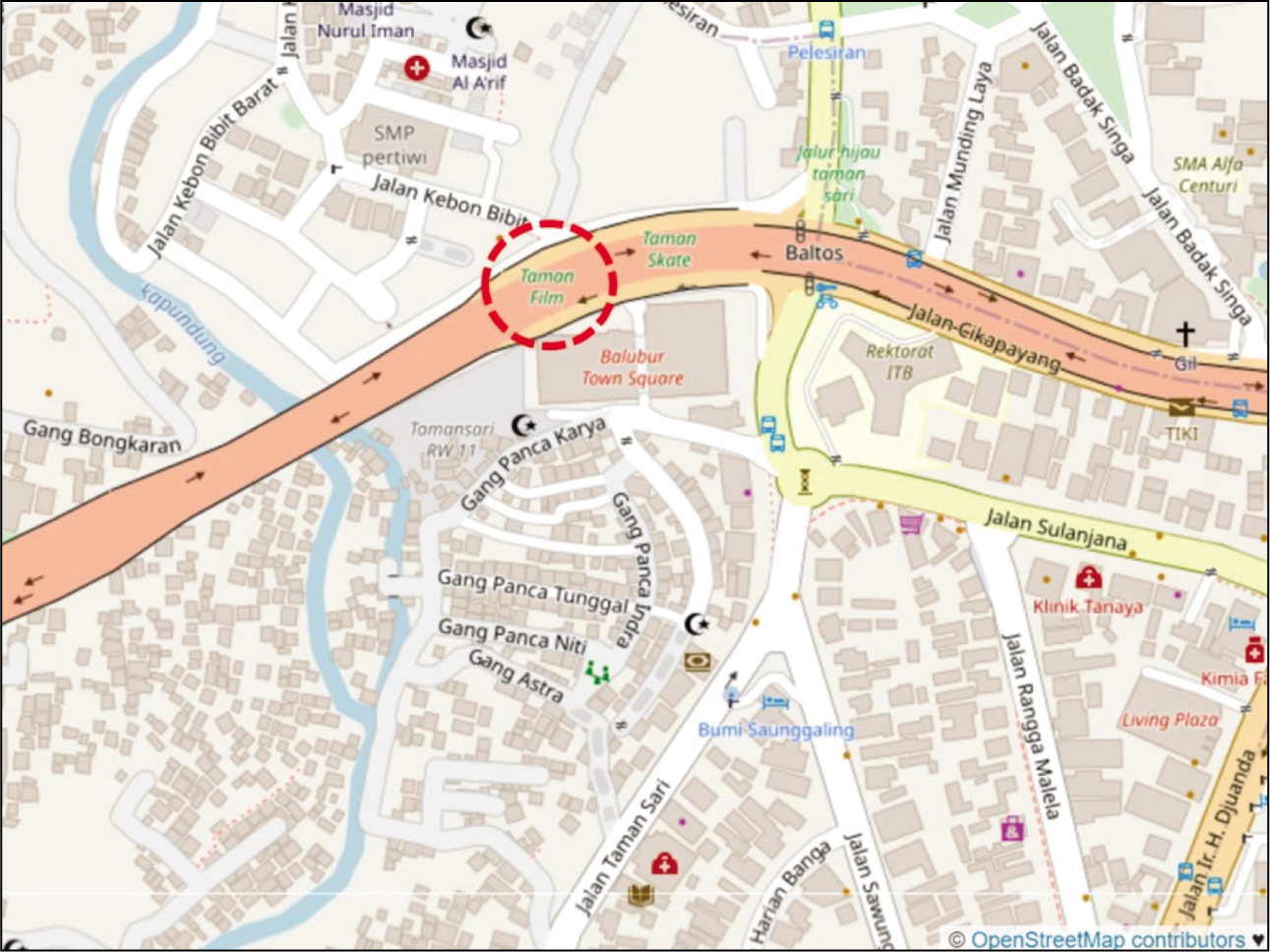
Taman Film, designed and built in 2014, is the third in a series of park projects in Bandung, after Taman Jomblo (Singles’ Park) and Pasupati Skate Park, all situated under the same flyover (Figure 1). SHAU, a Netherlands-based architecture firm at the time, was the designer of the project. The design concept mimics rice fields in a terraced landscape that descends towards a river (Heinzelmann & Suryawinata, 2020). The synthetic grass was not part of the original design and was only added in 2018 by importing the material from South Korea (Anwari, 2018). Eventually, the artificial turf led to a no-footwear rule in the park. Equipped with free wireless internet, the park is now one of the most popular outdoor spaces in Bandung for various activities, from family outings to group exercises (Ajra, 2023).
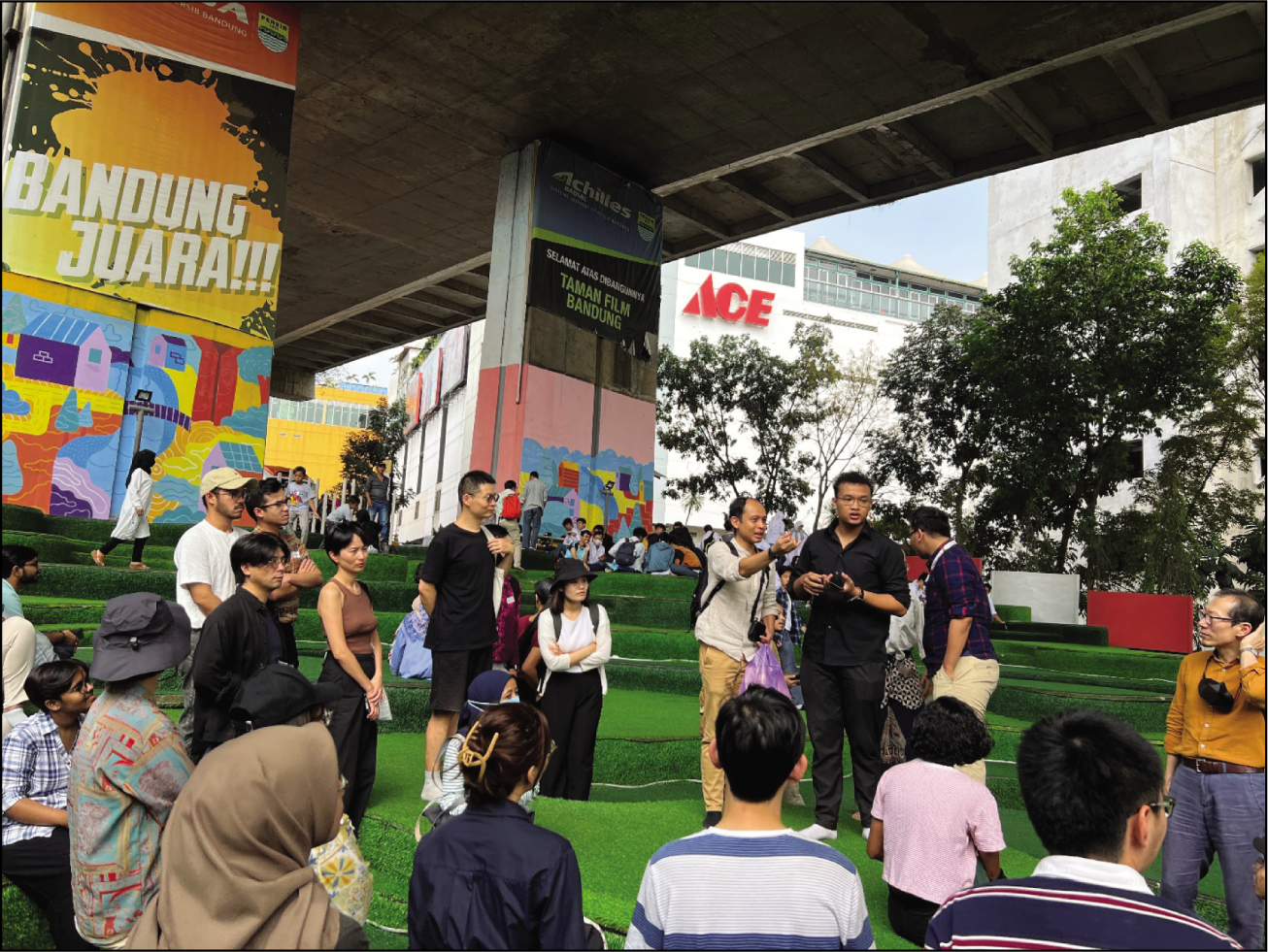
During our visit, the megatron was off, but the park was clean and vibrant with children playing and youths gathering as a group (Figure 2). Large concrete columns soared from the ground up; obviously, they were structural support for the flyover but their colourful, mural-style decorations with the tagline Bandung Juara!!! (Bandung is a Champ!!!) on one column and a congratulatory message for the completion of the park on the other added to the visual vibrancy of the place. One glance was sufficient to capture the image of the park as a well-designed space that activates the usually underutilised space below the flyover.
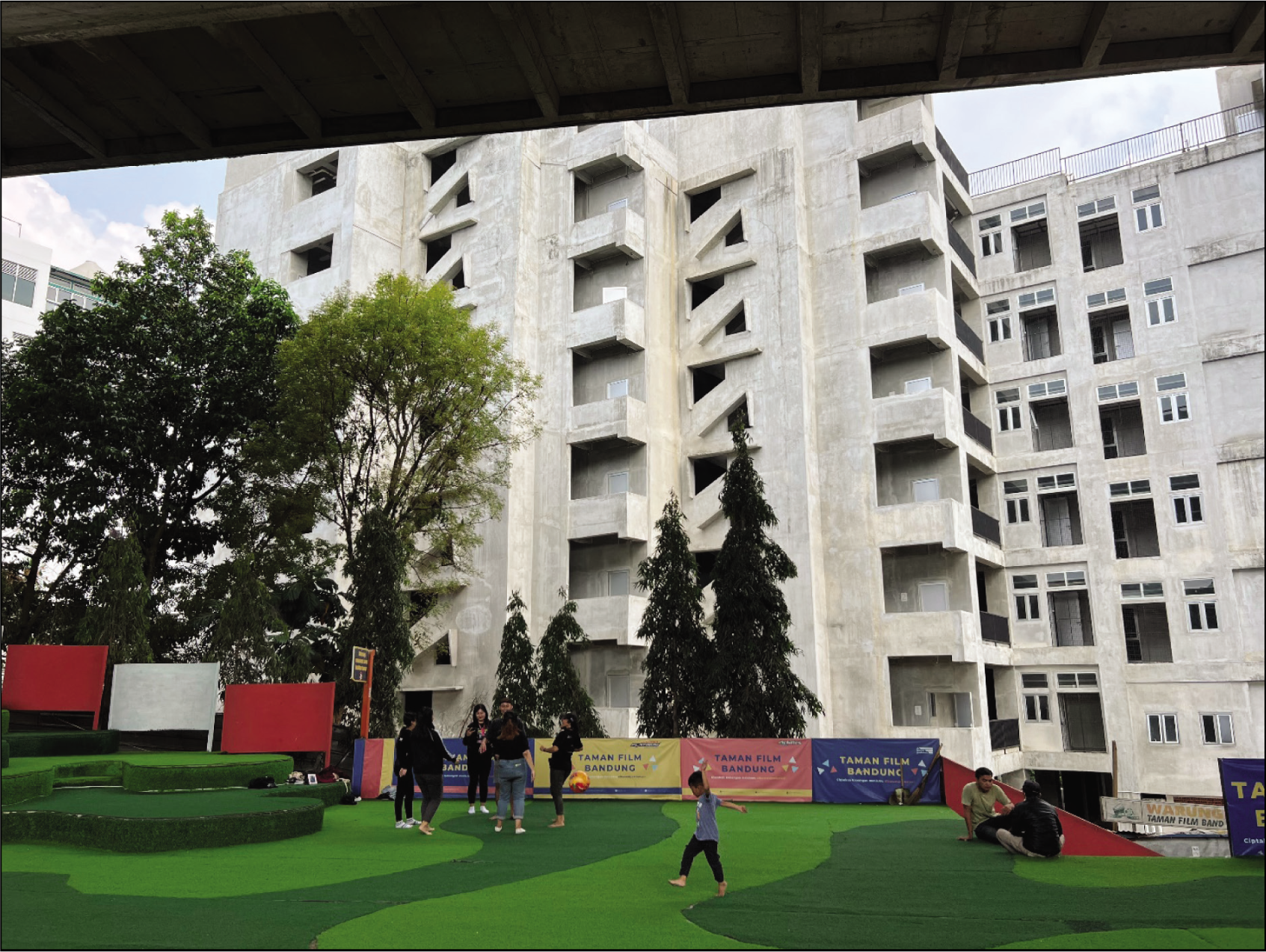
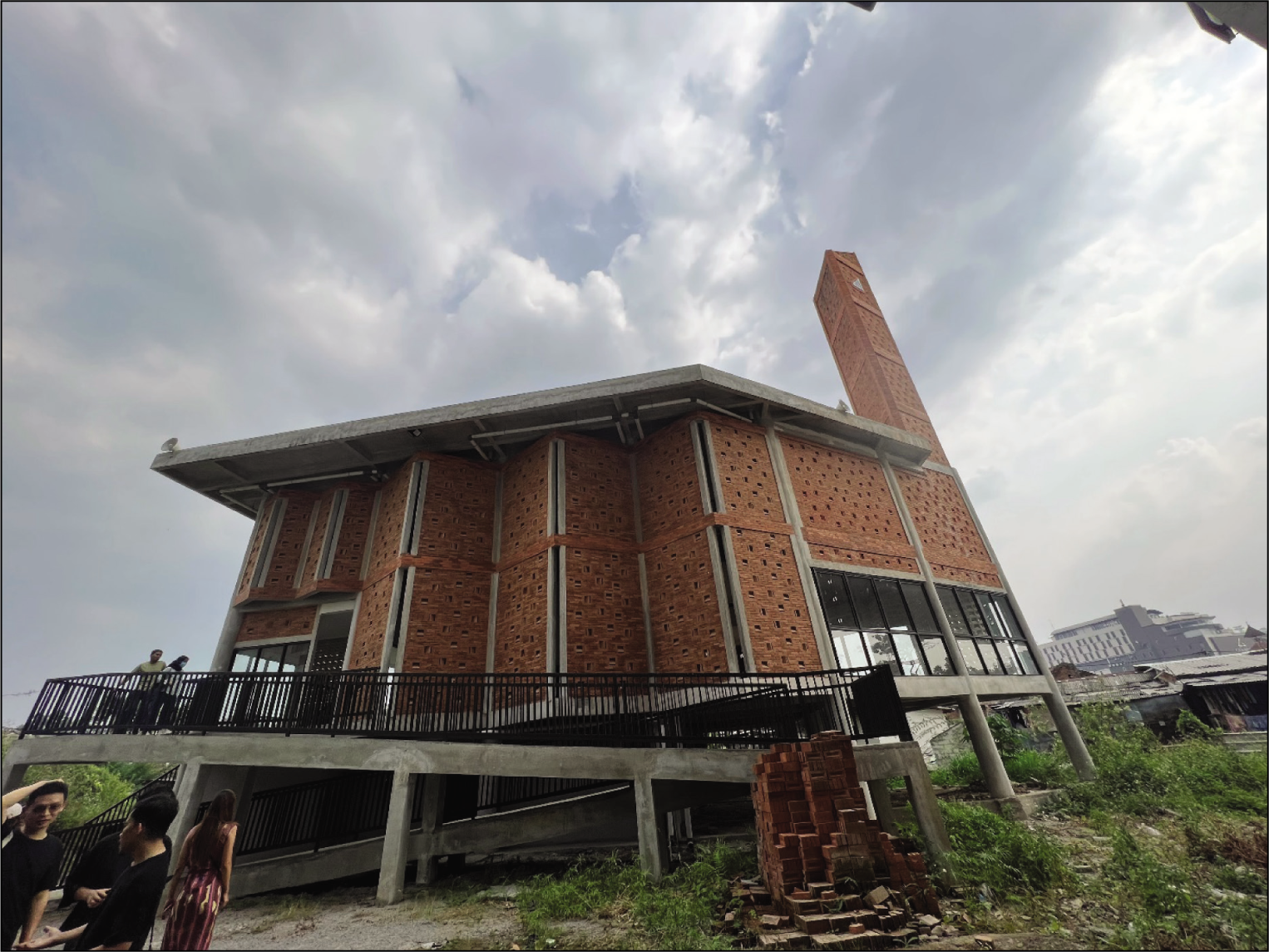
At one point, our guide brought to the workshop group’s notice the surroundings of the park, which are key to understanding overlookedness in Taman Film. It was impossible to miss the vertical structures at the southwest side of the park, close to the riverbank. Formally known as Rumah Deret Tamansari, the project is a 400-unit apartment building planned by the city government to replace the houses in the area that they demolished in 2019. The façade of Rumah Deret Tamansari frames the entire southwest view of Taman Film, making it an inseparable component of the public space, although the apartments are technically separate from the park (Figure 3). Next to the apartment complex is an architecturally unique mosque with variations of red brick compositions used for its walls and minaret (Figure 4).
The construction of Rumah Deret Tamansari and the presence of the unique mosque convey an image of progress surrounding Taman Film. Those of us who had only visited Bandung and seen these projects once had no clue what the space looked like prior to the development of the apartment project. But for the 33 families who lived in Tamansari four years before we visited, the project was the cause of their displacement through a violent eviction. On 12 December 2019, joint forces comprising the Satpol PP (Bandung City’s security personnel), police and military personnel stormed their settlement together with a backhoe to demolish their homes. The forced eviction—termed as ‘establishing orderliness’ by the government and mainstream media—started around nine o’clock in the morning. Citizens and groups who empathised with the families fought the joint forces, and soon after, the conflict involved rock throwing and deployment of tear gas by the police (Bunga, 2019). Dozens of people were injured and 25 were arrested. The forces chased the protestors to the nearby Balubur Town Square (Baltos) Mall (Bunga, 2019). Indonesia’s Human Rights Commission, Komnas HAM, later declared that the evictions involved ‘indications of human rights violations’ and recommended a thorough investigation (Prasetia, 2020). However, there have been no follow-ups by the police since then.
Rumah Deret Tamansari was a project that involved violence in the process. The city government claimed ownership of the land as the basis for clearing space to make way for the project. However, some families that refused to relocate had lived in the area for generations and disputed the government’s claim. They continued to stay on the land even after eviction but faced harassment from others who supported the project. These harassments were also directed towards journalists who attempted to cover their story and paralegals who assisted them (Ramadhan, 2021). When the land dispute was officially heard in court, the citizens lost their lawsuit and the subsequent appeals, but one person continued to stay on the land with support from the solidarity group Forum Tamansari Bersatu (Maheswara, 2023). The land dispute and the lawsuit outcome aside, it was a fact that a violent forced eviction took place to make way for the apartment project. The violence is no longer visible in the landscape and the visual appearance of the project does not indicate its history.
Taman Film and Rumah Deret Tamansari are manifestations of managerial city leadership, which places an emphasis on reliable public service delivery and provision of public spaces. The delivery of reliable services and public space provision are ‘non-ideological’ in that they are not dependent on commitment to social equity and justice, which are at the heart of the conceptual understanding of overlooked cities and of the call for seeing all cities as ordinary (Amin & Graham, 1997; Robinson, 2008). In the case of Taman Film, well-designed and active public spaces may be a manifestation of counter-overlooking—like the public spaces indicated in the examples of progressive cities—but they may also be a manifestation of overlooking.
Rumah Deret Tamansari is not the only urban project in Indonesia that involved forced eviction. There is a plethora of examples that present an image of progress while having a repressive background in their making. For example, the development of the 5,000 m 2 Taman Kalijodo in Jakarta, a popular playground and skate park, involved the violent eviction of more than 1,000 residents in 2016, using 5,000 personnel from the military, police, and city security forces, and 15 backhoes (Sani, 2022). The neatly paved banks of the Ciliwung River that we see today in Kampung Pulo and Bukit Duri in Jakarta involved forced evictions of both settlements. In the case of Kampung Pulo, violence ensued when the city government mobilised 1,000 personnel for evicting residents in 2015.
Methods of Counter-overlooking
Consistency in the overlooked cities research agenda requires researchers to continuously counter overlooking. However, it is extremely challenging to uncover the layers underneath the project in a single site visit to Taman Film when we are not equipped with critical information about the location. The case of the Tamansari eviction brings us to address the second question: What are the methods of counter-overlooking that researchers need to deploy in observing the field?
The first step to counter overlooking is to think beyond the visible and to enquire about the processes behind an urban project. This thinking process is consistent with the first research agenda of overlooked cities, namely, examining the actors and processes in power relations. All urban projects, including Taman Film, require resources and procedures to enable their construction and maintenance. While the initial construction of the park and megatron was supported by corporate social responsibility (CSR) funding from private companies, the operation and maintenance of the 4 m × 8 m megatron with its 33,000-watt sound system is covered by the city budget. The Bandung city government revealed that the operational cost of the 1,300 m 2 Taman Film is nearly IDR 30 million per month (approximately $ 1,850 per month, or $22,000 per year). With a budgetary allocation of IDR 5 billion (approximately $ 309,000) for park operation and maintenance in 2014, Taman Film’s operational cost was already 7 per cent of the annual city budget. Meanwhile, the park is only one out of 30 actively visited parks for social interaction in Bandung (Bandung City Government, 2016). Replacement of park elements also requires significant financial resources. In 2018, replacement of the synthetic grass cost IDR 250,000 per square metre to cover an area of 1,100 m 2 . The new synthetic grass was imported from South Korea, which the authorities claimed was softer and of better quality (Anwari, 2018), but cost more than IDR 230 million (approximately $17,000) that year alone. Given the high operation and maintenance costs, the city government acknowledged that Taman Film is the most expensive park in Bandung (Bandung City Government, 2016).
Besides the flow of resources, the inquiry on actors and processes necessitates that we ask the ‘who’ question in making this space possible. The park was one of the featured projects under Ridwan Kamil, the mayor of Bandung at the time. Early in his tenure (2013–2018), Kamil, an architect himself, launched a chain of parks to connect two commercial districts of the city. Well-functioning public spaces serve as political capital for city leaders, especially in Indonesia, where maintaining public spaces has long been a struggle (Padawangi, 2024). Meanwhile, scholars have discussed Kamil’s social media presence as a significant source of political capital. With conscious self-branding efforts, such as sharing his life stories alongside showcasing his professional achievements, he established himself as a ‘micro-celebrity’ with thousands of followers (Fathiroh & Hapsari, 2017). The combination of a visually attractive ‘instagrammable’ park and Kamil’s micro-celebrity status on social media symbiotically worked to establish him as a capable leader (Lo, 2024). Exactly how much these factors have propelled his political career is subject to debate, but Kamil successfully won the election to become the governor of West Java in 2019, an upward move in his political career. As governor of the province, he continued to commission architectural projects in other cities, such as the redesign of Alun-alun Kejaksan, a 12,000 m 2 central public space in Cirebon City, which was also commissioned to SHAU. In 2024, Kamil joined the race to become the governor of Jakarta and at some point was considered the front runner, but eventually he lost the election.
Another aspect of Taman Film that the city government flaunted as a success was the ability to secure private sponsorship for the initial construction of the park without spending the city budget. The cost of developing Taman Film was IDR 1 billion, which was covered by CSR funding from several companies, with PT Multistrada Arah Sarana as the largest contributor (Perdana, 2014). Kamil thanked the companies during the inauguration, saying that ‘the city government has limited budget, but thanks to cooperation with businessmen who love Bandung, we can make this dream [Taman Film] come true’ (Perdana, 2014). The use of CSR funds for public spaces was not unique to Taman Film; in fact, it has become more common in Indonesia. For example, Taman Kalijodo involved contributions from Sinarmas Land, one of the largest real estate developers in the country, and Tebet Eco Park in Jakarta was supported by Astra Land, the real estate arm of Astra Group. These corporate financial contributions to develop urban public spaces also enhance the companies’ image in eyes of the public (Padawangi, 2024). While different companies may follow different business practices, normalising the use of corporate money to build public spaces can encourage whitewashing of these companies’ images, especially when there are no checks to prevent the appropriation of public projects for such manipulation.
The second step to counter overlooking is to build partnerships with grassroots organisations that can provide insights to navigate the problematic layers of urban projects. Living in Bandung or conducting research in Indonesia does not automatically enable one to counter overlooking, because information in mainstream media about forced evictions is still subject to the hegemony of developmentalism. The rewording of penggusuran paksa [forced evictions] to penertiban [establishing orderliness] is an indication that the media is also entangled in power relations that shape the city. Based on my own experience in researching eviction-prone settlements, it was an uphill battle to call for counter-overlooking amidst abundant media coverage that consistently adopted the city government’s framing of evictions as progress. The polarising landscape of social media also makes counter-overlooking more challenging (Lim, 2017), especially when images of visually aesthetic scenery are contrasted with supposedly ‘messy’ settlements of the lower economic class. Thus, the most promising avenue to obtain information to counter overlooking is through grassroots organisations who are directly in touch with communities on the ground.
In practice, however, partnerships with grassroots organisations can also be complicated. There is a spectrum of grassroots organisations that engage with communities, and they may not be on the same page on the issue. Some organisations may be closer to the government’s position, while others may favour the residents. Such opposing views on urban issues can complicate the effort to partner with grassroots organisations to counter overlooking. In the case of the Tamansari eviction, grassroots activists were divided: some were critical of the government and supported the 33 families, while others collaborated with the government to build Rumah Deret Tamansari, which they saw as a good housing alternative for those affected by the displacement. The architect who worked on the apartment project also had good relations with housing activists in Indonesia and was actively involved in advocating for alternative housing for the residents of Kampung Pulo and Bukit Duri, the eviction-prone riverbank settlements in Jakarta. He designed replacement housing for Bukit Duri residents after they won their lawsuit against the eviction.
The architect’s involvement in the Rumah Deret Tamansari project ignited a debate within the network of activists. Five days after the violent eviction in Tamansari, the intense exchange of texts in the Forum Kampung Kota WhatsApp group—one of the communication platforms among urban activists in Indonesia—indicated differing viewpoints. The architect believed that the city government ‘intended to give an alternative development without evicting’ and that ‘in the beginning, all residents agreed to the plan’. In his view, the conflict started from a disagreement about compensation, and residents were ‘divided between the supporters of the plan and those who refused. The ones who refused also had several factions, each with different reasons for refusal’ (Architect, personal communication, 17 December 2019). But those who disagreed openly questioned and rebutted his position, countering that the residents who had agreed to be displaced in 2016 were stuck in limbo as they were only promised three years of rental subsidy but by 2019 Rumah Deret Tamansari had not even started construction. They also pointed to uncertainty about the continuity of rental support and getting their space back, as well as uncertainty about when Rumah Deret Tamansari would ever be built:
This is the city government’s scenario to divide residents who accepted the plan for temporary relocation, so that they are scattered and had no way to organise and mobilise because they had to focus on survival. Also, the temporary relocation to Rancacili rental apartments distanced them with Tamansari by 20 kilometers. How would they live there, while all their livelihoods are informal economy in Tamansari? (Dissenting activist, personal communication, 17 December 2019)
The above communication highlights only snippets of a lengthier debate that involved several other activists around Rumah Deret Tamansari and the eviction in the development process. Differences in viewpoints may lead to polarisation among grassroots activists. When forging partnerships with grassroots organisations, which one between two polarised groups would a researcher choose to counter overlooking? If the approach is to partner with both, what are the possibilities to navigate through the different standpoints and ideological stances without alienating one group over another? Furthermore, given the adverse impact of overlooking on people’s lives and livelihoods, to what degree should the researcher be involved in partnering with grassroots organisations? In eviction cases in Tamansari as well as other cities in Indonesia, and perhaps the global South in general, detachment is counter-productive to meaningful grassroots partnership. One key takeaway from my years of observation in eviction-prone communities in Jakarta is that the act of ‘being neutral’ itself is an expression of privilege, one which the poor cannot afford. The researcher may not be an activist, but in studying overlooked cities and all things overlooked in cities, there are moments when activism is required to continue the commitment to counter overlooking and to reorient urban planning and policy.
Counter-overlooking Amidst Managerial City Leadership: An Attitude of Scepticism
The deeper the discussion on counter-overlooking, the more obvious it becomes that there are contradictions in the three agenda points that we still need to unpack. Power relations, knowledge production and grassroots politics in cities of the global South revolve around and within this thing called ‘the city’. But the discussion on overlooked cities has greatly focused on critical debates on the concept of ‘overlooked’, not so much on ‘cities’. It is important to examine whether the city in the global South implies the political process of overlooking.
The practice of governance in contemporary cities in the global South often involves continuing colonial legacy. Three legacies from the colonial city are cities as economic centres, urban infrastructure systems and standards, and aspirational images of the city (Kusno, 2017). The land ownership system, for example, is an example of the continuing systems and standards: many cities carry on the colonial system of land titling, resulting in the shaping of cities as an amalgamation of private property. But this approach to managing space is more accessible to those who have capital and are familiar with the system, which then perpetuates power hierarchies.
For example, in global South cities, we often see informal housing and businesses coming up just beside a large urban development (Kusno, 2013). The presupposed notion in urban governance of the formal as inherent to cities often results in prejudice towards the informal, which does not fit into bureaucratic processes. This prejudice in the management of urban spaces is what results in the use of violence—such as through forced evictions—and reproduces social inequalities that perpetuate stigmatisation of the informal. The lack of acknowledgement of collective ownership and the autonomy of settlements to govern themselves are acts of overlooking local systems of governance and the values that residents have cultivated (Padawangi, 2018; Putri, 2020). The urban condition of the global South is a postcolonial condition that is rife with layers of inequality. Therefore, the scale of the city may be too distant from the ground reality of local communities and may well lead to overlooking.
Amidst the layers of enduring inequality and colonial legacies, the popularity of managerial city leadership arises from the intensification of cities as economic centres in a globalising world and their aspirational image that presumes capable administration of urban governance. Cities in Indonesia are no exception to the competition for a place in the global economy. Many have shown attempts to attract investments and visitors by using urban projects, aesthetic visuals and catchy taglines (Padawangi, 2024). Visual appearance, service delivery and infrastructure become indicators to measure the success of city leaders. Apart from Ridwan Kamil, whose park projects were discussed earlier in the article, there are other examples of city leaders who rose up the ranks. Tri Rismaharini, mayor of Surabaya from 2010 to 2020, was also known for undertaking the revitalisation of parks (Bunnell et al., 2013). The most famous example is the rise of Joko Widodo from being the mayor of Surakarta (2005–2012) to becoming the nation’s president in 2014. For these city leaders, urban development projects were legitimising factors for their campaigns to move to higher political positions. While Kamil became governor of West Java in 2019 and ran for governor of Jakarta in 2024, Rismaharini went on to become a cabinet minister and then a gubernatorial candidate for East Java in 2024.
Managerial city leadership is an accumulation of political capital; it is insufficient to consider it as a merely techno-managerial approach for urban service delivery and development projects. Beautification projects—including urban parks such as Taman Film—are not just ‘aesthetic governmentality’ as a form of inclusion and exclusion, as Ghertner (2015) argued in the case of Delhi. Nor do they only preserve the hegemony of top-down ‘control’ of urban planning to achieve an aspirational image of the city (Harms, 2012). Managerial city leadership is a tool that may lead to overlooking political ambitions as well as fundamental ideological contradictions in urban life. Improvements in visual appearance, service delivery and infrastructure of cities as non-ideological approaches of urban governance are challenges to the research agenda of counter-overlooking. Apart from deflecting attention from issues such as traffic jams and flooding (Lo, 2024), beautification projects, by projecting the image of having capable city managers, may lead to overlooking collaterals of development, which can include the use of violence in the name of securing public service delivery (Padawangi, 2024).
Managerial city leadership as an accumulation of political capital is best exemplified in the transformation of Widodo from being the ‘progressive’ mayor of Surakarta (2005–2012) to the governor of the Jakarta Special Capital Region (2012–2014) and finally the President of the Republic of Indonesia (2014–2024) with the support of a considerable number of intellectuals and grassroots organisations. The cultivation of Widodo’s image as a leader capable of building infrastructure and actualising development through urban projects—including relocation without forced evictions—demonstrates the political power of managerial city leadership (Padawangi, 2024). This managerial city leadership, however, also brought in a ‘new developmentalism’ that masked its conservative nationalist agenda (Warburton, 2016). Eventually, Widodo became a president who perpetuated the problem of power hierarchies and attempted to build his own political dynasty while using urban projects, such as the construction of the new capital city of Nusantara, as a populist appeal to project the image of a capable manager (Padawangi, 2019; 2022; Warburton, 2016). It is important to note that his achievements as mayor and governor have been discussed in academic publications that relied on collaborative research with local NGOs/grassroots organisations (Bunnell et al., 2013, 2017; McRae, 2013). Whether there were indications of dynastic or regressive politics in Surakarta during Widodo’s tenure that might have been overlooked, or whether it was even possible to predict such manoeuvre, is debatable. 6 The case of Surakarta under Widodo serves as a reminder that academic publications that provide positive appraisals of a city leader also run the risk of becoming part of that same political capital accumulation towards ambitions that may be contradictory to the premise of overlooked cities—and the ordinary city to that extent—on social equity and justice.
Critical reflection on managerial city leadership does not mean that the city should not build aesthetically pleasing spaces to counter-overlook underlying contradictions of the city. Rather, this critical viewpoint highlights the necessity to ‘adopt an attitude of scepticism’ as the default perspective when experiencing new urban spaces (Padawangi, 2024, p. 17). Seeing ‘beautiful’ projects and ‘neat’ public spaces in cities requires researchers to critically assess what it took to create them, what possible political ambitions could have motivated their creation, whether their construction involved repression and marginalisation, whether the affected/displaced people were accorded justice and human rights. In the case of Taman Film, the project utilised the unused space beneath a flyover, hence seeming like a good articulation of space. A critical assessment of what it took to create the park revealed significant costs for its construction, operation and maintenance, underlying political ambitions and normalisation of private interests benefiting from the project through image branding. If a similar project is constructed beneath the Angke Toll Road in Jakarta, it would have involved the displacement of the urban poor who had constructed their homes under the elevated highway (Prihatini & Sari, 2023). In the case of Rumah Deret Tamansari, the neat design may be visually aesthetic, but the project was made possible through forced eviction, intimidation tactics and divisive practices that can be easily overlooked if there is no attitude of scepticism when seeing the building.
Rather than looking at the city or its mega projects as the focus of analysis, the neighbourhood can be a useful scale to understand the urban landscape. As the smallest scale of city life, the neighbourhood allows for ‘ethnographic engagement with urban spaces and lives beyond “global” financial districts’ and using local language in the research process to examine ground realities (Bunnell & Maringanti, 2010, p. 417; Padawangi et al., 2022). A study from SEANNET in Chiang Mai, Thailand, for example, looks at the role of temples in Wua Lai on the silversmithing heritage, uncovering different models of engagement between communities and temples in the city’s everyday life (Pumketkao-Lecourt et al., 2022). Another example from the network is a study in Surabaya that found nuances of diversity in everyday life in Kampung Peneleh, one of the oldest neighbourhoods in the city, as a manifestation of the neighbourhood’s relative autonomy from the city administration and influence from national narratives of diversity (Perkasa et al., 2022). The attitude of scepticism should also be adopted in studies at the neighbourhood scale as they do not preclude overlooking. Managerial leadership can also manifest at the neighbourhood level; in fact, the neighbourhood scale has relatively higher chances in making immediate local interventions such as cleanliness and greenery, and it does not prevent the possibility of local leaders accumulating political capital from these efforts. Thus, more attention to the local scale is not to assume immunity to overlooking but to provide more insight into what might have been missed in the wider scale that has dominated urban studies thus far and to what extent scale matters in the relationship between overlooking social equity and justice with managerial leadership. The neighbourhood provides the everyday scale, not just in terms of warm social-neighbourly relations but also in terms of conflicts and power inequalities that researchers need to be critical of.
The attitude of scepticism is the starting point to enquire into layers that are possibly overlooked in studying the city and in an aesthetically designed appearance of an urban project. By breaking free from the boundaries of the city, yet acknowledging the existence of the formal administrative planning boundaries, counter-overlooking challenges the problematic hierarchy of power that prescribes prejudices and expectations on what a city should be. Focusing on overlooked scales and aspects that are meaningful in everyday urban life potentially addresses the problematic hierarchy of power and, at the same time, provides new ways of analysing the city and urban life.
To Look Over: Reconstructing Ways of Looking
Counter-overlooking is a critical stance on power inequality that requires deconstructing power relations and reconstructing ways of looking at cities and urban life that pave the way to challenge power inequality constantly. First and foremost, this requires researchers to look beyond formal plans and policies to uncover possible contradictions of managerial city leadership. Assessing power inequality among city actors and processes is not only for displaying a critical stance per se, but it is about reconstructing ways of looking at power relations through the lens of disadvantaged communities in the city. Such a viewpoint would contribute to aligning conceptual inquiry with practical implications of the study.
Second, resisting constraints of the city’s administrative jurisdictions on studying urban life can provide an alternative view of the city that is often overlooked. Cities in the global South, including Indonesia, carry colonial legacies of development and policies. Going beyond the formal city is a potential way to challenge and critically deepen our understanding of persistent domination–subordination, both in urban life and in building city knowledge. The neighbourhood, an often overlooked viewpoint of understanding the city, is an everyday unit of urban governance that can provide an accessible scale to contextualise city knowledge.
Third, the choice of topics and methods in studying urban development has political and social implications for lives and livelihoods in cities; hence, reconstructing ways of looking at cities and urban life requires collaborative effort from the start of any research project. It is important to forge connections, networks and collectives as the research may go beyond the classic expectations of academia. Counter-overlooking cities does not mean giving up on academic publishing, but rather to reshape the ways in which we study cities and the vantage point that is necessary to deconstruct power relations. Throughout these efforts, it is pertinent to continue developing research methods and pedagogies from the ground up to ensure the sustainability of studies and approaches. This includes not only contextualising collaborative engagements with grassroots organisations for each research project but also sustaining relationships from those engagements to build a network of city knowledge from the ground.
Finally, since studying cities has real-world implications, researchers need to think carefully about the focus of their work, the implications of the methods used, how to sustain the research agenda beyond their individual career progression, and to whom the research would matter. A publication that celebrates the achievements of a particular city leader, for example, might disseminate meaningful practice of urban governance, but the timing of the publication might also become political capital for managerial leaderships that cultivate their own hierarchies of power. In contrast, a publication that studies the urban poor might aid the researchers’ academic career progression while their research subjects remain poor. An academic publication best serves as part of a purposeful knowledge building, with thoughtful considerations of possible implications on the ground and for whom the publication would matter.
Counter-overlooking takes a critical and sceptical view on urban development, with the purpose to reorient urban studies and planning in the way it looks over cities and urban spaces. Studying overlooked cities would further build knowledge on cities and urban life by looking over cities and communities, to reduce indifference and integrate what we see, think, feel, act and care about in our study of cities (Nugraha et al., 2023). Beyond publishing more papers, building knowledge on cities and urban life through the overlooked cities viewpoint involves addressing the contradiction between academic research and the pragmatic needs of research subjects, which means redefining the purpose of urban research and approaches in knowledge production from the ground (Bunnell & Maringanti, 2010; Padawangi, 2022). Thus, to resist the temptation to overlook cities is to consider urban studies’ implications on urban planning, policies and the everyday life of citizens, and such consideration would affect the choice of topics, areas, communities, partnerships as well as methods of study.
Footnotes
Acknowledgements
I thank Forum Kampung Kota and Overlooked Cities Collective for the stimulating debates, discussions and commitment to reconstructing ways of looking at and building knowledge of cities.
Data Availability Statement
Data sharing is not applicable to this article as no new data were created or analysed in this study.
Declaration of Conflicting Interests
The author declared no potential conflicts of interest with respect to the research, authorship and/or publication of this article.
Ethical Approval and Informed Consent Statements
No new data were created or analysed in this reflection piece. All new information was collected from openly accessible media reports. Therefore, no ethics approval is required for this reflection piece. Written consent to include block quote from the activist’s statement in Forum Kampung Kota group communication from 17 December 2019 was obtained through WhatsApp communication on 25 July 2024. Written consent to include block quote from the urban poor activist’s statement in the opening paragraph of the paper was obtained through WhatsApp communication on 20 September 2024.
Funding
The author disclosed receipt of the following financial support for the research, authorship and/or publication of this article: The field research experiences for this reflection piece consist of several research projects that received research funding from various sources, as follows: The fieldwork related to grassroots activism in Indonesia was funded by the Singapore Ministry of Education AcRF Tier 2 grant for the project ‘Aspirations, Urban Governance, and the Remaking of Asian Cities’ (MOE2012-T2-1-153). The fieldwork related to grassroots activism in Indonesia on disaster governance was funded by the Singapore Ministry of Education AcRF Tier 2 grant for the project ‘Governing Compound Disasters in Urbanising Asia’ (MOE2014-T2-1-017). The work related to the Southeast Asia Neighbourhoods Network (SEANNET) was funded by the Henry Luce Foundation. The site visit in Bandung in 2023 was supported by the Overlooked Cities Collective on funding from the Urban Studies Foundation Seminar Series Award.