




Abstract
This article takes the COVID-19 pandemic and the resultant migrant exodus from cities as an inflexion point and engages with the new policies initiated to address the needs of migrants to cities. As against the significant and persistent invisibility and neglect of the issue of circular internal migration in the country, recent years have witnessed some shifts in the narrative and a few new policies triggered by the pandemic. The article reviews these initiatives to find that the hegemonic hold of the previous narratives and policies informed by the same is largely intact. The new policies do not account for migrant realities and needs. The article therefore calls for more migrant-aware policies based on its study of migrants in Mumbai and proposes principles by which these policies can be reimagined.
Introduction
In India, the COVID-19 pandemic in 2020 was accompanied by a clampdown on city economies, resulting in a mass migration of thousands of migrant workers from cities towards their homes. This moment exposed the scale of internal migration and the exclusionary nature of cities in relation to migrants and was a potential disruptor for conventional narratives and policies towards migration. It made visible the vulnerabilities of migrants and brought migration into public discourse. The migrant crisis definitely led to the creation of a few policies intended for migrant workers. However, a review of these policies indicates that even though they were designed for migrants, they do not fully account for the realities of urban-ward migration and hence are unable to deliver their intended benefits.
This article is based on literature and the author’s personal experience of working with migrant communities in Mumbai. It seeks to make four contributions to the overall discourse on internal migration and policies for migrants in urban destinations in India. First, it asserts that the nature of migration to urban destinations is neither unidirectional (i.e., rural to urban) nor permanent. Rather, it comprises multiple stilted, halting mobilities that are sometimes cyclical but often involve many more places that may or may not cumulate in a settlement in the urban. Second, the policy paradigm that governs internal migration in India is characterised by the above-stated assumptions of unidirectional and permanent movement to urban areas and hence undercounts and invisibilises migration typologies that do not culminate in a long-term residency. Thirdly, key policies that may be crucial to the well-being of migrants in urban destinations are characterised by a sedentary bias and do not fully account for the existing realities of urban-ward migration. Finally, the article shows how a lack of migrant awareness in policies persists even in the post-pandemic era and outlines some principles, which may be used for designing more migrant-aware policies.
This article is divided into five sections. The first section discusses the overall context of urban-ward migration as a part of internal migration and its invisibility in data systems and policies. The second describes the nature of urban-ward migration and the various facets of the lived experience of these migrants in urban destinations. The third section reviews some key policies in the pre-pandemic era and the extent to which they included or excluded migrants. The fourth section reviews the post-pandemic policies in similar domains initiated specifically for migrants and the barriers experienced in effective service delivery. The fifth section distils the lessons offered by the third and fourth sections and arrives at principles for more migrant-aware policies.
The author has been involved in an action research project in one of the peripheral geographies of Mumbai, which also acts as a hub of several low-income migrants from varied source regions for several years. This has included experimenting with pilot projects for supporting vulnerable groups during COVID-19 and after. As a result, she has had significant interactions with short-term and long-term migrants to the city, enabling some of the insights in the article. Further, the author also conducted a focus group discussion with about 25 community leaders in the locality from informal settlements with significant proportions of migrants. 1
Urban-ward Migration as a Component of Migration and Migration Policies
There is significant undercounting of seasonal and circular migrants in Indian data systems (Datta, 2020). Until very recently, internal migration in India was understood as a unidirectional (rural–urban) phenomenon that resulted in permanent and complete shifts of households to urban areas. This is reflected in the ways in which migration is defined and measured by the Census of India 2 and the National Sample Survey Organisation (NSSO). 3 India has conducted decennial censuses since 1871 in which lifetime migration, a comparison between current place of residence and place of birth, is measured. Such a definition that is preoccupied with current and permanent migration is inadequate to even identify circular patterns of migration (Chandrasekhar & Ghosh, 2007). The National Sample Survey is another nationally representative, multi-round survey in which the employment rounds try to gather migration data. The NSSO defines migration as a change in place of employment other than the place of usual residence over the past six months and is thus able to capture better migration data as compared to the census; however, it is a sample survey and collects very few dimensions of data. As a result, overall, there is a dearth of official data pertaining to temporary or circular migration (Keshri & Bhagat, 2012).
Deshingkar and Akter (2009) adopted unconventional methods of estimating temporary migration on the basis of overall estimations of labour force in occupational streams where migrants are prevalent such as construction, sugarcane cutting, plantation work, brick kilns and so on. Srivastava (2020a), through an analysis of NSSO and census data, estimates the number of long-term circular migrants to be about 85 million and short-term circular migrants to be about 55 million; this is way more than the estimates of the NSSO’s 64th round, which was about 13 million. The complete reality of temporary migration—its extent and patterns—is thus largely invisible. The COVID-19 pandemic–induced lockdown and the resultant exodus of the nearly 11.4 million urban migrant labour force (Adhikari et al., 2020) was thus a rude shock.
In the recent past, there has been a shift in the narrative of migration in India. This can be attributed to the consistent work done by migration researchers and activists 4 in demonstrating the significance of temporally and spatially dynamic mobility patterns, forms of migration such as long-distance commuting and seasonal migration and occupations that largely deploy migrants such as brick-making, construction, plantation work and migratory communities such as nomadic tribes. There have also been some policy initiatives towards creating some migration-aware policies through the appointment of a working group on internal migration in 2016.
However, the principal push towards the acceptance of migration as a positive force has come from the vastly transformed policy outlook on urbanisation. After 2000, urbanisation has been accepted in development policy frameworks not just as an inevitable phenomenon but also one that would multiply development and hence is desirable—the challenge was to be prepared for the same in terms of infrastructure. Interestingly, temporally short-term and spatially dynamic migrants did not find much mention or attention in this shifting narrative of migration. On the one hand, while some reports 5 advocate significant improvement in infrastructure standards so that internationally mobile persons could feel at home in cities, there was no commensurate move to create policies that would make cities friendly and accommodative to migrant labour who have toiled to construct the cities and make them liveable.
Srivastava (2020c) estimates that there were 52 million interstate circular migrants in India in 2018, of which 43 million were in urban destinations, 24 million were short-term migrants and 19 million were long-term migrants (p. 170). Datta (2020), in her study of rural Bihar, indicates that the duration of out-migration largely varied between 10 months and more (p. 1152) and that more than half of the respondents had stayed in their respective destination locations for more than six years (p. 1154). Breman (2020) has documented in his studies in Gujarat as well as South India how migrants can move between destinations for irregular periods before moving back to the source location.
Urban-ward migration, thus, defies terms such as seasonal (which implies outmigration in non-agricultural months) or circular (which indicates repetitive, regular movement between source and destination locations). The stilted, halting, multilinear and irregular nature of migration needs recognition and appreciation by data systems and policy. Apart from issues such as undercounting in data and neglect towards short-term migrants, I argue that there is very little understanding of the complex processes of urban-ward migration and integration of migrants in urban destinations and that this creates gaps between well-meaning programmes and their intended target groups. The article thus adopts qualitative insights from the author’s long-term engagement with low-income communities in Mumbai supplemented by literature to explicate some of these processes and how an awareness of them can inform migrant-inclusive policies and schemes location.
Indian Cities and the Process of Urban-ward Migration
Migration is defined as a movement across borders for mostly economic purposes (Todaro, 1969). While the emphasis here is on the act of movement across places, I assert that migration, particularly circular migration, is an attempt to diversify livelihoods. It involves displacement from an existing way of life and an attempt to adapt to another place and way of life, all the while keeping the interests and welfare of those left behind in mind. When seen in this perspective, many facets of the lived experiences of urban-ward migrants are brought forth.
Migrants often come to the city through networks, which may range from contractors who hire groups from particular regions for particular kinds of work to relations who may offer some support in the destination locations in the form of temporary stay arrangements or some connections to prospective employment. Several migrants stay locked in such cycles for multiple years; however, some of them are able to develop networks that enable them to consolidate and explore possibilities of settling in the city. 6
The migrant-partial city dweller, who is more invested in the source area when migrating, goes through a process before becoming a worker-citizen who is fully invested in the city. Settling in is not a one-time decision, and the form of settling in is also uneven. For example, the author’s research (Bhide & Spies, 2013) in Dharavi shows that more than sixty years after their migration from Andhra Pradesh, in the rajak (washer people) community, only couples of working age stay in the city while older people shift to the villages. Similarly, migrants from Konkan exhibit a pattern which (Bhide & Vartak, 2022) can be labelled as ‘javun yevun’ (going and coming) despite following a well-trod path of migration between Konkan and Mumbai. Clearly, migration and settlement patterns vary, are unpredictable, involve significant circular movements and are not unilinear.
Saving and remitting money to the family left behind in the village is a common preoccupation of migrants in the initial years after migration and one of the reasons why they live frugally. The attempt to minimise expenditures on the self in the destination location and uncertainty of work that makes them want to maintain ties in the source location. These are reflected in their poor and sometimes risky housing conditions and their lack of investment in basic services and creating documentary evidence such as ration cards, voting cards at the destination. These are also significant concerns for policies seeking to improve living conditions of migrant workers to consider.
For migrants, the process of settling in a new destination is not smooth and is contingent on several factors in the destination location. These include the degree to which a city demands physical labour and services, the economic prospects in these sectors, the comparative costs that deploying local or migrant labour entails for the employers, the differentials in opportunities for migrants and the overall affordances 7 in bastis and other forms of informal housing. Migrants are exploited and excluded by the more settled populations in informal settlements through gatekeeping of information and benefits of schemes and rent seeking for giving access to even basic services like water, toilets, etc. (Bhide, FGD notes).
Migrant workers are one of the most vulnerable groups in urban settings. Given their purposive and scant interactions with the wider community and city, they tend to have few supportive networks in the city and are perhaps hit the hardest when there are disruptions in the sub-local economies and conditions (Breman, 2020). Such disruptions can range from epidemics and riots (or threats of the same) to changes in the industry structure due to new technologies and shifts in production centres. Such changes are often visible to only the community residents or to those closely involved with the relevant industries at the ground level. In my own experience of working with migrant communities in Mumbai, the informal industries employing migrant workers were extremely spatially dynamic and sensitive to changes in capital and technology regimes. For instance, the bag-making and embroidery industries, which were fairly prevalent in several slum settlements in Mumbai prior to the COVID-19 pandemic, are hardly seen in Mumbai today; they have shifted to other destinations, and the workers have moved with them.
Indian cities have been unable to provide decent work and living opportunities for people who have been working there for a long time (Tata Institute of Social Sciences, 2013). As a result, there is a significant continuity and overlap between groups such as the homeless, basti dwellers, casual labour, informal sector and migrant workers. In fact, a sizeable number of short-term migrant workers may be homeless and sleep in the open, stay in bastis on a group rental basis or stay in huts hired/owned by contractors/employers in bastis. Most of them work in the informal sector and are casual labourers. The complexity lies in the fact that not all homeless people, basti dwellers and informal sector workers or casual labourers are migrants. Identifying migrant workers as a distinct group with distinct needs can thus be a highly complex task for service delivery agencies.
Each of the above facets affect the inclusion and exclusion of migrants from welfare policies. We discuss this further in next section below.
Policy Inclusion of Migrants
This section reviews pre-COVID-19 trajectories of select policy domains to illustrate the issues that plagued the policies in the past and trace the changes in recent policy initiatives. The domains chosen for this analysis are food, shelter and registration of migrant workers. Food and shelter are obvious choices due to their criticality for survival and because they represent two areas of maximum spending and potential causes of distress for migrants. Registration of workers and their visibility in data on locations, population and access to services in urban destinations is important for securing the workers’ rights to decent wages, social security and improving working conditions.
In the Indian federal system, functions such as housing, basic service provision, health services and social protection were 8 largely contingent on belonging to a particular state and entitlements varied as per the state policies (Bhide, 2020). Furthermore, even the pathways to access such services were highly contingent upon domicile in a particular place and possessing a permanent address and voting rights (Srivastava, 2020b). Food security was a joint function shared by the central government and the states—the central government was responsible for procurement, storage and release of quotas for states while the state governments were responsible for the actual distribution to the beneficiaries.
Ration Cards and Food Security
The public food distribution system via the National Food Security Act (2013) is one of the most extensive services for well-being provided by the Indian state. The foodgrains provided at a subsidised rate in fair price shops (FPS) provide basic sustenance to vulnerable and poor groups. The system has undergone several reforms in the past decade but its basic operational principles have remained the same. These include the issue of ration cards to households by the revenue authorities in every district (with a provision to add and delete names as per changes in the household structure); the entitlement of grains on a unit basis to every member of the household; the food stock supplied to FPS depending on ration cards registered with the same and the buying/collection of the grains by households every month (Sriraman, 2011). The issue of ration cards and the management of food supplies and additional subsidies is managed by state governments, which is the main cause for the sedentary bias in the policy. There has been some willingness to innovate the system to include intra-district migration in the case of migrants within Nashik district by the collaboration between the Collector and a civil society organisation—Disha (Borhade, 2007) but there has been resistance to move towards interstate portability. The ration card is issued to a family, and the entitlement cannot be split to suit the needs of individual members who are on the move. Thus, this excludes urban-ward migrants who do not have ‘an address’ at the destination locations (Srivastava, 2020b). Migrants who seek to avail benefits in urban areas often try to do so by working around the system and creating another ration card at the destination (Mooji, 1998). Establishing portability of entitlements has been in discussion among civil society groups, central government departments and international organisations like UNESCO since the late 1990s. The Aadhaar card was initially hailed as a single national document that would enable portability, but it has been unable to make a dent in the issue of portability of food entitlements at destination locations (Aajeevika Bureau, 2020).
Shelter Policies
The most common shelter option for short-term urban-ward migrants is rental housing. Rental housing has found very little policy attention in India since the 1970s, and there are very few options of public rental housing (Tandel et al., 2015). In the handful of public rental housing policies that have been initiated in the pre-COVID-19 period in West Bengal and Mumbai, various ills have plagued the schemes. For example, in Mumbai, eligibility to state supported rental housing is contingent upon state domicile for over 14 years—a condition that clearly excludes migrants. In West Bengal, the terms of rental housing were so deeply subsidised and delinked from private rental markets that the scheme itself became unviable and its benefits restricted to a select group (Harish, 2016). In a recent article, Harish et al. (2023) assert that low-income rentals also extract a social absolute rent that makes even private rental housing inaccessible to certain groups, which may often include migrants. Migrants to urban destinations thus occupy a liminal place in cities. Their housing is seen as low priority by the migrant workers themselves as well as by their employers and the government. Migrant workers tend to live in arrangements made through employers (living in workplaces or in other places arranged by the employer) or in group rental housing in bastis or other insecure places (Aajeevika Bureau, 2020). Shelters for homeless populations initiated in various urban centres are also housing options for migrant workers. However, the number of such shelters is far too few to match the need; additionally, the amenities and infrastructure are far too basic (Desai, 2017).
Registration of Migrant Workers
There is an integral link between the registration of migrant workers, the visibility of their work and economic contribution, and the possibility of social security and improved wages and working conditions. In India, this link was sought to be established in the pre-COVID-19 era through the Inter-State Migrant Workmen Act of 1979. In this act, the responsibility of registration was placed on contractors or employers who deployed interstate migrants; however, this has resulted in exclusion of migrant workers who were not employed explicitly by a contractor (Sathya Pratheeka, 2022). In 2007, the National Commission on Unorganised Enterprises made an explicit recommendation to register all unorganised workers; however, this was not realised. An active database of migrants in relation to their job sectors and destinations was thus largely absent. A process of registration did exist in a few work sectors, such as construction, domestic work and transport work; however, such registration was also largely contingent upon certification by employers and hence the number of workers remained far lower than the estimates. For example, while the estimated number of construction workers in the country is about 8.5 crore, the number of registered workers was 2.15 crore in 2020 (Shyam Sundar, 2021). Further, registration with the labour boards did not necessarily translate into delivery of assured benefits like health and life insurance or scholarships to children (Shyam Sunder, 2021). The migrants therefore also did not have any incentive to get registered, adding to the invisibility of their numbers.
Review of Post-COVID-19 Initiatives for Migrants
While the COVID-19 pandemic led to a few initiatives intended to benefit migrant workers, we contend that these new policy initiatives are not informed by a critical awareness of migrant realities. We illustrate the same through a review of select policy initiatives below.
One Nation One Ration Card
The One Nation One Ration Card (ONORC) initiative was launched just before the pandemic in 2019. It was a pilot project with an objective to ensure food security for migrants irrespective of differences in the place of issue of the ration card and place of current stay by enabling their access to foodgrains without the need for new ration cards. It was scaled up in 2020–2021 to cover all states. A digitalised system is assumed to enable recognition of beneficiary families split across geographies by transcending conventional barriers to such a system such as duplication of records and adjusting fluctuating demands for grains. The key elements of ONORC are the installation of ePOS (electronic point of sale) devices at the FPS, the seeding of Aadhaar numbers with the beneficiaries’ ration cards and the operationalisation of biometrically authenticated ePoS transactions in the states. Table 1 illustrates the features of ONORC and how they compare with the lived realities of migrants.
Comparison of ONORC Features and Lived Realities of Migrants.
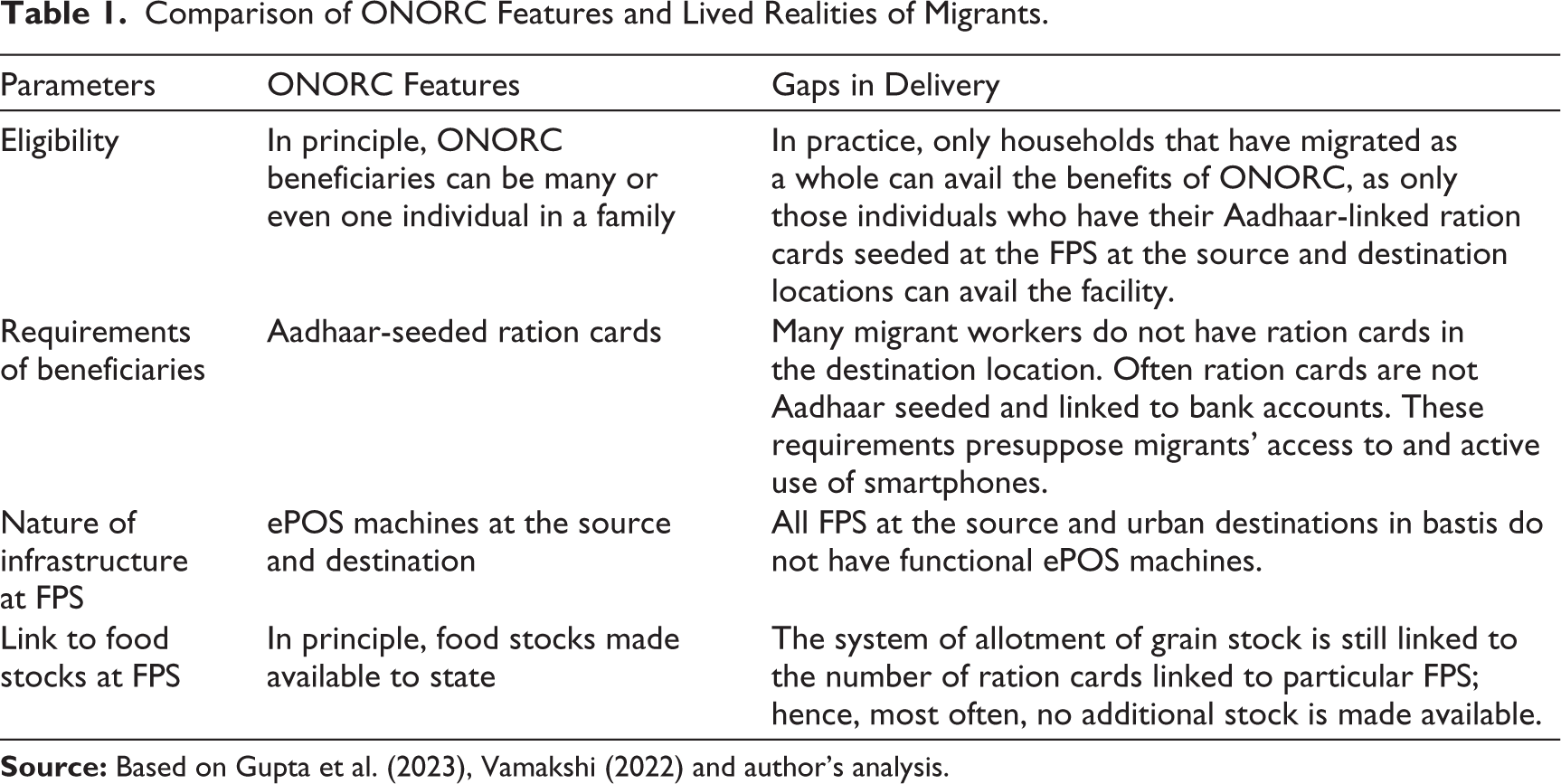
It is reported that there was a significant addition to the portability transactions linked to the National Food Security Act in 2021—about 9,726,000 inter-district transactions (Gupta et al., 2023). Other studies indicate that while there was a provision of extra foodgrain stock to meet the additional demands posed by ONORC, there were logistic issues in this reaching all FPS. Several FPS dealers reported apprehensions of falling short of stock and hence excluding portable entitlement holders (Dalberg & Omidyar Network, 2022; Vamakshi, 2022).
The realities of migrants who leave source areas singly or as a nucleus of a larger family and who prefer to secure their food entitlements in the source areas and lie outside the ambit of convergent digital technologies are thus not taken on board by the ONORC. While it is well intentioned, it is also a case of an over-engineered solution to a problem that could be taken care of through more convergence between centre–state systems of civil supplies.
Affordable Rental Housing Complexes
Another key initiative aimed at providing shelter to migrant workers was the formulation of a policy for constructing and operating affordable rental housing complexes (ARHC), which was announced in July 2020. As per the latest data given by the Ministry of Housing and Urban Affairs, 5,648 vacant houses have been converted into rental housing units in Chandigarh, Gujarat, Rajasthan, Uttarakhand and Jammu and Kashmir with 4,470 houses already occupied (The Hindu Bureau, 2023). There are also plans to construct several more rental houses under the Prime Minister Awas Yojana (PMAY). That migrants prefer a rental housing option as opposed to homeownership is a given. However, several aspects of the design of the ARHC scheme reveal a mismatch with lived realities of migrants, as seen in Table 2.
Comparison of ARHC Features and Lived Realities of Migrant Workers.
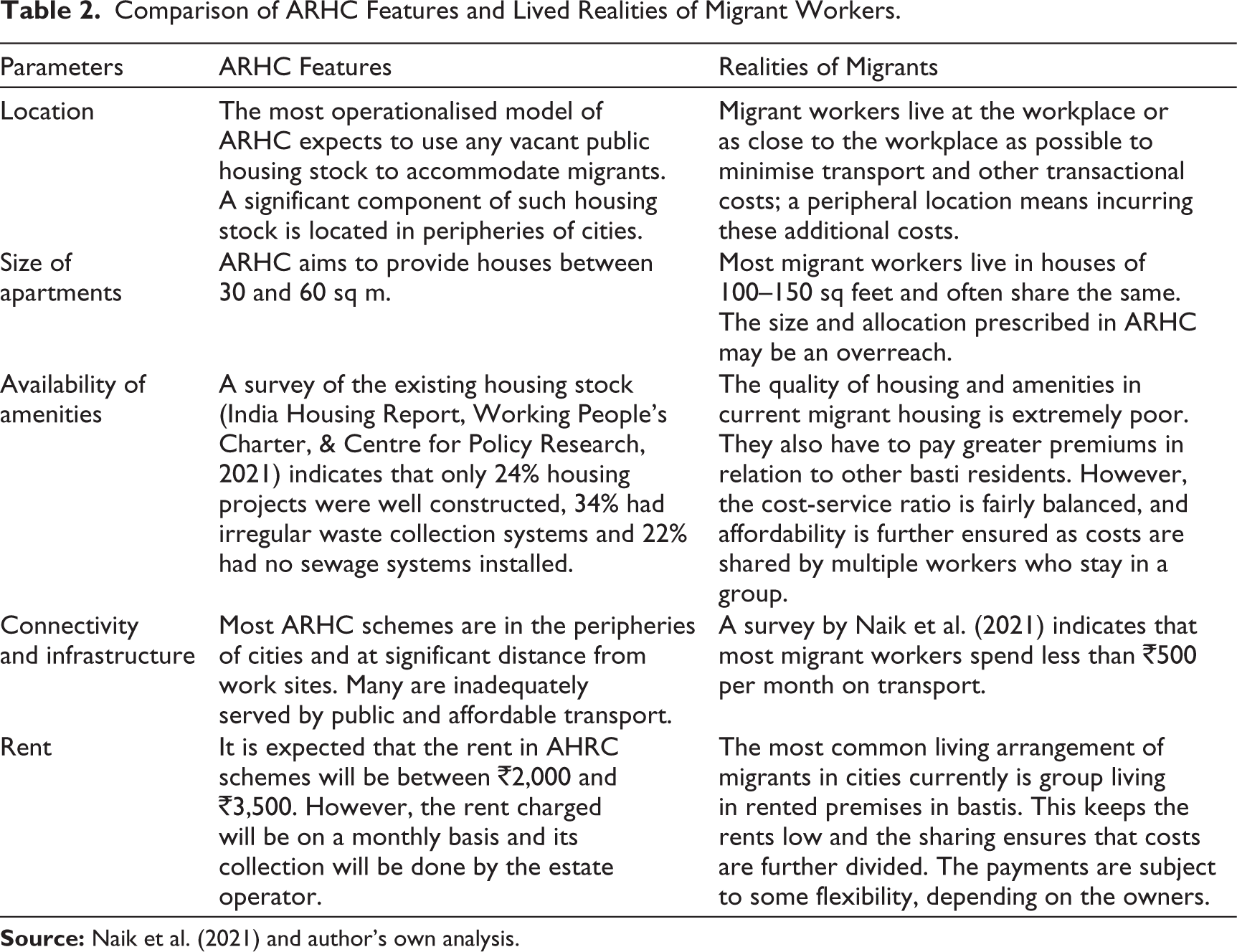
Table 2 illustrates that while the ARHC is an overreach that proposes much higher standards of housing and living conditions than the current housing conditions of migrants, it fails to make them available close to their work, thus making it unaffordable. Further, there is no mechanism to mediate between the migrants and the managers of ARHCs, for example, to make the policy flexible to the needs of vulnerable migrants or to offset costs by involving employers or local municipalities. Thus, the outcome of such policies is an inevitable poor uptake by migrants.
Registration of Unorganised Workers
The COVID-19 pandemic exposed the lack of data on workers in the unorganised sector and migrant workers in particular. The e-Shram portal was launched in 2021 under the directive of the Supreme Court. This initiative has been successful in seeing the registration of over 28.64 crore workers (PIB, 2023). It is a remarkable achievement, given the past trajectory of very few registrations
9
under the boards formed for various groups of workers such as construction workers, domestic workers, street vendors and so on. Two factors that led to the positive response to e-Shram are as follows:
The e-Shram has a self-registration process. The past registration processes required workers to get a certification from the employer. This proved to be the biggest barrier to registrations as employers, apprehensive of government regulatory actions, often refused to provide these. Categorisation of workers by the kind of work they do often does not account for temporary work. An agricultural labourer during monsoons and harvesting seasons may also be a migrant labourer at other points in time; a construction worker may also engage in street vending at some point. Several worker boards also insisted on a particular period of engaging in an occupation as a precondition to registration. e-Shram partially offsets this barrier by allowing registration of several kinds of workers.
However, the e-Shram portal contains conditions like the requirement of Aadhaar-seeded data and the exclusion of workers beyond 60 years of age. Further, as of now, the e-Shram is not linked to any incentive other than a possible award of Pradhan Mantri Shram Yogi Mandhan (PM-SYM). Its potential benefits remain prospective, which is why the registration process is still ongoing more than a year after the given period for registration.
Principles for Migrant-Aware Policies
The study of pre-COVID-19 policy trajectories reveals that policies do not effectively recognise mobility across district or state boundaries.
The post-COVID-19 policies presume migrants can be treated as yet another urban resident beneficiary group rather than as one of the most vulnerable labour groups in the urban that needs recognition and reorientation of services and delivery systems. The realities of migrants compel us to revisit city life—housing, settlement and work—from the perspective of dynamic movement. We attempt to distil some key principles for migrant-aware policies, based on the review of experiences discussed in previous sections:
Circular migrants in particular are engaged in multiple economic activities. They may be agricultural workers in particular seasons, construction workers for some time and engage in other industries or street vending at other points in time. Most data measures, however, tend to characterise workers uni-occupationally. This can have the impact of either excluding them from data or in double counting. Welfare policies need to recognise this dynamism in work sites, work streams and industries and avoid singular categorisation. They should have more inclusive and expansive boundaries. Circular migrants have a transverse relationship with the territorial urban state. Their invisibility in data systems is partly linked to definitional and other structural issues with data systems and welfare policies, but part of it is also tactical. Thus, urban settlements that are most insecure or are neglected by the state tend to be places of refuge for migrants. The low costs offered by such places may outweigh the high costs and hostile ethos of more secure housing. Even more importantly, the employers and consequently the jobs held by the workers may be under threat in more surveilled localities. Policies that are migrant aware need to be sensitive to this context and go light on surveillance. Data can be collected on a need basis. This is perhaps one of the reasons for the relative successful response to e-Shram portal as it demands minimal supportive documents. Work is the topmost priority of migrant workers at the destinations. Employers often do not allow them to deviate from their jobs as well. The transactional costs associated with preparing officially recognised documents for eligibility to schemes or welfare policies may not be affordable to the workers. Policies should therefore rely more on documentation options that include certification by source region. This would include institutions such as gram panchayats, self-declarations, attestation of tenancy status, service usage at living sites or validation by neighbours or employers. Migrant workers offset security and quality of life at the destination location with the optimisation of remittances. Policies that intend to work in their interests therefore cannot rely on a significant monetary contribution from the workers; they will need to be equally based on contributions from employers. However, there are work streams where it is difficult to identify employers and thus, the state also needs to be involved as a party to develop mechanisms for more secure working and living conditions. Decent shelter, affordable food and offsetting of health risks are the base expectations that single migrant workers have from destination areas. Similarly, family migrants engaged in circular movement also need education, health and foodgrain entitlements. Schemes that pitch welfare at higher standards with greater demands on identification documents and verification from multiple sources can add to transactional and other costs and hence likely to leave out the most vulnerable workers. Instead, schemes that are able to reach out, make minimal demands for supportive documentation and ensure portability or coordination between source and destination are likely to be more effective. Policies for migrants demand a new imagination of entitlements and of how welfare can work against a strongly embedded sedentary and territorial bias. There are few and only small-scale experiments in policies that work. A partnered approach that creates room for state and city governments in source and destination regions, civil society organisations, researchers and service institutions to be in conversation, experiment and institutionalise by drawing lessons from the same would be ideal.
Conclusion
Circular migrant workers constitute the invisible and neglected labour force that powers our cities. The sedentary and territorial bias in our policies has meant that they do not receive their due in the form of decent working conditions, living conditions and opportunities. The COVID-19 pandemic and the resultant exodus of migrants from cities in India exposed the extent of the neglect and the resultant vulnerability among migrants. The exodus moved the needle by a bit, exhorting the country’s policymakers into a few policies for the welfare of migrants. However, as the article reveals, through its review of post-pandemic policies, even policies meant for migrants are not adequately aware of the life realities of circular migrants. There is thus a dire need to frame policies that are migrant aware by incorporating principles that draw from these realities.
Footnotes
Declaration of Conflicting Interests
The author declared no potential conflicts of interest with respect to the research, authorship and/or publication of this article.
Funding
The author received no financial support for the research, authorship and/or publication of this article.