




Abstract
This article argues that the fundamental cause for migrants’ exclusion, precarity and the othering process in the ‘smart city’ lies in the epistemic violence against them, embedded in the Smart City Mission itself, which develops the knowledge framework of ‘inclusion and exclusion’. An epistemology constructs and shapes the knowledge and ideas of smart cities and the power structures which consequently influence urban government functionaries, urban planners and officials of the Smart City Mission Project Corporation. This constructed knowledge and perception of the smart city serves the interests of the ‘middle-class citizen’ by giving overwhelming importance to smart technologies and infrastructure growth. On the other hand, it systematically disadvantages internal migrants by excluding them at several levels. This epistemic violence has successfully distorted the reality of the existence and contribution of migrants in cities and portrayed a picture of ‘feel-good cities’ pleasing their middle-class citizens. At the same time, it deflects inclusion-directed interventions which would have had a significant positive impact on the lives of the migrants. It normalises the miseries of migrants and validates the salience of urban policy in protecting migrants’ rights. Consequently, migrants experience multiple and interconnected forms of violence and victimhood in their everyday life and remain unheard.
Introduction
India is experiencing rapid urbanisation, and cities have emerged as the ‘growth engines’ of the country. With approximately 11 per cent of the world’s urban population residing in its cities, India is the second-largest urban system in the world (NITI Aayog, 2021). By 2030, more than 400 million people are projected to live in cities in India (UN, 2018). The urban population is expected to increase from 31.8 per cent in 2011 to 38.6 per cent by 2036, and this urban growth would account for over three-fourths (73 per cent) of the total population increase in the country (National Commission on Population, 2019). Although they only occupy 3 per cent of the country’s land, Indian cities account for about 60 per cent of its gross domestic product (GDP; UN, 2018), which is estimated to increase beyond 70 per cent by 2030 (Mishra, 2021; Rajan & Bhagat, 2021). By having a $5 trillion economy by 2026 and a $40 trillion economy by 2047, India aspires to become a ‘global economic powerhouse’ and its cities will have to play a crucial role in the journey (NITI Aayog & Asian Development Bank, 2022). India’s urban-led economic growth was centred firmly on the ‘smart city’ vision (Hoelscher, 2016) with the newly elected National Democratic Alliance government in 2014.
The Smart Cities Mission
The term ‘smart cities’ is gaining wider popularity; however, the term is ‘ambiguous’ (Hayat, 2016; Hoelscher, 2016), ‘fuzzy’ and viewed as an ‘urban labelling phenomenon’ (Hollands, 2008). The term varies from city and country (Priyadarshi, 2021), with no universal definition (Habitat Forum-INHAF, 2021) and is used in ways that are not always consistent (Vito et al., 2015). Narendra Modi, Prime Minister of India (2018), stated that ‘Smart City Mission will help prepare our cities to take up the challenges of New India; and prepare world class intelligent urban centers in India, for the 21st century’ (Ministry of Housing and Urban Affairs, 2021a).
The Smart Cities Mission (SCM) in India results from the promise of the ‘construction of 100 new cities’ mentioned in the Bharatiya Janata Party election manifesto in 2014 (Anand et al., 2018). The SCM is a centrally supported flagship programme launched in June 2015 to promote cities that offer a decent quality of life to their citizens through the application of ‘smart solutions’. The mission aims at sustainable and inclusive development by working comprehensively on social, economic, physical and institutional pillars of cities. It concentrates on the idea of area-based development, which involves the selection of a specific area of the chosen city for either improvement (retrofitting), renewal (redevelopment) or new development (greenfield) (Shivam, 2020). The SCM is an idea, practice and a ‘new avatar of urban planning and development policies’ (Khan et al., 2018) and the ‘urban regeneration programme’ (Anand et al., 2018). According to the Ministry of Housing and Urban Affairs, the SCM was launched ‘with the objective of promoting cities that provide core infrastructure and give a decent quality of life to its citizens, a clean and sustainable environment and application of “smart” solutions’. The intent was to look at small areas to produce replicable models acting as lighthouses for other aspiring cities (Ministry of Housing and Urban Affairs, 2021b).
Along with finance, entertainment and information technology centres, smart cities are also characterised by the unregulated rise in the informality and informal economy. Internal migrant workers are a ubiquitous feature of the growing urban informal economy. Indian cities are expanding through internal migration, and the proportion of internal migrants is far higher than those who move beyond national boundaries (Bhagat, 2011). Migrants play an essential role in the labour market and India’s growth story (Ministry of Housing and Urban Poverty Alleviation, 2017) and are critical contributors to achieving the Sustainable Development Goals (International Organisation for Migration, 2020; Mosler, 2021). Without migrants, the increasing contribution of the migrant destination cities to India’s economy and GDP would not be possible (Bhagat, 2011; Bhattacharya & Sarkhel, 2017; Deshingkar & Akter, 2009; UNESCO & UNICEF, 2013). Therefore, internal migrants can be considered as the backbone of the national economy.
The contribution of a ‘smart city’ to a country’s GDP would be insignificant without the contribution of internal migrants. However, these migrants remain poor, hail from historically marginalised communities, belong to the low-income group and work in hazardous conditions. They differ entirely from those ‘elite’ internal migrants who belong to the higher socio-economic stratum and are less likely to suffer any discriminatory or exclusionary treatment at their destination city. Elite migrants negotiate with the state quite differently compared to those internal migrants who hail from historically, socio-economically disadvantaged groups (Bhagat & Kumar, 2022). Hence, the latter need special and urgent attention. It is paradoxical that despite contributing to economic growth and sociocultural remittances, these migrants remain ‘cogs in the machine’ and are critically marginalised and alienated in smart cities. Against this background, it is crucial to understand the fundamental causes that make smart cities ‘exclusionary and exploitative zones’ for internal migrants.
Internal Migrants and the SCM in Pune
The study aims to interrogate the Pune SCM to understand its approach towards internal migrants engaged in the informal sector. Pune, under the administration of Pune Municipal Corporation (PMC) and growing at 7.8 per cent during 2005–2014 (PMC, n.d.), is the second most populous city in Maharashtra and the ninth most in India (PMC, 2018). The driving force for this growth is mainly the development of the IT industry and the economic boom in the automobile sector, which form a significant portion of the industries in and around Pune (PMC, n.d.). Pune city is a popular foreign direct investment destination in India. It is also known as the ‘Oxford of the East’ as many educational institutions are centred in the city. Considering the urban population and the number of statutory towns, Maharashtra was allowed to choose 10 cities under the SCM, for which Pune was selected in the first round in 2016.
According to Census 2011, Maharashtra is the biggest recipient of migrant labourers in India (Kalhan et al., 2020) and Pune is one of the major migration hotspots in the state. It is a magnet for many skilled, semi-skilled and unskilled interstate and intrastate migrants. According to Census 2011, more than 85 per cent (51.6 lakh) of the migrants were intrastate, while around 15 per cent (8.93 lakh) were interstate. Among the interstate migrants, reliable and comprehensive internal migration data are not available (Rajput & Rajan, 2023), and the existing migration figures are entirely obsolete (Behera, 2020).
Conceptual Framework: Epistemic Violence
Epistemology deals with theories of knowledge and is concerned with questions like ‘what is knowledge, what gets counted as knowledge, how knowledge claims are justified and nature of explanations, subject–object relations and fact–value relations’ (Ejnavarzala, 2019). The study of epistemology enables one to understand questions such as who is at the centre of the knowledge production process; who benefits and who is excluded from the process; and the structure of relations and principles of domination, its transmission and the way this gets normalised. The development paradigm is largely influenced by the epistemology of the dominant group. A dominant group in a society decides what is the ‘worthy knowledge’ and ‘expected development’, thus reflecting the hierarchical social fabric. This, in turn, influences values, beliefs, attitudes and policies in the society at large. This process works at the micro level and systematically maintains the patterns of persistent inequalities by privileging certain groups and excluding others. It ultimately puts the oppressed section at extreme disadvantage by fuelling multiple forms of violence, and one of them is ‘epistemic violence’. The term ‘epistemic violence’ denotes the violence exerted through knowledge, legitimising the practice of oppression and domination through the knowledge framework.
Gayatri Spivak has used the term ‘epistemic violence’ in post-colonial studies in her popular and influential essay ‘Can the Subaltern Speak?’ (1988, cited in Bartels et al., 2019; Mangattu, 2021), ‘as a way of marking the silencing of marginalised groups’ (Dotson, 2011). Bunch (2015) states that the term stems from the concept of symbolic violence used by sociologist Pierre Bourdieu, focusing on the discourse involved in practising ‘othering’ (Bunch, 2015). The term also has its roots in the work of Michel Foucault, who originally developed the idea of episteme in Western thought (Bartels et al., 2019; Mangattu, 2021).
Epistemic violence, that is, violence exerted against or through knowledge, is probably one of the key elements in any process of domination. It is not only through the construction of exploitative economic links or the control of the politico-military apparatuses that domination is accomplished, but also and, I would argue, most importantly through the construction of epistemic frameworks that legitimise and enshrine those practices of domination. (Enrique Galván-Álvarez, 2010 cited in Brunner, n.d.)
The notion of epistemic violence refers to the different ways in which violence is exercised in relation to the production, circulation and recognition of knowledge. (Pérez, 2019)
To locate internal migrants in the smart city, the conceptual framework of ‘epistemic violence’ has been used in the present study. Despite development policies, migrants in cities still live in the margins. Thus, there is a need to understand the root cause of their pertinent marginality in relation to the urban development knowledge production process. The poly-victimisation of migrants in cities is deeply embedded in the existing urban power structures, which is conditioned by the epistemic process and the positionality of the knowledge producer. Such analysis is crucial to explore how a policy functions as a ‘development apparatus’ for mainstream city dwellers and how it completely sidelines ‘others’ like migrants.
Data and Methods
This study aims to interrogate the Pune SCM to understand its approach towards internal migrants engaged in the informal sector. The content analysis method is used to analyse the Pune SCM official guiding documents—SCM Statement and Guidelines, Reimagining Pune: Mission Smart City (Proposals I and II), and Pune Smart City: Vision Document—which have been selected by purposive sampling. For the content analysis, the inclusion audit scale (which is a rating scale) with 25 indicators was prepared to measure performance. Indicators were based on the major themes such as different types of internal migrants in city, accessibility to entitlements, problems faced by migrants, discriminatory practices, and so on. The scale was given to three experts to validate the content and to assess it. Experts were selected by considering their expertise in the field of urban policy, labour and migration. The revised audit scale was used to measure and scores were given accordingly. Findings from the primary data are supported by the secondary sources.
Findings and Discussion
The major findings are categorised into six sections. Section A deals with the inclusion audit scale and the score. Section B is about the class-based approach of the SCM, Section C deals with the SCM governance, Section D throws light on identity and citizenship rights, Section E discusses the pre- and post-pandemic vulnerabilities among migrants, and Section F argues that the violence against migrants in the city is perpetrated through discourse.
A. Positioning of Internal Migrants in the SCM
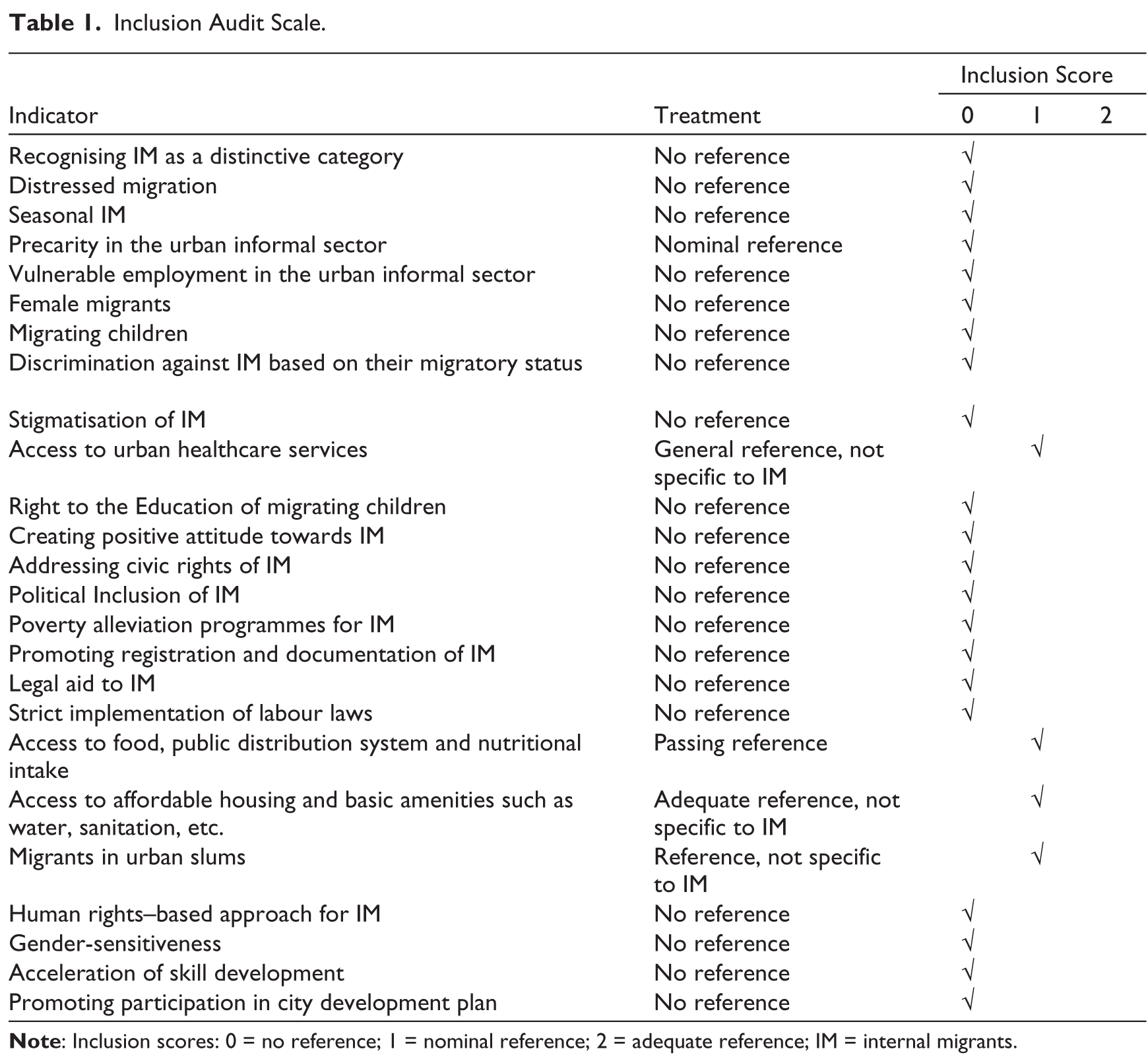
The inclusion audit scale was used to examine the inclusion approach of the SCM with regard to internal migrants.
Table 1 indicates that inclusion score of Pune SCM is extremely poor and migrants’ invisibility in SCM is prevalent. The SCM does not even recognise the presence of internal migrants and their issues. Migrants’ access to essential civic services such as healthcare, education, water and sanitation, and housing is unnoticed in the SCM policy. The Pune SCM is silent on the discrimination and stigmatisation of migrants in the city. The absence of internal migrants in the urban policymaking process and in the actual policy draft makes them ‘parasitic’ citizens. It systematically denies migrants basic citizenship rights at several levels, consequently making them undervalued.
Inclusion Audit Scale.
However, this short assessment of the Pune SCM needs to be understood in the context of other influencing factors such class privilege, regional identity-based conflict, politics of knowledge and inclusion–exclusionary structures in the city. These are discussed in the following section.
B. The Middle-class-centric Construct of the SCM
The SCM is said to be building resilient, liveable and sustainable cities, characterised by its focus on social and economic development through the foundational premise of citizen-centric governance (Kumar, 2021). However, it is critical to understand which ‘citizens’ are the true beneficiaries and are at the centre of the smart city and urban governance.
Kothari (2011) rightly states that the (Indian) city of today does not recognise everyone equally, nor does it make available its services, benefits or opportunities to all. It is evident that the SCM is directed towards benefitting the city’s middle-class, middle-income group citizens who have income sources in cities. The Pune SCM is portrayed in such a way that its middle-class citizens are made to believe that making a city ‘smart’ is the ultimate solution to all the problems of the urban society and of its citizens. The SCM is a middle-class-centric model ‘as it caters to an aspiring middle class who is digital, affluent and highly skilled’ (Basu, 2019). It has overemphasised infrastructure growth, beautification of cities and the development of smart solutions based on information technology. For instance, smart parking systems for cars, internet and mobile-based citizen engagement, digitalised public transportation, ‘high-end residential, commercial, and entertainment facilities’ (Prasad et al., 2023), etc., mainly attract and ultimately benefit middle-class city dwellers. On the other hand, these smart solutions have failed to consider the marginalised groups (such as migrants) and urban poor, and cater to middle- and high-income groups, which consequently deepens the existing socio-economic inequalities (Das, 2020; Ghosh & Arora, 2021).
Under the banner of the SCM, the bulk of funding is also allocated for the development of the physical infrastructure and reordering of the local urban space. This includes massive investments in mega infrastructure projects, renewal projects, road construction, transportation infrastructure (flyovers, metros, highways, ring road, etc.), and large commercial and residential complexes. In January 2023, the PMC spent ₹25 crore on road repairs and beautification projects as part of the G20 summit preparations (Thevar, 2023). At the national level, 5,005 projects worth ₹92,766 crore were completed by 12 December 2022, with 2,737 projects worth ₹88,796 crore in the advanced stage of implementation (Ministry of Housing and Urban Affairs, 2023). While these amounts are enormous, in the absence of a social justice framework, it is a mere eyewash as the SCM does not cater to multiple challenges faced by migrants and other urban poor groups.
The SCM shows a picture of ‘new India’ but has failed to address the fundamental issues of its important human capital, that is, internal migrants. Consequently, these precarious migrant groups remain voiceless and exploited and experience multiple layers of visible and invisible oppression and exclusion in the city. Their citizenship rights are critical to their inclusion, which city planners like the SCM Corporation and other development stakeholders must realise.
C. Isolated Governance of the SCM
A special purpose vehicle (SPV), which is a limited company established under the Companies Act, 2013, will implement the SCM. The SPV will plan, appraise, approve, release funds, implement, manage, operate, monitor and evaluate the smart city development projects (Ministry of Housing and Urban Affairs, n.d.). However, this implementation mechanism has made the SPV the power centre and kept the municipal corporation and elected representatives at the periphery. Consequently, the voices of people, especially the poor and migrants, have almost no space in the development process. According to Saldanha (2020), the Indian constitutional mandate for decentralised urban governance is being diluted and sidestepped through the SCM, primarily through creating SPVs. The SCM governance and its bureaucratic organisation functions as a tool of political hegemony and almost bypasses state governments. Adopting a market-friendly approach undermines citizen concerns, specifically ignoring ground-level concerns of disadvantaged and vulnerable groups (Saldanha, 2020). Panwar (2020) termed the ‘smart city model’ as an ‘obituary’ to the 74th Constitutional Amendment due to its corporatised and technology-driven economics, and the lack of participation of elected representatives and participatory governance in the smart city SPVs as well as the lack of accountability. This makes the SCM unsustainable (Panwar, 2020). Such power dynamics aggravate unequal development and play a critical role in keeping vulnerable sections such as the urban poor and migrants on the periphery. The centralisation of power and unidirectional approach to development is dysfunctional in creating a conducive environment for developing the city’s inclusive social justice fabric. SCM officials as agents of bureaucratic hegemony ‘control’ migrants and urban poor in several ways to maintain the ‘beauty’ of the city. Bureaucratisation of the SCM has been evident in multiple incidents of forced evictions, demolition, displacement and violence. In the name of smart and developed cities, the urban land where millions of people with low incomes have lived for decades, and fertile land of farmers, tribes and other indigenous groups have been taken over by the government (Kumar, 2018).
In the context of the forced eviction, the Housing and Land Rights Network (HLRN, 2018) data indicate that around 70 per cent of the urban poor across the country were displaced for slum clearance, anti-encroachment, city-beautification drives, mega-events, road widening, highway and road construction, housing and ‘smart city’ projects. Consequently, this poses enormous unaccounted risks for migrants as many end up in urban slums and informal settlements with poor infrastructure and constantly remain under threat of displacement and eviction from government officials (International Labour Organization [ILO], 2020; UNESCO & UNICEF, 2013).
D. Stigma and Urban Citizenship Rights
It has been observed that Indian cities have always been ‘exclusionary to migrants’ (Mukhopadhya & Naik, 2020). The hostility and brutality against migrants stemming from their regional, migratory identity cannot be overlooked. They have often been victims of ‘insider–outsider politics’. During lockdowns, they were largely treated as suspects, frequently humiliated and portrayed as ‘unwanted’ in the host cities and even at their place of origin (Rajput & Rajan, 2023). Along with regional discrimination, migrants are stigmatised based on their caste and gender identities, a central issue in accessing justice (ILO, 2020).
Stigmatising migrants and keeping them at the bottom of the labour market is the most potent and convenient polarisation device, deeply rooted in the dominant eco-political and sociocultural interests of certain influential groups such as construction employees, real estate lobby, regional chauvinistic political leaders and their followers. Stigmatisation of migrants is used to keep them fragmented in the labour market, to control the labour process and to maintain lower wage costs and increase the profit margins (Fernandes, 2012; Rajan & Rajput, 2023a; Srivastava, 2020). According to the Constitution of India (Article 19), free movement is the fundamental right of every citizen of India. Despite this, migration is perceived negatively, and several groups try to control the mobility of migrants. Weiner (1978) observed that the nativist movement converts cultural differences into cultural conflicts and the anti-migrant sentiment took a highly organised political form on the basis of the ‘sons of the soil’ principle (Weiner, 1978). To please the vote bank of nativist groups, the state hesitates to protect migrants’ civic and legal rights to the destination place. For instance, chauvinist regional political parties (such as Shiv Sena and Maharashtra Navnirman Sena in Maharashtra) have blamed migrants for several state problems such as economic deprivation, stealing jobs, unemployment, increasing slums, crime, overcrowding and so on (Dhanraj, 2018). These political parties frequently threaten and attack migrants and vandalise their shops and residences. However, such xenophobic acts have conveniently been ignored by the state. Consequently, native employers are not afraid of violating labour laws as the state overlooks it. Interstate migrants in the city experience regional discrimination largely and are the primary victims of such anti-migrant sentiments.
The politicisation of migrants and negligence of the state negatively impact migrants’ unionisation, labour rights and bargaining capacity, resulting in forceful labour conditions for them. Therefore, precarious migrants are left with no other alternative than to suffer in silence, accept the hegemony of the nativist groups and employees, and live with secondary citizenship. Urban governance caters to citizens who have domicile documents of their residence (ILO, 2020), while in the absence of identity proofs, many migrants are systematically excluded and remain out of the purview of urban schemes, programmes and access to legal rights and public services (Rajput & Rajan, 2023). The lack of unionisation further exacerbates their vulnerabilities. By invisibilising migrants in the city development policy and not giving them a voice, the SCM legitimises structural violence against them.
E. Lockdown Miseries, Post-lockdown Vulnerabilities and Silence of the SCM
The COVID-19 pandemic and lockdowns have exacerbated the precarity of internal migrants, especially poor interstate migrants. With a four-hour notice, the Government of India announced a nationwide lockdown on 25 March 2020 and left millions of interstate migrants and their families stranded at different destination cities. This resulted in widespread panic among migrants as they were left without food, water and employment. Stranded migrants took desperate measures including long treks home in the most inhospitable of conditions (Rajan & Bhagat, 2022). This resulted in ‘the largest exodus of migrants since the partition’ (Ellis-Petersen & Chaurasia, 2020) and ‘the most egregious scenes of desperation and misery in post-independence history’ (Rajan & Bhagat, 2022). Such crises were experienced in Pune as well, as it is one of the biggest recipients of migrant labourers. Migrants in Pune faced great distress in the absence of food, shelter, savings, income and fear of infection, which resulted in a mass exit from the city. Rashid (2020) noted that ‘the national highways … leading out of Pune, almost for two weeks were packed with flocks of migrants desperate to return to their home state mainly Uttar Pradesh, Bihar, Chhattisgarh and Madhya Pradesh’ (Rashid, 2020). However, the reliable data of migrants’ mobility amid lockdown are not available (Jolad at el., 2021). The vulnerable situation and ordeals of migrants did not change significantly after their return to cities and rejoining work in the post-lockdown phase in 2020 and 2021. In the ‘new normal’, migrants have experienced new challenges such as wage theft, complete loss of employment, non-portability of the public distribution system, increasing inflation and the negative attitude of people against them as they were perceived as ‘virus carriers’ (AIM Research Consultancy, 2023; Nath, 2021; Rajput et al., 2022).
Against this backdrop, it was essential for the state, and especially the urban governance through the municipality implementing the SCM, to learn lessons and bring a comprehensive inclusion and protection policy for urban migrants in the post-pandemic phase. Unfortunately, despite enumerating unorganised workers on ‘the e-Shram portal’ (an online portal launched by the Union Labour and Employment Ministry in 2021 as per the directives of the Supreme Court for registering unorganised workers; Rajput & Rajan, 2023), no significant steps were taken for migrants’ inclusion in cities. Even the e-Shram has not captured the number of migrants among unorganised labourers and fails to identify the dynamics, trends and patterns of internal migration (Rajan & Rajput, 2023b). This disregard towards migrants’ meaningful inclusion and inadequate urban policy response raises several questions on the existing philosophy of urban development.
F. SCM as a Discourse Resulting in Epistemic Violence
The previous sections complement each other and, hence, need to be interlinked to understand and analyse migrants’ situation holistically. I argue that the SCM is a ‘discourse’, or a social construct, created and perpetuated by powerful groups (Pitsoe & Letseka, 2013). According to Foucault, discourses are ways of constituting knowledge, reproduced by social practices, forms of subjectivity and power relations (Weedon, 1997). Such discourses are ‘interwoven with power and knowledge to constitute the oppression of those “others” in our society, serving to marginalize, silence and oppress them’ (Pitsoe & Letseka, 2013). Here, ‘others’ are the migrants; the Pune SCM as a discourse systematically subjugates them, resulting in epistemic violence. The exploitation of migrants in the urban labour market, violation of their rights and exclusion from urban policies are embedded in the discourse of SCM and the SCM itself is an ‘apparatus of epistemic violence’. This epistemology constructs the knowledge, values and ideas of the voting middle class, which consequently influences the urban government functionaries, urban planners and officials of the SCM project corporation (SPV). Here, it is critical to note that the epistemic violence against migrants goes beyond the dichotomy of ‘inclusion and exclusion’. Migrants are not completely excluded from the city as they are perceived as a cheap labour force. However, at the same time, they are not accepted as citizens or city dwellers; they remain somewhere in the middle. They simultaneously experience both inclusion (by getting registered at the e-Shram Portal) and exclusion (denial of civil rights in city), and this process is structured by epistemic violence. Moreover, the epistemic construct of the smart city has a long-lasting and profound impact which excludes migrants from being considered significant human capital and citizens, legitimises their omission in city development plans and normalises their marginalisation. This also silently stigmatises the internal migrants as a ‘problem’, ‘burden’ and ‘unwanted’ and promotes the ‘othering’ process and hostile attitude against them. Internal migrants’ everyday life in a city is woven around multiple interconnected forms of violence and victimhood based on this epistemology. This ‘knowledge framework’ of the SCM produces several forms of state-led structural violence against migrants resulting in increased precarity, insecurities and vulnerabilities. The conspicuous silence of Pune’s SCM on the miseries of its internal migrants during the lockdown and in the post-lockdown phase results from such epistemic violence which produces and sustains multiple mechanisms and patterns of urban exclusion. This violence remains embedded in the social, political and economic structures that make up a society and thus remains invisible.
Conclusion
It is a moral imperative for the SCM and urban governments to address the concerns of internal migrants and protect their rights as well as make cities inclusive and sustainable. Indian cities can be ‘smart’ but cannot be inclusive without recognising migrants’ contribution to the cities and protecting their rights and their participation in the knowledge production process that constitutes smart cities. It should be a high priority to integrate migrants into the SCM projects to protect their rights and strengthen the human capital formation process and social justice framework of development.
The nature of SCM is best understood if one tries to investigate the pattern and distribution of power and knowledge embedded in it. Migrants’ inclusion in a smart city has to be an integral part of the idea of ‘development’. Any social inclusion intervention or social security measure in a smart city directly comes from the epistemology, which shapes and validates the ideas and principles to form the knowledge of an ‘inclusive smart city’. Therefore, to make the SCM inclusive, especially for its internal migrants, it is essential to make it inclusive at its epistemological level first.
Footnotes
Acknowledgements
This study was presented online at the Second Annual International Conference on ‘Internal Migrants in the Cities: Entangled Lives’ on 29–30 December 2022, organised by the International Institute of Migration and Development (Kerala) and the Indian Institute of Technology (Hyderabad). The author is grateful to his mentor S. Irudaya Rajan and immensely indebted to Amrita Datta and the reviewers for their constructive comments. The author very much appreciates the support of the Urbanisation editorial team.
Declaration of Conflicting Interests
The author declared no potential conflicts of interest with respect to the research, authorship and/or publication of this article.
Funding
The author received no financial support for the research, authorship and/or publication of this article.