



Abstract
Acid violence is embedded in larger macro-political and economic structures that sustain gender domination and perpetuate new forms of gender inequality. This article argues that increasing incidences of acid violence in South Asia and especially in India would benefit from the structural analysis that takes into account impacts from socio-economic structures that reinforce gender inequality. In contemplating a systemic redress mechanism, structural analysis is used to enlarge legal norms. The article proposes a model of transformative justice that involves centrality of state responsibility as a catalyst for social change.
Sheroes’ Hangout is a small café tucked between souvenir shops in Agra, close to the Taj Mahal. The laid-back ease of the café, colourful walls with graffiti, corners that tell stories through photographs and the boutique that sells designer clothes are all part of the hangout experience. Yet, this is a café with a difference. It is run by five acid survivors who came together and shared their stories with each other as part of Stop Acid Attacks campaign, an initiative of Chaanv Foundation, a non-governmental organization based out of Delhi. The pain of the disfiguration, reconstructive surgeries, psychological and financial consequences of acid attack were common to all of them. What was in their mind was how to build their future by finding work that they liked doing and a life that they were proud of. For the skilled survivors, getting a job was not easy because no firm wanted to hire them. For others, learning new skills to be competent in the job market was the challenge. They took inspiration from Lahore Beauty Salon, an all-acid survivors entrepreneurial initiative in Pakistan.
Sheroes’ Hangout began out of a crowdfunding initiative collecting $4,500 in 2014. Over 5,000 people visited the café in the first six months. The café works with a donation system that uses a ‘pay as you wish’ policy. What is amazing is not just the confident stride and dignity that the survivors have when they are taking orders or serving food, but the positive fallouts in their lives beyond. All the survivors had shared their stories with each other before the venture began. They told each other how much the reconstructive surgeries were almost as painful as the attack, how they used to hide their faces and how they used to wonder why this happened to them, all the time. Now, what is on their mind mostly is how to break-even in their business, learn new skills and inspire other survivors to move ahead with their lives. Some of them are learning English so that they can communicate with their customers more effectively; there is one survivor who wants to go back to school to finish her education and others who want to open a boutique. But, what these young women are fighting for is their right to live and work with dignity, take pride in their work, question our idea of beauty and inspire other survivors to build their lives.
Reshma Qureshi, an Indian teenager, was the first acid survivor to walk the ramp in New York Fashion Week in September 2016. Reshma and her elder sister were attacked with acid by her brother-in-law and his friends when she was still in high school. After years of reconstructive surgery, she decided to take her life back by doing things she liked best. She became the face of acid survivors’ campaign as she began filming for a ‘do it yourself’ make-up video as part of an acid survivor campaign in YouTube out of her home base in Mumbai. This video garnered 300,000 signatures for the acid survivors’ cause and an invitation to New York Fashion Week.
Lakshmi, a 26-year-old acid survivor from India, became the first acid survivor model to represent an apparel brand as part of their ‘Face of Courage’ campaign. She was doused with acid by her spurned suitor when she was just 15. From her experience, what she remembered the most was how slowly she began to show her face to the world again. She felt that one of the motives of the perpetrators was to destroy the physical beauty of a woman and diminish her prospects in life. Her motivation to model for a clothing brand was to inspire more survivors to come out in the open and take charge of their lives. Her choices, she hopes, would question our mindset that judges a woman’s worth by her physical beauty.
Monica Singh was studying apparel design at the prestigious National Institute of Fashion Technology, Delhi after clearing the entrance exam with the second highest score in India. In the first summer break, when she was visiting her parents, she was attacked with acid by a male acquaintance for turning down a marriage proposal. After 46 reconstructive surgeries and eight years, Monica knew she had to get back to school and do what she did best. She finished her undergraduate studies in apparel design and applied to renowned design schools for graduate studies. She got accepted at Parsons New School of Design in New York. She funded her tuition and living costs entirely out of crowdfunding with the help of Acid Survivors Foundation of India and became a fashion designer.
Understanding Acid Attacks in the Context of Gender Violence
The World Health Organization (2013) regarded violence against women as a ‘global health problem of epidemic proportions.’ Estimates state that one in every three women would be beaten, raped or otherwise abused during her lifetime (United Nations Development Fund for Women, 2003). International norms have recognized gender-based violence and especially violence against women as crime as well as human rights violation under the various instruments of the United Nations.
The term gender-based violence is used interchangeably with the term violence against women but such a definition overlooks the targeting of all genders (cis-gender, transgender, and multi-gender) or sexuality. Furthermore, violence against women operates within a particular political context and social relation marked by structural gender inequalities. Gender identity and relations are socially constructed using cultural norms, language and history and is a product of strategic relations of power (Butler, 1986; Foucault, 1978, 1985). Butler (1990) enunciates the difference between sex as biological marker and gender as socially constructed. Gendered differences are sustained through normalized violence on individuals or groups in subordinated situation in the power relation. For instance, gender-based and sexualized violence are ‘normalized and performed through material and symbolic acts that are carried out in regular life through ordinary networks’ making them ‘routine violence’ (Chatterji, 2016, p. 24). This makes gender-based violence a more difficult phenomenon to identify, acknowledge and redress. Targeting and seeking redress often upsets kinship relations and undermines community security. There is also the difficulty in understanding universal principles and norms in gender-based and sexualized violence because of the inapplicability in local situations where they manifest. To a certain extent, limitations in research methods, definitions of violence, sampling techniques, interviewer training and skills, and cultural differences that affect respondents’ willingness to reveal intimate experiences as well as underreporting of such incidents makes direct comparisons between cultures or countries problematic. This makes different forms of gender-based violence more invisible and highly context specific.
In recent times, the scope of gender-based violence has been broadened to include aspects of sexual, economic and psychological violence. Sexual violence refers to a violence of sexual nature against an individual on the basis of the individual’s perceived sex. It pertains to sexual acts committed to establish power and control over the victim, including sexual humiliation and intimidation, sex trafficking and prostitution, abduction, sexual slavery, sexual torture, sexual mutilation, forced sterilization, rape (individual, gang and collective), forced pregnancy and coerced abortion. It is a constitutive component of gender and a form of gendered violence (Chatterji, 2016, p. 22). Such a definition includes the possibilities of non-male abusers and non-female targets. A comprehensive understanding of the nature of gender-based and sexualized violence is significant in the context of two recent developments. The first is that acts of gendered and sexual violence are increasingly found to be deliberate and premeditated in intent rather than ‘crimes of passion’. The second is that among new and diverse forms of gendered and sexualized violence, more opportunistic and retributive 1 forms of spectacular violence like acid attacks are increasingly being reported from around the world, especially the South Asian region. Women are increasingly found to be punished and ‘put in place’ in the name of ‘honour’ and transgression of their gendered role. In contemporary history post globalization, 2 massive gendered and sexual violence have remained a significant element accompanying shifts in political economy and social relations in South Asia. Acid violence is one such act that requires both a contextualized mapping within the existing analytical framework as well as specialized understanding given the unique and remarkable causes and consequences of such violence.
This article attempts to enlarge the legal norms pertaining to acid violence through the framework of transformative justice. Criminal justice perspective, as is widely used today, hinges on rational choices taken by the criminals from alternative options of actions. This is a limiting perspective to understand and redress acid violence considering its specific nature and consequences. Noticeably missing from the analytical discourse are macro-political theories that examine the structures of political and economic inequalities that perpetuate specific forms of gendered violence such as acid attack. The central argument of this article is that there is a compelling need in legal normative frame to accommodate structural political economy of violence so that a comprehensive model of state–civil society participation can be envisaged to prevent and redress acid violence and restore to the victims dignity and normalcy to the extent possible.
International Jurisprudence on Gender-based Violence
The first attempt at tackling women’s issues at an international level was through the declaration of 1975–1985 as the ‘Decade of Women’ by the United Nations. On the occasion of the World Conference on International Women’s Year in 1975, the first set of programmes adopted was called ‘The World Plan of Action for Women’, focusing on family as the primary unit of action. The objectives of the Decade for Women (1975–1985) were equality, development and peace. The first document to specifically acknowledge the problem of violence against women was the Convention on Elimination of Violence against Women (United Nations, 1979). Article 1 of the convention defined violence against women as ‘any act of gender-based violence that results in, or is likely to result in, physical, sexual or psychological harm or suffering to women, including threats of such acts, coercion or arbitrary deprivation of liberty, whether occurring in public or in private life’. Following this, the Forward-looking Strategies of Nairobi (United Nations, 1985) called for preventive policies, legal measures, national machinery and comprehensive assistance to women victims of violence. They also acknowledged the need for public awareness of violence against women as a societal problem. In its general recommendation no. 12 (United Nations Women, 1989), the committee noted states’ obligation to protect women from violence under various articles of the convention, and requested them to include information on the incidence of violence and the measures adopted to confront it in their periodic reports to the committee. General recommendation no. 19 (Committee on the Elimination of the Discrimination of Women, 1992) decisively established the link that violence against women constitutes a form of gender-based discrimination and that discrimination is a major cause of such violence. This approach to analysis added the issue of violence against women to the terms of the convention and the international legal norm of non-discrimination on the basis of sex and, thus, directly into the language, institutions and processes of human rights.
The World Conference on Human Rights and the Vienna Declaration and Programme of Action (United Nations Human Rights, 1993) was the next event of leading importance in international jurisprudence relating to gender-based violence. Article 2 of the declaration redefined violence against women as physical, sexual and psychological violence occurring within the family, community or perpetrated or condoned by the state. Article 3 enumerated the eight rights of gender, namely, right to life, equality, liberty and security of person, equal protection under the law, freedom from all forms of discrimination, attainment of the highest standard in physical and mental health, favourable conditions of work and right not to be subjected to torture or other forms of inhuman treatment. Article 4 set out the role of state to provide for sanctions, national plans, legal instruments, financial provisions including budget, setting of guidelines, complying with international instruments as well as locally engaging with women’s movements and civil society organizations (CSO) in furthering these objectives.
In the World Conference on Human Rights in Vienna in (United Nations Human Rights, 1993), women’s groups lobbied globally and regionally to redefine the contours of human rights law to include the experiences of women. They presented conference delegates with almost half a million signatures from 128 countries demanding that such violence be recognized as a violation of women’s human rights, and ran a global tribunal in which women’s testimonies, including cases of violence from around the world, were presented in a human rights framework. A further outcome of the Vienna conference was the appointment by the Commission on Human Rights in 1994 of a Special Rapporteur on violence against women, its causes and consequences. This mandate created an institutional mechanism for regular in-depth review and reporting on violence against women around the world. The work began to be conducted within the framework of the international human rights regime.
At the Fourth World Conference on Women, Beijing Declaration and Platform for Action (United Nations, 1995), 12 critical areas of achieving women equality were identified, one of which was elimination of violence against women. At the five-year review of the Beijing Declaration and Platform for Action in 2000, states specified that violence against women and girls, whether occurring in public or private life, is a human rights issue and highlighted state’s responsibility in addressing such violence.
Following this, the UN Resolution on Intensification of efforts to eliminate all forms of violence against women (United Nations, 2006) reiterated that gender-based violence is a form of discrimination that hampers full enjoyment of human rights and that states had responsibility to work towards addressing this problem. By equating gender-based violence as a human rights issue, the involvement of states in remedying the problem, including setting aside resources, reporting and monitoring, the framework of remedying gendered violence began to take shape.
Furthermore, the resolution of 2006 also recognized that violence against women and girls was a major impediment to achieving gender equality, development, peace and the internationally agreed development goals, in particular the Millennium Development Goals. Therefore, a wide range of mechanisms to tackle the issue was thought of. Noting that remedies for women and girls who have been subjected to violence may include a range of judicial and non-judicial measures that can result in reparations, such as restitution, compensation, rehabilitation and guarantees of non-repetition, and measures of satisfaction, such as public apologies, commemorations and judicial decisions restoring dignity and reputation, a more expansive framework to understand gender-based violence remained significant.
The report of the secretary general on the study of all forms of violence against women (United Nations Economic and Social Council, 2012) reiterated the causes of violence against women and other contributing factors. The medium- and long-term consequences of violence against women, the health, social and economic costs and the identification of best practices in areas including legislation, policies, programmes and effective remedies were taken as priority for the United Nations.
Acid Violence in South Asia
It is in this context of evolving international norms that acid violence in South Asia and especially India needs to be seen. Acid violence (also called acid attack or Vitriolage) is defined as the act of throwing acid or similar corrosive substances on the body of another person with intent to maim, disfigure, torture or kill (Journal of Punjab Academy of Forensic Medicine and Toxicology, 2013). The most commonly used chemical substances (nitric acid, hydrochloric or sulphuric acid) are also inexpensive and easily available in the countries where acid violence is widely prevalent. Reports from case studies indicate that acid violence occur in both private and public spaces and most often by perpetrators who are not strangers to the victims.
Acid violence is seen as a special form of gender-based violence where a majority of victims are women and girls. In South Asia, the highest number of acid attack cases is reported from Bangladesh, India and Pakistan. In the period since 1999, there have been 3,000 reported cases of acid violence from Bangladesh (Avon Global Centre for Women and Justice, 2011). Progressive Women’s Association claimed that they had come across over 8,800 victims of acid burns since 1994 in Pakistan (Zia, 2013). A state-wise enumeration of acid violence in India (see Table 1) records 802 cases of reported acid violence in the period 2011–2015.
In order to understand acid violence as one of the ‘spectacular kinds’ of violence against women with severe short-term and long-term ramifications, the experience of acid attack is described in detail below.
At first contact, acid feels like water on the body, but within seconds, it causes a burning sensation that quickly becomes increasingly intense. If not washed off immediately with water, acid can melt away a victim’s skin and flesh, going as far as dissolving bones. When thrown at the face, acid quickly burns and destroys victims’ eyes, eyelids, ears, lips, noses and mouths. Acid-burn victims are found crying in agony until the acid is washed away. It takes five seconds of contact to cause superficial burns and (a few more) seconds to result in full-thickness burns. Victims suffer the most physical pain from superficial wounds rather than deeper burns, as deeper wounds burn off the nerve cells. The acid continues to destroy the skin tissue until it is inactivated or neutralized by water. The burned skin dies, turning black and leathery, and severe scarring results. After the attacks, victims are at risk of breathing failure due to the inhalation of acid vapours which cause either a poisonous reaction or swelling in the lungs. In the weeks or even months after the attack, acid-burn victims may suffer from infections, which can also cause death if not treated with proper cleaning techniques and antibiotics (Avon Global Centre For Women and Justice, 2011, p. 9).
Reported Cases of Acid Violence in India: 2011–2015
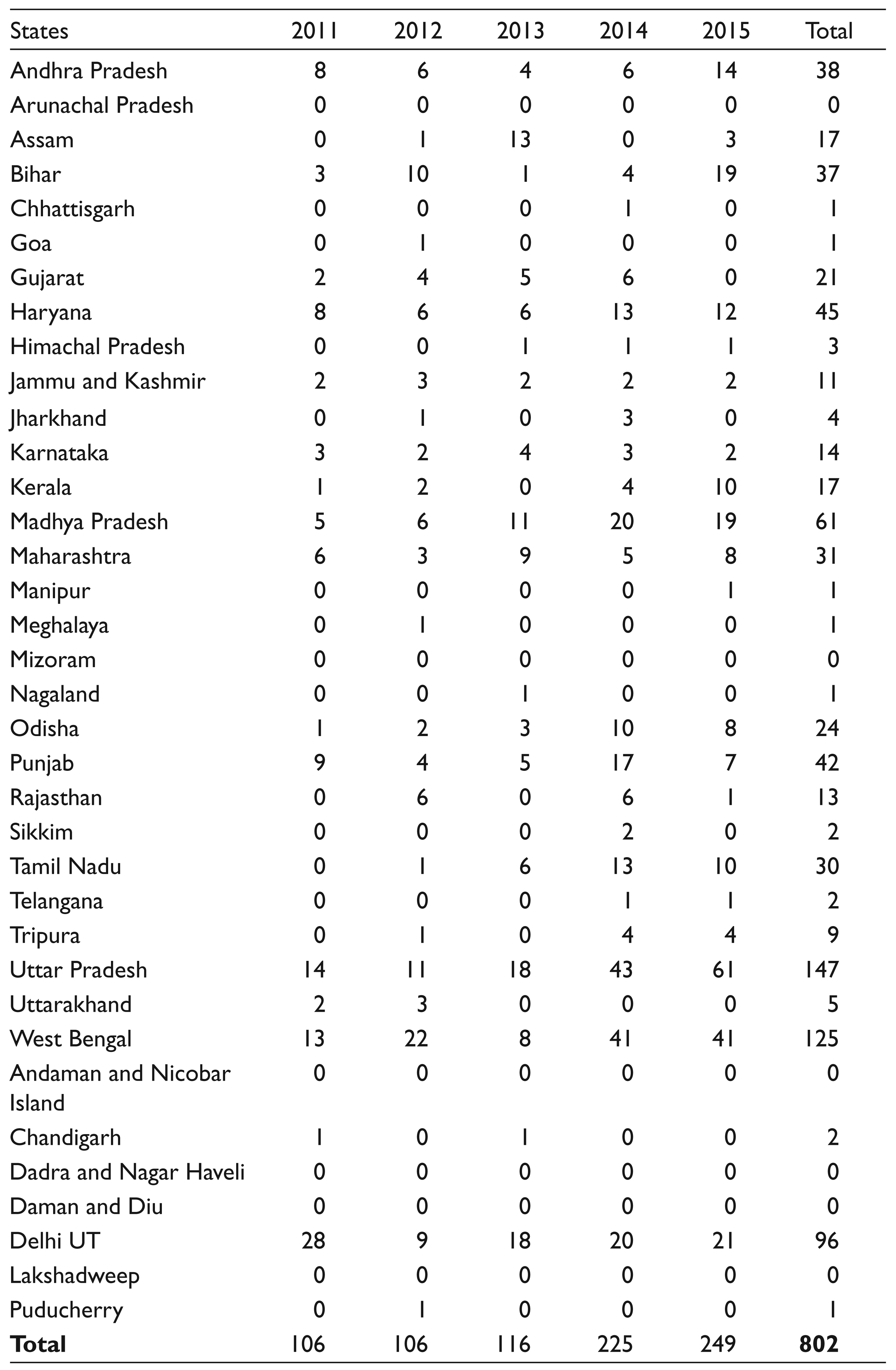
Acid violence has severe clinical, psychological and socio-economic consequences to the victims. The severity of damage due to acid violence depends on the concentration of the acid and the period of time before the acid is thoroughly washed off with water or neutralized with a neutralizing agent. Acid can rapidly destroy skin, the layer of fat beneath the skin, skeletal damage as well as organ failure. Treatment of acid victims involve removing burned skin tissues to facilitate mobility and further surgeries and physiotherapy to ensure that scarred tissue and the potentially growing tissue remain elastic and do not impair movement or arrest normal functioning of the body. Psychologically, acid violence victims are frequently seen to suffer from anxiety, depression, lower self-esteem and higher self-consciousness. The prospect of dependency, disability also exacerbates loss in potential education and employment opportunities as well as social integration.
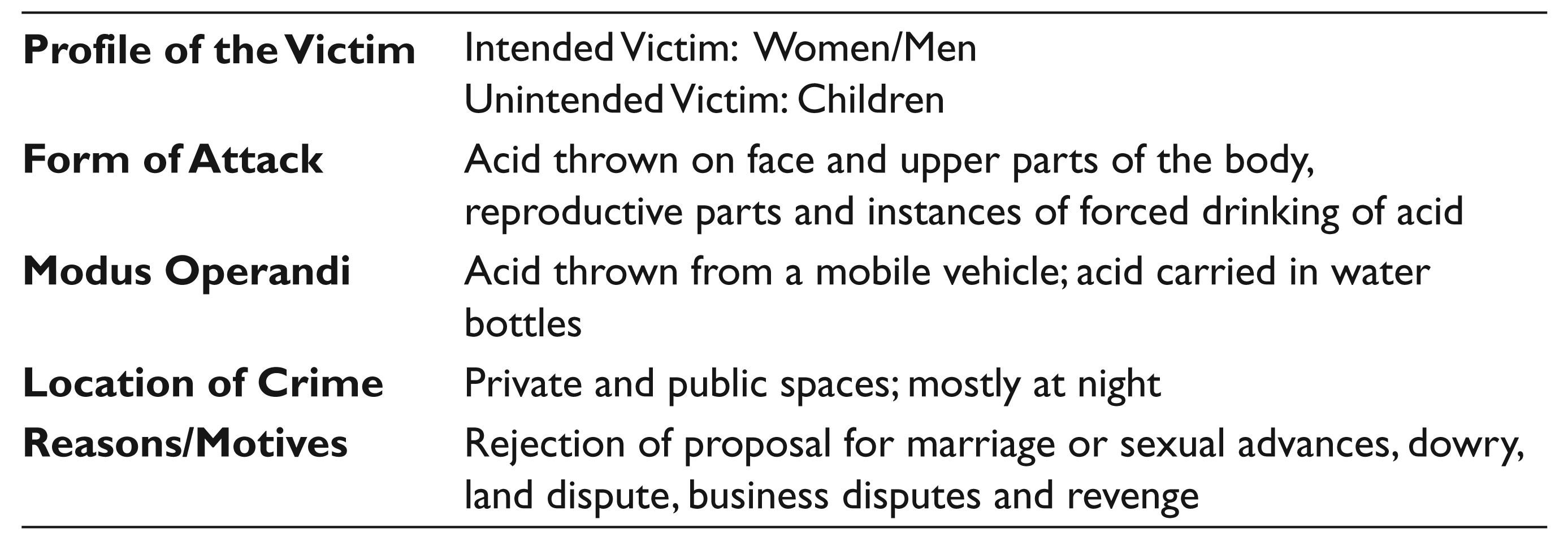
As a crime, acid violence shows a pattern in terms of profile of victims, perpetrators, modus operandi, location of crime and reasons for perpetrating the crime. As Table 2 enumerates, acid violence is mostly perpetrated against women than men (see Table 2). In a comparative study of acid violence, it was found that of the total number of reported cases, women as victims constituted up to 90 per cent in Bangladesh, 72 per cent in India and 52 per cent in Cambodia (Avon Global Centre for Women and Justice, 2011). Acid violence was also quietly perpetrated in public spaces even because of the nature of weapon resembling water. Most often, the victims (and onlookers) assumed that they were doused with hot water due to the initial burning sensation. The most common motive that drove criminals to use acid as a weapon against women was to instil in her a sense of obedience, restoring the honour of the family, revenge for rejecting marriage proposals or any other long-standing disputes between families or groups. The underlying assumption was to take from a woman ‘beauty’, punish her for her transgression and restore the social power balance.
Typical Characteristics of Acid Violence
Need for Structural Perspective
Violence against individual or group of women has a rationale embedded in preserving power dynamics in relation to women. It has punitive and restorative dimensions: punitive when the victim transgresses her socially acceptable role and restorative when she is brought back to her position. Social behaviour mediated by power has both material (economic) and ideological (cultural) roots. Violence against women in particular takes various forms—violence within family (intimate partner violence, harmful traditional practices like son preference, female genital mutilation, child marriage and crimes of honour); violence in the community (non-spousal sexual violence, femicide, sexual harassment at workplace and trafficking); violence against women condoned by the state (custodial violence against women and forced sterilization); violence in armed conflict and violence exacerbated due to the practice of systematic discrimination. Consequences of gender-based violence are not only on the physical, psychological and reproductive health of women of current generations but also have intergenerational impact.
One of the causes and consequences of gender-based violence is the persistence of gender inequality. In countries of South Asia, women continue to face discrimination in formal and informal sectors of the economy and their lack of economic empowerment, also reflected in lack of access to and control over economic resources in the form of land, personal property, wages and credit, can place them at increased risk of violence. While economic independence does not shield women from violence, access to economic resources can enhance women’s capacity to make meaningful choices, including escaping violent situations and accessing mechanisms for protection and redress. In this context, the impact of restructuring economy along the lines of neoliberal policies requires attention.
Policies such as structural adjustment, deregulation of economies and privatization of the public sector have tended to reinforce women’s economic and social inequality, reduced the capacity of many national governments to promote and ensure women’s rights through public sector programmes, social spending and community participation. World Health Organization had noted the disruptive effects of globalization on social structures and consequent increases in overall levels of violence in society:
[S]ocieties with already high levels of inequality, which experience a further widening of the gap between rich and poor as a result of globalization, are likely to witness an increase in interpersonal violence. Rapid social change in a country in response to strong global pressures—as occurred, for instance, in some of the states of the former Soviet Union—can overwhelm existing social controls over behaviour and create conditions for a high level of violence (United Nations Economic and Social Council, 2012).
The structural perspective of examining gender-based violence brings the centrality of the role of state and intergovernmental organizations to meet human rights obligations, responsibility of transforming socio-cultural norms and regulating power relations between men and women. Transformative Constitutions of India, Nepal and proposed Constitutional amendments of Sri Lanka point to the agency of state as catalyst for social change.
In the case of acid violence, the cultural perspective of hegemonic masculinity is inadequate and problematic in understanding the nature of structures that perpetuate violence. The use of acid as a weapon to expressly disfigure women, their feminine self and subjectivity is the consequence of men who are conditioned to enact hegemonic masculinity in a patriarchal society. However, the choice of acid as weapon has significant political and economic consequence for the victim impairing her social and economic mobility. Hence, acid violence falls more in the type of crime classified as premeditated rather than other kinds of violence that is a product of ‘passion’. Also, the risk of violence increases as women move further away from traditional gender norms and is present when gender relations are transformed.
Gayatri Spivak (1988) had indicated that locating the problem of gendered violence solely in the categories of post-colonial semi-feudal societies that were backward remained with the idea that emancipation lay in saving the ‘brown women from brown men’. Uma Narayan (1997) has argued that the extrication of women’s rights out of their socio-economic context to a battle in international grounds has the danger of assuming local cultures and contexts as stagnant. Kamala Visweswaran (2004) argues further that human rights discourse that focuses on universal idea of feminism leaves little space for the democratic contestation of women’s movements in the local contexts.
There are anthropological studies that reveal that gendered violence is linked to structural violence. Merry (2006) had argued that international norms often set up by the United Nations by using culture as an ‘alibi’ for perpetration of violence overlooks the economic and political restructuring as an important variable that sustains old forms of gender-based violence and brings in more new dangerous forms. Seen in this manner, crimes like acid violence is embedded not only in kinship and social structures directed by patriarchy but also inevitably linked to economic and political inequality (Merry, 2009) and is therefore desirable to examine in the intersection of political protectionism, globalization and poverty in a patriarchal structure.
Questioning the analytical framework that does not examine the interpersonal and structured violence that women face, Mutua (2011) argues that the discourse that identifies gender-based violence as human rights violation often impedes the layered understanding of the issue in the context of neoliberalization and economic inequalities. The tropes of ‘victim’ and ‘savage’ are located in the post-colonial developing countries, whereas the ‘saviour’ is located in the developed West.
Nancy Fraser (2012) has concurred with this analysis through her tracing of trajectory of feminist theory. She argues that having begun with the problem of women’s lived inequality and subordination in all spheres of life, feminism moved from structures to cultures until the politics of identity suppressed the politics of economic concerns. This has prevented the possibility of a radical feminist critique to structural adjustment and other forms of economic inequalities perpetuated by globalization. Weismann (2013) examines the reluctance of scholarship on structural factors of gender-based violence by concluding that feminist theory based on human rights advocacy has dwelt on ‘the ideological reflection of one’s own place in society’ with insufficient attention to superstructures. Feminist critiques have failed to provide an alternative to global capitalism, ‘undermined class-based solidarity efforts, failed to challenge the social construction of status categories, and ignored the intersection of identities’ due to co-option and professionalization of women (Weismann, 2013).
The possibility of a new wave of scholarship arises from the report of the United Nations Special Rapporteur on Extreme Poverty and Human Rights (United Nations Human Rights, 2006) who has perceived the linkages between extreme economic linkages and human rights realization. This approach if extended to studies on violence can bring in political economy framework to the problem of gender-based violence. Furthering this cause, public health professionals have been the first to cite the problem of political economy while examining victims of violence as subject of medical care. They have stressed on the relation between socio-economic status and public health outcomes, emphasizing the role of state in facilitating such transition.
In a study of gender-based violence from the medical perspective, Watts and Zimmerman (2002) identified violence against women as not only a serious violation of women’s human rights but also as an important cause of injury, and a risk factor for many physical and psychological health problems. The authors stated that in recent times, understanding gender-based violence and the appropriate case management of subordinated genders with a current or previous history of violence are recognized as core competencies for health workers. Similar findings that include structural factors of political economy are found in recent scholarship of family law, anthropology and social work.
A Model of Jurisprudence for India
The Indian criminal justice system currently views acid violence as a form of ‘grievous hurt’ perpetrated against victims. In this view, there are explicit provisions that address the modicum of investigation and evidence gathering, compliance of treatment by public health officials, cost of treatment and compensation to the victims and an attempt to regulate the sale of acid. For instance, Indian Penal Code (IPC) Section 100 identifies acid violence as a form of grievous hurt and directs the primary investigating officer and public health officials to take note of recording the crime and administering the treatment in sections 166 A and B. IPC 326 A and B deals with the penalty to perpetrators who attempt or perpetrate acid attack by categorizing the crime as a non-bailable offence. In the Criminal Procedure Code (CrPC) 1973, Section 154 deals with the recording of offence by a woman investigating officer. CrPC 357 B and C deal with treatment of victim and compensation due to her. The Supreme Court of India, through the judgement in Lakshmi v. Union of India (2013) directed all the sub-national governments to regulate the sale of acid and increase the compensation provided to the victims. On the advice of solicitor general of India, the Apex Court directed all sub-national governments to enhance compensation to ₹300,000, of which ₹100,000 had to be paid within the first 15 days of the attack. Furthermore, the Ministry of Women and Family Welfare through a directive dated 2 March 2013 have asked all public hospitals to administer free of cost first aid and medical treatment to a class of offences that include acid violence. Since 2013, acid has been brought under the category ‘poison’ under the Poison Act (1919) enabling regulatory purview over registration, sale and safe possession of substances classified as ‘acid’. Furthermore, since 2013, the National Crime Records Bureau has begun collecting data on acid violence at the district level for the first time.
However, the criminal judicial system fails to recognize acid violence as instances embedded in socio-economic structures. All the measures proposed are post-hoc interventions. In this context, this article proposes a three-stage model of structural intervention that situates acid violence in the immediate socio-economic structures and widens the scope for participation of stakeholders. The model advocates for utilizing both formal and informal machinery for prevention of acid violence, protection of vulnerable genders, prosecution in case of commission of crime and reintegration of the victims into society with state as the central agent of change. The model has three stages of interventions designed for acid violence (see Figure 1).
The first stage comprises ex-ante preventive measures that include stakeholders like communities, social movements and local media. Ex-ante intervention prevents the commission of a criminal act that otherwise requires the intervention of conventional law enforcement authorities. Districts that have reported the highest incidence of acid violence as crime should constitute areas of priority activity. Information dissemination on acid violence and first aid measures should be part of public health initiatives like Anganwadi (nutrition and health centre) at the local level. To draw on social controls with local political oversight, special attention must be directed towards poverty, unemployment, access to health care, substance abuse and mental health care, distribution of food stamps and other benefits to prevent the environment that induces gender-based violence. At the union government level, a specific that regulates control and sale of acid should be enacted. Media and youth activism can be co-opted to disseminate information and awareness campaigns regarding acid violence as a form of violence.
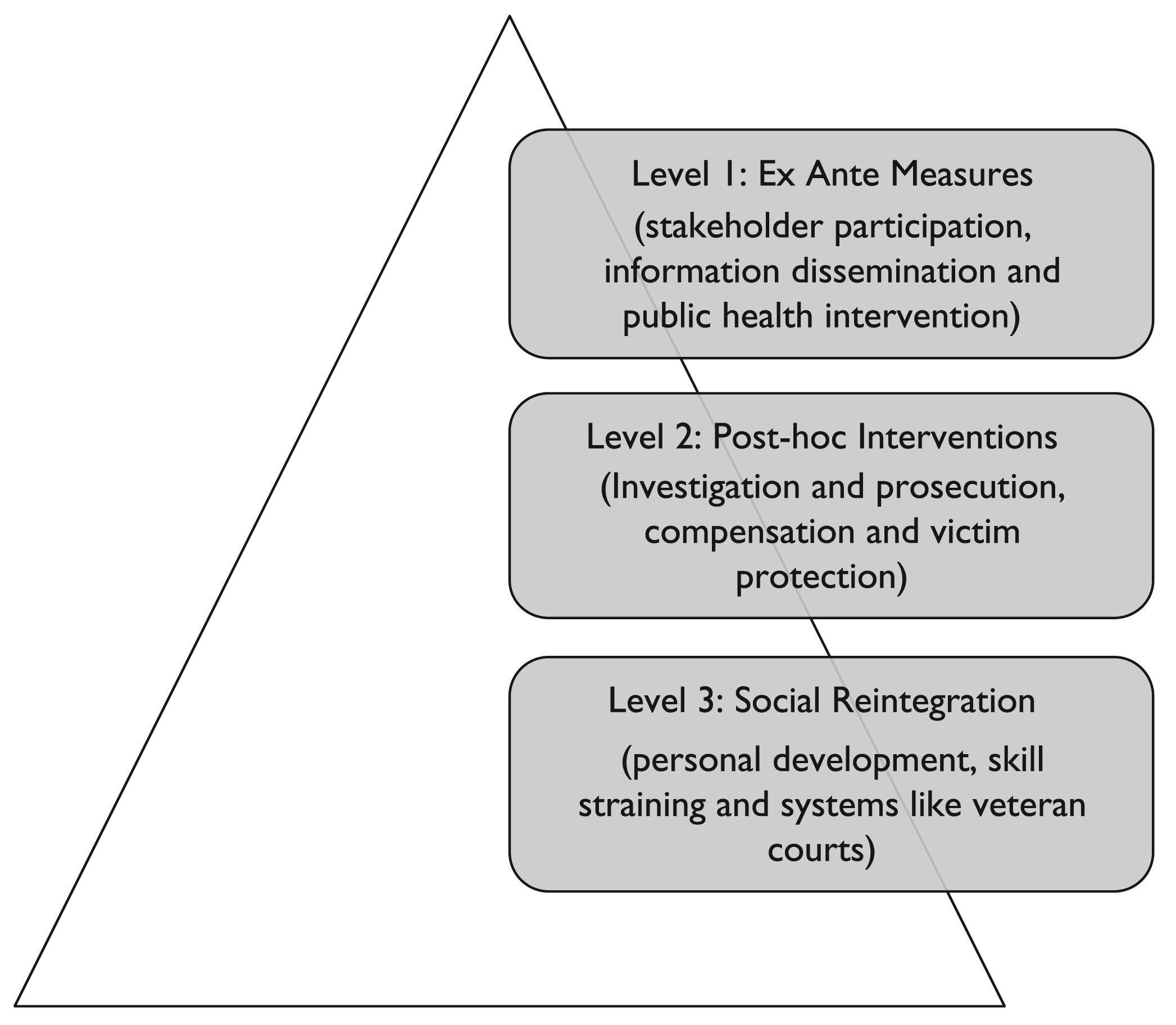
The second stage of the model comprises of post-hoc measures in the event of commission of acid violence. The first aid for an acid attack victim is washing off acid with water that reduces the severity of burns 90 per cent of the time. The National Commission for Women in India has proposed a bill to institute a victim assistance board that could bring concerted efforts of treatment, legal remedy and access to compensation. In addition to this welcome move, there should be sensitization of personnel to reporting and investigating acid violence as well as victim and witness protection measures in place.
Transformative justice models identify formal and informal mechanism, the role of state along with society to redress violence at interpersonal and structural levels. The final stage of confronting acid violence is thinking beyond redress to reintegration of the victim back into the society. The victim has to be helped on personal development as she battles self-esteem and other psychological issues as well as community integration by improving her economic and social capital, including education and employment activities and other avenues of social training. The setting up of local community meeting with people who have undergone stress situation in the model of veteran courts can be envisaged with the involvement of community.
Combating Gender-based Violence through an Integrated Approach
The scholarship of gender-based violence has fallen behind the theoretical advances of political economy that have arrived at a deeper understanding of the complex working of market, state and society that creates structures that reinforce gender inequality and violence. Critical reading still remains fixed on theories of patriarchy based on notions of a male-dominated society. These arguments based on ideology and culture tend to neglect the structural conditions from which patriarchy emerged as a cultural arrangement and newer forms of structures that sustain and perpetuate them.
Structural analysis of acid violence that was discussed in this article calls for identification, acknowledgement and redress of political economy variables that sustain and perpetuate gender-based inequality and violence. The article identifies acid violence as a product of the structural forces. In the realm of intervention, an integrated approach is crucial. An active and visible policy of mainstreaming gender concerns across policy also makes gender part of integrated approach to policymaking. Primarily, family, community and the state should be stakeholders in the process. Reforms should be aimed at education and information dissemination, sensitization of personnel in the criminal justice system and involvement of social movements. Adequate documentation and research including the availability of gender-disaggregated data is necessary to design-specific interventions.