



Abstract
This article problematizes the definitional discourse of manual scavenging in Indian legislative interven-tions and its judicial treatment by the Supreme Court of India. It assesses the evolution of the definition of manual scavenging and the judicial treatment of it to cull out the insufficiency of legal doctrines and judicial interpretations in its elimination. It is argued that the career of legal prohibition of manual scavenging, despite deploying new measures to promote the elimination and rehabilitation, is antithetical to the very objectives of the legislations due to a paradoxical definitional discourse. The paradox is discerned by problema-tizing the condition-based permissibility of manual scavenging, where the usage of protective gear is the excluding criterion for identifying manual scavengers and perpetuates the practice. This condition-based permissibility has been a key burden on the discourse of elimination, as no such measures, it is argued, can mitigate discrimination, humiliation and stigma faced by manual scavengers. After identifying the conditional prohibition of manual scavenging, the article makes normative suggestions towards the adoption of a non-condition–based complete prohibition approach rooted in the understanding of human dignity. This must be complemented with the complete rehabilitation of individuals and complete mechanization of sewage work.
Introduction
Manual scavenging, which is ‘the inhuman practice of manually removing night soil which involves removal of human excrements from dry toilets with bare hands, brooms or metal scrappers; carrying excrements and baskets to dumping sites for disposal’ is still rampantly practised in India (Shahid, 2015, p. 245). Having historical roots in caste-based discrimination, in Hindu social order, the lowest caste, or erstwhile untouchables, or Dalits are forced into undertaking menial and inhuman occupations, manual scavenging being one such occupation (Permutt, 2012). Since India adopted its Constitution in 1950, the practice of untouchability based on the notion of purity and pollution is a constitutional offence under article 17. Manual scavenging being deeply embedded in caste has an intersectional angle to it as 95% of manual scavengers are Dalits, out of which 99% are Dalit women (Permutt, 2012). As per the 2011 Census of India, there are about 2.6 million insanitary latrines, which are toilets that require human excreta to be manually cleaned, which throws light on the existing sanitation crisis in India. 1
The postcolonial legislative interventions have seen four laws prohibiting manual scavenging, of which two are special enactments prohibiting the practice of manual scavenging: Protection of Civil Rights (PCR) Act 1976 2 ; Scheduled Castes and Tribes (Prevention of Atrocities) Act, 1989 (Atrocities Amendment Act 2016) 3 ; The Employment of Manual Scavengers and Construction of Dry Latrines (Prohibition) Act, 1993 (MS 1993 Act) 4 and The Prohibition of Employment as Manual Scavengers and Their Rehabilitation Act, 2013 (MS 2013 Act) 5 . These legislations provide for a detailed framework for the prohibition of the act of manual scavenging and the protection and rehabilitation of manual scavengers. Despite these special legal interventions, the disadvantage, discrimination and stigma faced by manual scavengers persist. One central reason identified in this article is the failure of the Supreme Court of India (SCI) and the Indian scholarship to problematize and challenge the conditional prohibition of manual scavenging practice in legislation. By conditional prohibition, I mean section 2(g) Explanation (b) of MS 2013 Act which allows for manual cleaning of human excreta with the use of the equipment and protective gear, whereby manual scavenging is prohibited in general but for the protective gears—when provided to manual scavengers place them outside the purview of the Act.
The public interest litigation (PIL) activism by Safai Karmachari Andolan’s (SKA) for enforcement of the fundamental rights under the Constitution of India and statutory legal safeguards provides an outlook into the judicial treatment of the issue of manual scavenging. Critically assessing the decade-long judicial activism by the SCI and SKA’s grassroots movement for social justice of Dalits involved in the profession of manual scavenging in India will help delineate the successes and limitations of strategic use of rights and judicial interventions in addressing manual scavenging (Singh, 2014). It further complements the critique of the legislative interventions by indicating the limitations of judicial interventions in completely eradicating manual scavenging. It further supports the normative position in this article of a complete prohibition of manual scavenging, as despite mobilization to enforce legislative eradication of manual scavenging, the same remains a far-fetched reality. This is particularly relevant as SKA’s social movement is focused not only on eliminating all forms of manual scavenging but also on emancipating and liberating Dalits (Singh, 2014). With its outreach to 300,000 manual scavengers, SKA developed and sustained a mass movement by arguing that manual scavenging is a manifestation of caste discrimination, violence and untouchability, and is based on the notions of purity and pollution (Mander, 2010).
The struggle, as the founders of SKA, S. R. Sankaran and Beswada Wilson have time and again mentioned, was for reclaiming human dignity and abolish untouchability, which are rights recognized in the Indian Constitution. 6 Thus, even before engaging in PIL activism, SKA’s movement continuously evoked the rights framework present in the Preamble and the chapter on fundamental rights of the Indian Constitution, in its social movement, so much so that right to human dignity became the symbol of its social movement (D’Souza, 2016).
SKA’s movement is deemed as one of the most successful contemporary movements to eliminate untouchability in India. 7 Its success lies in the mass mobilization of Dalit communities and leading a non-violent movement strongly based on the strategic use of rights through PIL and by boycotting scavenging work, burning straw baskets used to collect human faeces, and demolishing insanitary or dry latrines. In 2003, SKA approached the SCI after realizing the ineffectiveness and non-implementation of legal safeguards for manual scavengers, which was conceded by the government itself. 8 Due to the failure of constitutional mandate under Article 17, it became imperative for SKA to evoke a rights framework for implementation of the safeguards and legal protections.
Despite these encouraging developments, the failure of formal legal provisions, strategic use of rights and balancing the grammar of rights with social mobilization in completely prohibiting manual scavenging is a contemporary social reality that cannot be limited to an issue of legislative non-enforcement or lack of political will. This article identifies and further problematizes the legal doctrinal understanding of manual scavenging and the defect in it and makes normative suggestions towards achieving complete prohibition.
My argument is that the very act of engaging in the practice of manual scavenging even with protective gear when construed discursively in its history and present social manifestations, grossly fails the constitutional scheme prohibiting untouchability and violates the constitutional understanding of human dignity. SCI jurisprudence has completely failed to capture this apparent basic structure violation, which has allowed the practice to perpetuate relying on the permissibility of protective gear as a legal exception to the prohibition, which is illustrated in the analysis of the Safai Karamchari Andolan v UOI 9 and the recent obiters 10 of the SCI.
Understanding Manual Scavenging in Four Acts
The evolution of the definition of ‘manual scavenger’ provides some insights into the intention of the legislature in outlawing the practice and steps initiated for the rehabilitation of persons engaged in the act.
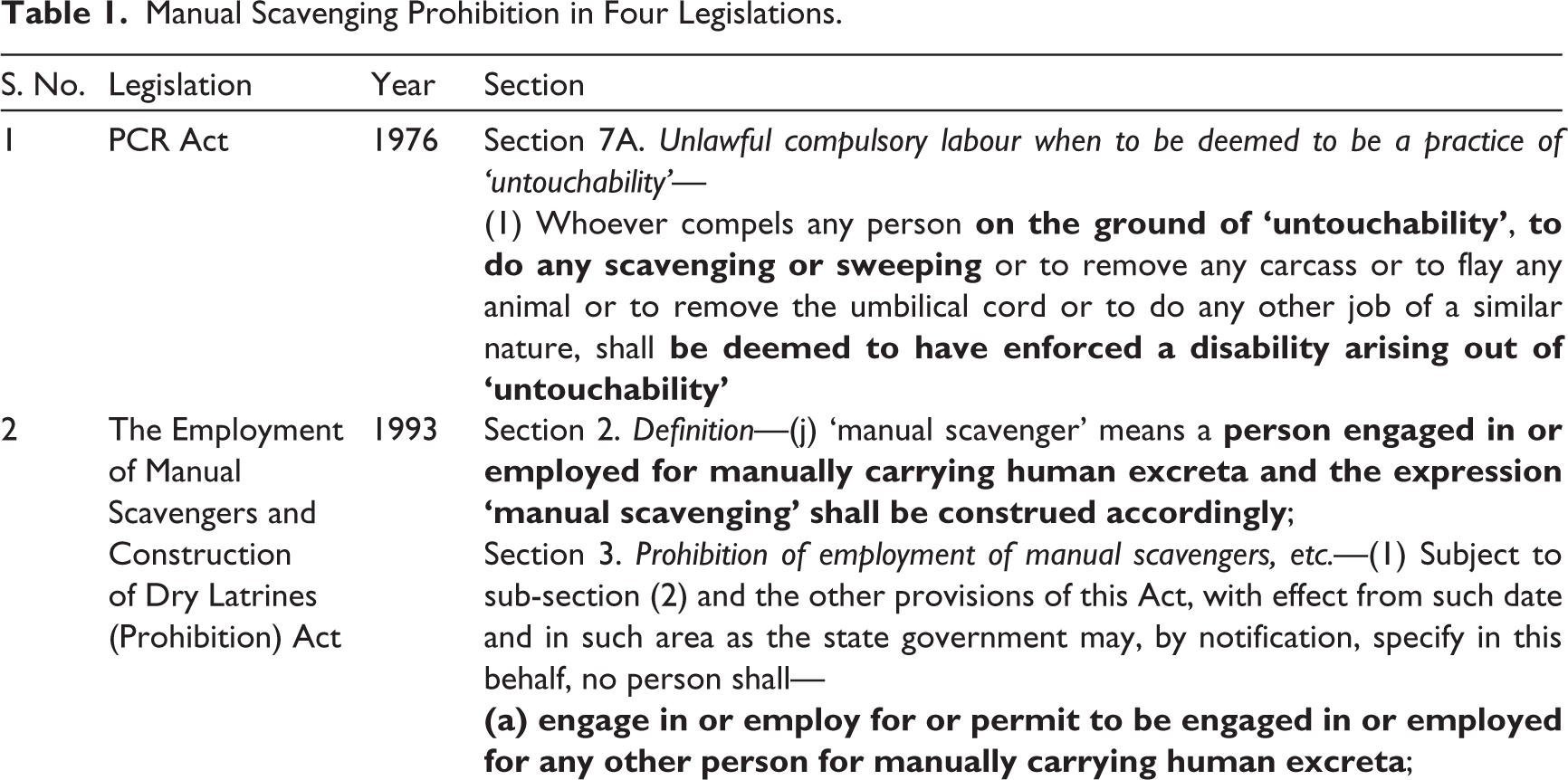
The PCR Act, 1976, was the first legislation to prohibit scavenging, however, only in the context of ‘unlawful compulsory labour’ when a person is compelled to do so ‘on the ground of untouchability’. The definition excludes municipal corporation workers and domestic workers who are engaged in the activity of manual scavenging, who are predominantly Dalits and as a direct consequence of their caste positions as untouchables along with the livelihood considerations, undertake the activity. The limitations of this definition stem from the rooting of the practice of manual scavenging in the evidentiary threshold of ‘on the grounds of untouchability’, where the scavenging, even when compelled upon, is excluded from the scope of the act if such compulsion was not on the grounds of enforcing untouchability against a person.
The MS 1993 Act was the first dedicated legislation outlawing the construction of dry latrines and the employment of manual scavengers, where the definition identified a person as a manual scavenger if such a person is ‘engaged in or employed for manually carrying human excreta’. In what can be identified as a significant development from the PCR 1976 Act, the definition expressly prohibited engagement and employment for ‘manually carrying human excreta’ without any qualifications of the existence of untouchability as a ground for engagement in such exercise. Thus, the outlawing of manual scavenging, through delegating the powers to the state government, has rejected the conditions-based approach of the PCR Act 1976 and provided a direct prohibition on the employment of manual scavengers.
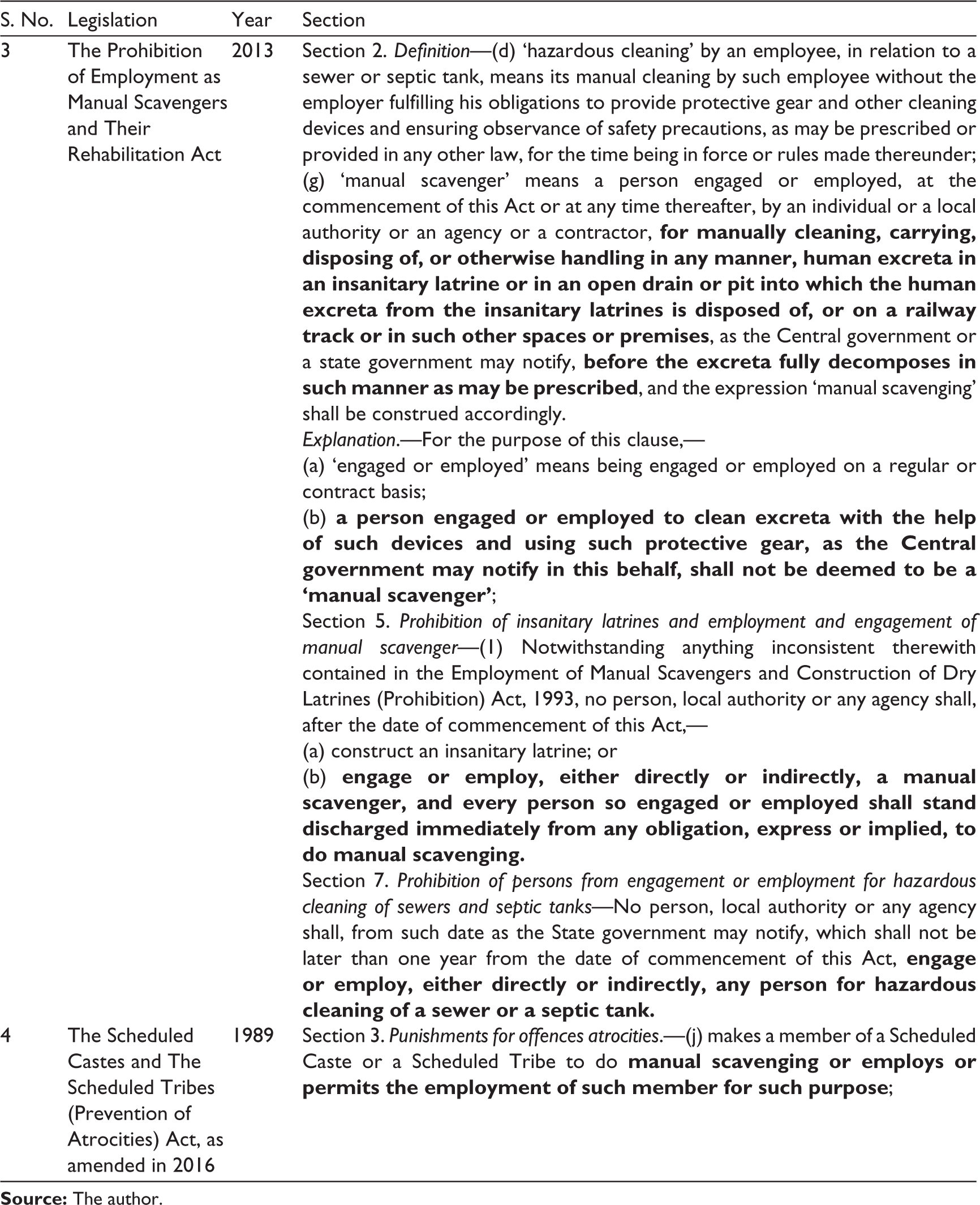
The MS 2013 Act, meant to reform the MS 1993 Act, establishes a distinction between hazardous cleaning and manual scavenging. The former entails manual cleaning of the sewer or septic tanks by employees without ‘protective gear and other cleaning devices and ensuring observance of safety precautions’. A manual scavenger on the other hand is any person engaged in manually cleaning and handling human excreta from an insanitary latrine or an open drain or pit where the human excreta is disposed of, including the railway track or in such other spaces or premises as identified by the government. The Explanation to section 2(g) attaches a condition to this definition where—
(b) a person engaged or employed to clean excreta with the help of such devices and using such protective gear, as the Central Government may notify in this behalf, shall not be deemed to be a ‘manual scavenger’;
Therefore, both hazardous cleaning and the employment of manual scavengers are prohibited by the MS 2013 Act 11 only if protective gear, equipment and devices are not provided to municipal employees and manual scavengers. The Prohibition of Employment as Manual Scavengers and Their Rehabilitation Rules, 2013, provide an inclusive list of 44 protective gear and safety devices which must be provided to persons engaged in cleaning sewer or a septic tank. 12 The significance of this legislative exceptionalism and permissibility of manual scavenging is that the MS 2013 Act lacks tools to achieve its central objective—‘the prohibition of employment as manual scavengers, rehabilitation of manual scavengers, and their families’. It is because, on the one hand, the legislation prohibits the employment in hazardous activities and manual scavenging, and on the other permits carrying out these otherwise prohibited acts if such persons do so with protective gear, equipment and devices. The legislative intent is thus not towards completely prohibiting any forms of engagement and employment in carrying human excreta, or entering sewers or septic tanks by persons, but to continue the practice of manual scavenging and hazardous cleaning by providing safety mechanisms to ensure engagement. It is evident that such conditional-based permissibility brings back the conditions-based approach as adopted by the PCR Act, 1976, and as abandoned by the 1993 prohibition Act. The claims of progressive nature of the 2013 Act, therefore, are untenable given the regressive development in the 2013 Act in form of reincluding the conditions-based definition to manual scavenging. 13
Manual scavenging is also an offence of ‘atrocity’ under the atrocities act, whereby through the Atrocities Amendment Act, 2016, sub-clause (j) made acts of compelling and employing SC/ST community members for the purposes of manual scavenging. The Atrocities Amendment Act, 2016, transposes the definition of ‘manual scavenger’ from the 2013 Act, 14 and hence also inherits its limitations as identified above. Table 1 maps the specific legislative provisions across four legislations that prohibit manual scavenging in varying degree, though through a conditional permissibility.
Manual Scavenging Prohibition in Four Legislations.
These legislative approaches, I submit, fail to capture two settled facts about manual scavenging—it violates human dignity as a fundamental right of manual scavengers; caste discrimination is the root cause of predominant employment of Dalits as manual scavengers and their subsequent stigmatization, exploitation and discrimination deriving from historical injustices of the caste system. No level of protection gear and safety devices can mitigate, it is argued, the violation of human dignity, right to life, stigma and humiliation emanating from the very nature of manual scavenging rooted in caste discrimination and social injustice. The last section discusses the normative insights that attempt at reconciling sewage work and the principle of human dignity.
The discussion and problematization of the abovementioned legislative fault lines do not exist in the judicial discourse on manual scavenging. A doctrinal assessment of the judicial treatment will provide crucial insights to enable making normative claims, especially of the SCI’s decade-long judicial activism to which the discussion now turns.
Judicial Discourse
Judicial treatment of prohibition of manual scavenging has gained traction in the recent obiters of the SCI both in hearing and a judgement. Before undertaking an analysis of the SKA v Union of India, 15 a landmark in anti-caste discrimination jurisprudence in India, it is imperative to assess critical obiters of the SCI.
During the hearing of Union of India v the State of Maharashtra, 16 the case involving review of Dr. Subhash Kashinath Mahajan v The State of Maharashtra (2018)—the case that diluted the scope of SC/ST Atrocities Act—the SCI expressed serious concerns over deaths of manual scavengers (The Hindu, 2019).
Why are you not providing them masks and oxygen cylinders? In no country in the world, people are sent to gas chambers to die. Four to five people are dying due to this every month.
It is the most uncivilized and inhuman situation where the people are losing their lives in gas chambers without any masks or oxygen cylinders.
This is the most inhuman way to treat a human being.
All the human beings are equal and when they are equal you should provide them equal opportunities as mandated under the Constitution. You are not even providing them an equal chance and they are not been given the basic facilities to even clean themselves.
Despite the Constitution abolishing untouchability in the country, I am asking all of you, will any of you shake hands with them? The answer is no. That is the way we are going on. The condition must improve. We have moved 70 years since Independence but these things are still happening.
The obiter in the final judgement in State of Maharashtra (supra), the SCI acknowledges the rampant prevalence of untouchability despite the formal prohibition of untouchability under Article 17 of the Constitution. The bench further observes
The plight of untouchables is that they are still denied various civil rights; the condition is worse in the villages, remote areas where fruits of development have not percolated down. They (Dalits) cannot enjoy equal civil rights. So far, we have not been able to provide the modern methods of scavenging to Harijans due to lack of resources and proper planning and apathy… The answer can only be found by soul searching.
17
The bench struck at the very root of a systemic problem of caste discrimination thereby opening up debate of relevance of legal protection in prohibiting deeply entrenched social practices backed by prejudices, discriminatory attitudes and strong socio-cultural and religious sanctions. It is submitted that, however, it failed to question the lacuna of ‘conditional prohibition’ of manual scavenging under the 2013 Act, as identified above, that has allowed perpetuating discrimination against manual scavengers in allowing the practice to continue by default.
The PIL and the Judgement of the Supreme Court
In Safai Karmachari Andolan, the PIL emanating out of the decades-old grassroots movement for achieving social justice for Dalits led by SKA and other sister organization was not merely focused on eliminating all forms of manual scavenging. It was largely targeted towards the emancipation and liberation of Dalits from the shackles of caste discrimination and untouchability. With human dignity as the pivotal emancipatory issue, the mass social mobilizations against discrimination instrumentalized rights framework within the Constitution of India and International Human Rights Law for implementation of the safeguards and legal protections as a matter of fundamental human right.
Supreme Court’s judicial activism from 2003 onwards saw the court passing numerous mandamus 18 orders calling upon state governments to implement the 1993 Act within their jurisdiction. The SCI also sought detailed information on all the rehabilitation schemes undertaken by the government and the number of manual scavengers rehabilitated under these schemes. The Court further delegated the monitoring function for the compliance of the directions and orders issued by it to all 21 High Courts in India.
In the legal battle fought for more than a decade, it will be erroneous to only analyse the judgement and not give due regard to the numerous mandamus orders issued by the SCI during the pendency of the writ petition. That way, the success of this legal battle cannot be assessed through the final judgement, which was rather a disappointment for SKA, but by giving due regards to what I call the ‘progressive safeguarding approach’ adopted by the SCI through sustained interim orders.
The petition was met with strong opposition from the Central and state governments, where both denied the existence of manual scavenging in their respective states. They also denied the overarching photographic evidence produced by SKA to prove the existence of manual scavenging in India (Human Rights Watch, 2014). In this context, two interim orders of April 2005 19 and October 2007 20 by the SCI are crucial for our discussion. In April 2005 order, the SC directed the Central and the state governments to file fresh affidavits detailing the existence of manual scavenging in public authorities. The Court also directed to furnish information of all the rehabilitation schemes undertaken by the government and also called for information of budgetary allocation by the Central government and the number of manual scavengers rehabilitated under the legal safeguards schemes.
Since the 1993 Act was a matter to be implemented by state governments, the SCI took note of the lack of implementation of the Act and abhorrent denial of the existence of manual scavenging by the states. Thus, in October 2007 order, it gave two-month-time period to the states to implement the 1993 Act within their jurisdiction. 21 One of the most important outcomes of this progressive safeguarding approach of the SCI was that the National Commission for Safai Karamcharis, the government’s nodal agency for the welfare of manual scavengers, finally issued data on manual scavengers in the public domain. The government thus acknowledged for the first time that 6,76,009 manual scavengers existed in India. 22
SKA faced challenges even from the judiciary, which questioned the existence of manual scavengers in India and the nature of such practice. SKA through mass mobilization carried out surveys in five sample states on the number of Dalits involved in the practice of manual scavenging, giving details of their personal and socio-economic conditions. 23 Having ruled the existence of the practice of manual scavenging on a rampant scale, the SCI directed the local authorities to implement the 1993 Act. SKA instrumentalising the orders of SCI, motivated the local authorities to act on the directions of the SCI and destroy dry latrines within their jurisdiction. 24
In 2011, for the implementation of the directions and orders issued by it, the SCI delegated its monitoring function in the case to all 21 High Courts in India for compliance with the directions and the 1993 Act, which was done for the first time in court’s jurisprudential history. 25
The final judgement is thus significant for three important reasons: First, the judgement elucidated the anti-caste discrimination jurisprudence through a conjoint reading of Article 17 (prohibition of untouchability), Article 14 (right to equality), Article 15 (the right against discrimination), Article 21 (the celebrated right to life in the context of human dignity) and Article 23 (prohibition of forced labour). This analysis has paved the way for developing future anti-caste discrimination jurisprudence in the country. Second, quite innovatively, the SCI relied on India’s International Law obligations under the Universal Declaration of Human Rights, Convention on Elimination of Racial Discrimination and the Convention for Elimination of all Forms of Discrimination Against Women to expand the scope of the above constitutional provisions. Third, it gave the directions and the judgement a sustained outlook by addressing the possibility of reoccurrence of the practice of manual scavenging in the future. Hence to preclude the future generations from suffering humiliation and indignity, the SCI diversified the scope of rehabilitation measures to include criminalization of entering sewer without protective gear and by providing compensation of Rs. 10 lakhs for sewer deaths; it also directed the railways to phase out manual scavenging which takes place on railway tracks, and eliminate hurdles faced by manual scavengers in deriving benefits under the rehabilitation schemes and provide a dignified livelihood to safai karamchari women. The Court finally imposed a duty on the states to fully implement the Act and directions of the Court and undertake legal measures to tackle non-implementation.
The above case study provides us with in-depth insights on understanding the emancipatory potential of rights in social change, provided they are backed by constant social mobilization. During the pendency of the petition, SKA not only fought a legal battle but also fought a social battle through its social justice movement. These developments of sustained judicial activism and social mobilization, in themselves did not drastically affect the situation of manual scavenging in India, nor did it cause systemic transformation in terms of eradicating caste discrimination and the practice of untouchability faced by manual scavengers, generally speaking. One of the limitations of the PIL was that the SCI did not critically evaluate problems within the MS 2013 Act that perpetuate the practice through conditions-based permissibility. The discussion now turns to carry out an in-depth analysis of the central reasons for such a failure and undertake normative inquiry which proposes complete eradication, complete rehabilitation and complete mechanization.
Towards a Complete Prohibition
Broadly, two reasons can be attributed to the failure of judicial activism in ending manual scavenging—(1) limitations of rights discourse in addressing systemic human rights violations when a conducive socio-cultural apparatus for norm adherence is lacking in the society; (2) conditional prohibition of manual scavenging under the 2013 Act acted as an essential impetus in maintaining the status quo—of discrimination, stigma, prejudice, humiliation—for Dalits employed in the menial job of manual scavenging.
Law as a means of initiating social change has been much debated and critiqued in socio-legal theory. As a crucial part of the culture of every society, rights’ intertwinement with other social institutions such as ethnicity, race and caste are predicaments of tension in the interaction of law with these structures and which of these structures superposes itself over another (Bradshaw, 2007, p. 1337; Borges & Pedro, 2009; Dror, 1958; Scheingold, 1974). Deviation in actual social behaviour and the behaviour ascribed by law leads to tension between law and social change. This tension grows into a ‘lag’ when the law is not at par with social changes in society (Berger, 2008; Rosenberg, 2008; Sharma, 2012). In the case of caste discrimination, in practice, social behaviour is deviant from legally expected norms, and, therefore, the sense of obligation in people is not towards complying with the legal norms, leading to non-adherence. Thus, to avoid the gap, ‘parallel changes’ in law and society are indispensable. This has not been the case in the larger anti-discrimination law framework in India concerning Dalits, as systemic violence equated with social and cultural discrimination limit the effects of court-oriented social change due to norm non-adherence socially.
Another reason for failure is that the 2013 Act makes a pitfall in the conceptualization of the definition of manual scavengers, one that it intends to outlaw. Legislated to overcome fallacies of the 1993 Act, the 2013 Manual scavenging prohibition law contains a glaring legal fault. The lacuna, as identified above, in the definition of ‘Manual scavenger’ is in the Explanation to section 2(1)(g), where a person is deemed to not fall into the category of a ‘manual scavenger’ if such a person, so employed to clean excreta and enter into ‘gas chambers’ (gutters), does so with the help of protective gear and devices. Despite the legal provisions, the large number of deaths of manual scavengers and qualitative degradation of their life, health and levels of morbidity speaks of gross negligence of the state governments in failing to provide such protective gears and safeguards stipulated under the law. It further orients us with the inadequacy of such ‘protective gears’ in safeguarding the lives of manual scavengers. Supreme Court’s recent obiters are just another reiteration of the grim situation on the ground. No protective gear is capable of mitigating both short-term and long-term health effects and related illnesses on manual scavengers. The inadequacy of protective gear in safeguarding the lives of individuals has to be contrasted with the apparent tension that even adequate protective gear have with the right to human dignity.
The issue here is thus not merely of their health, but also the fundamental human right of human dignity. By deconstructing ‘conditional prohibition’ under the Act, it becomes clear that in its complex interaction with ‘human dignity’—as the utmost fundamental human right, both in constitutional law and International Human Rights Law—fails to uphold the right in its normative canons and its ever-expanding expression in mass social justice movements (Feldman, 1999; Hennette-Vauchez, 2011; Reaume, 2003). Indian constitutional jurisprudence in particular considers dignity as a facet of the right to life under Article 21. 26 The content of human dignity constitutes ‘The equality of all human beings entails being free from the restrictive and dehumanizing effect of stereotypes…Intrinsic to these values is the anti-exclusion principle. Exclusion is destructive of dignity’. 27 Human dignity being foundational in informing the content of constitutional morality and interrelation between guarantees under part III of the Constitution leaves no scope for its selective and suitable interpretation by the government. Nor does it allow any varying degree of conceptualizations, justifying its derogation, as even arguments of the adequacy of protective gear under the inclusive list of the 2013 Rules does not end the violation of human dignity of manual scavengers. Stigma, stereotype, discrimination and untouchability that individuals face for undertaking scavenging work was reiterated in Indian Young Lawyers Association and Ors. v. The State of Kerala and Ors. 28 Manual scavengers were held to still stuffer disadvantage and social exclusion based on ‘system of “purity and pollution”’. Furthermore, constitutional prohibition of untouchability attempted at transformative and radical social transformation ‘moral re-affirmation of human dignity and of a society governed by equal entitlements’. 29 The constitutional scheme, therefore, acknowledges the ‘inalienable dignity of every individual’ through the fundamental right guarantee against social exclusion. 30 This understanding supports the main argument of the article—manual scavenging violates the right to human dignity as the basic structure of the Indian Constitution as merely providing protective gears and equipment do not guarantee protection against stigma, humiliation, untouchability and indignity that individuals, as the constitutional focal point, suffer while engaged as manual scavengers. Ambedkar’s struggle for the emancipation of Dalits and the fight against untouchability also gave human dignity the utmost prominence in theory and his political philosophy. The same is reflected in the drafting of the Indian Constitution which prohibits untouchability and caste discrimination by emphasizing on rule of law with fundamental rights as its central guiding principles. Therefore, no gas mask or protective gear can change the undignified and humiliating experience of cleaning human excreta, entering sewage potholes and gutters, an everyday job for a manual scavenger. Humiliation cannot be accepted in lesser standards, nor any justifications of higher safety standards—lessen the degree of humiliation and indignity—hold any ground in the rights discourse relevant to human dignity, it is argued. Experience of anti-caste discrimination legislation and constitutional provisions with formal rights structure has been that of failure in ending deep-rooted systemic causes responsible for widespread caste discrimination, violence and untouchability. A call for complete prohibition of manual scavenging is eminent and an essential stepping stone towards eradicating the practice of manual scavenging. Though such a step need not infer granting fundamental human rights powers they do not possess—of bringing complete social change, they are only instrumental in the process. Equally so, its role in empowering the anti-caste social justice movement in India, especially the one against manual scavenging, by giving them the power to initiate social change, cannot be neglected. Thus, it is argued that a complete prohibition of manual scavenging through the removal of the conditions approach will be a good starting point to reimagine the prohibition and rehabilitation debate. Such policy intervention must be matched with elevated efforts in rehabilitation of manual scavengers, especially by focusing on enabling access to rehabilitation schemes to the previously excluded sanitation workers not considered as manual scavengers due to the legal exception: ‘complete rehabilitation’. However, until the demand for municipal work persists, a complete prohibition will remain a legal relic where ground realities will ensure continuous engagement of individuals for the job. Equally pivotal, therefore, is to match complete prohibition and complete rehabilitation with complete mechanization of sewer and manhole cleaning. Recent innovations in form of sewer cleaning robots ‘Bandicoot’ and ‘Sewer Croc’, among others, are the type of innovation that must be encouraged and further developed through direct government investment (Gandhi, 2018). Technological advancement can help rapidly achieve complete mechanization of municipal work which has to be complemented with serious infrastructure interventions in building flush toilets and efficient sewage systems.
The government policy, therefore, must identify the limitations of the legal discourse as outlined in this article and amend the apparent flaws in such discourse that aim to outlaw and eradicate manual scavenging, on the one hand, and continue to allow the practice of manual scavenging through a conditional approval of manual scavenging based on the definitional exceptions, on the other. No protective gear can make an undignified act of manual scavenging justify the breach of human dignity and the definitional discourse, it is argued, only entrenches antecedent disadvantages.
Footnotes
Acknowledgements
The author would like to thank Felix Trust for providing the Felix Masters Scholarship (SOAS, London) during which I developed the core arguments and foundation of this paper.
Declaration of Conflicting Interests
The author declared no potential conflicts of interest with respect to the research, authorship and/or publication of this article.
Funding
The author received no financial support for the research, authorship and/or publication of this article.