



Abstract
Historically, it is a glaring fact that any disaster or pandemic made the Dalit and Adivasi as the worst victim. Therefore, it is of utmost importance to unfold the caste dynamics and social realities around the debate of the COVID-19 pandemic. A unique feature of India’s caste system is in its flexibility. Therefore, even during the time of the COVID-19 pandemic, the prescribed medical guidelines of ‘social distancing’ encourages the Savarnas to strengthen the caste prejudices in the name of science. Apart from this, the prescribed guidelines for ‘social distancing’ and ‘home quarantine’ exposed the graded caste inequality in India. The empirical evidence from this study brings it to the forefront that a graded caste inequality persists in household’s availability of exclusive room with attached toilet facilities and adequate ventilation facilities, household’s access to exclusive drinking water source, household’s affordability in practising hand wash with soap or detergent, etc. Therefore, when the Forward caste become the most privileged in maintaining the home quarantine and complete isolation, it becomes an unaffordable luxury for the Dalits. It makes the Dalits most vulnerable during this pandemic. Therefore, this pandemic provides a stark example of the pervasiveness and perniciousness of social inequality in India.
Introduction
Initially, the COVID-19 pandemic was thought of as a ‘great equalizer’ because of its potential to contaminate anyone without discriminating on the basis of race, gender or nationality (Gibson, 2020; Niemuth, 2020). This same thought was also echoed in the statement of Prime Minister Modi, who once said—‘Covid-19 does not see race, religion, caste before striking’ (PTI, 2020). The above-mentioned idea was gradually disproved with the enforcement of the complete lockdown and maintaining social distance as a rule to control the continuous spread of the virus. With the implementation of the lockdown, the plight of the migrant workers made it clear that the virus was not a ‘great equalizer’ at all. While maintaining social distancing became a compulsion to stop the further spread of the virus, it became evident that the virus would not affect equally those who were living on the 24th floor of a luxury apartment in a city and those who were living in a slum-cum-ghetto of the city. Therefore, the argument moved away from the narrative of a ‘great equalizer’ to the sharp ‘class inequality’ in the society. The pandemic starkly exposed the difference of life conditions between the haves and have-nots. The political vocabulary was shifted towards the issues like joblessness, homelessness, economic incapacity, etc. The media and social media evinced ‘concern’ or ‘pity’ for the plight of migrant workers and the flesh-and-blood sufferings of poor people. What was surprisingly missing around these debates was that caste, as an important explanatory component of analysing the Indian society, did not have a place in exposing the possible vulnerable sections and the real sufferers of the pandemic. It seems that when the debate is going on around the plight of the ‘casteless’ poor people—the caste question can be put on hold for some time. Around these circumstances, the question arises—should caste be brought in during a crisis like this? The answer is a firm yes. It is of utmost importance to unfold the caste dynamics and social realities around the debate of the COVID-19 pandemic.
Placing Caste into the Discourse of COVID-19 Pandemic
Historically, it is a glaring fact that any disaster or pandemic made the Dalit as the worst victim. In 1918, when the Spanish Flu pandemic proved devastating to India by killing almost 18 million people, caste became instrumental in determining who would receive health care, survive and die (Sur, 2020). The lower-caste people living in the crowded slum were the worst affected by the virus and were most likely to be deprived of getting food and regular medication. Much later, when polio rampantly spread in India, it was primarily prevalent in the areas having severe scarcity of potable water and sanitation (Das, 2020). It could be substantiated from the empirical evidence that Dalits and the Adivasis were deprived of the potable water and quality sanitation (Johns, 2012). This was also true for tuberculosis, where the Dalits and Adivasis were the most vulnerable sections and could not afford the quality care (Das, 2020). These examples can go on. During the Gujarat earthquake in 2001; the Asian Tsunami in 2004; the floods in the states of Bihar, Karnataka, Andhra Pradesh and Assam between in 2007 and 2009, the experiences of the Dalits and Adivasis were different from the others (George, 2020). It was obvious that any disaster or pandemic would not affect everyone equally. People who were socially vulnerable were the ones who were exposed to the disaster most. They witnessed the most terrible face of any disaster.
In the discourse of the COVID-19 pandemic, the caste-based socio-economic realities should come into the forefront. However, caste should not be thought as an unfortunate addendum or a supplementary issue that sits alongside or is subsumed within the bigger issues into the COVID-19 story (Keval, 2020). If we want to clearly manifest the impacts of the pandemic clearly, then caste should be thought of as a key organizing principle of Indian society. In this country, due to contemporary and historical discrimination, caste is still able to continue as a most essential explanatory component in analysing the society. When a pandemic breaks out, people’s social position determines their ability to access the basic amenities, the likelihood of getting quality care and health services. (Aksha et al., 2019). As caste plays a significant role in determining the magnitude of vulnerability, Dalits are the most vulnerable to the pandemic. Even though COVID-19 was thought of as ‘caste blind’, the vulnerability to this virus is spread over the population unevenly. The vulnerability and likelihood of getting exposed to the COVID-19 pandemic for a specific caste group are not a happenstance or coincidental. Instead, it is a product of a long history of indifference, casteism and discrimination. So one needs to understand the caste dynamics within the discourse of the COVID-19 pandemic.
Caste in the Time of Corona
A unique feature of India’s caste system is its flexibility. Thus, even during the time of the COVID-19 pandemic, caste continues to reinforce itself through various mechanisms. One such mechanism through, which caste reinvents and legitimizes itself as an oppressive form of isolation and segregation, is ‘social distancing’. The terms ‘social distancing’ was first coined by the World Health Organization, claiming it as the only curative measure of the COVID-19 pandemic (WHO, 2020). From the very beginning, media, social media as well as the Indian government were profoundly engaged in popularizing the term ‘social distancing’. Nonetheless, the idea of social distancing is not a new phenomenon in the Indian society. Social distancing as a socially sanctioned weapon of collective discrimination against Dalits is historically entrenched into the Hindu social order ever since the Vedic times (Kalyani, 2020). Since it is not a new phenomenon for a caste society like India, the notion of social distancing provides a socially sanctioned ground for distancing from one another based on birth (George, 2020). It is not surprising that the term social distancing gets appropriated by the Brahminical and caste fundamentalist and justify its use against the untouchables (Ratan, 2020). They applied the ‘social distancing’ measure to preserve the system of caste discrimination, asserting that they were the ones who discovered the caste-based distancing, which now seemed to act as a remedy for Coronavirus (Shepherd, 2020). Therefore, in contemporary India, the medical procedure of social distancing encourages the Savarnas to strengthen the caste prejudices in the name of science (Gupta et al., 2020).
Unlike ‘social distancing’, home quarantine and community quarantine are prescribed as a medical procedure to separate and restrict the movements of persons who are believed to have been exposed to the virus. Unfortunately, the community quarantine centres have become a new place of practising caste prejudice. These quarantine centres, that are mainly built up in the rural areas of the states, have become an epicentre of exacerbating casteism during this pandemic (Sharma, 2020). Substantial evidences from the ground have established the fact that the practice of untouchability prevailed in these quarantine centre in the form of rejecting food cooked by the scheduled caste (SC) communities. A recent incidence from Nainital has exposed this casteism where a quarantined youth allegedly refused to eat food cooked by a Dalit woman (Jha, 2020). A similar incident of refusing food cooked by a Dalit came from the Basti district and Kushinagar district in Uttar Pradesh (Kumar, 2020). Incidents of refusing food and water from the Dalit community are not a new phenomenon in an Indian caste society. A similar incident also occurred in the government-led midday meal (Kalyani, 2020). Thus, the prevalence of caste practices even during the COVID-19 pandemic exposed the tenacity of caste in a particular setting.
Caste, COVID-19 and Social Inequality
Apart from the above-mentioned caste practices during the pandemic, another important aspect that needs to be looked at is—how caste and social inequality are inextricably intertwined? In the Indian social perspective, it is the caste that produces social inequality by determining the norms of resource allocation (Mondal, 2021; Sameul, 2019). During a pandemic, this social inequality can determine who are at the worst risk, their level of preparedness, their access to information, access to basic services for survival, etc. (Elliott & Pais, 2006).
The Government of India prescribed ‘social distancing’ and ‘home quarantine’ as a measure of infection prevention and control intervention to avoid contact between those who were infected and those who were not (MoHFW, 2020). According to this prescription, it was essential for a person to stay in a separate room with adequate ventilation and a separate or an attached toilet to restrict the movement within the house, and wash hands frequently with water and soap or detergent. The question which arose in this context was—will everyone be able to follow those prescriptions? An answer to this question can be brought from the information of the recent round of the National Sample Survey (2018) on drinking water, sanitation, hygiene and housing condition in India.
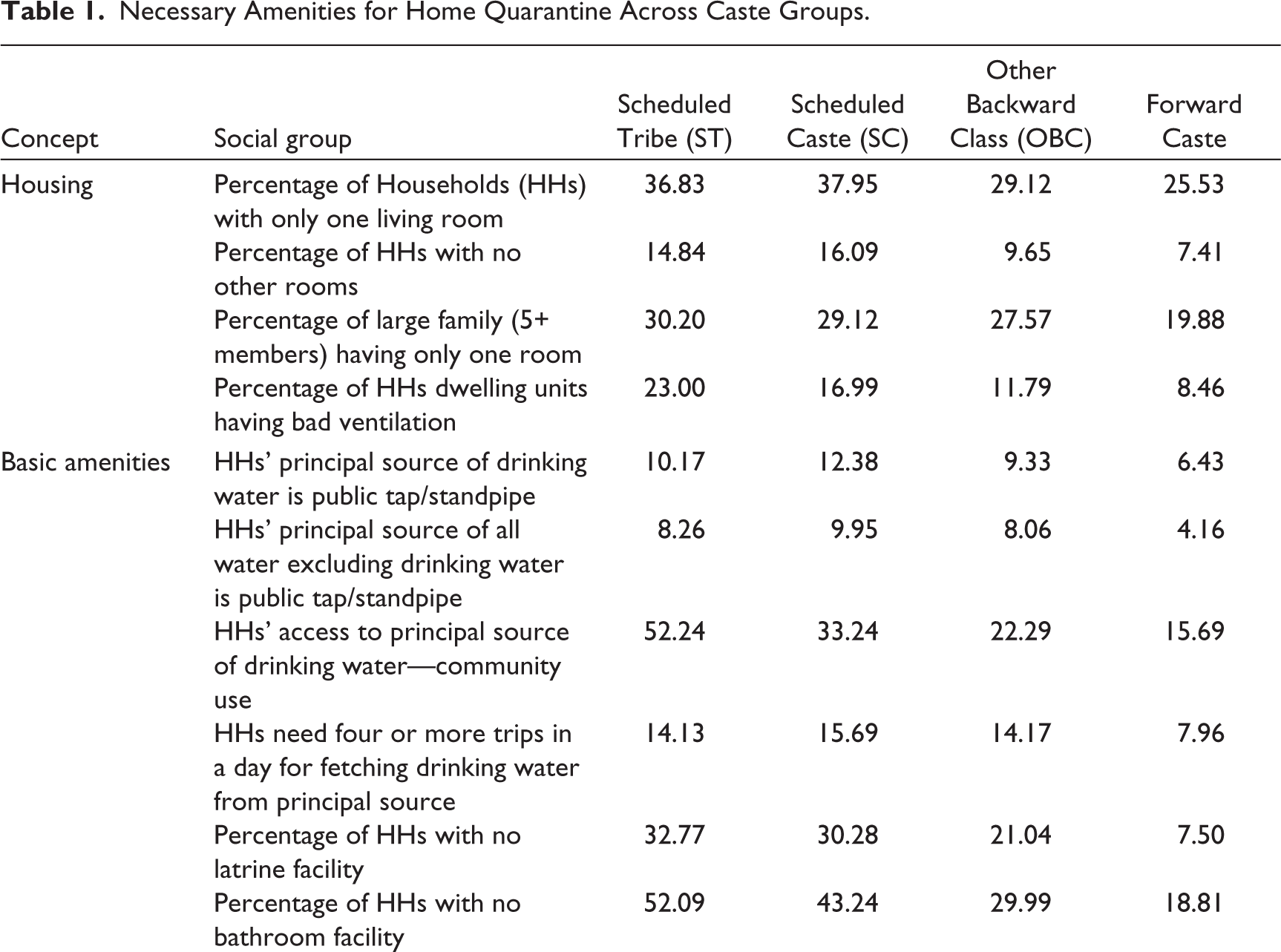
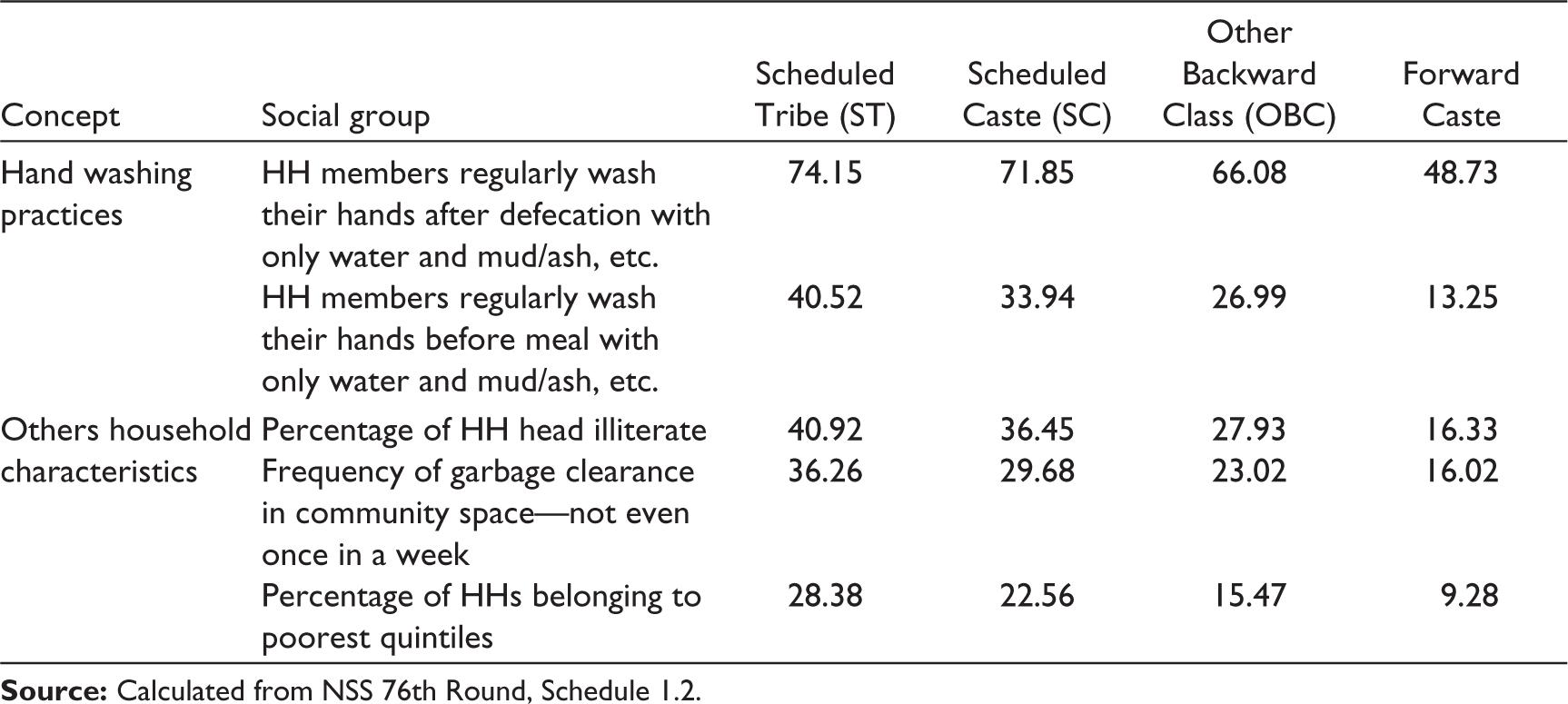
The prescribed guidelines for ‘social distancing’ and ‘home quarantine’ expose the graded caste inequality (Thorat & Madheswaran, 2018) in India. It is evident that different caste groups do not stand horizontally on the same plane to follow the necessary prescriptions of ‘social distancing’ and ‘home quarantine’. The government presumes that everyone has an affordable room, adequate basic amenities, water and sanitation to follow the lockdown procedure and absolute quarantine. It is starkly visible that graded inequality among the Forward caste, Other Backward Classes (OBCs) and SCs persists in housing characteristics, availability and accessibility to basic amenities, household’s hand washing practices and various other households’ characteristics also. In order to maintain the prescriptions of home quarantine, it is essential to allocate a separate room with adequate ventilation. However, it is unfortunate that almost 36.95% of the SC households have one living room only, while 29.12% of them have more than five members living in that single room (Table 1). On the contrary, the rate is low for OBCs followed by the Forward caste in a graded order. Similarly, graded inequality prevails in the households having ventilation facility, where 16.99% of SC households, 11.79% of the OBC households and 8.46% of the Forward caste households have bad ventilation (Table 1). Since the virus is contagious, exclusive access to the drinking water source and the use of separate toilets and bathrooms are recommended. But it is quite conspicuous that a substantial number of SC households depend on the public tap as a principal source of drinking water. Whereas 12.38% of SC households depend on public tap or standpipe for principal source of drinking water, it is 9.33% for the OBC households and 6.43% for the Forward caste households (Table 1). Households’ access to bathroom and latrine facilities is also not uniform across caste groups. The most deplorable thing is that 30.28% of the SC households have no latrine facility, and 43.24% of them do not have any bathroom facility. Frequent hand washing acts as the most effective way to restrain the contagion from further spreading and serves as the first line of defence against the COVID-19 pandemic. As the practice of hand washing with soap is highly correlated with affordability, the inequality tends to rise with the person’s position in the social hierarchy. Since the SC households cannot afford soap or detergent for hand washing, almost 71.85% and 33.94% of SC households use only water and mud or ash for washing hand after defecation and before the meal, respectively (Table 1). The rate of washing hands with mud or ash is low for OBCs, followed by the Forward caste. Along with that, household’s economic condition, garbage clearance in the community space, literacy of the household’s head, etc., are equally crucial for maintaining physical distancing and home quarantine. Unfortunately, a graded inequality across the caste groups also persists in these parameters, and it adds an additional layer of risk for infection to the Dalit households. Given this scenario, it is evident that the Forward caste is the most privileged in maintaining complete isolation and physical distancing as compared to the other caste groups. Thus, the home quarantine turns out to be an unaffordable luxury and inaccessible privilege for Dalits.
Necessary Amenities for Home Quarantine Across Caste Groups.
Caste, Social Inequality and Social Vulnerability
One of the outcomes of any form of social inequality is social vulnerability (Cutter, 1996). Social vulnerability means the differential exposure to a pandemic, the degree of potential loss, propensity to be adversely affected, etc., across various social groups. Pre-existing social inequality can be devastating to the socially vulnerable population when a pandemic hits (Rodríguez, 2008). Social inequality with respect to housing characteristics, basic amenities and wealth possession can make some population subgroups more vulnerable than others (Cutter, 1996). Thus, vulnerability can manifest itself in social stratification. Instead of assuming the impact of pandemic homogeneous to all social groups, there is a need to identify the most vulnerable caste groups in the social spectrum.
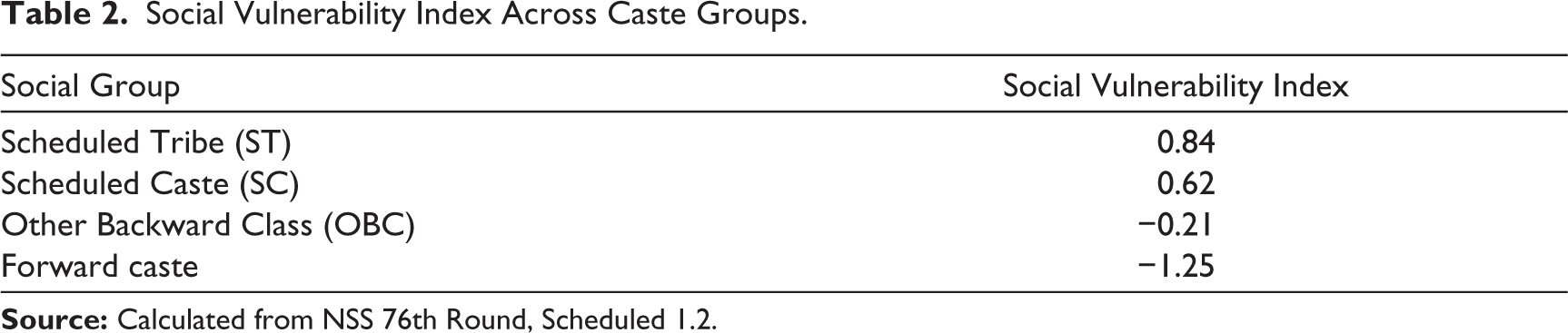
A sophisticated caste-based inquiry might expose further nuances to the impact of the pandemic if the caste-based data on mortality and morbidity of COVID-19 are available. A comprehensive national database on who is getting contaminated, who is getting treatment and who is dying can effectively make our responses robust and equitable. As the caste-wise data on these parameters are not available, it is important to assess—who are the vulnerable population in this pandemic? In order to determine the caste-wise manifestation of social vulnerability, a social vulnerability index 1 across caste groups is constructed with the variables that have been discussed in the earlier section (Table 1). The index is calculated by combining the Z-score of those variables and assigning equal weights to all the variables. The high value of the index bears the imprint of high vulnerability, and vice versa. It is evident that the score of social vulnerability index is highest for SC (0.62), followed by the OBC (−0.21) and the Forward caste (−1.25) (Table 2). Thus, the Forward caste performs better than the OBCs and SCs, the OBC lags behind the Forward caste, but performs better than the SCs, while SCs located at the bottom of the caste hierarchy are worse than both Forward caste and OBCs. It becomes quite clear that Dalits are the most vulnerable group in this pandemic. Thus, this pandemic provides a stark example of the pervasiveness and perniciousness of social inequality in India.
Social Vulnerability Index Across Caste Groups.
Conclusion
Pandemics are known for enabling large-scale social change (Das, 2020). Throughout the recorded history, pandemics have acted as effective levellers by abolishing social and economic inequality (Witte, 2020). Roy (2020) is also sanguine about the prospects of this pandemic and said that ‘it is a portal, a gateway between one world and the next. We can choose to walk through it … or imagine other world’. The empirical evidence of this study brings it to the forefront that Dalits are the most vulnerable during this pandemic. Their vulnerabilities are deeply entrenched into the caste structure of the Hindu social order. This pandemic does not offer them the choice to ‘imagine other world’. Therefore, at least from the perspective of the caste, this pandemic is not going to act as a portal for the Dalits. It is not going to change the caste-based social order and brings a homogenized society. Rather, it is going to reinforce the caste-based social inequality.
Footnotes
Acknowledgements
We would like to express my thanks of gratitude to Debottom Saha (PhD Scholar, IIT Delhi, Delhi, India) and Somdutta Barua (PhD scholar in CSRD, JNU, Delhi, India) for their valuable suggestions and comments during the research.
Declaration of Conflicting Interests
The authors declared no potential conflicts of interest with respect to the research, authorship and/or publication of this article.
Funding
The authors received no financial support for the research, authorship and/or publication of this article.