



Abstract
The caste system in India got transformed as a consequence of the policies of the British Raj. The introduction of the census under the colonial government, among other things, made the most direct impact because for the first time the castes have been enumerated with great details. As a result, castes immediately not only organized themselves but also formed caste associations in order to get their status recorded in the way they thought was honourable to them. Caste associations emerged over the period to pressurize the colonial administration to improve their rank in the census. This process was especially prevalent among the lower castes in different parts of India. Shilpakar Mahashaba was a case in point in Uttarakhand. Shilpakar Mahasabha claimed new advantages from the state like reservations (quotas) in educational institutions and in the civil service. Subsequently, they also became mutual aid structures. Shilpakar Mahasabha founded schools and hostels for the children of Shilpakars and led a sort of co-operative movement. Some have argued that caste associations acted like a collective enterprise with economic, social and political objectives for their caste.
Anthropologists have analysed the caste system as a sacralized social order based on the notion of ritual purity. Therefore, the dominant Brahmanical values have been regarded as universal references by the entire society. M. N. Srinivas, therefore, propounded Sanskritization as the process in which a low Hindu caste, or tribal or other group, changes its customs, ritual, ideology and the way of life in the direction of a high and frequently, twice-born caste. Lower castes may for instance adopt the most s features of the Brahmin lifestyle including diet and therefore emulate vegetarianism (Jaffrelot, 2000, p. 757).
The caste system in India got transformed as a consequence of the policies of the British Raj. The introduction of the census under the colonial government, among other things, made the most direct impact because for the first time the castes have been enumerated with great details. As a result, castes immediately not only organized themselves but also formed caste associations in order to get their status recorded in the way they thought was honourable to them. Caste associations emerged over the period to pressurize the colonial administration to improve their rank in the census. This process was especially prevalent among the lower castes in different parts of India.
Shilpakar Mahashaba was a case in point in Uttarakhand. Shilpakar Mahasabha claimed new advantages from the state like reservations (quotas) in educational institutions and in the civil service. Subsequently, they also became mutual aid structures. Shilpakar Mahasabha founded schools and hostels for the children of Shilpakars and led a sort of co-operative movement. Some have argued that caste associations acted like a collective enterprise with economic, social and political objectives for their caste (Jaffrelot, 2000, p. 758).
Caste associations, in turn, were secularized when the British started to classify castes for usage in colonial administration. These associations claimed new advantages from the state, principally in terms of reservations (quotas) in educational institutions and in the civil service. Caste associations not only played the role of pressure groups, but also that of interest groups. Subsequently, they also became mutual aid structures. They also founded schools as well as hostels for the caste’s children and created co-operative movements (Jaffrelot, 2000, p. 758). Lloyd and Susanne Rudolph have argued that caste associations behaved like a collective enterprise with economic, social and political objectives.
Besides, getting the concessions from the British, the most important social change that these associations have achieved was the unity of the caste groups. Caste associations have successfully motivated the sub-castes to adopt the same name in the Census in order to break the barriers of endogamy. The subjective representation of the collective self-played a crucial role in this transformation apart from intermarriages. Caste is basically a mind-set and a belief system. People who live in such a society have internalized a hierarchical pattern relying on the degree or ritual purity. Therefore, the primary objective of ethnicization of caste meant to provide alternative non-hierarchical social imaginaries. Since ethnicization process provides an egalitarian alternative identity to the lower castes, this became a key issue as far as the emancipator potential of the low caste movements is concerned. For efficiently questioning social hierarchies, therefore, the ethnicization of low castes, must imply the invention of a separate, cultural identity and more particularly a collective history (Jaffrelot, 2000, p. 758).
In India there has been a long tradition of intellectual reconstruction of Dalit identity. Phule, Periyar and Ambedkar contributed in their own way for this process. During medieval time, Bhakti movement questioned caste hierarchy, restrictions in places of worship. This is the reason why Bhakti movement became popular among Shudra and lower castes. Identity construction among Dalits got evolved historically over the period. Bhakti saints opposed caste distinctions and asserted equality before God. Many lower castes and Dalits constructed an identity which was against the Brahmanical one. After Bhakti movement, ‘Adi’ movements played an important role in the formation of Dalit identity. In the 1920s and 1930s mobilization of lower castes took place under varying leadership with different ideologies. Adi movements objective was to bring the original inhabitants argument to the fore as Adi meant original inhabitant. Adi dharma in Punjab, Adi Hindu in Uttar Pradesh and Hyderabad, Adi Dravida in Tamil Nadu, Adi-Andhra in Madras Presidency and Adi-Karnataka speak of the determination of the lower castes to assert equality in the society.
In the same way, caste system in Uttarakhand is different in the sense that the society was not divided into the four-fold varna system as was thought earlier but it was only three-fold stratification. The social structure of Kumaon and Garhwal roughly divided into three broad class: Brahmins, Khasiyas (Rajputs) and Doms (Shilpakars). Doms in Uttarakhand were numerically the largest group of different castes. There are no similarities between Doms in Hills and the Doms of plains of Uttar Pradesh. But most of the time, it was assumed that Doms in Hills and Plains are the same. Besides, some artisan communities among Doms emerged powerful economically and wanted to differentiate themselves from the Doms.
During the pre-colonial period, Doms were not allowed to have permanent houses. They were also not permitted to enter temples, ghats and use public wells. Nor were they allowed to wear sacred thread, use dola palki for marriage processions (Oakely, 1905, pp. 42-43). Usually upper castes had been using dola palki during wedding processions and this continued during colonial period also. Muslims and converted Christians also used dola palki for their wedding ceremonies. However, Shilpakars (earlier Doms) were not allowed to use this practice. But when Shilpakars wanted to celebrate their weddings with dola palki after their purification by Arya Samaj, the Bith did not like it.
Local industries declined during colonial period and rendered some artisanal groups redundant. But some of them moved to new locations in urban areas. Doms formed a large section of the village community in mining villages. In these kind of villages they enjoyed a reasonable amount of autonomy. Miners are not necessarily tied to the upper castes in the villages where upper castes also lived (Pande, 2013, p. 69). During colonial period, some of the Doms found very remunerative occupation in road making and some of them became wealthy and cultivators.
In the nineteenth century, the work of mining, smelting and production of iron and copper suffered, and indigenous metals were replaced by iron and copper sheets from England. However, the making of agricultural implements from these sheets continued. Therefore, Tamtas were not displaced but their occupation continued without interruption. In addition, they could diversify into trade and other related activities and by the early years of the twentieth century, Tamtas of Almora not only became rich but also influential. During the nineteenth century, monetization of the economy and the demand for labour services improved the position of artisanal groups and of agricultural labour. Construction of public works, roads and government buildings required skilled labour. This provided very lucrative positions to artisanal sections of the Doms (Pande, 2013, p.74)
Doms therefore, got economic advantage which was not commensurate with their social standing. With increase of wealth, it was natural that some of the Dom sub-castes wanted to improve social status. Therefore, there was conscious movement by some sub-castes of Doms for equality with other upper castes. This could be seen mostly in urban centres such as Almora, Ranikhet and Nainital where members of the Tamta, Lwar and Orh-Raj-Mistri occupational groups had come to be concentrated in large numbers. It happened in these urban centres only because of the great demand for their specialized services. Some Doms joined Arya Samaj and started following the doctrine of it. Doms who joined Arya Samaj started calling themselves as Arya (Sebring, 1972, p. 588). However, the dream of Doms to gain respect through Arya Samaj did not yield much fruit as Arya Samaj itself could not overcome caste perceptions in everyday practice.
With the arrival of the British, education also entered the hills. A number of schools were established in Kumaon province. Doms took advantage of educational opportunities. Hari Prashad Tamta, was an envisioned leader of the Shilpakar community. He opined that without education, the community cannot be empowered. Therefore, first of all, Krishna Day School for children, Krishna Night School for adult education were opened in Rajpura Almora. After 1932, the number of schools being run by the Shilpakar Sabha, were grew very fast. The department of Depressed Class Education, which was opened by the government, was giving help in the work of Shilpakar Sabha. But unfortunately, Shilpakars did not evince interest in sending their children to the schools.
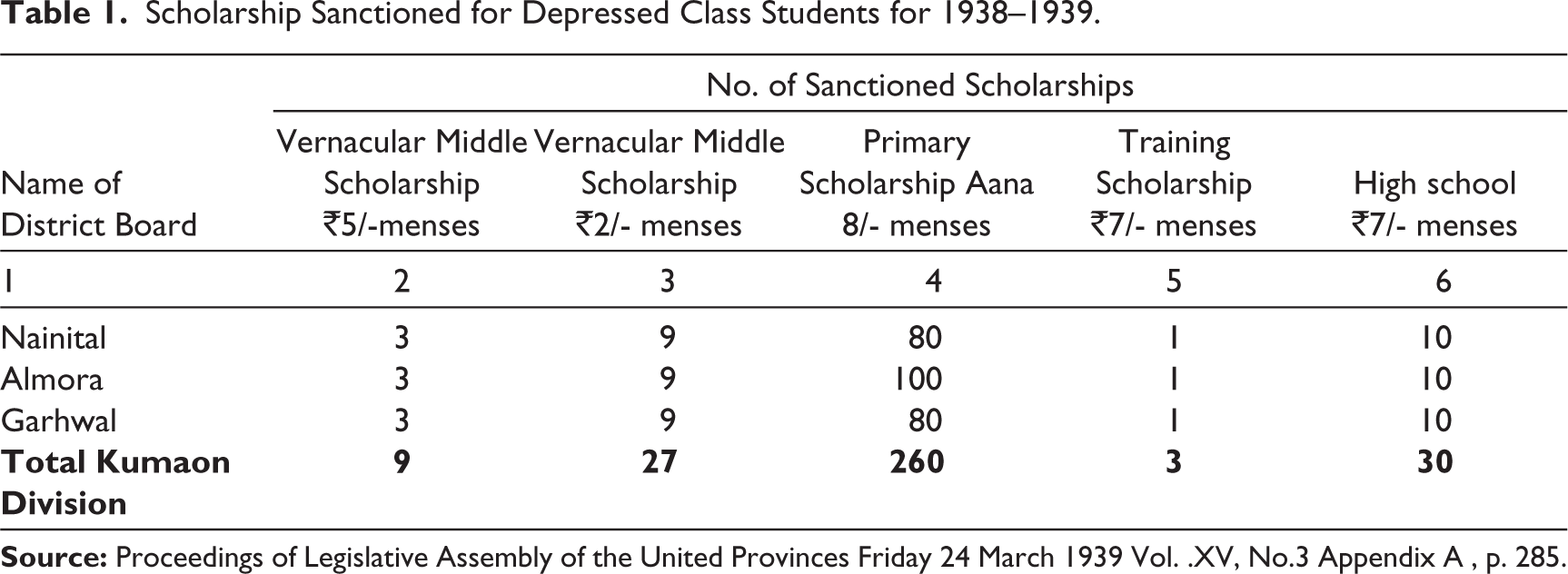
In order to encourage students, in 1932, government announced scholarships for the Shilpakar students studying in English schools. The rates for these scholarships were ₹7 per month for a period of five years, for vernacular middle schools, ₹5 per month for a period of three years and for the students of training schools ₹7 per month (Government Order issued in 1932, No. 1215–1092.). Again in 1932, with the object of safeguarding of interest of Shilpakars, two scholarships were granted, by the government. These scholarships were of two kinds: (a) Ordinary scholarship for help ₹3 to ₹15 per month; (b) Scholarship for training of artisanship, ₹7 to 25 per month. These two schools of training were government carpentry school Nainital and District Board carpentry school Almora (File no. 234/1937, p. 9).
There were discussions on the issue of education in the state assembly. In the Budget Session of Assembly 1937–1938 Ram Prashad Tamta drew the attention of house regarding progress in education and its expansion and scholarships for Shilpakar boys and girls (Viyogi & Ansari, 2010, p. 530). He argued, ‘there is a great hindrance in spreading up of education even up to the secondary and high school standard among the boys of untouchables. I simply want to tell that no sincere efforts have been made by the government up to this time. But I hope fully that in the duration of this government much stress will be laid down on this issue. Scholarships which are sanctioned by the government are insufficient. In every district there are only two scholarships for the untouchable students. These scholarships are being granted only to those students who take at admission in high school after passing middle. In addition to these eight scholarships of ₹2 to ₹5 are being given in each circle’. Table 1 gives the details of scholarships granted for depressed class students for the year 1938–1939.
Scholarship Sanctioned for Depressed Class Students for 1938–1939.
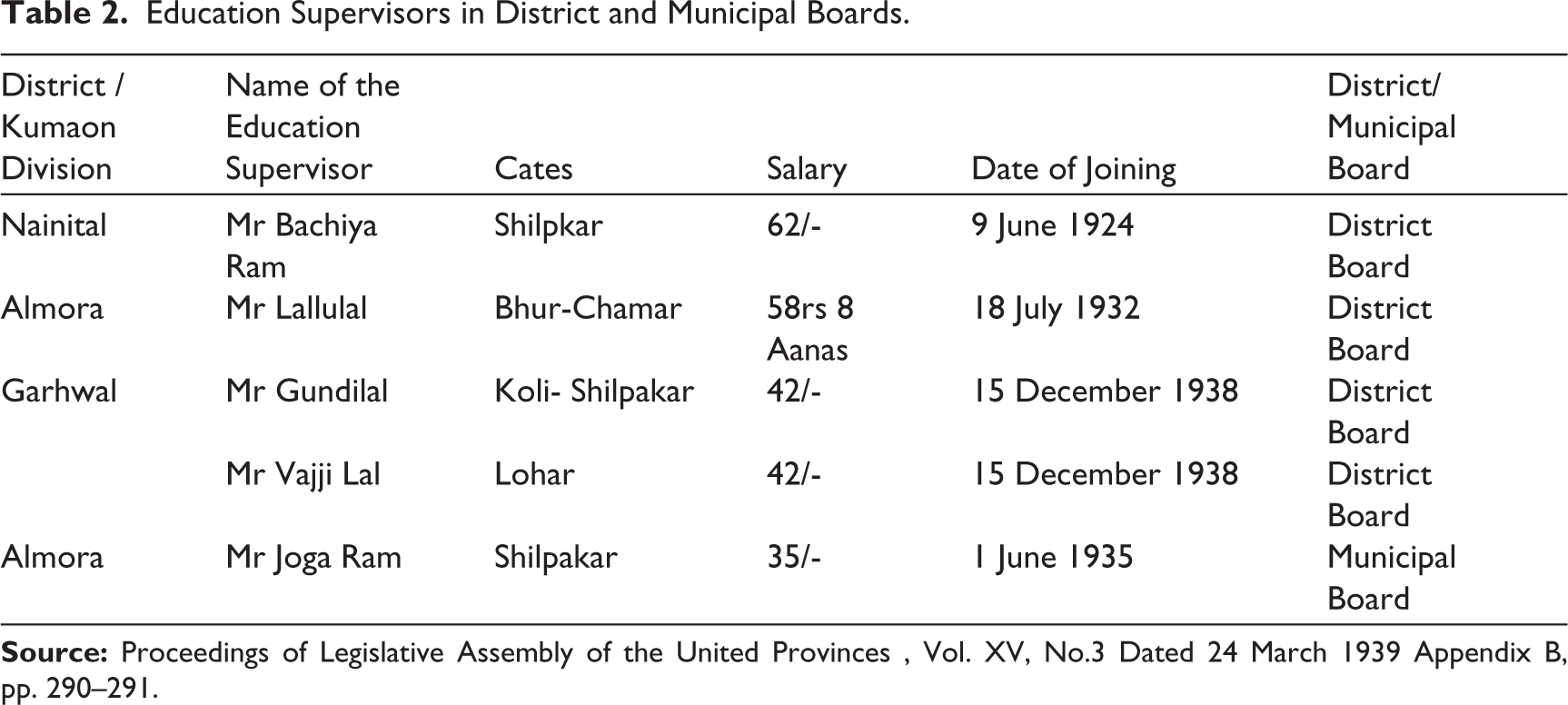
Education Supervisors in District and Municipal Boards.
Establishment of Special Schools for the Depressed Classes
In order to encourage education among the depressed classes, the British started special schools for them. Experiments were always taking place in the field of primary education in the united provinces. Though there was very little demand among the lower caste Hindus for the kind of education given in vernacular schools, the primary schools for the depressed class in many districts were started in 1910. In the beginning, certain difficulties such as providing teachers for such schools non-cooperation on the part of the higher classes and want of interest and the part of the depressed class parents were encountered. In Gorakhpur, for example the Domes were said to be much opposed in the higher education for their children, but the schools were started as an experimental measure (Srivastava, 1979, p.31). However in the Agra district the depressed class showed little enthusiasm for education of their children. The reason was that their children could earn something by working in day time but if they joined the schools, they were not in a position to earn at all. Gradually it was experienced that the prejudice against the depressed class was disappearing. In 1912 in Dehradun the schools were run by the Arya Samaj. There were about 150 boys in three schools (General Report, 1919, p. 12).
On the recommendations of the Board of education in 1919–1920, the experiment of appointing supervisors of schools of depressed classes was made in the districts of Meerut, Banaras, and Jaunpur. The financial aid to cover the cost of education was given by the Provincial Government. The results of this experiment were so encouraging that all Districts Boards were invited to continue it. (Srivastava, 1979, p. 32).Like in other districts of United provinces, Mahasabha demanded that supervisors of Shilpakar community be appointed to supervise education in depressed schools both at District and Municipal levels. ( Shakti,1925). Colonial government acceded the demand of shilpkars and appointed shilpkar supervisors.
A scheme of opening special schools for depressed classes was outlined in the government Resolution No 1231/ XV, dated 23 May 1921. In that year grants amounting to ₹78,920 recurring and ₹7,350 non-recurring were sanctioned to the district boards for this purpose. A scheme of further expansion was undertaken in 1922–1923, when additional grants of ₹15,000 recurring and ₹2,970 non-recurring were given.
In 1932–1933 there were 757 special schools for depressed classes with an enrolment of 18,443 depressed class boys (Srivastava, 1979, p. 32). The Hartog Committee examined, in detail, the problems of depressed class education. It was of opinion that these special schools had proved very expensive and these should be abolished and replaced by mixed Primary schools which were economical. Mr Weir also concurred with the views of the Hartog Committee and recommended the establishment of ordinary Boards schools rather than the creation of schools ignominiously called ‘depressed class schools’. He further suggested the amalgamation of budget under the head ‘depressed class education’ to the head of ‘ordinary primary schools’ and the saving arising from this could be spent on awarding scholarships to the depressed class boys (General Report, 1938, p. 55).
Education for the depressed classes was definitely in progress but the pace of progress was slow. But economic condition of the parents was responsible for this slow progress. During 1937–1938, all the district of the united provinces had a supervisor, 30 under district board services and 18 in non-pensionable government services. All the latter and 23 of the former belonged to the scheduled castes themselves, two to the backward classes and the remaining five to other castes.
The Provincial Depressed Class Educational Committee constituted in 1941 was instrumental in stimulating the demand of education among the depressed class community. With the object of increasing the proportion of teachers belonging to the depressed classes, it was obligatory on every district to depute one such candidate to a normal school. Districts had to depute two teachers to a central training school or training class every year. A few candidates to receive training were also deputed by the district and municipal boards. The result was the percentage of trained teachers in district board schools increased from 1% to 2% during 1941–1942. Three stipends were also devised for students of these classes in each of the government training colleges. Reservations were also made for depressed class candidates in the appointment to the education department of the governments. During 1942–1943, depressed class students were helped with their examinations fees to the extent of ₹800. In 1943, the number of scholarships for scheduled castes showed considerable increase. The scholarships were given at the monthly rates of ₹16 in Intermediate classes, ₹7 in High School stage, ₹5 in class VII and VIII, ₹4 in V and VI and ₹3 in III and IV, in all Anglo Vernacular Instruction and ₹3 in the vernacular middle schools.
In 1941, Powell Price, director of public instruction wrote to the deputy secretary to the Government of United Provinces that approval may be granted to the Municipal Boards to award vacant depressed classes stipend to classes 1 and 2 if necessary. Because some of the Municipal Boards have no full primary schools with class III and IV and were compelled to leave the stipends for the want of students of depressed classes. Director of the public instruction felt it was reasonable and requested the government to accept this proposal from 1 July 1941 (File, 328/ August 1941). Permission to municipal boards to award vacant depressed class stipend of classes III to IV of primary schools to stipend of classes I or II. A. M. Sapru, secretary wrote to the deputy commissioner in charge of Kumaon division that a recurring grant of ₹650 was sanctioned towards half of the cost of remitting tuition fees for depressed class students in the district board schools in the district (File No. 330, A. M. Sapru, Secretary to the Deputy commissioner Kumaon division, 1942).
Again, the director of public institutions, United Provinces wrote to the Secretary, on 29 January 1945 that the depressed class students both boys and girls reading in the government Anglo vernacular institutions, who are exempted from the payment of tuition fees shall also be exempted from the payment of games and medical fees (File no. 313, 1944 and No. D/7005 29 January 1945). On 10 May 1944, the director proposed that government should bear recreation and medical fees. If government has to bear this, it will come to ₹1,298 and ₹414 per annum respectively. He, therefore, recommended that government may kindly make a provision of ₹1,820 to meet this expenditure (Director of Public Instruction to the Secretary, Government of United Provinces, No.D.403/XXXIII, 13 dated 10 May, 1944).
Opening of Night Schools
With the objective of providing opportunities of elementary education to the adults the United Provinces Government, in May 1921, offered funds to the Municipal Boards of Lucknow, Kanpur, Agra, Meerut, Banaras and Bareilly for the development of Night Schools. Local Boards were expected to establish such free schools in places where a minimum attendance of 20 students could be assured. Night Schools were held in the buildings of the day schools. They maintained proper register for attendance and accounts which were open for inspection. No boy under the age of 12 was permitted to attend the Night School. Besides, only those boys were admitted in such schools who were not in attendance at the day school. The instruction was confined to reading, writing and arithmetic (General Report, 1927, pp. 80–81; Kichlu Report, pp.36–37).
The basic consideration for opening night schools was that since the occupation of villagers was agriculture, they were disinclined to send their children to the day schools but they had no objection in taking advantage of night schools, provided it was not very far from their houses. Night schools mostly run by board schools teachers. For teaching in night schools, these teachers were given additional remuneration of ₹5 per month and continent allowance of ₹2/- per month of oil and so on.
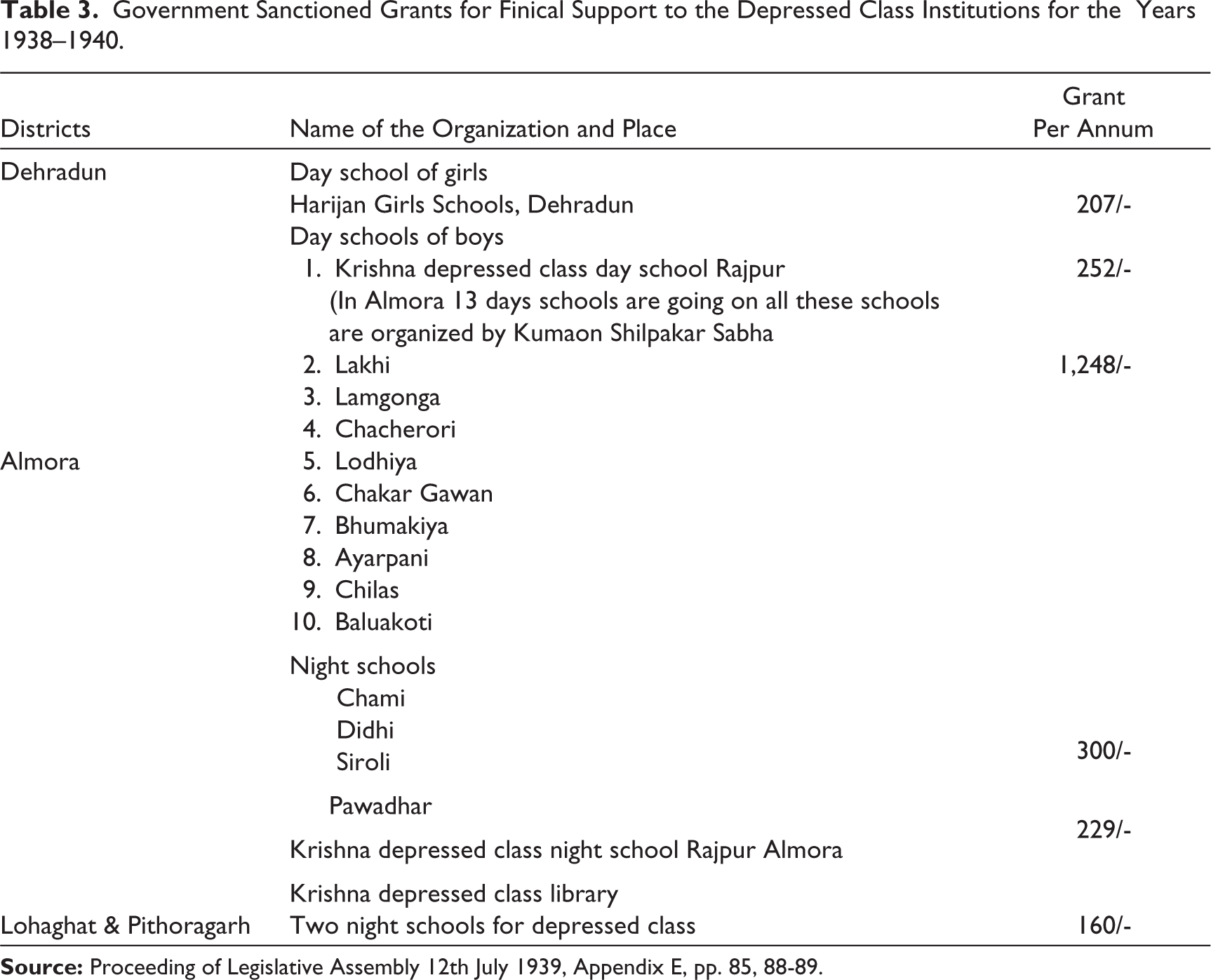
The United Provinces Government sanctioned grants to the night schools run by different bodies. In 1935–1936, it sanctioned a recurring grant of ₹272/- to Kumaon Shilpakar Sabha Night school, Rajpur and ₹196/- to Kumaon Shilpakar Sabha, Depressed Class Library, Rajpur (File No. 1209/1933). Budget provision for the education of depressed classes of united provinces had been provided. In the year 1935–1936, ₹1200/- were sanctioned to the local bodies and associations from ₹75,000 allotted budget.
Mr Panna Lal, advisor to the Government of United provinces held a conference on 15 April 1944, with the representative of scheduled castes and certain officers of the education department. The main agenda of the meeting was to consider how the difficulties faced by depressed class students to get admission in the Government Anglo vernacular educational institutions in the provinces. Nearly nine representatives both from depressed class communities and officers attended including Rai Bahadur Munshi Hari Prasad Tamta from Almora.
While discussing the government’s determination to remove handicaps of the students of the depressed classes for their education, the conference after a long deliberation, made the following recommendations to the government:
For every six new admission made, one seat should be reserved for the depressed classes provided that a minimum of one seat is always reserved and fraction of half and more should be treated as one and fraction less than half as nil. These vacancies should be kept open for one week after the beginning of the annual session and if the number of applications from the depressed classes is insufficient to fill these vacancies, they may be thrown open to others after the expiry of the period of one week. If any student of the depressed class unfortunately fails to secure admission, their cases should be brought immediately to the notice of the Inspector of schools who may be instructed to pass orders regarding the admission (File No. 313, Information Department, United Provinces, 17 April 1944). No difficulty has been felt among students of depressed classes for securing admission to hostels attached to schools. But in order to remove any possible misunderstanding it was thought desirable that 1/6th vacancies in government hostel be reserved for student of the depressed class similar to as in the case of new admission to classes in the schools. There are three hostels one each in Meerut, Allahabad and Agra for depressed class students. The entire expenses of the hostel are borne by the government. It was urged that the grants to these hostels under the present conditions are inadequate. The special officers for depressed classes will examine the matter and if necessary, recommend that the grants be increased.
Shilpakar Mahasabha
With Western education and betterment of economic conditions, Doms wanted social recognition. But unfortunately, they were not able to get the recognition which they aspired under Arya Samaj, therefore, they gradually wanted to achieve it under their own leadership. Their main idea was to fight for equality and honour and compete with the upper castes (Sanwal, 1976, p. 176). Tamtas took the leadership in transforming artisanal castes. Hari Parasad Tamta provided what Weber called charismatic leadership of Doms. Tamtas efforts at acquiring political and ritual leadership of the Dom and giving them political identity and unity also go back to the beginning of the present century. Shilpkar Mahasabha conducted various Conventions for the upliftment of their community. In one of the conventions which was held in 1925 demanded among other things, sanction of grant to depressed and Scholarships to the shilpkar students (Shakti, 1925). The Government accepted the demands of Mahasabha. Table 3 illustrates the same. The emergence of a formal political leadership as well as a priesthood was crucial in giving Shilpakar both identity and social and economic power during colonial period.
Government Sanctioned Grants for Finical Support to the Depressed Class Institutions for the Years 1938–1940.
However, there was no institutionalized system of status enhancement among Doms as per their economic improvement. Doms were still referred to as Doms during early part of colonial period also. It was argued that the biggest obstacle to status improvement was the absence of any kind of social organization (Pande, 2013, p. 74). Therefore, Tamtas have set up a society of coppersmiths called Tamta Sudhar Sabha in 1905. The same gradually developed into Shilpakar Sabha. Doms faced discrimination even after education entered the Hills. As early as in 1911 in Almora, there was a function to celebrate the coronation of Goerge V. In this function Doms were not allowed to participate. Hari Prasad Tamta, who was to emerge one of the strong leaders of Shilpakars remarked that Hari Prasad Tamta wrote in 1935 regarding this incident saying, in 1911, in the ceremony commemorating the coronation of George V, myself and my brothers were not allowed to participate. I am extremely grateful to them because their action awakened me from slumber. Precisely due to such talks, I took it to my heart that I should elevate my brethren to such a height that others may not look down upon them, but rather treat them at par’.
Construction of Shilpakar Identity Through Census
Dalits have tried on their own both individually and collectively to achieve identity or identities of their choice through various channels during various periods of history. Ambedkar has stated that the Chamars of north India call themselves as Ravidas or Jatavas, the Chakkiliyars as Arundhatiyars, the Mahars as Chokhamela or Somavamshi and the Bhangis as Balmikis. In south, most of the Dalit communities tried to construct the identity of Adi (sons of the soil concept).
The perception of the upper castes towards Doms had been discussed earlier. How social, economical and political structures tried to suppress Doms has also been explained. With the enlightenment which came through education, some of the artisanal communities from Dom wanted to change their identity. Previous identity which was constructed by the upper castes, which was of low, contempt, negative and impure, need to be changed. Efforts towards this started during the first half of twentieth century.
In a representation, dated 27 July 1920, the secretary of Shilpakar Sudharak Sabha of Kumaon mentioned the following:
That the Shilpakar Sudharak Sabha has been established since 1913 in village Sunkia, patti Agra, District Nainital with the object of ameliorating and elevating the social condition of the depressed classes of Kumaon and to make proper arrangements for their education . The Sabha has since made a great progress and has enlisted more than a thousand men belonging to the depressed classes as its members. It is to be said with a sense of gratitude to the benign government that they have helped the Sabha in a great way to remove the obstacles thrown in the way of the Sabha by the conservative sects of the Hindu community. The members have given up their old bad habits and now being awakened to the sense of their status / realize with regret their low position in the society and the estimation in which they are held by the higher Hindu castes. The English translation of the general rules of the Sabha is attached herewith. That the depressed classes of the hills have been called ‘Doms’ for the last few decades and have been so recorded in the government papers . The term is now understood in the light of extreme hatred and the people so called are hated and not allowed to touch higher classes who have assumed an unsympathetic attitude towards them. The Sabha has now found out that the said term has not been used for depressed classes in Mr Backet’s settlement papers or in other government records prior to this time. They were only designated in accordance with the vocation which they pursued as ‘Lohar’, Mistri and so forth. It is only in Pt. Dharma Nand’s settlements papers that the term is found. That since census operations have been started the Sabha deems it necessary to pray to the government that the depressed classes of the Hills be not designated with the term ‘Dom’ as has hitherto been done but according to the nature of the work which they do, as ‘Lohar’, ‘Mastri’, ‘Kshtkar’ and so forth or preferably, they should be designated with the general term Shilpakar (artisan) with which they are now generally called and referred to in the Hindi papers. That the Sabha therefore humbly prays that their position be duly considered they be not designated as ‘Dom’ in the Census paper and also in the government papers. Considering that the ‘Souns’, ‘ Nayaks’ and ‘Sunars’ hitherto considered as belonging to low castes have now been designated as ‘Kshatrees’ only meet to Brahmans, it is most humbly submitted that the ideas associated with the term ‘Dom’ will be likewise removed if the term ‘Shilpakar’ be used in connection with the depressed classes.
1
H. K. Gracey, Commissioner order, dated 26 July 1920, forwarded the petition to the superintendent of census operations. He also opined that it was clear the term ‘Dom’ as applied in the hills is a different word to the ‘Dom’ used in places like Gorakhpur. The question distinguishing the above to whom it is applies here elsewhere deserves consideration. Office of superintendent, census operations, Uttar Pradesh, dated 20 July, Nainital, wrote to Mr B. Khusi Ram, Secretary, Shilpakar Sudharak Sabha, Sunika, Ramnagar, Nainital, saying that he was glad to receive the letter and requested either Khusi Ram or any member of his organization who was well acquainted with the subdivision of the community and who would be able to assist him in the classification of that community the census report. As a result of these efforts by the community, Shilpakar category was introduced in 1931 census. Not only that Shilpakars were categorized into different groups depending on the profession they were following.
As a consequence, E. H. H. Edye, during enumeration for the 1920 census, noted that he had been advised not to use the term Dom in census. Because Doms were divided into a number of sub castes and Dom was only a general name given to all of them (Crooke, 2005, p. 31; Pande, 2013, p. 66; Singh, 1991, p. 1189). H.G. Walton mentioned that Doms called themselves as Tallijati (low caste) or Baharjati (Out caste) (Walton, 1911, p. 96). Although he came across 204 sub castes, he listed 30 authenticated sub-castes among them (Edye, 1923, pp. 21–22). Edye opined that Doms sub castes are not true sub castes but he thought only occupational sub castes are real sub castes of a caste. This is not a correct formulation of a sub caste in Indian society. In 1921 census, there were 31 sub castes and in his report E.H.H. Edye divided them into 5 groups. The most general rule seems to be that there is intermarriage between groups I and II while the members of groups III, IV and V intermarry indifferently within their several groups (Census, 1921, p. 21). which grew to 51 sub castes by 1931 census (Census, 1931, p. 554).
Shilpakar Mahasabha arranged craftsman teacher conference. This first conference of artisan teachers of district Almora was held in Narasimhbari Almora under the chairmanship of Shri Bal Krishna Patwari ji on 9th January. Artisan teachers of adult night schools from all around the district were present on the occasion. The following proposals were unanimously passed: (a) This convention of craftsmen teachers requests the higher officials of the Education Department that the schools which are open on behalf of the Kumaon Craftsmen Assembly, have to suffer a lot due to lack of buildings, so at least ₹500 per school should be provided for building and adequate furniture should be given. (b) This conference of teachers heartily welcomes the Kumaon Craftsman’s Circular in which we have made some demands regarding the organization of Volunteers. This conference is ready to extend its full support to this organization. (c) This convention urges the Education Committee to pay the teachers of Dharma, Sanskrit according to grade. Teachers residing in Lohaghat should be appointed into the schools of Lohaghat and there is no depressed school in the Salt Kalkas area so a school should be opened. (d) This convention pleads with the Education Department to waive off the education fees of the children for saving thousands of poor children from being illiterate. (e) This convention is dedicated to our heart emperor Rai Sahib Hari Prasad Tamta and Shri Ram Prasad Tamta and pays heartfelt tribute to the MLAs for their tireless hard work and leadership. (f) It was decided that copies of these proposals should be sent to the concerned officials. 2
Hari Prasad continued his efforts to improve the conditions of Shilpakars. In an address to Uttar Pradesh Depressed League he exhorted them, ‘The education conference which was held in Bareilly, its key points should be implemented soon. I would request my brothers to raise their voices and remind the government that it just began to perform the respective duties towards us and there is a long way to go. Government jobs should be offered to us. Our brothers should be employed in all the civil, military and public attractions. Education should be promoted within us and there should be a lot of stipends for the training of our promising youth. Such masters should be appointed who can go to our colonies and operate night schools to propagate education within us. Patrol librarians and patrol schools should be arranged for the training of our people.’ 3
Petition to Keep Them Under Depressed Classes
However, when there are attempts to delete them from depressed category, the community resisted and requested the government to keep them under depressed class so that community could get educational and employment opportunities. In a representation, in November, 1934, to His Excellency, the Governor United provinces, Shilpakars in Kumaon Division categorically expressed their apprehension that there were efforts by some vested groups to deprive them of the benefits they were receiving as depressed classes by including them among higher castes. The petition reads:
We the humble servants of your Excellency bring to your kind notice the grievance of the Shilpkar in kumaun regarding our classification in future elections. We understand that there is a move by some interested parties to classify us as Aryasamajists and not as depressed classes in Kumaon have begun to put on the sacred thread they have become touchable and therefore not depressed classed . This, your Excellency is misleading and at deliberate move to cause us harm. We have by putting on the sacred thread begun to call ourselves Arya Shilpkar (artisans), but all the same we remain a depressed class and entitled to be classification as such. We are given to understand that government will treat us as ordinary Hindus- Arya Samajists and consequently no number of this community will ever derive the privileges which the benign Government has extended or is going to extend for depressed classes. We the humble servant of your Excellency most respectfully submit that we put on the sacred thread in order to induce sanitary habits amongst the depressed classed and to improve the general conditions. On the other hand our humble petitioners are hated and considered as untouchable and there has been a great social conflict and Ill feeling with higher classes. Besides being regarded as Untouchables in the Kumaun Division, Most of your humble petitioners have no property of their own and depend upon their manual labour and are in very poor condition. As regards Social status, poverty and all other things, there is absolutely no difference between us and other depressed classes, whether of the plains or of the hills. Your humble petitioners were known as Doms only a decade ago and are still called as such by the higher classes. It was the result of some agitation by us that we were afterwards entered in the census as ‘Arya Shilpkar’ and ‘Shilpkar’. To consider us as Arya Samajists and among the higher classes is a mistake and a great hardship on your humble petitioners, who will thus lose their rights to be represented in the local bodies and to derive the benefit of any grant of land or scholarships etc. reserved for the depressed classes. We may also bring to your notice that it has wrongly been represented to you that the member of depressed classes (Shilpkar), who put on sacred thread is a few thousands. But the truth is that we are about half the total depressed class population of Kumaun and this clean habit, which the benign Government means to encourage, is spreading by leaps and bounds. If the sacred thread wearing depressed classes are excluded from the beneficial measure of the Government then the social uplift of the depressed classes will be seriously set back. We may further mention that we, sacred thread wearing, depressed people have nothing whatsoever to do with the Arya Samajists or their institutions. Your humble petitioners, therefore, most humbly pray that the right of your humble Petitioners to be represented in the legislative and local bodies of the country as depressed classes be not thrown out because we wear the sacred thread.
4
Thus, some artisanal groups within Doms, after getting education, got enlightened and strived to achieve self-respect and equality. The presence of colonial government which did not go by the traditions but by rule of law also helped in the process. It was not cake walk for Shilpakars to get this status. They had to struggle hard to achieve this status. Arya Samaj in the beginning wanted social mobility of Doms. But their efforts seem to have been generated more by their fears of Doms getting converted to Christianity than by genuine efforts to really change the status of Doms. Even after purifications ceremonies and wearing Janeo, they were not allowed to use dola palki in marriage processions of Shilpakar. This seems to have prompted leaders like Munshi Hari Prasad Tamta to raise the economic status by way of education, employment and demand for grant of land both for cultivation and for residences. Shilpakar Mahasabha became a platform and a caste association to demand and get concession and various benefits from the colonial government in the interest of Shilpakars.
Footnotes
Acknowledgements
I want to express my sincere thanks to Professor S. Victor Babu, Head and Registrar of Babasaheb Bhimrao Ambedkar University, Lucknow for going through my draft and for his critical comments and suggestions.
Declaration of Conflicting Interests
The author declares that there is no potential conflict of interest with respect to the research, authorship and/or publication of this article.
Funding
The author received no financial support for the research, authorship and/or publication of this article.