



Abstract
This article explores the relationship between overall and categorised migration policies and both documented and undocumented migration flows in Malaysia. It introduces and empirically deploys quantitative policy indicators to estimate the impact of policy changes on migrant inflows. Tightening of migration policies overall—especially border and integration policies—increases rather than reduces immigration, principally through undocumented migration. The gap between policy intent and migration outcomes suggests that Malaysia would benefit from policies that make formal migration more attractive. The article advances understanding of migration policy influence while offering a methodology for analysing iterative policy changes that could be replicated elsewhere.
Introduction
Malaysia is a young country with a population substantively shaped by historical and contemporary migration. Malaysia has an ethnically diverse citizenry and a substantial documented and undocumented non-citizen population—although the population share of persons who are not ‘Malay’ or bumiputera has fallen since independence in 1957, according to official statistics.
Migration policymaking in post-colonial Malaysia has faced considerable challenges, navigating fractious identity politics, balancing economic and social objectives, and managing migrants operating within and beyond the law. A fast-expanding foreign (and local) workforce has been a consistent feature of Malaysia’s rapid economic development since the late 1980s, complementing openness to international trade and investment but complicating pre-existing fault lines surrounding ethnic discrimination. The politics of ethnicity and identity has, and continues to, constrain migration policy options and effectiveness—though understanding how policy influences migration patterns remains largely based on anecdote.
This article seeks to deepen the understanding of migration policy influence on migration inflows into Malaysia, empirically. It does so by advancing a set of purpose-developed quantitative policy indicators, capturing the richness and variety of Malaysia’s migration policy journey from 1957 to 2020. The historical case study approach allows for close examination of iterative policy changes without requiring normative judgments about universally ‘optimal’ policy features. The article estimates the effect of overall migration policies, policies specific to low or unskilled workers, and individual policy types, including legal entry, integration and border control.
Estimates using vector error correction (VEC) models indicate policy tightening has marginally increased migrant inflows, contrary to policymakers’ stated goal to reduce them. Tightening border control and integration policies drive this result by prompting category shifting—from documented to undocumented—as opportunities and incentives to enter and stay legally are curtailed and informal arrangements become more sophisticated and normalised. Policy tightening—especially legal entry—does reduce documented migration, but by less than it increases undocumented migration. Together with evidence that increased migration in turn prompts further policy tightening, Malaysia appears caught in a vicious cycle and would benefit from considering alternative approaches.
The next section situates the article’s empirical investigation by outlining Malaysia’s migration and migration policy history and global examinations of policy influence. The following section details the quantitative policy indicators and the broader data set and methodology used to produce estimates of policy influence. The remaining sections present and discuss the main results and offer concluding thoughts.
Literature and Background
Migration Policies and Flows in Malaysia
Home to a major historical and contemporary shipping passage, Malaysia has long been an entrepôt for movements of goods and people. Malaya (Peninsula, Malaysia and Singapore) had the highest immigration rate in the world from 1881 to 1939, absorbing many times more migrants than widely recognised ‘settler countries’ like Australia and the USA (Reid, 2010). While most migration was temporary, at independence (1957), ‘non-Malay’ or ‘non-bumiputera’ residents represented about half of Malaysia’s population (Economic History Malaysia, 2024)—and they still represent around 35% in 2022 (according to official statistics, though a substantial undocumented foreign population implies a considerably higher share; Figure 1).
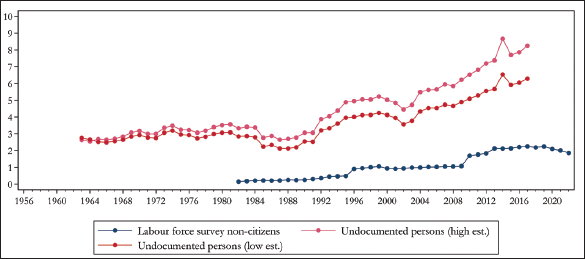
The scale of colonial migration and associations with economic and social divisions have cast a long shadow over Malaysia’s political and policy landscape. Contention surrounding the citizenship status and rights of former migrants and their descendants (who are still identified as ‘Malaysian Chinese’ and ‘Malaysian Indians’) constrains the setting of equivalent policies for new migrants. Efforts to correct colonial distortions through affirmative action policies redistributing wealth from British and Malaysian Chinese to Malays—first formalised under the New Economic Policy in 1971—keep ethnicity at the forefront of social, economic and political debate. Formal economic or labour migration policies were an afterthought until surging undocumented migration and labour shortages necessitated a system to be introduced in the early 1990s (Chin, 2017; Kassim, 1987, 2017; Kaur, 2008, 2015). Since then, Malaysia’s migration policies have faced considerable challenges in attempting to balance competing economic and social interests and in instituting effective regulatory arrangements within the broader governance limits of a developing economy.
From a relatively liberal starting point inherited at independence, Malaysia’s migration policies have followed an overall tightening trajectory (Figure 2). Integration policies have tightened the most, underpinned by an ever-present contest for Malaysian identity that has spilt over into discriminatory policies and rights for both Malaysians and migrants of non-Malay ethnicity. Discrimination against migrants, strict limits on their rights, and challenging employment and education conditions have been the norm—with formal migration for unskilled workers often bestowing fewer benefits and higher costs than informal channels (especially for overstayers). These incentive structures, combined with colonisation creating geographical boundaries where none had previously existed, explain the tightening trend in border control policies—most prominently since the early 1990s, as Malaysia’s strong economic performance relative to its neighbours incentivised increased economic migration. Clampdowns on illegal entrants, interspersed with regularisation exercises to encourage voluntary identification and departure, have been a regular feature—albeit a feature whose effectiveness is strongly contested (Abdul Aziz et al., 1999; Kanapathy, 2004; Kassim, 1987, 2017; Kaur, 2015). Legal entry policies tightened during the early 1980s with early attempts to address popular backlash against high rates of unregulated Indonesian immigration (Del Carpio et al., 2013), but the introduction of formal guest worker policies in 1991 involved the legalisation of previously illegal entry (alongside constrained integration rights; Chin, 2002; Devadason & Chan, 2014; Kaur, 2015). While not a smooth trend, easier entry combined with stricter post-entry conditions was the general approach until 2003–2004, when Malaysia began to entice skilled migrants, more actively guard against migrant exploitation and discrimination, and extend citizenship and residency rights to children and foreign husbands of Malaysian women, respectively (Low, 2017).
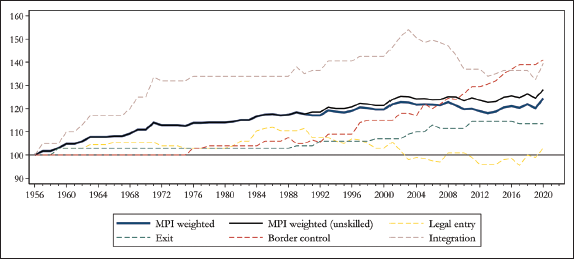
Contemporary migration policies continue to reflect an awkward and arguably ineffective convergence of competing stakeholder interests and institutional constraints. Migration remains conceived as an almost exclusively temporary phenomenon to support economic activity, with migrants and their sponsors subject to significant constraints on activities and rights (Anderson, 2021; Nah, 2012). Undocumented migration is endemic, documented migration is predominantly unskilled, securitised and blamed for various economic and social ills, and migration policymaking remains fraught (Anderson, 2021; Lee & Leng, 2018; Low, 2017). Individual immigration settings adjust with political and socio-economic winds in the absence of an integrated, overarching migration policy framework designed to reflect clear and achievable goals, stakeholder incentives and regulatory effectiveness considerations (International Labour Organization, 2016).
Despite longstanding political and public interest in Malaysia concerning the impact of migration policies, there is very little empirical evidence. An extensive review of the literature has found only qualitative assessments of immigration policy supported by presentations of raw data. A leading and comprehensive example analysing policies to combat irregular migration reports a declining ratio of irregular to regular migrant workers each decade from the 1970s to the 2000s as evidence of policy effectiveness, taking at face value government figures that more robust recent estimates substantively disprove (Kassim & Zin, 2011; Nixon, 2024). Kassim and Zin nonetheless identify no less than 18 ‘counterproductive policy elements’ that imply a large gap between policy intent and outcomes, including a faulty assumption of temporariness, corruption, the frequency of changes, regulatory capability gaps, the increasing sophistication of informal actors, and the challenges of Malaysia’s geography and diplomatic relations.
Another study claims to offer an empirical analysis of workplace enforcement strategies and employer sanctions, but instead presents anecdotal evidence of policy impacts on migrants (Low, 2017). Other leading Malaysian scholars highlight frequent cycles of irregular migrant roundups, amnesties, repatriation and regularisation as demonstrating regulatory inadequacies (Kaur, 2014), while a critical appraisal of migrant worker policies argues that legal deficiencies, ad hoc migrant management, and ineffective enforcement contribute to system failures and migrant abuse (Devadason & Chan, 2014). The devolution of regulatory responsibilities to non-government entities has been assessed as creating an accountability vacuum in which labour standards weaken, and migrant ‘facilitators’ extract large rents from migrants (Devadason, 2020; Nixon, 2020).
That immigration policy influences immigration flows and has not been examined empirically reflects both Malaysia-specific and universal challenges to analysing policy influence quantitatively. Immigration inflow data present greater barriers in Malaysia than exist elsewhere, owing to the absence of official (documented) migrant data prior to the commencement of guest work schemes (which limits the length of the time series), there are legitimate concerns that politicisation affects the veracity of migration data, and the sheer scale of undocumented migration, for which longitudinal estimates were not available until recently (Lee & Leng, 2018; Nixon, 2024). The next section considers the approach to empirical analysis in other settings.
Migration Policy Influence Globally
An immediate conceptual challenge for empiricists is whether policy effectiveness should be measured with reference to stated or unstated policy intent. The seminal ‘gap hypothesis’ identifies a large difference between stated immigration policy goals and migration outcomes that exists worldwide (Cornelius & Tsuda, 2004), with some scholars considering this a deliberate strategy of receiving countries seeking to expand migration in the face of political constraints (Boswell, 2007; Freeman, 1995; Hollifield, 2004; Hollifield & Sharpe, 2017; Kennedy, 2019; Ruhs & Martin, 2008). The gap could also reflect poorly designed, communicated or implemented policies, with unintended consequences—like migrants exploiting visa loopholes or choosing informal status—often the result (de Haas et al., 2018; Elrick, 2022).
Global evidence converges to some extent around the policy approaches that commonly produce unintended outcomes. A leading example is how tightening border control may temporarily disrupt illegal entry but can incentivise border official corruption and investment to make unlawful activity more sophisticated (Bazzi et al., 2021; Feigenberg, 2020; Lessem, 2018; Vrăbiescu, 2022). Reducing access to legal migration channels has likewise been found to boost informal migration to an empirically large degree (Czaika & Hobolth, 2016; Sarma, 2021). Constraining the rights of legal migrants—such as to change employers or stay longer—increases the risks of exploitation and informality (Clibborn & Wright, 2020; Coates et al., 2023; Wang, 2021), while reducing interest in obtaining citizenship (Hou & Picot, 2021). It is also doubtful whether migrant selection policies—prioritising skills and experience, for example—enhance economic integration relative to alternative approaches, like relying on self-selection (Clarke et al., 2019), providing migrants with job flexibility and protection from employer discrimination (Platt et al., 2022), and easier access to citizenship (Fellini & Guetto, 2022). Selection biases and a preference for temporary migrants can lead to ‘lower skilled’ wages (Di Giovanni et al., 2014), lesser incentives to develop skills (Jacobs, 2022), and skills-labour market mismatch (Lu & Hou, 2020).
Deficiencies in regulatory methods and organisation are also evident. Migrant abuse flourishes when regulatory powers are transferred to non-government entities, including migrant employers (López-Sala & Godenau, 2022), and costs rise with the introduction of middle actors, including agents (Weeraratne, 2021). Migrant and receiving country economic outcomes suffer under policies that are inconsistent, change unpredictably, and often are short-sighted or demonise some migrants (like refugees) (Brücker et al., 2021; Hayakawa, 2020; Lessem & Sanders, 2020; Tani, 2020; Vitus & Jarlby, 2022).
Global evidence establishes areas of policy ineffectiveness, particularly in major Western recipient countries, which helps situate further empirical analysis. There nonetheless remains substantial room to further understand the influence of individual and overall migration policies on migrant decisions, especially to address the limited quantification of policy effects. Greater understanding of how arguments developed from Western country evidence apply in alternative settings like Malaysia is also needed. Before outlining how this article addresses this need, the following section describes the challenges that policy measurement and aggregation present.
Policy Indicators and Measurement
Confronted with significant barriers, migration policy measurement was given little serious attention until the past decade, and has much further to advance. Policy quantification—converting descriptive policies into numerical indicators—requires a major time investment to collect and interpret diverse and context-dependent information. It also requires some subjectivity in magnitude assignment and conceptual approach that deters many empiricists, who instead use outcome variables as policy proxies for modelling purposes. The trouble with outcome variables as policy proxies is that they conflate cause and effect. Migration patterns can vary because of or despite policy changes, especially in countries like Malaysia with insecure external and internal borders. Proxies are nonetheless chosen because available policy indicators lack the geographic and temporal coverage necessary for empirical analysis.
A pioneering indicator is Beine et al.’s (2016) International Migration Law and Policy Analysis (IMPALA) database, which identifies entry and citizenship acquisition policies for economic, family and humanitarian migrants for a subset of Organisation for Economic Co-operation and Development (OECD) countries over a 10-year period. It is unclear whether the database will be updated to capture changes since.
A more contemporaneous and geographically extensive indicator is Helbling and Leblang’s (2019) Immigration Policies in Comparison (IMPIC) data set—capturing 33 OECD countries between 1980 and 2010, and recently extended to 2018 (Helbling et al., 2024). The creators deployed their measures empirically and found that more restrictive policies reduce migration flows—subject to information disseminating through migrant networks. They identified entry barriers as the most consequential for flows, but post-arrival rights were also influential.
Perhaps the most extensive and transparent undertaking is the Determinants of International Migration (DEMIG) database (de Haas et al., 2018), which documents policies for 45 countries between 1945 and 2013. It provides the most comprehensive account of individual policy changes over the longest timeframe and makes qualitative judgements regarding policy magnitude and restrictiveness (more or less), but does not attempt quantification. The authors’ own examination of the data identifies four means by which migration policies impact flows: (a) spatial substitution, where migrants choose another destination; (b) categorical substitution or switching, where migrants change visa type or legal status; (c) inter-temporal substitution, where policy alters the timing of decisions to migrate; and (d) reverse flow substitution, where restrictions in the migrant’s home country prevent a return.
Czaika and Parsons’ (2017) neat and simple indicator of high-skilled immigration policies (combining entry policies, post-entry rights and bilateral agreements) is found to strongly influence migration inflows into OECD countries. Aspiring high-skilled migrants are encouraged by migrant selection policies (such as points-based systems) and opportunities for future permanent residency, whereas requirements for a prior job offer, occupation shortage lists, and double taxation agreements represent deterrents.
There are other indicators with similar coverage limits that were developed in recent years but have not been tested empirically (e.g., Pasetti & Conte, 2021; Schmid, 2021). There is a significant remaining ground geographically and thematically for future indicators to cover, and opportunities to advance coverage and quantification on a within-country basis to better support empirical application (Solano & Huddleston, 2021). The next section describes this article’s attempt to do so for Malaysia.
Data and Methodology
Underpinning the analysis of migration policy relationships are quantitative policy indicators, purpose-built for a larger investigation into policy influence on international factor flows. This methodology section and an accompanying technical paper introduce the indicators and their construction.
The primary set of ‘baseline’ policy indicators—which this article deploys—codify legislative, regulatory and formal migration policy changes from the migrant perspective. By capturing changes to officially documented policies, the baseline indicators capture the ‘on paper’ policy environment that prospective and successful migrants face. Individual policy groupings or subcategories distinguish between legal entry and stay, exit, integration and border control policies, while composite indexes aggregate these into overall policy indicators using weighted 1 and unweighted subcategory averages.
Indicator development took significant inspiration from the DEMIG database, which documented iterative policy changes for 45 countries from 1945 to 2013 (not including Malaysia; de Haas et al., 2016). DEMIG’s policy categorisation was largely followed, and its focus on policy changes, not levels, adopted as this is best suited to analysing experience within a single country (avoiding judgments about what ‘optimal’ policies are across disparate historical and geographical contexts). This article’s indicators nonetheless diverge in several important ways, namely:
Most significantly, policy changes are assigned numerical magnitudes—whereas DEMIG only assigns qualitative descriptions (‘minor’ or ‘major’ changes that are ‘more’ or ‘less restrictive’). DEMIG’s analysis—which treats, and thus sums, all measures equally to consider trends across time—is prone to misrepresenting magnitude changes. For example, a year with one major liberalisation package and two new minor policy restrictions would appear as a tightening year when it is likely the liberalisation package more greatly influenced migration decisions than the two minor policies combined. Numerical magnitudes are assigned to individual policy changes based on categorisation as a minor (0.5 or 1), mid-level (1.5 or 2) or major change (no more than 5), and whether they are more (positive score) or less (negative) restrictive from an investor perspective. Magnitudes are determined in historical context, considering the change’s impact in terms of the number of investors and the scale of impact vis-à-vis the pre-change state. The numerical index starts at 100 (in 1957) for each policy subcategory and adjusts individually based on policy shifts. While a comparison for Malaysia is not possible (as DEMIG does not include Malaysia), a comparable exercise using an existing DEMIG country has found that the methodology deployed in this article produces more than twice as many policy listings. The indicator does not seek to capture every trivial legislative or other policy change due to the challenges of identifying these through historical research, but it achieves greater detail through a wider investigation of primary and secondary sources. DEMIG’s policy categorisation is maintained, but with some differences surrounding policy tools. DEMIG includes intake targets, quotas and migration outcomes as policy changes, whereas this article’s indicators treat them as contextual only. This reflects empirical application considerations (targets and quotas can override regulatory policies of interest and, as a supply measure, are less useful to a study of policy influences on migration demand). Unlike other countries, however, Malaysia has rarely deployed formal migration targets. Building on DEMIG’s approach, the indicators are accompanied by a sortable and itemised spreadsheet of policy changes with explanations, score assignments, and links to the source information.
For this article’s empirical analysis, the indicators deployed are an overall weighted policy indicator (MPIBW), an alternative overall weighted indicator specific to unskilled migrant policies (MPIBW2), a legal entry (and stay) indicator (MPILE), an integration indicator (MPIIG), and a border control indicator (MPIBC).
To supplement understanding of ‘on paper’ policies, a parallel effort was made to develop supplementary metrics capturing the ‘in practice’ policy environment beyond formal laws and regulations. This recognises that migrant decisions and lived experiences are influenced by the exercise of discretionary powers under informal or unpublicised rules, or at the changing whims of government ministers or officials, which operate on top of official laws and regulations.
Developing an ‘in practice’ indicator for Malaysia is challenging, as feasible proxies for other countries—such as records of public attitudes and political activities—are either historically limited or difficult to access or search. The indicator developed herein instead exploits that Malaysia had a single continuous government from independence to 2018, and a leading opposition voice in Lim Kit Siang (LKS) for much of that time (holding various opposition leadership and parliamentary roles from the late 1960s). A significant collection of LKS’ press releases and parliamentary speeches dating back to 1968 has been digitised and is freely accessible (Lim, 1996, 2021), which made it ideal for analysing a large subset of the period of interest. About 13,200 records were codified as relevant (or not) to one or more of the baseline indicator policy subcategories, by restrictiveness (either advocating more or less restrictive policies), and with values expressed as a fraction of total records for that year. Two years in which records are unavailable reflect fitted values based on adjacent year averages and historically comparable periods.
The supplementary indicators help inform wider analysis of the policy environment changes, and they are documented in the accompanying data set, but empirical applications are not part of this article.
The baseline policy indicator measures feed into a time series data set supplemented by secondary data, capturing the period 1957–2018, and including a large number of migration and economic variables (including foreign direct investment (FDI) variables, owing to broader research this analysis formed part of). Two migration measures are used: the official labour force survey non-citizen workforce (MLFS; DOSM, 2020) and the empirically estimated undocumented migrant population derived from per capita consumption and development data patterns (Nixon, 2024—the low estimate). A particular advantage of deploying an undocumented migration measure is that it supports understanding of migrant category shifting to circumvent policy changes, whereas a reliance on documented migrant numbers alone could lead to false inferences about policy effects.
For control variables, there are many factors that influence migration inflows globally, and an as yet unsettled literature is attempting to prioritise and organise these theoretically and empirically. The most convincing frameworks coalesce around decisions to improve livelihoods, influenced by a range of migrant, source and destination country characteristics (e.g., Borjas, 2014; Carling & Collins, 2018; de Haas, 2021; Van Hear et al., 2018). Commonly identified (non-policy) factors include employment prospects, anticipated wage gains, geographical, cultural and institutional proximity, human capital, network effects, and a country’s development level (e.g., Clark et al., 2007; Clemens et al., 2009, 2019; Hatton & Williamson, 2002; Ortega & Peri, 2013).
As this article’s research formed part of a broader examination of interactions between migration, FDI, associated policies and economic development, FDI measures are included among the controls. These are gross and net inflows of FDI (in constant 2017 US dollars and reflecting 5-year averages to reduce the distortionary effect of single large investments; Nunnenkamp, 1989; United Nations Conference on Trade and Development (UNCTAD), 2021) and foreign company registrations (FCR) (Department of Statistics Malaysia, 1957–2019).
Additional economic controls included real GDP per capita (calculated using the official (RGPPCO) and unofficial (RGDPPCU) population estimates—including the aforementioned undocumented population) and capital stock (CAP) (at constant 2017 values; Feenstra et al., 2015; Maddison, 2010; World Bank, 2021), the unemployment (UNE) rate (for persons aged 15–64 years; Department of Statistics Malaysia (DOSM), 2020), two alternative education measures (the human capital index (HCI; Feenstra et al., 2015) and an educational attainment metric (reflecting the highest educational attainment of the population over 25; Barro & Lee, 2013)), liberal democracy institutions index (Coppedge et al., 2021; Pemstein et al., 2021), trade as a percentage of GDP (World Bank, 2021), and two industrial upgrading measures derived from the Observatory of Economic Complexity’s Economic Complexity Index (ECI) and Product Complexity Index (PCI) (Simoes & Hidalgo, 2011).
With evidence of cointegration (based on Johansen tests) commonplace, the empirical methodology follows a traditional VEC modelling approach. Preliminary testing determined the optimal lag length, stationarity, autocorrelation, stability, cointegration and error distribution (Shrestha & Bhatta, 2018), and all variables were converted to either first- or second differences according to stationarity and unit root testing (augmented Dickey–Fuller and Kwiatkowski, Phillips, Schmidt and Shin (KPSS) tests), and into logs for ease of interpretation. The specifications are run with multiple variable orders to identify different cointegrated relationship combinations, with impulse response magnitudes calculated using the specification ordered by decreasing exogeneity (Cholesky decomposition). The results reflect Granger causality rather than strict causation (or ‘predictive causality’; Diebold, 2017). They produce relationships that reflect the predictive properties of the historical movement of variables over and above others in the system.
Owing to the large number of variables (particularly policy indicators) and therefore possible model specifications, a substantial but far from exhaustive set of variable combinations is executed. The analysis is informed by many specifications summarised into average effects, with only the preferred (most complete) models reported in the next section—those with a policy variable, migration variable, and combinations of controls for UNE, CAP, education (ED—the HCI measure) and institutions liberal democracy index (LIB).
The number of variables in each specification varies, with the three variable equations represented by:


where M, P and E represent migration, migration policy and economic control variables, respectively, and error correction term (ECT) represents the ECT (the remaining terms represent logs, lags, coefficients and residuals).
The models are estimated using the entire sample period for which the variables have corresponding data, excluding 2020 to eliminate potential pandemic influence. Econometric testing did not reveal series breaks around other major historical events.
Results and Discussion
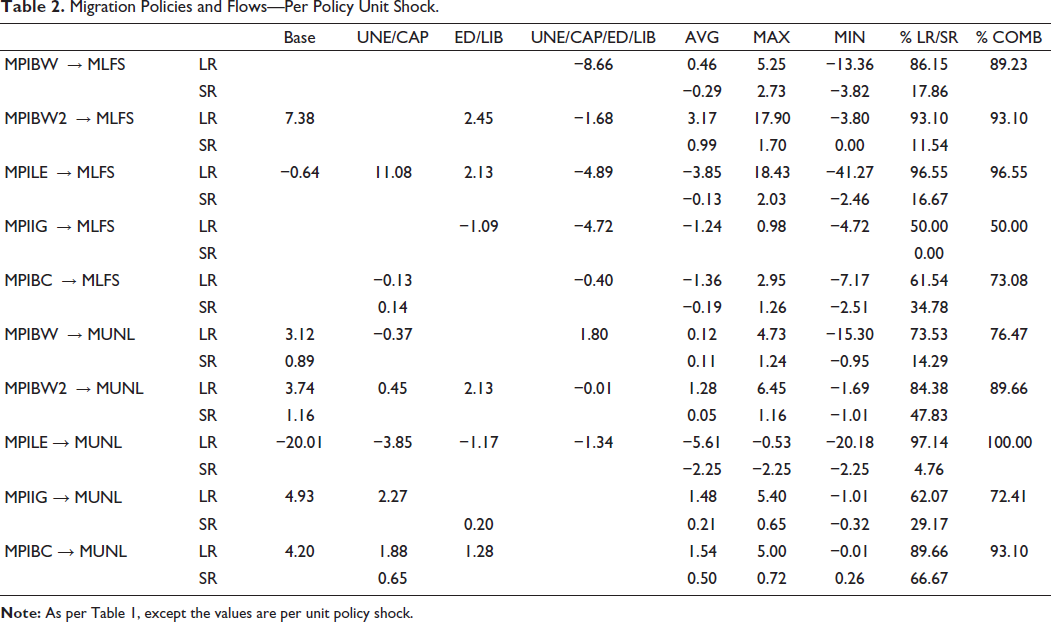
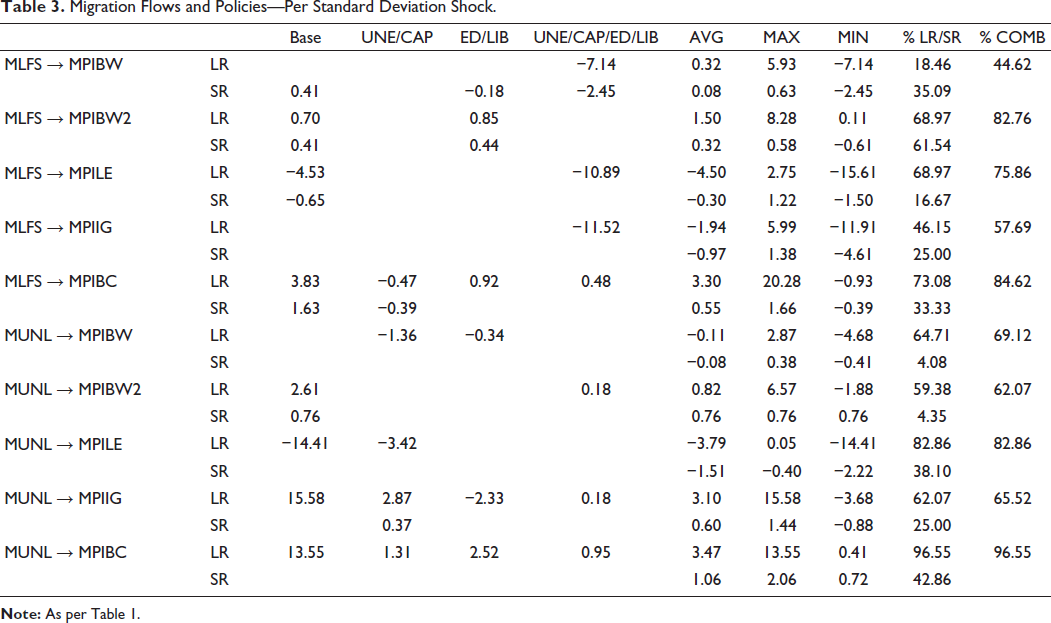
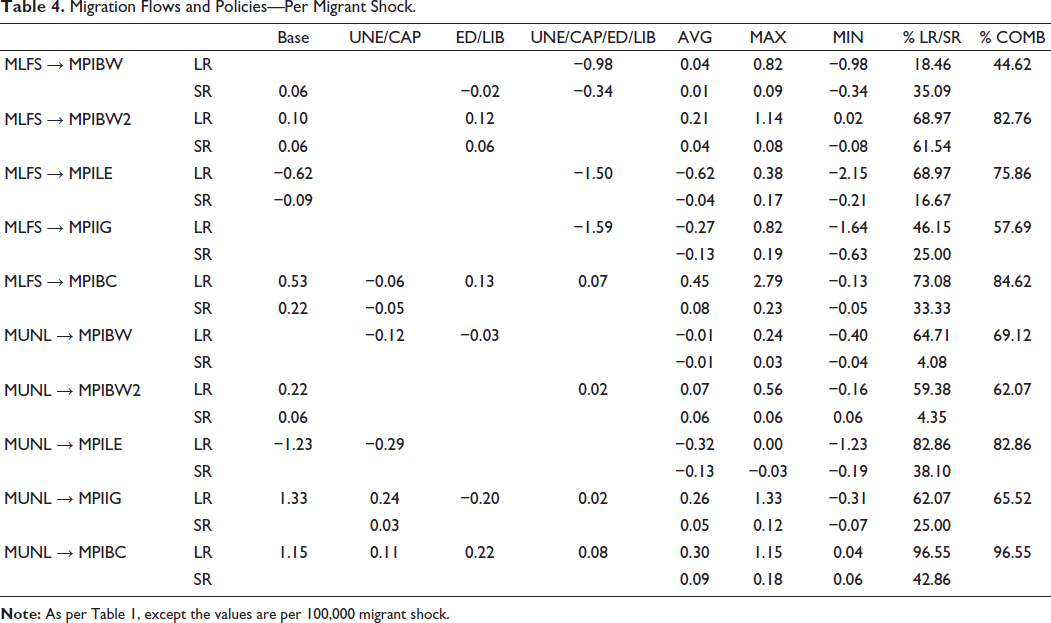
Tables 1–4 present summary results for the relationships between migration policies and flows in standard deviation and per unit shock terms, respectively. Included are the preferred specifications, plus the average, maximum and minimum impulse response across a larger number of specifications, and the percentage of all such specifications that produces a statistically significant Granger-causal relationship.
The results display substantial heterogeneity by policy subcategory and lesser differences by migrant type. A minor tightening of the overall migration policy indicator is associated with a cumulative increase in documented migrants of about 0.5% after 15 years, and an increase in undocumented migrants of about one quarter of that. 2 An equivalent tightening of the unskilled policy indicator has a much larger effect in increasing both documented (3.2%) and undocumented (1.3%) migrants.
Tightening legal entry policies contrastingly reduces migrant inflows—by the largest magnitude of any indicator in both standard deviation and unit shock terms. The average effect is largest for undocumented migrants, with a minor policy tightening associated with 5.6% fewer migrants after 15 years (the equivalent effect for documented migrants is 3.9%). The effect is larger for documented migrants in the most complete specification, however, which suggests the relative magnitude by migrant type is less clear than the reducing influence of policy on inflows.
Border control and integration policy changes appear to affect documented and undocumented migrants differently. For documented migrants, a minor policy tightening around borders and integration reduces inflows by around 1.2%–1.4% after 15 years. For undocumented migrants, policy tightening increases inflows by around 1.5%—with border tightening also associated with a short-term (5 years) increase of around 0.5%.
Migration Policies and Flows—Per Standard Deviation Shock.
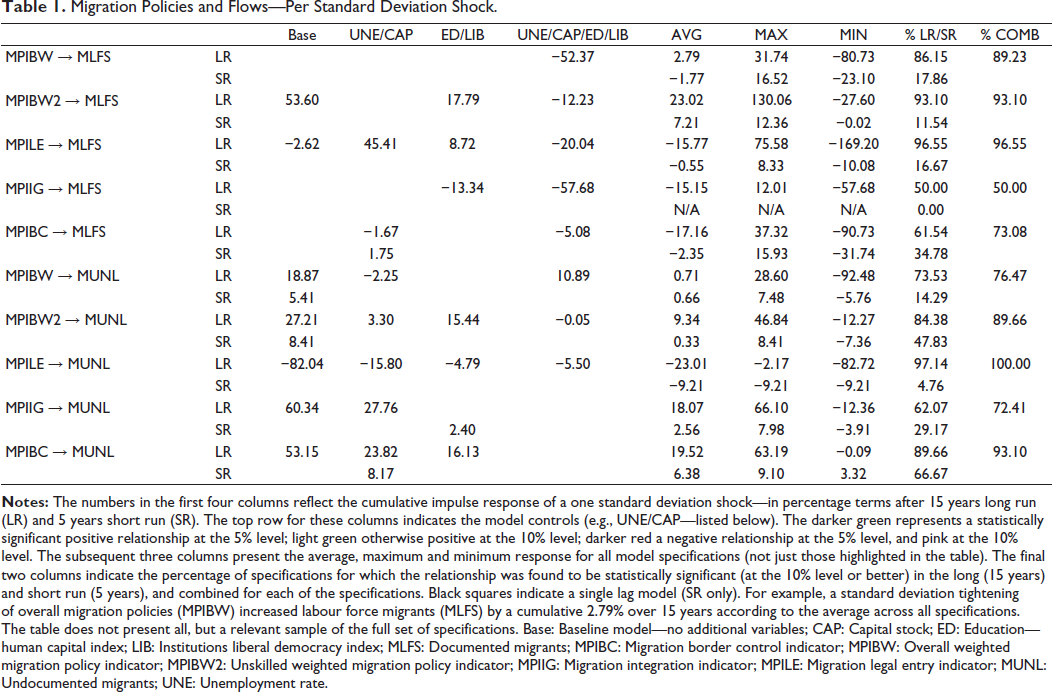
Migration Policies and Flows—Per Policy Unit Shock.
Migration Flows and Policies—Per Standard Deviation Shock.
Migration Flows and Policies—Per Migrant Shock.
That overall migration policy tightening appears to be associated with increased long-term migration suggests that reforms to date have not been sufficient to meet Malaysia’s objective of reducing immigration dependency. That the increase is larger for policies specific to unskilled migrants emphasises the challenge for policymakers, attempting to contain substantial inflows of both documented and undocumented migrants motivated by non-policy forces (including economic prospects). The results are consistent with there being a significant gap between announced policies and their effective implementation.
The policy subcategory results suggest migrant category shifting and post-entry rights are leading contributors to the implementation gap. Policies that reduce migrant rights to integrate into society—such as constraints on work, family accompaniment and education, pathways to residence and citizenship—diminish incentives to maintain documentary status. The evidence for Malaysia, where the difference between documented and undocumented migrant rights is relatively little, is that integration policy tightening appears to prompt transitions out of documentary status. Likewise, border tightening—including within country raids on workplaces and accommodation—may signal hostility that discourages future documented migration more than it deters undocumented migration (as informal channels increase their sophistication in response). Policy changes appear to have weakened incentives to migrate formally while making enforcement efforts more difficult.
The results for legal entry policies are more consistent with expectations. That policy tightening is associated with both reduced long-term documented and undocumented migration suggests that reducing formal entry opportunities have decreased overall interest in migrating rather than prompted category shifting. The large magnitude effect suggests legal entry policies have an especially powerful influence on migration decisions, consistent with their prominent status in migration debates.
In respect of the reverse relationship, immigration increases are mostly associated with a marginal tightening of policies over the long term. The evidence for documented migrants and the overall migration policy indicator is consistent with this, but not statistically strong, perhaps due to counteracting effects for policy subcategories. The results are clearer when unskilled policies are isolated, with a standard deviation increase in documented migrants being associated with a cumulative minor-to-moderate policy tightening after 15 years. A standard deviation undocumented migrant shock is associated with policy tightening for unskilled migrants of about half as much (less than a minor tightening), and a very small liberalisation of overall policies.
Results for the subcategory indicators suggest higher migrant inflows most substantively prompt border tightening and entry liberalisation. A standard deviation increase in either documented or undocumented migrants is associated with significantly stricter border control policies—cumulatively equivalent to a major policy shock after 15 years. In per migrant terms, the shock is slightly larger for documented migrants. Likewise, a standard deviation increase in documented or undocumented migrants appears to prompt the equivalent of a major policy liberalisation shock to legal entry policies—in numerical terms larger than that for border tightening. The per migrant impact for documented migrants is almost twice that for undocumented migrants.
The findings for integration policies differ for documented and undocumented migrants. An increase in documented migrants is associated with a moderate liberalisation of integration policies, whereas an undocumented migrant shock is associated with major policy tightening.
Increasing migrant inflows—particularly where exceeding policymaker targets—provides an opportunity and potential impetus to make policies more selective. Malaysian governments have periodically expressed an objective to reduce dependency on low-skilled immigration, and the findings herein are consistent with a tightening response to immigration shocks—especially towards unskilled migrants. That the magnitude effect is larger for documented migrants may reflect their greater visibility and thus political salience. The findings for border control policies exemplify this, as one would ordinarily expect a surge in undocumented migrants to more greatly influence policy efforts to reduce informality. That increased migration is associated with legal entry policy liberalisation in the longer-term is consistent with cumulative causation—where earlier migrant generations incentivise and facilitate later inflows—and the challenges this creates for regulating migration. Liberalisation in Malaysia reflects a combination of pressure from commercial interests benefiting from inflows of migrant labour, and periodic attempts to regularise (and thus regulate) vast numbers of undocumented migrants. That documented migrant shocks put liberalising pressure on integration policies, whereas undocumented migrant shocks apply tightening pressure, is an intriguing result that perhaps reflects policymakers responding to the livability needs of migrants who stay formally while seeking to worsen conditions for the undocumented.
Combined the results suggest that Malaysia is caught in a vicious cycle in which ineffectual and counterproductive border and integration policy tightening dominates legal entry tightening to encourage an overall increase in immigration, with the increase being mostly undocumented. Increased immigration in turn prompts further border and integration policy tightening, and the cycle repeats. Malaysian policymakers would appear to be better off pivoting—considering integration and border policies that substantively improve the rights and lived experience of documented migrants relative to undocumented.
Conclusion
Malaysia’s rich but turbulent experience with migration policymaking has received considerable public debate but limited empirical examination. This article deploys purpose-built quantitative policy indicators to explore policy’s historical influence empirically, producing novel estimates with policy subcategory splits. The findings suggest border and integration policy tightening have contributed to an unintended overall increase in immigration, largely through informal channels, including category shifting. That increased immigration in turn prompts further policy tightening indicates Malaysia is caught in a vicious cycle, for which a liberalising policy pivot, increasing documented migrant rights, would appear necessary to escape.
Data Availability Statement
The author will include for publication in accessible format (or include a link to a website that makes freely available) The data set has been made public on my website:
Footnotes
Declaration of Conflicting Interest
The author declared no potential conflicts of interest regarding the research, authorship and/or publication of this article.
Ethical Approval and Informed Consent
The research did not involve interactions with human or animal subjects. Australian National University ethics approval was obtained for overseas fieldwork in Malaysia, which for the purposes of this article was exclusively accessing library documents.
Funding
The author disclosed receipt of the following financial support for the research, authorship and/or publication of this article: The author would like to acknowledge the support of the Australian Government and Australian National University in providing scholarship funding towards the PhD research during which the data set was developed.
