




Abstract
This paper presents a survey of homeowners and renters who moved within or into the Greater Toronto Area (GTA), Canada, since January 2016. This timeline covers pre- and during-COVID movers. The survey investigates households’ residential preferences and the potential dissonance between their preferred and actual residential location choices. The respondents are asked to answer questions about their previous and current residences, their housing search, and hypothetical residential location choices given the option of telecommuting. Empirical analysis of the actual and hypothetical residential location choices is conducted through a joint revealed preference and stated preference (RP-SP) error component mixed logit model. The model estimations identify discrepancies between RP and SP choices, indicating the presence of residential dissonance. The positive effect of transit accessibility variables shows that people are more likely to choose residential locations with better accessibility. However, dissonance in transit accessibility is found in both models, suggesting homeowners and renters may settle for lower accessibility in real life. Moreover, the model results show that homeowners and renters are more likely to relocate when working remotely, indicating the significant influence of telecommuting on residential dissonance.
Keywords
Introduction
Residential dissonance refers to the existence of a discrepancy between a household’s residential preferences and their actual choice of residence (Kamruzzaman et al., 2013). Investigating this phenomenon is of great interest in metropolitan areas as it is often intertwined with crucial issues such as housing affordability (Kamruzzaman et al., 2013; Schwanen and Mokhtarian, 2004), unequal distribution of accessibility to public services (Kamruzzaman et al., 2013), imbalance in access to employment opportunities (Li et al., 2013), and social and economic segregation (Li et al., 2013). It is also believed that residential dissonance can significantly influence individuals’ travel behavior and propensity to relocate. The COVID-19 pandemic offers a unique opportunity to explore residential dissonance through the lens of remote or teleworking. With the shift to remote work during the pandemic, the physical proximity of individuals to their workplaces became less relevant, leading to potential changes in transportation habits and the reconsideration of living preferences. Consequently, housing demand patterns may have been affected, with some individuals seeking larger homes or properties in less densely populated areas.
The primary objective of this paper is to explore the existence and extent of residential dissonance in the Greater Toronto Area (GTA) by analyzing the residential preferences of individuals who recently relocated their homes (since January 2016). In addition, the paper investigates whether, and in what ways, different forms of telecommuting adoption may be associated with changes in relocation decisions in the post-pandemic context. It introduces an innovative approach to identifying residential dissonance using a joint revealed preference and stated preference (RP-SP) model framework. By comparing participants’ retrospective residential choices with their selections in hypothetical choice scenarios, this study aims to uncover any disparities between current and desired residences for households. Moreover, since telecommuting has become more prevalent after the COVID-19 pandemic, it may have shifted how households evaluate potential residential options by reducing the importance of workplace proximity. While previous studies have examined links between telecommuting and residential preferences, most were conducted prior to the pandemic and thus may not reflect the current normalization of remote work. This study contributes to the literature by addressing that gap—investigating whether the availability of telecommuting options can induce residential dissonance and the decision to move in a context where remote work is more deeply integrated into daily life.
The investigation is based on a survey of 910 movers conducted from May 2023 to July 2023. This survey delves into the retrospective residential location choices of participants, as well as their stated preferences, to understand how various factors, including the COVID-19 pandemic, remote employment, demographics, and housing affordability, influence their residential decisions. The relocation choices were empirically modeled through joint RP-SP error component mixed logit models. The results indicate the presence of residential dissonance in the GTA along several lines. In addition, the availability of telecommuting is a significant factor leading to residential dissonance and the decision to move, which is different from the pre-pandemic finding. Both renters and homeowners are more likely to relocate, given the option to work remotely. Meanwhile, pre-pandemic movers are more likely to relocate again, suggesting the existence of residual effects from the pandemic period. The model results of the hypothetical choices also measure the relative importance of housing attributes and households’ trade-offs in their relocation choices. This paper updates the findings on the effect of telecommuting on residential dissonance and relocation decisions in the post-pandemic era. As telecommuting is becoming popular worldwide, the findings can also enlighten researchers from other countries to continue investigating its relationship with residential location choice.
The remainder of this paper is structured as follows: the next section briefly reviews existing residential dissonance literature. The third section introduces the survey design, outlining its key components, analyzes the collected sample data, providing relevant descriptive statistics. Section four describes the model formulations and variable selection methods. Section five then presents and discusses the empirical findings from the modeling practice. Finally, the paper summarizes its key discoveries and offers suggestions for future research.
Literature review
Surveys of recent movers
Surveys are widely used in transportation research to collect information on individuals’ behavior. The most common survey is the household travel survey, which is used to collect household travel behavior. In comparison, fewer surveys are specifically designed for recent movers to study their relocation processes and decisions. Hollingworth and Miller (1996) conducted a retrospective survey of GTA housing careers that was subsequently used to model residential mobility decisions in ILUTE (Rosenfield et al., 2013). Recently, Shaw (2018) conducted a retrospective survey on households who relocated to Singapore between 2013 and 2015 and used the collected data to analyze the connection between household life cycle stages and relocation decisions. Wang and Wang (2020) interviewed over 500 participants who planned to move and eventually moved to Beijing, China. They developed a multi-level structural equation model to understand the factors behind the changes in residential satisfaction after relocation. The surveys of recent movers were mostly retrospective and only collected the respondents’ revealed preference (RP) data. Such data could be limited when trying to model residential relocation choices and investigate factors impacting such decisions, especially if alternative residences considered by the respondents were not collected in the surveys. The only exception is Bina (2005), who developed separate surveys for realtors, apartment dwellers, and recent homebuyers to investigate residential location choices in Austin, TX. The surveys for apartment dwellers and recent homebuyers included stated preference (SP) experiments, which asked the respondents to choose between their current residential and six enhanced options. Utilizing the survey data, Bina (2005) developed regression and discrete choice models to examine the determinants of property values, relocation decisions, and priorities and trade-offs involved in the relocation choices.
In general, data collected from recent movers’ surveys are mostly used to understand the reasons to move, the valuation of housing and neighborhood attributes, and residential satisfaction. These can be tangentially related to residential dissonance, but the dissonance aspects were rarely the focus of the aforementioned studies. Residential dissonance is believed to have significant impacts on individuals’ travel behavior such as mode choice and travel distance, and their propensity to relocate (Kamruzzaman et al., 2013; Kamruzzaman et al., 2013; Schwanen and Mokhtarian, 2005). Carefully designed SP experiments in a residential preference survey can provide data for analyzing residential dissonance and uncover the disparities between respondents’ actual and preferred residences.
Residential dissonance, location choice, and telecommuting
Residential dissonance has gradually been recognized in the field of land use and transportation. Miller (2005) stated that the dissonance between actual and expected travel patterns may accumulate and lead to a relocation decision. Several studies attempted to examine the determinants of residential dissonance. Using a series of binary probit, ordered probit, and tobit regression models, Schwanen and Mokhtarian (2004) discovered that automobile orientation, lifestyles, and personality traits are three main sources of residential dissonance. They also found that single dwellers in suburban and large households in the city are more likely to experience neighborhood dissonance (Schwanen and Mokhtarian, 2004). Schimohr et al. (2023) recently studied travel-based residential dissonance in Germany through logistic regression analysis and concluded that residential dissonance can hardly trigger a relocation decision by itself, but travel and accessibility-related factors are influential to relocation decisions. Literature also shows that reasons triggering residential dissonance include financial constraints, intra-household heterogeneity, and changes in preferences and lifestyles (Guan et al., 2020; Janke, 2021).
While it is important to understand the characteristics of households experiencing residential dissonance, it is also crucial to identify the dissonance itself. The existing literature on residential dissonance mostly focuses on the cause of dissonance, but rarely studies in what aspects dissonance exists. In addition, most of the studies on residential dissonance were conducted before the COVID-19 pandemic and the widespread of telecommuting, whose results may not apply to the current state. Since telecommuting and remote working have become a common practice nowadays, it can relax the constraint on the physical proximity of individuals to their workplaces. This may lead to a change in individuals’ choice sets and preferences in terms of potential residence. For example, this shift allows individuals to prioritize factors like housing affordability, space, and neighborhood quality. It can also reveal or reinforce latent lifestyle preferences, such as a desire for suburban living. This forms a key causal pathway through which telecommuting alters residential decision-making—reshaping the constraints and trade-offs individuals face and potentially leading to residential dissonance. Hence, there is a need to explore the relationship between telecommuting availability and residential dissonance.
Previous studies have investigated the influence of telecommuting arrangements on residential preferences and location choices. Some pre-pandemic studies suggested that telecommuters tend to live farther away from workplace locations (Muhammad et al., 2007; Zhu, 2013) and city centers (Tayyaran and Khan, 2007), and are more likely to live in suburban locations (De Abreu e Silva, 2022). Ory and Mokhtarian (2006) conducted an empirical analysis of the causality between telecommuting engagements and residential relocation decisions and found that workers who began telecommuting after relocating tended to have moved farther from their workplaces, whereas those who were already telecommuting before moving often relocated closer to their workplaces. Zhu et al. (2023) examined the impacts of telecommuting on housing tenure and type preferences and concluded that telecommuters, especially among the middle-aged group, had a higher preference for being homeowners and living in larger housing units. Meanwhile, some studies failed to identify a statistically significant relationship between telecommuting and specific relocations (Ettema, 2010; Kim et al., 2013). However, those studies were conducted before telecommuting became the new norm. It is uncertain whether the previous finding remains valid in the post-pandemic era after the widespread use of remote working. During the COVID-19 pandemic, Schulz et al. (2023) studied the effects of teleworking experience on home features through SP data and discovered a higher preference for high-quality home offices. However, they did not find any significant relationship between teleworking and the residential location’s proximity to the city center. Nevertheless, research is limited on whether telecommuting availability can induce residential dissonance and relocation decisions.
Contribution of the study
Although there are previous studies about recent movers and residential dissonance, this paper differs from them in the following aspects. This is the first survey on recent movers that includes a temporal domain from before to after the COVID-19 pandemic. The data collected from this survey can provide valuable information on the residential dissonance that may be caused by the pandemic or its induced behavior such as telecommuting. This paper brings the new academic argument that given the popularity of telecommuting after the pandemic, its relationship with residential dissonance and the decision to move may be different from the pre-pandemic findings. This paper discovers that both renters and homeowners are more inclined to choose relocation when given the option to work remotely. In addition, this paper contributes to the existing literature with an innovative approach to identifying residential dissonance through RP-SP data.
Survey design and data description
The “GTA Recent Movers Survey” was conducted between May and July 2023 to examine how household preferences and external factors such as telecommuting, demographics, and housing affordability influence residential decisions in the Greater Toronto Area (GTA), which is the largest urban region in Canada (Habib et al., 2021). The survey targeted households that relocated within or into the GTA between 2016 and 2022, including both homeowners and renters.
The survey consists of three main components: (1) pre-survey screening questions, (2) retrospective questions about the respondent’s recent relocation, and (3) SP experiments about hypothetical relocation choices. The retrospective component collected information about the respondent’s current and previous residences and their recent property transactions and search process. It also asked the respondents to list up to four alternative dwelling units on which they bid or came close to bidding when searching for the current residence, which is considered as their RP data. The stated preference experiments were followed by retrospective questions to gather information on changes in respondents’ residential preferences given the opportunity to work remotely. Each respondent was required to complete six SP experiments, each consisting of three hypothetical dwelling units and the respondent’s current residence. Respondents chose whether and where to move under three telecommuting scenarios: full-time remote work, hybrid work, and no remote work. The Efficient Adaptive Stated Preference (EASP) experiment design approach was utilized to develop the SP experiments (Shakib, 2024). A more detailed description of the survey design and collection process is presented in the Supplementary Material, including a data model in Figure S1 and an example of the SP experiment in Figure S2.
The survey collected 910 completed responses, including 488 homeowners and 422 renters. Full descriptive statistics and additional demographic details are provided in Tables S1 and S2 and the Supplementary Material. The distributions of the key socio-economic attributes are compared to the 2021 Canadian Census data. Individuals aged 30–40 are over-represented in the survey, while those 50 or older are under-represented. This is unsurprising because young adults are more likely to relocate due to changes in family members and work locations. Renters include a higher share of 18- to 29-year-olds, reflecting typical age-related housing patterns. Over-representing the younger generations is often an inherent limitation of online surveys. The younger generations tend to be more familiar and adaptable to telecommuting. Therefore, a more comprehensive sample might suggest that the effect of telecommuting is slightly less than the current finding, which is, however, still relevant. About gender distribution, there are more male respondents among the homeowners but more female respondents among the renters. Regionally, Toronto is over-represented, particularly among renters, likely due to affordability challenges in homeownership.
Regarding household composition, over half of the respondents live with family, while renters are more likely to live alone or with roommates. Most households have between one and four members. The observed characteristics of the respondents are similar to findings from other studies (Bina, 2005; Shaw, 2018). In terms of dwelling units, they are categorized into four types: condo/apartment, townhouse, semi-detached house, and detached house. Condo and apartment units are grouped into one category because they both represent individual dwelling units in multi-unit residential buildings. The only difference between them is that condos can be purchased by individual owners, whereas apartments are usually owned by corporations and leased out to tenants. The survey results indicate that many of the homeowners reside in detached houses, whereas more than half of the renters live in condos/apartments. Accessibility measures show that over half of all respondents have only local bus access within walking distance, and more than 80% live within a 10-min drive of their most frequently visited shops.
Methodology
Model formulation
The empirical analysis of this study is based on jointly modeling the collected RP and SP choice datasets using two separate error component mixed logit models for each choice dataset. The joint RP-SP estimation approach is employed to capture the choice variation between the two models, and for each model, distinct scale parameters are defined (Ben-Akiva and Morikawa, 1990). The mixed logit models assume that individuals are utility maximizers. In an RP choice scenario, the utility


Under the structure of the error component mixed logit model, the correlations between alternatives located in the same regions are accounted for by having the same error components in their utility functions. Such alternatives with the same error components can be viewed as belonging to the same “nest,” which represents the same region. To model this, the random component




The joint RP-SP error component mixed logit models were estimated using the MaxLik package in the GAUSS programming language (Aptech, 2023). Since the collected sample includes homeowners and renters, the choice data for each group is modeled separately. This division is based on the hypothesis that residential preferences may not perfectly match between these two groups.
Variable selection
Before delving into the estimation results, discussing how the presence and extent of residential dissonance can be effectively translated into the RP-SP model structure is necessary. To examine the presence of dissonance, the study operates on the premise that if respondents’ choices in the SP experiments do not align with their RP choices, it indicates a discrepancy between their preferred residence and what they currently have. Furthermore, the extent of residential dissonance is assessed by comparing the magnitude of the estimated coefficients, highlighting the factors contributing most significantly to the dissonance.
Two main categories of variables were included in the model, based on theoretical and empirical foundations: (1) dwelling attributes, and (2) socio-economic and demographic characteristics. Dwelling attributes—such as type, price, size, and access to transit facilities and shops—are key features of residential alternatives that respondents evaluate when making relocation decisions. These attributes reflect key trade-offs individuals consider when evaluating potential housing options, as supported by urban economic theory and previous studies (Bina, 2005; Zhu et al., 2023). In addition, socio-economic variables—such as age, income, number of household members, and commuting time—are also key factors in residential location choices. The inclusion of those variables can account for the taste heterogeneity in residential preferences. Variables found to be statistically significant at the 95% confidence level were retained in the final model specification. In addition, binary variables indicating telecommuting arrangements were also included to examine their influence on relocation decisions.
Lastly, to identify patterns in residential dissonance, the study tests two demographic variables in the model: visible minorities and recent immigrants. It is hypothesized that visible minorities and recent immigrants are more likely to experience residential dissonance due to various factors such as cultural differences, financial constraints, housing availability and affordability. Moos and Skaburskis (2010) studied the housing demand of immigrants and discussed that their desired houses may not always be attainable upon arrival. Clark and Coulter (2015) also mentioned that ethnic minority groups often experience residential constraints and discrimination, and recent immigrants have increased their wish to move. Therefore, it is important to determine if the presence of each variable increases the tendency of that group of respondents to relocate from their current residence.
It is worth noting that the survey included respondents who relocated since 2016. It is possible that the respondents’ current residences matched their preferences at the time of relocation, but then the preference may have changed over time after the relocation. In this case, it may still be interpreted as the presence of dissonance because their most recent residential location choice no longer aligns with their current preferences.
Model results
Model estimation results.
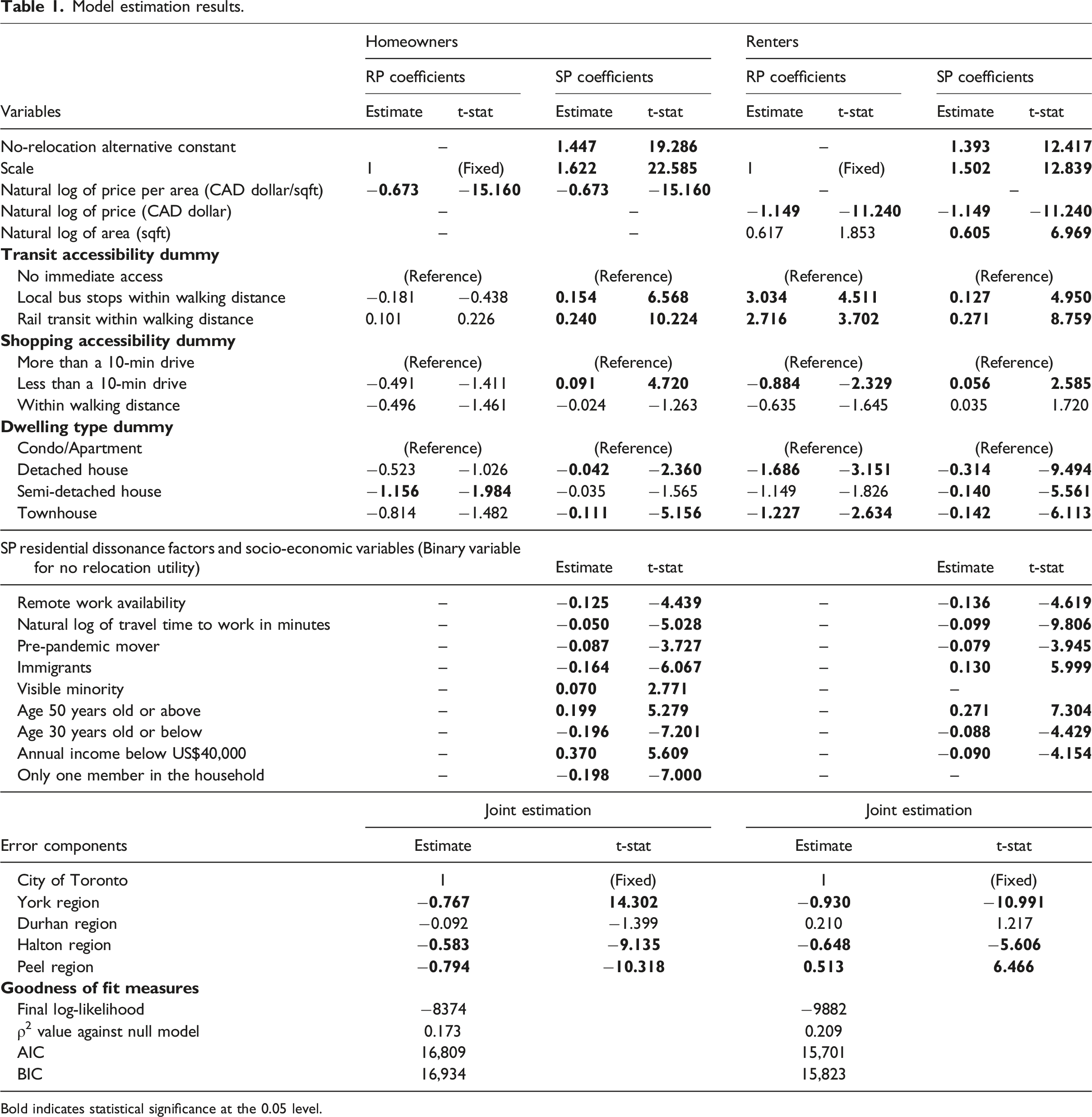
Bold indicates statistical significance at the 0.05 level.
In the SP model specification, only the current residence alternative is assigned an Alternative Specific Constants (ASC) parameter in its utility function to represent the inertia toward the current residence due to any unobserved factors. This can be considered as a no-relocation ASC. The other alternatives lack distinctive identifiers beyond their attributes, so their ASCs are fixed to zero. Similarly, in the RP model specification, the ASCs of all alternatives are fixed as zero, including the current residence. This is because the RP alternatives are the alternative dwelling units that the respondents considered during the search for their current residence. Since the previous residence is not included as an alternative in the RP model, the no-relocation ASC is not included in the RP model specification. The estimated parameters such as price, level of transit and shopping accessibility, and other related factors are discussed below to understand whether and how they contribute to the existence of residential dissonance.
Dwelling attributes and accessibility variables
Since the survey design employs an adaptive approach, both price and living area parameters are calculated and presented to the respondents based on the price or rent of their current residence. This ensures that the survey respondents faced appropriate choices within their budget range. In the homeowners’ model, price per square foot (CAD dollar/sqft) is included to capture the combined influence of price and area. However, in the renters’ model, total rent is used directly as a variable instead of rent per area. This distinction is made because rental prices do not consistently scale with unit size; instead, they tend to vary by dwelling type, with each type typically falling within its own rental price range. Rather, the area is added to the renters’ model as a separate variable. Due to the larger magnitude of area- and price-related variables compared to others, they are log-transformed in both models. Furthermore, given that SP alternatives were adapted to respondents’ budget ranges, it is believed that the (dis)utility associated with housing cost remains consistent across RP and SP contexts. Therefore, in both the homeowners’ and renters’ models, the corresponding price variables are jointly estimated across RP and SP choices using a common coefficient. The estimated coefficients for both price variables appear to be negative and statistically significant. The coefficients for the area variables in the renters’ model are positive in both RP and SP choices, although it is only statistically significant at a 90% confidence level in the RP choices.
To further examine the sensitivity of relocation choices to housing price, average treatment effects (ATEs) are calculated for the probability of choosing the current residence (i.e., no-relocation) in both models. The price of the current residence (i.e., rent or price per area) is systematically adjusted when computing ATEs. The adjusted price values range from 50% below to 50% above the original price. For each price adjustment, the change in the no-relocation choice probability is computed relative to the baseline value. These changes are then averaged across all observations to obtain the ATEs. The results on both RP and SP no-relocation choice probabilities are illustrated in Figure S3 and Figure S4 of the Supplementary Material for homeowners and renters, respectively. The figures show that variations in housing prices can significantly influence the likelihood of remaining in the current residence. The effect is particularly strong in the SP context. For example, a 10% reduction in rent can lead to a 4% point increase in renters’ SP no-relocation choice probability. In contrast, the effect of price change is smaller for the RP no-relocation choice probability. This is probably because the RP alternatives have relatively similar price values. Even with changes in the price of the current residence, the differences in prices between RP alternatives are not as significant as in the SP scenarios, in which the broader price variation allows for a clearer observation of respondents’ sensitivity to price in a controlled setting.
Regarding the estimation results for the transit accessibility dummy variables, the findings align well with our expectations. The attribute level “no immediate access” is set as the reference dummy during the estimation process. Both models show positive and statistically significant estimations in almost all cases, except for the homeowners’ RP choices. In contrast, their SP choices show clear preferences for both medium and high levels, with a stronger inclination toward the highest level. This indicates a certain discrepancy exists between homeowners’ preferred and actual level of transit access. In the renters’ model, although the dummy variables are statistically significant in both RP and SP choices, their estimations indicate different preferences. Renters appear to favor the highest level of transit access in SP scenarios, but their RP choices lean toward mid-level accessibility. When choices are purely hypothetical, it is not surprising to observe that homeowners prefer the best level of the attribute. Nevertheless, the reality of market competition may compel them to settle for lower levels of accessibility or not take it into account for making relocation decisions. Similar observations have been noted in studies from other countries. Through a sample of German residents, Schimohr et al. (2023) discovered dissatisfaction with transit services as a motivation to relocate, especially among non-urban residents. A study in China found that perceived accessibility is significantly associated with residential dissonance (Hu and Ettema, 2023). These suggest that dissonance in residents’ transit accessibility is not an isolated situation in the GTA, but also in other areas.
Unlike the transit accessibility dummy variables, the shopping accessibility dummy variables show different directional effects across tenure groups. Only the dummy variable for “less than a 10-min drive” is positive and statistically significant in the homeowners’ and renters’ SP choices. This indicates homeowners’ and renters’ tendency to favor proximity to their favorite shopping destinations, although walk accessibility is not considered a significant bonus. This finding may be explained by the fact that active transport modes are not usually preferred for shopping trips among GTA residents. However, this variable is negative in the renters’ RP choices. The opposite sign implies that better access to shops may become a disutility in the renters’ RP choices. It is possible that rents are higher in alternative residences that are closer to shops, which reduces the renters’ likelihood of selecting them. Nevertheless, the preference for the medium level of access to shops in both renters’ and homeowners’ SP choices implies that a certain dissonance may exist in this aspect.
The dwelling parameters are also dummy variables in the model specification, with the condo/apartment category as the reference. A preference for condo/apartment units is observed in renters’ RP and SP choices. Although a similar preference is observed in the homeowners’ SP choices, the magnitudes of those coefficients are relatively small. This observation may relate to the fact that the survey collected more respondents from the younger generation, who are in the earlier stage of the housing ladder and may find condo/apartment units more affordable. In addition, condo/apartment buildings are often located in dense urban areas with better access to public transit, which aligns with the respondents’ preference for higher transit accessibility.
Stated preference residential dissonance factors
To explore the patterns of residential dissonance among different demographics, several tests involving various factors are conducted to understand their influence on the tendency to stay at the current residential location. These factors are incorporated into the utility function of the no-relocation decision. If the coefficient of a variable is negative, the decision-maker is less likely to stay at the current residence and more likely to relocate.
The first variable examined is the availability of the telecommuting option. This is to understand whether different telecommuting options can influence residential relocation decisions. Dummy variables representing hybrid and fully remote options were tested, and only the fully remote option appeared to be statistically significant in both models. The negative coefficients reveal that both renters and homeowners are more inclined to choose relocation when given the option to work remotely. This finding also suggests that the availability of remote work can significantly impact residential dissonance. It differs from the conclusions of the pre-pandemic literature, suggesting that a statistically significant relationship cannot be identified between telecommuting and relocation decisions (Ettema, 2010; Kim et al., 2013; Muhammad et al., 2007; Ory and Mokhtarian, 2006). However, some recent studies presented similar observations, such as Stefaniec et al. (2022) who conducted a survey targeting white-collar workers in Ireland in 2021. Their results show that nearly half of the respondents would consider relocating based on WFH availability. The similarity in post-pandemic findings confirms that the influence of telecommuting is worldwide, and it is important to study its long-term effects on residential dissonance and relocation decisions. In addition, hybrid and on-site work settings were also tested to find whether they trigger residential moves. However, they are not included in the final model due to the statistical insignificance of their coefficients. This shows that indicates that decision-makers do not differentiate between hybrid work and on-site work settings, and having these options does not increase the likelihood of relocating.
In addition to telecommuting options, commuting time is another critical factor that may contribute to residential dissonance and influence relocation decisions. To evaluate its effect, log-transformed commuting time (in minutes) is included as a continuous variable in the utility function of the no-relocation alternative. The estimated coefficient is negative and statistically significant in both models, suggesting that longer commuting times increase the likelihood of relocation for both renters and homeowners. This finding is consistent with the intuitive expectation that individuals facing long commutes may prefer to move closer to their workplaces.
Furthermore, the direct effect of the COVID-19 pandemic on residential dissonance is investigated by separating individuals who made a residential move before the pandemic. The dummy variable “pre-pandemic mover” is set to one for respondents who relocated before the outbreak of the COVID-19 pandemic. The hypothesis is that the individuals who had not moved since the start of the pandemic might show a stronger inclination for relocation due to any lingering residential dissonance. The coefficient for this variable is negative and statistically significant, indicating that those who moved prior to the pandemic are more likely to relocate again. This implies that pandemic-induced residential dissonance may not have fully dissipated in the GTA at the time of the survey.
Several socio-economic variables are also incorporated to explore preference heterogeneity and its connection to relocation tendency. Statistically significant variables include age, income, household size, immigration status, and visible minority status. The estimates from both models show that respondents aged 50 and older are more likely to remain in their current residences, while those aged 30 or younger are more likely to relocate. Additionally, homeowners living in single-person households are more likely to move. This may be because younger adults are more frequently exposed to life transitions that may introduce residential dissonance, such as entering the workforce, changes in household structure, or challenges related to housing affordability. Likewise, single-person homeowner households may also face greater flexibility or need for change. In contrast, older adults may prefer to stay due to more stable lifestyles and household structures.
Since residential dissonance is often tied to wealth, annual income is also examined in the models as a potential dissonance factor. The survey respondents reported their income in categorical ranges. Therefore, various dummy variables representing different categories of annual income are tested accordingly. An annual income below US$40,000 was found to be statistically significant in both models, although with opposite directional effects. The coefficient is negative in the renters’ model, suggesting that lower-income renters are more likely to relocate, probably due to affordability-related housing dissatisfaction. Conversely, the coefficient is positive in the homeowners’ model. It is possible that lower-income homeowners do not experience dissonance like the renters, or their relocation decisions are limited by the fact that moving into a new residence is costly in term of time and money.
The empirical analysis also explores the choice behavior of members of visible minorities and immigrants in the GTA to ascertain if their decisions differ from other groups, potentially indicating the presence of residential dissonance. For this purpose, binary variables are tested for each group in the utility function of the no-relocation alternative to observe any disparities. The variable for immigrants turns out to be statistically significant in both models but with contrasting directional effects. Its coefficient is negative in the homeowners’ model, suggesting that immigrant homeowners are more likely to move from their current residence. Conversely, the renters’ model shows a positive coefficient. This contrast may suggest that immigrant homeowners are more likely to experience misalignment between their current residence and housing preferences. As for the visible minority dummy variable, it is only statistically significant in the homeowners’ model and has a positive coefficient, which does not indicate a potential presence of residential dissonance.
It is worth noting that given the scope of this study, only primary housing characteristics and transportation-related attributes are included in the SP choice scenarios. Other housing or neighborhood attributes may also influence household relocation decisions, such as housing layouts and the quality of nearby schools. In the survey, it is stated to the respondents that the housing attributes not provided in the SP scenarios should be assumed to be the same as their current residences. This statement is intended to minimize the situation in which the respondents keep choosing their current residence just because they feel there is insufficient information on alternative residential choices.
Discussion and conclusion
This paper investigates household preferences toward residential locations and the potential dissonance between their preferred and actual residential location choices. Utilizing survey data collected for a sample of recent movers in the GTA, joint RP-SP error component mixed logit models are estimated to identify the determinants of residential location choices and the existence of residential dissonance in the region. Separate models are estimated for homeowners and renters because of the potential differences in residential preferences between the two groups. The estimated coefficients between RP and SP components are compared to identify the existence and extent of residential dissonance, and two key findings are identified. First, a disparity was found in transit accessibility between homeowners’ preferred and actual residences. Homeowners value both the medium and high level of transit access in hypothetical residential locations, with a greater preference for the highest level (i.e., rail transit and local bus stops within walking distance). In contrast, neither transit access level appears to be significant in the RP choices. This suggests that homeowners may experience dissonance in terms of transit accessibility. However, such disparity is not found in the renters’ model. Second, a preference toward the medium level of shopping access (i.e., shops are less than 10 10-min drive) is only observed in renters’ and homeowners’ SP choices. Meanwhile, walk accessibility to shops is not considered a significant bonus by both renters and homeowners.
Furthermore, another objective of this study is to explore the relationship between telecommuting availability and residential relocation decisions. To this end, variables representing telecommuting options and the COVID-19 pandemic are also included in the models to test their effects on residential preferences and dissonance. The estimates indicate that both homeowners and renters are more likely to consider relocating when remote work is available, highlighting a potential link between telecommuting and residential dissonance. The pre-pandemic mover variable is also significant in both models suggesting that those who moved before the pandemic may still experience factors prompting further relocation. This may reflect the lingering effects of the pandemic period not fully captured by the variables included in the model, such as shifts in daily routines or evolving priorities related to home and work.
Additionally, a set of socio-economic variables is included to account for taste heterogeneity and to examine their associations with relocation tendencies. The model estimates show that respondents aged 30 or younger are more likely to consider relocating, while those who are 50 years or older tend to stay in their current homes. Meanwhile, immigrant homeowners show a stronger inclination to move, which may reflect mismatches between their current and preferred residence. Lastly, lower-income (i.e., annual income below US$40,000) renters are also more likely to move, possibly due to affordability-related dissonance.
This study contributes to the literature in two aspects: (1) identify the existence of residential dissonance through RP-SP data, and (2) uncover the significant effect of telecommuting on residential relocation decisions. The abovementioned findings of this study can help update our understanding of residential dissonance coming out of the pandemic era. With remote working becoming a popular work arrangement since the pandemic, policymakers must pay attention to the shifts in residential preferences and dissonance induced by remote working. Similar conclusions drawn from studies in other countries also prove the importance of investigating the long-term effects of telecommuting on residential location choices. This study serves as a starting point for identifying the residential dissonance associated with remote working. It encourages researchers worldwide to investigate the spatial influence of remote work on residential relocation decisions and its potential effects on “telesprawl.ˮ
However, like any other research, this paper is not without limitations. The main purpose of this paper is to present the recent movers’ survey and an empirical analysis aiming to reveal survey respondents’ choice behavior to shed more light on survey findings. The observed patterns are not intended to be extended for policy recommendations, as this would necessitate a deeper analysis that includes other survey parameters beyond the choice dataset. Future studies are recommended to perform comprehensive investigations of other factors collected from the survey to understand their impacts on residential relocation decisions. Factor analysis is recommended for data on the importance of accessibility, dwelling attributes, and neighborhood characteristics. Additional modeling exercises can be conducted to examine the influence of such preferences or attitudes on relocation decisions and provide policy recommendations accordingly. In addition, it is not within the study’s scope to identify first-time homebuyers and their relocation behavior. Future studies can pay special attention to first-time homebuyers, who may exhibit unique relocation behavior given different reasons for purchasing a dwelling for the first time.
Supplemental Material
Supplemental material - What drives you to relocate your home? Investigating preferences and residential mismatching of recent (prior to COVID and during-after COVID) movers in the Greater Toronto Area
Supplemental material for What drives you to relocate your home? Investigating preferences and residential mismatching of recent (prior to COVID and during-after COVID) movers in the Greater Toronto Area by Yicong Liu, Saeed Shakib, Christopher D. Higgins, Steven Farber, Eric J. Miller, and Khandker Nurul Habib in Environment and Planning B: Urban Analytics and City Science.
Footnotes

Funding
The authors disclosed receipt of the following financial support for the research, authorship, and/or 26 Sage UK House Style publication of this article: This study was supported by Social Sciences and Humanities Research Council of Canada, Grant No. 430-2021-00295.
Declaration of conflicting interests
The authors declared no potential conflicts of interest with respect to the research, authorship, and/or publication of this article.
Data Availability Statement
The datasets generated during and/or analyzed during the current study are confidential and cannot be made publicly available.
Supplemental Material
Supplemental material for this article is available online.
Author biographies
References
Supplementary Material
Please find the following supplemental material available below.
For Open Access articles published under a Creative Commons License, all supplemental material carries the same license as the article it is associated with.
For non-Open Access articles published, all supplemental material carries a non-exclusive license, and permission requests for re-use of supplemental material or any part of supplemental material shall be sent directly to the copyright owner as specified in the copyright notice associated with the article.
