




Abstract
It should be recognized that women in long-distance commuting in China may suffer from unequal treatment. This study visualized gender differences and uneven reactions of women in long-distance commuting in Suzhou, China. We speculate on the potential spatial impact of employment equity among female long-distance commuters in Suzhou. The cartogram revealed that women’s average long-distance commuting is longer, and their work destinations are mainly concentrated in Kunshan and the central city, where international companies gather.
Women have long been in a disadvantaged position in the job market (Shen et al., 2021). In fact, women are willing to endure long commutes for well-paid employment opportunities (Beck and Hess, 2016). However, women who commute long distances are more susceptible to stress-related negative effects compared to men (Roberts et al., 2011). This study examines the geographic distribution of women’s long-distance commuting in China.
We use a large-scale mobile dataset to identify commuters through the method of analyzing the spatial trajectory patterns of mobile users. This methods is relatively mature and effectively characterizes the residences and workplaces of commuters (Ding et al., 2023). We collected the mobile phone signaling data from China Unicom in October 2020. Due to strict privacy protection, those data do not include users’ personal information other than gender and is aggregated into a predefined 250 m grid by location. We identified 619,500 commuters (67.5% men, 32.5% women) in Suzhou. 1
According to data from Suzhou, the average commuting distance of women (5.35 km) was lower than that of men (5.72 km). However, when commuting distances exceeded 20 km, women’s average commuting distance surpasses that of men, with the difference in commute distance increased from 126 m to 1259 m (Figure 1(a)). This finding contradicts the previous research conclusion that men commute longer distances than women (He and Zhao, 2016). Gender differences in commuting distance and the spatial distribution of women’s long-distance commuters in Suzhou, China.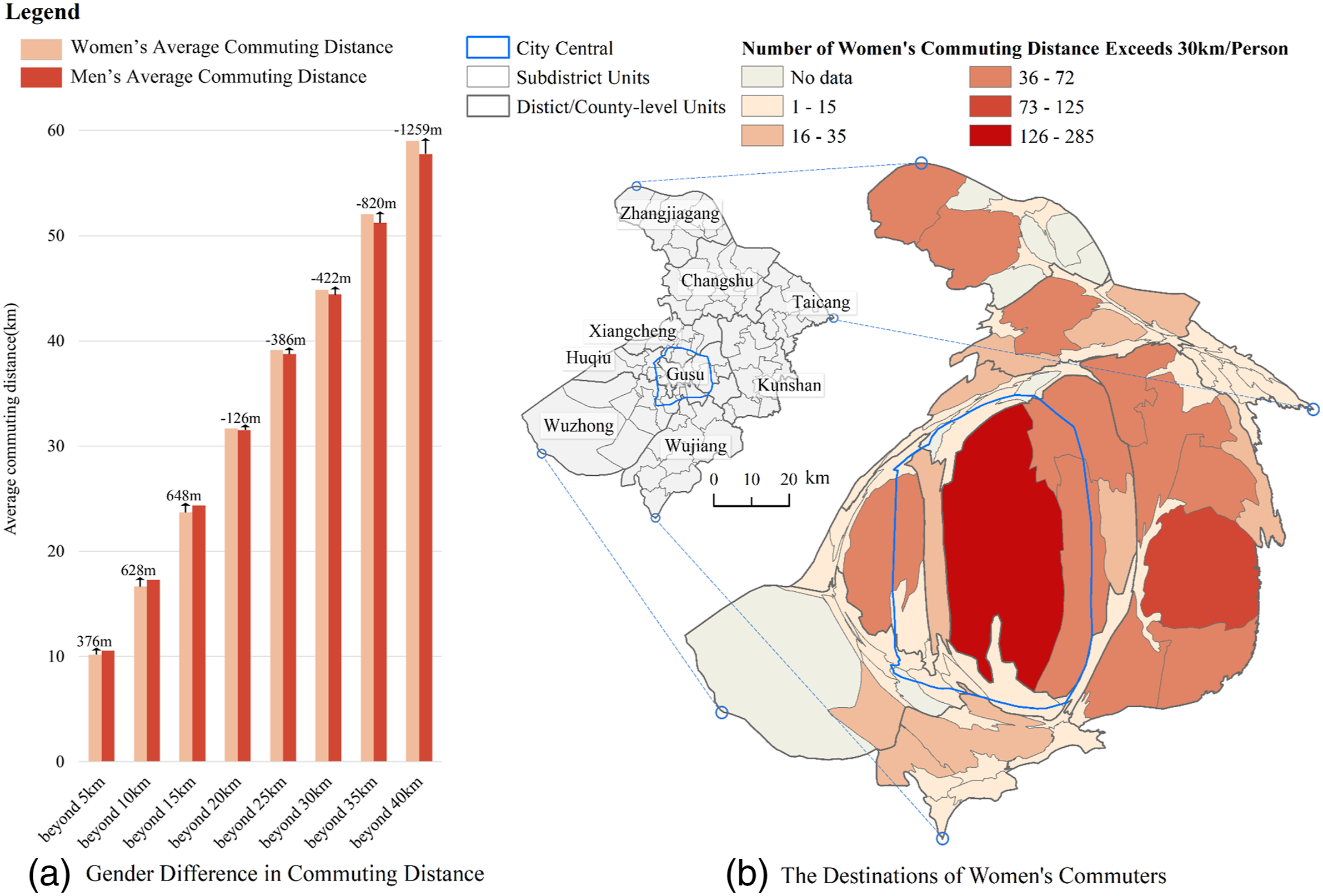
The phenomenon of female commuting is related to the hiring preferences of companies (Chen et al., 2013). Most foreign companies offer better compensation and benefits to female employees compared to local firms, which is related to the fight against gender discrimination and cost reduction (Zhou et al., 2013). Kunshan and the central city of Suzhou stand out as major employment hubs of women who commute more than 30 km (Figure 1(b)). It’s surprising that these two areas are precisely the main clusters of foreign companies, reaching 30.18% and 45.03% of the total number of jobs in foreign companies in Suzhou. We speculate that the willingness of those women to spend long-distance commuting is related to working in foreign-invested enterprises.
Female long-distance commuting is associated with personal characteristics such as high income, high education, youth, and being single (Masayuki, 2018). We compared the residential grids of Suzhou commuters with house price POIs and found that female long-distance commuters had, on average, 25.44% higher house prices compared to short-distance commuters, which proves the positive impact of high income. However, we lack other individual characteristics of female long-distance commuters in Suzhou, China. Overall, the cartogram revealed the potential space impact of corporate preferences and personal characteristics on the employment equity of female long-distance commuters in Suzhou, China.
Footnotes
Declaration of conflicting interests
The author(s) declared no potential conflicts of interest with respect to the research, authorship, and/or publication of this article.
Funding
The author(s) disclosed receipt of the following financial support for the research, authorship and/or publication of this article: This work is financially supported by the Postgraduate Research & Practice Innovation Program of Jiangsu Province (SJCX23_1698) and the Natural Science Foundation of China (Grant No.: 52008281).
