




Abstract
The literature on the diffusion of innovation from the 1970s has found that a domestic inter-urban hierarchy was the most common conduit for the innovation diffusion. Has this hierarchy become obsolete in today’s globalized economy? As less-developed cities within a developing country absorb technological innovation directly from overseas, is the nationality of cities becoming less important? Contemporary economic geography literature tends to answer these questions in the affirmative. This study challenges that resounding yes. Through our analysis of Chinese patent licensing data, we find evidence not only for the survival but also for the reinforcement of the domestic inter-urban hierarchy. While it is true that the number of cities licensing patents to import technology from overseas has been increasing, it is being outmatched by the domestic patent licensing from the top-tier cities within China. This development demonstrates that the role of the nation as a spatial unit of knowledge production and application has remained constant throughout, even as the technological level of its cities has improved under the increasing globalization of the national economy.
Keywords
Introduction
In the 1990s, many researchers argued that the globalization since the 1970s led to the demise of the nation state (Sinclair 1994; Strange 1996, among many others). This “strong theory of globalization” was quickly disproved by research that showed the evidence of the national state’s persistent significance (Brenner 2004; Jessop 2002). Despite such disapproval in cognate disciplines, within urban and regional studies, a strong theory of globalization seems to have survived in its implicit forms. Few authors directly approve the strong theory of globalization, but many do so indirectly by studying almost exclusively a city within the context of global economy with little attention to the national economy.
Against this backdrop, this paper tests whether strong globalization theory is true. More specifically, we examine inter-urban patent licensing networks in China to determine whether the less-developed cities continue to be dependent upon more advanced counterparts within the country for new technology or if they increasingly acquire new technology from foreign cities. The literature on absorptive capacity and knowledge sourcing would suggest that as China’s technological sophistication levels up, the less-developed cities should become more capable of sourcing the required technology outside of the nation. If this is true, the strong theory of globalization is validated. However, it is also plausible that the repeated transfer of technology from developed cities to less-developed cities within China makes the latter increasingly dependent on the former socially, institutionally, and technologically. If so, the domestic hierarchical flow of technology will persist. To determine which model is closer to the reality, we apply network analysis techniques to patent licensing data in this paper.
In section 2, we show that the two models have been implicit in the urban and regional economic development literature for much longer than has been acknowledged and they appear in implicit forms in contemporary literature. Section 3 presents the methodology used to test the two models. This is followed by a presentation of the findings in section 4. Section 5 then expands on these findings by reporting the morphological details of knowledge flow networks in China. Section 6 concludes the paper. Further details of methodology and findings can be found in the supplementary material.
Two models of inter-urban knowledge diffusion in a globalizing economy
In the 1960s and 1970s, the literature on the diffusion of innovation tended to assume that technology filters down from the largest cities in each country to smaller cities. In this model, innovation first spreads from the origin of the innovation to the largest cities of nations, irrespective of the geographical distance between the former and the latter. Once established in the biggest cities, geographical proximity becomes a factor, and innovation trickles down from the largest cities to surrounding cities. Applying this hierarchical model, Hägerstrand described how foreign inventions such as postal check services, automobiles, and telephones arrived in Sweden, were first accepted in the largest cities, and later spread to smaller cities and rural towns. His groundbreaking work was followed by anglophone empirical works on the diffusion of cable TV (Brown et al., 1974), the adoption of quantitative techniques in British geography (Whitehand, 1970), and many others (Berry, 1967; Gould, 1969).
If one uses this model to discuss the relationship between cities and the national innovation space, one will predict that technological innovation in an advanced city in country A will flow to an advanced city in country B and then filter down to lower-ranked cities in country B. We will call this view the domestic hierarchy model (“DHM” hereafter) because it focuses on the hierarchy within a nation’s innovation space. It should be noted, however, that the DHM discussed here is a modified version of the original. The original DHM is based on a linear model of innovation that sees innovation as a perfect formula ready for implementation. We assume an incremental innovation model, which has become more widely accepted in recent decades, to provide a more detailed explanation of the persistence of DHM. In the incremental model, the application of innovation requires a significant amount of learning, which slows the diffusion of the innovation. Once an innovation is successfully applied, learners can use this innovation to create new innovations (Ali, 1994; Dewar and Dutton, 1986). Those new, derivative innovations reduce the gap between core and learner cities. However, the gap would not disappear because core cities typically produce breakthrough innovations while learner cities produce innovations derived from breakthrough innovations.
The DHM, once prevalent, has failed to maintain its influence in contemporary studies of urban economies. Most researchers seem to have focused on the urban and global scales, presenting what we call in this paper the Globalization of Cities Model (GCM). GCM is related to the strong theory of globalization that we mentioned in the introduction. If the nation as an economic unit loses its dominance and cities are directly connected to the global economy, what we will see in the technology space is that companies in one city source needed technology across the globe irrespective of the national border. An extreme version of the GCM, that is, a global knowledge space where national borders have absolutely no influence, would not be explicitly advocated by many. However, we find that contemporary researchers of urban and regional economy implicitly approve a moderate version of it. Let us check how GCM is assumed in the three related bodies of literature in contemporary economic studies of cities: relational economic geography, global production networks, and multiple proximities.
First, relational economic geography (Bathelt and Gluckler, 2003; Sunley, 2009) tends to focus on the globalization of cities, paying less attention to the nation as a spatial boundary of innovation or knowledge flows. For example, Bathelt, Malmberg, and Maskell’s (2004) notion of “global pipeline and local buzz” distinguishes local from non-local flows of technology, with little mention made of national flows. Innovation is either generated within the city or it comes from outside. Whether the “outside” is another city within the same country or a city in another country is not a major concern. Many studies in this line treat a city’s interactions with other cities within the same country same as a city’s interactions with foreign cities.
Similarly, the global production network school (Coe et al., 2004; Yeung, 2016; Coe et al., 2008) often, if not always, assumes that resources are inherent to either a multinational corporation or to a city. Whether the geographical location of an MNE's know-how is a domestic city or a foreign one is not an important concern. The multiple proximities view that is often used in the two approaches discussed above seems to be more compatible with GCM than with DHM. Initially, the proximity debate mainly emphasized the benefits of spatial proximity (Sonn and Park, 2008; Storper and Venables, 2004). However, as the discussion has progressed, it was widely accepted that non-spatial proximities such as cognitive, cultural, social, and organizational proximity, can facilitate information exchange as much as spatial proximity can (Knoben and Oerlemans, 2006; Paci et al., 2014; Boschma, 2005). When spatial proximity is not the only type of proximity, businesses would be less bound by the national borders in information exchanges. The “global pipeline” of information can be created and function across national borders.
Unlike the three discussed above, regional innovation systems literature does not have strong GCM assumptions. While many works on regional innovation systems focus on the region itself without elucidating the role of the national border, DHM is alluded to in some works. Asheim and Coenen (2005) and Cooke et al. (1998), for example, emphasize the role of the RIS in the national innovation system, which implies a DHM. Chung (2002) and Sun and Liu (2010) claim that RIS can improve NIS, which also implies DHM. However, they do not explain exactly how RIS improves NIS. Sonn and Kang (2016) study the national dimension of RIS, but their focus is mainly on national politics and policies, with little attention given to the relationship between NIS and RIS. From our point of view, neither GCM nor DHM has been explicitly discussed in RIS literature.
As discussed above, four of the most influential theories and approaches in urban and regional economic development are not concerned with this paper’s topic. Then, does any other work outside of these four address the issue? Within our reading, no, except for Seo and Sonn (2019). Their work explicitly deals with the relation between the nation and the city in the technology space, but only with significant methodological limitations that we will discuss later.
Research strategy
China as the testing ground
DHM and GCM as two ideal types should not be too difficult to understand. However, treating them as competing hypotheses for an empirical test is another matter altogether, since pure forms of DHM and GCM do not exist in the real world. In today’s globalized economy, businesses in a city should and do look globally for needed technology, as the literature on knowledge sourcing partly shows (e.g. Monteiro 2015). Thus, it is quite likely that local and global connections are increasing simultaneously. We still want to distinguish between DHM and GCM, because the hierarchy in the knowledge space is in question here. Whether domestic core cities maintain their dominance over non-core cities, or whether the non-core cities are partially liberated from the domestic hierarchy by establishing direct connections with the global core, is an important question for understanding the spatial structure of a country. As such, the domestic hierarchy that we refer to is a relative, not an absolute, insulated hierarchy. Similarly, a pure GCM does not exist either because an existing GCM is at least partially constrained by the national borders. That is why we do not attempt to categorize systems as either DHM or GCM. Instead, we attempt to find the direction of the change from DHM to GCM or vice versa.
China’s recent rapid development provides an ideal opportunity to test the two competing hypotheses. China, which was a closed economy, opened to foreign investment and products in the 1980s. We can safely assume that, in this short period of time, many Chinese cities have greatly improved their ability to absorb innovation and their understanding of the global innovation environment. Figure 1(a) shows the annual number of patent applications from abroad from 1985 to 2021, which shows a dramatic increase since the 2000s. These data are on knowledge production, not flows, but they allow some to speculate that China is moving closer to the GCM, where mid-level Chinese cities develop and import foreign technologies without going through the top-ranked cities within China. Annual patent applications in China (a) Patent applications from abroad, 1985–2021 (b) Domestic patent applications by Chinese province (CNIPA annual report).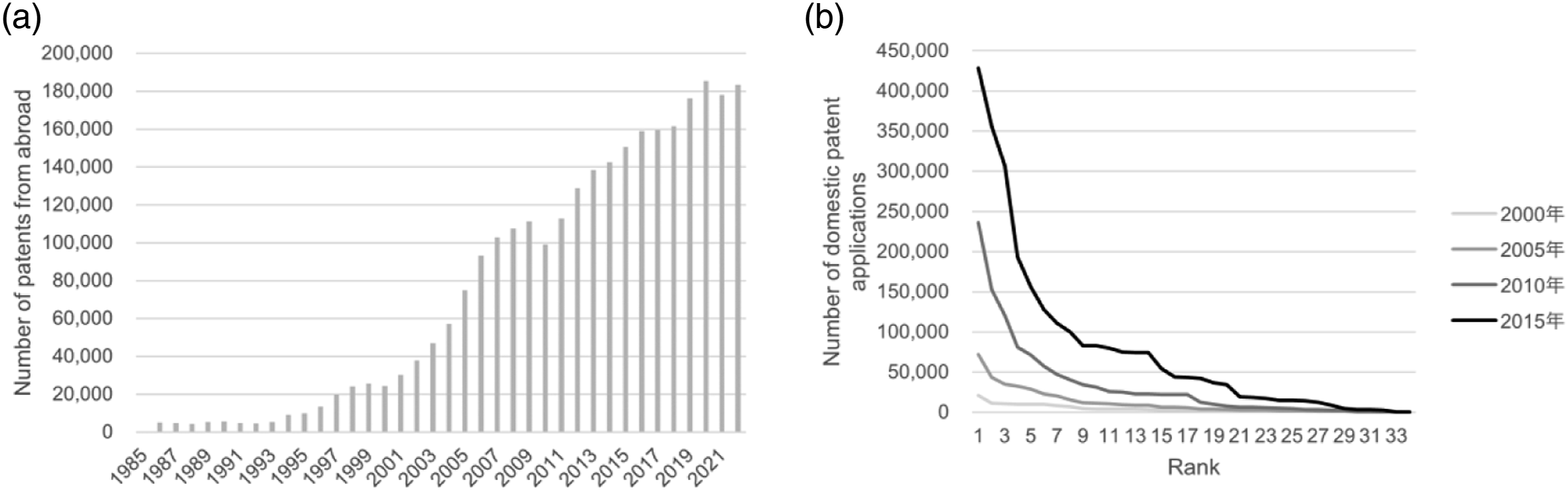
However, we can also easily write a plausible scenario of DHM. Figure 1(b) shows the number of patent applications by province in China from 2000 to 2015, demonstrating that the gap between provinces increases over time. By learning from domestic sources of new knowledge, a less-developed city, such as those in the central and western parts of China, can gradually be locked into the domestic hierarchy, which is led by advanced cities, such as Beijing, Shenzhen, and Shanghai. Under these circumstances, despite the improved technological capacity of all cities, the domestic hierarchy will be strengthened, not weakened. As such, China is one of the few countries where we can test our model.
Testing the two competing models
In this research, we use patent licensing data because they have an advantage over others in measuring the actual application of knowledge. Patent citation records (Hu and Jaffe, 2003; Jaffe et al., 1993; Maruseth and Verspagen, 2002) and co-authorship networks of patents or academic papers (Choe et al., 2016; Hu and Jaffe, 2003; Jaffe et al., 1993; Sorenson et al., 2006) are widely used indicators of knowledge flow. In analysis of Chinese patent, co-authorship has been widely used because the citation is optional in the Chinese patent system (Li et al., 2019). Both citation and co-authorship are good indicators of knowledge flow, but knowledge flow does not warrant the application of that knowledge. It is known that most patents are never used in production and remain in paper (Key, 2017). On the other hand, patent licensing is likely to represent a real application of knowledge because the licensor has to pay a royalty to acquire a license. China is also the only country, to our knowledge, that publishes complete data on patent licensing. Patent licensing data for other countries are mostly partial or outdated.
Of course, patent licensing databases, like all databases, have weaknesses. For example, subsidiaries of a multinational corporation may or may not have licensing agreements with the parent company for the use of technology. It is also possible for two companies to have general patent exchange agreements that allow one party to use the other’s patents without a license. It is difficult to estimate how much patent use occurs without licensing, but there is no reason to believe that such unlicensed use follows different spatial patterns than licensed use.
Patent licensing data were used in Seo and Sonn (2019), who tested the endurance of a domestic inter-urban hierarchy by calculating the small-world index. The index measures how well the nodes are connected, but this does not prove the stability of the hierarchical structure itself. A high score on the index can be an indication of connections between nodes of equal standing as well as hierarchically connected nodes. Another limitation of their study is that they did not consider the international linkage for each city. As mentioned earlier, understanding the relationship between a city and the national technology space requires a comprehensive knowledge of each city’s networks across city and national borders.
To go beyond the limitations of previous studies, we must first break down the DHM versus GCM question into two parts based on the two main variables: 1) domestic hierarchy among cities, and 2) global connections of cities. This breakdown is necessary because we do not have a workable method to test them simultaneously.
Figure 2 explains four possible scenarios. Figure 2(c), with a single globalized hub at the top of a strong domestic hierarchy, is a typical DHM. Figure 2(b), with multiple globalized cities, and a notable absence of a hierarchy, is a classic GCM. Figures 2(a) and (d), while plausible, are highly unlikely constructs and are included only for methodological purposes. Consider first Figure 2(a), in which one city among several cities of equal rank imports foreign technology. This structure is not probable in a developing economy. If one city receives advanced foreign technology, but other supposedly equal cities do not, the former would be in a better position to modify the foreign technology and produce its own technology that can be sold to other cities within the country, thereby creating a hierarchy and occupying its top position. Figure 2(d) shows the opposite scenario to 2(a) and is also unrealistic. If some cities can directly import technology from abroad, these cities will become much less dependent on the domestic core cities, thereby weakening the domestic hierarchy. Four possible structures of technology diffusion. Source: Authors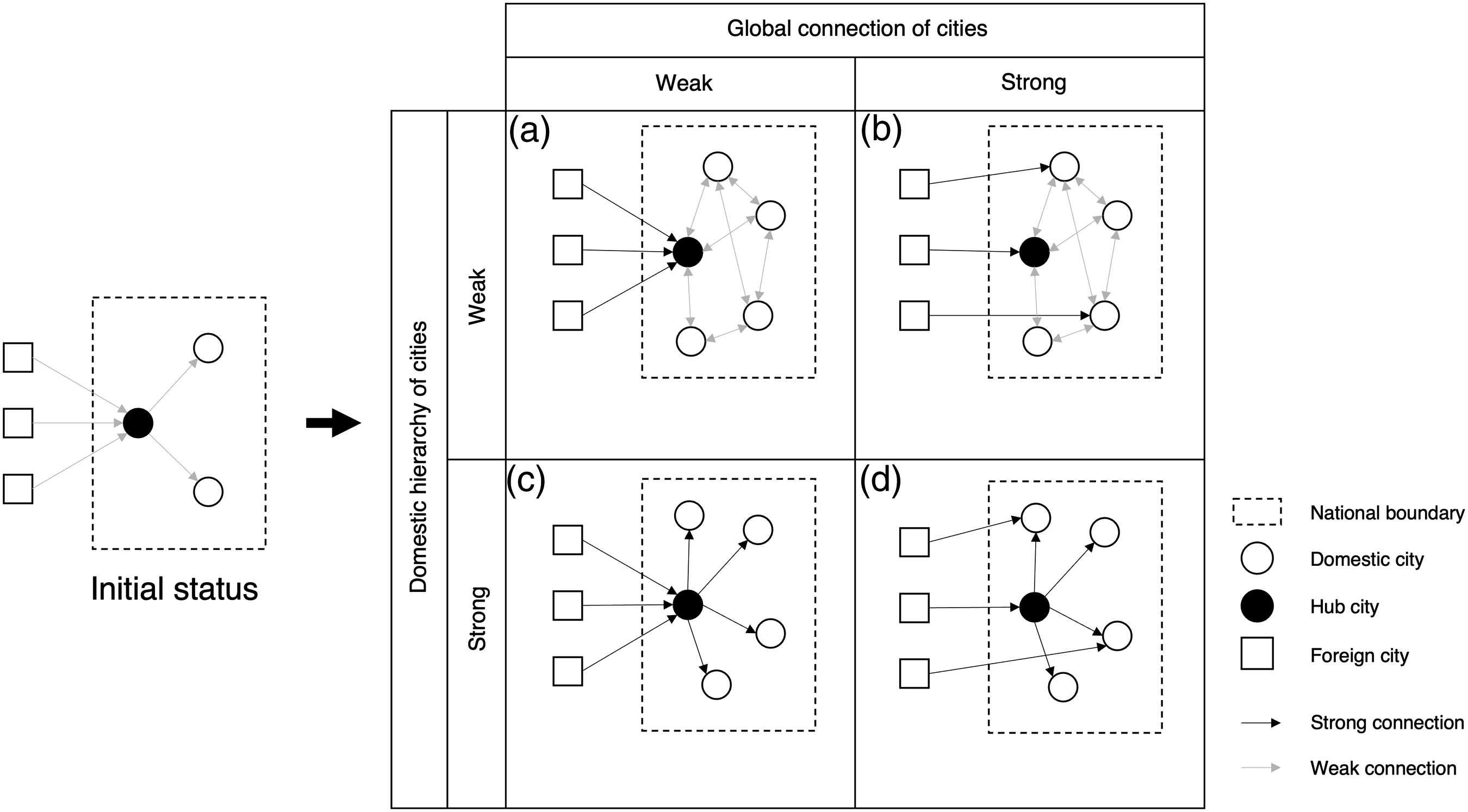
With these four models, we will test which, DHM and GCM, is closer to reality in two steps. The first step is to determine how the domestic hierarchy changed (a–b or c–d in Figure 2), and the second is to ascertain how the international connections of cities changed (a–c, or b–d in Figure 2).
Network analysis techniques are particularly well-suited for determining the hierarchical structure between cities and finding “core cities.” Network analysis techniques have been introduced in various knowledge flow studies (Sharma and Tripathi, 2017). We use the “sum of weights” (Barrat et al., 2004) as an index to identify the structure of knowledge flows between Chinese cities. It is calculated as Equation (1).
The second step is to test whether each city’s international connections are strong or weak (a, c or b, d in Figure 2). We calculate the rate of licenses from foreign sources to the total number of license agreements in each city each year to derive what we call the “globalization index.” If
Methods for further morphological understanding
After addressing our main research questions through these tests, we look at the role of each city to gain a more detailed understanding of the network. We first determine whether there are “core cities” in China’s patent licensing network, and if so, what their characteristics are and how they change over time. Specifically, we divide our analysis period into two halves to identify core cities acting as domestic hubs or international gateways. This allows us to see if the hierarchical structure of the network is centered around these cities and if their position has changed.
However, these core cities are unevenly connected to other cities, so the roles of cities can be further subdivided. By extracting clusters from the overall network, we can refine the role of each city in a particular cluster based on how it is connected to the same cluster or other clusters. For example, a city may not be a “core city” in the overall network, but it may have an important position within a particular cluster, or a city may play the role of a “connector,” connecting to multiple clusters simultaneously, even if the strength of the connection itself is weak. To make this categorization, we perform three analyses: First, we cluster the entire network using the Louvain method; second, we use z-scores to find the hubs of each cluster, which may lead to the emergence of core cities in subnetworks rather than “core cities” in the overall network. Third, we use the participant coefficient, adapted from Guimera et al. (2005), to measure the degree of connectivity with other clusters. This metric allows us to determine whether a city is connected to multiple clusters or dependent on a single cluster. Further methodological details can be found in section S1 of the supplementary material.
Database
We constructed a dataset by combining geographic information with the Chinese patent licensing database, compiled by the State Intellectual Property Organization of China (State Intellectual Property Organization, 2016). We obtained data from 1999 to 2013, which is an appropriate period because it roughly covers the period of the technological maturation of the Chinese economy. Data outside of these years are not fully available. The spatial units in this study include a mix of prefecture-level divisions and municipalities, totaling 230, excluding those with no patent licensing records. For overseas economies, we use countries rather than cities as the unit of analysis. In the end, we have a total of 32,551 licensing cases in our database. Further details on the database and the results of the exploratory analyses are provided in section S2 of the supplementary material.
Test results: Domestic hierarchy or globalization of cities?
As explained in the previous section, the model testing has two steps. Firstly, to get a picture of the changes in the domestic hierarchy of knowledge flows in China over nearly two decades, we analyzed the annual distribution of the sum of weights for domestic contracts between 1999 and 2013. Figure 3 shows the inequality of the degree distribution by year. In Figure 3(a), the x-axis represents the year, and the y-axis plots the Gini coefficient of the domestic sum of weights and the number of licensing patents in each year. According to this figure, the structural inequality of knowledge flows between cities in China has been maintained at a high level (0.72 on average from 2009 to 2013) after the rapid expansion of the network. The high Gini coefficient for China's patent network shows that core cities occupy overwhelming numbers of patent licensing contracts with other cities. This allows us to rule out scenarios a and b in Figure 2, where the hierarchy inside the country is weak. Degree of distribution inequality (a) domestic, sum of weights (out-degree) (b) international, sum of weights (in-degree).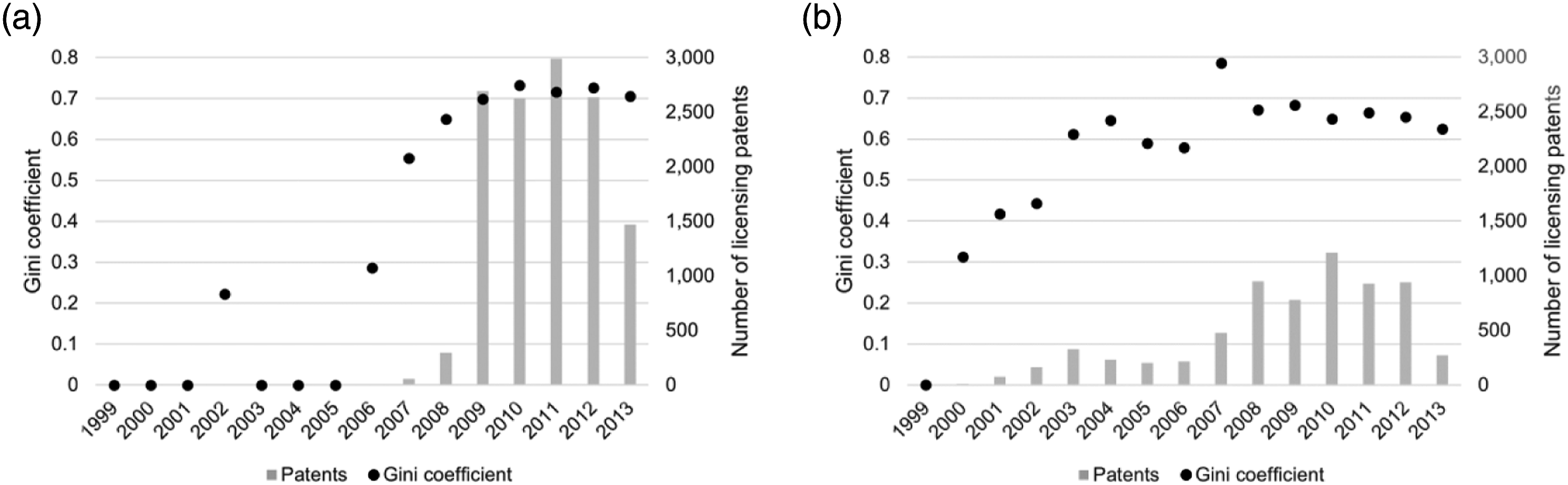
Figure 3(b) shows the degree of concentration of international contracts in certain cities in China and the gradual increase in inequality. While the quantitative expansion has not been as rapid as the domestic network, structural inequality has increased or been maintained even as the number of contracts has increased in the late 2000s. Although it is not clear from Figure 3 that the core cities in China and the other cities with a large number of international contracts are the same cities, we can infer that there are “gateways” that play a large role in knowledge flows from abroad and within the city.
We can now rejects GCM because GCM is represented by Figure 2(b). However, we cannot accept DHM until Figrue 2(c) is rejected, which requires the second step of the test. In the second step, we calculate the “globalization index” described above. As shown in Figure 4, this index dropped sharply after the expansion of China’s patent licensing network, reaching 0.1 in 2013. This means that the foreign dependence of each city in China has continued to decrease, confirming in another way that China's licensing network is moving towards DHM. Average globalization index by year.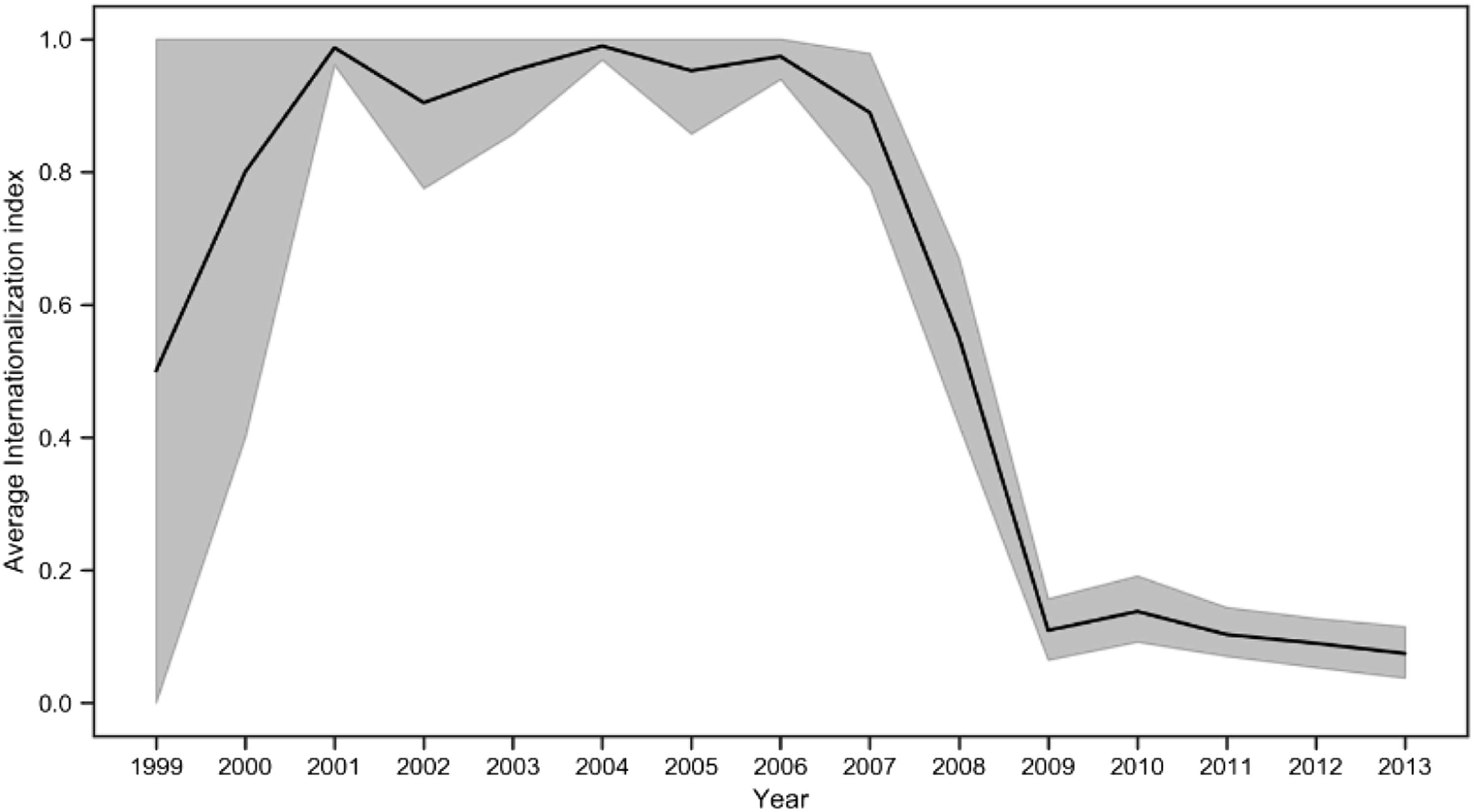
Morphological details of domestic hierarchy
Although we have established a hierarchy in the Chinese patent licensing network, we still do not know precisely what the hierarchy looks like. Which cities are at the top of the hierarchy? How are the connections around these principal cities structured, and what is the role of each city in the network? We will first examine the details of the head cities and then examine the morphology of the entire hierarchy.
The principal cities and their links
During the growth period of the Chinese patent licensing network, five cities (Beijing, Shanghai, Shenzhen, Suzhou, and Dongguan) stand out among the rest. These are cities that are involved in a significant number of patent licensing agreements in China. Figure 5 plots the number of domestic licensed patents on the x-axis and the number of international licensed patents on the y-axis. Figure 5(a) shows the results for 1999–2008, before the rapid growth of domestic networks, and Figure 5(b) shows the results for 2009–2013. In the earlier period (5(a)), these five cities accounted for more than half of both international and domestic licensed patents (57.6% international and 58.3% domestic). In the later period (5(b)), the proportion of international licensed patents was maintained at 57.7% and the proportion of domestic licensed patents was 29.1%, lower than in the previous period, but the high status of these major cities remained the same. Although there is a strong correlation between the number of domestic and international licensing contracts, some have more domestic licensing, and some have more international licensing. In these cases, we refer to the former as domestic hubs and the latter as international gateways. Domestic hubs and international gateways (a) 1999–2008 (b) 2009–2013.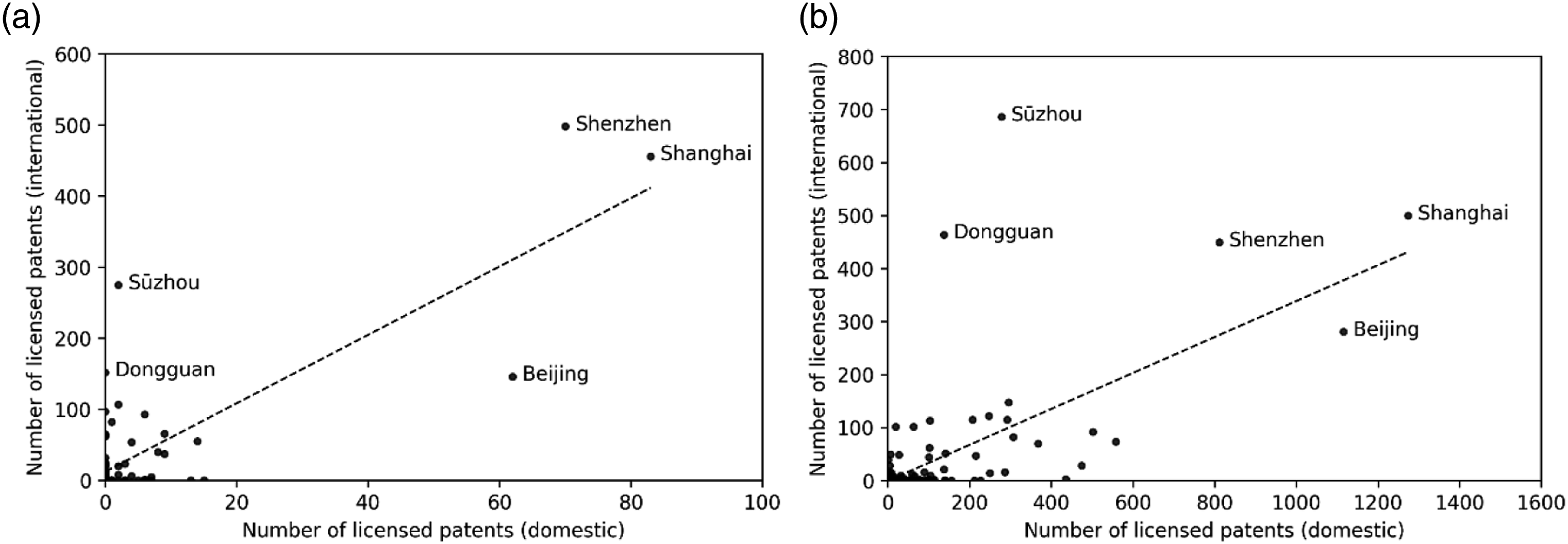
All key cities simultaneously play the roles of domestic hubs and international gateways. Since no agreed-upon criteria exist between the two, these distinctions are relative. The cities that fall below the trend line in Figure 5 have relatively more domestic licensing and thus, are domestic hubs. Those above the line are international gateways. Beijing is a good example of the domestic hub. This status is not too surprising given the fact that the city hosts innovative clusters like Zhongguancun and institutions like Tsinghua University and the Chinese Academy of Science (Zhou 2013). The R&D of foreign-invested firms in Beijing, such as Microsoft, has also increased rapidly, and the technological level of Chinese firms of all sizes has rapidly developed (Zhou et al. 2016). In contrast, Suzhou and Dongguan have a larger share of the foreign-invested enterprises (FIEs) and therefore they adopt innovations from abroad, including their parent companies (Fu 2015). Shanghai falls closer to the middle, managing to be both a domestic hub and an international gateway. Shenzhen appears between Shanghai and Suzhou/Dongguan, showing that it is an international gateway with some level of the qualities of a domestic hub. We interpret this to mean that Shenzhen, which has been known for foreign direct investment, now has large domestic firms (e.g. Huawei and Tencent) that both import and develop technology.
This skewed distribution is observed not only in the nodes but also in the links. Figure S2 in the supplementary material shows that a few links such as Taiwan-Suzhou and Netherlands-Shenzhen, account for a large proportion of the total contracts. A detailed discussion of the distribution of links can be found in Section S3 of the supplementary material.
Morphology of hierarchy
We found that a strong hierarchy persists around five major cities, and finally, we identify the specific forms of the network around these cities. Using the Louvain method, we detected the clusters in the patent licensing network and redefined the role of the city based on the eight multi-hierarchical clusters (Figure 6). The clusters are color-coded and named based on the city with the highest number of contracts. The size of the node reflects the number of patents that the city has contracted as a licensor within the country. Of the five hubs (Shanghai, Shenzhen, Beijing, Dongguan, and Suzhou) identified in Figure 5, Shanghai and Suzhou are grouped together, as are Shenzhen and Dongguan. Clusters in the Chinese patent licensing network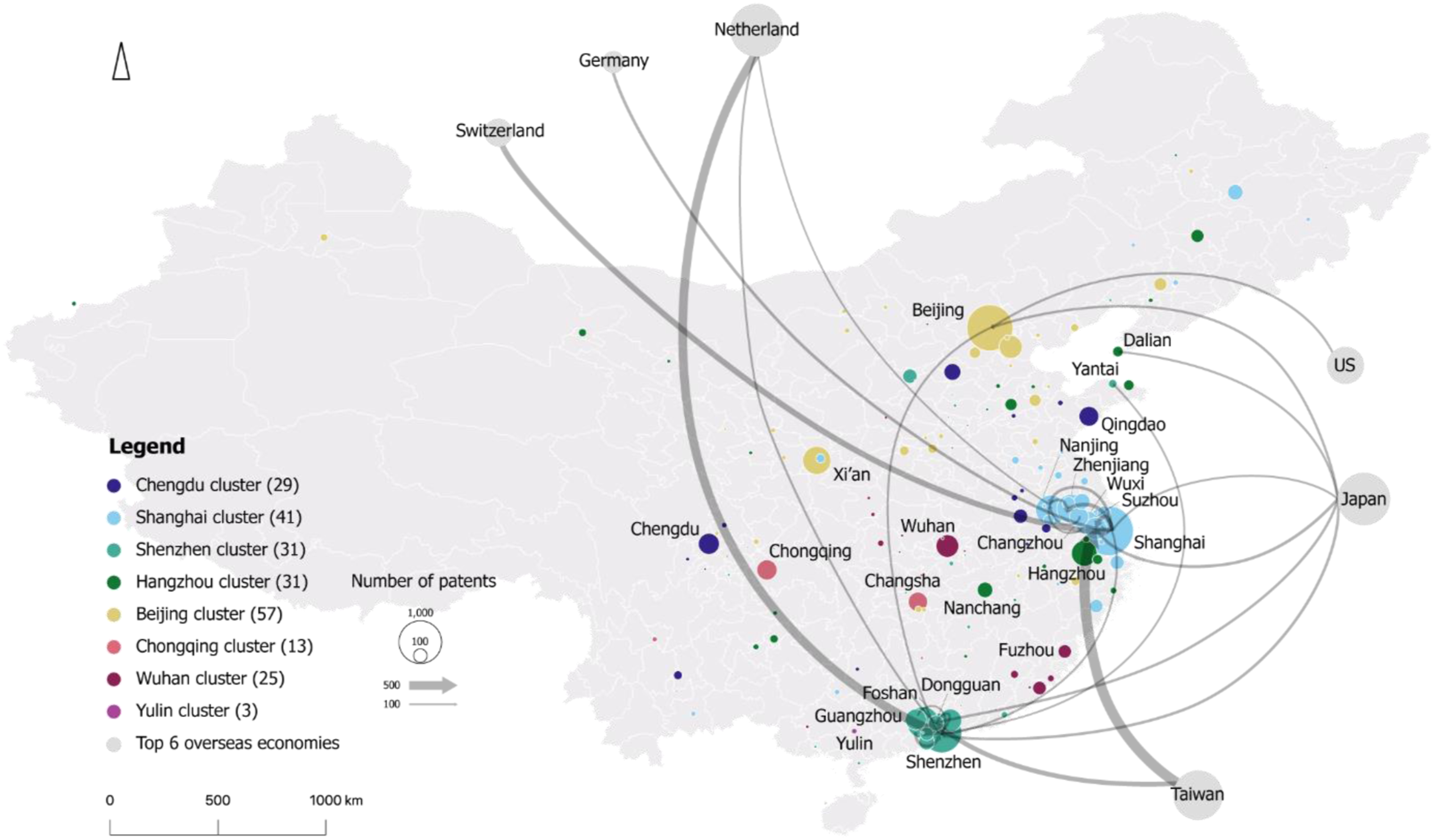
Note that clusters in this context are topological. Some clusters turn out to be both geographic and topological, while others do not. Cities in the Yangtze River Delta, such as Shanghai, Suzhou, and Nanjing, form both geographic and topological clusters. The same is true for cities in the Pearl River Delta (Shenzhen, Guangzhou, Dongguan, Foshan, etc.) and cities in the Jing-Jin-Ji area (Beijing, Tianjin, and Baoding). However, some clusters extend across space forming non-geographical topological clusters. For example, the Wuhan cluster includes cities, such as Xiamen, which are hundreds of miles away. But even the geographic/topological clusters have some offshoots. Xian, for instance, belongs to the Beijing cluster. These offshoots are likely to be the result of institutional proximy.
Figure 7 shows the overall view of the Chinese patent licensing network. The node size represents the sum of weights (out-degree) for each city. The colors of each node are defined according to the role of each city, which is discussed in Section S4 of the supplementary material. Shanghai, Shenzhen, Suzhou, and Dongguan are closely connected with foreign countries. They are like “gateways” that receive technology from outside the country and diffuse it to domestic cities. Despite the rapid development of technology, knowledge flows in China seem to have grown faster within the national borders than cross the borders. Network structure of the Chinese patent licensing network by cities’ roles.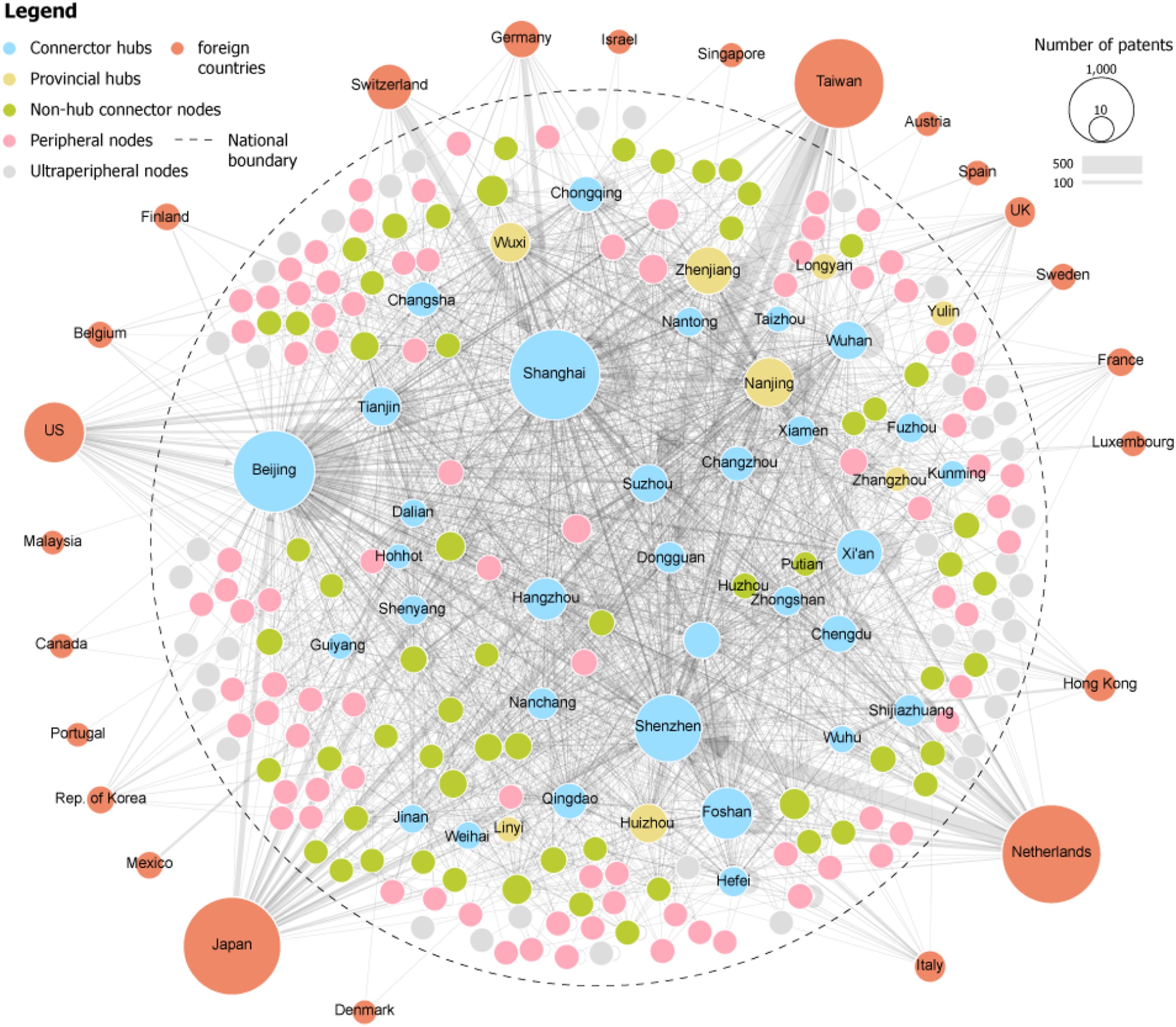
Conclusion
Since the 1990s, researchers in urban and regional economy and economic geography have tended to focus on urban and global interactions, often overlooking the nation as if it no longer matters within the economic space. In this study, we examine the inter-urban hierarchy within a nation with a focus on technology transfer to determine whether the nation still matters in the technology space. In studying China’s patent licensing, we discovered that overseas patents are increasingly licensed, but not at a greater rate than the increase in domestic patent licensing. The heads of these hierarchical structures are cities like Beijing, Shanghai, Shenzhen, Dongguan, and Suzhou, and these cities remain as heads, producing patents that are licensed out to other cities. At the same time, these heads are the main cities that acquire licenses of patents from overseas.
These findings support the persistence of the domestic hierarchy of knowledge transfer despite the widespread conviction in recent decades that globalization will put an end to it. While it is true that economic growth and technological development have increased the absorptive capacity of most cities and thus their ability to seek and use technology from overseas, this does not preclude the simultaneous strengthening of the domestic hierarchy. Hägerstrand’s and others’ multi-scalar model of innovation diffusion, which we call the DHM, seems to reflect the patent licensing networks of Chinese cities more accurately than the GCM, the prevalent model in contemporary economic geography. This finding confirms what our colleagues in urban politics, political geography and other social sciences already knew: the nation as a unit of politics, culture, and economy remains paramount. However, because the China’s patent system is still young and intellectual property rights are not always protected as required by law, some of our findings might have been affected by such fluctuations and fuzziness in intellectual property rights protection, which requires revisits of this topic in coming decades.
Supplemental Material
Supplemental Material - Is national border weakening in technology space? Analysis of inter-urban hierarchy with Chinese patent licensing data
Supplemental Material for Is national border weakening in technology space? Analysis of inter-urban hierarchy with Chinese patent licensing databy Suyoung Kang, Jung Won Sonn, and Ilwon Seo in Environment and Planning B: Urban Analytics and City Science
Footnotes
Declaration of conflicting interests
The author(s) declared no potential conflicts of interest with respect to the research, authorship, and/or publication of this article.
Funding
The author(s) received no financial support for the research, authorship, and/or publication of this article.

Supplemental Material
Supplemental material for this article is available online.
References
Supplementary Material
Please find the following supplemental material available below.
For Open Access articles published under a Creative Commons License, all supplemental material carries the same license as the article it is associated with.
For non-Open Access articles published, all supplemental material carries a non-exclusive license, and permission requests for re-use of supplemental material or any part of supplemental material shall be sent directly to the copyright owner as specified in the copyright notice associated with the article.
