




Abstract
Building coverage in urban areas is gradually increasing, inducing a lack of green spaces—a common problem for sustainable urban development. Greenery on buildings has significant low-carbon effects and it becomes an innovative approach to reduce loss of urban green spaces. This paper focused on the planning methodology for urban building greening and established the content framework including the investigation and analysis, planning proposal, and management policies. In addition, the key issues that affect planning scientificity and implementation were discussed. Quantitative models on greening potential were developed, and a combined policy system comprising incentives and mandatory measures was established. Shenzhen is a typical Chinese city densely built-up with a shortage of green spaces. The city was taken as the empirical research object to analyze the current scale and compositional, and the distributional characteristics of building greening planning. Method of estimating the low-carbon effects of building greening was proposed. The results indicate that the carbon reduction effect of existing building greening was 1.96%, which reached 5.55% under the planning scenario. Finally, the paper emphasized the need for a planning methodology to realize the large-scale refurbishment of existing buildings, and discussed the issue of planning implementation being highly dependent on public policies.
Introduction
Natural ground surfaces are increasingly being replaced by building roofs due to the sustained acceleration of urbanization. Housing construction, being the main carrier for human survival, is also a huge energy resource consumable. Building greening refers to the act of attaching plants to the facades, roofs, and other architectural spaces. As a greening method that effectively utilizes three-dimensional urban spaces, building greening is the current development trend in urban greenery and energy conservation in buildings (Oberndorfer et al., 2007). The practice has been widely promoted in developed countries. Germany has a long green roof tradition, building greening is emphasized as an important measure for alleviating storm runoff and reducing pollution sources when urban construction is embarked upon (Mentens et al., 2006). Roof greening is designated as Chicago’s major action plan to mitigate the urban heat island effect and improve air quality (Loder, 2014). Asian metropolises such as Tokyo and Singapore have also followed the international trend of green building in urban areas. For Tokyo, the Japanese National Building Law, 2005 requires the new apartment or office buildings in urban areas to have at least 20% vegetated rooftops. (Irga et al., 2017). For Singapore, the green building policy is regarded as an integral part of achieving the goal of a garden city (Tan et al., 2013). In contrast, the practice of green building in China is still at a nascent stage. The problems of tight constraints on urban land resources and deterioration of the ecological environment have become increasingly prominent with accelerating urbanization in the country. With green building beginning to receive attention in China, some cases have been implemented in Beijing, Shanghai, Shenzhen, Chengdu, and Guangzhou, especially Minhang District of Shanghai won the “World’s Best City for Green Roofs” in 2010.
Being low-carbon and energy-saving have become the hot topics of concern within societies to deal with the issue of global climate change (Dou and Cui, 2017). Recent research has identified and simulated the important value of green roofs and walls in tackling the climate issue (Manso et al., 2021). In particular, green roofs protect and thermally insulate the structural layers of buildings, indirectly producing energy-saving and emission-reduction effects, thereby promoting low-carbon urban development (Besir and Cuce, 2018). Alexandri and Jones (2008) have shown that green roofs and walls effectively reduce building temperatures, not only saving energy for the buildings but also alleviating the UHI effect in localized areas. Akbari et al. (2009) estimated that increasing the reflectivity of cities reduces summer temperatures, which is equivalent to offsetting approximately 44 Gt of CO2 emissions on a global scale. The presence of green roofs increases the attenuation of heat conduction. This significantly improves daytime thermal comfort and greatly reduces the energy consumption of buildings in summer, especially for air-conditioning (Knaus and Haase, 2020; Tang et al., 2007). The low-carbon effects of building greening inspired the current study. Presently, green building is still at a nascent stage owing to the unclear role of greening in urban management (Fan and Xia, 2018). Several dilemmas are involved, including insufficient understanding, unclear inventory documentation, and lack of proper planning. These issues impede scaled effects.
Shenzhen is a typical densely built-up Chinese city. The supply of urban land is tight, and space resources that can be used as green spaces on the ground are very limited, highlighting the need for building greening. This study aimed to promote sustainable urban development through building greening and provide practical experiences for typical Chinese cities. The first step was to design a framework for planning methodology that included the three components: investigation and analysis, planning proposal, and management policies. Second was to propose a contents system encompassing the entire process of planning and construction management for green building, and discuss key techniques that affect planning scientificity and implementation. Next, the applicability of the proposed methodology was demonstrated in the city of Shenzhen. A systematic survey of implementing building greening was conducted, together with an evaluation of its construction and development potential. These led to the formulation of development goals and spatial guidelines for building greening over the next 15 years and management policies that combined incentivizing and mandatory measures. Quantitative models were then used to verify the carbon reduction abilities of green building.
Basic ideas for building greening
Necessity: Ways to reduce loss of urban green spaces
In theory, the role and positioning of green building in the system of urban green spaces depend on a city’s stage of development. Population and industrial densities increase when a city develops. Correspondingly, large amounts of urban green spaces are eroded, coupled with drastic expansions of hard gray spaces. Many modern buildings have flat reinforced concrete roofs suitable for greening, which may have socioeconomic benefits (Jim, 2017; Eichholtz et al., 2013). The famous architect Emilio Ambasz proposed the architectural theory of green over gray. This involves attaching urban greenery to buildings, which does not occupy urban space and can concurrently solve the issue of insufficient urban green spaces (Scott, 2004). Building greening promotes the conversion of diverse spaces—from planar to three-dimensional—to green spaces, an important means of alleviating conflicts in land use and developing an urban green spaces system.
In practice, it took China less than 40 years to reach an urbanization rate exceeding 63%, which represents a highly compressed process. Consequently, conflicts between the demand for urban land and green spaces have become increasingly prominent, with Shenzhen being a typical representative of this situation. A densely built-up city in China, the level of urbanization in Shenzhen is 100%. A population exceeding 17 million congregates on a land area less than 2000 km2, with the population density of its central area being 19,700 persons/km2. However, the per capita area for the city’s parks and green spaces is only 5.6 m2, far below the minimum threshold of 10 m2 stipulated in the National Standards for Eco-Garden Cities. Given the severely limited land resources, building greening is undoubtedly an important way for Shenzhen to reduce the loss of its urban green spaces.
Importance: Buildings greening has significant low-carbon effects
In terms of the mechanism, urban buildings can be analyzed as a form of boxed enclosures; they are directly irradiated by sunlight, and heat is retained internally. A large amount of energy must be consumed to reduce the temperatures of building interiors so that normal operations and the comfort of people inside are ensured. Suitable plant species can be reasonably grown, attached, or laid upon the spatial shapes and additional structures of buildings, and their growth will have significant effects on the insulation, cooling, energy-saving, and emission reduction of those buildings (Kats, 2003). The moist substrate (soil) layer absorbs heat through vapor evaporation and prevents heat transfers to the interior; the dry substrate (soil) layer forms an excellent insulation material that similarly prevents heat transfers to the interior. Such interactions between the plant and substrate layers reduce the temperatures of building interiors and weaken the UHI effect.
Carbon emissions by buildings comprise one of the main areas for controlling total urban carbon emissions (Yang and Li, 2013). China ranks top globally in terms of floor space, with an existing urban building stock of approximately 65 billion m2. The CO2 emissions of these buildings account for approximately 22% of the country’s total carbon emissions, which is lower than the global average of 30.63% (Building Energy Conservation Research Center of Tsinghua University, 2020). The total carbon emissions of the city’s buildings have remained high in recent years, with the amount in 2019 being 53.66 million tons. Based on the city’s historical growth in carbon emissions and economic development trends, its carbon emissions peak is initially predicted to reach 65 million tons (Gao, 2013; Shenzhen Municipal Bureau of Ecology and Environment, 2021). Being potentially the first city to hit the peak carbon record in 2030, there is an imminent need for building refurbishment and greening to reduce carbon emissions.
Planning methodology for building greening
Planning ideas
Effective planning actions involve the comprehensive application of cognition, tools, and systems. The general ideas proposed in this study to plan building greening are stated below.
Value perception
Building greening is a governmental decision-making behavior involving public interest. It integrates the functionality of architectural design and procedurality of urban development, thereby forming contiguous and holistic landscape imagery and spatial experience. Roof greening is the core object of planning, and its area occupies an absolutely dominant position in all building greening.
Technical tools
Building greening is different from the traditional activities to promote urban greenery and relies on specific construction and architectural carriers. A breakthrough of the micro-scale green survey and evaluation technique for buildings must be achieved to serve as the working basis for scientific planning and decision-making.
System operation
The foci of planning include clarifying the development positioning, formulating the development goals, rationalizing the implementation mechanism, specifying the spatial guidelines, and arranging the construction schedule. The core goal is to achieve large-scale development.
Contents framework
The proposed workflow for the planning of urban building greening consisted of three components: investigation and analysis, planning proposal, and management policies (Figure 1). Framework for preparing the design of contents.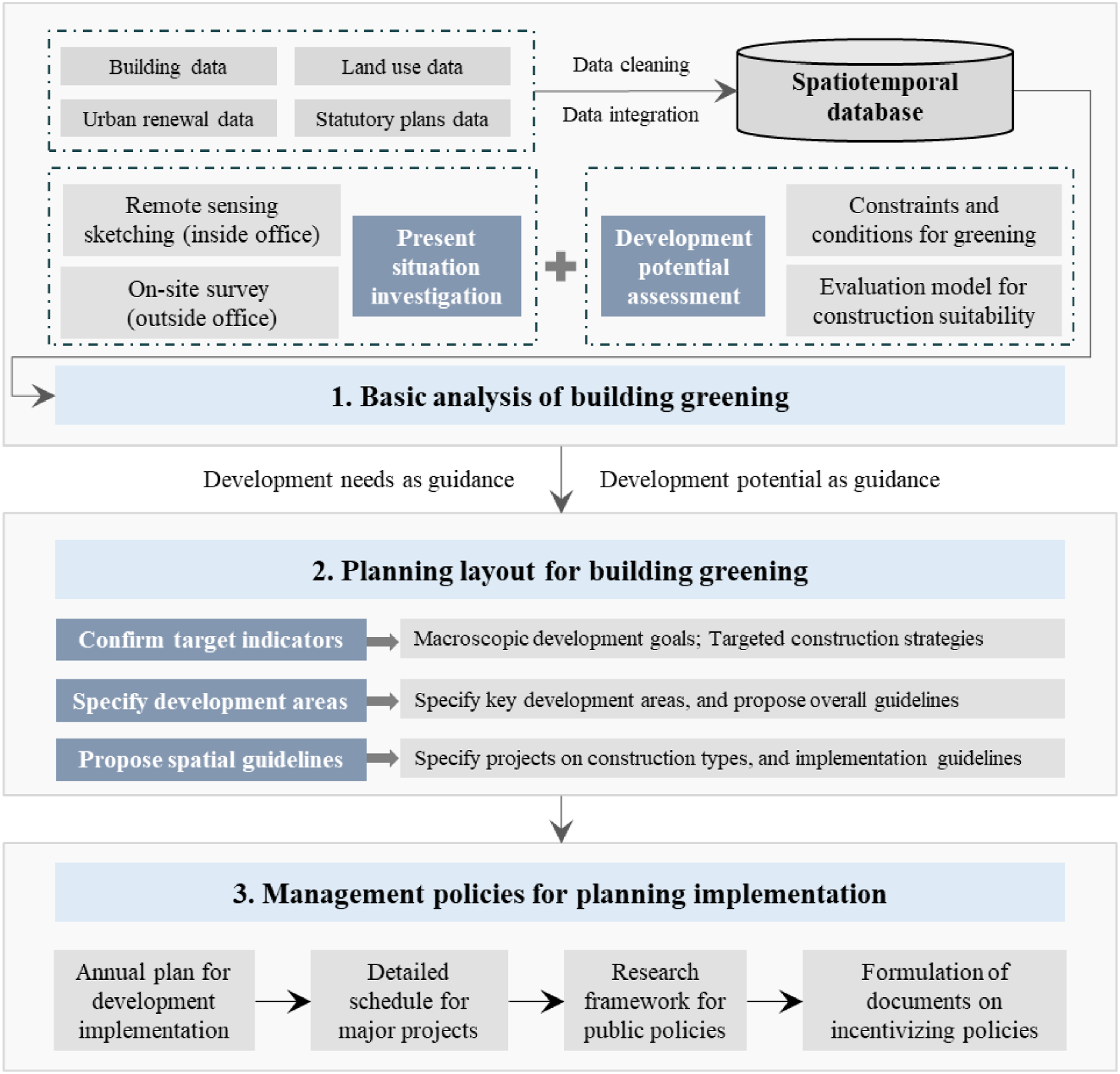
Basic analysis
The starting point of the planning methodology was to conduct a basic analysis of building greening, which must be supported by an abundance of confirmed data and innovative technologies and methods. There were two specific tasks: investigation of the current situation and evaluation of the development potential.
The first task was to survey the current status of building greening. Various techniques for surveying roof, wall, and bridge greening were developed using geographic information system and remote sensing technology as the bases. These facilitated the investigation of the basic conditions of building greening, such as scale and spatial distribution, and the determination of inventory of space resources. The second task was to assess the development potential for building greening.
Preparation of planning proposal
The basic elements were specified, including the planning scope, basis, and period. A path of spatial transmission comprising target indicators—key areas—spatial guidelines for building greening were then established, which consisted of three specific tasks.
The first task was to formulate the target indicators. The macroscopic development goals were set based on the current conditions and development potential of the planning region. Next, targeted construction and development strategies were proposed according to the characteristics and construction requirements of different types of greening. The second task was to demarcate the key development areas and propose the overall spatial guidelines. This was done by combining goal- and potential-oriented methods and considering building greening construction, urban landscape system, spatial structure, land-use layout, and social development needs. The third task was to propose spatial guidelines. The key areas served as the starting points for the breakdown and implementation of target indicators. Next, a database of key implementation projects was established by proposing the construction spaces, types, and implementation guidelines for specific projects.
Implement the formulation of management policies
Building greening has the characteristics of diversified entities in terms of construction and implementation and building social consensus through policies. The two research foci were to promote the preparation of implementation plans and formulate public policies. The first focus was to establish an annual implementation plan with the year as the time node. Detailed arrangements were made for the building greening indicators and key projects to be achieved within the period. The second focus was to formulate the relevant public policies. The laws and regulations, policies, standards, and technical specifications related to building greening were compiled. These served as the basis for proposing a public policy framework for building greening while taking into account the city’s actual situation. The framework provided the research foundation for the related management policies to be released subsequently.
Critical techniques
Two core technical issues were faced in the planning process of building greening. One issue was ensuring planning scientificity. The main difficulty of this was to find ways to determine the current situation of building greening resources through surveys and evaluate the future development potential of building greening objectively and scientifically. The other issue was guaranteeing planning feasibility, which focuses on solving the area demarcation method for spatial development and the design ideas for the policy system.
Remote sensing interpretation and field survey of greened roofs
One of the most difficult problems faced when planning building greening is the unclear inventory. The scale involved was small, the subjects were complex, and the difficulty level of surveying was high. Solely relying on traditional manual statistics would not provide comprehensive and accurate information (Shao et al., 2021). In this study, remote sensing analysis conducted inside the office and field surveys conducted outside the office were combined (Supp Figure 1). First, machine learning algorithms were used to automatically identify green spaces (including green roofs) and building outlines from time-sensitive and high-resolution remote sensing images. Data on greened roofs were digitally extracted, and their graphic boundaries were outlined, which allowed a preliminary determination of the type of greening. Next, field survey maps were prepared, and their accuracies were verified on-site, with the actual green resources recorded through photography and transcripts. Finally, modifications and supplementations were made inside the office to arrive at the survey data results. These included information on the greening plants, types of architectural carriers, and the greening construction, management, and upkeep. The survey methods involved comprehensive utilization of drone technology, on-site interviews, and collaborations with various managing departments, all of which facilitated the development of this study.
Model and techniques for evaluating the potential for building greening
The prerequisite to determine the key planning areas and planning target indicators rationally was to effectively grasp the potential carrier resources for which building greening could be implemented. A set of differentiated methods for evaluating the potential for building greening was proposed based on the characteristics of different types of building greening, main constraints, and technical parameters for greening implementation.
Model to determine the suitability of existing buildings for roof greening
The issues involved when greening roofs of existing buildings include structural safety and roof waterproofing. These are closely related to the original building design, structure, materials, and quality. We not only consider whether the attributes of the building carrier meet the conditions for the construction of roof greening, but also the attributes of the building roof itself are suitable for the construction of roof greening. Therefore, building and roof attributes are the key factors affecting the suitability for roof greening. Building attributes comprise five indicators: construction age, building structure, building quality, building height, and the number of stories; roof attributes comprise three indicators: useable area, roof loading, and roof slope (Hong et al., 2019).
The suitability model is expressed as follows

Method for estimating the greening potential of building walls
In terms of carrier types, wall greening can be carried out on three types of objects: municipal facilities (such as waste transfer stations and sewage treatment plants), commercial facilities, and new-type industrial facilities. The object recognition and case reference method were used in this study to evaluate the potential for wall greening. Object recognition involved extracting the three aforementioned building types. For case referencing, the survey data obtained above were used to carry out sample analysis of existing implementation cases. This provided the reference values for wall greening of different building types.
The point was taken as the statistical object for the greening of building walls, and its suitability model is expressed as follows

Analysis on the greening suitability of bridges
The scale of bridge greening is generally small, and the main constraining factors are the age and condition of the bridge structure and a lack of sufficient load-bearing capacity. Greening potential was analyzed from three aspects: the construction age of the bridge, its structure, and its function type. These determine whether the conditions of a bridge are suitable for greening. The suitability model can be expressed as follows

Method for identifying the key areas for building greening
The significance of demarcating key areas is that when potential buildings present spatial agglomeration, the green roofs of the building group will form a surface spatial form, thereby realizing the transformation from a singular project to a large-scale area. A method based on spatial superposition analysis was adopted in this study: using analysis of the potential for roof greening as the basis, the environmental remediation (problem-oriented), landscape improvement (demand-oriented) and future development (goal-oriented) were comprehensively considered before the key areas of greening implementation were finally demarcated (Figure 2). Among them, spaces needing environmental improvement included prominent areas that are UHIs, units with a green space rate lower than 30%, key construction areas of sponge cities, and restoration areas along urban corridors; the spaces requiring landscaping enhancement included important commercial districts, business areas, and creative industry parks; and spaces oriented toward future development included approved urban renewal areas, areas prioritized for demolition and reconstruction, and key development areas earmarked by the municipal government. Spatial analysis of the aforementioned types of spaces was conducted, as well as areas with a concentrated distribution of existing greening. The result was the comprehensively demarcated key planning areas that hold demonstrative significance. Process for identifying key areas when planning building greening.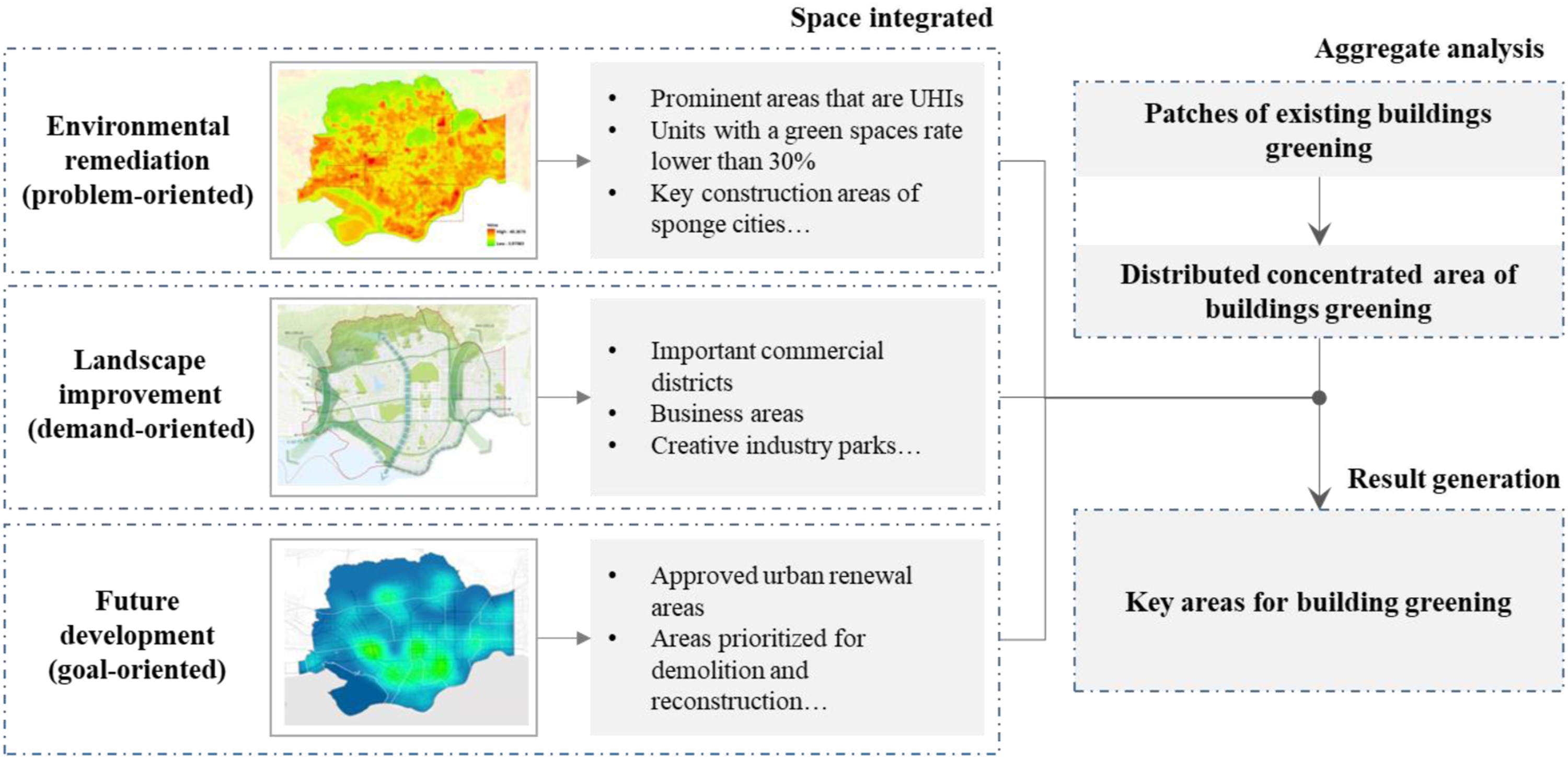
Design of public policy system for building greening
In this study, a public policy system to support building greening was designed that covered both incentivizing and mandatory aspects (Supp Figure 2). The relatedness of the policies was enhanced by investigating the basic supporting conditions, such as the legal, funding, and operating systems.
Incentivizing policies
Public policies that focus on encouraging and guiding management would be implemented to promote large-scale incremental development of building greening. Management policies included guiding directions, management procedures, preferential policies, and division of responsibilities. The government can formulate funding packages and policies providing operational support to encourage the development of building greening, thereby stimulating market vitality and forming a development structure with co-governance and sharing.
Mandatory policies
Public policies focusing on standardizing and strengthening management would be implemented to promote the sustainable development of building greening. Management policies include guiding directions, management principles, mandatory measures, and supervisory bodies. Through legislation, the government should formulate local regulations and detailed rules for implementation to ensure that building greening projects are guided by laws and proper basis. The policy focus has expanded from economic subsidies to monitoring and supervision of comprehensive factors (such as property, rights, and people) such that policy universality is strengthened.
Empirical research
Planning practice of building greening in Shenzhen
Current scale of building greening
Building greening in the city was in various forms, including roof greening, wall greening, and bridge greening. Roof greening can be subdivided into three types: heavy, hybrid, and light. There are presently about 56 × 104 buildings with a total building base area of 21,224.47 × 104 m2. Buildings occupy nearly 11% of the city’s land area. Our detailed survey showed that 377.87 × 10⁴ m2 of building roof area has already been greened, representing coverage of 1.78%. A total of 12.16 × 10⁴ m2 of wall greening had been implemented. The main building types included municipal sanitation facilities, public buildings along pedestrian streets, and commercial buildings. Of the 534 various types of bridges in the city, 294 had been greened (greening rate of approximately 55%).
Roof greening is the dominant type of building greening. In terms of greening types, the areas under heavy, hybrid, and light roof greening were 147.44 × 10⁴ m2, 115.72 × 10⁴ m2, and 90.81 × 10⁴ m2, respectively. The roof greening coverage of the city’s 10 administrative districts varied substantially (Supp Figure 3). The coverage of Futian District, at 8.56%, was far greater than that of the other districts. Next was Nanshan District, at 3.0%. The remaining districts had coverages below 3%, with Longhua District being the lowest, at only 0.4%.
Potential for building greening
Existing buildings suitable for greening were evaluated based on information on their roof area, building structure, and building type, without considering the planning of new buildings. The results indicated that 5,679 buildings (with a combined area of 859.76 × 10⁴ m2) were suitable for roof greening. Heavy roof greening can be implemented on 1,027 buildings with a combined area of 505.36 × 10⁴ m2 (Supp Figure 4). Multi-layered planting can be carried out in the future using a combination of trees, shrubs, and grass and through appropriate micro-terrain processing or planting pools; this will ensure the generation of better ecological and landscaping effects.
The potential areas for wall greening were 9.65 × 10⁴, 41.66 × 10⁴, and 6.62 × 10⁴ m2 for municipal environmental sanitation facilities, commercial services facilities, and new-type industrial facilities, respectively. The foci of bridge greening are the 26 motorway interchanges (including overpasses), including the Futian Port and Shennan Avenue–Qiaocheng East Road motorway interchanges. Transformation and enhancement of existing greening can be carried out for 24 bridges, including the Binhe Boulevard–Huanggang Village and Binhe Boulevard–Caitian Road motorway interchanges.
Development layout of building greening
Reasonable short- and long-term planning goals were set based on the evaluation results of the current and potential scales of building greening. The goal between the short term and 2025 is to achieve 600 × 104 m2 of greening area. This means that the annual plan for greening completion must not be less than 40 × 104 m2, of which roof greening must increase by more than 30 × 104 m2 per year. The target greening area by 2035 is at least 1200 × 104 m2.
The city’s greening layout is in the form of two cores, three central areas, and multiple nodes. The two cores refer to Futian and Qianhai; the three central areas are that of Haiyang New City, and Longhua and Longgang Districts; the multiple nodes refer to nearly 40 key areas such as the Futian District, Shenzhen Bay Super Headquarters Base, Shenzhen Train Station (North) Business District, Tairan Industrial District, and Zhuzilin Sub-district. The characteristics of the various key areas will be fully tapped, and different forms of roof greening construction models will be carried out systematically to promote roof greening and achieve scale effects.
Supporting policies for building greening
Overall, the supporting policy system for the city’s building greening included guidelines for construction standards, incentives for coverage of green spaces, funding subsidies for construction and maintenance, and exemption of building areas from plot ratio calculation. (a) Guidelines for construction standards: These are mandatory policies for building greening, which set up some non-negotiable construction indicators in the form of normative documents of government departments. When bridge and wall greening for all new public buildings and municipal facilities are being implemented, the actual green areas should not be less than 20% of the area suitable for greening on the carrier’s outer facade. (b) Incentives for coverage of green spaces: Building greening can be converted to green spaces on the ground. A quantitative method has been devised for converting building greening to the matching green space based on average soil thickness. For example, if the covering soil is 3 m thick or more, 90% of the land area of the matching green space will be converted. (c) Funding subsidies for construction and maintenance: For heavy, hybrid, and other types of roof greening, the reference standard for the subsidy amount is 300, 180, and 150 RMB/m2, respectively. (d) Exemption of building areas from plot ratio calculation: This refers to plot ratio incentives. Spaces such as the overheads of a building’s first or other floors or that of a tower’s ground floor are integrated with the construction of public green spaces. The floor areas of the spaces for greening are excluded from plot ratio calculations, similar to industrial and public buildings.
Low-carbon effects of planning for building greening
The UHI effect has caused the city’s high temperatures to rise sharply in summer and air-conditioning to become the main means of cooling throughout that season. High energy consumption is a key issue that needs resolution during the city’s process of becoming low-carbon. The focus of this study was the cooling function from the greening of building roofs. Compared with roofs not put to any use, green roofs have low-carbon effects that are specifically manifested as follows: first, their thermal insulation effects reduce indoor temperatures and air-conditioning use, resulting in lower power consumption; and second, lower power consumption reduces carbon dioxide emissions from power plants. Appropriate methods were used to estimate the low-carbon effects of the city’s green roofs under the current and planned scenarios.
Method of estimating the low-carbon effects of building greening
The process of building roofs being heated in summer can be divided into three stages. First, heat is transferred from the outdoor air to the roofs’ outer surface through convectional heat transfer, then to their inner surfaces by solid heat conduction, and finally from their inner surfaces to the indoor environment through convective heat transfer of air (Tabares-Velasco and Srebric, 2012; He et al., 2016). A heat transfer model was constructed to estimate and measure the amount of heat transfer from green roofs. The following assumptions were made during the modeling process: (a) the heat transfer coefficients of the inner and outer surfaces of the building envelope were affected by multiple factors, including wind speed, solar radiation, plant types, and leaf area index (Sailor, 2008). The treatment of these factors was non-differentiated in the study; (b) electricity was the residents’ main source of energy consumption. The carbon emissions arising from the power generation process were used for measurement, and (c) air-conditioning was used to cope with summer temperatures from July to September, totaling 90 days.
An important conductivity index for envelope structures is the thermal conductivity coefficient (h), numerically equal to the heat flow when the temperature and pressure between the cold and hot fluids is ∆T = 1°C and the heat transfer area S = 1 m2. The larger the coefficient, the greater is the heat flux. The static simplified calculation method (Huang and Franconi, 1999; Clark et al., 2008) was adopted based on the theory of stable heat transfer, and its equations are as follows


The basic principle of the emissions coefficient method can be expressed as carbon emissions = electricity consumption × carbon emission factor (CEF), where the CEF refers to the amount of greenhouse gases produced by the production or consumption of a unit mass of material (Solomon et al., 2007). The reduction in electricity consumption due to green roofs had to be determined first before the electricity consumption data were converted to carbon emissions data according to the corresponding CEF for electricity. The calculation equation is as follows

Analysis of the carbon reduction ability of building greening
In the search for more cooling strategies in cities to mitigate the increase in extreme high temperature values, green roofs can potentially function as spaces to cool down urban surfaces (Köhler and Kaiser, 2021; Köhler and Malorny, 2009). The amount of electricity saving due to cooling by the existing building greening resources was estimated. Based on data from field observations in the city (Wei, 2010; Wu et al., 2008), the observed values of temperature drop per unit area of heavy, hybrid, and light roof greening were 6.92, 5.12, and 3.32°C, respectively. The average cooling value of heavy roof greening in Shenzhen was 2.09 times that of light roof greening. Calculations based on equations (4)–(6) show that the existing annual amount of carbon emission reduction from the city’s roof greening would be 105.15 × 10⁴ tons. The breakdown in terms of heavy, hybrid, and light roof greening was 44.04 × 10⁴, 34.34 × 10⁴, and 26.77 × 10⁴ tons, respectively. Based on the city’s 2019 total carbon emissions of approximately 5366 × 104 tons, the carbon reduction capacity of the existing greening of buildings would be 1.96%.
When all potential buildings in the city suitable for greening are refurbished under the planning scenario, the annual amount of carbon emission reduction would be 360.93 × 10⁴ tons. This is approximately 3.4 times the current amount and leads to 5.55% of carbon reduction capacity. The energy-saving effects under this scenario, which is produced by building greening, would reach 4.459 billion KWh. The resultant savings in electricity would be 4.459 billion RMB based on the city’s domestic electricity price of 1 RMB/KWh, reflecting both ecological and socioeconomic benefits.
Further analysis was made of selected key areas (Figure 3). Case study (a) is the Zhuzilin Sub-district, where the predominant method was light roof greening. A typical project is roof greening along a segment of the Qiaocheng East Road that covered an area of 9.86 × 10⁴ m2. This project can achieve an annual carbon emission reduction of 2.91 × 10⁴ tons. Case study (b) is the Meilin District, which involves hybrid roof greening. Another typical project is the roof greening of the Futian Agricultural Market. Covering an area of 1.01 × 10⁴ m2, the project can achieve an annual carbon emission reduction of 0.30 × 10⁴ tons. Case study (c) is the Baihua District, where the main method is heavy roof greening, and a typical project is the Baihua School. The greening of its rooftop garden can achieve an annual carbon emission reduction of 0.01 × 10⁴ tons based on a total area of 500 m2. Typical models for roof greening. (a) Light roof greening: Segment along. (b) Hybrid roof greening: Futian. (c) Heavy roof greening: Teaching.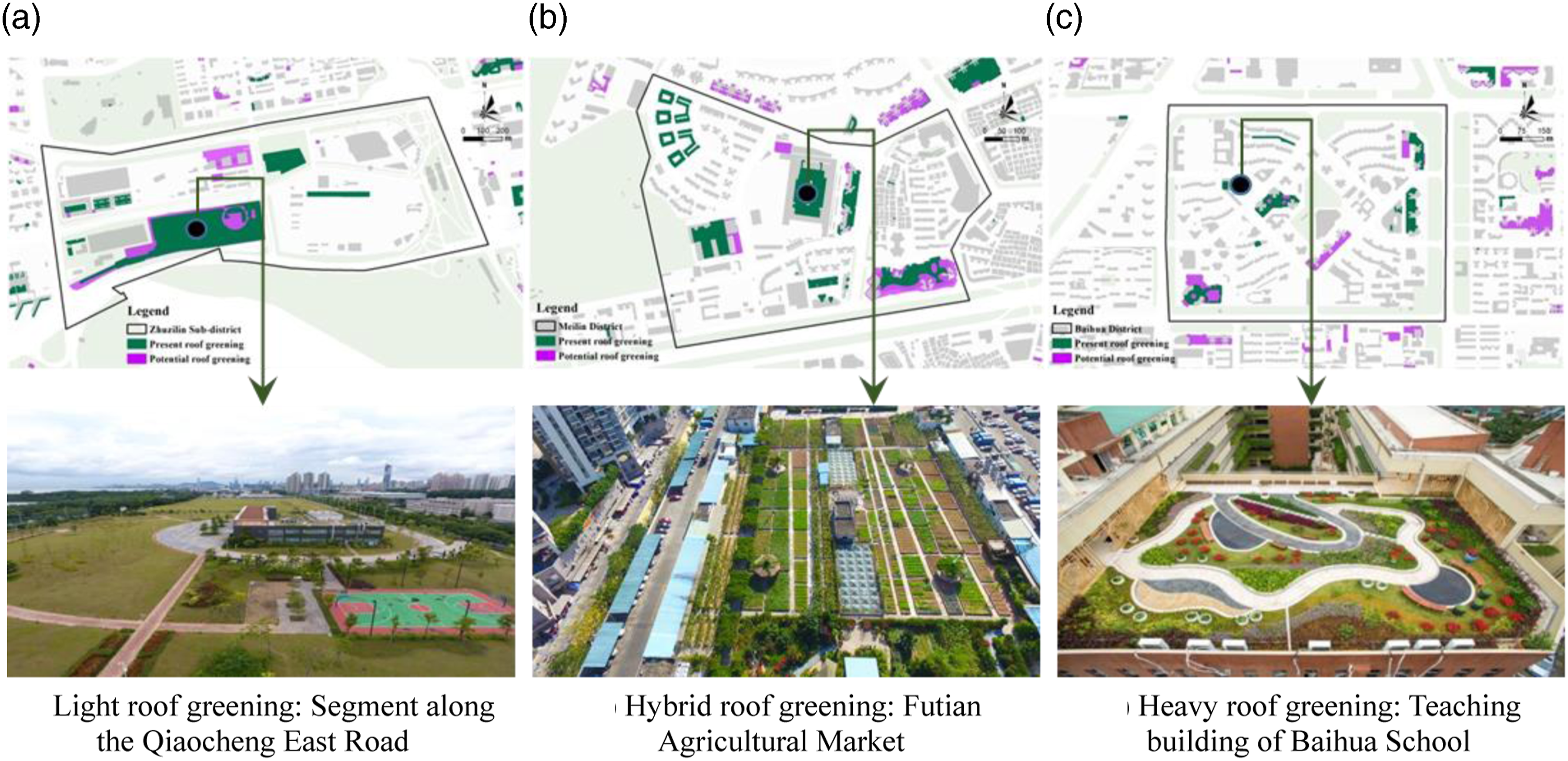
Discussion and conclusion
Discussion
Realizing large-scale development through scientific planning methodology
As a unique resource of urban space, buildings roofs are gradually gaining the attention of all parties concerned (Butler et al., 2012). However, due to the double restrictions of economic factors and technical means, it is difficult to build green roofs for large-scale old buildings, and the low-carbon value of building greening may not be easy to be demonstrated. In recent years, building greening has been integrated as an important planning and design element by the respective practitioners in urban planning, planning for green spaces systems, architectural design, and other fields. Building greening has the characteristics of being localized and microscopic in form. However, comprehensive ecological functions and low-carbon effects can be realized at the city scale if large-scale construction and development are implemented. In the future, it is necessary to guide building greening and transform it from the model of a singular landscaping project to that of an integrated ecosystem engineering project.
It should be noted that at this stage, the utilization of existing building roofs in Chinese cities is still at a nascent stage. On the one hand, due to the lag of cognition, most city managers only regard green roofs as a part of urban greening, and do not fully realize the important role of building greening in realizing urban carbon emission reduction. On the other hand, there is still a wide gap in terms of scale development compared with developed countries. Shenzhen started to promote and implement building greening in 1996 and has made some progress with its long-term efforts. The area of green roofs had grown from 100 × 104 to 378 × 104 m2 in the past two decades. The green coverage rate of roofs is approximately 1.78%. Overall, the rate of bridge greening is more than 55%, with the greening implementation rate of motorway intersections being especially impressive, having exceeded 84%. The city is at a leading level compared to the other cities in China. The green roof coverage in Tokyo and Singapore is essentially 15% or more, and the Green Roof Index of most cities in Germany has reached 1.2 by BuGG-Marktreport Gebäudegrün, which means that there are 1.2 m2 of green roof for every inhabitant on average(Tan et al., 2013; Shafique et al., 2018; MLIT, 2019; BuGG, 2022). In comparison, there is still substantial room for development in terms of building greening in Shenzhen.
High dependence on public policies for planning implementation
The sustainable city concept is often criticized for being unaffordable for the majority (Hu et al., 2015). At present, China’s policies on building greening are predominantly encouraging, advocating, and expressing desirability. Although government departments are seen to support and encourage the practice of building greening, the strength of policy implementation is lacking. Unlike traditional green spaces, the stakes involved in buildings are more complicated due to the presence of multiple units holding property rights. Building greening projects require the full cooperation of the property right units and the various departments with jurisdiction over planning, landscaping, and housing. In particular, the plants for building greening are grown on roofs and walls located far away from the ground, posing complications in terms of subsequent maintenance costs, capital investments, and management. Therefore, the difficulties and breakthrough points of building greening have gradually centered on the level of relevant public policies (Hwang and Tan, 2012; Olubunmi et al., 2016), making implementation highly policy-dependent.
For new buildings being constructed, it is necessary to implement the management and control method of building greening indicators through the construction approval process; for the greening of existing buildings, a guidance approach must be adopted to promote implementation through policy incentives and subsidies. Management and control methods driven by the government are undoubtedly the key force to promote building greening, provide quality assurance, and enhance the level of social acceptance. Taking Shenzhen as an example, the government formulated the Regulations on Greening of the Shenzhen Special Economic Zone in 2016 to clarify the legal status of building greening through local regulations. The emphasis was on process infiltration, with building greening made a mandatory requirement for new urban development projects. This truly guaranteed implementation of the planning methodology.
Conclusions
Building greening integrates architectural art and greening technology, is an important supplement of urban greening system, and has significant ecological benefits, economic and social benefits and natural education benefits. Under the constraints of tight space resources, building greening has become increasingly popular as a means of mitigating a series of environmental impacts related to urbanization (Irga et al., 2017). A planning methodology was proposed in this study based on an understanding of the necessity and importance of building greening. The foci were the survey techniques and model for evaluating the potential of building greening, adapted to the fine-scale. The contents paradigm for plans to develop building greening and the related public policy system were also proposed. The prominence of Shenzhen’s urban planning lies in its comprehensive planning and implementation system, which has complete contents and clear levels. There are both macroscopic planning goals and microscopic control indicators, as well as mandatory regulations and guiding measures. Under the planning scenario, the city’s carbon reduction through building greening would increase from the current 105.15 × 10⁴ tons to 360.93 × 10⁴ tons, which would provide a carbon reduction capacity of approximately 5.55%.
Building greening is essentially a three-dimensional use of urban space. Three-dimensional utilization of land is an innovative product of exploring ways to deal with urban malaises with the support of modern construction technologies. There are still many issues to be studied in the future. In terms of the technical methodology, monitoring of air-conditioning usage has not been included in the calculation of building greening and energy-saving effects because of data limitations. In the next stage, building information models and three-dimensional urban simulation systems can be introduced to analyze carbon reduction capacities at a more refined level. In terms of planning management, it is necessary to establish a project management framework for the design, construction, supervision, checking and taking over, and maintenance of urban building greening. The framework of incentive policy and regulatory legislation must be adapted to the complexity of building property rights and the particularity of three-dimensional utilization and management.
Highlight
►Building greening has significant low-carbon effects. ►Framework for building greening planning methodology included three basic components. ►Four key issues that affect planning scientificity and implementation were discussed. ►It has a high dependence on public policies for planning implementation. ►Method of estimating the low-carbon effects of building greening was proposed.
Supplemental Material
Supplemental Material - Empirical research and proposed planning methodology for the greening of urban buildings to achieve low-carbon effects
Supplemental Material for Empirical research and proposed planning methodology for the greening of urban buildings to achieve low-carbon effects by Wuyang Hong and Renzhong Guo in Environment and Planning B: Urban Analytics and City Science
Footnotes
Acknowledgements
We would like to express appreciation to colleagues for their constructive suggestions and comments. Additionally, we thank the anonymous reviewers and members of the editorial team for their constructive comments and contributions.
Declaration of Conflicting Interests
The author(s) declared no potential conflicts of interest with respect to the research, authorship, and/or publication of this article.
Funding
The author(s) disclosed receipt of the following financial support for the research, authorship, and/or publication of this article: This research was supported by National Natural Science Foundation of China (NO: 42101427) and Shenzhen Basic Research project (NO: JCYJ20220531101010021).
Supplemental Material
Supplemental material for this article is available online.
Author Biographies
References
Supplementary Material
Please find the following supplemental material available below.
For Open Access articles published under a Creative Commons License, all supplemental material carries the same license as the article it is associated with.
For non-Open Access articles published, all supplemental material carries a non-exclusive license, and permission requests for re-use of supplemental material or any part of supplemental material shall be sent directly to the copyright owner as specified in the copyright notice associated with the article.
