




Abstract

Evolution of global virtual-land flows associated with international grain trade
Land used in the production of a commodity is referred to as virtual land (Wurtenberger et al., 2006). A large area of virtual land is associated with the global grain trade (Zhang et al., 2016). Studying the evolution of virtual-land flow may help grasp the trend of reallocation of global land resources (Zhang et al., 2016), improve sustainability of food production (Gutierrez-Moya et al., 2020), and understand how socioeconomic activities affect distant ecological systems in the era of globalization (Liu et al., 2013).
Based on Qiang et al. (2013) and Tian et al.’s (2017) definition and selection, we retrieved international trade and national yield data on 10 kinds of cereals (i.e., barley, buckwheat, maize, millet, oats, rice, rye, sorghum, soybean, and wheat) from the Food and Agriculture Organization of the United Nations for 1986–2020 (available from https://www.fao.org/faostat/en/#data, last accessed on 20 July 2022). The area of virtual land associated with each international cereal trade between two countries was calculated by dividing the weight of the imported cereal product by the yield of the cereal in the export country. Finally, we visualized major virtual-land flows (>1 million ha/year) and net imported virtual-land (imported virtual land – exported virtual land) for each country for the periods of 1986–1988, 1997–1999, 2008–2010, and 2018–2020 (Figure 1). Virtual-land flows associated with international grain trade for the periods of 1986–1988 (a), 1997–1999 (b), 2008–2010 (c), and 2018–2020 (d). Note: Only the virtual-land flows >1,000,000 ha/year are shown. The thickness of the arrow lines is proportional to the areas of virtual land. For the period of 1986–1988, all the republics of former Soviet share the same value.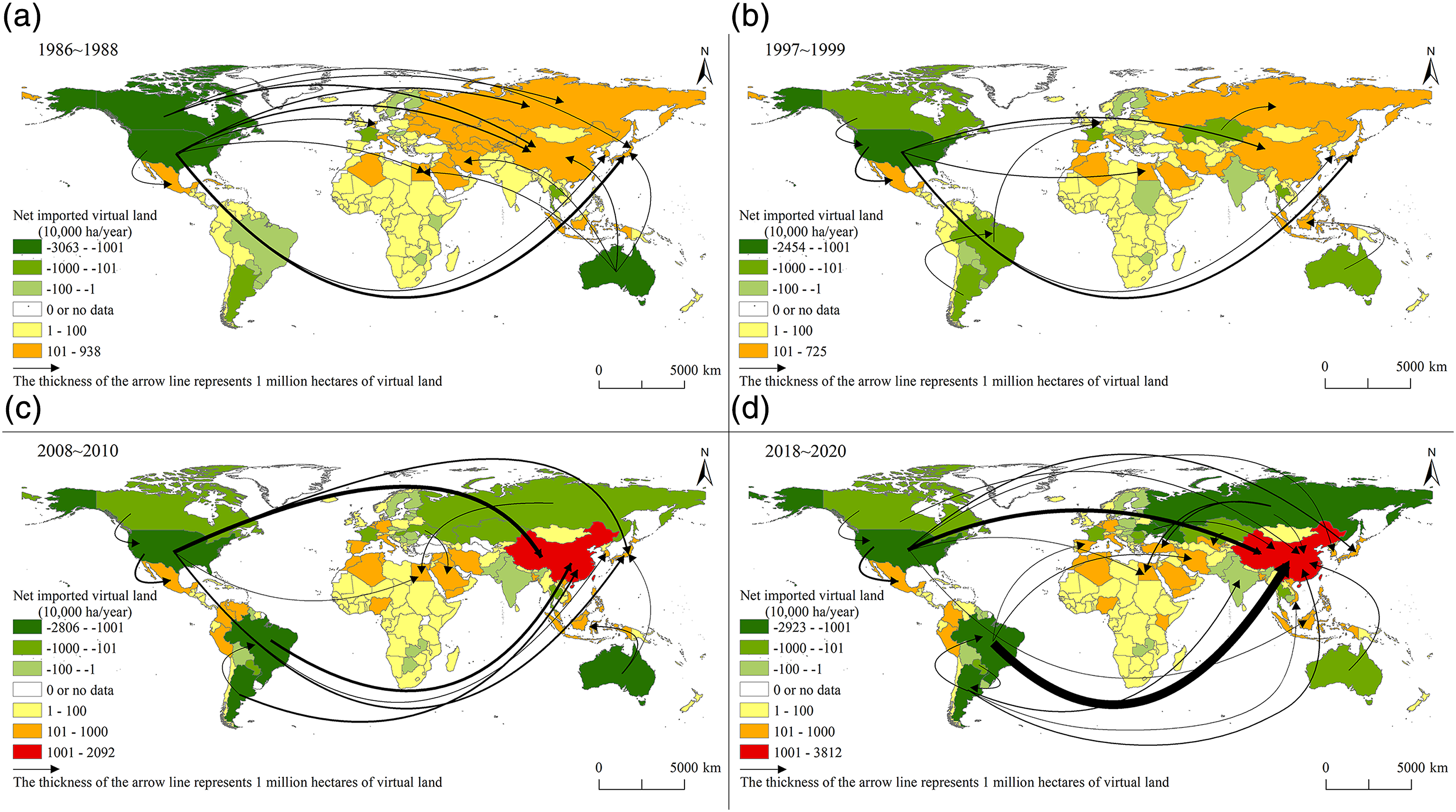
A total of 71.72 million ha/year, 84.18 million ha/year, 125.18 million ha/year, and 160.69 million ha/year virtual land emerged in the international grain trade for the periods of 1986–1988, 1997–1999, 2008–2010, and 2018–2020, respectively. In the first three periods, 50.31%, 43.93%, and 37.87% of the virtual land were associated with the trade of wheat, largest in the 10 kinds of cereals. In the last study period, international wheat trade contributed 49.32 million ha/year virtual-land flow, that is smaller than the area of virtual-land flow (61.03 ha/year) associated with soybean trade.
During the periods of 1986–1989 and 1997–1999, the United States and Japan were the countries holding the largest areas of exported and imported virtual land, respectively. The largest virtual-land flow was from the United States to Japan. During the periods of 2008–2010 and 2018–2020, Brazil became another country exporting virtual land as large as the United States due to increased trade quantity of soybeans with China. China replaced Japan as the largest virtual land importing country. The figure of the global virtual-land flow illustrates that in the past four decades China’s and Japan’s huge domestic demands for food strongly affected distant agro-ecosystems in North and South America and reallocation of global land resources through international grain trade.
Footnotes
Declaration of conflicting interests
The author(s) declared no potential conflicts of interest with respect to the research, authorship, and/or publication of this article.
Funding
The author(s) received no financial support for the research, authorship, and/or publication of this article.
