




Abstract
Although a growing body of literature has examined a variety of planning support systems, few studies have been conducted to understand emerging planning support apps for mobile participation and its impact on collaborative planning. This research develops a conceptual framework for assessing different phases of collaborative planning processes and the added value of planning support apps in stakeholder interaction and management. The case studies include four Dutch regeneration projects, which are ongoing pilot projects of the new Environment and Planning Act and supported by a variety of planning support apps. The data for each case study were collected from multiple sources, including policy documents, interviews with stakeholders and online information. The results show that the apps support to engage many participants, provide real-time communication and facilitate effective interactions between the stakeholder managers and local residents. However, their performance is largely dependent on the user-friendliness of the system. Besides, a good consensus building process in the planning phase has a positive effect on stakeholder management and the performance of the apps in the execution phase.
Introduction
Citizen participation was firstly introduced in Dutch spatial planning in the 1960s, mirroring the emancipatory and democratic movements in Western countries (Boonstra and Boelens, 2011). It was seen as an instrument to strengthen, support and improve the functioning of the representative democracy (Michels, 2006). Since the 1990s, there has been a paradigm shift in urban planning in the Netherlands similar to other Western countries. A communicative turn in planning has occurred, i.e. expert-oriented blueprint planning has slowly changed to process-oriented collaborative planning (Healey, 1996). Crucial to collaborative planning is consensus building, in which a wide range stakeholders (e.g. government, private sectors, civil society, marginalized social groups) come together for face-to-face dialogue to collectively cope with complex problems (Innes and Booher, 1999, 2018). However, collaborative planning has been often criticized for difficulties in consensus-seeking, lengthy and costly processes, and little room of citizen participation (e.g. Boonstra and Boelens, 2011; Huxley and Yiftachel, 2000). In the Netherlands, a recent institutional change for participation is the enactment of a new national law – Environment and Planning Act (Omgevingswet). In total, 26 existing laws are incorporated into the act, with the aim of making spatial policies simpler, better and more flexible (Ministerie van Infrastructuur en Milieu, 2017). The act stimulates wider participation and stakeholder collaboration in order to bridge the gap between government and society. It is a response to the growing complexity of society and the diversity of interests. Although this act is expected to take effect in 2022, there have already been ongoing pilot projects across the country, many of which are collaborative and participatory planning practices with the support of digital tools.
In recent years, the widespread use of smartphones has provided opportunities for online participation and collaboration. The percent of mobile or smartphone users in the Netherlands was 56.5% in 2012, while it reached 90.3% in 2018 (CBS, 2018). The improvement of digital accessibility has changed the ways in which communication takes place within planning. Nowadays, citizens and stakeholders could find planning information much easier and communicate with each other in real time via smartphone apps and digital tools. Among others, Planning Support Systems (PSS) attempt to offer such support. PSS is broadly defined as an ‘information framework that integrates the full range of current (and future) information technologies useful for planning’ (Klosterman and Pettit, 2005). A wide variety of PSS applications offer different kinds of support for particular planning steps or general processes, but their common goal is to improve planning practices (Te Brömmelstoet, 2013). A sub-group is communicative PSS, which facilitates communication and discussions between stakeholders though supporting the flow of information and knowledge (Te Brömmelstoet, 2013). Previous studies on communicative PSS have mainly focused on interactive GIS-based tools such as What if? and Public Participation GIS tools, which collect citizen knowledge and broaden public involvement in decision-making processes (Barndt, 1998; Kahila-Tani et al., 2015; Klosterman, 1999). Nevertheless, many of the tools have not been widely accepted, because they are often not user-friendly and citizens need training for processing the data (Ertiö, 2015). The bottlenecks also include a lack of transparency and technology oriented (Russo et al., 2018). Recent studies have called for PSS that possess a great awareness of user needs and that are more acceptable, interactive and useful for the planning process (Pan and Deal, 2020).
Some recent studies have paid attention to the use of mobile apps for citizen participation (Ertiö, 2015; Evans-Cowley and Kubinski, 2015; Hoffken and Streich, 2013). This is the so-called mobile participation, i.e. ‘the use of mobile devices to broaden the participation of citizens and other stakeholders by enabling them to connect with each other, generate and share information, comment and vote’ (Hoffken and Streich, 2013: 206). Mobile participation is expected to cast a wide range of participants, because citizens can provide real-time feedback by using their mobile phones anywhere (Ertiö, 2015). However, it is often characterized by one-way communication flows, such as informing citizens about plans, obtaining citizen feedback or collecting information on citizens’ behaviour. Previous studies show that mobile apps and other participatory digital platforms were often not interactive due to the challenges and risks that influenced government use and citizen adoption (e.g. Ertiö, 2015; Evans-Cowley and Kubinski, 2015). In a recent study, Falco and Kleinhans (2018) found that more and more digital platforms could be classified as co-production platforms, but more efforts should be done to facilitate digital collaboration. More research is required to understand to which extent emerging planning support apps could support the interactions between experts, government and citizens, and in which way they could be useful in collaborative planning embedded in specific local contexts.
Although there is a growing body of literature on collaborative planning and on the function and use of digital tools, few studies have been conducted to connect these two domains, particularly the potential of emerging planning support apps in collaborative processes. Therefore, this research develops a conceptual framework for assessing different phases of collaborative planning processes and the added value of planning support apps in stakeholder interaction and management. The empirical works focus emerging collaborative planning practices, which are pilot projects of Omgevingswet (Dutch Environment and Planning Act) and supported by emerging planning support apps. All case studies used a specific type of planning support apps called Omgevingsapps (Environment apps). The apps are slightly different but with the same goal to facilitate the interaction and communication between various stakeholders (e.g. the construction team, local residents and community organizations) in the execution phase. The results show that planning support apps assist the engagement of many participants, provide real-time communication, and facilitate effective interactions between the stakeholder managers and local residents in the planning process. However, their performance is largely dependent on the user-friendliness of the system. Besides, a good consensus building process in the planning phase has a positive effect on stakeholder management and the performance of the app in the execution phase. More research is needed to understand the interaction between different phases of a collaborative planning process, and the added value of emerging planning support apps in the process.
Conceptual framework
A conceptual framework is developed to assess collaborative planning processes and the added value of PSS (Figure 1). Kahila-Tani (2015) defines the process of knowledge-informed planning practice through seven phases, including early initiation, initiation, formulation of alternatives, decision making, implementation, evaluation and maintenance. In the Dutch context, citizen participation and stakeholder interaction could take place in the planning phase and the execution phase. First, the planning phase involves face-to-face communication for making a preliminary design and a definitive design. Second, the execution phase starts when the municipality consigns a construction team as a contractor. A stakeholder manager is then appointed to communicate with stakeholders by using planning support apps. It seems that the planning phase has a close relation with the execution phase, i.e. the former is done well, the latter might be better. Since the planning phase is related to conventional face-to-face collaborative planning, we adopt several criteria set up by Innes and Booher (1999) for assessing a good consensus building process. Regarding the execution phase, we develop a set of new criteria for assessment based on Dutch planning literature and PSS research.
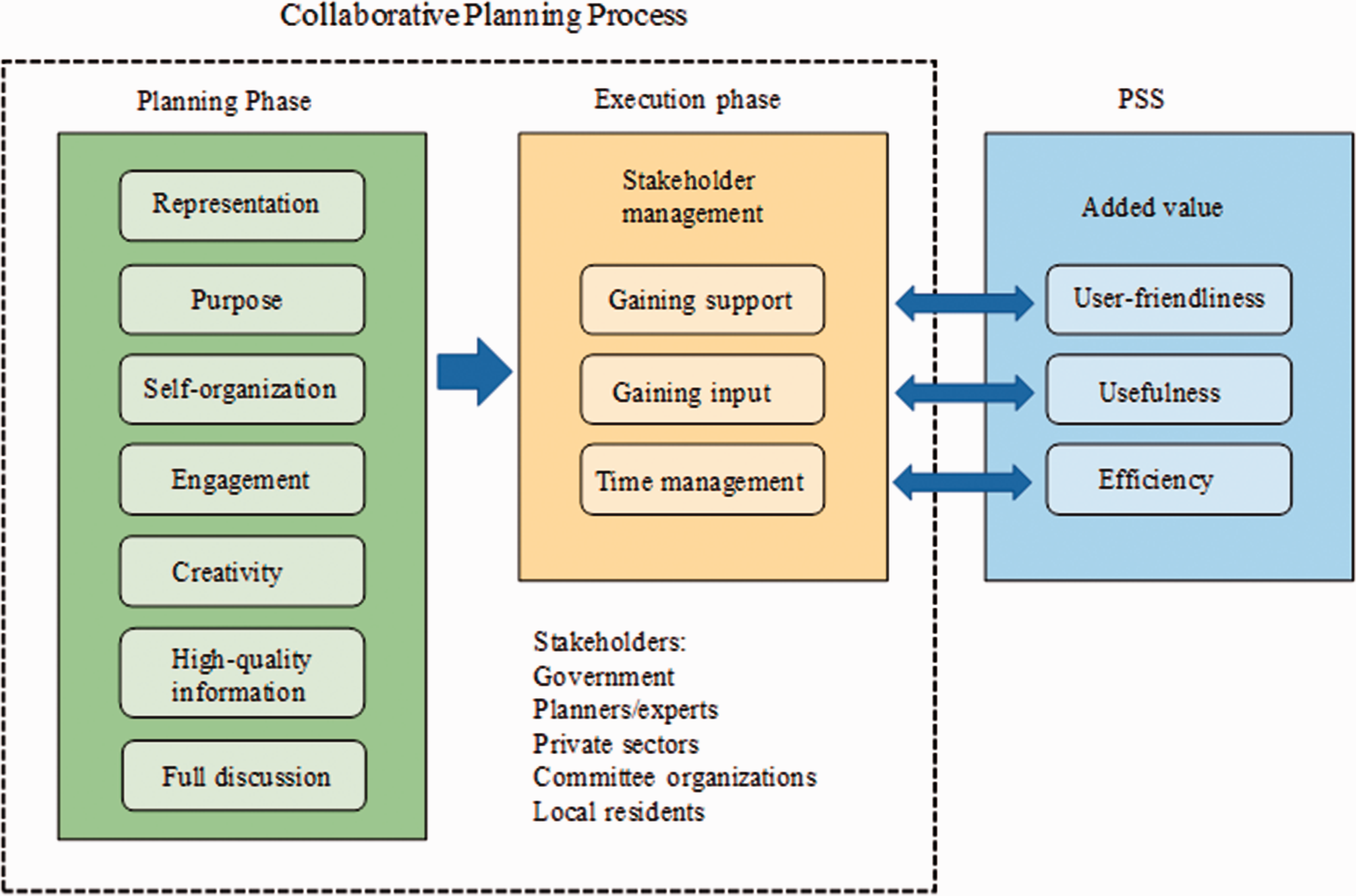
Conceptual framework.
Criteria for assessing the planning phase
Collaborative (or communicative) planning (e.g. Forester, 1989; Healey, 1997, 2003) draws largely on theories of social embeddedness of power relations from Habermas (1991) and Giddens (1984). It can be viewed as governance activities, in which the involvement and interaction of government, the market and civil society could generate new ways of thinking and acting that may lead into new relationships (Healey, 1997). Crucial to collaborative planning is consensus building, i.e. an array of practices in which stakeholders come together for face-to-face dialogue to address a policy issue of common concern (Innes and Booher, 1999). To designate collaborative networks, Booher and Innes (2002) develop the DIAD model in which diversity, interdependence and authentic dialogue are present. Innes and Booher (2018) further explain the three conditions for collaborative rationality, including ‘full diversity of interests among participants, interdependence of the participants who cannot get their interests met independently, and engagement of all in face to face authentic dialogue meeting Habermas’ basic speech conditions’ (p.35). They argue that a collaboratively rational process must include not only agents who have power, but also those who have needed information or could be affected by outcomes of the process. Nevertheless, collaborative planning was criticized for ignoring power relations within consensus-seeking processes and conflicting rationalities (Goodspeed, 2016; Huxley and Yiftachel, 2000; Watson, 2003). It is often controlled by government and provides little room for citizen participation (Boonstra and Boelens, 2011). Democratic legitimacy may also be undermined by the involvement of strong private sectors, because they may threat the public interest in order to maximize profits (Hartmann and Barrie, 2012).
In this research, we apply and test the seven criteria set up by Innes and Booher (1999) for assessing a good consensus building process to evaluate the planning phase (Table 1). These criteria include representation, purpose, self-organization, engaging, creativity, high-quality information and full discussion. Innes and Booher (1999) argue that a good communication process will lead to consensus and therefore a higher quality outcome. Nevertheless, many scholars have criticized that consensus building is difficult to reach in practice. Thus, it is now understood as a fully interactive process, but the outcome may be incomplete and contestable (Cheng, 2013; Healey, 2003). This research will contribute to the debate on consensus building and test the validation of the mentioned criteria.
Criteria for assessing the planning process.
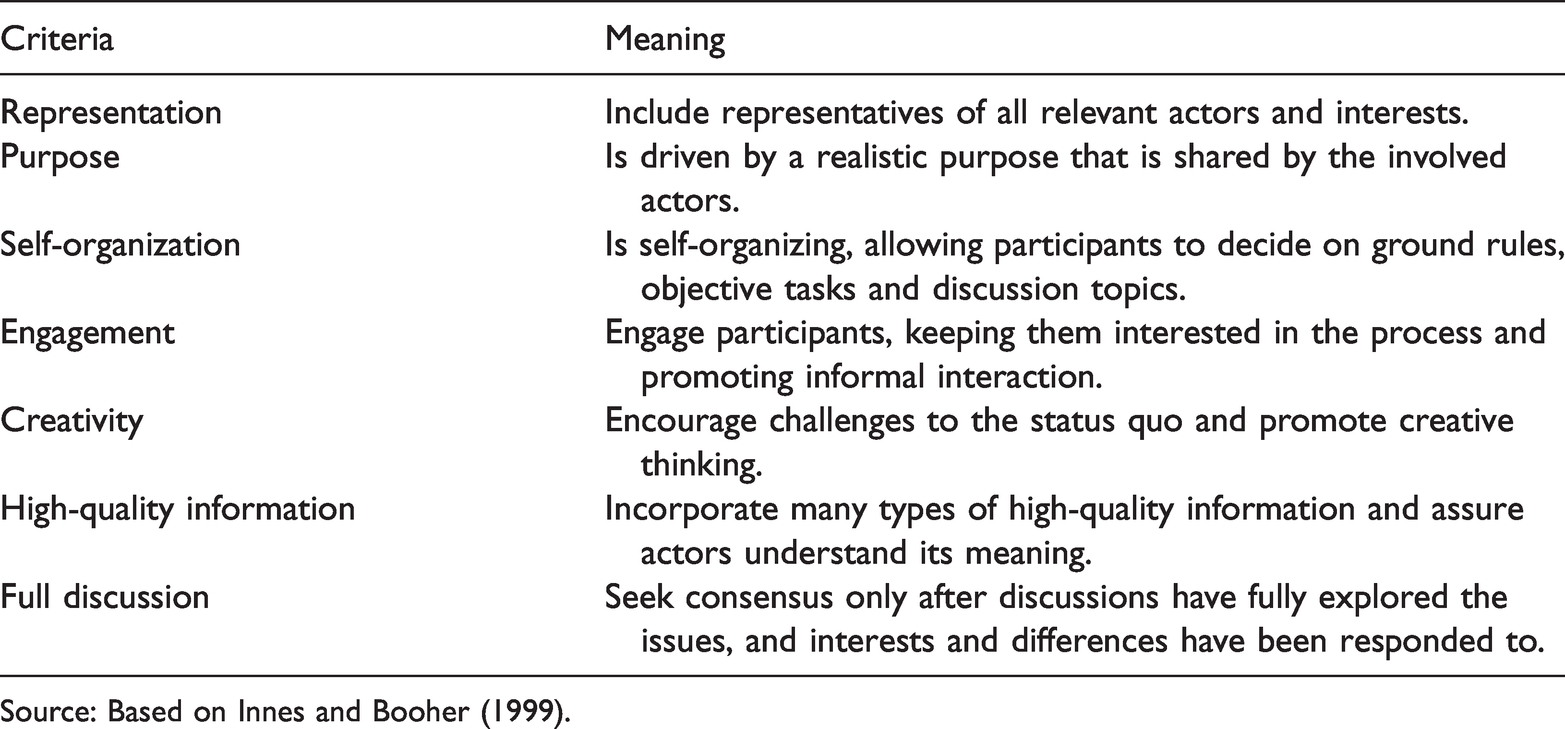
Source: Based on Innes and Booher (1999).
Conditions for stakeholder management in the execution phase
The execution phase involved stakeholder management in the construction process. According to the Dutch national planning organization (Rijkswaterstaat, 2009), there are three types of internal and external stakeholders: (1) co-makers who contribute to the project; (2) formal stakeholders who may object to the project and (3) stakeholders who are inadmissible in formal proceedings but affected by the project and exercise influence through political channels or media. The first and second types are internal stakeholders, while the third type are external stakeholders. Meijers (2009) further clarifies stakeholder management, especially the relationships between stakeholder managers who are in charge of the communication process and local stakeholders in the Dutch context. Based on these previous works, we identify three conditions that determine the performance of stakeholder management in the execution phase.
The first condition is gaining support from various stakeholders for the project (Meijers, 2009). Local committees and affected residents often want to keep up to date with what happen, so the stakeholder manager should timely respond to their questions and find proper solutions. To gain more support, the information of the project should be understandable, presented in a visually appeasing form, and able to reach a wide range of stakeholders (Rijkswaterstaat, 2009).
The second condition is gaining input, i.e. local knowledge from residents and other stakeholders. A merit of collaborative planning is that citizens and stakeholders could contribute different forms of knowledge to planning practices through the deliberative process (Healey, 2008). In the Dutch context, local knowledge is considered as important input for spatial planning. Meijers (2009) argues that increasing the amount of local knowledge from involved stakeholders could lead to better decisions made by planners and stakeholder managers. However, Rydin (2007: 55) indicates that: ‘handling multiple knowledges involves more than just bringing the different actors together to articulate those knowledges in a context oriented towards mutual understanding’. Therefore, it is important to find a suitable way to combine local and expert knowledge together.
The third condition is managing time. One of the criticisms on traditional collaborative planning is the lengthy process, through which all stakeholders are invited to the table for discussions (Boonstra and Boelens, 2011). A potential issue is that some stakeholders may not have time to participate in physical meetings. In the Netherlands, stakeholder managers are responsible for the working schedule of the project (Meijers, 2009). They are expected to inform and respond to stakeholder feedback in a timely manner to smoothen the process and avoid controversies between the construction team and local stakeholders.
The mentioned three conditions determine the performance of stakeholder management in the execution phase. Stakeholder management could also be influenced by the usage of PSS that may add value to interaction and communication.
The added value of PSS
Since collaborative planning has been criticized for ineffective consensus building and limited participation with a small number of selected stakeholders, many studies have investigated the application of new digital tools to support collaborative processes (e.g. Deng et al., 2015; Goodspeed, 2016; Mukhtarov et al., 2018). In particular, PSS have been developed to support planning tasks and stakeholder collaboration. The early version of interactive GIS-based PSS reflected the movement from ‘planning for the public’ to ‘planning with the public’ in the 1990s (Klosterman, 1999). Although a variety of PSS tools have been applied in planning practices in different contexts, scholars have identified a number of bottlenecks due to the discrepancy between supply and demand (Biermann, 2011; Vonk et al., 2005). Whether a computer system can satisfy the needs of the users is related to the acceptability of the system (Nielsen, 1994). However, the acceptance of the user of the PSS instrument and its outcomes is hampered by a range of issues, such as a lack of user-friendliness and a lack of experience to make use of the PSS, as well as a lack of intention to start making use of a PSS. (Geertman, 2017: 73)
User-friendliness is linked with gaining support, which is the first condition of stakeholder management performance. User-friendliness refers to the ease of use of a functionality for the intended end-user, i.e. the degree to which users believe that using PSS tools would be free from effort (Silva et al., 2017). It is related to: (1) connectivity, to which extent the tool is easily accessible to users and (2) ease of use, whether the system is easy to use for a diverse range of computer literacy levels and knowledge levels of the public (Zhang et al., 2019). If a digital tool is easier to get access and be used, it may be able to engage more stakeholders in the communication process and thereby gaining more support.
Usefulness is related to gaining input, which is the second condition of stakeholder management performance. It refers to the ‘issue of whether the system can be used to achieve some desired goals’ (Nielsen, 1994: 24). PSS could have different kinds of usefulness such as more informed outcomes and increased efficiency (Pelzer, 2017). Scholars have identified a number of criteria that determine usefulness, in which interactivity and effectiveness have a close relation with gaining input and knowledge from stakeholders. Interactivity is whether the system facilitates the interactions between participants rather than just providing information, while effectiveness is the accuracy and completeness with which users can achieve specified goals (Zhang et al., 2019). More interactive and effective planning support tools may be easier to gain input from participants.
Efficiency is connected with time management, which is the third condition of good stakeholder management. It refers to the time and effort of different users (e.g. citizens, stakeholders, managers) in relation to the accuracy and completeness of the goals achieved (Zhang et al., 2019). Compared with face-to-face communication, online participatory tools are expected to add value regarding time effectiveness due to its support for real-time communication (Deng et al., 2015). This could lead to save time to create productive communication between stakeholder managers and various stakeholders.
The mentioned three criteria of planning support tools could add value to the performance of stakeholder management in the execution phase, i.e. user-friendliness for gaining support, usefulness for gaining input and knowledge, and efficiency of time management.
Methods and data collection
This research selected four case studies of regeneration projects in the Netherlands, including the regeneration of Assumburg, de Kanis, Hoa Phase 2 and Zegveld. Several criteria are set for the selection. First, all case studies are ongoing collaborative planning practices. They also used a variety of Omgevingsapps to support the communication between stakeholders in the execution phase. The apps were downloadable for all devices (e.g. Windows Phone, Android iPhone) for free. They were introduced in the advertising boards near the construction sites and in the flyer which was sent to each resident’s house in the affected neighbourhood. The number of users who downloaded the apps varied in different cases, but all apps were downloaded more than 200 times. The cost of each app was between €2500 and €3000, with additional €50 per month for the server cost. Second, we collaborated with ITC Group that has involved in planning practices of all case studies to get related materials. On the one hand, we got access to related project and policy documents, which were then used for content analysis and allowed a more thorough preparation for interviews. On the other hand, we were able to conduct in-depth interviews with key stakeholders of the projects. Third, the case studies are located in different municipalities, reflecting the influence of different local contexts on the adoption of solutions and the various applications of the apps in collaborative planning practices. In this article, we use the regeneration of Assumburg as an in-depth case study, because it is a good example to elaborate stakeholder interaction in different phases of the planning process and reflect the added value of planning support apps. The other case studies are used for comparable analysis, reflecting some common grounds and specific issues.
We conducted content analysis to analyze policy documents related to the projects. The main documents include ‘Asssumburg en omgeving’, ‘Reconstructie de Kanis’, ‘Hoa Fase 2’ and ‘Reconstruction Zegveld’, which were made by local municipalities. We conducted a total of 16 in-depth interviews with key stakeholders including policymakers, stakeholder managers, experts, app developers and local residents during April to July in 2019. Each interview lasted approximately 30 min. Policymakers were involved in the planning phase and present during the information evenings, while the stakeholder managers managed the apps. The residents were approached through two methods: (1) convenience sampling, i.e. the respondents were accessible to the researchers; and (2) snowball sampling, i.e. the respondents were introduced by the stakeholder managers. The interview with policymakers from the municipality focused on policies, decision-making and communication in the planning phase. The interview with stakeholder managers focused on the communication with local residents, committee organizations and other stakeholders in the execution phase as well as the function and performance of the app. The interview with local residents paid attention to their feelings and experiences in the planning process and the function of the app (especially user-friendliness and efficiency). A set of questions were designed to guide the interviews. Regarding the planning phase, questions were related to the mentioned seven criteria for assessing the consensus building process. For instance, in order to understand representation, several questions were asked: To which extent stakeholders were able to give comments and input? Regarding the execution phase, questions were related to the added value of the app in stakeholder management. For instance, to which extent and in which way could the Omgevingsapp help to engage more stakeholders? We also collected online data (texts, pictures, etc.) from the apps, observed the functions and features of the app and combined them with the outcomes of interviews for analysis.
The regeneration of Assumburg
Assumburg is a neighbourhood in the city of Dordrecht. It faced several problems including outdated sewerage and poor road conditions, so the municipality decided to tackle these problems together with the upgrading of the public space. The regeneration project started on 14 January 2019 and was expected to be completed in 2020. The project aims to provide new green spaces along the road, better parking spots and new materials for roads and sidewalks. The upgrading of the road will lead to slow down driving speed, which is a key concern of local residents (Gemeente Dordrecht, 2018). Since the road is the main accessible route of the neighbourhood, the difficulty of the project is how to keep the road accessible while the construction takes place. This project included two phases: (1) the planning phase, in which the municipality organized two informal information evenings to interact with local residents and stakeholders; and (2) the execution phase, in which a planning support app was used to support the communication between the stakeholder manager and local residents.
The planning phase
Before public participation, the municipality of Dordrecht actually determined some ground rules of the project. It conducted internal research and communicated with key stakeholders such as the public transport company, the fire brigade and the green management department in the initiative stage (interview with the project director, May 2019). But the initiative stage was time consuming, as the project director stated, ‘The municipality had trouble finding a good way to tackle the problems. The municipality took a long time determining what the new design (of the public space) would look like. They spent 1.5 years discussing the new design’. This may be because a collaborative planning approach is needed to solve the intricate problem.
After that, the municipality organized two informal information evenings, with the purpose to offer local residents and stakeholders to ask questions and give comments for the preliminary design. The invitation of the information evenings was expected to reach all local residents. However, the interview with local resident A in June 2019 shows that not all local residents received the invitation letters for the first information evening. The letters may get lost in the delivery process. This hindered the degree of citizen representation. However, those residents who received the invitation were satisfied, appreciating that the municipality informed them in advance (interview with resident B, June 2019). The project director was also satisfied with the number of participants and indicated that the information evening well engaged local residents (Interview, May 2019). In the information evenings, local residents communicated with experts from the project engineering office and municipal officials about the preliminary design at different discussion tables. The topics of discussion tables ranged from green spaces, to parking spaces, to environmental issues. There was no general presentation about the design by the municipality. The project director criticized that the information evenings were not creative and argued that the municipality should focus more on the future and less on the existing situation. Nevertheless, the residents enjoyed the informality of discussions, because they could ask specific questions regarding their own situations. As resident C stated, ‘The information evening was well organised. There were sufficient experts to explain what is going to happen’ (interview, June 2019). The resident also pointed out that the municipality listened to the suggestion of residents and there was some room for citizen input. For example, a resident saw that his own parking spot would be unavailable in the preliminary design, so he discussed with municipal officials who made it available later in the definitive design. All questions and remarks in the first information evening were then published online and were expected to be addressed in the second one. Some residents’ comments or questions were not included in the list, but they have the opportunity to express them in the second information evening.
After the second information evening, the definitive design was published online and open to formal comments. Local residents are satisfied with the definitive design, as resident B stated, ‘I truly think that the municipality did its best regarding information and communication’ (interview, June 2019). Also, the residents felt that most of their input was included and that specific changes were made to the design. As a result, there were only 10 formal comments on the final design, the number of which was quite small considering the scale of the project. These comments were small issues which could be solved by adapting the design slightly (interview with the project director, May 2019). In sum, the planning phase proceeded quite smoothly. While some residents were not invited to the first information evening, the majority of local stakeholders were well informed and engaged in the project. As a consequence, the definitive design was accepted without too many complaints.
The execution phase and the application of Omgevingsapp
There was a long interval between the acceptance of the definitive design and the appointment of the contractor. During this period, there is hardly any communication with local residents. Both resident B and resident C felt like that they were in the dark and suggested that the municipality should pay more attention to this interval. The problem was that the contractor was not yet appointed to communicate with local residents while the municipality focused on selecting the contractor. The construction work was finally given to the contractor – Kuipers Infra. The contractor firstly organized their own citizen information evening to explain the construction work in detail, discuss practical tasks and communicate with residents for specific problems. After this evening, the stakeholder manager was appointed to be responsible for the communication with stakeholders, through monthly letters for the entire neighbourhood, a walk-in hour with the stakeholder manager and posts in the app (interview with the stakeholder manager, April 2019). Residents were well informed with the updated information of the project and they appreciated different ways to contact with the stakeholder manager (interview with resident C, June 2019). The stakeholder manager was responsible for the communication between local residents and the contractor, but some residents contacted the contractor directly, whose primary task was the construction rather than the communication. This led to the stakeholder manager being unaware of certain questions that were asked by residents and of some problems in the community, leading to irritations of some residents.
The app for Assumburg is called reconstruction Assumburg. Figure 2 (left) shows the home screen of the app. This screen has multiple options to click on. A short summary of the features is as follows:
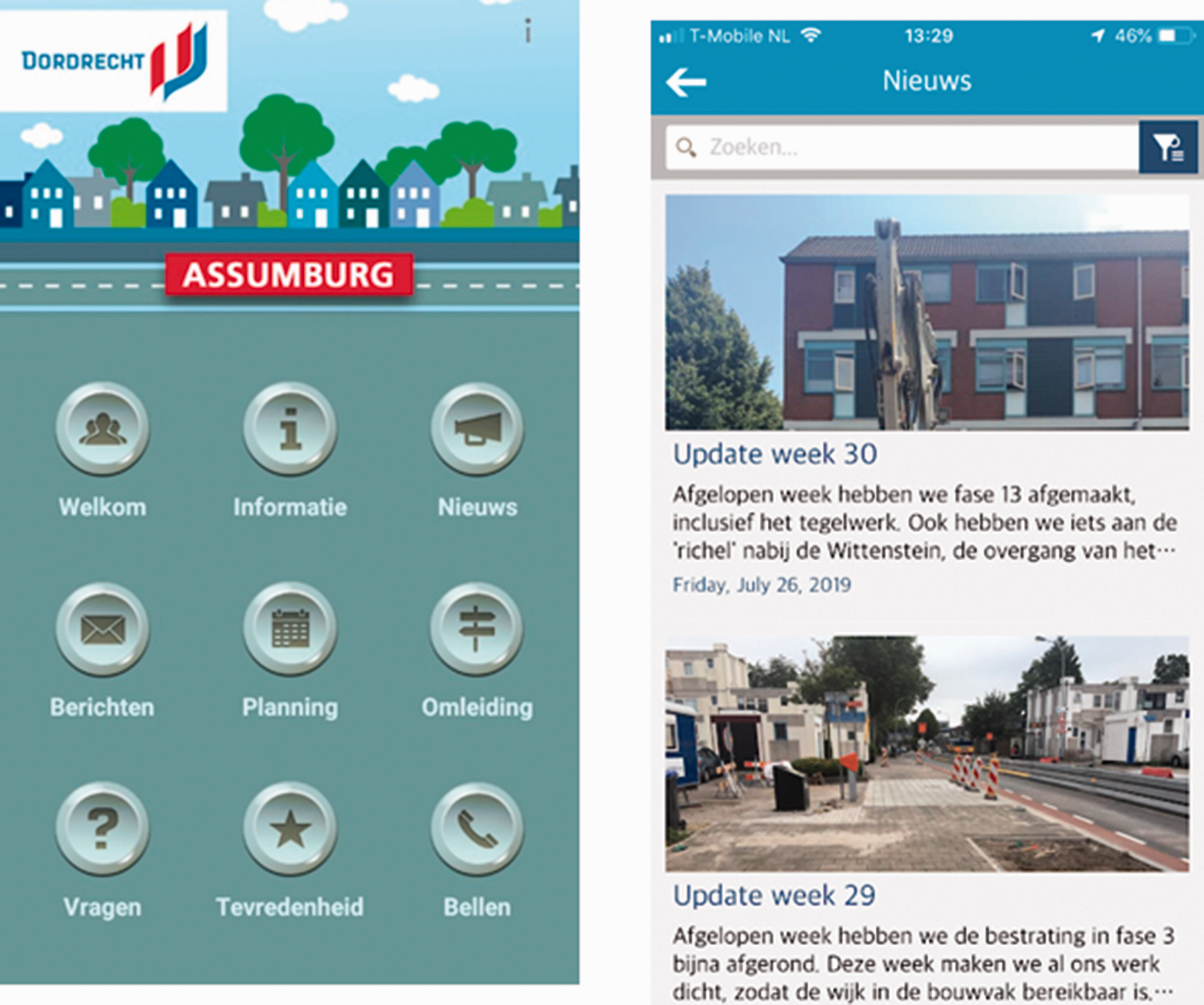
Left: Home screen of the Omgevingsapp reconstruction Assumburg; Right: The weekly updates contain pictures showing what the contractor did in the last week.
The app for Assumburg was developed by the company in which the stakeholder manager worked. Therefore, the stakeholder manager was able to determine all features of the app. The interview with the stakeholder manager in April 2019 showed that one advantage of the app was real-time and direct responsiveness. The responsiveness is especially apparent when local residents use the message function. The stakeholder manager can directly respond to the questions of residents anytime. As she mentioned, one issue of the construction work was the slow progress, so the original plan had to be altered. The questions from local residents concerned what this implicated for the accessibility of their houses. She quickly responded to these questions in the app, thereby taking away the worries of the community. Using the app for communication could save time and more effectively deal with emerging problems. Traditionally, stakeholders had to call the municipality when they saw something wrong on the street. The questions might not be answered until the municipality contacted the contractor. This extra step could take hours or days, leading to irritated stakeholders who waited for the response from the stakeholder manager. The app helps to avoid this issue. Another advantage of the app is to reach a large number of stakeholders. By using push notifications, the weekly updated news is automatically delivered to over 200 people in the community. This is a much more efficient way of delivering information when comparing traditional ways of delivering individual letters to each household. Whenever something goes wrong such as a power outage, the stakeholder manager can communicate it to the community immediately by using a push notification. Besides, the communication in the app allows the contractor to explain the reconstruction in a more informal matter and give more detailed information. This is better than traditional newsletters which only focused on the most important matter due to space limitation. Adding pictures and maps in the weekly updates makes the information clearer and more understandable.
The interview with several residents in June 2019 showed that local residents highly appreciated the interactive features and the possibility to post messages. As resident D mentioned, the app was ‘one of the advantages that contemporary technology brings with it’. Resident C agreed with him, indicating that every time he asked a question, the response from the stakeholder manager was swift. Resident E mentioned that the contractor was also quick to do what was agreed upon by the stakeholder manager. Besides, they liked the weekly updates with pictures that made them easier to understand the reconstruction. The stakeholder manager indicated that: ‘If I did not post the weekly update in time, I received a lot of worried comments and phone calls asking where the weekly update was. This really shows that people like the updates’. This also suggests that whether the app functioned well is tightly linked with the person maintaining it, as mentioned by Resident D. In this case, the manager of the app was a very good stakeholder manager who responded to questions promptly and pushes updated news in an effective way. In short, the execution phase went well and both residents and stakeholders were satisfied with the communication, aided by a well-functioning app.
Comparative analysis and reflection
Besides the regeneration of Assumburg, we also investigated the other three renewal projects of de Kanis, Hoa Phase 2 and Zegveld. First, the renewal of de Kanis was caused by the fact that the entire village, which lies in the middle of a polder with about 400 inhabitants, sunk rapidly due to a bad foundation. The sinking of the ground caused serious damages to roads, houses and sewerage systems. In order to tackle this problem, the municipality decided to upgrade the entire village infrastructure with a concrete construction, so that the village would not sink for 100 years (Bunnik Groep, 2018). The main challenge for the municipality was how to convince every stakeholder that a long-term concrete structure was the best option, even though it was more expensive and difficult than other solutions. Second, Hoa phase 2 is a project located in the town of Zwijndrecht. Similar to de Kanis, the foundation of the roads and gardens is not strong enough to keep the road from sinking. This causes a difference in height between the houses and the surrounding gardens. The whole renewal project is divided into eight different phases that will take about 10 years, and the ongoing project is currently in phase 2 (Gemeente Zwijndrecht, 2019). Third, the upgrading of Zegveld was started due to the entire village with 2400 habitants sinking into the peat. Houses and other buildings in the village were reinforced by poles in the ground, but roads and gardens have not yet been reinforced. As a result, houses remain at the same level, while the ground of the road is sinking and damaging the sewers. In the regeneration project, the ground level of the roads and gardens will be raised to match with the level of the houses (Gemeente Woerden, 2017). Since the project will also impact the public space and private gardens, it demands active participation from the residents (Gemeente Woerden, 2017).
The mentioned framework is applied to analyse these four projects. A comparative analysis is also conducted to understand consensus building in the planning phase and the added value of planning support apps (Omgevingsapps) in stakeholder management in the execution phase (Table 2). We find some common grounds and specific issues.
Comparative analysis of four case studies.
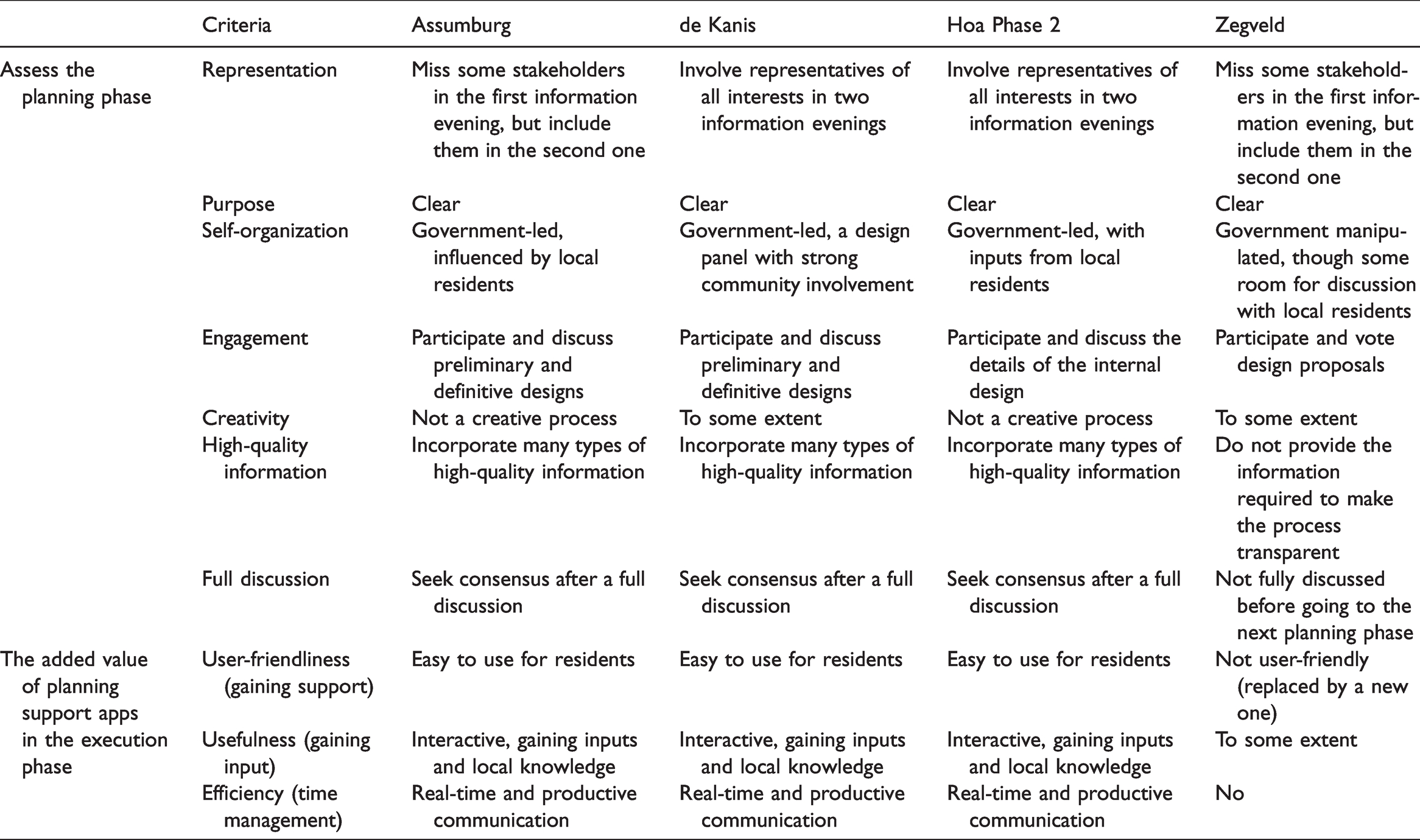
First, two information evenings were organized in all case studies, with a clear purpose to allow local residents and stakeholders to ask questions and give comments for the design. In Assumburg and Zegveld, nevertheless, the invitation did not reach all potential stakeholders. This leads to the problem of the representation of stakeholders, which is important for a good consensus building process (Innes and Booher, 1999). Except in the case of the Kanis, where the municipality used the village organization to effectively spread the message of the information evenings, the municipalities of Assumburg, Hoa Phase 2 and Zegveld posted the invitation letters directly to local residents. However, some letters might get lost during the delivery process. Although it might not be a big issue if only a few stakeholders miss the first information evening, it could potentially have negative consequences for the outcome of the planning process, i.e. the definitive design could not get the support of all stakeholders. The municipality of Zegveld is now thinking about using digital tools to support this process in the future, e.g. residents could vote online for different design proposals. Digital tools have the potential to support the involvement of more representatives of interests in collaborative planning (Lin, 2018).
Second, municipalities played a leading role in all collaborative planning practices. They decided ground rules of the projects and the involvement of stakeholders, so it is hard to say that it was a self-organizing process. In Hoa phase 2, the municipality tightly controlled the topics for discussion in the information evenings, and the space for residents to come with their own ideas was limited. Although there was some room for discussion with local residents in the case of Zegveld, the municipality manipulated the process and secretly altered the proposal selected by residents. However, citizens in Assumburg exerted some influence on the definitive design such as adding a parking spot. In de Kanis, the information evenings were organized by a design panel, comprising municipal officials, external experts and local volunteers (interview with the Communication Advisor, May 2019). The experts focused on the technical side of the preliminary design, while local residents helped with details and determined the topics for discussion in the information evening. As a result, the definitive design hardly received any criticism, and the execution phase went very smoothly. In this way, local knowledge is also combined with expert knowledge. Additionally, the government-led process showed that there was little room for creative solutions. From the perspective of municipalities, it might be better to give citizens less freedom but let them be important in a small portion of the plan, compared with giving them freedom but disappointing them. The lack of creation might not be a problem in this type of regeneration projects, which were led by government and had well technical framing. Nevertheless, creativity might lead to better outcomes and cheaper solutions in other types of projects such as bottom-up regeneration projects and strategic plans. More research is required to understand the pros and cons of a creative planning process.
Third, full discussion and transparency are necessary for a good consensus building process. In Assumburg and de Kanis, local residents were well engaged in the information evenings for full discussions and provided with high-quality information of the preliminary and definitive designs. In Hoa Phase 2, local residents were also allowed to freely discuss the details of the internal design selected by the government. In these case studies, the processes were transparent, as all questions and remarks in the information evenings were published online. However, stakeholders in Zegveld did not have full information and the process was non-transparent, because the municipality changed the plan in secret after the process was complete. Local stakeholders voted democratically for a grey design (with parking) for the entire neighbourhood, while the municipality decided to change a small part of the design without explaining this to all stakeholders. This led to outrage, as local residents felt like they were cheated by the municipality. In short, transparency is important for assessing a good consensus building process, besides the seven criteria established by Innes and Booher (1999).
Finally, the case studies show that planning support apps could add value for collaborative planning by supporting stakeholder management, but largely depending on its user-friendliness. All case studies used a variety of Omgevingsapps to support the communication between stakeholder manager, local residents and stakeholders in the execution phase. All apps had a message function, with the ability to send photos and the option to call the stakeholder manager. In Assumburg, de Kanis and Hoa Phase 2, the Omgevingsapp functioned quite well, enabling easier and interactive and effective communication. First, the projects gained a lot of support from local residents and neighbourhood organizations. The support was enhanced by the user-friendly design of the app, which was easy to use, thereby allowing to reach a large number of local residents and keep them up to date with the information of the projects. A simple and appealing app was useful and attractive for citizens. It also increased the transparency of the planning process, since updated information of the project was published in the apps and was accessible to local residents. The effectiveness and responsibility of stakeholder managers as the app managers was also crucial to the successful application in these projects. Second, the apps helped to gain inputs from stakeholders. Through using the apps, local residents could directly ask questions and the stakeholder managers responded them promptly. The interaction between various stakeholders greatly increases the amount of input and knowledge from local residents (Healey, 2008). Therefore, the goal of using the app that offered ‘the possibility for low-threshold communication with stakeholders in an attractive and interactive way’ (ITC Groep, 2019) was effectively achieved. This suggests that the apps were useful, i.e. the system could be used to achieve desired goals (Nielsen, 1994). Third, the apps assisted the stakeholder managers to manage the time of the projects. The stakeholder managers used the apps to distribute information to and interact with local residents in real time. Especially, the push notifications of the apps enabled all users to receive messages and updates immediately. Compared with the traditional door-to-door approach, this was more effective because it reduced the amount of time and effort which app users and managers needed to invest (Zhang et al., 2019). In short, the apps widened the scope of participation and promoted effective communication and interaction, thereby leading to smooth planning processes. However, the app of Zegveld was not user-friendly. As the important feature of the app, the push notification was hidden in an illogical place and not easily found. Local residents had to open the app to check whether there was updated information. As a consequence, there were few responses and comments from local residents, so the municipality, the stakeholder manager and the village organization had to arrange extra meetings about the process of the construction work. The old app was also replaced with a new one. This reflects that user-friendliness is crucial for the successful application of planning support apps.
Besides, the performance of the planning phase could influence the execution phase. In de Kanis, Assumburg and Hoa phase 2, the residents’ willingness to cooperate in the execution phase was high, because they were pleased with the process of the planning phase. However, the planning phase of the reconstruction of Zegveld did not go well due to a lack of transparency and full discussion. This negative atmosphere was reawakened in the execution phase when the contractor changed the plan, thereby impeding the planning process and outcome.
Conclusion
Collaborative planning has emerged to cope with conflicts of interest and complex problems in the regeneration of old neighbourhoods and other planning domains. Crucial to collaborative planning is citizen participation and stakeholder collaboration in planning processes (Backlund and Mantysalo, 2010; Healey, 1997). However, there has been a lot of criticism on collaborative planning such as limited room for citizen participation, unequal power relations and difficulties in consensus building (e.g. Boonstra and Boelens, 2011; Huxley and Yiftachel, 2000; Watson, 2003). Recent studies have investigated the potential of digital tools especially PSS in solving these problems (e.g. Geertman and Stillwell, 2020; Kahila-Tani et al., 2015; Staffans et al., 2020). This research will contribute to link collaborative planning and PPScience by developing an evaluation framework and conducting empirical research in the Dutch context.
First, this research applies the seven criteria set up by Innes and Booher (1999) to assess consensus building in the planning phase. Innes and Booher (1999) argue that these criteria (representation, purpose, self-organization, engaging, creativity, high-quality information and full discussion) affect the effectiveness of the process and the quality of its outcomes. We find that these criteria are helpful for evaluating consensus building. However, the case studies show that the processes are hard to be self-organized due to the leading role of government even in the democratic context. This approves pervious criticisms on unequal power relations in collaborative planning practices (e.g. Boonstra and Boelens, 2011; Huxley and Yiftachel, 2000). But this does not mean that local residents do not have a voice. In most case studies, they had the right to obtain information, question the proposal and gave comments. As argued by Innes and Booher (2018), three conditions (diversity, interdependence and authentic dialogue) are crucial for collaborative rationality in the DIAD model. The empowerment and engagement of various stakeholders in the case studies met the conditions of diversity and interdependence, and therefore contribute to a good consensus building process and outcome. We nevertheless argue that transparency (besides the mentioned seven criteria set up by Innes and Booher, 1999) should be an additional criterion for assessing a good consensus building process, because it is crucial to build trust between government and citizens. This will also contribute to a more authentic dialogue, in which ‘the communication flowing through the network must be both accurate and trusted by participants to allow the full advantage to be taken of the agents’ diversity and interdependence’ (Booher and Innes, 2002: 226).
Second, the planning practices in the Dutch context show the potential of planning support apps in supporting stakeholder interactions and managements. As argued by Wilson et al. (2019), digital tools could help citizens to understand planning issues and contribute to the removal of barriers to citizen engagement in the planning process. Recognizing the implementation gap, Geertman and Stillwell (2020:11) indicate that PSScience should emphasize on ‘the goals of support instead of focusing just on the means of support’. The cases studies show that all the four apps indeed have a same goal that facilitates the interaction and communication between various stakeholders. Three apps achieved this goal well, since they assisted the engagement of many stakeholders in real time and promoted effective interactions and communication. The usefulness, user-friendliness and efficiency of the apps contribute to stakeholder management through gaining input, support and time management. However, the app for the Zegveld project performed poorly due to not being user-friendly. PSS developers often make the system complex, while simple and easily used tools may be functioned better because the majority of laymen could use them in their smartphones. This calls for more research to understand the interactions between user-friendliness and usefulness (Te Brömmelstroet, 2017). Additionally, the interaction between local residents and the stakeholder manager via apps is mainly based on individual communication, rather than group deliberation. Therefore, the implementation phase has collaborative efforts in a broader sense, rather than group deliberation such as mediated collaboration as argued by Cravens (2016) or authentic dialogue in the DIAD presented by Innes and Booher (2018). In all case studies, planning support apps were used only in the execution or implementation phase in order to support the communication between stakeholder managers and local residents. Nevertheless, previous studies show that it is also possible to apply planning support tools to assist planning tasks in other phases (e.g. Geertman and Stillwell, 2020; Staffans et al., 2020). According to Kahila-Tani (2015), different kinds of Public Participation GIS (PPGIS) tools are required to support specific tasks in different planning phases, such as collecting data in the phase of early initiation, and obtaining participants’ comments in a map in the phase of formulating alternatives. But she indicates that empirical evidence does not support the use of PPGIS in the implementation phase. This is opposite to the finding of this research, i.e. planning support apps are used in the implementation phase. This may be because different digital participatory platforms have their own limitations and strengthens, supporting specific tasks rather than overall tasks. The app in this study does not have the mapping function like PPGIS, but it is easy to be used in smartphones for real-time communication. Besides, local contexts are crucial for the application of digital tools. In this study, the apps were specifically designed to support better communication between stakeholder managers and local residents in the implementation phase, because the reconstruction in residential areas (sometime even inside private gardens) had severely affected people’s daily lives. In order to minimize neighbourhood nuisance, municipal governments and stakeholder managers put extra efforts in the communication with local residents by applying the apps. With the further development of digital technologies, it may be possible to combine different functions into one planning support tool in the future. A combination of communication, mapping, designing and other functions in a planning support app may be more effective to support various tasks in some projects, which need continuous digital supports in the planning process.
The outcomes of this research have implications for practice, research and education. First, government and planners have increasingly used digital tools (e.g. mobile apps, social media, decision support tools) in planning practices (Falco and Kleinhans, 2018; Lin, 2018; Pan et al., 2020). To promote more equal power, advocacy approaches can be developed to empower disadvantaged groups in different stages of collaborative processes. For instance, an urban informatics approach can enhance the participation of disadvantaged groups, and the sharing of information to them in understandable and useful ways (Pan et al., 2020). Mobile phone apps can be used to engage a large number of participants in planning practices, which address complex problems and diverse interests. However, this does not mean that every project needs an app. Tailored approaches are required to meet different needs of different projects. For instance, the Municipality of Utrecht created a flexible participation approach, including five interrelated steps: field analysis, defining the level of participation, selecting key stakeholders, creating a calendar and determining different instruments (e.g. social media, apps, workshops) for engagement (Municipality of Utrecht, 2010). Second, the application of apps and other digital tools has often encountered similar problems such as not user-friendly (Geertman and Stillwell, 2020). One of the solutions is to incorporate the input from potential users in the development of these tools. Third, we need well-educated generalists who are able to use mobile phone apps and other digital tools to support planning process, and who can act the facilitator and mediator in the communication process.
With the increasing use of mobile apps and the continuing improvement of informational technologies, it is expected that mobile apps will play a more important role in engaging citizens in urban planning in the future. Digital tools could contribute to planning practices through information distribution, transparency, solutions through participation, and consensus building. They advance additional methods of participation that enhance citizen participation and stakeholder collaboration, rather than acting as a replacement of traditional participation methods (Wilson et al., 2019). Nevertheless, there are also many criticisms of the role of technology in planning processes, such as the digital divide and the cutting of local public services (Deng et al., 2015). In the case studies of this research, the residents without smartphones could not use the apps, thereby potentially missing some information. How to combine different types of offline and online participatory channels is thus important to ensure equal opportunities to influence decision-making in urban planning (Lybeck, 2018). More research is also required to understand to which extent local political and socio-technological contexts influence the performance of planning support apps in stakeholder interactions and management in collaborative planning.
Footnotes
Declaration of conflicting interests
The author(s) declared no potential conflicts of interest with respect to the research, authorship, and/or publication of this article.
Funding
The author(s) received no financial support for the research, authorship, and/or publication of this article.