




Abstract
The implementation of smart governance in government policies and practices is criticised for its dominant focus on technology investments, which leads to a rather technocratic and corporate way of ‘smartly’ governing cities and less consideration of actual user needs. To help prevent a mismatch between the demand for and the supply of technology, this paper explores what smart governance can learn from efforts in debates on planning support systems to close the ‘PSS implementation gap’. This gap refers to a long-standing discrepancy between the availability of planning support systems (supply) and the time-bound support needs of planning practice (demand). By exploring both the academic field of smart governance and the debates on the planning support system implementation gap, this paper contributes to the further development of smart governance by learning from the experiences in the planning support system debates. Two particular lessons are distilled: (1) for technology to be of added value to practice, it should be attuned to the wishes and capabilities of the intended users and to the specifics of the tasks to be accomplished, given the particularities of the context in which the technology is applied; and (2) closing the planning support system implementation gap reveals that knowledge on the context specificities is of utmost importance and will also be of importance to the smart governance developments. In conclusion, smart governance can and should become more aware of the role of contextual factors in collaboration with users and urban issues. This is expected to shift the emphasis from today’s technology-focused, supply-driven smart governance development, to a socio-technical, application-pulled and demand-driven smart governance development.
Keywords
Introduction
The notion of smart city has received much attention regarding its potential to deal with problems brought about by rapid urbanisation. Caragliu et al. (2011) state that a city is smart when investments in traditional infrastructure, modern information and communication technologies (ICTs), and human and social capital fuel sustainable urban development through participatory action and engagement. Present-day scientific smart city research criticises the practices of many smart cities that are primarily dedicated to implementing digital technologies, often provided by just one firm (‘lock-in’) (Roche, 2014; Shelton et al., 2015; Söderström et al., 2014; Trindade et al., 2017). Another criticism is that smart cities are promoting a set of uniform technological solutions for city problems worldwide while grossly neglecting the particularities of the local socio-political processes (Verrest and Pfeffer, 2019). As a consequence, in academic literature, scepticism arises about how smart cities are planned, who plans them and for whom they are planned (Hollands, 2015; Jiang et al., 2019a; Kitchin, 2019; Sennett, 2012). As Barns (2018) argues: The ideals of the smart city in seeking to leverage the benefits of digital services to improve the way a city works, can’t simply be realized by investing in distributed sensors and technology solutions alone, but necessitate a ‘reinvention of governance’ that involves transforming the way they work internally and together with outside partners and citizens. (6)
Nevertheless, the development of smart governance in practice has so far been unsatisfying (Ferro et al., 2013; Jiang et al., 2019b, 2020; Meijer and Bolívar, 2016; Ruhlandt, 2018; Stratigea et al., 2015). Practice shows that many technologies are implemented via government policies – ‘policy implementation of smart governance’ – in which governments consider ‘smart’ ways of governing cities as just a management issue that can be handled in technological and technocratic ways. The assumption underlying this view is that the acceptance and adoption of technology will automatically smarten the process of city governance and thus result in better city governance processes and/or outcomes. However, in practice, no straightforward relationship between technological innovation and improved governance processes and/or outcomes has been shown. According to some authors, while the widespread use of ICTs ranging from urban data analytics to mobile media, the internet and information management systems provides governmental organisations or ordinary people with even greater convenience, this well-funded private-led approach with a focus on technological supply often results in a failure to account for the mundane demands of citizens (Goldsmith and Crawford, 2014), discrimination against ‘non-smart’ people (Vanolo, 2014) or the prioritisation of ICT infrastructure over other imminent needs on the policy agenda (Jiang et al., 2019a).
However, the innovative development of new technologies and their implementation in a field of practice is not something unique and solely associated with the field of the smart city and its subfield of smart governance. Many examples can be provided in which governance processes are supported by innovative technology, such as the technology development of planning support systems (PSSs) within the discipline of spatial planning. Here, PSSs are dedicated to supporting the proper design, development and use of the spatial constellation of a city or rural area, as well as the increasing involvement of participants and stakeholders in their decision-making processes. In the context of the growing complexity of the processes and outcomes of planning problems (cf. Rittel and Webber, 1973), it can be expected that there is a growing need for assistance, also in a technological sense, to be able to better cope with these complexities, in particular by PSSs. PSSs are computer-based technologies with a focus on the support of different aspects of spatial planning, such as ‘problem diagnosis, data collection, mining and extraction, spatial and temporal analysis, data modelling, visualization, etc.’ (Geertman and Stillwell, 2004: 292). Despite many technological innovations in this field of research and the growing recognition of the need for technological support due to growing spatial complexities, this field has been dominated by the ‘PSS implementation gap’, namely the fact that the implementation in spatial planning practice of a wide range of PSSs – which were first developed in academia and later in the private sector – lagged far behind the supply of tools (Geertman, 2006, 2017; Te Brömmelstroet, 2017). Among the solutions proposed to close this gap were propositions that PSSs should be put into embedded contexts and developed according to the needs of the users and existing practices. It was also proposed to see PSSs more strictly as a means rather than a goal in itself and for its application to put the specifics of the context much more at the forefront (Geertman, 2006).
This paper discusses what the policy implementation of smart governance can learn from efforts in spatial planning practice to close the PSS implementation gap. The underlying idea is that spatial planning practice should possess a lot of experience in closing this gap based on 15 years of study of the phenomenon and the fact that the newly emerging smart governance developments need to learn from these experiences and should be able to do so. To establish our contribution to the smart governance debate, we depart from existing theoretical and conceptual approaches within the PSS literature to close the implementation gap and link these to the critiques within smart governance. First, a literature review on the concept of smart governance is presented in the next section. The ‘PSS implementation gap and its solutions’ section reviews the debates concerning the PSS implementation gap and the solutions proposed to close this gap. In the ‘When smart governance meets the PSS implementation gap’ section, a comparison of the two developments is made to explore the extent to which they do or do not relate to each other. The ‘Discussion: What the PSS debate can contribute to smart governance developments’ section distils those dimensions that are currently underdeveloped or even significantly overlooked but are useful to improve smart governance developments.
Smart governance
The concept of smart governance
Around the world, rapid advances in smart cities and smart ICTs (e.g. the Internet of Things, artificial intelligence, social media, sensor networks and platforms) have created opportunities to transform urban developments and city governance (Batty et al., 2012; Hollands, 2008, 2015; Scholl and Scholl, 2014). As a component of smart cities, the smart governance concept is increasingly employed by governments, urban managers, private sectors and political elites to create a smarter city by using key terms such as ‘intelligent’, ‘smart people’, ‘smart decision-making’, ‘smart administration’ and ‘smart urban collaboration’ (Chourabi et al., 2012; Ruhlandt, 2018). However, the meaning of smart governance in the realm of cities varies.
First, literature shows that smart governance is about making the right policy choices and implementing them in an effective and efficient manner (Alkandari et al., 2012). Nam and Pardo (2011) stress that smart governance includes the definition and implementation of the policies intended to make cities smarter, and requires the sharing of visions and strategies with the relevant stakeholders. Chourabi et al. (2012) argue that smart governance includes the management of the implementation of smart city initiatives targeted at making the various city dimensions/components smarter. As Barrionuevo et al. (2012) maintain, smart cities need to develop smart governance. For them, smart governance includes a three-step process: diagnosing the situation, developing a strategic plan and then taking action.
Second, smart governance is about developing innovative governance structures through the use of newly emerging technologies and new channels of communication to make cities smarter (Giffinger et al., 2007; Giuffrè et al., 2012; Meijer, 2016). For instance, UNESCAP (2007) states that smart governance revolves around ‘the process of decision-making and the process by which decisions are implemented (or not implemented)’. Pereira et al. (2018) assert that smart governance is the ability of governments to make smarter decisions through a combination of ICT-based tools. Other authors argue that smart governance is the advanced vision of e-government, focusing on a transformed relationship between government and non-state actors (Giffinger et al., 2007; Giuffrè et al., 2012). For those authors, smart governance goes beyond the traditional institution – the ‘compliance model’ – in dominating the management of city services at the local or municipal level, and creates opportunities for ‘technologically-mediated citizen co-production of service-delivery and decision-making’ (Webster and Leleux, 2018: 95). As AlAwadhi and Scholl (2016) contend, smart governance is only smart when it can reshape administrative structures and processes across multiple local government departments and agencies and promote stakeholder involvement and collaboration in governance.
Besides these views, smart governance in the field of urban planning (which is also called ‘smart city governance’) focuses more on a desired outcome, namely on how it can handle the substantive urban challenges (Hollands, 2015; Roche, 2014; Ruhlandt, 2018). For instance, Meijer (2016) claims that smart governance should be closely linked to the urban problem domain, since situational characteristics (e.g. the physical environment, the economic production, and democratic institutions and culture) can be either conducive to or limit the effectiveness of smart governance. Kourtit et al. (2012) emphasise that smart governance requires coping with negative externalities and maximising the socioeconomic and ecological performance of cities. In the same vein, Stratigea et al. (2015) state that smart governance must start with the ‘city’ and not with the ‘smart’, emphasising an application-pulled smart city governance approach. In this sense, central to smart governance is how the applied technology is dedicated and can be applied to solve the city’s issues.
The above analysis shows that the meaning of smart governance is manifold and fragmented. However, as Ruhlandt (2018) argues, such incoherent perspectives on smart governance inevitably produce semantic ambiguity and discontinuity. Meijer and Bolívar (2016) conducted an extensive literature review and summarised four ideal-typical conceptualisations of smart governance: (1) government of a smart city, (2) smart decision-making, (3) smart administration and (4) smart urban collaboration. From this, they argue that smart governance ‘is about crafting new forms of human collaboration through the use of ICTs to obtain better outcomes and more open governance processes’ (Meijer and Bolívar, 2016: 392). This definition highlights that the complex interactions between technology and urban social processes need to be analysed to develop a theoretical understanding of techno-governance. For the purpose of clarity in this paper, we adopt this definition to further explore the implementation of smart governance in practice.
The implementation of smart governance in practice
In general, smart governance is usually in the early stage of development and still faces a range of challenges in practice. Given the lack of empirical studies on smart governance and its factual benefits and drawbacks, in the following we can only refer to the potential benefits and drawbacks of smart governance.
As some authors indicate, smart governance not only creates appropriate infrastructures to promote the smooth functioning of cities, but also helps to build a collaborative and communication-based environment for citizen participation and engagement (Scholl and AlAwadhi, 2016; Scholl and Scholl, 2014; Webster and Leleux, 2018). In this process, various policies and decisions concerning the delivery of public services and urban developments are co-created or co-produced by interactions between different stakeholders, including governments, private sectors, citizens, and international organisations and regimes. Further to this, citizens are able to assess the quality of services via smart ICTs and consume those services in an informed and accountable way. For instance, Urban Living Labs in Amsterdam provide a co-innovative setting in which multiple stakeholders jointly test, develop and create metropolitan solutions to complex urban challenges. 1
Smart governance also supports the creation of innovative learning and new knowledge in seeking solutions to urban problems. According to Ferro et al. (2013), ubiquitous computing technologies in smart governance eliminate different kinds of restrictions and reduce the costs of and the time spent on understanding urban issues by employing context-aware big data and visualisation approaches for the exploration of communities and cities. For instance, the Aalto Built Environment Laboratory at Aalto University, Finland, offers the space and technology for interactive human-centred co-creation of the built environment. Via immersive modelling and simulation technologies, process modelling and data visualisations, new ideas, knowledge and visions can be produced as a new source for ‘smart’ decision-making. 2
Despite the argued advantages of smart governance for smart city developments and the opportunities it offers, critical voices note that smart governance developments and implementations are, in practice, not realising their potential (Barns, 2018; Jiang et al., 2019b, 2020; Ruhlandt, 2018). The implementation strategies of smart governance are largely based on a commitment to government-led policymaking and well-funded private-led technology solutions, overemphasising the adoption of technology as smart solutions. This development has several consequences (Hollands, 2015; Jiang et al., 2019b, 2020; Pfeffer and Verrest, 2016; Shelton et al., 2015).
First, by way of smart governance, governmental organisations are over reliant on the ability of the private sector to design, develop and implement technologies in accordance with their needs (Vanolo, 2014). In that, due to their technological advantage, big high-tech companies are able to show their strengths in defining and building solutions to the range of problems in the city. However, instead of exploring the particularities of the problem situation at hand, more often than not developers design, build and/or maintain new technologies with a view to their technical capabilities and the feasibility of their application to a range of problems and customers, ignoring the demands of the particular user. Several authors consider these supply-oriented, self-designated smart governance initiatives as ‘the corporatization, entrepreneurial form of urban governance’ (Hollands, 2015, 2008; Kitchin, 2019; Söderström et al., 2014). Or, as expressed by Hollands (2015), what we observe is ‘a trend whereby our cities are increasingly becoming a backdrop to corporate advertising and the privatization of public space’ (68). And related to this, it is noted that little room has been left for other potential stakeholders, such as ordinary people, to participate in the smart governance of a city (Hollands, 2015, 2008; Kummitha and Crutzen, 2017).
Second, governmental organisations that adopt smart governance limit themselves to ‘the technocratic way of governing cities’ in which decision-making is made on the basis of technical knowledge (Verrest and Pfeffer, 2019). New ICT and data-driven approaches (data science and informatics) often cover a wide range of functionalities dedicated to supporting those involved in smart governance in exploring, analysing, visualising, implementing and monitoring issues (Sarker et al., 2018). By transforming the characteristics of urban places (e.g. site, function, land-use and growth process, either planned or spontaneous) into maps, interactive tables, graphs, webpages, external programs or a single screen, city governments hope that the produced scientific knowledge will help them to realise the good governance of cities (Batty et al., 2012). According to Verrest and Pfeffer (2019), the assumption underlying this technocratic approach is that technology is capable of producing objective, value-free and unbiased knowledge that provides an account of urban futures and processes, by which the stakeholders can recognise and handle ‘all urban problems’. However, as some authors argue, this ‘top down, technocratic vision’ of smart governance can be considered problematic if matters such as the active engagement of all the stakeholders involved in designing, operating and controlling these computing algorithms are not properly addressed (Mattern, 2016). Furthermore, as Viale Pereira et al. (2018) criticise, the technocratic smart governance in practice mainly reflects an enhanced government capacity for administrative decision-making based on the analysis of data, while the shaping role of context specificities (e.g. political, social, cultural and historical contexts) in functionality design and application is grossly neglected. Such criticism indicates the failure of many urban data analytics, cloud computing and information management platforms to explicitly articulate their functional scope or be conscious of the way of knowledge production in an enabling or collaborative environment (McFarlane and Söderström, 2017). According to Roche (2014), smart city governance builds too much on the new technological functionalities rather than on the common elements of socio-spatial development processes such as actors, activities and issues.
As a result, there is growing interest in a more context-dependent contribution of ICT-enabled participatory and collaborative smart governance (Jiang et al., 2019b). This view emphasises that ‘we should understand how particular technologies and interfaces associated with smart city investments emerge and continue to act within wider operating conditions of the city, in helping to more intensively unbundle and rebundle users, space, services and networks’ (Barns, 2018: 5). However, at present, technology is primarily treated as an end rather than a means, which results in the adoption, dissemination and use of technology in governance becoming a goal in itself (Jiang et al., 2020; Scholl and AlAwadhi, 2016). Meijer and Thaens (2018) argue that for the innovative use of technologies to achieve smart cities, it is vital to focus on the long-term dynamics of ICT-enabled institutionalised collaboration and value production. Rather than allowing for urban cybernetics, local innovation and stakeholder participation are badly needed in handling wicked problems (Goodspeed, 2015). As some authors urge, a socio-technical approach to smart governance is needed in practice (Jiang et al., 2019a, 2019b; Meijer and Bolívar, 2016). Given that this discussion of and focus on the socio-technical development has been going on for a long time within the earlier-mentioned debate on the PSS implementation gap, we now turn to that field of research.
PSS implementation gap and its solutions
PSS implementation gap
In recent decades, a plethora of PSS tools have been developed by research laboratories and private companies to help those involved in planning (e.g. planners, designers and researchers) handle knowledge. As a subset of geo-information technologies dedicated to supporting planning, PSSs have long been used to explore, analyse, design, visualise, implement and monitor the spatial issues associated with the need to plan (Batty, 1995; Vonk and Geertman, 2008). According to Klosterman (1997), PSSs function as ‘information frameworks’ that combine the full range of ICTs that are useful for supporting the planning process; as a result, PSSs are argued to offer planners not only the power of reasoning effectively as a guide to behaviour, but also the ability to handle new situations and novel problems (Pelzer, 2015). For an up-to-date review of the current state of the field of PSSs, we refer to Geertman and Stillwell (2020). However, despite its long history, the PSS technology was long trapped in a vicious circle created by the large mismatch between the supply of and the demand for PSSs (Vonk and Geertman, 2008). In multiple studies, this PSS implementation gap was reflected in the difficulty in applying poorly funded, largely academic PSSs to support an equally underfunded civic function of planning (e.g. participatory planning and collective design) (Goodspeed, 2008; Pelzer, 2015; Vonk, 2006). In general, the PSS implementation gap arose because for a long time the implementation in planning and policy practice of a wide range of PSSs, which were first developed in academia and then in the private sector, lagged behind the supply of tools (Geertman, 2006, 2017). This gap was caused by three groups of bottlenecks (of the 74 identified by Vonk (2006)).
First, the instrumental quality of a considerable number of PSSs appeared to be insufficient, which hindered the implementation of PSSs in practice (Vonk and Geertman, 2008). This partly resulted from the poorly funded and largely academic, expert-led development of PSSs (Geertman, 2006). As an outcome, PSSs more often than not showed a lack of the requested utility and an insufficient user-friendliness (Russo et al., 2018). For instance, a discrepancy was often identified between the developers’ supply of primarily advanced and overly complicated PSSs, and the users’ demand for PSSs with easy to use, simple support utilities. Second, PSSs often lacked several usability attributes (e.g. transparency, flexibility, ease of use and interactivity), which had a damaging effect on the reputation of PSSs and ‘prevent[s] users from accessing PSS functionality’ (Vonk and Ligtenberg, 2010: 167). Third, numerous PSSs acted as ‘black boxes’ (see Douglas Lee’s Requiem of Large Scale Models from the early 1970s), in which the underlying models and variables of the PSSs were invisible and not transparent to the user (Te Brömmelstroet et al., 2014). Fourth, for a long time there was little proof of the actual worth of PSSs and, as a result, the usefulness or added value of PSSs was often not proved conclusively (e.g. insufficient comparative evaluations made it hard to distinguish favourable systems from unfavourable systems) (Vonk and Geertman, 2008). These four outcomes show that the insufficient instrumental quality of many PSSs contributed to the implementation gap. This all implied that despite the promises made about the supporting role of PSSs in exploring, analysing, modelling, designing, visualising, implementing and monitoring planning issues, the factual supporting role of PSSs for planning support could hardly be demonstrated to practitioners for quite a long time (Geertman and Stillwell, 2020).
A second group of bottlenecks that contributed to the implementation gap concerned the limited acceptance of PSSs in planning organisations, not at least the hesitance of organisational management. In this process, managers in a planning organisation often tended not to adopt PSSs since they generally lacked profound knowledge of PSSs and thus feared the unpredictable and risky consequences (financial or organisational) of accepting and using PSSs in the organisation. Furthermore, ‘insufficient communication within the organization, especially between organizational management and innovative precursors’ blocked the diffusion of PSSs within planning organisations (Geertman, 2017: 73). And, as Vonk and Geertman (2008) argue, ‘[technology developers and users] do not have a well-developed and shared communication network to exchange knowledge and experiences, and they lack a common vision of the role of PSS’ (160).
A third group of bottlenecks was composed of a diversity of user-related factors. For instance, many instruments were considered to be so complicated that their use could not be learned quickly and users often appeared to be unwilling to invest sufficient learning time in them (‘steep learning curve’). Furthermore, as indicated by Goodspeed (2008), despite the increasing public participation in urban planning, ‘the use of the Internet-[based PSS] to engage citizens has been constrained by the limited availability of suitable technical tools and concerns about the digital inequality’ (2). And finally, failure to teach PSS users the skills and knowledge required to use PSSs properly led to users being unwilling and unable to make use of PSSs in planning practice.
Solutions to the PSS implementation gap
A number of studies on closing the PSS implementation gap were conducted; most focused either on overcoming the lack of utility/functionality (from the systems’ view) or on usability (from the users’ view) (see Nielsen, 1993). The study by Pelzer (2015) found that PSS usefulness or added value was often conceived as the focal point, since questions permeating these studies not only reveal the value of PSSs for planning practice, but also contribute to supporting planning in a better way. In general, better functionality and usability of a system improves its practical acceptance and added value (Pelzer, 2017). Thus, some authors argue that there is a need for PSS developments to take into account the real demands of users within planning practice (Deal et al., 2017; Geertman, 2017; Russo et al., 2018). To accomplish this, a socio-technical development of PSSs should be applied in which the PSS technology is dedicated specifically to the particularities of the planning tasks and the specific users in planning practice. For instance, Te Brömmelstroet and Schrijnen (2010) show how PSS developers in interaction and dialogue with potential users helped refine and improve the acceptance and usefulness of existing tools, instruments and models for potential users. Pelzer (2015) also shows how the ‘fit’ with the support capabilities of PSSs and planning tasks is crucial for improving the effectiveness of PSSs in practice. And Goodspeed (2016) shows how linking the concept of PSSs to broader theories of social learning would help develop better PSS infrastructures and improve their adoption and use.
Furthermore, the right mechanisms to enhance the institutionalised cooperation between the field of PSS development (PSS developers or researchers) and that of PSS application (planners or planning organisation managers) should be well built to allow PSS instruments to be effectively integrated into planning organisations (Te Brömmelstroet, 2017; Te Brömmelstroet and Schrijnen, 2010; Vonk and Geertman, 2008). For instance, it is often argued that research institutions and universities are a good platform for validity assessment and evaluating international developments in PSSs. Scholars are, therefore, recommended to strengthen their communication with planning practice with a view to improving PSS instrument quality and encouraging PSS innovation, diffusion and adoption (Geertman, 2017). Therein, it is highlighted that involving different kinds of actors within the network of PSS innovation can help to promote a process of interactive learning and the sharing of knowledge about successful PSS applications (Goodspeed, 2016; Goodspeed and Hackel, 2019). Close cooperation in a group of interconnected people can be instrumental in facilitating the diffusion of dedicated PSS instruments to potential users (Vonk and Geertman, 2008).
In addition, when addressing the role of planning support, contextual variables – such as the organisational environment, the planning issue at hand, user skills and the specific policy context – should also be explicitly taken into account (Geertman, 2006; Goodspeed and Hackel, 2019). According to some authors, the PSS implementation gap was largely caused by the insufficient uptake of these kinds of contextual factors in the construction and application of PSSs (Deal et al., 2017; Pelzer, 2017). For instance, McEvoy et al. (2019) found that contextual factors like the style of tool use, the phase of planning and the local project setting greatly affected the added value of PSSs in a participatory environment. Pelzer (2017) found that existing organisational hierarchies and the timing of the policy process could seriously hinder the usefulness of PSSs in practice. Thus, statements were made that a better handling of the contextual factors would unblock and facilitate more widespread acceptance and usage of PSSs in planning practice.
When smart governance meets the PSS implementation gap
Taking the previous points into account, this section compares the smart governance debate with the developments in the field of PSSs to explore the extent to which these do or do not relate to each other in a fruitful way. Table 1 shows three differences and three commonalities between these two developments.
Comparing policy implementation of smart governance with ongoing PSS developments.
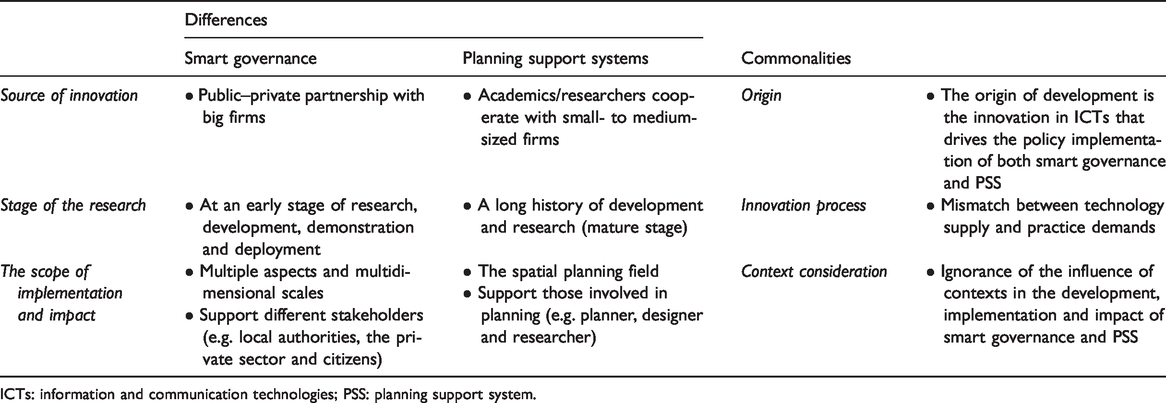
ICTs: information and communication technologies; PSS: planning support system.
Differences
First, smart governance differs from PSSs in terms of the source of innovation, namely individuals or legal entities engaged in innovation. In the case of individuals, public–private partnerships are often the main actors in smart governance, in which the private sector is usually comprised of big ICT firms. In contrast, in the case of legal entities, the initiation and development of PSSs is mostly performed by academics/researchers in cooperation with small- or medium-sized private firms. As a consequence, lots of smart governance developments are primarily ICT-directed (steered by the potential of available and up-to-date ICTs), while quite a few of the PSS developments are steered primarily by the topic matter (the content-wise task that has to be supported).
Second, smart governance is at a different stage of the research, development, demonstration and deployment cycle compared to its PSS counterpart. In general, smart governance is usually in the early stage of development and still faces a range of unmet challenges. For instance, there is often a discrepancy between the ICT needs of the organisation (how to support which tasks?) and the supply of smart governance ICTs (innovative, high-end technology). As a consequence, the needed support is sometimes difficult to offer because of a mismatch between the high-end technology and the users’ capabilities and/or the tasks to be performed. On the other hand, PSSs have undergone a long period of development and research and their ability to support spatial planning tasks has been further improved. In the PSS field, despite some continuing problems in practice, many lessons have been learned, for example it is important to analyse planning tasks and user needs, measure the benefits of PSS application, spread the news of PSSs to increase awareness, be more aware of the influence of context, etc.
Third, the scope of implementation and impact of the two differs. PSSs are mainly used by those involved in the planning process (e.g. planners, designers and researchers) to assist them in handling ill-structured or semi-structured problems (e.g. achieving sustainable urbanisation) and in producing knowledge that supports the proper handling of these kinds of planning issues (Geertman, 2006, 2017; Pelzer, 2015, 2017; Russo et al., 2018; Te Brömmelstroet, 2010). In contrast, smart governance has a much broader scope in the urban context, in the sense that it is not restricted to typical planning problems but is also applied to, for instance, organisational and management issues (e.g. managing traffic flows electronically). As Batty et al. (2012) argue, smart governance, as a much stronger intelligence function, should be implemented to coordinate the many different components that comprise the smart city (e.g. energy, buildings, mobility and infrastructure). Meijer and Bolívar (2016) state that, in practice, smart governance is related to the technological support of organisational internal bureaucratic processes, organisational external processes (e-participation and collaboration), the management of the city (e.g. living labs, smart urban labs, citizens’ dashboards and crowdsourcing) and ICT-facilitated decision-making. This all makes the scope of implementation and impact of the two differ substantially.
Commonalities
There are commonalities between smart governance and PSSs. For both, technology and its innovation were at the heart of their inception. The rapid development of smart city technologies offers the potential to harness the power of urban big data, sensor networks and urban data analytics to govern cities. In practice, the technological value – ‘the acceptance, adoption, and use of technology in itself is seen as valuable’ – has been prioritised in smart governance, whereas much less attention is paid to the extent to which technology can bring real added value to the city, facilitating information and knowledge exchange among stakeholders, and promoting the co-production of policies and decisions (Meijer and Thaens, 2018: 368). As a consequence, technological innovation largely drives the implementation of smart governance. Many inventories reveal that for a long time this was also the case in the field of PSSs (see Geertman and Stillwell, 2004, 2009). It shows that a technology-driven approach seems to have been the starting point of both developments, but the developments of PSSs in planning practice show that this overemphasis on technological innovation in itself is insufficient to become successful in practice, as evidenced by the PSS implementation gap (Geertman and Stillwell, 2020). It is only more recently that PSSs have been considered a means to an end, that is more focus is now put on what improvements and added value PSSs can bring to the planning issues at stake and what this means for the development and application of the instruments.
Closely connected to the previous point, in smart governance and for a long time also in PSS developments, the innovation process was characterised by a serious mismatch between technology supply and practice demands. In the policy implementation of smart governance, high-end technology companies possess strong research and developmental capabilities, which gives them a great advantage over their customers in technological innovation and application. However, this usually results in neglect of the socio-political nature of knowledge production and technological innovation. Although it is often claimed that technology will produce objective, value-free knowledge to ‘decipher crisis, tendencies, contradiction and lines of conflict in contemporary cities’ (Verrest and Pfeffer, 2019: 1335), this should be seriously questioned. As McFarlane and Söderström (2017) argue, ‘instead of technology-push strategies of urban management, [alternative smart governance] should strive to shape technology to put it in the service of social improvement’ (325). In the same vein, the PSS debates concerning the implementation gap show that technological innovation needs to be complemented with an explicit user- and task-orientation to be successful in practice (Geertman and Stillwell, 2020). This implies that the technology should be attuned to the wishes and capabilities of the intended users and to the specifics of the tasks to be accomplished.
It can be concluded from the PSS debates that the ignorance of contexts has contributed significantly to the emergence of the PSS implementation gap (Geertman, 2006). The failure to consider the specificities of context in practice led to a situation in which instruments did not fit the characteristics of the specific planning tasks or the skills and demands of users (e.g. planners, designers and politicians). For instance, in a range of experimental cases, authors argue that the characteristics of the planning and policy process – for example, time span (time pressures) and participation rate (resulting in diversity in educational background, experience, knowledge, occupation, etc.) – were hardly taken into account in the development and use of PSSs (Geertman and Stillwell, 2009). Consequently, this often contributed to a shortfall or even a failure in PSS development and implementation. It is only recently that more explicit attention has been paid to contextual factors in PSS implementation, and these factors have been proven to improve the implementation of PSSs in planning practice (Geertman and Stillwell, 2020).
One can also identify this tendency for one-size-fits-all solutions in smart governance implementations, for instance, in projects such as the Songdo Ubiquitous City (South Korea) and the Tianjin Smart Eco-city (China), in which the implementation of smart governance is standardised and not tailored to the real situations of cities, communities and individuals (e.g. real urban issues, the level of technological development, cultural preference and economic strength). As such, there have been criticisms that interventions must start with the place and not with the technology, since smart policies or smart approaches are socially constructed and are deeply embedded in specific socio-spatial contexts (McFarlane and Söderström, 2017). According to Meijer (2016), ‘an in-depth analysis of the smart solutions in their (political, institutional, societal, economic, and cultural) context is needed to assess the value of certain successful smart (city) governance approaches for other cities’ (75).
In short, and as an indispensable extension of previous points, the technology should be attuned to the wishes and capabilities of the intended users and to the specifics of the tasks to be accomplished, given the particularities of the context in which the technology is applied. It is only then that technology can be of added value to practice. Based on the above discussion of differences and commonalities, the extent to which the dimensions of the policy implementation of smart governance do or do not relate to the PSS implementation gap was outlined. It is argued that the much more recent smart governance developments and implementations can learn from the already longer standing debates around the PSS implementation gap. It is to these contributions that we now turn our attention.
Discussion: What the PSS debate can contribute to smart governance developments
From the previous discussion, at least two lessons that smart governance research and practice can profit from can be learned from the debates concerning the PSS implementation gap. First, as indicated, for technology to be of added value to practice, it should be attuned to the wishes and capabilities of the intended users and to the specifics of the tasks to be accomplished, given the particularities of the context in which the technology is applied. The development of smart governance is currently largely driven by short-term policy-based investments and high-end technological innovations. Some studies have explicitly stated that this policy-driven treatment of smart governance is neither necessary nor satisfying, since the acceptance of ICTs and the ‘intelligence’ that such technologies are supposed to generate do not produce substantive value per se (Jiang et al., 2019a; Ruhlandt, 2018). In contrast, as for smart governance itself, more pragmatic questions are required, for example to what extent can the implementation of smart governance in practice become more effective and valuable to the citizens? Rather than starting from the technological innovation, smart governance can and should move towards more application-dependent contributions to innovate governance processes and solve substantive urban challenges.
Furthermore, closing the PSS implementation gap shows that knowledge of the context specificities is of importance and will also be of importance to smart governance developments. Geertman (2006) argues that to close the PSS implementation gap, besides taking the supply–demand discrepancy into account, the technology should be explicitly attuned to the particularities of the specific context at hand. As regards smart governance, Meijer (2016) emphasises that ‘studying the effects of smart governance is complicated since the relations between governance arrangements, use of technologies, and effects on the quality of urban life are contextual’ (75). It means that ‘situations across cities vary widely, and the priorities for both analysis and interventions need to be grounded in the specificity of places’ (McFarlane and Söderström, 2017: 325). Several other studies also indicate that contextual factors have a considerable influence on smart governance (Jiang et al., 2019a, 2019b; Meijer, 2016). These studies cross-examine how context mediates the technological interaction with urban actors and produces the appropriate solutions to the urban issues of concern. From this arise questions regarding technological innovation and implementation: what sorts of smart ICTs are or should be implemented, by what kinds of urban actors, and in which types of governance situations or contexts?
To be able to answer these questions, the supply–demand discrepancy characteristic of the PSS implementation gap shows that there is a strong need to promote a socio-technical method. For smart governance developments, it means that one should include distinct (i.e. expert and lay) urban actors in the ICT development and implementation processes and attempt to develop more collaborative ways of working. In most current smart governance practices, the corporate-led version of urban governance leads to a situation in which broad political engagement and opinion expression are weak, and the interests and real needs of ordinary people receive only minor attention (McFarlane and Söderström, 2017). As a consequence, it is unclear in what sense various smart technologies deliver what people actually expect or need, even though they can be considered the final users of the smart city. Furthermore, it should be noted that practical urban challenges are socially constructed (Verrest and Pfeffer, 2019), which can either limit or be conducive to the chosen smart governance approach (Meijer, 2016). For instance, distinct governance issues (e.g. congestion, pollution, housing, flooding and crime) to a large extent stipulate the functional support of hardware and software devices that governance processes need. A lack of understanding or consideration of the specific governance issues leads to improper smart governance arrangements and the misuse of technology. Hence, smart governance should integrate knowledge from diverse actors into ICT development and implementation and as such ‘support city- and citizen-specific decision making, capable of dealing with objectives for urban sustainability’ (Stratigea et al., 2015: 1). To do so, this paper urges a shift from an expert-led, supply-pushed strategy to a user-centred, demand-induced approach of smart governance innovation.
Before concluding this paper, a main limitation of this research should be acknowledged: since smart governance is a relatively new field of study, the definition and discussions of smart governance were primarily based on reviewing and mapping the existing conceptual literature rather than on solid empirical studies.
Nevertheless, this paper shows how discussions around the PSS implementation gap can provide some meaningful insights into how to overcome the policy implementation voids of smart governance and change this into a more socio-technical oriented approach. It highlights the interactions and mutual shaping processes between technological advances and governance practices. This means that a technology should be implemented only when it can add value to governance practices. But whether the latter is the case largely depends on our understanding of the mediating role of contextual factors. Based on this, the conclusion is that relating the PSS implementation gap to smart governance means that smart governance can become more aware of the role of contextual factors in collaboration with users and urban issues. This is expected to shift the emphasis from today’s technology-focused, supply-driven governance development to a socio-technical, application-pulled and demand-driven smart governance development.
Footnotes
Acknowledgements
The author would like to thank the editor and two anonymous reviewers for their many extremely helpful suggestions and comments that stimulated substantial improvements to earlier versions of this paper.
Declaration of conflicting interests
The author(s) declared no potential conflicts of interest with respect to the research, authorship, and/or publication of this article.
Funding
The author(s) disclosed receipt of the following financial support for the research, authorship, and/or publication of this article: Financial supports from the China Scholarship Committee (Grant No. 20160601386) are gratefully acknowledged.
