




Abstract
This paper traces how right-wing populist media have shaped opposition to climate policy in the UK through the analysis of GB News coverage of the expansion of London’s Ultra-Low Emission Zone (ULEZ) in 2023. Although ULEZ was initially introduced as a public health measure for reducing air pollution, it became a political flashpoint through its framing as symbolic of a broader ‘war on drivers’. Drawing on the concept of ‘infrastructural populism’, this paper focuses on GB News coverage discussing the ULEZ scheme to understand this process. Two core narratives are identified. First, the backlash against ULEZ is presented in spatial terms, elevating London’s suburbs as a key site of opposition to the scheme and foregrounding resistance in how ULEZ reordered everyday mobilities in these areas. Second, the ULEZ scheme was positioned beyond its physical infrastructure and, instead, cast as a moral, populist battle with coverage presenting democratic and evidential deficits as part of a ‘war on drivers’. This paper highlights the need to understand contemporary backlash against climate policy as rooted in a growing infrastructural populism that positions new policies as technocratic interventions that reorder everyday life and create both spatial and procedural injustices.
Introduction
While polling shows support for climate action globally (Andre et al., 2024), a green backlash is becoming politically prominent as many governments and communities implement new climate, energy and environmental policies. Within this emergent opposition, there has been a pivot towards limiting or delaying climate action by presenting interventions as undemocratic, unfair, and unnecessary. In the UK, opposition to the 2023 expansion of London’s Ultra Low Emission Zone (ULEZ) is a prominent example of this backlash. The scheme started as a public health measure designed to reduce air pollution but became presented by its critics as a symbol of climate policy as a ‘war on drivers’.
In this paper, I follow recent work by understanding opposition to the ULEZ scheme as a form of ‘infrastructural populism’: in which the material and affective dimensions of infrastructure highlight nuances, experiences, and resistance to policy change (Beveridge et al., 2024). While previous work has explored how right-wing populism might signal a lack of trust or sense of neglect within political processes or institutions (Marquardt and Lederer, 2022), such movements can also reposition climate issues as a ‘container’ for senses of inequity and unfairness (Atkins and Menga, 2022). Infrastructure plays a role in this, materially and discursively defining the climate futures that are possible or foreclosed. This is particularly important in the study of movements against climate action, where new or existing infrastructure is reinscribed with new meaning within a ‘green backlash’.
I explore this infrastructural populism in the UK by focusing on how the ULEZ expansion was covered on GB News, a right-wing broadcaster that has become an important part of the UK media ecosystem (Parker and Thomas, 2024). Through analysing videos uploaded to YouTube by this broadcaster, I detail the positioning of ULEZ as a wider symbolic and material battleground within an asserted ‘war on drivers’ in the UK. Two themes are detected, highlighting both spatial and procedural critiques. First, the ULEZ expansion is positioned as reordering mobilities and disproportionately affect London’s suburbs, elevating these neighbourhoods as a key site of opposition to the scheme. Second, the scheme is positioned beyond its material infrastructure and outcomes and cast within a moral tension of democratic and evidential deficits underpinning the ‘war on drivers’. Taken together, these narratives highlight an ‘infrastructural populism’ that is simultaneously spatial and procedural, everyday and rooted in climate policies changing mobilities.
I structure this argument across several sections. First, I introduce the concept of ‘infrastructural populism’ to explore emergent scholarship on a ‘war on drivers’. I then turn to outlining the focus on the ULEZ scheme and define its political resonance in the UK in 2023. After outlining my methodological approach, I introduce two key themes detected in GB News coverage: first, the assertion of disproportionate impacts on London’s suburban residents and, second, claims of the circumvention of democracy and scientific expertise. The themes and their relevance to existing scholarship are outlined – before final conclusions are drawn.
Infrastructural populism and climate action
Recent scholarship has often made sense of anti-environmentalist movements through a logic and language of ‘populism’ (Marquardt and Lederer, 2022; McCarthy, 2019). Following Laclau (2005), populism should be understood as the construction of a frontier between two opposing camps: ‘the people’ and an ‘elite’ that is holding them back. How this antagonism is formed is contingent, with variations across national contexts and new demands or grievances always emerging. However, a common thread can be found in how populist politicians generally construct ‘the people’ as righteous, ‘ordinary’, and democratic and the ‘elite’ as technocratic, ‘out of touch’, and stifling the ‘will of the people’ (Atkins and Menga, 2022).
Beveridge et al. (2024) have introduced the term ‘infrastructural populism’ to highlight the central and varied role that infrastructure plays in contemporary logics of right-wing populism. This follows the increased focus in recent years on the political and affective power of infrastructure (Bosworth, 2022; Larkin, 2013) and Van Neste and Couture-Guillet’s (2022) call to ‘rematerialise’ urban studies: illuminating the role of infrastructure in regulating everyday practices of urban authority and life. Infrastructural networks play a key role in defining, reproducing, and constraining everyday life and how people move through and experience space (see Graham and Marvin, 2001; Siemiatycki et al., 2020; Star, 1999). As a result, a language of ‘infrastructural populism’ can support understanding of how right-wing populist movements can find new forms and narratives through opposing infrastructure or using it to legitimise their own political projects (Beveridge et al., 2024).
A focus on infrastructure as materially and discursively conditioning collective hopes and frustrations provides an important route forward for those seeking to detail and understand the emergent ‘green backlash’ of right-wing populism. As Haarstad and Wanvik (2016) have conceptualised, the ‘carbonscapes’ that underpin fossil fuel regimes are highly unstable in the face of climate policy. These extend across various sites and spatialities of extraction, distribution, and consumption. All require infrastructure that is both material and engineered (performing a designed function) and imagined, tied to the petrocultures that condition everyday life (Daggett, 2018; Szeman, 2019; Tewkesbury, 2021). For Beveridge et al. (2024), ‘infrastructural populism’ can take four forms: with infrastructure as (a) a site of antagonism between ‘people’ and ‘elite’, (b) a terrain of ideological struggle; (c) an exercise of national state power; or (d) part of everyday politics. It is notable that, while Beveridge et al. (2024) highlight the importance of everyday experiences, scholarship exploring the political role of infrastructure has often focused on large-scale projects, such as pipelines, highways, or airports (Knox, 2017; Mondragón-Celis and Weinstein, 2025). However, the ‘green backlash’ prompts greater analytical focus on the everyday infrastructures that provide new sites for dissent and opposition.
In this paper, I link this ‘infrastructural populism’ to a growing scholarship that understands transport infrastructure as an important site for social movements and dissent, bringing together different coalitions to affirm or contest planning decisions (Legacy, 2022; Paterson, 2007). This infrastructure is where the instability of ‘carbonscapes’ collides with an emergent ‘infrastructural populism’, being where climate policy takes material form and reorders everyday life and mobility (Beveridge et al., 2024; Remme et al., 2022; Wanvik and Haarstad, 2021). In a scholarship focused on the Global North and, in particular, northern Europe, this reordering has prompted opposition. In Germany, protests against speed limits on the country’s autobahn network fused together a scepticism about the need for policy intervention with a defence of values linked to the freedom of driving unrestricted, and assertions of overlooked costs of such action (Grünwald and Patterson, 2025). In Norway, sustainable transport policies have witnessed the construction of an ‘us vs them’ antagonism based on transport use, with anybody not dependent on a car deemed as ‘elite’ (Remme et al., 2022). Aasen and Sælen (2022) explored opposition movements to toll roads in Norway, highlighting how this dissent often adopts an anti-elitist narrative to position new schemes as the top-down imposition of restrictions on ‘the people’. Drozda (2025) has adopted a language of ‘motorist populism’ to make sense of these movements of backlash against changing automobility: outlining such opposition positions itself as representing ‘ordinary’ and ‘normal’ people living in urban areas. Across this work, climate policy comes to represent a shift, in both discursive and material terms, in how people use transport infrastructure, how automobility manifests, and how new forms of political antagonism emerge (Hellberg et al., 2024).
Within this, the mobilisation of right-wing populist concerns often repositions urban infrastructure within the logic of a ‘war on drivers’, in which changing transport practices overlap with people feeling overlooked or neglected in policy (Remme et al., 2022). The narrative of a ‘war on drivers’ positions schemes that manage automobility (i.e. through calming or slowing traffic) as part of a wider battle between surveillance and interference with the individualism symbolised in a car-dominated society (Paterson, 2007). It is within these tensions that climate policies interact with notions of automobility: or the broader system formed of technological objects (cars themselves) combined with practices of consumption, infrastructural networks, cultural representations, resource use, and a dominant mode of mobility (Urry, 2004). The saturation of this system in many areas has led to the private car being a predominant context of everyday life: for many, even the most basic routine involves car travel.
Collectively, these examples highlight an important manifestation of movements against climate policy, in which new measures are contested due to their perceived restriction of freedoms linked to automobility and fossil fuel consumption. Backlash against changing mobilities has been found to illuminate both perceived and real spatial injustices that require interrogation (Gössling et al., 2024). For Drozda (2025), these movements represent significant influences on contemporary urban politics and geographies through their positioning of sustainable transport policies within anti-elite politics. Those advocating for new transport policies are cast a out of touch, technocratic elites who neglect ‘ordinary’ lives of car dependence.
In their exploration of changing ‘carbonscapes’, Wanvik and Haarstad (2021) introduce three dynamics that sustainability transitions might take: ‘rupture’ (where ‘normal’ trajectories and arrangements are interrupted and disassembled), ‘instability’ (the condition of ongoing volatility), and ‘antagonism’ (political conflict which surfaces through rupture and instability). Taken together, these dynamics are presented as formative opportunities to make better policy. This focus on the procedural and processual in unstable transitions corresponds with work by Remme et al. (2022) who foreground spatial injustices of opposition to transport policy change within the processes that underpin such interventions.
In this paper, I present the case of the expansion of London’s Ultra-Low Emission Zone in 2023 as an example of how the antagonisms underpinning the claimed ‘war on drivers’ represent an ‘infrastructural populism’ that is both spatial and procedural, highlighting the political role of London’s suburbs and claims of democratic and evidential deficits. The ULEZ scheme represented a significant moment of political debate, leading to policy reversals, surprise electoral defeats, and episodes of vandalism and destruction. Following this literature on ‘infrastructural populism’ and the growing intersection of right-wing populism with transport policy, the questions animating subsequent analysis are: (1) How does opposition to the ULEZ scheme represent a form of infrastructural populism against changing transport policy in the UK? (2) What narrative role do claims of spatial and/or procedural justice have in such a process?
Anti-net zero populism in the UK and the ULEZ scheme
Climate policy in the UK has become an increasingly positional and partisan issue, with a growing opposition to environmental and decarbonisation policy, which is presented as costly and undemocratic (Atkins, 2022; Paterson et al., 2023). A growing part of this narrative focused on schemes that repurpose road infrastructure or introduce new measures and restrictions on drivers that have been claimed to lead to new senses of spatial injustice (Gössling et al., 2024).
A key site of the ‘war on the driver’ in the UK can be found in the opposition to London’s Ultra Low Emission Zone. This scheme was first proposed in 2014 to reduce levels of air pollution in London by the Conservative Mayor of London, Boris Johnson. Launched in 2019 under the Labour mayoralty of, Johnson’s successor, Sadiq Khan, ULEZ adopts a series of emissions standards for vehicles to enter a defined zone. Petrol vehicles less than 16 years old and diesel vehicles under 6 years usually comply with these regulations. Vehicles that don’t pay a daily charge of £12.50 (£100 for freight vehicles). As Figure 1 demonstrates, the ULEZ area has expanded significantly since 2019. The scheme first covered central London before being expanded to sit within the transport arteries of the North and South Circular roads. Khan announced in November 2022 that ULEZ would expand further to cover all 32 London boroughs, affecting five million more Londoners and saving an estimated 27,000 tonnes of CO2 emissions (Mayor of London, 2022a). The announced expansion was accompanied by new scrappage schemes and improvements to local transport networks. The scheme was expanded on 29 August 2023: with ULEZ becoming the world’s largest Clean Air Zone disincentivising private vehicles to reduce urban pollution. Map of London’s Ultra-Low Emission Zone, including 2021 and 2023 expansion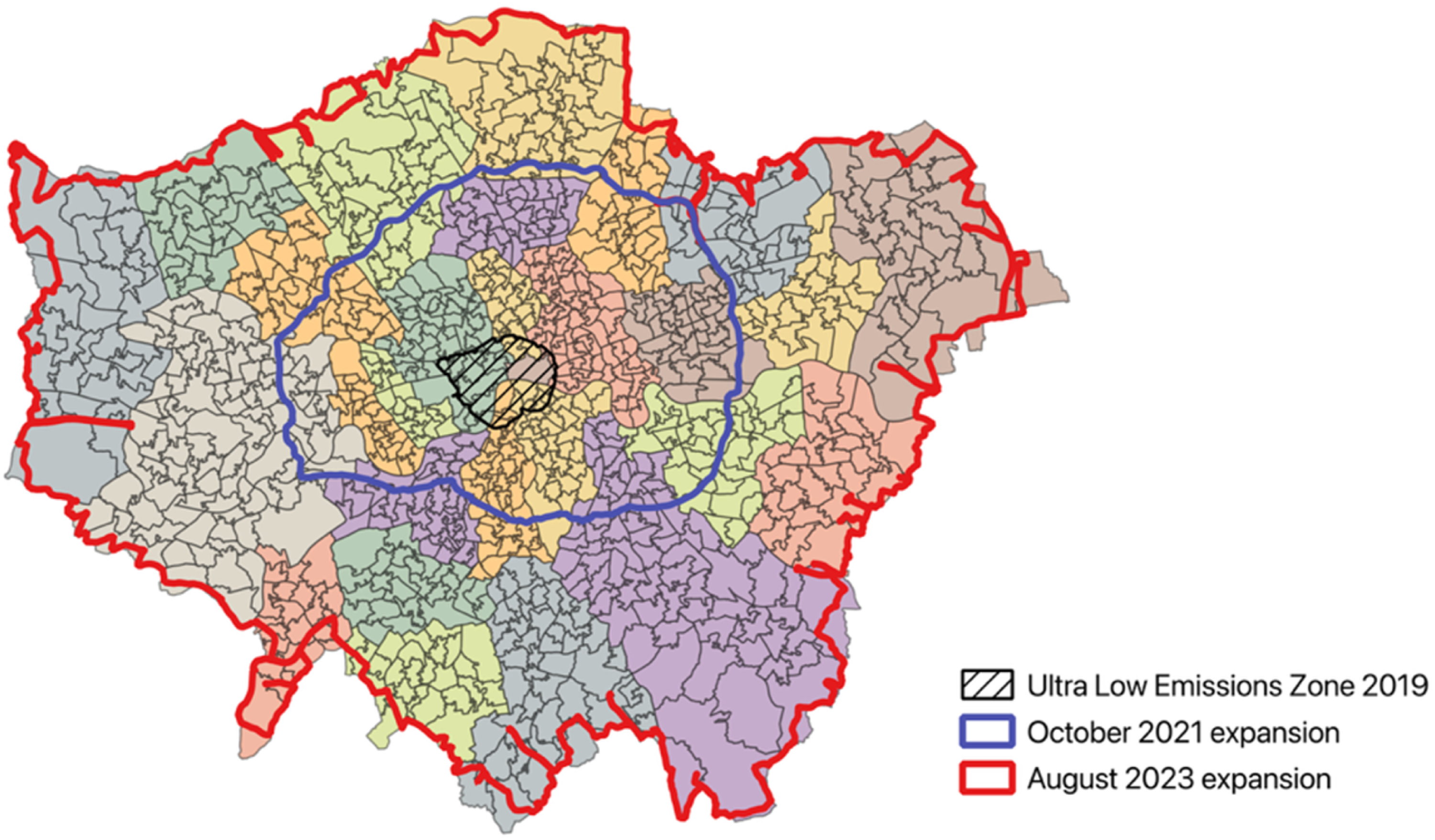
What separates ULEZ from other schemes changing automobility is that, whilst other schemes change systems of automobility (Aasen and Sælen, 2022; Horta, 2020), ULEZ restricts certain vehicles from driving in certain places. It represents infrastructural change as targeting everyday practices and behaviours rather than introducing new alternatives. Its 2023 expansion represents a change in urban schemes to reduce air pollution, that have mostly focused on the core areas of centres. The scheme’s expansion led to its entrance into neighbourhoods with different experiences of road infrastructure and levels of car use and dependence. Boroughs in Outer London are more likely to own at least one car: for example, while 61% of people living in the central borough of Camden in 2022 didn’t own a car, 85% of households in the suburban neighbourhood of Bromley own at least one vehicle (see Mayor of London, 2022b). This car dependence overlaps with a drop-off of public transport and cycling network density in London’s suburban areas. While Transport for London data shows that some 33% of London’s population lived within 400 m of a bus stop in 2023, there is a notable decline of this access as the network moves away from central London, the centres of boroughs, and railway networks (TfL, 2024).
Following Wanvik and Haarstad’s (2021) conceptual approach, ULEZ represents a rupture in this landscape of car dependence in London’s suburbs and, in doing so, functions to both generate instability and surface a series of antagonisms linked to the ‘war on drivers’ in the UK. In response to the announced ULEZ expansion, protestors blocked roads with vehicles, often wearing yellow high-visibility vests (a reference to the Gilets Jaunes protests in France). Placards included slogans of: ‘No ULEZ, No Pay Per Mile’, ‘Stop the Toxic Air Lie’, and ‘Stop the Khanage’ (Kelly and PA Media, 2024). Masked protestors, known as ‘bladerunners’, vandalised the cameras and infrastructure installed as part of the expansion (Lodge, 2024; Saunders, 2024). 1 Such vandalism has a long history in contested automobility in the UK and draws comparisons to a similar movement 20 years previously, namely the ‘Motorists Against Detection’ in 2002 who destroyed speed cameras across the UK, presenting the new technologies as money-making devices (Paterson, 2007).
The UK and, particularly, London’s suburbs represent distinct, varied and often politically charged spaces that are different from suburban narratives elsewhere in the Global North (see Mace, 2016). In London, these outer boroughs are that legislatively part of London (returning representatives to the London Assembly) but often hold distinct infrastructural, historical, and cultural identities (Holman and Thornley, 2015). As a result, they exist between the metropolitan character of London and the regions beyond it. As Holman and Thornley (2015) detailed, despite being at the urban periphery, London’s suburbs have often been politically salient in election results and political campaigning. This resonance continued with opposition to the ULEZ expansion. This local opposition entered the national political conversation in July 2023, after the result of the election for a new Member of Parliament for Uxbridge and South Ruislip, a constituency in West London to be included in the expanded ULEZ. This seat, vacated by the former Prime Minister Boris Johnson, was held by the Conservative Party (electing Steve Tuckwell by a margin of 495 votes). With Uxbridge being one of the most car-dependent areas in London, Tuckwell’s victory was linked by many to the planned ULEZ expansion (Rutter, 2023; Stone, 2023). In the wake of the result, Rishi Sunak (Prime Minister, 2022-2024) criticised the ULEZ scheme (Jackson, 2023), while Sir Keir Starmer, the leader of the Labour Party (now Prime Minister), backtracked on commitments to similar zones in other cities (Scott, 2023; Wright and Gupta, 2023). Polling of Londoners in August 2023, as the scheme expanded, found a deep division in opinion: with 62% of those in Central London supportive, compared to 26% in the suburbs of Greater London (Smith, 2023).
Whilst Mabbett (2023) has presented ULEZ as a “phoney war” over a scheme with only “minor costs and benefits”, I look to characterise it as part of an emergent ‘infrastructural populism’ that positions climate and public health measures as part of a ‘war on drivers’ and, with it, a new site of antagonism between ‘the people’ and an ‘elite’ pushing the project forward. To explore this, I have collected data from GB News, a right-wing populist media outlet in the UK. I now turn to detailing this process of data collection and analysis below.
Approach and methods
Launched in September 2020, GB News has become an important part of the UK media ecosystem. The media company is jointly owned by Sir Paul Marshall, a hedge fund manager, and the Dubai based Legatum Group (an investment firm). Generally seen as right-leaning, it regularly provides critical commentary on various issues such as climate policy, migration, transgender rights, and what it defines as ‘woke’. These outlets often position themselves as reporting on the issues that ‘matter’ to ‘everyday people’ but that go underreported on traditional media outlets (presented as part of ‘the elite’) (Fawzi, 2019). The company enjoys extensive investor support, with limited focus on profitability compared to reach and programming (Hedgeweek, 2024). In focusing on narratives on one broadcaster, I follow previous scholarship that explored the importance of media reporting in determining political polarisations around climate and environmental policy (Jambrina-Canseco, 2023; Tschötschel, 2023; Valero, 2022). Others have explored changing media narratives of automobility and air pollution, highlighting important moments in how narratives of everyday mobility gain resonance (Egan and Caulfield, 2024; Horta, 2020; Kenis and Barratt, 2022).
Whilst GB News has a smaller audience than other rolling news broadcasters in the UK (a monthly reach in July 2025 of 3.8 million viewers, compared to 8.5 million who watched BBC News 24), it has a growing significance in understanding right-wing politics. It has a growing base, having higher ‘average viewership’ figures than BBC News 24 and Sky News (both established broadcasters) in the second half of 2025: highlighting that, whilst it is watched by less people, it has a more loyal audience (Tobitt, 2026). Comparable to Fox News in the United States or CNews in France, GB News fits the conceptualisation of ‘hyperpartisan media’ provided by Rae (2021) to describe media outlets that challenge the traditional media ecosystem. This importance of its programming elevates right-wing politicians, commentators and narratives and in its increasing popularity within right-wing voters (Colbert and Mortimer, 2023).
GB News coverage of ULEZ is collected from YouTube, where the channel disseminates videos of shows outside of their broadcast time. GB News is highly active in the online space, operating through social media networks to share content and gain new engagement to generate revenue. As of February 2026, GB News has 2.07 million subscribers on YouTube, with its content regularly receiving hundreds of thousands of views. This focus on online media narratives follows previous work exploring how these spaces provide fertile ground for right-wing populist narratives. In Spain, online car forums have provided important platforms for the right-wing Vox party, with online messages elevating the party’s political messages (Miro and Toff, 2023).
Data was collected through Boolean searches of YouTube that targeted GB News videos discussing ULEZ in 2023 to understand how GB News coverage developed across the period of the implementation of and opposition to ULEZ. Only videos uploaded by the GB News channel were selected. After filtering out videos that were returned but didn’t match this paper’s focus (i.e., where ULEZ is referred to as a ‘story coming later in the show’), 122 videos formed the corpus of this study. Videos analysed ranged from interviews with activists to in-studio debates. These are listed in the Supplementary Material and referenced in the manuscript by numerical identifiers starting with ‘GB’.
The corpus was analysed via three stages of a qualitative content analysis that moved from iterative coding to the formation of thematic categories for analysis (Schreier, 2012). First, transcripts were coded manually, often multiple times in broad, iterative terms for each argument of opposition or support of ULEZ presented (i.e., ‘surveillance’, ‘health’). Second, respective codes were then collated into overarching themes to define the broader narratives, grievances and demands that such codes collectively highlighted. Third, videos were rewatched thematically to record direct quotations and be analysed for visual and production content: understanding where clips were filmed, which footage was selected to be shown, and who was interviewed (both in studio and in ‘vox pop’ settings). These steps allowed the integration of individual sources into the themes presented below.
City, suburbs and the ‘war on the driver’
The first theme detected highlights GB News’ representation of ULEZ as disproportionately affecting suburban communities, where people are more reliant on their cars (GB32, GB116) and where public transport networks have less investment than those in Central London (GB37; GB73; GB104). GB News coverage often focused on how the ULEZ expansion affected communities in the outer boroughs whose suburban character is presented as culturally distinct from the city’s metropolitan area. Coverage included interviews with those whose working lives were presented as dependent on their cars, including business owners (GB48; GB89), care-workers (GB16), self-employed people in manual trades (GB41; GB63). All were presented as both reliant on their vehicle for work and lacking the support that might be available from more-secure contracted employment. Small business owners, in particular, were highlighted as facing important risks. One interviewee, the owner of a jeweller’s business in Bromley cast ULEZ as an existential threat to his business: I’ve been here for 35 years.... We've got through the pandemic, we've got through the depression. This I think will actually break us. I'm really, really fearful for what might happen in the future…. (GB89)
Coverage analysed highlighted ULEZ as impacting business costs through the need to purchase new compliant vehicles (GB41; GB63; GB89; GB106). With those dependent on driving for work unable to switch to a compliant vehicle, costs were presented as at risk of spiralling, leading to the closure of businesses and loss of work. The jewellery business owner above, who had bought a new ULEZ-compliant vehicle, went on to highlight the plight of one of his employees: One of my staff, she's going to have to pay the ULEZ charge six days a week. Her car doesn’t comply [and] she can’t afford to buy a new car. So, at the end of the day, she will… have to give up work, which is not right, and she’ll probably go and claim benefits. (GB89)
In this theme, the infrastructural populism of GB News’ coverage focuses beyond access to infrastructure and towards defending infrastructural ways of everyday life. Across this coverage, the ULEZ scheme was presented as an attack on the driver, rather than the car itself, affecting everyday uses of private vehicles to navigate the suburbs and the city. Sources present the ULEZ expansion through a discussion of its injustice: highlighting how the scheme would have significant impacts on “ordinary, everyday people” who are vulnerable to its material consequences for automobility (GB26, GB40, GB63). Commentators highlighted ULEZ as an ideological scheme that sought to change behaviour and, in their framing, restrict people’s movement. For some, this ‘war on motorists’ represented an ideological pursuit of “get[ting] people out of their cars and… onto public transport” as a form of control and coercion to be resisted (GB108; GB110).
Transport for London argued that nine-out-of-ten cars in affected areas were compliant to ULEZ standards and, as a result, were to be unaffected by the expansion (TfL, 2023). Yet these claims were disputed with the BBC reporting that one in six cars in the areas affected did not meet the required standards (Donovan and Low, 2023). However, while official statistics highlight that the poorest people in London are less likely own a car and are, instead, reliant on public transport (GLA, 2023), the scheme’s impacts were presented on GB News as part of an elite ‘war on the poor’ in the suburbs.
2
This was presented through its uneven impacts: deemed to disproportionately affect those already suffering financially from spiralling prices. Elsewhere, in an episode of his evening show, Nigel Farage agreed that ULEZ was a ‘tax-raising scam’, and “an attack on the poor, the elderly, the young, the disabled, and many others” (GB64). In one appearance on GB News, Lois Perry of the anti-ULEZ campaign group, CAR26, argued that: …This will lead to [the] complete annihilation of the working class… and of the middle class… Because the internal combustion engine, the ability to move and get around and be independent and make money is a key component of our liberty and everything that we take for granted in this country... (GB110)
It is notable that, while Khan has faced racist abuse as Mayor of London (Low, 2022), no sources analysed here adopted an explicitly racial (or racist) tone or sub-text. The focus instead was on his political character. Khan is presented across the source material as the key figure of blame: described at different points as arrogant, incompetent, and corrupt (GB17; GB50; GB117). The one time that race is mentioned is when Richard Tice, the then-leader of Reform UK, extends narratives of Khan’s corruption to accusations of Khan himself being racist – referring to controversy around claims on Khan’s website that a photograph of a young White family did not represent ‘real Londoners’:
3
…He's a liar. He's corrupt… And us as White Londoners… apparently, we’re not real Londoners. In my mind, that makes him a racist. So he's a lying, corrupt, racist. If we could, he would be impeached, and he would be out of a job. (GB50)
Claims of the ‘war on drivers’ invoked parallels between ULEZ and other schemes assumed to be in the pipeline (GB53). Commentators frequently highlighted ULEZ as a “national story” (GB50) and a “warning sign” (GB47) of what other communities across the UK will face soon. The Labour Party, of which Sadiq Khan is a prominent politician, were presented as likely to roll-out similar schemes to new towns and cities (G50). Dan Wootton, a presenter of a regular evening show that was later cancelled due to a guest making misogynistic comments, argued that ULEZ “is just the start of Slippery [Keir] Starmer’s [the Prime Minister] war on motorists.” (GB109). These claims of the ULEZ expansion being a gateway to new interventions often highlighted claims of a democratic deficit and a distrust in the expertise underpinning the scheme. It is second them that I turn to below.
Democracy, representation and expertise
While the expansion of the ULEZ area represents an infrastructural intervention into suburban space, it was also positioned with a populist tension between an ‘elite’ expanding the scheme and an everyday ‘people’ pushing back in opposition. Within this second theme, GB News coverage elevated narratives of how the scheme represented the circumvention of democratic process and the exclusion of alternative viewpoints.
This was often framed around legal efforts by local authorities of Bexley, Bromley, Harrow and Hillingdon (all affected by the expansion) and Surrey County Council (partially affected) to challenge the scheme in the UK High Court. The councils, all led by Conservative Party politicians, argued that there had been inadequate public consultation and that the scrappage scheme provided was flawed. In late July 2023, the High Court ruled that the legal basis for the expansion was sound and that the scheme could go ahead. Coverage of these legal appeals argued that Khan had circumvented democratic process when approving and implementing its expansion. A consultation from May to July 2022 had received a total of 57,937 responses, 59% opposing the scheme (TFL, 2022). This included 11,868 of what were deemed as ‘organised responses’, or where organisations encouraged supporters to respond to the consultation in a specified way (TFL, 2022).
A major national newspaper had argued that some 80% of the total responses to the consultation were in opposition to the scheme and that TfL had acted to exclude many of these opposing responses (Pierce, 2023). Whilst these claims were later withdrawn and corrected by the outlet (Full Fact, 2023), many on GB News adopted this talking point, casting opposition as actively excluded. Nigel Farage reported in January 2023 that ULEZ: Has no democratic support… [Sadiq] Khan literally binned 5,200 objections that were put into this [the consultations] and he ruled them invalid. There is no level at which this has genuine democratic support. (GB43)
Claims of a democratic deficit would be coupled with questions of the rigour of the scientific evidence underpinning the expansion. This repositioned claims of ULEZ reducing air pollution as a key division between the metropolitan London core and those living and working in the suburbs (GB79). Farage presented one show from a field at “the furthest point from Central London, but [which is] considered [part of the] Greater London Authority” with an air pollution monitor and juxtaposing the reading with levels of air pollution on the London Underground (GB45). Sitting on a bench wearing wellington boots and surrounded by long grass, Farage presented his own assessment of air pollution in the area and highlighted a disconnect between official accounts of the need to reduce pollutants and the perceived purity of the air where he sat. Farage argued that there were “more horses than people living in this part of what is Greater London” (GB24).
The expansion of the ULEZ scheme to the outer boroughs of London was justified through assertions of its positive health outcomes through reducing air pollution across the city (Mayor of London, 2022b). However, commentators presented ULEZ as an example of “finding policy-based evidence” (GB17; GB105), in which the science underpinning the decision remains open to question, scepticism, and dissent (GB93; GB121; GB122). This disconnect became politically charged after a Freedom of Information request highlighted emails between Deputy Mayor Shirley Rodrigues and Professor Frank Kelly, an air quality expert at Imperial College London, asking Kelly to rebut research that had questioned the benefits of ULEZ (Daly, 2023). Kelly agreed to issue a supportive statement, which Rodrigues later edited to emphasize ULEZ’s impact (Daly, 2023). The role of Professor Kelly was disputed in coverage, with his award of research funding from TfL and the Greater London Authority presented as evidence of scientific independence in his work (GB2; GB66; GB112).
Across the sources analysed, GB News coverage positioned ULEZ as part of a democratic deficit and government overreach with uneven impacts that characterises climate policies to come. ULEZ was positioned as part of a “net zero madness” pursued by the “eco cult” (GB3) intent on limiting the lives and livelihoods of people across the UK. In one appearance, Richard Tice characterised ULEZ as part of a “madness of net zero…[because] that’s what’s driving Sadiq Khan’s complete obsession with climate change [and] with net zero, frankly, to the detriment of Londoners about other issues.” (GB3).
This corresponds with work elsewhere, finding that climate sceptic media frequently position climate policy as representing an injustice – signalling the uneven impacts of climate campaigns as elite-driven, fearmongering, and restricting the freedoms of ‘everyday’ people (Van Eck and Feindt, 2022). This is evident in the words of Neil Oliver, who argued that the ULEZ scheme was part of a shifting societal antagonism between ‘the people’ and an elite calling for climate action, public health measures, and behavioural change. Roleplaying as a member of this ‘elite’, Oliver looked directly down the camera and said: … nothing’s going to change for us while everything changes for you. When you heat your home with a gas boiler and drive a diesel van for your work, it’s because you’re downright stupid and reckless. We’ll heat our homes how we like and drive what we want, whilst you walk to work and live colder, hungrier lives. (GB13).
This work has found two overarching themes in GB News’ coverage of the ULEZ expansion in London: highlighting two forms of infrastructural populism. First, the ULEZ scheme is represented as an infrastructural imposition into London’s suburbs affecting everyday and ‘normal’ mobilities in the city’s outer boroughs and rooting opposition in the spatial injustice of this intervention. Second, coverage of opposition extends its ‘infrastructural populism’ to include claims of democratic deficits and procedural injustice, with the ULEZ scheme symbolic of a broader ‘elite’ politics to restrict people’s lives and mobilities and use all tools necessary to so. I reflect on the resonance of these themes below.
Discussion: Unpacking the backlash
In this work, London’s ULEZ scheme is represented across GB News coverage as an intervention into the transport infrastructure of London through the installation of new surveillance technologies (cameras), financial apparatus (charging mechanisms), and affective responses. All of which affirm new spatialities through determining how people can use their cars in public spaces and, ultimately, leading to an opposition movement that became resonant in national politics. Taken together, these narratives highlight an ‘infrastructural populism’ that is simultaneously spatial and procedural, everyday and rooted in climate policies changing mobilities. The ‘infrastructural populism’ of the ULEZ scheme contributes to and broadens scholarship in two ways.
First, it extends this analysis of the links between right-wing ‘infrastructural populism’ and space to explore a different site of backlash: suburban areas. Geographical scholarship exploring spatial injustices in climate and transport policy often focus on a binary between urban and rural areas, with experiences of rurality and ruralisation create fertile conditions for reactionary and populist politics (Förtner et al., 2021; Mamonova et al., 2020; Mullis, 2025). Yet the place resentment that mobilises backlash and discontent in rural areas is also evident in suburban spaces (Borwein and Lucas, 2023; Loftus and Gort, 2023) and with political consequences. In Toronto, Mayor Rob Ford (2010-2014) fomented political narratives that highlighted suburban experiences of deindustrialisation and the stigmatisation of those living in these neighbourhoods (Kipfer and Saberi, 2015). In Spain, the right-wing Vox has a substantial base in suburban areas, often those with lower incomes and lower levels of employment (Sánchez-García and Llamazares, 2026).
Narratives of a ‘war on drivers’ in London and, by extension, the UK, foreground work on claims of material and spatial injustices created by suburban car dependency. Coverage of the ULEZ scheme encompassed an important narrative of ULEZ being an ‘urban’ policy transplanted from high-density and high-pollution areas to suburban neighbourhoods that were calmer, slower, and in less need for intervention. GB News coverage of the ULEZ scheme analysed here highlights how these suburban areas can be produced as a distinct constituency in infrastructural populism, with experiences of changing mobility that are different from those in urban or rural areas. Across GB coverage, the ULEZ schemes were presented as infrastructural interventions into these spaces that affected everyday suburban life. Opposition to the scheme was presented as part of a revolution against state control (GB50; GB65; GB116). In illuminating this political role of the suburbs, I follow the work of others, such as Loftus and Gort (2023) who called for research to attend to such political movements as extending beyond core-periphery logics of urban and rural communities and, instead, focus further on suburban network – which, in turn, provide important settings for the ‘infrastructural populism’ highlighted by Beveridge et al. (2024) including those linked to access to housing or schools and healthcare (evident in campaigns against housing refugees or asylum seekers or for prioritising ‘local’ or ‘native’ people).
A second contribution of this work is found in how it illuminates the links between these claims of spatial injustice and narratives of procedural unfairness through democratic deficits and questioned expertise. Drozda (2025) has positioned movements against changing transport infrastructure as part of an emergent ‘paranoid urbanism’ in which resistance to urban planning becomes linked to a broader politics of distrust, paranoia and anti-elite, anti-technocratic tensions (see Caprotti et al., 2024). In analysing GB News coverage of the ULEZ scheme, this paper has uncovered media narratives that position the scheme’s expansion as part of a moral and political debate, focused not only on outcomes (i.e., clean air in suburban areas) but on the processes that underpin it. Narratives of a democratic and evidence deficits repeat allusions of climate action between a technocratic and anti-democratic pursuit. They also overlap with broader opposition to climate policies in the UK that frame them as undemocratic (Dixon, 2024) or too costly (Atkins, 2022; Paterson et al., 2023).
However, such grievances can move beyond a mere distrust of climate science, for example, and, instead, focus on the perceived unfairness in process and outcomes (Wanvik and Haarstad, 2021). In particular, GB News coverage that question the scientific evidence underpinning the ULEZ expansion signals an evolving frame of how the ‘war on drivers’ is understood and produced. The ULEZ scheme is an intervention to reduce air pollution and no GB News coverage questioned the need to address air pollution. Instead, critique centred on how necessary such interventions are in suburban areas. This politicisation of air pollution follows the work of Kenis and Barratt (2022), who charted representations of air pollution in London, finding evolving frames that foreground experiences within a constructed divide of us versus them. Opposition to the ULEZ scheme represents a continued politicisation of clean and/or polluted air through arguing that regional leaders selected scientific evidence to support the expansion and ignored data that might contradict such a decision.
By bridging claims of spatially uneven outcomes with procedural injustice, this form of ‘infrastructural populism’ became a political opening in national politics. The narratives analysed here became foundational to those of the Conservative Party, both when in government and in its campaign in the 2024 general election. At the 2023 Conservative Party Conference, the Transport Minister, Mark Harper told party members that he opposed “sinister” plans to “decide how often you go to the shops, and that they can ration who uses the roads and when” (Morales, 2023). At the same conference, Andrew Bowie, an energy minister, suggested that local councils would soon be able to decide which residents could go to the shops on a given day (BBC Radio 4 PM, 2023). These narratives repeat, and build on, the rhetoric found in GB News coverage of the ULEZ expansion.
There remain routes for future research in understand this form of infrastructural populism. First, this analysis focuses on coverage of one media outlet and, as a result, cannot make claims for the whole media ecosystem and its reporting of the ULEZ scheme. In particular, with online spaces providing important meeting points and deliberative spaces for right-wing movements (see Miro and Toff, 2023), future work may look to understand how the narratives outlined here travelled in different spaces and gained new resonances.
Second, more work is needed to understand the claims of ‘class’ within the anti-ULEZ movement. This provided an undercurrent of claims of spatially-uneven outcomes in the suburbs, who were often presented as home to London’s working class. Yet, this notion of class was one that is dependent on private cars for mobility and freedom. Class here is presented in petrocultural and behavioural, rather than strictly economic, terms. This should be explored further in future work on the ‘green backlash’, as well as how such claims overlap with the increased ‘racialisation of the working class’ (i.e., at the exclusion of racialised communities more fitting to traditional definitions of class) (Mondon and Winter, 2018) and the suburbs as being a location of contradictory class identities and relations (Olin Wright, 1985).
Third, with the rise and saturation of car use and dependence also intricately linked to gender (O’Connell, 1998; Sheller and Urry, 2000), further research is required to interrogate how this green backlash against changing mobilities has gendered logics, narratives, and outcomes. Vehicle choice and use is intricately linked to gendered norms and petro-masculine cultures (see Barber, 2019). As changing infrastructure functions to regulate mobilities, behaviours, and bodies and leads to uneven outcomes (Siemiatycki et al., 2020), so too may the infrastructural populism and backlash against new schemes today.
Concluding remarks
In July 2024, the Mayor of London (2024) released data on the effects of the ULEZ expansion, arguing that air pollution from cars in outer London had fallen by one-fifth. Yet ULEZ’s political resonance extended far beyond the city’s suburbs and claims of cleaner air. The scheme became a political watchword of resistance to net zero policy and or climate action restricting everyday life. Whilst there is much discussion of how a ‘green backlash’ from right-wing political movements might alter climate and environmental politics once they enter power (Ruffino, 2024), there remains a need for analysis of media narratives that might guide, influence, and take new form in what becomes mainstream anti-climate politics.
This paper details how GB News’ coverage of the expansion of London’s ULEZ scheme in 2023 represents a form of ‘infrastructural populism’ that moves in two ways. First, the backlash against ULEZ is presented in spatial terms, elevating London’s suburbs as a key site of opposition to the scheme as reordering everyday mobilities in these areas. Second, in elevating the ULEZ scheme beyond its physical infrastructure and positioning it as a moral, populist battle between an elite and an everyday people with coverage presenting democratic and evidential deficits as part of a ‘war on drivers’. This focus on overlapping procedural and spatial injustices chimes with recent work in political geography and adjacent fields that have explored the role of space, infrastructure and peripheralisation in the mobilising right-wing populist politics, highlighting how everyday practices of automobility are becoming flashpoints of the ‘green backlash’ (Remme et al., 2022; Wanvik and Haarstad, 2021).
The infrastructural populism of the opposition to ULEZ will likely be repeated elsewhere. Low Emissions Zones have been opposed in Belgium, Germany and France (Gill, 2024). In France, the Gilets Jaunes protest drew together suburban and rural communities to protest fuel-tax rises, rooting their opposition in changing mobilities and the absence of supportive infrastructure (such as public transport). Elsewhere in the UK, Low Traffic Neighbourhood schemes, that manage and restrict traffic flows in residential areas, have been subject to politicised backlash. The ULEZ scheme signals the importance of understanding these movements as a form of infrastructural populism that foregrounds overlapping claims of spatial and procedural injustice as a central terrain over which contemporary climate policy will increasingly be fought.
Supplemental material
Supplemental Material - London’s Ultra-Low Emission Zone, infrastructural populism and the ‘war on drivers’ in the UK
Supplemental Material for London’s Ultra-Low Emission Zone, infrastructural populism and the ‘war on drivers’ in the UK by Ed Atkins in Environment and Planning C: Politics and Space.
Footnotes
Acknowledgments
This work has been supported by the constructive and open comments provided by two anonymous reviewers and through conversations with Matthew Patterson, colleagues at the Swedish University of Agricultural Sciences, Uppsala, and attendees at the 2025 Rethinking Economics Summer School, Switzerland. My thanks to all for their interest and support of this work.

Funding
The author received no financial support for the research, authorship, and/or publication of this article.
Declaration of conflicting interests
The author declared no potential conflicts of interest with respect to the research, authorship, and/or publication of this article.
Supplemental material
Supplemental material for this article is available online.
Notes
Author biography
References
Supplementary Material
Please find the following supplemental material available below.
For Open Access articles published under a Creative Commons License, all supplemental material carries the same license as the article it is associated with.
For non-Open Access articles published, all supplemental material carries a non-exclusive license, and permission requests for re-use of supplemental material or any part of supplemental material shall be sent directly to the copyright owner as specified in the copyright notice associated with the article.
