




Abstract
Community organizations perform essential care services that are key to maintaining the well-being and survival of their communities. Often, the care work they undertake benefits underserved urban populations. The labor of these organizations and the support they provide may be underrecognized by municipalities that do not understand their role within the community service landscape, and who do not offer sufficient support for these groups to function securely. The entrenched neoliberal and hegemonic structures characteristic of Canadian municipalities contribute to a structural neglect that places community organizations, and by extension the individuals they serve, in precarity. This hinders the functioning of these collectives and the caring labor they undertake. Drawing on research conducted with community organizations in Cornwall, Kingston, and Ottawa, Ontario, this article highlights the importance of recognizing the care work of community organizations. It posits the benefit that municipal support systems might gain by supporting them in their critical care work to better meet the diverse needs of their communities.
Keywords
“Caring practice is ever changing, adapting, and responding to contingent circumstances and spaces. It is at the core of decisions that animate and support daily life, yet may also bring disconnection, neglect, and harm. Thinking topologically about how geographies of care are constructed can allow us to pay closer attention to the practices and assumptions that shape our lives by acknowledging the forces—a heterogeneous mix of times, spaces, events, and psychical processes—that constitute our environments, who we are, and the relationships that we find ourselves in” (Hanrahan and Smith, 2018; p. 231).
Introduction
Community organizations serve as essential anchors in the urban social support landscape, performing critical care work that contributes to the ongoing well-being and survival of their communities. Often, the care work they undertake is implicit, and embedded in other core activities, yet bears immense benefit for underserved urban populations. However, these organizations paradoxically find themselves underrecognized and insufficiently supported, grappling with the challenges imposed by neoliberal structures and municipal governance that does not value their labor. This underrecognition means community organizations often have inadequate support to function securely, jeopardizing their stability and placing them and those they support in positions of precarity. Understanding the complexities of how community organizations engage in care work within the neoliberal city is crucial for developing equitable and inclusive policies that address both the systemic issues and the individual experiences of those engaged in this vital, yet undervalued, labor.
This paper draws on data collected in 2021 during the COVID-19 pandemic, which employed a range of qualitative methods including surveys, traditional and walking interviews, route mapping exercises, and zine work (Nelson, 2023a, 2023b). Representatives from 44 community organizations were engaged through these methods, and further interviews were solicited from eight municipal professionals to provide insight into local contexts. 1 These organizations were sourced from Cornwall, Kingston, and Ottawa—three Ontario cities of multiple scales—to address the need for scholarship that explores urban experiences in Canadian secondary cities that are smaller and more regional than the oft-studied metropolises of Vancouver, Toronto, and Montreal (Kaida et al., 2020). The pandemic influenced research design, prioritizing participant choice and an ethic of responsive research (Nelson, 2024a, 2024b), while capturing evolving landscapes of care during a period of heightened precarity.
Employing the opening epigraph from Hanraham and Smith (2018) as a loose framing device, this paper is structured in three parts. Part I explores the care work of community organizations, and the ways their activities contribute to the well-being of their communities beyond formal mandate, locating their caring practice as responsive and adaptive to the sociopolitical, spatial, and circumstantial conditions they face. Part II examines the systemic neglect and misrecognition of community organizations’ care work, situating their experiences of inequity, harm, and disconnection within the context of hegemonic municipal governance and its perpetuation of structural barriers that limit their capacity to sustain essential caring practices. Part III follows by considering the resulting precarity that community organizations face in their care work. Together, they identify the urgent need to rethink municipal engagement with community organizations, emphasizing the necessity of transformative policies that not only recognize but actively support the vital contributions of community organizations to collective well-being and urban resilience.
Part I: Care work and community organizations
Community organizations
Scholars have examined collective social entities and their organization using unique terms to categorize these groupings, contingent on discipline and research interest, employing terms like “non-governmental organizations,” “the voluntary sector,” “charities,” “civil society actors,” and “cultural organizations.” Even within urban development literature, there is no standardized way to refer collectively to the diverse entities that are present in a multi-stakeholder urban environment, as the focus of research delineates the subject groupings of study (Kempin, 2019). A universally agreed-upon definition of a community organization, suitable for application within the breadth of this study and the entities it investigates, is lacking. Thus, I employ the term community organizations in this work to refer to collectives formed around shared markers of identity or shared goals or interests, as a more expansive definition allowing greater flexibility. These organizations function outside official government structures but engage in activities that support and develop their community of interest. For example, organizations that participated in this research included those creating supportive Queer social spaces like Kingston Pride, organizations related to cultural identity and heritage like the African Caribbean Cultural Society of Cornwall, faith groups like the Ottawa Jewish Archives, communities of interest like the Ottawa Ethnocultural Seniors Groups, and organizations concerned with community well-being broadly like Cornwall’s Coalition for Unity, Respect & Equity/Equality for All. They are community organizations typically born of the vernacular sociocultural structures that emerge in the everyday experiences of orienting oneself in and sharing urban space (Minkler et al., 2012). These organizations produce varied internal structures of power and responsibility, with groups of core individuals undertaking different labor. They function as a community of structural organization, and also support broader collectives that are considered part of their community.
Locating care work
In Canada, the responsibility of care work is popularly considered in the framing of either a public state-organized responsibility, or a private home-based task (Milligan and Power, 2010). This research was conducted during the COVID-19 pandemic, a period when the significance of community and care was thrust into public consciousness. During this period, the boundaries between public and domestic spaces became more clearly defined (Minton, 2022). Mainstream geographic imaginations of care shifted towards a focus on the public sector, with healthcare workers emerging as the embodiment of selfless community care and dedication, and critique of the failures of the care state took center stage (Wood and Skeggs, 2020). As physical interactions became limited and individuals experienced the loss of social connections and their sense of community, they found solace in emotionally supportive virtual networks that expanded to try and fill the gaps left by traditional social organizing (Mannarini et al., 2022). Concurrently, the shape of community care transformed. As public services were ill prepared for the scale of such a crisis, or became burdened by heightened need, neighborly action and mutual aid efforts rose to public attention globally as vital cultivators of solidarity and support during times of crisis (Coutts et al., 2020; El Zerbi et al., 2022). The pandemic made more visible the care work that community organizations had already been undertaking, and highlighted how these formations have significant social capital that can help them adapt under the conditions of crisis (Carstensen et al., 2021; Jewett et al., 2021). This time underscored the value of care work and encourages a reassessment of care work’s spatial dimensions. Critical scholarship has noted that third-sector organizations step in to fill crucial gaps left by state retrenchment and are particularly poised to deliver care in ways highly attuned to place context and local need, often providing support to underserved demographics (Power and Hall, 2021; Skinner, 2014). Despite their key role in meeting community needs, neoliberal policy and its associated individualism, fragmentation of community bonds, privatization of responsibility, and resulting precarity, has rendered these organizations marginal in public and state consciousness even as their responsibilities have grown (Ilcan, 2009; Richmond and Shields, 2024). The insights gained from the pandemic as a shared experience emphasize the centrality and importance of community organizations to urban care work, and prompt the need to situate care work beyond the boundaries of domestic spaces and public institutions, or the temporal context of crisis.
There is significant interdisciplinary literature on the subject of locating care and identifying who provides it, with particular emphasis on family and healthcare, aging populations, charity, care and racial capitalism, and the gendered dimensions of caring labor (Daly and Armstrong, 2016; Glenn, 2000; Meyer, 2002; Strauss, 2020). Geographers have worked to consider the sociopolitical landscapes and geographies of care (Conradsen, 2003, 2011; Power and Williams, 2020). Neoliberal policies, alongside urbanization and gentrification, have shaped cities over the last 20 years and informed the way care work operates within them (Hackworth, 2019; Power and Hall, 2018, 2021). Care work is frequently devalued and undercompensated, and policies of austerity worsen these concerns by cutting public expenditures on social services and transferring the responsibility of care onto individuals and families (Power and Hall, 2018, 2021; Stick and Ramos, 2021). Care work, as I employ it in this work, is the tangible and intangible support of the physical, social, and emotional needs of others (Milligan and Power, 2010). Shifting away from individualist dependency-based or provisionalist models and acknowledging the commodification of care within the context of a neoliberal city, care can instead be considered in its plurality of forms, locations, and experiences (Hall and McGarrol, 2013). This consideration of both formal and informal care and its unfolding in the inbetweenness of urban spaces allows a more nuanced and human-centered perspective, an “ethics of care” where “non-commodified and locally-based provision expands the discourse of care from ‘caring for’ individuals to ‘caring about’ people and places” (Hall and McGarrol, 2013: 689). This allows a recognition of care work in a highly localized form, as it exists in subaltern places outside the solely institutional, individual, or domestic. Community organizations engage in deep care work within a multiplicity of public, private, non-institutional, institutional, domestic, permissible, unofficial, and marginal spaces. The pandemic’s amplification of the precarity experienced by these groups presents an opportunity to reflect not only on the critical spatial dimensions and impact of their care work, but also on the need for improved recognition and support of these organizations as essential actors working within urban geographies of care.
Operating beyond mandate
The tendency of community organizations to operate in ways that extend beyond their stated mandate or presumed network of care is best illustrated by example. When Hay Boon Mak, President of the Chinese Canadian Association of Kingston and District (CCAKD), responds to a survey question asking about the organization’s mandate, he writes “To assist the Chinese community to develop within Canadian society. To promote good will and cultural exchanges. To supply services of a cultural, educational, and social nature.” Later, we sit down together and he pulls out a list of locations across the city and begins mapping them out, explaining what the organization typically does in each place. Summer picnics, Mandarin classes, Chinese folk dance, Tai-Chi practice, table tennis, the annual Chinese New Year dinner, Tomb Cleaning Day, the Dragon Boat festival, fundraising and charity dinners, the children’s Christmas dinner, the multicultural festival, the summer camp, and the bi-weekly lunches for Seniors. Towards the end of our conversation he leans back and sighs, “things have quieted down a lot.” Later, I talk with Ted Hsu, an executive member of the CCAKD. We discuss his worries for the future of the community: their reliance on overburdened volunteers, the feeling that they are losing the younger generations, the challenge of fostering local community in an increasingly connected global world. Still, he talks admiringly of the community networks that exist in and around the association who are fast to respond when need arises. “There’s just the whole informal support system that doesn’t rely on the formal system… Chinese people jump in and help.” The community has provided financial, legal, and tangible aid for those experiencing crisis, supplied translators to interpret for patients at the hospital, offered transportation for seniors who don’t drive to access programming, and created opportunities to develop supportive relationships both within the Chinese community and with others in Kingston. Though the Chinese community in Kingston exists irrespective of the formal structure of the CCAKD, the organization is an important hub that provides space and opportunities to gather and create generative relationships that nourish the well-being of those in the community. The CCAKD is only one of over 50 known community organizations operating in Kingston, Ontario.
It would be difficult to find a mid-sized city in Canada that doesn’t have at least a dozen operating community organizations. They work out of rented meeting rooms, community centers, dance studios, libraries, church basements, public parks, coffee shops, the back of restaurants, and around kitchen tables. From cultural dance groups to language schools, seniors and youth programs, festivals, memorial events, faith-based gatherings, social societies—community organizations undertake a huge diversity of activities. The official mandates of these organizations frequently point to arts, culture, or heritage identifications as their fulcrum, while the scope of their activities often extend far beyond these areas. In part, this discrepancy between mandate and actual operations may be a response to rigid funding mechanisms and increases in auditing and reporting requirements in Canada that restrict which kinds of advocacy are publicly supported, and which limit flexibility, responsiveness, and discourage risk-taking and innovation in the voluntary sector (Brodie, 2007; Elson, 2009; Phillips, 2000). Community organizations, which then may be superficially perceived as merely social or recreational entities, are in fact an integral part of the social support sector—a nuance that can be overlooked by municipalities, leading to their undervaluation and potential underfunding in the name of austerity (Stick and Ramos, 2021).
Neoliberal policies in Canada have meant a shift towards market-oriented policies, individualization, and reduced state involvement in ensuring social welfare, which has significant implications for the state of social services in urban areas (Brodie, 2007). Community organizations are uniquely positioned to cope with the repercussions of living under the conditions of a neoliberal city by recognizing communities of need, and establishing community networks, infrastructures, and people-place connections that enable them to provide culturally relevant care, financial support, solidarity, and a sense of belonging in shared experiences. They often provide informal childcare, transportation, contribute to food security, or participate in mutual aid projects for their communities (Fabbricatti et al., 2020). Simultaneously emerging from and serving as lifelines within the neoliberal city, community organizations play a critical role in fostering the well-being and collective agency of residents, supporting their ability to navigate and mitigate systemic challenges.
The care work of community organizations
A selection of care activities undertaken by community organizations.
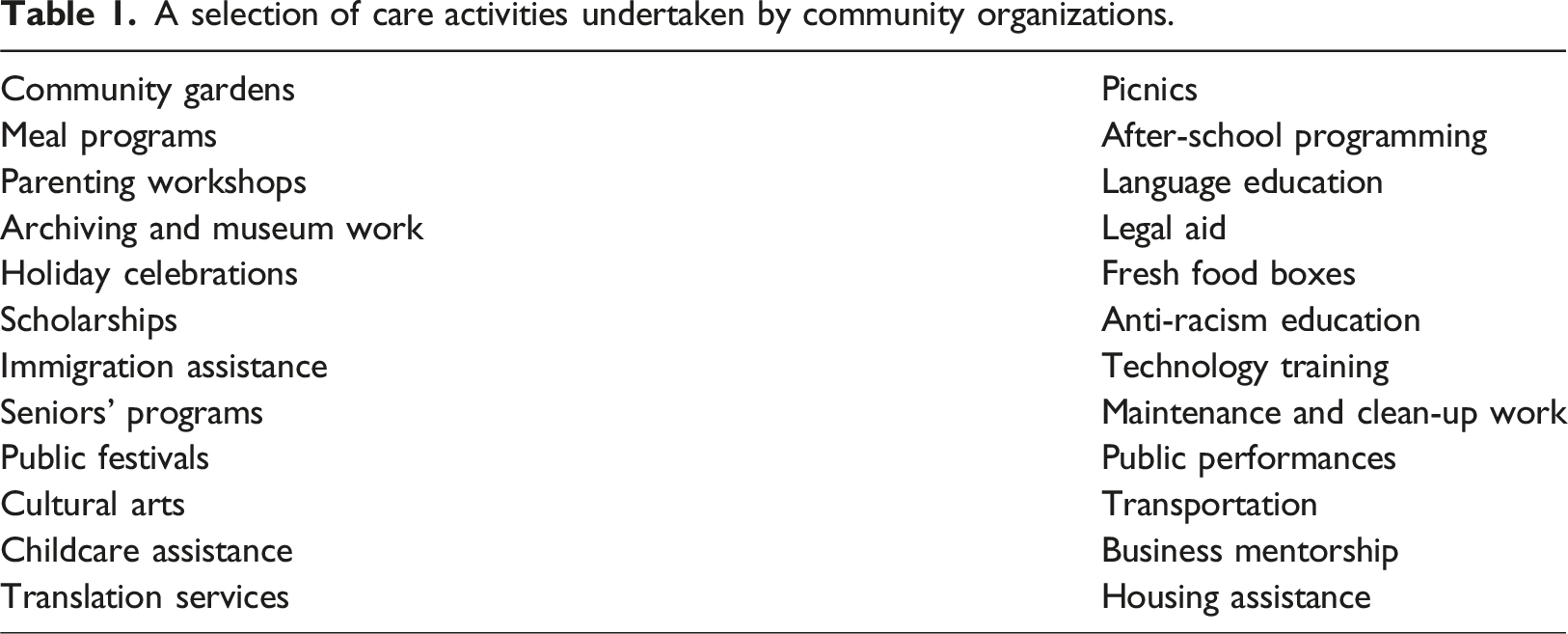
The imbrication of the tangible and intangible care work of community organizations was consistently made clear throughout the research. Participants often began with broad descriptions of their organization’s activities, before quickly pivoting to share detailed accounts that revealed the depth of care work embedded within their practices. For instance, when I spoke with the President of the Nigerian Canadian Association of Ottawa (NCAO), Efe Omueti, he first presented the mission of the organization with a general statement “to support the Nigerian community in Ottawa… growing community together.” However, throughout our conversation and subsequent route mapping interview it became clear that the NCAO was enabling an immense amount of care work. The community hosted gatherings, social events like barbecues and screenings of Nigerian movies, information sessions for new immigrants, business breakfasts to support investment in Nigerian-Canadian businesses, provided laptops and started a culturally relevant food bank during the pandemic, and facilitated town halls with politicians to voice community concerns. These activities not only provide practical goods and services but also foster interconnections, social knowledge, and a sense of belonging that contribute to a thriving community. The individuals who utilize the services of the NCAO experience the advantages of culturally tailored care and services that may be inaccessible or undesirable to them through public social care channels or which may not be as suitable for their specific needs. Considering this example, it becomes apparent that the scope of activities undertaken by organizations like the NCAO can exceed the conventional expectations and anticipated role of community organizations in urban life.
The very nature of being involved in community allows touchstone moments where care work can be engaged. Consider, for instance, a weekly ethnocultural senior’s coffee group in Ottawa. On the surface, there is clear benefit for attending seniors, who are able to converse and find the company of those with shared experiences. They can speak their primary language, eat culturally specific food, and find a sense of belonging in a larger collective. This meetup is also a touchstone moment for organizers and others in the community to engage in other care work. Volunteers may notice a change in a senior’s health and offer them a drive to a doctor’s appointment, send a struggling attendee home with extra food, or simply take the time to note the loneliness of an individual and decide to visit them later in the week. The organizers themselves benefit from the opportunity to connect with elders in their community and learn about their culture or history. Some volunteers may bring their young children, finding a brief respite in community childcare and giving their children the chance to engage with their elders, bridging a generational divide created by immigration. The group rents space from a church, and the pastor stops by to say hello. Through conversation with a regular volunteer he learns that their family is having a difficult time after a job loss. He offers comfort and proposes reaching out to his congregation for donations of needed items. This vignette, shared by a participant when describing the essence of their organization, illustrates the social geography of community engagement and how care work extends into the informal networks beyond the surface level mandates of organizations.
Part II: The (un)recognition of care
Overlooked impact
Examining the activities of community organizations reveals that they engage in care work that frequently transcends the boundaries of public care systems and service provision and surpasses the borders of their own stated mandates. Yet, in the cities studied in this project, municipalities and other public institutions tended to articulate their understanding of community organizations and their activities from an almost recreational perspective of urban culture. This attitude was present in institutional documents, reported by the participants sharing the experiences of their community organizations, and evident in the conversations I had with municipal professionals. Without prompting, the conversation often gravitated towards festivals, public art initiatives, and park use, suggesting a propensity to perceive community organizations more as contributors to local entertainment and aesthetic enhancement, rather than key collectives executing important care work. Helen, a National Capital Commission employee, discussed this pervasive attitude when she commented on public decision-making regarding supporting community initiatives in Ottawa: I always reference ribbon cutting because it’s a tangible deliverable. What do we have to show for this? Well, we can snip a ribbon in front of the statue. With a large festival, you can say here’s the economic development gain, here’s the attendance, here’s the spinoff from a tourism perspective. It’s with the smaller things where—what are we going to see from this? It becomes an intangible value, and it becomes more difficult to quantify.
Municipalities’ focus on attaining tangible results, as echoed by Helen, demonstrates a prevailing narrow perception of community organizations, overshadowing their less visible but nonetheless critical care work.
Common conceptualizations of cultural planning in Ontario are often narrow, and cultural planning’s affiliation with urban planning may be unclear (Kovacs, 2010). In this framing, municipalities are aware that community organizations run activities related to culture including heritage activities, cultural education, and other community events and celebrations. However, they are largely ignorant of the shape these activities take, and their true importance to communities beyond recreation, art, and social community development. This framing obscures the depth of experience and significance of the practices of these organizations and limits their formal support. By failing to appreciate the extent and impact of these organizations’ efforts, public institutions may inadvertently undermine the essential care work that these groups undertake and their contribution to urban well-being and sustainability. This finding aligns with research conducted elsewhere in Canada—particularly in rural and secondary cities—which suggest that municipalities do not understand the service needs of the full diversity of their communities, nor the kinds of support that community organizations need to function, perpetuating policy and institutional barriers that constrain the function and transformative power of these groups (Power and Hall, 2021; Ryser and Halseth, 2014; Tamang, 2010). There has not been a comprehensive national survey of nonprofit and voluntary organizations in Canada since 2006 (Barr et al., 2006). The resulting report concluded that such organizations had a positive impact on quality of life for Canadians, and recognized that greater municipal-public collaboration was needed to address the operational challenges faced by organizations (Barr et al., 2006). However, it appears there has been no formal follow-up; the ongoing state of under support for these organizations implies stagnant municipal attitudes, suggesting that little has been done to implement the report’s recommendations or amend municipal practices.
Politics of recognition
As part of this research, I connected with eight individuals who had professional experience in municipal planning or heritage in the study cities. During these conversations it became apparent that, as individuals, they had a genuine interest in supporting diverse expressions in their cities. Interviewees discussed positive experiences and professional relationships they had developed with specific organizations in their city and frequently mentioned examples of events or festivals that they thought exemplified fruitful city-community partnerships. The conversations heavily emphasized themes of celebration, representation, and intercultural interaction in the public sphere. Several participants proudly highlighted municipal participation in events like National Indigenous Peoples Day, Emancipation Day, Black History Month, or cultural food festivals. However, care work in the form of informal supportive labor seemed to be largely absent from their perception. When asked about community organizations in their city beyond those they had experience partnering with, it became evident in all three study cities that there was significant ignorance about what community organizations were operating in the city, and how many there were. They were often unsure about the varied activities of these organizations and expressed a crisis of responsibility—sharing their confusion surrounding municipal duty and if and how community organizations fit into their core service areas of municipal heritage practice or community development. Realizing that community organizations in their diversity are largely not a part of municipal awareness is troubling. While individual municipal workers may have good intentions towards making their practice equitable, diverse, and inclusive, they remain working within a system of power designed to perpetuate ignorance for the benefit of comforting hegemonic place identities (Nelson and Godlewska, 2023). They engage in a politics of recognition and delimited inclusion of difference that allows them to continue to not address the true needs of a diverse urban community (Blake and Hayday, 2018; Gaertner, 2020). Without awareness of the full host of community organizations and their operations in their city, municipalities take an extremely passive approach to community outreach—focusing on participation via celebration. Consequently, community organizations are compelled to step forward and bridge the service gaps resulting from these narrow practices, all while their crucial care work remains unrecognized and unsupported.
This practice of highlighting positive sentiments such as celebration and diversity, while disregarding the role municipalities play in perpetuating settler-ignorance, asserting dominant control, and hindering the capacity of community organizations to function securely and care for their communities, stems from a municipal tradition rooted in hegemonic authority (Nelson and Godlewska, 2023). The way that community organizations have been ensconced in the cultural practice of many Canadian cities has historically been shaped to reflect this dynamic of ignorance and control, and faithful attachment to the pluralist narratives most Canadians were raised with—that Canada is a “mosaic,” placed in competitive contrast to the assimilatory American “melting pot” (Litt, 2022). An illustrative example of this attitude and its permeation into public policy comes from since-problematized world fair style cultural celebrations that were once popular across Canada (Taucar, 2016; Truchly, 2003). Since the 19th century cities have historically employed cultural festivals as a key part of their community programming. Cornwall, Kingston, and Ottawa all have histories of multicultural festivals taking on a “world fair” style. This pluralist format of festival typically offered community organizations in cities a booth where they could feature their food, dance, and traditional dress to the public who would travel from booth to booth stamping “passports” along the way (Iacovetta, 2011; Stones Kingston, n.d.). This format of festival has fallen out of favor with some community organizations, ethnocultural groups in particular, many of whom refuse to capitalize on what they feel are stereotyped “packaged” versions of their culture designed for consumption by a predominantly white public. It has also been retired by some municipalities that fear social reproach as they begin to recognize that siloing culture in such a way risks tokenizing diversity in their communities. This format also excludes the participation of non-ethnocultural community organizations such as Queer community groups, or those of different abilities. Nonetheless, many cities across Canada still employ this typified style of public involvement as a main cultural celebration each year.
Though this kind of cultural segmentation may have fallen out of favor as an event model, it typifies the attitude of control and easy management of diversity that remains preferred in municipal practice. Put simply, municipalities are more inclined to support community organizations not for the benefit of those communities and their true needs, but rather when that support serves as a means to sell diversity via celebration or improve public relations through performances of remorse (Gaertner, 2020). Many participants from Kingston and Ottawa observed that since the loss of world fair style festivals, little has been created to fill the void left behind. In Cornwall, a significantly smaller municipality, there was little formal cultural programming to begin with. Though clearly imperfect, The Kingston Folklore Festival, which reached its height of popularity from the ‘70s to the ‘90s, was a municipally led festival particularly missed by participants who cited the material impacts of its loss. For many, it had been an important source of operational income needed to sustain their care work, a way to educate the public and mobilize knowledge about their presence in the community, and a chance to connect and strategize with other organizations. For many participants, these festivals were the last time they felt consulted and included by the municipality, and their loss represented the heralding of the neoliberalization of care in their cities. As Nadia Luciuk, a representative of the Ukrainian Canadian Club of Kingston & Maky Ukrainian Dance Ensemble objected “The city has to have someone involved in their planning that is more attuned to what the reality is of everyday cultural organizations. [At events] the city comes, the mayor comes, they come and are supportive… But it would be nice for the city to be a little more aware of what an organization’s day to day looks like.” This sense of municipal distance and the feeling that when organizations are supported it is not because their labor is valued, but rather that it benefits public relations, was a common one raised during interviews.
Limits of inclusion
Many participants felt that municipalities now consult only particular cultural organizations with whom they have existing relationships, or those whose identity or culture is particularly “popular” due to current politics, world events, or social unrest. Helen explained to me how this has shaped cultural development and heritage strategy in Ottawa: “Less attention has been paid to, what I would consider to be, underrepresented histories… working class histories… immigrant communities and their histories in Ottawa. This is changing—largely as a result of federal investment—for Indigenous communities. I say changing, but we’re by no means there yet. There are a multitude of groups that would fall under that category… less funded, less expressed, and less recognized through policies and programs. Generally speaking, our history, as it has been invested in… has been predominantly a national or prominent local narrative centered around historical figures of prominence who are overwhelmingly long dead, old, white men.”
Instead of being consulted or approached for collaboration by their municipalities, most participating community organizations felt that to successfully attain necessary resources and opportunities they must market themselves to their municipalities and compete with others for available public resources. Municipalities, as stewards of public space, are responsible for permitting, grant adjudication, and deciding whose and what activities should be sanctioned for public support. Instead of actively engaging in meaningful consultation, inclusion, or providing municipal services to support the vital work of community organizations, municipalities adopt a passive stance where communication is reversed (Andrew-Amofah et al., 2022). This issue is exacerbated by cities’ reliance on internet-based “smart city” consultation tools, which superficially tokenize participation and falsely present public consultation as equitably accessible while privileging particular populations and their feedback over others (Levenda et al., 2020). This is a symptom of systemic racism in municipal policy; “the pervasive act of engaging in the policy planning and implementation process without accounting for past historical acts of injustice, negative policy-making, unequal outcomes, and low participation levels by racialized and immigrant groups in the political process” (Andrew-Amofah et al., 2022: 2). Municipalities wait to be approached by the public, imposing barriers of formal procedure, paperwork, and requisite specialized knowledge that hinder organizations’ access to resources and support (Ryser and Halseth, 2014). When municipalities do instigate outreach to community organizations, it tends to be as part of responsive strategic politics. To cope with the risk that “uncontrolled” diversity poses to hegemonic municipal control, municipalities must work to balance the need to appear concerned with equity, diversity, and inclusion (EDI) for publicity, while supporting diversity in ways that can be managed with significant oversight.
Community organizations’ desire for recognition, representation, resources, and connection, conflicts with hegemonic municipal practice that must securitize hegemonic identity and power by limiting and controlling non-hegemonic diversity. This politics of control dictates who has the right to the city, an affective materialization that limits those who can engage in care work and which consequently restricts access to and constrains the capabilities of community organizations to provide care (Duff, 2017). This aligns with arguments from feminist scholars who contend that urban geographies of care extend far beyond interpersonal relations, spilling over into infrastructures, governance, and public policy (Power and Williams, 2020; Tronto, 1993). During my conversation with Senator Bernadette Clement, mayor of Cornwall from 2018 to 2021, she highlighted concerns related to representation in municipal governance and planning, stating; “I’m going to go to the municipal conference next week in Ottawa… the Association of Municipalities of Ontario… and you go to those organizations, those conferences, and it’s overwhelmingly still white and overwhelmingly, still male. And so if our institutions look like that, how are community organizations and grassroots organizations going to feel when they’re looking at their institutions that look a certain way, it’s a problem… So we have to sort of go back to our home communities and open up those doors and invite people in… actually say, come, please come here. We’re inviting you. And we want to hear from you. We really want to listen. That’s the message we have to figure out how to share.”
Her remarks highlight the critical issue of representation within municipal governance and raise questions about the implications for community development policy. This is further complicated as municipalities in Ontario, particularly under Doug Ford’s administration, are under pressure from provincial governance that aims to limit their power and enforce stricter operational timelines, potentially curbing the autonomy of local councils and preventing the support of community organizations and their care work (Gibson and Dale, 2023). The imposition of tighter operational timelines by the provincial government may exert pressure on municipalities to expedite decision-making, potentially bypassing the thorough review processes or community consultations that ensure checks and balances of power (Taylor et al., 2023). This could further limit opportunities for comprehensive community engagement, inclusive consultation practices, and collaboration in municipal decision-making processes.
The caring versus controlling city
Structural oppression that emerges in the context of municipal policy and practice is dynamic, part of a nuanced and transitory reactive politics. Cities are concerned with performing EDI in response to social and political pressure, while maintaining hegemonic power. There can be no true equity, diversity, or inclusion, without a restructuring of power and service provision. Power and Williams (2020) argue that the concept of a “caring city” would entail such a restructuring, resulting in an urban environment that fosters and prioritizes care at its very core. This shapes municipalities’ engagement with community organizations who face confusing terms of engagement if they wish to gain opportunities in their city: “Why did another organization get a grant when we were denied for proposing something similar?” “Why is another community so supported, while we struggle to even get a meeting with the city?” “Why can we participate in their street festival, but not use the park to run our own?” Planners working within municipalities find themselves facing outdated or absent cultural policy plans, and constrained by the broader identity pressures and politics of their community. Speaking with Alex Gatein, a Planner with the City of Cornwall, “My general perspective is that Cornwall has really good bones fundamentally as a city, but it often feels to me as it’s afraid to be a city…[there is] a fear of people using public space here. Like a very strong fear, particularly of poor people. And I mean, I think, these tenants—traditionally Francophone—I think it’s… a lot more mixed nowadays than it used to be, are the people using public spaces… There is, I think, a strong resistance to change here—despite the fact that it’s not in Northern Ontario where the population hasn’t grown since World War II—which to me is a shocking and horrible indictment of the leadership of this city for the past seven years. I think ultimately our biggest limitation here is… we’re able to pursue some things, but to do things without direction from council… it’s hard for us to do things.”
Here, in the tensions between inclusion and risk, action and securitization, the disjuncture between municipal practice and the lived needs of community organizations becomes clear. The municipal positioning of community organizations as assets (tourism, public relations, a progressive aesthetic), or risks (liability, counter-hegemonic narratives) disconnects their support of community organizations from the lived realities and needs of the individuals who comprise them.
The neoliberal city, through its limited recognition and insufficient support of community organizations’ care work, enacts a form of hegemonic control analogous to a necropolitical framework. By controlling who is allowed to engage in care work and who has access to the care services of community organizations, those in power can determine who is prioritized to receive care and whose lives are deemed less valuable. This places particular non-valued populations in positions of vulnerability, a disadvantage that “is crucial in the maldistribution of life chances… Necropolitical analysis assumes that the right to survive is formulated as a privilege invisibly afforded to the normative citizen with reliable access to both public and private resources, while those who fall outside of this construction struggle without the support of the state or access to capital” (Kenney, 2019: 13). Driven by a “municipal mentality” focused on fiscal concerns, risk, and jurisdictional limits, care systems can reflect a logic of containment, framing access to care as a privilege tied to notions of deserving citizenship (Evans et al., 2024). This execution of control not only can result in the neglect or marginalization of certain communities, denying them equal access to public care services, but it also hampers the endeavors of community organizations working on the sidelines, who are striving to mitigate these disparities through their own care initiatives.
Part III: The precarity of community organizations’ care work
The precarity experienced by community organizations emerges not necessarily from deliberate strategic maneuvering in municipal practice, but from a deep-seated history and tradition of hegemonic control that inadvertently underrecognizes and under-supports these entities. Thus, their vulnerability is a manifestation of this systemic preservation of municipal hegemonic dominance. I turn now to exploring the overlapping spheres of precarity that emerged out of interviews conducted with the leaders of community organizations. These experiences are largely derived not from anomalous failures of organizational leadership or skill, but stem from structural realities that speak to the inherent struggle community organizations face in sustaining their caring operations due to lack of substantial recognition and support in the hegemonic city.
Precarious labor
Through interviews with participating leaders of community organizations, it became clear that one of the key challenges facing organizations is the issue of labor. It takes time, capacity, knowledge, and funds to operate a community organization of any size, and most participating organizations rely on unreliable labor, threatening their continued operations and stability (Nelson, 2023a). While some organizations can fund salaries for paid employees, most who are able to offer paid positions or honorariums rely on municipal or provincial grants. As Toby Whitfield from Ottawa Pride shared, “grant funding and corporate sponsors are typically interested in funding events and programming, but often are not interested in funding the core staff team, office space, etc. that is necessary to be able to put on events and programming.” There is omnipresent anxiety from grant-receivers about the uncertain renewal of their grants, and paid employees typically do not have security that the funding for their position will be renewed. Even organizations with paid positions still rely heavily on volunteers to run activities and events, and the struggle to maintain a community of volunteers was evident in conversations with participants. The issue of retaining institutional knowledge is intertwined with the reliance on volunteer labor, as concerns often arise regarding the potential loss of experienced leaders due to aging or burnout.
Financial precarity
Community organizations typically lack significant income. They’re often volunteer run, not-for-profit, informal, and funded primarily by memberships and community donations alongside the occasional grant. However, government grants are rare and very competitive, and grant systems have a huge barrier to entry, requiring advanced English proficiency and a high degree of formalization and ascription to Eurocentric organizational and communication styles (Nelson, 2023b). Funding from other sources, like charitable foundations, is often limited, not eligible for use on operational costs, and funding opportunities may be incredibly limited for those who are classified as non-qualified donees (Power and Hall, 2021; Richmond and Shields, 2024). As Stacey Ottley, from Cornwall’s Coalition for Unity, Respect & Equity/Equality for All shared, “sometimes it’s hard to fall into a category.” To succeed, communities must narrowly define their activities, with funders more willing to support groups that promote celebrations or the arts over groups that provide important mutual aid, equity work, or care services, which may be controversial or harder to articulate on paper its impact. Many community organizations are involved with their municipality through municipally run public events, such as festivals or public celebrations (e.g., Canada Day events). These events often offer community organizations the chance to participate through sales of food or goods, performances, or speeches. Several participants shared with me in confidence that, to remain financially viable, their organizations were compelled to engage in municipally lead public-facing activities that they would otherwise prefer to keep private to their community. They felt that their municipality’s support for their organization’s goals and activities was superficial and did not adequately recognize the value of their efforts to sustain the well-being of their community. While they desired greater visibility and support from the broader urban community, they also felt a need to prioritize supporting their community’s survival without having to compromise their values, sell their community’s culture to a consumptive public, or participate in municipal endeavors that were an ill-fit for their community. These apprehensions correspond to contemporary issues in urban planning research, with scholars emphasizing the negative impact of city branding, power imbalances in urban decision-making, and tokenistic representation, particularly on non-hegemonic lives (Bonakdar and Audirac, 2020; Eisenschitz, 2017). As Sybil Braganza, program coordinator at the Social Planning Council of Ottawa and coordinator of Ethnocultural Seniors Groups expressed “there is still lots of discrimination, and I guess not realizing the value of the ethnocultural groups… Groups are really being taken for granted for the work they are doing. Mainstream organizations are unable to meet their needs because they don’t have the cultural competency to meet their needs.” The struggle for financial security emphasizes the institutional inequity that both marginalizes community organizations and underestimates the value of the care work they do.
Personal precarity
Although community organizations provide essential care services to their members, the leaders of these organizations sometimes find themselves in precarious personal situations as a result of maintaining their organization’s operations. These leaders shoulder immense time and financial burdens as well as the considerable weight of responsibility (Halseth and Ryser, 2007; Power and Hall, 2021). David Kajoba, president of the Uganda Association of Ottawa, poignantly expressed a sentiment echoed by others leaders, “it becomes impossible because as the president you do everything… there is the desire to serve but also the pressure to deliver…[sometimes] you invest more than you otherwise could.” The financial burden of sustaining the organizations often falls disproportionately to leaders, who may resort to using personal resources to keep the organization afloat. Volunteers and leaders frequently reported overextending themselves, both financially and personally, with repercussions for their careers, family life, and mental health, all in an effort to support their communities. This implicit ethic of care is noted in the words of Kaitlynne-Rae Landry from the Ottawa organization Pride, Not Prejudice, who stated, “we do make some money off of the craft and community fair, but it is largely a labor of love.” The enduring commitment and personal sacrifices exhibited by these leaders underscores the altruistic embodiment of care in their service to community.
Perpetuating precarity
The precarity of community organizations is especially troubling because their informal care work offers the most significant benefits to underrepresented and underserved urban communities. Community is not only essential to individual well-being but also to collective well-being. For non-hegemonic peoples living in urban environments that are branded to cater to specific audiences and narratives that they may find exclusive, the importance of community and feeling a sense of participation and belonging is even more important (Nelson, 2023a). Community organizations address service gaps by providing care work that may be more accessible to some individuals than the services offered by public institutions. As David explained in our conversation “there are different levels of care you can attach to one of your own, specialized care and understanding.” Public services may lack cultural knowledge or competency, and language or cultural barriers may hinder accessibility. In these instances, the ability to access support and care through smaller, informal, and culturally relevant channels becomes crucial (Chow and Austin, 2008). For marginalized individuals living in cities that primarily offer white hegemonic place identities, community organizations create opportunities to exist, find social support, receive tangible assistance, and be recognized in spaces that might otherwise feel unwelcoming. Community organizations participate in urban politics that transform everyday practices and relations into resistance to the conditions created by structural oppression and neoliberal capitalism (Beveridge and Koch, 2019). The prevalence of organizational, financial, and personal precarity amongst these collectives, coupled with their essential contributions to underserved communities, highlights the critical necessity for urban policy changes that honor, support, and secure their efforts. Their resilience against these systemic challenges serves as a testament to their value and reiterates the imperative of addressing these precarities in urban planning discourse and practice.
Conclusion
Building community sustainability
Community organizations played a crucial role in the social response to the pandemic when traditional and formal care structures faced limitations or were unavailable (Engelman et al., 2022; Roels et al., 2022). As communities adapted to new circumstances, informal care work became increasingly visible, highlighting the important contributions of community organizations. These organizations were able to adapt their existing care practices to address the evolving needs and restrictions of the pandemic. This adaptability demonstrates the growing importance of community organizations in responding to future crises and the need to consider community-based responses as essential components of municipal planning and strategy.
The benefit of individualized, localized care provided by community organizations is especially important in times of crisis when institutions and larger formalized care systems falter (Soden and Owen, 2021). The contemporary urban context in Canada is characterized by climate crises, social unease, discrimination, rapid urbanization, and a looming sense of turmoil. Recognizing the care work carried out by community organizations allows for a deeper understanding and appreciation of the role community building plays as a disaster readiness and crisis mitigation strategy (Jackson et al., 2023). These organizations engage in localized, place-based caring labor, which is distinct from the services provided by official care institutions.
While official care institutions strive to address community needs, they often lack the capacity to operate at the individualized, micro-scale level that community organizations excel in. For instance, an institution may not be able to deliver a casserole dish, engage in a lengthy conversation on a front porch, identify loneliness, or intervene at the personal level or with the specificity and cultural context that community organizations can achieve. Thus, examining the spatiality of care work shows that community organizations play a vital role in providing targeted interventions (Jackson et al., 2023). Their ability to address unique community needs contributes significantly to the overall resilience and well-being of an urban population. Municipalities are well-positioned to benefit from the expertise of community organizations, yet they underutilize this potential, hindering their own effectiveness at addressing community needs.
Community organizations face logistical and financial challenges imposed by municipal bureaucracy, which threaten their sustainability. Institutional hegemonic power often limits their access to spaces, funding, and relationships, exacerbating these challenges. Further, the leaders and volunteers whose largely uncompensated labor is essential for the function of these community organizations struggle with capacity limitations that restrict their ability to provide care work as effectively as they might like. Neoliberalization and austerity measures mean that additional burden is placed on community organizations, as the demand for their services only increases. Amid these challenges, it is paramount for municipalities to acknowledge the essential role of community organizations and provide them with the requisite support to sustain their crucial care work. One of the most significant assets of municipal governance is its capacity to facilitate swift changes, enabling responsive and inclusive institutional transformations that prioritize public life, space, and community-building (Andrew-Amofah et al., 2022). Recognizing the profound value of community organizations, engaging actively and meaningfully with them, and viewing them as strategic allies for creating reciprocal partnerships would allow municipalities to engage in more equitable community building practices. Moreover, such transformations to municipal practice could provide a pathway to redress systemic hegemonic oppression. This would not only empower underrecognized communities and their contributions to urban well-being, but also contribute to larger social justice and decolonization efforts in Canadian cities.
Footnotes
Acknowledgements
Sincere thanks to Dr. Laura Jean Cameron and Professor Hayden Lorimer for their invaluable guidance, to Jeremy Stephens for his support, and to all who generously shared their time, experiences, and care with me.
Declaration of conflicting interests
The author(s) declared no potential conflicts of interest with respect to the research, authorship, and/or publication of this article.
Funding
The author(s) disclosed receipt of the following financial support for the research, authorship, and/or publication of this article: This reflection draws on research supported by the Social Sciences and Humanities Research Council and SSHRC Joseph-Armand Bombardier CGS Doctoral Scholarship (767-2020-1981).
