




Abstract
The work of Karl Polanyi and, in particular, his signature concepts of disembeddedness and the double movement frequently inform the assessment of complex socio-economic dynamics in modern societies. Notwithstanding the unquestionable value of accounts that, inspired by the double movement, investigate the back-and-forth between market expansion and social protection, the potential of what has been called ‘offensive countermovements’, aspiring to novel institutionalizations beyond mere defence, remains underexplored. In this paper, I attempt to counteract the prevalence of Polanyian analyses that tend to overemphasize society’s inclination for preservation of the status quo and neglect the more transformational changes sought by offensive countermovements. Addressing this imbalance, I propose an expanded conception of offensive countermovements and argue that we may beneficially readjust the analytical lens by combining insights from Polanyian substantivism with the dynamics of the double movement. As a result, redistribution and reciprocity may come to the fore as equally salient forces of change alongside the market mechanism. I demonstrate the framework’s potential by analyzing instances of urban change and conflict that are driven by climate change. In this regard, I point to the profound institutional changes pursued by offensive countermovements that promote car-free cities, city empowerment, and an enhanced role for cities in international climate governance.
Introduction
Karl Polanyi’s account of the demise of 19th-century civilization, published in his magnum opus ‘The Great Transformation’ (TGT), continues to carry great weight in the social sciences. Especially since the rise of neoliberalism, the Polanyian concepts of embeddedness and disembeddedness, alongside the double movement, have reemerged as valued tools for the analysis of contemporary socio-economic conditions (Dale, 2010, 2012; Desai and Levitt, 2020). Yet, there is little consensus on how precisely Polanyi’s ideas ought to be interpreted and adequately adopted for study. As an insightful starting point, I will briefly revisit an exchange between Geoff Goodwin and Richard Sandbrook on this matter (Goodwin 2018, 2022; Sandbrook 2022).
While I do not attempt to recount the nuanced contributions of the two authors at length, the question at the heart of their debate was how the double movement should ideally be conceptualized and employed to grasp current developments. For Goodwin, it is a dialectical process of simultaneous commodification and decommodification within the disembedded society. By contrast, Sandbrook treats it as a heuristic two-phase model capturing how neoliberal market expansion at the end of ‘embedded liberalism’ provoked a new countermovement. For him, embeddedness exists in degrees. Although Sandbrook suggests moving beyond the ‘hard’ and ‘soft’ labels in Polanyian scholarship, 1 the authors’ disagreement dovetails with this distinction. A crucial point on which both agree, however, is that the countermovement – whether occurring within the disembedded society (Goodwin) or as part of a sequential process of disembedding and reembedding (Sandbrook) – need not be limited to mere preservation of the status quo. This carries important implications for how we conceptualize and study countermovements in the current political-economic conjuncture.
As both authors argue, the problem with many writings that invoke the double movement to interpret the great variety of conflicts and changes around us is that they tend to portray the reaction against advancing commodification in the merely defensive role of ‘active society’ (Burawoy 2003). It is the market acting and society reacting. Such an adoption of the double movement risks overly constraining the analytical lens, limiting it to the market as the sole driving force of change.
This concern is not exclusive to Polanyian-inspired writings. The diverse economies approach, for example, which shares many similarities with Polanyian ideas, sought to challenge the fact that non-market elements are rarely seen as ‘the motor of change’ (Gibson-Graham, 2008: 618). While proponents emphasize the valuable insights afforded by assessments that do not prioritize the market mechanism but instead work on ‘thick descriptive inventory’ (Gibson-Graham and Dombroski, 2020: 9) of non-market practices, critics also point out that they still struggle to adequately grasp their ‘transformational potential’ (Gómez, 2023: 8). Crucially, those willing to respond to Goodwin’s pertinent call to expand the Polanyian lens to offensive countermovements cannot yet rely on a well-developed theoretical conception of offensive countermovements, nor on an authoritative text à la TGT. To remedy this shortcoming, I will, in the remainder of the paper, attempt to develop a simple framework for offensive countermovements based on the insights of Polanyian substantivism and the dynamics of the double movement.
In the following sections, I will first discuss the nature of offensive countermovements and what, in my view, is missing from their current conception. I then outline a framework drawing on Polanyi’s later writings on pre-modern societies and the instituted economy. Finally, the second half of my contribution illustrates the framework’s applicability to different instances of conflict and change, taken from the context of urban politics amid climate change.
The double movement and the offensive countermovement
Karl Polanyi’s account of the double movement is well-known and will only be briefly recapitulated here. In Polanyi’s understanding, the market mechanism had played no more than a secondary role in the organization of society until the 19th century. The starting point for his explanation of change is thus the ‘birth of the liberal creed’. Mobilizing socio-technical as well as ideational shifts, Polanyi argues that the technological advances of the industrial revolution demanded the factors of production to be ‘on sale’, while social protection under the Speenhamland system 2 inhibited the formation of a functional labour market and allegedly exacerbated the poor’s suffering. Eventually, the need for an industrial workforce and the perception that interfering with market dynamics had done more harm than good led to the development that, as Polanyi puts it, ‘out of the horrors of Speenhamland men rushed blindly for the shelter of a utopian market economy’ (Polanyi, 2010 [1944]: 107). The idea that the economy was governed by natural laws that must not be obstructed thus took hold of history’s trajectory. And since the unregulated market and its drive to commodify the ‘fictitious commodities’ of land, labour, and capital is, for Polanyi, incompatible with the needs of society, a protective countermovement inevitably had to arise. The stalemate between movement and countermovement ultimately undermined the system itself, and ideologies that renounced both economic and personal liberty could prevail (Polanyi, 1935, 2010 [1944]).
It is this double movement narrative that not only earned its author posthumous acclaim but also inspired theoretical contributions and debates too numerous to recount in full here. On one side of the dynamic, Polanyi’s ‘birth of the liberal creed’ has, for instance, been examined and adapted to contemporary contexts by scholars who contemplate the market’s seemingly unwavering appeal (Konings, 2015; Maertens, 2008). Much thought has also been given to how the commodifying movement, in the ideological guise of neoliberalism, could come to retake centre stage in the 1980s (Blyth, 2012; Sandbrook, 2022). On the other side of the double movement, Block (2008), for instance, considers the individual agency and motivation of the forces that rally for protection, while Goodwin (2018) conceptualizes the different channels through which a countermovement may operate. As he argues, protective responses can pursue decommodification through intervening, limiting, and preventing or reversing forms of commodification (Goodwin 2018: 7). Only the latter fully removes fictitious commodities from the market sphere – a point to which I will return below.
Regarding empirical applications of the double movement, Goodwin holds that most scholars adhere to the ‘soft’ reading and trace similar patterns of economic liberalization, socio-economic dislocation, and protective reaction (Goodwin 2018: 10–11). This aligns with Sandbrook’s depiction of the double movement as a guide that predicts a sequence of ‘movement – countermovement – disruptive strains’, while the subsequent stages, ‘stalemate and economic crisis – polarization and ideological contention – systemic change’, are seen as context-dependent (Sandbrook 2022: 5). Again, the number of studies employing the Polanyian lens in this way is too large to summarize here. Still, a brief glance at the literature seems to corroborate their characterization, with studies applying the sequential understanding of the double movement to cases as diverse as gentrification and urban resistance in Berlin (Bernt, 2012), economic liberalization and social protection in Costa Rica (Rayner and Morales Rivera, 2020), land commodification and protection in Peru (Orihuela, 2020) or austerity politics and social movements in Greece (Kentikelenis, 2018).
The fact that many studies follow a similar understanding of the countermovement does not, of course, mean that they are misguided. On the contrary, by following the dynamics that Polanyi once analyzed in his own times, they succeed in producing valuable insights into various conflicts and changes in today’s capitalist system. Yet, Goodwin and Sandbrook’s brief exchange on offensive countermovements raises a critical point. The issue is not that prevailing accounts are mistaken, or that Polanyi’s intended meaning was necessarily different, but rather that the dominant lens tends to limit our view to conflicts in which the market, setting off the pendular swing between market expansion and contraction, is treated as ‘the principal source of dynamism in capitalist society’ (Schrank and Whitford, 2009: 522). Whereas in these accounts civil society is relegated to a passive warden of the status quo, the main characteristic of offensive countermovements is that they seek to establish new forms of decommodification, not simply defend existing spheres that are not yet subjected to market dynamics. They want to ‘create and transform as well as protect and reform’ (Goodwin 2018: 19), or, as Sandbrook puts it, they are ‘proactive in seeking system change’ (Sandbrook 2022: 19).
Goodwin and Sandbrook’s exchange does not go into further detail on offensive countermovements. However, in my view, the concept requires elaboration in at least two important respects. First, although offensive countermovements aim to alter the status quo, they still appear fundamentally reactive. While Goodwin stresses that movement and countermovement can unfold simultaneously, conceptualizing the latter primarily as a response to commodification risks reinforcing the disproportionate attention that Polanyian-inspired analyses pay to instances of market expansion. Important to note, this is not meant as a critique of Polanyi’s historical analysis in TGT nor as an exercise in textual literalism about a ‘correct’ reading of Polanyi. Rather, it is an attempt to challenge a recurring analytical bias within Polanyian scholarship. In Polanyi’s original narrative, commodification was a result of technological innovation and ideological shifts, which triggered what he called ‘the birth of the liberal creed’. Are similar dynamics not plausible for other modes of integration next to the market mechanism?
Second, if an offensive countermovement seeks to reorganize parts of the economy according to non-market principles, how would it proceed? Goodwin’s notion of ‘reversing’ commodification offers a starting point but remains somewhat vague. The question then is this: if the ‘stark utopia’ of market society depends on the all-encompassing commodification of land, labour, and capital, what would be the objective of a movement that is not simply the negation of market expansion?
It is my contention that Polanyi’s writings already hold the right tools to answer these questions and can lead us to a conception of offensive countermovements that may free Polanyian-inspired analyses from the impression that change necessarily emanates from the market. In the following, I will first present a conceptual framework that encompasses the dynamics of offensive double-movements, and I will then mobilize it for the analysis of ongoing transformations in one of the key sites of political contention and social change today – the city.
Polanyian substantivism and the offensive countermovement
After the war, Polanyi largely turned his back on the analysis of modern capitalism (Dale, 2010a; Peck, 2013b: 1548). Instead, he concentrated on the anthropological exploration of pre-modern societies and their complex institutionalization. While this change of focus may have been driven by the oppressive environment of McCarthyism in the United States (Peck, 2013b: 1549), it was not entirely inconsistent with his previous work. When Polanyi set out for his explanation of change in TGT, his logic was premised on the assumption that radical market expansion constituted something profoundly different from what had hitherto structured economic interactions. Having explained subsequent developments with recourse to the double movement, Polanyi returned to this key assumption. However, in seeking to substantiate this aspect of his argument with evidence from pre-modern societies, he also inadvertently shaped the future reception of his substantivist perspective. Despite assertive claims that substantivism does not imply temporal stages from archaic to modern societies (Polanyi, 1957: 256), the Formalist-Substantivist debate of the 1960s ended up relegating the Polanyian viewpoint to pre-modern societies and left the field of the modern economy to neo-classical analysis (Elardo, 2012; Hart and Hann, 2009). It is, therefore, worthwhile to briefly recap the central tenets of Polanyian substantivism before connecting them to the dynamics of offensive countermovements.
For Polanyi, there are two ways to assess the economy, formalist and substantivist analysis (Polanyi, 1957). The former, as he argued, equates the economy with a means-end relationship under conditions of scarcity. It assesses the rationally acting individual and their quantifiable decision-making. Polanyi’s critique is that this analytical frame is only adequate to grasp the workings of exchange in price-making markets. Polanyi does acknowledge that formalist analysis came to be the dominant approach during a period when the economy was indeed ruled by ‘an organization of man’s livelihood to which the rules of choice happened to be singularly applicable’, and he concedes that in such state ‘the formal and substantive meanings would in practice coincide’ (Polanyi, 1957: 244). If, however, the economy is also integrated by non-market institutions (i.e., anything but price-mediated supply and demand), formalist analysis loses its purchase and quickly succumbs to the ‘economistic fallacy’ (Polanyi, 1977: 6-19) of seeing all economies exclusively through the market lens.
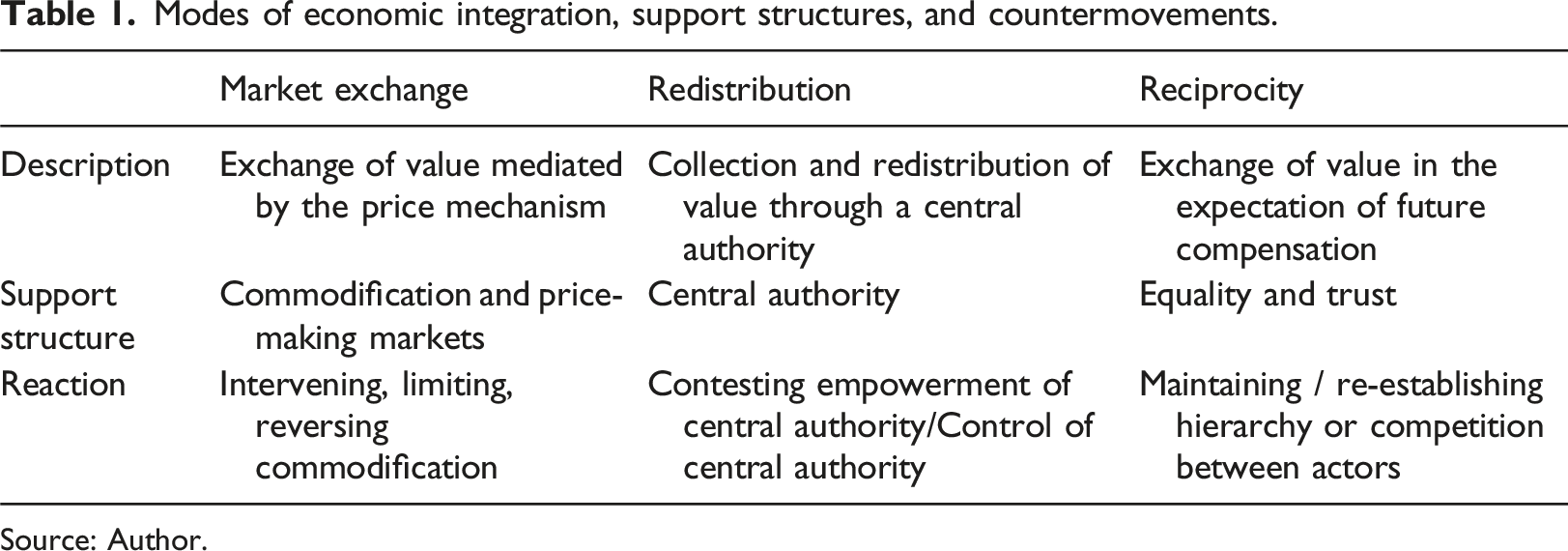
Substantivist analysis, in contrast, is concerned with the economy in its complex and embedded form. 3 Besides the price-mediated exchange of markets, it classifies relationships along the lines of reciprocity, redistribution, and householding (Polanyi, 1957: 250–255). In reciprocal relationships, actors agree to an exchange of value, expecting to see a favour returned in the future. This relationship demands a certain level of equality and trust. Redistribution presupposes a capable central authority. This authority collects value from the members of society and redistributes it according to some interest or social convention. And finally, householding is a sharing relationship in the inner-most circle of society (usually the extended family). In his later writings, Polanyi let go of the category of householding, subsuming it under redistribution, and narrowed his analytical frame to market exchange, reciprocity, and redistribution (Gregory, 2009).
It should be noted that I slightly diverge from Polanyi’s original formulation. Where Polanyi refers to either ‘locational movements’ of goods (their spatial shifting during production and transportation) or ‘appropriational movements’ (changes of who owns or has access to a certain good), I categorize the two as movements of ‘value’, which may or may not be material. This simplifies the conceptual frame without compromising its explanatory strength. Moreover, Polanyi refers to ‘similarity’ as the support structure that is necessary for reciprocity. Given that he does not specify what exactly needs to be similar between people or groups to encourage reciprocity, I replace the term with the more familiar ‘equality’. Additionally, Polanyi argues that ‘the closer the members of the encompassing community feel drawn to one another, the more general will be the attitude among them to develop reciprocative attitudes’ (Polanyi (1971 [1957]: 253). Building on the vast body of research that links reciprocal and cooperative behaviour to trust (e.g. Ostrom and Walker 2003), I refer to such ‘closeness’ between or within groups as trust. In any case, the assessment of how these modes of integration manifest in different societies, how they work, and how they interact is what is at the heart of substantivist analysis.
Polanyian substantivism remains particularly well-established in economic anthropology, where many of its concepts entered the common dictionary of the discipline (Hart and Hann, 2009). And while many authors still insightfully adopt the substantivist framework for the analysis of premodern societies (Garraty and Stark, 2010; Tatsuya, 2021), others have ventured beyond the confines of economic anthropology to assess, for instance, gift-giving in the neoliberal city (Hyde, 2021), the substantivist characteristics of sustainable agriculture (Jones and Tobin, 2018), the role of small and medium-sized enterprises in low-carbon transitions (North, 2016) or Argentina’s soy boom (Berndt et al., 2020).
This paper holds that the substantivist angle of these studies may be beneficially extended to our understanding of offensive countermovements and may help overcome the concept’s current shortcomings. To achieve this goal, it is instructive to take another look at how the original market expansion and protection dialectic works.
When, in Polanyi’s account, structural change and its incompatibility with the dominant modes of production gave rise to the liberal creed with its adherence to laissez-faire capitalism, entrenched social relations could not immediately be made into market relationships. Because this was precisely what the market demanded, land, labour, and capital, first had to be commodified. This commodification, the creation of the market’s very foundation, so to speak, is what provoked the countermovement, which, as defined by Goodwin (2018), pursued intervening, limiting, and preventing or reversing of commodification. What emerged is a struggle that revolved around the creation or inhibition of adequate market conditions, not the market itself.
Modes of economic integration, support structures, and countermovements.
Source: Author.
As recalled above, redistribution is an exchange relationship in which value is collected and redistributed through a central authority according to a particular interest or goal. It presupposes hierarchy. Indeed, to accomplish redistributive exchange, a sufficiently powerful centre is the necessary support structure. Like the commodification of land, labour and capital, an expansion of redistribution would therefore require a strengthened central authority. Consequently, if an ideational change were to elicit desire for increased redistribution, in the same way as ‘the horrors of Speenhamland’ gave rise to the liberal creed, its proponents would have to extend the central authority’s reach to areas that were hitherto structured along the lines of reciprocity or market exchange. Finally, social forces that do not wish to see increased redistribution could resort to the same channels as the original Polanyian countermovement, seeking to limit, prevent, or reverse their opposed mode of integration and its support structure, that is, a capable central authority.
Reciprocity as a motor of change can be conceptualized in a similar way. The necessary support structure for reciprocity is the existence of equality and trust between the participants. While these may be individuals as well as groups, only a climate of equality and trust makes the tacit agreement of reciprocal relationships a credible undertaking. How would change manifest here? As in the other two cases, if a change in opinion were to give rise to a desire for expanded reciprocity, its proponents, the offensive countermovement, would first have to establish equality and trust in relationships where they find the hierarchy of redistributive relationships or the impersonal anonymity of the market to prevail. If considered sufficiently unsettling, this would initiate the double movement dialectic, with parts of society struggling to limit, prevent, or reverse reciprocity in favour of hierarchy or market anonymity.
The proponents of both expanded redistribution and expanded reciprocity pursue decommodification. However, it should be stressed that offensive countermovements may seek heterogeneous and potentially conflicting forms of decommodification. Goodwin (2024) is clear on this point, as he argues that while commodification is ‘rooted in a singular logic of competition, profit maximisation, capital accumulation and private property, decommodification is based on a plurality of logics and relations, reflecting the diverse ways commodification is contested and the multitude of non-market relations and institutions that exist in capitalist societies’ (p. 887). This means that societal forces that are united in their opposition to the market may nonetheless clash over the specific forms that decommodified economic relationships should assume. At the same time, some forms of decommodification may also support larger structures of commodification. This is true, for instance, when market dynamics are underpinned by welfare-state arrangements to limit the market’s worst repercussions and stabilize the prevailing institutionalization. Moreover, it should be kept in mind that neither redistribution nor reciprocity are inherently ‘good’ or ‘bad’ (Schaniel and Neale, 2000). Just as one would not judge the moral desirability of any redistributive arrangement simply on the basis of whether an institution collects and redistributes taxes (but, for instance, by the morality of its design and the outcomes that it produces), redistribution and reciprocity should not be mistaken as synonyms for justice or generosity. I will return to this complex nature of offensive countermovements in my illustrative cases.
In summary, what the considerations above seek to show is that by expanding the dynamics of the double movement to all elements of the instituted economy, we may overcome the impression that the market is the exclusive source of social dynamism in modern societies. To illustrate my point, I will now turn to three instances of offensive countermovements that become visible only through this expanded Polanyian lens.
Offensive countermovements in the city
With the majority of the human population now residing in cities, it has become commonplace to stress the inevitably urban nature of most future developments (UN DESA Population Division, 2018). And although it may sometimes seem that ‘everyone think[s] cities can save the planet’ (Angelo and Wachsmuth, 2020), the nature of urban living per se does not preordain any trajectory. Whether growing urban settlements can indeed serve as vehicles for a social and ecological transformation will depend on what happens within the political realm of the city and the numerous arenas of change and conflict inside and outside of it (Thomson and Newman, 2020; UN-Habitat, 2020).
Given this crucial role of the city in an urbanizing world – and considering that municipal socialism heavily influenced Polanyi’s own thought (Bärnthaler et al., 2020) – urban politics can serve as an insightful entry point to illustrate the analytical benefits that an expanded conception of offensive countermovement holds. More specifically, I will take my examples from key issues concerning urban development and the role of the city in the context of climate change.
Richard Sandbrook (2022), in his analysis of today’s countermovements, rightly points out that global climate change is a driving force behind many contemporary social movements. While he insightfully argues that these may be seen as part of an incipient transnational countermovement, I also agree with Goodwin that it would be mistaken to classify them as mere reactions to the neoliberal turn. Neoliberalism is an important ideological underpinning of the current crisis, but its root causes run much deeper than this relatively recent development (Goodwin 2022: 693). Similarly, climate change is hardly the result of any one tangible act of commodification. Therefore, it elicits varied responses. While some may wish to resort to further commodification, a somewhat controversial example being carbon markets (Carton 2020; Stuart et al., 2019), others may find the expansion of redistribution or reciprocity to be the way forward. This means that the resulting heterogeneity of conflicts and changes resists subsumption under a sequential double movement understanding of market expansion and protective reaction. Rather, it is my impression that the increasing awareness of climate change’s deleterious effects could amount to the kind of groundbreaking ideational change that Polanyi once found to be triggered by the ‘horrors of Speenhamland’. In this sense, increasingly forceful social movements are true offensive countermovements that pursue structural changes without originating in a merely conservative ‘impulse for social protection’ (Putzel 2002).
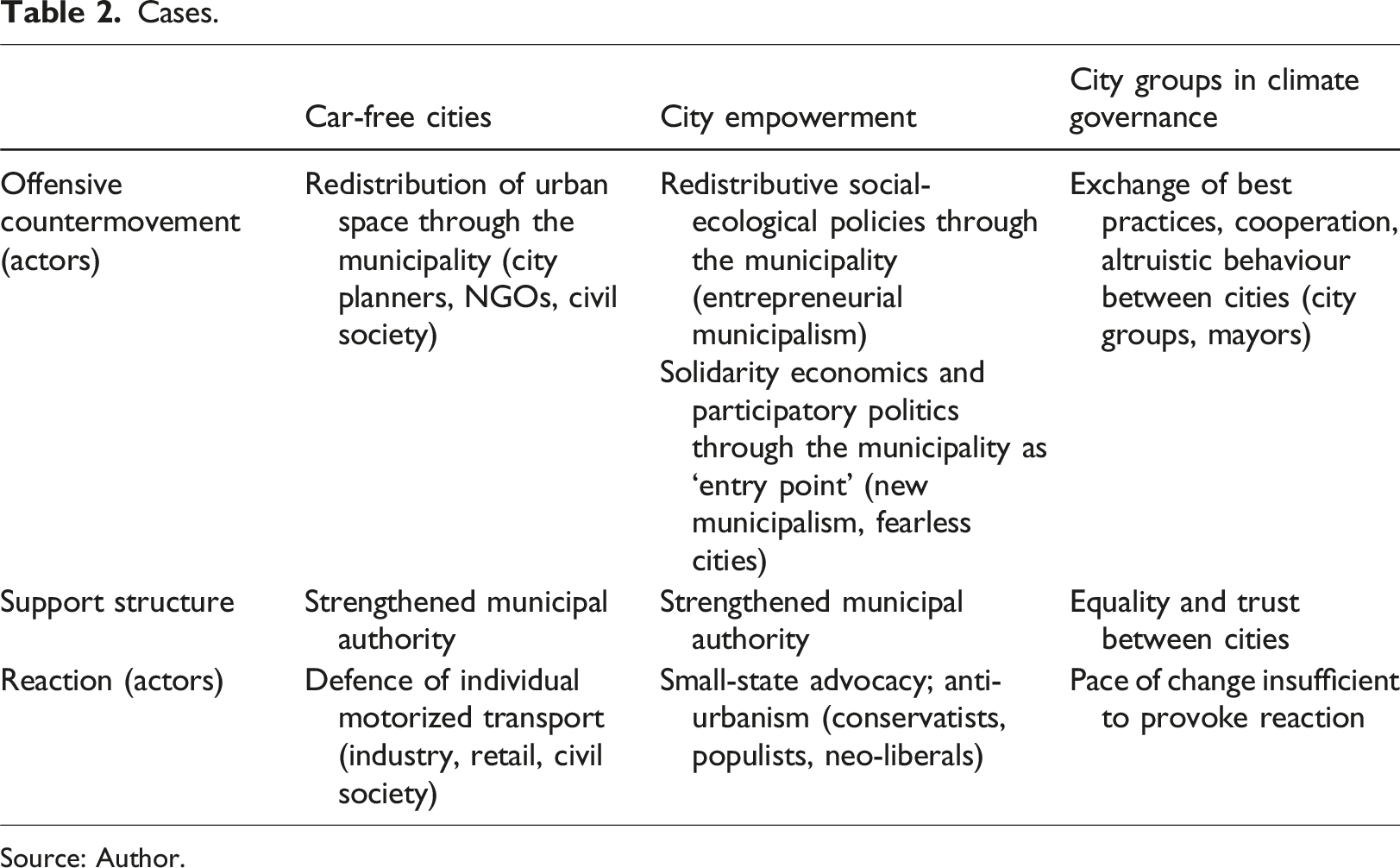
Since this is largely a macro-level reading of current events, I will, in the following sections, offer three concrete examples of offensive countermovements that illustrate the dynamics introduced above. First, I will highlight support for car-free cities as an offensive countermovement for redistribution that has provoked a powerful defence of the established economic structure. I will then examine city empowerment as a goal that is shared by heterogeneous offensive countermovements which attempt to establish support structures that can underpin either redistribution or reciprocity. And finally, I will assess the role of city groups in global climate governance as an incipient movement towards expanded reciprocity against a dominant market-like structure in international relations.
Car-free cities
The idea of eliminating car traffic in inner cities to reduce its harmful impacts on health, quality of life, and environment has been around since at least the 1990s and found expression, for example, in the New Urbanism’s advocacy for walkable cities (Bulletin of Science, 2000). However, the crucial boost to the idea, which elevated it from circulation among progressive city planners to a hotly debated topic in political arenas around the world, came not least because of the growing awareness of an impending climate crisis and an improved public understanding of the transportation sector’s role in causing it (Khreis and Nieuwenhuijsen, 2021).
In this context, motorized private transport can be understood as an underlying economic structure that has subjected large parts of the city to the logic of an exchange relationship. With the meteoric rise of the private vehicle, urban planners in the post-war industrialized economies pursued the ideal of the car-friendly city (Blanke, 2018). Despite early critiques of this car-centric planning approach – for instance from Jane Jacobs (1992 [1961]), who cautioned against its potentially devastating implications for urban living – the car was widely conceived as a means for economic growth and an expression of progress. Part of the reason for the car’s persistent dominance in the city lies in the nature of motorized private transport as a market relationship in the absence of fully attributed property rights – the textbook example of an economic externality.
First, the car buyer and the car seller engage in a routine market exchange mediated by the price mechanism, but this is not where ‘the market ends’ (Neves, 2012). Besides the fact that car-ownership constitutes the entry card to large parts of public space in the car-centric city, circumscribing its common good character, this exchange also creates profound repercussions for urban dwellers. Those living in the city suffer from poor air quality and noise, while the community at large incurs the various kinds of diffuse costs resulting from accelerated climate change (in contrast to the concentrated benefits of private car ownership). All of this is, again, shaped by the socially unequal results produced by market exchange as, for instance, income or racial characteristics can determine exposure to the downsides of car infrastructure (Boeing et al., 2023). These undesirable effects of the underlying exchange relationship can either be seen as a lack of commodification, following the Coase-theorem (Coase, 1960), or as social costs and an integral part of the market system (Kapp, 1969; Swaney and Evers, 1989). Either way, the material and social structure of the car-centric city has been fundamentally shaped by the market logic that underpins motorized private transport.
With increased awareness of climate change and its associated ills, public opinion regarding the dominant planning paradigm has been changing (Marcheschi et al., 2022). As a result, and evidence of the manifold forces that drive social contestation in the instituted economy, different kinds of movements have emerged. On one end of the spectrum, it has become a popular proposal to, in economic terms, fully attribute property titles and internalize costs, for example, through congestion charges. Elsewhere, the idea to incentivize sustainable transportation choices has spurred calls for fare-free public transport (Kębłowski, 2020). And finally, for some, the solution to ban private vehicles from inner cities has also gained appeal.
Conceptually, congestion charges, much like carbon markets, increase commodification and solidify the market traits of urban living, whereas fare-free transport, following Goodwin’s classification of countermovements, is a way to limit the effects of commodification. It reduces car-dependency and hopes to shift consumption patterns, even though the dominant market structure continues to co-exist. The movement for car-free cities, in contrast, is a more profound challenge to the entrenched structures of the instituted economy. As an offensive countermovement, it strives to abolish the prevailing market logic and to replace it with something new. In such a scenario, the municipality appropriates the values that are subject to market dynamics (i.e., access to urban space) and redistributes them according to a normative objective (i.e., good air quality, reduced emissions, social inclusion and so on). If successful, the retreat of motorized private transport as the dominant mode of transportation in cities would mean the substitution of an underlying market structure that carries significant unaccounted costs for third parties and renders parts of the city highly exclusionary – congestion charges would essentially make public streets a club good – for a redistributive structure that democratizes urban space and eliminates the externalities of the car-centric city.
Consequently, and a vivid testimony to the movement’s unsettling pace and impact, opposing forces struggle to defend the dominant economic structure of individual motorized transport in inner cities on what has been called the ‘newest frontier of the culture wars’ (Lewis, 2020). Like the original Polanyian countermovement, this reaction is not confined to a single interest group but ranges from car lobbyists and local shop owners to car-dependent commuters and those emotionally attached to a car-centric way of live (Gössling, 2020). Finally, as indicated by the Polanyian framework, these diverse coalitions seek to either roll back the expansion of redistribution through electoral means or challenge the central authority’s power through action in the courts. The intense conflicts accompanying this issue have become particularly evident in the highly politicized debates over the ‘15-minute city’ and the concept’s potential implications for car use (Marquet et al., 2024).
In conclusion, this example illustrates how ideational change – not least a product of increased climate change awareness – has given rise to an offensive countermovement that challenges long-standing tenets of the urban and aspires to create new institutional structures. At the same time, various social forces are competing to shape the city’s trajectory. The dominant structure is under pressure, but its future course is still fiercely contested.
City empowerment
In my first example, the conflict between the offensive countermovement for car-free cities and the provoked reaction hinges on political control of the central authority, the municipality. Since many city governments already hold the necessary legal authority to make significant alterations to the transport infrastructure, the offensive countermovement can essentially skip the creation of institutional support structures and instead concentrates on political control, thereby making traffic regulations a dominant topic in local elections. In the following example, I will examine a case where offensive countermovements for decommodification must first create the institutional support structures required by their desired mode of integration. I find this dynamic to be particularly evident in the pursuit of city empowerment.
While urban sustainability used to be considered a matter of secondary importance (Bulkeley, 2021), last decade’s ‘urban turn’ (Parnell, 2016) led to an urban sustainable development goal and precipitated a readjusted urban focus of political practice and scholarly debate. Concurrently, dissatisfaction with national-level climate action has given rise to a veritable urban enthusiasm that praises cities’ capacity to ‘save the world’ (Brescia and Marshall, 2016). The reasoning behind such hopeful accounts is often framed in terms of proximity, highlighting cities’ direct exposure to the effects of climate change, their potential to enhance the democratic legitimacy of climate action, and the innovative character of small-scale interventions on the ground. Yet, as the political advocates of the city argue, the full potential of urban centres has yet to be realized.
Urban political arenas around the world are home to an array of coalitions that aim to change the status quo. One of these is a group of devolution advocates that seeks, in a top-down fashion, to enhance city governments' legal and financial capacities. Their demands, amid a warming planet, are perhaps most poignantly expressed by the late Benjamin Barber, asserting that ‘decarbonization demands devolution’ (Barber, 2017: 10). This point of view is echoed by prominent urbanists such as Richard Florida (2017) or city groups such as the United Cities and Local Governments (United Cities and Local Governments, 2019). Cities are, as their argument goes, uniquely placed to successfully face today’s pressing challenges and merely require the institutional empowerment that would allow them to do so. A second movement has been described by Matthew Thompson as ‘entrepreneurial municipalism’ (Thompson et al., 2020). Refuting the so-called ‘financialised urban entrepreneurialism’, cities in this approach build on inclusive growth agendas and strive to ‘more proactively develop and better capture for redistribution the value created by the three classic factors of production’ (Thompson et al., 2020: 1190). Their objective is the expansion of redistributive exchange in the economy. To this end, enhanced municipal power is crucial. And finally, on the bottom-up end of the scale, there is the burgeoning movement of New Municipalism, embodied by the Fearless Cities Network. ‘Harnessing the urban or municipal scale to achieve strategic ends’, New Municipalism posits a radical reorganization of power relations to enact the ‘transformation of state/capitalist social relations’ (Thompson, 2021: 318). In this understanding, municipal control and ownership serve as important enabling conditions but need to be accompanied by new democratic forms of decision-making (Russell et al., 2022: 18). As put in the case of the Fearless Cities, their proponents seek ‘the emergence of democracy from local power’ (Miranda, 2022: 27).
All of these are offensive countermovements. As with car-free cities, the point of departure is an ideational change brought about by dissatisfaction with the current institutionalization of society and the perceived inadequacy of actions by dominant authorities. For all the movements above, city empowerment is not a goal in itself. Instead, and wary of the so-called ‘local trap’, it is a ‘strategic entry point’ (Russell, 2019: 991), or in Polanyian terms, it is the ‘support structure’ to pursue policies that foreground the commons, achieve social equity, and accelerate an ecological transformation. In this regard, the offensive countermovements are united in their pursuit of decommodification, but they do not necessarily share exactly the same objectives. Still, many of their desired policies can be classified as redistributive. They are at least partly reliant on authoritative resource allocation through local authorities, such as the public-common partnerships of the New Municipalism (Russell et al., 2022), or embrace established forms of municipal action, such as in the burgeoning trend for remunicipalization. In many cities, in particular in Europe and North America, this movement to reclaim ownership over health, transportation, and energy has gained steam. 4 However, as McDonald (2024) reminds us, not even all movements for remunicipalization are necessarily inspired by the same motives, and not all would classify as offensive countermovements against commodification.
In general, however, the movements for city empowerment illustrate a moment of change and conflict that is in line with the framework for offensive countermovements. To achieve social and ecological goals through redistributive or reciprocal means, the creation of the necessary support structure is imperative. While for some the ultimate goal may be an empowered city level that serves social and ecological needs through redistribution, others emphasize participatory democracy and solidarity economics as they aspire to transcend traditional state-society hierarchies altogether and establish new forms of non-market institutions.
Have these offensive countermovements provoked a reaction? Today, support for large-scale devolution has yet to pass a critical threshold, and new municipalist strategies grapple with ways to up-scale local initiatives. Additionally, and recalling Polanyi’s insistence that the pace of change is ‘often no less important than the direction of change itself’ (Polanyi, 2010 [1944]: 39), it is important to recognize that the elevation of city authority has proceeded in a rather piecemeal fashion. It is, therefore, not entirely surprising that one does not yet see a protective movement that explicitly opposes the empowerment of cities. However, there is, of course, a general reaction against the implementation of the ecological and social policies advocated locally by supporters of city empowerment. While those who oppose climate action, for example, are often ideologically close to small-state ideals (Collomb, 2014), today’s right-wing, populist, or fascist movements often exhibit a pronounced anti-urbanism, regularly clash with their country’s politically dissenting urban populations, and do everything in their power to curtail the space for autonomous city politics (e.g. Buzogány and Spöri, 2024). In that sense, one may argue that an anti-urban reaction does oppose the creation of powerful city authorities even if not directly concerned with impending devolution.
In conclusion, city empowerment as an offensive countermovement illustrates the heterogeneity of the social forces that simultaneously struggle for decommodification and seek to build the support structures necessary for redistributive or reciprocal exchange. For them, local power is not an end in itself but a prerequisite for the realization of different social and ecological objectives.
City groups in international climate governance
So far, I have considered two offensive countermovements that pursue change through central authorities (even if for some, redistribution is not the ultimate goal). It may seem that in an age of globalized, complex economies and large states, market exchange and redistribution are the only ingredients of change and conflict. Yet, Polanyian substantivism also highlights reciprocity as a mode of integration that requires neither hierarchy nor price-making markets. To illustrate reciprocity’s potential impact as a motor of change and the framework’s multi-scalar applicability, I will consider city groups in climate governance as my final example. 5
Reciprocity, as already outlined, involves the exchange of value between two parties with the expectation of future compensation grounded in equality and trust. Importantly, these interactions are not restricted to individuals but may also occur between groups. In the international system, the most consequential interactions between large groups of people are conducted by states. Following the assumption of anarchy in international relations, these interactions can be understood akin to the workings of a market, although in the fashion of an oligopolist market’s strategic interdependence rather than the undifferentiated atomization of a perfect market (Milner, 1991). Without delving deeper into ontological debates, I follow this market analogy in the next example on the nature of global climate negotiations. If one elevates Polanyian reciprocity from the confines of interpersonal gift-giving or solidarity to the high-level nature of climate diplomacy, a nascent movement of city groups emerges as an offensive countermovement for the expansion of reciprocity that challenges the prevailing market-like structure of global climate politics.
Since the Rio Conference in 1992, the world has witnessed no less than 29 Conferences of the Parties (COP), in which state representatives engage in bargaining processes with the goal of cutting greenhouse gas emissions. In line with the oligopolist market analogy and Polanyian market exchange, the participants of these conferences interact based on their differentiated positions in the UNFCCC annex, attempt to reach agreements with binding obligations, and seek guaranteed compensation for concessions made (Bulkeley, 2015; Hovi et al., 2013). Sub-national entities have long played a negligible role in all of this. Yet, increasing dissatisfaction with state-level stalemate in the face of an impending climate crisis has contributed to the vocal emergence of novel actors such as the C40 Cities, the Global Covenant of Mayors for Climate and Energy or the ICLEI – Local Governments for Sustainability. Against the lamented apathy of inter-state climate diplomacy, these city groups pursue interactions based on information-sharing, joint policies, and city-to-city cooperation (Acuto and Rayner, 2016). As Acuto (2013) has pointed out, this amounts to ‘structural novelties with respect to the “global deal” universal decision-making and the “global civil society” activism that have populated global governance in the past decades’ (p. 850). In other words, city groups attempt to overcome diplomatic impasses by fostering what Robert Keohane (1986) once called ‘diffuse reciprocity’, meaning sequential and cooperative exchanges of ‘rough equality’ between actors connected through trust and shared values. Fostering cooperation and emphasizing their shared concerns, city groups strive to create the trust that is the very foundation of reciprocity and whose lack has frequently been identified as part of the reason for unsatisfactory inter-state negotiations (Cole 2015). These developments can be seen as part of a broader move towards what Bai (2024) has called ‘altruistic cities.’ Recognizing the limits of confronting issues like climate change adaptation on their own, cities increasingly engage in a type of interactions that is analogous to altruistic forms of behaviour known from other social contexts. They cooperate, learn, and shape the shared experiences of their members.
Cases.
Source: Author.
Conclusion
The concepts that Karl Polanyi once conceived to make sense of his own times’ great transformation have proven invaluable guides for the analysis of countless conflicts between expanding commodification and resistance to the market’s growing reach. Undeniably, this type of conflict still is everywhere. But the market need not be the sole initiator of change, nor are movements for decommodification necessarily limited to defending the status quo. To counteract bias in Polanyian-inspired scholarship, the offensive countermovement is a crucial addition to the conceptual toolbox.
The case that I have sought to make is that we can develop the concept by combining the double movement with the complexity of Polanyian substantivism. Doing so, the Polanyian modes of integration alongside market exchange – redistribution and reciprocity – are liberated from their reactive subordination to the market and become visible as driving forces of social change.
In this contribution, I have made three key points. First, I have discussed the tendency of Polanyian-inspired scholarship to focus almost exclusively on a type of conflict in which the market acts and society reacts. While market expansion is an important part of contemporary conflict and change, it is far from being the only relevant dimension. Second, I have advanced a dynamic conception of offensive countermovements that goes beyond the idea of ‘reversing’ commodification by drawing on Polanyian support structures and the double movement type of contention that offensive countermovements for increased redistribution or reciprocity may provoke. And finally, I have turned to the city to show that there are, indeed, relevant moments of conflict and change that are easily overlooked if market expansion remains our only focus. In three examples, I have illustrated how the ideational changes brought about by climate change have given rise to a diversity of offensive countermovements that seek to move beyond the status quo and change society’s prevailing institutionalization.
My main concern in this contribution was how we can use Polanyi’s conceptual tools to better understand diverse conflicts in today’s complex societies., and I have tried to adjust the somewhat distorted picture that Polanyian-inspired writings tend to paint of market dynamics and countermovements. Beyond this application of Polanyian thought to individual cases, it should not go unnoticed that Polanyi’s ideas are also frequently mobilized for more macro-historical interpretations of current dynamics. For Polanyi, the contradictions between movement and countermovement were ultimately insurmountable and led to the fall of 19th-century civilization. In a recent exchange between Goodwin (2025) and Alcock (2025), a similar issue was pondered. While the latter claimed that, in the long run, countermovements are necessarily destructive, the former responded that conceptualizing them in such a way ‘downplays or denies their progressive potential’ (Goodwin, 2025: 8). I agree with Goodwin’s objection, but I also find that this might stretch the limits of what Polanyi’s writings can tell us. On a final note, I would like to briefly link this exchange to the Goodwin-Sandbrook debate, highlight some important common ground, and add a word of caution about the long-run effects of movements and countermovements.
On a macro-level, one may certainly debate whether post-war Keynesianism did indeed manage to assuage the double movement (Sandbrook), or if decommodification during this period was actually much less pronounced when observed from a global perspective (Goodwin). On a micro-level, however, it is not immediately apparent whether a given conflict is part of the back-and-forth between embeddedness and disembeddedness, or evidence of an inevitable contradiction within the disembedded capitalist society. Ultimately, Goodwin and Sandbrook agree on the transformational potential of offensive countermovements that, if successful, may lead to ‘the endgame of the double movement’ (Sandbrook), or to the radical changes required to overcome the contradictions inherent in the capitalist system (Goodwin). To this, I would add that no matter whether one regards the oscillations of the instituted economy as part of a capitalist contradiction or one is convinced of any countermovement’s ultimate drive to destruction (Alcock), at the individual level each conflict has very real consequences for the people involved.
To return to one example from this paper, the car has dominated the city for decades, and we now have overwhelming evidence of its damaging and socially unequal effects on health and quality of life. If this were to change as a result of what may be called an offensive countermovement – and there is already great diversity in this field in cities around the globe – the implications would most definitely be felt by people in and beyond the affected cities. The same is true for many of the conflicts that play out in increasingly polarized cities everywhere (Bärnthaler et al., 2020). My point is that this fact alone should caution us against adopting a reading of Polanyi that disregards the transformational potential of countermovements in the long run, just as much as one that would lead us to overlook their concrete implications in each case of conflict and change. With no ambition to make definitive judgments on macro-theoretical debates, I have argued that an expanded conception of offensive countermovements can be of great help along the way.
Footnotes
Declaration of conflicting interests
The author declared no potential conflicts of interest with respect to the research, authorship, and/or publication of this article.
