




Abstract
This paper addresses the question of how the spatiotemporal processes of urban assemblages can be understood in the context of a controversial urban squat. We mobilise concepts of time and temporality and employ the notion of the chronotope as a methodological frame to rethink the politics of change in urban contexts. Our multi-temporal, chronotopic analysis centres on Avtonomna Tovarna Rog, a squat in Ljubljana (Slovenia) that was forcibly demolished in January 2021. The paper highlights contingencies, tensions, contradictions, and potentialities of Rog by foregrounding four ‘volves’, or turns, that capture the elasticity yet cohesiveness which characterise assemblage. Through this, we contend that changes in/to chronotopes can approach lines of flight that fundamentally alter their composition when a temporality prevails – a transformation we term ‘chronotopic ruptures’. We substantiate this claim by showcasing the theoretical relationship between chronotopic ruptures, multiple times and temporalities, and assemblages.
Introduction
This paper examines the multi-temporalities and space-time configurations of squats as assemblages within the urban context. Squats reconfigure the built environment through experimental and radical practices (Vasudevan, 2017) that challenge and oppose prescriptive, capitalistic urban narratives (Daskalaki, 2018). They are often characterised by spatiotemporal variations in both their function and duration, highlighting their interstitial nature (Kanellopoulou and Ntounis, 2024). It follows that squats exhibit inherent prefiguration and potentiality, experimentation with temporal and spatial structures, as well as collaboration, cooperation, and social design (Gerhardt, 2020; Russell et al., 2011). Born out of multiple spatiotemporal and sociopolitical configurations, squats are sites of multiple and often contesting meanings and narratives, stories and struggles, people and objects, all at the same time. Bringing these multiplicities to life necessitates revisiting the constitution of space-time to prioritise squats’ kaleidoscopic function: squats are and were, have been and will be, all at once. In this way, squats can be understood as assemblages: ‘formed out of the totality of potentialities into a “new present”, shaped by a future yet to come while shaping a past that resists reorganisation (Nail, 2015: 98)’ (Gerhardt, 2020: 683). However, there remains a lack of empirical engagement with the ‘messiness’ of assemblage potential (self-)reconfigurations, as well as opportunities to advance our theoretical understanding of how the multi-temporalities of assemblage affect the production of space (Anderson et al., 2012).
Our paper focuses on Avtonomna Tovarna Rog (in English, Autonomous Factory Rog, henceforth ‘Rog’), a former squat in Ljubljana (Slovenia). Rog was forcibly demolished after almost 16 years operating as a multifaceted and well-visited autonomous urban space, before being reborn as a municipal arts and science centre: ‘Center Rog’. Prompted by this seeming ending to Rog’s story as a squat, we revisit instances and moments in its contested history where Rog acquired different temporal meanings, identifying breakages or ruptures therein. To do so, and building on debates about places as assemblages (McFarlane, 2011a; Wideman and Masuda, 2018), we employ ‘chronotope’ as a methodological and analytical frame to rethink the politics of urban change (Russell et al., 2011; Valverde, 2015). We emphasise multi-temporalities that constitute assemblage as they ‘break’ or ‘rupture’ (Deleuze and Guattari, 1987) from a predetermined ‘future anterior’ (Gerhardt, 2020: 683). Rupture, here, delineates the multiple ‘cracks’ or ‘ripples’ of (de)politicisation unfolding as Rog – a multiplicity of multiplicities (Deleuze and Guattari, 1987) – undergoes spatiotemporal transformation.
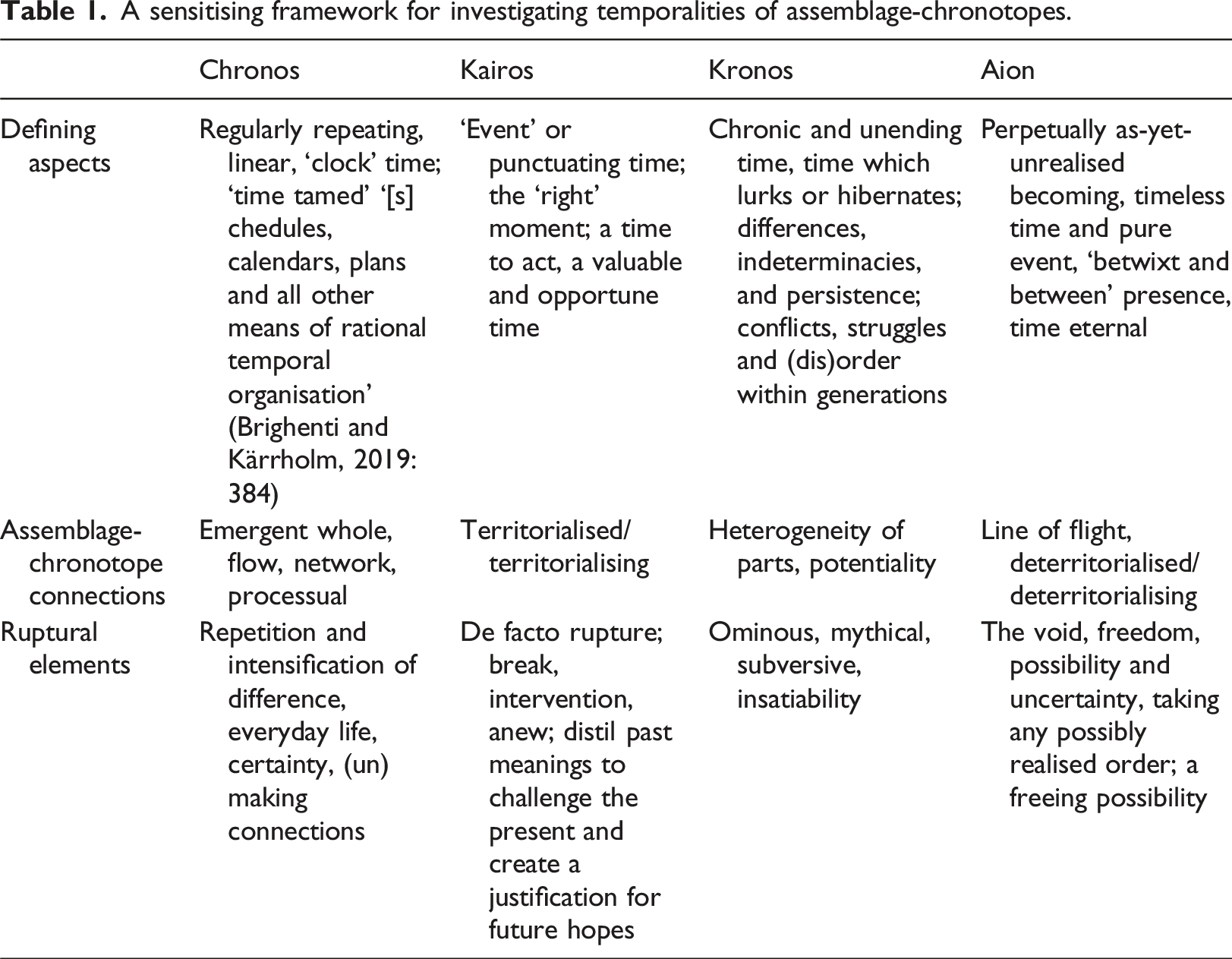
Drawing on insights into temporalities (e.g. Brighenti and Kärrholm, 2019; Delahaye, 2016), we theorise the overlapping and contrasting times of chronos, kairos, kronos, and aion that are co-present in different chronotopes – that is, space-time configurations – of the Rog assemblage. Yet, it became clear in our analysis that specific events precipitate major changes to Rog, prompting us to conceptualise processes whereby a particular chronotope of the Rog assemblage undergoes rupture. We describe these multiple ‘turns’ ‘turns’ as ‘volves’ – an English neologism used to capture simultaneously spatial and temporal change 1 – to highlight the inherent multiple spatiotemporal configurations of chronotopic ruptures. The volves (evolve, revolve, devolve, and involve) we identify serve as high-order themes, each comprising a chronotopic narrative and culminating in a rupture, which structure our interpretation of the changes Rog has undergone. Through our analysis, we present how the volves foreground progressive spatiotemporal changes in Rog as assemblage, and altogether how their ruptural elements can be explained chronotopically.
The paper therefore makes two significant contributions. Firstly, it contributes to the literature on place as (urban) assemblages (Farah, 2024; McFarlane, 2011a; Wideman and Masuda, 2018) by mobilising theoretical insights into time(s) and the multi-temporalities of urban change. Secondly, our chronotopic analysis of assemblage advances a novel methodological framework through which to conduct an in-depth examination of how urban change unfolds from a multi-temporal perspective, which has so far been difficult to investigate due to the unpredictability and non-linearity of assemblage ‘becoming’ (Anderson et al., 2012). The rest of the paper is structured as follows. We first contextualise Rog, before working with assemblage thinking and literature on chronotopes to theoretically examine the ways spatiotemporal change occurs. Then, we develop chronotope as a methodological tool for exploring Rog’s different coexisting configurations, with particular interest in multiple times (chronos, kairos, kronos, and aion) and ruptural moments. We next examine this empirically, extracting several chronotopic configurations of Rog and how these have changed with times. After presenting the four ‘volves’ identified in our analysis, we offer a broader discussion of how our paper connects to debates on urban assemblages and their formation through a multi-temporal lens. Finally, we revisit our paper’s contribution and re-turn to Rog in our closings, pondering what recent developments there signal for the futures of urban spaces more generally.
Openings: Times and spaces of Rog
The story of Rog is a story of transformation and place: contestations over Rog – struggles to delineate it in space and time – have continued ever since its days as a popular bicycle factory in the former Socialist Republic of Slovenia. The production site was left abandoned following the dissolution of Yugoslavia and Slovenia’s independence in 1991, to remain in a lasting state of transition until it was taken over by activist groups in 2006. The subsequent history of Rog as an urban squat is met with continuous ebbs and flows, ranging from popularity as an autonomous zone frequented by various users from across the city, to internal and external conflict and institutional disapproval, all while the City of Ljubljana struggled to secure the funds needed for the redevelopment of the massive, decaying 75,000 square feet space (Kanellopoulou et al., 2021).
Ultimately, in January 2021, police and private security (hired by the City) forcibly entered Rog on orders from the City, the legal owner of the premises. Those inside the disused bicycle factory were evicted. Resistance culminated in street confrontations with riot police and security personnel, but to no avail; bulldozers rolled in and began demolition. Rog’s fate was ultimately sealed by the superimposition of ownership over use, turning its established history of almost 16 years to rubble in a day. Violence and clashes between police and squatters are a well-documented occurrence (Vasudevan, 2017); but we aim to push deeper, unfolding Rog as an assemblage that has been subject to periodic and event(u)al changes that led to its demolition.
An important aspect of Rog is 2 that, like many squats and urban spaces, it functions without rigid organisational structures (Daskalaki, 2018; Pruijt, 2013; Vasudevan, 2017). Indeed, a constituent feature of Rog is that its heterogeneous parts are not strictly premised on hierarchical communication and control: the users and visitors of Rog are as varied as the social fabric of the city outside it (Kanellopoulou et al., 2021), demonstrating constant changes in activities and uses associated with the space itself. It follows that users and visitors are often unknown to each other, representing an ‘anarchic formation’ 3 of events, people, and temporalities, which remain unquantifiable to this day. Not one person or collective of users is ultimately ‘responsible’ for organising and overseeing activities at Rog. Rather, Rog remains assembled around divergent political and social initiatives, including hosting refugees during the Balkan migrant crisis, artistic activities, events, gatherings and actions, ever-changing and slipping away from the establishment of a collective memory (Loughran et al., 2015).
From this, we deduce a multiplicity of interactions that comprises Rog, from which the squat emerges as a unique space for experimentation characterised by a coexistence of difference (Massey, 2005). We therefore conceptualise Rog as an assemblage (DeLanda, 2016). Assemblage thinking has explored the ways urban complexity and capitalism (be)come together in cities (McFarlane, 2011a) and resistance therein – including how self-organised and squatted spaces generate solidarity (Daskalaki, 2018). Squatting urban space, part of what Vasudevan (2017) terms ‘makeshift urbanism’, has previously been conceptualised as assemblages of disparate activities, temporarily stabilised – with tensions, contradictions, and potentialities (Anderson et al., 2012; McFarlane, 2011b). Still, a persistent challenge facing assemblage-inspired geography involves accommodating temporality, addressed by focusing on events (Daskalaki, 2018) or moments (Wideman and Masuda, 2018). However, the capacity for assemblages to (un)form, develop, and change highlights the need to acknowledge not only assemblages-in-connection, but also their diverging temporalities: time(s) and temporalities can help us re-view assemblage thinking when normative linearity becomes disrupted, to better illustrate certain urban phenomena. To approach such conflicting notions of spatiotemporality in the subversive urban environment (e.g. a squat), we take inspiration from the ‘enveloped’ and context-dependent space-time unit of the ‘chronotope’ (Bakhtin, 1981; Chatzidakis, 2020; Valverde, 2015) to rehabilitate and extend assemblage thinking from a multi-temporal lens.
Admittedly, spatiality and temporality are engrained in assemblage theory from the outset. Deleuze and Guattari’s (1987) articulation of assemblage foregrounds how elements and moving parts are drawn together at specific conjunctures, illustrating the importance of time and timing in processes of displacement and orderliness. Such processes do not follow a particular pattern: they ‘can be fleeting, lasting, instantaneous, or laboured, and they may be near or distanciated, present or absent’ (McFarlane, 2011a: 662). McFarlane (2011a) foregrounds the role of ‘depth’ (multiple and overlapping histories in practices and everyday doings) and ‘potentiality’ (intensity and excessiveness of moments) in assemblage. These temporal elements – when situated in complex mosaics of the urban – uncover new capacities of assemblage, blurring the current economic, political, and spatial orderings of the city (Prince, 2017). In turn, multi-temporalities disrupt and generate new connections with people and objects, leading to constant recomposition in search of new ways of thinking, ideas, hopes, and visions for a better city (McFarlane, 2011a, 2011b). Furthering this notion into assemblage thinking, Anderson et al. (2012: 172–175) call for less attention to power relations and agencies, and instead greater empirical scrutiny of assemblages’ spatiotemporalities to identify how they ‘open up or close down possibilities’ while also attending to the ‘messiness and complexity of phenomena’.
Yet, the urban fabric continues to undergo significant, often violent, transformations and changes in the course of everyday life (Harvey, 2012). Recent applications of ‘chronotope’ in geographical debates specify how distinct settings are constituted simultaneously as chronos (time) and topos (place). Engaging Bakhtin’s (1981) notion of the chronotope, empirical investigations acknowledge the ‘heteroglossia’ (Lawson, 2011) or ‘dilemmas’ (Chatzidakis, 2020) that different chronotopes make visible in the urban pulse of multiple entangled space-times, thereby helping reveal a place’s meaning(s). However, the relations between different chronotopic configurations have been given less attention to date. We contend that place can be as time-contingent as time can be place-dependent, already alluding to the ‘flakiness’ of the spatiotemporal qualities of assemblages that can break, fracture, or burst at any given viewpoint (Deleuze and Guattari, 1987). It is this process, the dynamics of change in and between chronotopes, we seek to uncover in Rog, through the weaving of ‘legacies from the past, the effects of modernization, [and] resistances to change’ (Melucci, 1995: 54). We next expand these chronotopic considerations with assemblage theory, offering a bridge between the spatiotemporality of assemblages and their relational capacities to change.
Assemblage thinking, change, and temporalities: A chronotopic reconciliation
Thinking spatiotemporally allows us to afford significance to wider forces that influence assemblages within the context of Rog (e.g. capitalism, gentrification, refugee crisis). Our discussion does not presuppose a privileged understanding of assemblages from one or another perspective (Savage, 2020). Instead, we draw on Delanda (2016) to inform our interest in how assemblages evolve over time: assemblages’ degree of territorialisation (homogeneity/heterogeneity of component parts) and coding (a component’s role in fixing the whole) can change as they pass from/through/as historically constituted phases, undergoing de/territorialisation and de/coding via ‘strong confinements on what seems to be a storming ocean of informal places and practices’ (Dekel, 2020: 397; see also Brighenti, 2010). This addresses the explanatory and normative potential of assemblage (cf. Brenner et al., 2011), offering a more rigorous conceptualisation that elaborates their temporal dimension (McFarlane, 2011b) while also questioning the prevailing linear understanding of time (Delanda, 2016).
The multi-temporalities of assemblages, however, require careful treatment. Ontological claims that the immanence and vivacity of assemblages derive from ‘lines of flight’, or transformative potentialities where the conditions of assemblage change (Deleuze and Guattari, 1987), say little about such possibilities. Rather, they must be elucidated in the specific, contingent nature of interactions that may (not) approach lines of flight, articulating a more contextual (read: temporal) concern (Anderson et al., 2012) via the geographical notion of ‘spatiotemporality’ (Massey, 2005). Building on efforts to weave this insight into assemblage theory (Daskalaki, 2018; Delanda, 2016; Wideman and Masuda, 2018), we attribute multi-temporalities to assemblages. Thus, we highlight how the processes of ‘ordering and disordering through which spatiotemporal patterns are laid down’ (Edensor, 2010: 2) characterise assemblage as flaky re-engagements between ‘virtual’ (i.e. potential) and ‘actual’ configurations (Deleuze and Guattari, 1987), continuously ‘on the move’ (Cresswell, 2006).
So, while assemblage theory makes connections with spatiotemporalities, this link is not gratified vis a vis the multiplicity of potential spatiotemporal changes. To address this, Bakhtin’s (1981) ‘chronotope’ elaborates the specific moments of assemblage and their spatiotemporal dimensions. Rather than linear or chronological time that is sequential, we acknowledge the multiple ‘temporal sequences’ (Delanda, 2016: 17) of assemblages and their multiple time-place – chronotopic – configurations. Seen this way, assemblages have presents (and pasts and futures) – their differences coexist (in place) and acquire meanings and plots across times.
It is critical to distinguish the space-time interaction in chronotopic understandings: while they can exist in ‘well-codified’ and stabilised ways, chronotopes inevitably exhibit a specific, compositional nature. Space can be seen as an ‘assemblage of assemblages’, or a ‘set of sets’ (Delanda, 2016: 14), but chronotopes coexist, overlap, collide, and remain subject to countless other transformations which are contingent on spatiotemporal moments. In other words, chronotopes are premised on the relativity of space and time (Chatzidakis, 2020). A corollary of this is the necessity to consider changes as negotiated in situated, contingent encounters and, importantly, to account for the moral and ideological aspects of such changes (Chatzidakis, 2020; Landau, 2019). Therefore, we understand chronotopes as spatiotemporal configurations (Chatzidakis, 2020) engaged in continuous, situated processes of de/reterritorialisation (Brighenti, 2010), specifically the ways in which assemblages undergo and produce change (Deleuze and Guattari, 1987). This immanent process of becoming marks out ‘singularities’ – such as events (Daskalaki, 2018; Delanda, 2016) and moments (Wideman and Masuda, 2018) – that de/code assemblages, or, in other words, re-configure them as ‘other’ (Deleuze and Guattari, 1987).
Importantly, in assemblage thinking singularities are ‘new catalytic nuclei’, which are ‘capable of bifurcating existence’ (Guattari, 1995: 18). They are a ‘rupture of sense, a cut, fragmentation, the detachment of a semiotic content’ (ibid, p. 18 – italics added). The notion of ‘rupture’ is pregnant with accelerating possibilities (Deleuze and Guattari, 1987: 4) but also explosive violence (ibid, p. 9). For our argument, this clarifies that a rupture can only precede/follow the territorialisation process that inscribes ideological content into a chronotope, describing a movement of deterritorialisation, both rapid and accelerating – toward a pure line of flight (Deleuze and Guattari, 1987) – wherein the political character of assemblage changes (e.g. Brighenti, 2010; Chatzidakis, 2020).
Thus, although the pace, rhythm, and trajectory of what we term ‘chronotopic ruptures’ – that is, singularities anticipating/following a new spatiotemporal configuration (i.e. a chronotope) – is a matter of empirical concern, we can nevertheless distinguish them theoretically from readings of chronotopes through the lens of dilemmas (Chatzidakis, 2020), ‘many-voicedness’ (Lawson, 2011) or related notions such as tensions or strains. Chronotopic ruptures are breaks situationally changing the urban fabric (e.g. Brighenti, 2010; Harvey, 2012): material and discursive disruptions generating discernable ‘cracks’ and ‘ripples’ in both the spaces and times of assemblage. Although many events (Daskalaki, 2018) and moments (Wideman and Masuda, 2018) happen through more incremental change, chronotopic ruptures are a specific kind of event which expresses a re-configuration, a point of no return, a line of flight. Thus, a chronotopic rupture can be understood by the aleatory and unpredictable nature of assemblage (Müller and Schurr, 2016), defined as a persistence that creates transformation via stasis and change both spatially and temporally. In simple terms, the chronotope – as a spatiotemporal configuration of assemblage – always is othering (with a capacity for rupturing) and this paper understands it as such.
Investigating assemblage and chronotopic ruptures through multi-temporality
We have argued that chronotopes are an effective tool to capture the spatial and temporal dynamics of assemblage (Chatzidakis, 2020; McFarlane, 2011a, 2011b), with a chronotopic analysis capable of dealing with certain kinds of change differently: namely those breaks, cracks, and potentially violent ruptures which ripple through the urban. It is therefore necessary to explore not only the truth claims underlying specific assemblages and multiple chronotopic configurations therein, but also the processes of (re)turning that unfold as they emerge, solidify, dissolve, and transform. This dynamic relation, which emerges through what we have called chronotopic ruptures, is our empirical interest in Rog.
Opening up the question of space-time interaction is central to inquiring into chronotopic ruptures. The spatiality of assemblage components, and the nature of change that particular temporal twists and turns manifest, need to be understood together. Drawing upon the notions of synchronisation (or lack thereof) and synchronic endeavour that space-time commands (Osman and Mulíček, 2017; Saldanha, 2012), urban places emerge as prime sites where multi-temporality is visible. Heavily subjected to the rhythms of capitalist forces that manifest through ‘cycles of ruination, construction and regeneration’ (Edensor, 2010: 12), urban life is rendered meaningless and banal by imposing tight scheduling, stability and order. This normative understanding of time manifests also as a sequence of events in urban change and regeneration if looked upon from an urban growth machine lens (Logan and Molotch, 1987). Murray (2021) highlights how city-building is a synchronic, future-oriented building/rebuilding process that conjointly erases (via discarding ‘useless’ built structures) and reinscripts (via rebuilding structures for highest use) urban environments. This assumption rests on the teleological nature of urban transformation processes through capital investment and market competition (Murray, 2021: 348), a neoliberal chrononormativity (Freeman, 2010; Seidenglanz et al., 2023) whereby the past is extinguished as everything is pushed forwards for the sake of ‘progress’ (Neimanis, 2014).
Nevertheless, localised places (can) deviate from the norm, and ‘do not comply with the idea of a single synchronized machine’ (Osman and Mulíček, 2017: 55). Places possess their own temporal regimes within the typical and ‘properly’ conceived chrononormative temporality of the urban (Mulíček et al., 2016). Different chronotopes alter how places are experienced (Anderson, 2012), and how ‘simultaneous presences of territorial production’ (Brighenti and Kärrholm, 2019: 376) – some informal and spontaneous, others more hierarchical and calculated – conjure into being assemblage reconfigurations (see also Kärrholm, 2017).
In our case, Rog constitutes a ‘spatially dislocated urban place’ (Osman and Mulíček, 2017: 47) where processes of urban change occur as ‘certain actors claim and/or saturate a certain space for a certain time’ (Citroni and Kärrholm, 2019: 52). Consequently, investigating the multi-temporality characterising chronotopes seeks to uncover the conflicts and violence that stem from social, political, and ideological differences between actors-in-assemblage via a deep understanding of time (Saldanha, 2012). To do so, we mobilise theoretical insights about time and temporality to implicate assemblages in spatiotemporal processes of urban change.
A sensitising framework for investigating temporalities of assemblage-chronotopes.
Method and data collection
Because the times of chronos, kairos, kronos, and aion are co-present in assemblage, our task was to delineate Rog’s heterogeneous elements and investigate how their combinations acquire different presence/presents. Then, through attention to different chronotopes’ relative stability, and the time(s) characterising them, we articulated the predominant characteristics and temporalities of four chronotopes to uncover how specific (transformative) breaks and changes come about. The multi-temporal ‘fixes’ in Rog that have emerged since its initial occupation and functioning as a squat make it a suitable context to examine these questions. Thus, our methodological contribution is encapsulated in the use of chronotopic analysis through multiple temporal dimensions for understanding changes to Rog as an assemblage. By examining Rog as an assemblage, we are equipped to analyse our data from a monist, radically immanent, and relational ontological worldview (Deleuze and Guattari, 1987), thus adding epistemological rigour to our study.
Data collection followed the extended case method (ECM) (Burawoy, 1998), involving participant observation, in-depth interviews, and desk-based archival research. ECM allowed us to follow events over years and highlight the situational sociopolitical order, as well as Rog’s crises and ruptures. Moreover, we investigated the multi-temporalities that constitute Rog and its users within the wider cultural, historical, and social processes and meanings that underpin the squat’s history in the urban transformation of Ljubljana. The abductive nature of ECM gives emphasis on ‘the close and inextricable relation between the local and the generic’ (Atkinson, 2018: 416), enabling us to investigate time and temporalities, while highlighting the potential for explaining social transformations, including those of violence and exclusion (Cabot, 2023).
Interviewees, occupation, and relationship to Rog.
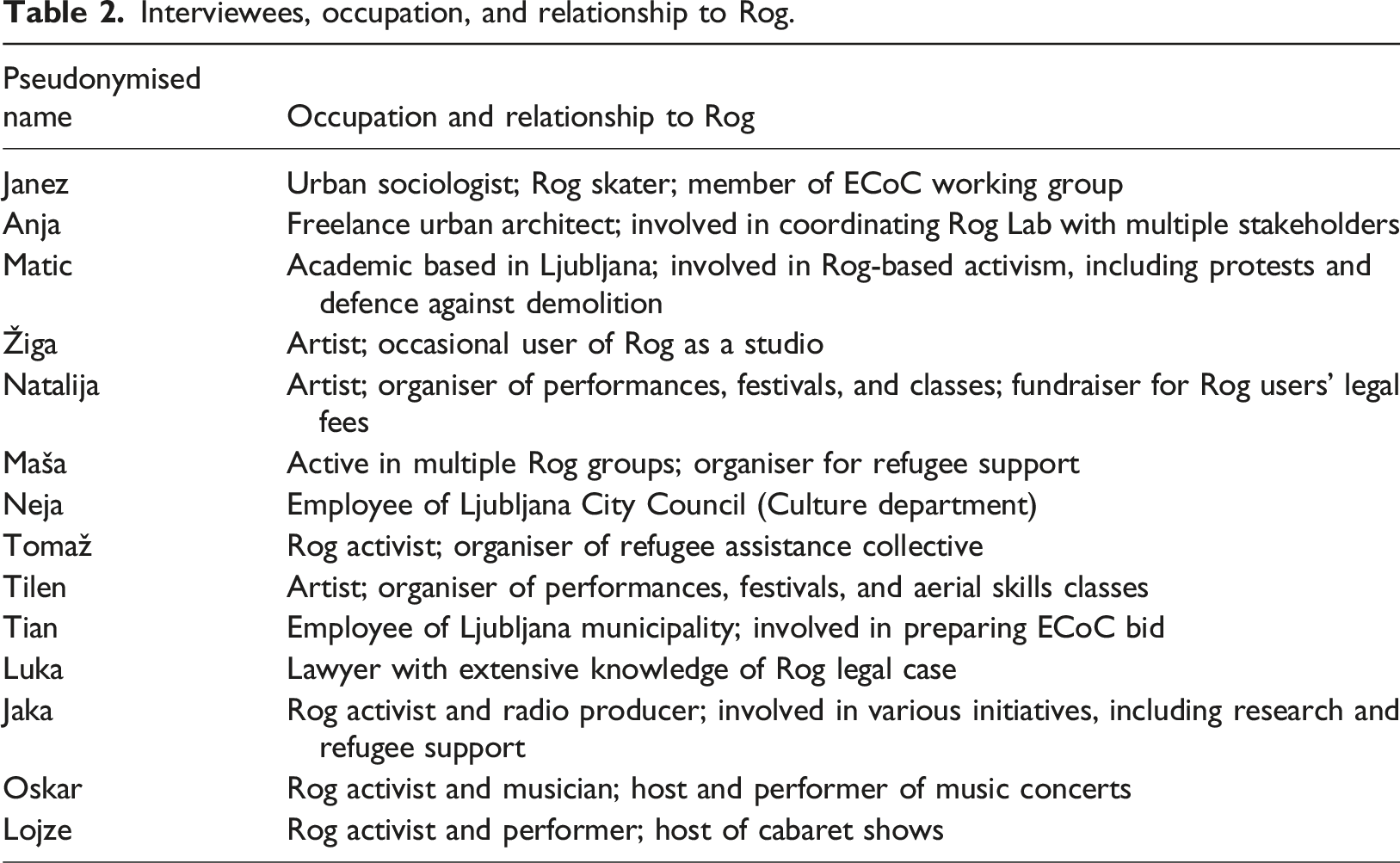
Our analysis connected broader questions about the politics of urban change to the everyday social settings of Rog, while remaining rooted in our theoretical interest (Burawoy, 1998): in this case, a concern for the temporalities of the Rog assemblage, its multiple chronotopes, and their ruptures. Data were abductively analysed to conceptualise Rog’s different chronotopic configurations, their stability, and how they undergo ruptural change. Specifically, we undertook an initial round of open coding, which helped establish the coexistence of radically different understandings of Rog as a place and its component parts – substantiating our assemblage conceptualisation. Then, wary that identifying overarching themes risked imposing a fixity upon Rog’s multiple meanings, we instead began with specific moments in the data that appeared central to Rog’s story: a legal case involving Rog users and the City of Ljubljana; Rog’s inclusion in Ljubljana’s European Capital of Culture bid; a refugee stabbing another Rog user; and how, as one interviewee described, in Rog a broad and inclusive ‘initiative kind of like fell apart’. By ‘building on preexisting theory’ (Burawoy, 1998: 5), we engaged with existing chronotopic analysis (e.g. Chatzidakis, 2020) and followed these central moments across our dataset to (re)construct how each manifests a particular chronotope – a space-time configuration of Rog – that ruptured. Further, aided by Brighenti and Kärrholm’s (2019) work, we traced the multi-temporalities co-present within each (seemingly) stable chronotope. Thus, staying ‘close’ to the empirical material, we sought to understand the times that were concurrent within and across chronotopes.
Pursuing our interest in change, we chose to depict each chronotope as a ‘volve’, or ‘turn’: a narrative device we developed to capture the elastic, yet cohesive, nature of space-time configurations that are pregnant with potential for ruptural change. Our findings therefore offer distinct, yet overlapping, vantages on Rog as an assemblage, highlighting different elements of Rog and how these interact over/with times. We utilise vignettes, descriptions arising from fieldwork, and interviews to bring each chronotope ‘to life’ – with each volve concluding at its moment of rupture. The volves structure our chronotopic analysis, presented in the findings.
Importantly, these volves are not presented sequentially; our findings perform time in a pattern (chronos) but with each chronotope presented in the ‘right’ time (kairos) that begin to reveal the potential times (kronos) and timelessness (aion) of Rog. Equally, within each volve, multiple temporalities assert themselves: the timeliness of chronotopes elude rigid or rationalistic rendering in our findings, and in fact. Through the interplay of times within and between these chronotopes, we simultaneously unentangle Rog as an assemblage and reveal the limits of unentanglement. In doing so, we emphasise our interest in the chronotopic politics of becoming ‘other’ within the process of interpreting findings. We focus on how the coming together of relata that arrange chronotopes builds up to de/reterritorialising singularities – that is, chronotopic ruptures – producing Rog’s reconfigurations in unpredictable and creative ways, which may (or may not) result in the desired conditions of its (human) inhabitants.
Findings: Chronotopic ruptures of Rog
Evolve: An EU bid and redevelopment proposal
Ljubljana’s local government, supported by the Slovenian Cultural Ministry, has submitted a bid to the 2025 European Capital of Culture (ECoC). Part of the application proposes a completely redeveloped ‘Center Rog’, combining community and arts spaces with retail and apartments. The ECoC application is made with limited citizen consultation, let alone engaging with the loose collectives comprising Rog. Yet, this is already catalysing a cascade of actions: consultants (re)draft plans for Center Rog; ‘Rog Lab’, a temporary ‘fab-lab’ with 3-D printers, appears in a shipping container adjacent to Rog; nearby streets are torn up and ‘cleansed’ in eager anticipation of potential development.
Ljubljana’s application for ECoC involves multiple actors that are developing a vision for the city’s future, albeit with the (necessary) exclusion of activist groups. The aims of local, national, and supra-national governments to transform Ljubljana into a market-led, neoliberal space materialise in the bid proposal, in the temporary fab-lab, and in the broader aim to stake a claim to the cultural priorities of EU funding bodies. In this respect, there is increasing pressure to provide many cultural programmes and spaces for creative users and NGOs. This issue is heightened since the largest creative hub in Slovenia, Poligon Creative Centre,
4
was forced to shut down after a change in ownership. But as several interviewees suggest: ‘It depends on shortages. Now we have more than a 100 spaces for the NGOs, and also 50 studios for the artists and, for Ljubljana, it’s something. It’s not nothing’ (Neja). ‘It’s always a problem for the people who don’t have space. There’s always somebody who doesn’t have space…they don’t have space to work, and that’s why we also think it’s very important for Center Rog to be an institution where nobody will have a residency for more than project time’ (Anja).
Rog certainly fulfils the space requirements that the city claims are desperately needed. A former user highlights: ‘[Rog] can give to artists many things, many elements, many means of production… big space is something Rog can give, for a sculptor or for a painter, it’s a place you can make good things, because you experiment with big spaces, in fact there is not a gallery in Ljubljana as big as Rog’ (Žiga). Particularly important to this ideological commitment (Chatzidakis, 2020) is the notion of ‘creative industries’, which one interviewee involved in developing the EU bid describes as parts of the ‘culture, or creative sector that delivers some kind of value in terms of profit or workplaces’ (Janez). Already beginning to demarcate urban space in these terms, he continues: ‘for Rog, I’m not sure that there is a very big amount of people in this city that can answer the question what kind of social value it delivers, and how big the group of potential or actual beneficiaries is’ (Janez). In other words, whereas the EU bid aims to foster creative and cultural industries that generate value, the obscurity of Rog’s current functioning means it cannot be readily translated into this prevailing chrononormative framework.
By situating Rog within – but also in contrast to – the EU bid, a coherence to the squat is assembled which carves out particular parts as consequential (the cultural past of Rog, its creative influence and/or potential), while ignoring the views, conflicts, and power dynamics within the squat – and among previous and current groups. Of course, this interviewee is also a Rog user, so a contradiction appears when navigating ideology in the context of lived experience. At the same time, the coalescence of (f)actors in the EU bid is perhaps most visible in Rog Lab, where partners have included the University of Ljubljana, private companies, the Museum of Architecture and Design, Massachusetts Institute of Technology (MIT), the City of Ljubljana, and others. These partnerships are supported by EU funders (e.g. Interreg Europe) and Rog Lab receives a Eurocities Award for Innovation in 2018. At only 302 m, Rog Lab is located adjacent to the Rog squat, reflecting how the fabric of Rog, Ljubljana and Slovenia are closely meshed together.
While the evolve chronotope is spatiotemporally other to Rog, it nevertheless transforms Rog immeasurably. There are discursive practices whereby Rog becomes the precursor of a powerful new configuration: the regenerated, sanitised urban space of Center Rog. Equally important are both anticipated and actual material interventions that inject disruptive change to the surroundings area to Rog, both the fab-lab and streets. As one informant describes: ‘the idea that, you know, the Center Rog would become a factory again. Not just an exhibition space or whatever, I think this is also somehow, um, the, the—homage to the old factory, of course’ (Anja). Here, a future space is projected onto the present, folding the current squat into the city as a chronotope that is evolving to envelop the present. A prominent culture expert highlights: ‘[in Rog] there is public interest in different fields, not just culture, but also education, science, etc … but the main point of the Rog Factory is to make a story of social awareness, climate, activism, [while] aligning with governmental and national priorities … The Center Rog is an enchanting story, it’s really the [future] space with the soul, with the mission, with the nexus of connectivity, the narrative, and so on’ (Tian).
Thus, the evolve chronotope is situated within a wider understanding that progress/time is a coherent trajectory. It undergoes rupture following Ljubljana’s unsuccessful ECoC application, a decision itself taken elsewhere by an EU-level panel of ‘experts in the field of culture or culture-based city development’ (European Commission, 2025). Thus, the process of evolve is contingent on a wider dynamic – EU’s decision-making – that simultaneously impacts on Rog’s future(s). When the bid is unsuccessful, the certainty of the evolve chronotope momentarily collapses and an ideological vacuum emerges. Still, material replacements are at the ready: the Rog Lab, as a prefiguration of the ECoC bid, remains as a marker of the persistent threat to Rog from ideological forces.
Revolve: Refugees and self-organising, attempted demolition, and resistance
Waves of refugees arriving in Slovenia and Europe are fleeing the Syrian war and other conflicts. Some arrive in Ljubljana after journeying through Turkey, often via the dangerous sea journey to Greece. Where the state does not provide support for refugees, local groups are mobilising, including several present in Rog. Two such groups, Ambasada and Second Home, emerge as key nodes in helping refugees who arrive in Ljubljana jump through bureaucratic hoops and navigate the dizzying complexity of applying for asylum.
The refugee crisis that has taken hold of Europe results in a strengthening of ties within groups on Rog. Alongside efforts to provide effective refugee assistance are multiple activities and events at Rog aimed at reaching wider publics. Charitable activities exist alongside artist collectives and events, circus lessons and sport (especially skateboarding), and other social activity. These intensities of organising increase, seeming to approach a threshold where the squat is en route to becoming an institutionalised space like its more famous neighbour Metelkova Mesto (an established squat with thousands of events that has been appropriated by the municipality for touristic purposes; see Ntounis and Kanellopoulou, 2017). Yet, amid such dynamism, the City Council’s attempt to destroy the squat in 2016 becomes an important mobilising moment: …this demolition started, which was an event of bringing people together, but bringing people together only instantaneously. And after that, because there was no organisational structure, no ideas what to do with it, there were no possibilities of really in-depth discussions – what to do with the space, how to organise (Matic).
Though the demolition attempt is ultimately unsuccessful, a digger (a heavy equipment vehicle used in construction, subsequently painted pink and decorated by users) manages to tear down part of the wall surrounding Rog. That this has occurred in the midst of including more publics in Rog’s activities, and with Rog users assisting refugees in place of the state, suggests a threat arising from Rog itself. Is the existence of an uncontrolled space so proximal to Ljubljana’s city centre grounds for initiating its removal?
Despite such a possibility, the multiple modes of organising ultimately dilute the squat’s potency: the demolition attempt serves to reveal fissures in Rog’s lack of an ‘organisational structure’. In an attempt to address this and consolidate an effective mechanism for resistance, the Rog ‘skupščina’ (‘assembly’ in Slovenian) begins holding regular meetings again. However, this also brings further consequences. Perhaps most significantly, the regular meetings contribute to a broader polarisation within Rog over how to address the increasing presence of refugees (e.g. finding work and housing; government paperwork; learning languages).
So, the increasing complexity of the Rog assemblage in its response to the refugee crisis, alongside the strength of its (potential) alterity and the prefigurative practices of resistance, together make Rog more problematic within Ljubljana. The attempted demolition becomes explainable, perhaps expected, in this regard. But the rupture rending this chronotope of revolve apart is not the demolition. Instead, following a personal dispute, a refugee stabs another Rog user, further stigmatising the squat in the city while also dividing groups involved in place-based practices. This ruptural laceration leads other divisions in Rog to fester, and conflicts and tensions that were dormant throughout the refugee crisis and attempted demolition have brought forward the unstably heterogeneous (Anderson et al., 2012) nature of the assemblage: They were different types of people. One type of people, we squatted the Rog — I was the part of a team who squatted the Rog. And for us...the political assembly was the point of ruling the space…While for other people… [they had] a different perception of political management of the space… And I don’t have anything against it, but we said that there were two different ideas on what a political squat is—because we were, from the beginning, saying that this is not a living squat… And unfortunately, they lost more than they gained, you know. Because a lot of people left (Maša).
The struggles between the ‘old’ Rog guard and the new users are a prime example of the internal conflicts that political squatting entails (Pruijt, 2013), the ominousness that lingers in insurrectional movements, and the negation of any possibly realised order before a new power can be established (Brighenti and Kärrholm, 2019). Whereas the demolition attempt creates a time ready to be seized and moment of opening (Negri, 2003) – capable of strengthening Rog as an assemblage – the reality is that the event is nothing more than a sudden insurrectional explosion (Brighenti and Kärrholm, 2019) that fills the present with disputes, struggles, words, and opportunistic behaviours. In an interview, a user reflects how, as a result: a lot of people saw the opportunity to sell themselves to the city, like skaters for example, or other—or artists…While others were thinking about this, ‘Okay, we need to make some compromises and work with the city to—at least defend a bit of the space’. While others were like, no, totally anti-city, anti-municipality, anti-Janković,
5
‘We do not talk with him, we fight, we build barricades’. So these were main conflicts that were never resolved…this stabbing opened up these conflicts totally (Matic).
Thus, even after the failed demolition, the revolve chronotope swirls around a common dispute over refugees, re-turning upon itself with a degenerating effect for the entirety of the Rog assemblage. This renders uncertain/unstable who and what could legitimately call Rog ‘home’ (Nowicki, 2021). This lingers in the other chronotopic configurations of Rog: ‘there is so much history of that space for people who, who were active, or are active now, that they cannot deal with all that past’ (Matic). The squatters struggle to move on from the revolve rupture, as the moment of opening that could lead to a period of stability is now hindered by the very internal struggles and spatiotemporal controversies (Farah, 2024) invited by this opening, with material consequences in terms of space and territoriality within Rog.
Devolve: Infighting, dissolution, and the legal system
Splits between factions of Rog users are becoming more pronounced, spearheaded by the migrant crisis. Unable to process the squat’s changing landscape, a diminished collective identity manifests both externally and internally: users boycott assemblies, artists distance themselves behind locked doors in Rog’s upper floors, skaters repeatedly proclaim a dissociation with Rog. Consensus emerges among the public that Rog has become isolated, secluded and unwelcoming. Against this dissolving background, the City’s attempt to evict Rog users is met with a collective strain of resistance that, paradoxically, manifests individually in the legal system: eight people declare themselves Rog users and sue the City for disturbance of possession, and one case is appealed to the Slovenian Supreme Court.
The vestiges of Rog’s past activism have given way to the practical realities of dealing with the continued migrant and refugee crisis, coupled with individual concerns and priorities regarding the use of space. Groups – originally formed to provide aid to refugees – come into conflict with Rog-based anarchists and artists, who favour a continuation of previous activities. Mistrust deepens and a sense of secretiveness begins to pervade Rog. As one user notes: it got really obvious...that Rog never existed as a community…it was not able to because there were a lot of different interests, ideas, um—and there was not really a plan what to do with the space, how to organise it (Matic).
It is not the case that creativity, artistic expression and social experimentation cease at Rog. What instead occurs is a fragmentation of activity, the dissociation from Rog’s collective narrative – to the extent that one existed – and the proclamation of space as serving specific, dedicated functions (e.g. to welcome refugees, for artistic practice) as opposed to housing an array of parallel and interwoven activities. Whilst activity is ongoing, Rog users’ identity as ‘liberators of public space’ (Tomsich, 2017) starts to diminish, with groups traditionally associated with Rog, such as the skaters and the artists, removing themselves from the Rog name, making room for a new wave of spatial use and association. This hides ongoing internal struggles from public view, but also instils Rog with a false sense of identity and relevance as other to the surrounding area. A situation arises which, as a former squatter describes, ‘produces an operation of making visible what is not there, and at the same time making invisible something which is already there’ (Žiga). The increase in prominence of Rog appearing to be a hub of creativity is accompanied by a decrease in the cohesiveness and vibrancy of political activism, artistic practice, and other social (skating, events) activities. As a former user highlights in our discussion, ‘[Rog] became a playground for bourgeois kids, who were not able to justify the need to squat the urban surplus’ (Jaka). This paradoxical situation is mirrored in the legal challenges to the City’s right to evict Rog users, constituting a focal point of resistance to state-centric urbanism. Yet, the object of defence – Rog as an autonomous collective – is losing coherence due to the deteriorating state of relations therein.
Challenging the City’s plans to redevelop Rog, eight users sue the city for disturbance of possession. The City counter-sues to evict those eight individuals on the grounds that they are in Rog illegally. Following a series of temporary injunctions halting the City’s plans for Rog, one case works its way to the Slovenian Supreme Court. The Supreme Court’s judgement, on 19 September 2019, declares that a collective of Rog users cannot be sued as such because they lack legal standing as part of a flexible and amorphous mass, unable to perform in a collective capacity. The Court dismisses the City’s claim that a collective of users exists because Rog is sufficiently open such that anyone can become a user. In other words, just as the squat is breaking down internally, it is asserted as a public space and elevated at the national level in a landmark ruling. The rhetorical strategy of ‘temporary use’ (Siegrist, 2023) that is omnipresent since the initial squatting paid dividends and allows current users to reaffirm the Rog assemblage through maximum usage. A newer squatter highlights this: ‘I joined in 2017 and wanted to help with the squat and the legal expenses, I just wanted to use the space as much as possible, and still want to, depending on how much time (based on the legal decision) we have … we have an opportunity to create more alive and active spaces, now is forever!’ (Lojze).
The situation of Rog is thus simultaneously ‘fixed’ through the Supreme Court’s judgement and entering an in-flux shapelessness. The devolve chronotope highlights tensions between these dynamics, arising from the clash between the situation within the squat and an emergent legal intervention elsewhere. Spatial determinism of urban redevelopment is halted – temporarily – while the deterioration of relations in Rog accelerates. Devolve is thus a paradoxical configuration, at once victorious and dejected, both the culmination and low-point of ongoing struggle, simultaneously opening and closing possibilities for the squat’s survival. From these conflicting temporalities, tensions persist and cannot seem to be resolved – despite the Court’s decision. The event of the legal case thus constitutes a rupture to devolve by demarcating an institutional representation of Rog completely divorced from the dissonance of the squat itself. On the contrary, these contradictions are multiplied by the Court’s decision, leading to a dissolution of the chronotope’s stability.
Involve: When cooperative co-existence becomes sedimented
The people coming together in Rog are doing something different. Autonomous activities are open to anyone, whether a DIY area or a circus, artist studios or apartments. The motivation is to make, as one person describes, ‘a place of self-fulfilment, which I don’t get from the state’.
6
Such creative acts are guided by an openness to difference: the factory’s occupation creates a space that is visible and renders material the existence of alternative futures. To coordinate these activities, the Rog assembly provides a forum for different groups to meet regularly and discuss the squat’s ongoing and future activities, while recognising that Rog is only a temporary site of such practices.
Rog is characterised by an endeavour of commoning: the squat attempts to breathe new life into a disused and decayed space by organising based on anarcho-democratic principles. Waves of squatters occupying Rog share principles and values of commoning, focused on creating a space for cultural, political, and social activities without the burdens of bureaucracy and gentrification engineered by Ljubljana’s government. The antipathy toward profit-driven city management mobilises Rog users: early active groups are characterised by an ethos of creating a ‘new common’ place (Kanellopoulou et al., 2021) in the city centre, asking how cultural and social production can manifest in fairer ways. This constitutes the emergence of a ‘movement area’ (Melucci, 1984 in Membretti, 2007: 252–253): a network of the Ljubljanian cognitariat is claiming new rights of citizenship via the liberation of an unused space, seeking cooperation and negotiation with groups sharing similar priorities. Referencing these well-known myths about Rog, one interviewee states: …probably you already heard, like, Rog is – was – not occupied with one group, and really specific guidelines or, like, political view, and then accepting people under these terms (Natalija).
This work of bringing different groups together seeks to involve disparate, yet shared, interests. Such efforts continue to resonate – note Natalija’s shift in tense – and their traces echo across the changes Rog has undergone. Yet, such interventions are not without complications.
On the one hand, Rog functions as a space of creativity and artist practice, which takes multiple forms. For example, one ‘huge festival’ where ‘people from all around Europe came’ is deemed successful precisely because it arose without a set of formal procedures: ‘this kind of festival, we would need, I don’t know, one year of bureaucracy if we would make it official’ (Tilen).
Rog is also a stepping stone for studio-based artists to further their craft, some of whom also participate in Rog’s political debates. This co-constitution of Rog activism with artists means that the squat gathers multiple coexisting creative and political communities.
But, despite these promising developments, groups like artists hold different aspirations to those occupying Rog for political reasons. A former squatter observes how: ‘the fact that Rog was occupied by a small group of architects and artists, more than activists, led also to some kind of depoliticisation of Rog at the beginning’ (Žiga). While implicitly suggesting the situation has politicised as more groups become involved, many artists continue to simply treat Rog as a convenient venue for their work: There are artists who are using Rog as a studio place, who are not so interested in creating an environment in Rog, but produce there. And there are artists, who are just occupying a place for some time, in order to just to have a place (Žiga).
So, while at once a site of almost mystical possibilities, defying bureaucratic and hierarchical organising to provide a crucible for aspiring activists and artists, Rog is also ‘just’ a place for artistic practice. Of course, a complex array of other actors inevitably leads to further emergent differences. The involve chronotope is continuously enacted by – and through – groups providing refugee assistance, emerging communities amongst refugees themselves, political activist collectives, groups providing dance/silks lessons, those using the skatepark, and others. Yet, despite some coordination of these multiple elements, opposition to regulatory, managed synchronisation creates opportunities for meanings to be acquired other than those intended by these groups. As Rog’s functioning relies mostly on unpaid and unrecognised work, initiatives that resemble activities of institutions such as NGOs are met with scepticism and lead to further disagreements and conflicts. Some Rog users – who have had ‘one leg inside and one leg outside because they had to survive’ (Maša) – begin leaving to prioritise their wellbeing, instead of investing in Rog’s survival. An interviewee notes: …Rog…managed to keep some of its political priorities, you know? But…the structures are falling apart because there’s no professional incentive to keep people…Basically, since you don’t live from what you’re doing in Rog, when you don’t have so much free time, your job or your family or whatever…you stop doing it. And what comes after you is not your problem. So we have this difficulty of keeping full-time collectives that are maintaining and investing in the place (Tomaž).
Coordinating mechanisms such as the Rog assembly cannot control the diverging trajectories of meanings ascribed to the squat, or the conflicts between them. These several elements of Rog become increasingly polarised and radicalised, making Rog’s ‘lasting’ (Ciobanu, 2015) a property of the ‘social whole’ (Delanda, 2016: 10) that creates the conditions for its rupture. As one of the longest users says: I don’t see the necessity to have Rog as a whole [anymore], it could function as a community of communities, it is a collective property that people can benefit from and learn from it, and encourage creativity (Oskar).
In other words, involve’s potential for dissolution is an inherent capacity from the outset. To the extent that tensions, periodic eruptions of disagreement, and limits to the collective’s ability to manage them are defining features of Rog, these parameters also lurk behind involve throughout its various manifestations. The involve chronotope remains in a perpetual state of rupturing, a latent potential of squatting as a form of collective world-making that involves creating alternative lifeworlds (Vasudevan, 2015) while simultaneously accentuating precarity.
Discussion
The four volves presented above capture distinct chronotopes of Rog, and their event(u)al ruptures. Each enrols disparate elements comprising the Rog assemblage, with many actors surfacing across multiple chronotopes – whether activists, skaters, artists, Ljubljana’s governmental bodies (City, national, Court), or others. The buildings of Rog, of course, persistently materialise in each chronotope as well. Yet, these heterogeneous parts are combined very differently in our narratives of how the volves twist and turn. Chronotopes each exhibit a (temporary) stability – in the buildup to the ECoC bid, while activists respond to the refugee crisis, as infighting precedes the Supreme Court decision, or during the hope-full culmination of commoning activities – while also overlapping in space-time (Chatzidakis, 2020). Rog simultaneously involves as it devolves and evolves and so forth. We have deliberately presented each volve in the present tense to highlight this simultaneity. But in each case, the chronotope does not endure indefinitely; its stability is not meant to last.
We argue that multi-temporality offers important insights into understanding these changes to the Rog assemblage. Just as heterogeneous parts combine in spatiotemporally overlapping chronotopes, so too are multiple times mingled/mangled together across the four volves. In each, the regular time of chronos, the opportune time of kairos, the sickly time of kronos, and the eternal time aion are co-present. While it is well-established that a multiplicity of elements constitutes a source of robustness for urban assemblages (Delanda, 2016; Durose et al., 2022), our findings suggest that the coexistence of multiple times also affords vitality to the chronotopes comprising assemblage. Certainly, this multi-temporal attribute can unfold within an ideologically or politically subordinative chronotope – as in evolve, which catalogues the endeavour to subsume Rog to EU decision-making. But evolve also demonstrates the inability to both fully control Rog’s current functioning and diminish the enchanting uncertainties of its becoming.
Prevailing temporality and multi-temporal dynamics of volves based on findings.
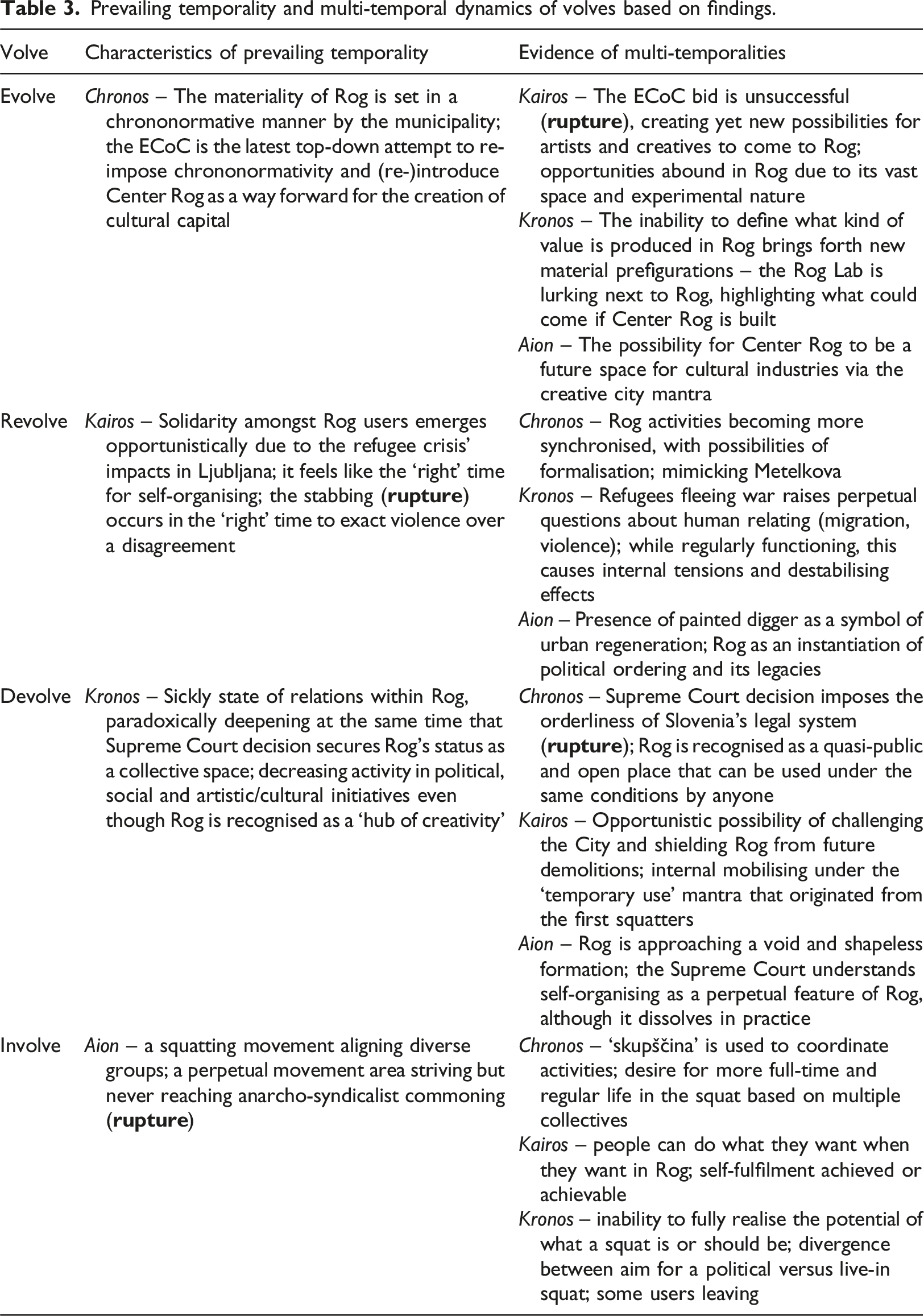
Importantly, ruptures (in bold) do not necessarily arise from a prevailing temporality. Rather, ruptures are moments that accentuate already-approaching thresholds of reconfiguration which lead to a disembeddedness in place. For Rog, small triumphs throughout the squat’s lifetime failed to repoliticise and revitalise its self-organising (Beveridge and Featherstone, 2021). Rog’s ruptural moments, associated with one of a chronotope’s multiple times, open up new possibilities while also surfacing tensions between the actual and possible (Anderson et al., 2012). This points to the broader implications of multi-temporality for understanding urban assemblages and their intrinsic (im)potential. If our findings demonstrate the difficulties of orchestrating co-functioning parts of assemblage (McFarlane, 2011b), which contributed to a lack of collective identity and unity in Rog, they also highlight the role of ruptures in creating openness and potentialities within Rog. The urban assemblage changes through these ‘cracks’ and ‘ripples’, though it is their pace, momentousness, and trajectory that allow for the emergence of a prevailing temporality to be assigned. Contrasting with McFarlane (2011b), this allows us to speculate that, amidst temporal multiplicity, it is through rupture that a prevailing time becomes assigned in the course of assemblage.
Thus, our analysis shows that chronotopic ruptures allow for breaks and reconfigurations in urban assemblages through productive, co-existive tension between multiple times. For Rog users, this tension materialised in choosing to resist (inevitable) change (revolve) without considering the ‘end-directedness of time’ (Melucci, 1996: 44), leading to (unrealised) efforts to make permanent Rog’s deliberately temporary arrangements (involve). Even the seemingly synchronic material chrononormativity of Center Rog (i.e. evolve) breaks when the ‘proper’ ordering of urban space (Mulíček et al., 2016) fails to deliver promises of growth and progress. Meanwhile kronos, a time that is not ruptural by definition, is lingering as a persistent threat for the Rog assemblage; our findings show how this manifests as discontent and a metastable mass of confrontations, permanently entangled in the radically immanent line of flight (Deleuze and Guattari, 1987) that is the squatting movement (involve). As a sickly time, kronos prevails at an opportune period for political disruptiveness due to the Supreme Court decision (devolve), bringing a repressive backlash (Pruijt, 2013) between new and old Rog users, while also accentuating the persisting refugee crisis and squatters’ fatigue. We consider kronos to be a depoliticised time that disrupts and undermines transformative changes towards more instantiations of squats, solidarity and urban experimentation (see Sierhuis et al., 2024). Overall, chronotopic ruptures showcase the possibilities to spawn further urban experiments and new space-time configurations in the urban assemblage, but also how ruptural changes can lead to depoliticised practices that are ripe for (violent) displacement (Roth et al., 2021).
Closings
To conclude, this paper has mobilised theoretical insights into times and multi-temporalities to examine urban assemblages (McFarlane, 2011a, 2011b) and their transformation through a chronotopic analysis (Chatzidakis, 2020) of an urban squat. Through our empirical examination of Rog, we posited that the spatiotemporal qualities of assemblages and their unraveling as change occurs during different times are worthy of critical attention. We have shown that critical, decisive, unending, or everlasting moments are part and parcel of how assemblages open up and close down possibilities to create new spatial imaginaries (Anderson et al., 2012). Thus, our paper contributes a new lens for evaluating the empirical phenomena of social movements and urban squats by applying a chronotopic analysis to the tensions in/between multiple times to demonstrate the making and unmaking – the (dis)assembling – of Rog.
Furthermore, our paper explains the ways multiple times (chronos, kairos, kronos, and aion) are co-present in assemblages across their multiple chronotopic configurations. Our theoretical exploration and subsequent analysis enabled the contextualisation of spatiotemporal dynamics at play in the context of Rog as urban assemblage. Specifically, we showed that ruptural breaks in space-times suppress the productivity of multiple times, leading one time to dominate over others in a way that expresses a point of no return, and the need for re-configuring assemblage. We coin these breaks as chronotopic ruptures, and posit that seeking out the multi-temporality of assemblages can sensitise participants to risks of temporal dominance and ruptural potential. We encourage future research to be grounded in the recognition that overlapping chronotopes can approach lines of flight that fundamentally alter the composition of urban assemblages.
Our paper itself carries multi-temporalities: while written under the subordinating conditions of academic work and publishing (chronos), we were also afforded opportunities via the review process to, for example, reconceive the relations between times within the volves identified (kairos), which led us to expand on the multi-temporality characterising each. Of no small consequence, while fieldwork extended from 2016 to 2019, we began this paper in 2019; the ensuing years saw a global pandemic disrupt our best efforts at promptly proceeding to publication (kronos). While some may aspire to write from the ‘pure’ time of a detached academic, we follow Burawoy (1998) in advocating instead for an engaged methodological position that embraces researching as the search for a(n unreachable) horizon (aion).
Finally, during this period, the potentialities of Rog also reassembled only a few kilometres north from the former squat: Participativna Ljubljanska Avtonomna Cona (PLAC), 7 an autonomous zone providing opportunities for participation and action in an increasingly gentrified Ljubljana, started occupation of a bank-owned building in September 2022, and is already displaying chronotopic configurations with uncertain possibilities, 8 while experimenting with new political imaginaries and practices through direct care work (Abram, 2023). Times echo in assemblage, and ruptures spawn new reconfigurations that articulate with elsewhere in a never-ending, mutating, self-organising unfolding. The ‘final’ rupture of squats is to the urban fabric as kairos is to aion. Urban space will never re-turn to a similar time. Nor, indeed, was it ever so.
Footnotes
Acknowledgements
We would like to thank the two anonymous reviewers for their constructive feedback, and Prof Eugene McCann, Prof Luiza Bialasiewicz, and Kate Nudd for their help and support during the revision of the paper. We also thank Prof Tim Edensor for his guidance, support, and feedback throughout the duration of the project and the writing of this paper in particular.
Declaration of conflicting interests
The author(s) declared no potential conflicts of interest with respect to the research, authorship, and/or publication of this article.
Funding
The author(s) disclosed receipt of the following financial support for the research, authorship, and/or publication of this article: This paper is part of a project titled “Making and managing Ljubljana's urban squats: inclusive and participatory practices”, which is funded by the BA/Leverhulme Small Research Grants (SRG1819\1904000) and supported by the UK Department for Business, Energy and Industrial Strategy.
