




Abstract
Urban place offers potential to disrupt municipal bureaucratic cultures—conceptualized as organizational traps in public administration theory—that stymie policy formulation, implementation, and innovation. Drawing on 17 in-depth interviews with policy actors and survey responses from 103 urban households, this paper offers three interventions in the policy diffusion literature. First, I demonstrate that policy leaders and workers engage with multiple actors outside of the organization, and those actors also interact amongst themselves and at times magnify different policy ideas and advocacy. These activities occur in the bureaucratic realm, which overlaps the urban realm and is thus informed by the features of an urban way of life. Second, this complex and intertwined realm involves lateral learning and transfer of policy through the city and amongst a broadly defined set of policy actors with varying levels of formal connection to the municipal bureaucracy. The learning that occurs is not only of policy advancement: external actors also learn about internal organizational traps that stymie policy development and implementation. Third, respondents offered place-based, or “hyper-localized” methods, to disrupt organizational traps and municipal bureaucratic deficits known as managerialism.
Researchers of policy processes have made important contributions to understanding how policy is created (Cochrane, 2007), analyzed, and diffused across global networks (McCann, 2011), up and down urban systems (Montero, 2017), and even across municipal agencies within the same city (Lucas, 2016). These scholars have identified the key political and economic forces that prompt policy development (Mohl, 1993), the actors who move policy forward (Brash, 2011), and the conditions through which the public may become activated for or against such policies (Jonas, 1992). This research has had an urban focus, as cities have become primary engines and expressions of global capitalism. As such, they bear the brunt of capitalism’s scintillating, inherent instability (Harvey, 1978), which in turn necessitates ameliorative policy interventions.
Cochrane (2007) offered a prototype of what these interventions look like. Urban policy is the cluster of initiatives dealing with the problems of cities; the initiatives that are intended to take advantage of the synergies and innovation of large numbers of different people living in proximity; the institutional response to the pluralist politics of consumption; state activity that affects the way of life in cities; and efforts to facilitate capitalist production rather than social welfare. Others sought to define who led these processes. They identified the powerful role of capitalist elites holding narrow, wealth-accumulation interests (Logan and Molotch, 1978), as well as a cadre of policymakers existing throughout the city, from street-level bureaucrats (Proudfoot and McCann, 2013) to non-state entities (Keenan and Meenar, 2023; Martin, 2004).
These actors conceptualize, implement, and analyze policy in a variety of ways, most of which bears little resemblance to formal analysis methods defined within the field of public policy. (For a review of contemporary policy methods, see Mintrom 2011.) Municipal policymakers are influenced by subjective experiences that inform their initiation of policy processes (Musheno and Maynard-Moody, 2014), including perceptions of politics, their own understanding of communities, and even personal attachments to place (Keenan and Dehaan, 2023). Proudfoot and McCann (2013) demonstrated that implementation of policy is similarly subjective, with bureaucratic workers exercising considerable discretion in the application of rules. Professional communities that possess the knowledge, time, and resources to advocate for certain priorities over others also influence bureaucratic leaders (Haas, 1992). In short, there are many cultural and institutional factors, including related to place, that affect what is presented to a community as policy.
In this paper, I analyze two of these factors. Argyris (2012) conceptualized the powerful role that institutional cultures play in shaping policymakers’ understanding of policy problems as well as their proposals for solutions. Summarizing many of the themes developed elsewhere, Argyris (2012) defined “organizational traps” within institutions. These traps can emerge from institutional norms, assumptions related to problem solving learned and shared by institutional workers over time, and ways of perceiving, thinking, and feeling influenced if not generated by the work place (Schein, 2004). An organizational trap can prevent accurate problem identification and policy analysis, and it may even lead to harmful outcomes. Argyris (2012) identified a prominent example of an organizational trap via the space shuttle Columbia disaster in 2003, which was caused in part by the re-emergence of traps that were made visible (and presumably disrupted) in the prior Challenger disaster and subsequent report. These traps involved assumptions about engineering expertise given prior success that ultimately stymied safety investigations and the ability to listen to all intra and inter agency communication.
At the same time, urbanists have begun emplacing organizational traps by recognized the place-based dimensions public policy as both a process and an outcome. Place is three things: it is a location or point on the Earth, it is a background for human action, and it is a subjective human experience and understanding (Agnew, 1987). The “urban” part of public policy analysis applied to cities reveals unique ontologies that influence bureaucratic work. Urban place is literally the location defined as a city. It is a flexible, changing space produced to support the ever-varying needs of capital accumulation (Lefebvre, 1991[1974]). And, it is the cumulative affect of these conditions upon people encountering them in the urban location (Simmell, 1976[1903]). Keenan and Dehaan (2023) demonstrated that ideas of a city as a subjective place affected nearly every policymaker’s approach to every aspect of the policymaking process across the bureaucracy of a small U.S. city. Using direct evidence from the municipal workers themselves, the authors revealed that those workers relied not on policy analysis methods to do their jobs, but rather upon their own ideas of place—some of which were deeply subjective while others were part of dominant, elite narratives. This condition presented a form of organizational entrapment linked to place. Martin’s (2004) analysis of urban foundations and their role in municipal policymaking demonstrated the wide extent of urban policy actors beyond the municipal government, opening the possibility that there is a similarly wide extent of both place-based policy ontologies operating within a city as well as associated traps.
To date, these two concepts—of organizational traps and the role of place as an ontological influencer—have focused on the culture within the organization. However, neither the workers nor the leaders of these organizations live their lives or careers exclusively within the institution. Rather, they are present within several other communities, perhaps at different scales. They are part of wider professional networks that necessitate regular professional interaction. These networks could be formed under a state chapter of a professional organization or within the national association itself (which is the case for planners). The institution may be articulated in specific places (via multiple offices), and thus have some interaction with the publics in those locations. But it too may be connected at different scales, perhaps linked to regional, state, and even national networks. The institution’s mission may be to directly serve the community which will generate greater interactions beyond simply those occurring due to co-presence. And finally, the workers themselves are also residents, living personal lives apart from their workplace in other communities of varying types, distances, and scales which puts these communities within the institution’s orbit of interaction.
This constellation of different communities, networks, and informational pathways is connected to the institution, and emanates out from it. The constellation brims with policy actors, who are people who have formal or informal engagement with policy processes at different levels of intensity. These actors may interact with the policymaker. However, they are not within the organization and may have varying degrees of connection to it via their relationships with the policymakers. This condition raises the question of where an “organizational trap” begins and ends. There is no real beginning or end of the interactional space or network, but rather shifting strengths and intensities of interactions over time and space as contexts and arrangements change. To help understand this situation, I conceptualize the bureaucratic realm as a rhizomatic space (Deleuze and Guattari, 1987) beyond the organization in which organizational culture extends, intertwines, and influences the policy process without a singular center. The flow of contact, information, and influence is not one way, but is rather enmeshed and intertwined with varying degrees of strength amongst the different actors.
This paper seeks to conceptualize a rhizomatic organizational trap, to identify and define it, and to explore its shifting web within urban space as well as its relationship to the bureaucracy. I collected the data presented in this paper for a project funded by the New Jersey Board of Public Utilities (USA) to study policy initiatives to support the transition to electric vehicles in the state. That data consists of 17 in-depth interviews with leaders of state-level public sector agencies in New Jersey (USA) and policy actors that exist outside of the agencies but seek to influence public policy positions and outcomes, as well as 103 survey responses from three different municipalities. The survey results demonstrate the gap between the policy actors affected by an organizational trap and the constituents that policy is intended to serve. I begin by outlining the policymaking process, and then discuss the effect of organizational traps and develop the concept of the bureaucratic realm. I then describe the methods and analysis, and present three advancements to theory: (1) the features and qualities of the bureaucratic realm and how organizational traps develop within this realm; (2) the communicative methods that generate and sustain the traps; and (3) strategies to disrupt the trap as rooted in community knowledges.
The urban policymaking process and policy actors
Public policy refers to the choices that governments make on behalf of residents living in their jurisdictions. Policies are adopted to promote control and order and to structure the environment in ways that lead to overall improvements in the quality of life for people (Mintrom, 2011). Formal public policy defines a series of common steps undertaken to create, implement, and analyze policy. These steps include (1) identifying the problem; (2) proposing responses; (3) choosing criteria for analysis; (4) projecting outcomes of different interventions; (5) identifying and discussing tradeoffs; and (6) arguing to select one course of action over others. However, Anderson (2006) argued that most policy is generated via politics rather than such sound technical reasoning. And in the case of cities, the urban environment itself creates a distinctive way of life (Wirth, 1938) which leads to distinctive forms of politics and thus also policy processes.
Cochrane (2007) identified the place-based source of this distinctiveness. He conceptualized the unique manifestations of poverty, disorder, and race within cities that are generated in part by the sheer number of people, density, and heterogeneity in these places (Wirth 1938). Capitalism, which prompts the growth of infrastructure to support wealth accumulation and leads to agglomeration economies in place (Harvey, 1978), accelerates both the expansion of cities and magnifies social problems within them (Harvey, 2005). Urban political systems are thus presented with demands to address problems that vary with the ever-shifting needs of capitalism, while simultaneously being constrained by elites who attach to the manifesting modes of production to seek wealth accumulation (Logan and Molotch, 1978). These elites harness cultural ideas about what the city should be, drawing on selective history and national mythology (such as the consumer oriented “good” life) to create local ideologies that help advance their interests (McCann, 2002). Leitner and Garner (1993) demonstrated how such maneuvering can itself create an organization trap, as it directs the policy gaze to the purely local interest at the behest of rentier elites while ignoring the globally linked and incessantly changing nature of capitalist systems (Massey, 1991). Further, the construction of a local ideology is not only possible amongst elites. Other actors, though often less powerful, can seize the same processes to craft alternative urban visions and build a constituency around them to challenge the elites (McCann, 2002). Policymakers must resolve the resulting tension within place-delimited frameworks, yet explicit analyses of place in policy development and transition have been rare (Coenen et al., 2012).
There are a variety of policy actors present in this place-delimited policymaking nexus. There are elected officials, particularly the mayor, who set high-level policy goals and frameworks for the city, and who appoint the heads of municipal bureaucracies to advance these goals (Brash, 2011). These actors seek to address problems within the city but also engage with external actors to learn about successful policy innovations elsewhere (McCann, 2013). City councilors and city-wide elected officials also play a role, usually via advocacy or investigative efforts (Anderson, 2006). Workers within the bureaucracy wield a considerable amount of discretion in enacting policy (Lipsky, 1980; Proudfoot and McCann, 2013). Logan and Molotch (1978) identified a cadre of elites outside of the government that exert influence in support of particular policy outcomes related to wealth accumulation. Martin (2004) identified the role of foundations and philanthropic organizations in urban policy processes, while others have shown that community activists and community-established organizations also become policy actors (Keenan and Meenar, 2023). In short, there is a constellation of policy actors both within and outside of government and its bureaucracies.
These actors are linked via hierarchical communication channels, through the ambient culture and professional networks related to policy work, and through the jurisdiction and its members for which policy is generated. These actors interact with each other, deepening and strengthening networks and institutional linkages over time, and they can even create new spaces to solidify and amplify the relationships (Coenen et al., 2012). Communication related to policy processes is framed by hierarchical structures, dominated by elites who set the agenda (Hazelton-Boyle and Wellman, 2022) and have access to both existing knowledge communities related to policy problems and also to new ones that they sometimes create (referred to as epistemic communities (Haas, 1992)). This hierarchical context establishes the rules and narratives by which bureaucrats deliver policy and communicate their actions, but it does not eliminate their subjective use of culture and discretion as they do so (Musheno and Maynard-Moody, 2014). Rather, the hierarchical context provides cover for such usage amongst street-level bureaucrats (Maynard-Moody and Musheno, 2012). Culture informs the behavior of policy workers, including their assessments of the morality or deservedness of individuals invoking policy to gain resources or other benefits. While culture varies within a city given the city’s diversity (Wirth, 1938), the place as a jurisdiction is a cultural artifact that is shared and experienced by all policy workers (Keenan and Dehaan, 2023; Keenan and Meenar, 2023). It is through this shared place that organizational traps emerge beyond the organization and by which policy actors might disrupt such traps.
Identifying organizational traps within the organizational realm
Argyris (2012) synthesized concepts related to policy and public administration into the theory of organizational traps, which are cultural systems that operate within organizations that hinder policy development and evaluation, sometimes with dire consequences. There are two ways that the hindrances occur: institutional cultural systems generate symbols that correlate with reward structures, and workers respond by interpreting these symbols as signposts to appropriate behavior that will yield a reward. Personnel within the organization avoid challenging such interpretive systems out of latent fear that doing so will block a reward. In addition, these cultural systems create organizational ontologies (or ways of knowing) amongst the organization’s members, which they use to inform their work. These ontologies rely on the same internal interpretive systems, which similarly block or limit alternative viewpoints and may thus prevent disruption of faulty analysis, methods, and conclusions. Lipsky (1980) argued that internal organizational culture was a reflection of the larger societal culture, which raises the question of how organizational traps are linked to the contexts external to the organization.
Policymakers and public bureaucracies usually advance a specified policy domain and serve a delimited jurisdiction. The municipal bureaucracy delivers services to constituents within the city boundaries. A variety of policy actors, as outlined above, exist within this space, and they have a variety of interests related to the policy domain, including advocacy (Lopez and Montero, 2018) and self-preservation (Logan and Molotch, 1978). They are also differentially positioned to engage with the bureaucracy, with some having exceptional influence (Haas, 1992) while others offer input from the margins (Lake, 2021). Because the bureaucracy is a porous entity, with a multitude of channels of engagement with the larger community and its culture—especially vis-à-vis the policy workers’ direct engagement with the public via delivery of policy-related services—it is possible that organizational traps also extend through these channels into the broader policy domain.
An organizational realm emanates beyond the bureaucracy, which encompasses a constellation of connected policy actors. In the context of a socio-technological transition, of which the shift to electric vehicles is representative, Bulkeley (2014) has identified a plurality of socio-technical, rule setting regimes within the city. Organizational traps, though currently conceptualized as existing within the organization, influence these actors too via their encounters with policy workers both in the field as well as through the organization itself. The actors are not merely passive agents; they too have an affect by influencing the organization’s actors and thus the organizational culture as well. How these extra-bureaucratic organizational traps function, including the interplay between the realm and the bureaucracy, is currently poorly understood, though research suggests that they matter. Frantzeskaki et al. (2018) and Scholl and Kemp (2016) both outline how specific institutional structures can be created that collect policy actors and link them to the bureaucracy, but allow them to “experiment” unburdened by institutional norms. Frantzeskaki et al. even find an ability to “shock the system outside a trap” within these arrangements (pg. 1047). Hodson et al. (2018), referencing this work, characterize the focus as on urban infrastructures and attempts to understand how communities will respond to them. The current paper, though touching upon new urban infrastructures to support electric vehicles, moves the analysis further to consider broader aspects of policy. The findings clarify the aspects of organizational traps beyond the actual bureaucracy, existing within the bureaucratic realm, but which are not intentionally disrupted via the creation of artificial institutions, as in the case of Frantzeskaki et al. (2018) or Hodson et al. (2018).
Finally, the realm need not only be the source of a trap; it may also be the site where an antidote is found. Organizational traps are generated by organizational ontologies that are rooted in the act of communication—of employees within an internal hierarchical structure as well as with the broader policy community. The act of communication is the primary mode of learning within the organization and beyond it. However, the policy actors also share another ontology, which is of the jurisdiction as a place. Keenan and Dehaan (2023) demonstrated that such place-based ontologies affected how policy workers did their jobs. In that analysis, the ideas of place became a restrictive policy regime, especially in economic and place-promotion contexts, and they limited the workers’ usage of formal policy analysis methods and thus affected policy outcomes. In effect, the workers did their work within a pervasive place frame that was used to advance oppositional politics. But the process and outcome were both quite different from that theorized by Martin (2003): the political part was unstated or not recognized amongst the workers as the frame operated within government offices that are supposed to be apolitical. The case study was not of a social movement, but rather of those who might suppress one. Thus, the oppositional stance was to any place frame that challenged the dominant one. So it is possible that in addition to moments of discursive struggle to actively implement the place frame (Neste and Martin, 2017), some people in some contexts, such as the policy workers in their jobs, are completely unaware that they are a priori operating within an existing frame.
Nevertheless, the policy workers themselves had intricate knowledge of and subjective attachments to place by virtue of living and working within the jurisdiction. This knowledge, often latent but sometimes activated, formed a place ontology that demonstrated potential to disrupt organizational traps (Keenan and Meenar, 2023). That disruptive potential was formed in the field, but it was also transferred to the organization itself by the workers. When those workers’ own experiential knowledge of place conflicted with the dominant place frame operating within the bureaucracy, they expressed frustration and began to mount challenges through their policy work. These workers cannot appropriately be classified as part of a subaltern that challenges a dominant political place frame (Feola et al., 2023), as they were part of an empowered class and they couldn’t resist their employer in the same way theorized vis-à-vis social movements. However, their own experiential knowledge of place, which can be in the milieu of (or close to) urban crises and transitions (Lefebvre, 1996), yielded a cognitive dissonance that they resolved by interjecting their knowledge directly into the policy process. This finding advances theory of how new ideas of the city as a place in transition or crisis (Lefebvre, 1996), as well as associated solutions, emerge not only through oppositional social movements built around place frames, but rather through everyday practices of policy workers.
Methods, data, and analysis
Overview
The New Jersey Board of Public Utilities (NJBPU) provided funding to a research team, including the author as co-PI, in the spring of 2020 to study institutional and community-level contexts that would advance vehicle electrification initiatives in the State of New Jersey (USA). The project involved in-depth interviews with policy actors across the state, as well as surveys of households in three different communities in different regions of the state that yielded both quantitative and qualitative data. This methodology allows an analysis of both the missing local context in which sustainability transitions take place (Raven et al., 2012), as well as of the different policy actors potentially involved in the transition. More specifically, the project provides information to develop “bridging concepts” related to sustainability transitions through the collection of diverse viewpoints via the surveys, as well as theory related to the role of space in the interactions of socio-technical regime actors, which in this paper are the interviewed policy actors (Levin-Keitel et al., 2018).
The funder had a specific goal of understanding how state-level policy might advance EV transition, and the project was designed to achieve that goal. However, the research activities and data provided a direct window into not only the functioning of a major state-level bureaucracy, but they also allowed access to external policymakers and examination of their decision-making processes. The project provided a window into the views of residents vis-à-vis the same EV policy goal. The survey data yielded information on the constituent perceptions of the policy environment, and it signaled the operation of organizational traps within the transportation policy domain. The interviews provided data on how policy actors operate within these organizational traps and reproduce them—both inside organizations but also within the broader realm. So, while the funder’s research design emphasized a narrow topic (vehicle electrification), the application of theory and subsequent interpretation allowed further insight into the policymaking process.
Data collection
The author collected quantitative and qualitative data for this project during the spring of 2020. Data collection began before the onset of the COVID-19 pandemic in the United States and continued through the spring of 2021 with accommodations made for the public health emergency.
The survey data for this project was generated from a mailed and emailed survey to respondents from three municipalities in New Jersey that the funder selected. The communities are in each of the three regions of the state: Washington Township in the south, the City of New Brunswick in the central region, and the City of Newark in the northern region. Washington Township is a municipality in a predominantly rural area, while the other two are urban. The survey was provided in English and Spanish, which are the two most prevalent languages in the communities studied. The survey consisted of 25 multiple choice and open-ended questions, grouped into four content areas of interest to the sponsor: (1) perspectives on community-level air quality; (2) awareness of electric vehicles; (3) perceptions of electric vehicles; and (4) demographic information.
The respondents were selected via a spatially stratified random sample. I loaded TIGER street files into ArcGIS and generated 20 random points for each municipality. I selected the streets closest to these points. I then entered the house number range for the street, which is found in the street files. I then used the Microsoft Excel random number generator to identify the first address to contact and proceeded to contact every 5th residence on the street. The Cole Directory provided names, phone number, and email addresses organized by street name and residence. Survey mailings (both paper and email) began after the November 2020 election and continued through the winter and early spring months of 2021. (The author waited until after the election to avoid potential respondents discarding the survey due to the onslaught of political mailings leading up to the election).
Households received one post-card reminder in the mail to complete the survey, and between four to six emailed reminders. In total, 1812 households received a paper survey. Each of the 971 email addresses associated with these households also received the survey electronically. 35 surveys were returned from New Brunswick, 34 from Newark, and 33 from Washington Township. The overall response rate was 5.6%. The response was likely impacted by concerns about handling mail during the pandemic, lack of familiarity and interest in the topic, and the length of the survey. Nevertheless, on average the author obtained 34 responses for each community.
The interview respondents were identified via an iterative process with the sponsor. The NJBPU supplied a database of 92 high-level transportation policymakers in New Jersey for whom they had contact information and a working relationship. The author added additional contacts to this list, including transportation planners and engineers, from the specific communities that were to be studied. The author analyzed the resulting combined set for possible interviewees using the following rubric: (1) leadership position within government and ability to make decisions that affect local communities; (2) knowledge of planning and zoning; (3) knowledge of transportation policy in general and vehicle electrification in particular; and (4) balance of participation across each of the three municipalities. Twenty-one potential interviewees for the project were ultimately selected for participation and were approved by the sponsor. 17 agreed to participate. The author and a member of the larger research team conducted in-depth interviews with these respondents via telephone due to the COVID-19 pandemic. The interview protocol included a mixture of 12 questions that elicited specific information, such as knowledge of community transportation needs, but also open-ended reflection prompts on various topics related to transportation policy. The interviews were audio-recorded, and a paid transcription service generated verbatim transcripts.
I have employed data triangulation to bolster the trustworthiness and confirmability of findings (Baxter and Eyles, 1997). The quantitative data for this project is derived from three different communities representing three different types of environments (urban, suburban, and rural), whereas the qualitative data was generated with experts from around the state who are knowledgeable both of transportation policy and New Jersey communities. In addition, this project was supervised by a state agency team of experts, some of whom were professional researchers. This group offered feedback on the project, supplied context and relevant documents to situate processes and evaluated results.
Analysis methods
A student assistant entered all numerical survey data into an SBSS database. The assistant also transcribed verbatim open-ended survey responses and entered these into the database as well. The quantitative data was subjected to descriptive statistical analysis, including measures of frequency, dispersion, and variation. The author interpreted the qualitative data using the coding frameworks described below. Content that advanced understanding of emergent themes was linked to those themes using a qualitative memo writing process (Charmaz, 2006).
The author analyzed the qualitative data using standard coding procedures (Cope, 2003). The author imported all interview transcripts into the Nvivo software system, and then systematically engaged in open coding, which involves scrutinizing every line of the transcript and fracturing the data into preliminary themes. The author referenced Böhm’s (2004) prompts to help identify themes in the data, especially the prompts for causes, contexts, consequences and conditions, as well as those for processes and strategies and tactics. The author then conducted a second coding process in which they grouped the preliminary themes into broader categories that scaffolded nascent concepts. The research question and theory informed this process, but the respondents’ ideas defined the concepts. Examples of emergent codes at this stage were “Mobility Problems” in which respondents explained their perception of mobility problems facing residents and “New Jersey is Behind” in which respondents explained their perception of the state’s transportation policies vis-à-vis other states. In total, 28 different codes emerged at this stage, seven of which were en vivo codes. Finally, the author conducted a review in which these categories were refined and key quotes exemplifying different aspects of core concepts were selected for interpretative discussion in the manuscript.
Ethics
The author’s university IRB approved this project, and the author adhered to all required ethical principles including informed consent, participants’ right to review the data and interpretations of it, and that the research should result in no harm to respondents. All survey participants received summary copies of the larger project’s preliminary analysis results, and they were invited to provide commentary. Each interview respondent received a copy of the transcript for their interview, and they were invited to revise their statements. In additions, these respondents were shown how quotations were used in the qualitative analysis, and again they were invited to confirm that the interpretations reflected the respondent’s experiences.
This paper adopts a critical urban epistemology. By conceptualizing the bureaucratic realm, the author recognizes that place is not simply a container in which things exist, but is also a space where interdependencies develop to create both unintended synergies as well as consequences (Boudreau, 2010). In describing these interdependencies, the author positions themself as a qualitative researcher (Fine et al., 2003) interested in engaging alternative paradigms of public policy, specifically in defining the urban-ness of “urban” policy. The author seeks to advance frameworks of policy that are urban but are not singularly focused on solving market-driven problems. Both the questions asked in this project and the subsequent interpretations of data are informed by this intention.
Results and discussion
Existence of the bureaucratic realm
Both the interviewees and household respondents recognized that successful policy is created not within the confines of a municipal agency, but rather in the community itself. These respondents, though discussing questions related to advancement of vehicle electrification policies within New Jersey, articulated how different policy actors came together outside of the organization and influenced the policy domain. One such actor from a private vehicle electrification advocacy organization operated in this plane, stating the following: To actually build a charging station, to support the fleet of vehicles that would be available for this, to build charging stations can be very expensive. It depends on a lot of specific details, but one big issue is what we call the utility “make ready.” So everything that the utility has to do to essentially prepare to deliver power to a point, and the state needs to figure out, you know, if that’s on the developer, if that’s on the NGO, if that’s on industry, it just simply won’t be built. Right now there’s no business case for that.
This respondent is not employed by a state or local government, but rather by the private sector. Yet, they are intricately aware of the different actors that influence policy implementation and as a result also influence policy creation. The respondent references at least 4, possibly 5, such actors. The point extends the findings of others that municipal policymaking is effected by a set of actors much wider than the municipal government. This set now includes not only urban foundations (Martin, 2004), community non-profits and stakeholders (Keenan and Meenar, 2023), but the private sector as well.
The knowledge of the prior respondent related to the different actors operating within the policy realm that can influence policy implementation contrasts with the statements from someone who is inside the bureaucracy. The following respondent develops transportation policy within the municipal government for the City of New Brunswick, and they seem unaware of the other policy actors that are ready to advance vehicle electrification policy. And I mean, while I don't know that we would be willing to meet the investment, I don't know that we wouldn't, but I also don't know that, I mean, maybe I’ve got my blinders to the future on or something, but I just don't see that happening where anybody's going to be coming into new Brunswick and saying, yeah, you know, we we'd like to, you know, if we could convert this parking deck and use all like 500 or a thousand spaces and make them all electric and we're going to rent it and have our mobility fleet here, and everybody can come and rent a car and use it for the day.
The respondent’s reference to having “blinders to the future” signals their inability to identify how different actors might surmount market barriers, a point similarly made by the prior respondent. The current respondent’s language, however, points to an organizational trap in that they can’t conceive of how to solve a market limitation that affects policy implementation. The prior respondent, who operated in the field, moved beyond this “blinder” to identify the state as an actor that might be able to assist.
The different viewpoints help define realistic assessments of policy implementation (Hupe and Hill, 2016): actors external to the municipal bureaucracy may be able to disrupt internal “blinders.” A third respondent, this one from a public utility, specifically recommended a version of this disruptive approach. They stated the following in response to a question about effective ways to communicate with the public regarding an agency’s policy initiatives: I've also kind of learned in my tenure in the city that…sometimes you just simply kind of go where people are…There's also just like a very large population within the city that are really just focused on their own social media things. And they're not necessarily paying attention to what government is doing. So I find that going out, having community meetings, being kind of tenacious, just kind of meeting people where they are and having that face to face is very important, even though Newark is very much like the largest city within the state, it’s kind of broken down into just like many, many smaller, um, communities.
To remove implementation barriers, the respondent explained that a policy worker must enter the community to educate people about policy goals. This action positions the policymaker in a learning stance vis-à-vis the viewpoints of a potentially diverse group, some of which may challenge preconceived notions about how implementation unfolds. Cochrane (2007) demonstrated that such learning stances result in revisions to policymakers’ outdated knowledge, which in turn facilitate implementation of new policies.
Our survey respondents offered glimpses of what such community learning might entail. While the household respondents identified well-known barriers to adoption of electric vehicles, such as cost and access to charging stations, they also selected novel, community-based implementation issues. Fully one-third of respondents indicated that they would be more comfortable using an electric vehicle if they first got to ride in one with someone who had already used it. Approximately 40% indicated that receiving an in-person demo on how to use the vehicle by someone they know and trust would facilitate their own adoption, while another 40% indicated that seeing the vehicles in their neighborhood would make a difference.
Understanding the interaction of policy actors within the realm
The bureaucratic realm is the space outside of the public bureaucracy where different actors come together to implement but also to change policy. The quality and strength of interaction amongst these actors influences how organizational traps spread and are maintained within the realm.
The interview respondents in this project revealed a robust knowledge of vehicle electrification in general, but there was a significant gulf between their knowledge and that of the public, suggesting weakness of interaction between these two groups. The weak interaction is not the result of constituents’ lack of interest, as expert citizens who advocate for niche policy outcomes are known to exist within the transportation policy domain (Lopez and Montero, 2018). Rather, Cochrane’s (2007) concept of managerialism helps understand the knowledge gap. Managerialism occurs when policy workers become so confident in their ability to identify and manage public problems due to their training and cumulative administrative experience that they neglect learning through continual engagement with the communities they serve. The result is policy informed by internal administrative knowledge rather than knowledge generated for and by the community, which is closest to the problem.
Managerialism creates an organizational trap as policy is created via expertise of the managers rather than that of the community. The following statement demonstrates how a respondent presumed community understanding without verifying their knowledge first. In response to a question about whether the respondent’s community would be willing to invest resources in electric vehicle charging infrastructure, the respondent, who is from a public utility, stated: The community would have mixed opinions, though they may support it if they understood the benefits: reduction in pollution, asthma rates (and thus severity of Covid-19), and the costs associated with these things. The community would also be more likely to support a move to EV if they had more knowledge of alternatives. Our community includes those concerned with climate change and thus would support the investments.
The respondent’s utility serviced 13 of 21 counties in New Jersey and 221 municipalities. However, the respondent made no distinction amongst this vast collection, nor did they offer any information for how they arrived at a summary conclusion of such a diverse group.
This respondent also stated that the community was not yet ready to adopt electric vehicles because there was “not enough awareness yet to have an impact” and that “more education is needed.” They continued by stating that “EV is still a bit of a mystery to everyone,” which is a hyperbolic statement when compared against the survey data from the households in the municipalities served by the respondent’s agency. That data revealed not a mystery, but a range of familiarity with the technology: 45% of all respondents claimed average to very high knowledge of EVs, whereas a smaller percentage (42%) indicated below average or no knowledge whatsoever. Three-quarters of all respondents (74%) indicated they were interested in owning an EV in the future. As reported above, a third of survey respondents indicated they would be comfortable using an EV if they got to ride in one with a knowledgeable person first. This finding is one of degree around comfort-level and does not itself confirm an absence of knowledge altogether (e.g., technology as mystery).
The interviewee’s statements reveal that they recognized a gap in the community’s knowledge, but not that they themself might also be operating within a knowledge gap (such as believing that the EV is a “mystery to everyone”). The respondent’s claim that the community lacked knowledge altogether could itself be interpreted as evidence of the community’s missing interaction with policymakers. The absence of such interaction might explain why the community did not know much about vehicle electrification policy, but the respondent did not identify such a possibility as affecting their interpretation. This respondent and the survey data reveal how some policy actors operated via limited—and possibly even inaccurate—circuits of knowledge.
Another respondent, this one from a different utility that serves a micro-region within the state, provided an example of how organizational traps spread within the bureaucratic realm. The respondent described that a narrative about needing to build charging infrastructure before there would be demand for electric vehicles had become entrenched, and that this narrative created intellectual cover for inaction on the part of policy actors who otherwise might advance vehicle electrification. I think the government similarly might have a role in leveraging resources to provide “on the hood” incentives to encourage the adoption of electric vehicles, which I know that New Jersey has recently passed… You often hear in the industry that there's a chicken and egg problem with charging infrastructure and with vehicles. I think it's kind of a false narrative because really we have to be able to do both at the same time.
This respondent implicitly challenged the idea that it is not the public sector’s role to fund private infrastructure (in this case referring to upgraded electric infrastructure), which created a form of advocacy. As the respondent is from a utility, which is a private, for-profit entity that creates and maintains public infrastructure, they argued for government approval to raise rates on consumers to fund the needed infrastructure improvements, which in turn benefited the utility’s shareholders. Another policy actor from a state-level agency, however, argued that the respondent perpetuated rather than challenged an organizational trap. Because the utility’s fee structure benefited private shareholders, the respondent from the utility exposed a perception of government’s role (i.e., that government doesn’t fund private infrastructure) and framed it as a problematic organizational trap that needed to be dismantled. However, the result would be greater public spending that benefited the shareholders, raising the question of whether the policy was in the best interest of the taxpayers. This example demonstrates how a policy actor can extract an organizational trap from the bureaucracy and repurpose it within the realm.
Finally, an interviewee from a transportation agency described how the traditional understanding of the bureaucratic realm as a space for engagement with the public was no longer relevant. This respondent discussed the decline of the public meeting: I'll tell you what's not working anymore is public meetings. Nobody does public meetings, and that's nothing to do with COVID. Nothing. I believe that…convening people based on flyers around the town saying, hey, come and join us at 7:30 on Wednesday night at the local gym to hear about a project. That has proven to not be something that gets the audience that we used to get 10 or 20 years ago. Nobody does it anymore.
The decline of the public meeting as a space and process in which policymakers learned from the public may help explain the rise of organizational traps in the agencies and in the bureaucratic realm. As the historic methods for knowledge exchange with the community have declined, so too has community-generated knowledge within the organization and its realm. The absence of this knowledge allowed organizational traps to go unchecked. To be sure, robust contemporary methods other than the public meeting exist for engagement, particularly in planning (Hoch, 2012). However, the point made by this respondent is that the presence of such methods is uneven throughout the bureaucracy.
The disruptive potential of place
The interview respondents in this project offered place-based approaches as novel methods for policy learning that might disrupt organizational traps, which is not surprising given that the survey respondents in this project still live mostly local lives. Nearly half (47%) indicated they did not travel more than 10 miles on a typical day. Three-quarters did not travel more than 30 miles. As one respondent from a public utility stated: “Sometimes you just simply kind of go where people are.” This policy actor presented the point to rectify gaps between the policymakers’ knowledge and problems affecting constituent communities. However, the other respondents described the complexity involved in such a simple, place-based approach. Going “where people are” did not mean that simple co-presence resulted in policy improvements. Rather, respondents described the delicate process of building trust before building learning networks, that these networks are based on observation of how community members use space in the field, and that landscape itself is also an observable artifact that can be modified by policy to advance policy learning.
Place is ontologically significant in the policymaking process, particularly as it relates to planning (Keenan and Dehaan, 2023). Policymakers rely on subjective ideas of place to both identify community problems but also to analyze them and propose solutions (Keenan and Meenar, 2023). The participants in this project revealed that place also holds potential to disrupt organizational traps that operate within the bureaucratic realm. A respondent from a non-profit advocacy group based in Trenton, the capital city of New Jersey, stated the following: I think there's a misunderstanding of at least like in my field, and the work that I'm surrounded by, there's this idea that we have to constantly keep pumping education into these communities for things to get done. There's nothing wrong with education and outreach and whatever, but the thing is like these communities, these people, they know what they need. So the issue is really addressing the challenges of them accessing solutions for those needs, right? It's not necessarily them being uneducated or needing more education.
This respondent clarified the existence of an organizational trap that hindered their work, even though their non-profit organization is not part of the bureaucracy. The assumption prevailed that the community needed to be educated about appropriate policy, but the respondent’s community-based work allowed them to realize that the community itself had a different understanding, both of problem and solution.
Other respondents reinforced this theme, commenting that the most useful knowledge is found within the community as a place where people interact. For example, a respondent from the New Jersey Transportation Planning Authority stated that “we also have a pedestrian safety education campaign where we actually go into communities on the streets and interact with people directly.” This respondent identified a public, everyday space (i.e., the street) as part of the bureaucratic realm. It is a space where interaction (and learning) is possible and where policy knowledge can be disseminated (in this case related to safety). But the place of the street also allowed policy learning, as the respondent interacted with people from the community and learned how to modify policy in the future to enhance implementation. This point connects place-based learning as a process relative to defining the relationship between policy goals and implementation (Hupe and Hill, 2016).
A respondent from NJ Transit clarified that a variety of place-based approaches are needed to effectively analyze policy and implement it. They stated: “What’s true for one area might not be true for another, so it’s best to not follow any holistic rules and really try to, uh, hyper-localize whatever effort you’re putting in.” This respondent called for an intensely intricate place-based strategy that varied according to the unique needs of each locality.
Other respondents provided specific instructions on how to achieve the “hyper-local” strategy. A respondent from a non-profit organization located in Trenton offered the following: I think going door to door, talking to folks will be one thing [to create effective policy]. And, um, a lot of, uh, the door-to-door work in Trenton is, is easier than knocking on doors because people are sitting on their stoops or they're out and about a lot. There are people walking a lot. So, I think a lot of the education is much easier…there's a lot of other ways to access the community.
This respondent recognized how the uniqueness of a place—in this case of its built environment that contains many single-family detached-unit housing with front porches where people congregate—can cause access to vary, increasing or decreasing difficulty of access. A different respondent provided a list of places that provide a starting point for the “hyper-localized” strategy. I'm thinking, you know, grocery stores, barbershop, hair salons, places that people go on a frequent basis…but really like you think about the spaces that people go all the time, especially in lower income communities: church, beauty salon, the hair salon. And my, you know, I'm just a generation away from campus community too…
This respondent continued by recognizing that communities also have distinctive cultures. These communities always have some type of, um, a few times a year, sort of annual block party…every region has got their own like style of music…national radio has kind of taken over, but those types of festivals, that everyone in the community comes out to, those are great ways to reach people.
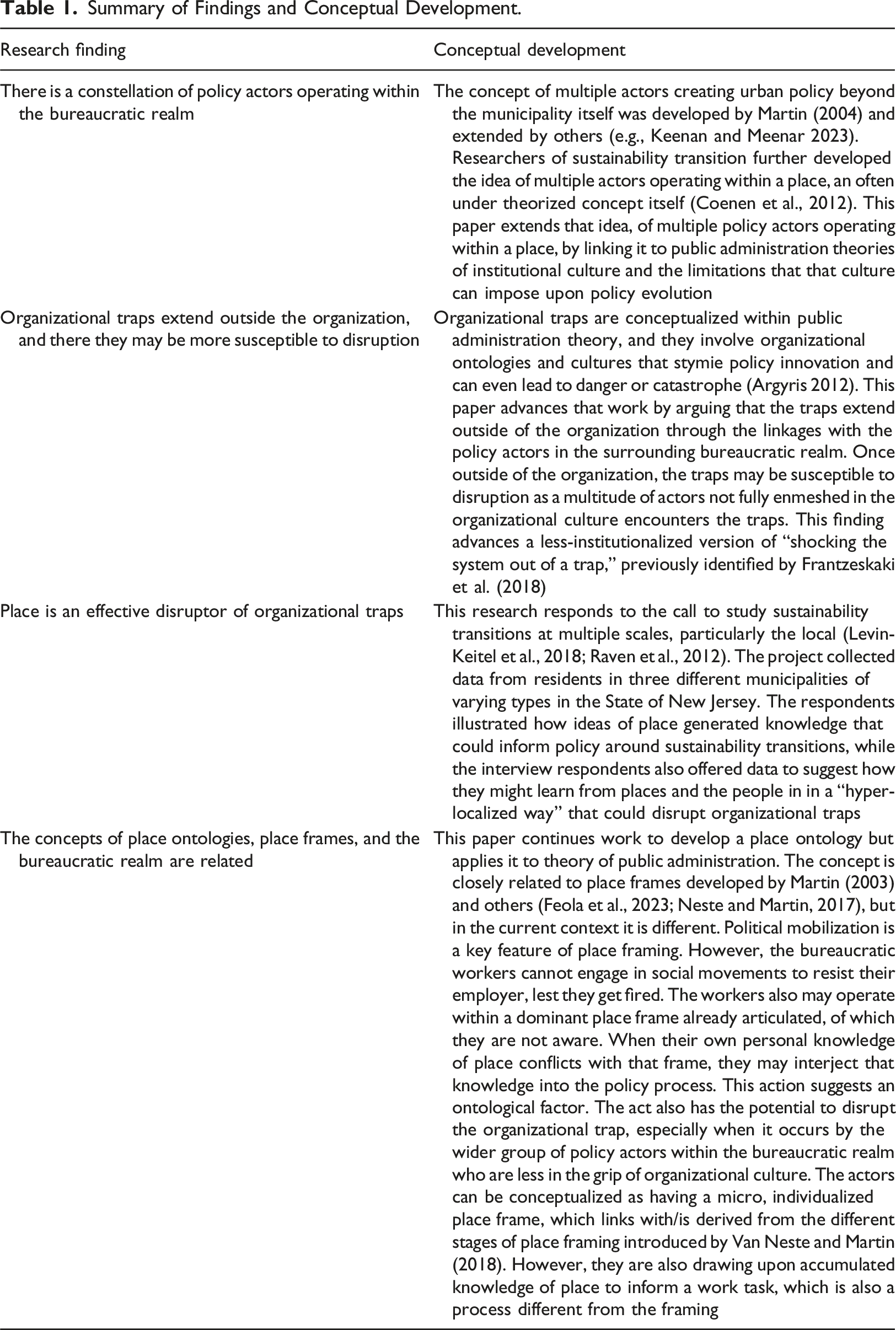
Summary of Findings and Conceptual Development.
Conclusion
In this paper, I have conceptualized a rhizomatic organizational trap, identified and defined it, and explored its shifting web within urban space as well as its relationship to the bureaucracy. Drawing on 17 in-depth interviews with policy actors in New Jersey as well as responses from 103 urban households, I advanced three points: (1) a bureaucratic realm exists outside of the organization, and it is the location in which a diverse group of policy actors exchanges information, engage with policy, and sometimes advocate for change; (2) within this realm, policy actors also engage with the organizational traps that have heretofore been conceptualized as existing within the organization, though the ways that they do so in this external space reveal some differences; and (3) place-based approaches to policy learning are disruptors to the organizational traps.
Institutions and public bureaucracies may be the places where policy is formally made, but there is a much broader collection of diverse policy actors that interpret policy, implement it, and even change it. I defined the space where these actors come together as the “bureaucratic realm.” Understanding what happens in this space advances an understanding of the relationship between policy goals and actual implementation (Hupe and Hill, 2016). The realm is the space where the urban way of life, created by the city’s size, density, and heterogeneity (Wirth, 1938), diversifies policy viewpoints and experiences that inform the interpretive stances of the policy actors. These stances in turn connect with the bureaucracy through interaction at both street-level (Lipsky, 1980; Proudfoot and McCann, 2013) but also through professional, elite communities (Haas, 1992). The openings provide a way for the actors to enrich, challenge through advocacy, and sometimes even change what happens inside of the bureaucracy.
The policy actors in the bureaucratic realm, however, were affected by the same organizational traps that existed within the organization, including of managerialism, though the relatively less structured and less reward-dependent environment allowed for the traps to be contested outside of the organization. While some respondents revelated the limitations of “blinders” (i.e., organizational traps) affecting them and explained why these traps might exist (e.g., the decline of familiar methods of community engagement, such as the “public meeting”), others were able to repurpose the traps to the benefit of their own policy goals. Finally, still other respondents went further and presented place-based ways of analyzing and even implementing policy. These approaches, rooted in specific prescriptions for how to work on analysis and implementation of policy in urban space, countered organizational ontologies that were otherwise limiting.
Policy actors come together both within formal, definable organizations, but also in the operational and community spaces that emanate out from these organizations. This space is the bureaucratic realm. The actors in the bureaucratic realm are not immune to the same public administration challenges that exist within the organization, though the less structured and greater diversity of the realm facilities disruption of organizational ontologies that lead to traps. The most powerful disruptor identified in this project is that of urban place. Additional research is needed to confirm the findings across policy domains other than transportation, in addition to analyzing the findings within diverse types of cities (those studied in this project were relatively small when compared against national urban systems). Finally, other aspects of the bureaucratic realm, such as its existence in more liminal spaces (e.g., in cyber networks), also needs to be examined.
Footnotes
Acknowledgements
The author thanks the anonymous reviewers and editor for their critiques of a prior version of this manuscript. The feedback has undeniably helped improve the paper.
Declaration of conflicting interests
The author(s) declared no potential conflicts of interest with respect to the research, authorship, and/or publication of this article.
Funding
The author(s) disclosed receipt of the following financial support for the research, authorship, and/or publication of this article: New Jersey Board of Public Utilities.
