




Abstract
In the wake of violent events comes a rush to make sense of what happened. Sensemaking matters because it bounds political possibilities, producing knowledge about what caused the violence, who is accountable, and whether society should change to prevent a recurrence. This paper explores sensemaking through an intertextual discourse analysis of elite, print, and social media responses to two violent events in the global city of London in June 2017: the London Bridge terrorist attack and the Grenfell Tower fire. For some, global cities like London are imagined as inclusive and post-imperial: a place of safety and security. Others regard global cities like London as sites of intensive racialisation, inequality, and hierarchy: a political order that produces insecurity. Scholarly debates suggest that public sensemaking could generate alternative political registers to contest the established narratives that sustain violent orders. Yet, our analysis reveals that, in this instance, intertextual sensemaking in a social media age overwhelmingly reflected and reproduced existing socio-political order. Through discourses of denial, the prosperous global city of London emerged as a place where violence might occur but not a violent place. We analyse three discourses of denial: (1) that the events failed to reflect ‘who we are’, (2) that ‘others’ were to blame, and (3) a fatalistic acceptance that some violence ‘is what it is’. Despite academic optimism about public sensemaking, we show denial functions to externalise the causes of violence from socio-political and spatial orders, limiting the scope for change.
Introduction
In 2017, two mass fatality events occurred in London within a fortnight: the London Bridge terror attack and the Grenfell Tower fire. London Bridge took place on 3 June, when three assailants ploughed into pedestrians and then attacked people nearby with knives. Eleven people died (including three attackers shot by armed police) and forty-eight people were injured. Eleven days later, on 14 June, a fire broke out in the 24-storey residential Grenfell Tower and quickly spread along flammable cladding on the block’s exterior. Seventy-two people died. Seventy more were hospitalised. This paper examines the public response to these events, revealing how geographies of violence are made, maintained, and contested.
Both events unsettled common understandings of place: London is characterised as a ‘global city’, a place where violence might occur but not a violent place. Global cities are key nodes of globalisation, financialisation, and deregulation that sustain global order (Ancien, 2011). Violence is understood to emanate from and reside within other places, usually outside the Global North. The events of June 2017 were disruptive because the violence occurred in a place (London) and places where people were supposed to feel safe: crowded spaces that are expected to be protected (Coaffee, 2003) and private homes associated with safety (cf. Brickell, 2012).
Global cities like London are imagined as inclusive and post-imperial, but London is also a site of intensive racialisation, urban inequality, and hierarchy (McLeod, 2018: 465). People are drawn to global cities by economic necessity and exploitative colonial relations (Danewid, 2020). In this way, Grenfell has been characterised as an extreme, visible manifestation of the everyday suffering and inequalities produced in and through global cities (Bulley and Brassett, 2021; Closs Stephens, 2022; Danewid, 2020). Similarly, as an incident of ‘urban terrorism’ in a global city, London Bridge reinforces the idea that we live in a world ordered by ‘cartographies of fear’, whereby certain places are progenitors of violence while others are targets (Springer, 2011: 90). However, the global economic hierarchy upon which London depends also produces the fragility of places from which the threat of terrorism emerges (Gray and Wyly, 2007). As such, cities of both North and South are ‘not only afflicted by many of the same problems, but are bound together in their affliction’ (Beall, 2006: 117).
Despite the tensions and contradictions of the global city, the idea of London as a benign place persists. Collective sensemaking maintains this image (inter alia Weick, 2006; Homolar and Rodríguez-Merino, 2019; Murphy and McDowell, 2023). Sensemaking is an important social process that reestablishes order in the wake of events, such as Grenfell and London Bridge, that are not simply violent but ‘violent to a particular order – a way of organising and comprehending social order’ (J. Johnson et al., 2022: 610). They undermine the tacit agreement by which the state provides security in exchange for acquiescence to its laws. Such violence must be reconciled with the image of London as a place of prosperity and security.
Sensemaking occurred as elites and publics tried to explain the events. We analyse some of these attempts through an intertextual discourse analysis of official, print media, and social media responses published during the first seven days following each event. This period was marked by a ‘rush’ to make sense of what had happened, as powerful discursive tropes were established (Edkins, 2003). Both events are important moments when practices of sensemaking about violence and its geographies can be observed and analysed.
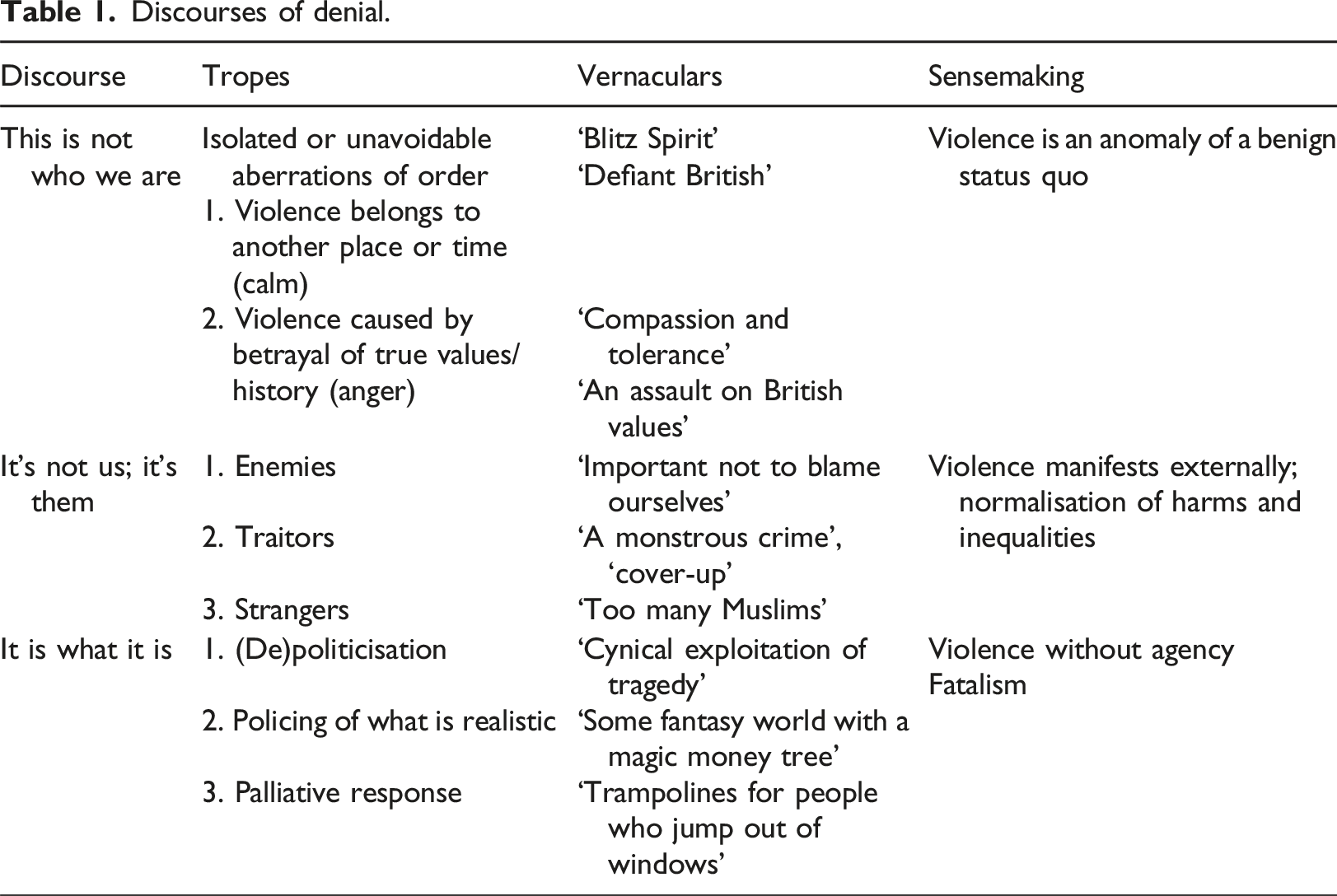
The paper proceeds as follows. First, we situate our paper within debates on sensemaking before outlining our methods and methodology. Thereafter, we set out our analysis, which found similar sensemaking practices becoming ‘common-sensical’ in the aftermath of both events. First, the violence was attributed to another place or another time (This is not who we are). Second, responsibility for the violence was ascribed to ‘others’: enemies, traitors, or strangers (It’s not us; it’s them). Thirdly, the violence was understood as something over which we have little agency (It is what it is). We conceptualise these sensemaking practices as ‘discourses of denial’.
Much of the sensemaking literature suggests that public sensemaking can potentially disrupt the structures that maintain violent geographies. Significantly, however, we show that discourses of denial work to police, discredit, and suppress alternative registers of sensemaking, narrowing the terrain of political possibility.
Sensemaking and violence
News of this latest barbaric act of senseless violence reached me at the end of a day that until then had been both peaceful and beautiful (Brendan Cox, widower of the murdered MP Jo Cox, on London Bridge, cited in Black, 2019: 234, emphasis ours). We got the senseless and avoidable death of people who burned to death in their homes (David Lammy, Member of Parliament, on the Grenfell Tower fire, 2018, emphasis ours).
Claims of ‘senselessness’ reveal how events conflict with ‘the imaginative geographies of where harm is expected to occur… that it wasn’t meant to be happening there and to them’ (J. Johnson et al., 2022: 610). Above, London Bridge and Grenfell are ‘senseless’ because they contradict expectations of where, when and to whom violence occurs. ‘Senseless’ violence is always already being made sense of in relation to ‘rules, prescription, etiquette, and protocol’ (Blok, 2000: 24). These conventions explain how violence can be simultaneously anticipated and unexpected (Tyner, 2012). Some violence is anticipated as an unavoidable part of socio-political order: an irrepressible feature of conflict-ridden places, a staple in popular culture, a misfortune to be insured against. Conversely, some violence is disorderly when experienced as exceptional, unfamiliar, and disruptive to ‘normal’ life.
Sensemaking reestablishes control: ‘Order, interruption, recovery. That is sensemaking in a nutshell’ (Weick, 2006:1731). It is a social process through which people interpret ostensibly senseless events through a ‘familiar code’ of discursive narratives and affective responses (Homolar and Rodríguez-Merino, 2019: 564). Sensemaking thus helps to ‘structure the unknown’ so it can be acted upon (Ancona in Murphy and McDowell, 2023: 2835). Making sense of disorder reveals that we are ‘already part of communities of sense’ (Closs Stephens, 2022: 137) that dictate the boundaries of inclusivity and care, producing ways of thinking and feeling about where and to whom violence is expected to happen (J. Johnson et al., 2022).
Sensemaking is intertextual: it occurs through the interaction of elites and publics, traditional and digital media (Merrill et al., 2020). Publics have been shown to respond to disorderly events with novel affective registers that could produce alternative ethical and political responses (C. Barnett, 2015; Vaughan Williams and Stevens, 2016; Cloke and Conradson, 2018; Downing, 2021; Fregonese and Laketa, 2022). Less optimistically, others suggest public vernaculars can reinforce discrimination, indifference or belligerence (Hutchison, 2010; da Silva and Crilley, 2017; Ali and Whitham, 2018; Anderson, 2021). Nonetheless, this literature conveys hope that sensemaking contains possibilities for solidarity and change, even when it includes ‘ugly and exclusionary dimensions’ (Closs Stephens et al., 2021:37). Sensemaking around London Bridge and Grenfell presented an opportunity to explore this potential to complicate, challenge or reaffirm established ideas about violence and order.
Discourses of denial.
Methodology
We collected elite statements published in the first seven days after each event, issued by the offices of the then-Prime Minister, Theresa May; the Leader of the Opposition, Jeremy Corbyn; the Mayor of London, Sadiq Khan; local government; and the emergency services. 1 We then collected op-ed news articles published in the British press during the same time frame, using LexisNexis to search for the keyword terms ‘London Bridge’ and ‘Grenfell’. 2 Such elites are expected to articulate sensemaking around violent events. They facilitate public discourse despite not defining it entirely (Van Dijk, 1993). To examine public engagement with elite claims, we used the social media analytics platform CrowdTangle to determine where each statement or op-ed was shared on Facebook and Twitter, and collected comments made by social media users. Our data set comprises 32 elite statements, 166 op-eds, and 8204 social media comments. Using NVivo, we analysed the discursive sensemaking around each event. We paid attention to presupposition (background knowledge deemed to be true), predication (labels and attributes given to certain subjects), and subject positioning (linking subjects vis-a-vis identities, opposition, and similarity) (Doty 1993: 306; Åhäll and Borg 2013). We engaged in ‘investigator triangulation’ to collectively question, challenge, and validate our shared findings (Denzin 1970). Our quotes are heuristic, illustrating key themes from our data. 3
We restricted our analysis to social media posts that directly engaged with elite statements and op-ed articles. This has both limitations and advantages. We acknowledge that social media posts that did not engage with the elite or op-ed sources were not included, which risks excluding posts that produced or promoted alternatives to the ‘discourses of denial’. Conversely, our approach facilitated a detailed analysis of intertextual sensemaking in the digital age. Political and media elites play crucial roles in producing denial but cannot do so without continuous interplay with public discourse. Elites formulate ‘subtler’ denials than the more ‘blatant’ ones of popular discourse. Still, they can be mutually reinforcing. Things that are difficult for elite actors to say are said more freely by publics and vice versa (Van Dijk, 1993). Security politics is shaped through a ‘milieu’ of everyday forms of public reason and feeling (C. Barnett, 2015). Our methodology captures this interplay, demonstrating how denial is articulated, contested, and defended across social strata.
Discourses of denial (1): This is not who we are
In global cities like London, societies often regard premature deaths as deviations from expected political order (Hom, 2018). Deaths are expected to be orderly, peaceful, and in old age. Violence in the city affronts these expectations as ‘not who we are’.
Both events were understood as emanating from another place or another time. London Bridge was seen as part of a history of external aggression against an imagined ‘British way of life’. Grenfell was broadly understood as an unsettling ‘tragedy’ at odds with life in ‘modern’ Britain, contrasted against ‘less advanced’ places and pasts. Both were understood as entirely disconnected from ‘our (contemporary) way of life’ despite the global connections that made both possible and produced their victims, survivors, and perpetrators (Bulley and Brassett, 2021). London Bridge and Grenfell signalled that the country had forgotten ‘who we really are’ and that politicians had neglected the values that underpinned past glories. Such claims about progress and decline are inseparable from narrow colonial discourses of what Britain and Britishness mean and who belongs (Closs Stephens, 2022). Both events became ‘not who we are’ and, therefore, not something requiring change from ‘us’.
Blitz spirit and faraway disasters
London Bridge was situated within familiar stories of a plucky, beleaguered island (A. Barnett, 2012). Echoing Kelsey (2015), we found extensive use of slogans invoking defiance and resilience that represented Britain and Britons as united against evil, external aggressors. Media commentators and social media users likened the attack to V1 missiles, IRA bombings, and the 7/7 attacks. The ‘Blitz spirit’ frequently featured alongside a claimed exceptional British capacity for ‘keeping calm and carrying on’. Invocations of the Second World War – a potent cultural touchstone – signified continued longing for empire: an era when racialised subjects were seen as alien to a predominantly white citizenry (Gilroy, 2004), when same-sex relationships were criminalised, and when violence against women occurred with impunity. If the Blitz was ‘who we are’ and London Bridge is not, the ‘we’ being conjured is one of whiteness, heteronormativity, and patriarchy.
British identity was cemented through praise for ‘defiant British humour’ in print media, highlighting its intertextuality (Belam, 2017). The day after the attacks, a New York Times tweet suggested Britain was left ‘reeling’. Under #ThingsThatLeaveBritainReeling and #NotReeling, Twitter users shared memes and jokes arguing that it takes more to make Britain reel, such as making a cup of tea in a microwave. A photo of a man running away from the attack while carrying his pint of beer – ‘the man who won’t let a terrorist attack get between him and his pint’ (Low, 2017) – was celebrated. One social media user played on a line from the film Braveheart: ‘You may try to break our spirit, but we will never spill our drinks!’. Such humour consolidates the idea of the British underdog, ever defiant against, rather than an architect of, global (dis)order.
Grenfell was compared to past ‘disasters’, distanced from Britain by time or place: 9/11, Hurricane Katrina, the sinking of the Titanic, and twentieth-century mass fatality events such as Aberfan (1966) and Hillsborough (1989) (Hill, 2017; Hitchens, 2017). Columnists wrote that it ‘felt as if we had gone back’ to the 1970s or 80s when such violence was familiar (Hinsliff, 2017; Aaronovitch, 2017). Elites and publics reinforced each other by invoking sadness and ‘tragedy’: a register implying unforeseeable harm, defying agency or comprehension (J. Johnson et al., 2022). Characterising Grenfell as anathema to modern life belies the role of privatisation, deregulation, and austerity – posited as essential to prosperity and progress – in facilitating Grenfell (MacLeod, 2018).
Humour, so central to sensemaking around London Bridge, was taboo in relation to Grenfell. One reporter provoked outrage for jesting to a boy who had lived there: ‘So, no school for you today, then? Well, it has a plus side, I guess’ (Ronson et al., 2017). Whilst some commentators voiced a creeping anxiety that the fire was a ‘preventable accident’ (R. Johnson, 2017) or a ‘monstrous crime’ (Lammy, 2017), many elites appealed for calm and unity. This call for dignified patience is a familiar mode of sensemaking, deferring judgement until the conclusion of a lengthy official inquiry (Thomas et al., 2024).
While London Bridge and Grenfell elicited different affective responses, the denial remained the same: a story, as then-Home Secretary Amber Rudd (2017) wrote, of British ‘grit, compassion and tolerance’. Sensemaking manufactured the idea that the deaths should not lead to introspection; that normal life was ruptured by – rather than a cause of – violent death.
The national story betrayed
Competing with this account of British unity was one of division, a nostalgia for the past, and a complaint that society has lost its way since the end of the Second World War. This was anger rather than calm, which nonetheless amounted to a denial that ‘proper’ British values could be implicated in the violence.
Commentators argued that some reactions to London Bridge betrayed the national story. Calls to ‘keep calm and carry on’ involving the Blitz spirit – decried by one journalist as ‘candles and cowardice’ – were ‘absurd’: ‘[I]n 1940 there was a genuine sense of unity’ and ‘Churchill’s government starkly spelt out the nature of the threat we faced from Germany and took heroic action against it’ where in 2017 there was ‘little such defiance from the British state against militant Islam’ (McKinstry, 2017). This discourse rejects London Bridge as akin to the Blitz but remains fiercely nostalgic for it: London Bridge was not like the Blitz, but our response to it should be. One social media user urged, ‘Someone, dig up Churchill!’ Another commentator lamented the demise of an ‘Anglo-Saxon society in existence for over 1000 years’ being ‘obliterated’ by political elites that had ‘opened the floodgates to mass immigration’ and ‘mediaeval and barbaric’ cultures (Littlejohn, 2017a). Critics opined that a tolerant and Christian Britain had become a ‘soft target for terrorism’ and ‘too nice’ (T. Stanley, 2017). These colliding visions of Britain’s triumphant past and gloomy present combined in one social media remark: ‘What happened in WWII? Were the Nazis defeated or given lessons in multicultural democracy?’ Here, who ‘we’ are has been diminished by excessive tolerance and multiculturalism; London is too global. This echoes a ‘failures of multiculturalism’ discourse that problematises ‘newcomers’ (Van Dijk, 1993).
Responses to Grenfell reflected similar ideas about Britain losing its way. Many blamed the Conservative-led austerity policies of the 2010s: the ‘fatal consequences of Tory dogma’ that ‘profit should take precedence over people’ (Beattie, 2017). But Grenfell both betrayed and revealed nostalgia for British ‘decency’. When the Queen, one of the world’s wealthiest women, visited one of London’s most socio-economically inequitable places, she was met with near-universal admiration: ‘a beacon of strength in dark, dark times’ (A. Philips, 2017). Though both Grenfell and London Bridge were described as ‘an assault on the British values of democracy and decency’, the monarch’s visit offered ‘tradition’ and ‘brought comfort and a sense of security’. Such remarks reveal an ahistorical nostalgia for a simpler time, characterised by a clear and rigid class system alongside an amnesia for the exploitation and class inequality it produced (Clancy, 2021). The Queen’s visit to Grenfell affirmed the belief that whilst the fire was a stain on the surface of national decency, Britain remained decent underneath.
Discourses of denial (2): It’s not us, it’s them
Attributing disorder to ‘others’ is seductive: violence becomes the work of intangible forces (Bauman, 2016). The spatiotemporal denial we have just discussed is co-constitutive of othering: imaginaries of a plucky nation and/or nostalgia for a sepia past require out-groups that attack or betray ‘us’. Three sub-categories of othering – enemies, traitors, and strangers – are blamed for London Bridge and Grenfell. Each diverts responsibility beyond the community, denying that violence could emanate from within (Tyler, 2020).
Enemies (within)
Enemies are ‘other’ because they do not share ‘our’ values and disrupt ‘our’ socio-political order. Identifying enemies was prevalent in both elite and public responses to London Bridge. The attackers were ‘evil’, ‘sick’, and ‘cowardly’. The violence was almost universally attributed to, in the Prime Minister’s words, the ‘evil ideology of Islamist extremism’ (May, 2017). Islam was labelled ‘primitive’ (McKinstry, 2017), ‘aggressive’ (M. Phillips, 2017), and ‘a violent, militant cult’. London Bridge was an attack on Londoners’ way of life: victims were consistently described as ‘innocent Londoners and visitors to our city who were just enjoying their Saturday night’ (Khan, 2017; see also Corbyn, 2017; Daily Mail, 2017; May, 2017). Framed as an attack on innocent fun, commentators asserted that we should not change ‘how we work and play’ as this ‘would be a victory for terror’ (Muir, 2017); that ‘If we are going to win the “war” ...it is important not to blame ourselves or try to “understand” why they hate us’ (The Telegraph, 2017). Responding to media op-eds such as ‘Never mind singing John Lennon songs...we need less Islam’ (Murray, 2017), some social media users went further still, describing Islam as a ‘disease’, ‘sickness’, and ‘cancer’ that has ‘infested’ Britain. Another suggested, ‘If there were no Muslims in our country, there would be no terrorists’. This echoes deep-seated anxieties about a Muslim ‘contagion’ and the ‘infiltration of Britain by Muslims...without the knowledge or consent of the population’ (Ali and Whitham, 2018: 401). The problem is others: those who do not share ‘our’ commitments to peaceful order.
Enemies of the peace also feature in responses to Grenfell. The local authority, central government, and Fire Brigade were all considered as ‘enemies’ of survivors and the bereaved. Councillors and local officials were depicted as ‘people so distant from the residents that they might as well have run it [the local Council] from the moon’ (Bush, 2017). Some claimed that the ‘state didn’t care, does not care and will not care. The poor were sentenced to death by burning’. Others drew attention to vast inequalities between the government and communities living in towers like Grenfell: ‘spending £4bn on Parliament’ to tackle flood and fire risks was identified as a concern that wasn’t ‘shared for the people in tower blocks’. Elites made concerted efforts to be seen as with and of the community but sometimes found themselves othered nonetheless. The Prime Minister, Theresa May, visited Grenfell without meeting any survivors and was criticised as lacking empathy: ‘The Maybot hasn’t been programmed with peopleware’. Similar comments decried divisions between the community and ‘them’: a government by and for a wealthy elite who ‘don’t care about the poor, the brown and disabled or normal people, just their rich friends’. Remarkably, across media and social media, the Queen always remained part of the community: ‘Love the Queen, hate this good-for-nothing government’.
The enemies identified around both events draw on well-established caricatures of an ‘other’ so different that they are incomprehensible (Fanon, 1986; Minh-ha, 1989). Their otherness is grounded in their inability to be like, care about, or understand ‘us’. This consolidates the self and prevents introspection about the existing (supposedly benign) socio-political order. Blaming violence on enemies is a powerful form of denial. It legitimates apparently non-political interpretations wherein existing order is above scrutiny. Enemies are bad, ‘our’ community is good.
Traitors
Unlike enemies, traitors are members of the community they betray: ‘an enemy in the guise of a friend’ (Horn, 2004: 135). Treason reinscribes the community’s boundaries of loyalty, patriotism, and fidelity. While anyone could be a traitor, the labelling of traitors is most convincing against people and behaviours at society’s margins. Treason is a powerful discourse of denial because it individualises transgressions so that the community does not need to change. The individual who has transgressed the community’s values is the problem; the community’s values remain unsullied (J. Johnson, 2017).
After London Bridge, discourses of treason appeared in two ways. Firstly, the quality of traitors as both belonging-to and being-against the community was expressed through fears about ‘home-grown’ terrorists: ‘We don’t know who the bad guys are, but they are among us’. Treason was a prominent, intertextual feature of right-wing journalism and social media commentary, with some suggesting that the UK should ‘bring back the crime of treason for any British citizen taking part in terrorism at home or fighting abroad’ (Littlejohn, 2017a). For one social media user, punishment should be meted out by ‘a quasi-military squad of ex-military personnel’ who would ‘take out’ the ‘worst of the worst so that the remaining traitors will either get the message and behave or get a bullet in the head’. Here, betrayal is used to rearticulate the terms of legitimate violence (Dumouchel, 2015). Violence that would otherwise be unacceptable becomes legitimate when directed at traitors. This discourse positions swathes of people – the assumed ‘remaining traitors’ who have yet to ‘get the message’ – as killable. This cognitive dissonance does not undermine the community’s assumed tolerant and peaceful character. It is merely about dealing with an aberration through aberrant means. This idea is illustrated well in an op-ed from The Sun (Liddle, 2017): We are in a war... We have given too much respect to the human rights of these savages. And too little respect to the safety of our own people...I think we need a bit more ‘F*** you, I’m Millwall’.
4
And a bit less of the old candlelit vigils, the singing of John Lennon’s Imagine. And the local politicians saying, pointlessly: ‘We all stand together’ and ‘Islam isn’t to blame’. Oh yes it is.
Secondly, treason was directed toward the political class for refusing to support violent anti-Muslim rhetoric. Reflecting anti-Islamic political movements elsewhere, political elites were labelled as betraying ordinary people’s opposition to immigration and multiculturalism (Berntzen and Sandberg, 2014). One social media user blamed those invested in ‘multiculturalism and its blind refusal to point out good religions and bad religions’, dubbing them ‘accomplices to Islam and traitors to Western nations’. Others argued that anyone ‘who welcomes Radical Islamists is a traitor to their country and has blood on their hands’. The precise diagnosis of this betrayal varied. For those on the right, multiculturalism and liberalism constituted a betrayal of the polity’s ‘true’ values. For those on the left, the Conservative Government were traitors who ‘helped’ the attack by underfunding the police. For others, successive governments had created ‘the conditions for this chaos’, concluding that all ‘politicians are traitors’. Crucially, in all cases, the transgressor is the problem requiring intervention.
In Grenfell commentary, the council, wealthy property owners, and political elites were marked as traitors for criminal transgressions against the community. Opposition Member of Parliament (MP) David Lammy (2017) wrote, ‘Don’t let them tell you it’s a tragedy...it’s a monstrous crime. Corporate manslaughter. They were warned by the residents that there was an obvious risk of catastrophe. They looked the other way’. Tragedy implies the fire was unforeseeable, whereas Lammy claimed that the (in)actions of successive governments had ‘condemned the vulnerable’ to unsafe living conditions. Emma Dent-Coad, the local MP for Kensington, described Grenfell residents as ‘failed and betrayed by the local council’ (Gentleman, 2017). One op-ed accused the state of failing to uphold the social contract: Parents should have the right to put their children to bed, secure in the knowledge that everyone will wake up in the morning... [this is a] colossal betrayal of vulnerable people’s trust by the state (Hinsliff, 2017).
On these terms, the appropriate response to the fire is juridical: ‘Things change only when powerful people are put in the dock’ (Lammy, 2017). Others called for a judge-led inquiry capable of summoning witnesses, getting to ‘the truth’ and offering ‘no hiding place for wrongdoing’. The problem is framed as individual transgressions: powerful people that the community trusted, who knew or should have known that residents were vulnerable. The community is bound by the promise that justice can be delivered through the revelation of a secret, a ‘cover-up’ or conspiracy: a ‘smoking memo’ that will expose the guilty parties (Dean, 1998). Yet much violence arises from structural, political, and even lawful processes that defy individual malpractice (Michalowski, 2010). Nonetheless, social media was replete with references to politicians ‘hiding the facts’ or ‘covering their tracks’. The social media comment below conveys each aspect of the betrayal – named actors, hiding the truth of their transgressions, who must be singled out for punishment: The Tories and the BBC are committing treason by hiding the truth of this terrible crime … The landlords need to be brought to justice for manslaughter, and the chief of the fire and police departments need to be investigated for ordering the victims to stay inside a burning building for hours. Heads MUST roll.
Treason facilitates denial by focusing on individuals and their transgressions, diverting scrutiny away from social order.
Strangers
Strangeness facilitates denial through victim-blaming (‘they deserved it’) and moral indifference (‘it’s not our problem’). Through dehumanisation and stigmatisation, strangers are othered. Unlike traitors who are othered for their individual actions, wants, or desires, a stranger’s personhood is unimportant. They are members of suspect groups: peoples who unsettle communities through perceived ‘spiritually remote’ customs, habits and intentions that cannot be easily read (Bauman, 1991: 60).
This attitude was apparent in racialised commentary on London Bridge, which homogenised Britain’s Muslim communities as suspect. Print and social media commentary frequently claimed that multiculturalism had led to ‘too many Muslim families’ being able to ‘insulate themselves from wider British society’, providing ‘a climate in which extremism can thrive’ (Daily Mail, June 6, 2017). This generates demands that British Muslims should make themselves less ‘strange’ or face violent consequences: ‘I’d like to see a mass public march by Muslims up and down the country denouncing Islamic terrorists as murderers and traitors of their faith’, wrote one social media user. Failure to do this results in more aggression: ‘Of the ones who were born in the UK, tag them, curfew them, deprive them of…the internet. If they don’t like it, deport them to the Muslim hellhole of their choice’, argued one op-ed writer (Liddle, 2017). As Phelan (2001: 5) argues, a stranger’s ‘distance from cultural membership makes her continually prey to renewed exclusion, scapegoating, and violence’. Strangers are required to disprove the strangeness projected onto them: to seek belonging, never guaranteed, through performances of allegiance.
The victims of Grenfell were often regarded as strangers: residents of London in the community, not wholly of the community. Strangeness engendered distinctions between deserving and undeserving victims. Many victims came from minority ethnic backgrounds, with 19 different nationalities represented among the dead (Rice-Oxley, 2018). Social media users claimed that there simply were ‘No victims’ as the building was ‘full of illegals’. Another remarked: ‘No single person is really English, wow’. Other social media users described the fire as a ‘Bomb factory accident’, misidentifying victims of Grenfell as terrorists. Some commentators contested such remarks: one wrote, ‘[w]hat appears to be beyond the imagination of some is not the deaths of these poor people but their lives. The “othering” of the black, the Muslim, the poor and those of uncertain immigration status has been a consistent project. It is ongoing...We are told that Grenfell is not political...Such denial is shocking’ (Moore, 2017). Such dehumanisation facilitates indifference: it is easier to deny that Grenfell is ‘our’ concern if those who died were strangers.
Some commentary went further to blame victims for their own suffering. The discourse of excessive immigration was employed to cast victims as naïve and greedy. One social media user stated: ‘the State cannot cope with all the demands made on it and in many cases from people who have just arrived in the land looking for milk and honey’. Another wrote that the fire would not have happened if not for ‘London trying to house its increasing population...with still more arriving every day’. Others suggested that victims were responsible for their own deaths because, as strangers, they behaved strangely. One remarked, ‘People should have covered their mouths and noses and got torches and gone down the stairway to get out. It’s common sense to get out!’ Such language relocates the deaths at Grenfell to the outside. It is a denial of who deserves to reside within the community. Being non-white, an immigrant, or from a family of immigrants means being denied membership of the ‘deserving poor’ and empathy (Shilliam, 2018).
Violent events can threaten the legitimacy of a political order. Othering disarms that threat by attributing responsibility to enemies, traitors, and strangers. Accusations of external infection, internal betrayal and racialised strangeness work together to deny the possibility that violence could emerge from existing socio-political arrangements.
Discourses of denial (3): It is what it is
The final discourse of denial refutes alternatives. It took three forms. First, discourses of (de)politicisation rejected responses perceived to have ‘political agendas’. Second, responses were policed on the grounds of what is realistic. Tropes such as ‘there is no alternative’ are mobilised to suppress radical politics, while deeply rooted material and discursive structures of global politics and the suffering they inflict – indebtedness and austerity, or military interventionism and post-9/11 counter-terrorism – are defended as unavoidable necessities. Third, this policing of politics and reality generated a palliative focus on the symptoms of violence, not the fundamental causes. Reactive or simplistic policy responses are all that remain once alternatives are denied. The denial that ‘we’ can do anything differently is a form of de-agentification: that is, forcefully asserting that no other option exists due to irresistible forces or unavoidable conditions (Leader Maynard, 2014). This generates a culture of fatalism.
It’s a tragedy
Commentators used the language of tragedy and politicisation to police responses. Commenting on London Bridge, many criticised politicians calling for new anti-terrorism laws as politicising the attacks. Several ‘Letters to the Editor’ published by the left-leaning Guardian claimed that ‘Theresa May’s commitment not to politicise the tragic events in London on Saturday didn’t even last as long as her first speech’ (The Guardian, 2017) and that the speech was ‘(unnecessarily) polarising when it’s important for all decent people to stay united against these horrible acts’. Social media users followed suit: ‘Don’t make political capital out of this tragedy! It’s offensive and degrading to victims’; ‘their deaths should not be used by anyone for their political agenda’, claimed another.
Similar language appears in responses to Grenfell, with a reversed politics. Here, various right-learning newspapers criticised Labour politicians for a ‘cynical exploitation of human tragedy’ (Littlejohn, 2017b), of ‘trampling over dead bodies’ (Little, 2017), and ‘rush[ing] on to the airwaves to blame austerity and deregulation for the disaster – before an inquiry had even been called’ (Samuel, 2017). Commentators distinguished between appropriate affective responses. Calmness is associated with fairness and neutrality, while anger is linked to rushed, flawed judgement, or politicisation. The commentary carried a paternalistic tone of expressing sympathy toward an ‘understandably’ angry community struck by ‘tragedy’ and emphasised that the community was vulnerable to exploitation or ‘stirring’ by ‘political’ activists armed with irrational, ideological explanations. Such criticism was interwoven with an assumption that the fire was reducible to unforeseeable but regrettable ‘individual incompetence, rather than some conspiracy theory’. This is a vernacular expression of a methodological bias toward positivist, individualist analyses of the social, and a corresponding rejection of structural or social accounts of harm (Winter, 2012).
Getting real
Alternatives were also refuted as unrealistic. After London Bridge, some social media users called for radical change in British foreign policy. They argued that Britain had been engaged in a ‘perpetual war’ of ‘disastrous interventions’ in the Middle East, that counter-terrorist strategy had failed, leaving Muslims feeling criminalised as ‘the enemy within’, and that Britain was supporting terror through arms sales to regimes such as Saudi Arabia. Yet numerous commentators responded that such policies were a tragic necessity, portraying the Middle East and Islam as inherently warlike and barbaric. One user wrote that halting arms sales or ‘any destabilisation of the Saudi regime really will make the situation a thousand times worse. It’s a case of better the devil you know perhaps’.
Similarly, some commentators placed Grenfell within a system of ‘social murder’. One op-ed writer claimed that ‘Britain remains a country that murders its poor’ (Chakrabortty, 2017). Another claimed preventable deaths were the result of ‘Dickensian’ living conditions and local authorities ‘starved of resources’ (Lammy, 2017). One social media user remarked that Grenfell was related to a ‘pattern of liberal capitalism’ whereby ‘our entire society has become accustomed to punishing and despising the vulnerable’. Other social media users rejected these claims as ‘ideological’ or ‘stoking tensions’. Mentions of austerity, state deregulation and underinvestment in safe housing were rebuffed through everyday understandings of feasibility (see also L. Stanley, 2014). These included household metaphors (‘money in = money available. Too many people not working/getting benefits = reduced revenues for local authority’), the dismissal of public investment (‘some fantasy world with a magic money tree at the bottom of every garden’), and a reappearance of anti-immigration rhetoric (‘Gotta stuff the Muslims somewhere since they flow into other countries like a broken dam. Only way to go is vertical. Or maybe you’d prefer farmlands or forests be razed just for their housing?’).
Walking sticks and trampolines
Finally, assumptions that the root causes were unavoidable led to bleak and farcical responses. For London Bridge, social media users suggested militarised or technological responses: ‘arm the police’, ‘biometric data such as fingerprints and eye retina scans’, ‘internment’, and giving security services ‘access to all internet and phone traffic’. The logic of these responses assumes that the violence was caused by barbaric outsiders, concealed traitors or untrustworthy strangers. ‘Is it time we prepared, Israeli style’, one user suggested, ‘with terrorist proof safe rooms in every public facility’. In a peculiar wistfulness for times past, The Times published this reader’s letter: During the 17th and 18th centuries, walking sticks replaced swords as accoutrements of the English gentleman. These sticks were … essentially a civilised mace. Perhaps it's time for Englishmen to once again carry a walking stick…The only person you can truly rely on … is yourself (The Times, June 6, 201).
Similarly bizarre solutions were offered after Grenfell. Assuming the fire was a tragedy (‘The government didn’t start the fire, a fridge did’), social media users suggested that ‘all tenants should be given parachutes’, ‘maybe base-jumping training’ or ‘trampolines to save the people who jump out of the window’. Such claims deny optimism for a future where such ‘tragedies’ could be eliminated, relying on physical measures in the absence of a reflection on the wider causes of harm (Chambers and Andrews, 2019). Limiting the pursuit of security to such ostensibly apolitical, realistic or practical measures works to normalise those violent geographies that make some people more insecure than others.
Conclusion: A global politics of denial?
Imaginative geographies, such as the global city, shape our understanding of where and when violence is expected to occur (Springer, 2011). For many, global cities are inclusive, prosperous and secure places. Violence is uncommon, occurring instead in foreign places or distant times past. When violence erupted at London Bridge and Grenfell, it was, therefore, disorderly. We analysed elite and public responses to these events in order to understand how geographies of violence are made, maintained, and contested. We have shown how the ordering of the world into violent and non-violent places is reasserted through sensemaking. We describe this sensemaking as denial, which allows these events to be understood as aberrations, rather than consequences, of global power relations. Denial makes it unnecessary to reflect on why violence is unevenly distributed globally or how global order might produce cartographies of fear.
This dissociation depends upon three interwoven discourses of denial that insulate the status quo from scrutiny. First, the events became intelligible as emanating from another time and/or place: as episodes of a plucky island under attack from foreign aggressors or as a national tragedy anathema to a modern, inclusive society. Second, through discourses of othering, imaginaries of a benevolent socio-political order were sustained by blaming enemies, traitors and strangers. Third, responses that would challenge the existing socio-political order were rejected. The notion that ‘there is no alternative’ generates a culture of fatalism. Preventing future violence became a matter of bizarre physical, technocratic, and bureaucratic fixes. While some sensemaking around London Bridge and Grenfell alluded to a direct relationship between violence and order, denial allowed such ideas to be ‘repressed, disavowed, pushed aside or reinterpreted’ so that the implications could be ‘evaded, neutralized or rationalized away’ (Cohen, 2001: 1).
Our findings are significant for the political potential of public sensemaking. As noted above, scholarly debates suggest that publics could generate alternative political registers to disrupt violent orders. Instead, our analysis of intertextual sensemaking in the digital age reveals how publics can repair socio-political orders, reinforcing their boundaries, especially in racialised and xenophobic terms (see also da Silva and Crilley, 2017; Ali and Whitham, 2018). Where elites speak of ‘evil’ and ‘cowardly’ attackers, social media users go further, calling for death sentences and hit squads to purge them. Both co-produce an external antagonist who must be excised; both deny that existing socio-political arrangements are implicated in violence. Discourses of denial are not totalising. Some social media users derided elite or media statements as ‘straw man drivel’ or ‘hysterical fear-mongering’. Denial is also brittle, leading to dissatisfying or farcical responses. Nonetheless, we show how alternative accounts of violence and death are fiercely policed and discredited through denial.
One could respond that our claims are a limited snapshot of the most vocal users of increasingly toxic social media platforms rather than reflections of broader society. Critical voices may exist elsewhere, and we encourage research to identify other voices in contemporary digital society and any emancipatory potential they may possess. This could include taking ‘the fears of those who are feared’ seriously by attending to those who are castigated and victimised (Pain and Smith, 2008: 2). Social media discourse is, nonetheless, highly influential: a powerful force in instigating and justifying political violence (Marcks and Pawelz, 2020; Wahlström et al., 2021). It is also valued by elites, disproportionately amplified by journalists and commentators (McGregor, 2019), and used by many politicians and officials to infer ‘public opinion’ (Jungherr et al., 2020). Thus, even if our findings are only a partial snapshot of public sensemaking, they are significant.
It is striking that similar denialism exists in academic discourse. Many scholars link events such as Grenfell and London Bridge to systemic causes (e.g. Cooper and Whyte, 2018; Stampinsky, 2013). Yet such diagnoses are often rejected as lacking in rigour or as overly political (e.g. Winter, 2012; Wright, 2024). This permits narrow, situational solutions (Krasmann and Hentschel, 2019), reinforcing racialised and gendered biases, ignoring structural causes, and justifying militarist policies.
Denial continues to haunt sensemaking around both events. A 2019 inquest into London Bridge recommended steps such as barriers to prevent vehicular attacks or improving first-aid training (Lucraft, 2019), reflecting a tendency to emphasise ‘security failures’, foreclosing ‘the ability to consider structural causes of violence’ (Pettinger, 2023: 1293). This pattern of foreclosure is repeated, albeit differently, around Grenfell. In 2024, a public inquiry reported that safety concerns were dismissed or concealed for decades, that government deregulation worsened oversight, and that the London Fire Brigade was ill-prepared (Moore-Bick et al., 2024: 7-30). The survivor-led Grenfell United group responded that ‘[w]e were failed in most cases by incompetence and in many cases by calculated dishonesty and greed’ (Grenfell United, 2024). This aligns with some public sensemaking highlighted by our findings. But the group also noted that: ‘[t]here’s a reading of the inquiry hiding in plain sight that …[t]he system isn’t broken, it was built this way’. Though the report can be read as a story of systemic insecurity, this remains in tension with prominent discourses of denial disposed to blame localised actors.
When defined by denial, sensemaking results in knowledge but not acknowledgement (Nagel, 1998). The idea that violence in global cities is an aberration furthers the myth that violence belongs to some people and places but not others. Exacerbated by the forces of populism and post-truth, denial undermines the epistemological structures of social justice; it forecloses the pursuit of structural change. In an era of violent polycrises, from catastrophic climate change to virulent racial capitalism, acknowledging society’s complicity in harm is both urgent and vital.
Footnotes
Acknowledgements
Earlier versions of this manuscript were presented at the 2019 EISA Pan-European Conference in Sofia. The authors are grateful for the insightful comments and reflections provided by the participants. The authors also thank Jamie Johnson and Margot Tudor, for their invaluable feedback on earlier drafts, and the anonymous reviewers and editorial team at EPC, for their thoughtful comments and suggestions that have significantly improved this article. Finally the authors are grateful to the student research assistants at the University of Exeter--Ethan Lierans, James Marsh, Lily McAuley, Fatuma Mohamud, and Alex Rockey--whose contributions were essential in constructing the dataset for this research, supported by the Access to Internships and Student Campus Partnership schemes.
Declaration of conflicting interests
The author(s) declared no potential conflicts of interest with respect to the research, authorship, and/or publication of this article.
Funding
The author(s) disclosed receipt of the following financial support for the research, authorship, and/or publication of this article: This work was supported by British Academy (SRG18R1\181282).
