




Abstract
Once the last unclaimed solid expanse on Earth, the ocean floor has become one of the most contested spaces in contemporary geopolitics. The data-imagery produced by technoscience serves as the ultimate tool for nations asserting sovereignty in this territorial race. This symposium gathers diverse perspectives on the ongoing expansionist drive on the seabed, drawing inspiration from Abissal——a film-article featuring the Portuguese modern odyssey on the ocean floor that serves as the symposium’s centerpiece. Aligned with modern ocean law, technoscience strives to render ocean depth visible to politics and territorializable for coastal states. However, the submerged prolongations and divisions it proffers are inherently political, as the images and knowledge it reveals are inseparable from the territorial regimes that commission them. Acting like an upward-facing mirror, the seabed divided by technoscience reflects humanity’s expansionist thirst back to the surface. Yet the conquered depths do more than merely reflect this impulse; they also diffract the abyssal politics above. This symposium introduces a critical and creative conversation on the territorialization of the deep-sea and its far-reaching reverberations——both within and beyond ocean space.
Abissal
A film-article by Pedro Figueiredo Neto and João Afonso Baptista
DOI: 10.1177/23996544241302929a
Instituto de Ciências Sociais, Universidade de Lisboa
Abissal weaves sound and image to explore the convergence of imagination and territorial ambition. At its core, this film-article asks: what does it mean to render the uncharted visible, to draw the boundaries of “nature,” and to transform the abyss into a vertigo of human desire?
Watch Abissal (12 min) here: https://vimeo.com/601203182

The Abyss as Mirror
João Afonso Baptista and Pedro Figueiredo Neto
DOI: 10.1177/23996544241302929b
Instituto de Ciências Sociais, Universidade de Lisboa (ICS-ULisboa)
Seeing the world from above gained momentum after the mid-1940s when a camera launched on a V-2 missile registered the first shots of the Earth’s circular arc. Decades later, NASA’s Apollo programme captured another sequence of top-down legendary images showing the lone rock where humans live. The downward gaze transformed how people see Earth, along with the human, nature, and life within it, highlighting certain attributes while dimming others. Humanity entered “the age of the world picture” (Heidegger, 1977). Above all, top-down visual technique came to organize thought and truth about the sociomaterial world. What happens when we reverse the point of view and gaze upward, instead, from the depths, to see the world? What kind of world’s picture would the abyss provide?
The end of World War II marked a turning point in the geopolitical economy of surfaces, as coastal nations turned their attention to the ocean floor. In September 1945, U.S. President Harry Truman declared that, “aware of the long-range worldwide need for new sources of petroleum and other minerals,” the United States would claim the subsoil and seabed of the continental shelf adjacent to its coasts (Truman, 1945). This proclamation served as a global alert to the (mis)appropriation of the ocean’s depths. The negotiation of marine borders, above and below the water, became a global priority, accelerating an unprecedented convergence of geopolitics, international law, technoscience, and deep-sea visualization.
In 1982, representatives from over 160 states reached a landmark agreement, establishing the United Nations Convention on the Law of the Sea (UNCLOS). Coming into force in 1994, UNCLOS enabled coastal states to claim new territorial jurisdictions in the ocean depths, transforming vast expanses of common ground into legally contestable national territory (e.g., Vivero, 2012; Jouffray et al., 2020: 46). To attain international recognition, the coastal states are required to produce evidence of the submerged floors as “natural prolongation of [their] land territory” (UNCLOS, 1982: Article 76[1]). Such evidence must be presented to the Commission on the Limits of the Continental Shelf (CLCS), which then evaluates the submissions’ merit and provides technical and scientific advice to the claimants. In the process, expert scientific work blend with intricate legal proceedings, forming what Braverman (this symposium) aptly terms a “legal abyss.” The term captures the remote and obscure dimension of the juridical affairs that enable the states’ claims, hence mirroring the abyssal character of the deepest ocean floors, which are opened for sovereign expansion.
Crucial to this process, technoscientific imaging (Höhler, 2002) and measurement transform—and transduce—land-seabed “natural prolongation” into evidence, deploying an abstraction into a means for territory. This rendering carries profound doctrinal dimensions. As Helmreich notes (this symposium), “there is a faith… that precise scientific measurement of out-of-everyday-reach ocean territories can offer up geopolitical objects.” Such objects are products of faith but also of technoscientific possibility as they are formed from sci-tech accomplishment. Here, imaging, data, and territory are intimately bound. More than geological nature, the seabed artifactual “prolongations” depict geopolitical ambition, visually shaping and legitimizing territorial conquest (Bleiker, 2019; Rancière, 2004). They “reveal and fix the deep seabed as a new site of extractivism” (Childs, this symposium), positioning technoscientific data production as the primary authority in the “remapping of the globe” (Deloughrey, 2017: 32)—natural territory formed by virtue of legal and scientific work. In this remapping, submarine robots emerge as preeminent cartographers (cf. Braverman, 2020).
Most of the images in Abissal, our film-article around which this symposium orbits, were captured by one of these robots: a remotely operated underwater vehicle (ROV) named Luso. Owned by the Portuguese state, Luso is operated by the Portuguese Task Group for the Extension of the Continental Shelf (EMEPC), a governmental department primarily composed of geologists, ocean engineers, and legal experts, established in 2004. EMEPC has one mission: to support Portugal’s submission to extend its marine territory to the United Nations. The Portuguese Task Group submitted the national application in 2009, and revised it in 2017 with updated information. While awaiting a decisive response from CLCS, EMEPC continues to generate more data from ocean expeditions. EMEPC generously granted us permission to use the footage with the ROV Luso’s “perspective” to make Abissal. The shared files, comprising records from marine expeditions starting in 2008, arrived to us organized into two categories: “Best of” and “Selfie.”
The “Best of” files showcase a collection of edited clips with the expeditions’ highlights. In them, we see Luso performing different activities, such as collecting bio- and geological materials with its robotic arm and mapping the seabed with laser beams—Luso the “rave star.” This title draws on Jue’s contribution to this symposium as she relates the (imperial) laser surveying of seabed territory to the aesthetics of the rave. Along these lines, the scanning of the ocean floor is the activity of a delirious, underground partying powered by (inter)national territorial “fantasies” (Childs, this symposium). These “parties,” we would add, are a means to occupy space, creating a sense of unity with the venue.
The other set of files, named “Selfie,” depicts Luso filming itself in the Atlantic’s abyss. The clips naming enlightens the human projection onto the ROV Luso, challenging the depersonalizing sphere of nonhuman technologic work. In one of these clips, Luso places an external camera filming itself at a distance. The camera is remotely operated from the water’s surface by EMEPC’ pilots and scientists. Through the camera, they see Luso moving as they drive it from the surface and, therefore, they see themselves mirrored in it. The abyss they look at, the abyss from where they see is an intimate “distant Proximity” (Merleau-Ponty, 1996: 149; see also Ihde, 2009). Technically, this Proximity between humans and ROV, surface and subsurface, allied and alien (Helmreich, 2009) stems from the possibilities of mediation (Jue, 2020), in this case, via “the umbilical cable”—a connection cable that enables real-time interconnection between the operator and the underwater robot, blurring the line between one and the other. Anthropomorphism and technomorphism are two sides of the same coin (cf. Ihde 2009; Vertesi, 2012).
The Luso’s selfies portray a “submarine cyborg” (Helmreich, 2009: 213), as well as the techno-scientists, -legislators, -entrepreneurs, -politicians, and all techno-others immersed in the geopolitical production of seabed imagery—and imaginary. From de oceanic depth, they also unearth something traumatic, that which Steinberg and Palermo (this symposium) refer to as “the ghosts of Lusitania’s past”: the bodies, horrors, and hauntings left behind, sunk in the Atlantic abyss by the previous Age of Discoveries. As both bearers and producers of meaning, the selfies of the new Atlantic conqueror—Luso—destabilize the abyss’ concept founded on the notion of an unfathomable away (e.g., Chandler and Pugh, 2022; Santos, 2007). They show the abyss’ “excess” (Peters and Steinberg, 2019), revealing that its dimension surpasses location: the abyss is also here, in space and time. Given the strength of this revelation, Steinberg and Palermo conceptualize Luso not simply as the subaltern medium of the Portuguese mapping but as the “cyborg offspring of Afrofuturism.” By salvaging the memory of black slavery from the Atlantic depths, Luso reveals that the Abyss is not empty or away, but a presence in the world that must be seen and narrated for envisioning a more inclusive future. Fundamentally, Luso’s selfies undermine the divisive and foreign character of abyss for they show there is no “other side of the line” separated from “this side of the line” (cf. Santos, 2007: 45). Perhaps the creation of lines in the ocean that Helmreich (this symposium) mentions not only divides but also unifies, extending the abyss onto the surface and thus reconfiguring other kinds of “natural prolongation(s).”
From law and geometry to colonial pasts and resource geopolitics, the contributors to this symposium around Abissal illuminate the mirroring dimensions of seabed territorialization. They denaturalize the seabed’ bounded prolongations, bringing the taming and delirious conditions essential to the production of such geological objects to the surface. The abyss upwelled by technoscientific imaging may thus surpass its original purpose and reveal the extent of the abyss beyond submersion—the abyss above.
Law’s Abyss
Irus Braverman
DOI: 10.1177/23996544241302929c
University at Buffalo, the State University of New York
After watching the film Abissal (this symposium) a few times, I set out to better understand what Luso—and, by extension, its human operators—were doing on the deep ocean floor: Were they allowed to be there? Who granted them this permission? What type of activities were they authorized to do, and why did they do them? Is this yet another story about greed, profit, and extractivism in the newest rendition of terra nullius—the capitalist/colonial imaginary of an empty land ready for the taking—this time performed underwater? Or maybe it’s a story about scientific discovery and advancement for the sake of protecting marine ecosystems? Is there another way to tell this story?
I thus embarked on a journey that took me to what I refer to herein as the “legal abyss.” Like the ocean’s abyss, the legal abyss, too, is out of sight, out of mind, and out of the frame of reference for most laypersons. Law’s abyssal materialities and practices include those less frequented and more convoluted formalistic procedures and bureaucratic rituals—the parts of the law that take place in remote rooms, pronounced in addendums, guidelines, and soft regulations, and documented in dusty files that require the submission of lengthy permits and forms discussed in obscure committees. In this Kafkaesque manner, the abyssal zones of the law mirror the abyssal ocean. Yet unlike the abyss at sea, law’s abyss does not generally evoke a sense of mystery and wonder but quite the contrary: it is what we would prefer not to be bothered with, eliciting deep boredom, revulsion even. Note your own experience while reading this short essay, how the excited, animated eyes through which you watched the ocean’s abyss glaze over the deeper you attempt to wrap your head around the law.
Yet it is precisely law’s abyssal spaces and materialities—those dark, remote, and unexciting practices that take place in locations so vastly removed from the ocean—that shape the ocean’s abyss. And it is precisely those tedious aspects of the law that guard its own abyss from becoming more popular and less obscure.
The obscure and obscuring aspects of ocean law come to full view when focusing on the central scientific-legal concept that governs Luso’s operations on the sea floor: the continental shelf. Enacted under the ocean regime of the 1982 United Nations Convention on the Law of the Sea, or UNCLOS, the basic idea behind the shelf is that the continents “naturally” extend toward the sea so that the edge of their land mass is covered in water. The UNCLOS regime allows a state to conduct economic activities at a distance of 200 nautical miles (one nautical mile equals, roughly, 1.15 miles on land) from the baseline (usually the low water mark at the coastline). Continental shelves cover 8% of the sea floor, a significant portion considering that the oceans cover 70% of the earth’s surface.
What looks to be ocean in the physical sense is therefore newly proclaimed as land in the legal sense. This ocean-to-land conversion proves useful in two ways: first, it extends the power of the nation-state further into sea and, second, it does so while reinforcing the idea that sovereignty is grounded, literally, in a terrestrial rationale, which in turn legitimizes this extension. Consistent with the logic of the land-sea divide, only the ocean floor and not the water column above it are included in the continental shelf regime, and, likewise, only inorganic and sedentary species, both perceived as inertly connected to the ocean floor, are subject to this regime (NOAA, 2023a). Scholars will often point to the arbitrariness of such legal classifications and to the inner contradictions they impose on ocean governance. But when seen from a legal standpoint they make perfect sense, as they consistently reinforce the land-sea divide, which is so fundamental to Western legal thought. Pointing to its continued prominence in private and public international law, Lauren Benton and Nathan Perl-Rosenthal (2020: 188) challenged this divide, calling instead for “land-sea regimes” that emerge from “maritime and terrestrial processes crossing the land-sea divide.” Similarly, in Laws of the Sea: Interdisciplinary Currents (2022), my colleagues and I issued a call to expose and then resist the essentialization of land and sea as fundamentally distinct materialities, setting the stage for the emergence of plural, yet integrative, legal and political administrations that do justice to vernacular and Indigenous knowledges.
It is through the land-sea divide, manifest here in a divide between column and seabed spaces, sedentary and non-sedentary species, and Area and High Seas regimes, that the law of the sea is naturalized, lending it an invincible power. In the language of Article 76(3) of UNCLOS: “The continental margin comprises the submerged prolongation of the land mass of the coastal State, and consists of the seabed and subsoil of the shelf, the slope and the rise. It does not include the deep ocean floor with its oceanic ridges or the subsoil thereof.” As the Abissal’s narrator proclaims, “National territories are built with the stones of the law … [creating] a measurable, divisible, governable nature.” It is indeed with rocks and with soil, terrestrial matters and logics—and not so much with seaweed, salt, or wet matter—that the law builds itself.
Under certain conditions, the continental shelf of coastal states can also extend beyond 200 nautical miles from the baseline, reaching nearly double that amount. The Commission on the Limits of the Continental Shelf (CLCS) is the expert body established by UNCLOS to evaluate claims made by coastal states about the extent of their continental shelves. The Commission issues recommendations and the limits that are set based on these recommendations are final and binding.
A handful of legal scholars have already explored the working of the CLCS and the myriad rules and caselaw regarding the extension of the shelf beyond 200 nautical miles, and especially Articles 76 through 85 of UNCLOS. These explorations include Xuexia Liao’s The Continental Shelf Delimitation Beyond 200 Nautical Miles: Towards a Common Approach to Maritime Boundary-Making (2021), Bjarni Már Magnússon’s The Continental Shelf Beyond 200 Nautical Miles: Delineation, Delimitation and Dispute Settlement (2015), and Joanna Mossop’s The Continental Shelf Beyond 200 Nautical Miles (2017).
The first request to the CLCS was submitted by Russia in 2001. As of January 2023, the CLCS recorded 93 proposals for extension of the continental shelf (Division for Ocean Affairs and the Law of the Sea, 2023). Faced with this unexpected massive workload, it adopted only a limited number of recommendations thus far. Since most of the proposals are still pending, the boundaries between national jurisdiction and the international seabed, referred to under UNCLOS as “the Area,” remain largely undefined (Tuerk, 2021: 251).
Because of its long coastline and extensive maritime possessions, Portugal has an exclusive economic zone (EEZ) of 1,727,408 square kilometers: the third largest EEZ in the European Union and 20th in the world (Pauly et al., 2020). In 2009, Portugal presented to the CLCS its proposal to expand its maritime sovereignty and in 2017, it submitted an addendum to its proposal that pushes the new outer boundary of the continental shelf even further (EMEPC, 2017). The submission’s executive summary includes a list of over one-hundred pages that list the coordinates of the Outer Limits (see, e.g., Figure 1). The first page from the Addendum to the executive summary submitted by Portugal in 2017.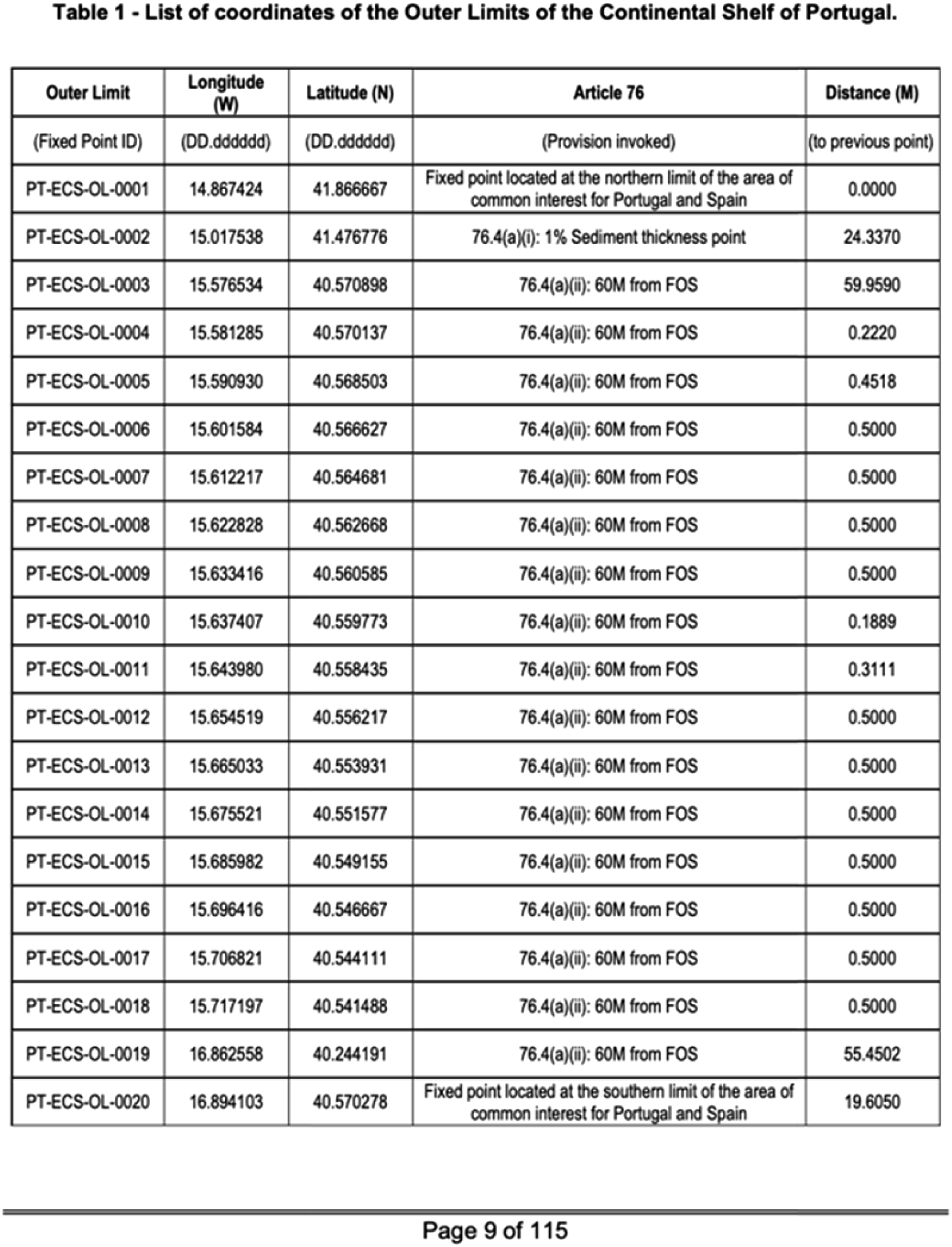
As of February 2024, the CLCS has not yet discussed this request. Nonetheless, the government of Portugal is already acting in this area and openly admits on its website that: “Despite the fact that the Convention does not prohibit the exploitation of resources on the continental shelf beyond 200 nautical miles while the proceedings are running their course, nor does any other international instrument, it happens that, due to the particular characteristics of rights over the continental shelf, Portugal is already exercising its respective sovereign rights” (EMEPC, n.d.). In 2006, Portugal created the first national marine protected area beyond 200 nautical miles in the Rainbow Hydrothermal Field.
UNCLOS outlines two methods to determine the extent of a continental margin. The first method uses what it refers to as the “Gardiner formula.” By measuring the thickness of sedimentary rocks, the edge of the shelf is drawn where sedimentary rocks become less than 1% of the thickness of the soil. The second method, called the “Hedberg formula,” uses as a boundary a fixed distance of 60 miles from the foot of the shelf’s slope. One way or the other, UNCLOS clarifies that the expanded continental shelf cannot exceed 350 miles from the baseline or 100 miles from the 2500-meter isobath (Persand, 2005; see Figure 2). This figure and caption are from Sharveen Persand, “A Practical Overview of Article 76 of the United Nations Convention on the Law of the Sea,” on pages 11-12. Persand is Project Officer at the United Nations and the image and related text are available at: https://www.un.org/depts/los/nippon/unnff_programme_home/fellows_pages/fellows_papers/persand_0506_mauritius.pdf.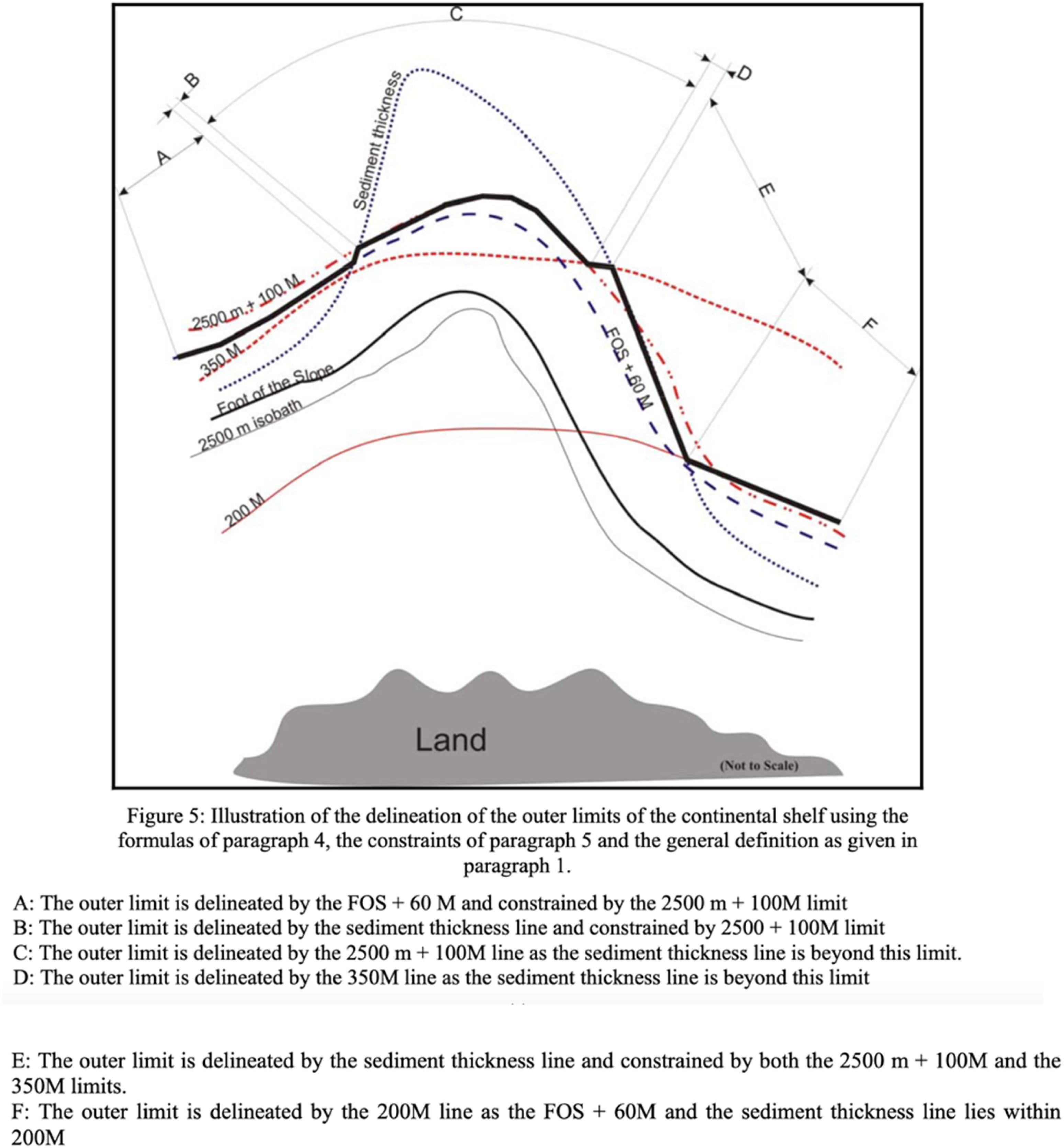
When preparing a submission for an extended continental shelf, the coastal state must determine the “foot of the slope,” effectively marking what is considered the edge of the continent. UNCLOS’s Article 76(4)(b) provides that: “In the absence of evidence to the contrary, the foot of the continental slope shall be determined as the point of maximum change in the gradient at its base.” Since no quantification of the gradients is provided in the law, nor does it provide any specific depth associated to the foot of the continental slope, coastal states use quite a bit of discretion when determining the most likely location of the foot. According to Persand (2005: 15): The Commission is aware of the difficulties arising from the determination of the foot of the continental slope and the edge of the continental margin from a geological perspective. Continental crust is compositionally distinct from oceanic crust, but the boundary between these two crustal types may not be clearly defined. Simple subdivision of margins into shelf, slope and rise may not always exist owing to the variety of geological and geomorphological continental margin types resulting from different tectonic and geological settings (paragraph 6.2.4. of the Guidelines). The Commission acknowledges that different scenarios might exist from which the general rule to locate the foot of the slope by means of the maximum change in the gradient at its base may be unsuccessful. In the case of irregular seabed topography, numerous local maxima might be revealed in the change of the gradient at the base of the continental slope and it is possible that the maximum maximorum may not be indicative of the location of its foot (paragraph 6.3.3. of the Guidelines). In such exceptional cases, geological and geophysical evidence may be introduced as an alternative for determining the location of the foot of the continental slope at its base. (See also Carleton et al., 2000)
If nothing else, surely this last quote, which identifies some of the pragmatic challenges of determining the boundaries of the continental shelf beyond 200 nautical miles, will bring readers to the foot of law’s abyss—a combination of expert science (with terms like “ocean and continental crust,” “geomorphological margin types,” and “tectonic settlings”) and dense legalistic jargon (“foot of the continent,” “maximum maximorum”) that one’s eyes cannot but glaze over. This quote allows a dip into the juridical abyss that both enables and sheds meaning on the footage from Luso in the film Abissal.
Curiously, the term abyss does not appear even once in the text of UNCLOS, the convention on the law of the sea. As a scientific term, the abyssal zone (Abyssopelagic Zone) extends from 4000 to 6000 meters (NOAA, 2023b). And so the film Abissal’s explorations of the extended continental shelf as an abyss is probably invalid from a legal and scientific standpoint. By using this term, the film effectively subverts the abyss as a conceptual enframing. Appropriated to resist the hegemony of the scientific-legal ocean discourse, the film re-enshrining the ocean’s deeply abyssal qualities: wonder, depth, and mystery.
My short reflection on law’s abyss demonstrates just a sliver of how deeply saturated ocean space is with legal regimes. While such regimes are currently remote and obscured—abyssal, as I have referred to them here—calling them up to surface to be observed in full sunlight might show us a way out of what are currently deeply expansionist and extractivist logics.
The More-than-Geological Abyss
DOI: 10.1177/23996544241302929d
Philip Steinberg
Durham University
Gabriella Palermo
University of Palermo
In Neto and Baptista’s Abissal (this symposium), the ROV Luso’s striation of the seabed resonates with the expansionist and colonial aims of the nation-state. As on the surface, the conquest of depth by the land-based Portuguese state is achieved through exploration, enhanced by the logic of the map, to fill what is conceived as a “blank space” with the potential to be made into territory: cuius carta, cuius regio (Sloterdijk, 2013). Luso stands proud as the ultimate cyborg-hero.
However, like all cyborgs, Luso is a multifaceted character: an entity that is simultaneously human, non-human, and super-human; both otherworldly and intimately rooted in statist projections of power. And so the territorial seabed that Luso encounters, and indeed constructs, needs to be understood as a technoscientific abstraction made possible through appeals to forces that go far beyond the geological, and through logics of conquest that go far beyond the mechanics of resource extraction. Geology may provide the seabed’s material foundation, but the powers of cartographic reason, national heroics, and legal certainty are all drawn upon to paint a picture of the seabed as something that is, but also exceeds, its underpinning geologic nature. Like the construction of Portugal—a small sliver of European coastline—as an ocean-spanning empire, the construction of the seabed as the “natural prolongation” of a nation’s territory—the legal concept that provides the impetus for Luso’s exploratory mission (UNCLOS, 1983: Art. 76)—is anything but “natural.”
This repositioning of the seabed as more-than-geological opens perspectives for conceptualizing those who haunt the ocean’s depths. The cyborgs of the deep are not all heroes. They are also the unseen bodies memorialized in the deep, whose hauntings persist even as their stories are covered over by Luso’s silt plumes. To uncover other bodies of the deep, we set Neto and Baptista’s narrative in conversation with works emerging from the African diaspora that focus on the afterlives of slavery that persist in the abyss, paralleling the way that Neto and Baptista set the story of Luso in conversation with imperial imaginaries that, while specifically referencing Portuguese history, also speak to a more universal state imperative to dominate distant frontiers. In particular, we put Abissal in conversation with the worlding opened by Drexciya and related works in Black studies (Gumbs, 2020; Sharpe, 2016), to understand the dynamic relationality of the Abyss, with its processes of co-digestion and becoming-with (Haraway, 2016). Like Luso itself, the submarine co-habitants that haunt the Abyss both reproduce and push against the expansionist imaginaries of past and future Lusitanias, suggesting a range of oceanic futures that probe the limits of the expansionist state. In other words, while the foundation that Luso is establishing for the plundering of the seabed suggests a new wave of imperialist expansion, it also suggests to us the possibility to position otherwise. What if we turn our gaze? What other politics and relations can emerge from the trauma being enacted in the ocean’s depths? How can thinking-with the ocean subvert our perspective, not for the sake of capital dispossession, but for the imagination and practice of new worlds?
As we position ourselves within the oceanic (or, one might say, post-oceanic) turn to more-than-wet geographies (Peters and Steinberg, 2019), we approach Luso as a figuration of the Abyss, an aquatic cyborg that reveals the social, cultural, and political construction of a space by no means blank, but inhabited by bodies, memories, lives, deaths, stories, hauntings, possibilities. In this positioning, we build on an emerging dialogue between critical ocean geographies and ocean-focused work within Black and decolonial studies. As we argue elsewhere (Steinberg and Palermo, forthcoming), it is impossible to look at the relationship between coloniality and the sea, between “exploration” and the sea-depths, without listening to Black history. We have the response-ability (Haraway, 2016) to try to mobilize our knowledges for the Black subjectivities and bodies on which this relation was and still is consumed, yesterday in the Abyss of the Black Atlantic (Gilroy, 1993; Glissant, 1997), today in that of the Black Mediterranean (Black Mediterranean Collective, 2021; Di Maio, 2012; Hawthorne, 2022), and on into perpetuity in the refractive space of the wake: the trans-oceanic path that reveals, even as it obscures, the ocean’s violent archives (Sharpe, 2016).
If, like those controlling Luso’s robotics, we look at the deep from above, the Abyss is the space of the White Whale, whose rolling and vaulting in the depths of the sea figures the alliance between modernity, capitalism, coloniality, and the conquest of ocean-space (Sloterdijk, 2013). If the whale’s roundness is the symbol of the globe to be conquered—an invitation to expansion and territorial power—its whiteness signals coloniality, the capitalist white, male, heterosexual subject of the world, and the terra incognita, to be filled, renamed, mapped, possessed. The Abyss is thus that specific space of the sea in which to relegate the exteriority, the roundness and whiteness, that capital has not managed to reduce to normativity. The Abyss is the horror to be hidden, that must not emerge, and should stay silent, removed, not registered: the nightmare across which Luso now bears its sensors and against which the ROV’s successors will bear their scrapers, dredgers, and claws.
If we look at the Abyss from below, by staying in contact with the turbulent materiality of the sea, made of liquidity, circular temporalities, and volumes as capacity (Peters and Turner, 2018; Steinberg and Peters, 2015), a pluriverse of counter-archives, counter-subjectivities, and more-than-wet relationships emerge. Seen from this perspective, Luso’s interaction with the water’s depth—moving, disturbing, reshuffling, and recirculating silt, water, and a host of organisms—can be seen as a figuration, (i.e., a transformative cartography) of the unveiling of certain situated Abyss stories.
To draw out this figuration, wherein Luso emerges not as a hero for the conquest of the colonial map but as an agent of mapping that points to alternative way of living-with, we propose conceptualizing Luso not simply as the subaltern servant of the Portuguese state but as the cyborg offspring of Afrofuturism.
Although Afrofuturism has turned to a range of “otherworldly” spaces to envision new worlds (Dery, 1994; Eshun, 1999; Womack, 2013), the ocean’s depths feature frequently, as a focal point for dis-assembling the category of the human (from dehumanization to posthumanism) and re-signifying the denied memory of slavery for the reappropriation of the future’s imagination, while elaborating on the pervasive role of the ocean as a space of loss and liberation in critical thought emanating from the African diaspora (e.g., Gumbs, 2020; Gumbs and Sharpe, 2022; Jue, 2017; Walcott, 2021; Wardi, 2016). Afrofuturism thus repositions the deep sea as the Abyss. Here, the sea is not empty, a space of abstraction, or a death-world, but a living space, with inhabitants, co-habitats, stories, narratives, relations, imaginations, and memories, all embodied in, with, and through water and its volumes.
Starting in the 1970s, the electro-techno duo of James Stinson and Gerald Donald called Drexciya imagined and constructed an entire mythology connected to the emergence of sea-related worlds. The Drexciyans are the inhabitants of the abyss of Black Atlantis, born from the pregnant women thrown alive in the wake of the slave ships that crossed the Middle Passage. The population of the submerged continent was born from the symbiotic alliance with the creatures of the deep sea: grafts, hybridizations and metamorphoses forming alliances between human, non-human, and more than human, between animals, corals, machines, and the offspring of Black women. The community of Black Atlantis is thus constituted by a porous, partial, relational subjectivity, an aquatic cyborg in multiple points of fall, representing the continuous becoming-with the materiality of the sea. In constructing Drexciya, Stinson and Donald narrate a multi-layered and multi-styled narrative that Eshun (1999) calls sonic fiction: a counter-narrative and sonic cosmology weaving other worlds where the future is no longer to be found in the space of the universe (or through its colonizing vessels), but in the space of the sea, where the Drexciya originate and regenerate, and in which they have built their underwater world (Attimonelli and Haqq, 2018; Di Stasi, 2019).
The cyborg inhabitants of Drexcyia can be understood, after Haraway, as “a condensed image of both imagination and material reality, the two joined centers of structuring any possibility of historical transformation” (Haraway, 2006: 150). This perspective adds a new dimension to Luso’s quest for riches, not just because it proposes a non-linear temporality that would confound investment decisions, but also because it proposes a figuration of materiality that undermines the notions of emptiness and presence that lie at the heart of statist imperatives toward resource extraction and territorialization. In Drexciya, and indeed throughout the Black canon of Abyssal writings (see: Drabinski, 2019; Pugh and Chandler, 2023), “invisible things are not necessarily ‘notthere’. […] a void may be empty, but it is not a vacuum” (Morrison, 1998: 11). In the drexciyan world, death is signified not by emptiness but by presence-absences, or hauntings. Thus, Saucier and Woods (2014) assert that the Black presence is as if buried, a world of unconscious fantasy in which the ghosts of the crypt return periodically to haunt and torment us, awakened, perhaps, by Luso’s lasers.
Coral reefs, aquatic cyborgs, dead bodies, whales, microorganism, bodies of water, tentacular engineers, ghosts from the abyss (Palermo, 2022): these presence-absences, of a past which is never past, that recirculate to question the present and shape the future, are constantly becoming-with the turbulent materiality of the sea, in extension and in excess. These elements, these inhabitants, constitutive of the sea, and therefore sea themselves, are part of its more-than-wet ontology (Peters and Steinberg, 2019). Present through multiple materialities—from the liquid to the gaseous state—the sea becomes atmosphere, its constitutive elements inseparable from its totality, woven together by the narratives reproduced by Luso and by the ghosts of Lusitania’s past.
We conclude by turning to Alexis Pauline Gumbs for a final reflection on the ways in which the environmental ruin and spoils of empire wrought by Luso are seen anew when a light is shown on the subversive liveliness that persists in the water, even amidst destruction and death. Referencing the African bodies that inhabit the depths, Gumbs writes:
Their breathing is not separated from the drowning of their kin and fellow captives, their breathing is not separate from the breathing of the ocean, their breathing is not separate from the sharp exhale of hunted whales, their kindred also. Their breathing did not make them individual survivors. It made a context. The context of undrowning. Breathing in unbreathable circumstances is what we do every day in the chokehold of racial gendered ableist capitalism. We are still undrowning (Gumbs, 2020: 4).
The oceanic spaces of conquest constructed by Portugal and its competitors in centuries past are no strangers to drowning. Lives have been lost and environments buried, and these processes surely will continue in Luso’s wake, as they have in the wake of vessel’s past. Yet Afrofuturism reminds us that hopes submerged are never permanently buried. Luso may be unearthing something even more potent than maps and minerals: a future undrowned.
Lines in the Lusitanian Sea
Stefan Helmreich
DOI: 10.1177/23996544241302929e
MIT Anthropology – Massachusetts Institute of Technology
Portugal’s history is deeply enmeshed with matters of ocean governance—and, more, with the extension of governance into ocean domains. Consider the Treaty of Tordesillas, which, elaborating an 1493 decree of Pope Alexander VI, in 1494 divided the Atlantic world between the Crown of Castile and the Portuguese Empire. A vertical line of demarcation from Arctic pole to Antarctic pole was declared just west of the Cape Verde Islands, making the sea to the west pertain to Castile and the sea to the east to Portugal (this would include the country’s maritime border as well as segments of what would become Brazil’s). Unlike the late 20th century UN demand, under the Law of the Sea, that such a line outline “a natural prolongation” of landed territory (the demand motivating sea-floor and continental margin mapping of the sort carried about by the Remotely Operated Vehicle Luso), this line left such “nature” out of it, warranting the division by appeal to religion—and more particularly with respect to the promise that Portuguese and Castilian seafarers would, as they encountered previously unknown territory in their travels, “instruct … inhabitants and residents in the Catholic faith” (Pope Alexander VI, 1493). Still, there is a faith in which Luso—a star of Pedro F. Neto and João A. Baptista’s Abissal (this symposium)—is instructing its audience: a faith that precise scientific measurement of out-of-everyday-reach ocean territories can offer up geopolitical objects. And consider this similarity between the making of the Treaty of Tordesillas and the actions of the Remotely Operated Vehicle Luso: both depend upon the creation of lines in the sea.
Green Laser Sensing in the Deep-sea Rave
Melody Jue
DOI: 10.1177/23996544241302929f
University of California, Santa Barbara
Who knew that the UN Convention on the Law of the Sea would launch a thousand deep-sea raves? Pedro F. Neto and João A. Baptista’s film Abissal situates the viewer in the darkness of the seafloor, lit by the bright strobes and neon lasers of the Portuguese ROV Luso. Using found footage from the ROV, they situate the viewer at the level of sediment plumes, swirling low to the ground like a fog machine. As the opening scene synchronizes the noise of whirring appendages with techno beats, it personifies Luso as a kind of campy space hero, exploring the strange planet of the ocean seafloor with a variety of clamps, tubes, cameras, strobes, and lasers. Addressing this vibrance in one scene, Luso itself seems to say, “I’ll dazzle your sight with a map to parts unknown, if the face of art and invention to me be shown” (Figure 1). Luso’s activities in the deep sea evoke the aesthetics of the rave, which McKenzie Wark describes as “a jackhammer in a sauna” (2023: 5), noisy, machinic, and humid, situated in pitch black darkness under the sweeping scan of neon lights. This dance party at the bottom of the sea, it turns out, is exactly how underwater territorial boundaries are measured. Yet it could not be more different than the sober maps of 200-mile territorial waters commonly representing UNCLOS. What UNCLOS represses—and depends upon—are a thousand deep sea raves that occur out of sight, as ROVs measure territorial boundaries on the slopes of continental shelves around the world. Screenshot from Abissal, as a green laser pans back and forth across an external camera placed on the seafloor.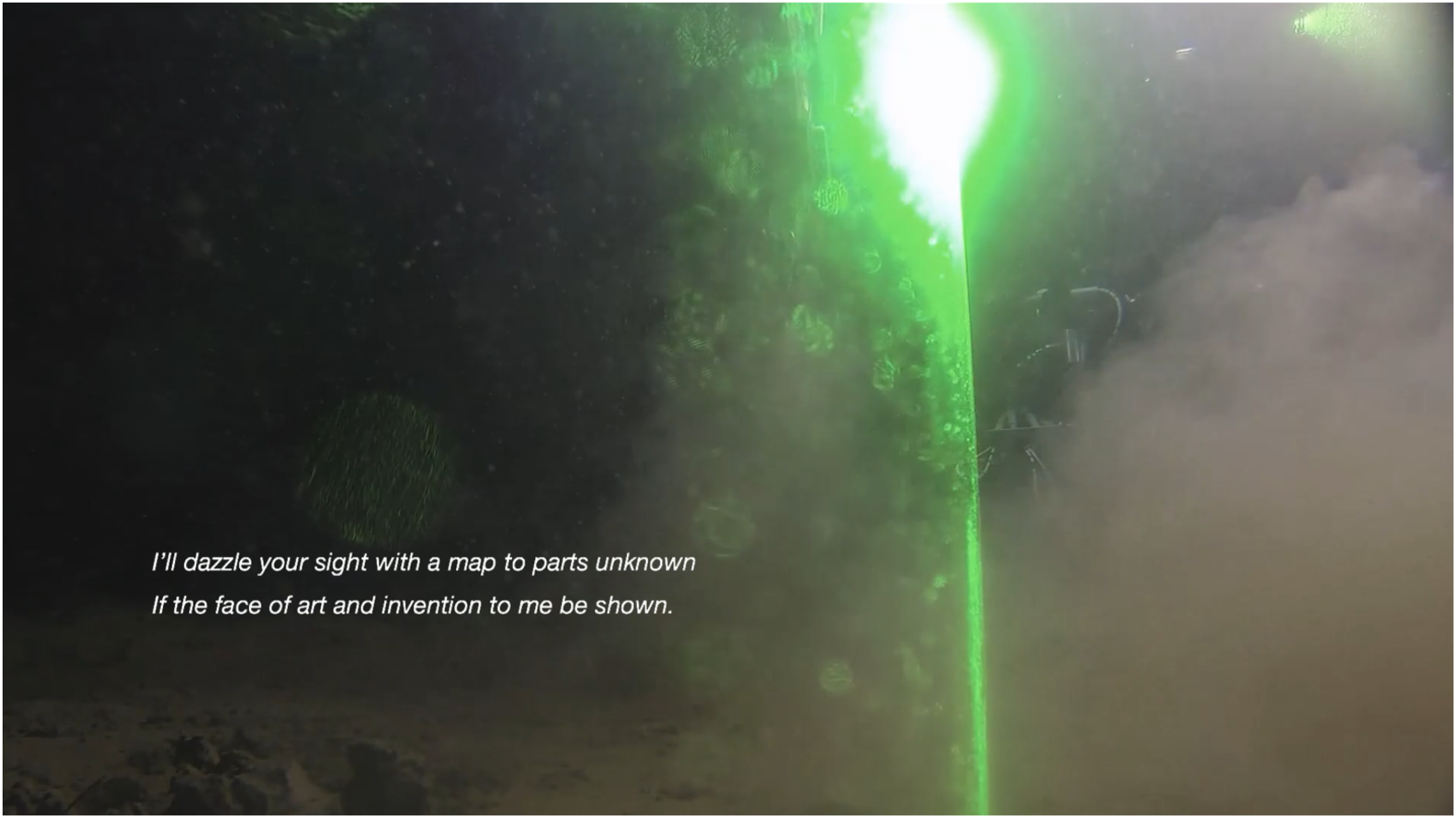
Whereas visualizations of oceanic territoriality, specified in UNCLOS, tend to take the form of flat territorial maps or cross-sections (Figure 2), Abissal draws on Luso’s own footage. This includes footage from external cameras on the seafloor that face Luso itself, classed as a “selfies,” as well as footage from Luso’s interior cameras, rotated to surreal effect to suggest a bad trip. Throughout the film, the green laser is a recurrent motif that transports the viewer from being sensorily embedded on the seafloor, to increasing forms of abstraction—both of which echo aspects of raving. Luso’s bedazzling green laser draws together Portuguese claims to the seafloor and situates the viewer as the seafloor, scanned by the sweeping light of surveillance. Screenshot of a Google image search for “UNCLOS” (UN Convention on the Law of the Sea).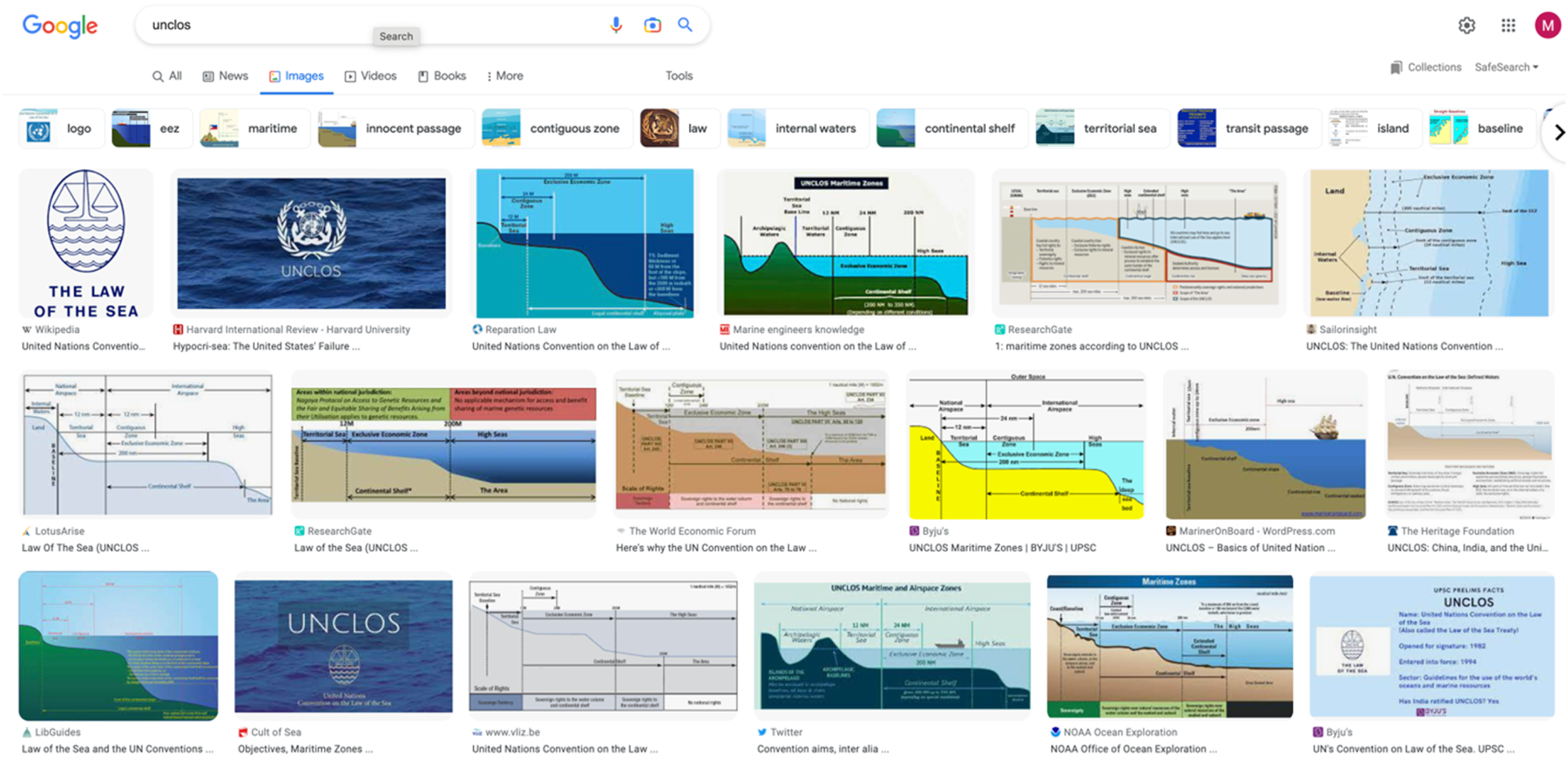
In Abissal, suspended particles create the temporary effect of a screen at the world’s deepest rave, recorded by Luso’s video selfie. This screen effect is best described by Bridget Crone as a “turbid image,” specific to the milieu of the deep sea. Crone defines turbidity as an agitation of matter that is felt, where the “density of matter suspended in water produces its own image (or turbid-image)” (Crone, 492–493). Abissal features just such effects through the interplay of the green laser Luso’s own disturbance of seafloor sediment (Figure 3). In the opening sequence the camera does not move, offering a still point of view from within the turbulence of cloudy seafloor. As the laser slowly sweeps back and forth across the external camera, its light catches dense eddies of sediment, illuminated in green. The laser appears not as a line, but as a plane, projecting onto the plume of sediment as if it were a screen. The eddies illuminated in this green vertical plane swirl in chaotic patterns, environmental animations of “suspended particles creating a surface” (Crone, 492–493). Like the temporary particle screen, we viewers are also illuminted by the sweep of the laser, enveloped by the image and poised to consider the “changing the conditions of what we see and how we see it” (Crone, 492–493). Through its play with the visual optics of seawater and sediment, Luso’s selfie footage grants sensory texture to the imperial desires of the state to map the seafloor—desires often concealed in dry documents, numbers, and abstraction. Screenshot from Abissal, as a green laser temporarily projects light onto the surface of suspended particles (bottom right corner).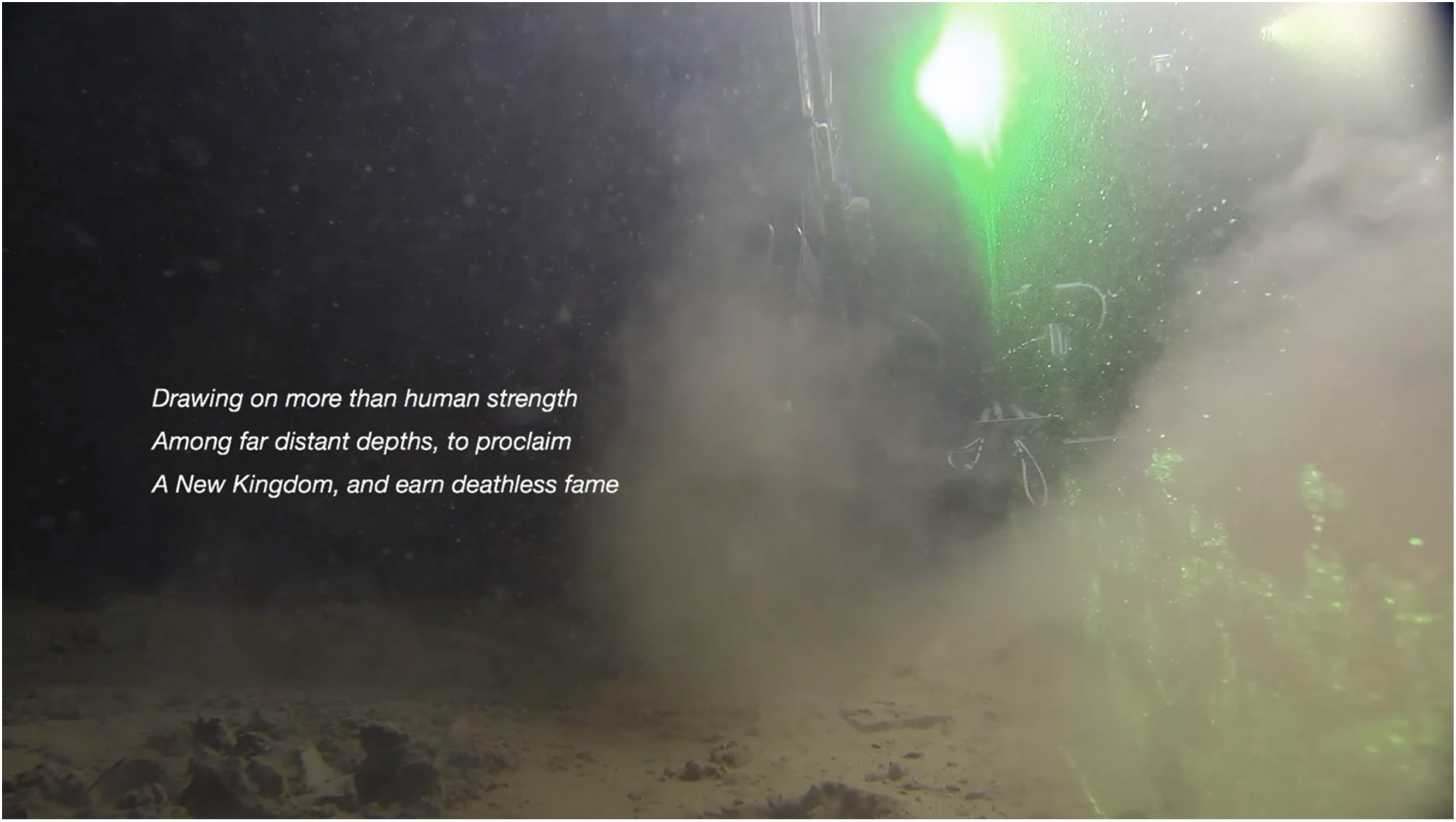
It is important to remember that the seafloor is full of life. Although Abissal features images of some macroscopic fauna, like crabs and fish, entire ecologies of seafloor life exist at the scale of the microbial. As Stefan Helmreich writes in Alien Ocean (Helmreich, 2009), marine microbiologists are actively interested in the genetics of these microbes, or what he calls “messages in the mud.” In a related vein, Susan Reid reminds us that legal language regarding seafloor management tends to portray it as a purely geologic realm, rather than biological. Such a view makes it easier to see the seafloor as a site of extraction. Reid’s practice of “sea-truthing” names a tactical process of writing the presence of living organisms back into legal descriptions of the seafloor, embedding a vital reminder of their existence in documents that would otherwise seek their erasure (Reid, 2021, 2022).
We can see such tensions between life forms and the seafloor as extractable geologic material in the apparatus of the green laser itself. The official model name for the green laser is “Angel Shark.” Its product description reads as follows: “By using two lasers in a fixed bracket, calibrated at a set distance, accurate measurements from video images is possible. The Angel Shark laser is ideal for use in pipeline inspections” (iMenco, 2014). Now consider again Figure 1, the moment when the green laser pans back and forth over the camera lens and the viewer. One can almost feel the green light reflecting off their skin. If the Angel Shark laser was designed for scanning pipeline inspections, what does it mean for the viewers to experience being the subjects of the scan? Are we, too, interpolated as pipelines? Or, in the context of Luso’s mission, are we embedded as part of the seafloor itself, subjects of territorial mapping? Either way, being the subject of territorial mapping turns out to be an ecstatic experience of the rave, of lights and techno music within the dark, until things start to dissociate and become weird.
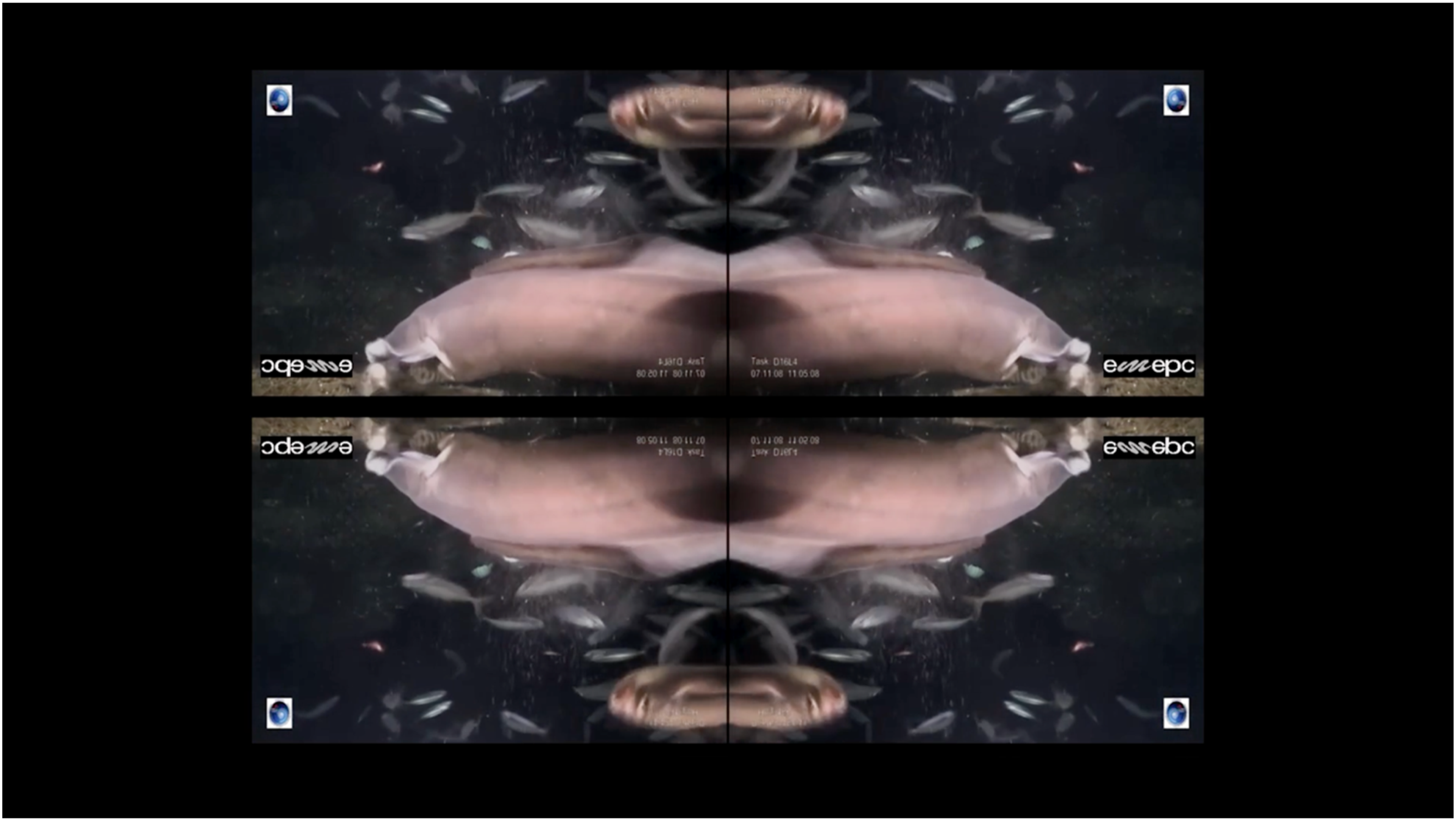
In Raving (2023), Wark observes that people who attend raves need all kinds of different things, from the release of dancing, to romantic encounters, to the ketamine-assisted loosening of self-boundaries (2023: 3). Abissal also moves the viewer through several possibilities. After the opening scene that sensorily emplaces the viewer as the seafloor, the film shifts to another camera view from inside Luso. This camera is not caught in turbidity. Elevated higher above the seafloor, it gazes outward through clear water, following the green laser as it tracks and measures geologic features, fish, and other life forms. From this angle, the feeling of being inside the rave disappears, and we are left with an objectifying view of benthic life. The fact that the filmmakers compound this interior camera footage into a 4-channel video mosaic (Figure 4) enhances this effect, shifting from the ecstatic feeling of being on the dance floor to looking through a CCTV camera, the scopophilia of surveillance accompanied by the measuring line of the green laser. Abissal exacerbates the surreality of this moment through rotating the angle of each screen in the videomosaic to create a kaleidoscope of benthic life (Figure 5), accompanied by the incessant ringing of metallic noises. A pink fish seems to radiate out in four quadrants, the stuff of nightmares. This is followed by a scene of abduction, where we watch as a vacuum tube hovers over a bright red crab before suctioning it into collection, an abducted specimen. The voiceover narrates, “Technoscience captures and creates new data, that validate the various territorial claims.” Abissal figures these moments of capture and creation of data, of territorial claims, as a bad trip—one that is worse for some rave attendees (the crab) than others. Screenshot of Abissal depicting a videomosaic of the ROV Luso’s underwater footage, scanning the seafloor and sea life with a bright green laser. Screenshot of Abissal depicting a videomosaic of the ROV Luso’s underwater footage, with screens oriented towards the center in a kaleidoscope form.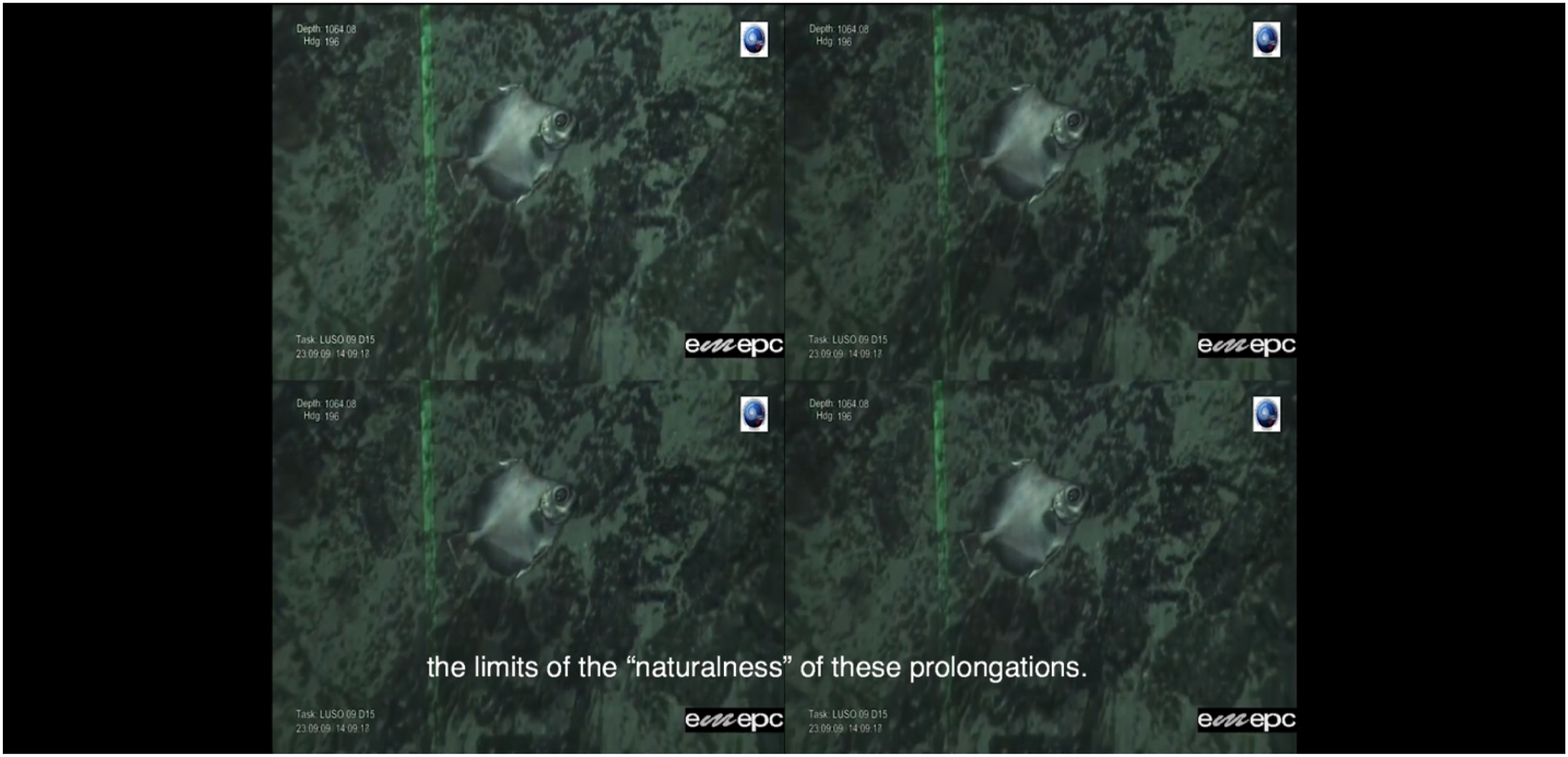
This brings me back to the final manifestation of the green laser in the closing credits. In the beginning of the film, the green laser catalyzed the aesthetic experience of a rave, embedding the viewer as seafloor that is scanned and measured by neon light. By the end of Abissal, the green light has receded into more and more abstract forms. No longer something to be haptically felt, the green line recedes to the demarcation of ocean territoriality on a map (Figure 6), illuminating Portugal’s territorial claims to the seafloor as extensions of its terrestrial borders. The credits continue with other maps, other locations that other ROVs have visited, assisting in so many national projects of scientific mapping that are a precondition to underwater territorial claims. This move returns us to the normative way of visualizing UNCLOS. But perhaps what we cannot forget is the continuity of the bright green laser aesthetics throughout the film—what started as a rave becomes a bad trip, and finally, ends with the afterimage of a map. Consider how the title Abissal signals not a noun (abyss), but an adjective (abyssal)—suggesting that the seafloor is not only a destination or object, so much as an aesthetic quality. Is the rave abyssal, or is the abyss full of raving? Is the machinic rave—known to us through technical mediations—what UNCLOS maps have always repressed? Closing credits of Abissal depicting a map of Portugal’s undersea territory, marked by a bright green line.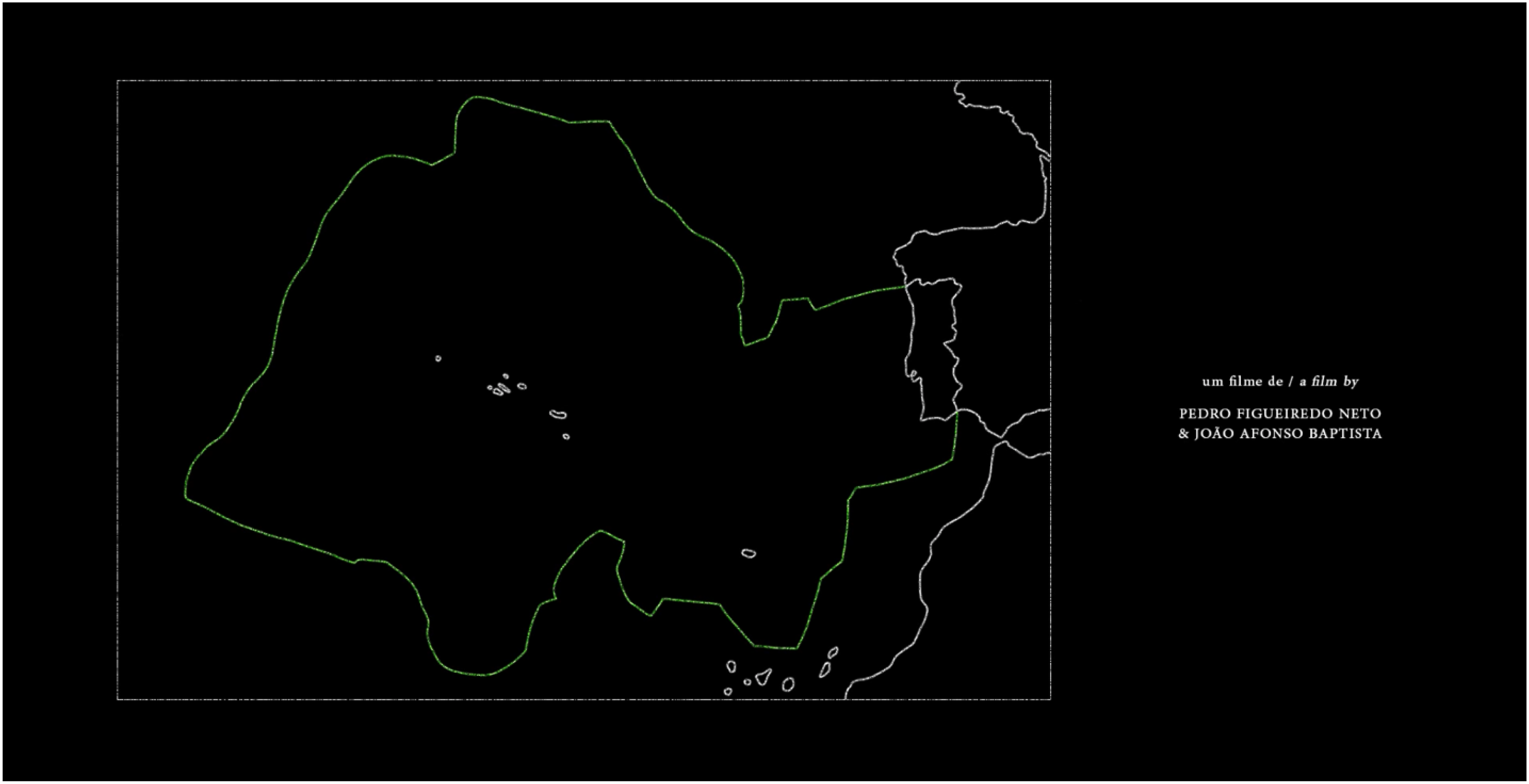
Deep Sea Mining and the Politics of the “Common Heritage of Mankind”: Beyond a State-based Geopolitics
John Childs
DOI: 10.1177/23996544241302929g
Lancaster University
In the film Abissal (this symposium), sediment plumes erupt as a penetrating green laser cuts through shifting waves of dust, matter and discordant sound. These uncanny beams of light belong to the Luso, a Portuguese remote operated vehicle (ROV) tasked with mapping the deep seabed, a task necessary to legitimizing nothing less than the territorial expansion of the Portuguese state itself. In language evocative of Donna Haraway (2016), the film’s poetic subtitle describes such cartographic efforts as the “tentacles of science” effecting to “redraw the contours of an old country.” Driven largely by the desire to reveal and fix the deep seabed as a new site of extractivism for emergent industries like deep sea mining (DSM), the underwater robot opens up profound questions for understanding the contemporary political geography of the deep seabed. Not least amongst these are the juxtaposed imperatives of national and international political-legal codes. How, for example, do the expansionist imaginaries of nation-states like Portugal give way to the international guiding principle of the “Common Heritage of Mankind”—used to govern the deep seabed beyond national borders? In this short commentary, I highlight some of the analytical shortcomings of understanding the deep seabed as a geography capable of being contained by (inter)national extractivist fantasies. By focusing on the specific and respective components of “commons,” “heritage” and “mankind,” I show how such thinking reproduces (in a submerged sense) the “trap” of conceiving of the state as “fixed unit of sovereign space” (Agnew, 1994).
Commons
There has been a recent push to understand the global ocean as a “blue commons” (Standing, 2022). This idea recalibrates governance mechanisms away from a framework based on inter-state relations and towards a model which foregrounds the rights, wellbeing and voices of community-based “commoners” in shaping and sharing oceanic stewardship and policy. Perhaps the chief historical reference point for this thesis is the oft-quoted intervention of 17th century historian Hugo Grotius (2012) who famously proclaimed that the “sea is common to all, because it is so limitless that it cannot be the possession of any one, and because it is adapted for the use of all.” Providing a moment of historical symmetry, this was written partly in response to the 1494 Treaty of Tordesillas in which Portugal and Spain made territorial claims to the world along an arbitrarily drawn line roughly halfway between Cape Verde and modern-day Cuba as a means to secure their imperial worldview. Fast forward to the present day and to Abissal and we can witness the ways in which the Portuguese state makes similar efforts to fix deep-sea oceanic space as a means to extend its national territorial extent. Here, it mobilizes deep sea technology and science to re-draw the contours of the contemporary state through the legally codified principle of “natural prolongation” (UNCLOS 1982a: Article 76(1)). The underwater continental shelf is to be considered contiguous with the above-water land mass associated with Portugal or, as the film puts it, “national territories are built with the stones of law; nature with the instruments of science.” These are all examples of the kinds of “lines in the sea” described by Helmreich in this symposium in which the deep seabed is rendered as “a geopolitical object.”
Superficially at least, the United Nations Convention on the Law of the Sea (UNCLOS) directly addresses such efforts, even as they are framed as “scientific research,” and it should be noted that Portugal is hardly alone in its efforts to map the global seabed. Indeed, organizations like the Japanese Nippon Foundation and, more recently the US Governmental National Oceanic and Atmospheric Administration feed into the international General Bathymetry Chart of the Ocean’s (GEBCO) purported aim to “produce the definitive map of the world ocean floor by 2030” (NOAA, 2022). Nominally speaking, and in the spirit of a global commons, this kind of marine research “shall not constitute the legal basis for any claim to any part of the marine environment or its resources” (UNCLOS, 1982b: Article 241) and yet, the execution of such work opens up as many questions as it forecloses. As Lehman asks, “who is such science supposed to serve” given the fact that “not all humans will benefit equally and, in some cases, may even be harmed” (Lehman, 2020: 176)? Any claim that the production of new cartographic data should be considered “definitive” must be treated with skepticism. It is by now well established how terrestrial maps can reproduce modes of injustice and marginalization associated with colonialism, racism and capitalism, especially as they come into contact with the imperatives of resource extraction (Tilley, 2020). The same is true of deep sea mapping.
Heritage
At a certain point, the narrator of Abissal ambiguously asks, “can you hear?” against the whirr and crash of industrial-scientific machinery. It is unclear who the question is directed towards. On the one hand, it is an invitation to consider the coming together of the sonic, material and political geographies as they operate in deep sea space. However, there is another dimension being provoked here—a summons to think about time and the question of heritage. On the one hand, we are immersed in the sights and sounds of the future as the expansionist tendencies of deep sea exploration and extraction propose an imagined extension and enrichment for the nation state. Yet other temporal registers are evoked. An engagement with the deep ocean and its “heritage” might also be an invitation to remember, perhaps even to repair its past, especially as it relates to decolonial calls to confront and work through the submerged violence sedimented by slavery during the so-called middle passage. For many of the millions of descendants of people who lost their lives during the Transatlantic Trafficking and Enslavement of Africans, the deep seabed’s heritage may be understood as an ancestral “sea of bones” (Clifton, 2015) or as a “burial ground” in which “bone soldered by coral to bone” (Walcott in Turner et al., 2020). Indeed, as Steinberg and Palermo (2024) put it in this collection, “it is impossible to look at the relationship…between ‘exploration’ and the sea-depths, without listening to Black history.” It is essential then to foreground attempts to counter narrate the forward-facing tendencies suggested by attempts to mine the deep seabed as the next extractive “frontier.” Recognizing alternative ontological positions and cultural understanding of the ocean is a first step to “decoupling…the futurological teleology” of deep ocean extractivism (Eshun, 2013: 145) and essential to contemporary deep sea governance (Childs, 2022; Conde et al., 2022).
These moves are not just conceptual and a body of work is now taking the idea of submerged heritage increasingly seriously (Turner et al., 2020). The “heritage” envisioned by UNCLOS tends towards the tangible, but this is not sufficient to capture its cultural dimensions, particularly as it is encountered by the push into the ocean by extractive corporations. These examples of capitalist “friction” (Tsing, 2005) are evident all over the world (and not just in the Atlantic) such as in Murujuga, Australia where the development of an offshore oil pipeline project unearthed Aboriginal artifacts on a seabed that, until 20,000 years ago, was “dry land” (Wiseman et al., 2021). Though scientific communities might explain this transformation through climate induced sea rise, for indigenous Yaburara people this “seabed” is instead part of “sea country” and a “continuous cultural landscape above and below that waterline” (Leach et al., 2021). Given that climate change is predicted to increase sea level enough to submerge 136 UNESCO designated World Heritage Sites by 2100 (Perez-Alvaro, 2016), these examples will require attention beyond the academic. UNESCO’s “Memory of the World” programme argues that the “world’s documentary heritage belongs to all, should be fully preserved and protected for all and, with due recognition of cultural mores and practicalities, should be permanently accessible to all without hindrance” (UNESCO, 2023). It is perhaps telling that the aforementioned example of Portuguese and Spanish imperial design—the Treaty of Tordesillas—is currently on UNESCO’s register. What so, for the submerged heritage of the seabed, both now and in the years to come? At stake here is nothing short of a geopolitics of memory, of recognition and perhaps even of “inheritance.” This latter concept is mobilized through the attempts made by the modern-day descendants of transatlantic slavery (Lehman, 2024) to trace and recover their dispossessed ancestry. An elusive and slippery notion, “inheritance” is here described as a “force” which “ultimately evades capture by the powerful as much as the dispossessed” (Lehman, 2024: 10). It serves as a clear reminder that claims to any “common” sense of “heritage” are both unstable and misleading.
Mankind
The final linguistic component of CHM—mankind—also fails to fully describe deep sea geographies adequately. Instead, we have a relational cast of political actors which push geopolitics beyond a classical state-based framing. Alongside the state, the film Abissal suggests that the oceanic political relations of the deep are instead constituted by a combination of non-human life, technology and spiritual entities. The ROV Luso is said to “proclaim a new kingdom, and earn deathless fame.” In doing so, it not only points to the political effects newly created by its ability to access and visualize underwater volumes previously unseen by human eyes—the great “revealer” of a new “scopic regime” (Jay, 1988). As Stefan Helmreich (2009: 213) has pointed out elsewhere, underwater vehicles like the Luso constitute a “cyborg” assemblage in which “a combination of the organic and machinic [are] kept in tune and on track through visual, audio and (human) metabolic feedback.” It also introduces the notion of immortality—that the geographic imaginaries and environmental knowledge produced by newly rendered visions of the deep seabed have eternal effects that outlast the physical lifespan of the machine itself. It is perhaps this divine association which has more analytical potential for moving beyond the machine as chief agent, a point echoed by Steinberg and Palermo’s (2024) essay.
Indeed for many, there is increasing recognition that despite the barriers to human livability, the seabed is inhabited by a full range of spiritual actors, themselves part of a relational ontology (Childs, 2022). The implication for many of the Indigenous groups proximate to the seafloor massive sulfide deposits targeted by DSM found around the Pacific ring of fire is profound: the deep seabed is part of their identity (Childs, 2020). As Neil MacGregor has put it, “it rends the very fabric of the world and a vivid, direct, sacred link with the land is irrecoverably lost” (MacGregor, 2017). And so, we have spiritual gods specific to the multifarious ontological perspectives on the ocean in relation with “deathless,” machinic gods (The film’s ROV is even named after Lusus, the Roman god to whom the Portuguese founding myth is attributed). When the Luso crawls over the seabed in its attempted act of scientific enclosure, it opens up new political relations with entities that are not well captured by the concept of “mankind.” This seabed is a space and “commons” shared not just with “mankind” or even (allowing for the obvious gender discourse critique) “humankind.” The geopolitics of the deep sea is in formation and commercial extraction has yet to begin in earnest. As the film ends, a muffled voice can be made out above the din of the industrial-scientific complex. It exhorts us: “please stay calm.”
Footnotes
Declaration of conflicting interests
The author(s) declared no potential conflicts of interest with respect to the research, authorship, and/or publication of this article.
Funding
The author(s) disclosed receipt of the following financial support for the research, authorship, and/or publication of this article: This work was funded by the Fundação para a Ciência e a Tecnologia, I.P. (2022.07661.CEECIND/CP1756/CT0002 and 2021.03558.CEECIND/CP1696/CT0002).
Contributions
Stefan Helmreich: Professor of Anthropology at Massachusetts Institute of Technology; Philip Steinberg: Professor of Political Geography at Durham University; Gabriella Palermo: Postdoctoral Research Fellowship of Geography, University of Palermo; Irus Braverman: Professor of Law and Adjunct Professor of Geography at The State University of New York at Buffalo; John Childs: Senior Lecturer in International Development and Natural Resources at Lancaster University; Melody Jue: Associate Professor of English at the University of California, Santa Barbara; João Afonso Baptista: Research Fellow at Instituto de Ciências Sociais, Universidade de Lisboa; Pedro Figueiredo Neto: Research Fellow at Instituto de Ciências Sociais, Universidade de Lisboa.
