




Abstract
This paper analyses how water reforms in Tunisia’s authoritarian regimes came to shape mechanisms of domination, repression, and co-optation anchored in the everyday politics of water allocation and use. The historical study of the water-agriculture nexus in Tunisia (1950–2011) argues that the sector served as a practical and symbolic vehicle to legitimise, produce, and reinforce authoritarian practices and regimes. Drawing on the dialectic of the state and society, this analysis showcases the links between agricultural water governance and practices of state-building. Water policy- and decision-making are put in the context of past political agendas and social unrest, explaining underlying societal perceptions and motivations. On the basis of this analysis, this paper hopes to inspire modest and realistic policy reforms that strategically address contemporary legacy barriers to good water governance.
Introduction
As water crises are increasing globally (Schlosser et al., 2014), societies are stepping up efforts in trying to solve them. Historical analyses provide useful tools in dissecting critical legacy barriers obstructing or delaying these good governance efforts. This paper explores the relationship between historical political processes and water resources management in authoritarian Tunisia (1950–2011). The contemporary Tunisian water crisis is driven by an irrigation-intensive agricultural sector that consumes 87% of the country’s water footprint (Chouchane et al., 2015). It is characterised by a failure to implement regulatory limits to water exploitation (Frija et al., 2014; MARHP, 2017) and lays its scene in the post-authoritarian context of an unstable democracy birthed during the Arab Spring. After French colonial rule, Tunisia was governed by authoritarian leaders Bourguiba (1957–1987) and Ben Ali (1987–2011), ultimately culminating in the Arab Spring of 2011. A note of caution is necessary for those that seek to address present governance challenges with panacea “good governance” tools that obscure the country’s political past: ‘For it is not in itself the departure of Ben Ali and the “clans” that has radically altered the modes of government and the exercise of power in Tunisia. Nothing has been definitively decided’ (Hibou, 2011: xiii).
A growing understanding that water resources management is inherently political has led researchers to apply a political sociology lens to water resources management (Mollinga, 2008; Mollinga et al., 2007). Political decisions on water allocation create social patterns of haves and have nots among water users, inextricably linking water management to questions of identity, power, and justice (Tilt, 2015). Historical analyses of water governance systems help shed light on how political regimes have shaped these systems in their image (McCarthy, 2019) and which processes contribute to sustaining or undermining them (Swyngedouw, 2015). Little research has been conducted on authoritarian environmental governance from a historical perspective (Josephson, 2002; Wilson, 2019), particularly with regards to water resources management. Concepts of political control and state-building have frequently been studied in relation to water infrastructures (Akhter, 2015, 2019, 2022; Barnes, 2017; Engels and Schenk, 2015; Menga, 2015). Deterministic notions such as Wittfogel’s ‘hydraulic society’ (1957) are not well placed to answer questions on dynamic power relations in water systems (Worster, 1985) but have inspired a more critical literature on socio-technical infrastructures, which studies infrastructure, such as irrigation systems, beyond their mere material functions (Obertreis et al., 2016). Expanding on the literature of socio-technical infrastructures, this historical analysis seeks to explore the dialectic of the state and society as they relate to day-to-day contestations of water management (Mollinga, 2008) using key informant interviews and archival data.
Authoritarianism is not necessarily the antithesis of democracy (Koch, 2019). Rather than a concrete unit associated with the state, authoritarianism should be understood as practices inherent to a variety of organisational units (Adler and Pouliot, 2011; Eckstein and Gurr, 1975). Indeed, democracies can provide fertile grounds for authoritarianism, for example, corporate authoritarian practices in worker-employer relations. Within any particular organised context, authoritarianism can be defined ‘as patterns of action that sabotage accountability to people over whom a political actor exerts control, or their representatives, by means of secrecy, disinformation and disabling voice’ (Glasius, 2018: 517). In contrast to obsolete conceptions of “oriental despotism” (Wittfogel, 1957), in which the ruler has perfect control over access to water, authoritarian practices go beyond the linear hierarchy between ruled and ruler and frequently involve endogenous self-reinforcement processes that trigger path-dependence (Gerschewski, 2013). The paper studies the relationship between state and society using the case-study of water sector reforms in authoritarian Tunisia (1950–2011).
Grounded in the theoretical framework of historical institutionalism (Blatter and Haverland, 2014), this paper mobilises the concept of the security pact as theorised by Hibou (2011). Legitimacy in the precedent authoritarian regimes in Tunisia, first during the colonial order, later in the Bourguiba and Ben Ali administrations, was derived from an image of economic and social security (Hibou, 2011). Inseparable from state-building and ideals of social unity, the so-called “security pact” between the government and those governed lies in the assurance of order and tranquillity. Against the backdrop of imminent danger of poverty and inequality, Hibou argues, the government receives a hall pass to do whatever is required to ensure social security. Where no clear legal status exists, the police is allowed to intervene, to repress individuals and their private affairs, in order to ensure public order. This phenomenon of the security pact can also be applied to the irrigation agricultural sector, where bureaucratic and practical supervision by so-called “social agents” allowed for the co-optation and repression of water users in the name of agricultural development and prosperity. As a complementary mode of governance, political mechanisms of laissez-faire (the systematic, and indeed often tolerated, by-passing of laws) paradoxically works in tandem with strict laws and repressive surveillance. According to key informant interviewees in the Tunisian water sector, the “disorganised” and unregulated landscape of illicit wells is highly regulated through social means (Ostrom, 1990). The extent to which political authorities are aware of these illicit activities and acknowledge their effectiveness, indicates that they are tolerated (Brochier-Puig, 2012). Acting as a safety valve, regimes would tolerate illicit water extraction to establish a public myth of self-determination among resource users.
In this paper, the author will explore how historically water reforms served as a practical and symbolic vehicle to construct a security pact between Tunisia’s authoritarian regimes and their water users. Bundled land and water reforms transformed rural spaces and created standard operating practices to re-structure land and water use and there-embedded social interdependencies between water users and the state. On the flip side, policy failures in the water-agricultural sector are placed in the context of weakened security pacts, social unrest, and ultimately regime change. The academic contribution of this paper lies in the application of theories of state legitimisation, repression, and co-optation to the water-agriculture nexus. This paper provides an evolutionary perspective on water governance illustrating how (irrigation) water reforms in authoritarian regimes created standard operating practices to structure interdependencies between individuals, which in turn contributed to the institutionalisation of legitimisation, repression, and co-optation of water users. Co-optation is defined as ‘the capacity to tie strategically-relevant actors (or a group of actors) to the regime elite’ (Gerschewski, 2013: 22), or in the words of Bueno De Mesquita et al. (2003), the ‘selectorate.’ A resulting “with or against us” dichotomy is commonly upheld by instruments of clientelism and corruption. This study builds on the conception of space-time, that is, that ‘space is not static, nor time spaceless’ (Massey, 1992: 80), and hopes to untangle the spatio-temporal interactions between institutions and individuals (Koch, 2022).
The practical significance of this paper lies in a deeper contextual understanding of the limits and opportunities in planning for uncertain futures of water resources governance (Mollinga et al., 2007). Empiric research exploring the role of water resources management in nation-building, with respect to the politically contested arena of irrigation management, is necessary to uncover the context-specific power relations at stake in agricultural water allocation and use today (Molle et al., 2009). Causal processes will be studied in the comparative historical tradition: An effort to derive meaningful lessons from the past to more meaningfully address contemporary challenges (Mahoney and Rueschemeyer, 2003).
The methodological framing of this paper is grounded in process tracing, a within-case historical tool used to theorise about links between causes and outcomes (Blatter and Haverland, 2012, 2014; Kay and Baker, 2015; Trampusch and Palier, 2016; Ragin, 1987, 2008). The unfolding of situations or events over time starts with careful descriptive inference of a series of snapshots at specific moments in time. Once a timeline is created (Figure 1), narratives and there-embedded causal ideas can be explored within the limits of available empirical evidence (Bennett, 2010). Mechanisms of social norms and informal contracts inherent to complex process dynamics may be immaterial and seemingly invisible to the observer (Lyall, 2015). Near immeasurable, these phenomena are often associated with low levels of explanatory certainty (Richards, 2011). Without overstating the explanatory power of historical process tracing, this methodology generates a descriptive evolutionary narrative of the causal process, which is directly tied to historical facts from archival sources and individual testimonies. This ensures that even in research settings of fragmented and incommensurable data, process tracing can deliver meaningful results (Checkel, 2006). Results are not meant to generalise a proof of theory but rather serve as an example of context-specific evolutionary pathways of water policy-making and implementation in an authoritarian context. Timeline of events (economic data from World Bank group, WWW).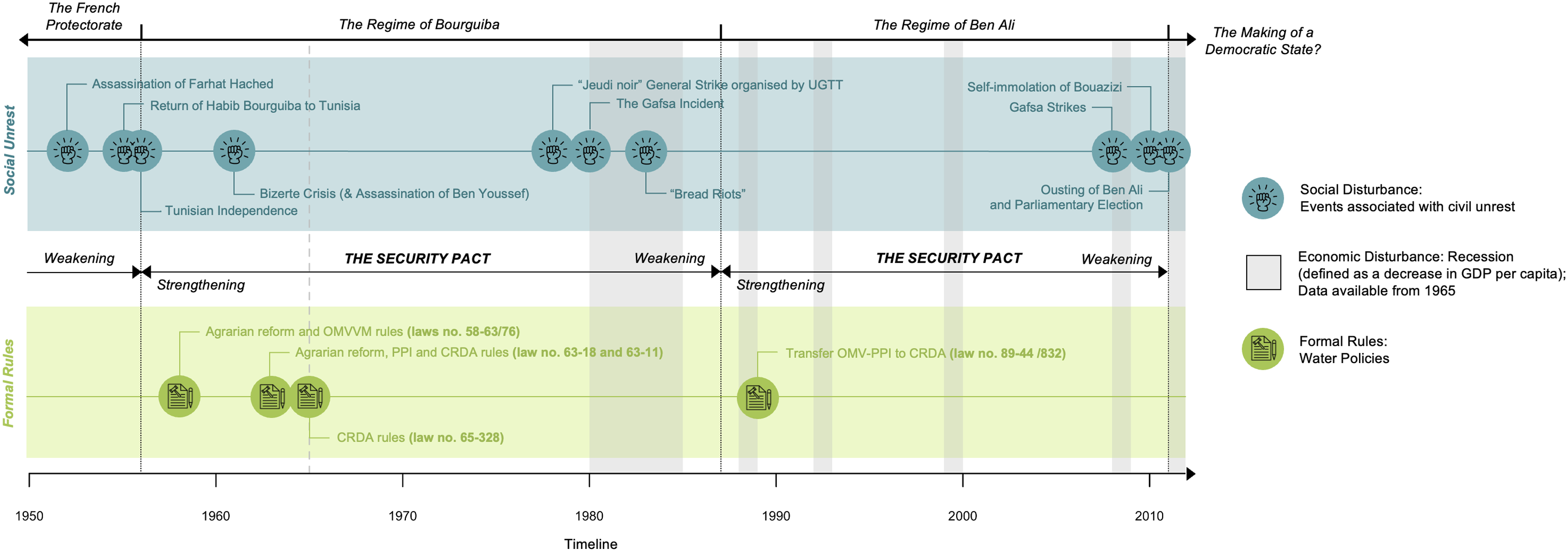
Historical evidence (planning documents, testimonies, etc.) for the analysis of water rules and institutions in Tunisia was collected in November–December 2021. Data was collected from archival sources (National Library of Tunisia), the academic literature, global datasets, and expert interviews. In total, 17 key informant interviews were conducted in Tunis with representatives from government, civil society and NGOs, trade unions, development organisations, and academia. Interview quotes will be referenced using interviewee codes representing the respective expert groups (e.g. GOV1, NGO2, UNO3, DEV4, ACA5). Following standards of good practice, the paper triangulated and cross-referenced data from documentary sources and interview data to limit biases and shifting baselines syndrome (Berkes and Folke, 1998; Folke, 2006; Gergel and Thurstan, 2021). The subsequent analysis will be structured chronologically and phased drawing on the three governance regimes in Tunisia 1950–2011 (the French Protectorate, the regimes of Bourguiba and Ben Ali) and their respective water management agendas. For the regimes of Bourguiba and Ben Ali, the paper will trace the construction of the security pact (by means of water sector reforms), resulting authoritarian control, and eventually the weakening of the security pact. The paper will conclude by summarising emerging themes and highlighting the relevance of this case-study for wider water governance efforts.
Analysis: ‘La Tunisie c’est l’Agriculture!’ [Tunisia is agriculture!]
The French protectorate
Established in 1881 by the Bardo treaty, the French Protectorate had two priorities regarding the use of land and water in Tunisia: Constructing water infrastructures and changing the juridical status of land collectives. The Plan de Modernisation et d’Équipement was initiated in 1947 and represented an ambitious programme of infrastructure development of Tunisia’s agricultural heartlands. Notably, the plan established the Lower Medjerda Valley irrigation scheme, which led to the irrigation of 35,000–40,000 ha of agricultural land (Chevalier, 1950). The colonial regime struggled to control collective land use systems in the centre and south of Tunisia (such as the Islamic collectives called habous) and began to abolish traditional agricultural systems under the slogan modernisation du paysanat [modernisation of peasantry] as early as 1938 (Charbonnier, 1964). The colonial administration pushed for the development of Tunisian land and its people through the surveillance of farmers by agents of the Protectorate and the redistribution of resources. Although overt violence was rare (in contrast to French colonialism in sub-Saharan Africa), violence in Tunisia was exercised by juridical normalisation, for example, vast operations of resource seizure on the basis of administrative laws (Hibou, 2011). The colonial experience played an essential role in normalising coercion as a regular exercise of power, weaving recurrent violence into the very fabric of contemporary Tunisian political history: a foreshadow of the repressive tactics employed in later regimes.
Three key political leaders paved the road to Tunisian independence: Habib Bourguiba, Farhad Hached (leader of the Tunisian General Labour Union, UGTT, founded in 1946), and Salah Ben Youssef (Neo-Destour leader while Bourguiba was in a self-imposed exile 1945–1949). Bourguiba, expelled from the country’s first opposition party, les Destouriens, called for independence in 1933, and created the ‘Neo-Destour’ party (Partie Socialiste Destourien). In 1952, Bourguiba was arrested by the French administration and handed the baton in leading the nation’s independence struggle to his right-hand man, Hached. In the same year, Hached was assassinated by French intelligence agents of ‘La Main Rouge’ [Red Hand] (Lebourg, 2021). Hached’s murder triggered public outcry (Figure 2), a 3-day general strike, and manifestations across the nation, which were countered with unprecedented violence by French forces (Mestiri, 2011). The already frail position of the French protectorate was weakened by the social unrest and eventually pushed them to open negotiations over possible Tunisian autonomy with the Neo-Destour party. Viewing Bourguiba as a ‘lesser evil’ over pro-Arab Ben Youssef (Wolf, 2017), the French Protectorate allowed the anew exiled Bourguiba to return to Tunisia in 1955 triggering never-seen-before national euphoria. Following these events of social unrest, French colonial forces put an end to the Protectorate and handed governing responsibilities to Tunisia’s reigning monarch, Lamine Bey. Descriptive inference of the event timeline and there-embedded causal narratives, where 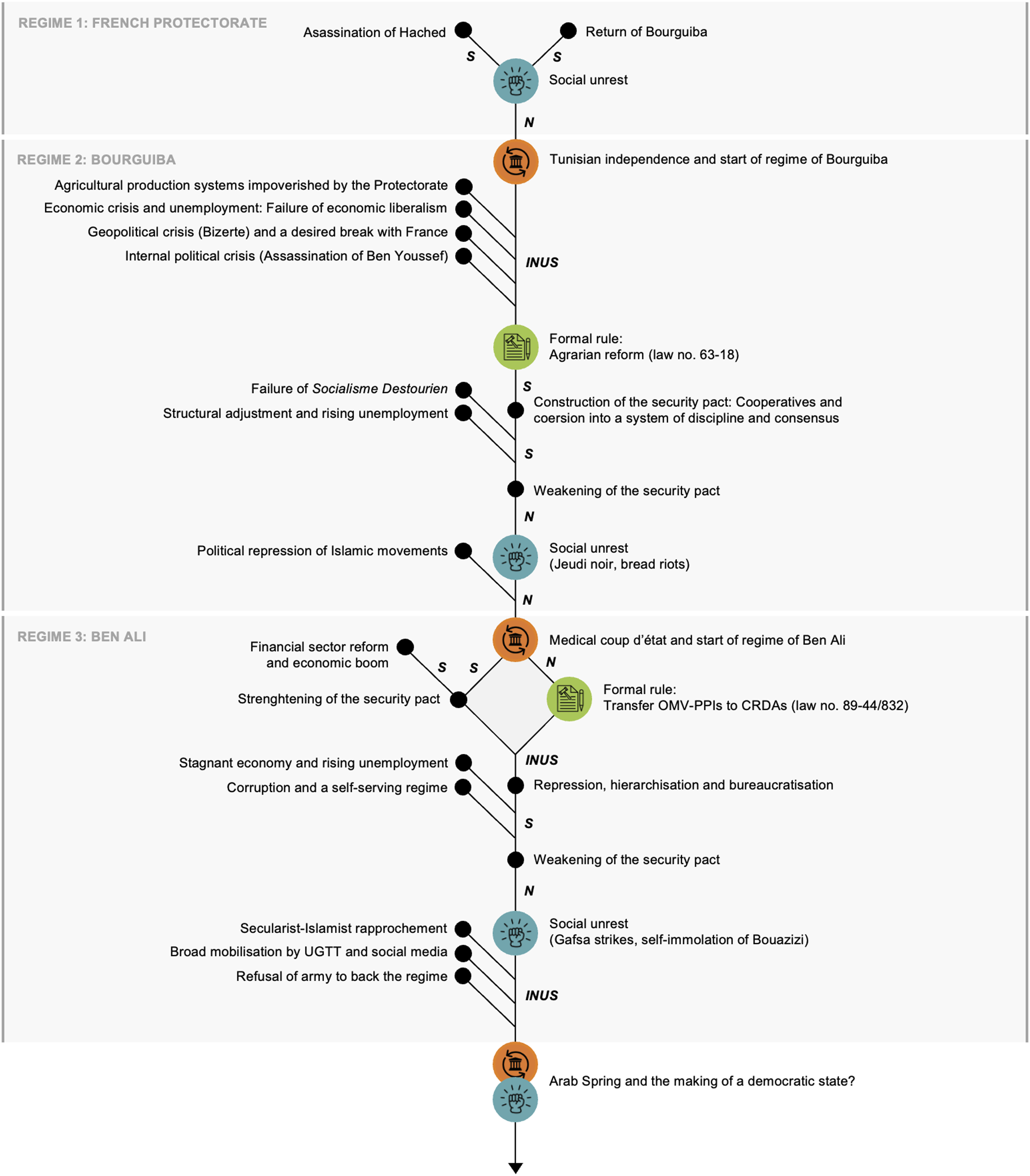
The regime of Bourguiba
In 1957, Lamine Bey resigned and Habib Bourguiba became the Tunisia’s first president. In the new “neo-patrimonial republic,” the Neo-Destour party had a monopoly of political power without effective constitutional opposition (Moore, 1962). Bourguiba frequently legitimised the authority of the regime as a necessary means to build a common national purpose: ‘As the party that gave birth to the state, the Neo-destour will work to resaturate the authority of the state and its prestige’ (Bourguiba in 1958 in Amrani, 1979: 74). Patterned upon metropolitan parties of “the West,” the Neo-Destour largely assimilated political procedures and culture of the old colonial power (Poncet, 1956). At the time of Tunisian independence, 918,350 out of 1,327,520 active Tunisian workers were employed in the agricultural sector (Amrani, 1979). A first tentative land and water reform was passed in 1958 (law no. 58–63) to set a maximum of 50 ha and a minimum of 5 ha for private irrigated properties in the agricultural heartland of Tunisia, the Medjerda Valley. To contextualise: At the time, three quarters of Tunisia’s irrigated lands were owned by private landowners holding more than 50 ha, and indeed those that owned more than 200 ha covered almost a third. This land reform of 1958 also foresaw landowners to contribute to irrigation infrastructure investments, either by relinquishing part of their land or paying their share directly (Charbonnier, 1964).
While theoretically revolutionary, these policies (targeted at the subdivision of communal lands) were not rigorously implemented and failed to effect the desired increase in productivity: ‘The titleholders needed credit and technical staff to help develop the land. In addition, the area allocated to each family was insufficient and did not allow the beneficiaries to obtain the minimum income, estimated at the equivalent of 250 Dinars per year per family. This is why they were quick to sell their plots to their neighbours or to third parties and to go work in underdeveloped sites’ (UGTT et al., 1967: 171). A second policy (law no. 58–76) was passed in 1959 creating the Medjerda Valley Development Agency (OMVVM), reporting directly to the presidential administration (Hamdane, 2019) (reiterating the high level of national importance of the irrigation water sector). The OMVVM replaced the Commissariat of the Medjerda Valley (established during colonial rule) and extended responsibilities beyond coordination and research tasks to the development and maintenance of hydraulic structures, technical support to farmers, and managing (where applicable) the land ceded by landowner with more than 50 ha (Charbonnier, 1964).
Construction of the security pact: cooperatives and coercion into a system of discipline and consensus
In 1963, a second agrarian reform (law no. 63–18) presented a break from the past: Extending limits to property rights, previously only relevant to the Medjerda valley, to the whole of Tunisia and defining clear obligations for farmers to develop and work irrigable lands in the form of cooperatives (Charbonnier, 1964). The creation of these “public irrigation perimeters” (Office de Mise en Valeur Perimetres Publics Irrigués, OMV-PPIs) and respective agricultural cooperatives, so-called unités de production [production units], are considered one of the major achievement of the Bourguiba era (Charbonnier, 1964). To this day, PPIs cover more than half of Tunisia’s irrigated land (242,000 of 435,000 ha total irrigated area) (MARHP, 2017). The year 1963 also saw the establishment of four regional representations of the Agricultural Ministry (law no. 63–11), so-called Commissariats Régional de Développement Agricole (CRDAs) (Canesse, 2014); extended to 24 CRDAs, one for each Tunisian governorate, 2 years later (law no. 65–328) (Amrani, 1979). The land reform of 1963 set Tunisia on a path of continuous irrigation expansion that to this day dominates policy- and decision-making in the water sector.
In the words of Charbonnier (1964), ‘reforms of this kind are only carried out under the pressure of events because their realisation clashes with too many interests to be undertaken cold’ (5). What were the conditions that culminated in the passing of the land reform of 1963 (Figure 2)? The sequence of events set its scene in newly-independent Tunisia, where marketisation and speculations of the French Protectorate had left agricultural production systems impoverished keeping farmers below the profitability threshold (Amrani, 1979). Further, in a brief period of economic liberalism (1956–1960), a series of incoherent and often contradictory policy efforts had been unsuccessful in putting a halt to rising rural unemployment as large-scale farmers resisted the government’s call for self-investments in agricultural intensification (Amrani, 1979). The economic crisis of 1959–1960 and the political crises of 1961 (described below) served as a trigger for a change in the party’s ideology, which marks a first (although incomplete) rupture with the colonial past.
During the economic crisis 1959–1960, inflation of the Tunisian Dinar (TND) was paired with economic dependence on France. Not only was TND still tied to the Franc, but an uneven import-export balance fosters structural dependence on the previous coloniser: ‘As long as France has the means to constrain us, our political independence will be perfectly illusory’ (Bourguiba in 1957 in Amrani, 1979). This debate culminates in the Bizerte crisis of 1961: ‘The Bizerte crisis and its consequences fit quite easily into the political and economic dynamics that led to the (…) adoption of socialism in November 1964 in Bizerte. We must then see how the 700,000 ha of colonial land were integrated into the first part of the experiment of reforming agricultural structures, and especially in what political, ideological and economic framework it took place’ (Amrani, 1979: 155–156). Simultaneously to the geopolitical crisis of Bizerte, the Neo-Destourien party is fighting an internal crisis of political domination and control. The assassination of Bourguiba’s political opponent Ben Youssef in 1961, drowned out by the success of the Bizerte crisis (ousting of French military presence on Tunisian soil), is considered the first blatant step on the path towards authoritarian repression.
The land reform was the centrepiece of the period of so-called Destourien socialism (1960–1969) (UGTT et al., 1967). It sought the equitable distribution of land (and consequently water), and increases in agricultural productivity (although this paper will go on to show that the regime prioritised the latter over the former). The ‘land reform was in its core a social project’ [ACA4] in favour of agricultural production, which at the time sustained three quarters of the Tunisian population (Charbonnier, 1964). The land reform hoped to achieve these goals via two main avenues limiting land ownership (limiting maximum and minimum area held by one landowner), and introducing irrigation cooperatives (raising water volumes available to individual farmers) [ACA4]. At the 7th Party Congress, President Bourguiba tied Destourien motivations of state-building to a new social agenda: ‘Property must therefore be considered a social function. It follows from this that no negligence is tolerated and that the land belongs to those who work it’ (UGTT et al., 1967: 16). In return for working the land as productive members of their agricultural cooperatives (so-called “production units”), new landowners were granted rights and livelihoods. Membership to cooperatives was mandatory and property rights shared between its members, after a probationary period of a few years (Charbonnier, 1964). This new formula of collective farming, and water allocation, was designed to raise productivity by shifting the financial burden of rural development from the backs of isolated individuals to structured social groups. This transformation of the rural space was also a means for Tunisia to present itself as a nation that upholds international values of modernisation (Karem, 1989).
Pushing the notion of productivity at all costs, the regime unveiled a range of ulterior motives during what can only be called an incomplete implementation of the equity-oriented ambitions of land reform. These motives see the prioritisation of agricultural productivity over promised social justice efforts – at the expense of disadvantaged communities and political opponents of the regime. First, while the expropriation of colonial lands represented an initially useful political tool, high returns from colonial farms were regarded as even more useful: ‘What is most important is not to put a Tunisian in the place of the French colonist; it is still necessary to maintain, and if possible increase, the level of production’, Bourguiba states in front of his party’s National Council in 1963 (Bourguiba in Charbonnier, 1964: 15). Second, Bourguiba pushes back against partisans of “Arab socialism” who are fighting for a more egalitarian allocation of resources: ‘What exactly do they want?,’ he argues. ‘Is it a question of enacting a law under which the lands would be confiscated, distributed, their owners thrown into prison? Such a spectacle would naturally excite the disinherited masses, who are always sensitive to the spectacle of the downfall of the great or the rich. If this is so, I will tell you frankly that I am not ready to make such a revolution. We know the resentments that have resulted in the countries that have chosen this path and the fall in production that has followed’ (Bourguiba in Charbonnier, 1964: 20). Third, the land reform sought the abolition of traditional forms of production (and thought) deemed incompatible with the economic development of the country (Karem, 1989). The reform conveniently reshuffled rural order against the traditionalist agrarian opposition that were angered by the abandonment of Youssefist pan-Arabism. Traditional systems of land tenure and agriculture particularly those associated with religious institutions such as the habous were strategically outlawed (UGTT et al., 1967) – similar to previous efforts by the colonial oppressor.
The shift towards a productive irrigation society built on the notion of state-building and contributed to the construction of the security pact (Figure 2). Bourguiba infused Tunisia with a new sense of “Tunisian-ness,” a communitarian nationalism that sought to put a halt to conflict, divisions, and tribalism (Hibou, 2011). It was in this notion of civic patriotism and the identification of Bourguiba as its “creator” that the choice of a single unifying party was to be justified. In its decadal development plan (1962–71), the government directly linked its vision of agricultural production to a social promise: 250 TND per year for families of five – 50 TND as the minimum individual income for a decent life (République of Tunisia, 1961). Presented as the only limiting physical factor to this promise, the question of water exploitation thereby became inextricably linked to social security with agriculture chosen as the key driver of the Tunisian economy – one that regulates and harmonises all other sectors by allowing for an equitable income distribution through agricultural cooperatives (UGTT et al., 1967). Two notions keep repeating themselves during interviews with key informants: ‘l’agriculture doit gérer tout’ [agriculture must manage everything] and ‘l’eau peut gérer tout’ [water can manage everything] [GOV2].
A leading political force since independence and co-developing the land reform, the UGTT and its unionists made “water for agriculture” its key political priority in the 1960s. Inspired by earlier Kolkhozes and Sovkhozes farming systems of the USSR (UGTT et al., 1967), the UGTT promoted the spirit of cooperatives as a tool to capture the public support of Tunisian citizens and integrate them in productive social communities: ‘The Tunisian experience is essentially based on the cooperative system. (…) Another principle that emerges from all this is also a method: persuasion’ (UGTT et al., 1967: 17–18). Being a productive member of a cooperative (and therefore society), individuals could be coerced into a system of discipline and consensus which was safeguarded by the social promise of development. Appealing to popular unity and social cohesion, the regime created an undeniable “truth”: ‘Here is our program. From now on, no one has the right to hesitate, whatever his function, whatever his position’ (UGTT in Amrani, 1979: 41).
The road from discipline to repression is a slippery one. Soon after introducing the land reform of 1963, as a necessary means to protecting the security pact and the myth of public consensus, Bourguiba introduced an apparatus of social agents, which he justified on the basis of ensuring social order (République Tunisienne, 1965). Political control over “units of production” produced a fine-tuned apparatus of domination and repression onto the working class: ‘The Neo-Destour supervises the population. Without this supervision, the success of the cooperative experience would be incomprehensible. In the boards of directors of most of the units there are leaders of local party cells - elected naturally like other administrators by the assembly of cooperators, but whose presence reinforces the control of the Neo-Destour’ (Charbonnier, 1964: 18). Fuelled by a populist rhetoric of state-building, these mechanisms of political domination were widely accepted due to the initial successes experienced by farmers, recently being able to afford investments collectively. Despite the return to economic liberalism in 1969, the rhetoric of rural development continues to prove useful to this day: ‘La notion du développement agricole, ça soulage l’état!’ [the idea of agricultural development relieves the state] [GOV2].
In the following decades, direct involvement of the state became a necessity in all matters of water sector decision-making (Ministère de l’Agriculture, 1976). ‘The state has taken charge of setting up and financing the basic infrastructure, from the construction of the dam to the installation of the irrigation terminal in the farmer’s plot of land’ (Elloumi and Gara, 1995: 99). The patrimonial political system of Bourguiba morphed into a ‘modern administrative dictatorship’ (Moore, 1970: 108). What the regime called ‘a temporary and inevitable tutelage’ practically equated to a monopolisation of all facets of political and social life in Tunisia, where the party ‘insisted on loyalty from a passive population while maintaining a populist, participatory ideology’ (Vandewalle, 1988: 605).
The weakening of the security pact: economic decline and social unrest
By 1969, Tunisian socialism had suffered from rigid hierarchies, growing inefficiencies (Karem, 1989), and corruption, and was largely dismantled having encountered significant opposition from Tunisia’s political elite. The break with socialist traditions was accompanied with ‘the alignment of Tunisia with the model of a liberal Western economy and the strengthening of an authoritarian and repressive state’ (Dakhli, 2021: 64). To counteract a lingering political and economic malaise, mounting debts owed to French banks, the decline of the agrarian sector, the new system put in place in the second half of the 1970s intended to free up private investment and implement new public infrastructure programmes (Wright, 1982). The regime bowed to new wisdoms of liberalisation by drawing on inspiration from the success of the export-oriented industrialization of the East Asian tigers (Murphy, 1999). With financial support from the World Bank and IMF, structural adjustment and stringent austerity programs forced the closure of unproductive unités de production – leading to a rise in unemployment accentuating regional disparities (Dakhli, 2021; World Bank, 2022).
On January 26th 1978, often referred to as Jeudi Noir [Black Thursday], the country witnessed its ‘biggest working class upheaval since Tunisia won independence in 1956’ (Disney, 1978: 12). The, at that point half a million members strong, UGTT called for a general strike, which was met with violence by the government, leaving more than 200 dead, thousands injured, and around 1600 arrested. The strike represented a sharp break from the previous co-dependence between UGTT and the government. Having acted as a transmission belt for the regime and its policies, the labour union’s role had ‘been as much to control the workers as to defend their interests’ (Disney, 1978: 13). Evidence from police communications of the strike later revealed planned escalations of violence and that clashes between protesters and police/military forces were purposely provoked in order to justify a campaign of repression. After the events of Jeudi Noir, the government took control of the UGTT leadership but sources of discontent within the organisation and its workers continued to grow. Two years later, on January 27th 1980, a group of around 60 guerrilla fighters opened fire on a military base and police station in Gafsa, a mining town in the South of Tunisia (Wright, 1982). The uprising, which sought to rally Gafsa’s citizen against the Bourguiba regime, was halted by Tunisian security forces after some days and several dozens of casualties.
In 1982, nearly two-thirds of unemployed were under 24 years old, representing a considerable and potentially hostile social force (Murphy, 1999). On December 28th, 1983, the so-called “Bread Riots” ignited. Lasting barely 10 days and costing the lives of more than one hundred people, the riots fit into a chronology of the civil struggle against neoliberalism. The destabilisation of the Tunisian economy had been accompanied by price hikes and the withdrawal of redistribution policies. Beyond the sudden doubling of the price of bread, the Bread Riots of 1983 was a testament to an inherent social struggle: ‘More than hunger or poverty, what the demonstrators pointed to was the violation of a tacit social contract’ (Dakhli, 2021: 42–43). The strong symbolic value of the riots turned a seemingly unorganised and apolitical group of people into political insurgents. The events served as a natural extension of a confrontation with power, a theme that can be revisited as part of the Arab Spring protests. The strength of the campaign in 1983 lay in the appearance of hope and the imagining of a new open and progressive society. ‘The value of bread is less measured by hunger than by the gap, transformed into a divide within a few days, between those who can “be part of it” and those who remain on the sidelines’ (Dakhli, 2021: 67).
Despite this unprecedented civil unrest, both in nature and extent, the regime of Habib Bourguiba showed little to no inclination to initiate or implement political reform. In the meantime, Islamic movements, most notably the Islamic Tendency Movement (MTI), had started to receive considerable public attention since the 1970s. Initially, the movement’s stance had not been to seek a monopoly on political expression but rather to add a contemporary Islamic meaning to the political debate (Vandewalle, 1988). When the entire MTI leadership had been imprisoned or exiled, after having asked the government for recognition as a political party, the movement gradually politicised creating new splinter groups prone to violence. When Bourguiba insisted on a retrial and harsher sentences for Islamists arrested in early 1987, his prime minister, Zine el-Abidine Ben Ali, grew wary of a potential breakdown of the country’s social order and took it into his own hands to effect a change in political leadership (Vandewalle, 1988). During the night of 6–7th November, a medical evaluation signed by seven doctors deemed Bourguiba incapacitated and silently removed him from office. What was thought to necessarily end in violence as an ‘inevitable result of the polarization of Tunisian politics’ (Wright, 1982: 134) instead took the form of a peaceful “medical coup d’état.”
The regime of Ben Ali
Construction of the security pact: a new era of discipline and coercion
The political events leading up to the decline of the regime of Bourguiba represent the boundary conditions for the subsequent regime of Ben Ali and illuminate political motivations for water sector reforms going forward. Ben Ali had near unanimous internal support and public appraisal for the so-called constitutional coup (referring to Article 57 of the Tunisian constitution stating that the president of the republic may be replaced in case of “death, resignation, or permanent inability”). The new 5-year plan (1987–1991) foresaw a great push for irrigation and water infrastructure development (Murphy, 1999) as well as the liberalisation of the Tunisian market: A near impossible task in a political system that had practiced clientelism and state control over pricing and planning even when and where private enterprise was allowed and encouraged. Ben Ali’s liberalisation reforms showed promise in the 1990s, when the country received substantial external funds to implement financial sector reforms, improve the competitiveness of Tunisian businesses, and privatize public sector enterprises (Angrist, 2013; Radwan et al., 1991). His increasingly autocratic rule was for a long time legitimized by his rational stewardship of the Tunisian economy.
In 1989, OMV-PPIs, locally managing public irrigation perimeters, were dismantled and absorbed by regional CRDAs (law no. 89–44/832). This tactic served the centralisation of water management by means of decentralisation or in other words a relay of power from technical institutions quasi-independent from the government to bureaucratic institutions representing the state itself [ACA4]. The new law charged the 24 regional CRDAs with the responsibility to implement agricultural policies at the regional scale including the maintenance and control of hydraulic structures, etc. (M’kadmi, 2005). Two years earlier, the Water Code had been amended by law no. 87–35 to endorse established collective interest groups, Associations of Collective Interest (AICs), today called Groupements de Développement Agricole (GDAs), and define practical responsibilities regarding operation and maintenance of hydraulic structures (Hamdane, 2019).
With law no. 89–44/832, authoritarian repression received a new coat by the new regime. Quasi-decentralisation meant that from then on, every decision had to pass through the regional representation of the agricultural ministry. With this integration of the state in the operationalisation of agricultural production (local monitoring of resources, creation of boreholes, installation of hydraulic equipment for drinking and irrigation water, etc.), the government directly involved itself in the everyday lives of farmers (M’kadmi, 2005). This shift also triggered a loss of technical expertise: ‘dans les CRDAs on ne gère plus l’eau’ [in the CRDAs, we no longer manage water] [GOV2]. While OMVs were specialized, managed by water technicians, water management is only one of many divisions in CRDAs, managed largely by generalists [GOV2]. More promising efforts to decentralise agriculture, for example, structuring water users into groups (GDAs), were overshadowed by theses centralisation effects. By creating a single instance for everything water-related, ‘le service à proximité est perdu’ [accessible service is lost] [GOV2]. Instead, technical proximity got replaced by the bureaucratic proximity of the state creating a new social dimension of water resources allocation and use. The power of the regime created, coexisted with, and mutual reinforced the omnipresent power of the administrative apparatus. ‘In the words of the jurist Mustapha Ben Letaïef, “governorate councils and municipal councils are structures that appear to be more like emanations of the central power, consecrating its territorial penetration and its hold on the local field”’ (Brochier-Puig, 2012: 59).
Power, in the regime of Ben Ali, was systematically exercised through a dynamic interplay of social and economic arrangements, negotiations, and informal contracts. Hibou (2011) draws on Foucault’s ‘political anatomy of the detail’ (1975) to unpack mechanisms of instrumentalization by police institutions and practices, that shape domination beyond physical coercion. Diffuse supervision transcends “obvious” coercive repression, commonly associated with repressive regimes, and enters the realm of moral, administrative, and social policing. Daily life in Tunisia during authoritarian rule was shaped by the conjunction of apparent normality and perpetual obtrusive surveillance. Beyond what common analyses of repressive regimes suggest, it is seemingly banal practices that render constraint almost “invisible” and subsequently render conformity “voluntary.” Complementing standard forms of punishment, for example, detainment, political opponents would, for example, be coerced to present themselves at the police station multiple times a day, be subject to systematic police surveillance, and could expect unwarranted confiscation of important documents such as their social security cards. These disciplinary functions ‘whose purpose it is to intimidate, to make an example of someone, to shape people’s minds and define the outlines of the social norm’ (Hibou, 2011: 6) were part of the so-called fringe strategy. It is through this exemplarity of exclusion that concealed procedures of domination were engrained in the social and economic reality, and personal interest, of Tunisian citizens. The interdependency of reciprocal relations between individuals resulted in the normalisation, and indeed often the acceptance and support, of disciplinary functions of the regime.
This institutionalisation of political and economic roles within the water sector can be linked to the rise of two phenomena: Hierarchisation and bureaucratisation. The power of administrative control held a strong disciplinary grip on water users with seemingly banal bureaucratic requirements. The government assumed the role of ‘supreme planning authority’ (Omar, 2012: 135) and coerced Tunisian farmers into a strict regime as laid out in their plan economy: ‘planners set constraints for the farmers, so for example, for a farmer with so many hectares, so many cattle (…), the planners take the liberty of forecasting the production of such and such quantities at such and such prices and the acquisition of such and such an income allowing the implementation of such and such an investment with such and such a grant and such and such a loan and the consolidation of such and such a debt at such and such a date’ (Karem, 1989: 2). Prior to law no. 89–44/832, receiving well authorisations or assistance from specialised OMVs (e.g. for a new borehole) had been a straight-forward process. Now that approval from central government was required for well authorisations, the authorisation process was slowed down substantially (Kassah, 1995). Water resources management by the Tunisian government was handicapped by the bureaucratic heaviness and randomness of its administrative processes. The centralisation of power decision-making divided and isolated local production units and their farmers: ‘Integrated in an extremely hierarchical circuit, the cooperative is isolated, in the sense that there are no possibilities of direct exchanges between the different cooperative production units of the same delegation or the same governorate’ (Amrani, 1979: 231). In 1992, the structure for agricultural subsidies, for example, funding for irrigation equipment, became centralised and channelled through one single national agency (Agence de Promotion des Investissements Agricoles, APIA). Previously, subsidy payments had been processed by regional CRDAs, who could hand out cheques directly on the spot [GOV2].
The weakening of the security pact: unemployment and social unrest
New roles and responsibilities resulting from the shift from OMVs to CRDAs lacked overall coherence and remained unclear to water users (Brochier-Puig, 2012). According to interviewees, the resulting uncertainty spurred “creative solutions” (such as illicit wells) as a response mechanism. Meanwhile local water management was delegated to GDAs, who unaccompanied by the government lack the capacity to work the new system or indeed implement laws (e.g. code des eaux of 1975). The uncertainty of rules and responsibility meant that individual civil servants were unable to take initiative to ensure policies were implemented. Even if policies had been clear and coherent, local decision-makers always required unlocking of bureaucratic barriers, for example, an official authorisation from a higher level of hierarchy (Hibou, 2011). The resulting institutional framework is a construct of social interdependencies, favoured by the extensive use of oral over written media. It follows, that ‘a law, in its real effects, is much more closely linked to attitudes, to schemas of behaviour than to legal formulations’ (Foucault, 1975: 308). Individuals who violated laws (e.g. drilling or taking water from an illicit well) would rarely think of their by-passing of the law as a politicised activity but rather a commonplace activity as any other.
Ben Ali’s reforms continuously turned more superficial than fundamental and his stewardship more rapacious than rational. The consequent stifling of new investment and gradual dismantling of tariffs during and after the 1990s, notably pushed by the European Union and liberal trade agreements, delivered poor economic performance and growing unemployment, for example, among university-educated Tunisians, an estimated 40–45% were unemployed (Angrist, 2013). Structural adjustment policies saw the privatisation of state farms, subsidy cuts, and the corporatisation of food distribution networks (Gana, 2016). As the negative aspects of a stagnant economy and the arbitrariness of a bureaucratic surveillance system outweighed the positive aspects of social promises, anger and disappointment grew within the Tunisian public. Bureaucracy was increasingly associated with lack of information and transparency: In the irrigation sector, a farmer who is denied their livelihood-sustaining authorisation would often not be given an explanation for this decision. As the security pact is weakening, the potential for frustration grows: “If my neighbour gets his well authorised, why didn’t I get an authorisation? How am I to make a living?”.
The calm façade of the police state began to crumble in 2008 when the country’s biggest protest movement since the Bread Revolt (and the first protests against Ben Ali) hit the city of Gafsa. The revolt started after a public phosphate company in Gafsa, a region ridden by unemployment and general economic distress, did not keep their promise of hiring marginalized local workers but instead individuals with proven connections to the regime. Although the strikes mobilised a wide range of social fractions from mine workers to unemployed graduates and internet activists, they were unable to withstand the coercive policies of the regime and remained regionally constrained due to limited national support (Marzouki, 2011).
On 17 December 2010 in the town of Sidi Bouzid, fruit vendor Mohamed Bouazizi is stopped, interrogated, and harassed by the police. For the lack of official papers, he saw his stand confiscated. In an act of complete despair, he set himself on fire in the centre of the town and died hospitalized a couple of days later. It was in the humiliation that this incident produced, that the Arab spring started. ‘As with bread [during the Bread Riots of 1983], it was not simply a confrontation, or a discussion about a corrupt system (although this was also a central issue), but a political statement, from the working classes, on the meaning of social justice’ (Dakhli, 2021: 68). Nationwide protests, populated by citizens from all socio-economic classes and across political divisions with shared aspirations for political liberties, triggered Ben Ali to step down on 14 January 2011. The events of the Arab spring must be viewed in connection with the series of rural protest movements sweeping the country’s farming areas after December 2010 (Gana, 2016). Resistance against marginalisation is a common theme for Tunisia’s rural population (Ayeb, 2011; Ayeb and Bush, 2019) and continues well beyond the events of the Arab Spring, for example, small farmer protests directed at falling net prices for agricultural products are common across Tunisia (Ayeb and Bush, 2014). The link between social unrest and perceived violations of promises of social security remains relevant for public debates on water reforms today.
Conclusion
Following a political sociology lens to water resources management, this analysis has traced historical processes that causally link (agricultural) water sector reforms in Tunisia to the creation of a security pact – and in its maintenance authoritarian repression and self-reproducing social norms. Bundled land and water reforms contributed to the institutionalisation of repression and co-optation of water users. The above case-study of water governance systems in Tunisia serves to expand theories of authoritarian control and the “selectorate” to trace the evolution of irrigation systems as materialisation of non-democratic politics (Rignall, 2021), and vice-versa how non-democratic procedures can be facilitated by water sector reforms. The steps that led to Tunisian independence in 1956 laid the foundation of the symbolic vehicles of state-building used by subsequent regimes to legitimise policy shifts in the irrigation sector. In the name of social security, the regimes of Bourguiba and Ben Ali consolidated political power by reshuffling rural order and associated irrigation systems (laws no. 63–18 and 89–44/832 respectively). Irrigation intensification served as the social promise justifying the centralised and increasingly repressive force of the administrative apparatus and its bureaucratic co-optation tactics over farmers. Expanding on the theme of water infrastructures (Akhter, 2015, 2019; Barnes, 2017; Engels and Schenk, 2015; Menga, 2015) and the role of pumping technology as a technological artefact (Barnes, 2012), the Tunisian example thereby contributes to the literature on space and identity politics (Alatout, 2008; Barnes, 2009; Swyngedouw, 2014; Woertz, 2017).
Why is it important to study the past when tackling present-day water scarcity issues? Water governance problems in Tunisia are not to be reduced to climate change, population growth, nor the nature of the resource or resource users per se. The processes driving water scarcity, and groundwater depletion specifically, as well as the associated loss of agricultural livelihoods are historically co-constructed, with structural interdependencies between resource users and policy makers. In the contemporary history of Tunisia, social unrest was born when individuals or groups of individuals felt the “security pact” was violated. In other words, the “force of obedience” (Hibou, 2011) weakened when positive elements of the pact, no longer outweighed the violent and humiliating dimensions of the repressive regime. For example, threats to a decent standard of living incited the bread riots of 1983, the Gafsa strikes of 2008, or the self-immolation of Bouazizi in 2010. Ayeb and Bush (2014) and Gana (2016) argue that the marginalisation of rural farmers and the associated feeling of neglect is the result of economic liberalisation by Tunisia’s urban elites – a legacy of authoritarian rule. This sense of “being left behind” is emblematic of the role and value of water for livelihoods and social security – in Tunisia specifically, as well as in the MENA region and beyond. While the silent revolution of groundwater use (Llamas and Martínez-Santos, 2005) has led to a serious global phenomenon of groundwater overexploitation and depletion (Jasechko et al., 2024), the transformation of drylands into “irrigation technozones” (Akhter and Ormerod, 2015) has also gone hand in hand with the creation of rural livelihoods, associated social expectations, and economic dependencies.
Across the world, managing water scarcity faces a seemingly insurmountable dilemma. The solution to groundwater depletion (reducing water use in the most consumptive sector, i.e. agriculture), poses a problem in itself. How can governments communicate important irrigation reduction measures, which essentially translate to farmers losing their jobs and growing less food? Particularly when irrigation intensification has historically been a tool of state legitimisation, a social promise and cornerstone of rural development, how can communities that rely on (ground) water for their livelihoods, not feel betrayed by a seemingly sudden retraction of irrigation subsidies? Today, threatening farmers their access to water, whether in the form of raising water prices or closing illicit wells, mirrors past triggers of social unrest in Tunisia, where citizens felt that their livelihoods, their very means of existence, were under attack.
Decades of forging an apparatus of repressive surveillance gave rise to widespread public distrust in formal rules and to a network of informal contracts between water users and communities, which developed in part as coping mechanisms and in part as reinforcements to existing hierarchical structures. On the other hand, as a consequence of the decadal erosion of decentralised institutional and technical capacity, there remains a continued dependence on centralised government in water resources management: ‘La locomotive c’est l’état’ [the government is the engine] [NGO1]. In this sense, the state is simultaneously distrusted and made responsible for solving contemporary water issues. Fung and Lamb (2023) find that resistance to authoritarian rule can be slow and incremental. A troubled past of coercion and marginalisation can be continually reconstructed in the collective memory of communities (Misztal, 1996). Water policies targeted at reducing irrigation intensity should therefore be calibrated to the sensitive collective memory of rural farmers and water users.
The historical case study of Tunisia serves as an example of the kinds of structural legacy barriers good water governance efforts might encounter when addressing pressing water issues. With respect to the state of water science and knowledge, data revealing critical biophysical limits of extraction are frequently considered “uncomfortable knowledge” (Rayner, 2012), particularly in cases where resources have previously been used to legitimise state control. According to Foucault (1975) and (Scott, 2000), states strategically produce knowledge to govern and control their populus. Similarly in the water sector, when states see their legitimacy threatened by water scarcity data, uncomfortable knowledge can be deliberately or practically erased. This “production of ignorance” (McGoey, 2014; Pestre, 2013; Proctor and Schiebinger, 2008) is common-place in countries that have historically relied (and continue to rely) on irrigation technozones for development – see Mayaux and Fernandez (2024) as a recent example in Morocco. In modern-day Tunisia, data on groundwater depletion is chronically fragmented in space and time. Efforts to standardise and integrate scattered data remain promises without effective results (despite substantial financial support from international donor agencies). Studying the evolution of irrigation institutions and the production of water-related knowledge through time can provide much-needed explanations for the messiness of contemporary water scarcity debates and inform steps forward in addressing these legacy barriers.
The author believes that it is important to understand the past, more precisely the pathways of decision-making in space and time, to understand what avenues for policy-making and practical institutional support are available and meaningful in the present. The historical analysis of land and water policies in Tunisia shed light on the erosion of institutional trust and regional capacities, the perversion of social promises for repressive ends, and the coercive construct of informal, hierarchical, and bureaucratic interdependencies that are still alive today. Addressing global water scarcity issues, which are particularly potent in the drylands of North Africa, requires a contextual historical analysis of legacy barriers to good water governance reforms. In the case of Tunisia, the past can serve as a tool for precaution, for example, in relation to recent calls for the establishment of a new Tunisian water-police to combat illegal wells, and as an indicator for policy potential, for example, the legacy of collective action in water user groups. Importantly, future-oriented water policies need to provide opportunities and/or alternatives to small-holder farming communities (Ayeb and Bush, 2014), some of whom are facing necessary transitions away from intensive irrigated agriculture (Bhalla et al., 2024). As Tunisia enters an uncertain political future as well as a growing (ground)water crisis, grounding policy interventions in empirical evidence is pertinent not only to reach sustainable resource use but moreover to ensure the protection of current and future livelihoods.
Footnotes
Acknowledgements
The author is grateful to Deutsche Gesellschaft fur Internationale Zusammenarbeit (GIZ) GmbH for their logistical support during fieldwork and to European Consortium for Political Research (ecpr) for the valuable feedback given during the ecpr Joint Sessions 2022 “Authoritarianism across space, time, and scale”.
Declaration of conflicting interests
The author(s) declared no potential conflicts of interest with respect to the research, authorship, and/or publication of this article.
Funding
The author(s) disclosed receipt of the following financial support for the research, authorship, and/or publication of this article: This work was supported by the St John’s College Oxford Special Grant and the fieldwork fund of the School of Geography and the Environment at the University of Oxford.
