




Abstract
Strategic urban planning has long been promoted as an important approach to transitioning to sustainable communities. However, previous literature on the Nordic context has critiqued strategic activities because they often take place outside of statutory planning procedures and therefore present legitimacy deficiencies. While the inclusion of both stakeholders and diverse expertise has been recognised as important in strategic planning, previous planning literature has focused either on the role of politics or knowledge in planning, but not as much on the relationship between the two. This paper aims to deepen our understanding of how political and epistemic authority affect the legitimacy of strategic planning by exploring how participants in an informal strategic planning process enact authority. By applying a theoretical framework of stakeholderness and boundary work, the paper shows how the balance between political and epistemic authority is important when legitimizing strategic planning processes. The paper concludes by suggesting the concept of knowledgeable stakeholders to describe actors’ enactment of political and epistemic authority. This paper argues for a need to repoliticise participation in strategic planning by illuminating the interrelatedness of politics and expertise, to which the concept of knowledgeable stakeholders can contribute.
Introduction
Strategic urban planning has long been promoted as an important approach to transitioning to sustainable communities, but previous research has identified legitimacy deficiencies in terms of transparency, inclusion and accountability, particularly in a Nordic context (Mäntysalo et al., 2015). In the Swedish planning context, strategic planning is incorporated into statutory planning in developing comprehensive plans that define the long-term aims of land-use development. However, when translating comprehensive plans into Detailed Plans (DP), strategic planning actions are not as clearly incorporated in the statutory procedures. Instead, in this phase of the planning process, when strategic procedures are employed, they tend to take place outside of statutory planning, particularly when it comes to innovation and collaborating with private actors or civil society (Persson, 2020; Trygg and Wenander, 2021). This causes an informality of strategic planning that can result in legitimacy deficiencies, as suggested by Mäntysalo et al. (2015), because it can bypass the regulations in statutory planning.
As participation and collaborative practices have been highlighted in strategic planning over the past decades as the inclusion of diverse knowledge and interests, and is considered one basis for legitimizing strategic decisions (Healey, 1997; Mäntysalo et al., 2015; Pettersson et al., 2017), ensuring the legitimacy of these practices is crucial to be able to uphold democratic values (Taylor, 2019). For planning processes, it also matters for avoiding contestations of planning projects. However, achieving inclusive participation is also particularly challenging (Boström, 2012; Pettersson et al., 2017; Swyngedouw, 2005; Turnhout et al., 2020).
In planning theory and practice, this challenge has played out historically through the relation between knowledge and politics in figuring out how to balance technocratic planning practice and the inclusion of stakeholders (Healey, 1997; Raco and Savini, 2019; Taylor, 2019). The balancing between the two refers to that politics tends to be understood as representing ideologies, interests and beliefs, while knowledge tends to be understood as facts and objective truths (Turnhout et al., 2020). However, while planning literature tends to emphasize the need for both local knowledge (Fenster and Kulka, 2016; Tironi, 2015) and community values (Kibukho, 2021; Tahvilzadeh, 2015), planning literature also points to the need to separate between engaging different voices and engaging different knowledges (Rydin, 2007). In other words, to distinguish between stakeholders and knowledge-holders.
Recently scholars have seen a new move towards a technocratic form of planning, where the political aspects of knowledge use are disregarded and rather depoliticised (see Raco and Savini, 2019; Turnhout et al., 2020). While this may seem as merely a theoretical distinction, in Swedish planning practice it affects how and at what stage of the process actors can influence the plan. For instance, the same citizen or a private enterprise can be considered as either stakeholders, with particular interests in the land use project or to have specific expertise valuable to the planning process.
Stakeholders would normally be shut out from the planning process until the public consultation of the plan while knowledge-holders can be invited as consultants earlier in the process (see also Raco and Savini, 2019). In Swedish planning practice, this distinction has been important in upholding a fair and transparent bureaucratic process where everyone has the same opportunity to influence. However, this also comes with the assumption that the knowledge is unbiased and unpolitical – an assumption that critical scholars have challenged (see, e.g., Flyvbjerg, 1998; Rydin, 2020; Tironi, 2015; Turnhout et al., 2020).
Despite the intention to separate stakeholders and knowledge-holders, previous planning literature has successfully shown that stakeholders wanting to influence planning decisions tend to make use of knowledge claims and technical facts (Tironi 2015; Stepanova and Polk, 2023), but also that authority tends to differ depending on the knowledge type activated; for example, lay and local knowledge tends to have less authority than scientific knowledge (Fenster and Kulka, 2016; Savini and Raco, 2019). This literature shows the politics of knowledge and the need to further explore the relationship between politics and knowledge in urban planning, something that contemporary governance struggles to balance (Savini and Raco, 2019).
With this understanding of knowledge as political, one is bound to stay critical towards claims made by strategic planning scholars, such as Albrechts (2015: 515), when suggesting that strategic planning should be an inclusive, equitable and multi-vocal arena where both different value systems and knowledges can be combined. While this is an important ambition to create inclusive societies, this broad involvement of actors and openness for innovative activities cause an informality that instead risks serious legitimacy problems (Mäntysalo et al., 2015), particularly if not taking the relation between politics and knowledge into account.
This study builds on this debate and draws on the understanding of knowledge and policy as co-produced (in Jasanoff’s (2004) terms), particularly regarding the role of political and epistemic authority and their influence in strategic urban planning. More specifically, this paper explores the roles of actors and how they enact authority in a Swedish planning project.
To explore the enactment of authority, I differentiate between political authority – whether participants are considered stakeholders or are accountable in the planning event – and epistemic authority – whether participants are considered to be knowledgeable within their domain. The paper focuses on how these forms of authority interrelate. Given that strategic planning activities refer to both a political dimension of including citizens or marginalised groups and an opportunity to integrate different types of knowledge, we need to understand how these two aspects interrelate and how this interrelation plays out in practice. The aim of this article, then, is to deepen our understanding of how political and epistemic authority affect the legitimacy of strategic planning. To do so, the paper endeavours to answer this research question: How are political and epistemic authorities enacted in an urban planning project in Gothenburg/Sweden?
I investigate this by applying a theoretical framework, building on the concepts stakeholderness (Metzger, 2013) and boundary work (Gieryn, 1999), on a Swedish strategic planning project, Frihamnen in Gothenburg. Together, these concepts enable us to look at the planning process and gain a new understanding of how politics and knowledge interact and relate. By applying the relational lens, this paper shows the importance for participants to balance political and epistemic authority, and how that affects the legitimacy of the strategic planning process. It also shows how strategic planning can change power dynamics between actors, which could either strengthen or weaken the legitimacy. The paper makes a theoretical contribution by suggesting the concept of knowledgeable stakeholders to describe this interrelation of political and epistemic authority and how it is framed depending on the participants’ roles. The paper also contributes an in-depth empirical study of how participatory events unfolded in the strategic urban planning project of Frihamnen, Gothenburg/Sweden.
The paper consists of six parts. The next section presents the theoretical approach of political and epistemic authority. Following that section, I present the methodology of the case study, which is followed by a description of the context of the case, Frihamnen. Next, I present the results of the analysis in three sections: first how the dynamic change between the involved actors, then how some need to balance political and epistemic authority and finally the issue of trust. Lastly, I discuss the implications of the findings and present my conclusions.
Theory: Becoming stakeholders, becoming knowledgeable
Legitimacy has a wide range of meanings. For this paper, I understand legitimacy as a process that is transparent and fair, as one in which the input and outcome are publicly accepted and trusted; and one that follows legal and bureaucratic procedures (Eyal, 2019; Kronsell, 2013; Mäntysalo et al., 2015; Metzger et al., 2017). As Buchanan (2002) points out, legitimacy is an ambiguous concept, mostly because of the conflation of legitimacy and authority. Overall, the legitimacy of a governmental planning process is highly dependent on who is included/excluded and how the different actors enact their authority (Mäntysalo et al., 2015; Metzger et al., 2017; Páez et al., 2020; Pettersson et al., 2017). In this article, therefore, I distinguish between legitimacy and authority according to Weber’s (2019) distinction: legitimacy refers to the acceptance of social order, and authority refers to an entity, for example, an individual, an organization or a group, who has the power to represent the statutory order or a stakeholder group. Authority can therefore be enacted by either a representative of, for example, the government as a civil servant or politician, or by representing the public as a political party, an interest group or a citizen. Legitimacy and authority, therefore, depend on each other: a statutory order grants authority and authority upholds the order.
Building on the understanding of policy and expertise as co-produced (Flyvbjerg, 1998; Jasanoff, 2004), I investigate how political and epistemic authority interrelate by combining Gieryn’s (1999) theory of boundary work with Metzger’s (2013) theorization of stakeholderness. Both theories take a relational perspective on legitimacy. From this perspective participation and collaboration are neither good nor bad, fostering legitimacy or not, but rather other factors determine the outcome of these practices, such as rationales and set of infrastructures of a certain context (Metzger et al., 2017). In other words, participation is a collective practice that shapes and is shaped by its political and societal contexts through how it is configured, mediated, and performed (Chilvers and Kearnes, 2015). When comparing political authority and epistemic authority, the logic behind them differs and is seemingly in conflict when values and facts are understood as dichotomised (Hillier 1999; Savini and Raco, 2019).
Political authority, I define as a way to determine who is a legitimate stakeholder (Pettersson et al., 2017), in other words, who has “legitimate concerns” (Metzger et al., 2017). In land-use planning, the stakes are connected to a specific territory, where “statements of interest, attachments, and points of view are translated into stakes within a specific process of ‘stakeholderization’” (Metzger, 2013: 788). A stakeholder is someone who could be considered affected by the development and therefore has stakes in the process and the socially accepted right to weigh in on decisions made (Pettersson et al., 2017). However, Metzger (2013) argues that stakeholders are not found but rather are better conceptualized as a relational effect in a specific situation, where actors are made stakeholders through elaborate procedures by enacting and being ascribed “stakeholderness” by others involved.
Mäntysalo et al. (2015) point out that in strategic planning in Nordic countries, there are conflicting governing ideals in play, which means that inclusion can refer to both “the public” and “resourceful actors”. The inclusion of stakeholders in strategic planning can therefore serve very different purposes but still go under the same label of participation, for example, by including residents or business interests. Strategic planning also emphasizes the inclusion of different types of knowledge (Albrechts, 2015).
Epistemic authority, I define as an actor who is claimed to be knowledgeable in accordance with Gieryn (1999: 1), that is, as someone with “the legitimate power to define, describe, and explain bounded domains of reality”. According to Gieryn (1999), for knowledge to become socially acceptable there needs to be a general belief or trust that it is a ‘true’ description of reality. This does not mean that the description is true, but a critical mass needs to accept this description as true. Following Gieryn’s definition, to determine truth claims, actors with epistemic authority define and create rules for what knowledge is, how it is produced, and by whom. Gieryn (1999: 16–17) calls this a process of demarcation of knowledge domains or boundary-work. This is an ongoing, dynamic process wherein knowledge and who is considered knowledgeable are continually being reproduced or challenged.
Demarcation can be practised through expulsion – a means of social control – by placing and policing the borders of the authority of a certain knowledge domain. Within this domain, the actors with epistemic authority set (and know) the norms of conduct. By establishing and reproducing these norms it is shown who and what belongs within or outside the domain. For example, experts have the authority to make claims within their field of expertise but not others. Another practice of boundary work is the expansion of a knowledge domain by competing with another domain and seeking to extend its own. For example, an expert within one field takes over topics commonly belonging to another field and claims them as their expertise. The third practice of boundary work Gieryn calls protection of autonomy. This kind of boundary work is the result of actors outside of a knowledge domain using its epistemic authority for their gain. For example, politicians point to certain expertise or knowledge claims to prove why a political decision is the right one to make.
Both concepts of stakeholderness and boundary work bring a relational perspective to how participants are identified as legitimate, emphasizing the importance of social acceptance and trust. By focusing on their interrelation in the planning process, I see how they co-produce each other by supporting or delimiting authority. The framework of boundary work provides tools to determine how boundaries are drawn between different types of knowledge to determine actors’ epistemic authority, while the concept of stakeholderness focuses on the enactment of political authority, specifically on how actors come to relate to themselves and others as subjects with stakes or legitimate concerns (Metzger, 2013: 787; Metzger et al., 2017). These components allow for an investigation of who comes to be considered “legitimately concerned” (in/excluded) in relation to a specific issue in a particular context (Metzger et al., 2017), and whose knowledge is socially acceptable.
Methodology
The research for this article was conducted as a qualitative, in-depth case study of an urban development project, Frihamnen, in Gothenburg, Sweden. Within this project, I studied a collaborative knowledge production process taking place outside of the formal planning process, the Knowledge-journey. This was a meeting series consisting of 12 meetings from the end of January until August 2018, followed by an evaluation during the fall of the same year. In total, about 40 people participated in the meeting series, with about 14–30 participants at every meeting. The participants represented the municipal development company Älvstranden Utveckling (ÄU), the municipal administrative departments involved in the planning of Frihamnen, some of the private development companies involved in the development of Frihamnen, a research project from a local University, and active members from interest groups engage in the public debate of the urban development of Gothenburg.
The analysis is based on both semi-structured interviews and written material regarding the Knowledge-journey, such as minutes and PowerPoint presentations from the meetings and reports documenting the process. I conducted 19 interviews with participants involved in the process during the fall of 2018 and spring of 2019. In the fall of 2019, I conducted another four follow-up interviews with representatives from ÄU and the municipal departments in charge of the planning. I wanted to get insights into the process of the meeting series by interviewing a wide representation of participants. While the total number of participants was close to 40 people, I chose to contact those who had participated in half of the meetings or more, except for three persons who represented a specific department but only attended one or two meetings, or brought an outside perspective to the process. All the interviews lasted around an hour. I later transcribed the interviews in full, except for one interview with a person who did not want to be cited.
Taken together, the participants’ narratives, the written documentation and the oral presentation show the process from different viewpoints, as well as capture various interpretations; where boundaries were created between knowledge types and policy domains; and when and how participants were included/excluded. The analysis then approaches the issue of legitimacy through the authority enacted by the involved participants. I used the two concepts of political and epistemic authority as lenses through which to explore how participants in this specific case enacted authority.
By heuristically separating political and epistemic authority, I was able to view my case through two different lenses; and then bring them together to see how they interacted. I coded the material according to qualitative thematic analysis through affective and value coding (Saldaña, 2013: 110). The interview data, I coded for participants’ attitudes and beliefs, and the written material according to the motivation of different choices recorded in the documents. First, I scanned the material for when knowledge use and knowledge types were mentioned, and when participants demarcated knowledge. Then, I coded it according to the framework of stakeholderness, asking questions of the texts and transcripts such as: On what grounds were the participants included, according to themselves and others? On what grounds should the participants be excluded, according to themselves and others? And, what interests were ascribed to them by other participants, or did they themselves assume? Here, I was focusing on whether they were considered to have “the right” to be part of the planning procedure. Lastly, I looked specifically at how the codes related to each other. I was especially interested in the instances where they were merging or were difficult to separate.
The context: Frihamnen, a strategic planning project
The planning project of Frihamnen, part of the RiverCity development project, is a brownfield area positioned next to the Göta Älv river in the central parts of Gothenburg, Sweden. The RiverCity is an example of a Swedish strategic planning project, as well as one of the largest development projects in Scandinavia. As a strategic planning project, the planning organisation for the RiverCity differs somewhat from the statutory planning procedures governed by the Swedish Planning and Building Act (PBL, 2010).
In statutory planning, the municipality has a monopoly over how the land within its jurisdiction is used. This authority is most often delegated to a Building Committee, consisting of politicians, within the local government. Most Swedish municipalities are divided into silos where different departments represent different policy domains (such as spatial planning, traffic and infrastructure, social services, parks and recreation, and so on). Other departments than spatial planning are often involved in the planning process, but, they can only make decisions within their policy areas and complement the plans with the information needed. In Gothenburg municipality, during the research for this project took place, it was the City Planning Authority that had a monopoly over the plan and, therefore, authority over the planning procedure. 1
While RiverCity follows the regulated planning process, the organisation had a different arrangement compared to other planning projects within statutory planning. This was motivated by the ambition to carry out strategic planning. The project, for example, included innovative actions, such as place-making activities, extended citizen dialogue and collaboration with private developers and academia throughout the whole planning process. In statutory planning involvement of the public only happens during the public hearings after the plan has been drafted. The ongoing involvement therefore opens up for more informal arenas where different actors have the possibility to influence the plan, although arranged by the municipality.
Another example is the arrangement of the project organisation. While in statutory planning, the City Planning Authority (CPA) has authority over the planning process, within the RiverCity, the CPA and the municipal development company, Älvstranden Utveckling (ÄU), are co-leading the development project. ÄU was the sole landowner in the area and therefore had some authority over how the land is used and managed. However, as co-leading planning projects is not a usual arrangement, the two actors struggled with how to divide the responsibility between them. Besides CPA and ÄU, two other departments are actively involved in the planning project: the Traffic and Public Transport Authority (TA) and the Parks and Landscapes Administration (PLA).
The plan for Frihamnen was supposed to create a dense mixed-use city area, enable affordable housing and a new city park and further extend the tram infrastructure through the area (Gothenburg, 2012). Because of the properties of this specific area – i.e., an old industrial loading dock – and the ambitious vision, the Detailed Plan (DP) had to consider numerous policy areas. However, after the public hearing of the DP, several goal conflicts were identified. These conflicts stemmed from different objectives and interpretations of how to reach the goals, depending on the policy areas they represented (Saldert, 2021). The goal conflicts centred around the possibility of including all the different objectives without the project accruing a financial deficit. As the departments represent different objectives of the plan (for example, PLA was responsible for the park and TA for the tramline and infrastructure), the goal conflicts that emerged led to conflicts between the municipal departments and ÄU. Furthermore, the project was also criticised by the local interest group Yes in My Backyard (YIMBY).
In December 2017, ÄU singlehandedly halted the formal planning process and initiated an informal meeting-series, the Knowledge-journey, because of not agreeing with the CPA. When ÄU stopped working within the formal planning process, the rest of the municipality had to stop the planning as well. The Knowledge-journey became part of a 2-year interruption in the formal planning process (see Figure 1) whereby ÄU invited a diverse group of actors to address the goal conflicts. Timeline of the interruption in the formal planning process of Frihamnen.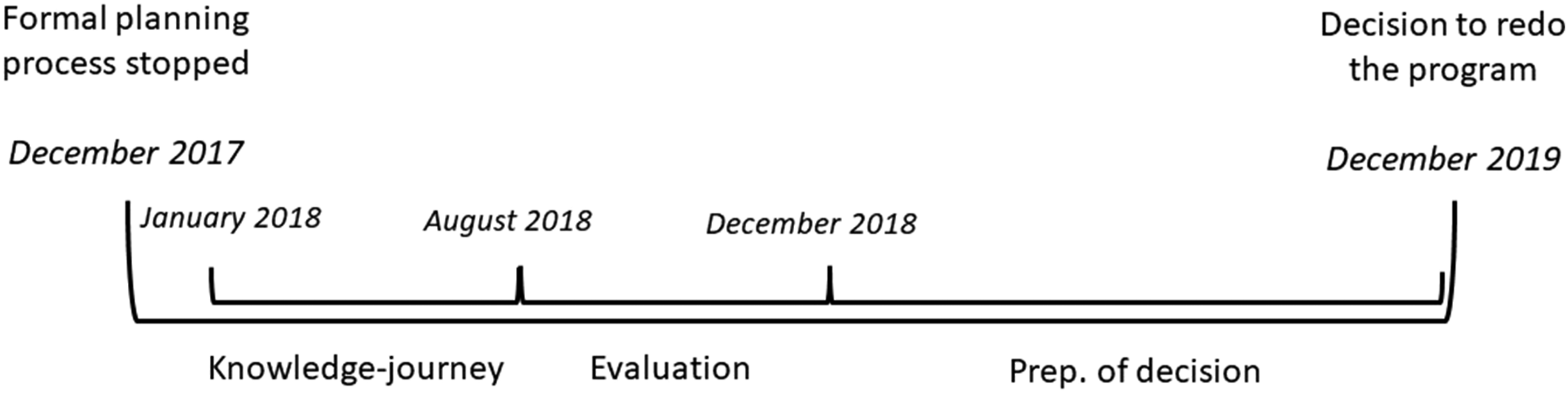
The series of meetings took place during the spring of 2018, followed by an evaluation led by the CPA, during the fall of the same year. In the following section, I will illustrate how both political and epistemic authority were enacted during the Knowledge-journey.
The enactment of the political and epistemic authority
Applying the theoretical framework of the interrelation of political and epistemic authority on the process taking place during the Knowledge-journey shows how both context and the role of the actors affect how the process gains legitimacy. In particular, we see how the actors have to balance their political and epistemic authority in the right way when acting outside the formal planning process.
During the legitimization of the Knowledge-journey, the inclusion and exclusion of participants and what roles they enacted were central factors. While the meeting series included a diverse group of actors, two actor groups emerged as crucial for the legitimacy of the Knowledge-journey and its outcomes: the municipal actors and the community actors. Below I will first present how the dynamics of the different actors involved in the informal process changed, then illustrate how municipal and community actors balanced political and epistemic authority, and lastly present the issue of trust as an important factor during the process.
Changing dynamics between planning actors
The informality of the two-year-long interruption in the planning process enabled actors to take on new roles that were uncommon in Swedish statutory planning. Community actors were able to give input on the working material and to affect plans in a way that is usually reserved for municipal actors. The municipal actors also took on new roles when ÄU halted the process and took the lead in the informal planning process, which should be the responsibility of the CPA. This was possible due to the strategic framing of the planning project.
When ÄU stopped the planning process, they claimed that there was “a lack of knowledge” of geotechnical and financial circumstances and that there was a need to do further investigation to be able to solve the goal conflicts. A particular concern was how to address all of the objectives within the financial budget. By this claim, ÄU questioned the knowledge base of the plan and as such the work already done by CPA. According to ÄU, the purpose of the Knowledge-journey was to “…put light on the choices needed to be made to develop the city we want. From the best, accessible knowledge, the Knowledge-journey will deliver a basis for the continued work with the Detailed Plan [DP]” (ÄU, 2018: 6). However, this purpose was questioned by the CPA because of its similarities with the responsibilities of their department: … it is confusingly the same purpose as you have when you produce a DP … when ÄU then starts this process, it was perceived as a provocation. That the property owner goes in and says ‘you have not done your job, we need to take a timeout and look extra at this’. (Participant 1, CPA)
By interrupting the planning, ÄU triggered issues of political legitimacy by interfering with the bureaucratic order of the municipality. Unsurprisingly, therefore, the interruption of the formal planning process was also heavily criticized by the municipal administration. Their critique was directed foremost at ÄU for taking initiative. As the municipal departments did not accept ÄU’s decision to stop the planning, they continued working on the DP for another month before the planning process was formally stopped by the municipality. In the beginning, the municipal departments did not attend the meetings during the Knowledge-journey. As one participant from the PLA explained: when the formal planning process was stopped, we were told by the management how we should act in the matter… It was quite clear that this initiative was ÄU’s process and not a municipality process, therefore we should participate in a limited matter. (Participant, PLA)
When the departments started attending the meetings of the Knowledge-journey, several respondents described how the civil servants still were less active than the rest of the participants. For example, the representative from PLA attended only two of the meetings. One of the participants from ÄU described the dynamic: It was kind of sensitive that we stopped [the formal planning process] … There was resistance [from the municipal departments] that we were doing this, and you can understand that, because we stopped all the work in progress. (Participant, ÄU)
That the municipal departments questioned the need for the meeting series, did not attend the meetings, and were less engaged than other participants when they did attend, showed how they did not consider the Knowledge-journey a legitimate part of the planning process. The departments took on a more active role first when the Knowledge-journey was concluded, and the outcome was passed on for evaluation.
When the planning process was stopped, ÄU gained a particular role as gatekeeper of who was involved in the continued process. While there was a struggle over who had authority over the planning process, ÄU was able to interrupt the planning and initiate the investigation. When initiating the Knowledge-journey, ÄU invited external participants such as academia, civil society and private developers, to broaden the knowledge base. Through the invitation and final report (ÄU, 2018: 12), ÄU ascribed the roles of the participants.
To broaden the knowledge base ÄU invited a research group from a local University, which was conducting an ongoing research project on the RiverCity, to ensure scientific knowledge. They also invited four individuals from two local interest groups: YIMBY (Yes in My Backyard) and Hela Göteborg (All of Gothenburg), who was first argued to represent the local community but during the process, the motivation of their involvement changed to representing certain expertise of urban development. ÄU had also hired an architectural firm, to document the meetings by drawing maps of possible structures for the area based on the discussions that were held. The municipal departments were supposed to represent the municipal administration and their specific policy domains, knowing the regulations and administrative systems of the municipality. By framing the participants as knowledge-holders and not stakeholders, ÄU could claim the meetings that took place as a knowledge-gathering process.
Despite ÄU’s motivation to include participants based on the need to gather knowledge, some actors were also included because they had specific stakes in the development project. For example, ÄU invited a group of private developers who had already been promised development projects in the area, and for that reason were considered to have legitimate concerns or stakes in the planning process.
As stakeholders, the private developers gained political authority. While this group also could contribute with their knowledge to the discussions, that was not the motivation behind their inclusion and a respondent from this group said themselves that they thought their purpose was to represent their firm’s interests. This is in contrast to the Research Group and the Architect Firm, which did not have any discernible stakes in the process. Of course, both actors had their own interests in taking part in the process, but not necessarily in the outcome of it. Rather, they were included based on epistemic authority as consultants or because of their scientific expertise. One participant from the research group said that they saw their participation from the point of view of their research group and that they gave presentations and comments based on existing research. A participant from ÄU gave the following comment: …and they [Research Group] have also been extremely charitable in this work because they have, as a neutral party [given presentations and commenting on the plan]… (Participant 1, ÄU).
Similar accounts were given by other participants as well, that the Research Group participated as a neutral and objective voice. While this group was framed solely as knowledge-holders, and seemingly had high trust in their expertise, other groups of knowledge-holders were not seen in the same way. However, some of the participants were also trained and employed as researchers at the University, but during the Knowledge-journey they claimed that they represented other groups. For example, one was invited and considered himself as a representative of YIMBY. Another of the participants was working at ÄU during the Knowledge-journey but was also a researcher in the Research Group and had previously worked at the Architect Firm. While during the interview, he did have trouble deciding which group he represented and acknowledged the different experiences he brought to the meetings, he claimed, in the end, that during the Knowledge-journey he represented ÄU.
These examples illustrate how the type of knowledge that is enacted is context-dependent; they also show that the participants chose which knowledge domain they were representing in this particular case. Instead of listing all of their areas of expertise, they made claims according to a certain role corresponding with their current political or professional position. Actually, all the respondents, when asked what they contributed to the meeting series, the participants referred to their educational background, professional training or professional position. This limitation comes out as important for the enactment of epistemic authority, particularly in the discussion on including community actors (which I will come back to below).
The context of the Knowledge-journey determined what roles the participants enact. The ability of ÄU to initiate the Knowledge-journey depended completely on the ambition to conduct strategic planning when developing the RiverCity. Framing this informal process as a knowledge process also depoliticizes the actions taken outside of the formal planning process and enables the inclusion of actors external to the municipal administration. While some of the participants had clearer roles during the informal process (such as the academics who were representing epistemic authority, or private developers who, rather, represented themselves as stakeholders in the process), two of the actor groups were neither only political actors nor only knowledgeable; in this context, they were both. Through the Knowledge-journey, both the community actors and the civil servants could be seen to enact both political and epistemic authority, but balancing these was necessary for maintaining their authority. This balancing act was an important factor in making the informal meeting series a legitimate part of the planning process, which I will develop further in the next section.
Balancing between political and epistemic authority
The community actors and municipal actors moved between political and epistemic authority. Both actor groups are ascribed and enact specific expertise and legitimate concerns in the process. These two groups in particular show examples of enacting both political and epistemic authority, both according to themselves and the other actors; they also show how these two forms of authority interrelate.
The community group was first invited based on their connection to the local community. One participant from ÄU explained their involvement as “to include the thoughts that existed out on the streets… We wanted to include citizens”. These participants had authored debate articles in the local newspaper, and were attending and asking questions during public presentations of the planning project. However, their involvement as representatives of a local community was questioned by the municipal administration, particularly regarding whose interests, specifically, they were representing: There is this constellation of people [the community actors] who represent a network, or do they represent themselves? In that case, there is an entire architectural branch that you can invite. (Participant 2, CPA) It can easily give the experience that the whole of Gothenburgian society is supporting an issue being discussed in a Facebook group [YIMBY], but this may not be the case at all, because it is a narrow group that is represented. (Participant, PLA)
The municipal departments ascribe the community group stakeholderness and because of the phase of the process, they are not considered legitimate to participate. While ÄU’s intention first was to include them to represent the public, during the process they changed their motivation given that they could not motivate themrepresenting the legitimate concerns of civil society. Instead, the community group’s epistemic authority was used as the motivation, and they were hired as consultants to be able to attend the meetings. The participants themselves also saw their role as contributing with knowledge rather than as representing public interests. It was about me contributing all the knowledge I have on these issues, which I have built up over the years by sitting like the spider in the web in this network, YIMBY. The network gathers citizens, professionals, politicians and committed people… And so, I was there as a kind of expert advisor. (Participant 1, YIMBY)
One participant from ÄU described it this way: We believed that the community actors were not representatives of YIMBY but they were representatives of an area of knowledge that we thought was good, but they were chosen also because they are communicators and they have a channel … and then this opportunity to have this broader dialogue [with the community]. (Participant 1, ÄU)
The fact that the community actors represented these local networks was seen by ÄU as contributing local and professional knowledge but also as contributing to the possibility of dialogue and inclusion. While both the representation of expertise and political representation were presented as the reason for the community group’s involvement, by enacting their epistemic authority they gained the ability to influence the planning project during as participants in the Knowledge-journey.
Compared to the community actors, the municipal actors by definition had political authority as representatives of the municipal administration. However, their political roles changed throughout the Knowledge-journey compared to their roles in statutory planning, and at the same time, their epistemic authority was limited to their policy domains.
Several of the municipal actors described how they were put in “political boxes”. Here they refer to the siloed administration, where the civil servants belong to a specific department with responsibility for a certain policy domain. These boxes prevented them from moving outside of their policy domain, even if their expertise could apply to other domains as well. The problem is that civil servants are steered, we have the box from the beginning … So you do not have the opportunity to think completely freely as a civil servant in the municipality … the civil servants have the capacity to do it but they are steered by the box, to stay within it. Unfortunately, the box is a bit too small for the civil servants to do something really good. (Participant 2, TA)
Limited to their policy domain, this delimited their epistemic authority as well. This is despite the ambition of strategic planning organisations to embrace a holistic approach to planning. One participant from ÄU described it this way: You carry your niche, your skills into it [the discussions] without understanding the entirety [of the development], without being able to see other participants’ perspectives and making these trade-offs to find the best answer for the project. (Participant 3, ÄU)
As this quote illustrates, the focus on specific policy domains comes at the cost of seeing the project holistically. In contrast to the municipal actors, the community actors could focus their input on the entirety of the project, and thus took a holistic approach to the structure of the area: Because we had a slightly freer role, we did not have to limit ourselves to the interests of a specific organization, just as we were free to move between and enthuse, contribute knowledge… (Participant 3, YIMBY)
The community group’s freer role allowed them to choose for themselves what they thought was important to focus on. The community actors were considered experts because of their professional background and engagement in the interest groups; therefore, their knowledge was considered applicable to the entire discussion. In extension, this has enabled them to influence political decisions.
In both groups, their political role affected their epistemic authority, either as a limitation or as an enabler that could impact the content of the land-use plan. The bureaucratic organisation of the silos delimits municipal actors’ epistemic authority according to their political boxes, while community actors gained authority by claiming professional expertise, and therefore able to comment on the project holistically.
Another issue identified in the case study is the issue of trust in the civil servants’ professional knowledge. This is an issue that stems from the new dynamics and relation between policy domains in the strategic planning organisation. Instead of collaboration between sectors and over organisational boundaries, the new arrangement led to competition between the departments.
The issue of trust
A central issue during the Knowledge-journey was the lack of trust among the different participants. This is a key underlying aspect of how they demarcated their different knowledge domains, but also a crucial factor in ensuring the legitimacy of the Knowledge-journey and its outcome. To gain legitimacy the input in the process needs to be trusted (Eyal, 2019). The distrust was first manifested in the reason behind halting the planning process to start with, when ÄU questioned the basis for the DP, and further led to conflicts between the municipal actors. One participant explained it as: … all of these opinions in urban planning, it has been disturbing … and therefore we started to build on facts and some kind of scientific basis, not opinion. So this Knowledge-journey has been very much about getting academia in, raising the competence ... (Participant 1, ÄU)
By making this distinction between opinions and facts, ÄU undermined the professional expertise of the municipal departments, particularly CPA. The same notion was described by several practitioners who described feeling a lack of trust in each other’s knowledge and frustration at being questioned. Instead, the municipal actors are described as having to protect their interests: From the Transport Committee’s perspective, [our role was to] pursue our issues in the development project. Other representatives of other committees have to carry their committee’s message and defend it. (Participant 2, TA) … CPA really wanted to defend their proposal [original DP]… The park people (PLA) were very concerned about their park… (Participant 2, YIMBY)
Instead of making use of their specific expertise and collaborating, the departments struggled over whose stakes should dominate in the planning process. This also meant that the municipal actors, especially, needed to demarcate their knowledge domains. This was shown for example through how to interpret certain general concepts such as what should be considered urban, which further exemplify the distrust between the departments: … but we thought it was urban, we thought that the tram that goes up the street in a way that we had designed was urban. But according to the city planning perspective, it was not urban, and then several architects said ‘No, it is not urban’, but what is urban then? And then there were other things that they thought were urban, and then we said that ‘yes, that may be urban, but it is not even feasible in terms of traffic technology’. (Participant 2, TA) I sometimes experience that the TA has a slightly different agenda than building a city; they see the need for technical solutions to enable mobility by car and public transport. And they may not always have the perspective that it is a city you live in too. (Participant 3, ÄU)
Here the municipal actors are demarcating their particular policy domains in relation to each other. Belonging to the various political boxes, the municipal actors were unable to step outside of these boundaries. When they applied their knowledge to other policy domains, they intruded on that department’s area of expertise and authority, which risked leading to conflicts between the departments (as exemplified above). During the Knowledge-journey, they needed to safeguard their policy domains, and in this way enact the stakeholderness that would ensure the inclusion of their specific knowledge. Seemingly, belonging to different policy boxes leads to a lack of trust in each other’s expertise.
Concluding discussion
Despite the struggles and doubts during the Knowledge-journey the local government made the formal decision in December 2019, to restart the planning process and to include the new suggested structure derived from the Knowledge-journey in the continued planning. Even though the Knowledge-journey did not start as a formal part of the planning process, and was not considered legitimate according to the municipal administration at the start, its outcome was deemed legitimate by the local government. This decision granted the informal process legitimacy and formalised it through documentation as part of the strategic planning of Frihamnen. This case shows how the participants navigated, enacted and ascribed authority to each other. Due to the strategic focus of the planning process, the participants needed to balance political and epistemic authority to legitimize it.
This paper aimed to deepen our understanding of how political and epistemic authority interrelate and how this affects the legitimacy of strategic planning. The analysis shows how the balance between the epistemic and the political determines whether the actors have authority in the process and, therefore, the right to participate, which in turn legitimizes strategic planning events. In this case, the informal process changed the group dynamics between the participants, where some actors gained authority by enacting roles otherwise not possible within Swedish statutory planning (such as ÄU and the community actors). Particularly two actor groups, the municipal and community actors, needed to balance their political and epistemic authority to legitimize the informal process. A central issue during the Knowledge-journey was the lack of trust among the different participants. This is a key underlying aspect of how they demarcated their different knowledge domains and was crucial for the legitimation of the Knowledge-journey and its output.
While the term stakeholder has long been part of the strategic planning lexicon (e.g., Healey, 1997; Metzger, 2013), thus far, the concept has been separated from the epistemic aspect of authority within this literature. This is despite exhortations to include a plurality of knowledge types, interests and values (Albrechts, 2015; Mäntysalo et al., 2015). Analysing the enactment of legitimacy through both political and epistemic dimensions shows how they co-constitute each other in the planning process via the interrelation of enacted expertise and legitimate concerns. In this context, the actors become knowledgeable stakeholders by balancing between political and epistemic authority.
I suggest the concept of knowledgeable stakeholders to describe the interwovenness of actors being both political and knowledgeable, and how the context and relations to other actors determine what the balance is. It is only when the actors accept each other’s political and epistemic authority that the Knowledge-journey gains legitimacy. This concept also illuminates how epistemic authority can mask certain interests or politics and be used to include stakeholders without having to motivate how they represent civil society (for example).
These findings speak to previous research on how power and knowledge are inseparable, but also more specifically to studies that have shown that organizational and professional affiliations both empower and circumvent representation (Boström et al., 2018; Metzger et al., 2017). Metzger et al. (2017) show how certain contexts enable some stakeholders to become legitimately concerned. Similarly, Boström et al. (2018) show how the context, or situation, affects what roles representatives can take and/or whom they can represent. This paper confirms the importance of organizational and professional affiliation for the inclusion of the participants but also shows how this representation can be circumvented by enacting political and epistemic authority in the right way.
The findings in this study are case-specific in a Swedish planning context, however, the issues brought up here are not limited to this specific planning project or Sweden. The results of this research point to the relevance of further development on how to ensure inclusive and democratic collaboration over organisational and epistemic boundaries, and understanding participants as knowledgeable stakeholders could contribute to that.
This paper echoes earlier work that highlights the complexity and risks of participation. As Turnhout et al. (2020) point out, the focus on participation as knowledge co-production risks depoliticising the conflictual processes of urban planning, and therefore there is a need to repoliticise these processes and not assume that participation and collaboration alone offer a quick fix.
Furthermore, this paper acknowledges the technocratic approach as a risk of black-boxing intentions (Rydin, 2020). As seen in this study, and emphasized by scholars before, trust is an important factor when balancing political and epistemic authority (Eyal, 2019; Wynne, 1996), which should be further explored especially in strategic planning practices. This is particularly important in the field of sustainability studies as knowledge integration and collaboration are particularly emphasized to transition to sustainable communities (Boström, 2012; Kibukho, 2021; Kronsell, 2013; Wiese, 2020). Kläy et al. (2015: 73), for example, discuss how researchers contributing to sustainability policy can have difficulties when addressing conflicting, normative framings of what sustainability is, and therefore need to reflect on the relationship between values and facts. Therefore, to be able to transform into sustainable communities, there is a need to overcome the fact/value split (Kläy et al., 2015). Insofar as there is an emphasis on participation and collaboration as a means of transitioning to sustainable communities, and as social sustainability is often used as motivation for these kinds of processes.
To summarize, the interrelatedness between policy and expertise needs to be reflected upon in sustainable and strategic planning processes. I argue that the concept of knowledgeable stakeholders can contribute to that. While the dynamics between participants and their enactment of authority played out in one certain way, this may play out differently in other cases. By further developing the interrelation of political and epistemic authority, the concept of knowledgeable stakeholders could be used to gain further understanding regarding the roles actors play in the legitimization of strategic planning processes and to address the challenges and problems inherent in cross-sector collaboration. This, in turn, would further contribute to our understanding of how to legitimize equal transformation to sustainable communities.
Footnotes
Acknowledgements
I want to thank Merritt Polk, Olga Stepanova and Sebastian Linke for their guidance and insightful comments during the process of this research project as well as for composing this paper.
Declaration of conflicting interests
The author(s) declared no potential conflicts of interest with respect to the research, authorship, and/or publication of this article.
Funding
The author(s) disclosed receipt of the following financial support for the research, authorship, and/or publication of this article: This work was supported by the Svenska Forskningsrådet Formas (2016-00349).
