




Abstract
The question of Kurds in Iran is a political as well as a regional issue. By applying the Gramscian spatial perspective, this paper examines how the socialist movement in Iranian Kurdistan has rethought and reshaped the collective identities of the Kurds through spatially collective mobilization. While “private spaces” were central for Komala as sites of group formation and political underground activities, after the fall of the Shah in 1979, the opening up of public spaces was of crucial importance for Komala to transform from a small organization to a social and influential current. The production and use of the public spaces enabled Komala to establish associational ties among subordinate social groups through strengthening a collective identity and political ideology. For Komala, the territoriality of the Kurdish region has been historically formed by class conflicts and class-relevant social relations in conjunction with the national question (self-determination for Kurdistan), and in relation to a specific spatial location in place, space, and scale.
Introduction
The nationwide uprising ignited after the state murder of Jina (Mahsa) Amini, by Iran’s hijab police, began from Kurdistan. During the funeral of Jina Amini in her hometown, Saqez, in the western province of Kurdistan, women collectively took headscarves off in protest and chanted “Jin, Jîyan, Azadî” (Women, Life, Freedom) and “death to the dictator” (BBC, 2022). As a public place for mourning, the burial place became a political space for protest against the ruling government. Following that, street protests spread to other Kurdish cities and then all over Iran. It shows how spaces are socially produced for collective mobilization. Spatially, Kurdistan was not just the starting point and the forerunner of the uprising but also the protests in Kurdish cities have been more organized compared to other parts of Iran, which made a context in which the slogan “Kurdistan, eyes and light of Iran” has become one of the main mottoes of the Iranian people in the Jina uprising (RFI, 2022). This phenomenon indicates the unevenness and discontinuity of sociopolitical movements in different regions and places, i.e. it is disjointness and imbalance of the rhythm of political struggle along time and space. The special characteristics of struggle and resistance in the political geography of Kurdistan are rooted both in the “Kurdish Question” and the socioeconomic dimensions. Although the slogan “Women, Life, Freedom” itself originated, spatially, from the struggles of Kurdish women in the Turkish and Syrian part of Kurdistan, which rose during the magnificent resistance of Rojava in Northern Syria (under the leadership of the Syrian Kurdish People’s Protection Units (YPG) and its associated Women’s militant organization (Yekîneyên Parastina Jinê, YPJ), found a wide reflection throughout regionally and globally. However, the waving of the headscarf and chanting of this slogan by the women of Saqez should be spatially contextualized in the historical, social, and political contexts of radical women’s struggles and the Revolutionary Movement in Iranian Kurdistan – originated in the precious experiences of resistance and struggles in the 1979 post-revolution era, in which Komala has played a key role. As I demonstrate below, laid the basic foundations of the women’s movement and the leading traditions of the struggle for women’s equal rights, as it manifested itself in various forms from 1979 up to now.
The question of Kurds in Iran is a political as well as a regional issue. As Antonio Gramsci puts forward in relation to the Southern Question in Italy, it is necessary to address the political geography of Kurdistan as a political question, not only in terms of “structural” (economic and class) factors but also as a territorial problem (Morera, 1987: 149) because, in alignment with Lefebvre (1991), “there is a politics of space because space is political” (p. 59). As such, the notion of “region” as representative of space is not neutral or material environment but socially constructed in a historical process. From this spatial perspective, space is, for Gramsci, one crucial moment within his overall “philosophy of praxis” – (in its concrete sense, transformative activity). In his pre-prison essay “Some Aspects of the Southern Question,” Gramsci demonstrates his deep sensitivity to the socially produced territorial distinction within the developing Italian state and the barriers and opportunities suggested within this geography for a communist movement (Ekers and Loftus: 26). Gramsci’s Philosophy of Praxis “thinks subalternity, praxis, and hegemony together, in a complex, dialectically-related, differentiated unity” (Chalcraft, 2021: 91). Spatial politics and spatial analysis in relation to territoriality is, in Gramsci’s analysis, “a matter of geographical specificity and understanding how the success of the Bolshevik revolution in the “East” could be translated in the “West” (Thomas, 2009). From this spatial viewpoint, the unevenness in the form and content of political movements and struggles in different geographical spaces in Iran (or any other country and region) is a historical matter that crystallizes through the evolution and development of each single society, in spatial distinctions in terms of geography between nested places and scales, as well as in human development and the plurality of communities.
Although Kurdish nationalist currents link the notion of “Kurdish regions” to the question of ethnonational identity, the narrative of “Kurdish identity” has always been a contentious issue among political forces. Concretely, after the Iranian revolution in 1979, once the nascent Islamic Republic of Iran was consolidating its position in the whole country, due to a power vacuum in Kurdish areas, the political forces – mainly (but not limited to) the Kurdistan Democratic Party of Iran (KDPI) and Komalay Shoreshgeri Zahmatkeshani Kurdistani Iran (The Organization of Revolutionary Toilers of Iranian Kurdistan – henceforward Komala) – took control of most part of the region from 1979 until 1982 and 1983 (McDowall, 1997: 262). Khomeini’s declaration of “a holy war against the Kurds” on 19 August 1979 was accompanied by an organized and mass armed resistance in the Kurdish region. This civil war in Iran and the armed and civil resistance in Kurdistan coincided with a broader military conflict in the Middle East, the Iran-Iraq war from September 1980 to August 1988.
The dynamic of the struggle for the appropriation of space and power among those political forces took on new life in the leadup to the autonomy of Kurdistan. Under these circumstances, Kurdish nationalist currents reduce the concept of the geopolitical space of “Kurdistan” (Kurdish regions) to the level of the national identity issue of “Kurdhood.” As a result, conflict of interests, the existing sociopolitical and class tensions, and contradictions in the society are erased in the mega-narratives of the “Kurdish identity.” They turn these identities into a thread that weaves the different classes and strata in Kurdistan into a homogeneous and integrated whole, as formulated by Benedict Anderson (1991), like an “imagined community.”
Spatial analyses of the Iranian Kurdish question are entirely absent. When the resistance and struggles of the Kurds are studied, almost all scholars pay predominantly attention to the origin and formation of the Kurdish national identity. The focus of these writings is mainly on the associations between political factors and ethnonational identities (Ahmadzadeh and Stansfield, 2010; McDowall, 1997; Olson and William, 1989; Vali, 2011; Vali, 2020). In contrast to those perceptions, the collective identity and spatial imagination of those people are changing over time and take distinct formations parallel to two developments: (a) The gradual decline of feudalism, the growth and expansion of capitalism, the transformation of the political-economic structure, the emergence of new social classes and strata (workers, capitalists, new middle classes, etc.), as well as the formation of their associated collective identities and imaginations. Specifically, the blind-spot of the mainstream scholars, in this regard, is analyzing the formation and evolution of Komala mainly within the scope of Kurdistan’s political geography and the Kurdish national identity. In contrast, the political perspective of Komala was mainly inspired by the hegemony of the communist movement and leftist revolutions on the global and regional scale and was itself emerging from the radical left movement in Iran seeking a social and political transformation of radical politics in Iran.
Accordingly, when (b) social practice turns into different forms of socio-spatial politics, the collective identity and spatial imaginations of those people, groups, and social classes change over time and, parallelly, give distinct forms to the political struggle in Kurdistan. Especially since the 1979-Revolution, a large mass of Kurdish people organized themself under the red flag of Komala and identified themself with socialist/class identities, which has challenged the narrative of national identity and uniformity of the Kurds. Not only the literature on the role of Komala as an influential communist organization in Kurdistan is scanty, scattered, and skipped in most histories of the Iranian Revolution, those few studies of Komala focus mainly on some ideological differences between Komala and KDPI, and the approach of Komala toward the national question in Kurdistan (Cabi, 2020; Koohi-Kamali, 2003; McDowall, 1997; Romano, 2006; Vali, 2020). Not only that these studies do not discuss how ideological differences influence the Kurdish nationalist movement, nor do they pay attention to the spatiality of the socialist movement and its associated collective actions and identities. The relevant question is how the radical socialist movement in Kurdistan under the leadership of Komala is articulated in relation to a perspective on spatial practices. It is important to note that despite the centrality of “territory” as a concrete manifestation of space, in interrelations between political forces in Kurdistan, and the case that was sparked by the battle over territory, no one paid attention to the question of space so far. For, space is historically produced, differentiated, and contested within any hegemonic project, which is the result of different forms of praxis: i.e., “historically-embedded conscious, collective, purposive activity challenging subordination and building new social relations in which subaltern status is ameliorated or eliminated and hegemony re-made” (Chalcraft, 2021: 91).
This paper fills this neglected issue from a spatial perspective. Hence, it is necessary to include the spatial dimension (geographical themes) in our analysis because it makes the scope of analysis and recognition of social phenomena more comprehensive and dynamic by referring to the origin of social classes and political forces in their collective practices in the specific places, spaces, and scales, which are “the cognitive frameworks, both collective and individual, constituted through the lived experiences, perceptions, and conceptions of space itself” (Wolford, 2004: 410). Following, by applying the “dialectical method of analysis,” “the way to study a world composed of mutual dependent process in constant evolution” (Ollman, 1998: 342), this paper examines how the socialist movement in Iranian Kurdistan, in stature of Komala as an avant-garde force, rethink and reshape the collective identities and the Kurds through spatially collective mobilization in conjunction with the spatial dimension of class-national struggles and contradictions between social classes and strata in the region.
Methodology: The dialectical method of analysis
Referring to Marx, the dialectical method restructures our thinking about reality by replacing the common-sense notion of “thing” with notions of “process” and “relation” (Ollman, 2003: 3). Given that the internal relations and process are often invisible in the real world and it is not possible to examine and measure a certain element of the whole, dialectical epistemology tackles this problem with the process of abstraction, which is a “way of singling out, or focusing on, and setting up a provisional boundary around some part(s) of the processes and relations that have come to his attention” (Ollman, 2019: 3). In other words, this method allows us to “expose features of an object that were hitherto unobservable” (Paolucci, 2007: 127). The function of these abstractions is to isolate variables and set up their interrelationship to be experimentally examined and measured. There are three types of abstractions: (a) abstraction of the level of generality, (b) abstraction of extension, and (c) abstraction of vantage point.
First, the abstraction of the level of generality allows us to distinguish what is unique to each period and level of the totality because each period and level “has its own law of motion” (Ollman, 2019: 3). The socioeconomic formation of capitalism as the “Bigger Picture” of the historical development of the human condition is the main subject of our inquiry. This Bigger Picture is broken up into three levels of generality, from relatively more generality to more concretely, from the highest level of abstraction to the lowest concrete level: capitalist mode of production (Level Three), capitalism’s most recent era (Level Two), and specific individuals and events (Level One) (see Figure 1). Second, the abstraction of extension denotes “how much space and how long a period in time is brought into focus in dealing with the processes and relations involved in any given problem” (Ollman, 2019: 3). My analysis limits itself roughly to the period of the 1979-Revolution and the years later until 1982. Third, the abstraction of vantage point “brings out and emphasizes the importance of all that can be seen of the ‘whole’ from a particular angle, when more than one angle is available” (Ollman, 2019: 3). I apply three key vantage points – place, space, and scale – to understand the territoriality and spatial politics of Komala’s role in political developments in Iranian Kurdistan. Dialectical model of abstraction and structural analysis. Source: This model is a derived and modified version of Figure 4.1 of ‘Paolucci, Marx’s Scientific, 117’.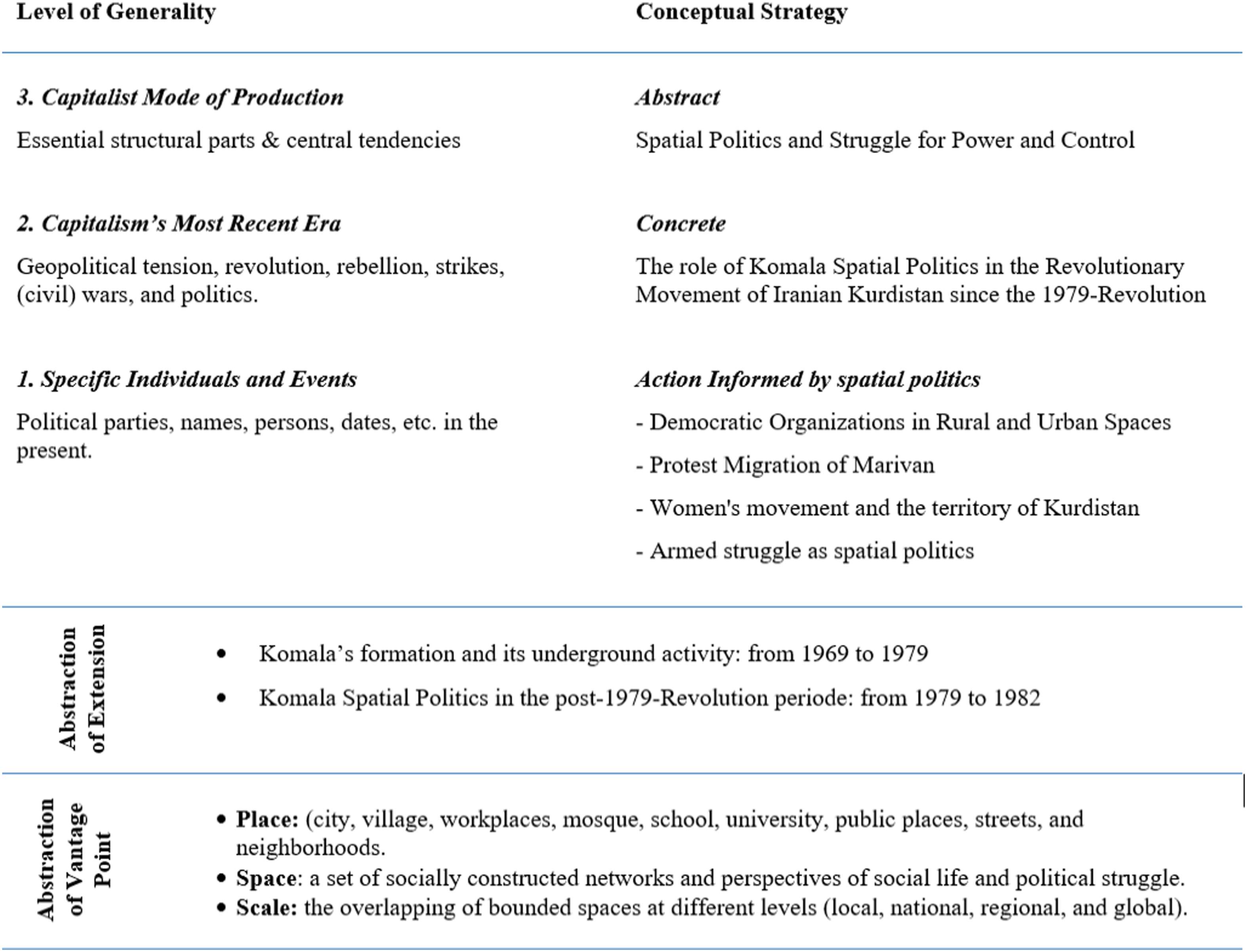
The main challenge many scholars face is gaining access to primary sources on this. To tackle this issue, I have especially taken advantage of a numerous variety of primary sources, which have not been used before by other researchers. The primary sources are the official documents of Komala (such as documents of its congresses, publications, newspapers, and the official political stance of Komala’s leaders). 1 These resources were produced by Komala activists in the historical contexts where the events took place. In addition, I used the video documentary “Trench of the Revolution,” along with some books and articles (interview with Komala leaders and activists), which is devoted to the oral history of Komala and its role in the revolutionary movement of Kurdistan. Using oral history creates another problem, and that is, running the risk of providing bad data due to the unreliability of the memories, and the risk of “presentism,” i.e., the interpretation of the past through a contemporary lens. To limit the related margin of error, I have applied the triangulation method – “the checking of inferences drawn from one set of data sources” (Atkinson, 2007: 183) – by comparing and verifying the statements and claims used in the source of oral history with other recorded data from primary sources.
Gramscian perspective on territoriality and spatial analysis
From Gramsci’s viewpoint, distinctions, and multiplicity of social practices in territorial bounded areas and different geographical spaces do not originate from the “essence” of the material and geographical environment, that is, independent of specific social relations. Rather, space has to be studied and treated like history, that is, in terms of their complex interconnections with states and political forces on other places, spaces and scales (Jessop, 2005: 425). Even human nature is, for Gramsci, not “simply static and immutable: it is rather ever-changing, depending on interactions with other moments that might be historicized and situated within specific geographical contexts and practices” (Ekers and Loftus, 2012: 28). So, sites of social struggles need to be comprehended more fully as spatial politics and social praxis, not just as scenes. As Lefebvre (1991) underlined, “any ‘social existence’ aspiring or claiming to be ‘real’, but failing to produce its own space, would be a strange entity, a very peculiar kind of abstraction unable to escape from the ideological or even the ‘cultural' realm. It would fall to the level of folklore and sooner or later disappear altogether, thereby immediately losing its identity, its denomination, and feeble degree of reality (Lefebvre, 1991: 53). From this vantage point, the formation of territoriality has to be comprehended as a production of a “social space,” which “incorporates social actions, the actions of subject both individual and collective who are born and who die, who suffer and who act. ... within it, they develop, give expression to themselves, and encounter prohibitions” (Lefebvre, 1991: 73). This forms complex territoriality for states and social forces.
While Gramsci never used the term the production of territory, in his approach, “territory associated with contemporary political geography” (Lee et al., 2018: 424); interwinding of inter-scalar social actions, discourses, and practices. For Gramsci (1971), territoriality is the product of a historical, socioeconomic, and political process, not static and inert (Q13§23). In this way, Gramsci (Q13§2, 1971) underlines that “the geographical position of a national state does not precede but follows (logically) structural changes [of socioeconomic formation], although it also reacts back upon them to a certain extent” (p. 176). This has to be considered as a historical matter that the formation and consolidation process of a bounded territorial nation-state or any form of bounded spaces is a historical-geographical-political process that goes through different and specific paths. Therefore, the socioeconomic formation within any territory is “complicated by the existence within every state of several structurally diverse territorial sectors” (Gramsci, Q13§17, 1971: 182). It does not mean that politics is reactively built on economic development as a foundation, rather there is a dialectical and reciprocal relationship between socioeconomic formation and superstructure factors such as politics, the constitution of the nation-state and its bounded territory, geopolitics, and culture. These elements together shape the structure of a system as a whole, within which, for Gramsci, territoriality and spatial politics are formed by class and class-relevant social relations. As Glassman (2012) points out, “to search for the roots of resistance to capitalist rule solely outside the spheres of capitalist production, consumption, and political-ideologist influence is to miss the possibilities of rebellion that gestate precisely within the uneven process of capitalist development” (p. 225).
This leads us to the role of politics within this process. Politics encompasses various elements, such as power relations, the balance of power and class, and political confrontations between subaltern groups and ruling classes. Gramsci’s views on politics should not be extracted from the dialectics and contradictions of capitalist development, so as to depict it in the form of “political possibility” within existing non-capitalist spaces. Politics is a “particularly crucial element of the entire context in which political outcomes like hegemony are generated” (Glassman, 2012: 249). From this vantage point, politics, for Gramsci, is a matter of geographical specificity and understanding how the success of the rebellion of subaltern groups against capitalism can be translated in time and space.
By discussion and analysis of the Southern Question, Gramsci underlines essentially the regional and territorial dimension of capitalist development and the “rootedness of social classes and political forces in specific places, spaces and scales of economic and social life” (Jessop, 2005: 424). The notion of place (city, workplaces, school, university, public places, streets, and neighborhoods, etc.) “is generally closely tied to everyday life, has temporal depth, and is bound up with collective memory and social identity” as a struggle for control and power over shape various identities and spatial meaning (Jessop, 2005: 424). Space refers to a set of socially constructed networks and perspectives of social life, which includes (a) the spatial division of labor between different spaces (urban-rural, center-periphery, local-national, and regional-global), and (b) the territorialization of political power and dynamic, and dialectical interaction and influence between different regions (mutual domestic and external influence on socio-political movements and life); (c) “different spatial and scalar imaginaries and different representations of space” (Gramsci, 1997: 425). Scale includes the overlapping of bounded spaces at different levels (e.g., local, national, regional, and global). It can be considered that a certain scale (i.e., a local or regional) is a subaltern scale to another scale, which, simultaneously, “serve as the primary loci for delivering certain activities” and may become a place of subaltern movements’ resistance and struggle (Collinge, 1999: 569).
As the scale facet of collective social mobilization and identity is the product of social struggles for power and control, it will be the notion of hegemony in conjunction with social relations at sub-national, supra-national, and trans-national aspects (Jessop, 2005: 424). In line with Thomas (2013), hegemony is better understood as social and political leadership and political project, which is a type of leadership whose purpose is to help the subaltern classes to express, deepen and strengthen their participation in political-social transformation. So, Gramsci’s understanding of hegemony is not thinkable outside the spatial relation through which leadership is constituted (Ekers and Loftus, 2012: 26).
Spatial and territorial origin of the process of Komala’s formation
Geopolitical tension on global, regional and national scales
As mentioned before, the spatial politics of Komala in the revolutionary movement of Iranian Kurdistan has to be, methodologically, analyzed within a wide framework of the Bigger Picture; the historically uneven development of capitalism in Iran. This historical process needs to be understood in relation to the territorialization of socio-economic and political transformations of Iranian society. As such, the formation and considerable influence of Komala in the political scene of Iranian Kurdistan took place in a full of tension area on the international and regional scale; at the age of the Cold War – the age of territorializing the world into the domain of influence of the two leading world powers, the United States (US) and the Soviet Union. The geopolitical competition and tension between the two camps of the East and West dominated the international scene in the second half of the Twentieth Century. The Western camp policy during this period was securing the world against the danger of “communist world conspiracy,” which also covered the southern and southeastern borders of the Soviet Union (Hobsbawm, 1994: 230). Within this spatial en geopolitical context, the US helped strengthen the Islamic currents – with financial, military, and political support – in Iran, Afghanistan, and the Arab countries to counter the Soviet bloc. During the 1979 Iranian Revolution, the main Western powers (the US, England, France, and West Germany) reached a consensus at the Guadeloupe Conference (January 1979) to impose Iran’s future alternative to the fate of the revolution through the full support of the Shiite political Islam – led by Khomeini – to counter the power of the left in Iran (Saidi, 2019). On another scale of international gaps in the Eastern camp, during the 1950s and 1960s, new gaps and splits in the communist movement opened up. As a result, new groupings and blocs have emerged, reflecting a gap between the Chinese and Soviet blocs. Maoism had gained considerable prestige and hegemony among the radical section of the movement. Radical and revolutionary ideas for societal transformations, both on a national scale and on a regional and global scale, gained credit and led to the emergence of Kurdish leftist groups and parties in, among others, Iran, Turkey, and Iraq.
Spatially, Iranian universities were in this period a main center of the radical left. So, the core group members of Komala were founded in the fall of 1969 by a radical group of the Kurdistan revolutionaries, who mostly studied in Iranian universities. The 9 years preceding the first congress of Komala in 1979 referred to the underground activities of a small group of Kurdish revolutionaries under the name of Organization (Tashkilaat) and later as Komala. Given that during this period public space became securitized by the strict rules of the Shah’s regime, Komala turned to “private spaces” for political discussion and group formation. The foundation of Komala as a leftish organization in Iranian Kurdistan is accompanied by the rise of other leftish groups in Turkey and Iraq. In the late 1970s, the Kurdistan Workers’ Party (Partîya Karkêren Kurdistan, PKK) emerged. More or less, similar to the formation process of Komala, the core group members of the PKK were university students and the historical formation of the PKK originated from the left movement in Turkey, which was also affected by geopolitical developments and revolutionary struggles at the global and regional level, from China to Cuba and Vietnam, Laos to Angola, Mozambique and Guinea, and Algeria to Palestine (Jongerden and Akkaya, 2012). Also, in the mid-970s, Komala (Komalay Ranjdaran), a clandestine Marxist-Leninist organization emerged as a serious alternative to the classic Kurdish nationalist movement in Iraqi Kurdistan. Later, Komalay Ranjdaran became a faction of the Patriotic Union of Kurdistan (PUK). In this period, the PUK became an umbrella organization for two Iraqi leftist groups: Komala (Komalay Ranjdaran), a clandestine Marxist-Leninist organization, and the Socialist Movement of Kurdistan (KSM) (McDowall, 1997: 343). Although there are long common geographical borders between Iranian Kurdistan and the other two parts of Kurdistan in Turkey and Iraq, in the early years, there was no connection between Komala and the PKK. Contrary to this, Komala was aware of the existence and activity of Komalay Ranjdaran in Iraqi Kurdistan and decided to create a connection and cooperation with PUK. After the fall of the Shah in 1979, the connection between Komala and PUK was formed and gradually expanded and deepened to a close cooperation and bilateral support in various military, political, and social fields (Saeedi, 2012: 71–75).
On the national scale, through restructuring of capitalism in Iran in line with global capitalism, Iran’s economy is connected to the global reorganization of capitalism in the aftermath of the World War II. According to the report of the French newspaper Le Monde, “US requires to restructure the Iranian regime based on liberalism, land reforms, purification of the government apparatus and relentless fight against corruption” (Grantovsky et al., 1981: 581). Therefore, this reorganization – under the slogan of the White Revolution – involved land reforms, an import substitution industrialization strategy, privatization of state factories, and nationalization of natural resources (Abrahamian, 2008: 123). Consequently, the traditional social formations in Iran collapsed and new classes and strata (especially the quotative increase of the working class), with new aspirations and a higher level of expectations, entered the field of social conflicts (Saeedi, 2012: 51–58; Muradbaygi, 2004: 19–33; Eshterak, n.d). In short, the class horizontal interest replaced the vertical sectarian, tribal, and local interests, and reinforced class consciousness among the new social forces, especially among intellectuals and the urban proletariat. These new conjunctions created the ground and the possibility of the emergence of new political forces and organizations (Abrahamian, 1982: 422).
Spatial perspective on the formation of Komala and its theoretical transformation
What happened in Kurdistan was no exception. By supporting this global trend and based on participating in real struggles in Iran and Kurdistan, groups of Kurdish revolutionary and communist intellectuals came together in the universities of Tehran, Tabriz, Isfahan, and Kurdistan and formed a radical left organization, later called Komala. The securitizing of public spaces by the Pahlavi regime was followed by using private spaces as sites of group formation, meeting places, discussing politics and strategy, recruiting new members, and interconnecting networks among small organizational cores and even political organizations. In this period, Komala was a small organization of middle-class intellectuals. After 9 years of clandestine and underground activities, the First Congress 2 was held in the fall of 1978, a few months before the downfall of Shah’s regime, and emphasized the necessity of active participation in the political movement in 1978–79 (Saeedi, 2012: 51–58; Muradbaygi, 2004: 19–33). In the congress, their strategies and practical policies stemmed from their spatial analysis of socioeconomic transformations and the class antagonisms in the Kurdish regions in connection with the central state and global imperialism. These spatial analyses were situated in a broader context of the territorialization and uneven development of capitalism – a wide framework of the Bigger Picture – on the national as well as global scale.
Spatial analysis of the economic and social structure of Kurdistan has played an important role in the theoretical approach of Komala leaders and, as such, in the praxis of Komala’s spatial politics. Inspired by Mao’s approach – without considering themselves as Maoists – from the vantage point of the global scale, they argued in the First Congress that “the economic composition of Iranian society is uneven and Kurdistan is one of the unevenness of this composition” (Mustafa-Sultani and Watandust, 2015: 420). It is uneven because, although the land reforms in Iran caused the increase of capitalist relations, it led to a decline in agricultural productive force because, they inferred that, investment in agriculture is based on “making it more dependent on imperialist countries and have nothing to do with the needs of the people” (Mustafa-Sultani and Watandust, 2015: 38). The distinct implications of the land reforms were also identified in Kurdistan compared to other places, spaces, and scales. In this sense, from the vantage point of national en regional scale, they assumed that “the Kurdistan region is not comparable to Ahvaz or Isfahan; that is, although it has degenerated in all the productive forces, it is more in our region, however” (Mustafa-Sultani and Watandust, 2015: 374). Interscale interactions between different regions in Iran lead to spatial heterogeneity in capitalist development in different regions and places.
Even within this uneven development of capitalism, capital accumulation has taken a special form of spatialization in different regions of Kurdistan. “In some areas, the growth of capitalism has been slow, in some areas, feudal relations have remained and the possibility of the establishment of capitalist relations was low, and some areas have been intermediate” (Mustafa-Sultani and Watandust, 2015: 392). Following this analysis, it was stressed that in different parts of Kurdistan, this imbalance is “mainly political and secondarily economic, and this is due to the struggle traditions of the people of different regions. [...] The majority of the population is rural and the industrial proletariat is almost non-existent. [...] The petty bourgeoisie has been drawn into the field of anti-imperialist struggle both in Kurdistan and in Iran, but the national bourgeoisie and the petty bourgeoisie of Kurdistan are more militant and progressive due to the multilayered oppression” (Mustafa-Sultani and Watandust, 2015: 418). These inferences and analyses led them to several political and practical conclusions, establishing the foundations of spatial politics for Komala in several spaces and places.
Concerning mobilizing and organizing social movements in Kurdistan, unlike the PDKI imagined the Kurdistan society as homogeneous and uniform, and raised it to the mere level of “Kurdhood” identity, participants in the Komala’s congress recognized Kurdistan as a class society full of contradictions and tensions between different social classes and strata. In addition to defending the right to self-determination for Kurdistan, Komala also concluded that the mobilization in Kurdistan could not be comprehended without attending to the class dynamics in the Kurdish region of Iran; avoiding to reduce the dynamic of the society to a mere conflict between the Kurds as a “homogeneous” ethnic group and the central state. That contradictions and conflicts were spatially realized and analyzed distinctly in different places and spaces through identifying differences and similarities in (a) rural and (b) urban areas and (c) practical inference appropriate to each area for practical struggles.
First, regarding rural areas, they analyzed that in the Northern part of Kurdistan, the main conflict is the conflict between the people and the central state. Because the division of wealth between the people and landlords “is not great and their conflict is small. [...] The landlords are richer than the peasants, but the main conflict is with the state.” Furthermore, “the conflict with the state has reached such a level that the national question is considered as the main issue, which is why it has always been the hotbed of the Democratic Party” of Iranian Kurdistan (Mustafa-Sultani and Watandust, 2015: 398). By contrast, in the Southern regions of Kurdistan, because of different types of land ownership in rural areas, “the conflict between the landowners and the people is very intense” (Mustafa-Sultani and Watandust, 2015: 399–410). Second, from the vantage point of the place, by focussing on Sanandaj, the largest city of Kurdistan, which became the core base of Komala after the 1979-Revolution, was more seen as a consumer city. After the land reform, Sanandaj’s market flourished, “but due to the influx of imperialist goods, most craftsmen went bankrupt, and the brokers of imperialist goods grew cancerously.” However, “its capitalist is dependent on the bourgeoisie outside of Kurdistan and does not rely on itself” (Mustafa-Sultani and Watandust, 2015: 408–409). Referring to our theoretical analysis, the dynamic and dialectic of internal relations between various factors demonstrates that the territoriality of Kurdistan is not homogenous but complex and incoherent, which is socially produced by interconnections between different social forces and central states and political forces, which, from Gramsci’s viewpoint, follows (logically) structural changes of socioeconomic formation.
Relying on this analysis and considering the conflict between social forces in different places and spaces (rural and urban areas), they conclude that “Kurdistan is a backward region and far from industry, the main forces are toiling peasants who make a living by farming and the contradiction with imperialism and feudalism in all regions is seen. The conflict and the struggle of the people of our cities are related to the struggles of other cities throughout Iran. The question of land has not yet been fundamentally resolved, and the urban toilers are in organic connection with the villagers. Therefore, it is necessary to unite all the forces that conflict with our main enemy.” These forces are the workers, the peasants, the petty bourgeoisie, and the national bourgeoisie. Influenced by Maoism, they concluded that “since the majority of our people are rural, our people’s revolution necessarily starts from the village” (Mustafa-Sultani and Watandust, 2015: 417–419). Based on these analyses, after the 1979-Revolution, Komala spatial politics in mobilizing and organization of a radical left movement in the rural and urban areas was considerably important (see the next section). In addition to the decision of the Congress to “contact and cooperate with the Marxist groups of Iran, especially those who have a mass approach,” the Congress approved making contact and cooperation with the Patriotic Union of Kurdistan (PUK) in Iraqi Kurdistan (Mustafa-Sultani and Watandust, 2015: 428).
In the Second Congress, which took place in March 1981, Komala distanced from its Maoist views in spatial politics in spaces and places; emphasizing the central role of the proletariat and the social force in the city and workplaces. Although the land reform had started during the White Revolution under the Pahlavi regime, the speedy resolution of the land issue and the crushing of the feudal lords in Kurdistan played an important role in Komala’s understanding of Kurdistan society which has transformed into a capitalist society. This also affects the strategy of Komala’s spatial politics in which the activity in the urban area plays a key role after the Revolution (Saeedi, 2012: 66–67). Komala announced that “holding this congress, in terms of its theoretical achievements, is the biggest revolutionary step in the life of our organization. [...] The Second Congress formulated and criticized the main ideological deviations of our organization as populism (pro-people and distorting the independence struggle of the proletariat) and economism (limited understanding of the duties of the conscious proletariat and the following of the spontaneous current)” (Khabarnameh-e Komala, 1981: 1–2). Simultaneously, since Komala did not demarcate itself to the geographical territory of Kurdistan, the 2nd Congress “stressed the need to link the Kurdistan Resistance Movement with the workers and revolutionary movement throughout Iran, a link that will make the entire Iranian revolutionary movement stronger” (Khabarnameh-e Komala, 1981: 2).
The 3rd Congress took place on 1 May 1982, in which “the Komala Program for Kurdistan Autonomy” and “the Program of the Communist Party of Iran” were approved (CPI, n.d). With this approach, unlike the KDPI demanded “democracy for Iran and autonomy for Kurdistan” (Shams, 2010), which summed up autonomy for Kurdistan only under the rule of the Kurdish elite in the form of “Bureaucratic Autonomy,” Komala advocated for the establishment of an autonomous government’s democratic revolution in Kurdistan, a government that is the instrument of exercising the will and sovereignty of the workers and toilers, guarantees the establishment of revolutionary democracy in Kurdistan and satisfies the urgent demands of the workers and toiling masses. In autonomous Kurdistan, sovereignty is exercised at all levels through people’s councils (CPI, n.d). Moreover, Komala and some other Iranian communist organizations established the Communist Party of Iran (CPI) on 2 September 1983 and Komala became the Kurdistan Organization of CPI “to carry out its political and class duties in a party connection with the conscious proletariat throughout Iran” (Communist 1, 1983: 24–27).
Democratic organizations in rural and urban spaces
As mentioned before, the power vacuum emerged in Kurdistan after the 1979-Revolution confronted Komala with important social and political issues. Various places and spaces in rural and urban settings have become a momentous fireplace of the social-political struggles. These spaces (in different intertwined scales) play a mediating role through which the social matter and the outcome of these struggles are constituted. Specifically, the creation and use the public spaces enabled Komala to establish associational ties among subordinate social groups through strengthening a collective identity and political ideology.
One of the key areas in which Komala challenged the KDPI and its nationalist policies and identities was the formation of mass institutions for mobilizing and organizing the social classes and strata in both rural and urban regions. These institutions became important places and spaces of collective mobilization and socialist identities and imaginations. In the aftermath of the revolution, Komala brought the line of forming mass institutions among the society to organize the people to continue and struggle to defend the revolution; including the Populations/Societies for the Defense of Freedom and Revolution, the Women’s Council, the Teachers’ Council, the Unemployed Workers' Union, and the Peasants’ Council (Komala TV, 2014a: min. 25:00). The main members and leaders of these institutions and revolutionary organizations were communists and Komala-affiliated militants. According to Komalah activists, “the bourgeois, liberal, and reformist currents of Kurdistan also organized themselves. The left and the communists, in opposition to them, created these institutions to advance and gain hegemony in Kurdistan. The Jam’yat-haye Democratic [democratic societies] were institutions to fight the bourgeois and repressive institutions were taking shapes” (Komala TV, 2014a: min. 27:00).
Komala’s first experience in forming democratic organizations began with the Peasants’ Union in Marivan in the rural spaces. The architect of forming this organization was Foad Mustafa-Sulatani (known as Kak Foad), the then-leader and the main co-founder of Komala. Since part of the landlords had formed a “nomadic council” and a mercenary armed force, Komala saw the necessity of forming the Peasants’ Armed Forces to counter and thwart the aims of landlords. This experience was repeated in a short time in other parts of Kurdish areas, such as Saqez, Mahabad, and Sardasht. So, under the guidance of Komala, the rural toilers were organized in the Peasants' Unions (Saeedi, 2012: 62–63). By taking the initiative of Komala, the poor peasants also defended themselves and, in some areas, fled their landlords and confiscated their lands. After the first attack of the Peasants’ Union and the Peasants’ Armed Forces, the remnants of landlords were crushed very quickly, and this victory helped return the lands to their original owners [peasants] in some parts of Kurdistan, such as Divandereh, Kamyaran, and Bukan (Saeedi, 2012: 66–67).
Furthermore, the diverse set of places and spaces in the Kurdistan urban areas became the center of Komala’s spatial politics to achieve hegemony in the political geography of Kurdistan. Komala’s second experience was the formation of councils, the Jam’yat-haye Democratic and various trade unions, women and teachers’ organizations, and different councils in cities, districts, and neighborhoods. Komala activists were the key members of these institutions. In addition, in the Spring of 1980, Shuray-e Movaghat-e Enghelab [the Provisional Council of the Revolution] was formed by the people of Sanandaj who in the first step took over the administration of the city. Also, the people succeeded in disarming the gendarmerie barracks of the city (Komala TV, 2014a: min. 35.00). Despite the sabotage of the reactionary and repressive forces, this council was able to carry out the affairs of Sanandaj city in the most democratic way possible. Islamic and reactionary currents were very angry with the imposition of the Sanandaj City Council and were constantly sabotaging it, knowing that the council was influenced by leftist currents, mainly by Komala. The significance of this council was that it was an assault on the property of lords and capitalists, the workers required their rights, and it became a class movement (Komala TV, 2014a: min. 16.00). Furthermore, the Population of the Defense of Freedom and Revolution in Sanandaj and many Benkes (neighborhood-oriented institutions) became the main organizations where the radical and lefts youths, women, and revolutionary people in Sanandaj organized themself, “which was essentially a petty-bourgeois revolutionary-democratic character and created a line opposed to the compromising [PDKI] and reactionary currents” (Shoresh, 1979: 29).
Women’s movement and the political-geographic Territory of Kurdistan
Historically, there is a close connection between masculinity and nationalism. That is, masculinity and patriarchy have always been one of the most important elements and symbols of the formation process of modern nation-states and their related nationalist identities, 3 which is also true for the emergence and expansion of Iranian nationalism. 4 Accordingly, in Kurdish nationalist discourses and symbols, spatially, the homeland (the political-geographic territory of Kurdistan) is imagined as “a mother, a sister, a bride and a 14-year-old girl” (Hesen, 1933: 5). From this viewpoint, the “real” actors of the Kurdish national movement are men whose duty is “defending their freedom, their honor, their homeland, and their women” (Nagel, 1998: 244). 5 Specifically, the history of Iranian Kurdish nationalism under leading of KDPI has demonstrated that “nationalist struggle for sovereignty [...] is a thoroughly masculine politics,” and the male leaders of Kurdish nationalism see women as icons of “mothers of the homeland” (Mojab, 2001: 71–72).
Instead, along with the emergence and growth of socialist movements in Kurdistan since the 1979-Revolution, particularly, as a result of Komala’s activities, this discourse and patriarchal approaches were more or less marginalized and replaced by egalitarian and progressive ideas. The leftist and socialist forces in Kurdistan became the main inheritors of breaking taboos and fighting against the dominant culture of masculinity. The socialist tendency led by Komala considers the oppression of women as a social and political matter and does not define itself, solely, in the form of identitarian (Koordhood) and abstract narratives. Rather, they struggle and make demands among a multitude of class, social, political, and cultural contradictions of society. For, women in Kurdistan have always had to fight in several fields to get rid of several forms of oppression and exploitation in another field – including patriarchy, religious fundamentalism, and regressive culture – in the struggle to formulate the situation of cross-gender, national, and class oppression, and in a field against structural oppression by the ruling regimes, both in the Pahlavi royal era and in the Islamic Republic system.
In their social and political practices, revolutionary women have reconstituted a new meaning to the political-geographic territory of Kurdistan in the form of the production of “social spaces.” In the aftermath of the 1979-Revolution, the announcement of Khomeini regarding the mandatory hijab in Iran provoked a wide protest reaction in some cities of Iran, including Kurdish cities (Sanandaj, Mahabad, Marivan, and Kermanshah). The revolutionary conjuncture provided a better environment for women’s activities. Following, many leftist and communist women took steps towards the establishment of women’s democratic organizations, including the “Women’s Council” in Sanandaj, the “Women’s Union” in Marivan, and the “Saqez Women’s Fighting Community.” Komala women activists played a key role in establishing these institutions.
Within this context, the celebration of 8 March (International Women’s Day) became a leading tradition in the women’s liberation movement. On 11 March 1979, more than three thousand women of Sanandaj participated in a women’s street march on International Women’s Day and protest against the mandatory hijab in Iran. The main slogans of this demonstration were: “No scarf, no humiliation/oppression,” “We did not make a revolution to go back” and “Women’s freedom is the measure of society’s freedom” (Matin and Mohajer, 2013: 466). On the same occasion, a magnificent demonstration was organized in Marivan by the “Marivan Women’s Union” and in Mahabad and Kermanshah. From the vantage point of the place, the streets and public places of those cities became the social space of struggle and resistance for women against the religious ideology of political Islam, patriarchy, discrimination, and inequality. The social-political contradictions in this society manifested themselves in the tension between the women’s radical movement and the political Islam groups in different places and public spaces. In both demonstrations in Sannandaj and Marivan, the Sunni political Islam groups, known as the Muftizadeh organization and Maktabeh Qur’an (the Koran School), in alignment with the Islamic Republic’s policy, attacked the women demonstrators. In Sanandaj, Muftizadeh’s organizations attacked the women’s demonstrations, air shooting broke out and the women dispersed but continued their protest gathering again in Iqbal Square. This also happened in Marivan, but the armed women of the “Women’s Union” responded with air shooting and Muftizadeh’s supporters fled and left the street scene. The women continued their street march from a power position and with enthusiasm (Matin and Mohajer, 2013: 470).
These tensions also occurred in other public places and spaces. In response to the demonstration of three thousand women fighters in Sanandaj, after the demonstration, the armed forces affiliated with those Political Islam groups attacked Sanandaj’s “garment factory” – where most of the workers were women – and also the dormitory building of the nurses in Sananda, shooting the women’s workplaces and living spaces” (Kar, 1979: 1–7). The mosque, as a sacred religious place, that has always been a male-dominated space, became another arena for confrontation between women and religious groups. With their activism and resistance, women turned this masculine realm into a place for spatial politics to express women’s powerful co-presence, promote women’s rights, challenge masculine-dominated culture, and strengthen collective identity. Since the mosque was the most appropriate public place for large public gatherings in Kurdistan, Islamic groups tried to prevent women and girls from entering there. After a street demonstration in Sanandaj, in 1979, the women gathered in Sanandaj’s Grand Mosque to give a speech and to present their resolution. But Muftizadeh’s religious forces attacked women very violently so that even some girls were thrown into the mosque pond. In return, the women reacted decisively, standing behind the podium and boldly speaking against the violent behavior of reactionary groups towards women (Matin and Mohajer, 2013: 474). The impressive presence and collective action of women were so influential that, in the traditional and religious society where women faced discrimination and inequality for centuries, the Peshmerga revolutionary women gave speeches to people in village mosques (more importantly, in the pulpit of the mosques, where the presence of women is forbidden and blasphemy), even giving exhortation to the men how important the equality between men and women is (Saeedi, 2012: 83).
The political involvement of women in Kurdistan expanded further beyond civil activities. During the declaration of the full-scale military attack on Kurdistan to militarize the space of Kurdistan, the sphere of women’s activism entered the field of armed resistance and struggle. Komala was the first political current in (all four parts of) Kurdistan to arm women on a large scale. The ceremony of arming the first group of women and joining the ranks of Komala Peshmerga Forces (KPF) was held in 1981. If before the 1979-Revolution, the politics in the Kurdish national movement was completely monopolized by men, and the rights and roles of women disappeared under the shadow of ethnonational identities, but the Komala’s Peshmarga women, singing the revolutionary anthem, called their fellow women to fight and resisting as such: “O women of this land, it is a revolution, it is an uprising, stand up, join the ranks of the struggle. We are fearless in work and revolution. We are women militant. We are present in all areas, in factories, farms, and trenches” (Azadi-Bayan, 2013a: min. 0:07). Subsequently, the message of the ceremony was read by one of the women. She announced: Today is a new day in the life of the Kurdish people and in the life of the workers and toilers; This is new because a group of Kurdish women took up revolutionary weapons based on a revolutionary program, which is the true meaning of equality between men and women in the struggle for freedom. It means that half of the society, half of the workers and toilers, and half of the revolutionary force, have risen side by side with the men to join the revolution (Azadi-Bayan, 2013b: min. 12:00).
The magnificent performances and radical slogans that the women displayed during the funeral of Jina Amini in Saqez, in September 2022, were not a “spontaneous” and incidental event but a conscious action that erupted from the collective memory, the sociopolitical and economic conditions, and the historical struggle of women in Kurdistan that ignited the spark of public anger and was born in the form of the glorious and revolutionary uprising of Jina. In fact, the seeds planted by egalitarian and socialist men and women in Kurdistan under the leadership of Komala, since the 1979-Revolution, have continuously proliferated in many fields of struggle during the past four decades and were transferred from generation to generation.
Protest migration of Marivan in July 1979
The historical Migration of Marivan (Kooch-e Tarikhi-e Marivan) as a collective action was another form of spatial politics in Kurdistan whereby various places and spaces reflected the political struggle for freedom and revolution. On 14 July 1979, the people of Marivan gathered in front of the Revolutionary Guards base. The Islamic regime forces reacted aggressively, and dozens of people were killed and wounded. Consequently, a militarized atmosphere was imposed on the public space of Marivan. Kak Foad, the then-first secretary of Komala, led the protest. He chanted the slogan: “If the regime forces come to the city, we will move out of the city” (Komala, 2014b: min. 4:00). As a protest action against the regime’s aggression, all the citizens of Marivan left the city and camped outside the city (in Kani Miran) for about 2 weeks (from 20 July to 4 August 1979). A special report of Tehran Mosavar magazine under the title of “Marivan Camp, the manifestation of the spirit of solidarity” narrated the action as follows: It is not despair. As a rule, it should be seen as “displaced”. They are lively and succulent. Strong and consistent. We cannot call them displaced, and it is better to call the distance of the people of Marivan from their city, in its real name, 'protest migration’. The protest migration ... has created, in general, a series of courageous struggles, and, in particular, the people of this city are against imperialism, their internal allies, and reactionaries [religious groups]... In every corner of the camp, the spirit of solidarity and cooperation of the people of Marivan is crystallized. ... To regulate, the work is divided into several committees, and all – men and women, young and old – operate within the duties of these committees. In addition to the armed men who control the city, armed men and women in the trenches provide security for the camp. The labor committee draws water from the spring by machine and distributes the received aid sent by the residents of the surrounding towns and villages to the campers. (Golestan, 1979: 32)
In support of this historic event, thousands of men and women walked from the cities of Sanandaj, Baneh, and Saqez to Marivan, which was also organized by Komala activists. It was the manifestation of solidarity among Kurds and the defense of their achievement. This solidarity took on a different manifestation in the city of Kamyaran. The people of Kamyaran succeeded in preventing an Iranian army armored column from reaching the city of Marivan by closing the road from Kermanshah to Marivan. Consequently, the regime was forced to send a delegation to Marivan to negotiate with Kak Foad and the representatives of the protest. The people realized some victories and came back to the city after two weeks (Komala, 2014b: min. 8:00; Kak Fouad, n.d).
Conclusion
This paper has analyzed the spatial politics of Komala in Kurdistan in the framework of the socioeconomic formation of capitalism as the “Bigger Picture” on the local, national, and global scale. It is necessary to consider that the dialectics of “internal relations” between different elements of the totality of society – in which political outcomes are generated – unleash revolutionary potential (Ollman, 1977: 26–40). As such, understanding the dialectics of resistance in places and spaces in conjunction with Gramsci’s analysis of hegemony in the capitalist society has to be understood as the socially constituted territorial distinction by different social forces within the broader context of the development of capitalism in a specific political geography. We can conclude that “the political is constituted dialectically through co-production of society and space, without any firm boundary between those dynamics that are internal and external to the national territory” (Lee et al., 2018: 425).
Following this spatial viewpoint, this article was an inquiry into how Komala as a vanguard force has mobilized and organized the socialist movement in Kurdistan articulated in terms of a spatial practices perspective so that it posed a serious challenge to ethnonational identities, masculinity and patriarchy, and religious culture in the region. Considering that political suffocation dominated Iranian society during the Pahlavi regime, Komala turned into “private spaces” as sites of group formation, political underground activity, and interconnecting networks among small organizational cores. After the fall of the Shah in 1979, the opening up of “public spaces” was of crucial importance for Komala to transform from a small organization to a social and influential party. The production of space became the center of collective social mobilization to demarcate the boundary of the political struggle. As Lefebvre pointed out, a social and political existence needs to produce its own space in the political and social struggle, to avoid being subordinated or disappearing: “Any ‘social existence’ aspiring or claiming to be ‘real’, but failing to produce its own space, would be a strange entity, a very peculiar kind of abstraction unable to escape from the ideological or even the ‘cultural’ realm. It would fall to the level of folklore and sooner or later disappear altogether, thereby immediately losing its identity, its denomination and its feeble degree of reality” (Lefebvre, 1991: 53).
As explored above, for Komala, the political-geographic territoriality of the Kurdish region has been historically formed by class conflicts and class-relevant social relations in conjunction with the national question (self-determination for Kurdistan) and in relation to a specific spatial location in place, space and scale. From Gramsci’s understanding, the political-geographic territory of Kurdistan, as the expression of space, has historically “produced, differentiated, and contested within any hegemonic project” (Ekers and Loftus, 2012: 26), in this case, within the socialist strategy of Komala spatial politics. Social interactions and conflicts in different places (even with each specific situation in different places in both rural and urban areas) became spatial politics for Komala for mobilizing class and liberation struggles and the declaration of solidarity of social forces as collective action and associated class and socialist identities. Through various social organizations in rural and urban areas and the organization of armed struggle, each place in the Kurdish region has represented a space for the territorialization of political power, dynamic and dialectic interaction, and influence between different regions. These factors together created a condition for class and socialist collective actions and identities in Kurdistan that challenged the ethnonational discourse and identities. Nonetheless, producing hegemony by subaltern groups within any political-geographic territory is continually interrupted by the activity of the ruling groups, even when they rebel and rise up: “Only permanent victory breaks their subordination, and that not immediately” (Gramsci, 1971: 202). Gramsci’s sensibility to place, space and scale was crucially related to his philosophy of praxis. So, he argues that revolutionary uprising and collective resistance must be formed “with the degree necessary and sufficient to achieve an action which is co-ordinated and simultaneous in the time and the geographical space in which the historical event takes place” (Gramsci, 1971: 194, Q8§195).
Footnotes
Declaration of conflicting interests
The author(s) declared no potential conflicts of interest with respect to the research, authorship, and/or publication of this article.
Funding
The author(s) received no financial support for the research, authorship, and/or publication of this article.
Notes
 ’.
’.