




Abstract
Scholars have drawn attention to educational spaces as sites of contestation and struggle. Researchers have increasingly scrutinised the power structures and relations that shape educational spaces, particularly in the mobilisation of education to further the economic competitiveness of nation-states. Adopting a dispositif lens, our ethnographic study examines digital business education in a North Korean university. In doing so, we uncover the unstable interplay between a dispositif of paternalist care and a dispositif of discipline, which are both required by the regime to control the development of new digital capabilities, examining the techniques used to develop and restrict digital education. In conclusion, our paper develops new understanding of how digital capabilities, through education, are simultaneously enabled and constrained, and how dispositifs differentially unfold across space.
Introduction
The geographies of education is a burgeoning and diverse research field (Kraftl et al., 2020), which has drawn attention to educational spaces as sites of social reproduction, but also of contestation and struggle (Nguyen et al., 2017). Increasingly, more critical lenses have been deployed to examine the power structures and relations that shape educational spaces. For example, Henry (2020) argues that education is historically linked to the creation and reinforcement of modern nation-states and the expansion of capitalism. More recently, a focus on economic competitiveness has drawn attention to the spaces of education and their role in fostering knowledge-driven economies (Mitchell, 2018), particularly through the internationalisation of business schools, their technical knowledge, neoliberal ideas and artefacts (Hall and Appleyard, 2009; Hall and Faulconbridge, 2014).
Despite advances in the field, the geographies of education literature has been criticised for its focus on the global north. Subsequently, we seek to offer a study from the global south through the novel case of North Korea. It is an unusual case, where technology proliferation, and therefore digital business education cannot be ‘taken for granted’, due to the closed borders of the nation-state, trade restrictions and authoritarian control. This allows for a more critical and granular investigation as to how innovative technological knowledge is adapted in educational space. On the one hand, North Korea is seeking to adopt technologies developed by capitalist organisations in neoliberal economies, and on the other, is strictly containing the knowledges, values and applications associated with these technologies.
North Korea is one country where access to the Internet is closely controlled and limited. Despite this, its approach to technology is changing and access to the Internet is available for some official use, and for a privileged elite. A growing fraction of the population is also gaining access to the country’s internal networked services, called Kwangmyong. Launched in 2000, the network provides access to state services and communication between state owned enterprises (Warf, 2015). North Korea’s economy is changing more broadly following policy reforms in the 2000s, with the introduction of market instruments and forms of state-corporate entrepreneurship (Hastings, 2017; Lankov, 2013; Smith, 2015). Increasingly, the urban middle-classes, as well as elites, have access to digital devices, while educational institutions have begun to develop digital innovation courses and expertise, creating new prototypes and capabilities to assist in the development of North Korea’s digital economy. North Korea is beginning to adopt new digital technologies, which are contingent on the cultivation of new networks of social relations that bind together diverse materials and information (Mansourov, 2011). This is driven by a desire of the government to improve living conditions for citizens (c.f. Warf, 2015).
In seeking to contribute to the geographies of education literature, we provide an ethnography which centres on a higher education institution in North Korea (which we shall call Tech School), where elite education is provided for future leaders of the country. We explore how education and experimentation through prototyping, 1 seeks to develop new digital business knowledge, skills and capabilities, compatible with North Korea’s institutional space. Graduates depart with digital capabilities and the potential to contribute to the emerging digital economy.
Inspired by Foucault’s concept of the dispositif, we specifically explore how a dispositif of paternalist care entwines artefacts, regime desires and individuals, in an attempt to improve citizens’ lives through the development of new digital capabilities and prototypes. We also examine a dispositif of discipline, to uncover how the regime exercises power through Tech School, to ensure that new digital technologies and knowledge, primarily originated from neoliberal settings, do not contradict, or undermine the government, leading to negotiation between the dispositifs’ relations, in the development of new technological education. Subsequently, we reveal how the two dispositifs co-exist, seeking to care for society and protect the regime, while being simultaneously contradictory, as techniques are applied to both promote and constrain innovation, making the relationships between the dispositifs unstable. Furthermore, we advance theory by examining how dispositifs connect the macro and micro (Bailey, 2013), to spatially examine how the dispositifs unfold in particular places and how their contradictory relationships with other controlling dispositifs interact.
Taken together, our work advances the geography of education literature by responding to Nguyen et al’s. (2017) call to focus on dominant logics within education, to shed light on the processes at work and to reveal the struggles and contestation of logics and how they shape social norms. Specifically, we draw upon Silverman’s (1985) idea of distinguishing the dispositif, between its macro and micro unfolding, which we mobilise to understand how dispositifs unfold in particular spaces, and how the logics of different dispositifs interplay, complement and conflict. Through studying Tech School in North Korea, we also complement the dominant investigative focus on educational settings in the global north (Kraftl et al., 2020). This allowed us to deepen our understanding of how digital technologies and knowledge from neoliberal economies are reworked by the logics of state dispositifs. We explain how neoliberal rationalities and knowledge can be contested by dispositifs in diverse educational spaces (c.f. Bailey, 2013) through our insight into the development of new capabilities to support North Korea’s digital economy.
Moreover, our study informs broader geographical debates by adding insight into how countries are now pursuing competitiveness through advances in their digital capabilities, seeking to enhance the digital skills of their citizens through education. We particularly highlight potential techniques used by authoritarian regimes to constrain the openness and connectivity of digital technologies, to embed and align them with the politics of local settings.
The rest of this paper is structured as follows: the next section investigates research from the geographies of education literature, Foucault’s concept of the dispositif and different types of dispositif, which we use to frame our analysis. This is followed by a discussion of the research methods and data collection, in addition to the study’s context. The paper then examines two specific dispositifs: a dispositif of paternalist care, followed by a dispositif of discipline. We unpack these dispositifs to examine the constituent (non)human actors, artefacts, information, negotiations and techniques. We also examine the tensions between these two dispositifs and the techniques that connect them, and investigate how state dispositifs unfold in local spaces, which shapes the development of new technological education for North Korea’s emerging digital economy.
Geographies of education and dispositifs
Research on the burgeoning geographies of education is diverse (Holloway and Jons, 2012; Kraftl et al., 2020). Since Thiem’s (2009) call for a more critical geography of education, scholars have sought to question governing structures, political, cultural and economic projects. Studies have investigated diverse experiences of educational settings (Holloway and Jons, 2012; Holt et al., 2017; Holloway and Kirby, 2020), the impact of schooling on gentrification and citizenship (Mills, 2016), through to the emotional politics of education (Gagen, 2015) and the role of big data (Finn, 2016). While earlier work has investigated the role of state institutions in fostering social reproduction and marginalisation (Gough et al., 2019; MacLeavy, 2011), studies have mobilised more fine-grained analyses of privilege, power, surveillance and conflict (Nash and Browne, 2019; Pini et al., 2017; Zulfiqar and Prasad, 2020).
A transnational lens has directed attention towards mobilities, particularly of international students and faculty (Madge et al., 2015; Waters, 2017), while discourses surrounding global economic competitiveness have placed education at the centre of attempts to foster knowledge-driven economies (Mitchell, 2018), seeing researchers turn to focus more explicitly on the development of business education and neoliberal attempts and train potential executives and to indoctrinate them into elite professions (Brown and Hesketh, 2004; Hall and Appleyard, 2009; Hall and Faulconbridge, 2014; Power and Malmberg, 2008; Zulfiqar and Prasad, 2020). While there is a broad literature on management education and ‘best practice’ from within the discipline (Grey, 2004; Peltier et al., 2005), a more spatial lens has been deployed to scrutinise the role of business schools as key actors in the dissemination of economic and management theory, while bestowing sought-after cultural capital upon those who attend elitist programmes.
Business schools are important institutions in circulating and legitimising new theories and knowledge, which are then performed and practiced in the ‘real’ economy (Hall, 2009). In addition to purportedly cultivating a more productive workforce (Hall, 2009), business education also communicates norms, values, and beliefs to newcomers (Calori et al., 1997), to enable them to participate within distinctive varieties of capitalism. More recently, research on the spatialities of business education have declined, despite the broader increase of academic interest drawn towards the effects of neoliberalisation on education and attempts to spread, individualistic, marketised, responsibility-laden and enterprising rationales (Ball and Grimaldi, 2021; Maesse, 2017). Given the role of business education in perpetuating neoliberal concepts, particularly in tech innovation, and the subsequent opportunities for resistance in the global south, we seek to make much needed further contributions later in our paper.
As the burgeoning field of education studies has evolved and begun maturation, calls have been made to make scholarship both more critical, but also attentive to the social processes that shape education (Kraftl et al., 2020). Criticism has been levelled at education studies for being grounded in spaces of the urban, global north (Henry, 2020). Henry (2020) also argues that researchers in the field need to question the assumption that school and education remain a social good, as historically, education has been linked to attempts to extend capitalist expansion and exploitation, or to use curriculum design to promotes the idea of a homogenous and bounded nation-state (Mitchel, 2018). This has led to suggestions to move away from studies of national education systems, to examine more fragmented, alternative spaces of education. 2
One route to achieving this while unifying the field has been suggested by Nguyen et al. (2017), who propose that the subfield focus on the dominant logics within education to shed light on the social processes at work, but to also examine the social struggles and contestation of logics and how they shape social norms. Answering this call is key to our paper. Kraftl et al. (2020) have argued that future studies need to draw upon debates outside of geography, and in doing so, we seek inspiration from the work of scholars in education studies, who have turned to use Foucault’s dispositif to explore the education field’s constituent logics, which we argue can be used more widely in geographical scholarship, particularly when seeking to examine how they unfold and interplay within different educational spaces. We turn to outline our use of the dispositif shortly.
Surveillance and discipline
Foucault’s work elucidates how the state attempts to influence populations, using routinisation, surveillance and disciplinary power, alongside violent sovereign power (Legg, 2011), focusing on particular spaces and their technologies, including prisons, schools, hospitals and military academies (Rao and Nair, 2019). Foucault refers to techniques, or technologies, as mechanisms, strategies and procedures that governments can use to guide individuals (Legg, 2005). For example, teachers undertake regular acts of calculation based on student data, including grades, performance, attendance and participation that are used to discipline the body and re-organise student behaviour (Ball and Grimaldi, 2021). As such, bodies become regulated, as power relations impact the body, where state techniques exercise power over life (Legg, 2005). Power is exercised over the population through a dominant system of knowledge and security, and is transmitted by other means beyond that of state institutions, but also through civil society and personal life through techniques of self-care and self-discipline (Chaudhuri and Konig, 2018). As such, power is enacted through non-legal means to affect social control (Behrent, 2013).
Governments seek to create technologies of the self, where citizens are empowered to self-regulate their own behaviour (Legg, 2005), enabling governments to operate remotely at a distance (Chaudhuri and Konig, 2018). In addition, peer-to-peer surveillance by friends and colleagues can also extend state power through non-legal mechanisms, as can ‘experts’ who develop norms of deviance, including teachers and educators (Manokha, 2018). As the state cannot constantly undertake surveillance and discipline citizens, it must balance interventions to enable subjects to make their own decisions and to regulate their own behaviour. Studies have emphasised the use of instruments or tasks to control individuals, govern (Etzioni, 2010) and organise (Ringel, 2019). Digital technologies also assist in the surveillance and monitoring of the individual, with tools to calculate and render their behaviour predictable, or to optimise their bodily actions (Villadsen, 2019).
Unfolding dispositifs across space
One particular concept that has garnered substantial interest by researchers is Foucault’s (1977) dispositif, which enables an analysis of power structures to accommodate an individual’s acts of negotiation, resistance and manoeuvring to examine how state apparatus can operationalise governmentality (Villadsen, 2019). Foucault acknowledged that his earlier analysis focussed on the oppressive aspects of power relations, only later moving to place greater emphasis on individuals, and technologies of the self (Manokha, 2018). Dispositifs are used by social scientists to emphasise the ordering of social relations (Legg, 2011), but to also highlight flexibility within relations and how they are continually reshaped by different actors, making them a mechanism that configure discursive and non-discursive elements, shaping practices, procedures and regulations (Villadsen, 2019). Dispositifs highlight how power is differentiated between actors and can shed light on how networks are constructed, but how they also operate through different logics (Hansen and Weiskopf, 2021).
Turning to studies of education that mobilise the dispositif in their research, scholars have often focussed on the neoliberalisation of education and have subsequently identified dispositifs organised around multiple neoliberal rationales: individualisation, responsibility and enterprise (Bailey, 2013). For example, researchers have identified credence logics that mobilise symbolic capital to justify hierarchicization (Maesse, 2017), while Ball and Grimaldi (2021) observed a logic of learnifiction, which individualises learning to prioritise the aims of edtech start-ups and private equity over students.
Given the context of our study within North Korea, and power of the state, we directed our attention to two types of dispositif: discipline and paternalist care (Hansen and Weiskopf, 2021; Villadsen, 2019). A dispositif of discipline seeks to establish standards of normal and abnormal behaviour and the capacity for self-discipline (Villadsen, 2019). This follows a prescriptive logic, where good behaviour is rewarded and deviant, or less preferred behaviour, is sanctioned, with comparisons to show differences in performance (Hansen and Weiskopf, 2021). For instance, the aim of a dispositif of discipline is for the North Korean regime to try and selectively constrain new knowledge, experimental learning and devices in Tech School, so self-discipline, for example, curtails the creation of knowledge or devices that the regime could perceive as having the potential to undermine its monopoly of power (c.f. Ostrowicka, 2012). Subsequently, while education may follow rationalities to enhance ‘civicness’, new knowledge can contradict and threaten the same civic order.
In turn, a dispositif of paternalist care 3 (Whelan, 2019), is consistent with government seeking to protect citizens from ‘problems’, particularly in addressing physiological health, disease and food security issues (Breckenridge, 2019). As such, this dispositif places a logic of care for others at its centre, where care augments a given moral community and supports confessional truth-telling (Munro, 2017; Villadsen, 2019), and emerges as a self-disciplining technique, by creating norms to help advance society (c.f. Udayabhanu, 2015). For example, in order for North Korea as a regime to support advances in its digital economy, it deploys a dispositif of paternalist care for its citizens, taking sole responsibility of enhancing society, by providing access to technologies and education in Tech School. Milligan and Wiles (2010) in critiquing landscapes of care, argues that the term is often used loosely as a spatial metaphor, and that researchers need to examine the interplay of temporal practices and processes across different spaces and scales. In our paper, we seek to provide a more exacting analysis of care, by observing how state ‘care’ permeates space unevenly, unfolding selectively in space. Specifically, we seek to depart from health and medical settings (for example Roberts et al., 2012), to investigate how privileged students, selected by the state are entwined with a logic of care whose politics are paternalistic.
Our paper expands upon the idea that different dispositifs and their logics can be complementary, contradictory, unstable and open to change (Legg, 2011; Hansen and Weiskopf, 2021; Smets et al. (2015). We extend Silverman’s (1985) observation that dispositifs can be distinguished between the macro and micro and extend this to space, to examine how multiple dispositifs interplay and unfold in particular places. At this point it is important to reaffirm our case choice of Tech School to assist in examining how dispositifs unfold in different spaces. For example, through the dispositif of discipline, political officers and security officials are tasked with controlling the topics and ideas discussed on campus, blocking knowledge that is seen to challenge or undermine the regime, in common with other educational institutions and controlled at the state-level. Yet, at the same time, permission has been given by the state for Tech School to invite, host and encourage international teachers to design the curriculum, rupturing it from education space and the usual state discipline which shapes education, through the creation of a more flexible education space, open to negotiation and new ideas, influenced by a dispositif of paternal care. This makes the case of Tech School highly useful in contributing to analyses of education spaces as being fragmented and heterogeneous (Bailey, 2013; Ball and Grimaldi, 2021), as dispositifs shaped at the national scale conflict and unfold differently in Tech School’s unique space
While the apparatus of a dispositif has been previously used to remove dualisms, we argue that this distinction is particularly relevant in our study, as Tech School’s space is arguably given exceptional flexibility in North Korea, to deviate from the ‘normal’ standards and rules within state dispositifs. As such, we seek to use the dispositif as an analytical tool in two ways. First, to enable an exploration of how disciplinary and techniques of care are deployed by the state as a mode of control, where the regime’s power is dominant. Second, to highlight competing logics and dispositifs within Tech School’s educational setting and how macro-level dispositifs unfold in micro-level spaces, such as the campus’ classrooms, while demonstrating how logic contradictions are mediated and enacted.
Methodology
Research context
North Korea initially aimed to develop a technological base to pursue digital innovation, while policy reforms and an increasing flow of digital devices from China, is driving demand for technology amongst growing elites (Mansourov, 2011). North Korea began to pursue modernization efforts to develop the telecommunications sector in 1993, but it wasn’t until 2002 when the National Academy of Sciences organised a conference to discuss the next steps that the government should take to develop software and IT infrastructure, through cooperation with the international community (Warf, 2015). Many of these developments have been assisted with expertise from China, Japan and South Korea, and more recently, collaborations with external universities. The move to integrate digital technologies within the economy is seen as a way to enhance science and technology, improve industrial structure and spur growth while improving living standards.
However, many of the artefacts within North Korea remain disconnected from the Intranet and Internet, although data is exchanged through offline practices. A cell phone network called Koryolink with three million subscribers (10% of the population) is available throughout Pyongyang and five other cities, although handsets only enable users to make calls, text and to use offline apps. Data and code is often exchanged physically using USB sticks, or DVDs to circulate media, while new phone or tablet apps are installed by a physical visit to a distributor who downloads the feature using a physical connection. Computers function using Windows XP or RedStarOS, an open source operating system, with computers and software sourced through China. Desktop computers may be connected to the national Intranet, the Kwangmyong, which consists of three networks: an ‘educational’ network connecting schools and libraries, a ‘work network’ for coordinating logistics between state owned enterprises and a ‘research’ network for government labs (Mansourov, 2011).
Despite North Korea having a reputation as a ‘closed’ state, it has long been open to acquiring and adopting external knowledge and technologies that are perceived to be useful in supporting the political economy. As new economic policies have been created to stimulate growth, introducing market instruments (Smith, 2015), business education and a turn to explicitly focus on digital technologies has led to the formation of a series of new university departments offering business innovation and computer science curricula to educate the children of elite families. One of the eminent universities offering digital innovation teaching is Tech School with students studying 4.5–5 years undergraduate programmes. The digital curricula is supported by a department of two resident computer scientist professors, and visiting professors from two other North Korean institutions, in addition to 6–8 visiting overseas faculty members. The curricula on business and IT began in 2010, with the objective of teaching students to be able to contribute to the embryonic digital economy and to modernise organisations through understanding hardware and being able to code and design new applications. English is the language of instruction and the courses include programming languages such as C and Linux, complemented with database systems, computer architecture, AI, algorithm design, compiler design, pattern recognition and software engineering. Teachers have sporadic Internet access when a connection is available, but students do not have regular Internet access, although senior undergraduates can request content from the Internet for course purposes, but access is supervised and narrow. Students and teachers have access to western computers and software in communal labs and many students possess smartphones, albeit not connected to the Internet or Intranet.
In operationalising our analysis of dispositifs, we analysed how combinations of material and discursive elements were connected (Villadsen, 2019). Dispositifs constitute networks of human and non-human actors, and their ordering in social relations, which are aligned around specific logics (Hansen and Weiskopf, 2021; Legg, 2011) As we shall demonstrate in our findings, logics are enacted not just through students and teachers, but also political officers, technical devices, code and even the absence of connectivity, through its introduction of constraints, which when networked forms particular dispositifs.
Research methods and data
The organisation and practice of ethnographic research can be problematic, but despite these challenges, interest in ethnographic geographical research remains strong (Hitchings and Latham, 2019; Kibler et al., 2022). To address our research questions, it was necessary to collect first-hand data from the classroom to understand how digital skills and prototypes are created. Ethnographic data on digital education was collated by one of the authors who was teaching at Tech School between Autumn 2013 and Spring 2016. The research period coincided with the implementation of key economic reforms, which promoted new modes of sustained survival and development. These reforms prioritize enhancing livelihoods, bolstering self-reliance through domestic production, advancing science and technology, and expanding market-oriented approaches. This has granted citizens and managers with greater involvement and control, creating new economic elites, whose rise has been supported through increasingly formalised university-level business education.
Class materials and the language of instruction was English, with students required to have a qualification of high competency in the language as a pre-requisite. As a member of faculty, the main ethnographer facilitated data collection by teaching courses on computer science when visiting one-two times a year. Using their expertise, they were able to teach students to understand the design and configuration of digital devices and operating systems. A second co-author has also taught business information system courses at Tech School since 2012 who has been able to provide further insight into the data collected and North Korea context, and a third author visited in 2016 to assist in the cumulative and interpretive practices of uncovering the meanings of the activities taking place inside the classroom. The observations of these three authors were summarised daily and form the core of the research data in field diaries.
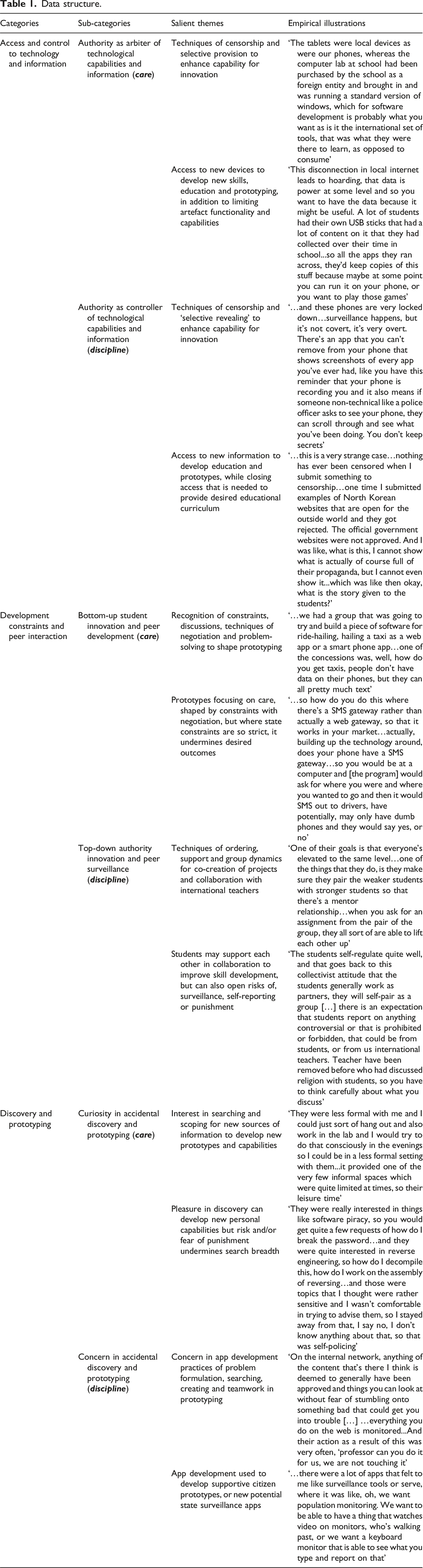
As typical for ethnographic studies (Bruni et al., 2004), the main observations are analysed by those who have collected them, owing to the importance of the context in which the observations were made. All four authors then reflected and discussed the data and observations with the principal ethnographer. To develop our observation ground we organised the data based on its context, source, content and practice, that enabled us to frame small ethnographic stories, or ‘vignettes’ (Wilson, 2011). Following Navarini (2001), we further prepared and structured the vignettes into two types of event. First, we draw on the principal ethnographer’s observations (i.e., field diaries) to explain concrete situations including thoughts and dialogue with teacher and student, or other citizens. Second, we complement the observations with a wider analysis of post-hoc reflections by the principal ethnographer.
Data structure.
Research ethics
Due to the context of our ethnography, ethics was taken very seriously to protect the participants. It must be emphasised that the content of the projects and artefacts did not question or criticize the North Korean regime – much of the paper focusses on the dispositif of paternalist care. While written permission was gained from Tech School’s President, by the principal ethnographer to teach, this was done on the agreement with senior Tech School officials that field observations were being made and recorded for use in later academic and media publications. However, this agreement was under constant renegotiation (cf. Ram, 2000) as international politics and events, and the consequent perceptions and reactions, could challenge that agreement. Different participants of Tech School, including officials, students, teachers and minders were aware that observations were being recorded and artefacts catalogued. This long-term project of promoting educational engagement with North Korea was conducted as appreciative inquiry (Bushe, 2011), where the ethnographers’ objectives and interests of participants are complex to understand, as they are constantly shifting over the extent of the field work, and are not always aligned (Geertz, 1973).
Only students studying on the main ethnographer’s modules, taught between 2012 and 2017, participated in optional project activities, which were observed for the data collection. Tech School permitted informal (yet not to be recorded) conversations for research purposes, and it was communicated to students that observations by the teachers could be included in our study. The main ethnographer taught 11 modules over 5 years. It is important to note that the university in North Korea had no specific IRB protocols. However, we have taken ethics very seriously in conducting our field work. Nevertheless, due to the constraints of the research setting, it was not possible to get written consent forms from the students. Subsequently, we always orally communicated in every class when an experimental project was only for research purposes and that every student could freely choose to not participate. For instance, some students chose an alternative assignment, on another theme than the one related directly to the research topic. Given the circumstances and what was possible, this was the most appropriate strategy to collect data during the study period, focusing on the ethnographers’ rich observations in the field.
Having no written consents is a common issue in field work, especially in unique and unusual settings. Particularly in North Korea, most of the formal processes commonly used in research as standard are still novel for the system as very few studies have been conducted within this context. For example, the main ethnographer and the students recorded lectures in 2015, but they only received oral permission from the university as there was no formal process for obtaining recording permission. Even the main ethnographer’s work contract (as assistant and associate professor) was only based on informal consent between the different parties, and not offered in written form. In practice, every agreement made and all permission received were in the form of informal, mostly oral, conversations as well as to some extent via email conversations.
In presenting data in the paper’s analysis, we made sure that any observation or vignette cannot be attributed to individuals or groups of students. The observations are completely anonymized, and in some cases generalized, whereby ‘common’ examples, such a project choice, are used. Vignettes that are sensitive or linked to individual students were never used. Diary note observations are anonymous, so it is no longer possible for the authors to trace back examples to individuals or groups of students. The data collection occurred over a substantial time period, adding a further layer of protection, making it impossible to make inferences over individual student actions. To further secure confidentiality and anonymity, we also decided to anonymize Tech School in the paper. The research project was supported by two European funding bodies which required the study proposal to undergo a careful ethical assessment, prior to funding, which clarified the ethics, prior to the commencement of the data collection. The application process also involved scrutinization by an internal ethical approval panel, conducted by the lead ethnographer’s institution.
Findings: Techniques and dispositifs in tech school
In this section, we turn to examine vignettes from our teacher diaries to provide insight into the different techniques active within Tech School. Following our coding (Table 1), we separate different techniques into three specific categories: access and control to technology and information; development constraints and peer interaction; and discovery and prototyping. We then seek to examine the techniques through our vignettes, and in each sub-section, separate them into techniques used under the dispositif of paternalist care and of discipline. As such, we highlight similarities between techniques, but also their differences, to gain insight into how the dispositif logics shape the operation of these techniques, resulting in an unstable interplay between the two dispositifs, which is complimentary, but also contradictory (c.f. Smets et al., 2015).
Access and control to technology and information
The techniques used in both dispositif can be direct, through the provision and acquisition of particular technological artefacts and information, by teachers, or indirectly through self-discipline, by students, wary of being under surveillance, seeking to modify their behaviour to avoid violating accepted norms (Legg, 2005). Vignettes illustrating the techniques in the dispositif of paternalist care (Authority as arbiter of technological capabilities and information) and the dispositive of discipline (Authority as controller of technological capabilities and information) are highlighted below, while providing insight into how the dispositif unfolds in local classroom space.
Authority as arbiter of technological capabilities and information
The state enacted a logic of care by gradually increasing access to digital artefacts that were previously prohibited, partly to give citizens access to technology for entertainment and cultural pursuits, but to also augment digital education. Access to new digital devices enhances learning and provides students in Tech School with opportunities to develop new digital capabilities. The following examples below illustrate how a logic of care facilitates the acquisition of new technology, which under international trade bans should not be possible, but which entwines new technological artefacts into the dispositif of paternalist care, devices that are more relevant to students learning software development, by using tools that meet international standards. The addition of these new devices to the dispositif assists the state’s wider aim of developing capabilities for the digital economy and society: The tablets were local devices as were our phones, whereas the computer lab at school had been purchased by the school as a foreign entity and brought in and was running a standard version of Windows, which for software development is probably what you want as is it the international set of tools, that was what they were there to learn, as opposed to consume
In the example below, highly controlled artefacts were selectively provided to more advanced students, to accelerate the provision of new apps and services. The addition of these specialist artefacts to the dispositif of paternalist care was not to benefit individual students, but is to help students capture international expertise from visiting teachers on unique projects, which could directly support the development of new apps for citizens by elite officials. On the one hand, the macro view of the state dispositif seeks to curtail access to artefacts as a matter of policy and security, but the micro enactment in local teaching space, sees this undermined in practice, despite being part of the same dispositif. This provides an example of a more focused and targeted technique towards a logic of care: It [device] came from an external source...there was [maybe] a friend at KCC [a government computer lab] who wanted a sub-contract unofficially, or just ask or something...they had a development version phone without the DRM on it, so it could load custom apps that he was building which a normal production phone couldn’t. but this was an interesting leakage where that was a privileged piece of technology.
It will come as no surprise that the government is known for techniques of broad censorship and control of information. However, the logic of care seeks to promote the accumulation of new external knowledge within Tech School. In contrast to the macro state-level, Tech School’s political censors have become more open to inbound information, as they recognise its necessity in developing digital education for a new generation of students. This again illustrates how the macro view of the dispositif still seeks to maintain broad censorship, but the interplay with the logic of care, sees this unfold differently and more flexibly within local teaching spaces. Techniques of censorship ironically carried a logic of care, where the aim is to be selectively open to artefacts from the web, rather than to block access entirely. The extract below indicates that there may not always be the capacity or expertise within the censorship unit to assess all materials in time, before they are needed for teaching. As such, responsibility through self-discipline is placed upon international teachers, displacing the censorship task from political officers to teachers, and highlighting the potential for acts of negotiation: …it’s about proofing the system because we would put these [teaching] materials through the censorship office. There were times where I distributed the knowledge directly [to the students] and they said like, yes, that’s fine, just give the USB to us and we'll take care of that, but it bends the rules
The capacity for punishment upon lecturers, if they import forbidden materials, can be reported through student surveillance of potential ‘deviant’ teaching activities, guiding external lecturers into self-discipline, limiting themselves to ‘apolitical’ artefacts. Alternatively, deviant activities could be exposed in a retrospective review of materials by the censorship office. Either way, this change of censorship techniques through the dispositif demonstrates its fluidity. As will be discussed later, in the dispositif of discipline section, authorities limit flows of information, partly by restricting access to the Internet. However, the censorship authorities seemingly permit the use and circulation of USB sticks to store digital materials, to widen student access to information, that can be experimented with and which broaden an awareness of other apps and digital assets, developing student capabilities. The logic of care pushes censors towards tolerance of increasingly widespread USB usage, as it supports student development, and in turn a generation of students whose skills have the potential to support North Korean society: This disconnection in local internet leads to hoarding, that data is power at some level and so you want to have the data because it might be useful. A lot of students had their own USB sticks that had a lot of content on it that they had collected over their time in school...so all the apps they ran across, they’d keep copies of this stuff because maybe at some point you can run it on your phone, or you want to play those games
Authority as controller of technological capabilities and information
Routine techniques of control are enacted by political officials and censors located in Tech School which control how computers are used, including the automated tracking of website visits. With the exception of Internet-free smart phones and USB sticks, technology is accessed communally. For example, there are no personal email addresses, only shared group email addresses. This technique promotes informal peer surveillance (Manokha, 2018) as messages can be overseen and perceived deviant behaviour can be potentially identified and reported. Knowledge of this informal technique within Tech School also enforces individual self-discipline, to follow prescribed norms of artefact use: Because the computers really, by and large, are really not personal computers. They’re group computers…people maybe have access to a computer in a library…I think that relates also to the censorship and if you look on a tablet it leaves a trace, it tracks it. If you look at it from Windows
Similar techniques are used to control the uptake of personal devices amongst Tech School students. Smart phone use cannot be monitored remotely as they cannot be connected to the internet. However, prescriptive logics see that phone capabilities are locked, not only from the Internet, but also with the addition of offline tracking apps. This technique of surveillance means that while the device cannot be remotely accessed, offline tracking apps could be checked by police. The power of this technique is not in regular, routine police checks, but through self-discipline (Chaudhuri and Konig, 2018) stemming from the risk that the phone could be checked. This develops power over student behaviour to not download apps or use the phone in ways that could be viewed as abnormal deviant behaviour, which could be subject to punishment: …and these phones are very locked down…surveillance happens, but it’s not covert, it’s very overt. There’s an app that you can’t remove from your phone that shows screenshots of every app you’ve ever had, like you have this reminder that your phone is recording you and it also means if someone non-technical like a police officer asks to see your phone, they can scroll through and see what you've been doing. You don’t keep secrets
Routine checks of teaching materials by Tech School’s censors are a technique which shapes the behaviour of international teachers. The dispositif’s prescriptive logic dictates what is normal and permitted, to exclude students from exposure to data and information judged to be undesirable. Due to the special status of international teachers, rather than being punished, they are advised on what can and cannot be used. This technique develops self-regulation by international teachers (c.f. Legg, 2005), who seek to strike a balance where they can bring in external ideas, but which must not contradict what could breach prescriptive norms. This is challenging and fluid as prescriptive norms were unclear, and responses could be surprising and unpredictable, adding to the need for negotiation, and highlighting instability within the dispositif: …this is a very strange case…nothing has ever been censored when I submit something to censorship…one time I submitted examples of North Korean websites that are open for the outside world and they got rejected. The official government websites were not approved. And I was like, what is this, I cannot show what is actually of course full of their propaganda, but I cannot even show it...which was like then okay, what is the story given to the students?
As demonstrated above, there are similarities between the techniques in both dispositifs of paternalist care and discipline. These include the self-discipline of teachers and students in deciding what information, resources and artefacts to use as part of a dispositif of care (c.f Manokha, 2018), but also how the censorship office selectively decides what information and artefacts can and cannot be used. As such, we see similar techniques used for both dispositif, but they are also contradictory in their end use. In following the work of Smets et al. (2015), the similarity of these techniques illustrates the interplay and how the dispositifs are complementary. However, the opposing care and prescriptive logics see these techniques take on different opposing roles, as the dispositifs unfold within local teaching space. For example, under the dispositif of paternalist care, the censorship office may give autonomy and space for negotiation to international teachers, or give student access to high-end, privileged devices to develop digital capabilities, but simultaneously the dispositif of discipline’s prescriptive logic sees similar techniques seek to constrain access to information and artefacts. As such, this logic undermines the logic of care by limiting potential innovation and the development of digital skills, whereas the care logic seeks to undermine the discipline of discipline and state control, which could challenge the regime.
Development constraints and peer interaction
As above, the techniques in both dispositif can be direct or indirect, where students and international teachers seek to undertake self-discipline to avoid violating perceived norms, or through direct limitations imposed by authorities in limiting access to specific artefacts and devices, for example cloud technologies. The vignettes, organising the techniques, are ordered by the dispositif of paternalist care (bottom-up student innovation and peer development) and dispositif of discipline (top-down authority innovation and peer surveillance), below.
Bottom-up student innovation and peer development. Techniques of prototyping, as the development of new artefacts by students, regularly occurred in the curriculum as part of the dispositif of paternalist care, to cultivate new skills and potentially new apps that address social issues (c.f. Breckenridge, 2019). For example, students would scope for and identify common problems, such as, mobility issues due to limited car access, as a form of confessional truth-telling (Munro, 2017), and sought to reconfigure external digital artefacts and local knowledge, to repurpose them for their spatial context. Students often selected app ideas and prototypes that were framed around a care logic, rather than for developer profit or benefit: …we had a group that was going to try and build a piece of software for ride-hailing, hailing a taxi as a web app or a smart phone app…one of the concessions was, well, how do you get taxis, people don’t have data on their phones, but they can all pretty much text
Prototyping required problem solving, where students positively sought to work around the technical infrastructure constraints on their available artefacts. The challenge students faced is to tailor an external idea and negotiate between local political and infrastructure locks on capabilities, along with the available resources and norms to develop a prototype. Rather than criticising available infrastructure, the students developed solutions by negotiating between the technological capabilities of materials and political values to create an artefact that can improve society, contributing to the logic of care (Udayabhanu, 2015): …so how do you do this where there’s a SMS gateway rather than actually a web gateway, so that it works in your market…actually, building up the technology around, does your phone have a SMS gateway…so you would be at a computer and [the program] would ask for where you were and where you wanted to go and then it would SMS out to drivers, have potentially, may only have dumb phones and they would say yes, or no
The technique of prototyping for the logic of paternalist care involved student collaboration, where students collectively wanted the cohort to succeed in developing digital skills and arranged themselves to provide peer support, improving development and learning outcomes. The moral community focus is to ultimately help society develop new digital skills, so by working together with weaker students, which is model citizen behaviour and open to reward (Hansen and Weiskopf, 2021), as it helps maximise success for the whole class, and in doing so, has potentially greater impact as more citizens will graduate with tech skills. Additional techniques involved the unprompted and informal ‘ordering' and pairing of peers by students, based on capabilities: The students self-regulate quite well, and that goes back to this collectivist attitude that the students generally work as partners, they will self-pair as a group One of their goals is that everyone’s elevated to the same level…one of the things that they do, is they make sure they pair the weaker students with stronger students so that there’s a mentor relationship…when you ask for an assignment from the pair of the group, they all sort of are able to lift each other up
Top-down authority innovation and peer surveillance
The prescriptive logic used in Tech School’s dispositif of discipline seeks to shape curriculum content by determining what is (in)appropriate. However, this logic is problematic, in that it directly contradicts the dispositif of paternalist care, as its operation is to prohibit the use of open technological artefacts, needed to teach computer science. Moreover, it illustrates macro-state level influences on the dispositif which make sense to policy elites in shaping the curriculum, but which could not be enacted locally, due to competing logics in micro teaching space. This political authority of top-down power is strong and teacher-led attempts at negotiation to access appropriate technology for learning were often rejected. Established routines and techniques of technology control views openness as abnormal, yet it is needed to teach what authorities perceive to be a crucial and important concept to develop digital capabilities. This required a move from political negotiation, to curriculum negotiation, where an attempt was made to teach a concept which was demanded, without the correct artefacts: They wanted us to teach about the cloud, we pushed back and said, well we aren’t connected to a cloud so how do we do this? We can talk about some of the technologies that you'll need to do that, but your insistence that we run it all on campus, that isn’t cloud and it’s only connected to limited labs on campus, this is missing the point
In contrast to peer development under the dispositif of paternalist care, three specific techniques were undertaken by student peers within this dispositif to extend the reach of the state (Villadsen, 2019). First, peers have the responsibility to inform on other students whose behaviour may deviate from norms. Second, by extension, students could be punished for not reporting suspected deviant peers. Third, knowledge of these techniques, leads to self-discipline by students themselves, so they do not engage in behaviour that could be viewed as deviant. Deviant behaviour could refer to general behaviour, but as will be highlighted later, there is a perception that many deviant behaviours in their education could ‘accidentally' occur through the use of technical artefacts or in innovative prototype development. The gaze of the first and third techniques are also turned to international teachers to ensure they do not engage in forbidden activities: There is an expectation that students report on anything controversial or that is prohibited or forbidden, that could be from students, or from us international teachers. Teachers have been removed before who had discussed religion with students, so you have to think carefully about what you discuss
The above vignettes highlight similarities and differences between the techniques in both dispositif (c.f. Smets et al., 2015). Self-discipline is again important as a form of non-legal, non-technical technique which moderates how digital devices and resources are mobilised. For example, on the one hand, students under the logic of care may order and self-organise collectively, to pair stronger and weaker students, to maximise cohort success in developing digital capabilities. On the other hand, those same students under a prescriptive logic of discipline, may undertake informal surveillance and inform on each other and teachers, if they perceive norms to have been violated. What is particularly problematic here, is how in a field of innovation, what is and is not ‘normal’ is unclear, with no previous precedent. Similarly, negotiation as to how different devices and artefacts are organised is undertaken as a technique to work around technical device constraints, under a logic of care to develop new prototypes, whereas the prescriptive logic of discipline can derail attempts to teach even state demanded curriculum, creating constraints and barriers that cannot be successfully managed by negotiation in local teaching spaces. These vignettes further illustrate how the similar techniques can take on different or opposing roles under different dispositif, following either a logic of care or prescriptive discipline.
Discovery and prototyping
The vignettes below, illustrate how the two logics create different outcomes from similar techniques. Related techniques of self-discipline under the dispositif of paternalist care, shaped student behaviour into spending additional time on developing their skills, driven to improve themselves through self-directed study, where ‘discovery’ in learning and the development of societally beneficial prototypes brought excitement. In contrast, self-disciplinary techniques under the prescriptive logic of discipline made the accidental discovery of forbidden information a clear risk, leading to self-regulating techniques of avoidance and conformity to avoid accidentally engaging in what could be viewed as deviant behaviour, leading to potential punishment. Once again, similar techniques, when enmeshed with the dispositive of paternalist care logic (curiosity in accidental discovery and prototyping) and dispositif of discipline (concern in accidental discovery and prototyping), create different and contradictory outcomes. While at the macro-level, with state policy-makers, these rules may make ‘sense’ but they unfold differently in local classroom spaces, where different dispositifs interact and contradict.
Curiosity in accidental discovery and prototyping
Following the moral community focus, students would often seek out informal opportunities to develop their expertise further as a technique of self-care (Villadsen, 2019), to discover new knowledge beyond that in the taught curriculum. Self-regulated techniques of discovery and experimentation broadened knowledge, responding to the logic of care in the dispositif, through being able to make a potentially better contribution to society through having advanced knowledge, raising prospects of positive rewards (Munro, 2017). Informal opportunities of learning bring positive rewards, such as excitement from self-discovery, and potential self-promotion through self-directed study and expertise, which feeds into class ordering, as these students assist their peers: There are a few students in each class who are genuinely interested about the technology, but they’re going out and trying to get more knowledge through some self-motivation, but there are students who are very excited and will work on their own projects or things they’re excited about...it’s a time when they can share knowledge...it’s leisure and self-betterment
Within the dispositif of paternalist care, and seeking to support the moral community, students undertake scoping for internationally available ideas that could be used domestically. These ideas are then subjected to techniques of prototyping in an attempt to solve social problems, by identifying an issue as a form of confessional truth-telling (c.f. Villadsen, 2019). A common theme of interest to students was improving healthcare for citizens, enabling them to take responsibility and overcome healthcare constraints. The vignette below, gives an example focusing on improving health, through prototypes developed by students: They found a couple of Chinese [health] apps that did similar things and they were trying to model or copy or adapt to make a local version, everyone was excited about IOT and watch heart rate monitors, but there is no watch ecosystem, they don’t have Apple watches, but you could develop a phone app
Interestingly, the care logic pushed students towards more controversial techniques, such as reverse engineering apps and software, to capture artefacts that could be used to prototype apps more quickly to seek positive rewards. This illustrates tensions and instability within the dispositif as international teachers would view this as unethical and not a logic of care towards authors and developers of original artefacts who would not receive recognition. To defuse tensions within the dispositif, feigned ignorance was used, to navigate from questionable practices: They were really interested in things like software piracy, so you would get quite a few requests of how do I break the password…and they were quite interested in reverse engineering…and those were topics that I thought were rather sensitive and I wasn’t comfortable in trying to advise them, so I stayed away from that, I say no, I don’t know anything about that, so that was self-policing
Concern in accidental discovery and prototyping
Prescriptive logics under the dispositif of discipline attempt to define what is normal and what is deviant. Resonating with Ostrowicka (2012), creativity is valued as long as it does not appear to damage public image and the status quo. Students were concerned about accidental deviance, whereby they may unintentionally find something forbidden on the Internet, or create a prototype with unintended outcomes. This led to techniques of self-regulation, where coping tactics were developed to avoid violating norms, as use of the Internet is monitored by censor officials. For example, some students had a preference to use the domestic Intranet, rather than the Internet, as the assumption is that all material on the Intranet will have been scrutinised and approved by officials in the KCC, so there is no need to fear the accidental discovery of controversial information. It becomes difficult for students to navigate the Internet as they have limited clarity on what is deviant or forbidden, particularly in projects focussed on innovation, when using novel digital technology departs from established routines and norms. This makes it difficult to know how behaviour will be viewed by political officers, as there may be no prior precedent. As the vignette indicates below, self-regulation sees judgements and decision-making on what is acceptable, moved to an authorised official who knows how to better navigate the Internet, or to an international teacher as they have an elevated status (c.f. Manokha, 2018): …everything you do on the web is monitored...And their action as a result of this was very often, ‘professor can you do it for us, we are not touching it’…I don’t want to accidentally find something bad …you can make a request for content and that goes to the lab…I think it was KCC one of the large government labs, where someone who’s approved to have access to the external Internet will do a search on your behalf
Techniques of conformity are also used as a form of self-discipline, following the prescriptive logic. While students wanted to develop new app prototypes, as part of a logic of care, non-routine innovation could lead to the development of prototypes that may not be accepted by officials. For example, an online dating app was discontinued in the early stages as it was seen as being too socially disruptive. To avoid potential acts of deviance, some students turned to mimic or develop apps that have a strong disciplinary purpose or could benefit the state’s disciplinary apparatus, closely aligning projects with the disciplinary logic. As the students live in the context of an authoritarian regime, and are subject to disciplinary control, an app that does the same can be considered to follow accepted norms. In contrast to a caring logic to help society, the development of prototypes that embed a prescriptive logic of discipline, sought to appease and support the state apparatus: …it was interests in preserving the social structure, that was more of the things that they were bringing, but there were a lot of apps that felt to me like surveillance tools…We want to be able to have a thing that watches video on monitors, who’s walking past, or we want a keyboard monitor that is able to see what you type and report on that
Instability through acts of negotiation exist within this dispositif, due to resistance from international teachers, who sought to curtail student attempts to prototype surveillance apps, which had the potential to extend digital surveillance across populations. Techniques of feigned ignorance were used, to deny support to these prototypes, as were tactics of redirection, to guide the students towards alternative projects, which may be more closely aligned with a logic of care. This highlights tensions between the actors, where international teachers as experts have more power and destabilised student attempts for success in developing prototyped apps of discipline: So, I'm not going to steer you down this path….to try and direct them towards things that given their context would be workable, especially as they would ask about surveillance or security…I would be more cautious in responding…generally I wouldn’t give them nearly as much. And I’d say look, if that's something you want to do, you’ve got to figure it out. And we'd do that by not giving them any useful material
Our analysis of the three specific themes above has highlighted the similarities and differences of techniques under the two dispositifs. The vignettes provided insight into the techniques deployed by different actors within the dispositif of paternalist care and discipline, entwining material objects, students, teachers and information within Tech School, in an attempt to control the development of digital skills and prototypes, which do not undermine perceived norms within the regime. One initial reflection of our international teachers on arriving at Tech School, was how many rules and routines were contradictory and confusing. Following our analysis, this reflection can be viewed as a rudimentary observation as to how techniques have been mobilised by different dispositifs, resulting in seemingly contradictory effects as a result of their opposing logics. What is particularly interesting, is how the development of capabilities for the digital economy requires both dispositifs, to introduce new ideas, knowledge and artefacts, but to also constrain their application and make them compatible with the regime’s values and norms. Despite this need to co-exist, the two dispositifs are contradictory and their relationship is unstable, leading them to require frequent negotiation. It is notable how this negotiation and adjustment often comes through self-regulation by students and international teachers in overcoming the contradictions, rather than as a direct intervention from the government. This also highlights how policy-makers in central government attempt to shape dispositifs at the macro-level, but how dispositifs unfold differently within local teaching spaces.
Conclusion
The geographies of education field has reached a phase of maturation and has turned to become more critical, attentive to the role of power structures and institutions which shape educational space, with an increasing emphasis on the need for studies in the global south (Henry, 2020; Kraftl et al., 2020; Nguyen et al., 2017). While education has been historically entwined with activities to promote nation-states and capitalism (Henry, 2020), researchers have increasingly highlighted the role of neoliberalism in education and opportunities for resistance (Ball and Grimaldi, 2021; Holloway and Kirby, 2020). In turn, this has seen an emergence of studies with a transnational focus, particularly of international students and faculty (Madge et al., 2015), but also the growing role of elite business education as a conduit for the dissemination of new tools and knowledges (Hall, 2009; Hall and Faulconbridge, 2014).
In this paper, we sought to provide three additional contributions which address shortcomings in the literature. First, in following Nguyen et al.’s (2017) call to examine the dominant logics within education, we adopted the dispositif to examine the social processes, power and contestation between state logics in an attempt to enact digital education. Second, in drawing upon Silverman’s (1985) idea of distinguishing between the macro and micro of a dispositif, we illustrated how the dispositifs unfolded in different spaces. For example, the macro intentions of a state dispositif may have sought to censor or restrict particular activities, but in practice, when the dispositif unfolded within teaching space, and subject to competing logics, the effect and practices were different, afforded by the flexibility given to Tech School’s space and the competing requirements for its education. Third, we reacted to calls to move away from studies set in the global north (Henry, 2020; Kraftl et al., 2020) and sought to show the techniques used to manage technologies and knowledge from neoliberal digital economies, and to contest the rationalities behind digital innovation in one of North Korea’s diverse educational spaces (c.f. Bailey, 2013).
Our paper focused on an ethnographic study of North Korea, centered on Tech School, to address these research gaps. We began the paper by providing novel insight into the contextual situation of Tech School and North Korea’s desire to develop a digital economy, to improve living standards for citizens, despite the country’s unique focus over control of information, which curtails access to the Internet, for example (Mansourov, 2011; Warf, 2015). As such, we highlighted how this has given rise to Tech School as an elite institution, seeking to train graduates who will be able to lead the country’s digital transformation in the future.
Our paper used a dispositif lens to examine how North Korea seeks to provide digital education, whilst controlling and containing the use of digital technologies. We sought to identify the techniques used in the dispositifs to guide the development of digital education, but to also constrain it. In doing so, we mobilized the dispositifs of paternalist care and discipline. Our analysis drew attention to a series of techniques, some of which were directly operated by the state through the censorship office, for example: an authority as arbiter of technological capabilities and information, which provided access to particular devices and materials, but also where techniques of self-discipline were also used, where students and international teachers, would seek to avoid violating specific norms through their behavior, shaping digital learning. Having identified types of similar techniques that are used in both dispositifs, the analysis examined how they are used differently, based on the logic at the center of each dispositif. This led us to argue that not only are individual dispositifs unstable (Legg, 2011), different dispositifs that are used by the government to exercise control are complimentary and contradictory, due to their opposing logics (c.f. Hansen and Weiskopf, 2021; Smets et al., 2015). However, both need to exist to enable the development of the digital economy, so continue to be unstable, requiring negotiation and adjustment.
We sought to distinguish between the macro and micro perspectives of dispositifs. While dispositifs have been used to analytically remove dualisms, we argue that this distinction is particularly relevant in our study, as Tech School’s space is arguably given exceptional flexibility in North Korea, to deviate from the ‘normal’ standards and rules within state dispositifs. However, Tech School is still required to comply with the logics of dispositifs. For example, macro-level dispositifs of the state are present, for example, on security, but rules are re-worked locally by university leaders and teachers to interplay with competing rationales, such as the introduction of quintessentially neoliberal digital innovation and entrepreneurship teaching, to support a dispositif of paternalist care. We further argue that this macro-micro sensitivity is attentive to the unfolding of complementary and competing dispositifs and their constituent techniques and technologies, at different scales and spaces, making the macro-micro distinction a useful analytical tool for geographers studying the unfolding of dispositifs in particular educational spaces, and the affordance of contestation and resistance. This approach and its attentiveness to multiple dispositifs, emerging in different spaces, could be useful for more critical education studies investigating neoliberal contexts, especially in the global south (c.f. Wanderley et al., 2021; Zulfiqar and Prasad, 2020), where competing logics and dispositifs can contest neoliberal logics and apparatus from the global north. This approach could further encourage research aimed at gaining a deeper understanding of how authoritarian management styles in educational institutions influence the practice of learning and education. This is crucial because such styles may lead to the suppression and concealment of educational practices both within and outside these institutions (Szkudlarek and Alvesson, 2023).
In making a broader offering to debates beyond the geographies of education, we posit two additional findings. First, our case serves to exemplify some of the approaches which nation-states mobilize in seeking to acquire competitive advantage, using education as a crucial precursor to advance the frontiers of their technological capabilities and accelerate economic development, in turn, exerting geopolitical influence. Second, we draw attention to techniques used by nation-states, particularly regimes whose increasingly authoritarian stance, seek to ‘close’ and control the Internet within their geographic territory, and by extension digital technologies, challenging the status of an open, sharing orientated Internet. Of particular interest here, is the development of unique knowledge combinations and the innovative social infrastructure needed in education to integrate ‘objective’ technical expertise, embedding it within the political values of local settings.
We end this paper by arguing that further research is needed to gain deeper insight into educational spaces of the global south (Henry, 2020; Kraftl et al., 2020), but to also better comprehend how national settings shape the adoption of new digital technologies. With regards to our theoretical contribution, we suggest three areas for potential development: First, to examine contradictory/complementary dispositifs and how they unfold in different educational spaces and scales, in particular, the techniques that interlink those dispositifs. Second, to look at different types of dispositifs, for example, legal and security dispositifs, to examine their interplay, contradictions and complementarities. Third, to examine multiple combinations of dispositifs, their interplay contradictions/complementarities, to explore how more than two dispositifs function and how attempts are made to resolve them, in the context of digital economies. Finally, we agree with the recent study by Kibler et al. (2022), which argues that further research on North Korea is necessary to help researchers and policymakers understand the changes occurring within the country. This includes examining the emergence of entrepreneurial activities, as well as how the digital economy and technology-enabled citizens have the potential to reshape its development.
Footnotes
Declaration of conflicting interests
The author(s) declared no potential conflicts of interest with respect to the research, authorship, and/or publication of this article.
Funding
The author(s) disclosed receipt of the following financial support for the research, authorship, and/or publication of this article: Newton International Fellowship NIFAL19\190023 and Academy of Finland Postdoctoral Fellow 307765.
