




Abstract
This paper examines the sociodigital experiences of political and religious minorities in contemporary India to understand matters of voice and power, as well as feelings of belonging, identity and citizenship. It builds out from research conducted in New Delhi between February and June 2019 during and after the Indian national elections and focuses on WhatsApp as an everyday space where Hindu nationalism is (re)produced and articulated through memes, forwarded messages, videos and political talk. In the shadow of right-wing nationalisms, it examines how civic and political relationships are being transformed. Drawing on experiences and narratives of political and religious minorities we contend that the ‘digital denizen’ represents a new digital-political subject, one who is increasingly outcaste within a global conjuncture of exclusionary politics, technological affordances and local histories of power and coercion. Digital denizenship represents the regression of citizenship which connects ways of acting and articulating within intimate and digital storytelling infrastructures shaped by the articulation and defence of ‘truth’. We show how being a digital denizen means recognising, anticipating and navigating the oppressive expressive power of exclusionary sociodigital practices in order to quietly resist difference, disorientation, danger and unbelonging in everyday life.
India’s sociodigital scene and the rise of digital denizenship
WhatsApp message translation: “From a true Indian patriot, I pay tribute to the martyrs who died in the Pulwama attack – Black Day 14 February 2019” Received 15 February 2019.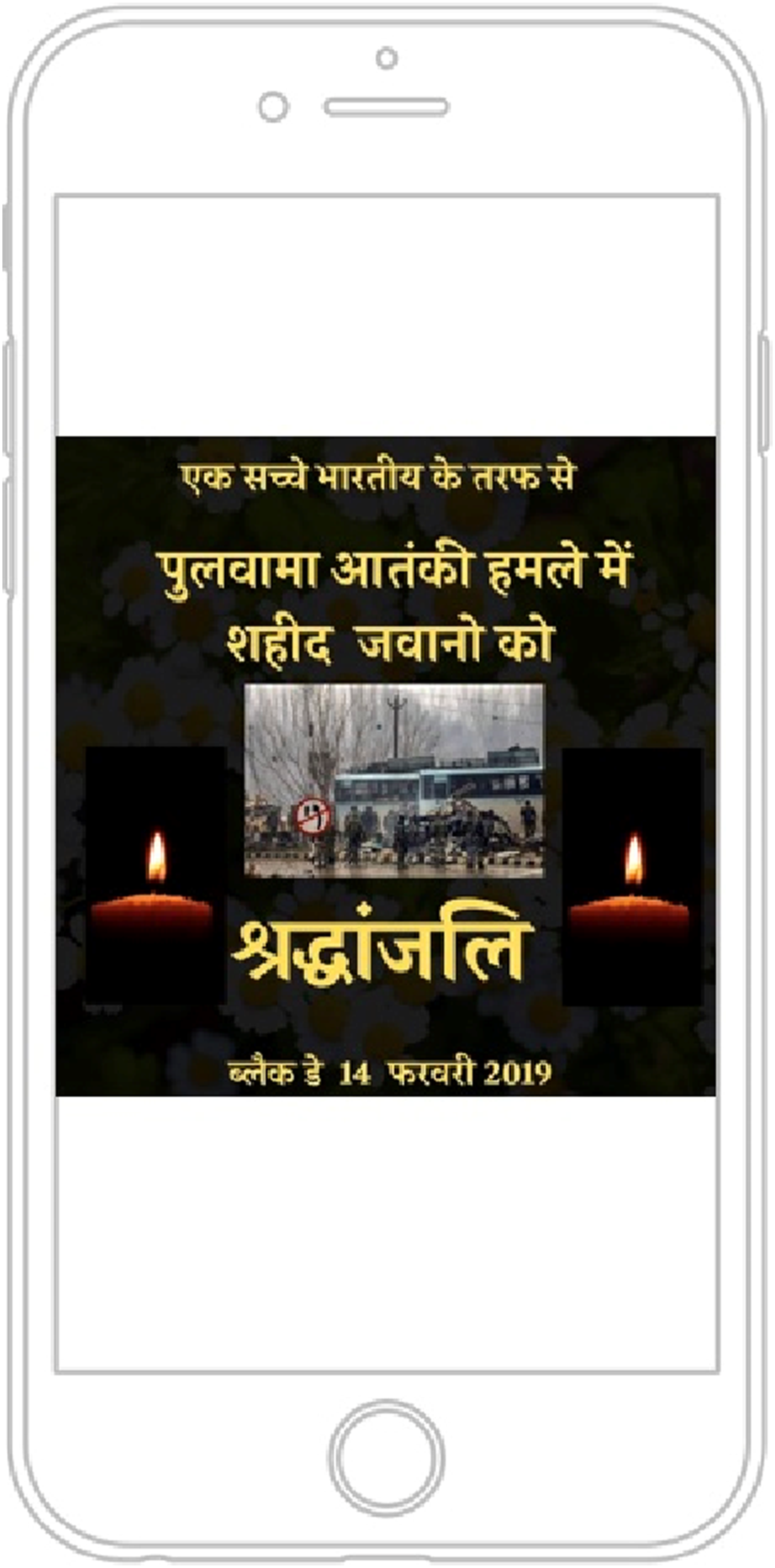
The day before, Jaish e-Mohammed, a militant group based in Pakistan, allegedly carried out attacks in the Pulwama district of Kashmir killing 40 Indian police officers. The police convoy was targeted on the Jammu-Srinagar highway, where an explosive-laden car rammed into the officers’ bus. Led by the government, the attack triggered public outrage and calls for revenge that were gaining momentum on WhatsApp and in the media. The nationalist and patriotic messaging was repetitive, with slight variations in the text and images but no one dared to challenge the emerging ‘truth’ about the attacks or the logic of revenge.
More messages arrived. One called for the revocation of Article 370 that granted Kashmir autonomy within the Indian Constitution at the time of Partition to temporarily assuage the right to self-determination of this Muslim majority state (Figure 2). These were not conversations, but a rapid-fire exchange of memes, quotes and motivational statements, some more spurious than others, and all feeding into Prime Minister Narendra Modi’s aggression towards Pakistan. The virality of the content was clearly visible; the same anti-Pakistan and anti-Muslim messages appeared on both my neighbourhood and transnational family WhatsApp groups as members of the diaspora also eagerly demonstrated their patriotism and support for Modi through ‘forwards’. WhatsApp forward. Received 15 February 2019.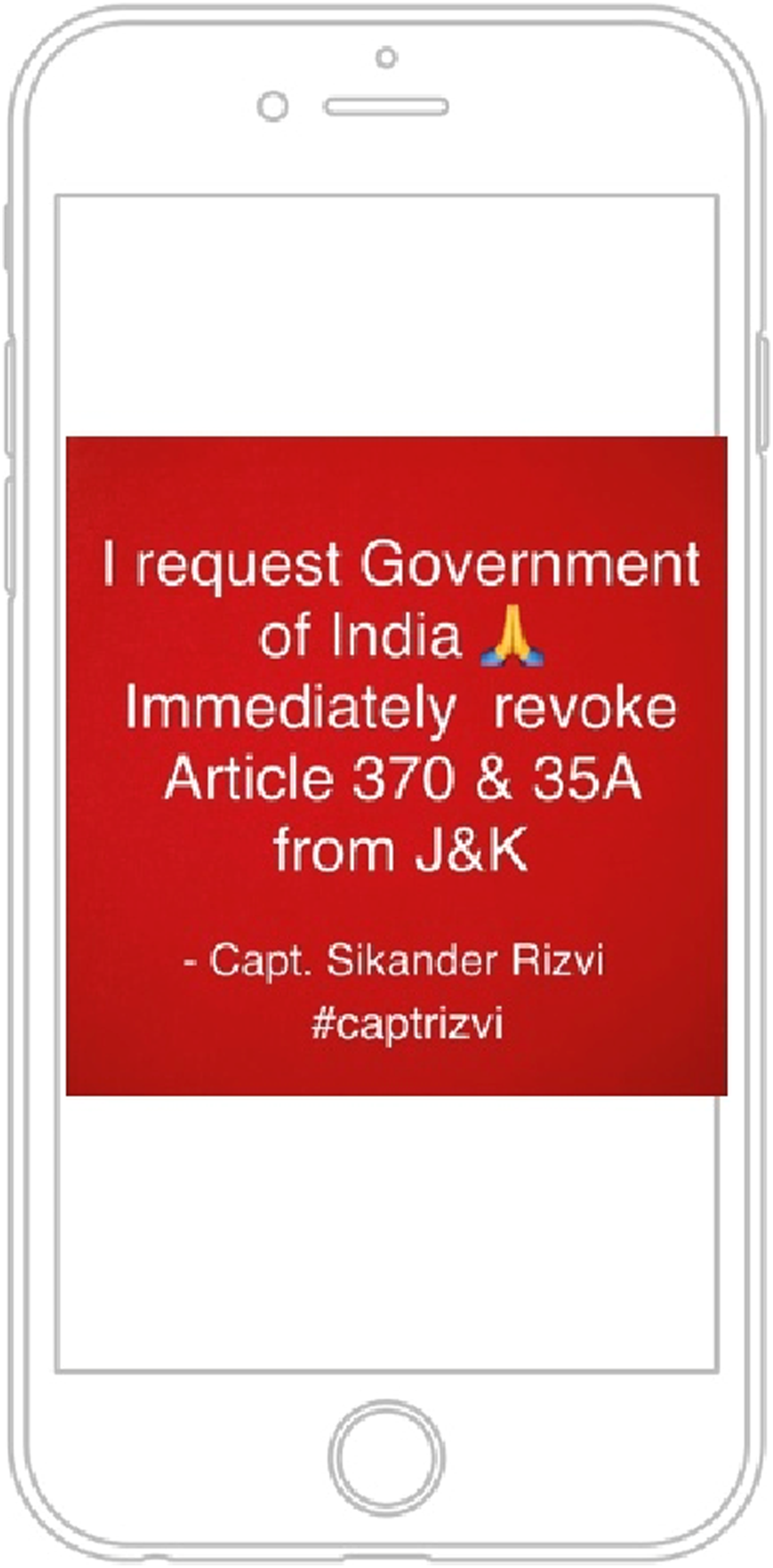
I live in New Delhi in a middle-class residential colony which, until recently, was a left-leaning, Congress supporting neighbourhood. But seduced by Modi’s popular and polarising politics (e.g. Figure 3) majority support has shifted to the Bharatiya Janata Party (BJP). Predictably, the RWA President circulated a call on the WhatsApp group for a candlelit vigil in the neighbourhood to honour the ‘martyred soldiers’ (Figure 4). WhatsApp forward translation: “Vote for a party whose victory will be celebrated in India, not in Pakistan”. that is vote for the BJP not Congress. Received 15 February 2019. WhatsApp message to the Residents Welfare Association WhatsApp group. 15 February 2019.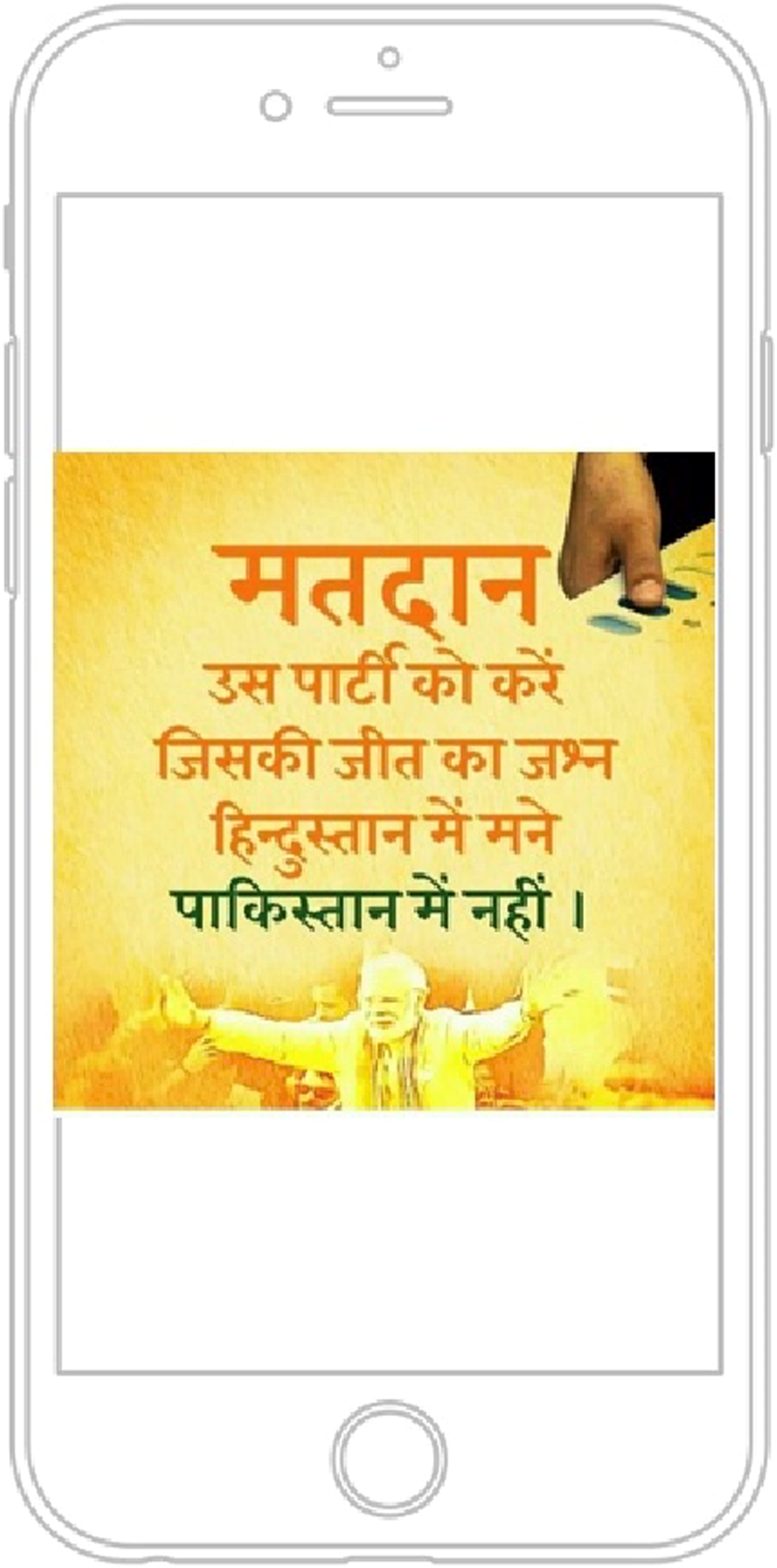
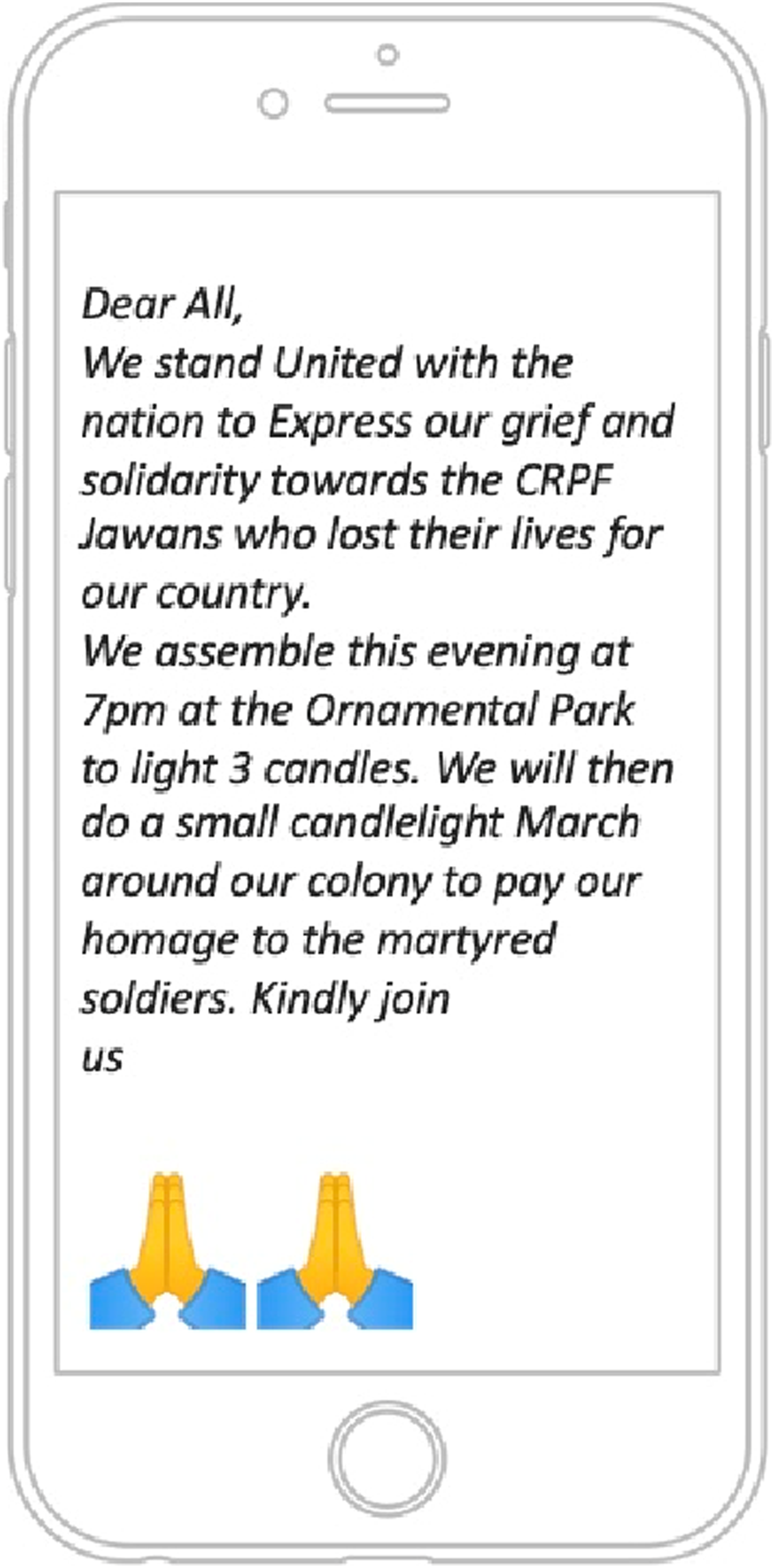
My immediate response was one of wry amusement that the expressions of (digital) patriotism on WhatsApp were now moving to the street, not just in my neighbourhood but across Delhi. The Pulwama attacks had been mobilised and transformed into an urban digital event that gave Modi precious electoral currency for his campaign.
Later that day I went to buy groceries from the market with a friend and encountered a crowd burning effigies of Pakistan and shouting ‘Pakistan Murdabad’ (Death to Pakistan) and ‘Bharat Mata ki Jai’ (Victory for Mother India). Filled with fear and anger at this scene of chest thumping patriotism and anti-Muslim aggression we left in a hurry. Whilst I could exit the street that evening it is much harder to leave my family and neighbourhood WhatsApp groups where comparable sociodigital scenes are common.
We open with this vignette to demonstrate how the ‘sociodigital’ worlds of WhatsApp groups and the streets are interwoven and reinforced in New Delhi as they are in other cities and villages across India (Williams et al., 2021). The Pulwama moment reveals on the one hand the expressive power of Hindu nationalism at this juncture and on the other hand the intimate and embodied experience of Hindu nationalism’s dominance and hegemony. Hindu nationalism’s force is ‘propelled by anti-Muslim prejudice’ and an impulse to realise a ‘pure’ Hindu nation (Mehta, 2022: 43). Following Narendra Modi’s victory in 2014, the family of Hindu nationalist organisations including the governing political party, the BJP and volunteer paramilitary organisation Rashtriya Swayamsevak Sangh (RSS) have extended their violence and deepened their control within India and its diaspora. This has led Mehta to argue that ‘Hindu nationalism has turned into a full-blown reactionary, authoritarian ideology with deeply fascist elements.’ (Mehta, 2022: 43) . Recognising Hindu nationalism’s long history (Jaffrelot, 2007; Zavos, 2000) and transnational intersections with white nationalism in the USA (Ashutosh, 2022), this particular moment is significant because of the overlapping relationship between Hindu nationalism's party power and state power and its ‘compulsive desire’ to control the ‘information order’ (Mehta, 2022: 43).
Recent scholarship has examined Modi’s embrace of social media to cultivate his brand (Sinha, 2017), the BJP’s targeted use of WhatsApp, Facebook and Twitter to polarise opinion and win elections (Singh, 2019) and the role of ‘Internet Hindus’ who aggressively voice their right-wing political views and support for Narendra Modi on social media platforms (Mohan, 2015; Udupa, 2015). These and other studies have documented how the Hindu Right’s populist project relies on circulating ‘extreme speech’ (Udupa and Pohjonen, 2019), hate speech (Banaji and Bhat, 2022) and how misinformation finds traction and circulation amongst an electorate cultivating their socio-political identity and motivated by civic duty and a commitment to nation building (Chakrabarti, 2018). Capitalising on the Internet for political power is just the latest iteration of the Hindu right’s influence within and through the media landscape (Rajagopal, 2001; Ståhlberg, 2002).
Whilst attention has gravitated towards the mediatised production of Hindu nationalism, we agree with Banaji and Bhatt (2022) that we know less about the affective implications of Hindu nationalism’s dominance in the digital-political lives of political and religious minorities, on whose bodies the boundaries of Hindu nation are reinscribed (see Mountz and Hyndman, 2006). This paper therefore examines the experiences of people living in the shadows of Hindu nationalism to elucidate how sociopolitical subjectivities and experiences of citizenship are shaped within a right-wing digital ecosystem rooted in anti-Muslim, if not anti-minority, prejudice. We ask: what does it mean for religious or political minorities to inhabit and negotiate intimate sociodigital spaces within this ‘global conjuncture of digitally enabled exclusionary politics’ (Udupa et al., 2021: 12). What are the implications for questions of voice and power, as well as feelings of belonging, identity and citizenship and how are civic and political relationships being transformed? In sensing the affects and effects of Hindu nationalism, we argue that we are witnessing the emergence of digital denizenship and the rise of the digital denizen.
Building from a position that recognises the mutually constitutive nature of ‘digital’ and ‘non-digital’ practice and relationships (Williams et al., 2021) we advance our argument in four sections. First, we discuss the wider research project and our method for researching sociodigital life in New Delhi. We then introduce the conceptual framework of ‘digital denizenship’ and the rise of ‘digital denizens’ by interweaving scholarship on digital citizenship with respect to digital openings and closures, feminist understandings of the ‘global intimate’ and storytelling within digital political economies of feeling. In the third section, we contextualise India’s Hindu nationalist architectures of digital closures within a longer Hindu nationalist project and show how Hindu nationalism is reproduced in this moment through the uneven infrastructures and practices of the state, Big Tech and society. In the fourth and final section we animate the emergence - the becoming and being - of the ‘digital denizen’ within this complex of sociodigital closures. Drawing on experiences and narratives of political and religious minorities we contend that the ‘digital denizen’ represents a new digital-political subject, one who is increasingly outcaste within a global conjuncture of exclusionary politics, technological affordances and local histories of power and coercion.
Researching sociodigital politics
Our article builds out from research conducted in New Delhi between February and June 2019 during and after the Indian national elections. Widely anticipated as India’s ‘WhatsApp election’, this moment proved fertile terrain through which to witness sociodigital life, that is the situated experiences and affect experienced by ordinary citizens within India’s digital media ecosystem. We adopted an ethnographic approach that privileged locating and interpreting individual narratives, experiences and practices of using digital technology and consuming ‘extreme speech’ within everyday contexts and social political histories (Banaji and Bhatt, 2022; Horst and Miller, 2012; Pink et al., 2016). The research principally involved participant observation within the streets and living rooms of a south Delhi neighbourhood and the digital spaces afforded through smartphones to new media and social media, in particular WhatsApp’s ‘digital living rooms’. These observations were accompanied by everyday conversations and a series of in-depth interviews with 20 middle-class New Delhi residents aged between mid-30s to late-70s. This included four political party workers who shared their insights on BJP's social media and door-to-door campaigning strategies, two party workers from Congress and one from the Aam Admi Party.
The neighbourhood featured in the opening vignette and where most research for this paper was conducted, was in an affluent residential colony of south Delhi. Most research participants either owned or had access to a smartphone on which they used WhatsApp and were generally dominant castes and classes. This is in part a reflection of the digital divide that persists as well as access afforded by the principal researcher. Many of our research participants were older residents who described their intimate and dependent relationships with their smartphones, rising each morning to check messages from friends and family, send Good Morning greetings, and read the news on WhatsApp which effectively constituted the ‘heart of the phone’ (Miller et al., 2021: 181). Focusing on a range of generations contrasts with other studies that have tended to foreground millennials and the novel role of smartphones and social media in their lives (Udupa et al., 2021). Our participants were a part of different WhatsApp groups including neighbourhood WhatsApp groups which tend to act as the micro-level unit for the production of Hindu nationalism and authoritarian politics (also see Kamra et al., 2023). The experiences and narratives of residents within this neighbourhood are analysed and interpreted within our larger project on the politics of WhatsApp (see whatsapppolitics.com). We therefore also draw on desk-based research of Meta and WhatsApp’s policy, financial and marketing documents, Government of India policies, press releases and mainstream media articles on intersecting issues.
Interviews were conducted by Ekta in Hindi or Hinglish, as preferred by the interviewee, and translated and transcribed by Ekta, whilst taking care to retain culturally specific meaning (Jazeel, 2016). Pseudonyms have been used for research participants’ names to protect the identities and relationships of those involved in the research. With our focus on the relationship between everyday sociodigital life, affect and political subjectivity we adopt a feminist approach that recognises the embodied and emotional experiences not only of our research participants, but also of Ekta, and surfaces how she was situated within her south Delhi neighbourhood as events and experiences unfolded. 1
Digital denizenship: Digital closures, affective citizenship and political economy of feeling
We develop the concept of digital denizenship through a feminist approach to digital geopolitics that brings together scholarship on digital citizens (Isin and Ruppert, 2020), feminist understandings of the global intimate (Mountz and Hyndman, 2006; Pratt and Rosner, 2012) and ‘deep stories’ and digital storytelling (Hochschild, 2016; Papacharissi, 2014 and 2016). Isin and Ruppert’s argument is formative in characterising the generative potential of ‘digital openings’ for acts of citizenship. They conceive of cyberspace as ‘a space of relations between and among bodies acting through the Internet’ (2020: 36) and conceptualise how ‘digital citizens’ ‘come into being through the meshing of their online and offline lives’ (2020: 17). Similarly, we contend that everyday technologies such as WhatsApp are mediating and reconfiguring citizenship as belonging in and through cyberspace.
With their focus on ‘digital citizens’ Isin and Ruppert intentionally chart more optimistic sightlines concerning citizens’ capacity to disrupt hegemonic authoritative and knowledge practices within ‘cyberspace’ whilst recognising how cyberspace is differentiated and ‘anything but a smooth space’ (2020: 37). However, their focus on digital openings and acts of citizenship is less attentive to the limits of citizenship for understanding experiences in postcolonial nations where citizenship is more often contested, partial or denied for the majority of would-be citizens and where the possibility of citizenship is rooted as much in the social as in state-society relations (Chatterjee, 2004; Kabeer, 2006; Williams, 2015; Williams et al., 2021). We are sympathetic to their agenda to shift ‘analysis from how we are being “controlled” [by the Internet] …to the complexities of “acting”’ (Isin and Ruppert, 2020: 4). But, we argue for an expanded understanding of digital citizenship, one that also embraces and interrogates the implications of interlocking, insidious and incremental digital closures on would-be/should-be citizens. Our research in north India demonstrates how should-be citizens who, despite their efforts to ‘tinker’ and make rights claims in their sociodigital lives, are persistently marginalised within Hindu nationalist architectures of digital closing. We show how these digital architectures, reproduced by the actions and affordances of the state party, Big Tech and society, inform the making of digital denizens.
Second, we engage approaches to ‘emotional citizenship’ (Ho, 2009) and ‘affective citizenship’ (Fortier, 2016) to capture the increasing confluence of issues around political participation as a citizen of rights with questions of nationalism and belonging that have gained new prominence within contemporary popularist regimes, and where feelings matter more than facts. It is also the case that whilst ‘[c]tizenship might be produced by institutional factors and social relations … the emotional dynamics through which these processes happen are also important. This is because the intersubjectivity of emotions structures social relations and underpins ‘the social structures operationalizing social life’ (Ahmed, 2004 cited in Ho, 2009: 789). Read in this way, citizenship feelings are the production of the ‘global intimate’ with the intimate encompassing ‘not only those entanglements rooted in the everyday, but also the subtlety of their interconnectedness to everyday intimacies in other places and times.’ (Mountz and Hyndman, 2006: 447). The affective reconfiguration of citizenship and citizen identities is therefore an increasingly powerful dimension through which ‘borders are reproduced and inscribed on the body in daily life’ (ibid: 451). We demonstrate how Hindu nationalist architectures of digital closings inform an exclusionary digital political economy of feeling (Fortier, 2010) that is reconfiguring how should-be/would-be citizens negotiate citizenship, identity and belonging through sociodigital relations.
Third, we show how digital ‘political economies of feelings’ (Fortier, 2010) are shaped by the articulation and defence of ‘truths’ which find traction through social media and increasingly determine the contours of inclusion and exclusion. Writing from the perspective of Trump supporters in the United States of America, Hochschild (2016) documents how the articulation and defence of truths are central to how people ‘feel’ about politics and their encounters with others. Evoking the notion of ‘deep stories’ and their constitutive truths Hochschild shows how truths are felt and never merely factual. Whilst social media is present in Hochschild’s analysis of stories, emotions and political subjectivities, its significance is not. But Papacharissi (2014) does examine the relationship between digital technologies, sentiment and politics through platforms such as Twitter and Facebook, which she argues, constitute ‘storytelling infrastructures’ (see also Boler and Davis, 2018). These support hybrid forms of storytelling that remix content to affectively represent subjectivities, and especially during elections to prompt ‘powerful affective reactions toward candidates’ (Papacharissi, 2014: 27). Though influential for constructing a picture of affective networked publics, Papacharissi’s big data and discourse analysis approach cannot capture how storytelling infrastructures become entangled in everyday life, and shape everyday politics, relationships and subjectivities. In India, ‘privileged users’ – often Hindu and dominant caste, with sympathies for the ruling BJP – justified their sharing of hate speech against Christians and Muslims, Pakistanis and others on the basis of nationalism, and civic duty (Banaji and Bhat, 2022; Chakrabarti, 2018). Hindu right anxieties are further naturalised through their repetition and validation in mainstream media, giving rise to an inter-textual relationship between mainstream media, social media and offline discourses (Banaji and Bhatt, 2022; see also Williams et al., 2021). We build on this work to argue that ‘subterranean’ storytelling infrastructures like those facilitated by the private digital spaces of WhatsApp, induce and incite affective relations and produce emotional effects that structure feelings of nationalism, belonging and identity (see also Hassan and Hitchen, 2022). We show how sociodigital infrastructures, and in particular, WhatsApp are facilitating the production and circulation of ‘truths’ and therefore situated practices of digital citizenship and denizenship. Our feminist digital geopolitical approach to understanding the intersecting sites and scales of digital denizenship demonstrates how state, Big Tech and everyday sociodigital practices are entangled and embodied.
Hindu nationalist architectures of digital closing: State, Big Tech and society
To develop the concept of digital denizenship we demonstrate how Hindu nationalist architectures inform and are produced through interlocking scales and practices of technopolitics (Milan and Trere, 2019) and ‘digital closures’ (Isin and Ruppert, 2020) which are reconfiguring feelings of identity, belonging and citizenship in India. As Isin and Ruppert argue, ‘[i]t is through the interrelated actions of citizen subjects, governments, corporations, and others and their repetitions, iterations, and citations that cyberspace comes into being and knowledge about it is produced and disseminated’ (2020: 95). Therefore, digital closings are ‘dynamically configured by the play between all of these actions, including those of citizen subjects that arise in response to the callings to participate, connect, and share’ (ibid).
In examining the interlocking relationship between the Indian state, Big Tech and society we first focus on the role of the BJP government – the ‘state party’ (Mehta, 2022) – led by Modi and backed by the Sangh Parivar. The BJP’s IT Cell was well established prior to 2014. Having attracted the expertise of return migrants from Silicon valley, it understood the power of large data sets and social media to mobilise voters through populist and polarising political messaging initially with Facebook, then Twitter and was quick to ‘weaponise’ WhatsApp to target voters in state and national elections. Digital closings are enacted through the filtering of ‘truths’ and ‘stories’ to polarise the electorate; inciting feelings of pride and connection for some, and alienation and fear for others (Jaffrelot and Vernier, 2020; Singh, 2019; Williams et al., 2021). In 2018, the BJP’s President, Amit Shah boasted to a gathering of social media volunteers that the party’s growing network of hundreds of thousands of ‘WhatsApp warriors’ meant they were ‘capable of delivering any message we want to the public’. And crucially, he announced how the BJP could harness viral messages to ‘create a certain mahaul’ (a perception, atmosphere) amongst the electorate (The Wire, 2018). As Subhash, a member of the BJP’s legal team, explained to Ekta, the logic behind using WhatsApp concerned its affordability, scalability and the ability to piggyback on the ‘reputation of a network like family or friend groups, to spread a message’. Afterall ‘[t]he consumer doesn’t know if it is fake or not because there is social proof of it, because it is sent by a relative.’ Establishing WhatsApp groups for party political purposes can be seen as an extension of the intimate strategies characteristic of the RSS that have historically nurtured neighbourhood connections and social capital (Basu et al., 1993; Noorani, 2019).
The RSS relied on notions of service and voluntary work for building grassroots presence. The digital structures of the IT Cell speak to a shift in methodology but not of ideology. Shantanu, a BJP-ward president spoke about the BJP party as a ‘family’ where he feels deeply respected. He created a local-level WhatsApp group that consisted of 35-40 members. Like booth-adhyakshs (booth leaders) across Delhi he was responsible for personally adding people from the local community to the WhatsApp group and then using the group to: share information regarding government schemes; forward the party message as sent from the leaders; raise awareness about local issues and conduct events for children and others around festivals. Such communications echo the grassroots work of the RSS and as Shantanu explained, it all helps ‘keep in touch with the people’.
Juxtaposed to the BJP’s embrace of social media for its election coordination and campaign, Modi’s government has progressively censored public digital expressions and activism on social media through regulatory regimes and clandestine surveillance. The new amendments to the IT rules in 2021 impose an obligation on social media companies to abide by local laws and constitutional rights of Indian users. In practice this means the Indian government has authority to decide on the suitability of posts, with Facebook and Twitter being reprimanded for not removing information deemed to be anti-national. Meanwhile the government has also, allegedly, deployed Israeli NSO spyware to hack WhatsApp and track 121 human rights activists, journalists and religious leaders across the country (Rajan, 2019). In the context of public protests across India, the government persisted in disproportionately targeting Muslim minority students and human rights activists, levelling charges of ‘sedition’ against those it accused of posting ‘anti-government’ content on Twitter or Facebook. State surveillance or ‘digital violence’ (Forensic Architecture, 2021) operates to (self)censor the digital expressions of ordinary citizens, activists and journalists alike for fear of government-led reprisals.
Moreover, despite the BJP government using the phrase ‘digital citizens’ (NDTV, 2023), its commitment to digital citizenship is uneven. Another practice of digital closing by the Indian government concerns Internet shutdowns as ‘architectures of control’ which determine what citizens can say and do, or not, through the Internet (Cohen, 2012 in Isin and Ruppert, 2020: 97). Since 2012 there have been 665 such cases ordered in India (Software Freedom Law Centre cited in Sharma, 2022). The government typically justifies Internet shutdowns based on national security threats arising from misinformation and rumours circulating in social media. It argues that curbing the flow of information is important for maintaining law and order and peaceful community relations. The shutdown of Internet infrastructure represents a material censorship of communication and information flows disproportionately targeted to further marginalise India’s regional, religious and political minorities (Al Jazeera, 2020a).
Second, the infrastructure and relationships of Big Tech represent an important scale through which digital closings are enacted intentionally and inadvertently. Modi literally and figuratively embraced Mark Zuckerberg at their meeting in Menlo Park soon after he came into power in 2015. And whilst the Cambridge Analytica scandal revealed the tight nexus between Facebook content and political authority, globally, the more recent publication of Francis Haughen’s Facebook papers, as well as the revelations by Sophie Zhan, an ex-Facebook data scientist, and the Wall Street Journal, have uncovered the digital geographies of political profiteering through Facebook in India. Collectively these disclosures reveal a tight nexus between Facebook and the BJP and in particular, a reticence by Facebook’s Public Policy Directors to act swiftly, if at all, in deleting hate speech and misinformation from BJP pages (Al Jazeera, 2020b). Although Facebook and the Government of India do not always see eye-to-eye on regulatory matters, the close nexus between Meta (and therefore its Facebook companies) and the Government of India has produced digital closings that facilitate and reinforce the expressive power of Hindu nationalism and simultaneously marginalise and undermine religious and political minority voices and identities.
Finally, society and its citizens represent the third scale of Hindu nationalism’s architectures of digital closure and includes the everyday circulation, consumption and normalisation of exclusionary discourse and digital content on social media platforms. State-led digitisation, data capitalism and Hindu nationalism have intentionally and spontaneously co-produced an environment in which a right-wing Indian media ecosystem has flourished (Chopra, 2019). The growth of cheap handsets and affordable data means smartphone usage has soared, with almost 750 million users in India who spend on average over 4.5 hours per day on their phones (App Annie, 2021; Statista, 2022). Politics and political talk have long been a pervasive feature of everyday Indian life (Banerjee, 2014). But as the BJP and other political parties mobilise social media platforms to communicate and campaign, political conversations that typically took place at tea stalls, street corners and living rooms, now also take place on smartphones and social media platforms. As we have shown, WhatsApp’s ‘subterranean’ storytelling infrastructure has proven to be efficient at circulating Hindu nationalist digital content at speed and scale within new and existing societal and political networks (see also Chakravarti, 2018; Williams et al., 2021). 2 This encapsulates satirical as well as violent content, activating feelings rather than prioritising facts, to polarise political imaginations (Bartlett, 2018; Udupa et al., 2021). The potency of ‘hate speech’ lies not just in the individual messages, memes or movies, but in their circulation between WhatsApp groups and chats, for ‘the more they [signs] circulate, the more affective they become’ (Ahmed, 2004: 120). By producing ‘affective economies’ the BJP and its proxies have created ‘affective regimes’ (Mankekar and Carlan, 2019: 204), and a sociodigital mahaul (atmosphere) conducive to cultivating support for Modi and the Hindu rashtra (nation) through exclusionary practices. In the next section we first elaborate a little further on the sociodigital production of affective Hindu nationalism before examining its implications for 'digital denizens' who are increasingly marginalised, yet not entirely outside of the Hindu nation.
Digital-political unbelonging and the rise of digital denizenship
We have illustrated how Hindu nationalist architectures of digital closure are interlocking and multi-scalar, articulated through state surveillance and Internet shutdowns, social media, misinformation and extreme speech, and Big Tech failings in the global South. WhatsApp and its network of subterranean ‘digital living rooms’ is central to India’s contemporary digital political economy of feeling, informing voice, agency and practices of exclusion within everyday sociodigital life. Whilst citizenship and belonging have long been contested and partial for religious and caste minorities in India (Chatterjee, 2004; Pandey, 1999) the reconfiguration of citizenship in contemporary India is notable given the dominance of exclusionary sociodigital architectures and the rise of a new digital-political subject, the digital denizen. As an ‘in between concept’, a ‘denizen’ is ‘in a kind of middle state between alien and natural born subject’ granted some but not all rights, and therefore not fully accepted as a member of a/the community (Standing, 2014: 7). Denizenship can also arise by ‘not conforming to moralistic norms’ by ‘having a set of values that puts them outside the range of protection’ (Standing, 2014: 9). The concept of ‘digital denizenship’ therefore captures a regression of citizenship rights and belonging in and through ‘cyberspace’ (Isin and Rupert, 2020), where bodies or values threaten right wing Hindu nationalism. To become a digital denizen is to experience practices of sociodigitally mediated exclusion within ‘mainstream’ communities, conversations and practices. Here we turn to experiences that surfaced in our research to first document how Hindu right digital content and circulation reproduced sociodigital meaning and inclusion for majoritarian Indian ‘citizens’ and then we examine how Hindu nationalist affective economies of exclusion, that also predate the digital, informed the becoming and being of digital denizens.
The ‘Pulwama affair’, with which this article opened, was regarded as a pivotal storytelling event in Modi’s 2019 political campaign serving to affirm and energise Hindu nationalist sentiment vis-à-vis a threatening foreign, Muslim other. As Ekta’s account testifies Modi, the BJP and its proxies capitalised on the alleged pattern of geopolitical events, on media platforms and rolling news coverage to simultaneously exploit majoritarian emotions through the language of terrorism and threat and justified military retaliation. Many research participants first heard about the Pulwama attacks on WhatsApp and continued to receive and circulate information on the platform as events unfolded (see Williams et al., 2021). The case of Shyam is illustrative; a retired civil engineer and a self-described ‘hardcore (kattar) BJP supporter’ he was effusive about his trust and belief in Modi to protect India’s security and praised Modi’s decisive response to the attacks on Pulwama. His understanding of the ‘event’ was mediated by conversations between friends, TV news channels and WhatsApp messages. [T]here were photos [on my WhatsApp] immediately after the Balakot strike saying that we [India] killed 300 people [in Pakistan]! Yet, people didn’t believe it. I saw those photos myself. I believe it’s true. It’s not a rumour. I know that there is fake news being circulated on WhatsApp, but I have never come across any. [The Balakot news] is true … when the opposition party is denying it and asking for proof, this is the proof. People’s mindset [on the Left] about Modi has become such that they want to remove Modi [from power]. That can’t happen!
Another Modi supporter, Manav, who was in his late forties, was openly tearful and full of frustration when discussing Modi’s sacrifices for the nation and the future of India. He resented and demonised fellow countrymen who did not vote for Modi: ‘People don’t love their nation (rashtra), they are not patriotic (desh bhakt). I think Modi gives me hope. … I have never seen anyone like him. Modi is different, he has something special.’
As well as building ‘brand Modi’ and maintaining a constant threat from foreign others, WhatsApp messages also sought to misrepresent and malign the Congress’ political goals to create an imagined ‘doom’ scenario which both played on deep fears of Indian Muslims outnumbering Indian Hindus intertwined with predicted economic collapse in a future ‘Gandhistan’. The affective tone and format of Hindu nationalist messaging has been well documented and analysed (Banaji and Bhat, 2019; Jaffrelot and Verniers, 2020; Neyazai and Schroeder, 2021; Sinha et al., 2022). We therefore turn more extensively to the experiences of middle-class Delhi residents who inhabited marginalised political and religious subjectivities and were both excluded by, and often the target of, the Hindu right media ecosystem. As such, we document the alter experiences of living in the shadows of hegemonic Hindu nationalism shaped by sociodigital connections and disconnections, feelings of fear, frustration and the filtering of violent right wing ‘truths’. We document how digital denizens articulated their diminished sense of belonging through muting and moderating political voice and carefully mitigating against claims of difference and their perceived ‘threat’ to the majority within sociodigital spaces.
Becoming a digital denizen: Subterranean story-telling and feeling Hindu nationalism
To become a digital denizen is to feel the exclusionary normalising narratives and practices that reproduce the hegemony of Hindu nationalism. We are interested in how ‘feelings of structure’ (Ahmed, 2010: 216) shape digital denizens’ relationships with others and the nation. Reflecting on the ubiquity of the smartphone and WhatsApp, Harish shared his frustrations surrounding the apparently near universal support for Modi. For him, a Hindu and a retired government worker, his phone was a ‘mini-computer’ with WhatsApp groups, email and games that meant he could ‘move with the times’. Every evening he joined friends in the Senior Citizen club where Ekta met to interview him, and where politics often filled his conversations. Harish was cynical about how scrupulous India’s politicians and business leaders were, and critical of Modi’s term in office despite having voted for him in 2014. ‘When people tell me how good the BJP is, I ask them only one thing – “in these past 5 years, what has changed in your life? I don’t see any difference. Overall, there is no effect.”’ As Ekta and Harish chatted, another ‘uncle’ moved to sit beside them; after being introduced he pulled out his smartphone and busied himself scrolling through WhatsApp messages. Meanwhile, Harish continued his reflections on Indian politics: ‘BJP has indoctrinated everyone, people can’t tolerate anything that is against the BJP. They are not ready to listen, they begin screaming at me. They are 100% andh bhakt (blind supporters).’ Harish’s frustration and fear for India’s future lay in the inability or abject refusal of Modi supporters to listen to, or even entertain alternative political arguments.
Whilst the smartphone and in particular WhatsApp facilitated access to information and connections it was also through sociodigital spaces that political and religious minorities saw the circulation of misinformation, hate speech and violent content. The experiences of Raj Pawar, a middle-class Hindu resident of south Delhi, are illustrative here. Raj was in his late forties and worked as an accountant with an NGO. He was animated when speaking about his attachment to his smartphone telling Ekta how after waking up in the morning he immediately satisfied his curiosity by checking all new WhatsApp, Facebook and Gmail messages. ‘Even when you are sitting idle … the (smart)phone has become an integral part of one’s life. You feel connected’ whereas ‘the landline is not useful anymore!’ Yet, just as Raj enthused about the sense of connection, especially to friends and family, he was equally animated about the ‘flip side’, or the darker side of his encounters online, particularly in BJP groups to which he had been added and where not everyone was acquainted. Raj recalled witnessing forms of extreme speech and graphic videos such as ‘people being killed or physically hit … live accidents, live murder’ that deeply troubled him and left him ‘feeling anxious.’ It was in this context of increasing violence and division that Raj had recently transferred his allegiances from the BJP to Congress as he lamented the polarising nature of society along political and religious lines. Raj attributed polarisation in part, to the rise of hate speech and people’s narrow belief in their own ‘truths’ and refusal to see other perspectives. He explained to Ekta how: … if you don’t like Muslims and you receive a message that talks about this Muslim person who is doing good, serving people, you are unable to digest it. … But instead, if there is a video about a Muslim man who has slaughtered a cow or who has killed four Hindus, then you will believe it and go around telling everyone “see I told you, they are like that!” So, it depends on what you want to see.
As a form of sociodigital closing, ‘filtering’ can be both the product of technical operations of sorting, ranking and categorising on platforms like Facebook and Google, but it can also be the product of cognitive filtering through storytelling, in this case of ‘truth’ by those constituting private digital spaces like WhatsApp.
The anonymity and scale that WhatsApp’s private digital infrastructures affords enables ‘dark speech’ to flourish and for right wing ‘truths’ to be embedded, rather than openly contested (see Chakrabarti, 2018). As Raj went on, ‘there is no parental or societal surveillance in these intimate friend circles [on WhatsApp]. They only receive these [violent, hate] messages, and their reaction perhaps accounts for the win of the BJP. I think religious communalism is on the rise … from what I see around me, people are becoming less tolerant about their religious practices … social media is playing a central role.’ Om Prakash, a 73 year old architect, was similarly angered by the prolific circulation of violent messaging, providing amongst others, the example of videos circulating in the aftermath of violence in Muzaffarnagar, as he told Ekta: 'Remember when the riots took place in Muzzafarnagar? I was out getting a haircut and someone there was showing everyone a video of how a Muslim man was killing Hindus. I became so uncomfortable it was so violent, I just came home. I was very angry.’ Unable to comprehend the film, Om searched the Internet for verification and ‘found that this happened in Pakistan a long time back where two men were caught stealing. The man who was beating was dressed like a Muslim, so this video was circulated here after the riots. … Even when the attack (Muzzafarnagar pogrom) took place, many people believed that 250-300 people died’. Om concluded that ‘the “best” part about social media is that you can present any information how you want. The person viewing it is not going to do any investigation and is not going to make any attempt to know the truth behind it.’
The views presented by Raj and Om Prakash are illustrative of how right-wing storytelling controls the truth and how the truth is ‘made through the act of speaking; it is not an independent test of veracity’ (Mehta, 2022: 44) much to the frustration of these two political liberals. As Mehta goes on to argue ‘[t]he fusion of truth and conviction is the hallmark of Hindu Nationalist’s politics’ and ‘the perfect antidote to liberals who cannot take their own side in an argument’ (Mehta, 2022: 44–45). But attempting to argue against the Hindu right’s truth telling ecosystem presents huge personal risks in India today which is hastening the making of digital denizens. Afterall, the boundaries of the Hindu right’s truth creation are reproduced and inscribed on Muslim bodies to polarise political-religious communities, discipline minority bodies and reproduce Hindu national hegemony through the exclusion of minority others. Whilst Om Prakash was angered by digital discourses he stayed quiet, for as he phrased it ‘[t]he moment you express your difference, it becomes dangerous.’
Om’s resignation not to ‘express my opinions’ echoed the position adopted by other religious and political minorities in what they experienced as an exclusive and hostile sociodigital mahaul. Papacharissi examines how affect produced through storytelling infrastructure presents ‘a way for understanding both the opportunities for voice that networked platforms invite, and the inequalities in expression that they frequently conceal or reproduce’ (Papacharissi, 2014: 27). The affective intensity of Hindu nationalism facilitated by WhatsApp’s subterranean storytelling infrastructure produced uneven expression by design; where majoritarian truths prevailed and persisted as counter opinions became self-censored or silenced. In the final section we further expand on the ways of being and acting as digital denizens in contemporary India and the implications for identity, belonging and citizenship.
Being a digital denizen: marginalisation, moderating and muting voice
We introduce the experiences of Rosa, Sadiq and Asif to demonstrate the ramifications of ‘speaking up’ against Modi’s dominance or challenging the Hindu right’s marginalising ‘truths’. Rosa was in her mid-forties, a single mother and teacher, and a Christian originally from Kerala. Despite her minority religious status, she was fully at home both in middle-class Delhi, and on WhatsApp where she liked to stay ‘updated’. She was frustrated that whilst there were so many issues in India for politicians to address, politics had become solely about optics and images on the screen. She bristled at the overtly scripted nature of Modi’s appearances: ‘how can I take him seriously when I know that there is a huge PR agency that is working to ensure a particular demeanour, the script and what he says? So how do I trust him?’
As someone that derives energy from her interactions on WhatsApp as much as ‘in person or face-to-face’, Rosa’s experience illustrated the risks and repercussions of not aligning with mainstream Modi supporters and values, as she energetically recounted to Ekta: Oh, and you won’t even believe this! … I had the biggest fight of my life on WhatsApp where my best friend from college – you know, we used to be one body two souls – and today she doesn’t want to talk to me. Do you know why? It’s only because I didn’t want to participate in her Modi praise campaign over WhatsApp … She felt so upset with me that she hasn’t spoken to me in the last nine months. She’s just shut me out of her life altogether.
The abrupt and unilateral closure of their childhood friendship following Rosa’s unwillingness to support the Modi campaign speaks to the micro practices of political polarisation. Such transformations in friendships, underpinned by shifting and strengthening political emotionality frequently informed sociodigital encounters. Sadiq was a middle-class Muslim in his early fifties who volunteered for the Aam Admi Party. In conversation with Ekta he condemned hate speech and communalism and as ‘Pulwama’ inevitably entered their conversation, he lowered his voice and said: I’ll share an experience with you, Mr. Jain lives in the same colony as I do. He forwarded a message about the Pulwama attack to me. It was about Muslims. I went up to him and asked, ‘why have you forwarded this to me? Do you even know where this message has originated?’ In front of everyone he replied, ‘you will say such a thing. You should go to Pakistan.’ He was my good friend. I am scared now. You cannot speak your mind with anyone. I’m a minority, I’m worried. It’s best to stay within ourselves now.
Sadiq’s account illustrates the impact of Hindu nationalism’s affective economies of hate. The exclusionary remark that implies Sadiq should ‘return’ to Pakistan ‘sticks’ because it becomes ‘attached through particular affects’ and assigns ‘the other with meaning in an economy of difference’ (Ahmed, 2004: 60). Performed in front of other neighbours, Sadiq was wounded by his friend’s words and left disorientated. As Butler argues ‘to be injured by speech is to suffer a loss of context, that is not to know where you are’ (1997: 4). Moreover, for Sadiq and Rosa, their ostracisation within sociodigital spaces was a shock that wounded them. Indeed ‘it may be that what is unanticipated about the injurious speech act is what constitutes its injury, the sense of putting the addressee out of control’ (Butler, 1997: 4).
Digital denizens normalised feelings of anxiety and fear about participating within sociodigital spaces. Minority political and religious interviewees worried about how their WhatsApp messages might be read within a polarised and febrile political atmosphere, and the potential for violent repercussions online and off. Rosa reflected on her intersectional experiences: … so my parents said ‘vote for Congress’ because we are the minorities and they [Congress] were helping minorities. If we vote for BJP [and they get into power], the next [thing] we know is that we are either thrown out of Delhi, sent back to Kerala, or asked to leave the country … today, if I comment [critically] on anyone’s post on social media, everyone will begin to troll me. Tomorrow people will throw stones at my building, my child would be abused. All that will happen. One, people will say I am a woman, and do not have the right to do so. Second, they don’t want to hear it. They don’t want to change; everyone knows what is happening is wrong. But nobody is allowed to raise their volumes here. We cannot talk about this. Third, you are a minority, so people will say because I am a Christian, I want to shame Modi.
For Rosa, her religion, regional identity and gender were interpreted as categories for organising difference and producing her denizenship status in majoritarian India, neither included nor fully excluded from the mainstream majority. She perceived Hindu nationalist prejudice and violence as an open public secret where ‘everyone knows what is happening is wrong’ but ‘nobody’ can talk about. In this context Rosa was resigned to accept negative feedback and exclusionary practices in sociodigital spaces and therefore actively self-censored her voice as she drew the connections between her potentially critical social media posts and the risk of trolling and public aggression not just against her, but also her family members. These were experiences and fears that others also shared.
Asif was in his early seventies; he was a retired bank manager and a middle-class Muslim who was unashamedly addicted to his phone but was frustrated by the BJP and its proxies’ blatant efforts to polarise opinion through spreading misinformation to win votes. ‘If they [the BJP] say Hindus are in danger, getting victimised, and that Muslims are being appeased. People who don’t understand the details will naturally get carried away.’ The upshot is that people believe that Muslims are appeased by the government, and yet in reality when you see ‘the condition of Muslims, it’s very bad. But people tend to believe everything that is posted on WhatsApp and social media. Especially WhatsApp. It is the home to a lot of, what should I say … misinformation?’ Asif continued: … there is a whole army of bloggers who are working you know. The moment you put up something against this thing [Hindu nationalist sentiment], there will be people waiting to swoop down on you [smiled] like hungry vultures. And they use very abusive language. Sometimes you feel very shaken, with the kind of language they use [paused]. So, I think it’s best to keep away.
Asif further contextualised his opinions, stating that ‘earlier on Facebook and other forums, I used to react a bit, you know … just to state the truth and put things in perspective. But now I’ve stopped reacting, it’s of no use, I’m just wasting my time. I have a few years left, so I might as well just go and enjoy myself [he chuckled] instead of getting into all this.’ Asif’s pragmatism and withdrawal from political debate came from his experiences of ‘feeling the rules’ of social media, and occasionally overstepping the boundaries of acceptability which triggered aggressive responses and left him ‘shaken’. He explained that: [Over the] last two-three years, I have cut [myself] off from politics. I find it futile. I sometimes feel helpless, I can’t change things so what’s the point in following all this? Very few people speak up about it. I also don’t speak up maybe out of fear, I don’t know, I’m not a very brave person. It wasn’t like this before. That’s what my feeling is … The future is slightly worrisome.
Though Asif qualified his remarks by acknowledging his relative wealth and freedom from overt religious discrimination, it was striking that despite his class privilege, he did not feel safe, let alone welcome in diverse digital-political spaces. Asif’s decision to mute his voice is reflective of a wider process concerning the potential of Hindu nationalism’s communicative affect or futurity which results in the silencing and quiet political retreat of political liberals and religious minorities out of a fear and anxiety fuelled by rising right wing populism. Muting one’s voice in the absence of any other safeguards became another manifestation of digital denizenship.
Conclusion
The contemporary global rise of authoritarian regimes has been propelled by majoritarian and populist movements which have flourished in sociodigital spaces afforded by the rise of public and private digital messaging spaces. In India, Hindu nationalism has capitalised on the interlocking architectures of the state, political party, Big Tech and society to produce digital closures that discriminate and disorientate ‘citizens’ whose bodies or values threaten cultural nationalism. We have focused on how the affective and expressive power of subterranean storytelling infrastructures such as WhatsApp has proven to be an effective tool for generating and reinforcing spaces of inclusion, connection and community at the expense of minoritised individuals and voices, who occupy the digital political shadows of Hindu nationalism. In these shadows we detect the emergence of digital denizenship and the figure of the digital denizen as a new sociodigital subject. Digital denizenship is the emotional production of unbelonging and the unmaking of citizenship for would-be or should-be citizens, whose discrimination is a core principle and open secret within rising authoritarianism in India. The boundaries of the nation are today inscribed and reinscribed through sociodigital space, on and through the bodies and beliefs of digital denizens.
In making this argument we have highlighted the importance of interpreting emotional subjectivities which emerge in response to sociodigital encounters with right wing storytelling and meaning-making. Forwarding, consuming and producing right wing messaging cultivates feelings of affection, civic duty and national belonging for majority individuals. Conversely and not surprisingly, for religious and political minorities receiving and witnessing viral right-wing messaging induces feelings of fear, anxiety, hurt and frustration which leaves digital denizens feeling progressively marginalised, disconnected and disoriented within mainstream sociodigital and political communities. The concept of digital denizenship as the regression of citizenship therefore connects ways of acting and articulating within intimate sociodigital spaces and this global conjuncture of exclusionary politics. To be a digital denizen is to recognise, anticipate and navigate the oppressive expressive power of exclusionary storytelling infrastructures in order to mitigate against difference, disorientation and danger and therefore sustain life in the sociodigital shadows of ‘mainstream’ communities, conversations and practices.
Footnotes
Acknowledgements
The authors wish to thank research participants for sharing their time and experiences, members of ‘EDSJ’ in the School of Geography, Queen Mary University of London who commented on earlier drafts of the paper and anonymous reviewers and journal editor for their insightful and constructive critique which informed a significant restructure of our arguments and ultimately, a much-improved article. We would like to acknowledge funding from WhatsApp for the first phase of our project, during which time research for this paper was carried out. WhatsApp does not have editorial oversight of our research or publications. We would also like to thank the Leverhulme Trust for its Philip Leverhulme Award that afforded Philippa the time to write this paper.
Declaration of conflicting interests
The author(s) declared no potential conflicts of interest with respect to the research, authorship, and/or publication of this article.
Funding
Notes
 in India and is co-author of Privacy Techtonics: Digital geopolitics, WhatsApp and Democracy in India, forthcoming in 2025 with Bristol University Press.