




Abstract
Islands worldwide experience commodification of land and natural resources that is closely related to touristic activity and urbanization. Islands represent the epitome of commodified represented spaces, power, and territorialization, and in this regard, focusing on islands may shed light on how the production of socio-natures shapes the dynamics of capital accumulation, dispossession, and resistance. We explore the contestation of urban-tourist development in Mallorca and Tenerife. Both have experienced an intense expansion of artificial land uses since the touristic boom in the mid-20th century, which has intensified with neoliberal capitalism and the commodification of everyday life elements. Environmental struggles in both islands have facilitated greater mobilization than other claims. An empirical survey of the spatio-temporal evolution of these two islands illustrates and helps to deepen the conceptual development of the right to the island and nature. The idea of the right to nature consists of the right to influence and rule the processes by which nature–society relationships are (re)shaped by urbanization and capitalism. The notion of the right to the island relies on the political action to foster a sustainable island future.
Introduction
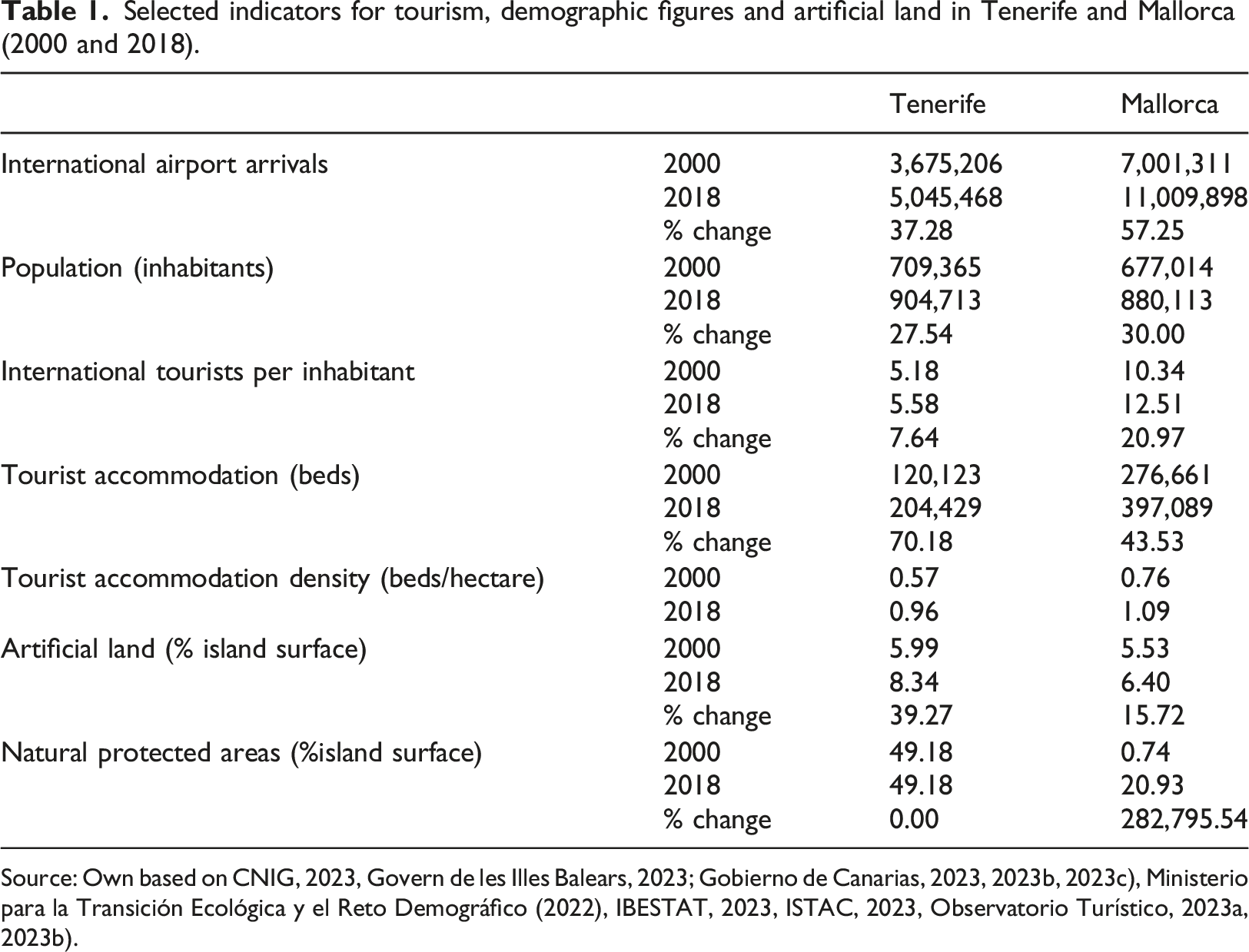
Selected indicators for tourism, demographic figures and artificial land in Tenerife and Mallorca (2000 and 2018).
We focus our attention on the processes of spatial change that have triggered the highest social unrest in island societies, building on the role of grassroots social movements as a popular epistemic community (Valdivielso and Moranta, 2019). In the next section of the paper starts by looking at the theoretical and conceptual framework to territorial disputes in terms of the right to nature and the right to space, going on to take into account the singularities of islands (an awareness of their limits, the coexistence of different cultures, local potentates, colonialism, etc.). Afterwards, we summarize the processes of spatial change that have occurred in the two cases under study and the most important reactions that they have triggered. Finally, the last section concludes with our overall contribution to discussion on the right to nature, by identifying singularities of insularity in terms of the collective significance of protests due to environmental struggles, to demand their inhabitants’ control of the urbanization process and genuine sustainability.
The work methodology is based on participative observation in our role as academic activists in our respective islands, where we have been raised and where we continue to have links as citizens. Our academic, professional, and political activities have led to our involvement in social debate, particularly in matters concerning spatial changes, where our geographic knowledge comes into play. This paper reflects the link between theoretical analysis and our activities as political and social activists. Through a process of theoretical reflection, we analyze disputes over the right to space in island contexts, exploring public expressions of political debate and the regulatory mechanisms developed by the public authorities and executive, and legislative bodies. We evaluate social disputes by classifying them at a qualitative level.
Insularity, territoriality, urbanization, and nature: the right to nature and to the island
The uniqueness of islands is an issue that is addressed in widespread literature (Mountz, 2015). Despite their peculiarities, islands are well-defined territories (Gillis, 2004) whose borders play a fundamental (albeit not exclusive) role in the delimitation and practice of territoriality (Paasi, 2003). Power is an essential concept in understanding islands as territories (Keating, 2014). Territoriality is a fundamental force in capitalism, expressed through state policy support for economic processes (Harvey, 2003); for instance, the redefinition of island areas as energy supply regions (Cederlöf and Kingsbury, 2019). However, less attention in literature has been paid to the key role of maritime and coastal areas (including islands) in the organization and reproduction of traditional capitalism. Political institutions, spatial forms and legal frameworks “facilitate market forces, appropriating nature for exchange” (Campling and Colás, 2021: 118). This can also be observed with tourism as the organizer of territoriality in some islands (Celata and Sanna, 2010): an activity that is a very attractive option for governments, the private sector, and international organizations in terms of economic growth, incorporating peripheral or semi-peripheral economies into the global market (Pons et al., 2014). Another example is the creation of acronyms for island development models, which reduce the island to its economic characteristics (Clark, 2013). Other approaches to territoriality address the inequality and conflict inherent in a territory; that is, they focus on disputes over control of people and resources within certain established boundaries (Corson, 2011). Thus, in recent decades, the notion of ‘territory’ has been extended and included in the discourse of the movements and groups that dispute it, while another irreconcilable official narrative is also spread (Beuf, 2019). From this perspective, territories are not a natural phenomenon but a socially produced one through the disputes and reflections of those who inhabit them (Clare et al., 2018).
States have used islands as places to experiment, exercise control, claim sovereignty, or harvest resources in different ways (Mountz, 2015). Nonetheless, the link between insularity and sovereignty has prevailed in analyses, regardless of other perspectives on power (Clare et al., 2018). One of the contributions of this paper is an approach to power that is not founded on sovereignty, but which is instead based on the social movements that dispute the territory in two specific island contexts. At this point, it is important to consider the extent to which the concept of an island corresponds to that of a space whose visual and natural characteristics differentiate it from continental spaces and how this idea has been (re)produced and transformed into a “reductionist rendition” (Baldacchino, 2012: 57). In other words, is an island a territorial entity with fixed limits–a mere container–or, as a disputed territory, is it far more than that because islandness really matters (Allen, 2017: 82)?
It has been argued that spatial scales are not fixed but that, instead, they are socially produced through struggles and contestation, and that they can also be determined by the biophysical characteristics of a territory under dispute (Brenner, 2001). Thus, insularity plays an essential role, not just for its capacity to territorialize projects, but also because it provides a scale for collective protests in defense of resources or against specific projects (Allen, 2017).
Islands are some of the most lucrative areas for tourism and real estate investment, particularly certain islands on the fringes of the world economy (Buades, 2009). They offer favorable conditions for returns on investments, such as the availability of cheaper land, labor, and natural resources; the advantages of subject states (less tax, more flexible regulations and cheaper local currencies); and the optimization of capital investments, with shorter payback periods and lower business costs due to cheaper local labor. Fantasies of an escape to the sea (or a dual evasion in offshore cases) lead to utopian visions of oceans and islands as “a space beyond the interference of politics and the nuisance of class antagonism” (Campling and Colás, 2021: 272). Capital investors’ attraction to island territories is strongly tied in with the development and restructuring of the built environment (Hof and Blázquez-Salom, 2013), with spatial changes that involve the appropriation of housing, rural land, infrastructure, the coastline, and public spaces for tourist use, and by fencing off areas–a necessary requirement for their commodification (Domblás, 2020).
Paradoxically, the island population’s counterreaction can actually make these places even more attractive to capital investors. Legal restrictions on further urban development and on tourism accommodation, in response to social rejection of the dispossession of the local population and the commercialization of the island’s environment and cultural identity, can work to the advantage of monopoly rents. According to Harvey (2002), the owners of real estate and tourist establishments logically benefit from regulations that clamp down on or prevent new real estate developments and rival tourism accommodation that might push down the prices of their own properties or services. This convergence of conservationist and capitalist interests has contributed to the formation of territorial alliances, leading, for instance, to moratoriums on urban development or tourism accommodation (Gómez-Llabrés, 2018). This then contributes to an increase in prices, and hence to a rise in the value of property, the rents they provide, and the privileges of the elites who monopolize their ownership. In turn, this fosters the island’s gentrification through a process of socio-spatial segregation based on displacement and dispossession (Clark, 2013). The 2008 financial crisis put an end to the consensus on the containment of growth, relegating territorial protection to second place.
Harvey (2012) pointed out that urbanization has played a key role in absorbing capital surpluses by introducing processes of creative destruction and the dispossession of the masses. Nevertheless, these processes also give rise to periodic revolts which can lead to the definition of new forms of urban life different from those imposed by the capitalist class. To reinvent the city, ways of exerting collective pressure on urbanization processes are needed (Harvey, 2012), guided by social majorities (Lefebvre, 1978) who continue to react to the imposition of public policies that favor ruling class interests and clash with those of the working classes and other popular social strata (Navarro, 2007).
Based on Lefebvre’s right to the city, Apostolopoulou and Adams (2015, 2019) defined the right to nature as the right to influence and redirect the urbanization processes promoted by capitalism that modify relations between nature and society. Clark (2013) continued to explore this right, associating it with the right to spatial justice; that is, the deepening of democracy and the de-commodification of space and nature, transferring it to the specific framework of islands. In a similar vein, other authors developed the idea of “southern thought” (Cassano, 2012 cited by Kallis et al., 2022), a way of thinking contrary to Western values that takes a specific form in island regions, oriented towards sustainability through degrowth, coexistence and a respect for nature. Schmelzkopf (2008) expressed a similar idea in his analysis of protests by the population of Viesques (an island in Puerto Rico) against the American military installations and the consequences of the latter on the health, environment, and daily lives of the islanders. Likewise, Clark (2013) criticized the adoption of socio-economic and hegemonic models of island development, claiming that the right to the island is “a means to reinforce social and political processes aimed at fair and sustainable island development”. It also implies “working together with people who possess considerable local/traditional knowledge relevant to defining and addressing problems concerning local resource management and development issues” and it involves “diminishing the role of outside policy experts while encouraging local design of programs to meet local goals” (Clark, 2013: 129, 134). In this sense, the right to the island is not limited to demands for the protection and active defense of landscapes, ecosystems, and natural and cultural heritage (although it does include them), since all these demands and aspects form part of broader debate on the island’s development and its consequences, with the population having a democratic right to decide on their present and future models of socioeconomic development, taking into account their historical experience, the island’s local culture, and accumulated skills and knowledge (Sabaté-Bel and Armas-Díaz, 2022).
Through commodification and financialization mechanisms, nature has been incorporated more and more into the accumulation and circulation of capital. So-called green capitalism uses the appropriation of nature as an accumulation strategy (Smith, 2007), with this process intensifying after the 2008 crisis in order to reactivate tourism and urbanization by applying new legislative frameworks and reorienting environmental policies (Apostolopoulou and Adams, 2019). After the Covid-19 pandemic and the energy crisis, recovery and growth strategies have focused on using green solutions to foster capital accumulation (López and Martínez 2022).
In parallel with the growing commodification of nature, urban and rural struggles for environmental justice have intensified globally (Temper et al., 2018). Environmental protests are one of the most powerful means of opposition to neoliberalism, offering a source of radical future alternatives (Heynen et al., 2007). Territorial disputes over the protection of marine and coastal ecosystems, for example, spark off many protests in tourist regions (Kousis et al., 2008), with this unrest leading, in particular, to the mobilization of groups and people in islands (Sánchez, 2015; Valdivielso and Moranta, 2019).
Tourist territories in dispute: Mallorca and Tenerife
The islands of Mallorca and Tenerife are prime examples of converging links among protected or unprotected natural areas, urbanization, tourism, and social protests over the degradation of the environment. Both islands have indicators that denote their high level of tourism congestion, rapid urban development, and the strong artificialization of their coastlines (see Table 1 and Map 1). We will show how the relations among tourism urbanization, spatial protection and social mobilizations tie in from a political ecology perspective by analyzing different periods in order to gain a better understanding of the concepts of the right to nature and the right to the island. Urbanization, touristification and land change indicators in Mallorca and Tenerife (2000, 2018).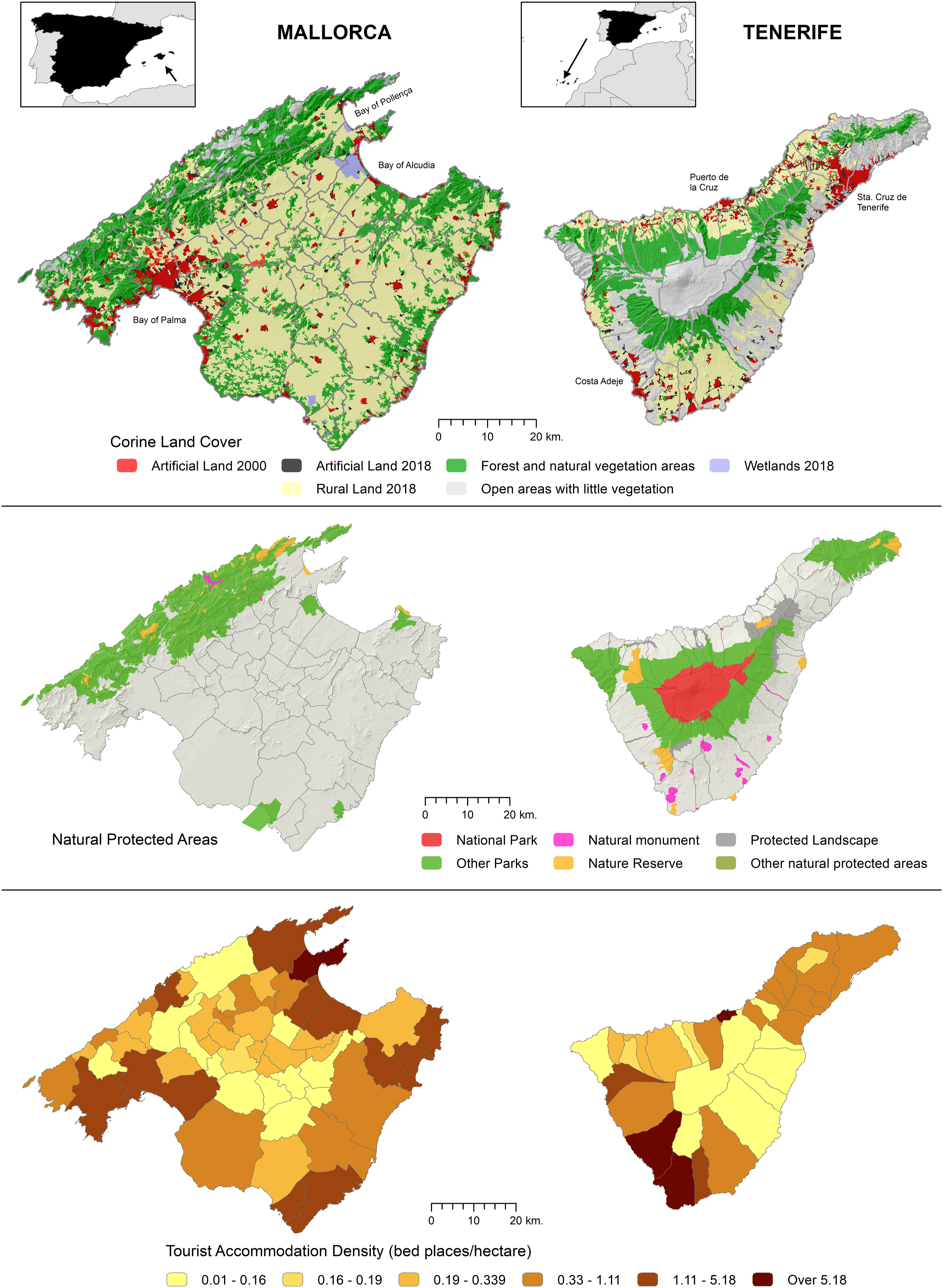
During the tourist boom, tourism congestion led to discord in most hyper-touristified areas (Cañada and Murray, 2019). Over the last two decades, legislation has been introduced to try and counter “mass tourism” and, specifically, binge-drinking tourism. These measures contribute to the spatial segregation and discouragement of the low-price holiday segment, fostering a move away from tourists with a lower purchasing power while also encouraging the gentrification of island areas. As a refuge destination for people and their capital, islands “conjure up both the rent and the imaginary power of the sea and its islands as places where dreams of exclusive luxury, detachment, discretion and freedom can come true” (Campling and Colás, 2021: 281). These segregation-based spatial strategies intensify disputes over the territory, particularly in terms of access to coastal areas, which are privatized for the exclusive use of deluxe homes and coastal tourism establishments.
Different interest groups have joined forces to protect the islands and their landscapes: environmental conservationists, guardians of the islands’ local identity, and privileged rentiers who own land, hotels or homes in elite locations. This local alliance is characterized by a common desire to contain growth—as further construction and urbanization impacts negatively on the monopolistic business returns of rentiers—and to improve other aspects of the island, such as its natural spaces, as a strategy in capital accumulation (Fletcher et al., 2019; Müller and Blázquez-Salom, 2020; Sabaté and Armas-Díaz, 2022).
In contrast, there is less consensus when social conflicts are associated with sociometabolic issues, especially in matters concerning: (1) energy consumption and its contribution to climate change; (2) social exclusion due to class, gender, origin, ethnicity, etc.; and (3) the extension of infrastructure such as transport networks, waste treatment plants, power plants, etc. When protectionist demands have focused on landscape and territorial aspects, they have been supported by big social majorities (as exemplified by demonstrations in defense of the territory in both Tenerife and Mallorca). After the 2008 financial crisis, however, the major social support that they had received waned due to the urgent priority given to social demands.
Mallorca
Mallorca is the largest of the Balearic Islands, a Spanish archipelago in the western Mediterranean. After the Spanish postwar period under the Franco regime, the Fordist model of tourism led to the development of a monoculture economy (Pons et al., 2014). The social production of space has converted the island into a low-cost seasonal tourist destination and one of Europe’s leading destinations. European transnational corporations, such as Thomson, Thomas Cook, or TUI, have based their activities on the commercialization of holiday packages, charter airline seats, and hotel accommodation. Mallorca was visited by 11 million international tourists in 2018, a 57% increase in relation to 2000, with a 12:7 ratio of international tourists/inhabitant (see Table 1).
Coastal sun and sand tourist resorts are the most visible scenic outcome of this process, although the boundaries of tourism commodification have constantly been pushed back to encompass other areas, such as housing, public spaces, or the commercial landscape (Blázquez-Salom et al., 2019). The building development process is reinforced by the island’s transport network. Capital investors, landowners, and the spatial planning authorities have boosted the island’s touristification. The intertwined interests of these social agents are based on classic drivers: (1) spatio-temporal fixes for the over-accumulation of capital, particularly during the 2008 financial crisis; (2) reaped profits from productive activities, such as tourist services, through job creation; (3) financialization, related particularly to the real estate sector; and (4) monopoly rents linked to real estate and business licenses (Murray et al., 2017).
Tourism-induced demographic pressure on the environment has generated problems, such as a scarcity of water, waste management problems, and pollutant gas emissions. Public debate on the subject has been fueled by widespread recognition of the limits to growth, with the adoption of measures to limit the number of tourists, protect the landscape, and restrict urban development. Economic growth cycles and crisis periods have gone hand in hand with public policies focused on either procyclical or countercyclical measures. The objectives of these measures are, on the one hand, to promote growth policies within a cycle (either a crisis or an expansion period) and, on the other, to halt touristification and only limit growth during expansion cycles (Murray et al., 2017).
The beginning of Balearization: 1959–1975
The Glorious Thirties started during the Spanish autarchic period (1939–1959), with the Fordist economic boom and urban growth fostered by the Franco regime. Public policies focused on promoting this growth cycle and the term “Balearization” was coined to denounce the socio-environmental impact of full-throttle tourism. Only at the end of this period were the first urban and regional planning tools approved, mainly to legitimize urban growth and to plan the archipelago’s spatial structure and basic infrastructure (roads, sewage treatment plants, water supplies, etc.). At a socio-political level, in the final years of the dictatorship, there were incipient clashes with social movements that demanded democracy, better working conditions, human rights, etc. (Capellà, 1977).
The growth curve in Mallorca and the internationalization of Balearization: 1975–1989
The 1970s economic crisis led to a neoliberal agenda, with the restructuring of the tourism industry (as with other industrial sectors in Spain). This new cycle of capital accumulation was characterized by increasing financialization, privatization, globalization, and the production of goods and services that offered far higher returns (Méndez, 2018). The largest Spanish multinational hotel chains internationalized their businesses by taking advantage of their ability to attract capital investment and their cultural familiarity with Latin America where a series of Structural Adjustment Plans had been passed (Murray, 2015). During this period, social movements began to map the externalities of tourism in response to the substitution of non-tourism-related economic activities and land uses, particularly in natural areas, and due to the overburdened infrastructure and natural resources. One of the most important social protests after Franco’s death was the occupation of Sa Dragonera Island in 1977 to stop it from being developed (Garcia, 2017). A growing social consensus was reached on the need for nature and landscape conservation, starting by protecting natural areas from urban development. Environmental protest groups popularized slogans such as ‘Save Es Trenc’ (1978), ‘Save Sa Canova’ (1987), ‘Save Mondragó’ (1989), etc., demanding the protection of specific areas which, on many occasions, were later protected by law (Mayol, 2021). The ruling classes also agreed on the need to limit the number of tourist beds, based on the notion of overproduction, upholding the renovation of obsolete tourist facilities and the promotion of residential tourism. Paradoxically, though, the steps that were taken to curb growth reinforced the monopolies held by landowners and the holders of tourism operating licenses. Regional or countercyclical planning and restructuring measures were applied through specific regulatory tools aimed at the protection of natural spaces, the establishment of density indices for urban tourist areas, and a reduction in urban density through selective demolitions or moratoriums on the concession of operating licenses for new tourism companies, particularly for accommodation. In the hegemonic political discourse, the restructuring of tourist destinations was advocated in response to the deterioration of built environments due to the maturity and obsolescence of tourist facilities. This notion was based and continues to be based on arguments such as renewal, excellence, and sustainability (Blázquez-Salom et al., 2015; Murray et al., 2017).
The real estate bubble and touristification: 1990s–2008
During the 1990s and the first decade of the 21st century, there was a growing real estate bubble, fueled by credit expansion and pro-growth policies which led to new urban developments and infrastructure (such as desalination, waste incineration and electricity plants; roads; ports, and airports) and the promotion of mega-projects (such as conference and sport centers and opera houses). Mallorca airport was enlarged to double its capacity, and tourist arrivals soared, driven by the liberalization of air transport and the expansion of low-cost airlines in a context of low oil prices. Since Spain’s membership of the EU, wealthy European citizens have purchased second homes on the island. Foreign capital investment into housing and a favorable regulatory framework created the conditions for the tourist commodification of housing. These pro-cyclical policies were challenged by environmental protestors, who denounced the urban expansion brought about by growing transport infrastructure. This period represents the end of a wave of protests aimed at promoting the protection of specific natural areas and the birth of a movement to uphold the “right to the island” with some of the largest demonstrations ever seen in Mallorca under slogans like “People who love Mallorca don’t destroy it” (2004) and “Save Mallorca” (2007) (Mayol, 2021). With the bursting of the real estate bubble (2008), there was social outcry over cases of corruption (Murray et al., 2011). The local population began to prioritize quality of life over possible economic benefits, with social movements playing “the role of a popular epistemic community” (Valdivielso and Moranta, 2019: 1881).
Tourism fixes to the systemic crisis: 2008–2019
Following the 2008 financial crisis, many development projects were abandoned as toxic financial assets and numerous financial institutions were bailed out by the State. To mitigate the effects of the crisis, tourism became the main cornerstone of the Spanish political economy (Blázquez-Salom et al. 2015). Countercyclical policies prompted the construction and legalization of tourist beds, with the novelty of growing interest in hotel assets by international financial investment groups (Murray et al., 2017). New tourism regulations once again boosted the tourism and real estate sectors. New spatial planning regulations paved the way for the modernization and enlargement of tourism establishments (Blàzquez-Salom et al., 2023), the introduction of new management systems, such as condo-hotels, and the conversion of hotels into residential units, offices, or other types of commercial premises. With the increasing activity of online accommodation platforms, tourist accommodation spread to areas that were previously only inhabited by local residents. The rising prices of short-term rentals in residential neighborhoods displaced the local population (Müller et al., 2021). Neighborhood and political associations claimed their right to the city and were accused of tourist phobia in an effort to discredit their reaction to overtourism (Blanco-Romero et al., 2018). The spatial and social outcomes of this crisis were further aggravated by the restructuring and tourist commodification of housing and public spaces, intensifying the touristification process (Cañada and Murray, 2019). It was agreed by a big majority of social interest groups that Mallorca was suffering from tourism overcrowding. To tackle the growing process of touristification, intervention mechanisms to address tourism congestion were used, not only in Mallorca, but also in cities with progressive local governments, such as Barcelona or Madrid, in the form of limitations on tourist rentals (Blázquez-Salom et al., 2019). In this context, there was a shift in environmentalist campaigns from objections to mega-projects and the destruction of the landscape to opposition to the spatial logic of tourism capital and its contradictions, for example gentrification, displacement, worker exploitation, home dispossession, etc. Social movements were organized on an island scale: the ‘All Inclusive’ lobby, the “Ciutat per qui l’habita” (The city for those who inhabit it) campaign in Palma, and the ‘Las Kellys’ association organized by chambermaids to push for better working conditions. In 2017, a big demonstration against overtourism was organized in the streets of Palma under the slogan “We’ve come this far! Let’s stop overtourism”. After the 2008 crisis, social activism became less united for the following reasons: (a) because priority was given to job creation in the hegemonic discourse, disregarding the challenges of environmental problems; (b) because the alliance between environmentalists and tourism investors came to an end, with the latter seeking to increase their rent grabbing tourism activities in Mallorca as they reduced their investments abroad; and (c) due to the spreading tentacles of real estate investors through property investments and the tourism commodification of housing (Vives-Miró and Rullan, 2020), facilitated by online platforms. This benefited the so-called middle classes, who might support the protection of natural areas, but who opposed the regulation of short-term rentals, aligning themselves with capital investors (Yrigoy et al., 2022).
Covid-19 and green grabbing in a refuge destination for elite groups and their capital
The Covid-19 crisis has led to a radical change in the economic situation, generating uncertainties and concerns about company bankruptcies and job losses. The pandemic brought the tourism circuit to an abrupt halt, with dramatic social repercussions in highly touristified spaces. The outbreak of the crisis occurred at a time when touristification was being challenged and the ruling classes were taking the first steps to clamp down on debauched tourism (binge-drinking and sex tourism), while also striving to encourage a better class of tourist. It was a perfect example of the promotion of high-end deluxe tourism as a strategy for tackling overtourism problems, with the use of terms such as degrowth. The management of the pandemic was characterized by the adoption of a green-based accumulation strategy promoted by the NextGenerationEU recovery plan (Cañada and Murray, 2021). In this context, there has been a change of focus in the regulation of tourism, moving the spotlight onto sustainability and circularity. Policies aimed at addressing climate change have also fostered the construction of large solar parks on the island. In parallel, private conservation schemes have grown in relevance, and one side effect of the Covid-19 crisis is a dramatic increase in foreign investment into housing and rural properties. In short, the recovery strategy can be described as a green tourism fix to the crisis, based on green grabbing dynamics opposed by environmentalist and agricultural organizations. This green grabbing process is not only about green capital accumulation, but also about the appropriation of the green narrative by the dominant class and its hegemonic goals. The voices that uphold the “right to the island” oppose these green fixes and the green grabbing agenda. Although a vast majority of Mallorcans supported demands for the “right to the island” and opposed “ungreen grabbing,” it is now harder to mobilize such large numbers of protestors, added to which green grabbing is not so easy to campaign against.
Tenerife
Tenerife is the largest of the Canaries, an archipelago located in the central-eastern Atlantic, close to the coast of mainland Africa. The island saw a soaring rise in tourism at the beginning of the 1960s and in recent times (see Table 1), along with some of the other Canary Islands, and the region as a whole became the third favorite Spanish destination for foreign tourists in 2019 (Frontur, 2020). Tourism accounts for 35% of the GDP and it employs 40% of the working population (Exceltur, 2018).
A two-pronged official narrative has been developed on the “insular remoteness” of the Canary Islands–remote in terms of the approximate 1500 km that separate the archipelago from Europe although it is only 96 km from mainland Africa–, successfully conveying the idea that the Canaries are on the “ultra-periphery.” Its elite groups have spearheaded initiatives aimed at the obtainment of benefits and positive discrimination in different EU policies which also apply to Portugal’s Atlantic island regions and France’s overseas South American and African territories. According to this narrative, on the one hand, the archipelago’s ultra-peripheral location and its insular nature (in addition to its climatic and geopolitical characteristics) offer opportunities in sectors such as tourism, logistics, and agricultural exports. On the other, however, dramatic claims are being made about the supposed disadvantages of its ultra-peripheral location and the difficulties that the archipelago faces in forming part of the global market (Aguilera, 2006). Thus, paradoxes arise: for instance, the fact that an archipelago with alleged difficulties in international links due to its supposed remoteness received 16 million visitors in 1 year, or the fact that the Canary Islands are lumped together with other island regions faced with extreme climatic problems, while the benefits of the archipelago’s climate are what attract such high numbers of tourists and what also enable it to specialize in extra-early agricultural export products. This second narrative is used to claim European subsidies for the construction of mega-projects in the field of transport infrastructure to the benefit of strong local and transnational business groups (Aguilera, 2006). It also serves as the basis for authoritarian decision-making and a long-standing hegemony by regionalist liberal-conservative political forces (Déniz, 2006).
The beginning of mass tourism
Mass tourism reached the Canaries almost a decade later than the Balearics, as the archipelago had to wait until profits could be made from mid-haul jet charter flights, facilitating flight routes between the archipelago and the home airports of European tourists (Vera, 1993). Mass tourism was initially concentrated in the two central islands (Tenerife and Gran Canaria), although it expanded to the two easternmost ones (Lanzarote and Fuerteventura) in the 1970s, forming the region’s four tourist islands that we know today.
The first tourist boom (1960–1973) was marked by one fundamental feature, which continued during all the subsequent boom periods: the travel industry’s subordination to the capital gains that could be made from construction and real estate activities. The boom ended in the year of the oil crisis, not so much because of the increase in fuel and travel prices, although these were contributing factors, but due to the growing gap between the soaring promotion of hotel and non-hotel accommodation and a much lower rise in the number of travelers (Vera, 1993). From a spatial point of view, the phenomenon was confined to a few particular places with a high urban density. It began to have an impact on the local environment and in terms of human ecology, although, for some time, tourism coexisted with traditional agricultural activities, fishing, and a stunted processing industry, without completely destroying them. However, emblematic places were opened up to mass tourism, such as El Teide National Park and World Heritage Site through the construction of a cable car. In this late stage of the Franco regime, through a series of development plans, the State fostered the idea (which continued up to the later democratic period) that an increase in the number of tourists was equivalent to a general expansion in prosperity (Vera, 1993).
During this phase–under the regime of a dictator and with a population in a chronic state of poverty of semi-colonial origins–, social opposition was almost impossible. The first conservationist groups to appear (in professional and academic circles) were concerned about the early deterioration of the landscape and they focused on nature conservation, avoiding criticisms of the social problems caused by tourism (which might have led to the banning of their organizations).
The first protests about the growth of tourism and destruction of nature
The second tourist boom (1985–1989) was closely linked to an acceleration in the international circulation of capital and, despite its short duration, it had a very big spatial impact: the amount of land developed for tourism purposes doubled (Martín, 2000), and the demand for water soared (to the detriment of agricultural irrigation), as did energy consumption and the generation of waste (and, for the first time in the contemporary history of the Canary Islands, an immigrant workforce was imported). This situation gave rise to a myriad of protests by local groups, which each–separately and with little coordination at a regional or even island level– took a stand against the real estate-tourism development process. These scattered initiatives, combined with expert scientific reports, managed to achieve a major success when a progressive majority in the regional parliament approved the Natural Spaces Act (1987). In it, two sections and a cartographic appendix safeguarded over 40% of the region’s surface area from direct urbanization (almost half the surface area in Tenerife). The second boom ended abruptly, again due to the difference between the rise in real estate growth and the influx of tourists (which never stopped growing but not at the same rate as the former).
Tourism and urbanization outside tourist resorts
In around the year 2000, the Canary Islands’ well-known process of international real estate growth began, in this case affecting most of the islands’ urban areas. The phenomenon was not just confined to an increase in the tourism supply–it also encompassed first and second homes, apartments, and luxury villas for seasonal foreign residents. It was also characterized by the heavy development of infrastructure and mega-projects (curtailed when the real estate bubble burst in 2007–2008). Outside urban areas, there was a trend toward the renovation of local architecture (a boom in rural tourism, bolstered, as in the Balearic Islands, by the notion of landscape conservation and a temporary alliance between civic sectors and landowners).
Nevertheless, the previous 1980s experience, with its resulting environmental impacts and social opposition, gave rise to another paradox: a spatial planning model of apparent good intentions, aimed at containing tourism growth in some areas, although it actually had other repercussions. A so-called moratorium was proposed for the four tourist islands, with guidelines for the rationalization of the growth of accommodation and limitations on further land use. However, it prioritized the renovation and upgrading of established tourist areas, encouraging infrastructure associated with “higher quality” tourism, while also taking a permissive attitude to the expansion of housing, and so urban development continued (García-Cruz, 2014). Far from containing the growth (in what would have been a certain move toward degrowth), its continuance and redirection could be observed, and this process only came to a halt with the international crisis that began in 2007 (when the real estate bubble burst and temporarily curbed the construction sector), proving, once again, that real estate interests were the drivers behind the process, to the detriment of tourism and its sustainability (García-Cruz, 2014).
The moratorium had three other effects (Simancas et al., 2011), all negative and unexpected (at least for those who had believed in its good intentions): (1) a “cascade effect,” with a deluge of applications for the upgraded classification of accommodation before the new legislation came into effect and the hasty completion of projects with licenses that were about to expire, leading to a rush of developments in just a few years that would normally have taken much longer; (2) the aforementioned growth in housing (coinciding with a new international acceleration in cycles of capital turnover, encouraged, in our opinion, by geo-economic phenomena, such as the economic stabilization of post-Soviet Russia, an influx of capital of “irregular” origin, ultimately associated with southern Italy, and a rise in global investment funds); and (3) the spatial impact of increases in the size of new tourist facilities, such as the trend toward “horizontal hotels,” imitating Caribbean resorts (Simancas et al., 2010). These were high-category low-rise hotels, with extensive unbuilt areas featuring gardens, swimming pools, and sports or leisure facilities for guests. In short, they were fewer in number but far bigger in surface area, with a higher accommodation capacity and a much bigger environmental footprint, consuming double the amount of water and generating double the waste, four times more electricity, and so on (Hernández, 2001).
Throughout this period, successive regional governments ensured that there were barriers to citizen participation. In practice, this contributed to growing social outrage, manifested through non-official channels such as environmental protests (Brito, 2020). Advantage was taken of certain chinks in parliamentary or official procedures, leading to the registration of popular initiatives for legislation to be passed (a practice i.e. far more frequent in the Canary Islands than the rest of the country). This happened, in particular, during the third real estate-tourism boom (1993–2008), coinciding at an island level with a liberal-conservative political scenario (Brito, 2018). The succession of mobilizations led to the normalization of this type of protest, with a level of almost permanent conflict being reached in around 2004 to 2005 (Brito, 2018). Thus, in recent decades, environmental protests have received more support in the Canary Islands than protests over issues of a social nature (health, education, housing, etc.) (Sánchez, 2015). These recurrent mobilizations in the Canaries are fueled by anger at the destruction of nature (Brito, 2018: 288–289). The demonstrations in Tenerife against a high voltage power line that would impact on the landscape of southern inland areas united mass numbers of people (about 100,000 people on an island with just under a million inhabitants), as was also the case of demonstrations against the construction of the port of Granadilla and its effects on some protected species and environments (Armas-Díaz and Sabaté-Bel, 2022). During this period of mobilizations, the slogan “another island is possible” was coined, summarizing calls for the right to the island.
More tourism and urbanization as a fix for the 2008 and Covid-19 crises
In the Canary Islands, the tourism sector and, above all, the construction industry were the main victims of the 2008 world financial crisis. It is not surprising that the expansion of tourism became a priority for the regional administration. To this end, shortly after the onset of the crisis, rural land that had been hitherto partly protected was re-rated apt for development, allowing for activities other than agriculture. This was followed by the expansion of tourism and, more recently, a new spatial policy that continues the liberalization process initiated at the beginning of the world crisis, with neoliberal ideas being applied to spatial planning by the regional authorities, such as land deregulation, a reduction in State control of environmental and spatial planning, fewer control mechanisms, and the decentralization of power to local authority bodies (Theodore et al., 2011). This gives island councils and, above all, town councils the power to approve plans, despite their very limited human and technical resources and their susceptibility to being co-opted by tourism-real estate companies, with the intensification of commodification, privatization, and financialization processes and their extension to other areas and spaces as the main cornerstones on which the circulation of capital is based (Peck, 2004). As is the case everywhere else, the socio-economic, geopolitical, and cultural consequences of the Covid-19 pandemic have prompted an increase in security concerns bordering on the obsessive, which might lead to a growth in tourism in the three westernmost islands that are not yet touristified (La Palma, La Gomera, and El Hierro) and are therefore not overcrowded. This trend could also extend to the recolonization of the entire non-coastal space, under different formats (rural tourism, holiday rentals, villas and rural houses), although not (as yet) to the same extent as in the Balearic Islands, and to the romanticization and obsessive transformation of the landscape in towns and villages and rural central areas–a landscape conserved up until now in a “frozen” state rather than taking full advantage of it. This would lead to the disappearance of traditional crops, with the exception of fruit trees conserved for greening purposes, with a boom in swimming pools and vehicle access to any hidden corner where a property might be sold.
Even after 2008 and a social crisis of dramatic consequences in the Canary Islands, protests to try and stop the destruction or commercialization of the archipelago have continued to mobilize the population. This is demonstrated by other mass mobilizations; for instance, to try and stop an oil-drilling project a short distance from the archipelago, with big demonstrations in all the islands (Herranz et al., 2018). The latest environmental demonstration was a protest at the construction of an exclusive, low-density “green” tourist complex. Environmentalists not only demanded the protection of natural areas closely affected by the complex, but also a halt to new tourism projects and other infrastructure, particularly those affecting the whole island’s coastal areas. In Tenerife, the right to nature is synonymous with the right to the island.
Final remarks
The singularities of insularity have been addressed by different authors, especially with regard to debate on sovereignty and biodiversity (Mountz, 2015). Our analysis of protests in Mallorca and Tenerife has attempted to highlight the complex relations among neoliberal mega-projects and tourism, their scale, the commodification of nature, and the opposition that all this has prompted.
Rapid urbanization processes, based on specialization in tourism and the construction of infrastructure, have led to large inflows of capital and their investment in the real estate sectors of tourist areas like the ones analyzed in this paper. This capitalist logic responds to the ruling class’ desire to form part of the world economy (Harvey, 2003), taking advantage of peripheral areas for this purpose (Keshavarzian, 2010; Pons et al., 2014). Mallorca and Tenerife are no exceptions, as their strategic positions and island status are exploited by powerful groups (with public policy support) in order to satisfy their interests. Tourism is the main linchpin on which the territorial governance strategies of the two peripheral regions hinge (Rowen, 2014).
Nature plays a central role in the accumulation process (Smith, 2007), combining different forms of accumulation (un-green grabbing and green grabbing) with new environmental regulations that reduce the protection given to biodiversity while also promoting the exploitation of natural areas (Apostolopoulou and Adams, 2019). Both strategies have been united and aligned with capitalist interests to meet urban development needs, particularly after the 2008 financial crisis (Apostolopoulou and Adams, 2019) and also after the Covid-19 pandemic.
Both case studies highlight how environmental and territorial protests can converge in their criticisms of capitalist growth models. Barriers to decision-making and outrage at nature’s destruction and commodification mobilize mass numbers of people on a much higher scale, opening up new political opportunities (Smith, 2010). The spatial aspect of protest movements is an important factor to take into account, because protest groups need a specific base for their activities, both in physical terms as an operational center and as a symbolic focus for their campaigns (Harvey, 2012). Protests acquire more collective significance at an island level: it is a scale that can be extended in order to forge international, national or regional alliances, for instance, among other islands from the same archipelago (Brito, 2018); and it fosters a territorial sensitivity that contrasts with the official narrative, upholding a different model of an island consistent with environmental conservation (Clark, 2013) and the right to nature (Cortes-Vazquez and Apostolopoulou, 2019). In this way, protests and demands by social movements all revolve around the notion of the right to nature, on a specific island scale. Hence, what they are clamoring for is the right to the island (Armas-Díaz et al., 2020; Armas-Díaz and Sabaté-Bel, 2022; Clark, 2013; Schmelzkopf, 2008); that is, recognition of the singularities inherent in an island and the rights of its inhabitants in order to control urbanization processes (Harvey, 2012) and demand genuine sustainability (Clark 2013; Kallis et al., 2022).
Evidently, there is a spatial and scale-based difference between the right to nature (which encompasses the biosphere’s non-anthropized or less anthropized resources and its specific expressions, such as a particular forest, mountain, wetland, river, lake, coast, sea, or any natural or barely humanized landscape in general) and the right to the island, which is limited to a concern for the future of all or part of a medium-sized or small island. The main conceptual difference between the two notions is, nonetheless, essentially a qualitative one, involving at least two aspects. First, experience shows that the local communities and populations of island territories traditionally tend to develop a closer awareness of limits than communities in continental areas. Secondly, debate on the limits to growth seems to be expressed in a more direct, spontaneous way in islands for obvious physical and social reasons, such as a clear perception of their territorial limits, bounded by the sea; the typical fragility of their natural ecosystems and their social and communal ways of life (i.e. “otros saberes” in other regions outside the Global North and “southern thought” in southern Europe); irreversibility, on many occasions, when areas are privatized or destroyed; and the verification that all goods that cannot be produced locally must be imported from overseas, leading to strong external dependence.
Footnotes
Declaration of conflicting interests
The author(s) declared no potential conflicts of interest with respect to the research, authorship, and/or publication of this article.
Funding
The author(s) disclosed receipt of the following financial support for the research, authorship, and/or publication of this article: MCIN, AEI, ERDF (RTI2018-094142-B-C22), MCIN, AEI, ERDF (RTI2018-094844-B-C31), MCIN, AEI, ERDF (PID2022-137648OB-C21), Comunitat Autonòma de les Illes Balears through the Direcció General de Política Universitària i Recerca with funds from the Tourist Stay Tax Law (PDR2020/82 - ITS2017-006), European Union's research and innovation program Horizon 2020 Marie Skłodowska-Curie (873082).
