




Abstract
Over the last twenty years considerable attention has focused on the territorial restructuring and rescaling of the state. In particular, there has been an emphasis on city-regionalism to enhance the capacity of formal and more informal structures of governance to secure greater spatial equity and economic competitiveness. However, the spaces which sit outside of these spaces – the ‘In-between Spaces of City-Regionalism’ (ISCR) – have received relatively little attention. This paper addresses this gap in knowledge by focusing on the Northwest of England (UK) and an in-between space flanked by the Manchester and Liverpool city-regions. It highlights that despite the significant privileging of city-regions and their respective governance structures by the state, actors of relevance to ISCR spaces have also worked in highly entrepreneurial ways - both territorially and relationally - to embed economic development activities conducive to economic growth. Consequently, we offer important insights into the methods key actors in ISCR spaces can use to bypass presumed (and widely ineffective) assumptions of economic trickle down fuelled by city-regional agglomerative policy.
Introduction
Across Europe and beyond, there has been an increasing emphasis on city-regions to facilitate integrated vertical and horizontal cross-boundary relationships that more accurately reflect where people live and work (for example, see Lobao et al., 2009; Pemberton and Morphet, 2014; Tang et al., 2022). In tandem, there is evidence of the progressive transferring of power from the national state to sub-national and/or sub-regional governance structures, including those focused on city-regions (Agergaard et al., 2022). Furthermore, the emergence of city-regions has often been characterised as encapsulating new ‘soft spaces’ of governance and ‘fuzzy’ boundaries (Haughton and Allmendinger, 2016; Williams et al., 2021), and which are argued to better represent the relational realities of political and economic issues and opportunities (Pemberton and Morphet, 2014). These new scales of governance reflect a ‘brave new world’, aiming to progressively supersede and permeate traditional administrative geographies (Amin, 2004; Harrison and Hoyler, 2014) and instead offer nation states new scales and opportunities for economic, political, and social interventions.
City-regions are therefore a particular urban phenomenon distinguished by their spatial extent, functional heterogeneity, size and accompanying political influence (Scott, 2019). The increasing prevalence of city-regionalism is now clear; city-regions are now widely dispersed across the world, operating as “interconnected nodes that compete and cooperate with one another across the entire globe” (Scott, 2019: 116). Consequently, city-regions are increasingly being variably employed by national governments to serve as the new geographies for national and regional economic innovation and policy focus, but which are simultaneously characterised for their relational attributes, both to one another and to the global economic market. Thus, the construction, prioritisation, and promotion of city-regions in national policy are reflective of the strategic and spatial selectivity of the state (Jones, 1997; Harrison, 2010) and are now “…everywhere in evidence where capitalism prevails, though at very different levels of integration into the capitalist system and with very different empirical manifestations from one case to another” (Scott, 2019: 115). This variability means that nation states continue to craft new ‘visibility’ politically, economically, and spatially for such spaces, with important implications (Harrison and Heley, 2015) including new coalitions of actors collaborating across an increasingly diffuse public, private and voluntary sector, and with differential multi-level scales of influence (Lee, 2017; Mackinnon, 2021).
Despite the increasing prevalence of city-regions in international policy, it is argued that the creation of “economic imaginaries constructed around… agglomeration economics that privilege the role of large cities” (Hincks et al., 2017: 643, adapted) can exacerbate regional disparities between city-regions (Etherington and Jones, 2009). City-regions have also been viewed as creating differentially empowered private organisations across different spatial contexts (Broadhurst, 2018). A prevailing critique is that agglomerative economics which underpin many such city-regions overstate the likelihood of economic ‘spill overs’ to spaces outside of city-regional limits (MacKinnon, 2021). This latter point is a particularly troublesome gap in our knowledge. The impacts of city-regional policy on spaces outside the city-regional jurisdiction – what we define as the ‘In-between Spaces of City-Regionalism’ (ISCR) – have seldom been explored from the perspective of actors operating in such spaces. In contrast, existing literature has proceeded to ‘scale up’ the focus on city-regions per se. This ‘scaling up’ has been characterised by a concentration on pan-regional or regional interconnections between city-regions and defined by an array of appellations - for example, as polycentric urban regions (PURs) (Cheng and Shaw, 2021) and super mega city-regions (Yeh and Chen, 2020), both of which are pan-regional approaches to governing city-regions (Haughton and Allmendinger, 2016). Such pan-regional imaginaries are the product of “variable logics, alliance(s) of actors and tactics” at the city-regional level, but which are also “used to build momentum and secure legitimacy around preferred imaginaries by the state (Hincks et al., 2017: 642). ISCRs seldom have a prominent focus in this research.
This paper addresses the lack of existing research to date on “in-between areas, such as smaller towns and cities” (Hinks et al., 2017: 653) – in other words - ISCRs. It identifies how ISCRs, which are often not formally incorporated within city-regional or PUR agendas, can work in highly selective and entrepreneurial ways to better articulate their positionality within city-regional policy. We argue that whilst ISCRs can be territorially and administratively differentiated from city-regions, they nonetheless interact with and are influenced by city-regions and PUR imaginaries in profound relational ways. In turn, the paper provides important empirical and conceptual insights into the ways in which ISCR actors seek to better integrate ISCRs with city-regions, often in indirect, but economically important ways. Moreover, the paper demonstrates how actors embedded in ISCR spaces bypass expectations of trickle down and economic spill overs by crafting their own branded territories to draw economic potential from surrounding city-regions.
The paper has the following structure. First, it provides a literature review which outlines the concept of ISCRs and notes the strengths (and challenges) of utilising this lens. Subsequently, the literature review focuses on how city-regions are both constructed and privileged through the strategic and spatial selectivity of the state and through the internalisation of state discourses by those involved in branding their city-region to better conform to policy goals by the state. Through this exploration, key lessons are also identified which are of relevance to ISCRs. The paper then proceed to outline the methodological approach and research methods of relevance to the paper and introduces the relevant context for the research. The paper then presents the key findings of the study, including important new insights into the ways in which working within ISCRs use the rural-urban fringe in territorial and relational ways to secure economic growth. Finally, the paper concludes by drawing together the key conclusions of the paper, including new avenues for further research.
Literature review
Setting the agenda for ISCRs
Previous studies have highlighted how “city-regionalism is politically constructed through state-orchestrated processes of redistribution and social provision” (Jonas, 2012: 822). This selectivity in who and where is afforded city-regional status by the state leaves a plethora of spaces which sit outside this specific spatial definition (Dembski et al., 2017). In this study, we therefore characterise ISCRs as i) spaces which are not spatially demarked as belonging to city-regional policy, including those that do not receive specific political or economic benefits afforded by jurisdictionally belonging to a city-region; and/or ii) those spaces excluded from city-regional labels or discourse, but which are nevertheless functionally interconnected with city-regions.
Such a definition reflects the fact that whilst city-regions are conceptually ‘fuzzy’ and based on relational economic geographies, they nonetheless have been territorially defined. In such a way, such spaces are both “bounded and porous: bounded because politicians are held to account through the territorially defined ballot box…porous because people have multiple identities and they are becoming ever more mobile, spawning communities of relational connectivity that transcend territorial boundaries” (Morgan, 2007: 33). This dual territorial and relational lens is critical for further understanding ISCR spaces because whilst ISCRs are defined by their existence outside of territorial city-regional space, they nonetheless interact and engage with such spaces in important ways. For example, Allmendinger and Haughton (2009) and Harrison (2010) note how many places in the Northwest of England have been captured in pan-regional spatial imaginaries. The “imprecision and flexibility of spatial imaginaries” over time (Hoole and Hincks, 2020: 1587) means that many of the dynamics between city-regions and ISCRs have not been explored. Instead, the literature has focussed more on “winning” or “superstar” cities (Hadjimichalis and Hudson, 2014: 213). We therefore argue that our definition enables us to capture both the territorial realities and relational dimensions of this dynamic.
Moreover, whilst there has been some discussion of the spatial imbalances created through city-regional policy, much of this discussion has been at a broader conceptual level and seldom involving any empirical research. In England, for example, it is argued that “the asymmetric and experimental nature of English city-regional deal-making has been “problematic in deepening territorial inequalities and pitting places against one another” (Hoole and Hincks, 2020: 1586). Similarly in China, the “reform process” through city-regionalism policy has been characterised as “spatially uneven” (Li and Wu, 2012: 57). In particular, Li and Wu (2012) note that there is a polarising trend between mega-cities and other areas in terms of resource flow that is led by both ‘top-down’ (the state) and bottom up (local government) actors (Li and Wu, 2012). We therefore synthesise ISCRs through a multi-level lens, with a dual consideration as to how city-regions are constructed by the state and the ways in which their existence is also sustained and supported by local actors.
We now proceed to articulate key conceptual and empirical literature of relevance our multi-level and duel relational-territorial definition of ISCRs.
The distinctiveness of city-regions?
Despite the increasing dominance of city-regional policy across the globe, various studies have noted how city-regions are constructs or ‘soft spatial imaginaries’ (Allmendinger and Haughton, 2009; Davoudi and Brookes, 2021). Indeed, whilst the concept of city-regionalism has roots in regional planning of the early 20th century (Hall, 2009), modern applications of the concept are now being “remoulded and stretched…to fit better the processes and patterns…and territorial organisation associated with globalisation” (Jonas and Moisio, 2018: 354). Despite this remoulding and stretching, city-regions are simultaneously “rooted in… distinct historical-geographical contexts and political-institutional structures” (Li and Wu, 2018: 314). In turn, city-regions remain “…a contested product of discourses (talk), territorial relationships (territory) and technologies (both material and of power)” (Addie and Keil, 2015: 409), meaning that they are socially and culturally produced through specific policy discourse by the state (Lee, 2017), but also remain products of their historical legacies, networks and associations (Harrison, 2010).
The literature has therefore viewed city-regions as fluid constructs which constantly remain in flux and with key actors attempting to (re)construct new identities and ways of working to match these new scalar policy arenas created by central government, yet still operating as autonomous entities with jurisdictional responsibilities within territorial remits. Hence “city-regions are unable to escape the existing territorial mosaic of regional and subregional political-administrative units and boundaries” (Harrison, 2010: 24) and “while territorial governments work to clearly defined territorial boundaries, such as those of local government, the boundaries of many ‘governance’ initiatives tend to avoid following those of single local government jurisdictions, with a variety of alternative geographies summoned into being instead” (Hincks et al., 2017: 644). This means that in understanding how ISCRs might interact with city-regions, we need to consider both how the state is attempting to craft and sustain city-regions vis a vis the ways in which key actors operating in such spaces might seek to sustain or engage with city-regional policy themselves. In understanding this dynamic, Harrison (2007) suggests there is a need to focus on what and who renders city-regions ‘visible’ – those who shape the identities of city-regions and how they transform city-regions from broad ‘object(s) of mystery’ (Harrison, 2007) to ‘legitimised’ constructs in the public and private sphere. This includes understanding how governance activity is consolidated around city-regions as key spatial arenas (Waite and Bristow, 2019). From the literature, this legitimisation of city-regions appears to be two-fold.
First, the legitimisation of city-regions is a product of government and policy discourse – as such, a reflection of specific, strategic and spatially selective metagovernance processes (Jones, 1997) – promoted as ‘new economic geographies’ and equipped with new statutory responsibilities to ‘lubricate’ them as new orderings (Beel et al., 2021). Thus, through the continual restructuring of the state, city-regions can be rendered as more or less important, depending on the agendas of the state at any time. In the UK for example, a narrative for city-regional reforms was promoted under the guise of the ‘Northern Powerhouse’ – an initial umbrella term for state-spatial rebalancing between the North and South of England - but which “drifted significantly from the initial concept and has become an increasingly fuzzy agenda for wider policy and economic attention in the North (Lee, 2017: 487). Consequently, this reflects how the state can both promote and remould the identity of city-regions over time. It also suggests that how city-regional agendas are ‘branded’ and thus rendered visible by the state remains a key component of their relative success, but also in how resources are delivered and prioritised over time (Williams et al., 2021; Beel et al., 2021).
Second, processes of legitimisation of city-regions by the state have also been shown to mobilise actors into ‘jumping scale’ (Princen and Kerremans, 2008) and to accept a “redefining of territorial relations from the [local authority] to the city-regional scale” (Beel et al., 2021: 32). Indeed, key actors can seek to mobilise themselves to take advantage of new state discourse and policy – and to embody the opportunities they view as pertinent to economic or political success within these new spatial (city-regional) arenas. In turn, a focus on place-branding has increasingly been of relevance to the ‘visibility’ of cities, regions and city-regions in respect of securing resources and their overall competitiveness (Gertner, 2011). Place-branding has been defined as “the practice of applying brand strategy and other marketing techniques and disciplines to the economic, social, political and cultural development of cities, regions and countries.” (Papadopoulos 2004: 36). In geographical terms, it refers to the construction of particular ‘images’ or imaginaries of a place. Kavaratiz (2005) notes how this can be accomplished through a combination of a) physical appearance (such as landscape features, infrastructure, social structure and society’s behaviour which craft particular imaginaries in places); b) through marketing (city slogans and advertisements which convey the imaginaries of particular places); and c) through ‘reputation’ discourses of those that are associated with particular places (and which reinforce such imaginaries).
Place-branding has occurred at a multitude of scales in the context of city-regions. For example, De Jong et al.’s (2018) study of three city-regions in China highlights how “cities want their particular brand to be perceived by the wider world” (p. 529). Similarly, Daramola-Martin (2009) illustrated how the city of Liverpool branded and regenerated a specific central area of the city to differentiate it to better compete with surrounding catchment areas for tourism and retail. Thus, inherent within both examples are important distinctive cultural and economic particularities in branding approaches, and which operate at different scales and spatial extents. Furthermore, Falkheimer (2016) noted how actors at different national, regional and municipal levels in the Danish-Swedish Øresund region sought to develop one bi-national place brand in order to improve mobility infrastructures and commuting patterns between the two nations. Hence “few place-branding initiatives are about the branding of a single place” (Syssner, 2010: 38). Place branding - as we will see - can therefore be relationally driven and ordered across multiple scales of governance and between city-regions (Bell, 2016). Van Ham (2008) has also argued that the plurality of scales at which place-branding can be employed means that it can be conceived as a specific type of tool employed by local governments to help them to plan, manage and market their jurisdictional territory in emergent ways, including as a city-region (De Jong et al., 2018).
This does not mean, however, that place-branding always achieves its intended outcome(s). Kavaratzis (2005) identifies that those implementing branding approaches may have limited understanding and knowledge to effectively deliver place-branding. For example, Falkheimer (2016) highlights how bi-national place-branding failed to unify two nations under one brand. In addition, attempts at marketing have also been described as linear, relying on a model of ‘sameness’ which is proven to work (Griffiths, 1998) but which can erode local place identity and distinctiveness. Thus, it is important to be critical of attempts at place-branding.
Crafting new visibility - lessons for ISCRs?
In synthesising the discussion above, two key dimensions are of importance for understanding how ISCRs might engage with city-regions. First, given that the state is a key actor in creating and sustaining city-regions, it not only renders city-regions as ‘visible’ but it does so in spatially and politically selective ways. This means that it can imbue such spaces with specific privileges which are spatially and politically distinctive to those for ISCR spaces. Unpacking this relationship and how this privileging may influence the actions of actors focused on ISCRs is therefore a key dimension which requires further exploration given that interrelationships between city-regions and ISCRs appear to be a product of unequal and piecemeal practices (Harrison, 2010; Dembski et al., 2017). Second, city-regional policy makers may also employ branding strategies to better align with national government policy goals, both at the city-regional level and through pan regional spatial imaginaries. Consequently, evaluating the actions of local actors focused on ISCR spaces and how they also might use local branding practices to overcome a de-privileging by the state in terms of resource allocation or the devolution of power (in comparison to city-regions) is equally important to explore. Such issues are captured through the following research questions, and which frame the discussion which follows:
1. In what ways has the spatial selectivity of the state in prioritising city-regions influenced the activities of actors focused on ISCR spaces?
2. What evidence of place-branding exists in relation to ISCR spaces and how do branding strategies stand separate from/connect to city-regionalism discourses and policies enacted by the state?
3. How is place-branding reflected territorially in ISCR spaces?
4. How is place-branding for ISCR spaces also being developed relationally?
Methods
Employing a case study approach
Given the lack of previous research on ISCR spaces, a specific case study was selected to provide an ‘exemplifying case’ for this new area of research. As Bryman (2008) remarks, the ‘exemplifying case’ approach is particularly useful when “the objective is to capture the circumstances and conditions of an everyday or commonplace situation…” (p. 56). In this context, the objectives of the research were to understand the ‘circumstances’ and ‘conditions’ under which the actions of those focused on ISCR spaces were derived. Thus our exemplifying case approach “provides a suitable context for certain research questions to be answered” (Bryman, 2008: 56). However, we do recognise that “while the case study approach enables us to encompass underlying processes and the particularity of contexts… such an intensive approach cannot at the same time claim statistical representativity” (Bertaux and Thompson, 2017: 12).
Research context
The northern powerhouse as an illustrative case
The Northern Powerhouse (NPH) is a policy agenda which aims to address economic disparities between the North and South of England (Lee, 2017). The vison is “[to] bring our northern cities (in the UK) closer together – not physically, or in some artificial political construct – but by providing modern transport connections, supporting great science and our universities...and giving more power and control to civic government” (Osbourne, 2014). Hence NPH is a pan-regional vision for the north of England under which distinctive investments concentrated at the city-regional level could trigger an agglomerative effect across North – envisioning that the ‘rising tide’ will ‘lift all boats’ (Nurse, 2015).
The state has attempted to legitimise city-regions both through NPH discourse (Parr, 2017), and through processes of selective devolution to new city-regional governance structures – combined authorities. This has involved the ‘pooling’ of local government resources and responsibilities alongside an inheritance of responsibility for subregional economic development, local regeneration, and transport from central government. However, the literature remains critical of NPH. Lee (2017) argues that it remains a “fuzzy, problematic concept” for it “is not a defined institution or plan, but a vague idea” (p. 480). Thus, the NPH is viewed in the literature as a ‘state-spatial strategy’ (Mackinnon, 2021) with privileged places – such as Manchester City Region – leading the way to building new alliances amongst neighbouring authorities (Haughton et al., 2016).
Warrington as an example of an ISCR space
The borough of Warrington, UK was selected as an example of an ISCR space. Warrington is a large borough with a population of approximately 210,000 people at the time of data collection (mid-2019 estimates) (ONS, 2020). Warrington meets both aspects of the definition provided in section 2. Firstly, as shown in Figure 1, Warrington is administratively separated, yet in between, two key city-regions in the NPH. It attained Unitary Authority status in 1998 (Bickerstaff and Walker, 2005). Warrington Borough Council [WBC hereon] "has wide-ranging powers in education, social services, local transport and town planning” (Jones and Gibson, 2011: 241) through which to govern its own interests outside of city-regional policy. The jurisdictional remits of both city-regions and Warrington Unitary Authority as an ISCR.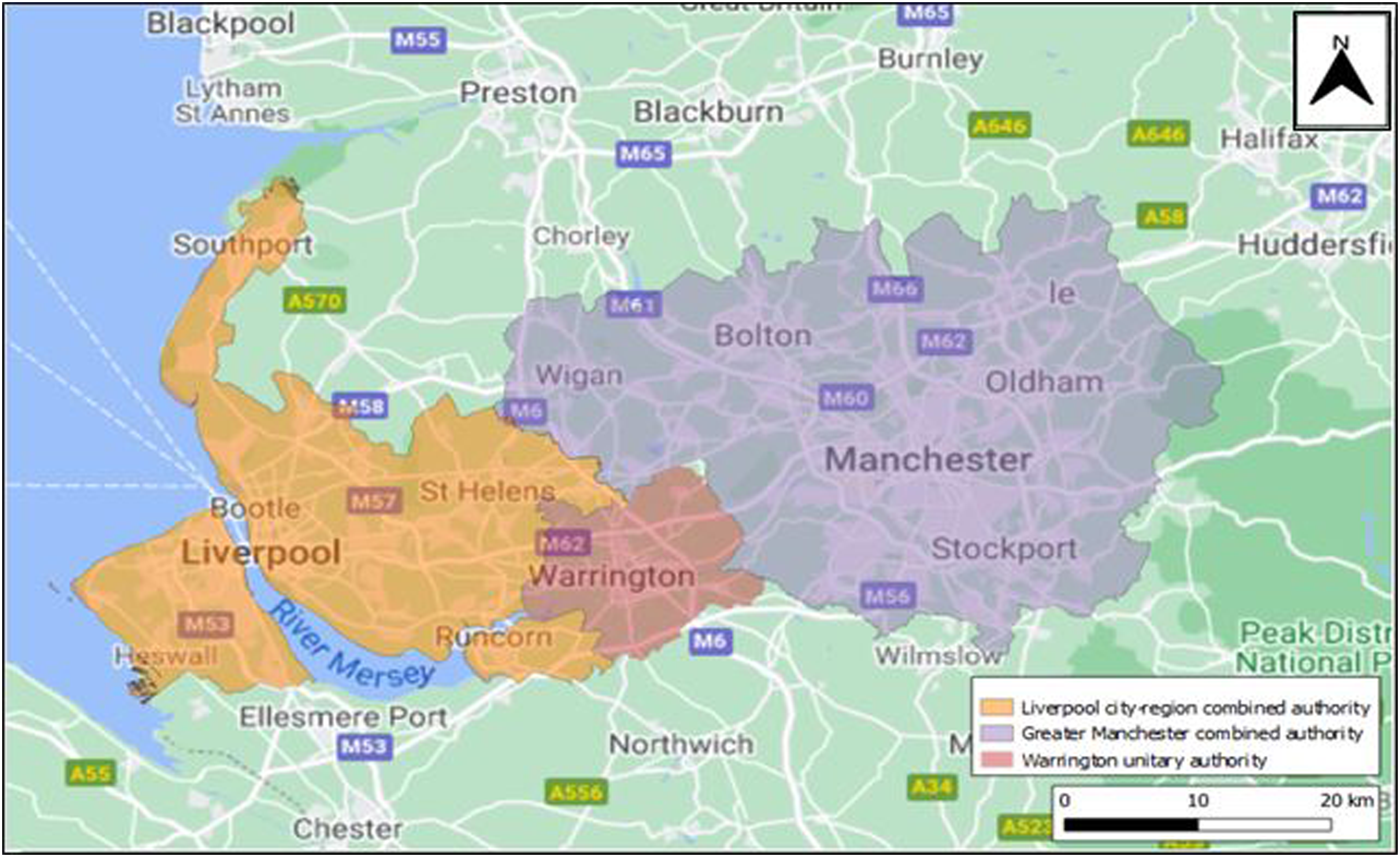
Second, no evidence was found of Warrington being referred to through city-regional labels or discourse, but it is clearly functionally interconnected with surrounding city-regional spaces. Indeed, “Warrington’s history has been shaped by the east to west River Mersey and its valley, and efforts to cross the river by ford, ferry and (since the 1200s) by bridge……transport links were improved with new canals, including the Manchester Ship Canal in 1893, and with (new) railway links” (Jones and Gibson, 2011: 240). Further, Warrington town itself is located between the major motorways of the M56, M6 and M62. Nevertheless, despite such potential for (inter)connectivity, Warrington has experienced some economic difficulties - “…by the 1980s, de-industrialisation had left its mark… many of Warrington’s manufacturing industries had declined, despite their diversity… the M6 motorway, built in the 1960s, brought benefits to the town but also allowed people to by-pass it” (Jones and Gibson, 2011: 240).
Evidently Warrington is a strong example of an ISCR in line with the definition we provide. This does not mean that other, less immediately compatible ISCR spaces are not relevant for this line of academic enquiry. Rather, this paper aims to catalyse research on ISCR and a clear example has been chosen to achieve this. It is expected that other less distinctive examples – which may cater more to either aspect of the definition provided - will emerge in future research.
Research methods
Given the desire to understand the role of place-branding in Warrington we employed a qualitative approach (Figure 2). Interviews are a well-developed, conventional choice of research technique for human geographers. In particular, the semi-structured approach was seen to be particularly favourable as it enabled us to maintain a broad structure which focused on place-branding but similarly provided respondents a significant amount of freedom in what they chose to talk about, how much they chose to say, and how they wished to express it (Van Teijlingen, 2014). One of the primary rationales behind this approach was the recognition that whilst several key themes and questions could be devised based on existing literature, it is possible that there may have been aspects excluded from prior consideration. The research process.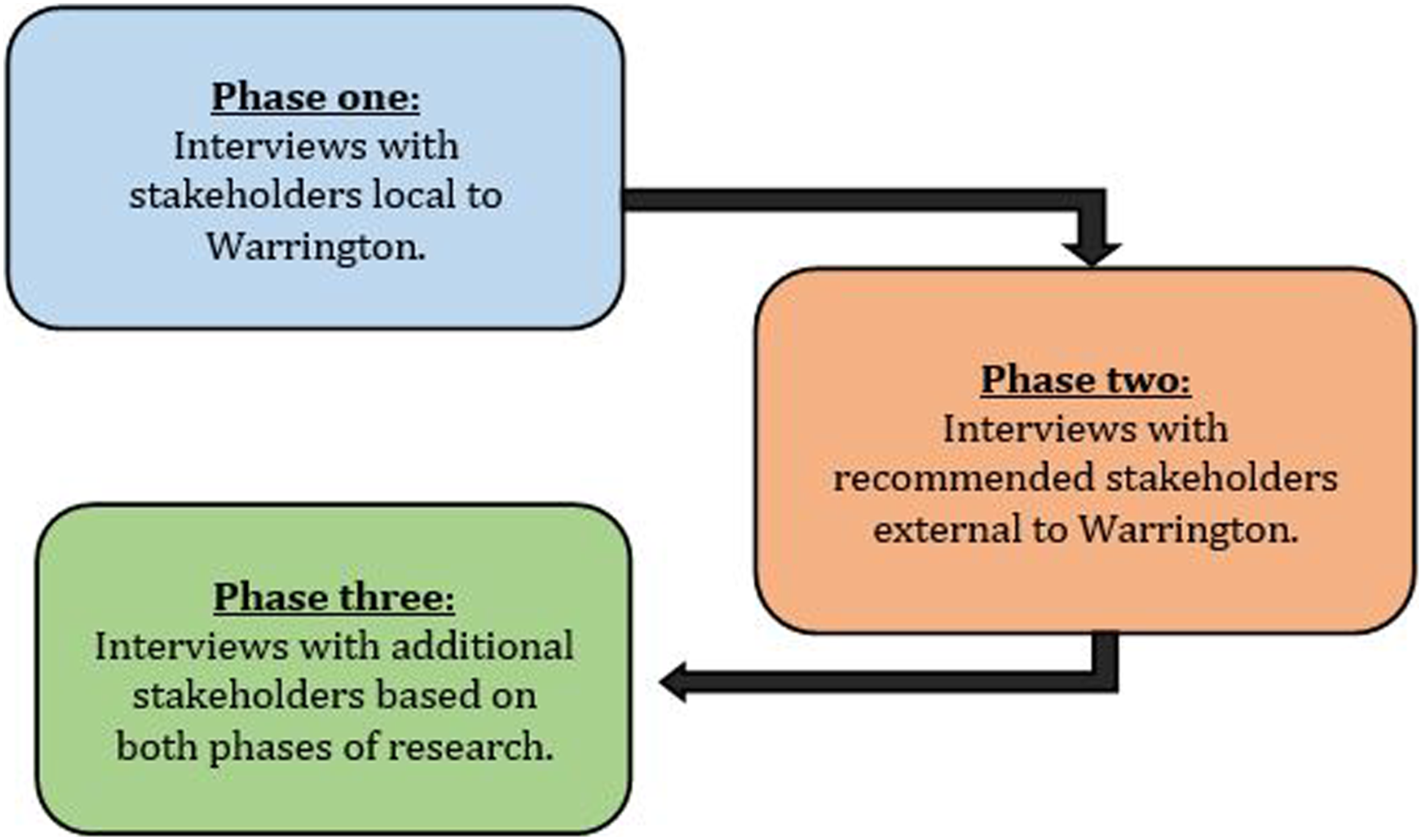
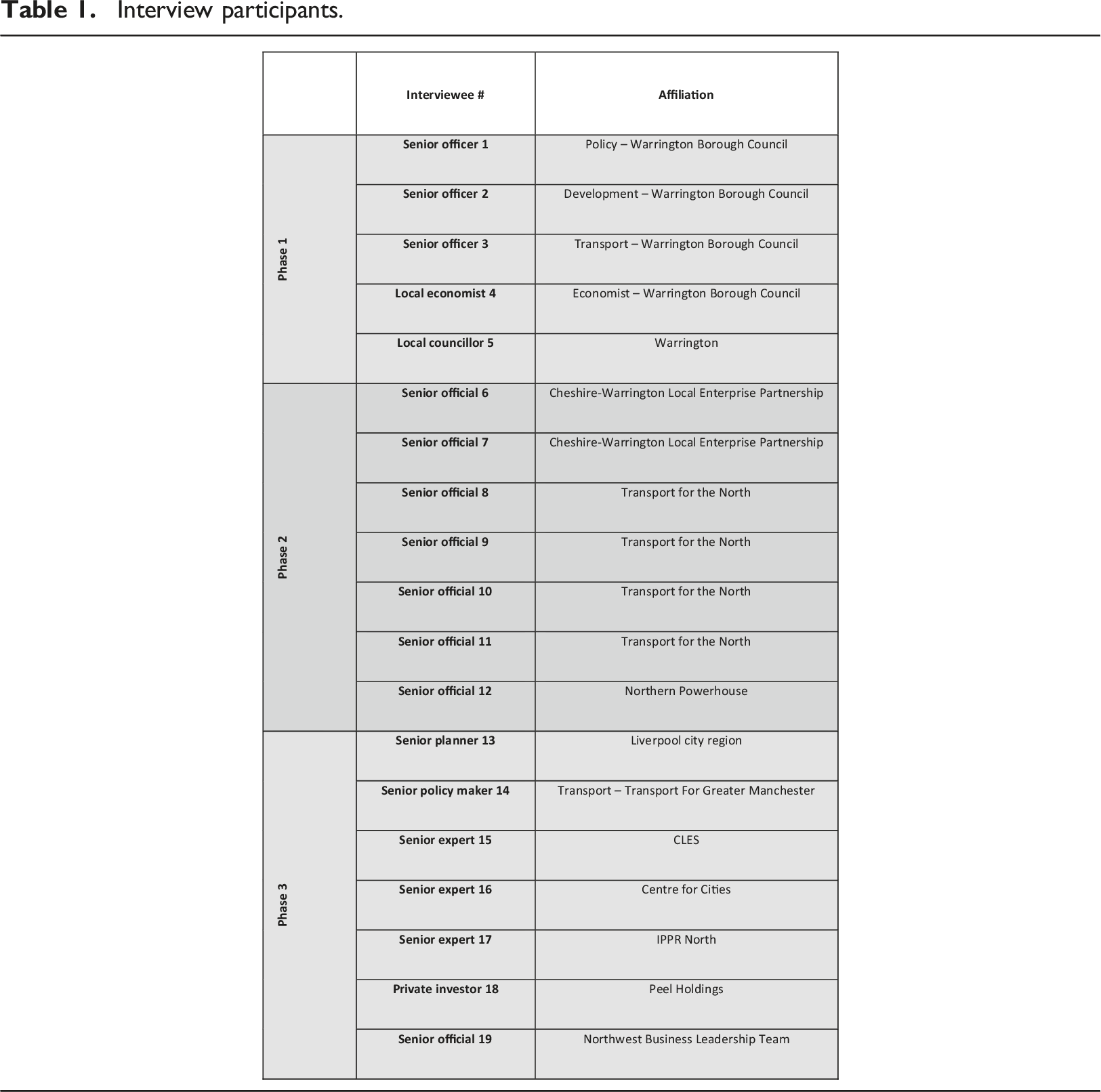
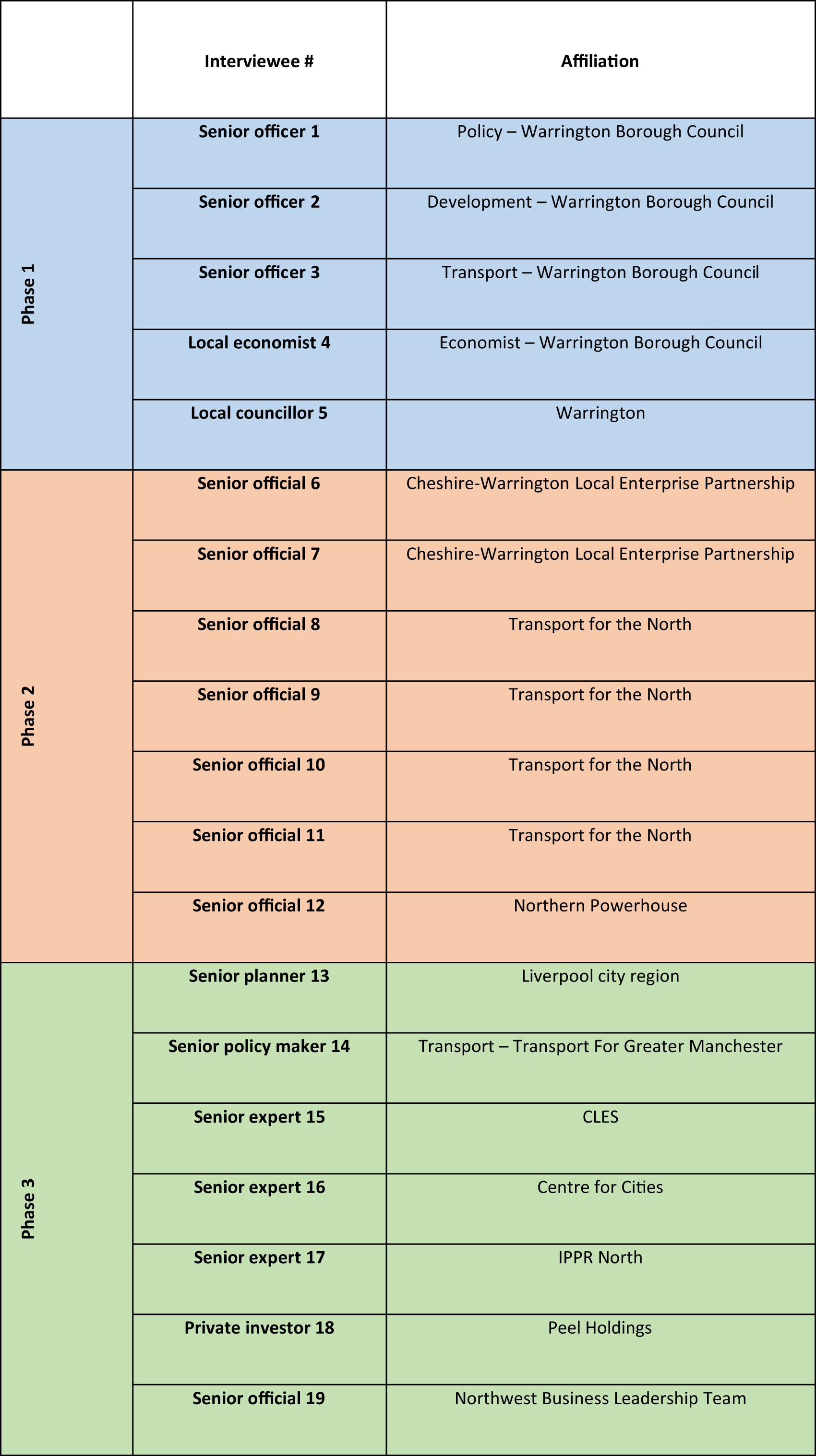
We conducted interviews in three phases. First, we interviewed stakeholders with a specific territorial basis focused on the Warrington Borough – WBC - to explore their perceptions and experiences of the impact of broader city-regional policy and their attempts or struggles to mitigate these challenges in the context of Warrington. Second, we broadened our interviewees to include those associated with NPH and the surrounding city-regions of Manchester and Liverpool in order to develop an understanding of their perspectives on the ISCR space of Warrington and WBC’s attempts at place-branding. Third, we analysed this data and then recruited other key stakeholders working in and around the Northwest of England to further contextualise our findings. This included expert interviews with those working on policy and economic development issues in the wider region. This approach was viewed as most applicable for capturing the ‘multilevel’ influences on place-branding as identified in the literature (Van Ham, 2008).
Interview participants.
Results and discussion
State selectivity: City-regions at the expense of ISCRs?
We have already noted how successive national governments in the UK have strategically and spatially privileged city-regions - in terms of resources and devolution of responsibilities - as an integral element of its ambition to enhance national economic competitiveness. Hence connecting with our first question, our initial focus was on how such privileging had served to shape the activities of actors focused on ISCR spaces. In this respect, several interviewees from the ISCR local authority – WBC - argued how the Manchester-Warrington-Liverpool corridor was characterized by significant governance inequalities, and not least informed by the devolution settlements to the adjacent Manchester and Liverpool City regions. These had been taken forward through the ‘City Deals’ struck between local authority leaders and locally elected mayors involved with the Manchester and Liverpool Combined Authorities - set up to govern each of these city-regions - and central government respectively. Such deals had led to powers over health, transport and employment and skills being devolved to the Combined Authorities, along with control over associated investment: “I think they have a louder voice nationally, which means that they've got access to further resources, compared to those of us that don't have an elected mayor. I've seen urban areas really cry out because of this - the devolution and the additional funding they obtain because of perceived crises - whereas other areas are only (able to) bid for what might be left over. So……additional resources that are going into these big conurbations that have agreed devolution deals”. [Senior officer 1 (policy), WBC]
Furthermore, despite the NPH being set up to help rebalance the UK economy, catalyse public and private investment and improve life chances for people growing up in the north of England, it was felt that the ISCR space of Warrington had received little benefits from such an approach in relation to its budget and ability to shape its own agenda: “You know, I think that model [of devolution] will persist and only get worse as far as disparity. So yeah, I think there is a disadvantage there”. [Senior officer 3 (transport), WBC]
Equally, such a disparity was acknowledged by those involved with the NPH: “The challenges Warrington has at the moment... there's an asymmetry of functional economic geography and powers. So, Warrington doesn't have its own devolution settlement. So, although it has lots of economic opportunities, it doesn't have the tools to be able to take advantage of them. I think that the solution for Warrington is that its connectivity needs improving, and it needs more ability to make its own decisions”. [Senior official 12, Northern Powerhouse]
Hence the spatial and strategic selectivity of the state (see Jones 1997) in prioritizing city-regions was perceived as particularly hindering the strategies of economic development that local actors could take forward. This was recognized by those working within and outside of the ISCR case study area of Warrington and reflective of (Pemberton and Winstanley, 2010) arguments that “central government can control who it lends powers to, on what terms…and can redraw and redefine its distribution of powers over time” (p.29). As such, organisations such as the WBC argued that they were having to spend much more time in making a case for investment to central government - often through piecemeal and highly competitive funding programmes - and which had less chance of being successful: “Local areas know more the local issues, and other problems, better than Whitehall officers. So, we spend a lot of time in bids, trying to get Whitehall to understand what the issues are and where the issues are so that we might address them”. [Senior officer 2 (development), WBC].
and “We put our bid in and the limited feedback we were given was that we were just we were just short.... but that's very, very frustrating in the sense that… is it better to miss by a bit or is it better to miss by a mile? If you don’t get it, you’ve wasted a lot of time”. [Senior officer 3 (transport), WBC].
Overall, whilst this finding is not unexpected per se, it is consistent with long-standing arguments - certainly in the UK - over the limited capacity to which “government authorities give local government freedom” and the “…extent to which local government is dependent on other authorities in its decision-making practices” (Fleurke and Willemse, 2006: 75) In essence, such arguments appear to be equally recognised by actors involved in ISCR spaces.
ISCR responses to city-regional strategic and spatial selectivity - entrepreneurial place-branding
In response to the promotion of city-regionalism and city-regional governance structures in the UK, a distinctive entrepreneurial ethos was evident in terms of the actions of those working for WBC. In particular - and reflecting our second research question - place-branding was being used in response to the perceived strategic and spatial selectivity of the state towards the adjacent city-regions of Manchester and Liverpool: “In a way, we don’t know what we’re missing. We’ve never had it… And that gives you a different mindset, which is just crack on and have confidence in your brand”. [Local economist 4, WBC]
Unlike other reports of place-branding in the literature, which frames place-branding as “a necessary undertaking to respond to local issues” (Cleave and Arku, 2020: 1), actors working in the ISCR saw place-branding as a necessity - and as an integral element of an economic development strategy for the area - to respond to the perceived inequalities wrought by the Government’s city-regional policy focused on adjacent areas. In this respect, it has been argued how place-branding requires consistent messaging, rather than ‘one off’ attempts at branding (McCann, 2009). The need to ‘crack on’ and have ‘confidence’ in the brand being constructed by WBC - and partners - thus reflected such an approach - and which had been developed over a considerable period of time.
The (ISCR) Warrington brand
Place-branding - as already highlighted - is frequently constructed on the basis of physical appearance, marketing and the ‘reputation discourses’ of those associated with particular places (Kavaratiz, 2005). In terms of physical appearance, it was noted how the Warrington ‘brand’ had been constructed through three ‘ingredients’ – i) positioning (where Warrington is specifically located as an ISCR); ii) land availability (in terms of developable brown and green field sites); and iii) the presence of the mobility infrastructures (which intersect the Warrington ISCR area primarily by rail and road): “Warrington (town itself) was once in receipt of not just ‘New Town’ design, but Government funding. But 20 years ago (or so) that fell away… What was left in Warrington was a substantial amount of land. It was highly developable land, in large scale, and it was in the box of the M6, M62 and M56 (motorways). So, it had land. It had location prior to having any Government funding through a New Town commission. So, it had all the ingredients of success - that's kind of self-evident”. [Senior officer 2 (development), WBC]
In response to a perceived deprivileging by the state and with little direct assistance emerging from the recent focus by successive national governments in the UK on city-regional policy, officers working for WBC had chosen to focus on its location and on local assets which were strategically inherent to Warrington and its position (Doringer, 2020) and how to generate local economic growth from these. Yet, it was namely mobility and the presence of motorways, surrounding A and B-roads and the railway which were viewed as being a significant factor in determining WBC’s ‘success’: “It’s because of this mobility... but that's the world over, you know, where you have an intersection of strategic infrastructure, the location where that intersection exists becomes an economic powerhouse in itself - anywhere in the world. You look at any strategic infrastructure, be it road or rail, and where they cross is where you’ll find economic activity – that is true from days when we were just driving horses and carts to now with high-speed rail - the philosophy is still the same”. [Senior officer 3 (transport), WBC]
These ingredients, notably the importance of mobility infrastructures and Warrington’s positioning, were similarly recognised as being critical to underpinning the brand by sub-regional actors, such as the business-led Cheshire-Warrington Local Enterprise Partnership (CWLEP) - which is a non-statutory body responsible for local economic development across Warrington and Cheshire (i.e. the area to the south of Warrington), as well as by those working in adjoining city-regions: “The geographic location [of Warrington] means it has quite a large two-way commuting flow. Thinking in terms of the geography. So, it is all very interconnected. Warrington is slap-bang in the middle of the other two metropolitan areas, which helps”. [Senior official 6 (Transport), CWLEP]
and “Warrington’s success if you like is due to its locational advantage. It’s right next to the North major motorways, and it is slap bang in the middle of the two major Northwest conurbations”. [Senior policy maker, 14, Transport for Greater Manchester]
Consequently the mobility potential of Warrington, as a space in-between two city-regions provided some strategic value – one which had led to the crafting of a regionally recognised Warrington brand. As such, place-branding had sought to exploit Warrington’s connectivity and positioning. In addition, whilst Warnaby (2018) has noted how branding approaches often fail due to “different stakeholders having very different conceptions of the place within which they exist” (p. 4), the ISCR Warrington ‘brand’ was recognised by a plethora of different actors working within and beyond the ISCR space.
The spatialities of ISCR branding
As a key actor in defining the ‘Warrington’ brand, WBC also sought to legitimise such branding through particular territorial practices. Thus, in seeking to capitalise on Warrington’s mobility potential, WBC had focused on land development in the context of the wider borough and specifically the rural-urban fringe, rather than the town centre itself (and which is typically reported in the place-branding literature; see Daramola-Martin, 2009): “So, just near the Town Centre, we do have a few business offices for smaller organizations… but it is more (about) the retail parks…..such as at Omega”. [Local economist 4, WBC]
Warrington’s brand was widely supported by ‘Warrington & Co’., WBC’s inward investment and regeneration agency, and which was also owned and operated by the council. As the Warrington & Co website proclaims: “Ask Amazon, Hermes, Asda and Travis Perkins why they located to Omega Business Park - a thriving development on what was the location of the US Army Air Force's most significant base outside America. Or why is Birchwood now home to world-leading nuclear engineering giants?” Indeed, the Warrington & Co website (Figure 3) illustrates how the rural-urban fringe is branded as a ‘premier location’. Thus, in relation to our third research question (How is place-branding reflected territorially in ISCR spaces?), it is evident that the rural-urban fringe of the ISCR (of Warrington) - and its mobility potential - was critical for local actors in achieving their economic development ambitions: “Well, the location (the rural-urban fringe) is very important and transport infrastructure is going to be conducive to our future growth ambitions. Absolutely… [Senior officer 2 (development), WBC] The Warrington brand applied to the rural-urban fringe on the Warrington.Gov website in 2021
and “Those spaces (the rural-urban fringe) represent the economic heart of the border... So, the job at hand for the council is to change the mix – to transform not just parts of those areas as such, but just to redesign the mass movements of people between them”. [Senior officer 3 (transport), WBC]
Also outlined above is a prioritisation of rural-urban fringe spaces to improve local mobility, illustrating how the rural-urban fringe had become a key area of interest for local government actors in the ISCR. Moreover, the emphasis was on two specific archetypal ‘fringe’ spaces: Birchwood (to the East of Warrington) and Omega (to the West of Warrington) given that both of these spaces were situated at key interconnected points of mobility infrastructures (Figure 4). The transport infrastructure and land uses across Warrington, with Omega and Birchwood fringe localities marked. © OpenStreetMap contributors. Contains public sector information licensed under the Open Government Licence v3.0.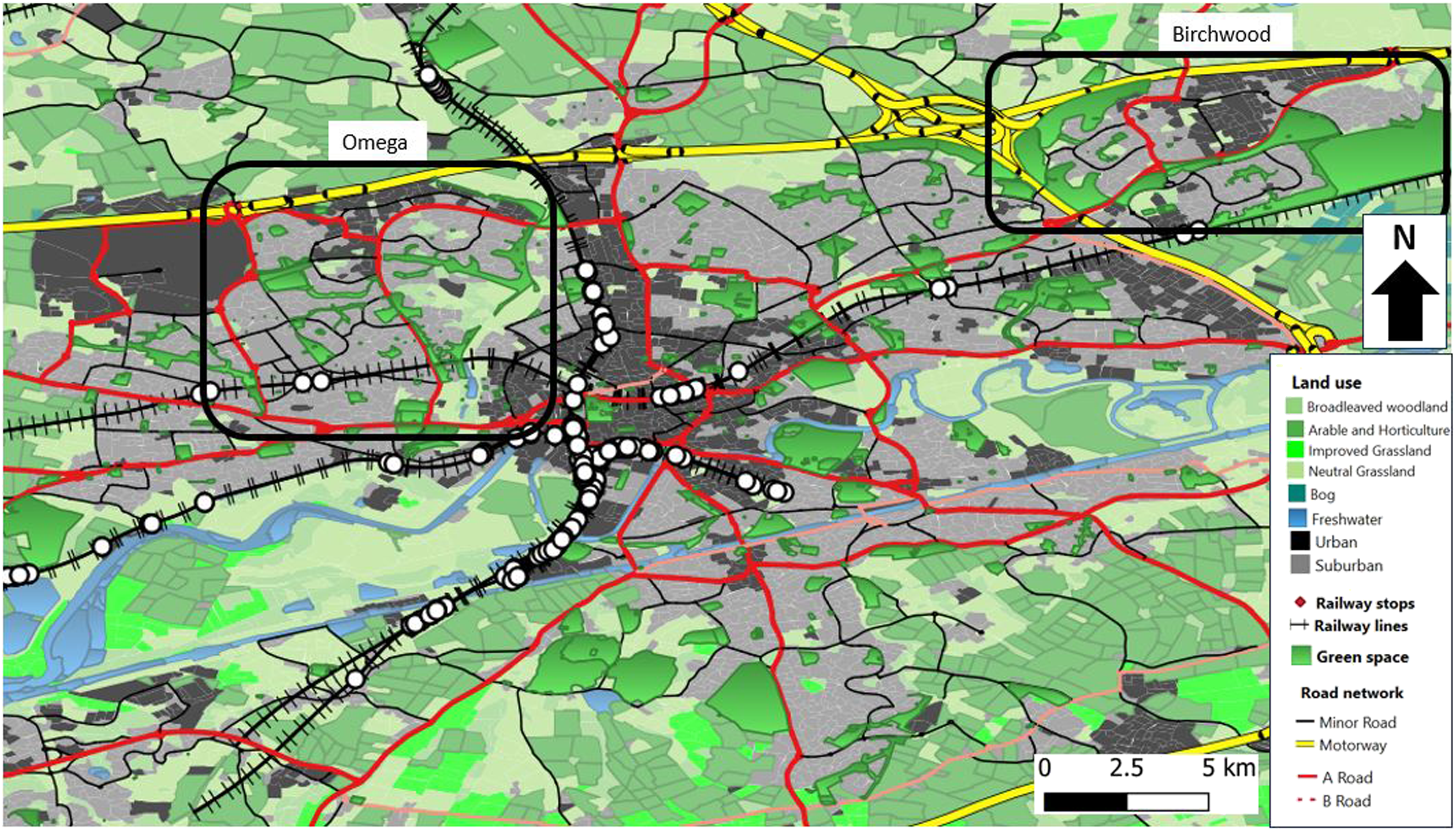
We can therefore deduce that the explicit interest in spatially fixing the Warrington brand at the rural-urban fringe of the ISCR was largely a product of how WBC perceived such spaces as having an inherent mobility potential and their connectivity to other places (Gallent and Andersson, 2007). For example, the mobility infrastructure and connectivity to both city-regions of Liverpool and Manchester comprises a key part of the branding of the Omega site. As the website proclaims: “Omega’s infrastructure links are unbeatable: immediate access to the M62 at Junction 8 [and] situated three miles West of M6/M63 interchange, midway between Manchester and Liverpool” (Omega Warrington, 2021; no page number). The branding of Omega as being a space constructed around the mobility potential of the rural-urban fringe was deeply embedded into a strategy focused on drawing potential from proximate city-regions, and which will be discussed further in the next section: “So, in Omega – that’s where I’ve got those big companies, the big distribution ones. There is a company called Plastic Omnium who manufacture parts for Jaguar Land Rover. That is a good one for us. They’re up there at Omega. So, certainly, those companies have come there because, well, it’s very visible – you can see the development and it’s really well connected as it’s next to the motorway”. [Local economist 4, WBC]
Similar arguments were also applied to the Birchwood development in the rural-urban fringe: “Because of Birchwood’s location and its connectivity to multiple areas, you can get land away in no time at all. [Senior officer 2 (development), WBC]
Hence the emphasis on using the rural-urban fringe to inform the Warrington brand - based around positionality, land availability, mobility and connectivity - was widely recognised as an effective strategy: “It's (an area) with huge amounts of land... WBC has been shown to be entrepreneurial and make gain out of planning decisions, it's in a good place”. [Senior expert 16]
Such statements highlight a critical finding – local actors have entrepreneurially used the rural-urban fringe of an ISCR space - and which has long-deemed to be a hyper-mobile space (see Gallent et al., 2006; Peacock and Pemberton, 2019), to craft a specific brand for facilitating economic development in the ISCR. Furthermore, it renders a specific ‘visibility’ for Warrington as an ISCR.
The Warrington brand - relationally constructing a brand from surrounding city-regions
Despite the importance of the rural-urban fringe in contributing to the branding of Warrington, it was clear that the brand had also been derived from Warrington’s connectivity to other places, namely the two adjacent city-regions of Manchester and Liverpool. As a result, local actors were being strategically and spatially selective in relation to opportunities arising in adjoining city-regions and which also served to shape and inform the branding of Warrington, and how this was used to capture economic growth. Two examples help to exemplify this point. First, WBC had recognised that Liverpool City Region was seeking to increase its logistics capacity through the re-opening of its port: Liverpool again, I think is rediscovering its industrial heritage and is focusing again now on its port, particularly Peel… So, if you've got shipping coming into Liverpool, the place where those goods are delivered sorted and re-sent on, then the main centre is going to be Warrington. So Liverpool's economic growth helps Warrington's economic growth”. [Senior official 2 (development), WBC]
But beyond this, it was apparent that WBC’s branding strategies were not only being informed by their city-regional neighbours but had in some instances trumped those developed by the Liverpool City Region Combined Authority and Manchester City Region Combined Authority in respect of capturing related investment. This was particularly evident in relation to logistics, where Amazon, Hermes and Royal Mail – all logistics companies - had located on the Omega site in Warrington (Omega Warrington, 2021), rather than in the Liverpool city-region. This was a 25-year investment plan for Warrington. In the words of a senior planner from the Liverpool city-region: “In terms of the west of Warrington are some very large containers, you know, Amazon, Post Office, Travis Perkins, they've got some huge, super warehouses just off the M62. Arguably, they should really be in the Liverpool City region, but Warrington got there first, and you know, the business has established there. It's really escalated recently with logistics facilities. In many ways, I think you could argue that they've actually stolen some of our some of our leading edge there”. [Senior Planner 13, Liverpool City Region Combined Authority]
Second, if reference is made to Birchwood Park on the eastern periphery of Warrington, this is a renowned knowledge intensive site with nationally leading sectors in nuclear research, as well as other scientific sectors. It also has an array of warehouses which typify the rural-urban fringe (Gallent, 2006). Consequently, WBC purchased the Birchwood Enterprise Park as a key element of its entrepreneurial approach and in an attempt to promote its brand: “Birchwood is one of the most successful science parks of its types in the Northwest – a massive cluster of nuclear industry, we own now, you know, we've we bought that, and……we have done a lot as far as mobility (is concerned) from the railway station up to the park”. [Senior officer 3 (transport), WBC].
The focus on improving mobility infrastructure is instructive as this meant that Warrington could ‘connect’ its brand into the science and innovation potential associated with the Manchester city-region. In this respect, its inward investment agency has highlighted how “Manchester is spearheading the discovery and adoption of new tech-enabled solutions, giving companies the opportunity to leverage the AI and cyber skills for data driven healthcare innovation and explore the medical applications of new materials, such as Graphene in SMART and connected medical devices” (MIDAS, 2022; no page number).
It is interesting that whilst Birchwood indeed has similar logistics facilities to the Omega site, these were not what were prioritised in the interviews or in any secondary documents related to the identity of the place. In turn, the Borough Council has sought to selectively use - and indeed develop its brand - with reference to other forms of economic growth activity taking place in the Manchester city-region: “We are incredibly well-connected to Manchester and there’s a lot of science and innovation going on in Manchester... Graphene institutes and the Dalton Nuclear Institute that Birchwood in particular can connect into. So, you know, there's collaboration to be had. That’s not a wish, it happens every day”. [Senior officer 2 (development), WBC].
To summarise, a second important finding that emerges from the research is that place-branding can be employed as an entrepreneurial strategy by local actors within given ISCR territories to draw relational (economic) potential from surrounding (and often more privileged) spaces - and which in this instance was once again being taken forward through the use of particular sites within the rural-urban fringe. In essence, WBC developed a specific place brand for an ISCR space through thinking both territorially and relationally in terms of its location between the city-regions of Liverpool to the east and Manchester to the west. This meant that it was able to capitalise upon its geographical positioning, local assets and relational connections and synergies to generate new economic opportunities. This is consistent with Allmendinger et al.’s assertion of the importance of “drawing in relational conceptions of networked space into territorial forms of governance… to address specific and complex issues around growth management within territories in relational ways” (Allmendinger et al., 2014: p. 2706).
Conclusions
In contrast to the considerable focus that has been placed on city-regions - and reflective of the on-going restructuring and rescaling of state spaces informed by the shifting nature of state institutions and political strategies (Brenner, 2005) - little attention to date has been placed on the ‘in-between’ spaces of city-regionalism - or ISCRs. This paper has sought to address this lacuna in knowledge through a focus on one particular ISCR - Warrington - which lies in-between the adjacent Manchester and Liverpool city-regions in the UK. The findings presented illustrate the ways in which local actors - and specifically WBC - have sought to overcome a perceived deprivileging by successive national governments in respect of the devolution of power and resources for economic development through an entrepreneurial approach to place-branding. This has been developed territorially and relationally through a focus on rural-urban fringe spaces and particular sites which lie at the edge of the ISCR. Reflective of the identification of such spaces as being distinctive in their own right (rather than simply being a ‘zone of transition’), they have sought to capitalise on the availability of land, mobility infrastructure and the potential for connectivity with surrounding city-regional spaces to both inform and develop a brand which is able to facilitate economic growth and support local economic development activities. More specifically, they have employed their own strategies of strategic and spatial selectivity to develop a differentiated spatial approach which reflects wider opportunities and developments in adjoining city-regional areas. In so doing, they have crafted a ‘visibility’ for themselves through articulating their interconnectedness with surrounding city-regions.
Beyond these insights, the paper also makes several important conceptual contributions. First, it draws attention to the importance of local strategic and spatial selectivities (Jones, 1997) employed by actors seeking to work not only with the state but also working around the state to offset a perceived de-privileging in state policy. Moreover, it also highlights the strategies key actors in ISCR spaces can use to bypass presumed (and widely ineffective) assumptions of economic trickle down fuelled by city-regional agglomerative policy.
Second, the paper draws attention to the importance of alternative spaces of the state that may be inadvertently created by the shifting nature of state institutions and political strategies – ISCRs – and of which has important implications for practices of local economic development and territorial governance in such spaces. Third, it provides new insights into place-branding and the need to move away from an approach that only focuses on “the people living and working in the geographical space that is being configured into a place brand” (Falkheimer 2016: 162). Rather, there is also a need to focus on the relational influences which may also shape particular types of place-branding. In such a way, this reaffirms the notion that “the relationality and interconnectedness of a certain place affects what territorial aspects are selected as tools in local (place-branding) activities (and through which) place-branding strategies become materialized and spatially fixed” (Andersson, 2015: 39). We therefore illustrate the importance of “positioning place reputation [and place branding] within a clear human geography context and, more precisely, the economic geography debates of relational and territorial understandings of place” (Bell, 2016: 249).
Finally, there is a need for more research on ISCRs. This includes a focus on how place-branding is initiated in the first instance and the processes of negotiation which are required between different actors (often with different territorial and spatial remits) in fixing such a brand for ISCRs. Moreover, further consideration is also required of the work involved in consolidating actors around such a brand, issues of power and indeed how both territorial and relational contexts may shape the actions of actors focused on ISCRs in order to further explore the dynamics between ISCRs and city-regions in different parts of the world. Finally, more research is needed on less distinctive ISCR spaces and the degree of success they may have found in employing similar strategies.
Footnotes
Declaration of conflicting interests
The author(s) declared no potential conflicts of interest with respect to the research, authorship, and/or publication of this article.
Funding
The author(s) received no financial support for the research, authorship, and/or publication of this article.
