




Abstract
The regional scale continues to be considered critical to UK economic governance. Successive iterations have however seen limited impact in addressing enduring issues of uneven development despite significant reform. This paper argues for a reconceptualization of the region and regional geographies through application of an assemblage reading. Building on existing work in economic geography, it argues regional economic governance should be considered as an assemblage process involving overlaying territorialisations of place, policy, and stakeholders, and related dynamic capacities involving the multiplicity of components and interactions, legacies of prior arrangements, and agency of actors. Regional governance therefore occurs through a process of continual becoming. Similarly important here however is decoupling. Decoupling has significant spatial and sectoral implications as changed arrangements shift the dynamics integrating actors and groups of actors locally and regionally. Using analysis from Southern Staffordshire, part of the Greater Birmingham city-region, the article argues the shifting nature of regional assemblages and distinct forms of territorialisation are material in decoupling key local sectors from local economy and place. We conclude the application of an assemblage reading, and its enhancement through application of decoupling, has scope to illustrate key causes of uneven development within regions.
Introduction
Regionalism and the reform of regional territories has become a core component of sub-national economic governance in the UK. Yet the impact of this approach has arguably had limited effect on resolving enduring issues of uneven territorial development (Martin, 2010; McCann, 2016; Martin et al., 2021). The introduction of the ‘levelling up’ agenda (HM Government, 2022), and its associated Ministerial and governmental lexicon to discussions on sub-national development, follows a long line of policy panaceas; the ‘rebalancing the economy’ of the Local Growth white paper (HM Government, 2010), ‘industrial activism’ of New Industry New Jobs (HM Government, 2009), and urban renaissance of Our Towns and Cities: the future (ODPM, 2000) to name only the more recent.
The UK has therefore experienced an ongoing process of reforming regional governance arrangements, involving adjustments to the machinery of governance, the revision of statutory responsibilities, and the redrawing of the regional map. Within this, territorialisation has become a prominent component as spaces of regional governance have sought to adjust in line with those of economic production and transaction. Such territorialisation has however challenged a core component of the regional mode of practice. In place of structured readings, shaped by spatial articulation or scalar relations, an alternative framing has become more prevalent. With ongoing rearrangements underpinned by shifting topological and topographical systems and relations, regions are perhaps best interpreted as a form of assemblage, their spatial reconfiguration representing a ‘performance event’ shaped by, but not necessarily limited to, geographic form (McFarlane, 2011; Simandan, 2018).
Central to these assemblages is the reconfiguration of place in processes of spatial production (Jessop, 2007; Salder, 2020), the integration of diffused, network-based modes of practice (Allen and Cochrane, 2007; Dicken, 2007), and the pursuit of more entrepreneurial forms of governance (Pugalis and Bentley, 2014); here competition for a limited pool of resources is key, engaging places in negotiations around devolution and distribution of autonomy and funding through new sub-national structures including the West Midlands Combined Authority and the Midlands Engine (Green and Rossiter, 2019; Harrison, 2012). But alongside these assemblages sits the decoupling of established assemblages formed during prior rounds of restructuring, with impacts for the ongoing and enduring relationship between political and economic actors.
This paper argues that such a process may be material in underwriting forms of uneven development. With regional policy making increasingly informed by analysis focused on core, large or global cities as regional loci (Fothergill and Houston, 2016; Robinson, 2005), this often occurs at the expense of understanding places considered integral to the ethos of levelling-up; smaller, peripheral cities and secondary centres (Bell and Jayne, 2009; Salder and Bryson, 2019) often considered to be left behind (Martin et al., 2021). Such a tendency has implications in terms of prioritised intervention often seen as at odds with the everyday needs of different regions and particularly localities.
This paper examines the reform of regional governance as a material consideration in re-framing these ‘left-behind’ places in regional and national governance, framing this evolving governance process as an assemblage involving territorialisations of place, policy, and stakeholder. Crucially, this process of assemblage formation includes an ongoing decoupling, defined here as the separation of actors and their relations established during prior assemblages. The paper argues a decoupling effect is a key component of contemporary regional economic development as organisations fall away from existing regional assemblages and are attracted into another’s field of relations; this may involve engagement with a non-local assemblage (Allen and Cochrane, 2007) with profound material impacts on localised dependencies.
Commencing with discussion on sub-national state spatial governance and its framing as a process of assemblage and decoupling, the paper progresses its analysis through a qualitative approach using semi-structured interviews. The study area is Southern Staffordshire, a peripheral part of the Greater Birmingham and Solihull city region in the English West Midlands facing new geographic and governance assemblages following redrawing of the UK regional map in 2010. Through these interviews, the paper identifies and examines territorialisations of place, policy, and stakeholder-based assemblages and their effects on the embedded relationships between local governance arrangements and local firms. It argues the fields of attraction brought into being by new forms of regional arrangement are, through prioritising specific assemblages, reinforcing a layered decoupling between local state and market actors with implications most prevalently felt in left behind places.
Regional economic governance, decoupling and assemblage
Rescaling, restructuring, and reconfiguring the means and processes of sub-national economic governance has presented notable changes recently. Ongoing shifts in the scale of intervention and implementation (Brenner, 2004), devolution of responsibilities within and outside state organisations (Jones et al., 2005), and broadening of participation in the policy process (Fung, 2015; Yuille, 2020) have seen numerous spatial challenges emerge. As a result, the processes through which regions both form and function have been increasingly problematised beyond simply territorial framings, incorporating the politics of scale, formation of place, and evolution of networks (Jessop et al., 2008).
The challenge here has been reconciling clearly bounded modes of governance practice with an increasingly dispersed form of relational economic production. The limited effect of regional policy - and its reconfigurations - to address enduring issues of uneven development (Martin, 2010; McCann, 2016; Martin et al., 2021) raises questions about both the structuring and reading of regions as spaces of production.
One means of re-reading these spaces is the application of assemblage thinking. Whilst the assemblage approach has been previously applied to regional governance processes (Allen and Cochrane, 2007; Briassoulis, 2019; Truelove and Cornea, 2021), we draw attention here to an underexplored consideration. Critical to assemblage is the notion of coupling as new relations and dependencies are formed between sites and actors (McFarlane, 2011). Less discussed are the effects of decoupling the established spatial and structural relations. In this section, we develop this perspective in more detail through discussion of the role of assemblage in regional governance, the need for greater consideration of decoupling in the process, and the potential role decoupling plays in ongoing issues of uneven regional development.
Regional economic governance as assemblage
Regional governance has witnessed significant evolution in the UK in recent rounds of restructuring. As modes of practice have evolved, one key shift in discourse has been toward employing forms of assemblage thinking as a means of explaining such processes (Allen and Cochrane, 2007; Briassoulis, 2019; Truelove and Cornea, 2021). In place of bounded, structuralist readings formed via territorial demarcation, assemblage thinking prioritises instead interactions. Space is here an outcome of “relations, heterogeneity, and differences rather than parts, homogeneity, and similarities” (Kamalipour and Peimani, 2015: 404).
The relevance of this assemblage approach sits with both the influences and objectives of reform in regional governance. Enduring uneven development between and within regions (Martin, 2010; McCann, 2016; Martin et al., 2021) has seen ongoing reform in pursuit of optimal configurations capable of effective response to the shifting topography of economic governance and topology of economic production (Cochrane, 2018; Harrison, 2013). Here, rhetoric of growth, entrepreneurialism, and agglomeration considered integral to the regional model has run parallel to that of democratisation and inclusion in reforming both machinery and mechanisms of sub-national government. As a result, the territorialisation of governance arrangements involves a process incorporating multiple overlain dynamic assemblages, rather than their situation within clearly demarcated and represented territories.
Prominent amongst these assemblages are three distinct components. First, spatial reconfiguration presents the region as a space perpetually “made and remade by political processes which stretch beyond it and impact unevenly” (Allen and Cochrane, 2007: 1172). From the renaissance of the region (Jones and MacLeod, 1999) to the development of city-regions (Harrison, 2010), functional economic areas (Bentley et al., 2010), and the levelling-up agenda (Hudson, 2022), such spatial adjustment has been adopted to identify an effective response to the network transformations of economic production.
Second, the resultant interaction of policies sees both the consolidation and the movement and mutation of objectives, interventions and projects within specific spaces and periods (Salder, 2020; Savage, 2020). The application of multi-agency models here generates increased interaction between key actors and agencies in tangential spatial demarcations, extending the reach of governance processes (Allen and Cochrane, 2010).
Finally, reconfigured spaces and overlain policies revise processes of selection and prioritisation amongst actors. The governance process therefore determines priorities and modes of practice which favour not only policy choices but a distinct set of actors, shifting established relations, partnerships, and forums (Jessop, 2007).
These shifting regional landscapes and their interacting policies and key stakeholders, illustrate the role of assemblage thinking in understanding governance processes as both situated and hybrid (Briassoulis, 2019). One possible interpretation of regional governance is thus as a meta-assemblage of assemblages (Jessop, 2007), a result of distinct forms of interacting territorialisation observing a perpetual phasing (Jones, 2009) or tidal heating (Salder, 2020) in reconciling layered spaces of regional governance with discontinuous spaces of economic production. This interaction creates a third space of dynamic topological assemblage, the formation of which depends upon certain key capacities of assemblage praxis.
First amongst these is a multiplicity of continually changing components and interactions, providing a framework through which a range of spatiotemporal forms can be viewed within a place simultaneously (McFarlane, 2011). This animation of space and time, and recognition of continual (re)formation, allow us to recognise “multiple urban assemblages in which urban topologies are made and remade” (Farías, 2011: 370). Here, not only is the notion of place undergoing transition, but the layering and interaction of policies and stakeholders varies depending on their differing fields of attraction. This includes processes of hierarchical stratification based on inclusion and exclusion (Jessop, 2007), or the extent of and capacity for reach (Allen and Cochrane, 2010).
Secondly is the role played by history and therefore legacy (McFarlane, 2011). Places are viewed as in an ongoing state of becoming (Dovey, 2010; MGuirk et al., 2016) enacted through the interaction rather than outcome of components (McFarlane, 2011). These components can be local or at-a-distance, including structural objectives implemented or actioned via national policy intervention, and the shifting allegiances or animosities between firms and regional stakeholders.
Finally is the scope to accommodate the agency of actors in creating their own distinctive spaces of practice as opposed to corresponding with formal spatial demarcations. It privileges the assemblage and its territorialisations (i.e. its multiple material expressions and embodied and spatial forms) over other influences, whilst acknowledging these occur as a result of embedded uneven power relations (McFarlane, 2011; McGuirk et al., 2016). The relationship between administrative space and that constructed through the assemblage via its actors is material itself in mitigating distance between spaces of economic governance and economic production.
Core territorialisations of the regional assemblage – of place, policies, and stakeholders – thus function and interact in response to ongoing fluctuations in their relations. These fluctuations are shaped by capacities of an enduring multiplicity of place as regional spaces undergo constant transition, a legacy as echoes of preceding interventions are experienced in new relationships, and the agency of territorialising components in reframing notions of place or reforming spatial relations (Figure 1). Regional assemblage: Territorialisations and capacities.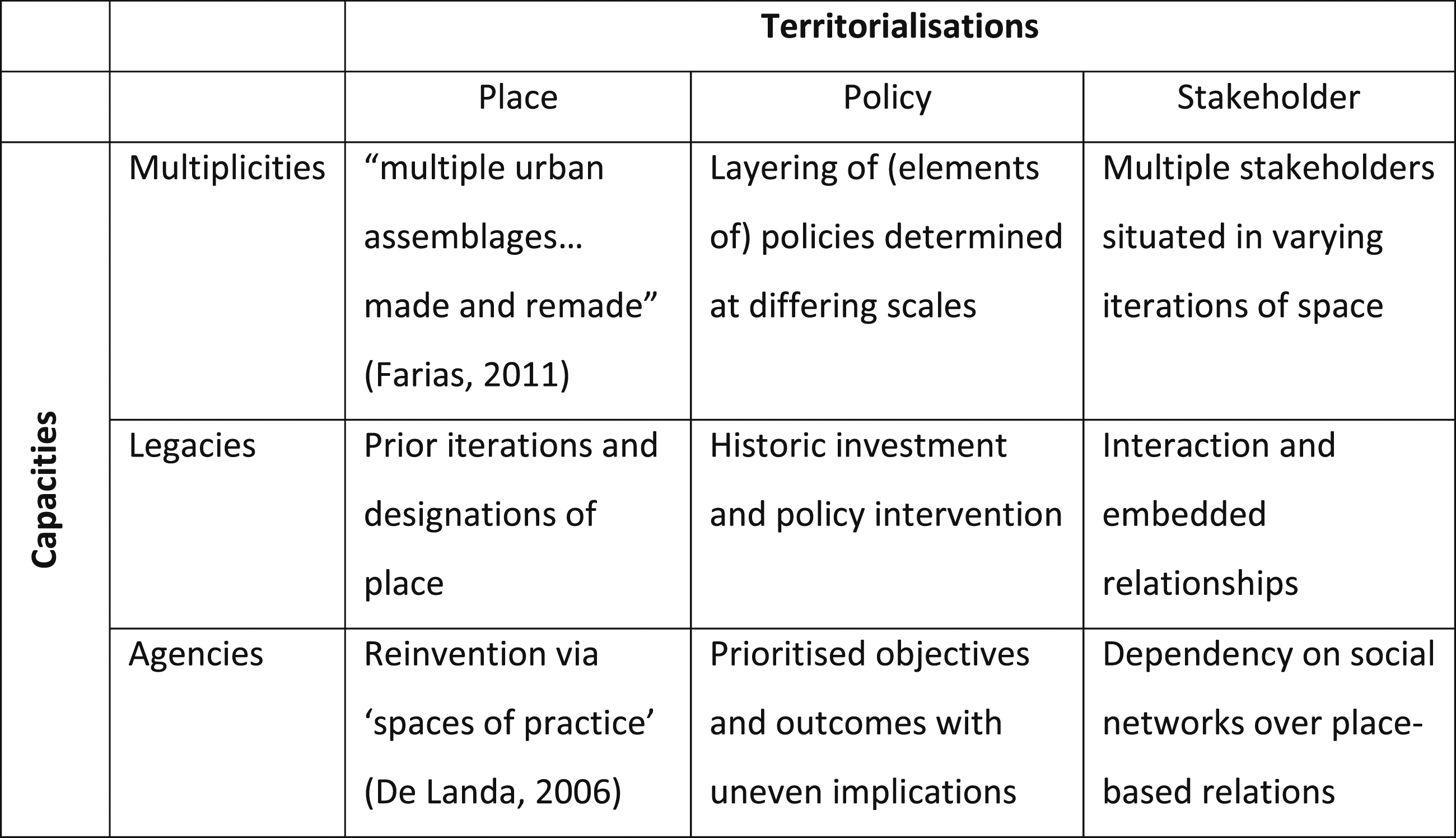
Assemblage and decoupling
The concept of assemblages provides a particularly pertinent tool for exploring the evolution of regional governance and the extent to which place, policy and actors are integrated through this on-going process (McFarlane, 2011). We argue, however, that current applications of assemblage thinking to regional governance require further refinement. Assemblage thinking’s ability to accommodate wider forces sheds light on the process of assemblage change or adaptation: for example, changing national economic development policies will alter dynamics between small (e.g. a business manager) and large (e.g. the regional economy) assemblage components. This can result in assemblages coupling with other assemblages to ‘lodge’ interests within a wider, politically-connected territorialisation (Allen and Cochrane, 2010).
Similarly, this dynamic can serve to diffuse the regional configuration through spatially-discontinuous relations (Allen and Cochrane, 2007). These changed tendencies are bound into the legated process of governance reform and the outcome of preceding arrangements and interventions forming successive layers of production and governance relations (Massey, 1979). For example, actor relations formed through prior assemblages can create institutional memories underpinned by long-term state personnel (Jones et al., 2004), established transactional dependencies (MacKinnon et al., 2004; Salder, 2021), and embedded stakeholder interactions (Fung, 2015; Yuille, 2020). This may lead to non-human actors exerting influence on the assemblage via the bounded rationality of institutional and industrial practice (Johnson and Hoopes, 2003) and sunk costs of organisational investments, network formation, personal interests, and public goods (Biniari, 2017; Capello et al., 2011; Clark and Wrigley, 1997). Assemblages are thus dependent upon how issues of materiality (varying in importance) and evolution (changing attractions between components through prior interactions) lead to change through relational external forces, as well as more proximate interactions.
Here, we propose the concept of decoupling is useful. Decoupling has previously been applied to explaining shifting regional dynamics, but often in the context of more conventional structural relations. For example, the hollowing out and subsequent (partial) filling in of automotive manufacturing in the UK illustrates a decoupling and recoupling in regional economies shaped by ongoing macro-economic factors and governance (Bailey and De Propis, 2014). Similarly, power dynamics between multi-national firms and regional institutions illustrate the shifting dialogue in ongoing rounds of regional investment underpinning coupling/decoupling, but here focus on transactional over systemic relations and the extent rather than form of coupling (MacKinnon, 2012).
Application of decoupling within the assemblage debate is thus limited, the focus tending to be on the process of becoming and its dynamic and fluid nature (McFarlane, 2011) over the continual reconfiguration of forms of territorialisation as they respond to this fluidity. Each new assemblage occurs on top of a set of inherited relations (Brenner, 2004). New configurations of assemblages develop in response to new couplings forming between (components of) established assemblages, yielding new territorialisations. These territorialisations, however, occur at the cost of existing relationships, their levels of localised dependence, and their involvement in the practice of becoming (De Landa, 2006). The effect of assemblage on existing territorialisations is therefore subject to a revision of components and their material and relational codes; recoding results in changed spatial arrangements, articulations, and dependencies. Decoupling can result in the separation of local actors and interests from locality in response to their shifting capacities (Anderson and McFarlane, 2011) and uneven power relations (McFarlane, 2011).
Decoupling and uneven development
Where decoupling has significant potential is in the analysis and explanation of contemporary regional dynamics, and within this electoral shifts in the UK, particularly around the more peripheral ‘places that don’t matter’ (Rodríguez-Pose, 2018) or ‘ordinary cities’ (Bryson et al., 2021) and their political relevance considering the UK’s ‘levelling up’ agenda (Jennings et al., 2021). One aspect of the presumed disenfranchisement of such places has been their more traditional economic structure, particularly dependence on production industries (Fothergill and Houston, 2016; Hamdouch et al., 2017). As a result, such places display distinctive capacities in resource configurations and associated limitations which demand an ongoing process of adaptation; one to which changing forms of regional governance has been unable to effectively respond (Salder and Bryson, 2019). Such changes have material effects on relationships between administrative demarcation and forms of territorialisation underwriting the evolving assemblages, illustrated in tendencies toward both industrial dispersal (Hamdouch et al., 2017) and administrative realignment (Salder, 2020).
The esoteric nature of such places makes the formulation and implementation of effective governance problematic. An ethos of more effective structural integration has been integral to reconfiguring regional governance in the UK since 2010, with Local Enterprise Partnerships (LEP) replacing Regional Development Agencies (RDA), and further adjustments through the formation of combined authorities and cross-region partnerships such as the Midlands Engine (Green and Rossiter, 2019). Despite this reconfiguration, an enduring system of state spatial meta-governance endures (Allmendinger and Haughton, 2009) through aligned policies of city-regionalism and austerity, limiting resources for local/regional policymakers in developing capacities to support localised firms or industrial sectors. In place, what is seen is an overarching privileging of specific territorialisation via this meta-governance. We argue this raises significant questions about the role of regional reform in decoupling local policy actors from local industry, in turn forming new assemblages contributing toward further territorialisation limiting the synchronising of regional development policy with territory. Having shown the value and significance of assemblage thinking and decoupling to regional governance, we next examine the material effect of governance rearrangements on economic spaces and stakeholder collaboration in a set of localities whose histories and structures illustrate how decoupling is actively shaping regional dynamics within areas affected by uneven development.
Methodology
The study area for this research is a collection of local authorities (LA) on the edge of the Greater Birmingham and Solihull (GBS) city-region and Local Enterprise Partnership (Map 1). Southern Staffordshire local authorities study area.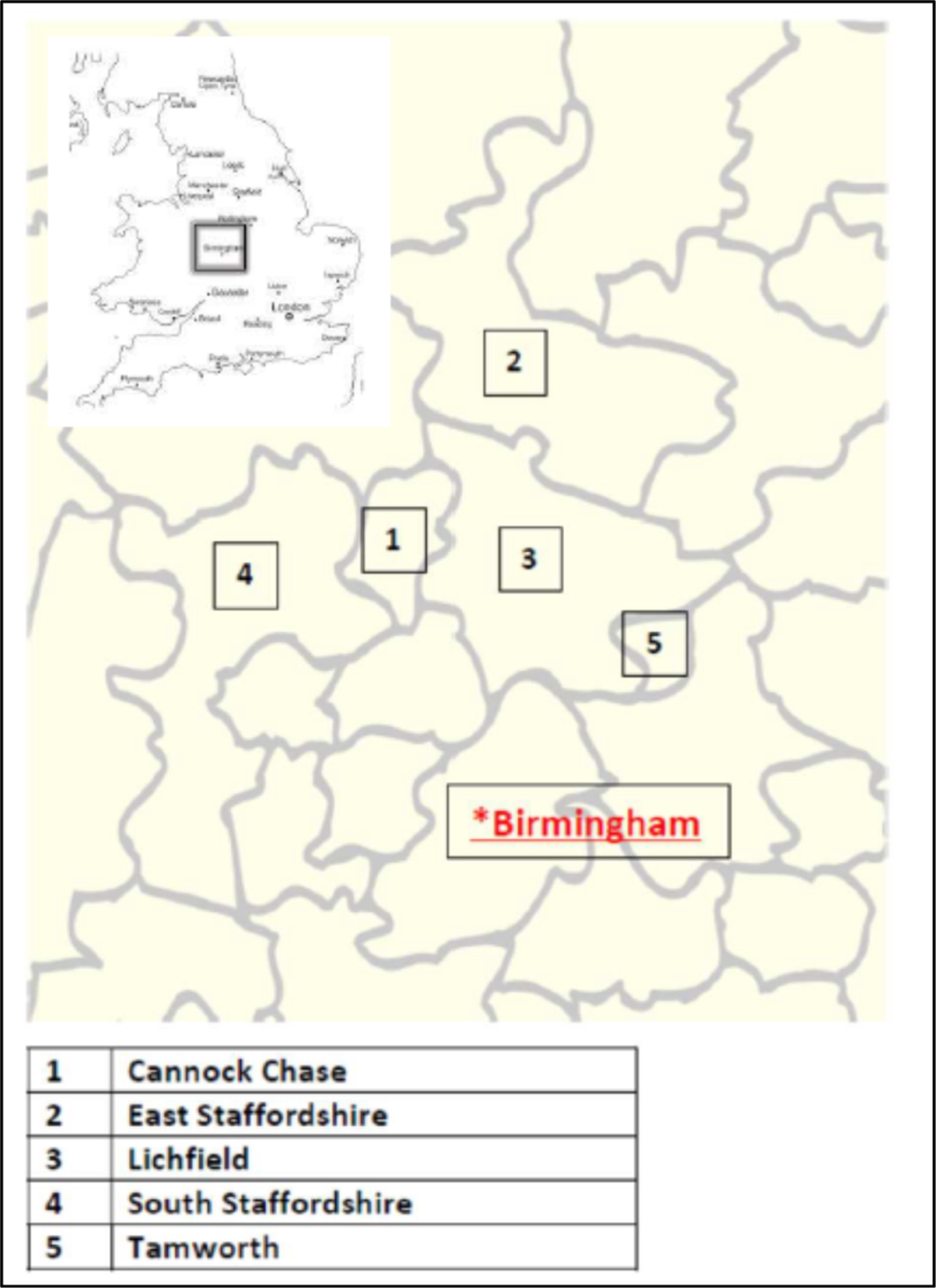
The Local Authority areas of Cannock Chase, East Staffordshire, Lichfield, South Staffordshire, and Tamworth – collectively referred to as Southern Staffordshire and historically collaborating as the Southern Staffordshire Partnership – are located north of Birmingham. Whilst structurally distinctive places – a former mining town, a brewing centre, a cathedral city, an urban spillover expansion – each displays limited structural transformation associated with uneven development, with higher dependence on more traditional employment sectors (Fothergill and Houston, 2016) and lower qualification attainment (Joseph Rowntree Foundation, 2016).
The case study area lies on the edge of the Birmingham conurbation. This case study location was selected as it requires an approach to governance that spans different territories with the sub-national state spatial governance unit being continually redefined by policymakers to meet different regional development policy agendas. This redefining includes attempts to create broader regional assemblages through both formal units, such as the West Midlands Combined Authority, and the wider cross-regional Midlands Engine partnership as vehicles to identify issues that cut across assemblages and frame these within national debates.
As a result, Southern Staffordshire represents a space undergoing a period of remaking in the wake of regional reforms implemented in 2010, shifting from RDAs based on bounded administrative units to LEPs based around functional economic geographies and the current West Midlands Combined Authority and Midlands Engine. The localities have thus undergone a process of integration into a new set of assemblages – specifically the GBS area, its city-region policy frameworks, and a set of newly-formed collaborative relations. This integration runs alongside established, historically-embedded assemblages, most specifically as part of Staffordshire County.
This case study area illustrates the ephemerality of regional assemblages within England. Prior to 2010, the Southern Staffordshire authorities developed stronger relationships, to varying degrees, with Birmingham, and this was further strengthened post-2010 both through membership of GBS and for its strong concentration of more traditional sectors considered strategically important in light of changing policy rhetoric of industrial activism (HM Government, 2009) and sectoral rebalancing (HM Government, 2010). Despite this repositioning, companies within Southern Staffordshire have had to respond to alterations in the geography of demand including its dispersal and fragmentation, whilst state-led investment to support such response is considered limited and often focused within larger urban centres. The firms within Southern Staffordshire represent an interesting lens through which to explore local firm-state dynamics and assemblages considering the erosion of specific core dependencies at the sub-national scale.
Data was collected through interviews with firms and policymakers based in Southern Staffordshire. Firms were selected from identified traditional sectors in line with the structure of the local economy – particularly manufacturing and production industries – and policymakers embedded within active local institutions and key stakeholders involved in the governance process. Interviews focused on key relationships and dependencies occurring through multiplicities of practice, legacies of forms of investment, agency identified in selection processes, and their territorialisation.
For policymakers, this process involved documenting local and regional policy objectives, arrangements, and interactions and their consistency. Managers and political leaders from 15 separate policy organisations were interviewed, consisting of key locally embedded actors in formulating, negotiating, applying, and implementing economic development policy: two LEPs, eight Local Authorities, two local colleges, and three local business representation organisations. For firms, this documented changing inputs to their production processes and within this the level of localised or regional dependency. Senior personnel (owners/directors/senior managers) were interviewed in 48 firms about their primary operational relationships and dependencies. As part of the process, and in documenting the development of assemblages, key organisations within the study area were observed longitudinally through evolving interventions applied via these governance relations and attendance at key partnership meetings.
Assemblage and decoupling in regional spaces: Place, policy and stakeholder
Reform of the regional governance landscape in the UK from 2010 has been material in creating a new set of assemblages through distinct territorialisations; the formation of a new regional geography, introduction of new policies, and broadening the set of stakeholders. This has run alongside a presumed level of liberalisation of criteria around developing these territorialisations, greater agency presented to sub-national actors in defining what constitutes a local or regional economy.
Such new geographies have been introduced through a negotiated process working on principles of functional economic geography as opposed to an a priori landscape of administrative units. Across the West Midlands new administrative units emerged that challenged the boundaries used by earlier arrangements. For Southern Staffordshire this involved moving from established sub-regional arrangements located within the county of Staffordshire to becoming part of a core city region in the form of GBS.
Accompanying this, a new policy framework was introduced in terms of the Local Growth Strategy adopting principles of spatial and sectoral rebalancing as a precursor to debates on levelling-up. This strategy was supplemented by region-specific Strategic Economic Plans and tangential policies implemented at varying levels, setting out objectives and responsibilities for partner organisations.
The network of partners has similarly increased, with requirement for LEPs to directly involve businesses through majority Board positions. As a result, the ethos of partnership working introduced through prior instruments committing public agencies to collaboration has been extended through incorporating private interests directly into the governance process.
The progression of these overlapping territorialisations forms a distinct set of new assemblages within governance arrangements; accompanying this is a set of decouplings as established relationships are impacted, territories reformed, and policies reconfigured within new geographical settings. This section explores the effect of these territorialisations on the capacities within Southern Staffordshire and GBS and their effect on dialogue between key groups of actors within the locality.
Assemblages of place: Reforming ordinary places through city-regionalism
The emergence of city-regional assemblages has been a key element of regional reforms post-2010, as material attractions reconfigured place-based relations. This was a place-based process with each area across England configuring a governance solution to support economic development that commenced following the 2010 General Election as existing governance structures based on an administrative model were replaced with principles of economic transaction, emphasising a regional model with cities as “engines of the economy” (HM Government, 2011).
One key aspect of this city-regionalism has been attempts to integrate cities with non-metropolitan areas, often breaching administrative boundaries as urban cores blend with the suburban or hinterland. This change was pivotal in developing a set of sub-national functional economic geographies prioritising transaction and dependency over administrative arrangements (HM Government, 2010) acknowledging the importance of developing an integrated approach to enhancing economic growth in cities and their hinterlands. In the case of GBS, a ‘Greater Birmingham’ city-region was established incorporating long-term associations between Birmingham, the metropolitan borough of Solihull, and lower-tier local authorities in Worcestershire and Staffordshire facilitated by an agency of self-determination underpinning the LEP formation process (HM Government, 2010).
Merging into GBS allowed the Southern Staffordshire authorities to progress long-term policy objectives of greater integration with the Birmingham economy based on a legacy of shared industrial heritage, involving traditional supply chains, and economic inflows, as part of Birmingham’s commuter belt or travel-to-work area. For the West Midlands this represented an unravelling of early territorial solutions to governance and the instigation of a long-term process of forming new assemblages involving processes of coupling and decoupling. This integration aligned with perceived preference in the Southern Staffordshire business community, where “when we took the decision to join (GBS) we had three offers on the table…and our businesses said you’ve got to go with Birmingham” (Councillor, LA), and forms of transaction where “I think we feed into a lot of the big supply chains in Birmingham” (Officer, LA); and “a lot of money that comes in…is actually coming from people earning out of the area, and in particular in… Birmingham” (Chair, Business Representation Organisation).
Travel-to-work analysis corroborated input-output labour flows between Southern Staffordshire and Birmingham (Office for National Statistics, 2016), illustrating shifting dependencies and the presence of coupling/decoupling. Translating this into supply chains is less clear given interpretations based on an industrial legacy since stripped out through reconfiguration in traditional production processes within the area. In response, local firms bypass declining legated relationships and pursue territorialisation through new at-a-distance networks of relations to reduce local dependencies. Firms noted the formation of new partnerships that represented new assemblages and the need for extensions of reach, where “In terms of factory output…none of our (customers) are in the UK. Which might sound strange, but it’s historic…none of those companies exist in the UK anymore” (L14) and “much of our work traditionally would have been with the kilns in Stoke-on-Trent, but with the decline of this industry we’re looking…at a worldwide market” (C9) alongside efforts to lodge interests in a wider network; “Our suppliers are UK based…one in Leicestershire, one in…Birmingham. We have new suppliers who we’re doing more work with, one in Finland, one in Turkey. They’re of increasing importance to us.” (ES5). This transition is echoed widely across local sectors illustrating evolution from regional integration during their formative stages toward multiplicities involving a more dispersed set of national and international customers and suppliers, redrawing notions of place as reflecting a balance between regional inputs and non-local demand (Figure 2). There is a tension here between the on-going regional decoupling of businesses as firms develop new forms of non-local coupling through extended supply chains combined with a shift towards non-local demand and the need for businesses to engage in sub-national state spatial governance arrangements. Trade dependency (customer/supplier) by location. Source: author.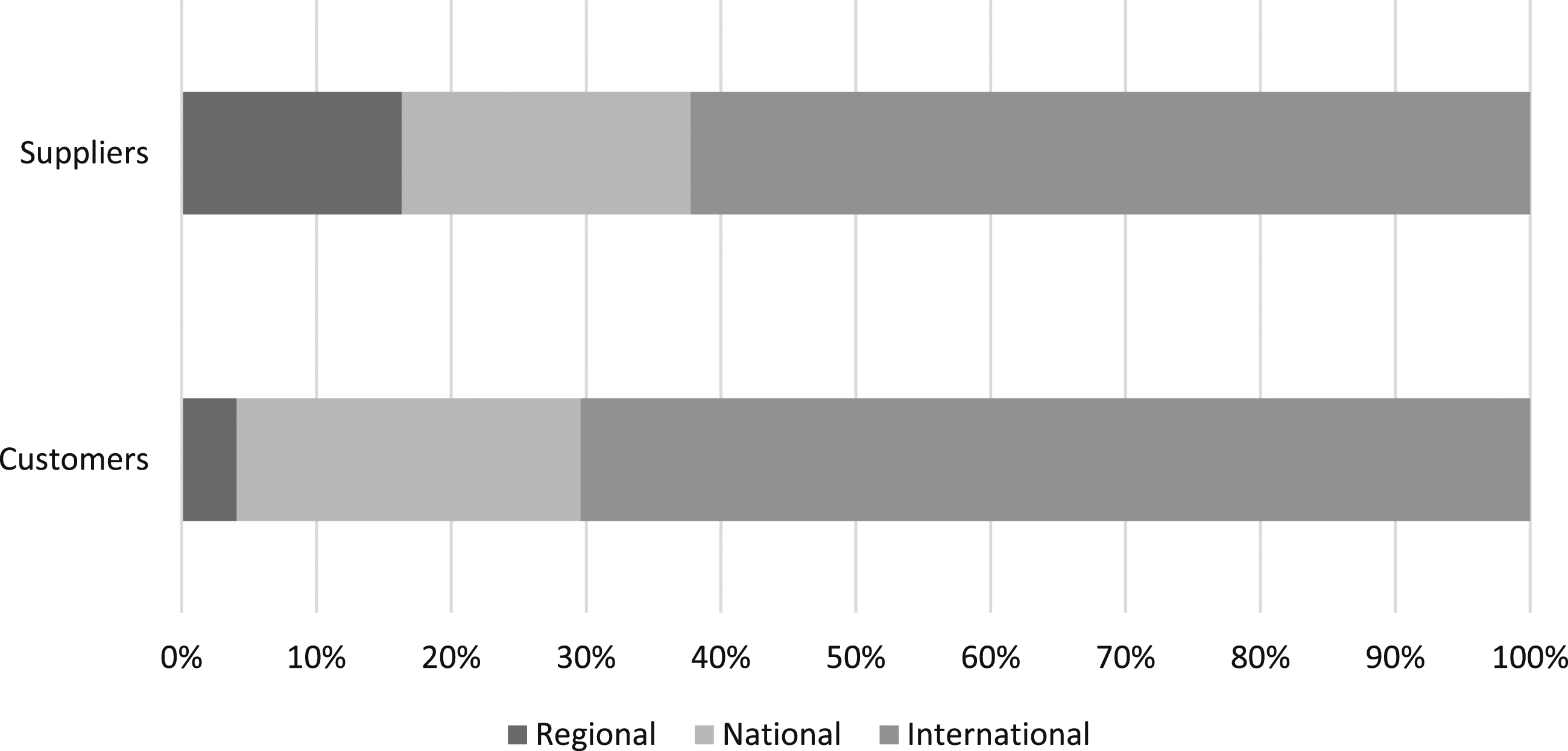
Assemblages of policy: City-region integration and firm-level interaction
For Southern Staffordshire, merging into the GBS city-region reconfigures not only territorialisation of place-based relations, but also rewires the scalar logics interpreting place and prioritising economic interests and industrial sectors. Incorporation into a city-region governance structure provided Southern Staffordshire with potential agency around regional objectives, GBS embracing elements of local policy priorities around traditional industry outlined by the Southern Staffordshire Partnership. This incorporation transformed spaces of governance in line with emerging policy (Figure 3); transitioning from a historic relationship with Staffordshire as a policy unit and the RDA as a key investment agency, joining GBS positioned Southern Staffordshire within a higher profile assemblage with scope to compensate for when the area “didn’t really feature on the… radar in terms of policy instruments” (Officer, LA). This policy assemblage was further supported by national objectives of sectoral rebalancing (HM Government, 2010). With LA representatives on the LEP Board, at the outset the existence of a Southern Staffordshire local economic strategy provided a legacy through which to shape and define LEP level objectives, “marshalling resources available within the public sector” (Officer, LA) with “potentially a huge amount of money (we) will have some access to determining how that’s spent” (Cllr, LA). This process of removing – decoupling from - and replacing an existing sub-national governance structure initially enabled Southern Staffordshire to make an informed decision regarding which newly forming sub-national state spatial assemblage to join; Southern Staffordshire had choices available including remaining with the status quo or joining some other territorial assemblage. Southern Staffordshire evolving policy units.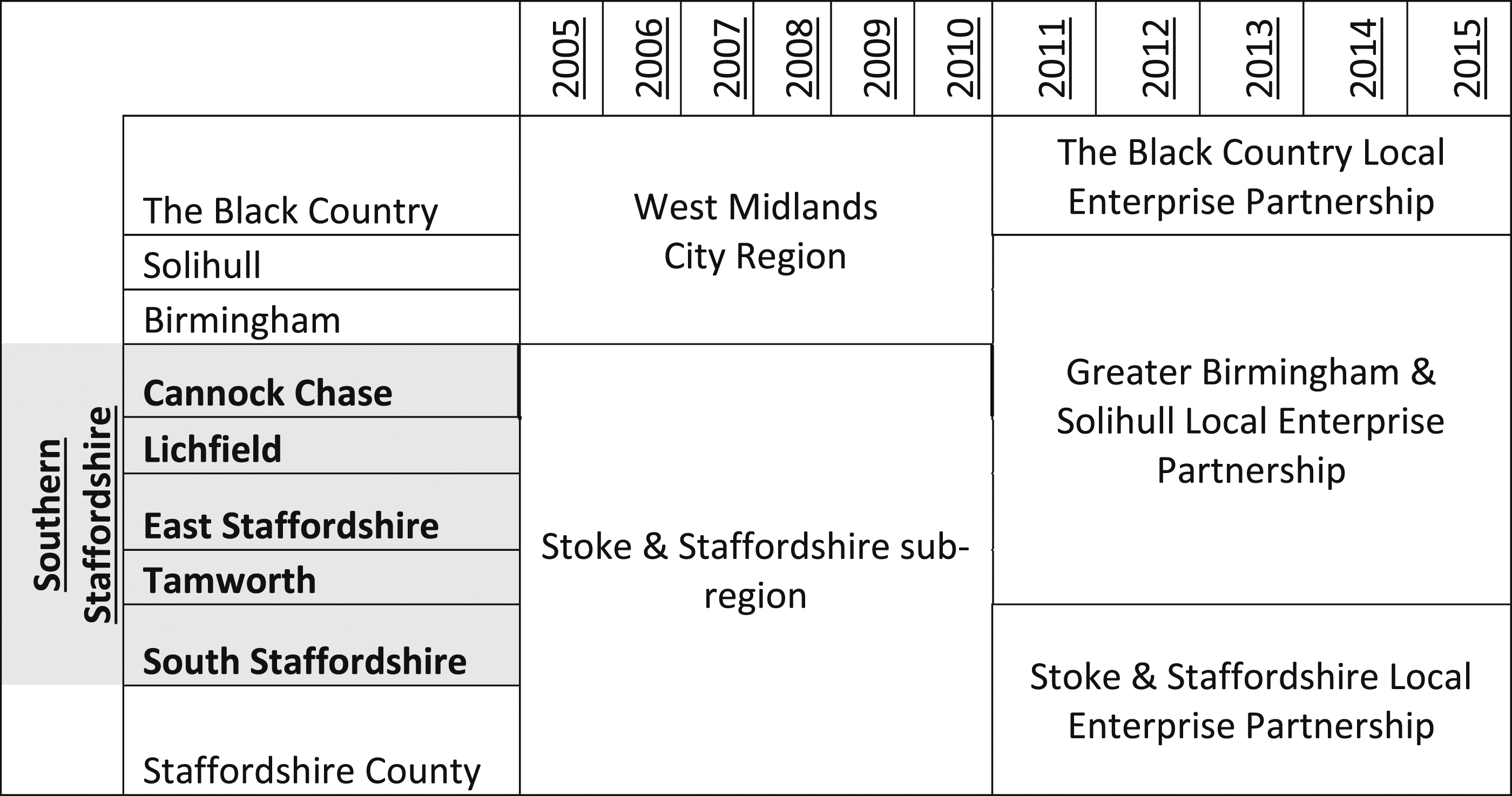
LEP policy is however centrally determined, national-level policies representing a critical aspect of the regional policy assemblage and incorporates a competitive process with spatial and sectoral implications as each LEP responds to funding opportunities set by national government (Harrison, 2012). This involves relational dynamics through which more marginal places compete for resources with places in closer proximity to the site of both decision-making and vested interest. It also involves LEPs trying to influence the formulation of national policy through participating on the edge of national policy assemblages informed by the convergence of local interests. Converging objectives from across GBS through forming a strategic economic plan was therefore regulated through three key influences.
First was involvement of the private sector in determining policy. Despite explicitly bringing private businesses to the LEPs, here a selective process facilitated greater local-level agency for “the bigger businesses” (Councillor, LA). Beyond this “within the small business community in particular there’s very little understanding” (Officer, LA). Issues on the balance of lodged interests, through prioritisation of larger organisations, and the development of reach, through smaller organisations involvement and understanding, emerged through the new assemblage.
Second was the application of a LEP classification by central government, affecting available support and funding through a three-level designation of phase 1 (core) city regions, phase 2 city regions, and the remaining non-city designations. Such framing of agency created through the multiplicity of governance status an uneven territorialisation impacting local relationships, thus “We took a decision to join the GBS LEP. GBS has got an enterprise zone…a city deal, which I know [Staffordshire] haven’t got” (Cllr, LA). Being part of GBS enabled Southern Staffordshire to have greater access to national policymakers and related funding streams. The GBS needed to ensure that all parties benefited from their involvement with the assemblage, and this required an on-going dialogue regarding the perceived and actual fair allocation of resources within the newly forming assemblage.
Finally, this classification is further reinforced through overriding policies of austerity and their effect on the allocation of regional funding, thus influencing strategic choices at the local level. Such investment supplemented funding reductions seen within LA settlements, providing Southern Staffordshire authorities with “strands that allows us to continue to deliver those services that the people of the District want” (Cllr, LA). Here, investment is shaped by arrangements where “Birmingham is our regional capital” (Officer, Business Representation Organisation) which “creates the space for lots of other things to happen that then spill out to the rural areas” (Director, LA) delivering Southern Staffordshire “the biggest payback” (Cllr, LA).
Broad objectives of local business involvement through the LEP therefore show limited capacity to directly support localised priorities within Southern Staffordshire. With the policy assemblage forming uneven influences, in turn shaped by central patronage of funding and designation, similarly uneven lodging occurs amongst local firms illustrating issues of (dis)engagement with the LEP, and thus decoupling. Running parallel is a decline in public support provisions limiting the reach of the assemblage, with “the area generally suffer(ing) from less [business support]…and that is very noticeable as there isn’t the help out there” (C5) and “we used to have a rep. that came and did some free consultation…I think that’s part of the cutbacks a couple of years ago” (L10). In place, localised priorities shift toward legacy interests more orthodoxly associated with city-region peripheries, partners “working on a branding…the centre of Anglo-Saxon Britain” (Cllr, LA) and building “the brand name of the ‘Mercian Trail’. These are tourism assets which we’re trying to grow and develop” (Officer, LA).
Such priorities are linked to core strategic investments for local state organisations – “the retail, the town centre offer is vital. Both areas obtained store developments. We want to see those happen” (Officer, LA); “home building is a priority…because of income from the New Homes Bonus” (Cllr, LA) – but illustrate little direct alignment to agreed industrial priorities around Southern Staffordshire and its enhancement as a knowledge-based economy. Thus, the territorialisation of policy through a process of regional reform revises both the interpretation of legacies and application of agency through compliance based on power dynamics – and routes to resources – enacted through the policy assemblages occurring within the LEP arrangements. This revision has material effects on the extent of roles and inclusion for local stakeholders and reflects their ability to influence GBS decision-making processes and national policy agendas.
Assemblages of stakeholders: The evolving social relations of state-firm interactions
Formation of a city-based – or city-led – assemblage establishes a new territorialisation of production on top of existing spatial patterns and of policy interactions with bounded and networked implications. In addition, a new set of stakeholder relations are mobilised, consolidating localised state-based interactions, adapting links with central government departments, and integrating a broader set of stakeholders through new methods of engaging private business. Stakeholder involvement represents a dynamic and potentially transformative form of assemblage, with new networked relations informed by external policy forces recasting or reinforcing place-based legacies and forming and reforming multiplicities. The legacy and memory of past sub-national spatial governance structures gradually decays with older structures losing importance as they experience processes of decoupling within successive assemblages that form new territorialisations.
Founded in spatially-bounded notions of local economy, the challenge of economic governance in a more networked economy has been reconciling regional spaces with city-regionalism in pursuit of network benefits. More tangible here however is the reconfiguration of dialogue and interactions within shifting regional apparatus. Previously, national/regional interactions were regulated and hidden behind a regional governance layer, the RDA. In its absence, LEP partners “really noticed… Civil Servants and Ministers want to come out and talk to us directly” (Chair, LEP) providing opportunities to establish “really strong links…between our partners and a whole set of Government departments, particularly around CLG, BIS…the Treasury” (C.Ex, LA). LA personnel through their key role in managing, coordinating, and delivering LEP objectives experienced greater reach to central government departments and ministers, suggesting that Southern Staffordshire met one of the objectives of joining a different territorial governance arrangement.
Alongside closer central government dialogue, local government’s role as direct local interface between governance arrangements and constituent firms was augmented as alternative intelligence capacities provided by the RDAs were dissolved. This dissolution reintroduced a legacy role built on LA’s presumed “fine grain understanding of their local economies” (Director, LA).
The extent of this understanding, however, illustrates limited lodging. The legitimacy of local knowledge is thus implicated; as one participant observed, “I went to the Abu Dhabi Chamber. They know everybody who’s in business there…when you think the (Birmingham) Chamber has only got a representation of… 7% of businesses, we can’t even tell what is great [here]” (Director, LA). Such reach is further restricted by greater resource limitations faced by the Southern Staffordshire authorities compared to their LEP counterparts; “working with new council areas has been a big change, starting to work alongside colleagues in Birmingham and Solihull. They have vast ranges of knowledge and experience of areas of work which we’ve never traditionally got involved with” (Officer, LA). This reflects uneven capacities and capabilities that may distort negotiations between actors in an assemblage, therefore underwriting processes of coupling and decoupling.
Stakeholder multiplicities are thus constrained for state agencies, but are further compounded in the hollowing out – and therefore dispersal – of local production dependencies. The limited multiplicities with state organisations are not replicated in firm interests as a more fragmented and esoteric picture emerges of critical points and interactions for not just trade but knowledge on the evolution of industry practice.
Fundamental here has been adaptation of interaction processes compensating for the broadening of firm-led spatial relations driven by decoupling from local companies and coupling with non-local companies. Interactions with immediate customers and suppliers have become increasingly networked, firm agency developing processes where “a lot of our customers work in conjunction with us on design” (C5) and “we are involved in the design process of our suppliers’ products” (C4). Also adopted here are collective groups and sessions where “we have customer forums where we…talk about what (customers) see as the emergent trends” (S1) or “we hold ‘ideation’ sessions…with groups of…customers” (L14). These extending relations form a broader multiplicity of place, serving to both lodge firms within different networks of interest and enhance their reach through such networks.
Transformation in firm’s core markets here required some diversification and blending of traditional efforts to maintain knowledge networks. Geographic dispersal of production networks runs parallel to the vertical dis-integration of production itself, manifesting as a more complex multiplicity across actors and locations. In response, firms engage at the front-end of the production process, identifying opportunities by “being in at the qualification stage…the key thing” (T10) and supplementing this through alternative clustering processes; here trade shows and conferences form iterative networks through which firms “read up-to-date material, keep in contact with the customer base, and have a regular dialogue” (E4). In addition, long-term recruitment and investment strategies buy in expertise and link into a broader network of subject specialists where “Many of our engineers are writing papers…we are at the leading edge” (L5) or applied specialism “…through mergers and acquisitions. It was very much about which markets do we need to enter, what product sets do we need and who can we buy to go and get these” (S1).
An ongoing reduction thus ensues in terms of lodged local dependencies. As production and network fragmentation occur, direct support and dialogue via local state agencies is reduced to principally operational statutory issues. In terms of firm strategy and adaptation, the relevance of such support is limited beyond those services which extend reach, such as export documentation, providing pathways into a more dispersed geography of production. Interaction amongst the stakeholders in this assemblage are thus decoupled, firm’s pursuing optimal network relations merging with multiplicities in spatial production as the relevance of legated local state-firm dependencies is further eroded.
Decoupling territorialisations and regional assemblage
The dynamics of regional governance arrangements in the UK have caused an ongoing set of restructurings and disruptions. Whilst applied in pursuit of more effective forms of governance, the outcome of such disruptions can be conceived as amongst the factors contributing toward enduring manifestations of uneven development. The processes underwriting these disruptions can be understood interpreting regions as an assemblage through which an ongoing and shifting set of interactions decouple the multiplicities and legacies of place, policy and stakeholders via the agency, and thus fragmented relations, of state and firms within localities. The application of new spatial articulations, revision of key priorities, and involvement of a broader set of actors serve to reform regions via an emergent set of governance assemblages, whilst similarly serving to decouple localities from key agents of the assemblage. This process of decoupling underpins ongoing challenges within places less actively lodged within the reconfigured assemblage (Allen and Cochrane, 2007).
A core principle behind the application of regionally-situated modes of governance has been addressing enduring problems of uneven development between and within the English regions (Martin, 2010; McCann, 2016; Martin et al., 2021). LEPs and their deliberate appropriation of the term ‘local’ is seen as integral to this process. Business-led boards, freedom of self-determination, context-based policy responses each presume to address issues of agency and multiplicity through remaking urban topologies (Farías, 2011), accommodating core principles of relations and difference (Kamalipour and Peimani, 2015). These foundations run parallel to a set of legated, uneven power relations, underpinned by capacity and capability differentials, emerging through processes of meta-governance (Allmendinger and Haughton, 2009; Jessop, 2007) and the ensuing agency this forms amongst and between localities within the governance assemblage (Harrison, 2010, 2012).
Greater engagement and involvement between state actors and private business can be identified in the configuration of place-, policy, and stakeholder-based assemblages occurring through the GBS LEP. Here, private sector leadership and representation via the LEP Board is lodged within local policy organisations, participating businesses providing both legitimacy and credibility to policy direction and government relations. Nevertheless, this valorisation overwrites or ignores the interests of certain organisations to whom the reach of the assemblage does not extend, specifically the noted experiences amongst the local small business community.
How these arrangements integrate the specific structural characteristics of place within Southern Staffordshire as a more peripheral part of the GBS city-region is less clear. Nonetheless, based on our analysis three aspects seem important. First, whilst local policy stakeholders are involved via direct Board representation, local industrial interests are presumed lodged via proxy, be this the presence of local state agents or larger, better connected business representatives. The latter may be locally based organisations but incorporate narrow industrial experiences with a broader multiplicity of extra-regional transactional relationships. Thus, firm-based legacies shaping the assemblage (McFarlane, 2011) are situated within narrow organisational interests, privileging extra-regional connections over a reach to intra-regional or local actors. The implication being that businesses engaged with a policy assemblage are often not representative.
Second, austerity policies have required difficult strategic choices for LEPs and local government including targeting specific forms of capital investment in place of more strategic industrial interventions. Here, austerity is continually reworked and reinterpreted in response to current events, recent examples being specific budgetary requirements for local authority intervention to mitigate the impact of COVID-19 in 2020 and the cost-of-living crisis in 2022. The trade-off here may be enhanced acquisition of investment, but with reduced flexibility to address strategic needs. This reframing of local priorities illustrates the uneven power relations embedded in governance assemblages and material, as much as human, agency (McFarlane, 2011; McGuirk et al., 2016).
Finally, spatial and financial meta-governance shapes LEP policy formulation, prioritization, and objectives whilst narrowing the extent of principles of difference (Kamalipour and Peimani, 2015). The emerging stakeholder territorialisations, whilst accommodating their own distinctive multiplicities (McGuirk et al., 2016), are reflective of a broader hierarchical structuring (Allmendinger and Haughton, 2009; Jessop, 2007) that benefits some components whilst decoupling others.
Through such shifting dynamics, the similarly dynamic capacities underwriting assemblage serve to reshape processes of territorialisaton with implications for the interaction of components or actors as decoupling processes occur (Figure 4). These processes of territorialisation are here part of an ongoing state of becoming (Dovey, 2010; MGuirk et al., 2016); simultaneously they serve to decouple established and existing assemblages as new forms emerge to shape understandings and interpretation of place through evolving and framed capacities. Whilst these capacities mobilise territorialisations of place, this mobilisation is refined and restricted by territorialisations of policy and stakeholder; reworking localised objectives within a new assemblage, refining critical relations and dialogues within a new hierarchy, and reimagining the local within a new structural context (Allen and Cochrane, 2007). Territorialisations and capacities: A decoupling process.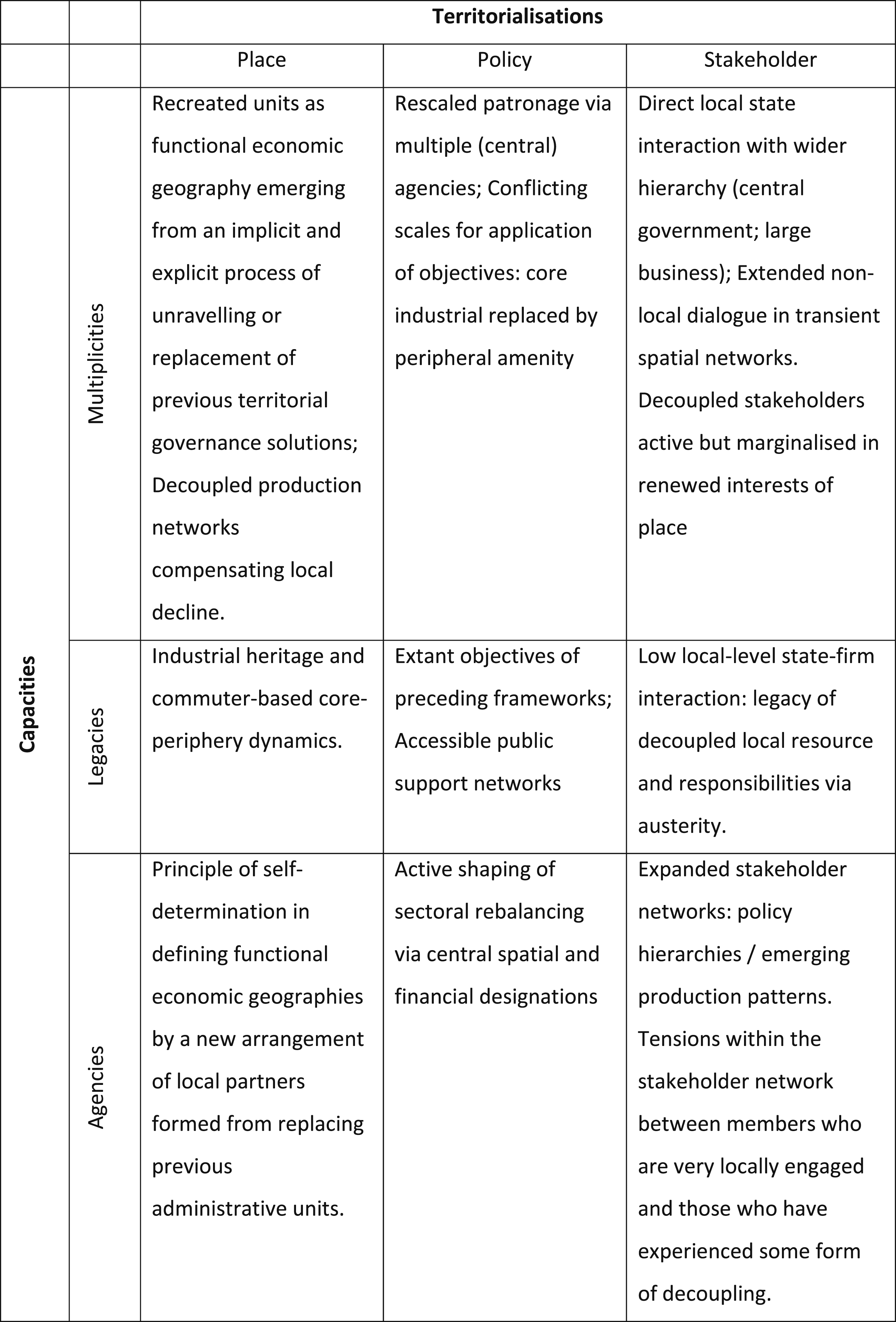
This decoupling process is of particular relevance in the enduring uneven development observed across and between the English regions with prominent issues of deindustrialisation, place-based productivity differentials, and slow economic adaptation. It also represents the replacement of an existing approach based on RDAs with a much more localised and fragmented governance structure. This structure based on LEPs required local policymakers to combine with business interests to represent a defined area’s interests in national policy debates and funding allocation rounds. It was important for each LEP area to be defined rapidly through an assemblage that would provide both local and national legitimacy. This process included recruiting participants to join a new assemblage who come with established political capital based on their involvement with existing regional or national administrative units (Brenner, 2004; Jones et al., 2004). It also includes writing off sunk costs as this new assemblage is founded upon processes of decoupling the assemblage that it replaces.
From a policy perspective, the aim of these new regional assemblages has been to lodge local governance more effectively with the structural requirements of constituent economic actors. This lodging is framed within clear bounded preferences of administrative practise. For policymakers, evolving governance assemblages seek to explicitly link networked production with bounded space, yet their capacity to mitigate uneven development and questions of peripherality remain limited. The fragmentation of place-based territorialisation through more restrictive capacities shaping policy and stakeholder assemblages sees a continued decoupling emerge in three distinct forms.
First, new governance arrangements have been progressed on a basis of building more resilient networks capable of integrating policymakers and constituent firms through relations simultaneously structured and dynamic (Cochrane, 2018; Harrison, 2013). Pivotal here is sensitivity to a set of shifting multiplicities as relations and objectives adapt, evolving legacies as places and constituents are accommodated, and agency as the distinctive nature of local needs are prioritised. In practice, these new regional arrangements seek to lodge localised dialogue within a wider, yet strategically selective territorialisation of policy and stakeholders (Allen and Cochrane, 2010). Enhanced relations with new regional associates, national policymakers, and larger local firms, sees local policymakers become embedded in practices embracing multiplicities but shaped by the uneven power dynamics of policy assemblage within an evolving territorialisation process (Savage, 2020).
Rather than forming locally distinctive responses, these networks catalyse the acquisition of essential external investment. Local level priorities thus become detached or reconfigured and policymakers become further decoupled from their localities in pursuing such investment. This occurs via negotiations and trade-offs within assemblages, bringing local assets and know-how into attraction with external forces to recast policy priorities and the allocation of investment. Resultant of embedded uneven power relations within these assemblages (McFarlane, 2011; McGuirk et al., 2016), specifically the city-periphery hierarchy, local interventions are framed as the structure of the city-region aggregates that of the local economy (Harrison, 2012; Salder, 2020). This is seen as Southern Staffordshire’s priorities shift from industrial heritage to leisure amenity, sponsor investment initiated through the GBS city-region considered suitable compensation for revising local priorities.
Second, reformed governance arrangements accelerate ongoing processes of decoupling in local-level industries, as production practices become increasingly networked (Dicken, 2007). Alongside the dispersal of production has been reduced support for priority sectors, with implications for localised dependence. Declining local industries are routinely bypassed as stakeholders try to fashion more novel and iterative production and knowledge networks to compensate for changing market demand, resulting in an extending set of complex overlain multiplicities (Hamdouch et al., 2017; MacKinnon et al., 2004; Salder, 2021); the extended reach of such actors becomes focused beyond the regional assemblage, resultant of a shortage rather than provision of active support mechanisms.
Finally, the decoupling of policymakers and firms/industry leads to a general decoupling of a place-based economy. For policymakers this might be driven by their engagement with a sub-national structure that requires them to trade-off the interests of a defined geography they represent with the interests of other partners in the assemblage considered more strategically important. Legacies of ongoing iterations of regional organisation (Brenner, 2004) and influence of centralised meta-governance (Allmendinger and Haughton, 2009; Jessop, 2007) encourage new forms of assemblage repatterning the operational and strategic practice of organisations (Salder and Bryson, 2019; Hamdouch et al., 2017). Such decoupling leads to the formation and embedding of key dependencies amongst state and firm actors in highly differentiated geographical spaces; lodged in hierarchical forms for local authorities through effective alignment with centralised sponsorship and more diffused for firms within dispersed production networks (Allen and Cochrane, 2007, 2010). The relevance of the local here undergoes perpetual reform, practices of decoupling created by the formation of new assemblages resulting in territorialisation locally situated but spatially dispersed and distanciated.
Conclusion
Regional governance, and its ongoing reform, has become a core response in addressing challenges of uneven development. Whilst modes of governance have sought to accommodate evolving topologies of economic production to address these challenges, significant questions remain around the efficacy of such an approach. This paper argues that, far from mitigating the challenges of uneven development, these regional reforms have through a process of decoupling reinforced the fragmentation and separation not only of constituent places, but also the core actors of firm and state within such places. This on-going process has important implications for the implementation of the levelling-up agenda as this new agenda has been overlain on existing sub-national spatial governance assemblages.
Conceptualising regional governance as an assemblage, this paper argues that these assemblages are in an ongoing process of becoming (Dovey, 2010; MGuirk et al., 2016) through fluctuating forces of attraction between large and small assemblages of place, policy, and stakeholder. These overlaying assemblages not only reconfigure established relationships and reinterpret embedded legacies, but actively recreate places through negotiation processes involving membership, the changing objectives of an assemblage, and the ability of any one assemblage to engage with national governance units. A regional governance assemblage simultaneously involves myriad processes of decoupling and recoupling. This is a geographical process reflecting the relationship between an assemblage’s territory and members and shaped by those member’s involvement with other territories.
This paper makes three key contributions. First, through mobilising assemblage thinking in analysing regionalism, it extends scholarly debate in the exploration of spatial relations as applied to regional economic growth. Specific here is the application of assemblages as territorial-material and networked-evolutionary, around which new territorialisation of place, policy and stakeholders emerge through a dynamic process of evolving relations and interactions involving processes of decoupling from one place and recoupling reflecting a different form of relationship with that place. This becoming arises from overlain governance assemblages being simultaneously formed and destabilised, a dynamic process of continual assemblage formation which is also one whereby an existing approach may limit innovation. For England, the current approach to regional economic development is fragmented reflecting differences between places based on capacities that are then reflected in the differential articulation of power between regions and national government. Ultimately, there are important implications for the levelling-up agenda as this will be implemented by a set of assemblages that reflect rather than challenge existing place-based inequalities.
Second, the analysis raises significant questions about forms of space-first governance and its capacity to respond to specific structural challenges. Regionalism here represents a fluid and constantly morphing arrangement to resolving issues of uneven development across the English regions, with expectation both to reconcile the challenges of a networked economy with bounded models of administration and to lodge local business interests more effectively into governance discussions. Its application and implementation identify a set of limitations, the uneven power dynamics of components within the assemblage establishing forms of place-based, policy, and stakeholder privileging (Allmendinger and Haughton, 2009; Jessop, 2007; Harrison, 2012).
Finally, the analysis illustrates a key challenge prominent within local economies generally, and those affected by uneven development specifically. Ongoing transformation in forms of economic governance in such places has seen growing levels of diffusion of spatial economy and place-based production; place therefore evolves to ‘lodge’ itself into more variegated assemblages through evolving modes of territorialisation (Allen and Cochrane, 2010). These variegated dependencies serve to situate firms in an ongoing process of decoupling from their immediate locality supported by the configuration of new relationships with firms located in other regions. This reach, whilst a core component of assemblage thinking, occurs separate to rather than resultant of the governance assemblage, further separating localised state interests from those of indigenous firms. The result is an extension of dependence on non-local assemblages, decoupling not only local firms from place, but more broadly notions of local economy.
This paper has identified that complex trade-offs sit behind the decision made by local policymakers to engage with non-local governance assemblages to access potential additional political, policy and investment benefits. Nevertheless, these additional benefits emerge from prioritizing certain needs, with both spatial and sectoral implications. This process shifts the policy prioritization process from an intra-to an inter-place process. The danger here is that the local interests of some stakeholders are rendered invisible in this policy formulation and investment process. The problem is that a regional assemblage provides political and policy benefits, but simultaneously creates other local problems by mobilising forms of reach beyond the local, simultaneously extending boundaries and limiting relevance of the local economy. Within a larger regional assemblage some of these local problems will be ignored. The problem is that an effective form of governance and support for peripheral places is a problem the local state, its sponsors, and ensuing policies have yet to fully understand.
Footnotes
Declaration of conflicting interests
The author(s) declared no potential conflicts of interest with respect to the research, authorship, and/or publication of this article.
Funding
The author(s) disclosed receipt of the following financial support for the research, authorship, and/or publication of this article: This work was supported by the Economic and Social Research Council (grant number 1650742).
