




Abstract
At a time of increasing prominence of the workings and judgements of international courts, recent interdisciplinary work has illuminated the deeply uneven ways in which violence is labelled, understood, and acted upon. Attempting to place work in genocide studies in conversation with current geographical scholarship, this paper argues that there are intrinsic spatial qualities to deliberations over whether an act of violence constitutes genocide. Understanding these invocations of space helps explain how accountability for violence is spatially contained, often severing judgement from wider historical or geopolitical contexts. This argument is made through analysis of the build up to, and enactment of, the legal deliberations at the International Court of Justice brought by The Gambia against Myanmar in relation to the expulsion of the Rohingya from Rakhine State, Myanmar. Such investigative work reveals the intrinsically geographical nature of both designations of genocidal acts and the intimate processes of legal deliberation itself.
Introduction
Scholars have long understood the spatial characteristics of genocide. Acts that seek to “destroy, in whole or in part, a national, ethnical, racial or religious group” (United Nations, 1948) involve a geographical imagination of erasure, where military or paramilitary forces present human populations as a problem addressed through lethal violence (Tyner, 2012). When part of military campaigns, euphemisms such as ‘ethnic cleansing’ (Heiskanen, 2021; Toal and Dahlman, 2011) and ‘clearance operations’ (Kipgen, 2020) underscore the normative ideal of the erasure of certain bodies to ensure the security of dominant groups. Violence, in such circumstance, takes many interlinked forms: the creation of racial or ethnic hierarchies, the dehumanising of specific groups, the normalisation of derogatory terminology, the removal of rights, and the enactment of lethal force.
But there is a second set of spatial practices related to genocide, these are the geopolitical and geolegal processes through which an act of violence is designated as ‘genocide’. Unlike a general description of violence (such as mass killing) which could be empirically verified, genocide is a situated term that points to a particular calculus of destroying individuals based on their group membership and recognised as such within international legal institutions. To understand the designation of genocide we must be alert to the multi-scale geopolitical circumstances, involving the history of genocide law, identity of the persecuted group, the role of intergovernmental agencies, the constitution of international legal institutions, the political histories of injured states and the situated knowledge of individuals within the process. But in addition to such conditions, we must then trace how these spatial relations are expressed, embodied, and materialised in court spaces, in so doing tracing the intimate geopolitics of genocide law. Challenging accounts of legal closure, where court processes are imaged to be separate from wider social or geopolitical settings (see debates in Blomley, 2022; Jeffrey, 2020), I argue that the spatial characteristics of court processes, their design, personnel, arrangement and atmospheres are neither incidental nor inconsequential. But this is more than simply an appreciation of context: it is a recognition of the connections between the geopolitical narratives that surround genocidal violence and the embodied and material processes through which legal deliberations unfold.
At the heart of this approach is a recognition that designations of genocide do not exist in a coherent and pre-existing form, ready for the scholar to uncover. Rather they are forged through extended and contested deliberations that take place across several political and legal settings. It orientates our attention to an interface between political agencies and the legal advice they receive and the subsequent production of an imagination of the spatiality of law (Jones, 2020). There is much work that could be done to trace the competing accounts of genocidal violence that are produced within such plural (domestic, customary, and international) legal settings, but this is not the focus here. Instead, this paper examines a single legal case which, at time of writing, is still in the process of deliberation. It focuses on the application made to the International Court of Justice (ICJ) by The Gambia against Myanmar for breaching the 1948 UN Convention on the Prevention and Punishment of the Crime of Genocide (hereafter referred to as the Genocide Convention) in its treatment of Rohingya groups in Rakhine State, Myanmar. This has, to date, led to two sets of public hearings at the ICJ in the Hague: the provisional measures procedure in December 2019 and preliminary objections by Myanmar in February 2022. To study this process this paper is based on three sets of data: verbatim reports and video recordings of the public hearings; 11 interviews between September 2021 and March 2022 with members of the legal teams of Myanmar and The Gambia, officials at the International Criminal Court involved with the Rohingya investigation and representatives of relevant civil society organisations; and analysis of legal submissions and other institutional documentation. All the textual material produced (verbatim reports, interview transcripts and legal documentation) was subjected to inductive coding using Atlas.ti software.
This empirical approach situates the paper within recent work that has argued for a practice-based approach to legal geography, emphasising the lived experience of law, its materiality and its ethnographic traces (see Brickell et al., 2021). Specifically, the weaving together of analysis of the international circumstances that frame accusations of genocide, together with the micro-geographies of court spaces, points to a desire to highlight the intimate geopolitics of genocide law (Brickell, 2014; Pain and Staeheli, 2014). Such an approach is indebted to feminist perspectives that have orientated attention to the political and embodied struggles within the everyday life of legal processes (Cuomo and Brickell, 2019; Jacobsen, 2021), coupled with anthropological and sociological accounts that have sought to challenge a textual and doctrinal approach to understanding the making of law (Braverman, 2014; Gill et al., 2020). In particular, the paper seeks to integrate an analysis of the geopolitical circumstances of genocide cases through the lens of the deliberations in court space, in all their theatricality, materiality, and bodily intimacy. While this could be understood as a focus on the contingency of international law (Orzeck and Hae, 2020), the purpose here is to draw a connection between the wider geopolitical framing of genocide law with the performances of legal expertise. A study of the geopolitical context entwined with analysis of courtroom performances helps understand the circumstances through which acts of violence become known as genocide while also identifying the possibilities and barriers for injured parties seeking legal redress.
While drawing attention to the making of genocide law at the ICJ it is important to emphasise the limits of the paper: the situation regarding the violence enacted against the Rohingya is far from a resolution, the legal case is ongoing at the ICJ and will also proceed at a future point at the International Criminal Court (ICC) (Fahim, 2022). It is also important to emphasise that Myanmar must not be presented as a unitary actor within this argument, its representation at the ICJ has changed in the wake of the 2021 military coup, a set of events that has sparked further armed resistance and support for the unrecognised National Unity Government elected in November 2020 (Kean, 2022).
The paper is divided into a further five sections: the first examines the geography of genocide and genocidal violence, this is followed by an analysis of the contestation concerning reporting and evidential traces between external observers and the Myanmar government. The following three sections examine the spatial deliberations which frame the possibility of the violence against the Rohingya being legally recognised as genocide. The first is the extent to which The Gambia has the right to bring the case to the Court, the second relates to the nature of the violence itself and whether the treatment of the Rohingya can be understood as genocide, and the third examines how the legal deliberations sought to question the existence of the Rohingya as a group, discussions that focus less on the legal deliberations as much as the silences and presences found within the court space. The conclusion evaluates how a geographical approach to understanding the production of genocide can advance struggles for international justice.
Geography, genocide and the International Court of Justice
Writing a history or geography of genocide provokes two different scholarly approaches. A first is to trace the incarnations of mass violence across the history of modernity that could, largely retrospectively, be understood as genocide. For example, work in this vein has studied the ways in which European colonial violence or the treatment of indigenous communities could be conceived as practices of genocide (Moses and Stone, 2013). The second approach is to study the creation of the legal concept of genocide and how this became juridically connected to certain types of violence (O’Lear and Egbert, 2009). This comparative approach necessarily focuses on a more discrete set of examples, starting with the Holocaust during World War II, leading on to events in Cambodia in 1970s, Rwanda and Srebrenica in 1990s, and Darfur in 2000s (though this list is inevitably contested). But in doing so, probing the emergence of the legal concept allows reflection on the partial and situated nature of purportedly international processes, and, in particular, it centres attention on the specific political geography of genocide set within, first, Europe, second, the United Nations and, finally, resolutely embedded in the inter-state system. One of the key criticisms of this perspective is that it can mask the very partial and situated nature of accounts of genocide, leading to a normative position that absolves the violence committed by Western state actors or imagines an expanding international humanitarian law flourishing over the course of the late 20th century (Meiches, 2019; Moses, 2021; Shaw, 2013).
Avoiding these assumptions is important, but they do not negate the need to explore the origins of genocide in international law, not least as these frame the later debates within the case of Gambia vs Myanmar at the ICJ. The term genocide was coined by legal scholar Raphael Lemkin who born in 1900 in Bezwodne in present day Belarus, studied law in Lviv in western Ukraine and served most of his career in universities in the United States of America, first Duke University, then Yale and finally Rutgers School of Law (Sands, 2017). Lemkin’s work, in particular his 1944 book Axis Rule in Occupied Europe, was interested in the use of law as a precursor to physical violence, in particular the targeting of Jews through the Nuremberg Laws and the Holocaust, and the collective nature of such efforts (Heideman, 2017).
There are two aspects of Lemkin’s work that have shaped debates concerning genocide in the intervening years, though the coherence of these are subject to ongoing scholarly debate (see, e.g., Curthoys and Docker, 2008). The first is his focus on the targeting of groups that takes place prior to physical violence, the modes of law, oppression, extradition and so on that can be directly responsible for the destruction of a group but does not necessarily involve mass killing. Though difficult to potentially prove in a court of law, this ‘slow violence’ is central to Lemkin’s grounding of the term in the legal persecution of Jews prior to and during World War II (Hinton, 2012; Nixon, 2011). The second distinctive feature is Lemkin’s focus on the cultural existence of a people as a contribution to a common humanity: “[t]he objectives of [genocide] would be disintegration of the political and social institutions, of culture, language, national feelings, religion, and the economic existence of national groups” (Lemkin, 1944: 79). By foregrounding – at least at this stage of his writing – cultural destruction Lemkin is connecting genocide back to a cosmopolitan concern with common humanity through the lens of lost cultural heritage. “[N]ations are essential elements of the world community,” Lemkin (1944: 91) writes, “[t]he world represents only so much culture and intellectual vigor as are created by its component national groups.”
In the wake of World War II genocide became the focal point of international deliberations concerning the prevention of mass violence. Lemkin strove over the course of the 1940s to bring the Genocide Convention to fruition, with the document finally proposed for ratification on 9th December 1948 and entering into force on 12th January 1951 (Hinton, 2012). The Convention defines genocide as “any of the following acts committed with intent to destroy, in whole or in part, a national, ethnical, racial or religious group” (United Nations, 1948). This definition has a number of significant – and for many contentious – traits. The first is the focus on intent: by identifying intent to destroy a group the convention establishes a “double mental element” to the crime of genocide, or what is termed dolus specialis (special intent) (Ambos, 2009). There is the general intent of targeting individuals on the basis of group membership, but this this coupled with a secondary intent that this act is part of a wider aim of group destruction (in whole or in part) (Schabas, 2012). The second trait on which the convention relies is the existence of coherent national, ethnical, racial or religious groups (Moses, 2021), a simplified imagination of the social world which seems to deny the possibility of hybrid and mutable identities. This places restrictions on the kinds of acts that may be challenged under the convention, orientating attention to violence that seeks to target groups on the basis of their identity, as opposed to state violence that leads to civilian death in other circumstances. It is for this reason that Moses (2021: 1) argues that genocide “functions ideologically to detract attention from systematic violence against civilians perpetrated by governments, including Western ones.”
One of the most significant aspects of the Genocide Convention for the purposes of this argument is Article 9, which states “disputes between the Contracting Parties […], shall be submitted to the International Court of Justice at the request of any of the parties to the dispute” (United Nations, 1948). This places the ICJ as the primary site for resolving disputes brought by state parties under the Genocide Convention. The ICJ had been established 3 years earlier, in 1945, as successor to the Permanent Court of International Justice to serve as “the principal judicial organ of the United Nations […] [where] all members of the United Nations are ipso facto parties to the Statute of the International Court of Justice” (UN Charter, Article 92/93). One of the defining features of the court is that, unlike other international legal institutions, only states may serve as parties in disputes before the court (ICJ Statute, Article 34), removing the opportunity for individuals, civil society organisations or corporate bodies from bringing claims (Onuma, 2017).
The Gambia vs. Myanmar marks the first time a purportedly non-injured state — in this instance a state that did not assert an injury or interest beyond being a party to the Genocide Convention — had been brought to the ICJ (Becker, 2020). The circumstances that led to this case are complex and grounded in both the events in Myanmar itself and the wider geopolitics of international human rights law. The persecution of Rohingya groups – and wider violence within Rakhine State – has multiple roots, but historians have identified the incorporation of Arakan, the ancient kingdom whose territory loosely correlates with Rakhine State, into British colonial India in 1926 as a key moment in inter-communal tension (Bhaumik, 2021). Extractive colonial enterprises brought migrants into Rakhine state, particularly from Bengal, who provided a range of jobs, from labourers through to civil servants and money lenders, the latter began to play an authoritative role in the provision of finance to locals (Wade, 2019). These migrations have been used since independence in 1948 by the Myanmar state to argue that the Rohingya are a non-indigenous population and consequently reject the concept of a distinct identity and instead label as ‘Bengali’ or, in more offensive terms, kala (Habiburahman, 2019). But evidence suggests that a Rohingya identity precedes these colonial encounters: the writings of physician and polymath Francis Buchanan, who travelled extensively in India and South Asia in late eighteenth and early nineteenth centuries, points to the existence of a defined Rohingya community in Arakan prior to the arrival of the British East India Company (Lee, 2021). One of the challenges, outlined in the analysis of Ronan Lee, is that the British colonial record-keeping, made in English rather Burmese, Rakhine or Rooinga, failed to use the prominent indigenous label of ‘Rooinga’, translating instead into “Arakanese Muslim, Musalman or Mohammadan” (Lee, 2021: 38). This assertion of non-indigenous status has cast a long historic shadow, notably enshrined within Myanmar’s 1982 Citizenship Law which failed to grant citizenship to Rohingya Groups, citing their imagined non-indigenous status, while also preventing a possible pathway for future generations through processes of naturalisation. This denial of citizenship rights is the backdrop to episodes of violence between the Tatmadaw (Myanmar military), Burmese communities, and the Rohingya, including by the Arakan Rohingya Salvation Army (ARSA) an armed insurgency movement formed in 2012 (International Crisis Group, 2017). ARSA attacks on Myanmar government guard posts in 2016 and 2017 were the precursor to a dramatic increase in violence in Rakhine State by the Tatmadaw and other armed groups within Rakhine State, leading to over 700 000 Rohingya refugees fleeing their homes and crossed the border into Bangladesh, where they are now living in sprawling refugee camps in Cox’s Bazar (see Figure 1). Map of Myanmar and surrounding region (Source: author).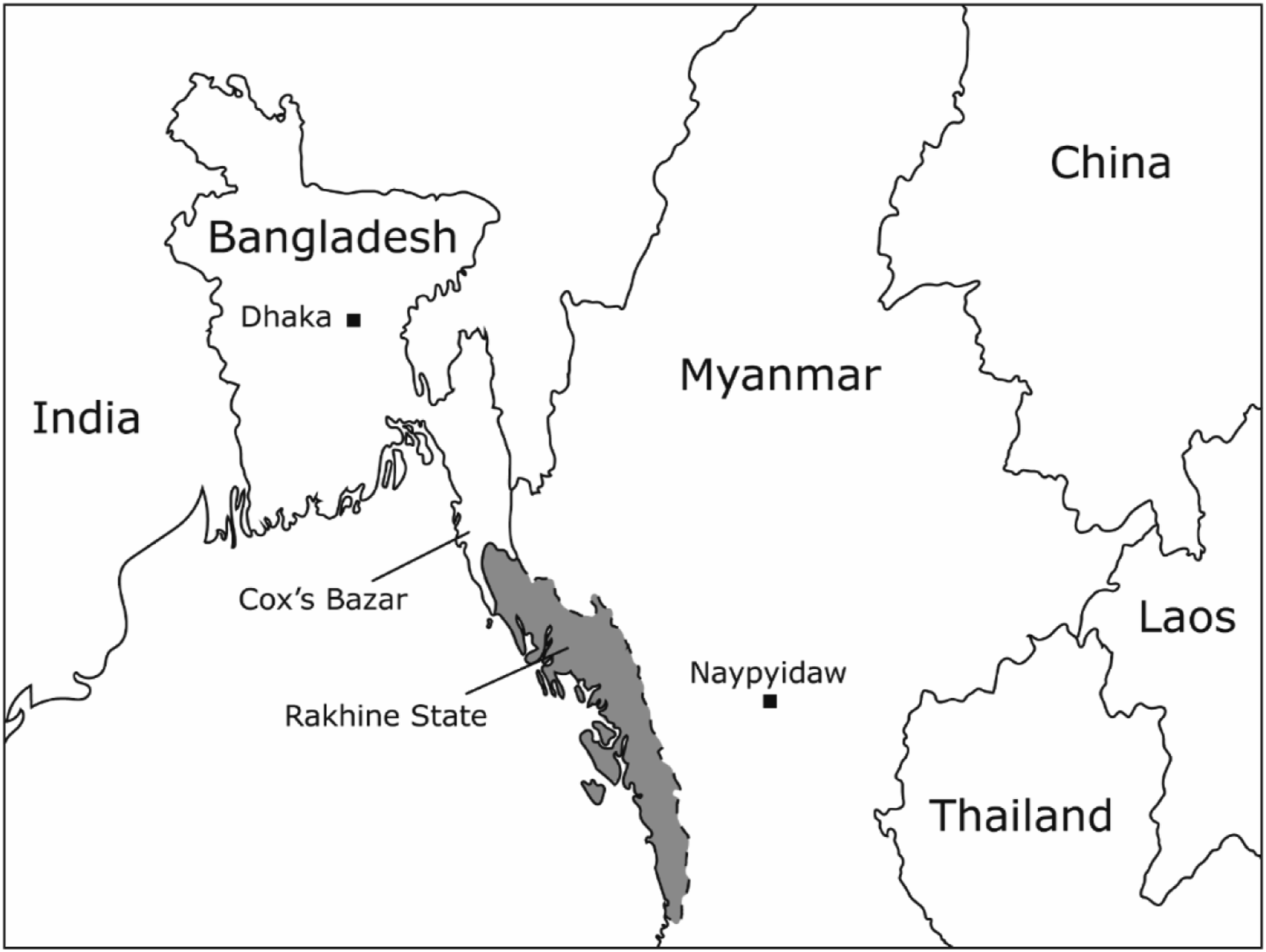
The circumstances around these events are the basis of the case brought by The Gambia against Myanmar at the ICJ. The role of the Gambia as the applicant in this case is the consequence of both its prominent position within the Organisation of Islamic Cooperation (OIC) and the individual initiative of Abubacarr Tambadou, Gambian Minister of Justice and former associate legal officer at the International Criminal Tribunal for Rwanda (ICTR). The OIC had, in 2018, formed a committee to investigate possibilities for international action against Myanmar in relation to the treatment of the Rohingya. The Gambia played a prominent role, hosting a key meeting in 2019 where the decision was made to pursue legal proceedings and acting as applicant. 1 The Gambia was well placed to perform this function since, unlike Bangladesh, it held no reservation to Article 9 of the Genocide Convention so could take the case to the ICJ. But the role of Tambadou is also crucial: in May 2018 he had visited the camps in Cox’s Bazar, an experience that both conjures memories of Rwanda while prompting an impetus for action. “I saw genocide written all over these stories,” Tambadou said, “[a]nother genocide is unfolding right before our eyes yet we do nothing to stop it” (Durmaz, 2019). The subsequent legal submission sought to build a case around the available evidence, and in doing so began to intervene in the contested politics of truth concerning the plight of the Rohingya.
Narratives and facts
We have objected to the formation of the independent international fact-finding mission on Myanmar since its inception […] Chair Marzuki Darusman’s reports, without exception, have been biased and flawed, based not on facts but on narratives […] The facts presented are inaccurate, distorted and lack professional objectivity (Kyaw Tint Swe in United Nations, 2019: 6).
One of the most significant but contested transitions in a judicial investigative process is the translation of event into evidence (Ingram, 2019; Jeffrey, 2021). The process of establishing proof is premised on the notion that knowledge held by any individual can be constructed through the available evidential base. This requirement to reconstruct events through materials and testimony leaves considerable room for dispute over the interpretation of the quality and rigour of evidence. The comment above made at a UN plenary meeting in 2019 from by Kyaw Tint Swe, Burmese politician and former Minister for the Office of the State Counsellor of Myanmar, illustrates this interpretive struggle. Here, the claims of external observers of events in Rakhine State, gathered principally through the testimony of those fleeing the violence and taking shelter in Cox’s Bazar, Bangladesh, are presented as inaccurate and lacking objectivity: as ‘narrative’ and not ‘fact’. The reconstruction of events is cast as a product of both error (flaws and inaccuracy) and purposeful manipulation (bias and distortion).
Since 2012 there have been 12 separate reports by the United Nations Special Rapporteur on the situation regarding human rights violations in Rakhine State, in addition to numerous written statements and resolutions. The requirement for gathering information concerning the situation has also led the UN Human Rights Council to establish two investigative mechanisms: the Independent International Fact-Finding Mission (FFM) on Myanmar in 2017 (resolution 34/22) which, in 2019, handed over to a successor institution, the Independent Investigative Mechanism for Myanmar (IIMM) (resolution 39/2). The establishment of the IIMM was designed to shift the focus from monitoring human rights abuses towards juridical intervention, in particular ensuring the gathering and storing of evidence met the standards of admissibility for future criminal proceedings in either national or international courts. Since 2018 the UN has been denied access to Myanmar, a move that has led to the formation of hybrid fact-finding processes, for example investigative NGO Myanmar Witness has been funded by the UK Foreign and Commonwealth Office to examine open-source social media channels to investigate military abuses, sharing their information with IIMM (see Myanmar Witness, 2021). The findings of the FFM were contained in four reports: a detailed report in September 2018, a report on sexual and gender-based violence in Myanmar and the gendered impact of its ethnic conflict in August 2019, a report on the economic interests of the Myanmar military in September 2019, and a general report in September 2019. To date the IIMM has produced three annual reports focusing on progress with the establishment of the mechanism and outlining the impact of the COVID-19 pandemic on its work.
The response of the Myanmar government to these multi-scale investigations has been to establish its own investigative mechanisms. The most high-profile to date has been The Advisory Commission on Rakhine State, launched in September 2016 and led by former UN Secretary General Kofi Annan. This body, which the publicity material described as “a neutral and impartial body” with the aim of “concrete measures for improving the welfare of all people in Rakhine state,” was tasked with providing “recommendations to the Government of Myanmar on measures for finding lasting solutions to the complex and delicate issues in Rakhine state, in accordance with established international standards” (Kofi Annan Foundation, 2016). As these initial comments suggest, there was a tension from the outset in the design and composure of the commission as it struggled to balance expectations of external observers and internal governing elites. The appointment of Kofi Annan, and its celebration in associated public statements by the Myanmar state officials, was a signal of the value placed on international expertise and the significance of detachment from the local context: this is also illustrated in the commission’s composition where six Burmese citizens, drawn from political, medical or civil society spheres, sit alongside three (including Annan) international appointments. Here, ‘distance’ is a virtue that is imagined to set the observer at a remove from local enmities and political influence.
The Advisory Commission on Rakhine State final report was released in Yangon on 24th August 2017 and presented the situation in Rakhine State as a simultaneous developmental, security and human rights crisis. The report did not comment explicitly on the position of the Rohingya, since it is explained in an early statement on procedure that the Commission were requested by the then State Counsellor, Aung San Suu Kyi, to refrain from using the terms either “Bengali” or “Rohingya” but instead use the labels “Muslims” or “the Muslim community in Rakhine” (Kofi Annan Foundation, 2016: 7). This request not only reflects the contested politics of group naming but – as discussed below – it also came to constitute a crucial line of argument in future deliberations concerning the presence or absence of genocidal violence within Rakhine state. But the report did include a set of recommendations encouraging Myanmar to improve – and expedite – its citizenship verification process and to amend the 1982 Citizenship Law that had rendered many communities, including the Rohingya, as stateless.
The release of the Advisory Commission report was overshadowed by a significant increase in violence in Rakhine State, as the Arakan Rohingya Salvation Army (ARSA) launched renewed attacks on Myanmar government installations and the Tatmadaw responded with widespread violence against the civilian population of Rakhine State (Wade, 2019). Qualitative research in the years since have identified this as the most significant period of coordinated attacks against Rohingya groups prompting a new, and vastly increased, exodus of refugees into neighbouring Bangladesh (Messner et al., 2019). In a September 2017 statement, the International Crisis Group estimated that in the month following the release Advisory Commission report over 270 000 residents were forced from their homes in Rakhine State (International Crisis Group, 2017). Human Rights Watch note that as of October 2017 access for external observers to northern Rakhine State has been denied “leaving the territory under a virtual information blackout and exacerbating a humanitarian catastrophe” (Human Rights Watch, 2017).
This, then, marks a turning point in the spatiality of the conflict and its international implications. The establishment of the Advisory Committee, with its eye-catching website and its international make-up, was an attempt to position the events in Rakhine State as a problem stemming from a longer lineage of Myanmar’s state building process, comparable to other postcolonial stateless populations and therefore of concern to the international humanitarian order. But this global outlook stands in stark contrast the exercise in sovereign power and closed borders that met the ARSA attacks and shaped the Tatmadaw’s subsequent violent repression of Rohingya communities. Reporting processes have shifted to testimonies of those fleeing Rakhine State and investigations of satellite and online data sources to trace the exercise of violence. In so doing the geography of justice also shifted at this instance, from the pages of international reports into the chambers of the International Court of Justice.
The first public hearings, in December 2019, saw The Gambia apply for provisional measures against Myanmar for contravening the Genocide Convention. These were unanimously granted by the judges of the ICJ in January 2020. In February 2022 a second set of hearings examined Myanmar’s preliminary objections, where they argued the lack of jurisdiction meant the case should be dismissed. These were, in turn, dismissed in July 2022. In what follows I examine three spatial deliberations which shaped the discussions at both sets of public hearings and in the subsequent interviews with legal personnel: disputes over The Gambia’s standing, the nature of the violence and the existence of the Rohingya as a group.
Standing
The legal requirements set out in the Statutes of the Court and the Genocide Convention that the parties in the dispute are states, these states hold no reservations to articles of the Genocide Convention and that there exists a dispute between the parties. While these could seem like rather arcane legal considerations, they lead to resolutely geopolitical questions concerning the origins and actors that perform international law. Immediately they ‘world’ the landscape of genocide law through the singular focus on the relations between coherent and knowable states. Within both the original application and the subsequent public hearings, Myanmar’s argument to reject the claim of genocide was structured around, first, a rejection of The Gambia’s eligibility to bring the case to the Court and, second, that the violence under scrutiny did not constitute genocide (a point examined in the next section). Abubacarr Tambadou, in the initial presentations during the provisional measures hearings, set out the universal underpinning to The Gambia’s claim: We seek to protect not only the rights of the Rohingya, but our own rights as a State party to the Genocide Convention by holding Myanmar to its erga omnes partes obligations not to commit genocide, not to incite genocide, and to prevent and punish genocide. The Gambia has been accusing Myanmar of failure to fulfil these obligations, and of carrying out genocide against the Rohingya, since at least early 2018, and we have done so regularly in our public and official statements since then.
2
There are two points to highlight in this account: that the obligations to uphold the Genocide Convention are erga omnes partes (obligations owed towards all) and consequently the geography of the applicant is of no regard, and second that Tambadou is asserting the existence of an ongoing dispute, that the application is part of longer lineage of complaint made by The Gambia against the violence in Rakhine State. In response, Myanmar, accepted the erga omnes partes character of the obligations but disputed whether The Gambia had the capacity to bring the case “without being specially affected by such alleged violations.” 3
In dismissing The Gambia’s claim Myanmar link the effect of the violence to a resolutely territorial conceptualisation of proximity. This sense of proximity and standing was more complex in practice, as a legal advisor to The Gambia’s application, explained the barriers to Bangladesh, neighbouring Myanmar, performing the role of applicant in the case: […] Bangladesh has a reservation to Article 9 of the treaty [The Genocide Convention] […] so for them to have brought the case may have caused some diplomatic complications. Because you know they’re a neighbouring State they ultimately want the Rohingya to return and so they are in ongoing discussions with Myanmar authorities to take them back to repatriate the Rohingya even though it’s really not a safe situation there probably for them.
4
Here, the proximity of Bangladesh is presented as possible grounds for taking action (though noting the reservation to Article 9) but also the basis of potential diplomatic challenges as the country seeks to facilitate the return of Rohingya refugees to Myanmar. It is, then, the distance of The Gambia from the location of the violence – and consequently its absence from the local geopolitical struggles over refugee repatriation – that promotes its viability as an applicant in the case.
But the legitimacy of The Gambia’s standing was questioned in terms other than distance. One of the key challenges posed by Myanmar related to whether the Gambia was the ‘real’ applicant, or was rather working as a proxy for the OIC, which would be in violation of Article 34 of the ICJ statute. This division between a ‘real applicant’ and the proxy state was drawn out in the preliminary objections hearing of the court by Christopher Staker for Myanmar: […] the question whether the applicant State acts as proxy for another must be a question of fact, a question of substance, not merely a question of form or procedure. If an applicant is in fact acting as proxy for another, it is immaterial whether or not there is a legally binding relationship between the proxy State and the real applicant, such as an agency agreement under international or domestic law, or whether or not the real applicant has legal power to compel the proxy to act. […] [I]n the present case there are reasons to conclude that The Gambia acts as an organ or agent of the OIC.
5
The evidence for this claim of proxy status were the minutes of a Gambian cabinet meeting where the decision was taken that the Gambia would ‘lead’ the legal challenge at the ICJ, inferring it was doing so in concert with other sovereign states. This was rejected by The Gambia’s legal team who asserted that “to ‘lead’ the case is not to serve as anyone’s puppet or proxy.”
This debate concerning The Gambia’s standing reveals a wider geopolitical legacy set within the terms of the ICJ. The requirement that states act as the only legitimate actors at the Court permits these rather abstract debates – so familiar to scholars of international relations or political geography – of what constitutes the state and acts in its interests. That the embedded statism of the ICJ could undermine a claim against the Genocide Convention, that this is even a debate within discussions of its jurisdiction, demonstrates how mid-twentieth century geopolitical arrangements reverberate into the present (Falk, 2008). This is particularly significant in the case of genocide, a crime that is explicitly concerned with the excesses of state violence, hence the probability that non-state actors could well wish to seek legal protection at the ICJ. It also forces us to consider what constitutes injury within a claim against the Genocide Convention, particularly whether harm to a common humanity, as seen in Lemkin’s early accounts of the cultural aspects of genocide, can render every state a possible applicant under the convention. Underscoring this attachment to erga omnes partes, and the wider conceptualisation of injury, in September 2020 The Netherlands and Canada expressed support and sought to join the case at the ICJ supporting The Gambia.
The nature of violence
At the International Court of Justice if it’s not genocide they have no jurisdiction […] One of the things this has led to is a tendency particularly of victim groups who realise they want to get to the International Court of Justice but the only way to unlock that door is to make an argument that it’s genocide and so you get exaggerated farfetched arguments about genocide.
6
This comment from one of Myanmar’s legal team reflects the binary nature of cases brought under the genocide convention: if a case does not involve genocide the court does not have jurisdiction. A clear strategy for the defence, and one enacted by the agent for Myanmar and the wider legal team during the provisional measures hearings, was that violence occurred but not on the scale suggested by The Gambia. This recalls established arguments that genocide refers to a certain magnitude of killing, reflecting the origins of the crime in the aftermath of The Holocaust. At interview, one of Myanmar’s legal team referred directly to this sense of scale, arguing that the total number of deaths “was less than 5000” so could not be equated with previous genocidal acts, making direct reference to Rwanda. 7 Despite the unanimous verdict by the 15 judges of the ICJ at the provisional measures hearing, separate opinions were produced by Judge Xue Hanqin and Judge Judge Cançado Trindade (Judge Klaus Cress also produced a separate declaration). Of particular note is the opinion of Judge Xue, representing China, who suggested that the scale of the violence did not merit the label ‘genocide’: “the evidence and documents submitted to the Court in the present case, while displaying an appalling situation of human rights violations, present a case of a protracted problem of ill-treatment of ethnic minorities in Myanmar rather than of genocide.” This did not prevent Judge Xue supporting the application for provisional measures but is suggestive of the spectre of an argument that declarations of genocide require a certain threshold of civilian death.
The role of scale has implications that extend beyond legal classification. This is captured in the statement by Aung San Suu Kyi in her bid for The Gambia’s application to be dismissed. In defending against accusations of 12 villages subjected to ‘clearance operations’ in Rakhine State, Aung Sung Suu Kyi reflected on the possibility of civilian casualties: It is still not easy to establish clear patterns of events in these twelve locations. […] There was some inter-communal violence. Buddhist and Hindu minority communities also feared for their security after the original ARSA attacks and many fled from their homes. […] Mr. President, it cannot be ruled out that disproportionate force was used by members of the Defence Services in some cases in disregard of international humanitarian law, or that they did not distinguish clearly enough between ARSA fighters and civilians. […] But these are determinations to be made in the due course of the criminal justice process, not by any individual in the Myanmar Government.
8
There are two aspects to these comments which both seek to assert the jurisdiction of the Myanmar state over the legal implications of the violence. The first discursive strategy is to present the violence as a civil war, conjuring a sense of symmetry between the ARSA and the Tatmadaw. This underplays the violence committed against civilians and reflects a well-established strategy for denying genocide (Moses, 2021; Shaw, 2013). Suppressing an armed insurrection could be seen as consistent with a Westphalian conception of indivisible sovereign power. The second move is to suggest that there may have been crimes committed but of a lesser degree than genocide, arguing that the nature of the conflict has prevented the Tatmadaw from upholding the distinction between ARSA and civilians. The point here is not to admit to genocide, but rather to suggest that lesser crimes had occurred which fall under the jurisdiction of the Myanmar state as opposed to the ICJ. These are, then, attempts to re-spatialise responsibility for the violence, away from international legal arenas and into domestic legal institutions. In one of the few legal cases against Tatmadaw officials in Myanmar, three military personnel were found guilty of crimes committed during a massacre committed at Gu Dar Pyin village in Rakhine State on August 27th–28th 2017. Information concerning the individuals involved, their military rank or sentence have not been revealed, leading Human Rights Watch to describe the trials as “an accountability sham” (Human Rights Watch, 2020).
In addition to presenting the violence as localised incidents, Myanmar also erased any mention of sexual violence, despite such crimes featuring prominently in both the UN Fact Finding Reports (including a dedicated UN report that investigates sexual and gender-based violence) and The Gambia’s application for provisional measures (UN Fact Finding Mission, 2018). These were not denied in Myanmar’s statements during the provisional measures hearings, they were simply not mentioned. As Paul Reichler, acting for The Gambia, set out in response to Myanmar’s account: We heard nothing about sexual violence from Myanmar yesterday. Not a single word about it. Not from the Agent. Not from any of their counsel. Because it is undeniable - and unspeakable - they chose to ignore it completely. I cannot really blame them; I would hate to be the one having to defend it.
9
Echoing this point Philippe Sands, also representing The Gambia, used the court space during his oral submission to emphasise this silence of the Myanmar legal team, turning to Aung San Suu Kyi to improvise off-script 10 “Madam Agent, your silence said far more than your words.” 11
Sexual violence is not directly mentioned in the Genocide Convention, though it is an example of Article 2(b) “[c]ausing serious bodily or mental harm to members of the group.” There is also a precedent at the ICTR in the 1998 Akayesu ruling of sexual violence being identified as evidence of genocidal intent (Anania, 2020). Through silence, Myanmar’s strategy at the provisional measures stage – sexual violence was not addressed at the preliminary objections hearings – was to ignore the existence of the allegations, as opposed to refuting directly their veracity. This silence recognises the challenge of classifying sexual violence as either part of a civil war or as consequence of classificatory error between ARSA soldier and civilian. Sexual violence could not be confused as a legitimate act of war, committing rape is not an error of judgement or classification. It is outside the boundaries of legitimate state violence and consequently within the gaze of international legal instruments designed to protect civilian minorities.
Existence of a group
Senior Myanmar government and military officials refuse even to use the word “Rohingya” in order to preserve their racist myth that no such group exists. The Court will have noted that the Agent, as is her custom, refused to refer to the Muslims of Rakhine State as “Rohingya”; she uttered the word only in reciting the full formal name of the ARSA insurgent group.
12
Two forces existed in tension during the public hearings concerning provisional measures. The first, outlined by the comments above from the leading counsel representing The Gambia, concerned Myanmar’s strategy of denying the Rohingya existed as a discrete ethnic group. This, of course, challenges the fundamental premise of the Genocide Convention in rendering impossible the targeting of individuals on the basis of group membership. To support this claim the Rohingya were rarely mentioned by name and instead historical evidence was mobilised to question the coherence of the group. For example, Aung San Suu Kyi sought to connect the events in Rakhine State to the permeability of the border region during colonial rule: When Britain made Burma a colonial entity separate from British India in 1937, the border between Burma and India was drawn along the River Naf, where we find today’s border between Bangladesh and Myanmar. The historical Kingdom of Arakan had at times extended much further to the north than the River Naf, including most of what is today Chittagong District in Bangladesh. Members of some Rakhine communities therefore felt that the border drawn by the British was too far south; others, that it was too far north.
13
The strategy here is to articulate an imagined geography of a frontier region, suggestive of an itinerant population in the border region that migrated to Myanmar from Bengal. This is an established strategy of the Myanmar state, to suggest that the Rohingya are understood as ‘Bengali’ (see discussion above) and that these are outsiders to the Myanmar citizenry (Lee, 2021). The steadfast refusal to recognise the Rohingya as a group nor to grant citizenship status was identified by The Gambia’s legal team as an aspect of genocidal practice, arguing “it is a short step from dehumanizing a people to killing them en masse.” 14
If the strategy of the Myanmar agent and legal team was to place the Rohingya outside the bounds of sovereign protection, The Gambia’s approach was to bring the Rohingya – literally and figuratively – into the court space. This involved the invitation of a group of Rohingya from Cox’s Bazar to the ICJ, as a member of the legal team explains: The Government of Canada did something amazing. They paid for a group of Rohingya who had no passports. They got them status people’s passports to allow them to travel from Cox’s Bazar to the Hague, and hanging out with those folks was deeply affecting.
15
This bodily presence acted as an obdurate material refutation to Myanmar’s assertion of the invisibility of the Rohingya as a group. It also recognised the Rohingya as active witnesses – rather than mute victims -- to the events of the court. By utilising physical presence it was an act that could communicate group status in ways beyond that of legal argument.
But in contrast to the provisional measures hearings, the preliminary objections hearings were impacted by the COVID-19 pandemic and were held in a hybrid format, where four of the judges and some members of both legal teams participated via video link. This transformed the nature of the interactions, denied the possibility of some of the more theatrical elements of the proceedings and certainly meant that members of the Rohingya community could not visit the court. But even in these circumstances attempts were made by The Gambia’s legal team to evoke the presence in the ‘court’, notably by highlighting a spatially distributed event from the previous round of hearings: Madam President, one of the most moving moments I have ever experienced in this Great Hall of Justice, since my first argument here in 1984, occurred on 12 December 2019 […] As I was waiting at the podium […] a member of our team tapped me on the shoulder and insisted on showing me a video that had just arrived on his mobile phone. It was of a remarkable event that occurred that very morning, in the overcrowded refugee camps of Bangladesh. Thousands upon thousands of Rohingya had gathered in an open field. They were chanting rhythmically: Gam-bi-a! Gam-bi-a! Gam-bi-a!
As he spoke these final words through a video link from Washington DC to The Hague, Paul Reichler lent forward, increasing his volume and emphasising each syllable. 16 The purpose here is clear, to evoke the presence of Rohingya groups within this distributed court, to point to the ways in which the decisions of the court have direct impacts, and to build empathy between the judiciary and Rohingya. It is harnessing space for this purpose, the spaces of the camp, of the podium, of the court. It is a digital and physical response to the erasure of the Rohingya, a means through which their existence as a group could be recentred within the court’s deliberations.
Conclusion
There is a two-stage geography of genocide. Stage one is the physical act of mass killing, expulsion and destruction which has a geographical imagination centring on the impossibility of certain bodies within specific territories (Tyner, 2012). This reflects an underlying violence of state projects, where the imagination of a connection between political authority and immutable identity acts as the basis for the killing or letting die of those considered outside sovereign protection. But there is a second stage: recognition of mass killing as genocide requires an act of naming based in legal verification. Consequently, information concerning violence is contained within evidential traces which travel through the interpretive and authorising process of legal deliberation. These negotiations, in this case at the ICJ in the Hague, are themselves deeply imbricated in geopolitical relationships and material geographical settings. Using the example of The Gambia vs. Myanmar, this paper has argued that these two elements of the geography of genocide are connected. The possibility of action being identified as genocidal is intimately connected to the nature of the violence itself, how it is presented as connected to specific state projects and targeting particular groups, but also how this requires a wider infrastructure of legal expertise and performance that weaves a meaningful connection between the abstract nature of violence and embodied experiences in court space. Space is both a container, as the embedded statism of the international legal process shapes the nature of legal argument, and it is a resource, in that it provides a shared place through which deliberations concerning mass violence may be performed and heard.
Of course, the partiality and silences of this account are stark. There has been a great deal of commentary concerning the unequal power geometries of claims of ‘genocide’, where the focus on killing on the basis of group membership excludes the wider array of violence committed to pursue other political agendas, in particular those committed by Western state actors under auspices of the elongated ‘war on terror’ (Moses, 2021) or long histories of racialised violence in the wake of European colonial exploitation (McKittrick, 2013). In addition, the existence of the Genocide Convention places genocide in an anomalous position within international law in creating the facility for states to take cases to the ICJ, in contrast to claims of crimes against humanity or wars of aggression. Again, this orientates attention at a small number of instances of mass violence and potentially allows wider patterns of state violence, both within and beyond the borders of individual states, to escape judicial concern. Finally, there is the wider normative question of why genocide cases are pursued, especially if there is little sanction that can be used to prevent further acts of violence. In the case of the The Gambia vs. Myanmar even the limited success of the demand for regular reports by the Myanmar state as to how genocide is being prevented in Rakhine State was celebrated by The Gambia’s legal team. The deep inequalities, the absence of wider legal protection and the limited possible sanctions all could lead to a conclusion that genocide does not substantively contribute to struggles for justice.
As this paper has demonstrated, geographers are well placed to examine these inequalities and limitations, shaping as they do the nature of treaty obligations, the sites of legal expertise and the cases that are considered judiciable before international courts. But care must be taken not to simply equate the existence of deep inequalities with the impossibility of genocide law contributing to claims for justice. There are three aspects of a geographical approach that expand the possibilities of genocide cases in addressing claims for justice. The first is a focus on the wider cast of actors and agencies that produce law. For example, the paper points to the range of actors that are enrolled within the case of a genocide case, from the individual experience of specific state agents (such as The Gambia’s Abubacarr Tambadou), the support structure of the OIC, and the existence of international legal expertise that could formulate the case. In resisting legal closure -- the sense that law is severed from wider social and political processes and agencies -- tracing genocide cases as one instrument amongst many aspects of international politics helps to understand why some, such The Gambia vs. Myanmar, are heard in court whilst others fail to achieve this status.
The second is a focus on the intimate geopolitics of court spaces where legal expertise, personalities, and performances cultivate understandings of proximity/distance, or absence/presence within court space shapes the possibility of violence being understood as genocidal. The plausibility of these arguments rests on the existence of suitable evidence coinciding with the ability to rapidly deploy legal expertise and experience, a process that truly distributes agency between different members of a legal team, the ability to corral the appropriate evidence and the possibility of performing authority within court space. These abilities are shaped by both financial limitations, the credentials of prior experience and gendered and racialised assumptions concerning legal credibility.
Finally, and beyond the scope of this paper, a geographical approach allows us to consider the implications of the legal judgement beyond the sanction itself. The paper supports scholars who have sought to emphasise the didactic value of genocide cases, in establishing formally and in an international arena the violence of state action and the existence of an international framework for seeking redress and – though less so in this instance – achieving accountability (Douglas, 2012). Careful examination of the spatial production of genocide focuses attention on the possibilities of international judicial mechanisms, both to pass judgement on the nature of mass violence but also to foster deliberation on the appropriate legal structures to provide protection from the excesses of state violence, wherever it is found.
Footnotes
Acknowledgements
I am indebted to the research participants for taking time to discuss their work. I would like to thank Abi Smith, Rachael Parker Allen, Alice Wilson, and the students on Legal Geographies final year module at the University of Cambridge for reading earlier versions of this paper, and seminar audiences in Bonn, Warwick and Cambridge for their engagement and feedback. I am very grateful to the editors and reviewers for suggestions that improved this paper. Errors that remain are my own.
Declaration of conflicting interests
The author(s) declared no potential conflicts of interest with respect to the research, authorship, and/or publication of this article.
Funding
The author(s) disclosed receipt of the following financial support for the research, authorship, and/or publication of this article: This work was supported by the Cambridge Humanities Research Grant.