




Abstract
Cities carry traces of their pasts; they also carry traces of imagined pasts, inscribed on them by authoritarian regimes to suppress other imaginings. Bangkok in the early 20th century displayed the signification of a Buddhist royalty and imagined origins, subsequently suppressed with the imposition of new emblems of democracy following a 1932 overthrow of monarchical absolutism. Democracy was to be signified as founded in the common people. In the 21st century, a military junta dressed in the clothes of a pseudo-democracy re-writes the emblems of democracy, now to signify that democracy is not based in the people but, rather, is the gift of a benevolent monarch. The subverting of democracy is to be read from the monuments of the city, which highlight the specific strategies that the authoritarian state invokes in re-writing the national history.
Keywords
Introduction
Distraction and concentration form polar opposites which may be stated as follows: A man who concentrates before a work of art is absorbed by it. He enters into this work of art the way legend tells of the Chinese painter when he viewed his finished painting. In contrast, the distracted mass absorbs the work of art. This is most obvious with regard to buildings. Architecture has always represented the prototype of a work of art the reception of which is consummated by a collectivity in a state of distraction. (Benjamin, 2008: 255)
National capitals typically inscribe their symbolic monuments with evocations of preferred histories, to be received subliminally by the distracted masses. Languages variously of architecture and of discourse are manipulated. So Washington would display references to variously imagined origins in a Roman Republic and a French Enlightenment; London’s pseudo-Gothic Houses of Parliament would claim origins in the imagined verities of a medieval past; Edwin Lutyens bestows a British-imagined Mughal past on multi-cultural Delhi. More recently, Malaysia’s administrative capital of Putrajaya claims a diversity of wished-for Middle Eastern antecedents in what is effectively a pastiche of architectures and references, while excluding other visions of origin (King, 2008; Sintusingha and King, 2021).
There is a commonality to this political practice of suborning the space of the city to claim one’s preferred history and to suppress—even to obliterate—other histories, memories and myths. The concern is with constructed memory: in an 1882 discourse Qu’est-ce qu’une nation? (“What is a nation?”), Ernest Renan insisted that in the social (re)construction of a nation, all citizens are obliged to remember (imagine) many things but also to have already forgotten many things (Renan, 1947–1961). Memory is always socially constructed (Halbwachs, 1992), likewise imagination; as hegemonic fractions manipulate that construction, power and its contestations intrude.
Pierre Nora sees history as always “a phenomenon of the present, a bond tying us to the eternal present; history is a representation of the past. Memory, being a phenomenon of emotion and magic, accommodates only those facts that suit it” (Nora, 1986: 3). Memory is ephemeral, multiple, subjective. It is constructed memory—representations of an imagined history—that hegemonic agencies would inscribe on (or alternatively obliterate from) the fabric of the city.
The question for this paper is: what are the mechanisms for this inscription/obliteration? How is it done? The concern is with the space of the city understood as text, on which messages (meanings) are written and from which the city is to be read.
Author, text, effect
Conceptually the present paper is concerned with the difference between intended purpose (what the author of the text or designer of the monument might have intended) and actual effect (what the text or monument actually does). To determine what the monument does is a matter of observation—what is actually happening? To determine the designer’s intention is more problematic, as statements of intention are almost inevitably entangled in post-hoc rationalisation and justification.
The Russian psychologist Yuri Lotman claimed that texts function in more than one way: to convey meanings adequately, and to generate new meanings. The first corresponds to a “transmission model” of communication, best achieved where the codes of speaker (designer) and listener (observer) most nearly coincide. The second, “dialogic” function arises in multivoicedness: there is difference between the message intended by the speaker or designer and that received by the listener or observer—there is discordance, perhaps dissidence. Instead of working as a mere passive link, the text becomes a “thinking device”, triggering ambiguity, equivocalness, and the evocation of new meaning (Lotman, 1988; Wertsch, 1991: 73–76). The main characteristic of a text (urban space) in this second function is an internal heterogeneity of social languages, while the generation of new meaning arises from the interaction between structures (Lotman, 1988: 37).
A related though more strategic (activist) argument was advanced by another Soviet-era psychologist, L.S. Vygotsky, to the effect that to change fundamentally the actions of individuals and social groups—to transform “the mind of the age”—it will be necessary to transform the mediating signs, to add new signification to that already existing (a “dual stimulation method”), whether in narrative or in the text of urban space (Vygotsky, 1962; Wertsch, 1991: 29, 32).
The Vygotsky argument is easily understood from a case such as Lutyen’s New Delhi: invented Mughal memories (that is, imaginings) are written on a text of imperialist (colonial) domination, itself crosscutting a multicultural reality. The effect is new meaning, feeding obliquely into new imaginings (multiple) of a forever ambiguous Indian nationalism (Irving, 1981). The same will be observed following from recurring attempts to (re)define a Siamese/Thai nation.
Objectives, methodology
To recast the political meanings that urban space is to transmit to the citizenry, both the imagery of the city and accompanying narratives are manipulated. It is argued here that this manipulation will be pursued variously by (1) transposing new imagery and its stories (new obligated origins) into the city, (2) by layering new imagery (new layers) across the pre-existing face of the city and its institutions, (3) more subtly, by changed referencing—ambivalence, ambiguity and the implication of new meaning, and (4) by offering the vision of an alternative reality.
The idea of an “architectural language” is commonly invoked; however, in the present instance the semiotic metaphor will be extended to suggest a methodology: the paper takes specific words and the operations they reference to question the political manipulation of architecture and the messages it might convey. So, the four political strategies suggested above will be explored as metaphorically equivalent to specific language operations: (1) translation, (2) montage or over-writing, (3) allusion, and (4) pastiche.
Thus, the first objective of the paper is to test the utility of this understanding of the manipulation of the city. Does it help to throw light on objectives and effects?
Two methodological dilemmas arise. First the attachment of names or categories inevitably smooths over the nuances and subtleties observable in architecture—architectural description is a rich field and scarcely to be summarised in four words signifying political strategies. Thus qualifiers will become necessary (or at least advisable) when categories are applied to actual cases. The second methodological dilemma is that, in an actual application of such categories, there is likely to be slippage between categories.
So the paper’s second objective is ultimately about the utility of words.
The structure of the paper is to consider each of these as political practices, mostly using the space of Bangkok to ground the explorations. Accordingly, there will be sections on transposition (translation), montage (collage), allusion (suggestion) and pastiche (re-imagining), where the languages of architecture (metaphorically understood) and those of narrative are viewed as having an equivalence. A discussion will follow, to focus on the political implications of contorting space to manipulate the national imagining, also on the usefulness of the method adopted.
Transposition, translation
In 1767 Ayutthaya, in the valley of the Chao Phraya river and capital of the Siam kingdom, was destroyed in war. In a program of both military and political brilliance, the governor of Tak province drove out the Burmese invaders, defeated rivals and re-established the Siam kingdom, now centred on Thonburi further down the Chao Phraya valley; in December 1767 he crowned himself as King Taksin (r.1767–1782). In 1782 a new capital, Rattanakosin (Bangkok) was established on the opposite bank of the Chao Phraya river from Thonburi by a further, upstart monarchy. Legitimacy was sought via religious display, but also by translating the institutions of the only recently lost Ayutthaya, also aspects of their symbolic relationships, on to the site of the new capital (King and Lertnapakun., 2018), though the basic form, that of the Tai muang, is much older.
If a city is seen as a text on which the sanctioned story of a people is written, then Rattanakosin is not inscription but transcription—transposition or translation. Translation is akin to transposition; it is problematic for two reasons: first, what is it that is to be translated—the word, the voice with which it is uttered, or the sentence (Benjamin, 1992)? In the case of a city, is it the hollow monument, or the monument and its life, or some more coherent space, physical or linguistic? Famously the walls of Rattanakosin were in part constructed with bricks salvaged from the destroyed Ayutthaya, floated down the Chao Phraya river on thousands of barges—a quite literal translation. The real translation, however, was of the memory of Ayutthaya—words and sentences, a literary translation, albeit expressed in built space. The founding monarch, Chao Phraya Chakri (Rama I, r.1782–1809), sought to construct the myth of continuity with the lost Ayutthaya; the institutions of Ayutthaya and their spatial relationships were to be replicated.
The second problem of translation relates to context. For Mikhail Bakhtin, context and contingency are inescapable; so “the most important thing for making sense of meaning is not the sign [the word and its sound, the building and its aura], but the whole utterance [assemblage] into whose composition the sign enters” (Ivanov, 1974: 237, summarising Bakhtin, 1981). The utterance—the urban assemblage—is always “situated”; it has context away from which it cannot be understood. It is here that the translation of Ayutthaya’s memory on to the (erroneously assumed) tabula rasa of Bangkok is problematic: the context of Ayutthaya presented as one of Buddhist-dynastic continuity. Rattanakosin, on the other hand presented a faux continuity, in the attempted legitimisation of an upstart, incidentally regicide, non-royal monarch (in reality, military dictator). The smoothed-over transition from Thonburi (Taksin) to Rattanakosin (Rama I)—Herzfeld (2022) terms it “air-brushing”—is a recurring aspect of Thai historiography.
Translation became a continuing political practice for the Chakri dynasty (Rama I and his successors). The Emerald Buddha statue had been translated (looted) from site to site across Southeast Asia in diverse dynasts’ claims for royal Buddhist legitimacy; then in 1784 the Emerald Buddha was installed in great ceremony in its own temple within the Rattanakosin Grand Palace, as sacred talisman of both dynasty and nation. Adjoining the Grand Palace is Wat (Temple) Pho; in 1788 Rama I ordered the temple’s reconstruction, initiating a program to remove Buddha images from abandoned temples in Ayutthaya, other royal capitals and elsewhere for installation in Wat Pho. This assembles the memories mostly of the ancient kingdoms of the Sukhothai–Ayutthaya–Thonburi–Rattanakosin corridor that Rama I would claim now to bring to fulfilment—their promise finally redeemed. Wat Pho is Thailand’s ultimate expression of national integrity, albeit through translation (looting).
Replication
Akin to the translation of Ayutthaya on to Rattanakosin (Bangkok) is the replication of the Theravada Buddhist temple—the eternal return of the same. There will be new temples, but they will follow patterns with no original. Innovation is eschewed and design will be by uninterrogated rules.
However, whereas transposition (translation) is explicitly political—for example to present the Rattanakosin regime as continuous with that preceding—replication will have political effect but not necessarily an expressed political purpose. Here the political effect is via a reinforcement of cultural continuity, that is, the acceptance of given (unquestioned) patterns of domination. It is Baudrillard’s (1983) argument that the task of domination in “consumer capitalism” (and by extension in “consumer nationalism”) shifts to the signifier and thereby to the media—the temple becomes a medium through which the distracted observer (the reader of religious truths) receives prevailing patterns of domination as “natural”. It is the never-ending repetition of (religious, architectural) ritual.
The distraction, however, enables a somewhat nuanced shift of signification, as the Theravada temple will also be “written upon”, for instance to overlay the idea of a legitimating royal modernity over unchanging Buddhist devotion (by King Chulalongkorn at Wat Benchama Bophit) and to claim compatibility of anti-royal revolution with Buddhist adherence (by the revolutionary People’s Party at Wat Phra Sri Mahathat) (Noobanjong, 2010). While the temple expresses as a simulacrum without explicit political role, it also presents as a tabula rasa on which messages can be montaged.
Montage
Montage will take an element or image from one place and graft it on to another; its effect is collage. It may seem to resemble translation, although its operations and implications are different. Translation deals with wholes, whereas montage deals with the layering of bits.
Gregory Ulmer (1985) argues that collage is “the transfer of materials from one context to another”—quoting, appropriation of the ready-made, “speaking with the voice of others”; montage is the “‘dissemination’ of these borrowings through the new setting”—as in photomontage. Ulmer quotes Derrida (1981a: 26) at length, to the effect that “no element can function as a sign without reference to another element which itself is not simply present”. So the interweaving of collage/montage results in each element “being constituted on the basis of the trace within it of the other elements of the chain or system” (Ulmer, 1985: 88). However, there is always more than one such chain for any sign, and more than one level of meaning. So every sign, linguistic or visual, can be cited, “put between quotation marks”, thereby to “break with every context, engendering an infinity of new contexts in a manner which is absolutely illimitable” (Derrida, 1977: 185). The point is that collage/montage comprises a deconstruction and re-construction of meanings.
Derrida refers to “grafting”. To graft changes the meanings of both source and montage: “Each grafted text continues to radiate back toward the site of its removal, transforming that too, as it affects the new territory” (Derrida, 1981b: 335). Thus cultural production, Derrida argues, must “endeavour to create an effect of superimposing, of super-imprinting one text on the other” (quoted in Ulmer, 1985: 91). It is super-imprinting that distinguishes montage/collage from translation, in architecture as in writing.
Superimposing discordant pasts
The classic example of montage in Thai architecture is the Chakri Maha Prasat Throne Hall, built for King Chulalongkorn (Rama V, r.1868–1910) between 1876 and 1882 to a design by British architect John Clunish (Broman and Kukrit Pramoj 1984: 54–57; Krairiksh, 1988). A somewhat hybridised, neo-Renaissance styled building sought to express Chulalongkorn’s embrace of the architecture of the European colonial-imperialist powers—a seismic shift in representing the nation, from Siamese continuity to European mimicry. A new Siamese modernity was prefigured, to stake a counter-claim to British and French rhetoric about bringing civilisation and modernity to a primitive Siam; also, however, to indicate a claimed role of Siam as colonial-imperial power in its own right over neighbouring realms.
To crown Siam’s entry into the imperialist sphere, as it were, the Chakri Maha Prasat Throne Hall would be crowned with three Renaissance-referencing domes. According to Poshyananda (1992: 5), however, the king was persuaded to assert a Siamese identity by replacing the European domes with Rattanakosin styled spires or chedi. There are divergent views on the Chakri Throne Hall. So, from Apinan Poshyananda: For many viewers, then and now, the building signifies vulgarity and kitsch, underscoring the mediocrity and vulgarity of a hybrid architectural style created without the pressure of necessity and unguided by an organic tradition. For others, however, it is the outcome of the cult of innovation and originality that developed during the decades of cross-cultural influence. (Poshyananda, 1992: 6)
The point here relates to the intersection of memory (of both antiquity and more recent contestations) with imagination (of a more modern, imperial destiny) and thence to express this in a reimagined Grand Palace (Figure 1). Montage. The Chakri Maha Prasat throne hall: Sacred nostalgia layered over a dream of already vanishing imperial grandeur.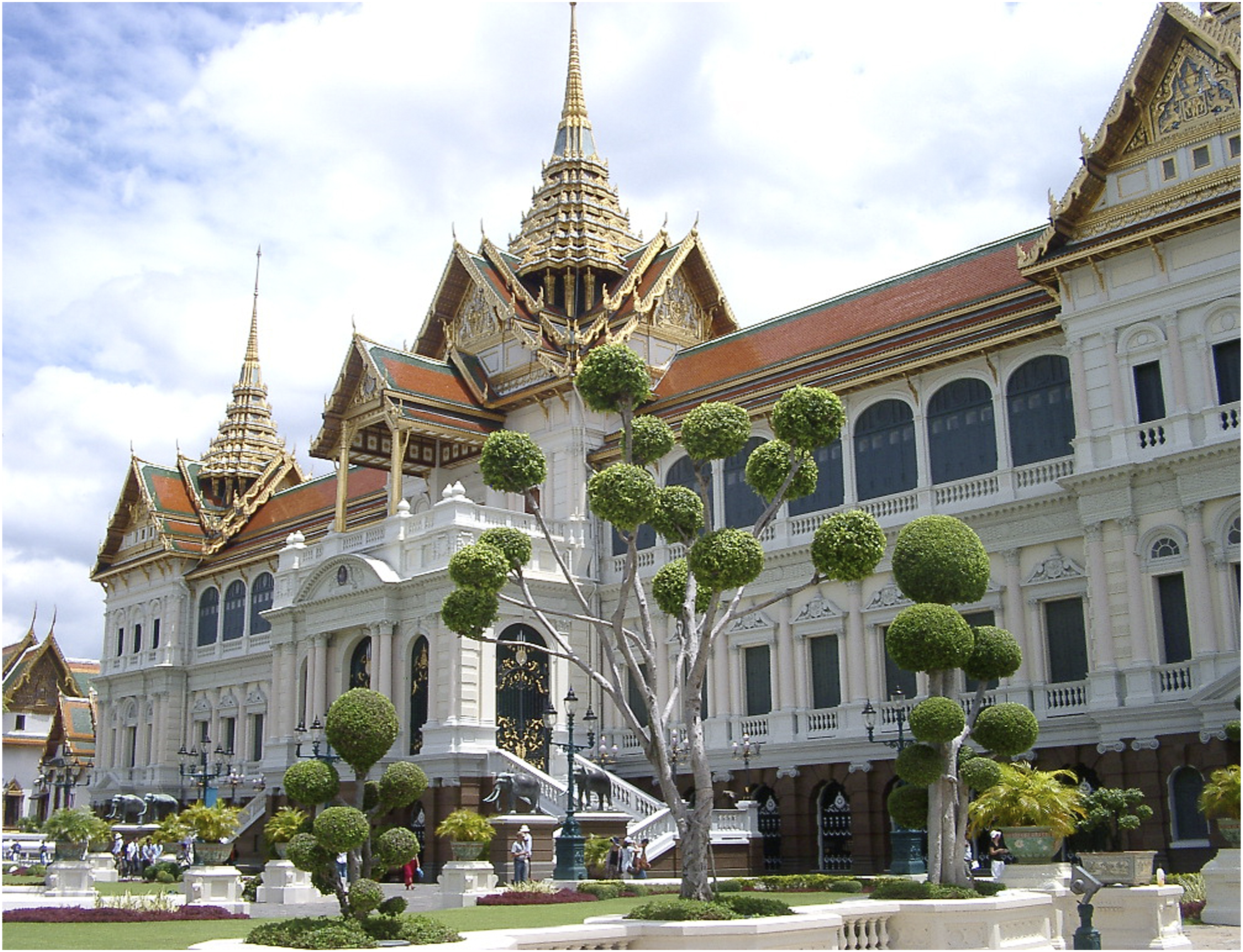
Superimposing discordant futures
In 1932 a mostly bloodless revolution ended the regime of absolutist monarchy most powerfully represented in the person and reign of Chulalongkorn, and expressed in the neo-Classical/neo-Renaissance monuments of his extensive public building program. The revolutionary People’s Party determined that the new institutions of a democratic polity were to be expressed in a new architecture, signifying an epistemic break. This would be modernist, variously alluding to a European Art Deco and to the monumental classicism favoured by the admired Mussolini (Barmé, 1993).
The parliament initially met in the Ananta Samakhom Throne Hall, another Chulalongkorn era, neo-Renaissance throne hall, subsequently moving to a new parliament house discretely sheltered behind that throne hall. The National Assembly building in a high-modernist, Corbusian-derived, International Style dates from 1970–1974 (King 2011: 183–185); it was designed by Phol Julsavek of the Public Works Commission. While the building lacked explicit national referencing except for an identifying badge montaged over its ceremonial entrance, its forecourt received a seated statue of King Prajadhipok (r.1925–1933) (Sintusingha and King, 2021). Its demolition began in 2019.
Something grander had long been mooted and in 2009 a design competition was conducted to choose a design for a new complex. The competition came down to five finalists, with a design from “Arsomsilp” (lead architect Teerapol Niyom) chosen—formalist, concerned with a building’s shape rather than its contents, a series of pavilions building up from the river edge to a Buddhist-inspired spire or chedi. The jury’s comment: the winning design “… is rooted from the Buddhist Tri-Bhumi [the three stories or superimposed worlds of the Thai Buddhist cosmology]. It is a balanced mixed [sic] between traditional Thai architecture and contemporary architecture” (quoted in King, 2011: 183–186).
Both design and implementation must be placed in an historical context. In 2006 a rare interval of parliamentary democracy was ended in one of Thailand’s intermittent military coups, to be followed by a sequence of popular uprisings variously of the conservative, Bangkok-centred, monarchist Yellow Shirts and the mostly regions-based, pro-democracy Red Shirts. There was again a brief period of unstable democracy from 2011 to 2014, confronted from early 2014 by an altogether novel, mass insurgency, directed not against a government but against government as such—against what was portrayed as the spectre of elective democracy (King, 2021).
As an expression of national identity, the complex replicates the continuing uncertainty of the Siamese embrace of modernity: the Thai-Buddhist crown on a progression of formalist pavilions resembles nothing more strongly than the similar crown placed incongruously on the Chakri Maha Prasat Throne Hall from 1882. The institutions of democracy will be placed beneath the emblem of monarchy (Figure 2). Montage. The Parliament: (a) elevation to the Chao Phraya river; (b) longitudinal section. The untruth of democracy as royal gift is layered over the compelled forgetting of history (Source: Arsomsilp).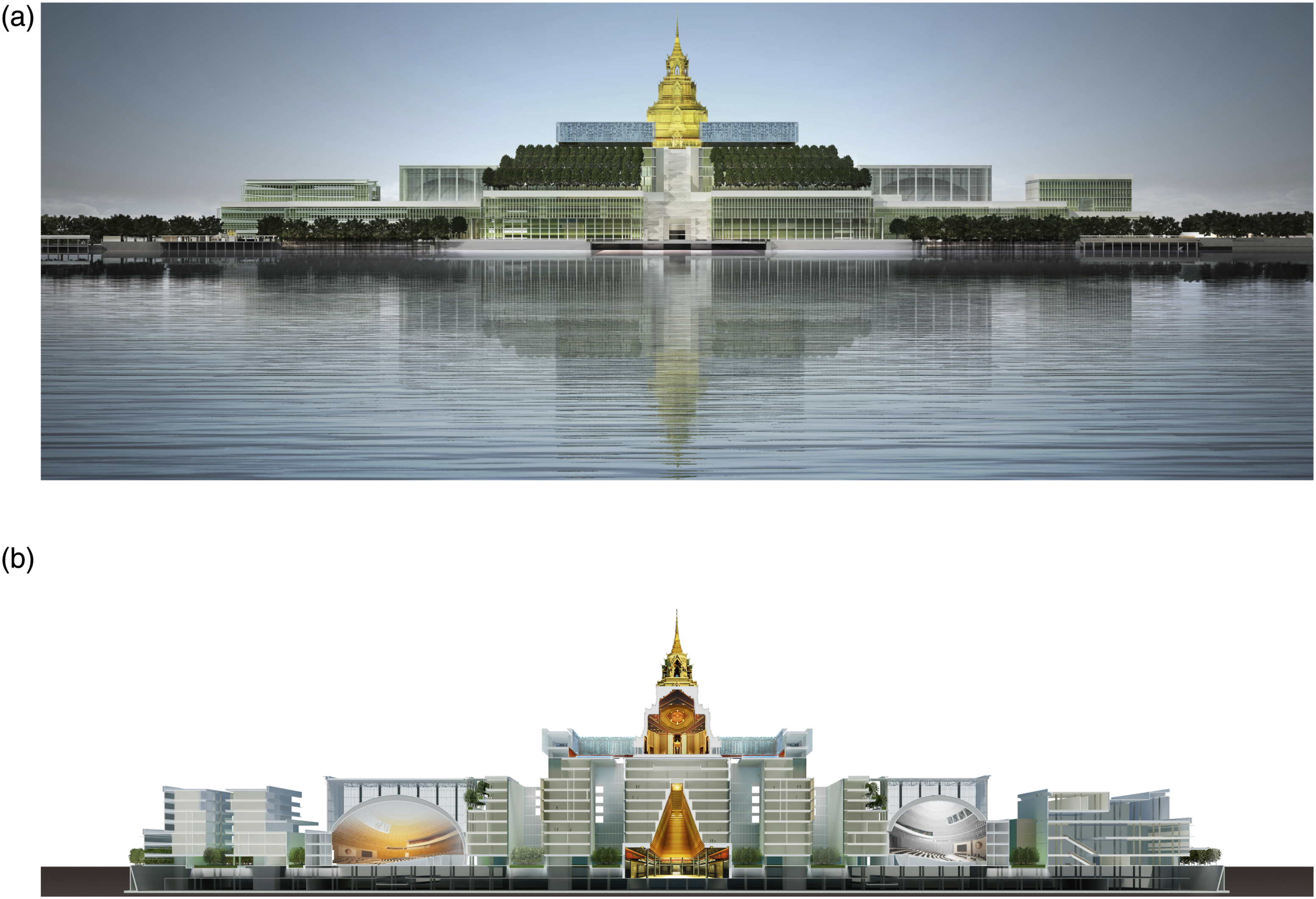
The Parliament exhibits the superimprinting of the past on to the present. The question, however, is the selection of that past—whose past? Here it is the royal-Buddhist past, implicitly the north-to-south Sukhothai–Ayutthaya–Thonburi–Rattanakosin past, but even more reflecting the 19th century, absolutist King Chulalongkorn. Any representation of a democratic past is to be eschewed. It can be seen as caught in the forever divisive tension between democracy and a royal-military-elitist hegemony—between the complex’s democratic function and its royal-Buddhist representation, even if they are conceptualised as an idealised symbolic synthesis.
Its vertical hierarchy at the central axis mundi is to represent the Trai Bhum Phra Ruang, the sacred pre-modern cosmology subsequently challenged by the more modern reforms of Rama IV (r.1851–1868) (Prakitnonthakan, 2009: 184). At the lowest level in that spatial hierarchy is the Democracy Museum, above it the chedi containing the hall for state monarchic ceremonies. In its upper level the chedi is surrounded by the cloisters of the Thai Nation Museum. Topping the composition is Phra Siamthewathirat, the protective spirit of the proto nation-state, created by Rama IV. A remaining concern: how will democracy be curated in the Democracy Museum—as an expression of the sovereignty of the people or as the gift of a benevolent monarch, following the now-sanctioned, royal-military narrative (Sintusingha and King, 2021)?
The triad of Nation–Religion–King is elevated to a sacred level while democracy is conducted on the earthly plane. The common people could approach the complex from a riverside park, then ascend a high staircase on the west-to-east axis to the summit, thence to circumambulate around the cloisters, a Buddhist practice of worship. In 2020, however, the building became a target for pro-democracy protesters and access to the complex was blocked by barricades and razorwire.
The chedi atop the Parliament might be seen as referencing the spires and chedis of the Grand Palace complex, as a grafting from the Grand Palace. More likely, however, it will be seen as a graft specifically from the Chakri Maha Prasat Throne Hall, thus as a graft from a graft and we observe the indeterminacy of chains of borrowed meanings. Traces of the Grand Palace are transcribed (its charisma taken) to legitimise a military junta and its subversion of democracy. Both monarchy and democracy are thereby compromised.
Allusion
The grand monument of the “People’s Party style” was the Supreme Court complex, designed around 1939 and built in stages from 1939 to 1963. All historical referencing was eschewed. The building’s location ensured that it confronted both the Mahathat temple opposite it and Grand Palace to its immediate south. It was widely seen as the most symbolically charged building of the People’s Party era and designed to express its ideology. So the six pillars at its entrance expressed the party’s six principles: the supreme power of the Thai folk, national security, economic welfare, equality, people’s rights and liberties, and public education. The monarchy is missing from the symbolism and had to be subsequently written-in with periodic portraits.
The brutal directness, geometric severity, even blandness of the Supreme Court building defied the glorious traditions expressed in the buildings surrounding it—chedis and spires of the Grand Palace, the glitter of the Temple of the Emerald Buddha, traditional forms of Wat Mahathat and the City Pillar. The affront was institutional—a law court intervening in the triad of Nation–Religion–King, yet it was also an affront of style (Figure 3). Allusion. The old Supreme Court building: all explicit referencing denied.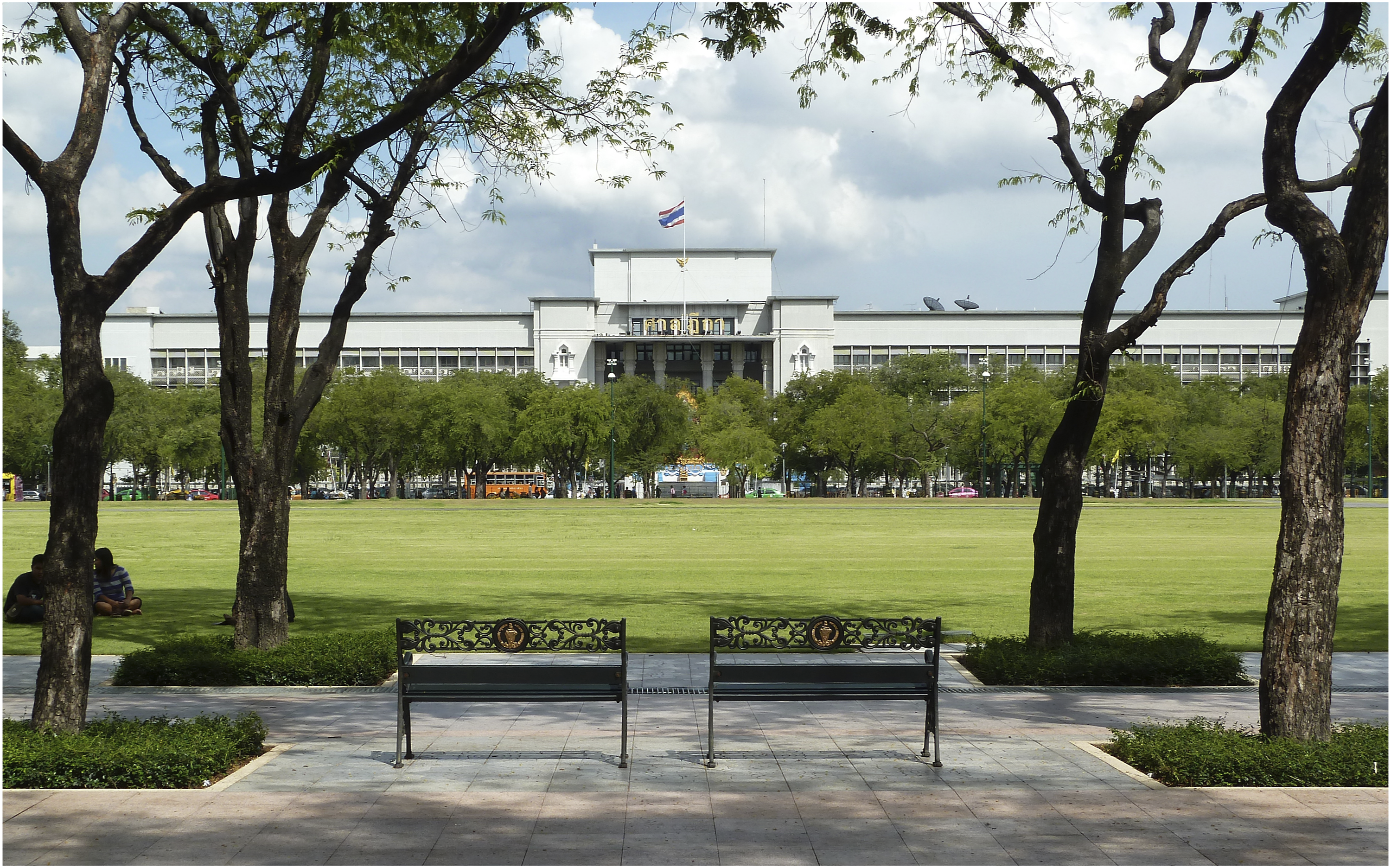
Chatri Prakitnonthakan, in The Art and Architecture of the People’s Party (2009), quotes a remark from Kukrit Pramoj (great-grandson of Rama II, prime minister 1975–1976, advocate for traditional arts): “If one speaks directly and with appropriate love of the country, one must say that the art after 2475 [1932 CE] was the worst decline in Thai art. There was no Thai art made during this period.” Chatri argues, in contrast, that the 1932 revolution marked a critical turning point in the history of Thai architecture. During the 15 years of the People’s Party governments, an architecture evolved that was decidedly different from that which came both before and after it, where its purpose was to destroy the system of symbols that reflected the sacredness and loftiness of the institution of monarchy, the centre of power in the absolutist system (Prakitnonthakan, 2009: 6, 124; 2020).
Around 1952, even as the construction of the People’s Party monuments was proceeding, there was a gathering movement to cleanse the city of its traces of revolution and shaming of the monarchy. The city was to be re-signed to express the new “truth” that democracy did not emerge from the actions of the common people, but from the goodness of monarchy (Chotpradit, 2016; 2018; Hewison and Kitirianglarp, 2008). Thongchai Winichakul (2008; 2016) argues that the radical left, moving from positions of Marxist and political-economy critiques of a Thai social structure prevailing after 1973, have especially since the coup of 2006 shifted to a cultural-nationalist advocacy of a “genuine Thai essence.” The cultural-nationalist ex-left rejected what it saw as a “bad” (Marxist, Communist Party of Thailand) nationalism and embraced a “good” one. A “good” nationalist architecture would therefore need to follow—Winichakul (2016) terms it “hyper-royalist”. Hence the chedi atop the Parliament.
There was a proposal in 2010 to demolish the Supreme Court building as major symbol of the People’s Party (Prakitnonthakan, 2004; 2009; Noobanjong, 2017). Despite a 2009 conservation award from the Association of Siamese Architects (proudly under Royal Patronage) and a declaration of its historic value from the Department of Fine Arts, its demolition duly proceeded in 2013. It was to be replaced by a larger and “more representative” Supreme Court—“a building exulting Thainess”, stated Pongkwan Lassus, President of the Association of Siamese Architects. As observed by Noobanjong (2017), the plan form of the new court complex mirrors that of its predecessor—the difference is in a heightened grandeur (the courts are substantially taller) and in its curiously hybrid traditionalist-modernist signification (Figure 4). Allusion. The new Supreme Court building: The wish-image of a better morality is written across an alien (imported, colonialist) idea of justice.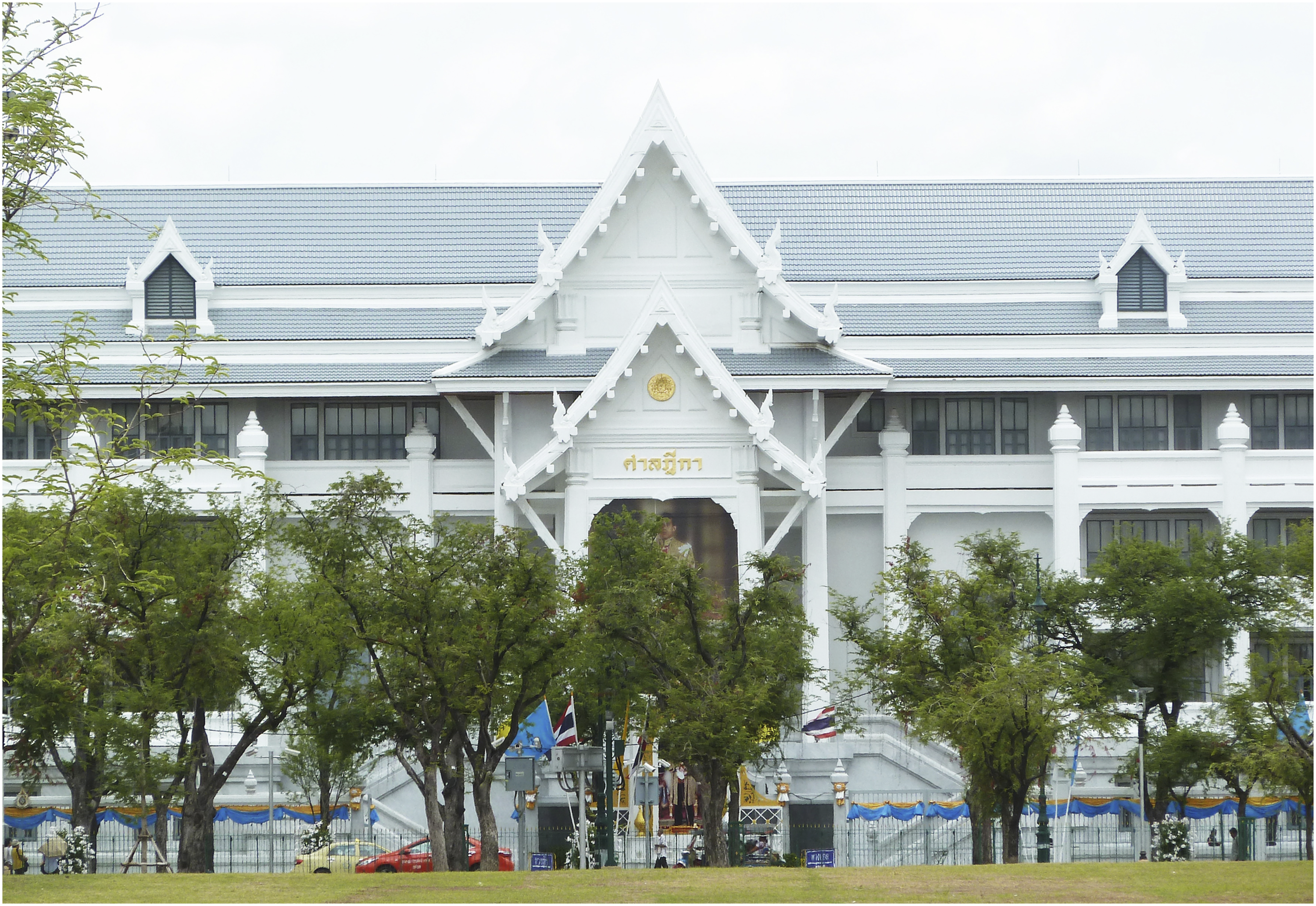
Architecture typically references other buildings, ideas and places. Walter Benjamin wrote on the referencing weaving through the architecture and arts of the Baroque: dark allusions characterise Baroque allegory, wherein a failed, decaying, chaotic world—entropic and melancholic—stands as “emblem” (a “montage of visual image and linguistic sign”) for history. It is an antique representational mode. For Benjamin, this grafting of old onto new was problematic, for allegory was a mode of representation peculiar to periods of prolonged war and destruction—a turning away in horror from the world of chaos and decay and, instead, the search for redemption in “the text” (Benjamin, 1972: 660–698; 1977: 343). To the conservative Thai mind, the time since 2001 would indeed present as chaos and decay, while the historicist “texts” of Parliament and Supreme Court would be mobilised to represent the promise of redemption at the hands of a military-monarchic junta.
In the 1970s and 1980s, architects widely began grafting references to past styles and ideas (memories) onto otherwise distinctively modern buildings. There was a combination of modern techniques and their representation with something else (usually traditional building) in order for architecture to communicate both with the general public and with a concerned minority, usually other architects. Architectural theorist Charles Jencks (1987) termed this practice “double coding”. In a very limited sense the super-imprinting of texts argued by Derrida (1981a) yields the “double coding” that Jencks sees as the identifying move of postmodernism in architecture. To Jencks, however, it was a strategy of resistance—a strategy of affirming yet denying the existing power structures by inscribing different tastes and opposite forms of discourse.
In the case of the Supreme Court, the double-coded text will more likely be read as one of unintentional (comedic) parody, but also as suppression: the compelled forgetting of the idea of popular democracy—both democracy (in the Parliament) and justice (in the Court) are now to be seen as gifts of a benevolent Buddhist monarchy.
The text—the Supreme Court—becomes a “thinking device”, triggering ambiguity, equivocalness and the evocation of new meaning (Lotman, 1988). To the traditionalist imagination, the Supreme Court might inspire—“a building exulting Thainess”—as a vision of justice emanating from a transcendent monarchy and Buddhist tradition; to a different imagining it is a military-monarchical hegemony, subverting justice and suppressing democracy.
Complexity and contradiction
In 1966 Robert Venturi (1966) published Complexity and Contradiction in Architecture, a seminal text in the discourse of “postmodernism” in architecture. Venturi argued for a self-emptying of architecture, to be rid of staid and static “truths”, to be thereby open to both the fulness (complexity) and incongruity (contradiction) of the always dynamic situations that it confronts. Lindstrom (2021) observes, however, that the architecture that followed Venturi’s dictum expressed neither self-emptying nor openness but instead a turn to assertiveness and historicism. Such, indeed, is the replacement Supreme Court building.
The notion of emptying and openness does, however, assist a reading of the Supreme Court’s political effect. The emptying (destruction of the People’s Party building) and the subsequent evocation of an earlier, absolutist “truth” (justice as royal gift) produces the new openness—the new resistance to monarchy and the assembling dissidents at the razorwire defending Parliament against the people (King, 2021).
Pastiche
The mish-mash of images that make up the Supreme Court building might be labelled a pastiche, imitating a style or character from one or more other sources. Unlike parody which mocks the work it imitates (perhaps unintentionally), pastiche celebrates it. Like parody, pastiche is the imitation of a unique style, the imagery or voice of others, but its mimicry is neutral, without parody’s satiric purpose—it is blank parody. Pastiche is a mechanism of intertextuality, in this instance the shaping of a text’s meaning by another text (Kristeva, 1980). Whereas referencing will be influenced by previous work, pastiche will directly copy.
Sanam Chai station is an underground rapid transit station on the Bangkok Blue Line, opened in July 2019. It is in the Rattanakosin old town and close by the Grand Palace and Wat Pho, also other temples, museums and palaces. To express its auspicious location it has been decorated in an early Rattanakosin theme—square pillars with gold lotus capitals, panelled and painted ceilings to resemble variously a throne hall and a temple, chandeliers. Like the Parliament and the Supreme Court, the station is part of the prevailing official turn to a recalled past—obligated remembering. Unlike them, however, the station carries no explicit political message. However, it is still political (Figure 5). Pastiche. Sanam Chai subway station: A railway station mimics a Theravada Buddhist temple. No irony, no parody.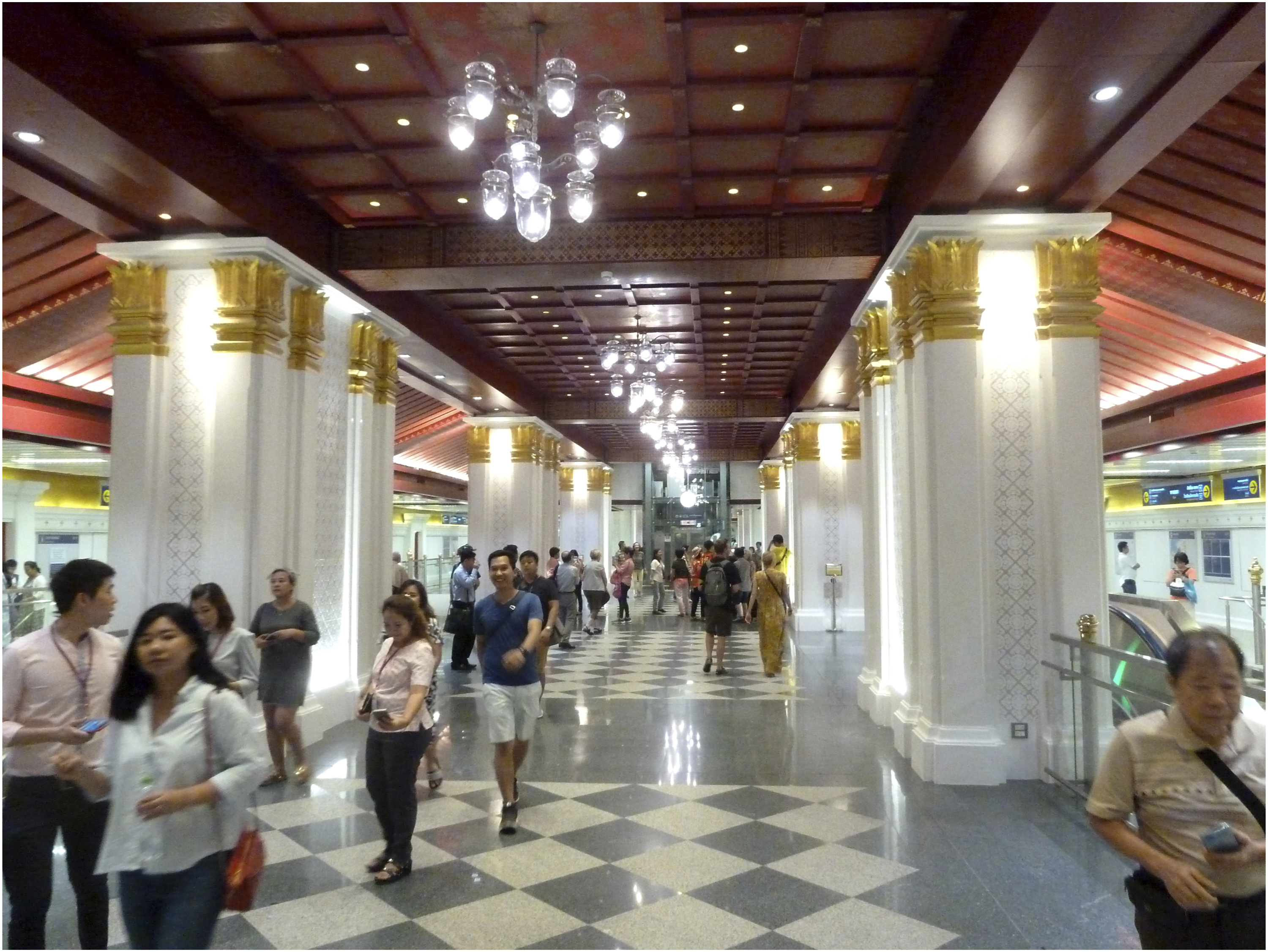
The program of the post-2014 military junta has been the reconstruction (re-imagining) of the political past—obligated forgetting (of the 1932 overthrow of monarchic absolutism) and obligated imagining of democracy as gift of a benevolent monarch and tolerant military and of royal-Buddhist virtue. The station reflects that endeavour: the visitor emerges from the station to confront an urban landscape of recently restored/reconstructed nineteenth-century buildings interspersed with more authentic, unrestored and still disorderly nineteenth-century buildings. There are restored, redecorated shophouses, a palace, and most dramatically a new and very extensive market complex in a faux nineteenth-century style more appropriate to a palace than a market—one of its entrances faces the station’s exit. The military junta and its subordinate Bangkok Metropolitan Administration (from 2016 to 2022 under a police general) have since 2014 substantially advanced an ongoing program of a “perfect” Rattanakosin, effectively a royalist-Buddhist theme park (Herzfeld, 2016; 2017).
The intended effect of the pastiched landscape of these variously restored and re-imagined elements of Rattanakosin, especially when read against the surviving, less “perfect” landscape of shophouses and old communities on which it is layered, is to create a sense of nostalgia—to highlight what has been lost. It can be read as part of the royalist-junta agenda to offer the vision of an alternative, “better” modernity, the dream of retrotopia, the future as return to an undead past (Bauman, 2017). It complements the two reimagined monuments of the Parliament and the Supreme Court, bringing their offered illusion down to the plane of street, market and everyday life.
Discussion
To repeat from the Introduction above, the (re)construction of a nation involves the purposive manipulation of memory—suppression of many memories and production of new memories (imaginings). The argument of this paper has been that the built environment and its signification are typically swept up in this endeavour; and the question posed has been: what are the mechanisms for this inscription of memories (meanings) and what are its effects—how does it work?
Bangkok (Thailand) has been caught up in multiple attempts to redefine the nation—to transform “the mind of the age” (Vygotsky, 1962)—first with the King Chulalongkorn (Rama V) turn to the idea of monarchical absolutism and imperialist internationalism, with architecture central to the endeavour; second, following the 1932 revolution against such absolutism, the turn was to the idea of parliamentary democracy and the sovereignty of the people, with architecture to signify the radical break; then, third, there is the compelled forgetting of that idea of democracy’s origin and instead the imagining of a different, royal-bestowed, military-guided “democracy”. The space of the city and its conveyed signals are thus left, in the present time, in a state of ambiguity and contested meanings, as the traces of each re-writing persist despite the suppressions.
The Chulalongkorn transformation is to be seen as expressed in the layering of a copied (translated) European-imperialist screen across a space and polity of feudal tradition (King and Lertnapakun., 2018). The superimposed screen took the form of institutions observed by Chulalongkorn in European-colonial centres, notably Singapore and Batavia, expressed in neo-Classical buildings mostly from Italian architects (King, 2011). The Chakri Maha Prasat Throne Hall constitutes a double-superimposition—an Italian neo-Classical palace is montaged onto the most traditional of royal-Buddhist spaces, only to have elements of that earlier tradition re-montaged onto it. It is a superimposition of architectural languages, and thereby of political visions. The building is a metaphor for the contradictions of what are to a Western eye incompatible traditions, and for the uncertainty that haunts a Thai idea of modernity.
The superimposition move is repeated a century-and-a-half later in the Parliament, with the contradictions and uncertainty also repeated. A distant past grafted onto the throne hall is, in turn, grafted onto the Parliament: indeterminacy of references ensures opposed readings, as both democracy and monarchy are highlighted as always already compromised.
The People’s Party-initiated Supreme Court building, like other monuments of the People’s Party, indicated the epistemic break by eschewing all referencing to either a royal-Buddhist past or the Chulalongkorn imperial desire. There was still referencing, however, most notably to art deco and Mussolini fascism—two aspects of 1930s modernity. As military, monarchy and conservative elites melded in the 1970s into a “network monarchy” (McCargo, 2006), memory of the People’s Party would be dismissed, suppressed, then finally in the 2010s its emblematic monuments removed, the Supreme Court building replaced.
The double coding of the new Supreme Court building ensures that, like the Parliament, it will be read differently by different publics. Peter Brooks (1976) has written of the distinction between a melodramatic and an ironic imagination: a melodramatic imagination would seek hidden moral values in a world in which values are being destroyed. By contrast, an ironic imagination and view of history builds on ambiguity of meaning—rather than look for hidden meanings in history, irony points to the uncertainty of history by showing that positive truth is not possible. A royalist-conservative eye (and melodramatic imagination), nostalgic and mourning for an imagined “better” time, will see the new court building as expressing the eternal truth of a royal-Buddhist descent; a dissident eye (from a more ironic imagination) will focus on the overthrow of democracy and denial of a secular descent. The dissident classes, thus challenged, assemble in 2020 to demand the end of the junta, “reform” of the monarchy and the restoration of democracy (King, 2021).
Dystopia, utopia
Walter Benjamin (1973): 159 has warned of the delusions of utopia: In the dream in which every epoch sees in images the epoch which is to succeed it, the latter appears coupled with elements of pre-history—that is of a classless society. The experiences of this society, which have their store-place in the collective unconscious, interact with the new to give birth to the utopias which leave their traces in a thousand configurations of life, from permanent buildings to ephemeral fashion. (Benjamin (1973): 159)
Since the 2001 election of the populist, province-supported government of Thaksin Shinawatra, a royalist-conservative elite has confronted an era of seemingly dystopic “electoral dictatorship” (King, 2021). Redemption would be sought in the imagined memory of a lost past; in that “collective unconscious,” class division would be imagined away under the rubric of “reconciliation”.
In the consciousness of the royalist elite, a new, wished-for dispensation would be written on the fabric of the city, in grafts and superimpositions from an autocratic, royal-Buddhist past—the dream of retrotopia, an undead past (Bauman, 2017). On the other side of the distinction, aggrieved at the 2014 destruction of democracy, the new (an imagined democratic order) is mythic, its pathway still to be discovered. It is Fukuyama’s (1992) insight, that we seem to be stuck in the infinite duration of the present moment—any imagining of progress is illusive. The infinite horizon of future possibilities has folded in upon itself.
To the aggrieved democracy advocate, the Parliament building is provocation, a “thinking device” (Lotman, 1988), generating ambiguity—new and unintended meaning. In late 2020 and continuing into 2021, mass protests and demonstrations targeted the Parliament and, more significantly, challenged the King and the institution of monarchy blatantly expressed in the Parliament and more implicitly in the Supreme Court and the wider re-signing of the ancient city.
Conclusion
The paper’s first objective related to reading the city as a political text. Architecture presents a diversity of languages which, like verbal languages, are able to be declaimed rhetorically in the pursuit of political programs. The power of architectural utterances will typically exceed that of verbal utterances, first because they are read differently, in a state of distraction as with cinema, second because they persist long after the declamations and manifestos of demagogues, and third because their power is to play with the popular memory. Indeed, they enter a distracted memory.
Architectural utterances, like the verbal, will be translated—grafted from one place or time, to be montaged onto another; there are also translations across architectural languages. When those different languages are discordant in terms of the values they suggest (the Chakri Maha Prasat Throne Hall, the new Parliament), the effect is ambiguity, albeit typically unintended. There will be double-reading—what is comfort to one reader is provocation to another. Then there is referencing, also a form of translation though not so much of elements (architectural utterances) as of traces, allusions, half-recalled memories.
Whereas montage, in these Bangkok cases, would attempt to re-make both society and nation by redefining their origins, referencing in the case of the Supreme Court would redefine the source of morality and law. With the pastiched re-making of the historic city of Rattanakosin, it is a vision of a better everyday life that is conjured—Thai, anti-modern, a retrotopia. However, to every violent action (and the denial of popular sovereignty is indeed violent), there will be an equal and opposite reaction—to both military junta, legitimating monarchy and distorted history. We see it in the previously unthinkable confrontation to the legitimating agency of monarchy.
The paper’s second objective related to the utility of the categories (words) used in undertaking the above analysis—transpositions (translation), montage, allusion and pastiche. The observation has been that the categories reveal much but also that they gloss over much. The political operation of transposition or translation, in particular, has called for qualifiers—transcribing, transposing, relocating, replicating. Further, in actual applications there can be slippage between categories, notably between translation and montage, also between montage and pastiche. The utility of the categories to distinguish between political operations persists, however.
Footnotes
Declaration of conflicting interests
The author(s) declared no potential conflicts of interest with respect to the research, authorship, and/or publication of this article.
Funding
The author(s) received no financial support for the research, authorship, and/or publication of this article.
