




Abstract
The natural environments of conflict arenas often embody invisible contexts for political analysis. This study questions how environmental agendas are framed and acted upon by mid-level environmental professionals engaged in land-focused conflict. Ideological attachment to contested land together with engagement in the polemics of conflict, facilitate unique engagements with environmental agendas, particularly regarding open space preservation. This engagement prioritizes conflict-related goals and thus creates discrepancies between environmental knowledge, attitudes, and actions. Our study focuses on Israeli West Bank settlers who serve as mid-level environmental professionals and share professional dilemmas. Mid-level environmental professionals, rather than high-level policy and decision makers, are “street-level bureaucrats” and therefore a potentially novel and revealing source of environmental positions within the settler community. Through interviews focused on Israeli environment-related policies in the West Bank, we reveal disparities between environmental knowledge and the positions grounded in this group’s political identity and loyalties and identify the three particular harmonizing strategies employed in narrating the realities of their professional initiatives and agendas. We expose a distinct dual agenda, one which acknowledges environmental values and concerns, and yet only selectively recognizes and engages in goals of open space preservation when these challenge settlement infrastructure and expansion. These environmental discrepancies can be interpreted as the cynical political manipulation of environmental values, yet we propose that at a mid-level professional level, they can serve as self-rationalization in resolving dual loyalties to both political and environmental agendas. Personal realities and life experiences of environmental professionals affected by the conflict are identified as significant to the design and support of the resulting selective environmental agenda.
Introduction
Environment in the context of conflict has been the focus of research regarding the environmental consequences of war (Austin and Bruch, 2007), and environmental security and peacemaking (Dodds and Pippard, 2013; Ide, 2018). We expand the scope of political environmental discourse and question the effect of land-focused conflict on the framing of and support for environmental agendas by ideologically identified parties affected by conflict. We reveal the channels through which environmental values reflect land-focused conflict, rather than embody common ground in the facilitation of peacemaking.
Environmental agendas have been identified as “party-sorting” in their divisive effect on domestic conservative-liberal political discourse on the desirable levels of government market intervention, environmental regulation, and even the scientific credibility of a looming environmental crisis (Clark et al., 2019; Dalton, 2015). Partisanship is exacerbated in the context of conflict, where land-related values are prioritized, and environmental concerns are perceived as of less urgency to those facing imminent and existential threats (Carmi and Bartal, 2014). This hierarchy of threats frames both policy and prospects for bi-partisan environmental cooperation.
We question how local contexts of conflict may consolidate individual and group identities, forming a prism through which environmental agendas are framed. In the context of the Israeli-Palestinian conflict, the environmental realities of the West Bank are a by-product of multiple agencies. These include the Israeli government, the Palestinian Authority, non-governmental organizations, businesses, local Palestinian and Israeli authorities, and individuals. Among these, we identify Jewish-Israeli West Bank settlers engaged in environmental education, management, and administration, who are therefore central to the environmental management of the West Bank. Contrary to high-level policy and decision makers, we identify these mid-level environmental professionals as “street-level bureaucrats” (Cohen and Aviram, 2021) and therefore a potentially novel and revealing source of environmental positions within the settler community. These individuals affect and implement policy through their regular interaction with higher-level policymakers and the public. Their social and professional identity frames both the discrepancies between their environmental knowledge, attitudes, and actions, and the three harmonizing strategies they employed in resolving these discrepancies - ideological reasoning, environmental pragmatism, and attention-shifting.
Our focus on Israeli-settlers acknowledges Israel’s power as the dominating agency occupying the West Bank and determining physical and environmental realities through multi-faceted, settler-oriented policies. While not internationally recognized as sovereign, Israel executes planning and development that realize national Israeli agendas in West Bank territories. Israel’s controversial control, planning, and settler-oriented developmental actions are perceived by Palestinian, international, and many Israeli political and environmental organizations as detrimental to Palestinian land rights, quality of life, and prospects of realizing legitimate national aspirations.
The realities of the West Bank territorial conflict serve as the context for our case study, which is not a comprehensive analysis of the Israeli-Palestinian conflict, nor of the impact of Israel’s West Bank occupation on natural resources, land, and Palestinian human rights. Rather, it focuses on the subjective perceptions of a specific ideologically identified population, regarding the intersectionality of ideology and environmental practices in the context of contested land. The Israeli settler narrative reflects a narrow but powerful agency that designs political, physical, and environmental realities in the West Bank. Palestinian environmental dilemmas and policies of land-claiming and developing further complement and complicate environmental realities in the West Bank and warrant a separate study.
We begin with a theoretical framework of environmental values and of discrepancies between values and behavior. We then analyze the centrality of open space to environmental discourse and its reflection in Israel’s planning and development policies, both in Israel and in the West Bank. We present our case-study methodology and move on to present and discuss our field research findings, identifying distinct “harmonizing strategies” employed by our research respondents to bridge environmental discrepancies in the context of territorial conflict.
Theoretical framework environmental values and discrepancies
A simplified outline of the main rift in environmental politics is the schism between right-wing free-market economy values versus left-wing environmental concerns and agendas (Mccright et al., 2015). Contemporary partisanship grows as far-right conservatives increasingly disengage from environmental agendas (Dalton, 2015). Radkiewicz (2017) argues for a bi-dimensional model, whereby social identity and socio-economic values are separate, though often positively correlated. Harring and Sohlberg (2016: 279) insist there is “nothing fundamental in the left–right ideology, which says that right-leaning individuals should deprioritize environmental issues”.
Notwithstanding right-left politics, environmental attitudes and engagement reflect personal values (Clayton and Opotow, 2004), cognitive capacities, emotional and moral sensibilities, childhood experiences (Kahn and Kellert, 2002), culture and education (Kahn, 1999), and their rural/urban contexts (Hinds and Sparks, 2008). Environmental attitudes are thus formed through personal identity, traits, experiences, and values. These are continuously constructed socially and politically through the communities we join, the lifestyles we choose, and the futures we pursue.
Environmental attitudes and knowledge are not sole predictors of behavior. Inconsistencies in environmentally responsible behavior – environmental discrepancies – are recognized as psychological and cognitive phenomena (Thøgersen, 2004). Diekmann and Preisendörfer (1998) identified “harmonizing strategies'', which individuals employ to resolve inconsistencies between environmental consciousness and actions. These include justifications, excuses, and moral licensing (Gholamzadehmir et al., 2019), shifting attention from environmental digressions and highlighting low-cost environmental sacrifices. Discrepancies are usually identified as inconsistencies between values and personal interests and convenience, yet we claim they could stem from less tangible sources, such as ideology and perceptions of threat, which are central to experiences of conflict.
Subjective perception of threat (Sjoberg, 1998) is a distinct prism through which identity and environmental attitudes intersect and design behavior (Axelrod and Lehman, 1993). The prioritization of simultaneous dangers is considered to reliably predict behavioral action (Dunlap et al., 1993). Non-acute threats to the environment, such as global warming or environmental degradation, loom ahead in societies’ medium to long-term future. Yet because they are perceived as abstract, they tend to rank low compared to more existential and tangible threats (Diekmann and Franzen, 1999; Leiserowitz, 2005). Thus, environmental threats are consistently downgraded during periods of economic distress due to their perceived temporal distance (Dunlap et al., 1993). Security threats, perceived as the most imminent and threatening both temporally and spatially, negatively impact engagement in environmental behavior (Carmi and Bartal, 2014).
Conflict, and more so intractable conflict, defined as existential and spanning decades (Coleman, 2003), profoundly impacts individuals and society, as well as their goals and inherent values. Bar-Tal (2007) identifies a distinct socio-psychological repertoire, a collective societal narrative that developed from intractable conflict, which promotes adaptation to severe experiences of hardship, threat, pain, grief, and trauma. This repertoire includes simplified beliefs which support the need for long-term societal mobilization and sacrifice and serve as a prism through which new conflict-related information, experiences, and challenges are filtered, interpreted, and incorporated.
This filtered interpretation by those engaged in conflict is especially relevant to environmental agendas where land, its use and misuse, and the critical value of open space is often a central issue. Yet land is perceived as central to national and ethnic values, hence the intersection between environment and territorial conflict.
Open space in environmental discourse
Open space preservation promotes habitat diversity by protecting local ecosystems. It facilitates aquifer renewal, climate moderation, flood management, and air purification (Brody and Highfield, 2013; Elmqvist et al., 2015). Open space protection preserves historical and cultural landscapes (Walsh, 2012) and promotes physical activity and wellbeing (Bertram and Rehdanz, 2015).
Open space preservation faces multiple barriers, as opposed to other environmental efforts, such as conservation and recycling, which do not require significant economic sacrifices or lifestyle changes (Dalton, 2015; Diekmann and Preisendörfer, 1998). Nature is often commodified for the “services'' it provides to humans and private ownership, and economic development interests dominate open space discourse (Kopnina, 2015). Hence, private-public interests regarding development magnetize public debate, more so than the multitude of environmental values of open space preservation (Tal, 2008).
While, in the context of conflict, the environment serves as an underlying shared interest and a potential basis for interdependence (Conca, 2002; Glausiusz, 2018), land is laden with national, cultural, political, and economic significance and interests, and therefore open space preservation is rarely consensual.
Open space in Israel and the West Bank
Environmentalism embodies the convergence of global and theoretically consensual concerns with local, particularistic, politically contested perspectives (Benstein, 2005). “Environment” may imply a neutral or apolitical space, but in the context of both Israel (Alatout, 2005) and the occupied West Bank (Braverman 2021), it is neither. The West Bank is an arena of extreme political conflict, yet it is contextually situated within the wider context of Zionism and the environmental priorities of Israel.
Israel’s history reflects the prioritization of development ideals and interests over environmental concerns (De-Shalit and Talias, 1994). Contemporary environmentalism in Israel has evolved from a predominately romantic, nature-centered approach to a second paradigm of focus on pragmatic agendas of land-use, planning, problem-solving, and public-health concerns (De-Shalit, 1995; Garb, 2011; Tal, 2008). Most Israeli environmental organizations can be categorized as “third paradigm” environmentalism, in their advocating for global social and environmental agendas and commitment to values of social justice and human rights (Orenstein and Silverman, 2013), which are perceived as the basis for acknowledgment of Palestinian rights.
Settlement of Israel’s limited open space exposes conflicting perceptions of nature protection. Contemporary Israeli environmentalists, conscious of global principles of sustainable development, call to abstain from further land development, while nationalists prioritize settlement expansion as a political and environmental imperative. (Dromi and Shani 2020: 16) note how “...the finding that pro-settlement actors believe themselves to be environmentalists sheds light on a key facet of their belief system”.
Tensions between perspectives of patriotism and environmentalism are reflected in the following dialogue between environmentalists and former settlers, regarding the resettlement of Gush Katif evacuees in the Lachish south-central lowlands of Israel, after the 2005 Gaza Strip disengagement (Dromi and Shani, 2020: 15): Adva (a Gaza Strip evictee): “There’s nothing there (in the Lachish area)! No trees and almost no plants. It’s a wilderness.” Ecology professor: “It’s an important ecological corridor with many species, butterflies, reptiles, and rare vegetation. The fact that you didn’t see elephants there doesn’t mean it’s not a sensitive spot….”. Adva’s husband: “So for a measly butterfly you abuse us like this? You’ve seen what goes on across the fence [on the Palestinian side]—you can be sure there are no butterflies there. That’s the problem with all of you. You care about butterflies and not people….” Amit (environmentalist): “... we care about both people and butterflies.”
New settlements in the northern Galilee and southern Negev regions of Israel reflect the same dilemmas of open space preservation that conflict with private sector real estate commodification as a vehicle for ideologically motivated Jewish settlement (Schwake, 2021a, 2021b). Open space preservation is often perceived by nationalists as an excuse to prevent Jewish settlement (Shani, 2017). Notwithstanding, Israeli Palestinian Arabs experience open space preservation as a tool of infringement on Arab land ownership and rights, preventing non-Jewish settlement.
Extreme dilemmas of open space are reflected in the circumstances and dynamics of occupied territory in the West Bank, with its Palestinian population of 2,481,434, and Jewish-Israeli settler population of 634,500 (CIA, 2020), living in approximately 150 Jewish settlements (Peace Now, 2019). Israel’s settlement of the West Bank is viewed as the fulfillment of an expansionist vision of Greater Israel (Sand, 2012; Selengut, 2015). Yet these settlements promote multiple national goals since Israel’s 1967 West Bank occupation.
Initially, settlements were designed to prevent future repatriation/withdrawal and were built mainly on Ottoman Empire and British Mandate state land, or seized for public needs (Home, 2003) in locations perceived as strategic to Israel’s security, its Palestinian population control, its water supply (Lowi, 1993; Zeitoun, 2008), or in economically lucrative regions adjacent to Israel’s cities (Lein and Weizman, 2002). Affordable housing adjacent to Israel’s metropolitan regions is a central motivation for settlement development and for relocation to affordable West Bank gated communities (Allweil, 2020). Geopolitical concerns regarding Israel’s eastern border further justify Israel’s settlement rationale (Hasson, 2010; Newman, 2002).
Since the 1993 Oslo Accords, Israel has declared restraint in establishing new West Bank settlements, and instead focuses on building within existing settlement borders. New settlements are often portrayed as existing settlement expansion (Peace Now, 2019). Notwithstanding, illegal residential outposts (ma’achazim in Hebrew) and farming outposts (Grosglik et al., 2021) are built by settlers throughout the West Bank. Due to the different identifications of these outposts, there is disagreement about their exact number, with estimates ranging between 88–105 (Peace Now, 2014, 2019). Despite their illegality, most outposts are eventually connected to infrastructure, reflecting their positive image as dedicated to promoting Jewish presence on state land (Peretz, 2020).
Settlements, and more so outposts, are often associated with radical political and religious views, yet they are demographically diverse and often reproduce wider Israeli social dynamics (Dalsheim and Harel, 2009; Handel et al., 2015). The outposts, although often characterized as constructed and populated by deeply ideological “hilltop youth”, are actually “localities for ordinary people” who pursue affordable community life, centers of study, and “new-age” communities – environmentalists and organic-loving bourgeoise (Tzfadia, 2017: 102–103).
Settlement and outpost construction are mostly dispersed, designed to catch as much land as possible (Lein and Weizman, 2002; Peace Now, 2019) while depleting West Bank open space. They demonstrate the deeply political nature of local planning regarding law, land-use, and budget allocation. Housing construction is supported by national infrastructure networks – electricity, waterworks, mining, and wide highways. Settlements and outposts are intertwined in the larger Israeli real estate market, reflecting entrenched norms and policies of neoliberal governance (Allweil, 2020).
Political and demographic complexities of the West Bank are thus reflected in its environmental challenges, mainly the diminishing open space resulting from the ongoing politically-oriented land grab (Abu Helu, 2012; Cohen, 2006; UCI, 2021). The environmental analysis serves to contribute to the developing discourse of “normalizing occupation”, which focuses on wider motivations, coalitions, and policies upon which the occupation is expanded, rather than on narrow radical settler ideologies, which have long dominated the settlement project analysis (Allegra et al., 2017). This discourse identifies the normalization of the Israeli occupation through multiple avenues of social and economic planning and policies of development, housing, suburbanization and privatization. These serve to normalize the development of the West Bank as a “compensatory mechanism” in the context of receding welfare state policies in Israel (Allegra and Maggor, 2022: 8). Bottom-up activities of planning and production of space substantiate the macro-politics of occupation, as “daily acts regularly become issues of sovereignty” (Yacobi and Pullan, 2014: 532). Thus, environmental perceptions of settlers demonstrate the embeddedness of planning in its surrounding socio-political environment. Planners' agency becomes strategic in realizing multiple ideological-political and socio-economic agendas (Rokem and Allegra, 2016).
Research design and methods
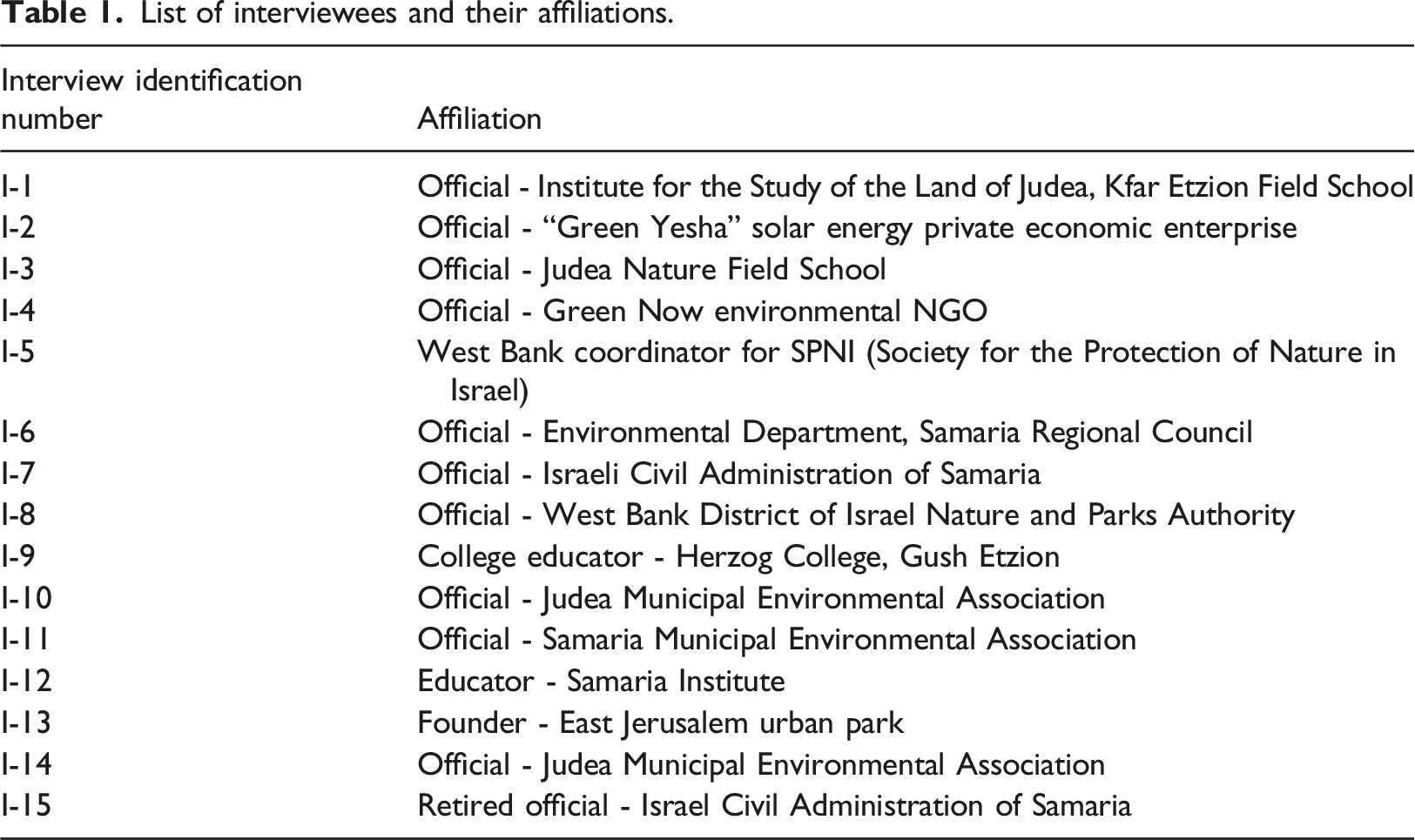
This study was carried out between 2019–2022 and was based on fifteen in-depth interviews carried out with mid-level environmental professionals, who live and work in the West Bank. Most interviews were carried out within work settings throughout the West Bank, where we familiarized ourselves with the environmental contexts and dilemmas and facilitated open dialogue.
This targeting significantly narrowed the selection of interviewees who were identified and engaged with through personal and social networking. Interviewee selection was based on willingness to participate (convenience sampling) and snowball sampling, proven effective in engaging respondents in sensitive circumstances (Cohen and Arieli, 2011).
Two criteria were employed in selecting interviewees: functional and geographic. The interviewees were not decision-makers nor politicians, rather professionals who operate in the field, impacting the environment in the West Bank – heads of nature-field schools, local government and NGO officials involved in environmental planning, management, and conservation. Six of the respondents were selected from the public sector, four from the education sector, three from non-governmental organizations, and two from the business sector. Most interviewees are also residents of West Bank settlements. Most (64%) of the respondents were men reflecting male dominance in environmental positions. Only two of the interviewees were secular while the rest were national-religious, reflecting the demographics of most West Bank settlements.
The interviewees were asked a basic set of questions regarding their personal affiliation and responsibilities, and specific questions about environmental beliefs and values. Most agreed to be recorded. Interview analysis was sector and theme-based, reflecting interviewees’ positions and perspectives on issues ranging from environmental education and youth activism to recycling and open space protection. Vested ideological interests were central to our interview interpretations (Lovering, 1999).
Settler identity and environmental values
Before approaching our respondents as individuals, we evaluate their group identity and values as mid-level environmental professionals of the settler population. We follow Weiss’ (2011:43) perception of settlers’ values as “socially specific byproducts of roles and functions in which individuals find themselves.… Residents are therefore vehicles of settlements’ institutional reproduction by virtue of their very being, as clients, members and supporters, irrespective of their personal beliefs”.
Hence, we assume that our respondents share significant elements of settler identity and values. These can be characterized as politically right-wing, as reflected in their deep engagement with nationalist ideals of Jewish rights to the Land of Israel. Settlers share concern regarding security, inherent to their community locations in the West Bank, and regarding the future of the settlement project. Many experience a clash of identities – in perceiving themselves as accepting state authority as part of wider Israeli society, yet potentially opposed to state authority in their demand for state reinforcement of settlements (Paryente and Orr, 2003).
Settlers can thus be characterized as “devoted actors” (Atran and Ginges 2015) holding “sacred values” (Ginges, 2015), which, in contexts of extreme conflict, serve to bind people together in groups of committed non-kin. Sacred values constrain the choices people believe they have and challenge the likelihood of balancing commitments to sacred ideals with everyday responsibilities, what Ginges calls “tragic tradeoffs”. These will be central to our analysis.
Voices from the field: Discrepancy and harmonization strategies
List of interviewees and their affiliations.
Ideological reasoning
Ideological agendas prioritizing West Bank settlement expansion over open space preservation serve as our first harmonizing strategy and analytical category.
This clear ideological position was stated by I-2, who claims “there is competition for territory, so we must, first seize it. The environment comes later.” Indeed, many respondents referred to environmental ideology and values. I-11 revealed that “the settlers found a new way of saving land, not through building new houses but through environmental projects such as the creation of farms, hiking trails, and nature reserves”.
I-15 referred to environmental ideals within the constraints of political realities. “There is a struggle between the two populations (Israelis and Palestinians) over open space. An ecological farm strives to preserve space from an ecological point of view, and this is much better than Palestinian attempts to capture areas by quarries and herding sheep”. I-2 outwardly admitted using the environment for realizing ideological agendas. He proudly presented his enterprise as promoting multiple benefits of clean and cheap energy while supporting settler employment and securing West Bank land for Israeli interests.
Ideological content of environmental education was referred to by several respondents. I-10 argued that “environmental education, ultimately, is the education for the love of the country and Zionist education is synonymous with environmental education.” I-9 claimed that the “settlers are environmentally aware on a certain level, and the environment is included in the love of the land that characterizes it, but it speaks to them in a different language”. I-3 noted that Israeli field schools “focus on exploring the land and are less concerned with nature itself”. I-15 proudly stated that environmental education is now in the curriculum even where there is hardly any environmental awareness such as the ultra-orthodox settlements of Modi’in Illit and Emanuel, where “there is success in expanding environmental education among girls”.
The ideological left-wing opposition of professional peers within the Israeli community of environmental organizations, which denounces West Bank occupation and refuses communication and cooperation with Jewish settler environmentalists, was described by many as a source of frustration. I-1 told us about the 2018 Hebrew University conference “Environmental Quality and Nature Preservation Transcending Borders”, which was denounced and boycotted by left-wing environmental NGOs (Hammerman, 2018) due to the participation of Israeli West Bank environmentalists and their organizations. I-1 was saddened by the lost cooperative potential for addressing urgent West Bank environmental needs.
I-9 argued that “left-wing Israeli political movements monopolize the environmental discourse. It is therefore difficult to create political right-left common ground and cooperation”. She claims that there is no inherent contradiction between political ideology and environmentalism. The right-wing public “is environmentally conscious, and their environmental concern is found in the love of the land... the only difference between left and right is in the discourse or semantics''. I-11 argued that “left-wing environmental organizations refuse to engage in addressing environmental challenges in the West Bank” and that these organizations are only concerned with “saving polar bears”. Furthermore, I-1 argued that the very existence of right-wing environmentalism is threatening to mainstream Israeli environmentalists whose left-wing ideologies clearly monopolize the discourse. This explains why “left-wing environmentalists are not willing to help us (Israeli environmental stakeholders working in the West Bank)”.
An ideological perspective regarding a needed balance between preservation and development was voiced by Noam, a resident of the Neve Erez outpost. He referred to his Palestinian neighbors as both sharing responsibility for environmental degradation and as potential beneficiaries of environmental action: “Ultimately, our very existence harms nature. We build a road but that harms how the ground absorbs water. Our house damages nature, but you have to try not to do harm. In our region there is too much Bedouin grazing; this kills many types of flora and animal life. On our hilltop, we are repairing what we can. Grazing is done in a measured way here. We don’t view ecological commitment as a form of self-denial. Instead, we do it for our own benefit, here and now. If the human race were not so swinish, there would be enough for everyone (Levinson, 2010).
This essence of balance was voiced by I-8, who concluded that “the mission is to preserve nature, to harm nature as little as possible in a world of uncertainty and constant security-related changes. And we are doing our best”.
I-4 was most far reaching in her call to better balance settlement, development, and environment, even at the cost of limiting settlement. “Judea and Samaria are becoming Israel’s garbage bin, a place that is ‘out of sight, out of mind’. The tension between Jewish presence in Judea and Samaria and environmental values is not unique to this area. It is a tension that always exists, throughout Israel, between nature conservation and development. Furthermore, there shouldn’t really be tension between settlement and preserving nature because you don’t need to establish a settlement in every natural area. One can express love for the Land of Israel through hiking.”
Environmental pragmatism
Our second harmonizing strategy and analytical category focuses on environmental pragmatism. The realities of the conflict were repeatedly referred to as rationale for expanding settlements, despite the environmental cost.
Thus, I-9 argued “land surrounding the settlements should be preserved as open space and not used for construction, but the Arabs take over the land so we must respond. We are forced to enter this competition game over land”. I-1 stressed the imperative for Israeli settlement considering ongoing Palestinian construction depleting open space. He sees Israeli settlement as environmentally preferable to Palestinian settlement, due to the higher environmental awareness of Israelis, reflected in protocols and projects of wildlife and plant protection and water source rehabilitation. I-12 argues that “Israeli settlement expansion is self-defense and is a reaction to the significant Palestinian expansion and illegal encroachment on Israeli state land”. In this vein, I-3 claimed “it’s either us or them, and they (the Palestinians) do not care much for the environment. We protect the environment better than the Arabs do. The solution is to settle the land and thus protect land and nature”. I-1 added that without their “Desert Edge Agricultural Farm” in Tkoa, the Palestinians would have taken over that land and carried out more damaging development. A more nuanced perspective was voiced by I-8, who believes that reality is complex and admitted that “settlement leaders are in disagreement regarding the conflicting values of settlement expansion and nature conservation”.
The realities of the outposts were not environmentally nor ideologically contested by our interviewees, but rather accepted or even tacitly supported. They are perceived by I-6 as a practical strategy, addressing settlement growth needs and realizing the vision of “one million settlers”, despite the limitations on new settlement construction since the Oslo Accord. I-15 claimed that “most of the outposts are a direct response to the occupation of Area C by the Palestinians”. Local environmental officials such as I-10, focus their environmental efforts on minimizing the damage to open space rather than opposing settlement expansion or outpost construction.
An especially pragmatic approach was expressed in the respondents’ deep concern with Israel’s severely lacking environmental supervision in the West Bank. This lack of supervision reflects the environment’s inferior importance in the hierarchy of Israel’s policies in the West Bank. This was denounced by most respondents as severely detrimental to the environment, mainly regarding water and sewage management. Thus, I-1 argued that “the most pressing problem with respect to environmental issues in the West Bank is the lack of long-term planning. There are no decision makers. A reality of life without government.” I-13 stated that “there is zero planning. Someone must start planning, otherwise there will be an environmental disaster”. I-10 and I-11 also lament the lack of interest of Israeli policy makers in environmental problems in the West Bank. I-11 provides an urgent example: “Israeli outposts are established without planning, and the biggest problem with this is that these outposts are not connected to sewage pipelines, creating major environmental damage”.
An example of pragmatic inclination was presented by I-15, who regretfully described a closed sewage treatment plant built in 2008 to serve the area surrounding the Ofra settlement. This plant, built partially on private Palestinian land, could potentially treat both Israeli and Palestinian sewage, yet legal issues and repeated Palestinian petitions prevent the facility’s operation, leaving untreated sewage to pollute the mountain aquifer as an acute ongoing environmental problem.
Security was pragmatically recognized as an issue of greatest concern that dominates policy. According to I-5, “in decision-making, the priorities are as follows: nature conservation and protection are at the lowest levels, slightly above are environmental issues such as recycling, and at the top by a huge margin, are security, political, and economic issues”. I-8 argued that the “planning committees value nature conservation, but when security considerations are significant, that consideration, of course, becomes trivial”. Furthermore, I-8 added that “security risk is a daily issue, and it is impossible to say no to a matter that has a security risk. This affects all areas of activity”.
I-5 pragmatically recognized the structural-administrational aspect of Israel’s West Bank environmental policy, which is the heart of the problem. “The protection of the West Bank environment is under the Israeli Defense Minister, not the Ministry of Environmental Protection. Therefore, the environment is inherently subject to security. Tensions between Arabs and Jews prevent long-term planning. That’s the problem. The priority is political rather than environmental and the environment is harmed”. I-9 admitted that “the complex political struggle comes at the expense of the environmental struggle. Politics trumps the environment. There is simply no choice.” I-15 pointed to a solution. “Just as the issue of Israeli security disregards the Oslo Agreement territorial divisions, the environment should be treated the same way and fall under full Israeli responsibility”.
The importance of pragmatic Israel-Palestinian environmental collaboration despite the ongoing conflict and widespread Palestinian opposition to settlement normalization, was recognized by several respondents. The Al Minya Palestinian landfill site built by the World Bank, demonstrates the mechanisms of coerced collaboration as pursued by settler environmental administrators. As I-14, described, “in preparation for the construction [of the landfill], the Palestinians did not want to accept Israeli settlement waste. In 2014, the site was opened. In the end, the Palestinians surrendered, but this agreement was achieved by force [by threatening with the withdrawal of the permit to operate]. During the first 3 years the Palestinians did not want money. After 3 years they started asking for money, then negotiations began about how the money would be transferred indirectly between settlements and Palestinians, so the money went through the Israeli West Bank Civil Administration”. I-14 also told us about a joint waste transfer station constructed by the Israeli West Bank Civil Administration to serve the Israeli and Palestinians localities in the Psagot-al-Bira area. He argued that, at present, collaboration “does not exist in light of the Palestinian’s policy of boycotting normalization”. He added that, therefore, there are no community-level collaborations, but rather, at times of urgent need or crisis, the Israeli West Bank Civil Administration coordinates environmental projects with Palestinian authorities.
Attention-shifting
Attention-shifting from environmental compromises to highlighting environmental commitment serves as our third harmonizing strategy and analytical category.
Narratives of park and nature protection reflect a leading attention-shifting strategy employed by our interviewees. I-12 emphasized that “many water springs in the West Bank were mainly puddles covered in vegetation. Today there are many beautiful pools that attract local visitors. This whole project contributes to raising awareness, tourism, and nature preservation, which would not have happened if we [settlers] did not do it”. Yet I-11 honestly admitted that “these pools are mostly artificial” and added that “the water in many pools originates from water pipes of excess water within the Jewish settlements and is therefore not ‘environmental’ as some argue”.
Our field research included a visit to the “Desert Edge Agricultural Farm” in Tekoa 4, an outpost of the Tekoa settlement. The Farm is advertised as an environmental education facility for Israeli children. Despite the environmentally controversial construction and planting of non-native vegetation that disrupts the local ecological habitat of the delicate semi-desert landscape, I-1 hailed the contributions made by the Farm to environmental education and ecological preservation.
I-11 described the creation of the Kana Stream Nature Reserve (located in southern Samaria), as an initiative which benefits Israelis, Palestinians, and the environment. This nature reserve was created 20 years ago with the initial goal of preventing sewage flow into the stream. A recent Israeli initiative was a regional sewage pipeline designed to connect Israeli settlements and Palestinian villages. Most Palestinian villages have chosen not to connect to the pipeline, yet I-11 described, with satisfaction, how the Reserve serves both Israelis and Palestinians who enjoy the park and stream restoration and the occasional positive interactions there between them.
I-13 proudly described the urban park he initiated in East Jerusalem, in a formerly neglected area between the Israeli neighborhood of Armon HaNatziv and the Palestinian neighborhood of Jabel Mukaber. The urban nature site, known as “Mitzpetel”, includes observation sites and protection of unique natural flowers (Lupinus), and serves the Jewish and Arab populations of these neighborhoods. I-13 regrets that despite multiple attempts for joint community events, “sadly this did not succeed, and the facility is used by Jewish and Arab communities on separate days”.
The above-mentioned desire for Israeli-Palestinian environmental collaborations also demonstrates a mechanism of shifting attention to one’s environmental commitment. Respondents told of past environmental collaboration initiatives, which encountered political challenges from both sides. An extreme example was I-14, who framed the above-described coerced Israeli-Palestinian collaboration in the Al Minya waste disposal site as the pursuit of collaboration. “We [Israelis] are looking for a connection [with the Palestinians], in the past there were good relationships, and we believe that only cooperation will help solve the environmental problems.”
Four respondents drew attention to their functions in Municipal Environmental Associations in Judea and Samaria as a reflection of Israel’s environmental commitment. Israel’s Municipal Environmental Associations have been statutory since 1955, while in the West Bank they were founded in the mid 1990’s as voluntary initiatives. These con-urban government associations join municipal forces to promote a regional level of environmental protection Municipal Environmental Association of Samaria, (2022).
I-15 explains that “the legislation of the Knesset (the Israeli Parliament), in large part, is not directly applied in the West Bank, rather only through the extension of temporary regulations and the management of the Israeli West Bank Civil Administration. Therefore, the creation of these Environmental Associations reflects the environmental awareness developing among settlers and their interests in promoting environmental education and planning”. I-11 regrets that, due to the voluntary nature of the Associations in the West Bank, currently “only five laws are binding and approved”. Yet, in a clear attempt to shift attention to settlers' positive environmental engagement, I-7 concludes that “the settlements are doing everything by the book and legally”.
I-3 and I-8 concluded with the environmental importance of Israel’s control of the West Bank. According to I-3, “the Jewish settlements protect open space and nature better than the Arabs, and it is lucky that we [Israelis] are there”. I-8 argues that “nature is better preserved in territories in Israeli hands than under Palestinian control. Here [under the Israelis] the deer are preserved, there [under the Palestinians] they are hunted.”
Discussion
We sought to understand how different expressions of environmental consciousness are harmonized with political ideology, particularly regarding land use, development, and environmental protection. The themes which arose from our interviews with selected Israeli professionals who possess environmental knowledge and influence in the West Bank and whose life circumstances are intertwined with the ongoing Israeli-Palestinian territorial conflict, reveal how political conflict frames environmental perspectives, and generates unique harmonizing strategies.
The dialectical engagement of the settler community, and particularly of its mid-level environmental professionals, with environmental agendas of open space preservation, reflects a distinct duality towards environmental and political values. As analyzed (Weiss 2011), these professionals are connected to the geographic, social, and ideological context of the Israeli settlements and settler population and are thus positioned in an inherent ideological-professional dilemma. In line with their group identity and values, these settlers compete with Palestinian national ideologies regarding claims of national and religious rights to control and settle the land. Yet, as environmental professionals, our interviewees identified with knowledge-based environmental goals of nature protection and perceived themselves as dedicated to their implementation. Environmental dedication and a love of the land based on national-political leanings are seemingly reconcilable values. Yet, in the context of land-focused conflict and the ensuing competition for land settlement and control, a collision and “tragic tradeoff” (Ginges, 2015) between professional and sacred values of values is almost unavoidable.
We examine the ensuing environmental discrepancies and expose the justifications and harmonizing strategies which our interviewees employed to present, resolve, and justify their prioritization of political ideology over environmental open space values. These discrepancies and strategies were not identified through a personal psychological evaluation of interviewees as individuals. Rather, they reflect a novel conflict-based socio-psychological group repertoire and a shared societal narrative, which, under the circumstances of intractable conflict, is recognized for its power to filter knowledge and information and somewhat resolve the dissonance between conflicting values (Bar-Tal, 2007).
Indeed, the multiple efforts of mid-level environmental professionals from the settler population to harmonize environmental commitment and political ideology in an environment of extreme conflict was the central finding of our field research. We therefore choose to frame and present our research findings using three central harmonizing strategies as categories for our analytical framework: ideological reasoning, environmental pragmatism, and attention-shifting.
Ideological reasoning served as our first harmonizing strategy and analytical category. It is interesting to note that many of our interviewees were not initially aware of the contradiction between their ideologically based support of settlements and their environmental values and professional commitment. This contradiction was revealed during the interviews, exposing their rationale and justifications of what was eventually rationalized as legitimate environmental compromises.
Respondents voiced various ideological justifications ranging between two opposite positions. On the one hand, there was the prioritizing of settlement over open space preservation as a regretful reflection of the perceived constraints that arise from political circumstances. This was reflected in the repeated sentiment of “us versus them” portraying a zero-sum view in the competition for land.
At the other extreme was a clearly voiced ideological justification for settlement expansion as the preferable environmental choice. This was demonstrated by I-2, who boasted about the double advantage of his project, which realized both environmental and ideological agendas. However, most respondents expressed a recognition of environmental constraints posed by political realities and voiced a preference for what they viewed as a much-needed balance between the ideological need to secure and develop the settlement project and their commitment to environmental protection. This preferred balance was illustrated in the importance attributed to expanding environmental education to include ideological attachment to the land. It was also reflected in their efforts to promote problem-solving collaboration with neighboring Palestinian cities and villages and in their disappointment with left-wing environmental organizations who refuse to engage with professional environmental initiatives of the settler communities.
Environmental pragmatism was identified as a second harmonizing strategy and analytical category. Respondents did not deny the environmental costs of settlement expansion in terms of open space depletion. Their position as ideologically identified local environmental managers and educators positions them as key figures in supporting and executing national land-related policies, despite these policies’ adverse environmental impact. As professionals, many focused on pragmatic solutions to minimize these costs, which were framed as unavoidable considering the political realities, which they did not seek to address.
This exclusive focus of most respondents on pragmatic issues such as sewage, pollution, and education, demonstrates commitment to essential environmental values often identified with the second paradigm of Israeli environmentalism (De-Shalit, 1995; De-Shalit and Talias, 1994). This identification sheds light on the deep ideological rift between our respondents and most Israeli and international environmental organizations, often characterized as the third paradigm of Israeli environmentalism. As opposed to our respondents, these organizations perceive social justice as inherent to environmental values, and therefore denounce the Israeli occupation of the West Bank and the settler project in its entirety, due to its detrimental effects on Palestinian rights and lives.
Thus, it is exactly the overarching political conflict which both defines and reflects environmental values. Our respondents collectively exclude social justice – regarding Palestinian land rights – from their environmental values, whereas contemporary third paradigm environmentalists cannot fathom this narrow environmentalism, framed as pragmatism.
Attention-shifting was identified as a third harmonizing strategy and analytical category. This strategy of shifting attention from environmental digressions (such as private car ownership and use) while highlighting low-cost environmental sacrifices (such as recycling), is widely recognized, even among environmentally dedicated individuals. Yet, while the widespread employment of attention-shifting is usually used to obfuscate a preference for convenience, this study exposes a novel use for this strategy, in buffering ideology.
This was demonstrated by our respondents, who, in highlighting their positive environmental engagement in educational projects, water and sewage management, and park and nature protection – designed to benefit both Israeli and Palestinian local populations – and pursuit of collaborations with neighboring Palestinians, were not focused on pursuing a personal lifestyle or convenience. Rather, they were shifting attention from the overriding environmental damages of the entire settlement project to specific examples of their positive environmental engagement. This often appeared to be an attempt to present and somewhat resolve professional discomfort stemming from the realities of the conflict.
The three harmonizing strategies – ideological reasoning, environmental pragmatism, and attention-shifting – although analyzed here separately, were revealed as integrated into our respondents’ answers. Many of the environmental initiatives promoted by our respondents demonstrate all three of the harmonizing strategies. For example, the “Desert Edge Agricultural Farm” was presented as a realization of a national and environmental vision, and as a pragmatic solution to Palestinian land-use practices. At the same time, it helped I-1 to shift attention to the positive impact of the project in terms of environmental education rather than its environmental cost in terms of land-use and open space depletion. The same can be said about most of the initiatives and projects presented by our respondents.
An underlying question which evolves from this analysis focuses on the issue of consciousness and self-awareness. Do harmonizing strategies in the face of political-environmental disparities, expressed by professionals with a personal-ideological stake in the overriding context of conflict, reflect a conscious obfuscation and even a manipulation designed to serve political goals? Or are they subconscious mechanisms of justification serving to resolve cognitive dissonance?
The accusation of a calculated, politically motivated greenwashing of the settler project is raised by the left-wing political opposition to the Israeli occupation. Israeli West Bank environmental policies regarding open space, natural resource management, and even afforestation are thus portrayed as land-grabs cynically disguised as environmental agendas (Braverman, 2021). The repeated claim that Palestinians lack environmental sensitivity and expertise and hence that the environment is better managed by Israelis, is perceived as a demonstration of how “the more non-sovereign communities ‘fail to build’, the more those who govern them can claim the right to control what and how they build” (Stamatopoulou-Robbins, 2020: 28). This grim view of the environment as a ploy indeed recalls Dorcetta Taylor’s warning regarding environmental justice, “...how racial minorities bear the brunt of the discrimination, and how discriminatory practices hasten the degradation of environments” (2000: 523).
Yet, the question of consciousness and self-awareness, although important, was not the focus of this study. Moreover, it appears that there is no simple answer to this question, which involves the psychological and social-identity analysis of the various actors. Notwithstanding, our study points to the importance of differentiating between individuals at different levels of power. Rather than upper-level officials who formulate policy, this study focuses on mid-level environmental professionals, “street-level bureaucrats” (Cohen and Aviram, 2021), charged with policy implementation, whose life circumstances are intertwined in settler communities and in the overlying complexities of the conflict environment. This social and professional identity frames our identification of discrepancies between their environmental knowledge, attitudes, and actions, and of the harmonizing strategies they employ. Therefore, rather than determining their level of self-awareness as individuals, we identify the mechanisms employed to present and harmonize professional and environmental discrepancies, given their social identity and values.
Environmental discrepancies and their justifications are detrimental to the natural environment, which ultimately demands a perspective of interdependence and bi-partisan cooperation, despite conflict circumstances. Yet the scope and degree of one’s dedication to environmental causes is indeed a balance between interests and beliefs, personal or communal. Bias that stems either from ideology or personal interests, whether consciously or subconsciously, affects environmental prioritization, and can be obfuscated or rationalized – as our study has shown. We focused on identifying this duality in right-wing ideological agendas and suggest that they are not alone in justifying discrepancies between their ideologies and actions.
Conclusion
This study reveals how ideology serves to generate discrepancies and harmonizing strategies between environmental knowledge, commitment, and behaviors. Conflict arenas are particularly susceptible to ideology-based discrepancies leading to “tragic tradeoffs” (Ginges, 2015) between environmental knowledge and practice, due to widespread perceptions of zero-sum competition over land and potential threats to ideological stakes, material wealth, and even life itself. Land-focused conflict has the distinct effect of deprioritizing the protection of open space, despite its centrality to environmental discourse.
Right-leaning ideology does not dictate the deprioritization of environmental issues (Harring and Sohlberg, 2016). Rather personal and group (sacred) identity and values serve to continuously construct environmental attitudes, leading to discrepancies and tradeoffs between them. That this is true regarding environmental professionals is a central insight of our study.
While often unacknowledged by their holders, environmental discrepancies in the context of conflict are harmonized through three central strategies – ideological reasoning, environmental pragmatism, and attention-shifting. These strategies are widely recognized mechanisms regarding normative environmental values and behaviors, yet they are particularly relevant to conflict arenas.
The West Bank serves as a unique setting for the examination of environmental discrepancies as a local civilian context and as a reflection of the Israeli-Palestinian conflict. Yet the phenomenon of land-focused conflict and the ensuing effect of ideology on environmental activism is relevant to territorial conflicts worldwide. The natural environment of conflict is often deprioritized in the face of clashing political interests and ideologies. Alternatively, perceived shared interests grounded in the environment are over-optimistically enlisted for potential environmental peacemaking.
Our identification of ideologically based environmental discrepancies and harmonizing strategies of mid-level environmental figures points to ingrained perceptions of territorial conflicts as distinct zero-sum factors, unlikely to generate cooperation even among environmental professionals. The acknowledgement of these discrepancies and strategies contributes to the identification of multiple mid-level influences through which decision-making and policies are formulated and implemented in conflict arenas. Understanding the mechanisms of the discrepancies shared by local environmental figures is critical to the eventual prospect of creating common platforms of environmental communication and cooperation, particularly in the context of conflict.
Footnotes
Acknowledgements
The authors wish to thank Yeshaya Nussbaum for his efforts as a research assistant, providing crucial support in organizing field work, interviewing informants, and analyzing and categorizing findings.
Declaration of conflicting interests
The author(s) declared no potential conflicts of interest with respect to the research, authorship, and/or publication of this article.
Funding
The author(s) disclosed receipt of the following financial support for the research, authorship, and/or publication of this article: This research was supported in part by the Tel Hai Academic College; 70051.
Correction (January 2024):
Acknowledgement section has been added since the original publication of the article.
