




Abstract
In 2018, far right candidate Jair Bolsonaro came to power in Brazil by building a socially and geographically heterogeneous electoral coalition. A crucial and largely overlooked part of this coalition were the inhabitants of low-income peripheries in large cities in the Southeast of the country. Throughout the 2000s, these voters tended to vote for the left-leaning Workers’ Party in presidential elections, but over the 2010s they shifted electorally to the right. This article maps these shifts and analyses them in relation to major urban, social and institutional transformations. We first present longitudinal electoral data at the scale of electoral zones for the metropolitan areas of São Paulo and Rio de Janeiro. We then present case studies of two peripheral districts, analysing these in relation to a range of key socio-economic and institutional variables. We argue that the peripheries of both metropolises have been subject to common transformations that influenced electoral behaviour, but that there are important differences between peripheral areas that help to explain the varying strength and durability of the rightward turn at the local scale. In dialogue with the theme of this special issue, we argue that that this kind of sensitive socio-spatial analysis helps to situate and add nuance to theories of ‘revanchist populism’.
Introduction
In the introduction to this special issue, Centner and Nogueira propose the concept of ‘revanchist populism’ to frame the dramatic rightward shifts that occurred in several major democracies during the 2010s. As they note, powerful nostalgic and nationalistic sentiments were mobilized in the victories of figures such as Donald Trump _in the United States_ in 2016 and Jair Bolsonaro _in Brazil_ in 2018. However, they also argue that we need to be cautious about conceiving such dynamics in either overly generalized or de-spatialized terms. The notion of “taking back” can have different meanings for different groups and in different places.
McQuarrie (2017) has similarly argued that an “actuarial” conception of voter behaviour – where demographic traits are presumed to determine individuals’ electoral preferences – can blind us to collective, organizational, and place-based and processes of political subjectivity formation. Taking the example of the US rustbelt, he points to the decisive role of a relatively small number of primarily white, working-class voters in swinging the 2016 election for Trump. Over previous decades, the rustbelt had been hit by the effects of deindustrialization, fuelling widespread perceptions of decline while at the same time weakening the trade unions and other civic organisations that had previously articulated Democratic Party influence. In other words, socio-economic, institutional and attitudinal shifts in particular places created space for a challenger to emerge. Trump’s nationalistic pitch, incorporating both rampant xenophobia and gestures to economic nationalism, was able to exploit this opportunity. However, “Make America Great Again” did not mean the same thing in the rustbelt as it did in wealthy suburbs or rural communities that had always voted Republican and still formed the bulk of his voter base. Trump’s achievement, then, was to have successfully sold his revanchist vision to these different publics simultaneously.
When Bolsonaro rose to power in Brazil 2 years later, he proved similarly effective at building a socially and geographically heterogeneous electoral coalition. Although his core support lay among wealthier and white Brazilians, he also won over significant numbers of lower-income (Datafolha, 2018) and nonwhite (G1 2018) voters. In regional terms, the divisions between the candidates were more clear-cut, with the wealthier Southeast, South and Centre-West regions preferring Bolsonaro by significant margins, while the poorer Northeastern (and some Northern) states favoured Fernando Haddad of the centre-left Worker’s Party (PT) (Nicolau, 2020). In both cases, these represented a continuation of previous electoral trends, with the exception that Bolsonaro had displaced the centre-right Party of Brazilian Social Democracy (PSDB) as the favoured candidate of the wealthier regions (Almeida, 2018). However, while these macro-regional dynamics hint at stasis rather than rupture, when we look at smaller spatial units the picture appears far more volatile.
In this article, we examine long-term electoral trends at this smaller scale, specifically in the low-income peripheries of Brazil’s two largest metropolises, São Paulo and Rio de Janeiro. We show that these areas bucked macro-regional trends: they strongly supported the PT in the 2000s, gradually abandoned the Party in the 2010s, and favoured Bolsonaro over Haddad by a significant margin in 2018. This distinct trajectory suggests that national and macro-regional scales (as well as “actuarial” forms) of analysis are inadequate for capturing the dynamics at play. Instead, we propose that firmer insights can be gained from addressing place-based factors. Echoing McQuarrie’s analysis of the US rustbelt, we argue that important changes have affected socio-economic conditions, institutional arrangements, and attitudes across the peripheries, and, in turn, collectively shaped their electoral behaviour. As we shall discuss, these include processes of deindustrialisation, labour precaritisation, consumption-led poverty reduction, the weakening of left-aligned civil society organisations, and the growth of both right-aligned civil society and organised crime.
However, these processes need to be treated carefully. As the above list suggests, the relevant variables we identify are diverse and, unlike McQuarrie’s approach, cannot be subsumed into a single macro-framework of “deindustrialisation”. Furthermore, their presence is highly uneven, with different variables converging to different degrees in different peripheral areas. We explore this unevenness by taking a closer look at two case study areas: Sapopemba in São Paulo and Campo Grande in Rio de Janeiro. While both cases display some of the broad trends affecting the peripheries, they also vary significantly. In general, this comparison suggests that higher poverty, lower labour precarity, a stronger presence of left-aligned civil society organisations, and less interference in political activity by criminal actors are associated with greater resilience of the PT vote.
The article contains five sections in addition to this introduction. The second section offers a brief overview of Brazil’s rightward turn in the 2010s and of the key explanations for it provided in the literature. Next, we provide a short history of urban peripheries, identifying aspects of continuity and transformation they have experienced in recent decades. The subsequent section then presents data of presidential runoffs for the metropolitan areas of São Paulo and Rio de Janeiro between 2002 and 2018. These show a common trend of declining support for the PT in the peripheries, though with significant variations in scale and speed. In the next section we explore these differences by presenting two cases studies of contrasting peripheral districts in relation to a range of key variables. In the conclusion, we summarise the key points and draw out their significance for our understandings of rightward turns in Brazil and elsewhere, political dynamics in urban peripheries, and the concept of “revanchist populism.”
Before we proceed, we wish to offer a clarification regarding the period covered by our analysis. This article was accepted for publication prior to President Luiz Inácio Lula da Silva’s narrow victory over Bolsonaro in Brazil’s 2022 election. The analysis we present is based on a large, longitudinal data set which would require extensive further work in order to include the 2022 results. As such, we will not be able to provide such analysis here. Nonetheless, we wish to highlight that headline results suggest a further divergence in voter behaviour across different peripheral areas in 2022 (Richmond, 2022). In some areas, notably many of São Paulo’s intermediate peripheries, the vote was significantly above the national swing to the PT, while in others, including much of Rio de Janeiro’s periphery, Bolsonaro retained large majorities and the swing was far below the national average (G1, 2022). Initial analysis suggests that these divergences are strongly associated with the key variables we identify in this article. However, further detailed analysis is needed, which we will present in future work.
Brazil’s rightward turn
Socio-demographic dimensions of the rightward turn
Between 2014 and 2018, Brazil experienced a sharp rightward electoral turn. Against a backdrop of deepening recession, major corruption scandals, and mass protests, PT President Dilma Rousseff was impeached in 2016 on trumped up charges of manipulating public accounts. Her erstwhile vice president, Michel Temer of the conservative Brazilian Democratic Movement (MDB) party, replaced her and quickly rushed through a harsh austerity package. While his popularity flatlined, the PT also performed poorly in municipal elections in late 2016, with right-wing political outsiders winning impressive victories in major cities, including São Paulo and Rio de Janeiro. Although the PT subsequently enjoyed a partial resurgence and former President Lula led in early polls, he was removed from the 2018 election by a dubious, and later overturned, corruption conviction. This cleared the way for Jair Bolsonaro, an obscure far-right congressman with a long history of misogyny, homophobia, racism and apologism for Brazil’s military regime, who had risen to second place in the polls. In the presidential election of October 2018, Bolsonaro defeated PT candidate Fernando Haddad in a runoff by 55%–45% valid votes. 1
As this short overview implies, numerous contingencies punctuated the rightward turn, including the imprisonment of Lula and a failed assassination attempt against Bolsonaro during the election campaign, which appeared to bolster his support (Nicolau, 2020). Party-political factors were also crucial. The PT suffered from anti-incumbency sentiment at a time of severe crisis, as well as the unravelling of its alliances with clientelist parties in congress. On the other side of the aisle, a radical “New Right” staged a successful insurgency against the centre-right PSDB (Santos and Tanscheit, 2019). While we recognise the importance of these factors, we begin from the assumption that the rightward turn was not limited to contingencies or processes occurring solely within the sphere of official politics, but rather reflect shifts in popular attitudes and electoral preferences over the period. Not only did large numbers of voters shift from favouring moderate left or right candidates in 2014 to the far right in 2018, but a significant minority also became mobilised in extra-parliamentary street movements and many more proved receptive to right-wing campaigns on social media (Nicolau, 2020). We must therefore ask, who in Brazilian society supported this shift to the right, whether as activists, social media users or voters?
Second-round voting intention by income band, 2014 and 2018 (%). 4
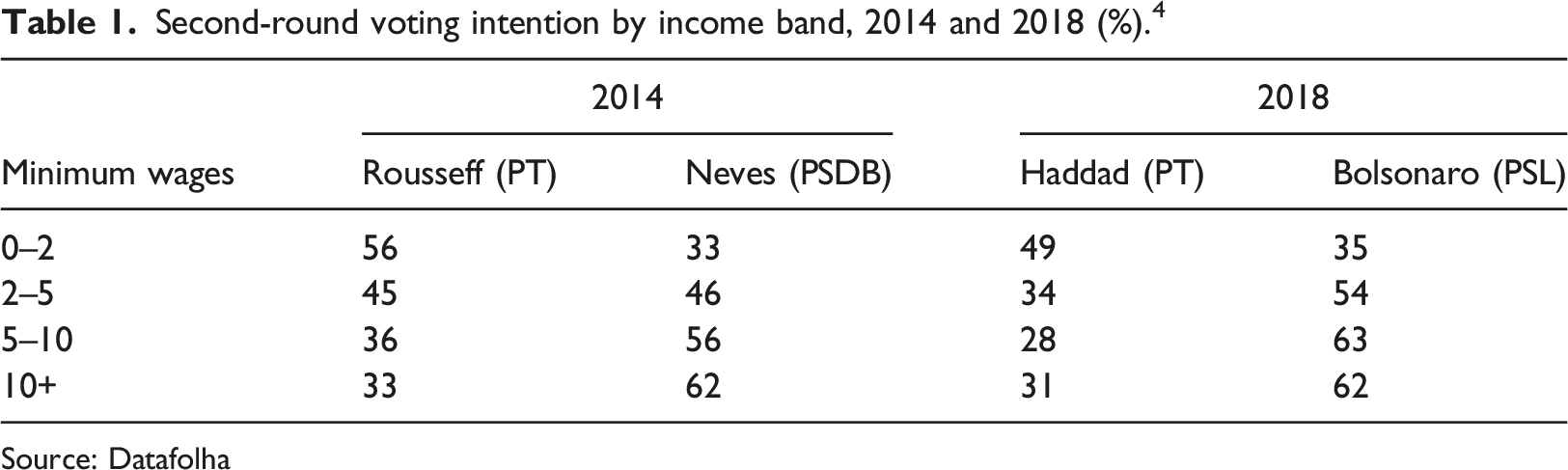
Source: Datafolha
Other polling by Datafolha during the campaign also points to important variations in 2018 in relation to factors like gender, religion, and race/colour. In the election-eve poll (Datafolha, 2018), Bolsonaro led Haddad by 18 points among men (55%–37%), while among women the candidates were technically tied, with Haddad on 42% and Bolsonaro on 41%. In relation to religion, Bolsonaro led by a wide margin among Evangelicals (69%–26%), while among Catholics the candidates were technically tied (44% for Bolsonaro versus 43% for Haddad) (Datafolha, 2018). A first-round poll indicates that Bolsonaro had a massive lead among white voters, with 42%, compared to 15% for Haddad, and the remainder distributed among other candidates and non-responses (G1, 2018). Bolsonaro also led among brown/mixed voters by 30%–23%, whereas Haddad was favoured by black voters by 30%–18% (Datafolha, 2018). 3
Explaining the rightward turn
While such correlations between socio-demographic categories and voting decisions imply important relationships, they do not provide causal explanations. The assumption that they should not only overlooks place-based factors, as already discussed, but also the highly “ambiguous” nature of political subjectivities, especially of lower-income groups in Brazil (Palmeira and Heredia, 2010). Palmeira and Heredia (2010) note that in many communities there is a distinction between election periods, when local life becomes animated by political debate, and “normal” times when only politicians and activists remain engaged. Collective pressure to vote for particular candidates during campaign season can be especially strong in legislative elections, which are often dominated by local clans and organized around clientelistic exchanges. For this reason, presidential elections provide a more reliable indicator of political attitudes, as votes are more likely to be motivated by ideological factors. Nonetheless, Richmond (2020) has also noted highly ambiguous attitudes towards national politics among residents of a peripheral São Paulo neighbourhood, where many expressed preferences for candidates who did not reflect their views on key issues.
While we should always bear such ambiguity in mind when interpreting large-scale shifts in voter behaviour, there are some consistent patterns in the sentiments associated with the rightward turn and the interests underpinning them. These are particularly visible when we look at wealthier and whiter segments of the population. Loureiro and Saad-Filho (2019) point out that middle-income groups lost relative status during the PT era, as rising incomes and opportunities for the poor drove up the cost of urban services and mildly increased competition in higher education and the labour market. Along similar lines, comparing Brazil’s rightward turn with analogous processes in India, Heller (2020) identifies what he calls “retrenchment populism.” This elite-led form of politics, appealing to large parts of the middle class, seeks to reassert traditional hierarchies and roll back prior gains made by historically excluded groups. Interpreted in this way, growing antipetismo (literally “anti-PTism”) and the eventual embrace of Bolsonaro’s candidacy by higher status groups can be understood as a backlash against social reforms threatening their historic privileges.
While persuasive, this does not explain why lower-income voters who benefited from such reforms also voted for Bolsonaro in significant numbers. Some have argued this is because Brazilians developed increasingly neoliberal attitudes during the boom years, and therefore embraced right-wing narratives about the PT’s profligacy and corruption when crisis struck (eg. Perseu Abramo Foundation, 2017). However, it is questionable whether lower-income groups in Brazil have become more receptive to neoliberal ideology (Richmond, 2020). In any case strong antipetismo seems to have been a minor component of support for Bolsonaro among lower-income voters (Nicolau, 2020). On the other hand, in a large survey study, Junge et al. (2022), found that upwardly mobility poor Brazilians whose mobility was stalled during the economic crisis were more likely to express anti-left sentiment than those who had not experienced any mobility. This suggests that frustrated expectations and a sense that the PT favoured only the very poor, in particular welfare beneficiaries, may have played a key role in growing rejection of the Party among the “previously poor”. Pinheiro-Machado (2019), meanwhile, argues the PT’s inclusion of lower-income groups was achieved _primarily_ via consumption rather than political mobilisation, meaning the crisis was experienced in a depoliticised way. Bolsonaro was able to exploit this with a revanchist ultra-conservative message, vowing to take back the country from forces that had corrupted it and directing public anger at criminals, sexual minorities, and progressives.
These analyses help to explain why some lower-income groups were receptive to Bolsonaro’s candidacy. However, they remain at a high level of generalisation and are less attentive to local, particularly organisational, processes in peripheries. Bolsonaro’s appeal certainly had a strong charismatic element and was assisted by the effective use of social media to spread propaganda. However, the diffusion of political discourse does not occur in a vacuum. Instead, it should be understood in relation to the presence of organisational networks that direct and amplify political discourses towards different groups. Some theorists of populism have interpreted recent success of populist candidates in diverse countries as the result of a “disintermediation” of politics, associated with a declining influence of parties, traditional media, and civic organisations (eg. Jäger and Boriello, 2020). However, in Brazil, where political partisanship in the population has always been weak (Borges and Vidigal, 2018), local civic organisations often play a key role in articulating populations to candidates, including those with a more populist style. In this respect, important changes within Brazilian civil society since the 1990s should be considered when interpreting the political preferences of lower-income groups.
McKenna (2020) notes two important and counterposed trends in this regard. Firstly, there has been a major decline in trade union membership and influence, resulting from both long-term deindustrialisation and labour precaritisation and attacks on trade union funding and organisation since 2016. This decline has weakened the unions’ ability to articulate the PT among the working classes. Meanwhile, while more “horizontal” left-leaning organisations, such as housing movements, black, feminist and LGBT rights groups, and cultural collectives, have grown precipitously, they tend to lack the reach and articulation with electoral politics to play a comparable role.
The second major change is a huge growth of Evangelical churches in Brazil since the 1990s, particularly concentrated in low-income areas. This growth should be understood as a social, rather than purely religious phenomenon, in the sense that Evangelical churches typically perform important local functions, like offering social assistance and recreational activities (Mafra, 2011). It is also important to note the significant doctrinal diversity between different denominations and the political flexibility of Evangelical voters, who tended to vote for the PT prior to 2018 and still favoured Lula to Bolsonaro in polls prior to his removal from the 2018 election (McKenna, 2020: 621). Nonetheless, Bolsonaro’s focus on religious themes, the vocal support he received from Evangelical leaders and his huge support among Evangelicals all suggest that religion played an important role in his victory in 2018. While Evangelical churches should not be viewed straightforwardly as local incubators of Bolsonarismo, they can be understood as a “resonance machine” (Hutta, 2021), that encourage affinities between the moral concerns of their congregants and ultra-conservative electoral projects. As such, the huge expansion of such churches in parts of Brazil must be understood as a relevant factor contributing to the rightward turn.
Continuity and transformation in urban peripheries
We focus our analysis on the peripheries of major cities in Brazil’s wealthier southern regions, and in particular the country’s two largest metropolises, São Paulo and Rio de Janeiro. 5 These spaces are of interest for several reasons. Firstly, as highly populous areas, they carry an important weight in majoritarian national elections. Secondly, as discussed, they have proved to be more electorally volatile than Brazil’s macro-regions, shifting from mainly supporting the PT in the 2000s, to swinging to the right in the 2010s. Thirdly, with predominantly low-income and black and brown populations, the peripheries of these metropolises were a crucial part of Bolsonaro’s victorious cross-class and multi-racial 2018 electoral coalition.
Urban peripheries can be defined as areas that were initially primarily settled via the irregular subdivision of land and autoconstruction of housing, in the general absence of urban planning and infrastructure provision, at the edges of the expanding city (Caldeira, 2017; D'Andrea, 2020). 6 This process of expansion occurred most rapidly between the 1940s and 1980s, at the height of Brazil’s industrialisation, when the peripheries were mainly settled by poor rural migrants. Over time, peripheral neighbourhoods have developed and diversified as residents gradually paid off housing debts and improved their homes, and as the state expanded provision of infrastructure, services and social housing. Although peripheries primarily expanded outwards from metropolitan poles, satellite cities also saw the growth of their own peripheries, which have merged to produce large, complex metropolitan areas.
State capacity and social conditions in peripheries have shifted over time thanks to institutional transformations associated with redemocratisation in the 1980s and 1990s and PT government in the 2000s and 2010s. Federal poverty-reduction programmes and expansion of core service provision have had important impacts, even if these remain unevenly distributed (Richmond et al., 2020). Certainly, there are important differences between cities in this regard – for example, São Paulo’s municipal government has been far more consistent in rolling out infrastructure and services to peripheral areas than Rio de Janeiro’s (Bradlow, 2019). Nonetheless, in both cases, the peripheries have become more socially and physically heterogeneous over time. While some areas have been transformed by construction of new housing and commercial and transport infrastructures, others remain largely untouched by such processes (Marques, 2014; Gomes-Ribeiro and Queiroz-Ribeiro, 2021).
Notwithstanding improvements, weak institutional provision of essential services and infrastructure still forces many inhabitants of peripheries to seek basic services via other means. These include forms of interpersonal reciprocity, collective self-organisation, or the direct provision of some services by non-state organisations, such as churches, NGOs or even criminal groups. However, state resources may often be accessed via irregular means, such as through contentious action by social movements or vote-buying by local politicians. This diverse range of actors and mechanisms might be more or less prominent in different peripheral areas, but all are usually present to some degree. As suggested above, there has been a long-term decline in the role of trade unions and the grassroots Catholic liberation theology movement in the peripheries, and a comparable growth of Evangelical churches since the 1990s (Feltran, 2011). Indeed, the peripheries of Rio and São Paulo have been key drivers of Evangelical growth in Brazil, with far higher proportions of adherents than nationally and in other urban territories (Mafra, 2011).
Finally, peripheries have been heavily affected by insecurity and a growth of organised crime. While this is a general trend, it has taken very different forms in different cities and neighbourhoods. Homicide rates in both São Paulo and Rio de Janeiro peaked in the late 1990s, after which they saw significant declines (Cerqueira, 2019). In São Paulo, this occurred thanks to a single criminal organisation, the First Command of the Capital (PCC), becoming dominant across the city with relatively little direct confrontation with police (Feltran, 2011; Richmond, 2022). In Rio de Janeiro, territorial competition among rival drug trafficking groups, militias run by armed security agents, and police has produced more volatile inter-group conflict. Nonetheless, there was also a steady decline in homicides in the city up until 2014 before they began to rise again in the late 2010s (though not back to previous levels) (Cerqueira, 2019; Richmond, 2022). Overall, security dynamics vary significantly between different peripheral neighbourhoods, from tense but relatively peaceful coexistence between armed groups to persistent violent conflict (Richmond, 2022). There are also variations in how far criminal groups affect other aspects of local life. Notably, Rio de Janeiro’s militias have made political organisation particularly difficult by intimidating and repressing local civil society (Gomes, 2020).
Socio-spatial inequalities and presidential elections in São Paulo and Rio de Janeiro, 2002–2018
In this section, we present original empirical analysis on presidential runoffs between 2002 and 2018 for the metropolitan areas of São Paulo and Rio de Janeiro. 7 The maps were created using publicly available data from the online repository of Brazil’s Superior Electoral Tribunal (TSE). 8 Electoral zone boundaries in both cities changed over the period of our series, complicating the task of creating longitudinal comparisons. However, these changes were always made via the subdivision or aggregation of existing zones, without otherwise altering their boundary lines. This allowed us to aggregate the data at the largest scale reached by each electoral zone over the period and adjust the entire series to this scale. This method furnished a total of 96 of what we will call “constant electoral zones” (CEZ) in each metropolis, which could then be compared over time.
To assist our analysis, we sought to map socio-economic inequalities across these constant electoral zones by ascribing an averaged score from the Municipal Human Development Index (IDHM) to each zone. The IDHM is a socio-economic index that combines indicators of income, life expectancy, and years of education from the 2010 Brazilian Demographic Census, assigning scores between 0 and 1. 9 This data is collected at the scale of “Human Development Units” (UDHs), which are small aggregations of census tracts. We were able to aggregate these to the scale of our CEZs and arrive at an average by adding up the scores of the UDHs in each CEZ and dividing by the number of UDHs. For ease of visualization, we divided the scores into four bands: ≥0.8 (the highest), 0.76–0.79, 0.71–0.75, and ≤0.7.
As shown in Figure 1, these parameters produce relatively clear centre-periphery patterns for both metropolises. In São Paulo, the expanded centre falls almost entirely into the upper band. Most peripheral areas fall into the two intermediate bands, with the exception of one higher value area (Mogi das Cruzes, to the east) and two in the lowest band (Francisco Mourato to the north, and part of Guarulhos in the northeast). In Rio de Janeiro, the pattern is slightly more complex, though it broadly still fits a centre-periphery model. The highest band covers most of the coastal strip, as well parts of the inner-North Zone. However, there are also more central zones with lower scores, mainly due to the large presence of favelas in these areas. Peripheral areas of the metropolitan pole and the inner satellite cities generally have intermediate scores, except for the centre of Nova Iguaçu which falls into the highest band. Finally, the most distant parts of the metropolitan area are almost all in the lowest band, comprising far more in this band than in the case of São Paulo. Human Development Index (IDHM) mapped to the São Paulo and Rio de Janeiro Metropolitan Regions by constant electoral zone
10
. Source: Maps created by Daniel Waldvogel Thomé da Silva (Centro de Estudos da Metrópole) and Elizabeth McKenna (Johns Hopkins University) using data from the IDHM (2010). Blue circles represent the location of our São Paulo case study area (Sapopemba) and Rio case study area (Campo Grande).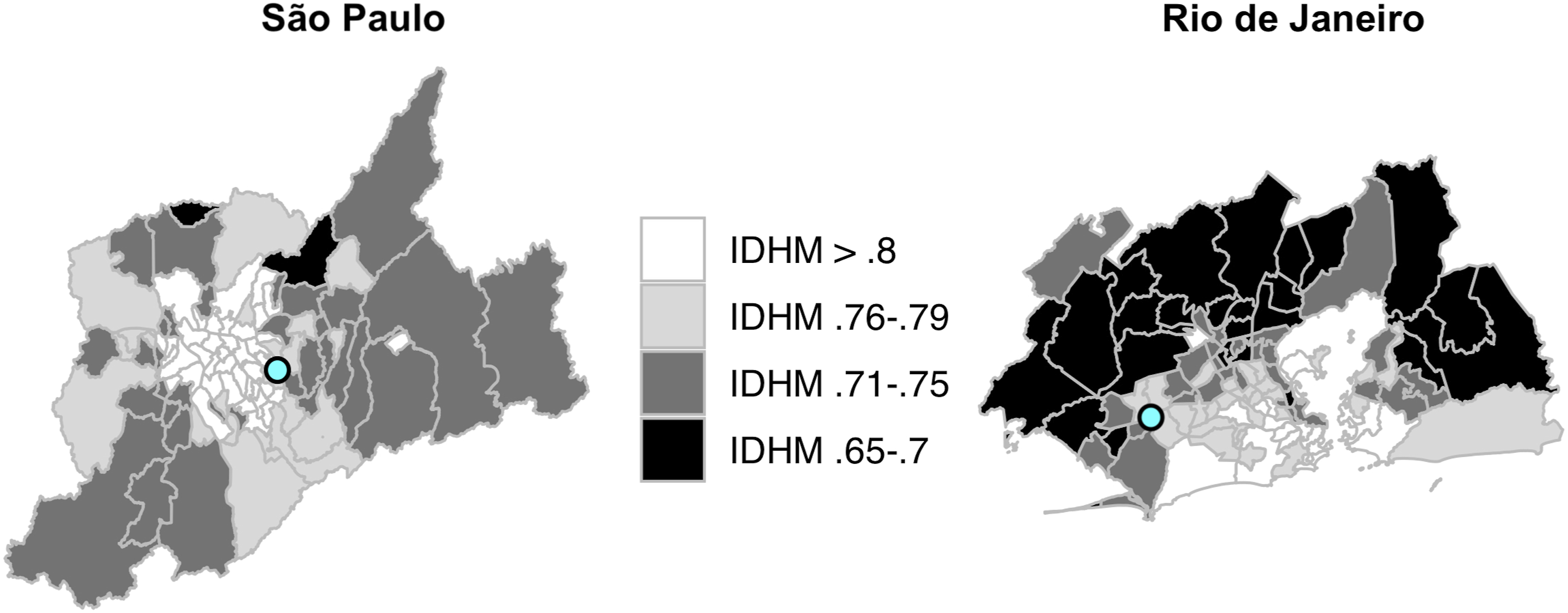
Keeping in mind this broad centre-periphery pattern in both cities, we now turn to recent electoral trends. Our series covers the presidential run-offs of 2002 and 2006, both won by Lula (PT), 2010 and 2014, both won by Dilma Rousseff (PT), and 2018, won by Jair Bolsonaro (PSL). We have limited the series to these years on the basis that prior elections were won in the first round, thus complicating direct comparison, and that we have not been able to include the 2022 election for the reasons outlined above. This range also has the advantage that IDHM data, drawn from the 2010 census, was gathered at exactly the mid-point of the series.
For ease of comparison and visualisation we made the decision to only include “valid” (i.e. registered) votes. Despite voting being compulsory in Brazil (with non-voters liable to pay a small fine), the combined proportion of abstentions and spoiled ballots in elections is significant. It also grew over the course of our series, from around 20% in both cities in 2002 to almost one third in both in 2018. This should remind us of the ambiguous nature of electoral choices (Palmeira and Heredia, 2010) and of the complex reality that lies behind the appearance of polarisation between two opposed, monolithic blocs. Nonetheless, we made an informed decision to stick to valid votes due to the significant methodological challenges involved in properly accounting for non-voting.
11
In Figures 2 and 3, we show variations in the strength of the vote for different parties using a sliding colour scale. CEZs in which the PT won more than 50% are shown in red, while blue was used for the defeated PSDB candidates between 2002 and 2014, and black was used for Bolsonaro in 2018. PT versus opposition vote share in presidential runoffs in the São Paulo Metropolitan Region by CEZ, 2002–2018. Source: Map created by Daniel Waldvogel Thomé da Silva (Centro de Estudos da Metrópole) and Elizabeth McKenna (Johns Hopkins University) using data from the Tribunal Superior Eleitoral. PT versus opposition vote share in presidential runoffs in the Rio de Janeiro Metropolitan Region by CEZ, 2002–18. Source: As above.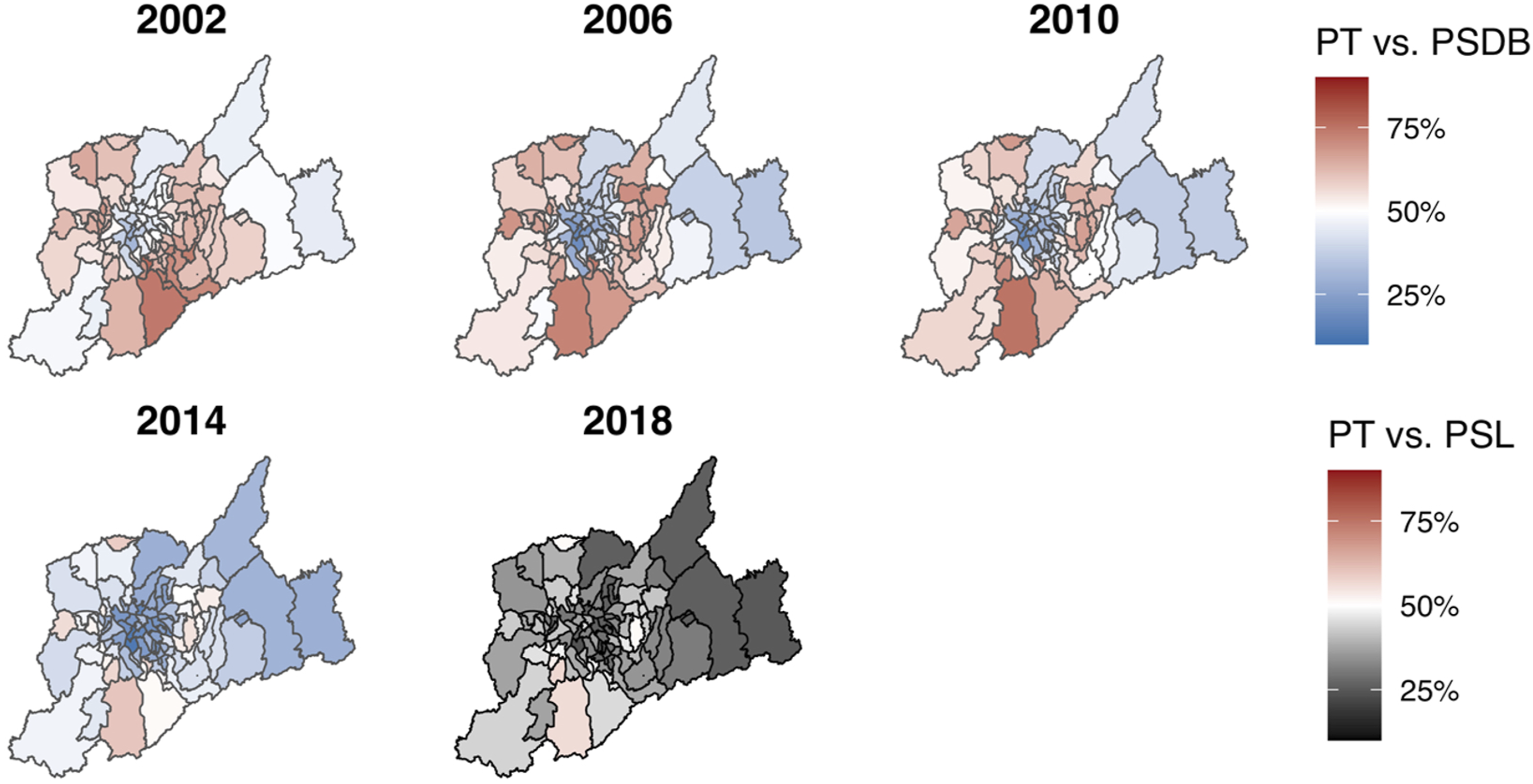
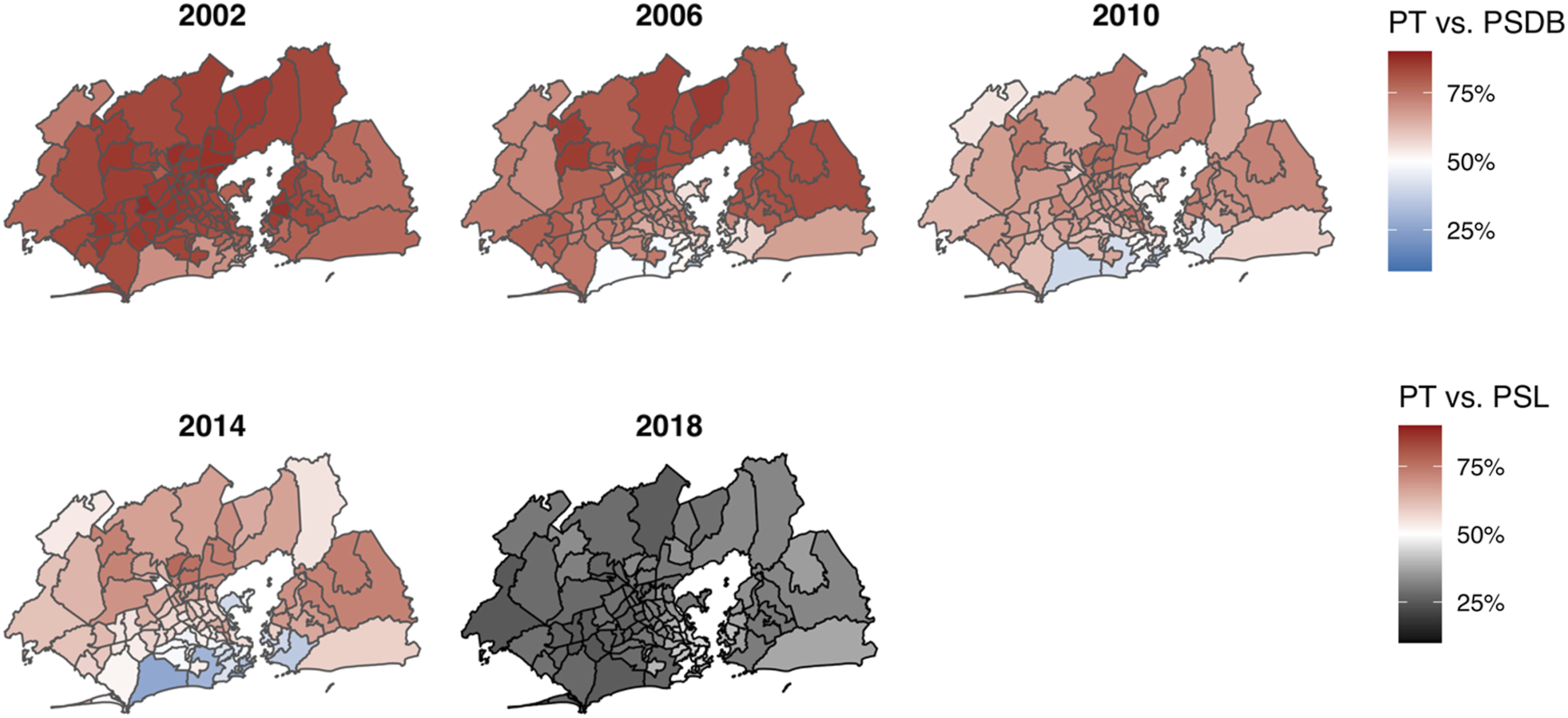
Figures 2 and 3 both show a general trend of declining support for the PT between 2002 and 2018, but with contrasting dynamics between the two metropolises and variations within each of them. In 2002, the PT won convincingly in both, only losing in the wealthier expanded centre and in some distant satellite cities in São Paulo, and winning every single CEZ in Rio, including in the wealthy coastal areas. In 2006 and 2010, opposition to the PT intensified in São Paulo’s wealthiest areas and appeared in Rio’s, while the peripheries of both largely held firm in their support for the PT, even if this had diluted somewhat by 2010. However, in 2014, most of São Paulo’s peripheral CEZs turned against the PT and opposition further intensified in 2018, leaving the party with majorities in just a few peripheral zones. In Rio, PT support in the peripheries was overwhelming in the 2000s, and this support largely persisted up to 2014, but swung dramatically away from the Party in 2018. Interestingly, some of these areas voted more heavily for Bolsonaro than even the wealthiest central areas. Indeed, in 2018, only one CEZ in the entire metropolitan region gave the PT a (very narrow) majority – roughly corresponding to the largely middle-class neighbourhoods of Laranjeiras and Santa Teresa in the South Zone.
We can see the socio-economic significance of these trends more clearly if we analyse the PT vote in relation to the IDHM bands. Figure 4 shows the percentage of the vote captured by the PT in the two cities over the series for each band. They reveal that in both cities, support for the PT in CEZs with the highest IDHM scores fell most rapidly between 2002 and 2006, and continued to decline steadily thereafter (although they rose slightly in São Paulo in 2018). In São Paulo, within the three lower IDHM bands, the PT vote declined most strongly between 2010 and 2014, before falling even further in 2018. However, whereas in 2018 the second band (0.76–0.79) moved closer to the highest, with the PT vote falling to the mid-30 s, in the two lower bands the PT remained more competitive, capturing just under 50% of the vote. In Rio, the picture is quite different. There, among the three lower bands, the major collapse in the PT vote occurred in 2018, leaving the Party with around 30% of voters in each band. Remarkably, this left the PT vote in all three of these bands even lower than its level for the highest band, reversing the previous pattern in both cities of greatest support for the PT coming from electoral zones with lower IDHM scores. PT vote in the São Paulo and Rio de Janeiro Metropolitan Regions by IDHM band, 2002–2018. Source: The authors based on data from the IDHM and Tribunal Superior Eleitoral.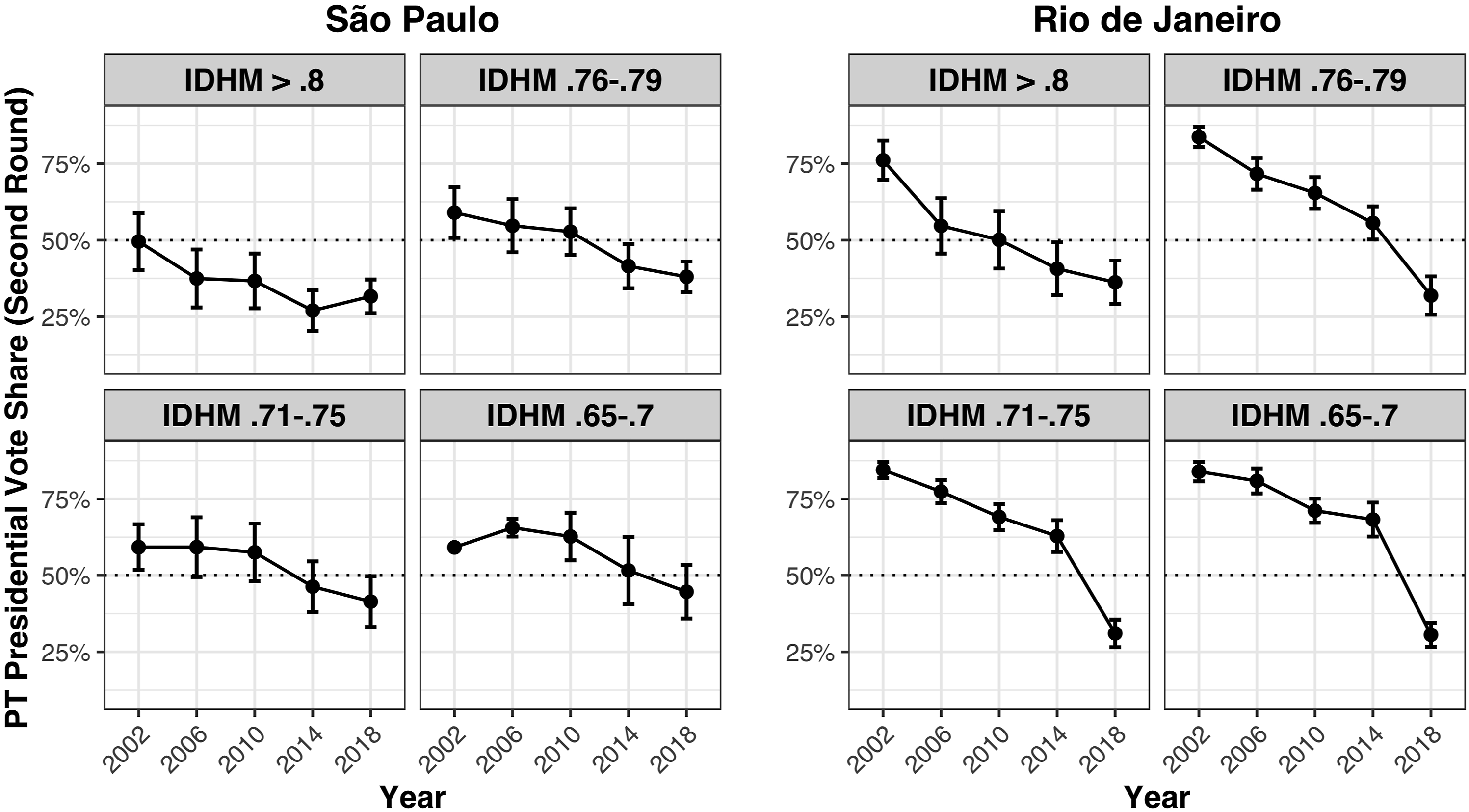
Placing peripheries within the rightward turn
Local factors affecting the rightward turn
The analysis so far has identified important macro-spatial and socio-economic patterns in changing voter behaviour in São Paulo and Rio de Janeiro. However, it also suggests there are important variations among peripheral areas that are not captured by such analysis. The literature we have discussed suggests key mechanisms driving the rightward turn may operate at a more local scale and may not be reducible to socio-economic factors. In this section we identify some key variables that we hypothesise as likely to affect electoral shifts in different peripheral areas, as well as the likelihood of their voting for Bolsonaro in 2018. We then present two brief local case studies—one from each city—to more concretely illustrate the relevance of these factors.
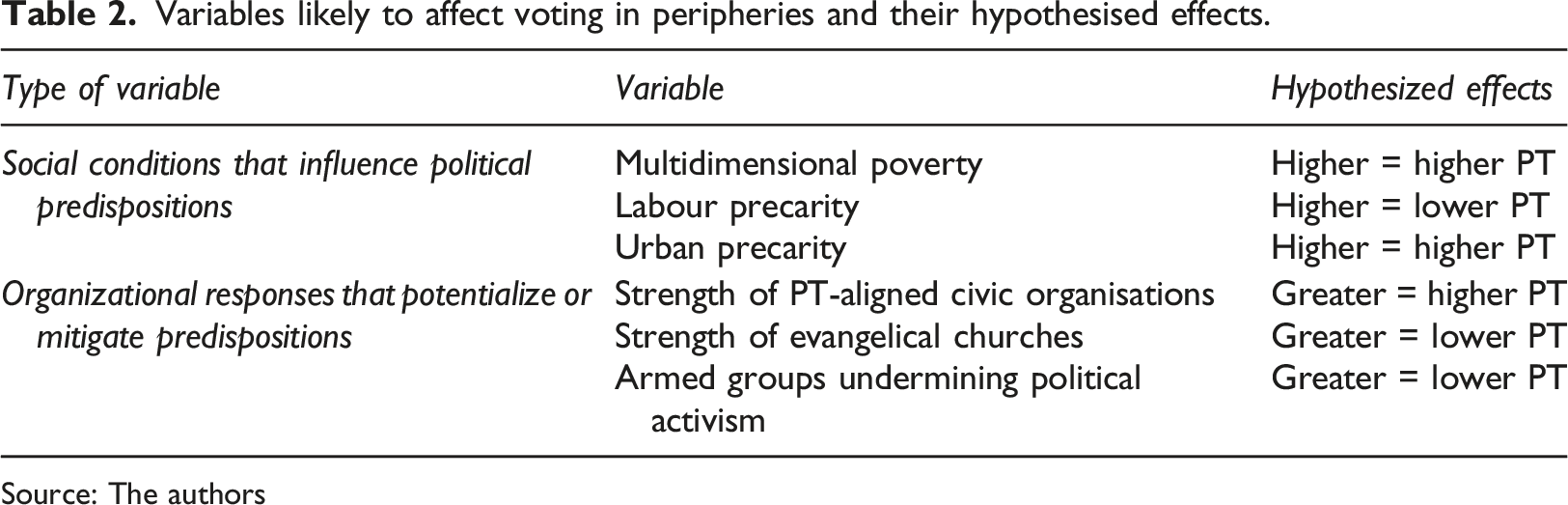
Variables likely to affect voting in peripheries and their hypothesised effects.
Source: The authors
Considering the second category of organisational conditions, we hypothesise that the stronger presence of PT-aligned civic organisations, including trade unions, progressive Catholic organisations, social movements in areas like housing or human rights, and local organisations delivering social assistance and educational programmes, would increase the likelihood of support for the PT. By contrast, we would associate the strong presence of Evangelical churches with the likelihood of a stronger shift to the right. Finally, we would hypothesise that the strong presence of armed groups that actively undermine local civil society and grassroots democratic politics would strengthen the shift to the right.
Of course, several of these organisational actors are likely to be present in any given periphery. Furthermore, our case studies cover entire districts with significant internal diversity. The factors we identify should be understood in relative rather than absolute terms, and as defying simple quantification. More generally, the variables we have identified are likely to interact with each other, complicating understandings about their relative importance and causal relationships. Rather than offering a predictive model, these variables offer broad parameters for analysing electoral change across different peripheries.
Case study 1: Sapopemba (SP)
Sapopemba is a large district in the East Zone of São Paulo (Figure 3(a)) with a population of around 284,000 (IBGE, 2010), making it the second most populous in the city (Richmond et al., 2020). We might describe Sapopemba as an “intermediate periphery”, considering its location and social and urban conditions. After growing rapidly during the 1970s and 80s, population growth today is slower than in more distant peripheries. Although Sapopemba lies some 18 km from the centre of São Paulo, it has reasonable transport links, including a new monorail line integrated with the city’s metro. Most of the area today is physically consolidated and there is a well-established network of social services, although some areas lack basic infrastructure and services, particularly in the east of the district (Richmond et al., 2020).
The IDHM for the Sapopemba CEZ is 0.73, placing it in the third of the four bands we identified in Section 4. However, from 2010 onwards the district was subdivided into two separate electoral zones, one roughly covering the western half and the other covering the east. When we separate them, we can see a notable difference: whereas the west of Sapopemba has an IDHM score of 0.76, placing it into the higher second band, the eastern section has a score of 0.71, placing it towards the bottom of the third. In terms of labour market dynamics, the area traditionally had high levels of industrial employment, though this has fallen significantly since the 1990s, while employment in services has grown (Richmond et al., 2020: 21). At the time of the 2010 census, 69% of economically active residents were formally employed, while 15% were self-employed.
The significant presence of trade unions and social movements during the redemocratisation era provided Sapopemba with a strong civil society ecology that was closely articulated to the PT (Richmond et al., 2020). Although trade union membership has subsequently declined, PT-aligned civic organisations remain highly active in the area. There has also been major growth in the number of evangelical churches. However, this has not displaced existing organisations and instead come to coexist with them, albeit with little direct dialogue (Feltran, 2011; Richmond et al., 2020). Like other peripheries, São Paulo’s hegemonic criminal organisation, the PCC, has a strong presence in Sapopemba, and police death squads, carrying out extra-judicial killings of low-level criminals, have also been known to operate. Both groups have at times threatened human rights organisations in the area who have challenged their activities (Feltran, 2011; Richmond et al., 2020). However, they tend not to interfere directly with other kinds of social activism or in electoral politics.
These conditions provide some clues for analysing Sapopemba’s recent voting trends (Figure 5). Over the period of the series, we see a gradual but significant decline in support for the PT in presidential elections. In 2002, Sapopemba voted heavily in favour of the PT, with 62% of valid votes, falling to 57% in 2006 and 55% in 2010. In 2014, however, it swung to the PSDB with 57% of votes, rising to almost 60% for Bolsonaro in 2018. However, we can see distinct trends if we disaggregate the two sides of the district. The western side (with a higher IDHM score and weaker presence of PT-aligned civic organisations), actually gave a narrow majority of 52% to the PSDB as early as 2010, when the eastern side was still voting heavily in favour of the PT. In subsequent elections, movements in the two zones proceeded similarly from these different starting points. Support for the PT in the west of Sapopemba fell to 37% in 2014 and then to a low of 35% in 2018, while in the east fell from just under 50% in 2014 to 45% in 2018 leaving the Party still competitive. Compared to the São Paulo average, Sapopemba voted at higher levels for the PT between 2002 and 2014, but converged with the city average in 2018. When the two sides are disaggregated, the PT vote in the east remained five points above the city average while in the west it was five points below the average, approximating levels found in many wealthy zones. PT vote in the CEZs of Sapopemba (SP) and Campo Grande (RJ), 2002-2018. Source: The authors based on data from the Tribunal Superior Eleitoral.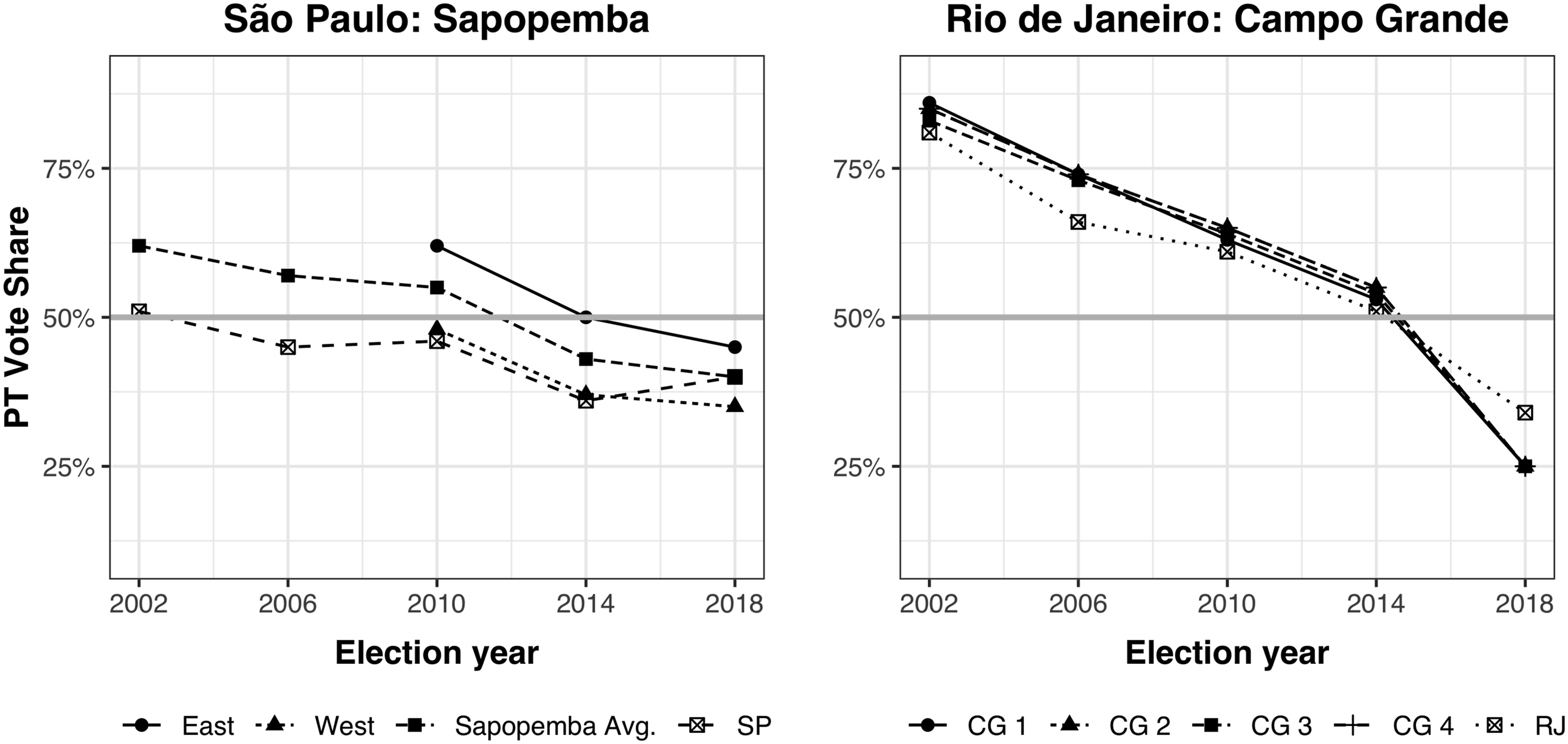
Case study 2: Campo Grande (RJ)
The case of Campo Grande in Rio’s West Zone offers an interesting contrast to Sapopemba. Lying some 50 km from the city centre, Campo Grande might be understood as a “frontier periphery” (Pope, 2019; Gomes, 2020). It has a rapidly growing population and a vibrant commercial economy, both formal and informal, but precarious public services and weak transport links connecting the area to the rest of the city. Campo Grande has grown to become Rio’s most populous administrative region, with around 328,000 residents (IBGE, 2010), significantly swelled in recent years by new social and private housing developments.
Campo Grande’s IDHM score is 0.79, placing it towards the top of the second of our four bands. 12 However, this masks the particular socio-economic challenges and inequalities found in this part of the city. A long-term decline in public sector jobs in Rio de Janeiro, which intensified in the 1980s, led to an increase in precarious and self-employment in Campo Grande (Pope, 2019; Gomes, 2020). In 2010, while the rate of formal employment in Campo Grande was similar to Sapopemba’s (68%), the self-employment rate was notably higher, at 20%. Despite poor transport connections, a significant proportion of the working population must still travel long distances to work (Gomes-Ribeiro and Queiroz-Ribeiro, 2021). Disparities within the population also have important spatial dimensions: Campo Grande has its own sub-centre, which acts as an important commercial hub for the wider West Zone, but also large zones of precarious housing with little infrastructure or commerce.
Two important factors affect the articulation between social organisation and electoral politics in Campo Grande. The first is that the region is dominated by militias, violent mafias run by off-duty police and other security agents who extort residents and local businesses. These groups have become deeply entwined in electoral politics in Rio’s West Zone and are highly suspicious of social activism (Pope, 2019; Gomes, 2020). Gomes (2020) notes that while Campo Grande had strong urban social movements mobilising to demand infrastructure and services during the redemocratisation era, militia dominance has subsequently forced local civil society to restrict itself to less contentious activities such as youth development and culture.
A second key factor is that Campo Grande has traditionally been dominated by networks tied to a clientelist political party, the Brazilian Democratic Movement (MDB), which has been the major political force in Rio de Janeiro city and state politics for the last two decades. While untangling the dynamics of local electoral politics in Campo Grande, not least the relationship between militias and particular electoral factions, is fiendishly complex (Pope, 2019), it seems clear that current organisational conditions in the area militate against the development of autonomous civil society that could articulate with a left electoral project in a similar way to Sapopemba’s.
These factors offer insights for understanding electoral shifts in Campo Grande over time (Figure 5). Looking at the four electoral zones, there is a remarkable shift over the period of our series. Unlike Sapopemba, the four zones move in step with one another, with never more than three percentage points between them (we therefore refer to them collectively). In 2002, Campo Grande gave the PT a super-majority of around 85% of valid votes. This then fell by around 10% points with each subsequent election, reaching 55% by 2014. Then, in 2018, there was a dramatic fall of 30% points, to just 25%. As a result, Campo Grande voted more heavily for Bolsonaro (75%) than any other area in the city, including wealthy zones like Copacabana (61%) and even strongly Bolsonarista Barra da Tijuca (73%). Along with contingent factors related to the crisis, the political cycle and the collapse of electoral alliances, local social and organisational conditions in Campo Grande seem to have turned it into a vanguard for Brazil’s rightward turn. Among these are high labour precarity, a weak public sphere, and the suppression of autonomous civic organisations that could articulate with the electoral left.
Conclusion: Taking back what?
This article has identified various factors driving Brazil’s rightward turn, which culminated in the election of Jair Bolsonaro in 2018. We argue this shift was not just the product of historical contingencies, the party-political system, or factors operating at either the national or individual levels. Rather it embodied shifts in attitudes and electoral preferences linked to social conditions, organisational ecologies, and subjective experiences of everyday life in particular places. Our analysis has focused on the urban peripheries of the main metropolises of the Southeast of Brazil. As populous, electorally volatile areas with largely low-income and nonwhite populations, the peripheries form a crucial part of any viable electoral coalition in Brazil, whether of left or right.
The data we have presented shows that these areas voted heavily for the PT in the 2000s, shifted away from the Party during the 2000s, and predominantly voted for Bolsonaro in 2018. We analysed these shifts in relation to a range of long-term transformations in the peripheries, including the uneven expansion of public services, a decline in absolute poverty (partially reversed by economic crisis), labour precaritisation, and changes to civil society ecologies, which encompass the decline of key PT-aligned organisations, growth of Evangelical churches, and entrenchment of various criminal groups. While these processes have impacted all peripheries to some degree, their impacts have been uneven. We therefore argue that particular constellations of these factors in different places help to explain the local strength of the rightward turn and the resilience of the PT vote.
In light of this analysis, we now return briefly to the questions we raised in the introduction: what about the political subjectivities of peripheral voters did Bolsonaro tap into in 2018? And what, if anything, did they want to “take back”? Despite the generally positive legacy of the PT era in the peripheries, by 2018 there was widespread anger about the impact of the economic crisis on employment and consumption, and more broadly with persistent problems such as underperforming public services and everyday insecurity (Richmond, 2020). These sentiments found an easy target in a political class widely viewed as corrupt, and a seeming champion in Bolsonaro, who came to embody radical discontent with the status quo. However, Bolsonaro also clearly articulated his own authoritarian and ultra-conservative agenda, which tapped into deeper strains of punitivism, sexism and homophobia (Pinheiro-Machado, 2019). While there is no reason to believe such attitudes are disproportionately prevalent in peripheries, they were present there as in other spaces (indeed, they may have grown over time, due to the relative decline of key progressive organisations and the growth of Evangelicalism).
This brings us back to the notion of revanchist populism and what, if anything, Bolsonaro voters in the peripheries may have been seeking to “take back”. In some regards, dissatisfaction with the status quo and sympathy for Bolsonaro’s agenda in 2018 may have been linked to nostalgia for a time when employment was abundant, crime rates were lower, and gender roles were clearly defined. In the US rustbelt, such sentiments would evoke the post-War Fordist era (McQuarrie, 2017). However, the closest equivalent in Brazil would be the so-called “economic miracle” of the 1970s, which was also a time of authoritarian rule, and, in the peripheries, of widespread poverty and state neglect. In these respects, an even more plausible “golden age” was the recent period of relative prosperity made possible by the PT’s redistributive agenda. Unlike the “revolt of the rustbelt” (McQuarrie, 2017), then, the recent past was not viewed as unambiguously negative in the peripheries. In contrast to the “retrenchment populism” of the middle classes (Heller, 2020), most residents of the peripheries would not wish to reverse social reforms. This suggests more ambiguous subjectivities, which could be plausibly incorporated into radically contrasting political narratives and platforms.
More broadly, our analysis suggests there are long-term trends that both favour and threaten the persistence of the PT vote in the peripheries. For example, while labour precaritisation and the growth of Evangelical churches may tend to push peripheries to the right, the PT’s record and continued commitment to social reform along with the persistence of left-aligned civil society actors help to uphold the Party’s vote. As we have argued, the relative strength of these different factors in particular places may determine which way they swing in a given election. In future work, we will analyse the 2022 election to identify how far it reflects a continuation of trends between 2002 and 2018. Nonetheless, it seems clear that the PT’s recent return to power should not be assumed to represent the formation of a solid new voting bloc in the peripheries, nor the impossibility of the future growth of the far-right vote. The various factors we have discussed, and competing narratives over the past and possible futures of life in the peripheries will be key to determining the political direction they take. Whichever way that is, they will remain key battlegrounds and play a crucial role in deciding Brazil’s political future.
Footnotes
Acknowledgements
We would like to thank Daniel Waldvogel Thomé da Silva for his invaluable help in organising the data presented in this paper. We would also like to thank Ryan Centner and Mara Nogueira for the invitation to participate in this special issue and for helping to guide the paper through various revisions. Thank you also to Benjamin Junge, Rob Coates, Moisés Kopper, Simone Gomes, Nick Pope, Talita Tanscheit and the EPC editors and anonymous reviewers for their valuable comments and contributions.
Declaration of conflicting interests
The author(s) declared no potential conflicts of interest with respect to the research, authorship, and/or publication of this article.
Funding
The author(s) disclosed receipt of the following financial support for the research, authorship, and/or publication of this article: This work was supported by the Fulbright Association and Leverhulme Trust (ECF-2019-315).
