Abstract
The article unpacks the multiple political implications of commissioned murals in contested urban space. It examines public artwork in Hogan’s Alley, a historically Black neighborhood in Vancouver, BC, situated on the unceded Indigenous territories of the Musqueam, Squamish, and Tsleil-Waututh Coast Salish Nations. Drawing from ethnographic field research and semi-structured interviews with local artists, policymakers and community activists, I read the mural Remember Hogan’s Alleny (2019), covering the sidewall of a subsidized housing project, as a contested public space. In this conflictual space, multiple pasts appear, disappear and reappear, oscillating between the celebration of Black culture, food and entertainment and the systematic displacement of Black residents and businesses. By contrasting diverging rationales, expectations and dreams regarding murals’ contributions to memory-making and cultural reconciliation, I trace where and how conflicts about public art inscribe themselves into the urban cultural fabric. The article intervenes into the predominantly ‘positive’ discussion of sanctioned public art to develop a more conflict-attuned understanding of artworks placed in the public realm. It deploys a framework of hauntology to discuss the appearance of ghosts invited into the public realm via official art commissions. These ghosts, becoming visible on urban walls via acts of placemaking, conjure memories of spatial displacement and racial discrimination, as well as stories of community care and healing. In sum, the article argues that the analytic of ghosts assists to foster an understanding of public art as always-already conflictual, thus inviting to stay with conflicts of belonging and memory, rather than to suppress them or shy away. By reflecting on what public art does politically – unpacking diverse narratives of the past that continue to mark present racial inequalities – the article contributes to sketching a conflict-oriented understanding of public space that is needed in cities wounded by racism and displacement.
Introduction: The multiple politics of murals
Inscriptions on walls appear, disappear and reappear in broad daylight, in plain sight, at night, in shadows of dim light. Some mural art is revealed with pompous opening ceremonies, and receive multi-level government funding. Other murals are created with little or no funding, and are relegated to less visible placements such as alleyways. These will often fade away after a few years, as funding for maintenance will typically not be (re)allocated. Some murals are globally-famous tourist attractions with high ‘Instagrammability,’ pulling in admirers from around the world; others go unnoticed in urban public space; others again are vandalized, publicly defaced, ridiculed. In short, murals attract very different audiences, and mobilize heterogeneous public sentiments – ranging from joy and celebration to skepticism and outrage. Murals have been studied variously as zones of protest, and mediums of negotiating religious, race- and identity-related conflicts (Abaza 2013; Harnett 2010; Reed 2005; McCormick and Jarman 2005). In light of these irrevocably political underpinnings of murals to be encountered in urban public space, this article unpacks where and how conflicts about public art come to the fore. I argue that by turning to the hauntological notion of ghosts – including, but not limited to unexpected, unsolicited memories, feelings or connections to places, times and people from manifold pasts – we can work towards new understandings of the implications of art in conflict-laden public spaces. In short, by engaging with ghostly presences of the past in public space, we can uncover legacies of racial discrimination, displacement and inequality that continue to mark urban life.
In this article, I draw our the multiply contested actors and aesthetics involved in the commissioning of art in public places. In doing so, I develop an analytical framework for public art that stays with conflict, rather than forces its suppression or erasure in a yearning for a final resolution. With what I call a hauntological approach to public art, I conjure the ghosts that elicit and thus remind us of both hurtful and joyful pasts that frequently, yet sometimes linger in urban space uninvited. By attending to these ghostly dimensions of public art, I point to the simultaneous workings of racialized displacement on the one hand, and flourishing of Black culture, art and sense of community on the other. To ground this conceptual work, I draw on the case study of a historically Black neighborhood in Vancouver, which is located on the unceded traditional territories of the Musqueam, Squamish, and Tsleil-Waututh Peoples. In the complex web of historical and contemporary spatial displacements, like white settlers, Black people in Vancouver have played a role as settlers of this place called Hogan’s Alley, or Old Strathcona and East End alternatively (Coquitlam Heritage 2022). Notably, Black community activists and artists have been, and to this day, are involved in solidarity groups such as the Black and Indigenous People of Colour Creative Association.
As hauntology, by default, defies stable orders of knowledge, theorization and control, the concepts, places, and times I straddle are constitutively precarious, and in that sense, haunted. With help of Derrida’s (1994) spectral approach, I propose hauntology as analytical device to trace how public artworks conjure ghosts of both past and present conflicts into urban space. Such ghosts arrive in manifold ways. As Derrida (1994: 123) argues: ‘There are several times of the specter. It is a proper characteristic of the specter, if there is any, that no one can be sure if by returning it testifies to a living past or to a living future. For the revenant may already mark the promised return of the specter of living being.’ With the objective to provision a more conflict-attuned notion of urban public space, marked by racial inequalities, the ghosts from multiple pasts are invited to challenge and reconfigure established conceptions of who and what matters in public space. In this incomplete ghostly ethnography (Ferrell 2015), I write as an intersectional white scholar committed to anti-racist practice in both academic knowledge production and everyday politics. Throughout my postdoctoral experience in Vancouver in 2019/20, coming to an abrupt halt due to the Covid-19 pandemic, I encountered various ghostly materialities in urban public space and art (i.e., tracing them by means of qualitative research methods such as interviews, taking field notes during long walks, spending lunch breaks on site, conducting policy and historical document and visual analysis, reading novels and poetry on Hogan’s Alley). In the face of this heterogeneous information, I acknowledge a persistent degree of illegibility of this data (Bissell 2022). The workings of hauntology in public art, and public space, thus necessarily remain contingently entangled with our own positionalities. Moving forward, and recognizing the challenge to center Black narratives, feelings, and memories of Hogan’s Alley as a relative outsider to this historically racialized context, I reach out to the ghosts I encountered within stories and walls of Hogan’s Alley.
Pushing public art beyond consensus
As public art has predominantly been investigated with regards to its revitalizing socio-economic effects in processes of culture-led urban development and regeneration (Cartiere and Zebracki 2016; Hall and Robertson 2001; Mathews 2010; Pollock and Sharp 2007; Zebracki 2012), public artworks are often functionalized to facilitate policy objectives such as social cohesion, the celebration of diversity, spurring of urban growth and pacifier against displacement (Chang 2019; Sachs Olson 2017). In that sense, public art is often geared towards constructing consensus between heterogeneous urban communities (Miles 1997). Art historian and critic Claire Bishop (2004) views the preference of consensus over conflict in art as limiting because obsession with consensus could problematically overwrite or even erase the necessary frictions that occur in the production and presentation of socially engaged art. Similarly, a ghostly approach to public art can prevent or delay what street art scholar Peter Bengtsen (2020) calls the “fossilization of urban public space“. Instead, a hauntological approach aims to keep diverse creative engagements with the socio-spatial urban environment open.
Besides these assumed ‘positive’ effects, however, public art can also induce ‘negative’ feelings such as sadness, anger, (re)traumatization, helplessness, fear, shame. Hence, public art has the power to (re)activate struggles against racial inequality, colonialism, and oppressive consequences of neoliberalism Beetham S (2016; Bruce 2017; Frank and Ristic 2020). Yet, instrumental understandings of public art often fail to consider and navigate the many subtle or not-so-subtle disagreements about belonging, diversity, and discrimination in public space erupting during placemaking (Courage et al., 2021; Summers et al., 2019). In light of a bias towards consensus that prevails in urban policy and governance (Deas 2012; Landau 2020; Pløger 2021), it might appear inconvenient to discuss conflicts that arise out of public artworks that are purposefully commissioned to create joy, order and a sense of community. In this logic, conflicts are considered rather tedious or even damaging to carefully curated political goals or intentions regarding public art. Deeper-seated conflicts about who and what matters in public space, or should be represented via public art, are dismissed as mere bureaucratic misunderstandings, due to insufficient resources, or cosmetic flaws. While the potential of public art to divide public opinion about what is beautiful, politically offensive or desirable has been acknowledged (Deutsche 2002; Fraser 1990; Miles 1997; Waldner and Dobratz 2013), public art scholarship is lacking an analytical framework to grasp the conflictual contours of art in public space (an exception is Bruce 2018). To take account of public art as ambivalent, political medium in culture-led urban development, the analytic of hauntology assists to grapple with the constitutively contested and racialized nature of public space (Backer et al., 2018; Ben-Arie and Fenster 2019; Dikeç 2005; Summers et al., 2019; Landau et al., 2021; Lipsitz 2007). More specifically, with regards to public art, a conflict-attuned approach of hauntology nuances the multiple underlying political implications of spaces and times invoked by artworks that seek to (re)tell stories, people and things from the past (Landau-Donnelly and Zebracki forthcoming). Via creative expressions, these past-present stories appear, disappear and reappear in the now, to shape possibilities for redress and encounter with difference and diversity in urban public space.
Towards a hauntological notion of public art
I interconnect conflict-attuned theories of space and hauntology with the larger body of work of public art, including practices of street art and graffiti (Avramidis and Tsilimpounidi 2017; Ross 2016). Since street art has long discussed the diverse political effects and feelings provoked by art in the public realm, public art scholars and practitioners can learn a lot from a more conflict-attuned understanding of public art. Again, a nuanced conception of conflict facilitates to capture the various contestations arising from the making and maintaining of public artworks.
Street art studies have discussed graffiti as revolutionary practice (Georgeon 2012), as contentious political participation (Waldner and Dobratz 2013), moral disciplining (McAuliffe 2013) and driver towards spatial justice (Bengtsen and Arvidsson 2014). However, informal street art is often by default deemed suspicious, problematic or unwanted by local policymakers and business associations because it is not officially allowed. Beyond the clamps of parameters such as legality, beauty or purpose, conflicts about public art come to the fore in relation to the temporary presences and absences they generate. Public art is socio-spatially entangled in what materializes, is shown, funded, permitted, seen. But also in what is not shown, remembered, displayed. 1 In this vein, Black geographer Katherine McKittrick (2022: 4) points to the complicated visibility of Black life and culture, which ‘oscillate[s] between clarity and opacity’ and urges to consider ‘how this oscillation illuminates a politics of liberation that rests on ambivalence.’ Some absences of public art are consciously produced by politico-bureaucratic decisions (e.g., zoning restrictions, zero-tolerance policies for graffiti, jury selections, superficial rather than substantial community engagement). In contrast, other absences remain systematic, systemic, ineradicable. The ambivalent states and stakes of absences can be transformed via transforming absence into presence (e.g., elevating missing voices growing out of long-standing legacies of racism, colonialism and systemic marginalization). Yet, in line with the ghostly framework of this article, these attempts at visibilization are never absolutely attained, but remain challenged by yet again other voices, memories, stories that are not there. Thus, beyond binary assumptions of absence/presence or visibility/invisibility, I capture the multi-layered dynamics of physical and discursive absence and presence as ghostly because both are never quite settled, neither pure nor finished, but always contested (Miller et al., 2020).
With hauntology’s understanding of temporality as discontinuous, out of joint, vulnerable to violent pasts that permeate the present (Derrida 1994; Demos 2013; Fisher 2014; Gordon 2008), the study of conflicts about public art facilitates the encounter with ghosts in contested urban space. Via hauntology, my objective in this article is to trace tensions folding into and out of racialized public spaces commissioned with art. Here, the ghostly analytic offers material and discursive space as opportunities to remember past and present at the same time, in a place with different layers of meaning. It is in such an open, non-fossilized space that hitherto untold stories can start to appear. While hauntology has already inspired graffiti and street art research (Ferrell 2015; Kindynis 2017; Parisi 2019), public art scholarship has not yet dared to wrestle with its ghosts. Hence, this article extends the ghostly framework to the realm of commissioned and in that sense allowed public art to discuss the underlying and manifest tensions that arise alongside public art’s official emergence. This conceptual extrapolation of hauntology into public art uniquely jumpstarts conversations about the role of art and culture in racialized public space.
The article proceeds by laying out the empirical case study of Vancouver’s Hogan’s Alley. This historically Black neighbourhood was gradually displaced by planning authorities, and culminated in the construction of Georgia Viaduct in the 1970s, cutting through Hogan’s Alley’s residential and cultural infrastructures (Allen 2019; Rudder 2004). Subsequently, I introduce the mural called Remember Hogan’s Alley (2019), and unpack its spatial, temporal and memorial politics. In line with the hauntological analytic, I point to the diverse ghosts that emerge around contested choices and reactions regarding the mural’s location, motif and temporary commission for two years. By attending to the complex braids of visibility, invisibility and the politics of memory invoked by Black art (McKittrick 2022), I straddle other memorial and artistic projects in Hogan’s Alley, and conclude by discussing the analytical and activist potency of a hauntological approach for the interdisciplinary study of public art and public space.
Tracing historical ghosts in and of Hogan’s Alley
The four blocks between Prior and Union Street called Hogan’s Alley were once home to more than 800 members of Vancouver’s Black community. In addition, Italian, Japanese and Chinese immigrants lived here. Hogan’s Alley is adjacent to Vancouver’s Chinatown and Strathcona, and was often referred to as ‘dirt lane’ (CBC News 2020), going along Union Street in the shape of a T. Hogan’s Alley was known as cultural hub for music, food, entertainment and informal economies (Figure 1). Devalued by urban planners since the early 20th century, who problematized poverty and poor living conditions, Black residents were moving out of the area since the 1950s. Hogan’s Alley and neighboring Strathcona were described as an ‘area of poor moral and physical health; a decrepit neighbourhood that “could spread like a disease throughout the city if it is not destroyed and redeveloped”’ (Scott 2013). While the construction of a large highway in the 1960s was prevented due to community-led protests, in 1972, the construction of the Georgia Viaduct finalized the displacement of not only Black residents, but also Italians, Asians, and First Nations people, which had gradually been taking place since the 1950s (Compton 2011: 104). In light of Hogan’s Alley’s diverse former residents, the assumption of one unified Black community, and the discussion of who was living, and being displaced, from Hogan’s Alley needs to be challenged (Rudder 2004). Historical map of Hogan’s Alley. Copyright/Source: Chris Brackley/Canadian Geographic. Map data © Openstreetmap Contributors: https://canadiangeographic.ca/articles/hogans-alley-remembered/.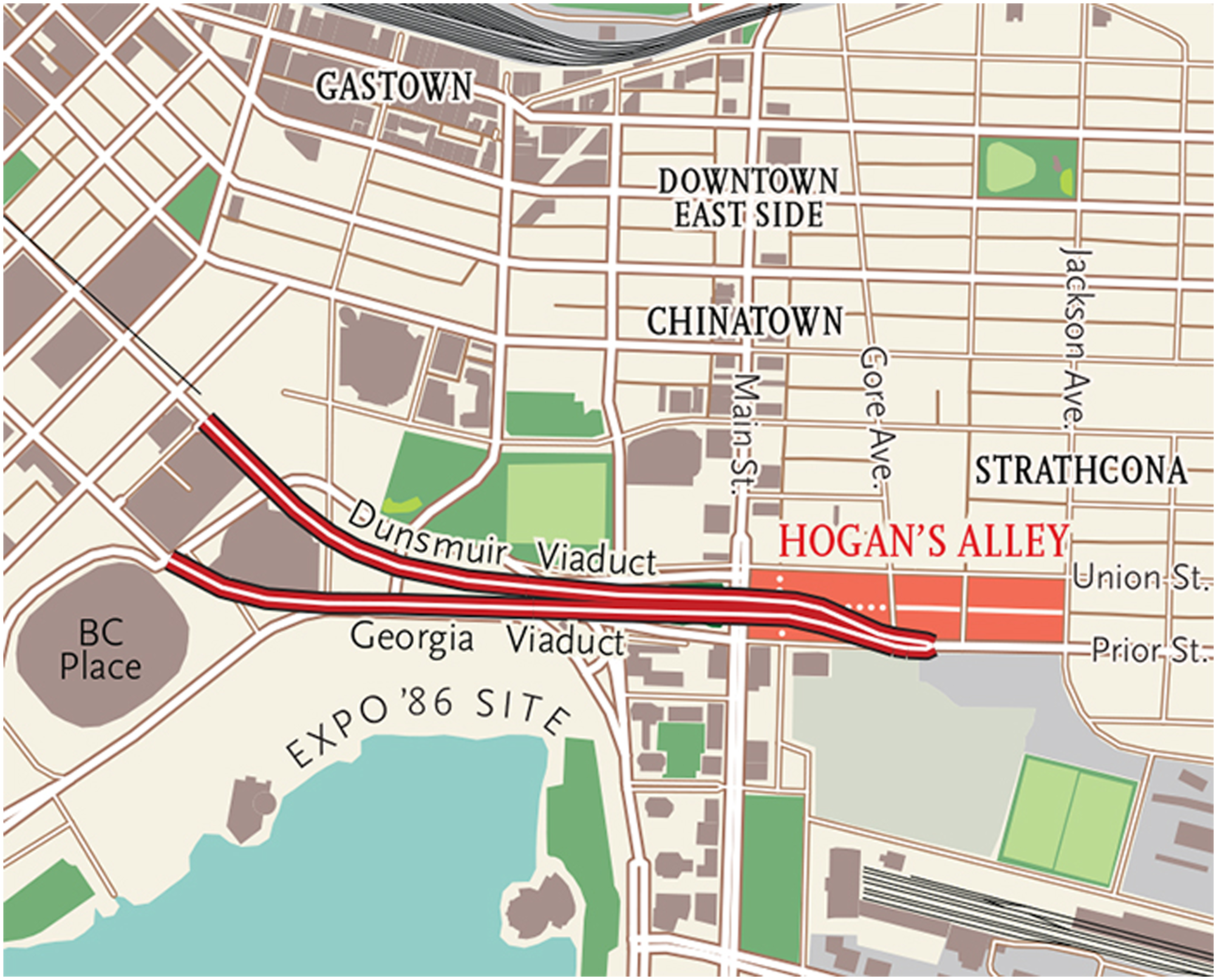
Vancouver-based poet Wayde Compton, a Black community activist and literary scholar, echoes planners’ attempts to subject Hogan’s Alley to ‘slum clearance’ since the 1930s. Narratives about the area later ranged from ‘resurrection’ to ‘revival’ (Dimoff 2017) or ‘rebirth’ (Jamal 2019). Today, reminders of Black spaces of the past on Union Street, between Gore and Main, are barely visible – the present-day area is populated by upscale vintage and ecological clothing shops, more affordable Chinese-run fashion stores, organic cafés, a furniture shop and a gym. Only about 1.2 percent of Vancouver’s contemporary population is Black, one of lowest in major Canadian cities (Tettey and Puplampu 2005; Van Evra and Jennifer 2020). Between 2006 and 2016, Metro Vancouver saw an increase of 44 percent in Black visible minorities, rising to almost 30,000, most of whom reside in suburban areas outside the downtown care, namely in Surrey and Burnaby (Pieper 2019), where Hogan’s Alley, also referred to as the East End or Strathcona, is located.
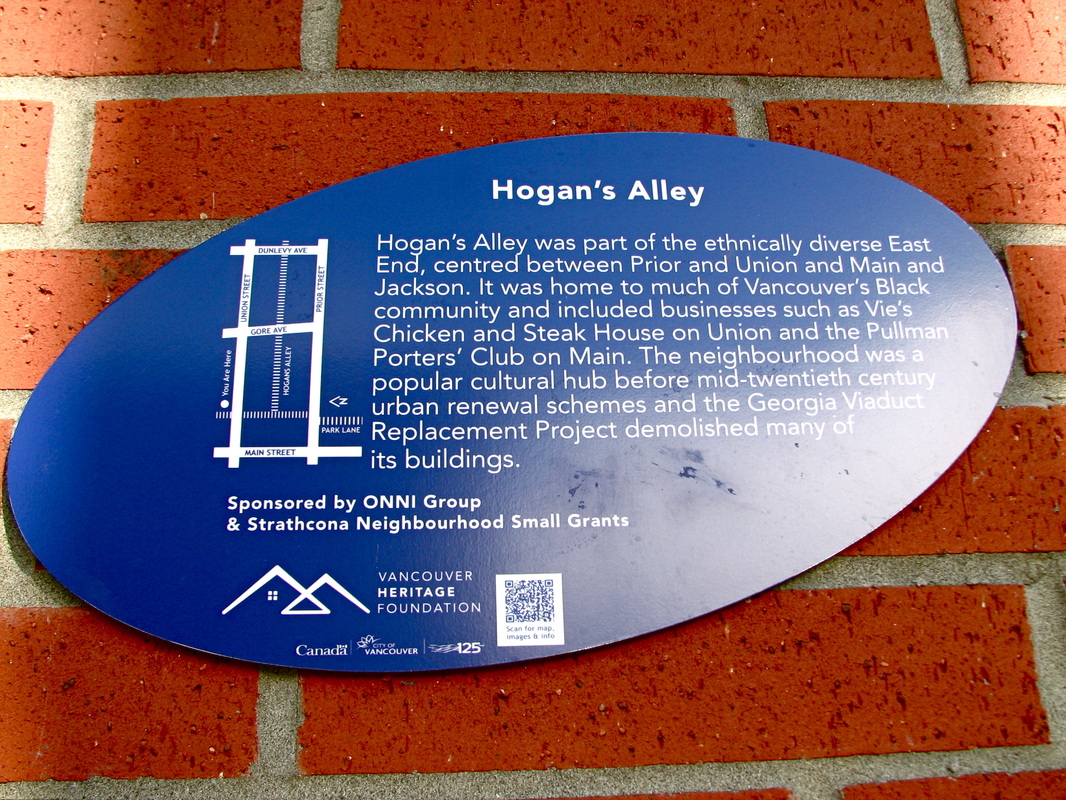
Once a place rich with vibrant Black culture, entertainment and business, Hogan’s Alley’s legacy was formally commemorated only in 2013, when a small memorial plaque was erected by the Vancouver Heritage Foundation. This informational sign, funded by a real estate developer and a neighborhood association, materialized memory of Hogan’s Alley’s in a official, visible, and somewhat permanent manner. While the plaque enforces public memory, it is also static and fragmentary in character. It acknowledges Hogan’s Alley as ‘part of the ethnically diverse East End (…) home to much of Vancouver’s Black community (…) a popular cultural hub before mid-twentieth century urban renewal schemes and the Georgia Viaduct Replacement Project demolished many of its buildings’ (Vancouver Traces 2022). Notably, the plaque speaks neither of racial marginalization nor of the intersecting relations of displacement between Indigenous and Black communities. In an interview, Compton reflects that such plaques (23 June 2020) ‘are like a historical carbon offset where the plaque is doing the remembering for you, you don’t have to really remember it.’ In sum, even though the plaque captures a partial visibilization of Hogan’s Alley, it is not enough; remembering needs to keep taking place.
The explanatory plaque had been installed after years of temporary memorialization such as Hogan’s Alley Poetry Festival (2008–2015). Compton (2011: 108) considers public talks and lectures as ways to bring Black history ‘alive again…all this is the ritual of memory, the extension of the lives that were lived through Black ancestry in that and this place. WE remember in the present tense.’ Another ephemeral inscription of Hogan’s Alley public memory was inserted in 2007, creating a ‘floral graffiti’, initiated by the Vancouver Flower Brigade, led by artist Rachel Mardsen, and Hogan’s Alley Memorial Project, writing out Hogan’s Alley Welcomes You into the grass area by Georgia Viaduct (Pask 2007). Compton remembers that nobody suspected anything bad to come of the flowery intervention (23 June 2020): ‘If it were graffiti, it would have been seen very differently, but because it was flowers, everybody assumed we had permits.’ The project was ‘lucky’ because city workers, who would usually have mowed the grass, went on strike shortly after the installation of the floral text (Pask 2007).
Another creative commemoration of Hogan’s Alley is the 2014 Canada Post stamp featuring Nora Hendrix, Jimi Hendrix’s 2 paternal grandmother. She was a local resident of Hogan’s Alley and founding member of the African Methodist Episcopal Fountain Chapel in 1918. Together with Fielding Spotts, an active Baptist church organizer and school trustee, Hendrix was displayed on a stamp in the context of Black History Month (CBC News 2014). In light of these historically influential local icons, Compton (23 June 2020) considers the impact of contemporary Black communities on Vancouver’s urban politics limited ‘because we don’t represent a voting bloc, we have no local elites.’ Accordingly, the need to educate people about Black life and heritage seems to lay in the hands of few self-organized projects such as Hogan’s Alley Memorial Project, founded by Compton and others in 2002. There have also been requests to build more permanent places to commemorate Hogan’s Alley’s heritage, and to keep it alive in the present day. For example, a Black Cultural Center has been advocated for by Black-led civic organizations such as Hogan’s Alley Society (HAS), a Vancouver-based non-profit, for years (CBC News 2020). Another ongoing demand to make space for Black art and everyday life is a Community Land Trust with rental housing, small community businesses, non-profit and cultural spaces for Vancouver’s Black communities, placing the long-requested cultural center ‘at its heart’ (Van Evra and Jennifer 2020). This request was reinvigorated during Black Lives Matter protests in the summer of 2020, when HAS supported the temporary blockage of the Georgia Viaduct (which, again, had displaced hundreds of Black Vancouverites decades earlier). This trans-local, and in a sense trans-historical, alliance sought to ‘honour the Black life and community that once thrived in these exact streets commemorating the lives of Black LGBTQS + folks in Canada and around the world lost to anti-Blackness and police brutality’ (Devlin 2020). In the summer of 2020, a mural called Hope Through Ashes: A Requiem for Hogan’s Alley by local artist Anthony Joseph was realized by the public-private-partnership of Vancouver Mural Festival on the side of the Georgia Viaduct. This second mural within the Hogan’s Alley area further expands its creative commemoration (Landau-Donnelly forthcoming 2). Let us move on to retrace the hauntological politics of Hogan’s Alley, and its continuously contested practices of place- and memory-making via the mural with the telling name Remember Hogan’s Alley.
Remember – depicting Hogan’s Alley today
The mural Remember Hogan’s Alley, digitally printed on interconnected large vinyl sticker sheets, by artist Ejiwa ‘Edge’ Ebenebe is located on 258 Union Street. It is placed at the heart of what used to be Hogan’s Alley (Figure 2). The mural abuts the Georgia Viaduct, whose construction spurred the displacement of Black residents in Hogan’s Alley from the 1950s onwards. Vancouver’s Engineering department had commissioned the unique mural in partnership with HAS, the provincial BC Housing agency and Portland Hotel Society, a non-profit that administers the temporary modular housing complex Nora Hendrix Place (NHP), on whose entire side wall the mural is placed. NHP serves as transitory living facility for people living without a home, offering social and health services as well as a daily warm meal. Remember Hogan’s Alley Mural. Photo credit: Rachel Topham, source: https://covapp.vancouver.ca/PublicArtRegistry/ArtworkDetail.aspx?ArtworkId=812.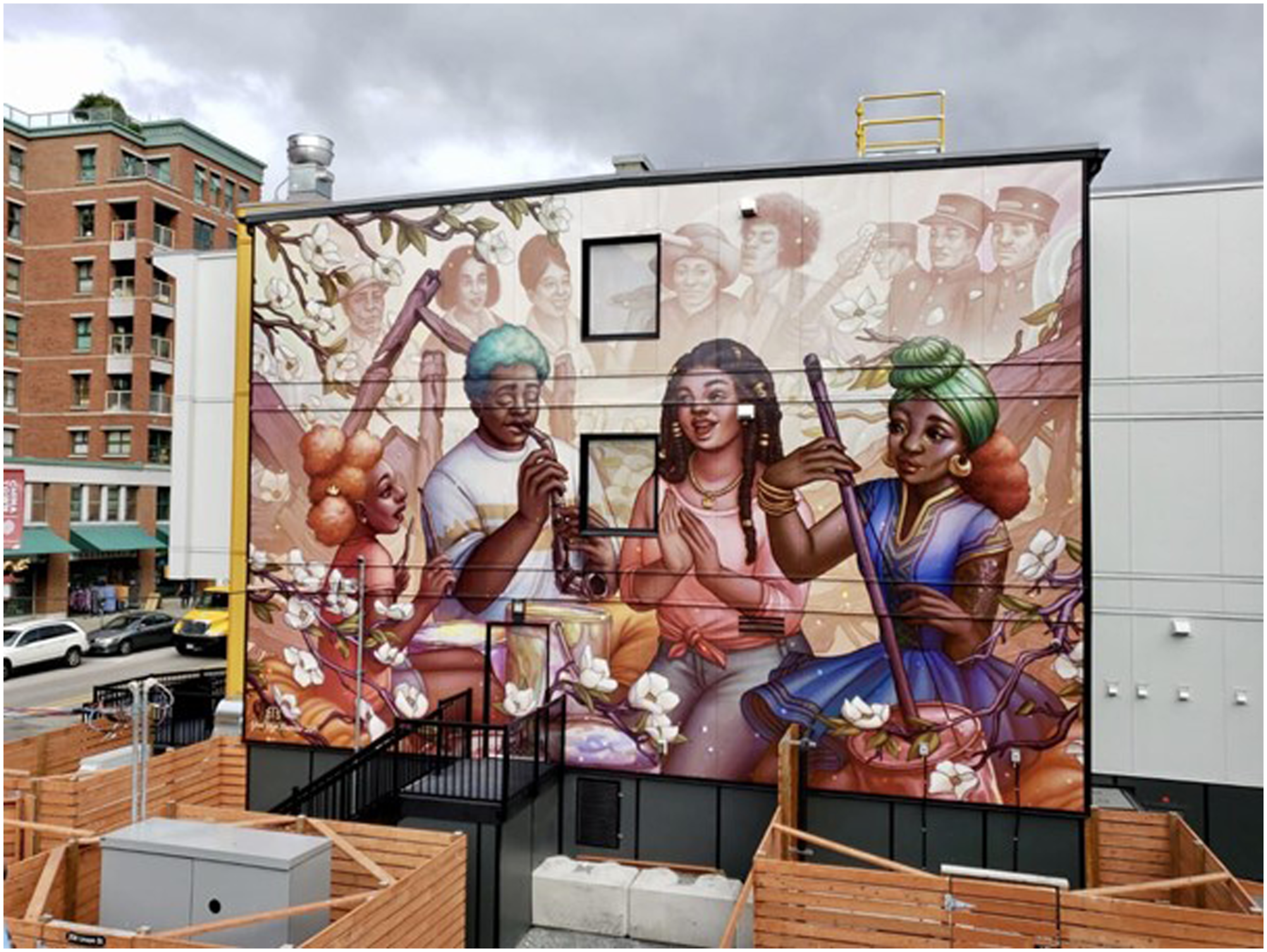
In a two-stage artist call, Black diasporic Vancouver-based artists were invited to submit artist portfolios. Based on these initial submissions, a small panel of Black artists and one HAS board member shortlisted a handful of artists, who were then paid to submit a mural design. Upon final selection, Ebenebe, who usually works with digitally produced artworks, created a vinyl mural with four Black persons, three female, one male, with make-shift musical instruments such as drums, a small saxophone and a washtub bass, one person is clapping. The individuals are presented as colorful and celebratory, with dyed hair and bright clothing, tattoos, jewelry, hair ornaments. The musical gathering marks Black beauty and style through hairstyles and clothing. Subtly reminiscent of Hogan’s Alley’s heritage of jazz music, Ebenebe (27 January 2020) describes her artwork as ‘building new hope and stories from and despite the ruin of the past.’ In contrast to the colorful foreground, the background is kept in sepia-faded shades of brown, grey and white, alluding to historical figures and community members such as Nora and Jimi Hendrix, three male sleeping car porters (a common occupation for Black males in Hogan’s Alley in the 20th century, conveniently proximate to the Pacific Central train station), and three further, smiling individuals, two females with elegant attire and a male with a newspaper boy’s hat, who gaze into the distance. It is a very peopled mural, rimmed by white blossoming cotton flowers. The mural’s bright and sepia color scheme refers to different pasts, and different presents of people from Hogan’s Alley. The simultaneous appearance of past and present, or presence, in the same mural evokes a sense of multiple memory, a ghostly atmosphere of pasts and presents intertwined, still alive in the present. As Derrida (1994: 123) puts it: ‘A ghost never dies, it remains always to come and to come-back.’ This is how hauntology becomes tangible: the mural conveys that the past is never fully over or terminated, but persistently re-enters into the present, and therefore, the future, too. Thus, the mural celebrates Black art and joy in the moment, but also carries with it memories of the past. This multi-dimensional sense of time resonates with McKittrick’s (2022: 81) analysis of Black music as rebellious political act that reframes relations between the ‘melodic procurement of black life’ and anti-colonial politics. In the visual environment of the mural, the procurement of Black life is leveraged via the creative assembly of personalities from then and now, celebrating together on a vinyl stage.
In comparison to the 2014 commemorative stamp, which foregrounds community members in sepia colors against a colorful background of Hogan’s Alley buildings and the ‘dirt lane’, in the contemporary mural, sepia-colored subjects are placed into and as background. The colorfully illustrated music-making individuals populate the foreground, their presence centers the present in this piece. Yet the contrast of colors subtly marks the co-existence of present and past. In sum, the mural interconnects present moments of joy and celebration with fading pasts that still linger in the contemporary sense of place in Hogan’s Alley. In relation to the ghostly analytic, Ebenebe’s artist statement, installed as small plaque at ground level, suggests a co-present temporality that appeals to ‘a vibrant, joyful perspective: one of hope and a future built from past remnants’ (City of Vancouver 2020).
Spatial politics of murals
Borrowing from Karen Till’s (2012) post-colonial approach of ‘wounded cities…harmed and structured by particular histories of physical destruction, displacement, and individual and social trauma resulting from state-perpetrated violence’, Hogan’s Alley is wounded but rising ‘through ashes’, as Anthony Joseph’s impressive mural alongside the Georgia Viaduct proclaims (Landau-Donnelly forthcoming 2). In an ambivalent state of commemorating and reclaiming Hogan’s Alley, McKittrick’s (2022) reference to Sylvia Wynter is insightful, which suggests oppression or woundedness and resistance not as binary oppositions, but dynamically intertwined. In that sense, Hogan’s Alley is also to be remembered as a place of Black life, liveliness, joy and art. Moreover, Till (2012) cautions to attend to a city’s co-implicated temporal and spatial wounds. These open fissures are inhabited now and then by difficult histories, permeated by partial visibilities, absences and presences. While persisting acts of racialized violence, discrimination and anti-Black sentiments keep historical wounds of Black dispossession open, reclamations of urban public space such as the temporary occupation of Georgia Viaduct by BLM activists unfold Black placemaking practices as interventions for pleasure, joy and care (McKittrick 2006; Patterson 2021). More specifically, Black placemaking can create ‘sites of endurance, belonging, and resistance’ (Hunter et al., 2016: 1) in the form of community encounters, celebrations, and shared creative practice.
With regards to the implications of ghosts on art in the public places, the trope of being ‘in and out of place’ (Creswell 1996; Kwon 2000, 2003, 2015) resonates with the co-constitution of absence and presence, the no-longer-here, the not-here-yet. In other words, the location or site-specificity of murals crucially determines their memorial-political place. The vinyl sheets that together make up Remember Hogan’s Alley have been placed on the walls of the exemplary NHP project, which currently shelters up to 52 individuals from Black and Indigenous communities, including people who were previously houseless. Remember Hogan’s Alley literally takes place on the walls of a housing project that aims to create a sense of belonging for Black Vancouverites. More specifically, NHP aspires to provide ‘safe, authentic and intentional community programming…disrupting the legacy of underinvestment for Black and Black identified communities in Vancouver’ (PHS Community Services Society 2020).
Drawing this to a close, the mural is located precisely in a space that bears traces of struggle, suffering, and woundedness, but also of community perseverance and inter-generational mutual support within the Black community, and between state and civic actors. Placing a mural of Black celebration and music into this place inevitably invites to remember other pasts, but possibly to dream of other futures for this place, too. Nevertheless, this dream remains complicated in the present day – its wounds open, to speak with Till – because the City of Vancouver still fully occupies the unceded lands of Musqueam, Squamish, and Tsleil-Waututh Peoples, which continue to struggle for a liveable life in Vancouver.
Complicated visibilities: Sites and senses of the past in the present
According to HAS board member Stephanie Allen (19 May 2020), the mural’s location constitutes ‘a visible spot…even though the space immediately in front of it is still this dead zone of grass.’ Moreover, Allen considers the building complex as ‘an important canvas, an important opportunity to really emphasize Black life, Black presence in Vancouver which is woefully missing from formal acknowledgment. The goals were about celebrating that remembrance’ (ibid.). In contrast, Ebenebe (27 January 2020) considers the site as somewhat inconvenient, finding it ‘a difficult spot just because of the side of the building; the other side is obscured by trees. It is just unfortunate that the building has to be rotated the way it is.’ She recalls her family’s initial reaction: ‘They drove down, I was telling them: “No, it’s behind you, just before you hit the intersection, it’s behind you!” And they were commenting on how hard it was to notice when you are driving – unless you glimpse it in your rear-view mirror’ (ibid.). Besides the mural’s compromised accessibility, the wall itself plays a role as agent that provides and takes space, thus involved in placemaking as emergent and multi-agential process. Compton (23 June 2020) finds the mural’s site-specificity a ‘beautiful fit in terms of what Hogan’s Alley’s activism was originally all about: the displacement of people.’ Connected to the hauntological analytic, the mural’s spatial context evokes the fragmented meanings and stories that Hogan’s Alley already bears. By conjuring people from the past and present, encountered differently by different people in the here and how, the mural opens a space to reflect, mourn, pause, to remember the multiplicity of that space.
The very wall the mural is placed on is ghostly in itself. Neither the wall nor the mural have always been there; the wall hasn’t always been covered with vinyl. Also, the wall of the temporary housing will likely not stay there forever. The transitory nature of NHP is two-fold: On the one hand, residents live there temporarily, hopefully moving into a more permanent residence later; on the other hand, the building itself might be demolished in the future. In sum, the sticky materiality of the vinyl print encapsulates the provisional even disposable nature of the commemorative mural that mediates so much history, joy and pain. Considering that the large stickers composing the mural can be removed without leaving long-term trace or damage to the wall, the mural’s eventual removal would be definite. To sum up, the mural’s potential to create a longer-term legacy is significantly constricted by its removable materiality, which does not bear a visible trace in the urban landscape.
Remember Hogan’s Alley’s fragmented materiality is also restrained within and around its walls. The motif spreads across two windows and a door, surrounded by wooden fence and electricity boxes placed on the building’s North end (Figure 2). Hence, the mural both takes and covers up space. It is pushed away, placed on the building’s sidelines but still significantly transforms the building’s sense of place. The mural’s not-so-central spatial position reiterates the continuously compromised visibility and presence of Black culture and heritage in Hogan’s Alley. By reshuffling the members and faces of Hogan’s Alley, the mural suggests that the contemporary place is also populated by people from the past – which ultimately surfaces the piercing question who Hogan’s Alley is for.
Having invited ghosts from different pasts on site, Ebenebe (27 January 2020) warmed to the idea of ‘having a mural, even if it’s more hidden than it might be otherwise…people still access those hidden spaces.’ She wonders why ‘hidden spaces should be less creatively expressive just because they’re hidden’, as there is ‘something charming about being able to walk down a small street and see a piece of expressiveness that you might not have realized was there.’ Accordingly, Ebenebe (ibid.) considers murals as adding to The embellishment of the city you live in, it creates spaces for your imagination to thrive as you are on your commute. It is not just this blank wall. Part of it is little windows into an exploratory world, and having those windows in these little spaces just brings so much life to your space.
Thus, depicting and paying attention to otherwise overlooked spaces is another way of (re)claiming Hogan’s Alley. Remember Hogan’s Alley oscillates between liveliness and inertia, between semi-hidden visibility and conscious display, colorful celebration and sepia-faded memories of an undated past. The mural’s sticky yet temporary presence in the now, and potential disappearance in the future, conjure a sense of transitory memory. In sum, with this versatile memorial claim to past and present, here and there, the mural sparks conversation beyond its assigned wall.
In addition to the pre-determined mural site, the artist’s own connection to Hogan’s Alley matters in the conceptualization of ghostly relations between space, time and public art. Ebenebe, who lives in Vancouver’s suburbs, only learned about Hogan’s Alley when she applied to the artist call: ‘When I first went to Hogan’s Alley, it was a shock: I had no idea that such a community had existed (...) I mean, it is called Union Street at the moment.’ Pointing to the lack of public visibility of Black heritage or memorial culture in the area, Ebenebe speaks of various spatial ‘disconnects’ she perceives in relation to downtown Vancouver, to fellow artists and diasporic communities (ibid.). To bridge these gaps, Ebenebe finds that art-making brings out ‘something very intimate about seeing another group of people expressing their connections through culture’ (ibid.). Conceptually speaking, the spatial politics of murals evoke a sense of place that is always permeated by such disconnects, both spatially and temporally. This ‘emplacement’, as Visconti et al. (2010: 525) call it, ‘strengthens feelings of closeness to the inhabited place, as well as a sense of legitimization and entitlement to its consumption.’ Notably, for Ebenebe, emplacement became possible through the formal invitation to realize her mural proposal. With an individual opportunity for (however temporary) emplacement, Ebenebe’s piece could create opportunities for diverse Black Vancouverites to emplace themselves via affective encounters with the mural. Spatial emplacement is necessarily experienced differently by people with diverging connections to a place, or memories thereof – be it long-standing or fleeting, unique or frequent, via an abled body or not, via paid labor or not. However, while the mural has been created from Ebenebe’s specific emplacement, it opens polysemic ways to remember Hogan’s Alley – appealing to pasts and presents, colors and shades, music and silence, joy and pain. While public art in the area is fairly sparse besides Joseph’s aforementioned mural, and the famous Jimi Hendrix Shrine (Atlas Obscura 2021; currently closed for the public), Ebenebe preliminarily reclaims space for contemporary Black culture and expressiveness.
In summary, while emplacement shapes a sense of connection and identification for some, it also mobilizes feelings or memories of being disconnected, displaced or further marginalized for others. An overreliance on creating connections to an ambivalently wounded place via artists’ voices might problematically responsibilize them to advance cultural reconciliation or redress. Overall, emplaced hauntological public art can evoke unexpected ways of belonging, wanting to belong, not yet belonging or no longer belonging to a neighborhood. In that sense, emplaced public art can invite ghosts in their temporary place, some of whom feel familiar and close, others that feel strange and unknown. In Hogan’s Alley, Compton considers different generations of Vancouver residents as coming together, and emplacing themselves, in non-enclosed ‘generational cycles’ of remembering (23 June 2020). Moreover, he perceives younger adults to be more supportive to commemorate Black heritage and displacement in Vancouver than in the recent past (ibid.). Ultimately, as new cycles of remembering are being mobilized, different ghosts of the past invoked by the mural hover in that space now. With its temporary emplacement of ghosts, Remember Hogan’s Alley takes and transforms space as one that belongs to many different generations of Black Vancouverites.
Temporal politics of murals
Beyond the importance of claiming space for Black culture and activism, Compton (2011: 106) points to the time it takes to actively remember: ‘In a city like Vancouver, where there is an absence of a place that Black people can regularly find each other, Black History Month has become instead a time to do so – at various sites, with varying focuses, and open to everyone.’ In these times when Black residents, artists, and community organizers can find each other open opportunities to counter real and felt silence, enforced or willed absence, social and physical death, planned displacement and voluntary departures from a neighborhood (Rudder 2004). These memorial times can be conceptualized as acts of Black placemaking, which simultaneously accommodate joyous and pained ghosts from the past and present.
Ebenebe (27 January 2020) was motivated to create ‘a snapshot of who used to be here, and what could be in the future, and I feel that’s something that can resonate with a lot of people.’ By calling her mural’s ephemerality and limited temporality ‘a slash in time’ (ibid.), Ebenebe hints at the inherent split in art exposed in public places, its potential slips, drips, polyvalences, spots (Ferrell and Weide 2010). In the face of these slippages, hauntology scholar Avery Gordon (2008: 3) argues that haunting ‘is not about invisibility or unknowability per se, it refers us to what’s living and breathing in the place hidden from view: people, places, histories, knowledge, memories, ways of life, ideas.’ What is also ‘hidden from view’ are the multiple times and stories from the past, present and future that the mural fuses into one ghostly piece.
Ebenebe (ibid.) understands art extrapolating both into the past and future ‘to create a tunnel back to the past visually or auditorily, same for envisaging the future…it is fascinating to see what people were hoping for, or dreaming about...to see how similar it can between now and then.’ The mural sketches a multi-color encounter, braiding together dreams and joy between and beyond times. Ebenebe’s artist statement (City of Vancouver 2020) emphasizes ‘the passion for rebuilding, of bringing back to Vancouver what has been lost (...) our youth rediscovering their roots and communing with their forebears.’ Against the dehumanization of both past and contemporary Black life, Ebenebe portrays the latter as living, celebrating (ibid.): Learning that a vibrant community of Black Canadians was not only tragically erased, but that their memory is nearly forgotten comes at a harsh shock. But focusing only on the pain of this tragedy isn’t telling the complete story (…) voices of triumph and hope still ring out from underneath the loss.
The mural thus problematizes some of the absences and erasures of the past by making them present now. It foregrounds that histories of Hogan’s Alley continue to be in and out of place, in an unhinged time that is never quite in the past (or the past, for that matter). Put differently, the ghosts of such contested places are never fully at rest (Coddington 2011). In light of the forced erasure of Black infrastructures of culture, music, food and life by predominantly white planners, the mural brings parts of these conflicts back.
Cruel slippages: Black absences and presences perpetuated
The launch of Remember Hogan’s Alley caused controversy when the City unveiled the mural without notifying local community activists. Stephanie Allen (19 May 2020) had explicitly asked to be notified about the installation: ‘We wanted to celebrate that installation. This is such a significant part of reclaiming the site, of asserting our presence in the city.’ However, the vinyl print was installed without either the artist’s or HAS’ notice. Allen expresses heartfelt discontent (ibid.): How on earth is this happening right now? How could you actually fail to tell us? We continue to be leveraged, commodified, appropriated, even with what they perceive to be some of the most enlightened and engaged processes. We are still not people that deserve, and are afforded respect, consideration, and accountability…To the City, it was just a mural installation, it was just part of the job…To us, it was something really meaningful…We wanted to come together and commemorate with that memorial…because of how much violence was enacted on that site, by the very City of Vancouver. It was just another straw in a very long straw accumulation process of the indignities we have felt from a city bureaucracy that has not yet come to terms with understanding and respecting marginalized communities.
With regards to the hauntological framework woven through this article, the mural invites stories from the past; it touches on ‘the border between the present, the actual and or present reality of the present, and everything that can be opposed to it: absence, non-presence, non-effectivity’ (Derrida 1994: 48). In Vancouver’s inter-departmental medley of responsibilities and timelines, however, borders between present, absence and non-presence morphed into an overarching mindset of ‘getting things done’. This pragmatic approach was prioritized over a substantial dialogue with affected community organizations from Hogan’s Alley. In summary, through the City’s failure to inform community stakeholders about the installation, the making-absent of Black voices and celebration (re)appears in the production process of a mural that seeks precisely not to do, or even undo, injustice. In the multi-stakeholder process of installation, ghosts from both long-gone pasts and those no-so-long-ago clash here as a reminder that wounds of disrespect and tokenization persevere for some.
In addition, during data collection in 2019/20, the City-administered Public Art Registry listed the artwork as ‘Untitled’ for several months since its hushed installation in September 2019. Ebenebe states that her piece is matter-of-factly ‘not untitled – the name is Remember or Remember Hogan’s Alley – I was asked to submit a name and I did, but I guess it didn’t make it through?’ This telling act of not naming of artwork that explicitly claims to remember a historically invisibilized group is perceived as intolerable and excruciating for some people affiliated with, afflicted by, or advocating against displacement from Hogan’s Alley. Early on, Ebenebe had suggested the name Remember, inspired by the eponymous Jimi Hendrix song, and later modified it to Remember Hogan’s Alley. Upon request, the title Remember appeared in the Public Art Registry in May 2020, and has to date been corrected into Remember Hogan’s Alley, while Remember was originally stated on the artist’s social media (Ebenebe 2020). What Allen calls ‘erasure’ (19 May 2020) resonates with Gordon’s (2008) observation that haunting captures harm, loss or mourning that took place in the past, but also affects the present day. In the case of Ebenebe’s mural, the piece not only registers the past physical and symbolical violence inflicted upon Hogan’s Alley’s communities, residents, and frequenters. It also evokes the continuing hurt and disrespect caused by the harmfully technocratic mural installation. In the worst case, Black culture is misused again to upscale assumingly devaluing neighborhoods (Montgomery 2016).
Against what Allen perceives as ‘tokenistic’ engagement in the mural commission process, the Head of Public Art, Erik Frederiksen (6 February 2020), explains the City’s ambition of commissioned murals ‘to really amplify and increase the amount of murals’ while many aspects of how to accomplish that appear vague: ‘It is not really clear what the long-term life of any of those works looks like… what would happen around decommissioning or recommissioning.’ Briefly, mural maintenance and installation, for Frederiksen, is a ‘pragmatic question’ rather than a political act. In stark contrast to Wynter’s ‘groundbreaking claim that making black culture reinvents black humanity and life’ (McKittrick 2022: 85), the City’s explicit invitation to produce Black culture in Vancouver’s public space is compromised by repeated precarization of Black artistic and activist positions, and the incomplete presentation of their artwork.
Mikko Joronen’s (2019: 3) notion of ‘negotiated precarities’ comes to mind, which addresses the compartmentalization of colonial power at the expense of making the lives of the colonized ‘close to unlivable.’ Arguing that ‘precariousness is thus what haunts all political, social and spatial manifestations as a reminder of their intrinsic finitude, thereby offering, not an ontological foundation of life, but a condition that makes life (and its governing) fragile, vulnerable and finite’, Joronen (2019: 4) concludes that it is ‘small-scale ways of erasing, diminishing, redirecting, cancelling, ignoring and inoperationalising’, induced by settler-colonial power that facilitates the ghostly appearance of a wounded past in present contexts of local cultural and memorial politics. The City’s failure to acknowledge the ‘negotiated precarity’ of Hogan’s Alley both in the past and present articulated a conflict – even though, or precisely because of the City’s assumption that putting up the mural without notifying concerned stakeholders would not be a problem. Worse even, the assumed, ‘business-as-usual’ installation reinforced Black activists’ actually existing sentiments of disrespect, displacement and ongoing erasure.
The City’s official, proclaimed stewardship for the mural’s long-term sustainability stands in tension with Frederiksen’s opinion that some public artwork ‘overstays its welcome’ (6 February 2020). McCormick and Jarman’s (2005: 51) discussion of the death of murals is insightful here to illuminate the limited lifespan of murals, which are ‘created for a reason, are maintained for a time and are then removed or allowed to disappear.’ Following that logic, public art planners and technocrats could more easily opt for public art’s permission to disappear. In contrast, however, artist-led initiatives have long fought against the disappearance of African-American and Black life through ‘urban renewal’ planning (Hunter et al., 2016; Rutland 2018). Ebenebe (27 January 2020) appreciates ‘the idea of wanting to free up space to embrace other art’ after the expiration of her 2-year contract, yet based on the assumption that other (Black) public art would take the space. McCormick and Jarman’s (2005) approach of ‘transitionary permanence’ assists to imagine more fluid practices of making time and space for Black memory-making through art. This understanding of time as malleable and permeated by disturbing (re)appearances of the past in the present feeds into the conceptualization of a hauntological approach to public art. The ghostly dimension of public art becomes apparent in artists advocating that further artwork take the place of their own ephemerally present art. Put differently, murals’ commemorative value can derive precisely from their non-permanent status. If murals are temporary commemorations, they can impressively communicate the fleeting nature of history and story-telling. As temporary, commemorative artistic media that convey stories, dreams and hopes from contested pasts, presents, and futures, ghostly murals can provide space to stay with, and work through, conflicts. Conflicts that can be mobilized through public art are multiple – they can unleash disagreements about meaning and belonging that may have already lingered in sites where public artwork is now to occupy space. In the case of Remember Hogan’s Alley, the piece takes place in a location formerly unoccupied by art. With its temporary-ghostly appearance, the mural leveraged attention and discussion about the differing interpretations of how much time, caution and care to invest in delicate planning attempts to reinforce Black presence, life and livelihood through art in Vancouver.
Conclusion: The ghostly power of conflict
By tracing the artful appearance of people and stories from the past via a Black art piece invited into urban public space, this article has shed light on multi-layered tensions that appear alongside the emergence of public art. Claims and goals to commemorate Hogan’s Alley as historically Black neighborhood were met with misaligned institutional commitment to center and celebrate Black placemaking. Moreover, it has pointed to the crucial influence of ghostly appearances of the past mobilized via artworks in the public realm. Hauntological public art is couched within multi-stakeholder processes of realizing public art. It simultaneously appeals to various pasts and contested interpretations of belonging in the present. Furthermore, ghostly public art hovers between official public art policy objectives and actually executed administrative action. Ongoing mishaps and discomforts amongst Black artists and community activists on the one hand, and local public art and planning authorities on the other illuminate what public art can do politically. Diverging reactions to mural locations, temporary commissions and more or less inclusive processes of mural production and unveiling illustrate how conflict-laden both public art and space can be. Public art thus operates as material and symbolic medium to (re)activate, remember and potentially hold space for conflicts about the meaning, presence and absence of diverse voices in historically marginalized neighborhoods. To further advance the historical acknowledgement of racialized displacement, which often continues to be facilitated by predominantly white-led urban planning, such conflicts need to be acknowledged as partially unresolved, yet not necessarily unresolvable.
As McKittrick (2022: 10) piercingly puts it: ‘Black aesthetics…are underwritten by stories and ideas that are fleeting, flexible, new, and old; these stories and ideas teach us how to navigate infrastructures of harm, these stories and ideas reside within, across, and outside prevailing knowledge systems.’ Interlinked with the hauntological analytic of public art sketched here, the political underpinnings of conscious, haphazardous and involuntary presences and absences affect multi-stakeholder collaboration, as well as mutual understanding, respect and trust. As systemic levels of racism in urban (cultural) planning and policy practice continue to persist in Vancouver (Allen, 19 May 2020), public art continues to appear as a rebellious medium that tells untold, hidden, displaced or forgotten stories. Hauntological public art wrestles with the wounds of the sites it is placed in, plays with color and time and engages the people that populated these places beforehand. Such public art takes place, yet also grants space to host narratives that have remained unnoticed or underappreciated. Hauntological public art thus points to partial possibilities for healing in wounded places where past and present agents can meet, and maybe reconcile. However, ghostly public art does not offer an ultimate solution to, or reconciliation of racial inequities, but rather requests an ongoing commitment and care for struggles against oppression, erasure and tokenization. In short, ghostly murals inscribe contestations about absences and presences into urban places with the hope to cultivate more appreciation for multiplicity and difference. Ghostly murals, then, differently mark historical and contemporary displacement and hardship on the one hand, and trans-generational celebration, laughter, and culture on the other. Ghostly murals that remember reflexively reach back into pasts we might know (too) little about and simultaneously stretch (us) towards futures we do not yet know.
Beyond the focus on a singular racialized neighborhood, further empirical research and conceptual work on public art in contested public spaces could set out to trace, track and encounter other ghosts in other places, walls and times of conflict. As conflicts that are (re)activated via public art certainly unfold differently in post-War settings, active conflict scenarios or predominantly peaceful societies, the repertoire of encounters with ghostly senses of place, time and memorialization needs to be expanded. Especially in territories marked by contemporary regimes of displacement, racial discrimination and ongoing colonialism, the power of controversy unleashed by murals that remember marginalized communities can not only destabilize and counter-narrate oppressive systems. Moreover, such conflictual public art can also demonstrate that narrowly instructed public art policies always, to some degree, escape planned intentions. Considering public art as a public matter of concern necessarily unravels conflicting opinions, feelings and degrees of appreciation by diverse audiences. In the spirit of encouraging to live with difference (Valentine 2008) and agonism (Bruce 2018), ghostly public art moves beyond perpetuations of exclusionary politics instead of falling for forcefully constructed consensus.
In sum, the article offers two main conceptual contributions for critical creative geographies, as well as scholarship on racialized public space. First, I have provided a conflict-attuned perspective to the ‘positive’ study of commissioned public art. This extends analytical rigor to understand the differing and often conflictual rationales of artists and communities on the one hand, and local policymakers and planners on the other. This framework pushes the implicit normative assumption of ‘well-intended’ and therapeutic public art beyond consensus (Landau-Donnelly and Zebracki forthcoming). A more conflict-oriented approach to the study of art in public space helps to better decipher the complex politics of public art (Landau-Donnelly forthcoming1). Second, I have pushed the conceptually potent framework of hauntology, already lingering in graffiti and street art scholarship (Ferrell 2015; Kindynis 2017; Parisi 2019), into the realm of commissioned public art. While the claim to publicness suggests the political rationale of serving communities in processes of commemoration and reconciliation, the case study of Hogan’s Alley has revealed that even sanctioned murals unravel deeper-seated divergences between community stakeholders. I have sketched a hauntological conception of public art along the lines of concrete yet contingent politics of space and time. Only when we dare to face the ghosts of multiple pasts will the piercing power of absence and presence in places wounded by racial displacements come to the fore. Yet, the implications of ghosts appearing, disappearing and reappearing remain ever so slightly beyond control. Ultimately though, in ghostly urban cultural political contexts, wounds fusing past and present pain can be actively acknowledged, mended, mourned. As violent and beautiful ghostly public art may be at the same time – decolonial urban futures can only be healing when Black stories, art, and life take place in the past and present.
Footnotes
Acknowledgements
I would like to thank Caitlin Bruce, Wayde Compton, Evan Carver, Ela Kern, Eugene McCann, and Lucas as well as the anonymous reviewers for their encouraging and constructive feedback on earlier versions of this paper. In addition, I would like to thank Edge, Stephanie, Anthony and Krystal to take the time to talk to me.
Declaration of conflicting interests
The author(s) declared no potential conflicts of interest with respect to the research, authorship, and/or publication of this article.
Funding
The author(s) disclosed receipt of the following financial support for the research, authorship, and/or publication of this article: This work was supported by the Social Sciences and Humanities Research Council of Canada (Referencescapes and public space: Futures; pasts a).