



Abstract
The declaration of China’s Air Defence Identification Zone (ADIZ) over portions of the East China Sea in 2013 has often been interpreted by international relations scholars as an aggressive “land grab” in the sky. However, classical geopolitical perspectives of territory and control, despite their popularity when analyzing the politics of East Asia, fail to present a full understanding of ADIZ creation, adjustment, maintenance, and contestation. Rather than a problem created by the rise of China, conflicts over airspace are a regional phenomenon. By engaging with the critical geography literature on airspace, verticality, and space production, this paper theorizes ADIZs as the partial extension of state sovereignty via assemblages in response to the emergence of new vertical threats and opportunities. It then shows how the Cold War consensus on the function and performance of these volumes has broken down in East Asia, which has paradoxically encouraged both the expansion of ADIZs as well as their systematic violation. These “grey volumes,” which are characterized by debates over the legality, function, and performance of airspace, are explored in a case study of the ADIZs of Japan, South Korea, China, and Taiwan. Ultimately, these patchworks of ambiguous and overlapping airspaces are difficult to reconcile with classical geopolitics’ one-dimensional assumptions of sovereignty and territory.
Introduction
China’s November 2013 declaration of an East China Sea Air Defence Identification Zone (ECSADIZ) provoked numerous alarmist statements from politicians, policymakers, and commentators. As defined in Annex 15 of the Convention on International Civil Aviation, an ADIZ is merely a “special designated airspace of defined dimensions within which aircraft are required to comply with special identification and/or reporting procedures” (ICAO, 2018: 1–2). However, for both Japanese Prime Minister Shinzo Abe and US Secretary of State John Kerry Beijing’s move was a “dangerous act” (Cole, 2013; Whitlock, 2013), while US Secretary of Defense Chuck Hagel denounced it as “a destabilizing attempt to alter the status quo” (Hagel, 2013). For others, the declaration was “a veiled invasion of the Senkakus” (Hipple, 2013) and “just the beginning” of a series of further imminent to-be-announced Chinese ADIZs (Kazianis, 2013).
The resurgence of interest in ADIZs following the ECSADIZ declaration was led by scholars of international relations, who had previously neglected the topic. Yet, two years after the establishment of the ECSADIZ, a study complained that “much of the research and information available on ADIZs is outdated and incorrect” (Charbonneau et al., 2015: 2). Although this criticism focused on the technical and legal aspects of ADIZ research, a similar accusation could be made about its conceptual underpinnings. There are perennial criticisms that international relations scholarship neglects deeper questions of territoriality and the spatiality of power (Beeson, 2009: 498; Brenner et al., 2003; Flint et al., 2009: 827; Kuus, 2020: 1190; Lacher, 2006: 15; Ruggie, 1993). Indeed, the resurgence of interest in ADIZs was limited by its adherence to classical geopolitical assumptions of two-dimensional, container-like states engaged in territorial competition as well as the tendency of English language scholarship to focus on China as a geopolitical threat. This resulted in Cold War-style scholarship equating Chinese ADIZs with territorial aggrandizement (Hipple, 2013; Pedrozo, 2014; Reeves et al., 2018). Often overlooked was the acknowledgment that ADIZ creation, adjustment, maintenance, and contestation was a regional phenomenon, not just a problem caused by China. But narrowly viewing the creation and utilization of ADIZs as a challenge to the US order obscures the wider geographical and historical context of these spaces, misconstrues the risks they pose, and conceals possible solutions.
Fundamentally, IR scholarship lacked engagement with recent progress in critical geopolitics and political geography, particularly their focus on ongoing transformations in how sovereignty and territoriality operate in contemporary world politics. Therefore, we argue that it is too simplistic to view China’s creation of its ECSADIZ as part of “an emerging struggle for control of the entire common maritime/air space of East Asia” (Auslin, 2020: 9) or as a “Great Wall in the Sky” (Osawa, 2013). Rather than seeing territory as one-dimensional, it must be understood as a complex product of material and representational interventions. It is also important to acknowledge that the rules and practices of space construction are currently in flux, which means that the use of international law is often part of these controversies rather than serving as an authoritative source of closure. In short, grasping the geopolitical implications of ADIZs requires a more reflexive awareness of how such spaces are constituted and the function they serve in contemporary world politics. Where do ADIZs come from? How do they operate? Why are they suddenly so controversial?
Drawing upon the rich literature on airspace production, this paper theorizes ADIZs as the partial extension of state sovereignty in response to the emergence of vertical threats and opportunities. In the early Cold War period, these airspaces were a technical response to rapid technological innovation that threatened to undo earlier paradigms for understanding power and space. But in contrast to sovereign borders, which were successfully black-boxed (Sassen, 2008: 6), the assemblages involved in the production of ADIZs have never been fully stabilized. Part of the reason has been the sheer technical difficulty of producing vertical spaces away from one’s own territory, which requires the continuous operation of intercepting aircraft and identification systems, but a deeper reason has been the changing meanings associated with these zones. As we show in our case study of East Asian ADIZs, the initial informal consensus among littoral states regarding these airspaces during the Cold War has broken down, which is paradoxically fueling an expansion of ADIZ performances across the region but also making these individual assemblages more contested than ever before. We describe these zones as grey volumes, noting that their greyness operates at several levels. First is the legal ambiguity of ADIZs, which produce spaces of partial and overlapping sovereignty that do not fit the black and white boundaries of classical geopolitics. Second is the functional greyness of these airspaces. Traditionally, ADIZs were used for the early identification of airborne nuclear threats, but East Asian states accuse each other of using them as instruments of terrestrial and maritime space production, which encourages their systematic violation. Lastly, the performative greyness of ADIZs refers to the complex networks of actors involved in airspace production, the idiosyncrasies of each state’s assemblages due to budgetary, technological, and political limitations, as well as the changing representations and enforcement of these volumes.
Ultimately, this paper contributes to the literature on ADIZs by acting as a bridge between the work of international relations scholars and political geographers. On one hand, the focus on the creation of new airspaces in East Asia contributes to existing work by political geographers on space production in the region, such as critical investigations of the Belt and Road Initiative (Flint and Zhu, 2019; Narins and Agnew, 2019; Szadziewski, 2020), the construction of Southeast Asia as a region (Glassman, 2005), or zoning technologies in North Korea (Doucette and Lee, 2015; Lee, 2014). However, these studies are generally terrestrial in focus and neglect airspace and verticality. On the other hand, international relations scholars can benefit from political geography’s more nuanced grasp of the relationship between territoriality and sovereignty. Unpacking the ostensibly neat lines of ADIZs in East Asia requires stepping away from the simplistic assumptions of classical geopolitics and embracing the complex reality of the region’s overlapping airspaces.
Literature review – space production from state to sky
For many international relations scholars, contemporary struggles over ADIZs in East Asia are viewed through the prism of classical geopolitics, defined as “zero-sum games of hegemonic competition between states viewed as unitary, and territorially simple, actors” (Flint and Zhu, 2019: 96). Indeed, this focus on great powers and territorial competition is hardly surprising, considering how closely the field of international relations has been aligned with classical geopolitical assumptions (Lacher, 2006; Stogiannos, 2019: 5). Moreover, contemporary East Asia appears to be a perfect fit for these approaches because of low levels of institutionalization, numerous territorial disputes, and great power competition between the US and China. This has resulted in a growing body of scholarship applying the geopolitical writings of Mackinder, Spykman, and Mahan to explain the rise of China and the international relations of East Asia (Auslin, 2020; Dueck, 2019; Lee, 2017; Mitchell, 2020; Schreer, 2019). A key concern of this literature revolves around the control of the Rimland, the littoral zone surrounding the Eurasian continent, and its implications for US hegemony (Auslin, 2020; Schreer, 2019; also see Spykman, 1942). As Mitchell (2020: 422) concludes, “much of what Mackinder and Spykman enunciated in the previous century remains relevant and applicable to the present.”
However, this emphasis on timeless geopolitical truths obscures the fact that space production is dynamic, contested, and historically contingent. Unlike classical geopolitics, which is “concerned with creating the image of control and permanence over a global spatiality that is always potentially in flux” (Agnew, 2010: 570) as well as “simplistic territorial demarcations of inside and outside, Us and Them” (Kuus, 2017: 5; also see Dalby, 2005: 310), scholars of critical geopolitics argue that these simplifying assumptions need to be contested and unpacked. Part of this unpacking is accomplished by focusing on the politics of space production, especially how geographical facts are socially produced rather than natural (Agnew and Corbridge, 1995). This means that geography does not exist outside politics, but, rather, is deeply implicated with it. Moreover, the production of geographical facts has been historically dominated by Western elites and intellectuals, often for imperial purposes (Beeson, 2009: 501; Gregory, 2004).
But how exactly are these geographical facts created? Space production involves discursive and material techniques designed to create new spatial realities as well as new geographical subjectivities. At one end of the spectrum, the use of maps, pictures, rhetoric, metaphors, and analogies are key strategies for creating imaginative geographies capable of influencing policymakers (Agnew, 2010: 571). These discursive, representational strategies often involve othering techniques designed to create binary divisions of the world, such as East versus West or Free versus Unfree (Glassman, 2005; Gregory, 2004; Kuus, 2017). When these representational strategies are successful they become emergent geopolitical cultures or anticipatory geographies (Szadziewski, 2020). If widely accepted and continuously reproduced, these discourses may even become accepted as self-evident or common-sense knowledge, what Agnew (2018) refers to in the context of the modern state as the “territoriality trap.”
The other end of the spectrum consists of physical interventions such as military performances, architecture, or complex assemblages of humans and machines. These material strategies can be used either to reinforce rhetorical or representational strategies or to subvert them by changing facts on the ground. Thus, the Israeli building of outposts and walls in the Occupied Territories creates a lever of control over the landscape that runs contrary to promises of a two-state solution (Weizman, 2007). Conversely, as argued by Scott, the robust deployment of US military assets to Asia is integrated with political rhetoric and diplomacy seeking the construction of the Indo-Pacific as a region (Scott, 2020).
Ultimately, a useful way of conceptualizing space production is to envision it holistically as a coherent set of practices deployed by political actors, what Tuathail (1996: 8) calls a “technology of power,” and Elden (2013: 49) describes as “political technology.” By viewing space production as a type of technology, we can foreground the instrumental nature of the practice—it is always for some purpose and for someone. This reflects both classical ideas of territorialization, described by Sack (1986: 1) as “a spatial strategy to affect, influence, or control resources and people, by controlling area” as well as Lefebvre’s (1991) insistence that spatial practices are inherently political. Like all technologies, space production involves assemblages of human and non-humans as well as justificatory logics and rhetoric (see DeLanda, 2006). Elden (2013: 49) describes this process as “a whole number of mechanisms of weighting, calculating, measuring, surveying, managing, controlling and ordering.” Sassen (2008: 18) similarly highlights how the Westphalian state is a historical assemblage produced by a constellation of actors, including lawyers, generals, and merchants, and that “there was nothing natural, easy, or predestined about the national.”
But these “inherited geographies of state space” are being transformed in the contemporary era (Brenner et al., 2003: 11). Although globalization has not led to the demise of the state, it has contributed to a looser and more complicated linkage between state sovereignty and territory, creating a sense of “geopolitical vertigo” (Toal, 1994: 231) or a “disorientated state” (Arts et al., 2009). This new condition is marked by “multiple hybridities” of state and non-state actors (Flint and Zhu, 2019: 97), and the proliferation of ambiguous spaces or zones of exception where “sovereign power is present and yet absent” (Mountz, 2013: 833). As we show in subsequent sections of this article, ADIZs are an example of these new spaces where sovereignty is rearticulated in novel ways.
It is also important to note that ADIZs are not a terrestrial phenomenon but, rather, aerial and vertical. Originating in urban studies, the concept of verticality criticizes geography’s horizontal bias and argues that territory needs to be envisioned as volumetric, extending both upward into the sky but also downward into subterranean spaces, like bunkers, tunnels and reservoirs (Elden, 2013; Graham and Hewitt, 2013; Sloterdijk, 2009; Weizman, 2007). This verticalization of territory is heavily reliant on technologies, such as skyscrapers, helicopters, excavation equipment, or drones, and is deeply politicized: “[t]he atmosphere is not a hollow volume, a politically neutral verticality, or an existential hiccup: the technics that enclose its auras reinforce and transform relations of political economy, domination, and violence below” (Shaw, 2017: 893). This linkage between verticality and power is complex, alternatively envisioned in these writings as running from the sky to the ground, from the ground to the sky, or “oscillating in its position from above to below and back” (Adey, 2010b: 61). Therefore, the expansion of ADIZs in East Asia serve as an excellent example of the verticalization of territory.
Closely related to the literature on verticality and drawing upon earlier works examining the impact of aircraft on geopolitics (Brobst, 2004; Butler, 2001), the scholarship on the creation and maintenance of airspaces is also directly relevant to this inquiry. Even though airspaces remain among the most state-centric territories in the world today, they too are undergoing many of the processes of reconfiguration identified in the wider geography literature. This means that airspace cannot be understood as simple or unitary volumes but “multiple and complex geopolitical airspaces” (Williams, 2011: 254) that are often “unevenly spaced with different states extruding into one another” (Adey, 2010a: 77). These accounts also emphasize the performativity of airspaces, which are systematically produced through technologies like aircraft, radar, and air traffic control systems (Budd, 2009). Yet the exact nature of the power relationship between control of the air and life on the surface remains ambiguous, with some accounts emphasizing how aerial performances can project sovereignty or dominion downwards (Graham and Hewitt, 2013; Gregory, 2011), while others argue that we cannot overlook the importance of agency from below (Budd, 2009; Williams, 2013). Moreover, as with scholarship on verticality, the literature on airspace creation has overwhelmingly focused on European and American case studies. 1 Admittedly, this study cannot avoid discussing the role of the US, which was undoubtedly “the lead actor in developing ADIZs” (Almond, 2016: 196), but its primary focus is on the wider dynamics of these airspaces and their transformation in the East Asian context.
The evolution of ADIZs
To better understand the origins and evolution of ADIZs, a simplified model of airspace production is presented in Figure 1. Heavily inspired by assemblage theory’s emphasis on processes of territorialization and deterritorialization via networks of heterogenous objects (Anderson and McFarlane, 2011; Müller, 2015; Sohn, 2016), our model begins when technological innovation creates the ability for states or groups to project power vertically. This ability to transcend two dimensional spaces is both a threat and an opportunity for states, but their perceptions may diverge depending on geographical location and access to technology. Unable to agree on a shared mental map of these new spaces, states may unilaterally use assemblages of machines to map and guard aerial volumes or even contest those of neighboring states. This process, we claim, contributes to the emergence of grey volumes characterized by intense debates over the right to possess vertical spaces (legal greyness), their purpose (functional greyness), and how they should operate (performative greyness). This stage corresponds with initial debates over airspace in the early 20th century and the split between the contradictory principles of closed skies (“aer clausum”) and freedom of the skies (“caelum liberum”) (Cuadra, 1978: 486; Zheng, 2015: 186). Conversely, if state actors arrive at a consensus on the risks and benefits of verticality, then airspace becomes a legally guaranteed space, loses its greyness, and the assemblages needed to produce it fade in relative importance. For example, the revolutionary application of aviation technology to military purposes during the First World War persuaded even previously reluctant actors to accept state sovereignty in the airspace above national territory—a new consensus that was subsequently reflected in the 1919 Paris Convention (Cuadra, 1978: 487; Kentaro, 2018: 245). The 1928 Havana Convention and 1944 Chicago Convention both similarly recognised sovereignty in airspace over national territory as customary international law (Cuadra, 1978: 488). As a result, national airspaces exist today even for those states that lack a powerful air force or early warning systems to actively perform these volumes. The Construction and Enforcement of Air Defence Identification Zones.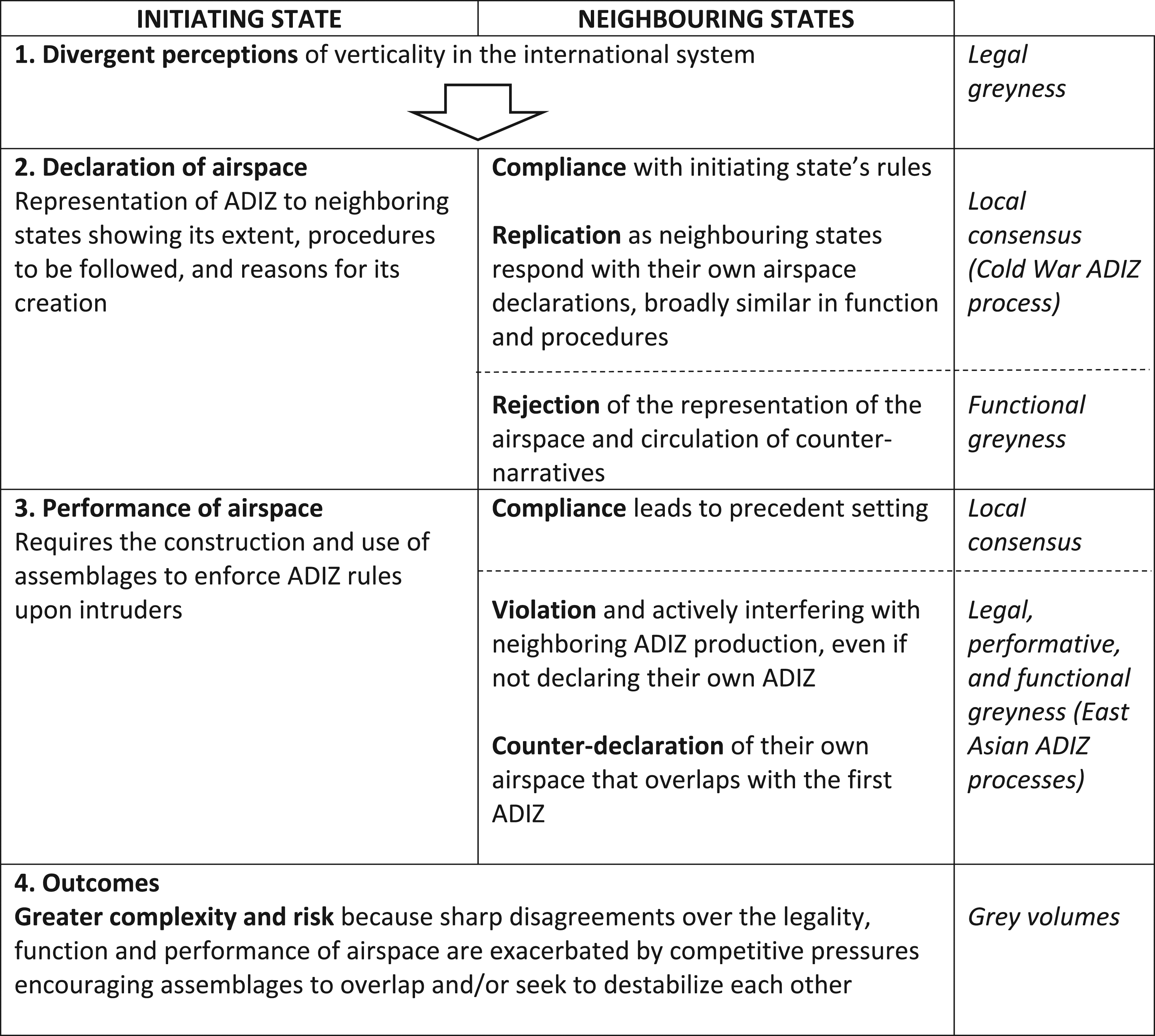
Our model avoids the common criticism of assemblage theory—that it risks turning everything into an assemblage (Anderson and McFarlane, 2011: 125)—by emphasizing when and how these performances of machines matter (periods of divergence) and when they fade into the background (periods of consensus). But these periods of consensus are vulnerable to social change, such as the emergence of a revisionist state, or underlying technological developments that enable new forms of airspace production outside the scope of pre-existing agreements or which cause states to recalculate the benefits and risks of verticality. This is exactly what happened in the mid-twentieth century when ideological polarization and the development of nuclear weapons and their airborne delivery systems encouraged the enclosure of adjacent airspace by some littoral states.
Washington’s decision to enact the first ADIZs in 1950 has been linked to the trauma of Pearl Harbor and nascent Cold War fears of aerial bombardments, including strategic nuclear attacks, from the Soviet Union (Beckman and Hao, 2019: 160; Calkins, 1957: 375; Lamont, 2017: 205; Schaffel, 1991: 131). A simultaneous expansion of the US’ material air defence capabilities followed the first Soviet nuclear test of 1949, with US military planners “secur[ing] funding to construct a massive network of 85 radars for Alaska and the Continental United States, along with control centers to coordinate response to a Soviet air attack” (Scott, 2015: 191). US zones were complemented by the declaration of a Canadian ADIZ, whose own radar systems were part-funded and manned by Washington (Scott, 2015: 192, 194). These North American ADIZs were initially interpreted through two-dimensional land-based understandings of territorial defence, as “towering chunks of air space forming a mid-century Maginot Line” (Calkins, 1957: 372). In practice, however, the American and Canadian zones, later formally integrated through the North American Air Defense Command (NORAD), entailed a complex and resource-intensive assemblage of radar systems, interceptor aircraft and surface-to-air missiles, that grew considerably in terms of sophistication and were directly linked to the US’ offense-oriented strategic air command bombers (Jockel, 2010: 1014; Karafantis, 2017: 140).
Perhaps surprisingly, given their unprecedented claims on volumes of airspace above the high seas, the international response to the initial US ADIZs of 1950 “was not one of protest; it was one of quiet compliance” (Head, 1964: 182) and the issue “rarely became the subject of public debate” (Lamont, 2017: 204). This was because littoral states broadly agreed that the verticality of nuclear delivery systems was an unprecedented threat and the development of ADIZs was perceived as defensive in function. The US and Canada were soon followed by other states endowed with the requisite material capabilities and social motivations to establish ADIZs. By the late 1970s, at least 12 had been declared, many based in the distinctly maritime theatre of Asia (Strauss, 2015: 761; Zheng, 2015). For Cuadra, these new ADIZ mechanisms amounted to “claims of limited sovereignty in airspace over the high seas” (1978: 485). But how would this extension of, albeit limited, sovereign authority be justified? Maritime law offered jurists an appealing point of comparison. The so-called “cannon shot rule,” in which the range of coastal defences was said to dictate the extent of state authority over adjacent waters, had previously expanded in limited forms from three to 12 nautical miles following the introduction of steam ship technology (Head, 1964: 188). A similar principle was invoked in the early Cold War period to support the imposition of these technical ADIZs. If limited sovereignty over coastal waters extended to the distance reached in approximately one hour of steam ship travel, then “it seems reasonable to argue that the littoral state also has certain interests. . . to the distance that an aircraft can fly in one hour” (Head, 1964: 188). This fuzzy principle of one hour flight time equated to “between two and three hundred miles” of airspace at the time of the first ADIZs (Martial, 1952: 256).
This expansion of gradated forms of sovereignty into airspace occurred alongside a contemporary expansion of state authority into maritime spaces due to “technological advances that were changing the relationships between societies and the seas” (Strating, 2019: 452; see also Harrison, 2011: 37–38). Specifically, the growing accessibility of the seabed and intensification of economic exploitation due to new technologies transformed the sea from an “infinite resource” (Von Zharen, 2000: 24) into a site of competition and risk (Kaye, 2007). Unlike ADIZs, which remained legally grey spaces because major littoral states’ threat perceptions diverged from smaller or inland states not facing the threat of nuclear strikes, a consensus was possible when it came to apportioning the opportunities of maritime spaces. The 1982 United Nations Convention on the Law of the Sea (UNCLOS) represented a major expansion of aspects of state sovereignty into previously ungoverned maritime zones, “convert[ing] a vast swath of oceanic space from a global commons to a regime characterized by 200-mile exclusive economic zones (EEZs)” (Alcock, 2011: 255). As with ADIZs, this expansion of state sovereignty was not a straightforward extension of hard Westphalian boundaries; rather, it produced a more complex maritime landscape of “spheres of overlapping rights, responsibilities, and political authority” (Carlson et al., 2013: 23; see also Abeyratne, 2012a: 12). UNCLOS’ complex and sometimes ambiguous re-zoning of territory on, under, and above the sea would eventually have an important impact on the shape and meaning of ADIZs in East Asia.
Meanwhile, political transformations in the late 20th century contributed to a sense that ADIZs were losing relevance, with some rescinded due to the end of direct colonial rule (Cuadra, 1978: 495) and others due to declining perceptions of threat at the end of the Cold War (Charbonneau et al., 2015: 2). Yet assessments that ADIZs amount to little more than a “Cold War relic” (Su, 2015: 302) fail to appreciate the ways in which the meanings ascribed to ADIZs have progressively shifted from the technical to political management of these vertical volumes, even as the one-dimensional cartographical lines depicting them have largely stayed the same.
A key shift in thinking occurred after the terror attacks of 11 September 2001, which raised the spectre of “civil aircraft as a major weapon” in the hands of non-state groups (Williams, 2007: I), and blurred the lines between the types of plane considered threatening to states. 2 Consequently, these strikes triggered a fresh wave of thinking about airspace volumes as sources of threat (Abeyratne, 2012b; Dutton, 2009; Su, 2015). For Abeyratne, this new era was characterised by the view that “aviation should first serve the safety and security of a society and that any damage posed by the misuse of aviation should be effectively precluded” (2012b: 17). Paradoxically, although the defence of civilian lives was centred in discussions of terrorism, non-military entities found themselves newly legitimised as targets of state violence—with air forces more willing to countenance the use of force on civilian planes. Anxieties over imagined air assaults by terror groups with access to civilian platforms and weapons of mass destruction likewise prompted a desire to strengthen and extend control mechanisms over airspace considered vulnerable. One US Air Force Legal Advisor thus opined in 2003 that “[w]hile it is difficult to imagine a circumstance that would warrant the destruction of a foreign aircraft in a U.S. ADIZ outside of U.S. national airspace, the use of force against an aircraft carrying a known weapon of mass destruction may be an exception” (Shrewsbury, 2003: 140 footnote 135).
In sum, the expansion of aspects of state sovereignty into previously ungoverned airspaces shortly after the Second World War is situated in context with other domains, especially maritime spaces, and particular focus is paid to how the meanings ascribed to these volumes evolved even as their cartographical depictions were unchanged. Rather than exemplifying traditional geopolitical concerns, these airspaces were initially viewed as a response to rapid technological innovation that threatened to undo earlier paradigms for understanding power and space. Cold War ADIZs were legally grey but rarely elicited controversy because major littoral states agreed on how they were to be performed and their function—identifying airborne nuclear threats by constructing volumes of airspace over international waters with assemblages of fighter interceptors and radar warning systems. But after the Cold War, this consensus was complicated by changes in nuclear threat perception and the rising threat of non-state terror groups. More recently still, the resurgence of great power politics in Asia in the form of competition between the US and a rising China, together with a surge in maritime territorial disputes (Strating, 2019), have further reshaped ADIZs as spaces of geopolitical management. As shown in the next section, the greyness of these volumes has deepened as a result, with regional states diverging on the legality, function, and performance of ADIZs.
The construction and enforcement of East Asia’s ADIZs
The immediate trigger for the construction of East Asia’s ADIZs was the outbreak of war on the Korean Peninsula in 1950, and related concerns among US planners over the threat posed by Moscow and Beijing’s burgeoning air capabilities (Gil, 2013; Shen, 2010; Zhang, 1998). Consequently, the 1950s saw the creation of three separate ADIZs covering South Korea, Japan and Taiwan (the KADIZ, JADIZ and TADIZ, respectively) (Lamont, 2017: 210–211). While the status of these zones was ambiguous in terms of international law, local consensus on their form and function was bolstered by the US’ newly established role as leader of a regional hub-and-spokes alliance system. Each zone functioned as a constituent part of a single cohesive strategic buffer, minimising physical gaps vulnerable to exploitation by encroaching Soviet or Chinese aircraft. Consequently, these three East Asian ADIZs did not initially overlap when it came to their respective states’ competing maritime territorial claims—a telling sign of their more technical function, and the US’ hegemonic role in the demarcation of its subordinates’ zones. In as much as these volumes remain partially divorced from their respective states’ territorial conflicts, some compliant and cooperative Cold War logics linger in elements of Seoul and Tokyo’s contemporary ADIZ performance. Under the terms of a 1995 agreement, reinforced by the establishment of a new military hotline in 1997, the two sides committed to sharing flight plans ahead of time, and typically refrain from scrambling against each other’s ADIZ incursions (Kentaro, 2018: 249–250). 3
However, post-Cold War reinterpretation of these volumes has led to the breakdown of the local consensus over their form and function, generating conflict between rival assemblages as well as their expansion. Crucially, airspace production in the region has lost much of its initial preoccupation with the identification of airborne nuclear threats. Instead, post-UNCLOS desires to match exclusive economic zones with ADIZs have contributed to debates over conflicting maritime claims, with a new focus on establishing volumes over maritime zones and contested territories. Japan twice expanded its zone, in 1972 and 2010, first incorporating its reacquired Okinawa and the contested Senkaku/Diaoyu Islands; and second over the whole of Yonaguni Island, which had previously been divided between the JADIZ and TADIZ—a relatively small overlap in ADIZs that nevertheless caused tensions between Tokyo and Taipei (Shih, 2010). 4 South Korea reportedly considered expanding its zone to include the Socotra Rock, which already fell within the JADIZ. Yet Tokyo allegedly rejected this move during consultations, and Seoul’s fears of a retaliatory JADIZ extension to cover the disputed Liancourt Rocks, already included inside the KADIZ, persuaded South Korea to refrain—but only temporarily (Chosun Ilbo, 2013). When China declared a new ECSADIZ in November 2013 that also covered the Socotra Rock, South Korea was quick to extend its KADIZ above the same maritime feature (Gale and Lee, 2013); resulting in a complex three-way overlap of grey volumes in this area that are at once deeply implicated in political disputes and extremely challenging to enforce. 5 Even as South Korea took advantage of the opportunity to extend its ADIZ over territorial claims, it warned Tokyo that any attempt to include the airspace above the contested Liancourt Rocks within the JADIZ would be “unthinkable and intolerable” (KMOFA, 2013). Meanwhile, Tokyo’s diplomatic response to Beijing’s ECSADIZ declaration was more explicitly focused on the Senkaku/Diaoyu Islands dispute, with a formal protest that called the declaration “totally unacceptable as it included the Japanese territorial airspace over the Senkaku Islands” (JMOFA, 2013).
In parallel to the diplomatic rejection of newly declared zones, East Asian states regularly seek to destabilise their neighbours’ ADIZs through a strategy of violation—contributing further to political tensions. In response to the 2013 ECSADIZ declaration, the US, Japan, and South Korea intentionally violated the zone, though in different ways. For the US, this entailed flying two B-52 bombers through the ECSADIZ (Sanger, 2013), whereas Japan and South Korea used less provocative reconnaissance and patrol planes (Taipei Times, 2013). Meanwhile, Beijing has leveraged its comparatively greater material resources into routine violations of its neighbours’ ADIZs, that have increased in frequency and intensity during moments of bilateral political tension (Trent, 2020: 27–34). For example, on the day that US House Speaker Nancy Pelosi visited Taipei in August 2022, 21 Chinese aircraft violated the TADIZ’ Southwestern zone (ROC MND, 2022). Chinese and Russian air forces have also collaborated in probing South Korean and Japanese airspace, with one notable incident in July 2019 resulting in Russian planes being on the receiving end of warning shots and flares from South Korean aircraft. Ironically, this incident also renewed the dispute between Seoul and Tokyo over which of them had the authority to performatively defend airspace above the disputed Liancourt Rocks and its contested EEZ (BBC News, 2019).
Japan has been particularly forceful in representing China’s violations of the JADIZ as threats to its territorial claims, and it has often failed to make a distinction between these volumes and sovereign airspaces. The Japan Joint Staff Twitter page regularly documents the Japan Air Self-Defense Force’s scrambles over the East China Sea in response to “intrusion(s) into Japan’s airspace” (Japan Joint Staff, 2022). As Japanese defence minister, Kono Taro was himself fond of regularly publicising intrusions of the JADIZ via Twitter, once asking pointedly in English “You know where those suspicious aircrafts heading to Japan’s airspace come from, don’t ya?” (Kono, 2020). For South Korea and Taiwan public rebukes have been less frequent and more measured, with Seoul often relying on diplomatic channels and Taipei only recently taking a more assertive path under President Tsai Ing-wen (Trent, 2020: 35–36). 6
This picture of ADIZ enforcement is further complicated when non-state actors are considered. Civilian airlines are the actors most implicated by ADIZ rules, but they do not act independently of government advice. As one representative of a major South Korean airline noted in 2013, “[a]ll we will do is follow the directions of the Ministry of Land, Infrastructure and Transport” (Kim and Noh, 2013). Interestingly, however, even states wholly opposed to a particular ADIZ usually recommend that their civilian airlines comply, citing overriding safety concerns posed by the zone (Shesgreen, 2013). Responding to China’s ECSADIZ declaration, after some initial confusion US and South Korean civilian airliners were ultimately advised to comply with the ECSADIZ’s conditions, and only Japan’s domestic airliners maintained their stance of non-compliance (Aoki, 2013; MENA Report, 2013). 7 Within a year of its establishment, 60 commercial airliners were found to be complying with the ECSADIZ (Feng, 2014), and in a further sign of its widespread acceptance among commercial airliners, in July 2015 a Laotian plane that was deemed not to have adequately followed the ESCADIZ’s directives turned back out of the zone upon the request of Beijing’s air traffic control (Panda, 2015). Crucially, where these zones overlap, transiting civilian aircraft find themselves in the position of having to simultaneously abide by multiple ADIZ procedures, even as military aircraft are wilfully violating them, a stark indication of the performative complexities surrounding these volumes.
Historically, identifying and managing civilian air traffic in ADIZs has always required a basic level of technical competency, but maintaining these aerial volumes in the face of continuous and deliberate violations by rival states requires increasingly costly assemblages of advanced tracking and radar systems, with highly trained personnel operating sufficient military aircraft capable of flying for lengthy periods of time over extended distances. Mid-air refuelling capabilities have therefore taken on added significance in the region, with China, Japan and South Korea all having recently acquired new tankers, and calls for Taiwan to follow suit (Chen, 2021; Everett, 2021; Song, 2019; Yeo, 2021). At the same time, states face pressures to invest in capital-intensive technologies able to compete with the assemblages of neighbouring states, even as these new technologies alter the benefits and risks of verticality. For example, China’s J-20 stealth fighters have been celebrated in state media for their ability to defend the ECSADIZ from stealth fighters deployed in Japan and South Korea; and simultaneously for their ability to evade detection by Taiwanese radar systems (China Daily, 2022).
Despite the vast sums spent on performing them, these rival aerial boundaries remain contingent and contested and East Asian states have faced difficult choices over how and when to enforce their respective ADIZs. Such demands inevitably favour those with larger defence budgets. North Korea does not typically acknowledge the existence of ADIZs, perhaps in part because its own air force is highly outdated and poorly resourced—and would therefore struggle to enforce one. 8 Taiwan enforces the TADIZ only where China’s violations cross the median line of the Taiwan Strait, and only where the violation consists of offensively-oriented fighter jets. Taiwanese foreign minister Joseph Wu justifies this policy based on fears of accidental collisions between inexperienced pilots, 9 but observers also note that China’s near-constant violations of the TADIZ place significant strain on Taiwan’s air defence systems. 10 Even larger countries can struggle in the face of these challenges to their ADIZ. In March 2021, worn down by relentless Chinese intrusions of the JADIZ, the Japanese Defence Ministry revealed a policy change in which only incursions that threatened to enter its territorial airspace would be met with scrambled interceptors (Kyodo News, 2021). In essence, both the TADIZ and JADIZ are now selectively performed only within certain parameters—the equivalent of ADIZs within ADIZs. This blurring of the lines of where a state’s claimed authority begins and ends encapsulates the wider functional and performative divergence of East Asian ADIZs and underscores the challenges of competitive airspace production through material assemblages.
Conclusion: grey volumes in East Asia
In this paper we have specified when and how material assemblages are significant for producing grey volumes where the legality, function and performance of airspace is contested. When technological or social changes create divergent perceptions of the opportunities and threats of verticality; states may engage in competitive acts of airspace production requiring the extensive use of assemblages to defend their own volumes and destabilize those of rivals. In post-Cold War East Asia, ADIZs became progressively greyer as the consensus over their function and performativity broke down. What used to be seen as a vertical warning boundary is now entangled with territorial and maritime disputes on the surface. But, in contrast to international relations scholarship’s focus on the role of China, this paper emphasizes the regional evolution of ADIZs, with Taiwan, Japan and South Korea also engaging in competitive performances of airspace. Moreover, instead of producing one-dimensional spaces of control as predicted by classical geopolitics, ADIZs are generating three-dimensional mosaics of partial and contested jurisdiction that require the continuous exercise of air defense systems. This complex bricolage of airspace in the East China Sea is exemplified by the three overlapping ADIZs above the Socotra Rock.
Our model of airspace production explains how these complex grey volumes emerged, but also suggests how they can be simplified. By disaggregating grey volumes into their legal, functional, and performative aspects, we suggest that forging a local consensus on airspace production can start at the level of the assemblage and work its way up to more comprehensive agreements. For example, a modest regional accord rationalizing or standardizing ADIZ procedures could help make the routine performance of these assemblages more predictable and transparent. Such an agreement could act as an aerial equivalent of the ongoing ASEAN-China negotiations over a Code of Conduct of Parties in the South China Sea. 11 The next step would be finding consensus on the function of ADIZs and formally disentangling them from maritime and territorial claims. This could be accomplished by a regional declaration that repudiates the assumption that ADIZs create “facts on the ground” and reiterates their defensive purposes, specifically their utility for counterterrorism, nuclear security, and the safe management of regional air traffic.
Admittedly, such a functional disentangling of ADIZs could be hard to accomplish because many regional policymakers still believe that extensions of airspace can somehow solidify claims to the sea or land below—even as they dismiss the legitimacy of rival attempts to do the same—but this paper highlights the limitations and hidden risks of ADIZs as a form of space production. Producing verticality away from land is expensive and tenuous, especially if confronted by rival assemblages, and already there are signs that some of these assemblages are unequal to the task, such as Taiwan’s substitution of surface to air missiles instead of aircraft or Japan’s pragmatic use of an ADIZ within an ADIZ. Even the strongest assemblages struggle to exert meaningful control over maritime spaces below and encounter resistance in the form of rejection, counter-declarations, and violations. Indeed, ADIZs are a potential source of vulnerability, because once declared they are open to systematic intrusion by unwanted aircraft. This suggests that the real danger is not, as classical geopolitics suggests, a creeping Chinese control over the surface, but rather a deepening of these grey volumes among regional states and rising levels of risk and uncertainty. Delaying attempts to create a consensus on these airspaces will only make the situation worse. For example, the recent Taiwanese decision to shoot down a Chinese drone near the Kinmen islands (Reuters, 2022) is a sobering reminder that new technologies, such as unpiloted vehicles or stealth aircraft, may even now be altering perceptions of the threats and opportunities of verticality and encouraging greater risk-taking in the competition over airspace.
Footnotes
Acknowledgements
The authors would like to extend their thanks to the editors and anonymous reviewers for their constructive feedback, and to Mr Taylor Coyne for his comments on an earlier draft.
Declaration of conflicting interests
The author(s) declared no potential conflicts of interest with respect to the research, authorship, and/or publication of this article.
Funding
The author(s) received no financial support for the research, authorship, and/or publication of this article.