




Abstract
As a first project launched after his nomination as Ethiopia’s new prime minister in 2018, Abiy Ahmed renovated the Imperial Palace in Ethiopia’s political center, Addis Ababa to turn it into a heritage site of significance for nation-state building. This project was widely interpreted as a sign for the end of authoritarian rule and political tensions in the country. In this paper, we scrutinize the monumentalization inside the palace as an assemblage of of mythical figures – political rulers and animals. In our focus are different statues, which we interpret in the context of Ethiopia’s political history of authoritarian rule, the politics of history, and ongoing ethno-nationalist contestations. On that basis, we demonstrate the strategic significance for Abiy Ahmed of articulating these mythical figures in his attempt to substantiate his sovereignclaim—especially in the context of his regime’s sever legitimacy crisis. Our analysis reveals the palace as a site of cultural and political significance in the broader context of ongoing ethno-nationalist struggles about nation-state authority, representation, legitimacy and history. It contributes to an inherently political understanding of developments of monuments and their significance for state sovereignty, hegemony, and authoritarian rule in Africa and beyond.
The sky is never tilled, as is the king never litigated. Popular saying in Ethiopia
Introduction
Monumentalization is key for consolidating political authority in Africa and beyond as monuments allow regimes to legitimize sovereign rule in reference to the past. Building monuments allows regimes to install “selective historical narratives that focus on convenient events and individuals while obliterating what is discomforting” (Bellantani and Panico, 2016: 28) and to justify political agendas for the future (Forest and Johnson, 2011). The materiality of monuments preserves such claims to legitimate rule in space and secures their endurance in time (Emmenegger, 2021; Morrisey and Warner, 2018; Tamm, 2013). For state formation to continue after regime change, new regimes then have to invent new narratives to bring the past in line with the present (Bellantani and Panico, 2016; Tola, 2017). It entails erasing the past installed by previous regimes and rewriting it from a current perspective, meaning that new monuments can be built and old ones destroyed (Emmenegger, 2021; Tola, 2017). Monumentalization can serve to legitimize instruments and technologies for political mobilization and does so especially in the context of a regime’s legitimacy crisis (Hayward and Dumbuya, 2008). In this paper, we scrutinize how monumentalization intensified in contemporary Ethiopia under the rule of Prime Minister (PM) Abiy Ahmed. We focus on the early days of the Prime Minister in office, demonstrating the significance of monuments for him and his entourages to articulate history selectively in the context of the ruling regime’s legitimacy crisis. As we demonstrate, the regime’s renewed attempt to legitimize its rule has entailed the strategic articulation of a unified state mythology by claiming legitimacy for sovereign rule in reference to the past. We thereby contribute to a better understanding of monumentalization as a political repertoire or strategies deployed in ongoing power struggles in Ethiopia.
Monuments have served successive modern Ethiopian regimes to ground state authority, legitimacy, and sovereignty in line with the respective regime’s ideological project (Tola, 2017): Monuments were built by the imperial regime (1889–1974) as a basis to consolidate imperial authority, by the military government of the Derg (1974–1991) to consolidate socialist rule, and by the Ethiopian People’s Revolutionary Democratic Front (EPRDF) (1991–2018) to consolidate ethno-linguistic federal rule. This came with tangible architectural consequences in the capital Addis Ababa, among others (see Tola, 2017), in form of a first school buildings and a hospital named after emperor Menelik II in 1908 and 1909 respectively (Marcus, 1975; Zewde, 2002), the first University named after Emperor Haile Selassie in 1950 (Zewde, 2002) or the monuments of Karl Marx and other socialist leaders under the Derg military regime. For all these regimes, monuments proved valuable for state and nation building, cementing state authority in a selective historical narrative and a collective memory (Tola, 2017). Some of these monuments where destroyed with the regime change, while others continued to endure. The strategic monumentalization thus reveals both continuities and change in Ethiopia’s political culture. In Ethiopia’s recent history, change occurred with the regime change and the creation of multinational federalism by the EPRDF in 1991. The right to write counter-histories thereby proved instrumental for a cohesive federalism in Ethiopia—even though this worked at the cost of a single unifying state mythology. Heralded as a radical break with the more unified approach of previous regimes, federalism now allowed ethno-nationalist parties in their respective regions to also legitimize their rule through monuments, opening up the past for a multiplicity of co-existing histories (Emmenegger, 2021; Marzagora, 2017, Østebø and Tronvoll, 2020).
The incumbent regime led by Abiy Ahmed, and his Prosperity Party has revitalized a more unified approach after assuming power in 2018. It has done so by monumentalizing a unified state history of the Ethiopian nation-state, writing “the” history of Ethiopia as one in which ethno-nationalist counter-histories can be integrated. For the regime facing severe ethno-nationalist opposition, interventions into monuments have proven of key significance for gaining support from proponents of a unified system, particularly Amhara nationalists and urban elites. This manifested prominently in the recent renovation of the Imperial Palace in the capital Addis Ababa as Abiy Ahmed’s first national project, launched shortly after his nomination as PM in April 2018. The site was strategically chosen: Initially built in the political center of the emerging territorial state in the 1890s, the palace used to be a key node from where former emperors—particularly Menelik II and Haile Selassie I—ruled the country. Renovation work included building a museum, park, and zoo, turning the palace into a “heritage site” of significance for state- and nation-building (see also Wang, 2019: 201). It also entailed the construction of a series of monuments.
In this paper, we scrutinize the ongoing monumentalization within Ethiopia’s newly renovated Imperial Palace as an assemblage of mythical figures – political rulers and animals. In the center of our analysis are the statues of emperors Menelik II and Haile Selassie I, the lions, and the peacocks positioned as guards at gates to and inside the palace. We approach these monuments as “memorial text” (Enslin, 2020) to be interpreted in the context of Ethiopia’s specific political history, the politics of history, and ongoing ethno-nationalist contestations. We do so along two parallel lines: On the one hand, we deconstruct the hegemonic meaning of these figures within Ethiopian state history and mythology. On the other hand, we scrutinize the cultural and material practices and performances through which meaning of these figures has been articulated at the Imperial Palace and in public discourse beyond. Our analysis provides insights into the “argumentative struggle” (Hajer, 1995) that lies at the basis of the “myth building process” (see also Bottici and Challand, 2006; Emmenegger, 2021) in Ethiopia’s political center. On that basis, we demonstrate the strategic significance of these mythical figures for Abiy Ahmed attempting to substantiate his sovereign claim: It allowed him to install himself as a sovereign Ethiopian leader, a king whose two bodies—the natural and the divine—are constituted in relation to his ruling predecessors and in relation to the political animals guarding them.
Our focus in this paper is on the early days of Abiy Ahmed’s rule and how his attempt of embracing the nationalist camp through a unified account of history has fragmented his legitimacy among the ethno-nationalists. This quest for legitimacy unfolded in the context of the PM’s rather precarious position as an ethnic Oromo representing the Ethiopian state. We put emphasis on the ideological struggle and contestations over state history and mythology that provides an integral, but often ignored dimension of the ongoing power struggle in Ethiopia. Our analysis proceeds as follows: In the following section, we elaborate on the selective nature of Ethiopian historiography and the political significance of Ethiopia’s so-called “Great Tradition”. In the third section, we shed light on the political struggles since the regime change in 1991, culminating in Abiy Ahmed’s nomination as PM. In section four, we put the Imperial Palace into the spotlight as a key site of political power and map the recent renovation work. In section five, we focus on the assemblage of mythical figures and the actual practices and performances through which their hegemonic meaning has been inscribed and contested in the context of ongoing ethno-nationalist struggles before providing a short conclusion.
Selective Ethiopian history and the “great tradition”
Governing imaginations of time is instrumental to lending legitimacy to the exercise of sovereign power. As Clark (2018) demonstrates, past European rulers and regimes rooted their sovereign claims in a very specific codification of time—a regime-specific “historical signature” (Clark, 2018: 22). The consolidation of sovereign rule then required the production, management, and dissemination of historical knowledge, grounding state authority in “certain representations of the state” (Bevernage and Wouters, 2018: 4) in history. In modern Ethiopia too, idea of state sovereignty has been built on a specific account of the state’s history as a “teleological narrative” of the past structured around selective “periods, people and places” (Clapham, 2002: 41). Writing history, Clapham (2002: 39) argues, is key to explaining “how the systems of rule under which people are currently governed have come in to existence and developed over time.” However, Toggia (2008: 335) reminds us that this “unicentric and unidirectional state history of Ethiopia” provides a rather totalizing account of the past. Along these lines, scholars have come to critically scrutinize the selective and exclusionary state history in Ethiopia that inspired ethno-nationalist resistance and culminated in the regime change in 1991 (see Clapham, 2002; Marzagora, 2017; Yates, 2020).
Under imperial rule, a totalizing account of state history in Ethiopia formed around the notion of the “Great Tradition,” which glorifies imperial Ethiopia and its core constituent society: the Christian Amhara-Tigrayan group settled in the Abyssinian highlands (Yates, 2020). Imperial political historiography traces its imperial roots back to a Solomonic legend: the marriage of the queen of Sheba of Abyssinia to King Solomon of Israel in the 1st century legend. Ethiopian rulers have mobilized the writing of the “Great Tradition” to legitimize power and particularly their state- and nation-building projects (Marzagora, 2017: 425). Imperial Ethiopian state nationalism has projected a homogenous identity upon diverse nations and served as a camouflage for Amhara nationalism, building a nationalist ethos around converging cultural, linguistic, and religious repertoires (Gudina, 2003; Markakis, 1994). Imperial Ethiopian state history thereby glorifies the Semitic northern groups as “pure” Ethiopians, subjects of history, while treating the Cushitic groups as mere objects of history who “should not rule Ethiopia” 1 (Yates, 2020: 7, see also Clapham, 2002).
When the Derg assumed power in 1974, the subsequent socialist revolution did not only abolish the feudal system in which imperial power was rooted but also challenged the core narratives of the “Great Tradition” upon which it was justified (Marzagora, 2017). The Derg initially departed from the past regime, at least to a certain degree, as it opened spaces for social integration and the exercise of cultural, religious and language rights of each nationality in accordance to the spirit of socialism. However, the regime still used party membership as a requirement for access to land and power and also consolidated its authority through a socialist slogan of “Ethiopia First” restricting the right to ethno-linguistic diversity and cultural autonomy (Bulcha, 1997). Multinational federalism created by the EPRDF set a new frame for history to be rewritten: The new federal constitution granted “Nations, Nationalities, and Peoples” an “unconditional right to self-determination” within an ethnic territory (FDRE, 1995 Art. 39). The rationale for reframing the political order and administrative structure along ethno-linguistic lines was to redress historical injustices of economic exploitation, political oppression, and cultural marginalization (Gudina, 2003; Markakis, 1994). The federal system also opened spaces for demythologizing Ethiopian historiography from the perspective of those hitherto marginalized within the singular state history. The creation of multinational federalism thus opened space for a “search for counter-histories” (Clapham, 2002; Toggia, 2008), triggering what Nora (1989) has called the “acceleration of history.” These counter-histories have since been integral to building a collective memory of the repressed, depicting Ethiopia as a country long shaped by “internal colonization” (Jalata, 1998) and finally liberated through ethno-nationalist resistance.
By opening history as a terrain for ethno-nationalist liberation in the federal Ethiopia, the EPRDF initially downplayed the narrative of the “Great Tradition” in its attempt to install itself in a clear departure from previous regimes. For the EPRDF however, allowing to write counter-histories proved strategic for ethno-nationalist integration of the hitherto peripheries. In the wake of the regime change, the EPRDF did not (need to) build a unified state history to secure legitimacy—as glorifying the radical departure from oppressive Derg rule after the regime change appeared sufficient (see also James and Donham, 2002). 2 Instead, the EPRDF focused on development as an integrative theme for nation-state building – manifesting most spectacularly in a series of mega-projects (such as the Great Ethiopian Renaissance Dam, GERD) as symbols of progress. However, the EPRDF—led by the late PM Meles Zelawi—started to pragmatically capitalize on the historical narrative of a unified state once its legitimacy started crumble and opposition parties increasingly gained support (see Marzagora, 2017).
Ethno-nationalist politics and Abiy Ahmed’s imperial vision
The creation of a multinational federal system in Ethiopia heralded change. However, Ethiopia’s political system continued to be characterized by authoritarianism under the EPRDF what manifested in a highly centralized and securitized government system. The system known as “democratic centralism” (Kassa, 2020) laid the basis for authoritarian rule under the Tigray People’s Liberation Front (TPLF) dominating the EPRDF coalition. 3 It particularly enabled the EPRDF/TPLF to tighten its grip on power through electoral authoritarianism, censoring the press, and suppressing opposition parties, activists, and civil society organizations (Emmenegger, 2016; Kassa, 2020; Lefort, 2007). Democratic centralism was accompanied by the emergence of a highly personalized system of rule around the longtime EPRDF/TPLF chairperson and PM Meles Zenawi (of ethnic Tigray origin). As a sovereign, he enjoyed de facto power including the right to silence, discipline, and punish rivals who dared to oppose his speeches, policies, and visions. However, popular discontent about EPRDF/TPLF’s authoritarian rule intensified the formation of opposition manifesting first in the contested 2005 elections and later in the Oromo protests from 2014 to 2018. As the movement spread to other regions, it prompted the resignation of PM Hailemariam Dessalegn in February 2018, who had technocratically ruled the country after Meles Zenawi’s sudden death in 2012.
On 2 April 2018, Abiy Ahmed became Ethiopia’s new PM through an internal nomination within the EPRDF. His nomination to the premiership from the Oromo People’s Democratic Organization (OPDO)—an EPRDF coalition party—reflected the ruling EPRDF/TPLF’s strategy to calm the Oromo protest movement. Abiy Ahmed is ethnically of Oromo background and made a career first in the military, later in top government positions as an OPDO member. Since then, he has successfully consolidated his political position as head of the state: In less than a year, he reorganized the EPRDF as a unified Ethiopianist party, the Prosperity Party. 4 The TPLF’s refusal to join the PP worsened the relationship between the Tigray regional party and the federal government soon after. As a consequence, Abiy Ahmed and his party shifted political alliances away from the TPLF and started portraying the TPLF as the culprit for all the evils the country had experienced under authoritarian rule between 1991 and 2018. The pushing of the TPLF to the margins was accompanied by the forging of a pseudo alliance between Oromo and Amhara parties, the so-called OroMara alliance within the EPRDF, that helped Abiy Ahmed garner support from Amhara elites. The worsening relationship with the TPLF has tragically culminated in a civil war in the Tigray region, ongoing since November 2020.
As PM, Abiy Ahmed has not only hardened power relations through a centralized party system; he has also cultivated a cult personality. Presenting himself as an intellectual, modern, liberal, and charismatic leader, he has repeatedly lectured his cabinet, university professors, ambassadors, and other sections of the society on themes from artificial intelligence, space science, and economics to leadership, eco-tourism, urban planning, and green economy. In comparison to his predecessor, Meles Zenawi—who also lectured university professors about revolutionary democracy and policies derived from it—Abiy has claimed a much broader range of expertise. He also (ostensibly) authored a book in Amharic titled Medemer (synergy) in October 2019, which has since served as an intellectual basis for his Prosperity Party. Essential for Abiy Ahmed’s claim to sovereign rule has been maintaining a balance between ethno-nationalist and nationalist camps: One the one hand, he has done so by embarking on “prosperity promises” through infrastructural projects – in line with the EPRDF’s developmentalist and modernist project (see Terrefe, 2020). On the other, he has attempted to appease the nationalist camp (the Amhara and urban elites) by turning infrastructural developments into projects for the building of nation-state mythology.
Abiy Ahmed’s nation-state building project entailed cementing state nationalism within a broader discourse of the “Great Tradition” by articulating a glorious yet mythical past to justify Addis Ababa’s absolute control of other peoples and territories. In fact, the control and consolidation of state power at Addis Ababa had served emperor Menelik as springboard in his regime’s conquest and subjection of the peripheries. In this regard, Abiy’s attempts to spatially ground authority have been interpreted by the US State Secretary for Africa, Herman Cohen, as an expression of a so-called “Menelik syndrome,” constituting “the core problem of Ethiopian politics for over a century.“ 5 It echoes a popular argument by Merera Gudina, Chairman of the Oromo Federalist Congress, that anybody who sits on the Menelik throne is infected by the imperial spirit—and Abiy Ahmed may soon be spoiled by that nostalgic imperial glorification. This has manifested also in the building of a personality cult around Abiy Ahmed, reflecting another continuation despite regime change as already Emperor Haile Selassie, Mengistu Hailemariam and Meles Zenawi had been celebrated as embodiments of the state. 6
Abiy Ahmed’s ethnic Oromo origin makes the current manifestation of the Menelik syndrome and his claim to embody the Ethiopian state paradoxical: A person with an Oromo background can neither claim inheritance of rule nor easily advocate for Ethiopian nationalism, as the latter has historically been the antithesis to Oromo nationalism (Gudina, 2003). Ethiopian nationalism has for long been built on an Amhara-Tigrayan cultural ethos in which rising to power has been difficult for ethnic non-Amharas (Markakis, 1994). Consequently, leaders who identify themselves as non-Amhara 7 and cannot easily fit to the dominant discourse of Ethiopian nationalism—the former Derg chairman Mengistu Hailemariam and Abiy Ahmed in particular—must pragmatically design alternative mechanisms of asserting authority. Abiy could claim a connection to the Solomonic narrative through matrilineal line, as his mother is from ethnic Amhara origin; however, the search for genealogical connections that would justify or legitimize his political rule is misleading. Claiming legitimate rule in reference to genealogical connections and the “Great Tradition” appears rather as a mythical and therefore inherently political project.
The imperial unity park
The renovation of the Imperial Palace is an important component of Abiy Ahmed’s state-building project. In his speech at the palace’s inauguration in October 2019, Abiy remarked that the renovation had been done “to demonstrate our commitment to sustaining the unity of our country that our fathers created and inherited to us.” 8 He further emphasized: “The renovation also reveals our capacity to bring life to what appears to be dead. This place was wilderness 8 months ago, abandoned, dusty and dead. However, it was given life by our skilled men and women and committed leaders, indicating the beginning of our prosperity. Nothing will hold us back from the path to prosperity.” 9 Along these lines, the renovation enabled envisioning a future that is a radical departure from the past. Abiy Ahmed led a recorded tour of the Unity Park, explaining that the palace used to be a place of torture, violence, and crime, but that his government is now transforming it into a heritage site. Indeed, it was at the palace where Emperor Haile Selassie I was assassinated and buried under a latrine by the military leaders during the 1974 regime change. 10 During the Red Terror of the Derg regime, it was the site of the execution of high-level politicians, including cabinet members who had served the imperial regime. However, for Abiy Ahmed, this mythical reference to past violence now serves as a foundation for articulating the legitimacy of his sovereign claims to a peaceful future in juxtaposition to a violent past.
In line with the widespread euphoria following Abiy Ahmed’s awarding of the Nobel Prize in 2019, the rebuilding of the palace was interpreted internationally as a clear sign for the end of authoritarian rule and the political tensions in the country: CNN Inside Africa (2019), for instance, gladly pronounced that “Ethiopia opens its secretive Imperial Palace for first time.” Indeed, the palace had long been exclusively accessible only to the country’s political leaders and security personnel. “Red-bereted elite soldiers with AK-47s manned watchtowers dotted around the perimeter,”
11
had long represented the political power consolidated within. Despite the palace’s central location in Addis Ababa, the site had always been fenced off. CNN depicted the new situation: “Today, the soldiers are still there, but the curtain has finally been raised on the mysteries within following renovation of a section of the compound that has housed Ethiopia’s rulers since the days of Emperor Menelik II. Locals and tourists are now being invited in to explore the 15-acre Unity Park created out of the palace complex.”
12
Since its inauguration, the palace has become a popular tourist destination. Visitors follow predefined guarded routes (see Figure 1) through several blocks from the entry to the exit gate: a green area, a cage for the imperial black lions, a botanical garden with indigenous plants, a block with administrative buildings, a banquet hall with the statue of Menelik II, the Throne House with the statue of Haile Selassie I, a zoo, a block with the pavilions showcasing different Ethiopian regions, and a recreation area with various restaurants. The palace has become popular among national and international visitors, particularly as a backdrop for wedding photographs for the urban middle class. Unity park’s journey map (Unity Park Leaflet, 2021).
29
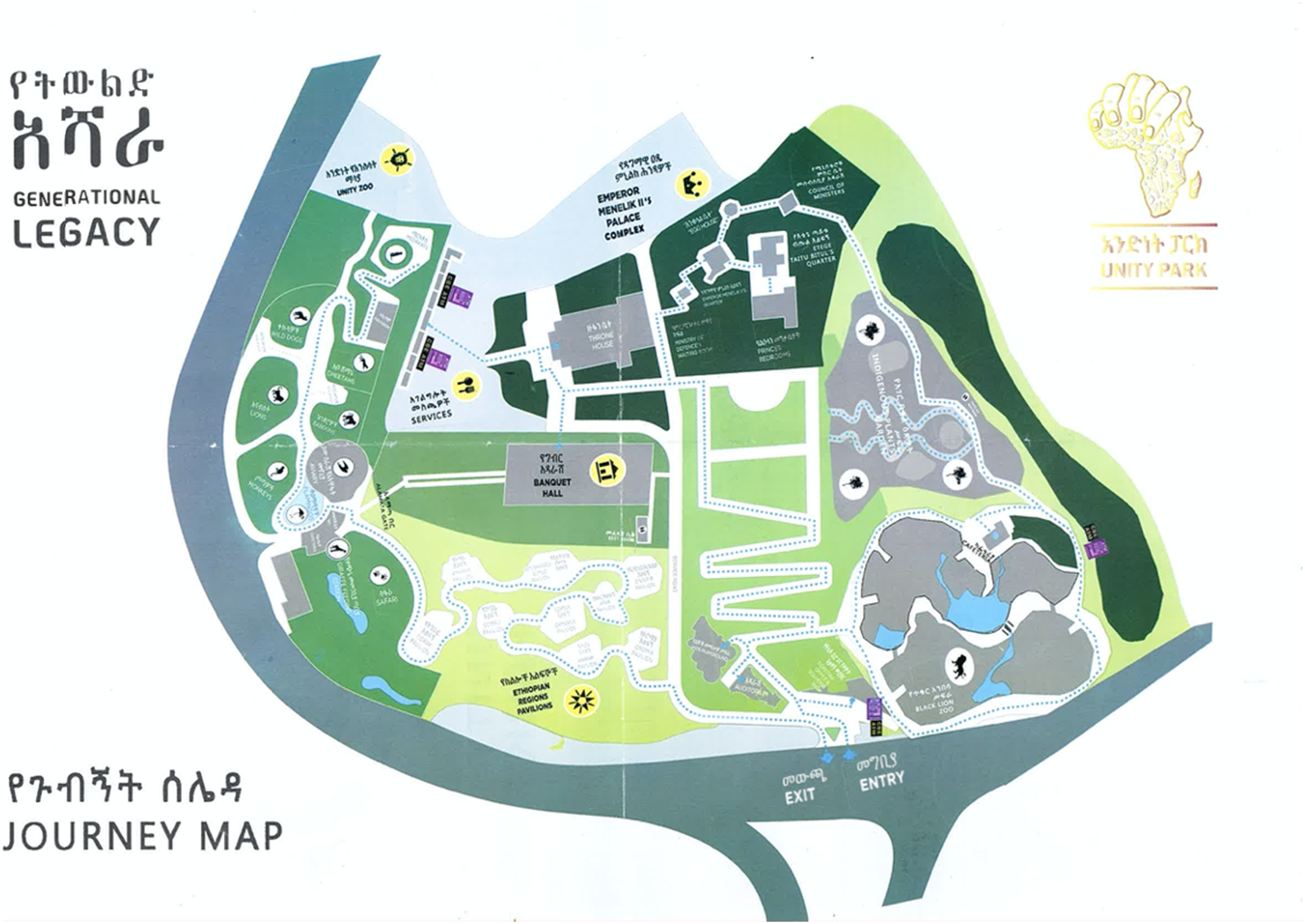
The Unity Park has emerged as a new site for the persistence of the “Great Tradition” in architectural form (see also Gallagher et al., 2020). The reconstitution of the Imperial Palace as a “Unity Park” allows for the reimagining the nation, anchoring three central pillars of a hegemonic nation-state mythology within the park landscape: nature, territory, and history. First, the public garden and zoo celebrate the country’s unique natural environment, including indigenous flora and fauna, as well as “mud houses and walkways that were not built using modern machinery,” as stated in a leaflet available at the park’s entrance in 2021. It depicts a pre-modern “state of nature,” setting a metaphysical zero point for which to imagine the emerging modern nation-state (see also Regassa, 2016). Second, the Unity Park exemplifies Abiy Ahmed’s rhetoric of unity in form of an ethnic federal miniature with “Pavilions of the Regions,” inspired by ethno-territorial imaginaries. In these pavilions, visitors are introduced “to the natural, cultural and historical riches of each region … through video[s], paintings, and other cultural treasures” (Unity Park Leaflet, 2021). The spatial arrangement of the pavilions in the park thus entangles an imagination of a unified ethnic federal Ethiopia in which cultural diversity is contained and subsumed within the territory of the Unity Park. Finally, the architects of the Unity Park have crafted a specific account of state history that is rooted in the past and directs towards the future. The leaflet mentioned above bears the subtitle “Ethiopia: A New Horizon of Hope”, supporting a vision for a prosperous future that appears almost real on landscape images of the planned Renaissance Dam and a “friendship square” inside the park. In turn, Ethiopia’s future is grounded in a particular projection of the past. This entails the selective reinstallation of modern Ethiopia’s “Great Tradition” and a history of political rule.
In the official account exhibited on a sign in the Throne House, “the history of modern Ethiopia began in 1855” with the efforts of Emperor Tewodros “to build a modern state,” centralizing political power in the highlands. Modern state building is then depicted as a rather linear process: “All Ethiopian leaders who have administered the country since then have contributed to the creation of a modern state and political system.” In parallel, this “modern” state history is articulated with a much longer “Great Tradition” of rule. Furthermore, official state historiography in the palace is not constrained by a focus on the political center in the northern and central parts of present-day Ethiopia. Rather it includes also an acknowledgment of various “kingdoms” in the peripheries, well in line with the recognition of ethnic groups across the country in a system of ethnic federal rule. And yet, historiography in the Throne House reveals these kingdoms to exist only peripherally in official historiography as sub-states subsumed within Ethiopia’s “Great Tradition”—a tradition celebrated in “one legend” and “a thousand stories” that explain how it came foundational for rule in Ethiopia.
The king and his political animals
In the focus of the analysis that follows are the statues of emperors Menelik II and Haile Selassie I, the lion, and the peacock. The building of theses monuments reflects a hegemonic attempt to establish a state mythology of sovereign rule in Ethiopia, conditioning the political subjectivity of a visiting public and legitimizing “a particular course of political action” (Forest and Johnson, 2011: 271). Built into an authoritative codification of history, it defines history for citizen-subjects, crystalizing an imperial vision and homogenizing Ethiopian identity around a unified nation-state: It serves to “educate” Ethiopian citizens-subjects by selectively remembering and forgetting (Tamm, 2013: 651). To that end, monuments in wood, wax, and stone set a scene for what Taussig (1997) has called everyday state rituals for citizen-subjects encountering the state. Indeed, scholars have highlighted the inherent fragility and multiplicity of meanings of monuments, despite governmental attempts to codify the past. Monuments entangle multiple meanings and interpretations (Enslin 2020) and evolve as objects of political contestations (Emmenegger, 2021; Morrissey and Warner, 2018). Of interest for our analysis is then not so much the question whether these monuments succeed or fail to subject visitors to a hegemonic unified state mythology. In our interest is rather the way monuments are given meaning in an “argumentative struggle” (Hajer, 1995) about discursive hegemony in a broader political arena—and political consequences for the consolidation and contestation of Abiy Ahmed’s sovereign claim.
Statues of imperial magnificence
Particularly illustrative for Abiy Ahmed’s claim to sovereign rule and his ambition to install himself as the divine embodiment of the nation-state is his claim to have received a prophesy from his mother to be the seventh king of Ethiopia.
13
According to a commentator on the news analysis website Ethiopian Insight, Abiy Ahmed’s efforts to associate himself with Ethiopia’s past emperors through the construction of “life-size wax statues has been part of his way to create a kingly image of himself.”
14
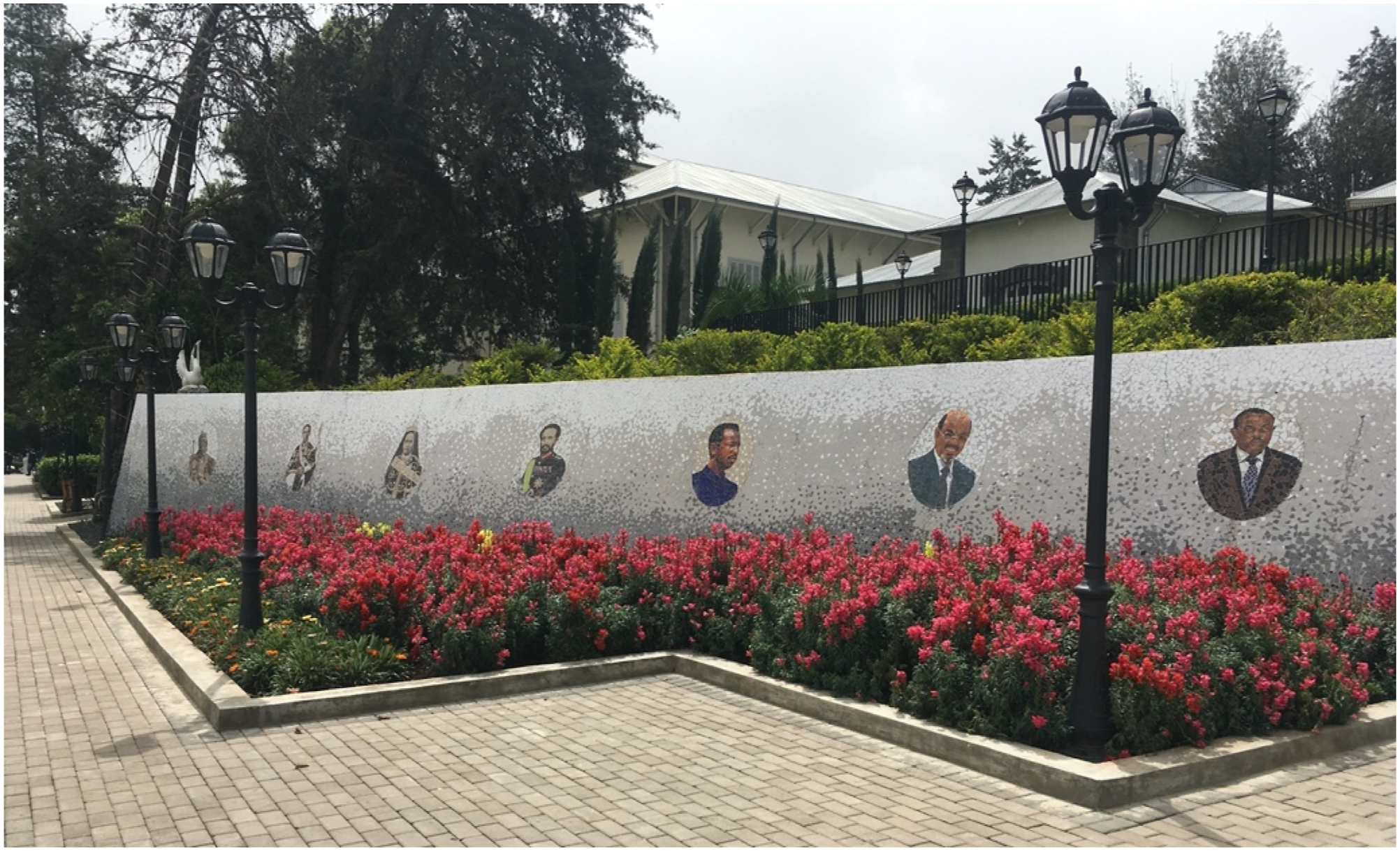
The renovation of the palace cemented Abiy Ahmed’s integration into Ethiopia’s royal line of succession. Inside the palace, Ethiopia’s kings appear in a line of seven rulers painted on a wall outside (see Figure 2). The succession including “seven Ethiopian leaders without counting Prime Minister Abiy Ahmed” (Unity Park Leaflet, 2021; emphasis added). In resonance with his prophesy, it is the explicit exclusion of Abiy Ahmed from the list that suggests him as the legitimate successor of rule by drawing a line between the living and the dead. Depiction of Ethiopian rulers in the modern period (1889–2018).
15
More spectacularly, statues of Emperors Menelik II and Haile Selassie I have been placed on thrones—the former in the banquet hall and the latter in the Throne House (see Figure 3). In common nationalist discourse, Menelik II is celebrated as a hero, empire builder, unifier, and defender of Ethiopian sovereignty; Haile Selassie I is applauded as modernizer who consolidated the empire his predecessor demarcated (Marcus, 1975; Zewde, 2002). On the signboards in the Throne House, a divine quality is assigned to the two emperors through their entanglement in Solomonic myths, foundational for imagining Ethiopia’s “Great Tradition.” Devine authority is further established through the exhibition of the two emperors’ crowns in the Throne House. wax statues of emperors menelik II (1889–1913) and Haile Selassie I (1930–1974).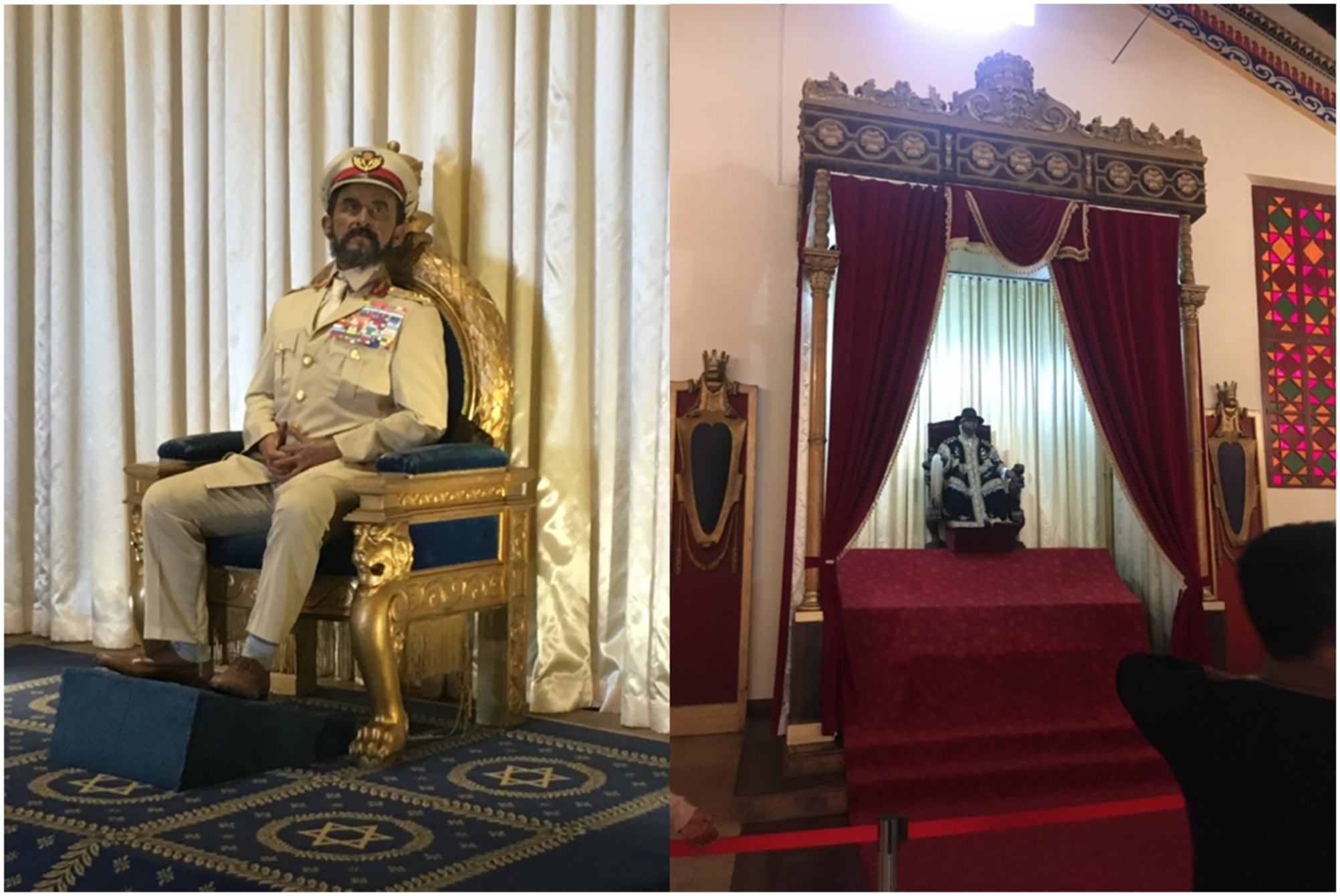
In Ethiopia’s political culture, political rule has long been justified not only through historical succession but also through a reference to divine power (De Lorenzi, 2015). With the emergence of the “modern” Ethiopian state, a claim to divine authority was then also codified in the constitution (Mulugeta, 2020; Clapham, 1969). Haile Selassie I, for instance, used a mythical claim through the codification of his sacred body that stands above the law it embodies: As Article four of the 1955 Revised Constitution states, “By virtue of His Imperial Blood, as well as by the anointing which He has received, the person of the Emperor is sacred, His dignity is inviolable and His Powers indisputable. … Any one so bold as to seek to injure the Emperor will be punished” (Imperial Constitution, 1955). It speaks to a conception of sovereignty in medieval political theology, with the king essentially constituted through his two bodies—“a natural body and a political body” (Kantorowicz, 1957). Pushed forward as a hegemonic project in Ethiopia, the imagination of the king’s two bodies has become deeply engrained in popular culture (see also Hansen and Stepputat, 2001: 28). This idea is manifested, for instance, in religious explanations of sovereign rule that depict rulers as elects of God, thus legitimizing the divine punishment of any who disobey them (Kassa, 2020, Østebø and Tronvoll, 2020).
The building of the two emperors’ statues is further instrumental for Abiy Ahmed’s attempt to ground his sovereign claim in reference to dead political leaders and the unified state they embodied. Claiming sovereign rule through lines of succession speaks to a certain cult of personality in Ethiopia’s political culture of centralized rule. In recent years, such a cult was revitalized after the sudden death of Meles Zenawi in 2012. It was spectacularly performed in the burial of the Meles Zenawi’s mortal remains at the Holy Trinity Cathedral next to those of Haile Selassie I, plus state-sponsored national mourning (Hess-Nielsen, 2013: 7)—henceforth grounding the EPRDF’s claim to sovereignty in the memory of its dead political leader (see also Benedicto, 2021). With the renovation of the palace, Abiy Ahmed now extended the list of the dead political leaders, rebuilding the national pantheon for his unifying state project.
The revival of the lion
Two lions guarding the Throne House serve as symbols of state power and authority (see Figure 4). In the Christian tradition, the lion is a symbol for Christ guarding his people day and night through his divine omnipresence (Moscovich, 2019). Lion symbolism has a long history in Ethiopia’s political culture too (Clapham, 1969), with the lion’s divine and physical body representing imperial power and authority as well as the country’s heroic resistance during colonialism (Tola, 2017: 38). In the lengthy imperial title, “His Majesty, The Conquering Lion of the Tribe of Judah, Elect of God, King of Kings, Emperor Haile Selassie I,” the lion represented the natural, political, and divine bodies of the emperor. The lion has thus been prominently placed, for instance, on imperial flags (1894–1974), coins, or documents as an embodiment of imperial sovereignty. Lion at Ethiopia’s Imperial Palace.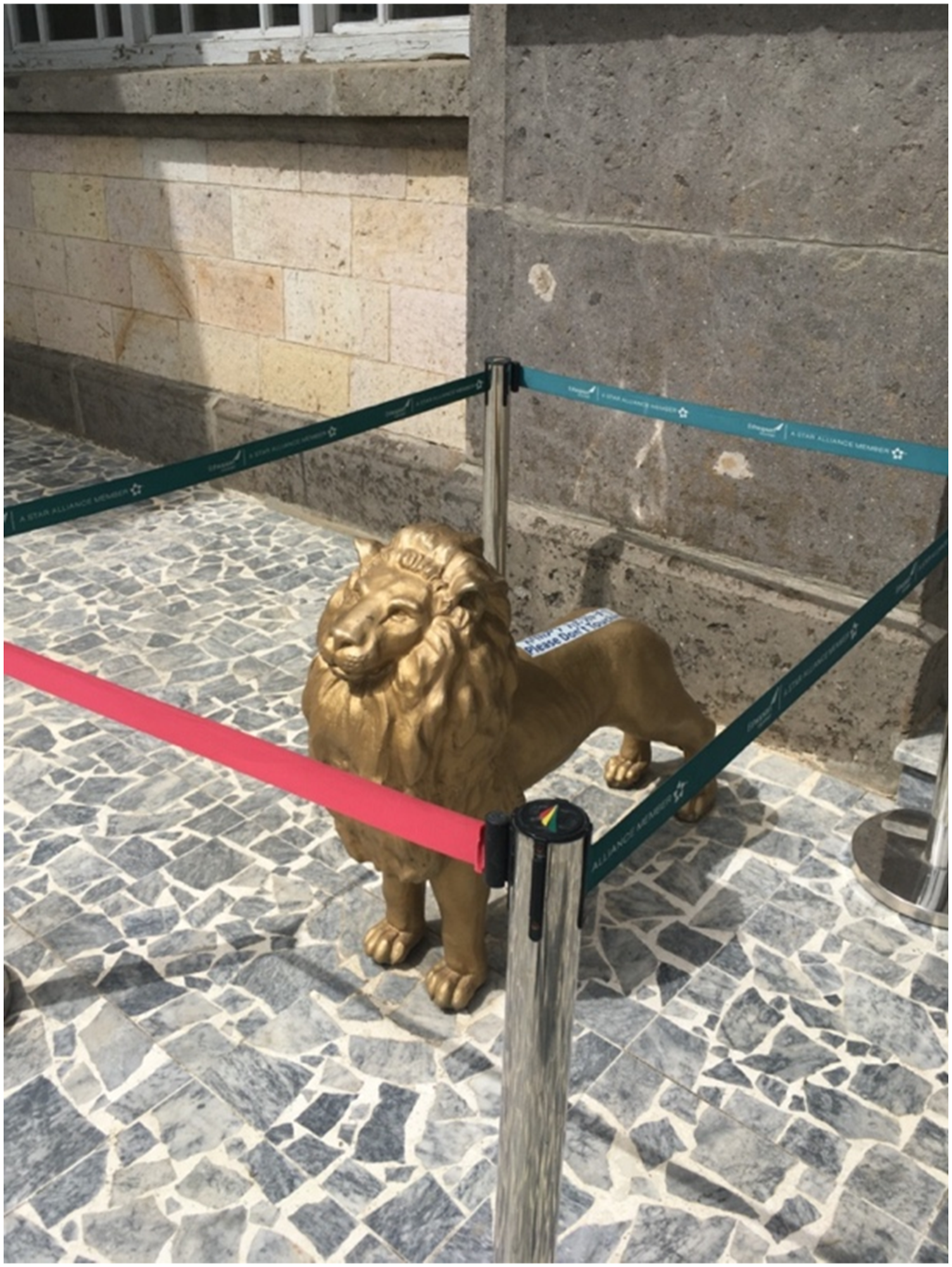
Already during the reign of Haile Selassie I, lions were spectacularly monumentalized. Soon after the restoration of imperial power in 1941 following Ethiopia’s liberation from Italian occupation (1936–1941), Haile Selassie I ordered governors to bring him lions, which he initially kept in the Imperial Palace’s yards. These royal lions were the emperor’s personal property and symbolic representations of the emperor’s authority. When Selassie’s palace became Haile Selassie I University in 1961—now a campus for Addis Ababa University—the lions were transferred to the country’s first zoo in Addis Ababa, losing their regal significance. In parallel, statues of the “Lion of Judah” were erected at main gates of the new palace, the Addis Ababa railway station (in devotion of Emperor Menelik II) 16 as well as at the gate of major public buildings such as the National Theatre (in dedication of Haile Selassie I) (see Tola, 2017: 37). Beyond their monumentalization, stone lions became territorial markers of significance: the figure of the lion accompanied state expansion as a symbol inscribed on imperial documents such as land certificates and coins through which colonial land tenure regime and taxation violently enforced could also be mythically codified (see Emmenegger, 2013).
The Derg regime aggressively worked on disbanding symbols and deconstructing narratives that glorified the emperor and his imperial regime. According to The Economist, the revolutionary fervor under the military rule was “so intense that even the royal lions were killed.” Symbolic artifacts and architectures were dismantled, destroyed or relocated (Tola, 2017), and books that included Haile Selassie I’s autobiography were ruined. 17 The EPRDF regime also systematically discredited most of these narratives targeting imperial statecraft in order to legitimize multinational federalism the regime advocated for (Markakis, 2011; Marzagora, 2017). And yet, despite successive regimes’ attempts to discredit the imperial legacy, the lions could endure or return, both symbolically and materially. While monuments and symbols with direct link to the emperors were destroyed, others with symbolic meanings of state authority and glory endured revolutionary destruction. The lions’ mundane presence across regime changes provides an example for “the invisibility and half-life” of statues that live almost “unnoticed by the passing crowd” (see Taussig, 1997: 149) once they have lost the spectacular guise.
With Abiy Ahmed’s renovation of the Imperial Palace, lions spectacularly returned, both alive in the zoo and as objects colored in gold at the gate. While the spatial dislocation of the lions did not provoke contestation about their meanings and significance, it signified their return to a unified state mythology: A commentator argued on the YouTube channel Ze Habesha that lions historically represent three interconnected meanings in Ethiopia: bravery and determination; divine power where Jesus Christ is symbolized as the “Lion of Judah; ” and Ethiopia’s lineage to King Solomon of Israel. 18 Abiy Ahmed instrumentalized this rather uncontested symbolic representation of the lion in popular imaginaries to mythically articulate his sovereign claim in reference to the political animal that once used to accompany his kingly predecessors.
The birth of the peacock
In contrast to the lion’s long symbolic history, the peacock was introduced as a mythical figure in Ethiopia’s political culture only with the renovation of the palace. Prominently placed at the southern and northern gates of the Imperial Palace in early 2020 (see Figure 5), two statues of peacocks have since been objects of debate: In Ethiopia, the peacock is neither among the widely known bird species nor is it embedded into popular culture or ethnic folklore, leading us to ask: Why did Abiy Ahmed and architects of the palace renovation introduce the peacock in the form of statues so prominently? What is its mythical significance as a potential national emblem? And, how could it be integrated into existing nation-state mythology and imperial imaginations? Statues of peacocks at the Unity Park gate.
19
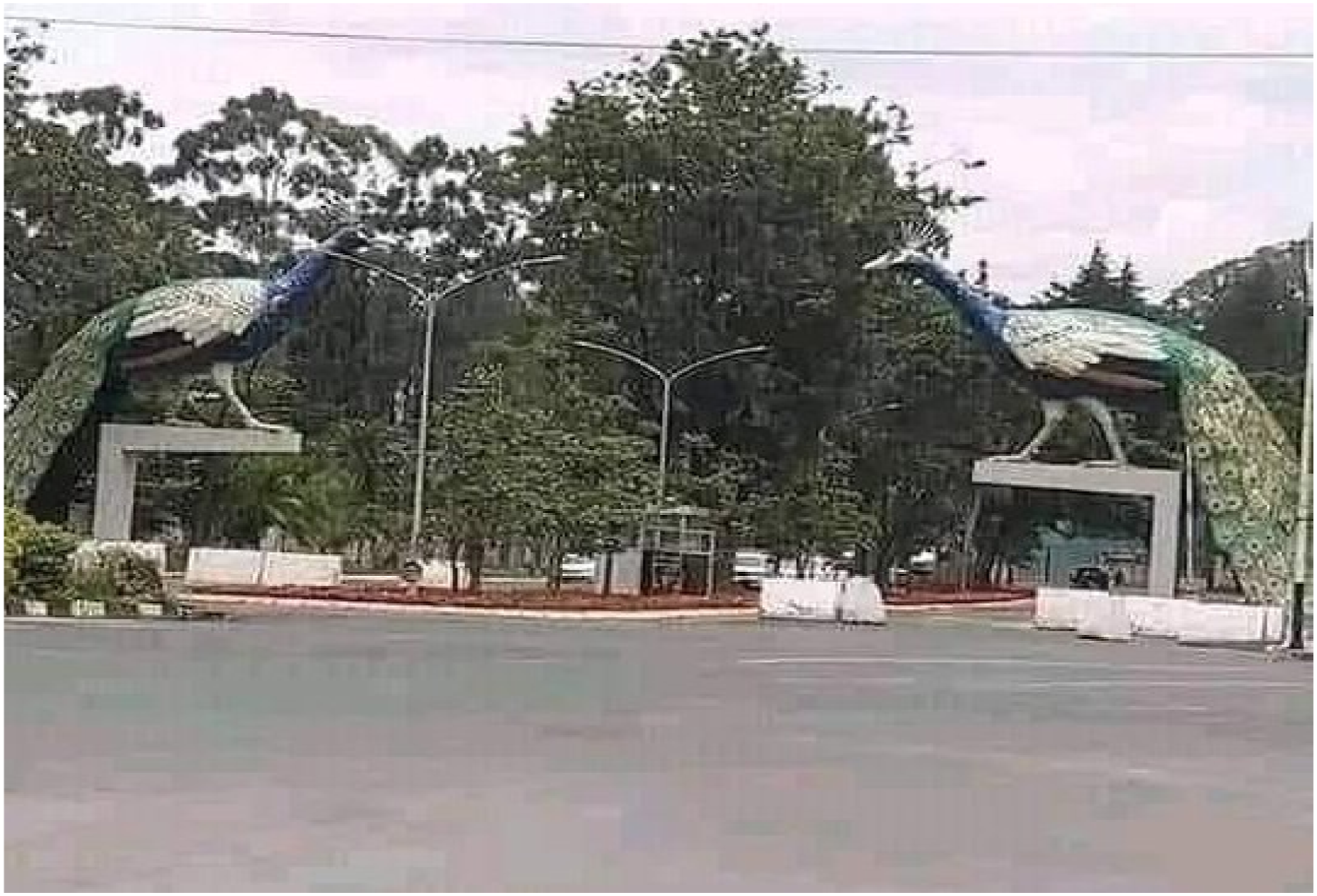
In general, the peacock’s symbolic characterization is supported by works in different cultural and religious contexts. As Andelković et al. (2010: 239–240) argue, the peacock is “a specific symbol of immortality for pagans as well as for Christians,” and its immortality is embodied symbolizing resurrection and regeneration based on the assumption that its body does not decay. Kang (2013: 37–38) also argues that “immortality in this case does not mean an uninterrupted flow of never-ending life, but rather is a ‘rechargeable life’ with a repetitive cycle of a temporary death and revival.” From religious perspective, the peacock denotes eternity in Christianity and a paradise on Earth in Islam (Green, 2006). For the ancient Greeks, Persians and Romans, rulers animated their royal palaces with peacocks not only for their beauty but also in the belief of the bird’s immortality (Green, 2006).
Not surprisingly, the spectacular display of peacock statues in early 2020 sparked a debate. In local media such as Tobia Tube, for instance, one object of controversy was the question of whether the lion rather than the peacock should have been installed as a national symbol. 20 While some commentators argue that Abiy Ahmed tries to impose his Pentecostal religious views through such symbolic markers, 21 others defend the PM’s choice of the bird as it may represent the diversities of Ethiopian people through its lavish colors. 22 In the local Dagu Media news outlet, a narrator underlined peacock symbolism from political perspectives, stating that as peacocks attract peahens through their color, peacock politicians impress their followers with eloquent speeches and public self-display through media and public gatherings. 23 Daniel Kibret, a deacon in the Ethiopian Orthodox Church and the PM’s Social Affairs advisor, posted on his Twitter account on 24 April 2020, tracing the connection between the peacock and the church back to the medieval age. Kibret revealed that peacock was depicted in fifteenth-century religious Orthodox books and claimed: “Ancient people believe that it signified eternity, resurrection and renaissance for its bodies never decay after death. On the gate to the Arat-kilo Palace [the roundabout right in front of the Imperial Palace] next to the electric poles, statues of two peacocks are erected. It seems to reveal Ethiopia’s renaissance and transcendentalism.” 24
Significant is that Abiy Ahmed did not himself define the meaning of the peacock publicly. Rather, Deacon Kibret did, acting as a broker advocating Ethiopian nationalism and representative of the widely trusted religious institution delivering interpretations about life and death in Ethiopia. And yet, the peacock embodies a theme that Abiy Ahmed has also made explicit on various occasions regarding issues of indivisibility of the Ethiopian state. In line with peacock symbolism, the PM has been advocating for a vision of Ethiopia that highlights its immortality and transcendental existence. In his inaugural speech, Abiy Ahmed said, “We remain Ethiopians while alive and become Ethiopia upon death,” in which he metaphorically personified the nation-state built through metamorphosis of its citizens. This vision corroborates, for instance, the PM and his Prosperity Party’s narratives of prosperity and the renaissance of Ethiopia’s mythic glories. Ahmed’s prosperity narrative, as reflected in his book Medemer and in his public speeches, oscillates around a rebirth, revival, and resurrection of a mythic Ethiopia that is depicted not only as one of the oldest civilizations on Earth but also as an ancient state ruled by descendants of the Biblical king Solomon (Ahmed, 2019).
Politics of history
The monuments of the two emperors and their political animals have been integral to the writing of Ethiopia’s unified history and have grounded Abiy Ahmed’s for his sovereign claim in a nation-state mythology. A critical scrutiny of modern Ethiopian history unveils these emperors as embodiments of state violence that has accompanied state expansion in Ethiopia: The modern Ethiopian state was built through imperial expansion and wars of conquest launched by King Menelik (who became Emperor Menelik II) from the late 19th century onwards. This state expansion resulted in the violent incorporation of various ethnic groups with different historical, linguistic, religious, and economic backgrounds into the empire dominated by Semitic groups of northern highland origin (James et al., 2002; Markakis, 2011; Regassa and Korf, 2018; Yates, 2020). As a consequence, people in the marginalized South and the lowlands depict these emperors as conquerors, oppressors, assimilationists, and generally as the architects of institutionalized state violence during their reigns (Bulcha, 2011; Gnamo, 2014; Gudina, 2003).
For the Oromo and other ethnic groups who were subjugated to the imperial polity in the course of modern Ethiopian state building, the Ethiopian empire and its rulers represent a history of agony rather than glory (Gnamo, 2014). 25 In the context of ethno-nationalist struggles in Ethiopia, monuments of emperors have thus evolved as objects of contestation: Already during the Transitional Period (1991–1995), the Oromo Liberation Front proposed to remove the controversial statue of Menelik II that the imperial regime erected in Addis Ababa in 1930 in memory of his victory against Italian aggression at the battle of Adwa in 1896. Controversial was not only the emperor’s role in the “internal colonization” of Oromos, but equally the statue’s location on sacred Oromo land (Biratu, 2010). The front’s proposal to remove the statue was not carried out at the time, however. Against this backdrop, the renewed commemoration of these rulers in the palace again intensified controversies about Ethiopia’s history. Enslin (2020: 1334) argues that although memorial statues are “originally intended to be celebrations of heroic figures whose actions benefited others, they don’t acknowledge the lives of those suffered the consequences of their deeds.” As imperial symbols, statues of the two emperors visibly communicate heroic deeds for which these figures are celebrated while conversely concealing the pain, suffering, and voices of subjugated groups and their ancestors. Heroic monuments thus articulate selective historical narratives, figures, and individuals, whereas they obliterate narratives, episodes, and voices that discomfort elites. By silencing subaltern voices, elites can set narratives and nationalist agendas that legitimate political power to create political subjects (Bellentani and Panico, 2016; Tamm, 2013). Not surprisingly, lionizing Emperor Menelik II angered many Ethiopians, according to the Washington Post, 26 for the installation has signified the resurrection of hegemonic imperial imagination of Ethiopia that once served to subjugate people both in the center and in the periphery.
In the context of ongoing ethno-nationalist struggles in Ethiopia, Abiy Ahmed’s hegemonic attempt to write history has been contested. Some Oromo activists and nationalists did so by defying the inauguration of the palace: In the political center on the day of the ceremony, for instance, activist and politician Jawar Mohammed and founding member and former chairperson of the Oromo Liberation Front Lencho Lata visited the Aannole memorial statue—a statue built in 2014 by the OPDO, of which Abiy Ahmed was a member at the time, in memory of victims of Emperor Menelik II’s war of conquest in 1886. 27 The Aannole monument has remained contested. The building of the Aannole monument resurfaced controversies surrounding the Aannole massacre between those claiming it was a fiction and those who argue that it was a historical fact. Evolving as an object of recent political contestations about the interpretation of the past, the presence of the Aannole monument highlights the inherent tension between Abiy Ahmed’s uninformed ethno-nationalist past and his nationalist present.
While Abiy Ahmed was rewriting imperial history at Ethiopia’s center of political power, these Oromo political figures re-invoked a counter-history to the imperial monuments from the margins. Jawar Mohammed remarked during his visit: “This place signifies Oromo’s scar and wound in the Ethiopian empire. In the process of building the empire, Menelik II committed atrocities against the Oromo and other nations and nationalities. Now, we are not here demanding for compensation, though that was in principle supposed to be the case in democratic societies. Rather, we are demanding for recognition of the scars, pains and agonies our people have lived with.“ 28 As this reveals, Abiy’s memorial interventions reactivated both imperial imaginations as well as contestations over the interpretation of the past and the writing of history. Memorialization has thus been an ambiguous project: It allowed Abiy Ahmed to install the mythical foundation for his sovereign claim but also resurfaced past struggles about representation and history.
Conclusion
In this paper, we have illustrated how the reconstitution of the Imperial Palace as a “Unity Park” has allowed Abiy Ahmed during his early days in office to anchor his claim to sovereign rule in a unified state history. Monumentalization enabled the rearticulation of the Ethiopian state’s glorified imperial past as well as the renaissance and prosperity promised for an Ethiopian nation ruled by his Prosperity Party. In light of the ruling regime’s severe legitimacy crisis, while monumentalization has been of key significance for the political mobilization of a unified Amhara and urban elite, the focus on prosperity promises were meant to embrace ethno-nationalist constituencies. While this has been partly successful, it also created new contestations between Abiy Ahmed’s uninformed ethno-nationalist past and his nationalist present, fueling interethnic tensions still at the present.
Monumentalization has further selectively celebrated past political leaders from which Abiy Ahmed could now claim the legitimate succession of sovereign rule. The installation of Abiy Ahmed’s imperial predecessors allowed entangling imperial imaginations of state sovereignty around the king’s divine and physical body. Sovereign rulers’ divine quality is underscored by the figurative assemblage of the emperors and certain political animals protecting, guarding, and accompanying them: the lion symbolizes the sovereign’s power and authority; the peacock symbolizes immortality and transcendence of the sovereign as an embodiment of the nation-state. The statues of the emperors, lions, and peacocks are not mere materials and things of cultural significance but political elements in a broader “Ethiopian body politics” (Hagmann and Korf, 2012) through which state sovereignty is grounded symbolically and materially in a mythical past. As this reveals, the continuation of authoritarian rule in Ethiopia has not only advanced through means of coercion but also through means of domination and hegemony. In this vein, this article has provided vital insights into the symbolic or mythical dimensions of the ongoing violent power struggle in Ethiopia (see also Emmenegger 2021).
Abiy’s attempts of legitimizing sovereign rule has been a contested project however. As we have demonstrated, contestations have unfolded as part of a broader ethno-national politics and politics of history about state legitimacy, representation, and authority in Ethiopia in the past and present: ethno-nationalist groups accuse him of restoring the imperial past while the nationalist camp suspects his nationalist sentiments due to his ethnic background. The “peace talks” with Tigray in November 2022 is further fracturing his support base from the Amhara and urban elites. Now, tensions are fueling over Addis Ababa, language issues, boundaries, and administrative structure of the state itself. Therefore, the building of the palace and controversies around it are only one dimension of the complex ideological and political contestations in the country. We finally argue that for the ruling regime to genuinely address its legitimacy crisis, it must reconsider its exclusionary approach to rule both in terms of real power sharing and representation in state mythology.
Footnotes
Acknowledgements
We are thankful to the participants of the Political Geography Research Lab at the University of Zurich for inspiration in the process of developing this paper’s central argument, to Thomas Betschart for the photographs that illustrate our argument and for valuable comments on an earlier version of this article, and to Tobias Hagmann for strategic advice in the publication process. We are also grateful to two anonymous re-viewers that helped us to contextualize our analysis better in a complex historical context. Furthermore, we are thankful to Jennifer Bartmess for language proof reading this article and to the Political Geography Unit at the University of Zurich for funding it.
Declaration of conflicting interests
The author(s) declared no potential conflicts of interest with respect to the research, authorship, and/or publication of this article.
Funding
The author(s) received no financial support for the research, authorship, and/or publication of this article.