




Abstract
This paper examines the cycle of a hydraulic infrastructure producing an unequal state, using space, every flood year, for what seems like perpetuity. Instead of theorising “elite capture” of the state, as a significant factor in producing inequality in postcolonial states the argument being advanced here is purposefully different. It argues that in carefully re-distributing flood risk, socio-technical interventions use space to (re) produce an unequal state effect at various scales. Thus, hydraulic infrastructures produce “dominant” and “peripheral” space, every flood year, continuing Sisyphean cycles of unequal state production. Drawing on evidence from the southern province of Sindh, in Pakistan, this paper examines a drainage project as a technique of government through which the state continues its production of inequality using “dominant” and “peripheral” space. These spaces of privilege and marginality—at a municipal, provincial, national and beyond level—are produced by the state and are then also complicit in producing the state. The argument in this paper demonstrates that in being subjected to previous productions of space, and the materialities of past interventions, while producing new ones, the production of state power in the postcolony is also scripted by broader unequal histories of power.
Water infrastructure: Using space to produce unequal state-scales
It’s a very hot day at the height of the South Asian summer, in June 2012 and I am sitting on a charpoy with Younas an elderly resident of Mullah goth in the Badin district of Sindh, in southern Pakistan. We’re talking about the floods that devastated his lands just a year before our meeting and he has painstakingly detailed every goat and chicken and all the crops he lost to the floodwaters. He is shaking his head slowly and telling me that it was so unnecessary-there was no real need for the rains to have caused that degree of flooding and for the floods to have resulted in this kind of a disaster. The impact of the devastation was made, in his words, “a hundred times worse” because of the drainage project built by the state. An artificial drain that has caused immense misery to people in his goth and in neighbouring goths. When I ask him if this drainage project will drown his lands again in the next flood year, his reply is that he is “a hundred percent” certain, it will.
This hydraulic infrastructural project, and the state that built it, evidently does not work for Younas 1 and his neighbours, yet people, institutions and processes continue producing its unequal and uneven structural effects. This paper draws on an understanding of socio-technical arrangements ‘loop (ing)’, individuals, water and political structures into ‘closed circuits’ of infrastructural failure (Ley 2022) to produce an unequal state, using space and scale. It further illustrates hydraulic infrastructural failure to be a key part of the cyclical process of unequal state production, arguing that the deliberate act of breaking embankments for flood control should not be seen simply as action taken by an Imperial state to flood the peripheries. Instead, it shows these socio-technical interventions are critical in making the state appear to exist. The fragmentary effects of a state coming together to break embankments and flood large swathes of land, produces privilege and marginality, in space, at different scales. This effect continues to be intensified and repeated, because of the consistent social imaginary that this state is delivering for someone else, saving someone else, and other lands in ‘dominant’ space.
There is an extensive and evolving body of contemporary scholarship on the role of hydraulic infrastructures in producing and cementing different types of postcolonial state formations (Akhter 2015a, 2015b, 2017; Anand 2016; Gilmartin 2015; Mustafa 2007; Sneddon 2015; Stensrud 2019). This paper however is particularly interested in revealing the ways in which water infrastructure produces an unequal but naturalised state that uses space to produce privilege and marginality at multiple scales. This work is particularly novel in its contribution to notions of postcoloniality within poststructural understandings of the state. It demonstrates that (breaching of) water infrastructures are a technique of government that reify state power by disciplining space, as ‘dominant’ and ‘peripheral’, at multiple political scales (Jones et al., 1958). At the same time, in being subjected to its previous productions of space, and the materialities of past interventions, while producing new ones, the postcolonial state can only engage tactically in this “space of the other” (De Certeau 1984: 37), defined by historical socio-technical formations. In Pakistan, this has meant reproducing as ‘dominant’, spaces instrumental in maintaining Empire, cities and colonies of military recruits, while all else remains spatial backwater (Ley 2022) and thereby ‘naturally’ subjected to floods and stagnation.
Scholarship on Pakistan has tended to highlight the ways in which water infrastructure reproduces inequalities in knowledge and power at the intra-state, inter-province level. Pakistan’s largest and most dominant province of Punjab, historically providing the vast majority of recruits to the British Indian army, is also the upper riparian on a heavily irrigated and dammed Indus River Basin. This hydro-politics between Punjab and the smaller, and lower riparian province of Sindh has been discussed in other works (Akhter 2015a, 2015b; Gilmartin 2015; Haines 2013; Mustafa 2007). Whilst this political materiality of water has been explored in some depth, the biopolitical, most especially the production of the state in these unitary effects of irrigation and drainage projects has not received comparable attention to date.
Beyond Pakistan however, colonial legacies of privilege and marginality, of spaces constructed as ‘dominant’ and ‘peripheral’ profoundly shape hydraulic infrastructures and state formation today. Yet, in discussions of the deep ‘entanglement’ between controlling water, infrastructures and power relations (Linton and Budds 2014) notions of postcoloniality have rarely been mentioned (Bannister 2014), and hardly ever explored. The argument in this paper shows ‘peripheral space’ produced by and through the state does not exist on the margins of water governance (Ley 2022), but rather is essential in the production of an unequal Imperial state. Yet while, the violence of mega projects, such as large dams, is regularly discussed as an instrument of Imperial oppression, dispossessing subaltern populations (Gellert and Lynch 2003; Kenney-Lazar and Ishikawa 2019; Vanclay 2017; Vandergeest 2003; Yoder 2015), the more ‘everyday’ and ‘naturalised’ ways that socio-technical practices produce a particular kind of ‘state effect’ exerting control through space has not received the same attention. This paper goes some way towards bridging that gap to reflect on postcoloniality as part of post-structural understandings of the state.
Based on ethnographic data collected in Lower Sindh in southern Pakistan in 2012–2013 and using post-structural state theory, constructivist understandings of space and notions of postcoloniality, I argue that to see hydraulic infrastructure, controlled by Punjabi dominated state as an instrument to further marginalise the downstream province of Sindh, is confusing cause and effect of the state. This state, emerging as an effect of people, institutions and process, uses space as a Lefebvrian “privileged instrument” (Secor 2007) to reproduce multiple scales of inequality by breaking embankments of the artificial drainage project and flooding the peripheries. This paper suggests the design and materialization of this hydraulic infrastructure uses space, to produce privilege and marginality, at different scales reifying and reproducing an unequal state. This process is intensified and repeated because of the belief in a state that is dispensing fairness and justice for another, somewhere else. Thus, continuing the Sisyphean cycle of unequal state production.
(Re)Producing an unequal state in socio-technical interventions
Recent interventions on the social life of infrastructures in postcolonial contexts increasingly recognise their discursive or material origins in ensuring extraction, accumulation and/or political control for Empire. These histories have had profound impacts on the more contemporary relational dynamics of hydraulic infrastructures (Alderman and Goodman 2022; Ranganathan, 2015). Yet the relationship between water flows and social control is neither straightforward nor elegant but rather messy and indeterminate (Bannister 2014). This analysis focuses on the everyday socio-technical practices through which ‘peripheral’ and ‘dominant’ spaces are produced through a drainage project in Sindh, Pakistan
Post-structural state theory has drawn attention to two interrelated characterisations of the Foucauldian state. First, that large-scale exercise of power, the kind attributed to the modern state, is dependent on the micro-practices and social behaviours of disciplined individuals. Rule is not established through politico-legal structures but rather through manufacturing a population that self-disciplines, most especially their bodies, to enact state order in everyday life. (Mitchell 1999; Foucault 1991). Second, the state does not pre-exist the political action of disciplined populations, rather it is produced in the practices of government that first, produce the population that embodies and enacts the state through everyday life (Lemke 2015). Thus “the state is at once that which exists, but which does not yet exist enough”. It is simultaneously a “given”, while having to be “constructed” and “built” (Foucault 2008: 4). A “powerful, metaphysical effect” of fragmentary, even contradictory, practices that make a unitary structure appear to exist. This “state effect” is the “counterpart” of the modern individual, who does not just confront the edicts of external power but is complicit in its internal production (Mitchell 1991, 1999, 2002).
This ‘state effect’ has thus been produced and seen, especially in the postcolony, as a myriad of fragmentary and disconnected schemes that dictate and govern the development of postcolonial subjects (Scott 1998; Corbridge et al., 2005; Li 2007). It is constitutive of “practices instead of objects, strategies instead of function and technologies instead of institutions” (Lemke 2011: 58) and exerts power through techniques and instruments of control rather than legal-political jurisprudence. Thus, it has been argued that the state might be hugely ‘present’ even in contexts where there is very limited material/legal presence of its existence (Garmany 2009: 725).
As scholars have successfully illustrated, the state space is governmentalized based on the particular social behaviours it produces and reifies in society, rather than on the material visibility of state artefacts such as infrastructure, institutions and administration (Garmany 2009; Painter 2006; Secor 2004, 2007). This understanding of ‘geographies of stateness’ requires taking a closer look at the most ordinary and mundane practices in social life for involvement of, what Painter (2010) calls, ‘prosaic’ aspects of the state and the “state effect” they produce.
Thus, it becomes especially important to reveal the techniques and interventions (Garmany 2009; Mountz 2004; McConnell 2016; Nevins, 2002) that naturalise social practices, and the spaces of engagement that produce and re-produce the state. Within this tradition, geographers such as Secor (2004, 2007) have demonstrated, the ways in which the idea of the state is “produced and lived” amongst the poor. She suggests that fragmented bodies and institutions cohere as a unitary ‘state effect’ to exert control over space. By mediating the “circulation and arrest” of people, documents and influence, space becomes the state’s most ‘privileged instrument’ and also its most defining feature. While for Kelley-Richards and Bannister (2017) marginality (informality) is implicated in the production of the state, rather than simply something that the state produces. The state is the effect of the relationship that emerges between authority of a “formal” institution and the ambiguity of the marginalisation of “informal” settlers. This ambiguity “must be taken as central to the state effect rather than something that the state simply affects” (107).
Borrowing this understanding from Secor (2007), that between hope and despair, circulation and arrest - space becomes a Lefebvrian ‘privileged instrument’ of the state and also the effect through which the state is produced. And from Kelly-Richards and Bannister (2017) an understanding that “formal inclusion” in the urban state-space is a technique of government that effects relationships between people and objects to produce the state. I argue that the state is the structural effect produced in the ‘natural’ actions (and interactions) of people breaking embankments and diverting floodwaters in the attempt to save their own lands while flooding others thereby re-produce spaces of privilege and marginality at multiple scales.
State power ‘concretized’ in water infrastructures, carefully arranges, and redistributes flood risk (Meehan 2014). By reconstituting water flows, space is disciplined into ‘dominant’ and ‘peripheral’ thereby reproducing inequalities at different state scales. At the same time political scale, to a certain extent, is directly related to “already-existing national political organisation and international competition” of markets and their control (Jones et al., 1958). Thus the ‘state effect’ of breaking embankments to produce ‘dominant’ and ‘peripheral’ space at multiple political scales reifies scalar productions of the state. The drainage project disciplines space - as city-outskirts, Upper-Lower Sindh, Punjab-Sindh and military-civilian. In so doing, it shifts the focus from projects and policies that create conditions of postcoloniality and privilege, to the encounters, interactions and affects that come together to ‘naturally’ produce such a state.
At the same time this hydraulic infrastructure also continuously consolidates state power because this drainage projects consistently fails (Ferguson 1994) and embankments must be broken every flood season. Thus, undermining existing water arrangements and providing grounds for new breaches, reproducing this unequal state-scale through space. While water infrastructures producing different state formations and forms of power has long been discussed in political ecology and science and technology studies literature (Swyngedouw, 1999, 2004; Harris 2012; Loftus 2006; Von Schnitzler 2015), this paper sheds new light on how socio-technical interventions use space to reproduce unequal state power at various scales. In naturalising ‘dominant space’ by breaching and breaking embankments, the drainage project is only making real the power of the state for its postcolonial subjects. It demonstrates that this state works and delivers, but for others. It is this belief that the state is delivering fairness and justice that ensures its repeated production in spaces and scales of inequality.
At the height of the flooding disaster, the drainage project was deliberately breached outside city centres to submerge the outskirts but save the city-proper thus producing the space of the city and its peripheries. Similarly at a provincial level Upper Sindh was believed to have released excess water to drown lands in Lower Sindh reifying the space and privilege associated with its territorial boundaries. At an inter-provincial scale Punjab was considered responsible for diverting the water of the drainage project away from its boundaries of Sindh to save its own lands from floods. Thus, re-producing the territory of the province and the privilege associated with its space. Finally, this drainage project and others like it were also re-producing the state space as army land and civilian land, a critical scale of state production in Pakistan. At a multi-scalar level then, the drainage project is a technique of government that produced the ‘natural’ practice of people trying to save their own land by submerging others under water. This emergent effect of the state recreates spaces of privilege and marginality continuing this cycle of unequal state production.
This paper is thus also presenting an alternative understanding of the state in Pakistan, long been viewed through structuralist explanations that emphasise various political super-structures, especially the Punjabi dominated military, responsible for creation and maintenance of unequal power relations in the postcolonial state (Talbot 2011; Haqqani 2005; Hasnain 2008). Within this body of work, state marginalisation of minority ethnic groups but also lower caste, class and rural poor is intimately tied up with the “social construction of hydropolitics” (Mustafa 2010), especially irrigation infrastructure in the Indus Basin (Ali 1998; Gilmartin 1994; Wescoat et al., 2000; Mustafa 2010). While recognising the strength and importance of this work, I am proposing an alternative mode of inquiry here. Drawing on an understanding of the state as a structural effect creating “an actual framework that somehow stands apart from physical reality” and enforces an order or a set of rules (Mitchell 1991: 94) that result in the ‘natural’ actions of populations to marginalise the subaltern. Thus, the state is produced in the seemingly unitary effects of socio-technical practices that produce “dominant form of space” and “peripheral spaces” (Lefebvre 1991: 49).
The empirical work details the processes of breaching embankments of a large drainage project suggesting that it should not be seen as an instrument of marginalisation constructed by a state apparatus, controlled by Punjab, but rather as bringing together objects, processes and people to reproduce state space that re-enforces marginalisation and privilege, at different scales.
The Pakistani state: Producing the state through spatial marginalisation
The notion that the country of Pakistan was created, carved out of India in 1947, primarily to preserve particular class interests is no longer contested by scholars on South Asia (Alavi 1972, 1983). These class interests coalesced around two dominant ethnic groups in Pakistan, the Urdu speaking communities of north India (Mohajirs) instrumental in Pakistan’s independence movement and the Punjabis, who belonged to the country’s largest and wealthiest province of Punjab. For the first few decades after Pakistan’s independence, the Mohajir-Punjabi grip over power continued the structural marginalisation of almost all other ethnic groups, culminating in the violent war of liberation in East Pakistan that eventually became Bangladesh in 1971. Subsequently over the years, the Punjabis (44% of total in the country’s last census in 1998), compared to a much smaller Mohajir community (8% of total population), were able to establish dominance as the country’s main power brokers, particularly due to their control over Pakistan’s main institutions of the military and bureaucracy. That all ethnic groups, most especially the smallest provinces of Sindh and Baluchistan in Pakistan, feel marginalised by elite Punjabi interests is well established in literature to date (Khan 2002, 2003; Verkaaik 2001; Ayres 2009; Karrar and Mostowlansky 2018; Ali 2019).
Up and down the country then, it is widely believed that the state is (elite) Punjabi, and (elite) Punjabi are the state. While Mohajir youth in the southern city of Hyderabad referred to Pakistan’s national carrier Pakistan International Airlines (PIA) as-PIA for “Punjabi International Airlines” (Verkaaik 2001), residents in the north of the country used the same replacement of Pakistan with Punjab when speaking of the CPEC-the China-Pakistan Economic Corridor (Karrar and Mostowlansky 2018). In the province of Sindh this dominance of Punjab and its capture of the state is epitomised by its control of a ‘colonial’ hydrological infrastructure (D’Souza 2006). Punjab is the upper riparian on the Indus River and is therefore believed to control the fate of Sindh’s agricultural lands, through its control over irrigation water.
The inter-provincial struggles over control of the Indus River and the role of large hydro-projects in marginalising the smaller provinces is established elsewhere (see Mustafa 2007; Akhter 2015a; Gilmartin 2015) and will not be presented in detail here, except to say that being marginalised by Punjab/Pakistan is a defining feature in the way that the effects of the state come to be produced. Actually, and to be more precise, it is the northern region of the Potwar/Potohar Plateau in Punjab (known to supply the vast majority of Pakistan’s military recruits) that is seen to control reins of power in the country. The state is thus an emergent effect of seemingly ‘natural’ relations between populations, institutions and processes that come together to produce spatial marginalisation of almost everywhere in Pakistan that is not northern Punjab. The empirical evidence illustrates that producing this space of privilege requires re-producing spaces of marginalisation at multiple scales–there is almost no one in Sindh, who believes that this state delivers on its promise of adequate and appropriate irrigation water or drainage for them but it does for ‘others’. These fragments come together to produce the state effect of ‘dominant” and “peripheral spaces” which then reproduce the state.
Methodologically the paper follows in the tradition of the ‘everyday’ state (Gupta 1995; Hansen 2005; Fuller and Harriss 2009) and acknowledges that “the state as something people ‘see’ and experience” is made real only through daily practice (Garmany 2009). It draws on the different epistemologies of state production that include “experience” (Hansen 2005), “encounters” (Carswell et al., 2019), “imagination” (Gupta 1995), “embodiment” (Mountz 2004) and “enaction” (McConnell 2016) by regular people of ‘the state’. Ultimately through a discursive analysis, of these narratives and feelings, the paper examines how ‘the state’ is produced and lived through marginality. It is based on primary research done in three districts of southern Sindh called Lower Sindh or Laar, over 7 months between May 2012 and March 2013. I did ethnographic fieldwork in the districts of Thatta, Badin and Tharparkar in Lower Sindh, amongst the worst affected by large-scale flooding around the Indus River in 2010 and 2011. The district of Thatta had been affected by the floods of 2010 known locally as the ‘daryaee sailaab (river flood)’, while Badin and Tharparkar districts had been affected by the floods of 2011 colloquially called the ‘barsaati sailaab (rain floods)’. In addition to 118 open ended interviews and conversations, I also conducted participant observations in the small towns and villages that made up my study site. This paper is based on ethnographic data collected on the LBOD which was a particular pain point in Badin, thus it draws primarily on interviews conducted and material collected there.
The left bank outfall drain: Producing the state’s scale, using space
The Left Bank Outfall Drain, or LBOD, as it is more commonly known in Laar, is a 1950 km long surface drainage project meant to “alleviate waterlogging and salinity from left side of the Indus River by discharging highly saline drainage brine to the Arabian Sea” (Qureshi et al., 2008). Waterlogging and salinity are common challenges facing agricultural lands in the region, substantially exacerbated by the large-scale irrigation projects introduced to the Indus Basin in the 19th and early 20th Century by the British Imperial state (Kijne 2001).
Irrigation administrators in postcolonial Pakistan have continued their emphasis on such mega projects despite their considerable ecological and social costs for local communities. The barrages and reservoirs constructed reflected the independent state’s scientific agricultural experimentation to ‘modernise’ (Scott, 1998) but ultimately had limited regard for local perceptions of equality or fairness (Mustafa 2002, 2007), especially within communities in Laar whose farmland and livelihoods slowly withered away due to sea intrusion or high rates of salinity. Inevitably the postcolonial irrigation administration in Laar epitomises a materiality, that privileged ‘modernisation’ and control rather than facilitating access to sustainable system of irrigating farmlands (Mustafa 2001). This high modernism notorious for being epistemologically severely limited in its ability to incorporate knowledge that was ‘created outside its paradigm’ (Scott 1998) has continued to degrade the ecological environment of the region and disenfranchise its residents further in recent decades.
Breaching the embankments of the Left Bank Outfall Drain (LBOD) is a technique of government that produces spaces of marginality and privilege-a periphery of the city/a core or centre of the city, poorer Lower Sindh/richer Upper Sindh, politically and economically marginalised Sindh/powerful Punjab and an all-powerful military/disempowered civilian societies. These spatial divisions are produced through the most ‘natural’ practice of people saving their land from floodwaters. Thus, the state emerges as an effect of relationships between people, objects and institutions that produces this “dominant form of space” by submerging other lands. At the same time this making and re-making of space is also an instrument used by this state to privilege spaces and people closer to the centres of power-centre of city, Upper Sindh, Punjab-at the expense of the subaltern-periphery of city, Lower Sindh, Sindh. The LBOD produces a population that “has to” break embankments and divert the water that will flood their lands unless this action is not taken. This ‘natural’ or ‘common sense’ (Peluso and Lund 2011) action is called a deliberate “cut in the LBOD”, colloquially in Sindh. Needless to state these ‘cuts’ are deeply marginalising and painful for those in “peripheral spaces” whose lands this floodwater ends up submerging.
The following section details the ‘state-effect’ of producing “dominant” and “peripheral space” at different scales: municipal/city, intra-province, inter-province and army/civilian. It uses a Lefebvrian understanding of social space (1991) that “emphasises the situated processes by which … territorial forms are constructed politically, produced and rendered visible” (Buser 2012: 282). The following section will highlight the way the LBOD, as a technique of government, is used to perceive the physicality and tangibility of space, to conceive of state space by knowledge and power, demonstrate the way this space is lived by local residents. Given that “space is produced and reproduced… contains a diversity of objects, both natural and social… not only things but also relations” (Lefebvre 1991: 77), this section explores the ways in which the “cuts” in the LBOD use space to produce the state at different scales.
State effect of producing outskirts and core of the city
The “dominant form of space”, where wealth and power are centred, seeks to “mould the spaces” it dominates to encounter less resistance from these “peripheral spaces” (Lefebvre 1991: 49). Unsurprisingly then the “cuts” in the LBOD, is a socio-technical practice that re-produces the periphery of the city centre-as the outskirts that must be flooded so that the core, presented as a ‘natural’ property of society (Fuchs 2019), can be protected. In a conversation with residents living on the outskirts of the town of Jhuddo, in District Badin, I enquired about the cause of the floods that destroyed their homes and lands. One middle aged man replied The flood was the consequence of waters that breached some embankments, but these embankments were deliberately breached to divert the course of floodwaters and submerge our land… Our fields have been frequently submerged because the LBOD passes from here and we are just near the sea where the drain releases this saline wastewater… This time however the LBOD was cut just outside Jhuddo and the water was re-directed to our lands. Basically, they cut the embankment to save Jhuddo city. My brother spoke to the army jawaans (officers) who were in charge of the operation, and he said “you are submerging many towns to save one city, we will not let you do that…” But very powerful people live there (names three large landowners) so Jhuddo had to be saved…
By submerging these lands, the deliberate breaching of embankments produces the structural effect of a state that reinforces the marginal status of the outskirts of urban sprawls while delivering security for the core centre of cities, in Laar. Thus, the state, on the one hand, emerges as a set of people and practices that come together in the ‘natural’ action of breaching the embankments of the LBOD to save the city. On the other hand, it is also producing the state through effects of reifying state space by producing a “dominant space” of the city centre and the “peripheral spaces” of the outskirts. The LBOD is therefore a technique of government that re-produces the city centre as the “dominant form” state space, while reinforcing the marginal status of population-through-space not at the centre of its spatial construction. These residents, however, do not form the boundary of what lies outside the state (Harris 2012), rather they are central in the production of this state through space and government.
State effect of producing Lower Sindh
Moving from city/municipal level to the scale of the province reveals that the cuts in the LBOD also reproduced the space of Lower and Upper Sindh. Another respondent, a journalist from a different city affected by LBOD related flooding, drew a map to explain how the ‘state effect’ of the cuts was implicated in the production of this space, as Lower and Upper Sindh. After drawing the map of the province of Sindh (see Figure 1), he explained how the LBOD was reifying the “peripheral space” of Lower Sindh, or Laar, by submerging large tracts of areas under water to ‘save’ the Upper Sindh. The latter representing “dominant form of space” because of its closer relationship to centres of power in Pakistan. (a) Now in Sindh, the political landscape is dominated by Baloch-Sindhis… of the influential political dynasties from this region, the majority are Baloch-Sindhis. Since Baloch-Sindhis are resident in this region [indicating area above the central line], during the 2010 flooding disaster the biggest relief operation was carried out in Upper Sindh. ‘As compared to’ here [indicating the part below the central line], where the flooding disaster occurred in 2011, now these people (from Lower Sindh) did not have ‘representatives in assemblies’ they were not involved in ‘politics’; hence they were not part of the mainstream narrative of suffering. The condition of education here is poor, people here do not have money and they do not have ‘social status’. Think of it as ‘a class difference’ (between Upper and Lower Sindh)… Have you heard of something called the LBOD?… It was built to drain ‘agricultural wastewater’ out into the sea, but the physical infrastructure of this drain was resulting in reverse intrusion and seawater coming back upstream through the drainage channels submerging land in Lower Sindh under water. During the 2011 floods the saline wastewater of all the districts of Upper Sindh came and accumulated here (in Lower Sindh), and in those days there was ‘high tide’ at sea, so the water (from the LBOD) was not washed away. It stayed there and eventually (the ‘cuts’ in the embankment had to be made thus) large tracts of land were submerged under this water. I saw corpses floating in this water with my own eyes. Map of the province of Sindh. Juxaposed next to hand drawn map of Sindh, made by journalist to explain the political divide in Sindh.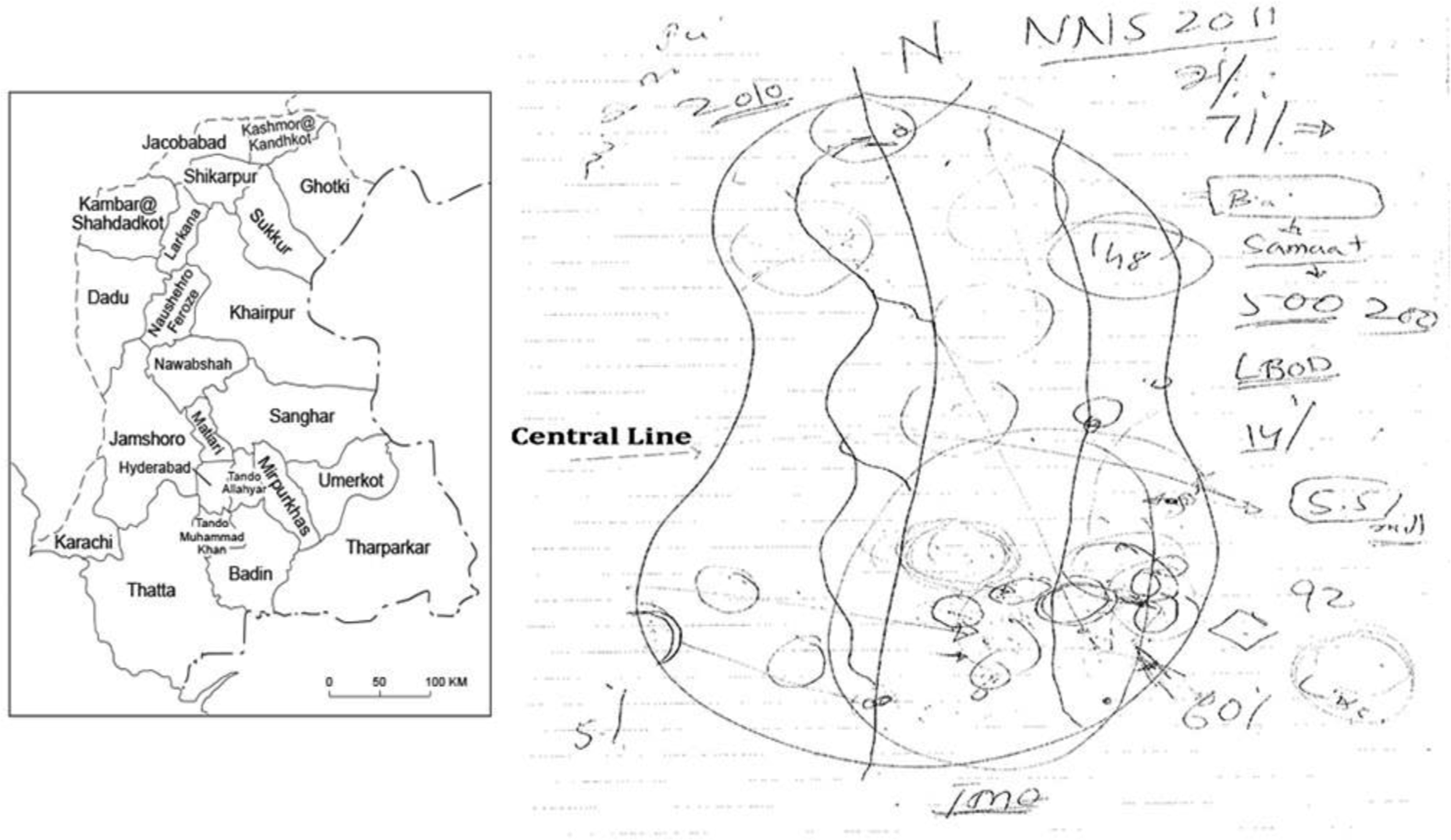
The state once again emerges as the (mal)function of the LBOD that re-produces Upper Sindh as the “dominant form of space” receiving drainage facilities and benefits while Lower Sindh has to be submerged with floodwaters, to maintain the privilege above the Central Line. Thus, we see how space is used in producing the state and is also an outcome of the structural effect of the state.
In this instance, the LBOD produced by the state, is producing a state that constructs Laar as the “peripheral space”. Thus, demonstrating that Upper and Lower Sindh cannot be understood as existing “a priori” but are rather ways in which the ‘state effect’ organises space according to its specific requirements for exerting control. This production of space is critical for maintaining the omnipresence of the state – as the very centre of political imagination. For while producing marginalised residents in Laar, drowning their homes, lands and even family members, it is believed to deliver benefits to those it is seen to favour thus reinforcing the idea of privileged state space. This belief was prevalent in the months I spent doing fieldwork in Laar, especially in the phrase I encountered most frequently “… Upper ko bachanay kay liyay humain dobaya gaya hai…” … to save Upper (Sindh), we were deliberately drowned (by the state) …
The narrative presented in these terms is discursively telling. The first part of the statement suggests the reason, a justification by those marginalised, for why this marginalisation by the ‘state effect’ is ‘natural’ or inevitable. In naturalising this discourse it becomes possible to see the way in which Upper Sindh is first produced, by the LBOD, so that it might be ‘saved’ by drowning Lower Sindh during flood years.
State effect of producing Sindh
As the argument thus far has shown, breaching the embankments of the LBOD is reproducing “dominant form of space” at the centre of the city that peripheralises space on the outskirts of the city and in Upper Sindh that peripheralises Lower Sindh. For residents living in “peripheral spaces” this unitary ‘state effect’ produced in the “cuts” made to the LBOD’s embankments, results in floodwaters washing away their homes in order to save the homes of others.
Following on from the above and going in ascending order of scale, this section will highlight the way in which the LBOD also re-produces space of the lower riparian province of Sindh as “peripheral space” to deliver adequate irrigation to the upstream province. The province of Punjab is the upper riparian on the River Indus (see Figure 2). Sindh has long maintained that this privilege’s the larger and more powerful province of Punjab to control the flows of water through dams and other mega projects within its boundary (Akhter 2015; Mustafa 2007). Map of the provinces and Indus River in Pakistan. Source: Magsi and Atif (2011).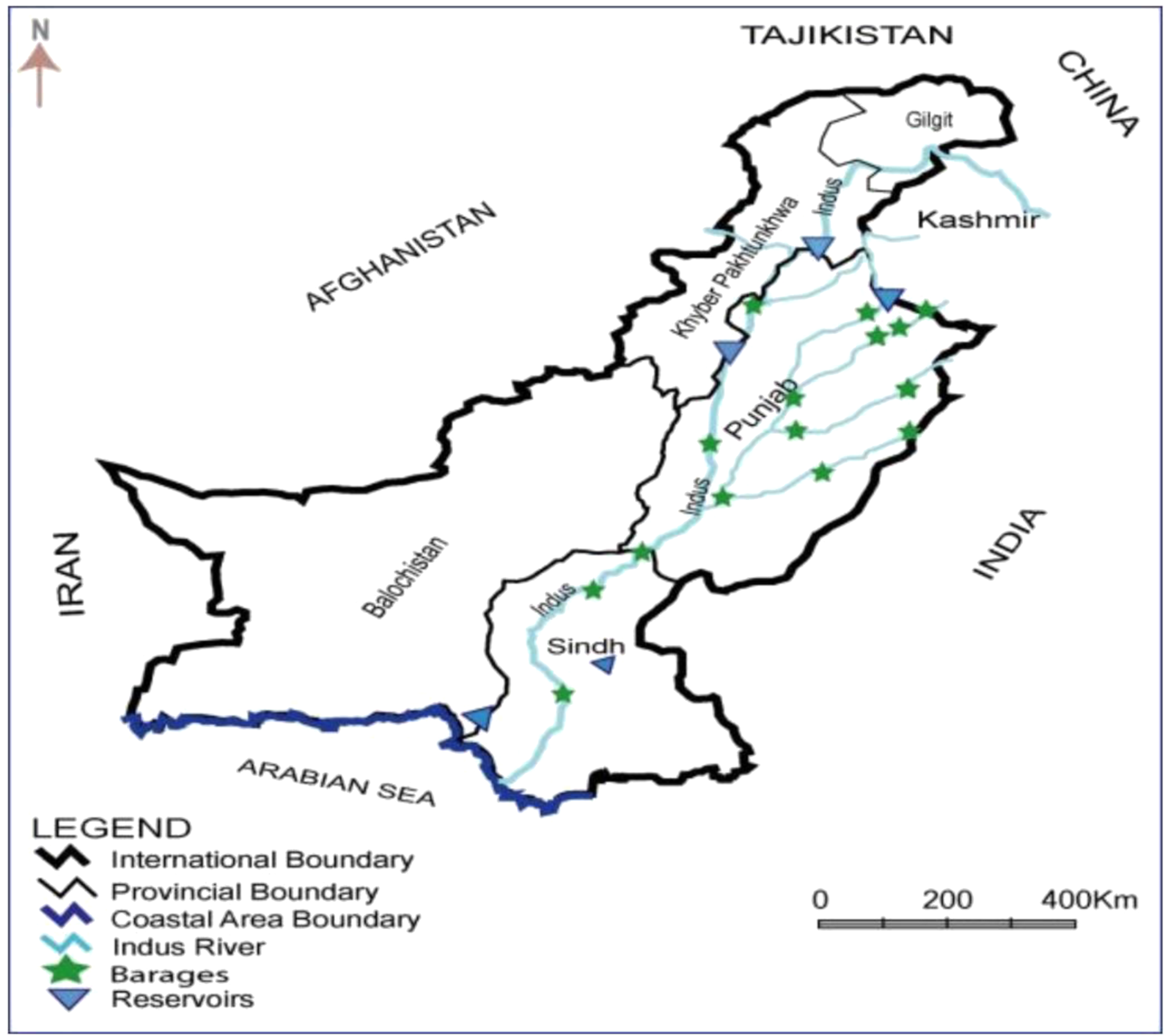
Instead of drawing on this literature that discusses the ways in which hydro-politics, especially water allocation and irrigation management, reinforce the Punjabi dominated state’s marginalisation of smaller provinces, the argument here is somewhat different. To see the spatial marginality of Sindh as “first and foremost” a product of the state, rather than implicated in this state’s production would be “conflating cause and effect” (Kelley-Richards and Bannister 2017). The LBOD is a tactic of government that manages the population by constructing and reinforcing “dominant form of space”.
The ‘cuts in the LBOD’ thus produce a state that uses space to marginalise Sindh, but provide adequate irrigation and drainage facilities for Punjab. In the city centre of Badin, a teacher at the local primary school explained the way in which the province of Sindh was subjected to flooding through the LBOD This disaster was not natural; it could have been prevented but the state drowns us deliberately. They released water from the floodgates in Punjab, to prevent flooding there and submerged us, entirely, under water. Our homes have been destroyed. What did they think would happen?… To prevent flooding there, water was released from Punjab through the LBOD. Small landholders have been protesting for days, demanding that a new embankment is built, or this injustice will continue to take place…
This large project, comprising of thousands of kilometers of drains, is not simply a technical intervention to ‘resolve’ a pain point in the hydrological cycle (draining wastewater) but rather a tactic (rather than a law) that reveals practices of government and its production of naturalised inequality by disciplining space. Much like Harris’s (2012) work suggests, the South-Eastern Anatolia mega-project was the coming together of various actors, processes and objects to produce a state that was seen to be Turkish by the Kurds and Arabs-the LBOD reveals a state that is seen to be Punjabi, by most in Sindh. It is why according to one middle-aged shop owner from the district of Badin, he saw the entire state system in Punjab responsible for the flooding of his family’s land, “especially the administration that built this LBOD. Since its construction it has been the source of misery and ruin in this region in every flood year… So that they can live like they are living in the US not in Pakistan…”
Thus, instead of seeing the LBOD as a simple or direct product of state led ethnic marginalisation, the argument here is somewhat different. The socio-technical practices of government around this large drainage project produce a state that exerts power by controlling, even disciplining space - as “dominant form of space” and “peripheral spaces”. From a municipal and city-level scale to the level of the province, to that of inter-provincial almost national scale, this ‘state effect’ is using space and dispossessing citizens through flooding, to create spaces of perceived privilege, where residents are accessing the full benefits of irrigation and drainage. For those on the periphery of the city it is the residents at the centre of the city, for those in Lower Sindh it is residents of Upper Sindh and for most residents in Sindh it is residents of Punjab who are being privileged by this state.
In Sindh, this state that fulfils it promises and delivers bountiful benefits is never encountered by my interlocutors, but they ardently believe it provides justice and fairness to others. It is in fact part of the fascination with this ideal-a “desire that can neither be fulfilled nor obliterated” (Secor 2007) and “an emergent effect… that delivers the promise but not the reality of water and drainage” (Kelley-Richards and Banister 2017: 105) and one that keeps the state at the centre of political imagination. It ensures that the most marginalised populations still cling, almost vehemently, to the idea of the state. In Mitchell’s words “we need to question the traditional figure of resistance as a subject who stands outside the state and refuses its demands”. The methods of political resistance available to citizens are dependent on “the organizational terrain we call the state, rather than in some wholly exterior social space” (Mitchell 1991). Perhaps then continuing to believe in an ideal state, first produced then encountered even when it dispossesses and marginalises, can be understood as a form of subaltern resistance.
The production of space through constructing scale: The military and the rest
A substantial amount of work in human geography now emphasises that the scale at which political action takes place is constructed by a range of different processes and actions that cannot always be reduced to size or level (Howitt 2000). Rather than seeing scale as an unanalysable given fact, it should be understood as a way of framing different conceptions and understandings of the political (Delaney and Leitner 1997). This section of the paper is exploring the scale at which political action takes place between the military and everyone else who make up Pakistan.
The exceptional power wielded by the Pakistani military is succinctly captured in the adage I often encountered during my fieldwork “while most countries have armies; in Pakistan the army has a country” (Shah 2014). The conversation below highlights the narrative on the army regularly encountered in Lower Sindh, where anti-Punjab and anti-military sentiments run high. I asked a social activist from Badin why he used distinctly separate words to speak of the government in Pakistan and the army in Pakistan, “is the army not part of the government”, I enquired. He replied Of course not! The army and the government are separate here (laughs loudly). The army is not a part of the state in Pakistan. Army has control over the entire country. It has an altogether separate identity. People know that army can takeover government at any time. They are not associated with the state or with the government. They do not support the democratic government but control the reins from back doors…
This viewpoint was fairly common amongst my respondents from almost all parts of Sindh. It has also however been argued that seeing the army in Pakistan as controlling the state apparatus rather than an emergent effect of people, processes and objects coming together to produce a supremely powerful army (Azeem 2020), which is a law onto itself, is to again “conflate cause and effect” (Kelley-Richards and Bannister 2017). The same respondent continued his explanation of the state and the army (Army) thinks they are separate from the government. Many people say that Tori embankment (in Upper Sindh) was “cut” to save the PA Cantonment. People think army is separate from government, army’s behaviour, their take over and control of government make them separate from the government.
In emphasising that this army stands above and apart from the state, this respondent is in effect only re-affirming the production of the state by using social space at this scale in Pakistan. By deliberately making “cuts” in embankments to divert water and save PA cantonment, while submerging all civilian land around it, the army re-produced the state space-the army versus the rest-most familiar to citizens of Pakistan. This space can be found in any physical province or region of Pakistan and in true Lefebvrian terms “goes beyond the false division between ‘mental space’ and the real space of the practico-sensory realm” (Beard 1997), rather wherever space designated as belonging to the army is privileged over space officially considered ‘civilian’ this scale exists. It was reproduced in the people, processes and relations that came together to divert floodwaters and produce the state.
The LBOD “cut” produced a ‘state effect’ that would re-produce the space as “dominant” military versus “peripheral” civilian spaces. One of my respondents who lived in very close proximity to the LBOD in Badin stated During the martial law regime of General Ayub Khan (1958–1969), lands were given to army men and it was decided that they would retain these lands for 25 years and after that these lands would be given to retired army personnel, but those army men and their families never settled here, now their Punjabi employees have occupied the lands here and are amongst our large landowners… the “cuts” in the LBOD in our area were to save these (military) lands… ask anyone here, it is well known.
Evidence presented by these interviewees suggests that the state was produced in different parts of the province of Sindh (and beyond) by producing military owned land as “dominant form of space” saved from flood waters, while civilian owned land was submerged by the ‘state effect’ that came together in the socio-technical practices of diverting water and making cuts in the LBOD and other irrigation/drainage channels. Thus this “natural” action of “cuts” in the LBOD re-produces the city-outskirts, Upper-Lower Sindh or Punjab-Sindh divide and also reifies the military-civilian boundary that intensely, and even exceptionally, appears to exist in Pakistan. Consequently, while residents in Sindh commonly suggest that the military stands above and apart from the state in Pakistan, the evidence here suggests something quite different. While the army creates a new scale of political action, it produces the structural effect of unitary action in exactly the same way as other fragmentary bodies and institutions cohere to produce the state.
Conclusion
The ‘state effect’ is produced by subjects (people, institutions and processes) and objects (water infrastructures) coming together and governmentalizing space. Using post-structural state theory, social construction of space and notions of postcolonialism this paper illustrates how ‘the state’ is produced by disciplining space as “dominant” and “peripheral” at multiple scales. Socio-technical practices, such as “cuts” made in embankments of the LBOD, produce an emergent effect of the state that creates marginality in “peripheral spaces” and privilege in “dominant spaces”. At the same time, these practices are considered a ‘natural’ or inevitable action taken in “dominant space” to save people and their lands thus reproducing their privilege. As the evidence from Sindh shows governmentalizing space or, as some scholars have argued, exerting control over space by claiming the power to govern territorially (Peluso and Lund 2011) produces a state that reproduces spaces as “dominant” and “peripheral” at multiple scales. This paper highlights that the causes of (state) power also create its effects (Ekers and Loftus 2008) re-producing each other (through failed hydraulic infrastructures and floods) in perpetuity.
The drainage project, LBOD, was examined as a technique of government through which ‘naturalness’ of the unequal state was produced in Pakistan. Such techniques of government do not just facilitate capitalist modes of production (Brenner and Elden 2009) in producing the structural effect of the state but also, as the evidence in this paper has shown, re-produce the power and privilege of such state formations by using space. These spaces of privilege (city centre, Upper Sindh, Punjab and the army) and marginalisation (urban outskirts, Lower Sindh, Sindh and civilian) are re-produced by the state and have also come to be the “most obvious attribute” (Secor 2007) of the state. This paper thus complicates the understanding of the LBOD as an instrument of marginalisation controlled by the powerful province of Punjab by demonstrating the production of “peripheral spaces” at every scale and not just at the provincial.
Finally, the production of “dominant space” through embankment “cuts” at the military-civilian scale particularly demonstrate these state tactics as defined by socio-political histories and existing structures of power. Hence the uneven power relations between dominant Punjab and everyone else in Pakistan, does not produce new “peripheries” through hydraulic infrastructures but rather reproduces the politics of scale and the existing inequities of ‘the state’. It is here that recognising the limitations posed by the condition of postcoloniality become especially pertinent-the structural effect of the state cannot remake the landscape without engaging in its historical socio-technical formations. Thus, it continues to reproduce existing (i.e. Imperial) forms of privilege and marginality through use of ‘dominant’ and ‘marginal’ space.
In Secor’s (2007) work subjects are “impaled” between a longing for care and justice from the state and the despair of its indefinite deferral. The state is thus produced in “the precipice that cannot be traversed because it represents a desire that can be neither fulfilled nor obliterated” (48). While for Kelley-Richards and Bannister (2019) subjects are “caught in a state of suspended animation between hope for full urban service provision and trepidation that it will ever reach them”. The citizens that make the state boundary appear to exist in this work, are also navigating this in-betweeness. The more intensely the fragments of the state come together to exclude and marginalise, the stronger the belief in the omnipresent and ideal state producing privilege and “dominant spaces” somewhere else, for someone else. Hence as Siddiqi (2019) argues, even though local encounters with the state regularly disappoint and fail to deliver, the belief in the idea of the state holds and is, in fact, at “the very centre of political imagination” (88) in “peripheral spaces”. This belief that an ideal state exists and works well for other people, somewhere, while remaining unattainable to most citizens ensures the continuity of this Sisyphean cycle producing “dominant space” for almost no one.
Epilogue-Pakistan floods in 2022
In August and September 2022, Pakistan experienced unprecedented flooding comparable, though larger, in scale to that discussed in this paper. By all reports this time the LBOD, and also the drainage project on the right bank of the River Indus the Right Bank Outfall Drain (RBOD), were at risk of overflow and embankments had to be breached to save large cities/Upper Sindh/Punjab and military lands. Thus, continuing the Sisyphean cycle of unequal state production. This paper is dedicated to my fieldwork interlocutors and everyone else living in these “peripheral spaces” made and re-made every flood year by the LBOD and RBOD in Pakistan.
Footnotes
Acknowledgements
The author would like to thank all research participants who have contributed their time and knowledge to her research.
Declaration of conflicting interests
The author(s) declared no potential conflicts of interest with respect to the research, authorship, and/or publication of this article.
Funding
The author(s) disclosed receipt of the following financial support for the research, authorship, and/or publication of this article: This work was supported by the AXA Research Fund fellowship and their support is gratefully acknowledged.
