




Abstract
This article interrogates the turn towards digital technologies for addressing sustainability challenges in global supply chains. Focusing on the case of blockchains, we assess industry claims that this set of distributed ledger technologies for undertaking, verifying, and publishing digital transactions provides the greater transparency necessary to resolve sustainability challenges. Our central contention is that blockchain-based initiatives to promote sustainability in global supply chains double-down on modes of third-party audit and disclosure governance that have thus far failed to address labour and environmental abuses. The turn towards these digital technologies, we show, extends interlinked processes of managerialization and the spread of ‘audit culture’ in the governance of global supply chains. These tendencies heighten obstacles to enhancing sustainability across global supply chains, exacerbating the very challenges blockchain initiatives are ostensibly meant to address. Worse than not fundamentally addressing sustainability problems, applications of this set of ‘sustech’ render failures to address sustainability abuses more opaque. The technological novelty of blockchain helps to construct what we call a ‘veil of transparency’ over sustainability abuses and marginalities in and across global supply chains.
Introduction
Sustainability challenges are increasingly central to the governance of global supply chains (LeBaron et al., 2017; Ponte, 2020). On-going revelations of labour and environmental abuses have driven the development of a range of private and hybrid sustainability governance schemes. These include third-party audit, standard setting, and disclosure agreements that have been developed to tackle an increasingly broad range of problems. Increasingly, these schemes rely on various ‘innovative’ applications of digital technologies. A small but growing literature critically examines this turn towards digital technologies for addressing sustainability challenges in global supply chains (Dauvergne, 2020; Howson, 2020; Manski and Bauwens, 2020; Sanders et al., 2019). We contribute to this emerging literature through a scoping study, unpicking the politics that inform the deployment of blockchain as a ‘sustainability technology (sustech)’ and assessing claims that the technology can help resolve sustainability challenges through its enhanced transparency (Liao and Fan 2020).
Our main finding is that blockchain-based initiatives intended to promote sustainability in global supply chains double-down on modes of governance and forms of power relations that thus far have failed to address labour and environmental abuses. Blockchain-based responses to existing failures of supply chain governance reinforce interlinked processes of managerialization (see Baglioni et al., 2020; Eagleton-Pierce and Knafo, 2020) and the spread of ‘audit culture’ (Shore and Wright, 2015). We argue that as an emerging ‘sustech’, blockchain extends rather than resolves governance failures by: 1. reinforcing the positions of lead firms in supply chains; 2. expanding roles of for-profit consultancies and audit agencies; and 3. deepening managerial modes of ‘governance at a distance’ rooted in quantitative metrics.
Blockchain initiatives reinforce existing power relations in ways that render sustainability governance more opaque and removed from the people and communities that the operations of global supply chains directly affect. This failure is on-going and paradoxical: blockchains and their promoters ostensibly seek to make visible immutable records of data that designers choose to include ‘on the chain’. Their invocations of visibility and traceability cast, however, what we describe as a ‘veil of transparency’ over abuses. Calling attention to this veil, we argue, makes visible the ways blockchain initiatives obscure both the wider configuration of power relations through which global production networks operate, as well as the political choices underlying the design of blockchain systems for traceability. Mapping out the modes of governance and power relations mobilized by blockchain projects contributes to this themed issue’s repoliticizing of the wider turn towards technology in sustainability governance.
We proceed in six sections. First, we review persistent failures of private-led governance to address unsustainable practices and systems in and across global supply chains. Second, we re-introduce blockchain and the general manners that ‘permissioned’ versions of this technology are harnessed for supply chain sustainability. Third, we provide a general mapping of the actors mobilizing blockchain to enhance sustainability in supply chain governance. Fourth, we examine more closely the relations between actors in blockchain for supply chain initiatives. Fifth, we assess the purported benefits of blockchain as a mode of sustech with reference to the global cobalt supply chain, an important case due to prominence and attention that these particular schemes have attracted in efforts to address sustainability failures. Finally, we conclude by summarizing and pointing to further research directions that enhance focus on the specific spatial contexts in which blockchain initiatives operate.
Sustainability failures in global supply chain governance
Three key features of global supply chains and their governance are replicated, exacerbated, and ultimately depoliticized in efforts to mobilize blockchain as ‘sustech’. First is global supply chains’ dominance by hierarchical and exploitative structures of corporate power. Second, and closely related, are managerialist modes of governance and ‘audit culture’ (Shore and Wright, 2015). Third, is the reinforcing of these twin dynamics by third-party consultancies. From existing studies of supply chain governance, we draw together these themes in situating the wider stakes at play in our politicizing the turn to blockchain as supply chain ‘sustech’.
First, corporate power in global supply chain governance. This is exemplified most explicitly by the retention by leading firms in supply chain of the most lucrative elements of production processes. Supply chains have increasingly been broken down into component parts across spaces and industries, with the more costly and risky activities contracted out to peripheral workers and places. Incorporation of dispersed regions and processes into global supply chains is justified as a key avenue for development and poverty reduction (see Barrientos et al., 2011). Yet, such claims belie the persistent power imbalances underlying the corporate-centered globalization of production. A range of studies across disciplines link the organization of global supply chains and hyper-exploitation through various forms of unfree labour (Phillips, 2013; McGrath, 2013). Selwyn (2019) argues that global supply chains are best understood as ‘global poverty chains’ due to engrained tendencies towards the hyper-exploitation of peripheral workers. Equally, in addition to tendencies of supply chains to externalize ecological degradation (see Dauvergne, 2008; Ponte, 2020), the logistics and transport operations associated with the functioning of global supply chains have been credited with considerable growth in carbon emissions (Jiang and Green, 2017). The hierarchical and exploitative structures of global supply chain have then materialized and been maintained by complex but supposedly ‘universal’ modes of coordination across time and space.
Second, the centrality of managerial modes of coordination. This refers to the systematically uneven rollout of techniques of standardization, measurement, and fostering of competition in global supply chains that underpins exploitative corporate power. Baglioni et al. (2020: 806) frame managerial forms of coordination as mechanisms for the ‘continuous expansion and capture of value’. To some degree, managerialism has universalizing concerns as a mode of governance conveying an “aspiration for a rational ordering of the world,” while relying on expert knowledge of calculation and predictability (Eagleton-Pierce and Knafo, 2020). In practice, however, managerialism has expanded social and ecological costs and consequences that have been disproportionately borne by workers and communities in the Global South. Discussions of managerialism in this sense are closely cognate to anthropological research on audit cultures. The latter have specifically highlighted how the calculative rationalities of modern financial accounting systems designed for measuring and auditing cast governance issues as mere technical and administrative matters, undertaken by far-off technocrats in ways that diminish the role of local knowledge and professional expertise (Shore and Wright, 2015). The merging of financial bookkeeping with human management or “human accounting” foregrounds the attainment and efficiency through measuring and ranking as the key set of ethics underpinning “audit culture” (Strathern, 2000). Such processes often work to render grassroots communities knowable and accountable to market-based “development authorities” (Vannier, 2010) that make far flung activities “visible” through the imposition of top-down, external, pre-determined criteria. These process tend to depoliticize and displace local and bottom-up solutions to sustainability issues. Instead of a turn away from managerial tendencies, the growing recognition of such costs has often extended increasingly complex forms of private, and corporate-led governance. Most prominently, since the early 2000s, leading firms in global supply chains sought to allay concerns about socio-environmental costs by issuing a growing array of codes of conduct and sourcing guidelines for their industries. Early Corporate Social Responsibility (CSR) schemes and corporate codes of conduct for suppliers (on which see Taylor, 2011) have been increasingly complemented by multi-stakeholder initiatives involving multiple public and private actors (see Bair, 2017) and professional services firms like the ‘Big Four’ Deloitte & Touche (D&T), Ernst and Young (EY), KPMG and PricewaterhouseCooper (PwC) (see Fransen and LeBaron, 2019; LeBaron et al., 2017).
Last but not least are the solutions that private sector-led initiatives have taken to address these problems. These have tended to reinforce the very conditions that have led to labour and environmental exploitation in the first place. This process has occurred in two manners. First, corporate power has been extended as industry actors have been able to ‘pick and choose’ adherence to voluntary standards in ways that have favoured a ‘race to the bottom’. While providing cover against pressure to at least do something to ameliorate sustainability challenge, the multiplicity of private sustainability standards has worked to further empower foreign ‘stakeholders’ over grassroots communities across the Global South. The latter typically harness local knowledge in seeking to address sustainability problems at a less global, yet potentially more effective, scale (Alford, 2016; Kumar and Beerepoort, 2019; Orock, 2013). The easy evasion and difficult enforceability of international voluntary standards, meanwhile, largely inhibits private codes of conduct, principles and other such modes of governance from actually addressing the very problems they are positioned as resolving. At best, having multiple expanding sets of environmental and labour standards has been shown to displace rather than reduce labour and environmental violations (e.g., Dauvergne, 2008; Keonig-Archibugi, 2017). At worst, the flurry of private codes of conduct have passed the costs of compliance and monitoring on to smaller local suppliers and sub-contractors, without alleviating the pressure from leading firms to deliver raw materials cheaply and quickly in ways that undermine labour and environmental abuses (see Taylor, 2011; Scheper, 2017). Notably, where improvements have occurred, studies have consistently attributed these gains in large part to political pressure by civil society groups or the incorporation of workers’ representation and workers’ voice (see Barrientos, 2013; Bair 2017; Fransen and Burgoon, 2012; Graz et al., 2020; Pike, 2020).
In sum, private standards and codes have tended to draw on pre-existing repertoires of supply chain management and coordination (see Baglioni et al., 2020), ultimately reinforcing both the power of transnational corporations over the organization of production and exacerbating the uneven capture of value within supply chains. The rise of such “governing at a distance” produces numerical forms of ‘technical transparency’ that cater to the interests of distant corporate actors in quantitative data, rather than addressing the more complex socio-political, ecological and socio-economic problems that exploitation by these powerful actors has enabled (Shore and Wright, 2015). The turn to blockchain in response to these repeated failures, we argue in what follows, casts a ‘veil of transparency’ on the socio-political implications of efforts to render sustainable supply chains, doing so in ways that can ultimately reinforce existing failures and depoliticize them.
Repurposing blockchain as sustech
Information communication technologies (ICTs) and the evolution of what has been more recently dubbed platform capitalism have been shown to extend and intensify the practices of managerialism by providing managers with more precise mechanisms such as algorithms and digital tracking technologies to control the labor process (Moore and Joyce, 2020; see also Langley and Leyshon, 2021). A range of emerging digital technologies have been harnessed for ostensibly enhancing transparency, visibility, and the legibility of actors and resource flows in global sustainability governance. Amongst these, blockchain has received considerable attention by firms, governments and international organizations.
Despite their anti-financial system origins, blockchain applications codify both the key characteristics of the forms of private governance discussed above, as well as their pathologies. Blockchains, in short, materialize audit culture. They “promote economic-like accountability of data and information […] and calibrate messy human exchange and interaction via auditable and calculable logic” (Herian, 2018, 106). In doing so, this set of technologies “transforms the human into a modality of pure economic, calculable and auditable rationality” (Scott, 2016, 13). Blockchains are typically presented as providing universalist solutions in advancing a technical view that “all problems are engineering problems” (Golumbia, 2015). Blockchains are also often explicitly seen as “transcending human geopolitical contestations” (Herian, 2018, 160). In other words, the technology is often mobilized with a view to ‘flatten’ variegated spaces of activity towards singular competitive market behaviour as an uncontested universal global good.
Conceiving blockchain as a value accounting infrastructure, Manski and Bauwens (2020) argue that the technology could in theory also facilitate more collaborative governance around shared resources. For instance, by adopting a “commons-centric” value logic and aiding a global transition towards more equitable communitarian future, the technology has the potential to give rise to “ecosystems of productive collaboration” and facilitate new forms of organization and governance (2020: 6). Yet, to actually realize these possibilities, far more conscious designs are needed to redistribute “sovereignty from elites to the people in financial, service, and national infrastructures” (Manski and Bauwens, 2020, 1). Much depends, in other words, on politicizing the specific social relations through which blockchain applications are being developed and rolled out (see Bernards et al., 2020). As we go on to show here, by contrast, blockchain applications for supply chain governance in practice operate through and extend managerial governing logics and top-down power relations of the kinds traced in the previous section. The technology is deployed more as means of deepening managerial logics and extending corporate power. This depoliticizes unsustainable practices through a ‘veil of transparency’. Specifically, the permissioned version of blockchain as so-called ‘distributed ledger technology’ that has become popular in corporate consortiums and public-private partnerships (PPPs) is typically positioned as a natural solution for overcoming the two main problems limiting private-led efforts to enhance the sustainability of global supply.
First, blockchains are said to help overcome the multiplication of codes and standards in global supply chain governance. As the lead for blockchain at the World Economic Forum put it, “the supply chain industry is fragmented, with parties adopting a siloed approach. Blockchain and distributed ledger technology could bring standardization and transparency” (Nadia Hewett quoted in Birch, 2019). The coordination between supply chain participants such as manufacturers, shipping companies, and financial institutions relies on a great deal of paperwork (Telling, 2022). Within the growing digitization of global logistics are initiatives to establish permissioned blockchain-based networks to store and facilitate data on global trade flows. These include the Global Shipping Business Network, launched in 2021. Continual challenges have remained, however, regarding compliance with competition and antitrust laws and other regulations in cross-border environments (Telling, 2022).
Second, blockchain applications are said to promote data transparency by creating shared and permanent records of transactions that, in theory, can be viewed by all and modified only by consensus amongst network participants. These functions are critical to sustainability in global supply chain governance. As supply chain complexity grows, blockchain is viewed as offering cost-effective solutions for improving visibility and traceability. The technology is said to not only economise the costs of data recording and sharing, but most importantly for global supply chain sustainability, to efficiently present and verify identify attributes of goods, including their condition and provenance (Berg et al., 2019, 100–102). Yet, despite the increasing visibility of certain aspects of supply chain that blockchain may offer, actual management decisions in the (block) chain solidify established top-down routes set out by managerialism and audit culture. The increased legibility of certain attributes of goods and their movements provided by blockchain, paradoxically, also facilitates new invisibilities that render socio-political, ecological and economic challenges less rather than more transparent.
We now proceed to map out the main actors and types of blockchain projects involved showing whom and how permissioned versions of the technology are being deployed in efforts to resolve sustainability challenges in global supply chain governance. Our two related mapping exercises draw on information compiled on (1) initiatives using blockchain in supply chain governance and (2) the principal claims made about their benefits. In producing each map we collected announcements on projects using blockchain applications to govern global supply chains, using both conventional web searches, as well as NexisUni. We relied primarily on specialized business (e.g., the Financial Times) and blockchain (e.g., CoinTelegraph) focused outlets reporting on sustainability governance-focused initiatives. For each blockchain-based initiative identified, we collected publicly available information from these media reports, along with company white papers, and company reports about project status (e.g., announced, pilot test, active). While not comprehensive, our sample nonetheless is broadly indicative of the range of applications (active, planned, or proposed), and of the range of actors, institutions, and purposes at play to gleam the key claims made about the potential benefits of blockchain.
The next two sections present the findings of our mapping exercises. We show first how blockchain initiatives involve many of the same key players, and reinforce existing patterns of inter-firm involvement in the complexities of global production. We then map the particular uses of blockchain within these initiatives. Both mapping exercises more concretely reveal overlapping aspects of what we call the ‘veil of transparency’ in showing how invocations of ‘technical transparency’ by blockchain promoters mask the deepening of unequal relations of power and depoliticize crucial questions about what is made transparent and to whom.
Who harnesses blockchains as supply chain sustech?
The actors already playing dominant roles in global supply chains harness blockchain as ‘sustech’. These include large leading firms and third-party management consultancies. Insofar as blockchain initiatives introduce new actors into supply chain governance, these include both large and small technology companies providing blockchain infrastructure, along with a handful of specialized audit or other startup firms that are selling blockchain-based supply chain services. The embrace of blockchain has thus had limited impact on the range of actors involved in supply chain governance. Yet mobilizing blockchain has worked to draw away from increased opportunities for participation by the actual people and communities directly affected by unsustainable practices or labour abuses.
This section thus identifies a first important facet of the ‘veil of transparency’: that blockchain initiatives promise qualitatively greater transparency in who can participate while actually only quantitatively increasing the roles of corporate and managerial power in supply chain governance. This finding has important implications, as we go on to show, for answering the important question of just what, exactly, blockchains render ‘transparent’. We begin, however, by first identifying the specific types of actors involved in promoting sustainability solutions for blockchain-based global supply chains.
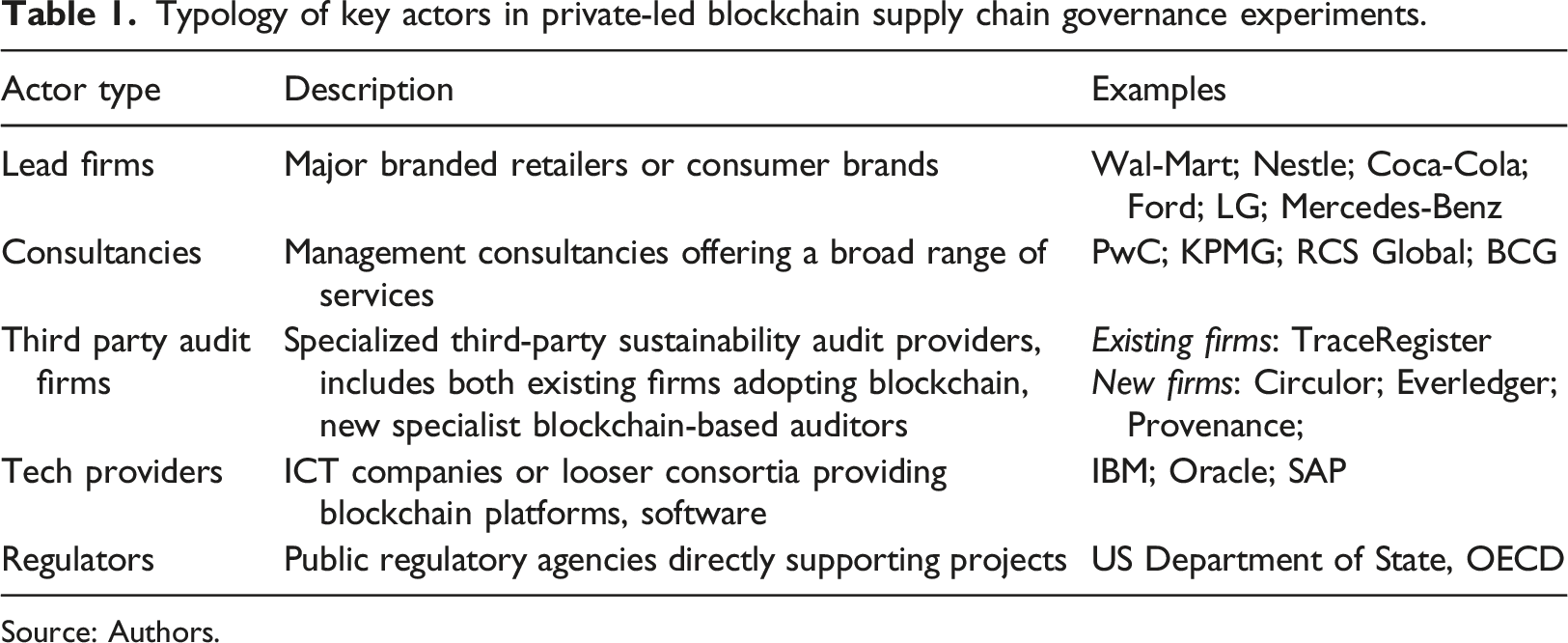
The foremost promoters of blockchain as sustech solutions for global supply chains are lead firms. These are the consumer brands or retailers that are end users of raw materials. Ford, for instance, does not generally directly buy or use key metals for its car batteries. Rather it buys batteries already incorporating metals like cobalt. Second are consultancies providing advisory services on how to integrate blockchain in sustainable manners. Third are third-party audit firms that offer blockchain-based audit and supply-chain monitoring. Lastly, there are public regulatory agencies that work to support blockchain supply chain governance pilot projects. These agencies are national, such as the United States Food and Drug Administration and State Department, as well as international institutions like the Organization for Economic Cooperation and Development. The role of public regulators here is mixed. It is primarily US agencies, often operating in collaboration with technology providers and lead firms, that are directly involved in pilot projects. Blockchain projects are often connected to the proliferation of audit and disclosure requirements from public regulators as in the case of seafood supply chains discussed further below. State involvement in these projects, in short, takes forms closely resembling existing forms of ‘hybrid’ governance in global supply chains (see Bair, 2017).
Typology of key actors in private-led blockchain supply chain governance experiments.
Source: Authors.
Why then are there so few genuinely new entrants in supposedly more participatory blockchain-based efforts to enhance the sustainability of global supply chains? Part of the reason is type of permissioned rather than permissionless blockchain being harnessed for sensitive data. The costs of administering the former type of gatekeeper-centered blockchain systems often form barriers to the meaningful involvement of marginal actors in many supply chains. These costs can function to increase barriers for smaller firms to participate. They can also stem from legislation, which in industries such as the fishing industry, requires companies to produce regular anti-slavery and human trafficking statements (Howson, 2020). Various supply chain transparency acts 1 hold companies liable for the working conditions of their staff and suppliers and traceability of catches. Utilizing a distributed ledger on the Ethereum blockchain to trace tuna from Indonesian fisheries to UK consumers by supply-chain management business Provenance in 2016 and other blockchain pilots reveal major expenses for smaller companies, as well as doubts on the veracity of the data put on blockchain applications. The data exchanged across supply chains, in short, may not guarantee that for example the fish were caught the ways claimed. Blockchain and smartphones alone are not sufficient for “reliable tracking and monitoring of fish,” necessitating further expenses such as the use of other peripheral trackers, including IoT devices, remote sensors, and handheld DNA sequencers (Howson, 2020: 4). Compliance may therefore entail high costs for the companies, and not provide much qualitatively meaningful transparency without the further harnessing of other expensive devices. In contexts of artisanal fisheries, a category making up about 95% of fishers around the world, small-scale players may not be able to afford the product licenses sold by IBM, or be able to harness blockchain to incentivize catch registration and data sharing. Meanwhile, more open permissionless blockchains, such as The Fishcoin platform can offer individual fishers tokens for sharing data on a blockchain ledger that can be exchanged for mobile phone credit (Howson, 2020, 4). Such open source projects are not controlled by a central company, and could, in principle, enhance grassroots participation, a second feature of the veil of transparency to which we now turn.
How are blockchains harnessed as supply chain sustech?
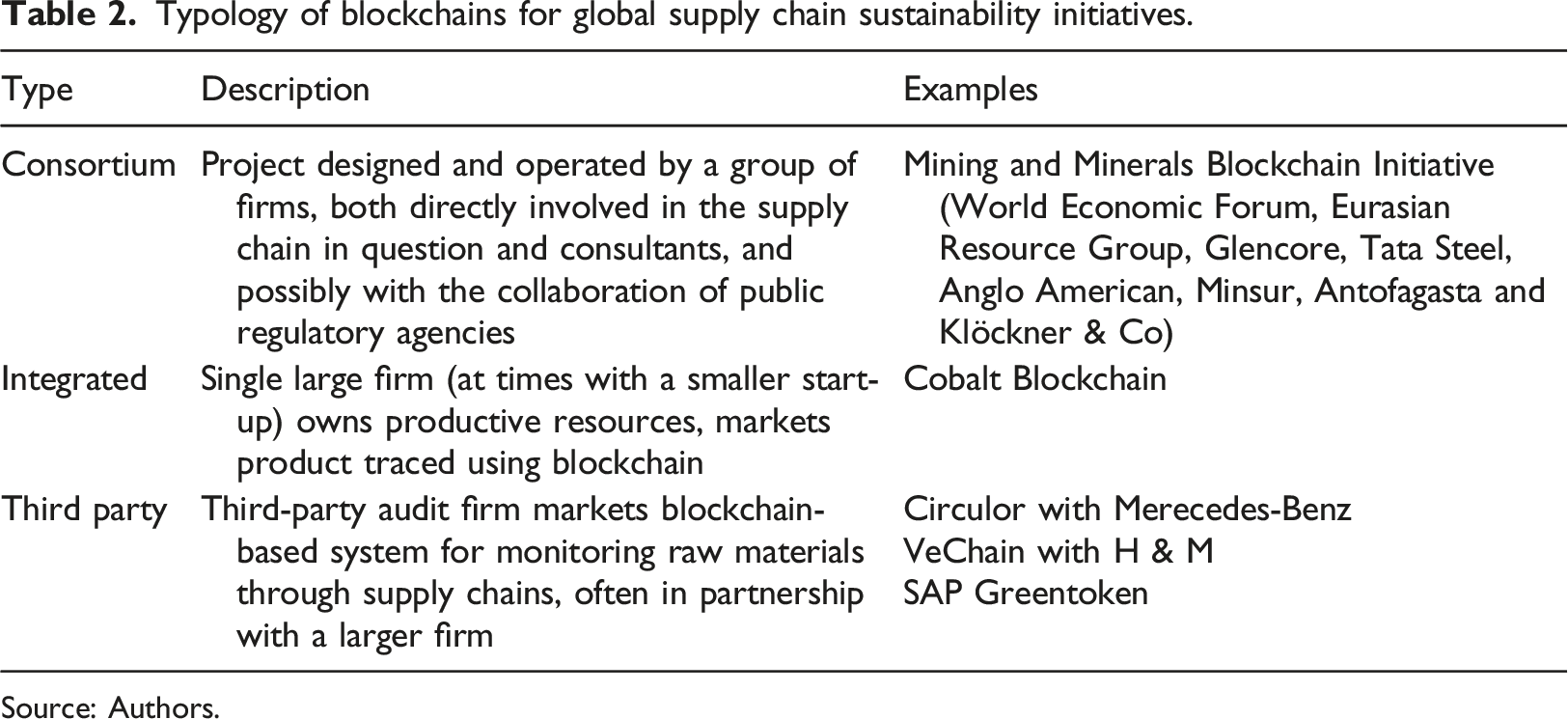
A second facet of the ‘veil of transparency’ is that blockchain initiatives promise greater data transparency while raising barriers for generating actual understanding of how data circulated across global supply chains are produced in the first place. This second aspect of the veil of transparency is exacerbated by the specific inter-firm relations between those designing blockchain sustech projects and operating the resultant shared ledger of transactions. When it comes to the question of how blockchain projects are developed and operated, therefore, we again find most to be led by large firms and major consultancies, accompanied by some speculative, ‘start-up’ ventures. What we can distinguish as ‘technical transparency’ afforded by blockchain supply chain projects then seem to undercut more ‘socio-political transparency’ regarding the continued marginalization of the people directly affected by unsustainable practices or labour abuses.
Typology of blockchains for global supply chain sustainability initiatives.
Source: Authors.
Second, are the third-party applications of blockchains for global supply chain governance. Here specialist sustainability audit firms market blockchain-based transparency systems contracted to producers or end-users as a means of demonstrating the traceability of data on materials. Specialist firms here typically partner with larger firms on specific projects, such as the start-up Circulor with Mercedes-Benz as part of pilot projects to track greenhouse gas emissions across the carmaker’s supply chain. Most of the firms of this type are specialized by the sectors they operate within, such as TraceRegister (seafood traceability), Circulor (industrial metals), Everledger (luxury goods). Recently, German software company SAP has launched a similar blockchain-based service called ‘Greentoken’, which is a more general application. It is currently being piloted in a project tracing ‘deforestation-free’ palm oil for Unilever. A further number of such firms arose in response to the Covid-19 pandemic, including TYMLEZ (medical goods generally) and Real Items (KN95 masks specifically) (Wolfson, 2020). Initiatives led by these third-party operators introduce new sources of inter-auditor competition to an industry already marked by substantial structural pressures tending towards lenient application of sustainability standards. Indeed, in the case of SAP, they represent the entry of a well-resourced software firm into supply chain audit provision. They at once enhance what we call technical transparency by providing numerical data, yet reduce what we distinguish as socio-political transparency by guarding the proprietary processes through which their data is produced and assessed.
The final type of blockchain supply chain sustainability initiative are integrated projects. Here one firm both owns the site of production and provides a blockchain-based product tracing system. Critically, this governance model is adopted by new firms seeking initial fundraising. The main examples are prospective cobalt mining firms raising money – either through the financial transparency accompanying conventional stock market issues (Cobalt Blockchain) or digital token-based initial coin offerings (Blue Hill Mining) in order to purchase mining rights to small plots in the Democratic Republic of the Congo and Mongolia, respectively. ‘Sustainable’ or ‘ethically’ mined cobalt, verified through blockchain traceability, is in these cases part of a wider package of transparency promises made to investors. There is some sense in which these initiatives promise greater meaningful transparency to existing supply chains – they involve genuinely new entrants. Yet they are also highly speculative ventures, aimed as much at mobilizing hype around blockchain to raise money from retail investors as at actually engaging in productive activities, to which many of these firms seem to have tenuous and unclear connections. Blue Hill Mining folded in late 2021 after investors voted to convert the project into “an online decentralized platform that will be able to provide the opportunity for people to invest in various projects and generate passive income” (Blue Hill Mining, 2021). Cobalt Blockchain renamed itself Enrev5 Metals around the same time, following the restructuring of debts with several private creditors (Newsfile, 2021). Enrev5 does not appear to currently own any actual mining rights, although claims to be in negotiation with several cobalt/copper projects. If these projects promise on some level to render transparent supply chains more meaningfully than consortium or third-party projects, they are also in no small part highly uncertain ventures wherein the invocation of blockchain is at least in part a means of appealing to wealthy individual investors. On current evidence then these schemes are unlikely to meaningfully shift from an emphasis on technical to socio-political transparency in the governance of existing supply chains. Their intention to appeal to far flung investors in no way promises to, for instance, attend to the exclusion of affected communities in decision-making, data collection or the like.
To summarize: our mapping of the main forms of collaboration and competition through which blockchain-based sustainability projects are being rolled out suggests a deepening of the organizational logics and power relations already prevalent in global supply chains. Blockchain projects are in the first instance extensions of existing forms of corporate power. With a handful of highly speculative exceptions, blockchain initiatives are being developed in ways that work through the power of existing lead firms and major consultancies, and even exacerbate some of the pathologies of fragmentation and inter-auditor competition. The turn to blockchain enhances the role of the ‘big four’ in supply chain governance – particularly in designing and negotiating larger consortium initiatives - spurred by competition with new specialist blockchain-based audit firms. This has led to a multiplication of complex and overlapping initiatives, each with their own standards proliferating across a range of ‘sustainability services’. A growing role of ‘regulatory intermediaries’ -- third party actors other than ‘rule-makers’ or ‘rule takers’ – is apparent in blockchain initiatives, especially involving the major consultancies (Fransen and LeBaron, 2019).
That the rollout of blockchain initiatives further fragments governance arrangements in global supply chains is recognized by industry/government actors as a persistent problem. As Gartner Research (2019) laments, most blockchain supply chain projects, “have remained pilot projects due to a combination of technology immaturity, lack of standards, overly ambitious scope and a misunderstanding of how blockchain could, or should, actually help the supply chain”. By contrast, the development of integrated blockchain-for-sustainability initiatives is comparatively rare despite a stress on the need for ‘interoperability’ between standards emanating from start-ups and Big Four accounting firms and coordinated by actors like the WEF and OECD (Allison, 2020; Ledger Insights, 2020; Pawczuk et al., 2020). There is widespread support for “cross-chain” platforms developed by technology firms to overcome the multiplication of standards “that currently plague this fast-growing technology” (Jagati, 2020). Yet, beyond a few trials of “multiple traceability systems successfully interoperated when following a product through a supply chain” there is little to show (Albrecht, 2020). These organizational dynamics have significant implications for what kinds of transparency, concretely, blockchain projects actually offer as we discuss next.
What then does blockchain actually do?
Blockchain sustainability applications are presented by their proponents as enhancing data transparency through the traceability of materials they provide through global supply chains. With the partial exception of a few pharmaceutical cases, however, we find that nearly all supply chain applications of blockchain are more specifically concerned with tracing raw material inputs through global supply chains. These applications are part and parcel of private-led efforts to demonstrate compliance with emerging requirements on disclosure and due diligence in supply chain governance. Such applications often promise more direct forms of informational transparency to regulators and to consumers, for instance promising smartphone applications can render the provenance of a fish, tomato, or diamond completely traceable. In general, consumer-oriented forms of quantitative transparency are more prevalent with less complex supply chains while regulatory compliance-oriented forms of transparency are more prevalent in more complex supply chains involving multiple material transformations.
Blockchains then are harnessed in ways that promise informational transparency, yet cast a ‘veil of transparency’ over labour and environmental abuse. It is not that sustainability problems are hidden by blockchain applications. Rather, it is that the promise of ‘transparency’ in itself obscures and depoliticizes very important, and ultimately power-laden choices about what information to record ‘on the chain’ (and, by extension, what information to leave off), as well as how this information encodes particular, contested, understandings of ‘sustainable’ or ‘ethical’ production. There is thus a revealing tension here in industry discussions around what blockchain can actually do. A shared ledger of transactions, most blockchain promoters will quietly acknowledge, can really only be used to ensure that data entered onto a distributed database has not been modified or tampered with, not that it is reliable in the first instance. As an executive of Circulor notes in a promotional case study for Hyperledger, (n.d.: 3) a “blockchain will record an immutable record of custody of a material, the locations it’s traveled through, its composition over time, and all that… But if you’re trying to make sure the wrong material never enters the system in the first place, you need processes to make this work”. Similarly, the whitepaper of start-up TraceRegister notes that ‘while blockchains can help us “trust” that the data is not altered, it still cannot determine if the data is valid’ (TraceRegister, 2019: 2).
In sum, we find a key tension between technical informational transparency provided by the ‘immutable’ record of transactions that blockchain offers and the more obscured transparency regarding the socio-political, economic and ecological conditions under which that record is made and what exactly is recorded. The question of what data should be stored on the blockchain is fundamentally a political and socially contested one, a point that is sometimes explicitly identified as a source of conflict in blockchain supply chain discussions. Writing about a blockchain pilot carried out by Target, the retailer’s chief technology officer notes that ‘we learned that standing up a blockchain is simple from a technology standpoint, but difficult in deciding what data should live on the distributed ledger’ (Crabb, 2019). The implications of contestations over what data goes ‘on the chain’ are particularly clear in the proliferation of blockchain traceability schemes targeting cobalt that we proceed to elaborate upon in the next section. A range of different blockchain projects focused on cobalt have bridged the actor and project types identified in our general mapping exercises. This case particularly exemplifies the technical transparency focus on the traceability of raw materials through complex supply contemporary chains. It is fruitful, we contend, to both place blockchain-based cobalt sustainability schemes within the wider context of attempts to address governance problems in global supply chains, as well as to point to some cross-cutting problems with these initiatives.
The case of cobalt
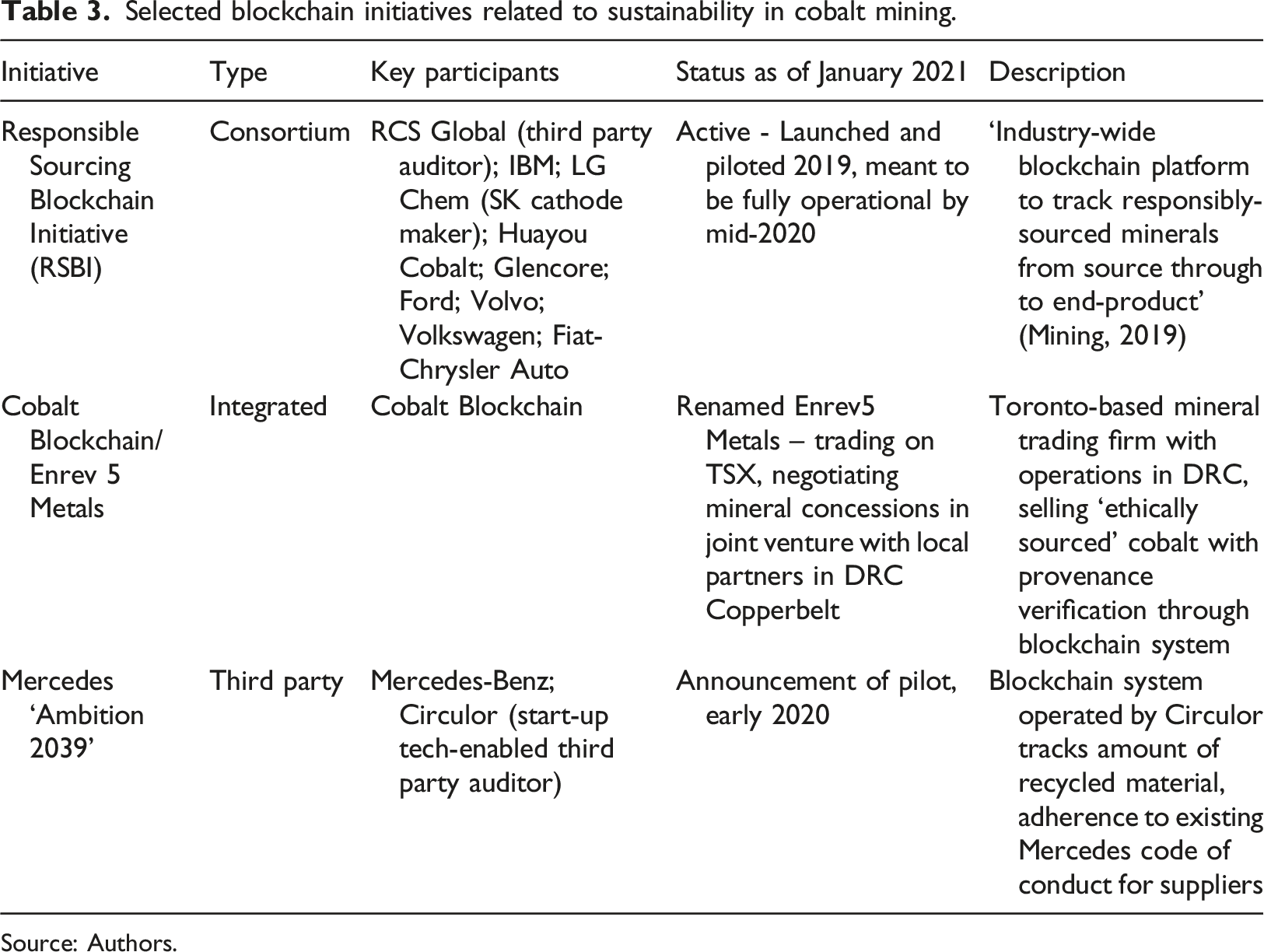
Selected blockchain initiatives related to sustainability in cobalt mining.
Source: Authors.
The proliferation of blockchain sustainability projects has taken place alongside a wider proliferation of private regulatory schemes for cobalt, as we show below. These arose in response to widespread reports of labour and other abuses in cobalt mining in the DRC – including in a series of reports by Amnesty International (2016, 2017) and prominent media outlets (CNN, 2018). These reports documented how children were frequently exposed to abuse and dangerous or unhealthy working conditions. The reports and their media coverage drew links between labour abuses and the ubiquity of the mineral in lithium-ion batteries in smartphones, laptops, and (increasingly) electric cars produced by high-profile consumer brands.
A range of efforts by various private firms seek to ensure that cobalt mined using child labour is kept out of their battery supply chains in the aftermath of these reports. In the aftermath of the publication of the Amnesty reports outlining cobalt mining abuses, Chinese producers advanced the ‘Responsible Cobalt Initiative’ (RCI). The initiative was formed by the Chinese Chamber of Commerce of Metals, Minerals, and Chemicals Importers and Exporters (CCCMC) in 2016. The RCI was launched as a legal entity in December of 2017, with participation from a number of major end users including Apple, BMW, Sony, and Volvo, along with Chinese traders and refiners (PMR, 2017). The London Metal Exchange, through which at least some of the materials mined in the DRC and refined in China are traded, was also pushed into developing sourcing guidelines in the aftermath of the Amnesty reports (Bernards, 2021). Initiatives to enhance the sustainability of the cobalt supply chain through blockchain, then, are part of a range of emerging private governance initiatives, as well as efforts to increase managerial control over flows of minerals.
All three types of blockchain initiatives outlined above are visible in the case of cobalt. The largest and most significant consortium scheme is the Responsible Sourcing Blockchain Initiative (RSBI). This initiative announced in 2019 is coordinated between the blockchain division of tech giant IMB, supply chain audit firm RCS Global, as well as several mining houses, mineral traders, and automotive end users of battery materials including Ford, Volvo, Volkswagen Group, and Fiat-Chrysler Automotive Group. RSBI conducted a pilot test tracing 1.5 tons of Congolese cobalt across three different continents over 5 months of refinement. Meanwhile, the most notable integrative scheme is Toronto-based trading house Cobalt Blockchain, which markets its ability to trace ‘ethically sourced’ cobalt certified through its proprietary blockchain system. Finally, the leading third-party scheme is provided Circulor, a new tech-based auditor deploying a blockchain-based system to certify materials in the supply chain. Circulor partnered with German carmaker Mercedes Benz in 2020.
These blockchain-centered schemes, summarized in Table 3, illustrate of the limits of the kinds of technical transparency enabled by technological solutions to sustainability problems in global supply chains. The main blockchain mechanism for enhancing the ‘sustainability’ of cobalt is through the verification of provenance. For example, Cobalt Blockchain now Enrev5, has sought to set up joint ventures with private partners in the DRC to operate specific mineral concessions, and has negotiated a lease on a local processing plant using a blockchain system to demonstrate the provenance of materials from these sites. The RSBI, likewise, while operating on a very different organisational model, similarly certifies provenance through automated monitoring providing considerable attention in its early development to the difficulties in certifying provenance at a number of points in the supply chain where minerals from different sources are amalgamated. As the initiative’s third party auditor, RCS Global (2017: 8) put it, ‘[t]he minerals and metals supply chain features important material aggregation points – primarily at the smelter/refiner level – where minerals and metals from different sources – including potentially from artisanal and small-scale mining (ASM)’. The proposed solution to this issue was to track proportions of material from particular sources, setting acceptable ranges for amounts of material from particular sources (or proportions of untraced material) (RCS Global, 2017: 12).
The RSBI boasts of materializing Organization for Economic Cooperation and Development (OECD) guidance on supply chain monitoring, minerals supply chain management, as well as other international standards developed by industry associations (see below). For their part, the OECD’s guidelines are primarily focused on monitoring procedures and explicitly voluntary (OECD, 2016: 16), consisting of guiding principles on best practice with respect to managing conflict risks and human rights abuses in mineral supply chains. The broad thrust is that companies monitor mineral supply chains for risks of human rights abuses and subject their practices to independent audits. Yet, the OECD guidelines contain no specific definitions of ‘human rights’ or set standards specific to child labour (e.g., minimum working ages, restrictions on tasks). Instead, the guidelines focus on the processes by which firms monitor activities across their supply chains. They thus add to rather than reduce the opacity stemming from the overlapping layers of voluntary sustainability governance standards that harnessing blockchain is intended to overcome.
Blockchain for supply chain sustainability initiatives were rolled out as leading multinational firms sought to reinforce or expand control over supplies of cobalt in anticipation of expanded demand. Reports suggest that demand for cobalt is likely to exceed known reserves if projected shifts to renewable energy sources are realized (Dominish et al., 2019). There has been a dramatic concentration of cobalt refining in China, where roughly half of global refining takes place. In the midst of increased concentration at the refining stage, major end users including Apple, Volkswagen, and BMW have established long-term contracts directly with mining houses (Ochiai, 2018). Whether this is a primary objective of blockchain schemes or not, in practice initiatives like RSBI will enhance the power of lead firms over flows of scarce and contested materials through complex supply chains. We noted above that claims about the novelty of blockchain based systems were a key part of how firms like Cobalt Blockchain/Enrev5 have sought to mobilize speculative capital to fund their entry into mining projects.
The particular way in which blockchain-based cobalt supply chain systems operate illustrate what we identify as a ‘veil of transparency’. In the process of providing a thin form of technical transparency, tracing sourcing as a proxy for the presence of child labour, blockchain-based initiatives obscure both a wider range of abuses and unsustainable practices, as well as the underlying socio-political and ecological structures that lead to child labour in the first place. Most child labour indeed takes place in ‘artisanal’ settings, but excluding materials from artisanal mines is primarily a means of protecting the interests of lead firms seeking to avoid reputational damages rather than those of local communities. Child labour, critically, is far from the only exploitative or destructive practice prevalent in cobalt mining, most of which are not exclusive to artisanal mining at unlicensed sites. These include significant health risks from breathing dust (not only to miners but also to local communities); ecological disruption and pollution from acid, dust, and tailings; and violent displacement of local communities (see Banza Lubabu Nkulu et al., 2018; Sovacool, 2019). Industrial mines have also been linked to significant labour abuses. A recent report, for instance, documents how local labour in industrial mines is often employed through third party labour brokers, highly casualized, poorly paid and subject to unsafe working conditions (RAID, 2021).
Artisanal mining itself, moreover, does not take place in a vacuum. Artisanal mining in the DRC grew in significance with the 1988 collapse and privatization of parastatal copper miner Gécamines, which left more than 10 000 workers with severance payments financed by the World Bank and mining rights in the country marketized (Rubbers, 2017; World Bank, 2009). Artisanal and industrial mining take place in the same locations, with cobalt from different sources typically blended at refining stage (RCS Global, 2016, p. 8). Despite their small scale, the latter produced more cobalt than any single industrial mine (Sovacool, 2019: 923). Networks of traders then make it possible for small-scale artisanal mining in the DRC to circulate raw cobalt into global supply chains – albeit usually at steeply discounted prices (see Banza Lubabu Nkulu et al., 2018; Faber et al., 2017; Sovacool, 2019). While undoubtedly often dangerous and precarious, artisanal mining is also the primary means by which local populations have drawn any developmental benefit from the cobalt boom. The rise of industrial mining installations owned by multinational conglomerates has been linked to deepening inequality, driven in no small part by those firms’ preference for expatriate workers in higher paid roles (Rubbers, 2020; Radley, 2020). Artisanal and clandestine mining remains an important means of securing livelihoods, absent serious efforts to create alternative livelihood strategies its removal may do more harm than good (Katz-Lavigne, 2020).
Blockchain applications certifying the provenance of cobalt ores, in sum, do not address or even render transparent the broader entangle of relations of poverty and dispossession driving child labour in the DRC. Instead, they serve to obscure them insofar as they reduce ‘ethical’ cobalt to a question of provenance from industrial mines. Far from ‘solving’ this or other supply chain problems in any sustainable manner, then, blockchain projects extend a veil of transparency over such failures. Competing blockchain initiatives viewed in the context of wider struggles for control over supplies of cobalt seem ultimately as reinforcing the power of major lead firms through the veil of transparency they provide. They embed and depoliticize a very narrow conception of ‘numerical transparency’ in and over ‘sustainable’ or ‘ethical’ cobalt production obscuring a much wider range of socio-political, ecological, and economic consequences for local populations in the Copperbelt. Their emphasis on screening for material from artisanal mines, in short, makes very clear the stakes of those choices about what data lives ‘on the chain’ and the importance of who is involved in making those choices.
Conclusions
The persistence of sustainability problems across global supply chains is recognized by many industry stakeholders and policy-makers. These actors display an acute awareness of the problems and limitations of technological tools. Yet, they nevertheless continue to mythologize ‘sustech’ solutions. Our reading of this continued stress, drawing on the case of blockchains, is that information communication technologies have the unique ability to cast a ‘veil of transparency’ over unsustainable or abusive practices. The inability of blockchain in particular to address persistent sustainability problems in supply chain governance is emblematic of wider limits of ‘sustech’ solutions, like those of artificial intelligence, that “entail costs for marginalized peoples, distant ecosystems, and future generations” (Dauvergne, 2020, 2). Transparency regarding the politics of such socio-political, economic and ecological costs is sidestepped through a narrow, numerical transparency through traceability.
In further exploring the inequalities and marginalities rendered opaque by the ‘veil of transparency’ digital technologies, more spatially situated studies are required. As we demonstrated with the cobalt supply chain case, interactions between transnational corporations and local communities/entrepreneurs are complicated by the enormous magnitudes of economic informality, as well as uneasy relationships between far flung MNCs and local actors. Further research could investigate why some big tech firms, notably the FAANGs (Facebook, Amazon, Apple, Netflix, Google) as well as their Chinese counterparts the BATX (Baidu Alibab, Tencent and Xiamoi) have remained less involved from the likes of blockchain-based sustainability supply chain projects, beyond serving as some of the Cloud services powering providers (Jenkinson, 2020).
Further research could also explore how sustainability initiatives harnessing blockchain and other digital technologies engender new virtual territories whose remote governance builds on the old patterns of audit culture, while also generating new modalities of connectivity and disjuncture. Besides leading to a more efficient “integration” of existing stakeholders, these processes may facilitate greater fragmentation and isolation of certain social spaces. By highlighting the singularity of individual attributes of the product or person recorded by the digital ledger, for instance, blockchain-based supply chains may end up isolating these from their social context while publicly legitimizing just one aspect of a complex and dynamic relationship or identity. Illusions of increased visibility and legibility of local actors and livelihoods in complex global supply chains may exclude marginalized populations – such as informal artisanal miners in the Congo – from the realm of everyday negotiations as well as from broader political contestability. In facilitating novel virtual territories of visibility, further research is needed to explore how blockchain and other digital technologies can rise to new physical spaces of invisibility and marginalization.
Footnotes
Acknowledgements
For their constructive comments on earlier versions of this paper we thank the journal editors and reviewers as well as participants in the workshop “Exploring Technology-Led Private Experiments in ESG and Sustainable Governance” held at University of Warwick in December 2019.
Declaration of conflicting interests
The author(s) declared no potential conflicts of interest with respect to the research, authorship, and/or publication of this article.
Funding
The author(s) disclosed receipt of the following financial support for the research, authorship, and/or publication of this article: This study is supported by University of Warwick Institute for Advanced Studies, award no. IAS IAS/23051/19.
