




Abstract
Irregular crossings at the Canada-US border between 2017 and 2019 made headlines and pervaded political debates. Drawing on the literature on the instrumentalization of migration crises and on the disappearance of asylum in Canada, this article interrogates the “crisis” framing of these arrivals. We argue that, at its core, this framing builds on the incremental erasure of asylum seekers as a legal and political reality from the Canadian public sphere over the last three decades. During this period and leading up to 2017, there was a shift in the public understanding of asylum from an international obligation to a problem that had been dealt with and erased. When this “problem” resurfaced in 2017, it shattered the illusion. Over the past two decades, Canada and the United States have created a hostile border architecture that channels migrants towards a narrow section of the Quebec-New York border known as Roxham Road. This generated pressures on Quebec's migrant settlement resources, providing the elements for a framing of these arrivals as a “crisis” and paving the way for the implementation of exceptional measures within a very tight framework, with massively expanded budgets, and with the participation of a range of public and private actors at times unfamiliar with the international protection system and unprepared to meet the needs of asylum seekers. The discussion concludes with an examination of two main legacies of the Roxham Road events: the articulation of a Canada-specific form of border humanitarianism and the solidification of an old policy aspiration – the elimination of the agentic asylum seeker.
Introduction
August 2017: Montreal’s Olympic Stadium is requisitioned to shelter asylum seekers
1
arriving from the United States (US) by land using Roxham Road, an isolated country road located close to the Saint-Bernard-de-Lacolle (hereafter Lacolle) port of entry, about an hour south of Montreal (see Figure 1). Quebec settlement services are quickly overwhelmed. These migrants are entitled to temporary housing, food, and (limited) work permits. Meanwhile, at the border, the Canadian Red Cross and the military are busy providing humanitarian services and building emergency shelters. The federal government hires private security to maintain order in these temporary reception camps. In charge of policing the border between ports of entry (POEs), the Royal Canadian Mounted Police (RCMP) is deployed to intercept migrants and deliver them to the Canada Border Services Agency (CBSA) — which in turn is responsible for the management of POEs and, together with Immigration, Refugees and Citizenship Canada (IRCC), for the reception of asylum claims submitted inland. To address personnel shortages at the land border, CBSA agents from Montreal’s Trudeau International Airport are temporarily transferred to the Lacolle POE. In short, the arrival of asylum seekers by land between 2017 and 2020 forced the public, private, and community sectors to jump into crisis management mode. A senior provincial migration official later described 2017 as “panic time” for all involved (Paquet and Schertzer, 2020: 22). Location of Roxham road on the Canada-US border. Author: Jeanne Beauchemin.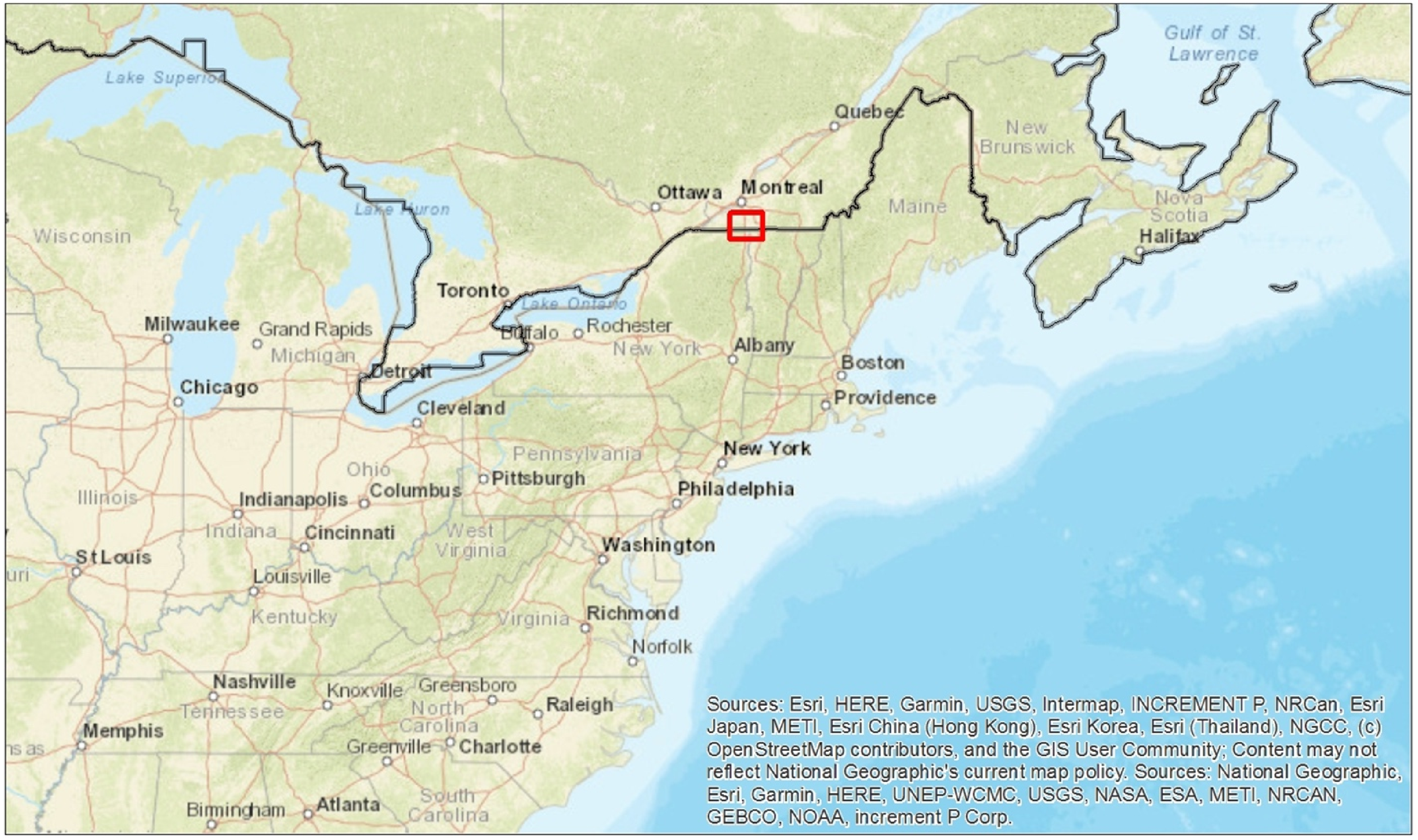
The crossing of the Canada-US land border by 56,515 asylum seekers between 2017 and 2019 has been framed as a “migration crisis,“ 2 but the question remains: “a crisis for whom?” (Young, 2021). Roitman (2014) tells us that crisis proclamations lead us to ask specific types of questions, opening some spheres of intervention while foreclosing others. We interrogate the events at the Canada-US border to “denaturalize crisis narratives” (Roitman, 2014: 48). Not that long ago, the arrival of asylum seekers was certainly debated, but it was nevertheless administered as an ordinary, everyday object of governance. What changed?
To answer this question, we first trace the genealogy of the symbolic, political, legal, and ultimately, physical erasure of asylum seekers from the Canadian public sphere since the 1990s. Authorities were caught off-guard in 2017 because this gradual erasure generated a sense that asylum seekers had been effectively contained and could therefore be conveniently forgotten. The “crisis” that ensued betrays a short-sighted approach to migration policy where agentic asylum seeking is constructed as an extraordinary event that must be dealt with through emergency means, rather than a normal, albeit increasingly politicized, phenomenon for which institutions must be prepared.
Secondly, we show how this erasure paved the way for the emergence of a crisis-centered border management model in Canada. This model aligns in some ways with the humanitarian bordering model observed in the EU (Pallister-Wilkins, 2020; Papada et al., 2020) and at the Mexico-US border (Campos-Delgado and Côté-Boucher, 2022; Williams, 2015). But if the humanitarian border and its reliance on improvisation as a mode of governance is part of the story, it is not all of it.
While Europe and the United States have never assumed the disappearance of migrants from their borders, over the last 15 years, Canadians convinced themselves that border enforcement had actually “worked.” The Roxham “crisis” is fundamentally the consequence of this politics of erasure, and it has resulted in jurisdictional conflicts along multiple scales of government over who should bear the responsibilities and costs associated with asylum claimants. Bilaterally, Canada has been insisting since the end of the 1990s to transfer an increasing part of this responsibility to its southern neighbour. As we shall see, the federal government made a choice in 2004 to close the Canada-US border to asylum seekers, a choice which resulted in funneling most of these migrants towards Roxham Road – thus creating the ideal environment for (self)smuggling situations. The humanitarian border emerges as a partial, incomplete solution to negotiate those conflicts. It legitimates the measures taken at the border in the past decades and allows for their administrative and territorial expansion and entrenchment.
We start this article by situating our contribution in relation to the literature on the instrumentalization of migration “crises,” how they advance political agendas that are hostile to survival migration (Betts, 2013) and how crisis narratives announce the recourse to humanitarian bordering. The next two sections present our empirical case. We first sketch out the policies and legal instruments that the federal government has experimented with since the 1990s to limit refugee claims. We then examine how the concentration of arrivals in Quebec starting in 2017 exerted immense pressures on a range of poorly prepared actors at the border. We conclude by considering two legacies of these events: the emergence of humanitarian bordering in Canada, and the consolidation of the erasure of asylum seekers.
This case study offers a solid empirical contribution to the literature on the politics of migration governance. It illustrates how governments seize “migration crises” to advance emerging models of migration governance based on humanitarian logics beyond the Mediterranean and European contexts. This supports the idea that a global border regime is in the process of becoming, but it remains a fragmented, incomplete process with significant regional differences (Jones, 2016; Vives, 2020).
Methodologically, our discussion draws from both primary and secondary information. We set the context using administrative data from the Canadian government, statistics both publicly available online and obtained through requests for previously released Access to Information records, originally requested between 2017 and 2019. The source of primary data are 19 semi-structured qualitative interviews conducted by the third author with CBSA officers between February and June 2019 for a separate project on immigration detention in Canada. The interviews are not used here directly for confidentiality reasons, but they have been crucial to structure our argument.
Crises, vanishing migrants, and humanitarianism
Over the last two decades, state borders across the world have become the site of repeated migration events framed as crises. This framing is possible because human mobility challenges one of the ideological tenets of our international socio-political system: that a key function of the nation-state is to contain population within a territory geographically defined by its borders. Productive of a “global mobility divide” (Mau et al., 2015), a double imperative to curtail the spontaneous migration of racialized persons from poorer countries while at the same time facilitating a range of privileged mobilities such as business travel, highly skilled migration, or tourism stands at the core of the contemporary geopolitical order.
Framing migration events as crises does important work for migration governance. Crisis talk provides a “powerful narrative device” which structures academic knowledge and “shape [s] policy decisions [and] governance structures” (Dines et al., 2018: 441). Moreover, as Carasthatis et al. observe, such framing “shifts the focus from the experience of displacement as a crisis for refugees, to the perception of their entry as a crisis for nation-states” (2018: 5; emphasis in original). The crisis narrative triggers “moments of hysteria” (Mountz, 2020: 38) that enable rapid policy transfer and innovation.
But what counts as a crisis? We generally assume a “migration crisis” happens when a large number of spontaneous migrants arrive at the border within a narrow time frame. The arrival of over 800,000 Syrian refugees and asylum seekers to Greece in 2015 or the tens of thousands of Central Americans who reached the US border as part of “migrant caravans” in 2021 serve as primary illustrations of migration events framed as crises. However, other events involving relatively low numbers of people have also been framed as such and used to promote restrictive migration and border policies. For example, in Canada, Mountz (2020) and Robinson (2021) show how a few boat arrivals carrying between 500 to 1000 migrants over a decade paved the way for the narrowing of eligibility criteria for international protection. Meanwhile, other protracted situations that involve larger numbers of people barely make the news, particularly if the events happen in the Global South (Hyndman and Giles, 2017). Often, the punctual moments defined by receiving states as “migration crises” are part of larger chains of migration events, prompting some to question the accuracy of the crisis framework to describe phenomena sustained over several decades (Vives, 2021).
In other words, while large numbers may justify a “crisis” intervention, they are not crucial: we must then ask why certain events are framed as crises, but not others. Instead of “migration crisis,” it is more appropriate to talk about spontaneous migrant arrivals as an increasingly common phenomenon that triggers political crises because it tests both the commitment of countries of reception to their international obligations and the resilience of public services weakened after decades of austerity policies. Framing migration events as crises is useful, then, since it moves the focus away from the legal obligations of the receiving state and onto migrants themselves. Furthermore, migrants’ agency makes them external to receiving states’ global political agendas and planned migration policies, leading states to construe the arrival of asylum seekers, big or small, as a crisis. Agency is often perceived as antithetic to the figure of the asylum seeker – supposedly “passive objects of intervention” legible and “docile while performing proper “refugeeness,” “innocence,” or the right kind of sexual identities that appeal to humanitarian organizations, donors, and screening or admission agents for potential host governments” (Ehrkamp, 2017: 818). Thus, asylum seekers who exercise their agency to choose when, where, and how to seek international protection are often characterized as fraudulent, that is, “migrants with no fear of persecution who attempt to use the refugee system to circumvent otherwise restrictive entry provisions” (Macklin, 2005: 367).
Macklin (2005) and Young (2021) have made important observations regarding the impact of restrictive asylum and border policies in Canada over the last two decades. Macklin has argued that, even though the “legal and material reality of refugees” has been ever present, we have witnessed “the erosion of the idea that people who seek asylum may actually be refugees” (Macklin, 2005: 365). This erasure “performs a crucial preparatory step towards legitimating actual laws and practices that attempt to make them vanish in reality” (Macklin, 2005: 369). Contemporary border and migration regimes articulated upon restrictive instruments “produce the border crises they anticipate while simultaneously masking and revealing contested and intersecting histories of migration” (Young, 2021: 7). Over time, these regimes make it increasingly difficult (if not impossible) to claim asylum.
A state-promoted solution to the mounting tension between Canada’s (and other countries’) international commitments and domestic policy goals in the context of a crisis-management model of migration governance is the “humanitarian border” (Walters, 2011; Pallister-Wilkins, 2015). Receiving states are caught in what Pallister-Wilkins calls the “paradox of protection,” the tension between “the protection of the individual against harm and the protection of borders and an internal space” (Pallister-Wilkins, 2015: 54). The asylum seeker arriving at the border is seen both as being at risk of violence from others and as an undefined but established risk to the security of a polity. The humanitarian border – a “complex assemblage, comprising particular forms of humanitarianism, specific forms of authority but also certain technologies of government” (Walters, 2011: 142) – claims to handle both sources of risk. The resulting border architecture is hostile to spontaneous migration, but it promises a haven to those most at risk: victims of human trafficking, children, or refugees deemed deserving of protection.
In this sense, humanitarianism serves not only to legitimate securitized bordering, but also to maintain receiving states’ sovereignty claims over the control of human mobilitiy intact and unchallenged (Williams, 2015). As a result, compassion and repression are now interwoven in humanitarian bordering governance. Rationalized compassion and the tactics of control it generates transforms care into a “calculated act” (Campos-Delgado and Côté-Boucher, 2022: 3; Fassin, 2018). This is important because humanitarian policies can be used to counter accusations of human rights violations and justify the violence towards migrants at borders, their genealogy being inextricably linked with the emergence of restrictive enforcement strategies in border spaces (Williams, 2016).
Significantly for our case, scholarship also underscores how humanitarianism has come to remake bordering into an adjustable and retractable response to migrant arrivals. Thus, Papada et al. (2020) analyse as “pop-up governance” the chaotic and makeshift reception of migrants in Greece in 2015–2017 – which was largely framed as a humanitarian intervention. These authors point to the improvisation of this response, but also to the malleability of the care-control logics intrinsic to it. Similarly, Tazzioli and Garelli (2020: 1010) also highlight the adaptability offered by the care-control dynamics in their study of Italian and Greek hotspot systems, thus pointing to how emerging models of migration governance favor “flexible systems for managing migrant mobility.” Compared to the European case, in Canada the level of disorganization and improvisation that followed the arrival of asylum seekers in the 2017–2019 period did not stem from a logic of flexible management, but rather from a lack of preparedness that resulted from a fantasy that refugees had disappeared.
Erasure: Disappearing asylum seekers
Canada’s recent shift towards securing the border against asylum seekers is critical to understand both the emergence of Roxham Road as a main point of entry and the framing of new arrivals as a crisis by actors at the municipal, provincial, and federal levels. Primarily due to growing backlogs and insufficient funding, Canada’s refugee status determination system has been a matter of political debate since shortly after its creation in 1978 (Kelley and Trebilcock, 2010). Throughout the 1980s and the 1990s, concerns about the number of asylum claims, narratives of abuse of the Canadian refugee protection system, and anxiety related to the supposed risk asylum seekers posed to national security prompted a series of legislative and policy reforms. This growing concern served to justify the adoption of additional inadmissibility grounds related to criminality, terrorism, and other security matters (Aiken, 2000). The passing of the 2001 Immigration and Refugee Protection Act (IRPA), just months prior to the 9/11 terrorist attacks, confirmed the association of immigration with new security issues and accelerated changes already underway – for example, the increased cooperation between Canada and the US for the management of their common border and the North American “perimeter.”
Other measures have prevented migrants from reaching Canada’s borders to claim asylum. For example, visa requirements for nationals from top countries of origin of asylum seekers have become standard practice (Mau et al., 2015). The Canadian government also penalizes airlines for carrying improperly documented travellers (Brouwer and Kumin, 2003). Other bilateral efforts were deployed after 2001. For instance, the Smart Border Declaration action plan included measures that targeted asylum seekers such as information sharing.
The Safe Third Country Agreement (STCA), which came into effect on 29 December 2004, was part of the Smart Border Declaration. The STCA was modelled after the European Union’s Dublin regulations. Canada proposed the agreement in the 1990s as a way to deal with its growing waiting lists for refugee hearings. The US initially refused the proposal, but brought it back to the negotiating table after the 9/11 attacks. Presented as a tool to improve the secure management of asylum flows, the STCA was based on the premise that both countries offer a robust refugee status determination system and are safe for refugees; for this reason, asylum seekers would be required to submit their refugee claim in their first country of arrival. The US is the only country designated as safe for this purpose (IRPR, sec. 159.3). 3 This means that an asylum application presented by someone who had first set foot in the US before arriving at the Canadian border would be considered ineligible by virtue of the STCA (i.e. they would not qualify for assessment by the Immigration and Refugee Board) and the claimant would be sent back to the US. 4 In other words, the STCA created a legal framework whereby Canada could return most asylum seekers crossing the land border back to the US.
However, and critically, the agreement does not apply to claims made by people crossing the border without passing through and official POE (IRPR, sec. 159.4 (1) (a)). Some have described this possibility as the “loophole” left open by the STCA and other related measures (Rehaag, 2019; Smith, 2019). Although this exception allows asylum seekers to claim international protection in Canada, it also funnels spontaneous migration away from regular channels and into remote border locations such as Roxham Road, effectively “enshrin [ing] this vulnerability at the border” (Gilbert, 2019: 427) and further altering the public perception of refugee claimants as “illegal” migrants.
The impact of the STCA
The STCA has spurred new dynamics at the land border. As Figure 2 shows, there were more than 10,000 annual asylum claims made at the Canadian land border between 2000 and 2003, with a peak of 14,007 claims in 2001. After the STCA came into force, the total number of annual claims dropped by more than 50%, from 8904 in 2004 to 4040 in 2005. Claims went back to pre-STCA levels in 2008 at 10,806, and then reached historic lows after 2008, with under 5000 annual claims between 2010 and 2015. Another high was reached in 2017 as asylum seekers started crossing at Roxham Road in larger numbers, with a total of 20,593 claims. Asylum seekers arriving at the Canadian land border (1997–2020).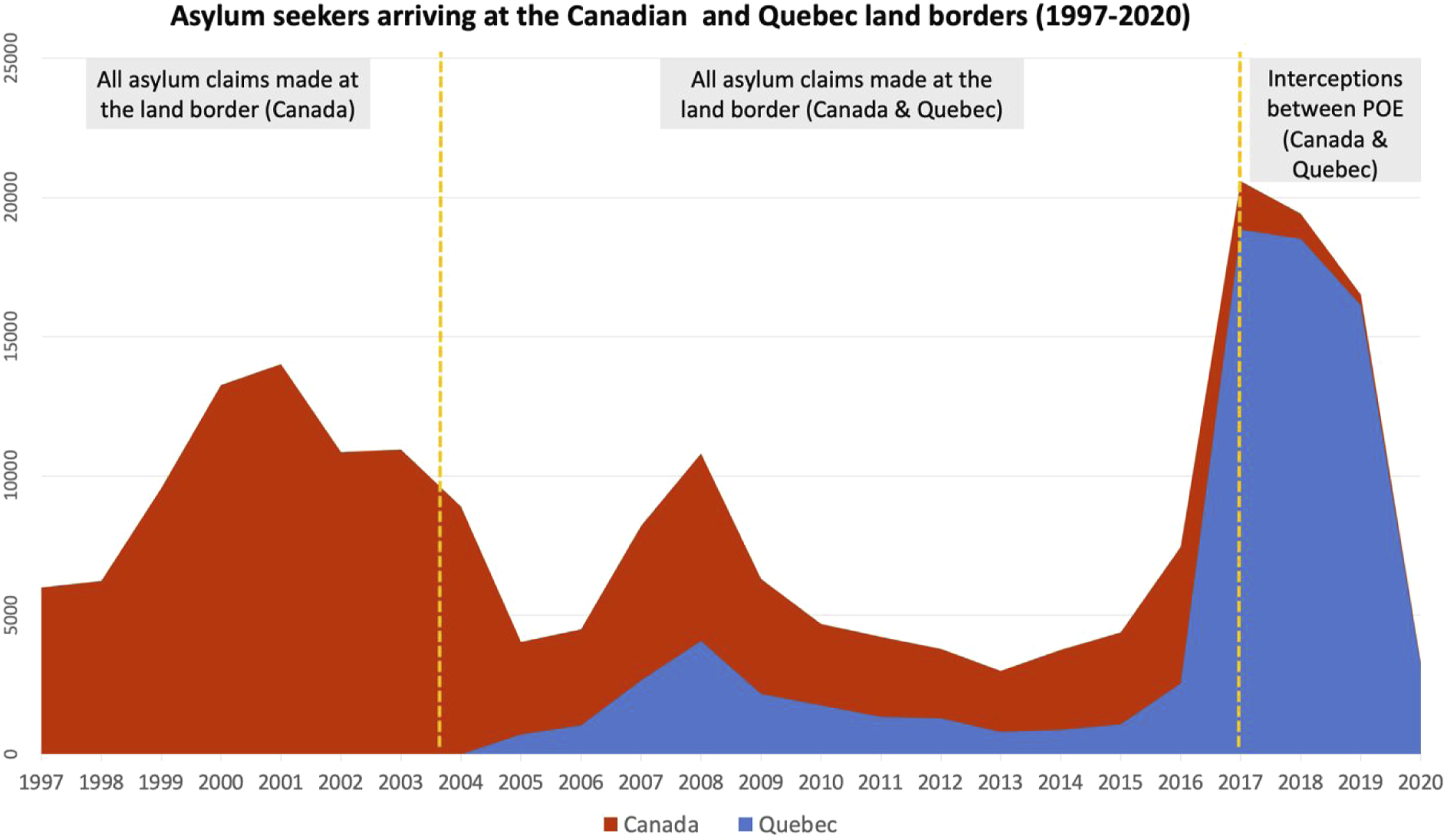
To put these numbers in context, the Canadian immigration system admitted 286,479 permanent residents in 2017 (and more than 400,000 in 2021) and delivered about 300,000 work permits that same year (Government of Canada, 2018, 2021). Thus, the 2017–2019 numbers shown above were hardly overwhelming. However, Figure 2 highlights a crucial development: the funnelling of asylum seekers towards a small portion of the Canada-US border, that is, a section of the border between Quebec and the state of New York (arrivals shown in blue). Thus, while claims increased by almost 100% throughout Canada – from 10,806 to 20,593 claims between 2008 and 2017 – the increase was more than 400% for the Quebec section of the border during the same period – from 4080 claims in 2008 to 18,836 claims in 2017. We will return to the significance of this channelling for the Canadian politics of border control in the next section.
The STCA also introduced new spatial dynamics in Canadian bordering. Some observers predicted the STCA would push refugee claimants to take increasingly treacherous routes (Macklin, 2005). Indeed, asylum seekers only had one option: to cross the land border between official POEs, often in remote locations. Some, like Ghanaians Razak Iyal, Seidu Mohammed, or Mavis Otuteye tried the Manitoba farmland route, and the frigid conditions led to severe frostbite and death (CBC News, 2017; Young, 2021). Mainly, however, the STCA seemed to funnel migrants to Roxham Road.
Why choose this forgotten country road? With its proximity to global transportation hubs (e.g., New York City) and to an urban centre with a large immigrant population (Montreal), its location was ideal. In practice, this meant that migrants did not have to rely on criminal networks to cross the border. They just needed to make it to New York – either by land or by plane, from some other point in the US or from anywhere else in the world – and then take a bus to Plattsburg or Champlain, where they could hire a local taxi to drive them to the unofficial crossing point near Lacolle, where they declared their presence to the RCMP. Migrant rights groups and no-border activists provided guidance on how to cross the border and present asylum claims. 5 By 2017, Roxham Road had become the main informal port of entry into Canada.
Other institutional changes
The STCA has attracted significant scholarly attention – and for good reason. But other institutional changes adopted in the years leading up to 2017 magnified the reach of the agreement and compounded the events that followed. Among the most significant of these was the transfer of immigration enforcement responsibilities to the Canada Border Services Agency (CBSA) following its creation in 2003. The CBSA has since become a border policing institution endowed with a security mandate and characterized by a heightened law enforcement organizational culture (Côté-Boucher, 2020). This translates into a “hostile” attitude towards asylum seekers (Atak et al., 2018: 23), a generational change of guard unprepared to process asylum claims, and an organization largely unsympathetic to migrants’ rights and entitlements. The conditions were ripe for CBSA frontline staff to be left scrambling at Roxham Road.
Along with the creation of the CBSA and the more restrictive view of asylum this involved, other events paved the way for the gradual securing of the border. For example, the arrival of two boats carrying a few hundred refugee claimants from Sri Lanka in 2009 and 2010 prompted the government to adopt important legislative and policy changes — from the removal of health care provisions for refugee claimants (since repealed by the Trudeau government) to the mandatory detention of so-called designated foreign nationals. Other measures included significant limitations to appeal procedures and other legal recourse (Atak et al., 2018).
Combined, the STCA, restrictive legislation and border measures, and the newly created CBSA triggered a fundamental shift. Increasingly, asylum seekers were no longer seen to need protection against persecution; instead, Canadians and Canada required protection from asylum seekers. The emergence of a border architecture hostile to refugee claimants and the disappearance of the figure of the (legitimate) asylum seeker thus went hand in hand. In the last section, we come back to this conviction that spontaneous asylum seekers can be erased, a conviction which contributes to the illusion that orderly immigrant and refugee selection can fully replace the messiness of “irregular” migration.
“Crisis”: Roxham Road and a new asylum seeker management model (2017–2019)
Between 1 January 2017 and 31 December 2019, 56,515 migrants claimed asylum after crossing the Canadian land border outside of official POEs (Immigration, Refugees and Citizenship Government of Canada, 2021). Ninety-five percent of them did so at the Quebec border. Public and governmental attention thus focused on Roxham Road. As conflicts unfolded between different organizations and levels of government over the handling of asylum seekers’ arrival, a presentist interpretation of spontaneous migration and the framing of these events as a crisis “overdetermined the significance of events” (Roitman, 2014: 42) and foreclosed a critical examination of the role played by Canadian migration governance leading up to that moment. This presentism also allowed for the development of a Canadian-specific version of the humanitarian border, which weaved security concerns into humanitarian ones and engaged in the increasingly divergent treatment of spontaneous asylum seekers and resettled refugees.
Good refugees, bad asylum seekers: The shifting public understanding of forced migration
Early in 2017, in reaction to President Donald Trump’s travel ban targeting seven Muslim-majority countries, Canada’s Prime Minister Justin Trudeau tweeted: “To those fleeing persecution, terror & war, Canadians will welcome you, regardless of your faith. Diversity is our strength”. Many of those who arrived at the land border between 2017 and 2019 left the US in fear of the end of their temporary protected status (which President Donald Trump vowed to eliminate) amid strained relations between the two countries. At the same time, and while the “crisis” at Roxham Road unfolded, Canada resettled more refugees than any other country in the world: 28,000 in 2017, compared to the 22,900 accepted by the US (UNHCR, 2019). These arrivals were often celebrated and used to bolster the image of a hospitable Canada — including the resettlement of 25,000 Syrian refugees in one hundred days in 2015–2016 (Government of Canada, 2020).
In contrast, the asylum seekers who presented themselves at Roxham Road were vilified by pundits and some politicians who entertained border containment solutions to the “crisis” — not unlike those discussed for the Mexico-US border. In March 2017, in the context of the federal Conservative Party leadership campaign, two candidates suggested extraordinary measures to deal with the situation at the border. The first proposed to suspend the application of the Charter of Rights and Freedom to enable their deportation before their claim was adjudicated; the second advocated for the deployment of the Canadian Armed Forces at the border (Sirois, 2017). On 25 April 2018 – a few months before the Quebec provincial electoral campaign – Jean-François Lisée, then leader of the provincial Parti Québécois, suggested that a fence be built on the border at Roxham Road so that asylum seekers could be redirected to official POEs – from where they could be returned to the US following the provisions of the STCA (Plante, 2018). During a meeting of the federal Standing Committee on Citizenship and Immigration (2018), Conservative Member of Parliament Michelle Rempel made the distinction between deserving and undeserving refugees explicit: “I think that regardless of our political affiliation, I would hope we would agree that managing a compassionate and humanitarian system means ensuring that Canada is prioritizing the world’s most vulnerable in our resettlement efforts.”
These opposing views were symptomatic of a broader shift in the Canadian public understanding of forced migration. On the one hand, resettled refugees (selected or at least vetted overseas) have become the face of the legitimate refugee: agency-less individuals and families caught in circumstances outside of their control (e.g., wars), assumed to be waiting patiently in refugee camps for resettlement. Asylum seekers who arrived spontaneously at the land border, on the other hand, were framed using terms that called for the increased surveillance of the border and containment of migrant mobilities. Years of securing the border and erasure of asylum seekers from the public sphere have made agentic migrants personae non gratae in Canada.
Crisis at the humanitarian border
As is the case in the Greek hotspots studied by Papada et al. (2020), migrant arrivals generated chaos in Quebec and were received by improvising municipal, provincial, and federal actors. More specifically, the concentration of land arrivals in Southern Quebec exerted significant pressures on provincial and municipal governments, as well as on refugee settlement organizations in Montreal – which were suddenly responsible for responding to the new arrivals’ housing, health, and educational needs, as well as facilitating the obtention of limited work permits.
The emergence of a multi-actor crisis model: Municipal, NGO and provincial response
The 2017-2018 annual report by the Table de concertation des organismes au service des personnes réfugiées et immigrantes (TCRI, an umbrella organization for immigrant and refugee service providers in Quebec), underlines that the arrivals posed “tremendous challenges” (TCRI, 2018: 6) to its member organizations, compelled to face these challenges “in the absence of adequate resources.” Paquet and Schertzer (2020: 22) also report that the Programme régional d’accueil et d’intégration des demandeurs d’asile (PRAIDA, the service provider tasked with the reception of refugee claimants in Montreal), was “overwhelmed” by housing and other needs, which led to the use of the Olympic Stadium as a temporary shelter. According to PRAIDA’s then spokesperson, the situation was “something never seen before” in the city (Radio-Canada, 2017).
These events were first framed as a political “crisis” in relation to the threat they posed to municipal and provincial finances (see Paquet and Schertzer, 2020). There was a sense of emergency, disorganization, and chaos – of overstretched human and material resources at the border and in Montreal. In this conflict-ridden, intricate, humanitarian scenario there were politicians to blame on both sides of the border (Trump’s policy, Trudeau’s tweet); heroic frontline workers to applaud (RCMP, settlement agencies) 6 ; and a country whose hospitality and resourcefulness in times of crisis could be praised (Canada). There were also asylum seekers who were “not really refugees”, and overstretched provinces who demanded the transfer of federal funds to cover the costs of public service provision to refugee claimants.
Then, between 2017 and 2019, a new crisis model for asylum management emerged at the Canadian border. That model eschewed the experience accumulated over the second half of the 20th century for the safe, regular, and orderly reception of asylum seekers throughout Canada. Before all the restrictive measures discussed in previous sections entered into force, policymakers debated the modalities, categories, and target numbers for international protection, but arrival of asylum seekers was expected. This previous model acknowledged receiving states’ “limited ability to address the causes of irregular border crossings” (Paquet and Schertzer, 2020: 5). Instead, the new crisis model considers spontaneous arrivals to be an exception — an aberration, even – and requires both a range of actors to perform tasks not always part of their mandate and the unblocking of emergency funds to make their intervention possible. These are the hallmarks of a “crisis” response: moments of hysteria followed by the opening of public treasuries (Mainwaring, 2019; Mountz, 2020).
The crisis response of federal authorities
Meanwhile, the crisis model tested at Roxham Road dovetailed security and compassion, redistributing responsibilities among new and old border actors. After the CBSA struggled to shelter asylum seekers in nearby hotels, the Canadian Armed Forces (CAF) was brought in to build temporary border infrastructure to house migrants and process their asylum claims. These makeshift camps were built in Lacolle and Cornwall (Ontario), 160 km west of Roxham Road. Meanwhile, the Canadian Red Cross was called upon to run a medical station near the Lacolle site to provide basic medical examinations and emergency medical care. According to Access to Information Request files and information about government contracts published online, the Red Cross and a non-profit security firm, the Commissionaires du Québec, were awarded numerous government contracts to provide health and security services during the 2017-2019 period. This firm also deployed staff with military experience “in order to help provide the best support in coordination and management of this vast operation” (Commissionaires du Québec, 2017).
Several indicators show that the federal government’s response to the arrivals followed a crisis model, including the resources devoted to staffing these facilities and to providing immediate humanitarian services to asylum seekers. Accommodation expenditures paid by the CBSA amounted to $2,374,189 in only 4 months, from January to April 2018 (House of Commons, 2018a). The breakdown of these costs is $132,939 for shelter, $569,295 for security, and $1,671,955 for humanitarian services (food, water, and Red Cross services). The accommodation expenditures paid by the CAF over 2017 amounted to $1,671,182 – including $1,134,288 for personnel costs (House of Commons, 2018b).
Another indicator is swift institutional change with lasting consequences. For instance, in the wake of Roxham Road becoming the most popular unofficial port of entry in Canada, the Quebec regional direction of the CBSA set up a special procedure to process asylum claims. This procedure consisted of two units working in close relationship: 1) the Regional Processing Centre (RPC), situated next to the premises of the unofficial port of entry in Lacolle along the Canada-US border (shown in Figure 1); and 2) the Urban Processing Centre (UPC), situated in Montreal in a federal government building. This organizational structure remains in place to this day. Once the migrants had crossed the border at Roxham Road, they were “stopped” by the RCMP, the federal police force tasked with the surveillance of the border between official POEs, in accordance with the Customs Act. 7 After a brief interview, migrants were released and brought to the RPC. From then on, they were under the CBSA’s responsibility (but neither under arrest nor detained). CBSA personnel at the RPC then began the processing of asylum claims for those wishing to make one, before sending those eligible to adjudication.
Yet another indicator of the crisis approach speaks to the CBSA’s lack of preparedness and know-how in asylum matters after two decades of securing the border. Frontline officers were urgently deployed to Lacolle from other offices and POEs around the country and from the nearby Montreal airport in 2017. “An exceptional response to an exceptional situation,” commented then CBSA director for the Quebec region, Patrick Lefort (Boutros, 2017). But public interventions by the Customs and Immigration Union (which represents the CBSA’s frontline staff) show the chaos experienced by the Agency. On October 13th, the Union issued a press release asking the federal government to “address organizational and workload issues resulting from the influx of asylum seekers from the United States,” stating that there were “not enough frontline workers,” that the situation was an “organizational nightmare,” and that CBSA’s workers were facing a “workplace crisis” (Customs and Immigration Union, 2017b).
In fact, federal officials scrambled to keep up. As a result, border security sometimes took a back seat. This is important to underscore since the (mostly Eurocentric) humanitarian border literature claims that a humanitarian outlook is a mode of governance deployed to justify more enforcement and a strict assertion of sovereignty (Williams, 2015; Pallister-Wilkins, 2015). In contrast, the Roxham Road case points to how a migration event framed as a crisis may at times diminish assertions of sovereignty at the border. For example, given the bottleneck situation at Roxham Road, identification document requirements for asylum claimants were lowered during this period, leading to a smaller ratio of migrant detentions. According to one informant met by Louis-Philippe Jannard, CBSA officers at Roxham Road accepted identity documents which would not have been accepted at other points of entry (e.g., photocopies) and which would normally have led to detention on identity grounds.
At other times, however, security habits resurfaced. This was the case with a questionnaire for asylum seekers that the RCMP hastily put together. One clue indicating hasty implementation was the poor French translation provided for some of the questions. The other was the xenophobic formulation of the questions asked and how they infringed upon the civil liberties of asylum seekers. Questions included: Do you have any intentions to protest in Canada about the events that are taking place in your country? (question 30); What is your opinion about terrorist attacks? (question 24) What is your religion? (question 34) How would you feel if your boss was a woman? How do you feel about women who do not wear the Hijab, Dupatta, Chador, Niqab, Burka? (question 30). The questionnaire required the “detainee’s signature” despite the decision to detain a person at the border resting with the CBSA, not with the RCMP. The questionnaire was eliminated after national media made it public (Shingler, 2017). 8
The scrambling at the border following asylum seekers’ arrivals between 2017 and 2019 came at great social and political cost. An outcome of two decades of border containment, the channelling of migrants through a narrow area of the Canada-US border contributed to a sense of invasion and has been instrumental in the rise of far-right movements in Quebec. The Soldiers of Odin formed vigilante anti-immigration and anti-Muslim “safety” patrols that roamed the streets of Quebec City while La Meute, another homegrown anti-immigration group, organized anti-refugee protests at the border. As a result of years of refugee containment and erasure, asylum seekers were confronted with a growing ignorance and hostility that can still be felt today and which scholars have only started to unpack (Gagnon, 2020).
Concluding thoughts: The legacy of Roxham Road
In this article, we have taken up the genealogy and characteristics of the contemporary crisis management model that emerged at the Canada-US border between 2017 and 2019. We have argued that the Roxham Road “crisis” did not appear out of thin air – it was a product of decades of Canadian border and refugee policy and of bilateral border control management. The crisis management mode that ensued allowed the federal and provincial governments to roll out measures that might be unacceptable under “normal” circumstances, with minimal public scrutiny, drastically reduced timelines, and boosted enforcement capabilities and budgets. These measures required the participation of a range of organizations at times unfamiliar with the international protection system and unprepared to meet the needs of asylum seekers. In this concluding section, we present our thoughts on two main legacies left by these events: the articulation of a specific expression of humanitarian bordering and the strengthening of the fantasy of a border without agentic asylum seekers.
Canadian humanitarian bordering or the end of Canadian exceptionalism?
The response to refugee arrivals at Roxham Road highlights the development of a Canadian model of humanitarian bordering that shares similarities with but is also distinct from the European and Mexico-US models. Like in these other contexts, novel forms of humanitarian bordering in Canada intertwine care and control logics. However, scholars working in Europe point out that at the core of the humanitarian border we find a minimalist commitment to human rights – one that provides the veneer of care and provision for migrants’ basic needs while allowing states to deepen repressive border practices (Pallister-Wilkins, 2020; Vradis et al., 2020; Williams, 2015). This explains, for example, the deployment of humanitarian logics to discuss and justify the “semi-carceral spaces” of Greek hotspots or practices such as pushbacks at sea (Pallister-Wilkins, 2020; Papada et al., 2020; Tazzioli and Garelli, 2020; Vradis et al., 2020). The situation is different in Canada. While asylum seekers have lost life and limb trying to cross the Canada-US border (Helleiner, 2013), statistically speaking, the situation is not comparable to what has happened along the southern EU and US borders. Accordingly, the rescuing model which sacralises life only to deny it legal and political standing that defines European border humanitarianism has not emerged in exactly those terms in the Canadian case, nor were the operations deployed at the border justified as a means to “save lives” (Pallister-Wilkins, 2022). Also, while the detention of asylum seekers happens in Canada (Jannard, 2020), in Quebec, most asylum claimants were processed and then released into the community, and then provided with lodging, food, and other services, and limited work permits.
The Canadian expression of humanitarian borderwork is necessarily defined by the integration of what is often referred to as Canadian exceptionalism. Canada has long been praised for its refugee policy – which, while undoubtedly generous, focuses heavily on resettlement – and strong and fair claim assessment procedures. Canadian decisionmakers’ primary national security and ideological concern was whether an asylum seeker had alleged links to communism or ethnic conflict, and, since the 1990s, claimants’ potential links to terrorism or criminality (Whitaker, 1998; Aiken, 2000). Despite its shortcomings, Canada sees itself as a generous host that treats asylum seekers as rights-bearers whose claims should be thoroughly considered. Successive governments have preserved this dual commitment to both liberal security and refugee rights for a long time.
However, Roxham marked a shift from a legal or responsibility-centered approach to a reluctant hospitality logic. The language of rights took a back seat as these events were discussed through a grammar of compassion and loathing, of kindness and fear. Thus, Canadian borderwork in matters of asylum is now defined by the replacement of the rights-bearing asylum seeker with the ill-defined and suspicious figure of border crossers to whom we owe shelter until we find a way to deport them and prevent their return.
The articulation of the care and control logics central to humanitarian bordering is therefore different in Canada, where the events at Roxham Road did not result in a rescuing discourse centered around the prevention of death; instead, they brought about a conversation about the limits of Canada’s “exceptional” politics of hospitality. Thus framed within the humanitarian discourse, the development of a Canadian crisis border management model shifted the perception of both asylum seekers and host society, as well as their obligations to one another. While the RCMP questionnaire mentioned in the last section seems to suggest otherwise, asylum seekers arriving at Roxham Road during this period were not primarily conceived as security threats. Nor were they seen as the deserving refugees carefully selected from UN-managed camps. Somewhere in between, they were handled through “a dialectic of hospitality and hostility, of the host and the hostage” (Fassin, 2018: 218) central to humanitarian reason. Canadians, confident in their self-perception as a hospitable and generous country (Côté-Boucher, 2015), saw themselves under the obligation to provide border crossers with food and shelter at the same time as authorities continued to look for more efficient border containment measures that would allow them to circumvent their national and international obligations regarding asylum. In other words, the Roxham Road events framed these arrivals as a moment of crisis for the host society, but it did so through deploying a range of governing interventions that cast agentic asylum seekers into the role of the humbled, indebted guest.
Unfulfilled fantasy: A successful world of containment
There are other differences between the European and Canadian responses to refugee arrivals. Papada et al. (2020: 1034) underscore both the improvisation inherent to humanitarian “pop-up governance” at Europe’s borders as well as the intention to redeploy and replicate these humanitarian bordering measures. In the Canadian case, the federal government never intended to replicate the measures deployed between 2017-2019 at Roxham Road. It was a “crisis”: once over, things would return to normal, that is, there would be no more asylum seekers showing up at the border. The Roxham “crisis” crystallized the policy view on spontaneous migration management developed in the past decades. According to that view, with the right border enforcement, Canada could make spontaneous refugees disappear. The government could then choose its refugees the way it selects its immigrants.
The continued arrival of asylum seekers at Roxham Road laid bare this fantasy at the core of contemporary border control; namely, that containment would succeed at limiting spontaneous migration. In that fantasy, what Kotef (2015: 22) calls a “politics of halting” conveys imaginings where additional and improved bilateral border policing would somehow stop those on the move. Since migration is a global social fact, the containment fantasy reveals the thinness of an anticipatory model of border policing that is predicated upon a refusal to prepare for these arrivals. Such illusion has fed the last two decades of border control in Canada.
If there was improvisation in crisis migration management “rather than implementation of prepared plans” (Papada et al., 2020: 1034), it is not because these events were unforeseen or because we lacked examples of preventative migration governance along the Canada-US border. Despite early warnings from refugee rights activists and scholars that the STCA would expose migrants to further violence and increase irregular border crossings, the Canadian government was incapable of offering solutions beyond the narrow security mindset of migratory flow surveillance, early detection, and border enforcement. At Roxham Road, government actors held fast to misguided hopes that authorities would eventually find a way to secure the border, efficiently exploit data collection for this purpose, convince the US to fix its visa system to make it even more challenging for asylum seekers to reach North America, and close the STCA’s “legal loopholes” (see for example Leuprecht, 2019). As Ahmed (2004: 76) aptly suggested: “It is through announcing a crisis in security that new forms of security, border policing and surveillance become justified.”
More than two decades of border containment rhetoric have cemented Canadians’ expectation that, with the right tools, asylum seekers would stop presenting themselves at the border. Such conviction builds on the belief that Canada was done with asylum seekers, that they belonged somewhere else where they could continue to be “governed through deprivation” (Almustafa 2022: 1065) — we do not know where, we do not care, but not here.
Thus, another legacy of Roxham Road is the perpetuation of this belief that the asylum seeker can be erased out of existence. This new norm (erasure) is predicated upon a refusal to acknowledge the existence of agentic asylum seekers as political actors and upon a related negation of the continuing and intensifying reality of survival migration around the globe. Young (2021: 7) argues that, when it comes to the movement of populations across borders, “rather than a deviation from the norm, the nation-state is always anticipating unwanted arrivals, always operating from a position of crisis.” Perhaps. Yet, we believe that something different was at stake at Roxham Road. The Canadian government was used to treating arrivals at the land border as an issue primarily of protection to be debated and managed (as would have been the case in the 1980s). The concentrated arrivals at Roxham, however, triggered the mobilization of a range of actors, exerted pressures on settlement organizations, and overextended Quebec’s resources by requiring instant and massive investments.
A framework that reads crisis as a perpetual state in migration governance rightly points to the archival depth of structural violence embedded in bordering (Young, 2021). However, it does not help us understand the contemporary work done by erasure as the new norm. To return to Roitman (2014: 4), the evocation of crisis unfolds against a norm that provides comparative elements to designate this historical moment as one of crisis: “Evoking crisis entails reference to a norm because it requires a comparative state for judgment: crisis compared to what?” In this case, the Canadian government works on the assumption that it found a way to eliminate that which Hannah Arendt had called the “refugee problem,” an inescapable result of the political organization of the world into nation-states. The “political death” of asylum (Mountz, 2020), its disappearance as an ethico-political reality – that is, where the political subjecthood and agency of asylum seekers cease to be recognized – explains why the arrival of a manageable number of asylum seekers can be coded as a “crisis.” Following a shared conviction that asylum seekers had been successfully dealt with, their eventual reappearance and reclamation of rights at the land border could only be envisioned as an aberration. Thus, state institutions were unprepared for the events that unfolded between 2017 and 2019: the only possible political response to unplanned arrivals was the declaration of a crisis.
Interpreting the arrival of migrants as a crisis means that, from a greater historical perspective, a return to the norm means the return to an imagined recent past, an alternative reality where there are no asylum seekers. The framing of the Roxham Road events concealed a hope and a promise that, once the crisis was over, “they” would stop coming and “we” would go back to border containment. In this chimerical, dreamlike scenario, Canada receives only those deserving, passive refugees we choose to resettle in our territory as well as the deserving immigrants we select based on their potential contributions to the Canadian economy and society. Such an illusion (the aspired "norm") betrays a willful ignorance of contemporary global migration dynamics. It also reveals the extent to which Canada is formidably unprepared for the 21st-century world of mobility, climate-induced migration, and the growing number of forced migrants compelled to seek protection each year since 2015. As Canadian immigration policymakers dream of a world of hand-picked, productive, and highly skilled migrants where hard borders block the rest, they are in for a rude awakening.
Footnotes
Acknowledgements
We would like to acknowledge the work of Jessie Bigras-Lauzon and Jeanne Beauchemin in helping us find background information; Jeanne also created the map. We thank the two anonymous reviewers for their thoughtful feedback and Lizzie Hessek for her help improving the text. All mistakes are our own.
Declaration of conflicting interests
The author(s) declared no potential conflicts of interest with respect to the research, authorship, and/or publication of this article.
Funding
Some of the information contained in this text is based on interviews made by Louis-Philippe Jannard with officers of the Canada Border Services Agency in the context of his doctoral research, funded by the Social Sciences and Humanities Research Council of Canada [Doctoral fellowship, Insight Grant]. This work was supported by the following grants obtained by Luna Vives: Fonds de Recherche du Québec - Société et Culture [2019-NP -253366]; Social Sciences and Humanities Research Council of Canada [430-2020-00700]. Dr. Côté-Boucher and Dr. Vives also thank for their financial support the Équipe de recherche sur l’immigration au Québec et ailleurs  , FRQSC programme de soutien aux équipes en émergence [271953].
Notes
Legal sources
Agreement between the Government of Canada and the Government of the United States of America for cooperation in the examination of refugee status claims from nationals of third countries, 5 December 2002, Can TS 2004 No 2.
Customs Act, RSC, 1985.
Immigration and Refugee Protection Act, SC 2001, c 27.
Immigration and Refugee Protection Regulations, SOR/2002-227.
Author biographies
Karine Côté-Boucher is an Associate Professor in the School of Criminology at the Université de Montréal. She studies how border control in North America is practiced by a range of public and private actors and how it differentially impacts those who cross borders, whether they are travelers, transport workers or migrants.
Luna Vives is an Assistant Professor in the Department of Geography at the Université de Montréal. She studies how borders are used to stop and manage unwanted migration in Europe and North America, and is particularly interested in the tension between states’ migration policy and the protection of migrants’ rights.
Louis-Philippe Jannard is a doctoral candidate in law at the Département des sciences juridiques of the Université du Québec à Montréal. His research interests include immigration and refugee law and policies as well as the sociology of law. His doctoral thesis is a sociolegal study of the daily immigration detention practices of the Canada Border Services Agency (CBSA) and of the ways in which CBSA officers use their discretionary powers.