




Abstract
This study explains how contrasting perspectives on resolving impasses in policymaking exist among all relevant actors in a case of transferring Dutch flood management policy to Jakarta, Indonesia. It does so by introducing Q methodology as a novel method in policy transfer and policy mobility studies. International policy transfer requires a continuous, iterative process of policy translation where stagnation may occur following disruptions on the policy, polity or political dimension. This paper assumes that actors go through a process in which they assign meaning to transfer objects. Using Q methodology, two contrasting perspectives are identified in the case of transferring the ‘Dutch Delta Approach’ to Jakarta, Indonesia. One perspective emphasises the need for direct implementation, while the other advocates further modification of ideas. These contrasting perspectives cut through existing sender-receiver categorizations and prevent strategic alignment needed for a breakthrough. Furthermore, they suggest a lack of political leadership from Indonesia and potential conflict of interests of the Dutch government as policy sender as other causes for prolonged stagnation. Finally, I conclude that the outsourcing of strategy making and planning to consultants delimits the space for translation.
Introduction
Attempts to transfer Dutch water management ideas to Indonesia have drawn the attention of various scholars, including those on policy transfer and policy mobility. These scholars study how policy from elsewhere is used to formulate policies in another time and place. Transfer is an erratic, continuous process of translation, in which policies are continuously modified by human actors while travelling (Dolowitz, 2017; Stone, 2016). Eventually, such processes culminate in (partial) adoption or rejection of the transferred ideas. However, scholarly understanding of how actors translate policy ideas remains limited, as well as our understanding of how actors cope with stagnations in the transfer process. I therefore aim to use the case of Jakarta to increase understanding of how involved actors perceive enduring stagnations as well as how transfer agents who engage in translating travelling policy ideas, wish to resolve an impasse.
There are two main causes for a limited understanding of how actors on the ground cope with stagnations. First, transfer processes leading to adoption are more frequently studied than those resulting a permanent rejection of ideas or a temporary stagnation of the process (Minkman et al., 2018). This underrepresentation is no deliberate choice, but follows from the notion that ‘failed cases’ are generally difficult to become aware of and get access to (Stone, 2016). Despite the growing number of studies into ‘failed’ policy transfers (such as Wood, 2020) and studies that go beyond the dichotomy of failure/success (e.g. Robin and Nkula-Wenz, 2021), the majority of studies still explains successful transfers or investigates the potential for transferring a certain approach from A to B. This study aims to contribute to the growing literature on ineffective policy transfer. Second, most empirical studies are ex post evaluations. Although this is understandable – identifying where policy is transferred is easier once the process is well on its way or finalized – these studies rely on respondents’ reconstructions of their intentions, thoughts, and actions (Bryman, 2012). These actors are likely to, unwittingly, create an idealised, logical narrative of the course of events and/or their own role. As a result, ineffective transfers and the strategies actors use to resolve impasses have received limited scholarly attention, which limits our understanding of how actors cope with initial rejection or resistance (Rusu and Loblova, 2019). Enhancing understanding of how policy translation takes place in practice thus requires studying resisted transfer attempts on-the-go.
An interesting example of a stagnated but still ongoing transfer process is found in Indonesia, where Dutch expertise is used to formulate a flood management plan for the capital city Jakarta. A Dutch consortium proposed a master plan called National Capital Integrated Coastal Development (NCICD; see pages 5-6 for a case description). A key feature of the plan is constructing an off-shore dam in combination with land reclamation for real estate development, which lead to fierce resistance from public and private stakeholders in Jakarta. The transfer entered an impasse: the idea was resisted but the transferred ideas did remain on the political agenda. Thus far, scholars have evaluated the proposed policy’s social, economic and environmental impact (Breckwoldt et al., 2016; Hidayatno et al., 2017) and its ability to transform flood management practice (e.g. Garschagen et al., 2018) or they explained the political tendencies that created a receptive environment for the Giant Sea Wall plan among Indonesia’s rulers (e.g. Colven, 2017; Octavianti and Charles, 2019a). The policy transfer and resulting developments have been placed in the broader political and historical context (e.g. Thompson, 2018). Previous studies with a policy transfer or mobility perspective noted how the policy formulation process has been stalled since 2015 (Colven, 2020), has apparently not moved in any direction in the years after but nonetheless remained on the agenda (Colven, 2017, 2020; Hornidge et al., 2020; Minkman et al., 2019). These studies are valuable but limited to explaining the causes of stagnation. This study adds a focus on the future, by examining actors’ responses to stagnation, in particular how Dutch and Indonesian consultants, state actors, researchers, activists and civil society representatives envision a ‘way out’ of the impasse. I thereby concentrate on the question: which perspectives do engaged actors have on breaking through impasses in the policy transfer process in Jakarta? These perspectives may then further our understanding of why impasses persist in policy transfer, as agents’ perspectives on the causes of the stagnation are linked to their ideas about how it should be solved. Moreover, agents’ perspectives on how to resolve impasses also bare information about how they believe policy transfer should take place and/or how certain elements of the transferred policies should be translated to fit the receiving context.
The remainder of this paper conceptualises stagnation in policy transfer in The Impasses in policy translation. Next, I will substantiate the selection of Jakarta as a case explain how I used Q methodology to systematically describe these perceptions on how to resolve the impasse in this case. Doing so, this paper also demonstrates the relevance of a research method not yet used in studies on policy transfer and translation. 1 The Results then hosts the results in the form of two narratives of actors on how to proceed the translation process. Finally, I conclude that the existence of multiple, contrasting perspectives prevents strategic alignment of all engaged actors, especially because multiple perspectives exist within a predefined actor groups (notably sender-receiver).
Impasses in policy translation
Policy translation: a process of modifying meaning and content
Several fields of study have studied the intentional activity of using knowledge about policies to formulate policies in another time and/or jurisdiction, such as policy transfer and policy mobility. The latter embraces constructivist approaches, attention to politics of knowledge and a context sensitive analysis (Peck, 2011; Mukhtarov et al., 2016). Similarly, recent conceptualisations of policy transfer also emphasise the continuous mutation and transformation of policies while being transferred (Stone, 2012) and aim to incorporate constructivist approaches (Dolowitz, 2017). Constructivist approaches are understood here as research that considers how human actions shape the material world and studies the interpretations of this material world, rather than trying to describe this material world itself (for detailed definitions, please consult Adler, 1997). Constructivist research methods therefore rely on the norms, ideas and culture as explanations for a particular interpretation of reality (Jung, 2019). Recently, Bertram (2022) called for a constructivist perspective on culture as a crucial – but overlooked – aspect of policy transfer. Jung (2019) further showed how constructivist approaches add a different perspective compared to studies grounded in realist traditions. Previously applied constructivist approaches in policy transfer studies include ethnographic methods, action research and in-depth qualitative case studies (see e.g. Leong and Mukhtarov, 2018; Veldhuizen and Coenen, 2022). Yong and Cameron (2018) further argue that adopting a constructivist approach is inherently tied to studying policy translation. In other words, travelling policies need to be translated for a ‘fit’ with existing policy programs, political ideologies and institutions and constructivist approaches are needed to capture the (differences in) underlying norms, ideas and cultural values. This study combines insights from both concepts but uses policy translation as central conceptualisation and adds Q methodology as a method to constructivist approaches to studying policy transfer.
Policy translation is defined as “the process of modification of policy ideas and creation of new meanings and designs in the process of cross-jurisdictional travel of policy ideas” (Mukhtarov, 2014: p. 6). In this process knowledge is interpreted and new meaning is created in the space between sender and receiver (Lendvai and Stubbs, 2007; Freeman, 2009; Stone 2016). Senders modify the original policy to mobilize it for travelling (McCann, 2013). They disconnect the policy from the original context, thereby creating a policy model, and then communicate about this model (Ward, 2006; Minkman et al., 2019). Receiving agents on the other hand play a key role in interpreting the transferred knowledge and modifying foreign norms so that they will fit existing local practice, norms and identities (Acharya, 2004; Freeman, 2009). Furthermore, those involved are not necessarily state actors, but may include transnational advocacy networks, epistemic communities, think tanks and other non-state actors (Benson and Jordan, 2011). Studying policy transfer thus entails studying the perceptions, motivations and behaviour of all actors involved, in all phases of the policy transfer process.
Translation also implies that policies do not travel as an integrated package but in “bits and pieces” (Peck and Theodore, 2010: p. 170). Each piece of transferred knowledge may be modified along the way and some may be embraced while others are rejected (Rose, 1991; Lendvai and Stubbs, 2007). As such, a spectre of possible transfer outcomes emerges, ranging from full rejection to full adoption, whereby most outcomes will be a mixture of ‘partial failure’ and ‘limited success’ (Stone, 2016).
Stagnations and breakthroughs during the translation process
Although a transfer process will eventually crystallize into (partial) adoption or rejection (Rusu and Loblova, 2019), this may be a bumpy ride. Transfer processes typically take several years to multiple decades (Dussauge-Laguna, 2012) and may be stalled for shorter or longer periods, which is referred to as ‘impasses’ (Minkman et al., 2019), ‘stagnations’ (Mukhtarov, 2014) or ‘resisted transfers’ (Hoyt, 2006; De Oliveira and Pal, 2018). Impasses are by definition temporarily, as they are considered resolved once the transferred ideas are (partially) adopted or rejected. Meanwhile, actors may continue their efforts to resist or promote the transferred ideas.
Despite the relative infrequent study of stagnated or rejected transfers, there are insights in causes why a policy transfer decision making process is not moving forward. Empirical and conceptual explanations for stagnation may be due to the transferred ideas itself (policy level), acceptance in the political arena (politics level) and the way the translation process is shaped (polity level) (e.g. Dussauge-Laguna, 2012b; Stead, 2016). Firstly, the policy itself may be a misfit with existing
Resolving impasses: an actor perspective
Strategies to resolve an impasse should thus take into account these diverse set of factors that cause friction. Structures in the broader context (institutions, planning practice, cultural norms, etc.) limits the possible responses of actors engaged in transfer. For example, when activities collide with the interests of institutions or powerful coalitions of actors they will not facilitate the acceptance of transferred ideas (Marsh and Mcconnell, 2010). In this study, I focus on the role of actors in the policy transfer process while acknowledging that structural factors shape (and limit) what actors deem feasible or acceptable.
Based on their evaluation of the transferred ideas, actors will highlight different causes of stagnation and consequently think of different strategies to breakthrough impasses. For example, supporting actors may devise strategies to lift barriers for adoption, while opponents strive to remove the ideas from the political agenda. In the process of policy translation, actors will make sense of the transferred knowledge by interpreting it, followed by internalization (i.e. connecting it to existing knowledge). As this knowledge is linked to individual experiences, different actors will have different perceptions of the suitability of the transferred ideas. I hypothesise that the existence of multiple strategies is contributing to prolonged stagnation. Where these individual opinions align, a strategic perspective may emerge on how to resolve the impasse. Breaking through an impasse is more likely when there is strategic alignment: when engaged actors reach consensus on the way forward with the translation process. The next section outlines why Q-methodology is most suitable to investigate this.
Using Q methodology to identify actor viewpoints
This section will first present the case in more detail, followed by a justification for using Q methodology and the application of the method in this case.
Case selection: stagnated policy transfer in Jakarta
Dutch water management is internationally renowned (e.g. OECD, 2014) and the Dutch Delta Approach (DDA) is a policy model that reflects the Dutch shift from prevention-based policies into an approach that combines ‘hard’ infrastructure (i.e. dams) with ‘soft’ measures (i.e. multi-level governance) and that integrates spatial planning and environmental management (van Buuren et al., 2016; Wesselink, 2016). International promotion of the DDA (Rijksoverheid, 2014; Minkman et al., 2019) resulted in the developed of strategic plans in other countries using Dutch expertise and financial support.
An intriguing case of stagnated policy transfer concerns the attempt of the Dutch government to transfer its ‘Dutch Delta Approach’ (DDA) to Indonesia’s capital city of Jakarta. Dutch-Indonesian relations date back into colonial times and transfer of water expertise exists ever since. Bilateral relations ceased during the authoritarian regime of President Suharto and were rejuvenated in the early 2000s. A Memorandum of Understanding (2001) reinforced the knowledge exchange in the field of water management. In 2007 severe floods hit the city (Abidin et al., 2011), triggering the transfer attempt investigated in this study. The Indonesian and Dutch governments collaborated in the Jakarta Coastal Defence Strategy (JCDS) to identify the root cause of flooding and explore strategies to address flooding. The study highlighted how land subsidence (caused by excessive groundwater extraction for domestic and industrial use) caused the city to sink below sea level. In two follow-up projects, a consortium of Dutch experts drafted a master plan called National Capital Integrated Coastal Defence, abbreviated as NCICD, as strategy to reduce flooding in the city.
NCICD was formulated by the trilateral cooperation of the Netherlands, South-Korea and Indonesia. As the Korean experts concentrated on engineering details only, this study focusses on the Dutch and Indonesian actors. A consortium of private sector consultants and researchers performed studies and designed the masterplan, a kind of outsourcing becoming more and more common in urban planning (Stapper et al., 2020). They collaborated closely with their Indonesian counterparts. At the time of this study (2018), the Ministry of Public Works and Housing (PUPR) was collaborating with the Dutch-Korean consortium on NCICD. This resulted in a proposed strategy consisting of an off-shore dam in combination with urban development, which has been referred to as the ‘Great Garuda’, Outer Sea Wall or simply ‘NCICD’ (Rijksoverheid, 2014). However, despite a decade of transfer and translation, this strategy has not been adopted and became more and more controversial over time (Deltares, 2016; Colven, 2017).
Criticism concentrated on the negative impact the plan (and particularly the dam) would have on coastal fishing communities and the marine ecosystem in Jakarta Bay (see e.g. Hidayatno et al., 2017) as well as its reliance on big infrastructure with realisation costs of 40 billion USD and associated corruption (Colven, 2017; Thompson, 2018), while failing to address the root cause of the flooding issue: land subsidence (Octavianti and Charles, 2019a). Overall, there is insufficient political support for the proposed strategy and at times (elements of) the Indonesian government resisted NCICD (Colven, 2020). Decision-making in Indonesia resembles a political game and requires consensus among political stakeholders (Blomkamp et al., 2017). Indonesian national-level ministries were divided over the plans. NCICD became especially politicised following provincial elections in 2017 and the newly elected governor has cut all ties with the consortium (The Jakarta Post, 2018). On a closer look, the set-up of the transfer process challenged proper translation of the ideas. Dutch technical advisors directly communicated with high-level Indonesian bureaucrats and politicians, undermining the decision-making power of the Indonesian government as they lacked in-house expertise to evaluate the proposed ideas (Minkman et al., 2019). Despite the challenges, the project is still ongoing and its ideas are still on the table in 2018. This case can therefore be seen as a critical case (Flyvbjerg, 2016) of prolonged stagnation to build scholarly understanding of the pathways that transfer agents envision to resolve impasses in policy transfer.
Q methodology to study policy translation
In several potential causes for stagnation were introduced and I argued that an equal number of possible exit-strategies exists, which prevents actors from reaching strategic alignment. Policy translation was conceptualised as a process of modifying content through a process of sensemaking, which is understood here as a process in which actors construct meaning in an attempt to understand the transfer object (see also Hornidge et al., 2020). Actors internalize transferred ideas and, based on previous experiences, develop a personal interpretation of the content and meaning of this knowledge. This means that conceptualising transfer as a process of translation entails moving beyond positivist approaches of transfer (Dolowitz, 2017). This study incorporates constructivist notions but is essentially rooted in a critical realist ontology (Elder-Vass, 2012). There are events that are ‘real’ regardless of social construction, such as a flooding event. However, actors experience and perceive these events differently and the meaning assigned to these ‘real’ events is thus socially constructed.
In other words, to understand how actors interpret and modify policy ideas (Stone, 2012), their frame of reference should be taken into account. This frame of reference or ‘perceptual lens’ is formed over time by an individual’s unique experiences and knowledge (Mckeown and Thomas, 2011). These individual perceptions may help understand the course of events in a complex transfer process, but effectively and efficiently mapping these perceptions and relating them to the process is challenging with traditional quantitative and qualitative methods. Quantitative research can reveal patterns, but reduces individuals to the sum of their measurable traits (Brown, 1980: p. 2) and therewith oversimplify the complexity of reality. Thick descriptions from qualitative methods can map individual subjectivity and their role in the course of events, but run into issues of scale and generalizability. Instead, a method is needed that can systematically capture patterns of people’s subjectivity within a larger group or network; this method is Q methodology (Van Exel and De Graaf, 2005). Essentially, Q methodology is “a set of procedures whereby a sample of objectives is placed in a significant order with respect to a single person” (Brown, 1980: pp. 5–6). The ordered samples are analysed through a factor analysis. ‘Q’ thus entails the application of statistical methods to explore “intra-individual differences in significance” rather than trait-based correlations (Brown, 1980: p. 10, emphasis in original). As a result, Q methodology does not link individual respondents to ways of thinking, but searches within the entire dataset for significantly different patterns of thinking and exposes which significant clusters of individual ideas exist regarding a problem or policy question within a certain network. These features make Q methodology most suitable for a single-case study, like this one (Mckeown and Thomas, 2011), especially for complex topics without clear problem boundaries (Stapper et al., 2020). In addition, this method requires only a small N of participants, typically between 20 and 60, which also allows for the in-depth descriptions that are typical of qualitative studies (Brown, 1980; Watts and Stenner, 2012). Hence, Q methodology can be used to systematically explore patterns of thinking in this single case of stagnated policy translation. What Q methodology cannot do is provide explanations why these perspectives exist. This means that additional methods are required to reconstruct the context in which these different perspectives emerged and to explain how this affects the transfer process. As such, in-depth interviews were held with all but one participant of the study. These interviews (as well as previous studies on the NCICD case) provide explanations why these perspectives emerged and how they influence the transfer process.
Applying Q methodology to NCICD
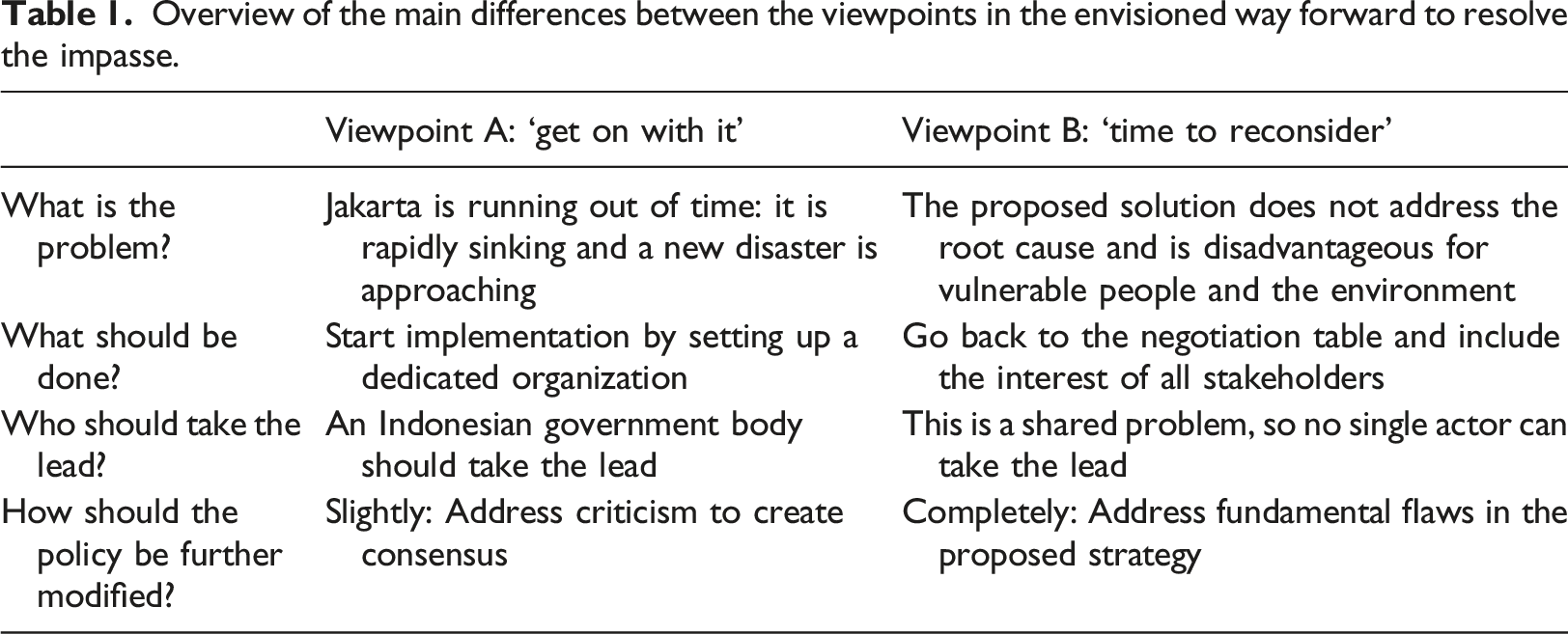
Overview of the main differences between the viewpoints in the envisioned way forward to resolve the impasse.
The participants to this study (i.e. the P-set).

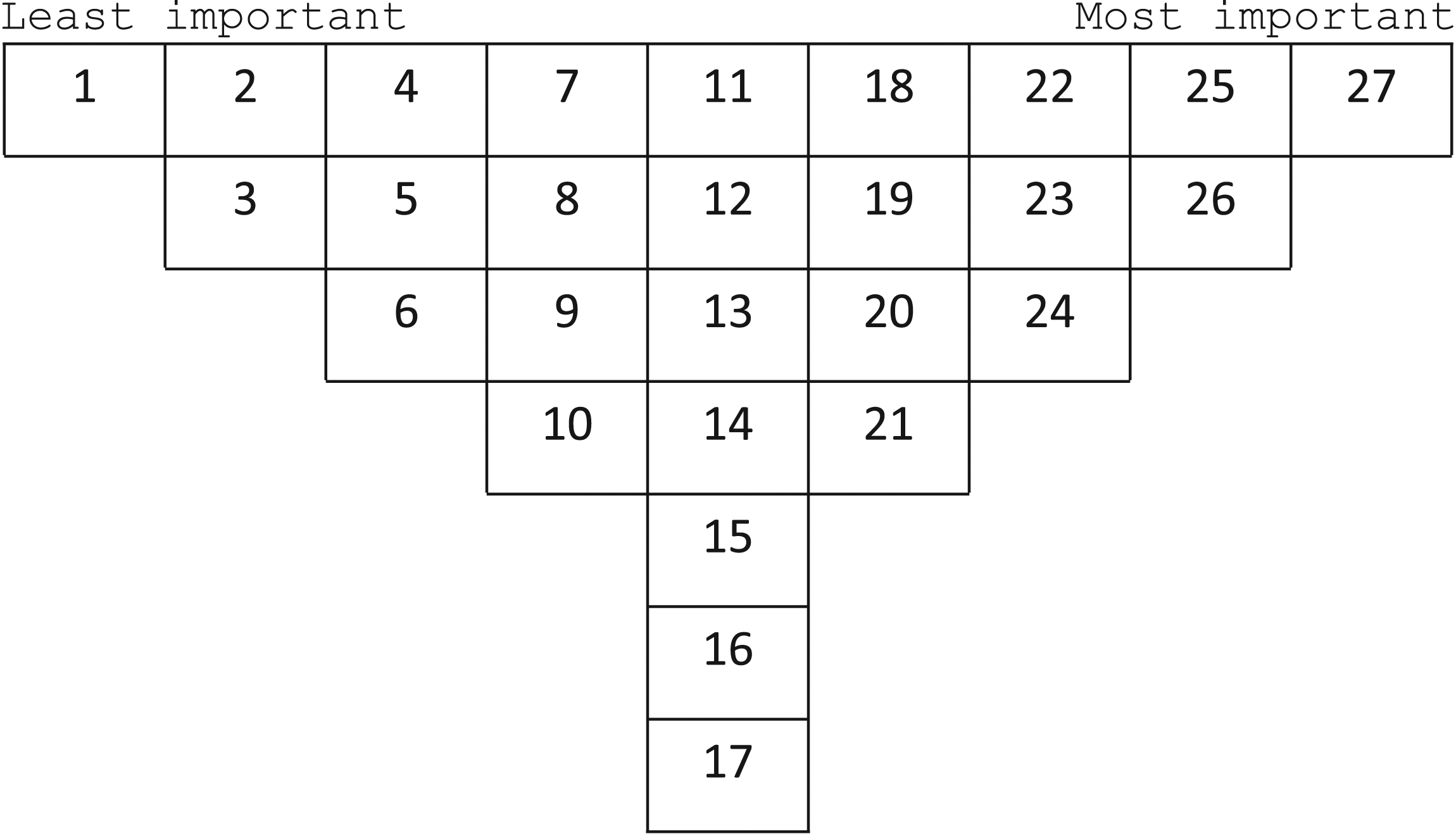
Fixed distribution format for the statements of the Q-set. The numbers 1–27 in this figure have no meaning, other than illustrating the number of statements per column and in total.
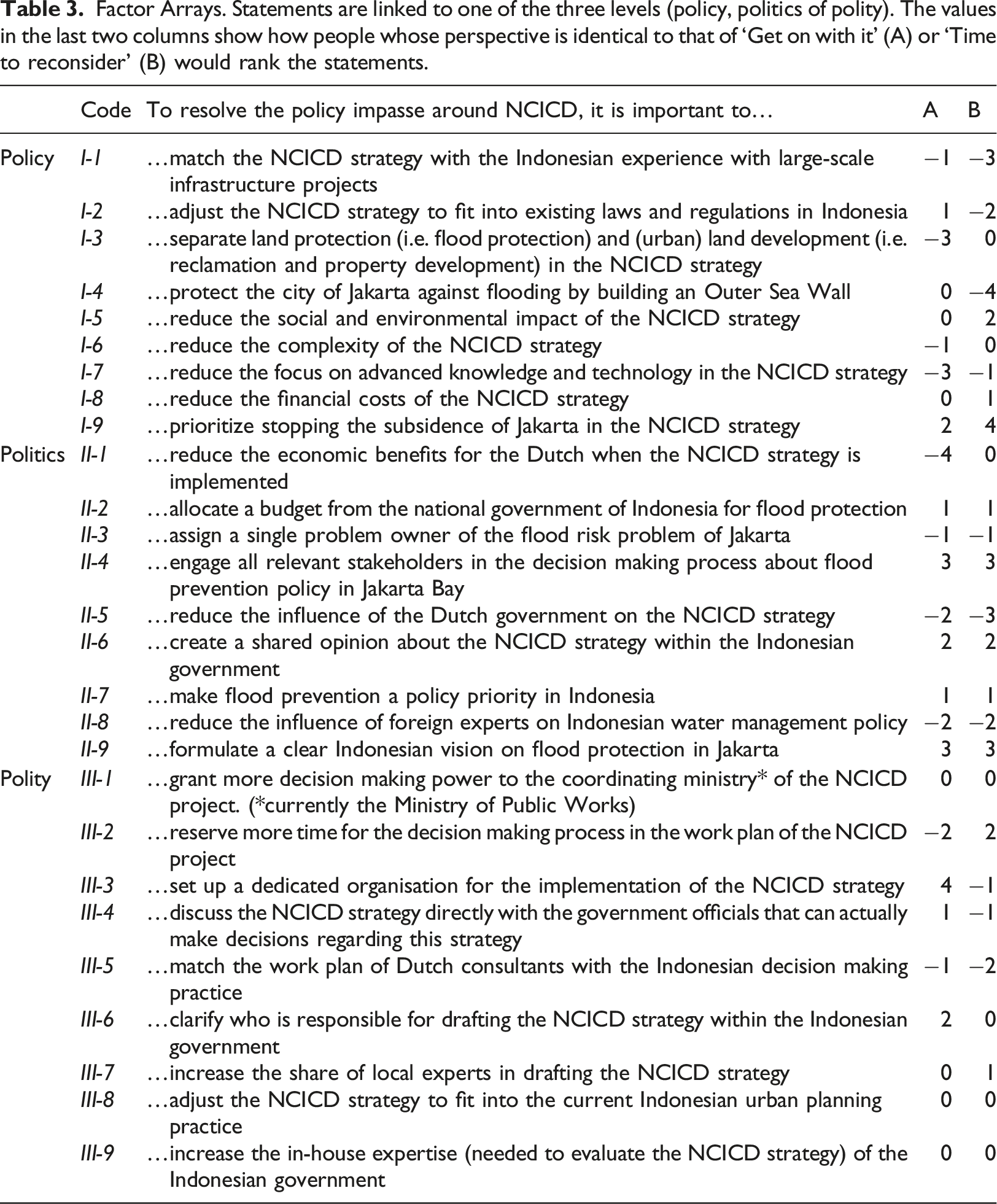
Factor Arrays. Statements are linked to one of the three levels (policy, politics of polity). The values in the last two columns show how people whose perspective is identical to that of ‘Get on with it’ (A) or ‘Time to reconsider’ (B) would rank the statements.
Results
In this results will first present the quantitative results of the factor analysis, before placing the perspectives in the broader context of the case.
Quantitative results
The quantitative results of a Q methodological study consist of the ‘factor arrays’ explained (see Table 1). Respectively 19 and seven people have a significant loading on the first (factor A) or second factor (factor B). Respondent 27 is significantly loading on both factor A and B. Together these two viewpoints explain 43% of the variance. The factors (and thus viewpoints) have a correlation of 0.3799, hence they are non-significantly correlated.
Individual statements
Some statements were similarly ranked by a vast majority of participants. Respondents agreed that foreign expertise is relevant and that Dutch and other (e.g. Korean, Japanese) foreign experts as well as the Dutch government should remain involved (see Figure 2). This suggests that they see merit in the transfer of the Dutch ideas. In addition, participants consistently ranked statements regarding the focus of the proposed strategy. All-but-one participant found it important to include land subsidence as a priority in the proposed strategy, thereby acknowledging that this aspect was insufficiently addressed in the current proposed strategy. Finally, all respondents point to the need for political leadership to resolve the impasse. They express the need for a clear vision on the flooding issue (II-6) that is broadly supported within the Indonesian government. Hence, respondents agree on using foreign knowledge and on the importance of political leadership and policies that address the root cause. This is an interesting finding, as it suggests that transfer of the DDA itself is not contested. What is controversial is the current translation of DDA. Overview of statements that virtually all participants ranked as more or less important (top row) or unimportant (bottom row).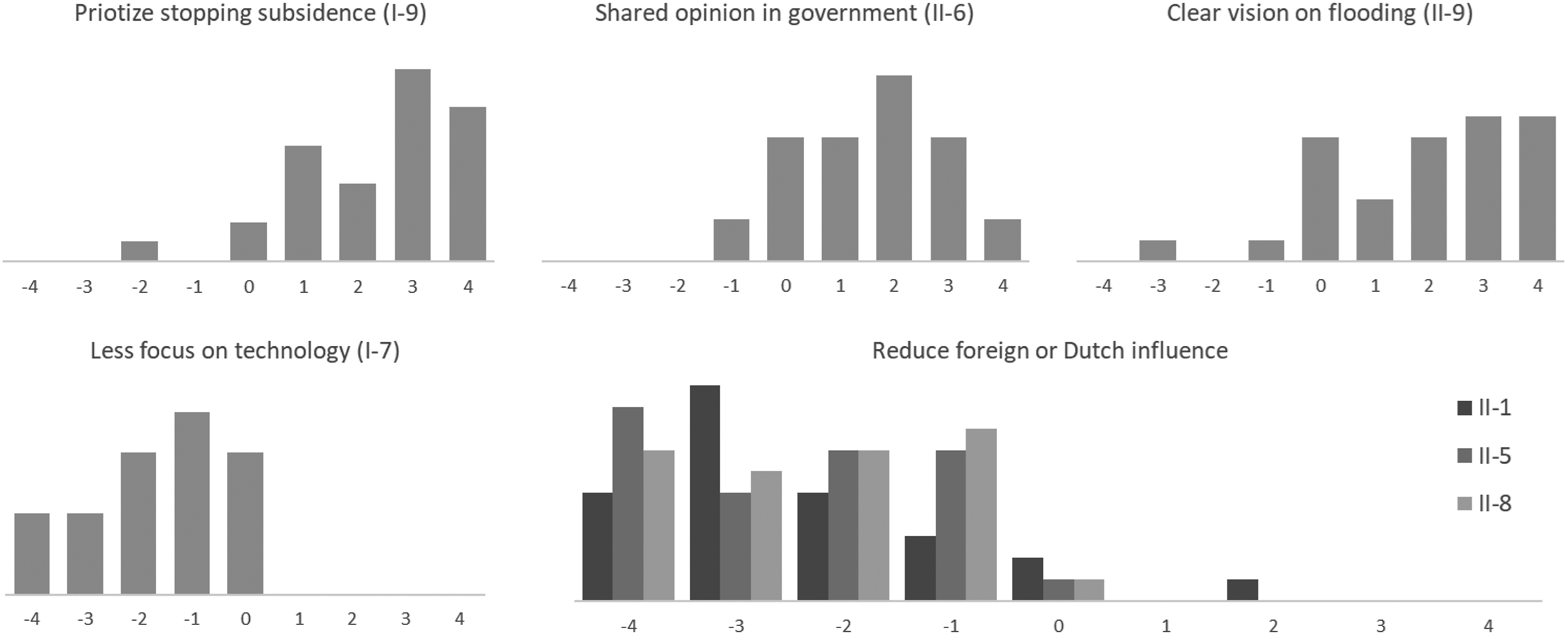
In addition, most participants (including five Dutch and Indonesians working for the consortium or the Dutch government) questioned the desirability and feasibility of a large off-shore dam. The interviews revealed two main reasons for this discrepancy. The first reason is that the sea wall as a “plan B” remains on the agenda as long as there is no plan A to address the root cause. An Indonesian member of the NCICD consortium explains this through a metaphor: “The reason that there is no action, is because we are like a frog in boiling water”. According to respondents, a ‘slow disaster’ is taking place, where there is no immediate threat, but rather an increasing risk. The constructing of a sea wall is seen as a last resort when this approaching disaster cannot be averted. Secondly, the Dutch consortium is hired by the Dutch government to design the Outer Sea Wall with strict Terms of Reference. This means that the transfer agents cannot adjust the project without re-negotiating with their clients, the Indonesian government as end user and the Dutch government who hired the consortium.
Two different viewpoints
The existence of two distinct viewpoints highlight that there is disagreement too among the transfer agents in Jakarta. The first viewpoint is that of ‘get on with it’ and the second has been named ‘time to reconsider’, see also Table 1. The two identified strategic pathways advocate two opposite directions of iterating the solution versus moving on the implementation. These viewpoints are presented here using of the three levels of the theoretical framework (policy, politics and polity).
Policy
People with viewpoint A wish to maintain the basics of the existing strategy and consider it sufficient to add some elements to accommodate criticisms related to the root cause of flooding (subsidence) and social-environmental impact. They believe that the NCICD strategy is acceptable, as everything that is necessary to address the (flooding) issue should be done. This includes issuing new regulation to enable implementation of NCICD. “If we follow regulations, disaster will come!” laughs an Indonesian scientist, “because sometimes our regulations are a mess.” states another Indonesian expert, meaning that regulations are inconsistent.
Where viewpoint A is looking for ways to get the proposed strategy accepted and implemented, viewpoint B envisions a complete revision of the proposed strategy. “The doubt is whether the sea wall is the perfect solution of this flooding and land subsidence. The issue is like it is not, the issue is not the Giant Sea Wall, but the land subsidence is really big, very high. That’s the problem of Jakarta. So I think here applies the precautionary principle, for this project.” states a civil society representative. Viewpoint B is thereby proposing an extra iteration of the translation process, in which the idea of an offshore dam should be abandoned. They argue that instead an integrated solution that takes into account the environment and all inhabitants of Jakarta.
Polity
Viewpoint A reflects a ‘get on with it’ mentality, whereby they emphasize the need for Indonesian leadership and a dedicated organization to start implementing. Viewpoint A thereby wishes to adjust existing institutions so that the NCICD-strategy can be implemented before it is too late. “I really mean we need it now. It is been too long I guess.” says a civil servant at DKI. Hence, they call for a champion who should be able to take decisions and for an implementing organization with a large mandate. A quote from a respondent from DKI Jakarta is illustrative for this perspective: “So, most important is that we verify who will be making the decisions and then, to make this decision, we have to engage all stakeholders and probably we have to set up a dedicated organisation that will manage it all.” Such a single responsible body owner however contrasts with the existing decision-making culture of Indonesia, which is based on reaching political consensus (Blomkamp et al., 2017).
Viewpoint B on the other hand wishes to adhere to these decision-making practices and institutional characteristics. A Dutch expert explains: “NCICD is there, in my opinion, to support the Indonesian government, so you should let the Indonesian government and Indonesian context guide you”. They argue that making one government body responsible and setting up a separate implementing organization is not suitable for Indonesia. “[I don’t like it] because it bypasses the idea of decentralisation. At the same time, we already tried decentralization for almost 20 years, but it makes work harder.” (Indonesian NGO) 2 Instead, they emphasize taking more time to follow the decision-making process.
Politics
Both viewpoints see merit in more pronounced leadership of the Indonesian government, but how they envision this leadership differs. Viewpoint A beliefs that more power to the Ministry of Public Works will not solve the impasse, because it is politically infeasible that one ministry decides. Instead they call for a champion with a multi-sectoral decision-making mandate. Involving more stakeholders will not be necessary, as all relevant state actors are already involved.
Viewpoint B on the other hand beliefs that “[t]hese stakeholders not only include state actors or NGOs, but in fact all people living in the affected area.” (Indonesian national level civil servant), as well as “representatives of civil society and universities” adds a Dutch self-employed policy entrepreneur.
Interestingly, potential economic benefit for the Dutch consortium is the only statement where the viewpoints divergence. The Dutch government actively funds instances of policy transfer, in order to help countries improve their water management but also to create business opportunities for Dutch companies. The government itself identified a potential friction between the two objectives of development aid and trade interests (Minister of Foreign Trade and Development Cooperation, 2013) and this study shows how this friction may affect the acceptance of transferred ideas. This objective of creating economic opportunities for the Dutch may create an impression of conflict of interests. Viewpoint A does not see this as a hindrance to the process. “Why is the Garuda designed? So the Dutch can create business for their dredging companies? Of course not. First comes the long-term flooding risk, that’s why we are here. But if that also means Dutch companies can benefit, then I say: why not?“ says a Dutch consultant. In contrast, viewpoint B warns for potential conflicts of interests as the Dutch are walking a thin line with these two objectives. Whether or not this is actually happening, solely the suggestion that the translation of ideas serves the interests of the Netherlands’ water sector (instead of creating the best possible solution for Jakarta) may affect acceptance of these ideas.
Discussion and conclusion
This study set out to further the conceptualization of policy translation, by examining how actors respond to stagnation in the process. It explored which strategies are deployed by transfer agents to resolve the impasse following transfer of Dutch flood management to Jakarta. To this end, Q-methodology was combined with in-depth interviews to move from individual views on the transfer process, via patterns in these perceptions to explanations of prolonged stagnation in policy transfer processes. The Q-methodological study revealed two distinct viewpoints about how to resolve the impasse in Jakarta from the perspective of the involved individuals themselves. This is a novelty as policy transfer studies usually focus on motivations and interests of actor groups (see e.g. Stone, 2016) and policy mobility has previously concentrated on the role of global consultants (Colven, 2020). The paper also contributes to the academic debate on NCICD. Where previous contributions focused on shortcomings of the proposed plan, explained how the present situation emerged or place the case in a broader historical perspective, this study explores potential solutions out of the impasse in Jakarta.
Can the resolve the impasse in Jakarta be resolved?
The results identified two perspectives that differ on who should lead the translation process, in what direction and by which rules the Dutch ideas should be translated. Viewpoint A (‘Get on with it’) considers current translation of the Dutch ideas sufficient and emphasises the need to start implementation. Viewpoint B (‘Time to reconsider’) proposes an extra iteration of the translation process, to improve the existing translation. In fact, these two viewpoints represent two different strategic pathways to resolve the impasse. As long as there is no consensus within the community of senders, convincing others to accept their ideas will be challenging (Rusu and Loblova, 2019). These viewpoints further highlight the friction caused by questions of power and politicization in NCICD.
The viewpoints show how actors would like to move out of the impasse, thereby emphasising the role of agency (i.e. the influence that actors have) compared to the institutional structure in which transfer takes place. However, the translation process takes place in a certain context of institutional and historical path dependencies and political debates (Hornidge et al., 2020). The Dutch government is exercising soft power by financing planning projects to introduce Dutch expertise in order to increase the market share of the Dutch water sector internationally (Minkman et al., 2019). They continued to stimulate the Indonesian government to adopt NCICD as it is, even when the plans already met resistance in Jakarta. This could be interpreted as an attempt by the former coloniser to keep exercising power in Indonesia, which may explain the fierce rejection of economic benefits for the Dutch consortium by some (Indonesian) respondents.
A key aspect of the DDA is the ‘depoliticization’ of water management issues and actors (attempted to) depoliticise the flooding question in Jakarta too (see Octavianti and Charles, 2019a). In this study, viewpoint A comes close to such a technocratic perspective in which rationality and science determine which solutions are most suitable. The pathway envisioned by viewpoint A entails adjusting political objectives as well as established norms, practices and other institutions to accommodate NCICD as an objectively created solution. This strategy may have seemed viable at first in a city captured in a technical lock-in in flood management (Octavianti and Charles (2019b) and with a tendency towards big infrastructure (Colven, 2017). The proposed plan is not politically neutral, as it favoured waterfront development over other interests (i.e. social and environmental). The political void was then filled by opponents of the strategy mostly.
The above suggest that the strategy envisioned in viewpoint A is a dead end. The strategy trickles down to defending an unrealistic plan with an unrealistic strategy of adjusting the context to the plan, without sensitivity to the political aspects of flood risk management in Jakarta. Viewpoint B might have better chances at resolving the impasse towards (partial) adoption of the plan, although one may wonder whether the window of opportunity in which this strategy could have worked has closed already.
Theoretical contributions
Apart from these findings, three theoretical conclusions can be drawn. First, I conclude that a lack of political vision for the translation process in Jakarta not only caused the impasse, but also prevents the creation of a strategic pathway out of the impasse. As the support for statement II-9 (see 4.1.1) showed, participants of this study call for a clear, Indonesian vision on flood protection. The translation process is undirected without an articulated political ambition or vision to connect to. The call for a political vision in Indonesia shows that these transfer agents (mainly bureaucrats and consultants) are well aware of their sphere of influence and thus they stay out of the political arena. A related issue concerns a lack of political leadership. Politicians are reluctant to take a decision and allow the impasse to continue. This also raises the question whether the transfer process aimed at the right policy level, i.e. whether those with actual decision-making power are involved in the transfer. Respondents further indicated that controversial decisions (e.g. concerning NCICD) are postponed until after the upcoming Indonesian national elections. Building on the notion that political support is essential for adoption of transferred ideas (Sabatier and Weible, 2007; Stone, 2016), this study adds domestic political vision that can direct the translation process as a condition for effective translation.
The second conclusion relates to the challenges of ‘outsourcing’ policy transfer. Transfer literature has extensively described transfers between state actors (Benson and Jordan, 2011; Stone, 2012). However, the Dutch government outsourced the actual transfer and translation to consultants via strict terms of reference. This study shows that these consultants and their counterparts feel that the root cause of land subsidence should be incorporated in the strategy, but Dutch consortium members who are willing to reconsider the Sea Wall lack the mandate to change the project’s scope from large-scale infrastructure to addressing land subsidence. As a consequence, the transfer agents involved in this case continued to advocate an idea that they themselves consider a Plan B at best. While transfer from the Netherlands to Indonesia was voluntary, there seems to be a certain degree of coercion for these transfer agents. This finding is particularly interesting, given the growing role of private sector consultants in (urban) planning (Stapper et al., 2020). In this case, ‘outsourcing’ of the transfer process resulted in insufficient translation and limited room to question earlier assumptions or proposed solutions and to incorporate new insights.
A third and related conclusion is that traditional distinctions between actor groups are thus not decisive in explaining different problem or solution perceptions. The importance of both senders and receivers in policy translation was established before (Stone, 2016), as well as including domestic actors such as other government bodies, civil society and local experts in early phases (e.g. Hoyt, 2006). This study adds another option to this, whereby transfer is not only constrained by opposing views between ‘senders’ and ‘receivers’ but diverges within these supposed entities. This study found that individuals within the sender or receiver actor groups not necessarily share the same perspective. As Colven (2020) already showed, the Indonesian government cannot be considered one entity, but neither is the consortium an entity as even individuals working for the same company may have a different personal perspective. This finding suggests that policy translation is not shaped by ‘senders’ or receivers’, but by individuals. Future analysis should thus take into account that these entities referred to as ‘actors’ consist of individuals who modify policy ideas and interact with each other in multiple ways next to linear sender-receiver exchange of information.
As the above finding was not foreseen beforehand, I doubt whether this would have been revealed using traditional qualitative or quantitative methods. Q-methodology thus proved essential in revealing the diversity of thinking within actor groups, as it revealed subjective patterns of individuals regardless of their role. I therefore propose to add Q methodology to the methodological toolbox of constructivist approaches to study travelling policy. Overall, this study demonstrates that transfer agents envision different strategic pathways to be suitable to resolve stagnation in policy transfer and how these perspectives cut through existing sender-receiver divides. This study therewith adds to our understanding of how actors translate policy and provides an important micro-level explanation for the emergence and persistence of impasses in policy transfer. Although this provides a partial answer to the question posed by Mukhtarov (2017) of which constraints to policy translation exist in practice, one should connect these micro-level translation dynamics to politics at national and bilateral levels for a full explanation (Evans and Davies, 1999; Mukhtarov, 2014). Future research may build on this study by exploring how transfer agents’ individual subjectivity affects policy translation in general, especially in the case of an outsourced transfer. Effective policy translation seems to be hindered by a double agenda at the sides of sending actors and thus a double loyalty of consultants that operate on their behalf. Translation requires independence and room to anticipate on the local context. Combined with a lack of political vision and leadership at the receiving side, transfer agents turn to well-intended improvisation, causing the translation to be insufficient for policy adoption and thus for impasses to persist.
Supplemental Material
Supplemental material - Resolving impasses in policy translation: Shall we adjust the idea or the process?
Supplemental Material for Resolving impasses in policy translation: Shall we adjust the idea or the process? by Ellen Minkman in EPC: Politics and Space
Footnotes
Acknowledgements
I would like to thank the participants of this study and my colleagues at Erasmus University Rotterdam for their input and feedback. In particular, Alex López Alberola who cross-checked the raw Q-set with the list of quotes, dr. Astrid Molenveld for her methodological advice on Q-methodology and prof. Dr. Arwin van Buuren and prof. Dr. Victor Bekkers for their guidance. I am also grateful to Peter Letitre and Gerald Jan Ellen of Deltares for reviewing the content and context of the statements. Finally, special thanks to Anton Sanjaya and Ario Wicaksono for translating the statements into Bahasa Indonesia.
Declaration of conflicting interests
The author(s) declared no potential conflicts of interest with respect to the research, authorship, and/or publication of this article.
Funding
The author(s) disclosed receipt of the following financial support for the research, authorship, and/or publication of this article: This work was supported by the Deltares [research project contribution, no grant number available] and the Institute for Housing and Urban Development Studies (IHS) [PhD project grant, no grant number available].

Supplemental Material
Supplemental material for this article is available online.
Notes
References
Supplementary Material
Please find the following supplemental material available below.
For Open Access articles published under a Creative Commons License, all supplemental material carries the same license as the article it is associated with.
For non-Open Access articles published, all supplemental material carries a non-exclusive license, and permission requests for re-use of supplemental material or any part of supplemental material shall be sent directly to the copyright owner as specified in the copyright notice associated with the article.
